
CHAPTER 12
By the Cover of Darkness
To strike [our flag] to any foe was mortifying, but to yield to an uncivilized, barbarous enemy, who were objects of contempt was humiliating.
—Captain William Bainbridge, USS Philadelphia
Commodore Preble knew nothing of the USS Philadelphia’s fate when, in mid-November, he delivered Tobias Lear, along with Lear’s wife and their baggage, to the consul general’s new post at Algiers.
On going ashore, Preble found the city a welcoming place. Richard O’Brien was still in residence, and would remain so until spring to ease Colonel Lear’s adjustment to his new situation. Though the dey was absent at his country seat, O’Brien gave the new arrivals the tour.
In Algiers, Preble viewed the ruler’s orchards, stables, granaries, and dockyards. The visitors took a turn through the palace gardens, which Preble thought so well tended that they had “the effect of enchantment.” It was a most agreeable day, he wrote Mary back in Maine. He concluded that Algiers was “an enviable situation.” Being a cautious man, he also acknowledged that “the caprice of the tyrant who governs makes it a dangerous residence.”1
The next day the USS Constitution weighed anchor. Ready to resume the rigors of navy life, preparing to tend once again to his assigned task, Preble ordered the ship’s course set for Tripoli to join Bainbridge.
The USS Constitution was nearing the Sardinian coast when, on November 24, a midsize ship flying the Union Jack was sighted. Once within hailing range, the foreign frigate identified herself as the HMS Amazon. Its British captain gave Preble the distressing news of the loss of thePhiladelphia.
The commodore pushed the passing pleasures of his day in Algiers from his mind. All in a moment, the successful settlement at Morocco seemed long ago and far away. In its place loomed the knowledge that his hope to subdue Tripoli by spring had ground to a halt on that sandbar.
It pained him that Bainbridge and the 306 men in his command were captives. Preble knew, even in the absence of fresh orders from America, which could not arrive for months, that the freedom of the men aboard the Philadelphia must be obtained. Having nearly died during his incarceration aboard the British prison ship Jersey, he understood the terrors and trials of imprisonment. And he knew full well these events put the honor of the United States very much at stake.
Then the news got worse. Making straight for Malta, Preble found letters awaiting him from Captain Bainbridge. Not only had the Philadelphia been lost to the U.S. Navy but now it was a free-floating Tripolitan warship whose guns could be turned on the Americans. Even as Preble read the dispatches, the mighty frigate was being refitted under the watchful eye of the bashaw. Divers had recovered much of the weaponry that had been thrown overboard onto the shallow reef. Armed with her rescued weapons, the Philadelphia was the most powerful ship by far in any of the Barbary fleets.
The commodore promptly wrote to Washington, asking Congress for more frigates. Just a few weeks before, he held a winning hand when his four-of-a-kind frigates awed the sultan of Morocco. Since then three of them—the USS New York, USS Adams, and the USS John Adams—had sailed home for the States, part of the annual ebb and flow of men and ships. Confident in America’s powerlessness, the Tripolitan leader would surely demand a king’s ransom for the U.S. Navy mariners.
“This affair distresses me beyond description,” he confided in the secretary of the navy. Preble also admitted new worries about the solo Constitution—“should any accident happen to this ship,” he fretted, “the consequences may be dreadful to our commerce in these Seas.” With his reduced fleet, he could no longer play the enforcer. At best, he could harass.
While the odds had shifted, Preble could not permit his adversaries to gain the upper hand. He recognized that the Philadelphia was the key piece—she must be removed from the game. Two young officers in Preble’s command, the dashing young Philadelphian Lieutenant Stephen Decatur and his friend Lieutenant Charles Stewart, had already volunteered to sail into Tripoli and set her afire. But Preble told them that such a mission “was too hazardous to be effected in that way.”2 Left unspoken was that he could hardly afford to lose another ship if they were captured.
Preble did promise the eager Decatur that he might lead the mission once they had a plan. And the more Preble thought about it, the more he realized that any plan would be dangerous—but it was worth the risk. Writing to the secretary of the navy, he promised bluntly, “I shall hazard much to destroy her.” He acknowledged that it might mean a loss of life. He didn’t yet know how his small armada would do the job—but his mind was made up.
“It must be done,” he wrote.3
But first they had to prepare a plan.
THE CAPTURE
On December 23, 1803, roughly two months after Bainbridge’s capture, Preble’s Constitution and the Enterprise sailed in tandem. The two ships made a fine team, with the Enterprise sailing along the Barbary Coast exchanging signals with the Constitution, which remained in deeper waters.
Preble was determined to maintain the Tripoli blockade even as he mourned the loss of the Philadelphia, but the rigors of winter weather had made keeping up the blockade difficult. During a two-week stormy span, the Americans harbored at the Sicilian port of Syracuse, a break that permitted the installation of new rigging on the Enterprise and new sails on the Constitution. During that time, the pirates at Tripoli had been free to come and go, but now the Americans were back and ready to fight.
At half past eight on the morning of December 23, nine miles east of Tripoli, the lookout at the masthead of the Constitution hailed the men on deck. He had spied two masts on the horizon. Preble signaled the Enterprise to pursue the ship they spotted. The Constitution would follow.
Young Stephen Decatur commanded the schooner Enterprise. Like many of his fellow sailors, he found parading the fleet and blockading ports to be dull work. After all, when a blockade worked properly, nothing happened because ships stayed in port. By nature, he favored more adventure. In his first two tours of duty in the Mediterranean, he had confronted no enemy in battle, and the ineffectiveness of Commodore Morris’s time left Decatur itching for the chance to show his mettle. He had hopes for his chances under the determined Preble.
Now in pursuit of the unidentified ship, the Enterprise sailed beneath the Union Jack, hoping to keep her American identity a secret. Within the hour, the crew of Decatur’s ship saw that their target flew Tripolitan colors. A shift in the wind permitted the Enterprise to gain on the boat, which was suddenly dead in the water. By ten o’clock, the Tripolitan captain, thinking he had nothing to fear from the Royal Navy, stood on deck with some twenty of his men, waiting to greet the approaching ship.
When the two American ships abruptly lowered the Union Jack and raised the Stars and Stripes, there was a flurry of confused activity aboard the Tripolitan vessel. However, as his ship was outgunned by the Enterprise, more than twice its size, the master of the little trader had no choice but to submit.
A U.S. Navy officer sent aboard the Tripolitan ship was told, through a translator, that the master was a Turk, his destination Constantinople. According to the captain, the vessel, called the Mastico, was only a small trading vessel of Ottoman registry, sailing the coast and making stops in Tripoli and Benghazi. The crew of eleven Greeks and Turks was in keeping with his claim. But the assortment of passengers seemed odd to the Americans. In addition to forty-two African slaves, there were two Tripolitan officers leading ten soldiers. The ship also had two cannons mounted on its deck and, doubly odd for a merchant, two more stowed below, along with a cache of muskets and pistols.
The Mastico carried no passport in English, and none of the Americans could read her papers, which were written in Arabic and Turkish. But one of the Constitution’s medical officers spotted a hole in the captain’s story: A few weeks before, Preble had hired Dr. Pietro Francisco Corcillo to be his surgeon’s mate, and Corcillo brought more than medical knowledge to the commodore’s fleet. Having been the bashaw’s personal physician, he knew Tripoli and its people well. When he got a look at the crew aboard the trader, Corcillo recognized its captain and its officers. This was no innocent trader, he told Preble. This ship had taken part in the capture of the Philadelphia.4
A thorough search of the small ship—it didn’t take long, as the vessel was just sixty feet long, twelve wide—proved him right. An American sailor found a sword hidden aboard the Mastico, one that belonged to a lieutenant on the Philadelphia. It was proof enough to Preble that her men had been among those who plundered the American frigate.
That made the Mastico a prize of war, and Preble ordered a crew to go aboard the vessel. They were to sail her to Syracuse where, in February, an admiralty court would condemn the ship, and officially award her to the United States.
By then, however, she had already been given a new name, a new master, and orders to return to Tripoli harbor.
A SPY WITHIN
Preble had been busily gathering intelligence on the workings of Tripoli, but the best information came from William Bainbridge. Under house arrest in Tripoli, Bainbridge could see with his own eyes—and a spyglass provided by Consul Nissen—what happened in the harbor. He also had a means of communicating with the Americans; the bashaw permitted him to send letters, believing that a captive was his own best advocate for securing ransom payments. But because his captors read his letters before sending them, Bainbridge couldn’t simply report on the results of his reconnaissance. At least not in the usual way.
Determined to be of service even during his imprisonment, Bainbridge found clandestine means by which to impart information that might be of military use. At first, he employed a cypher, coding his communications. When the bashaw started to suspect the code, Bainbridge resorted to “sympathetic ink,” a dilute mix of lime or lemon juice. Using that method, invisible messages written between visible lines on a page emerged as a readable brown when held to a flame. Writing in letters and in books borrowed from the ever-helpful Consul Nissen, William Bainbridge helped Preble lay the groundwork for a secret scheme.5
Since his capture, Bainbridge had reported on the business of the harbor, including the coming and going of the cruisers. He listed the ships launched and in the works. He counted the guns in the “Marine force of this Regency (as near as I can learn).”6 Most valuable of all, he kept his commanding officer informed of the bashaw’s plans regarding the Philadelphia.
By early December, the ship’s cannons had been restored to her decks. She remained moored in the harbor, where her presence was a painful reminder to Bainbridge of that awful October day. But her presence also got him thinking.
His notion, he wrote to Preble on December 5, was to destroy her using powder and shot. Bainbridge thought the job might be done by a “Merchant Vessel . . . [sent] into the Harbour, with the men secreted and steering directly on board the Frigate.” The mission faced little danger from Tripolitan artillery, as many of the gunboats in the harbor had been hauled up onto the beach for the winter and, as far as he could tell, only four shore guns pointed at the Philadelphia. He was certain the Tripolitans could be taken completely by surprise.
The captain offered his plan humbly. After all, he was the one whose honor was at stake in the Philadelphia’s capture, not Preble. “I beg that you not consider me too officious,” he wrote to Preble, “in giving my ideas on a conjectural practicability.”
When he read Bainbridge’s letter, Preble realized that solving the Philadelphia problem might not be a suicide mission after all. If he put together his best thinking, along with Decatur’s daring and Bainbridge’s reconnaissance, there just might be a solution. Perhaps Preble already had on hand the right ingredients: a mix of luck—he already had a “Merchant Vessel,” the Mastico—and pluck of the sort that the eager Lieutenant Decatur seemed to possess in abundance.
THE HAMET OPTION
Preble was also developing a larger secret strategy. With Jefferson’s and Madison’s authorization, Consul Eaton and others had continued talking to Sidi Hamet Qaramanli, brother of Yusuf. He still wanted his rightful place on the throne as bashaw of Tripoli, but to get it he needed American help. When letters from Hamet’s agents reached Preble, he arranged to meet the men in Malta.
Hamet had traveled to Alexandria, Egypt, they told Preble, and was still very much in exile. But he had a plan, too, and he also had followers. Hamet would assemble a large army of Arabs. If the Americans could help underwrite the venture and provide some naval support, this force might march overland from Egypt to Derne, a provincial capital in eastern Tripoli. With the help of American firepower from the sea, Hamet and Eaton believed, Tripoli could be taken back.
Hamet also had a promise for the Americans, one that Preble knew would please his superiors. If the Americans aided him with money and military equipment in his quest, Hamet, once restored to his rightful place as bashaw, would release all Christian slaves and captives, including the 307 men who had been aboard the Philadelphia. He would also agree to a permanent peace with the United States. Furthermore, he would allow the U.S. Navy to make Tripoli its permanent base and to garrison the main fort.
Though he could make no commitment without approval from Washington, Preble applauded the plan—and he immediately wrote to the secretary of the navy saying so. “Though destitute of Money, Powder, [and] Field Artillery . . . he thinks our assistance by sea would put him in possession of Tripoly; and I am very certain that it would in less than two Months.”7 He encouraged Hamet’s representatives, telling them something of his thinking about an assault on Tripoli once his squadron regained the ships and firepower required.
While the two sides left their meetings with optimism about what would be done in the spring and summer, Preble’s concerns were more immediate. He had told Hamet’s agents nothing of the plan for the Philadelphia. Even a hint of that plan, if it was to be overheard in the wrong quarters, could result in a disastrous failure and many lives lost.
During Preble’s January 1804 meetings in Malta, he had another conversation. The Tripolitan ambassador presented him with the bashaw’s demand: $100,000 for the prisoners. There was talk of exchanging the Philadelphia for a schooner—the Tripolitans admitted they didn’t have the skilled sailors to sail the big frigate, despite the presence of High Admiral Murat Rais, the renegade Scotsman. But Preble was in no hurry to make a deal. For one thing, he lacked the required funds; for another, he hoped the ransom would not be necessary.
A DANGEROUS MISSION
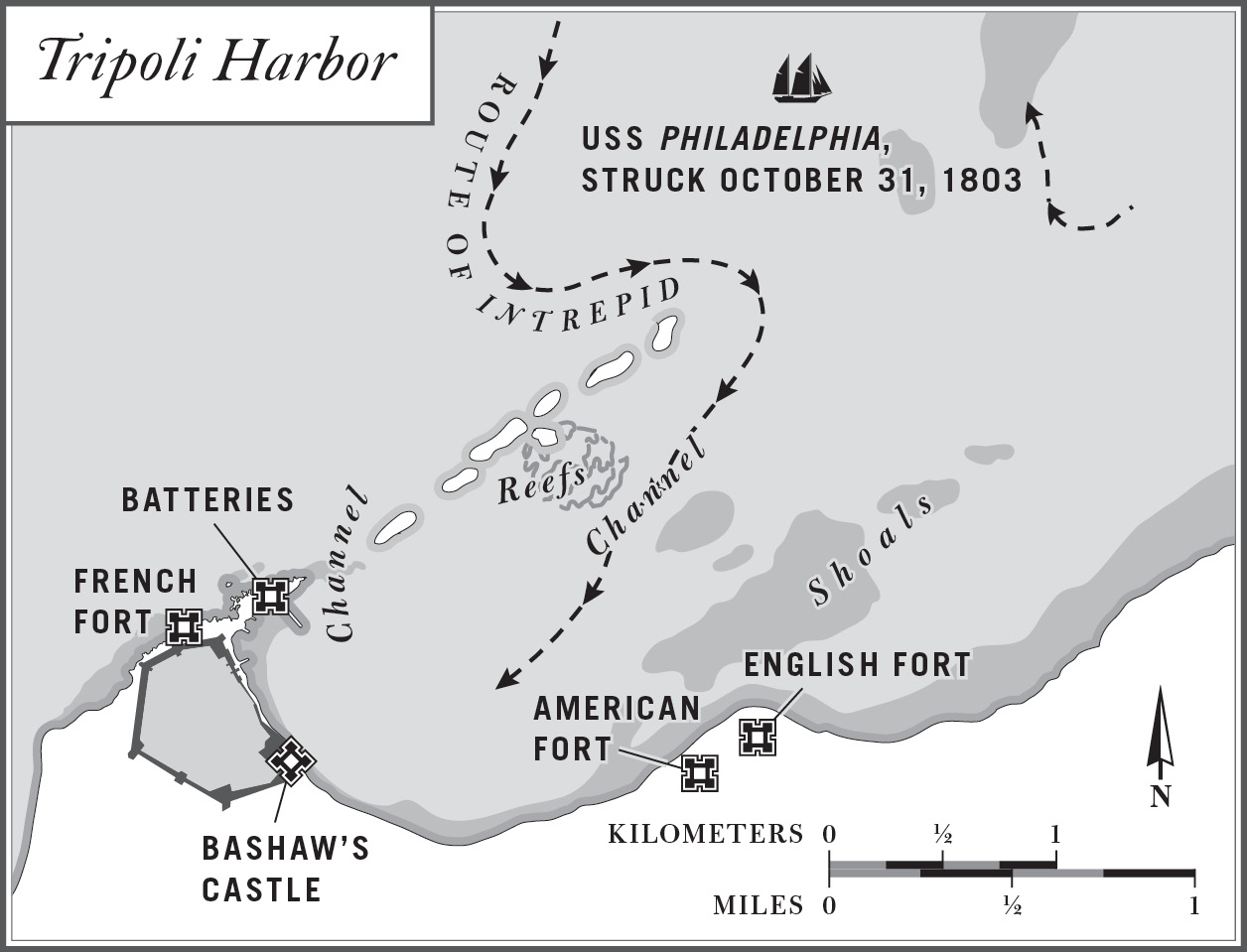
The orders made the operation sound simple. “Enter the Harbor in the night,” Preble instructed. “Board the Frigate Philadelphia, burn her and make your retreat good.”8
The recipient of those orders, Lieutenant Stephen Decatur Jr., intended to execute them to the letter, but Mother Nature refused to cooperate. As his little two-ship fleet neared Tripoli harbor on February 7, a big blow from the north drove both U.S. Navy ships many miles east of their destination. Only after the three-day gale finally quieted did a five-day sail bring Decatur’s little Intrepid, along with the USS Syren, back within striking distance of Tripoli harbor.
Crowded conditions prevailed aboard the Intrepid. She was the former Mastico, rechristened and reconfigured as a warship. Designed for a crew of two dozen, the little ship was now manned by seventy-five men. With berths for fewer than a third of those aboard, Decatur shared his small cabin with three other officers and the ship’s surgeon while many men bedded down among the casks in the rat-infested hold. Spoiled food, heavy seas, and the fear that their little ship might founder did nothing for morale. But at last, late in the morning on February 16, the Intrepid was almost at its destination.
The plan called for the Intrepid to run ahead, as it had been rerigged with short masts and triangular sails, mimicking the look of local ships; its appearance should raise no alarms. The USS Syren would trail five miles behind. The planners of the mission—Preble and Decatur (with guidance from Bainbridge)—had ordered that the look of the military brig be altered, too, so the Syren had a fresh coat of paint. Her topgallant masts had been removed and her gun ports closed.
As dark approached, the Intrepid was to anchor at the mouth of the harbor, east of the town. Then, after the arrival of the Syren, the Intrepid and the boats from the Syren would make for the Philadelphia under the cover of night. The lieutenants and midshipmen would then lead teams of sailors aboard the frigate to set her afire. They would destroy the ship, boosting American morale and snatching the advantage from their enemies. It would be a master stroke—if it worked.
Almost immediately, the plan went awry. Decatur realized that the easy sail into Tripoli was too easy: the Intrepid, normally a slow sailer, was making good speed and ran the risk of arriving in daylight. Not daring to shorten the sails—a wary sentinel might be suspicious of a merchant slowing his progress—Decatur ordered his men to toss overboard a drag line rigged with ladders, spars, buckets, and lumber in hopes that the resistance of all of the debris would slow the ship down.
After a scramble of activity to get the drag line overboard, there were a few tense minutes of waiting. Then the sailors breathed a sigh of relief as the ship slowed while still appearing to be sailing full speed ahead. Their plan had worked, and they could count on the darkness to help avoid discovery.
Decatur ordered most of his crew to remain below. Just six men at a time could walk the deck, and those who did wore the uniform of Maltese merchant sailors, with showy gold braid. The British flag they flew also seemed to fool those onshore. As they came within sight of the English fort at Tripoli, the English colors that waved over the Intrepid were answered by the raising of the Union Jack at the British consulate.
For Decatur, this slow sail into Tripoli was bittersweet. He had asked to head this dangerous expedition and desperately wanted to prove his bravery in battle. His reward for success, he hoped, would be a captaincy in the small U.S. Navy, where only a few gained such a promotion. But his assignment was to destroy a ship built with money raised by the citizens of and handmade by the shipwrights of his home city, for which the frigate was named. And her first captain had been his own father, Stephen Decatur Sr.
At dusk, the wind dropped. As the Intrepid negotiated the narrows at the harbor entrance at seven o’clock, Decatur could see that the Syren had fallen well behind in the diminishing breeze, despite the Intrepid’s intentional slowdown. It was a moment for naval calculus: the plan called for an attack at ten o’clock, and it would take much of the time remaining for Decatur to work his ship over to the Philadelphia. The Syren was well back, and it would not be able to make up the distance in time.
For Decatur, failure was not an option. He remembered Preble’s orders: “I rely with confidence on your Intrepedity & Enterprize.”9 Decatur saw his choice as between aborting the mission and taking the Intrepid in alone.
In the twilight, he had little time to decide. Emboldened by the frustrations of serving under Morris, proud of the trust Preble put in him, Decatur made the call. He told his men they would sail on, despite the absence of the Syren.
One of his midshipmen recorded Decatur’s quiet words: “The fewer the number the greater the honor.”10
• • •
As darkness fell, the light of a crescent moon revealed the Philadelphia in silhouette. She was a heartrending sight to Decatur and his men. Her foremast remained a stump, and her upper yards were laid out on the deck. Stripped of sails, she could go nowhere under her own power. Yet her sheer scale seemed awesome in a harbor where little local boats skimmed the waves. To see the frigate’s guns remounted and to imagine them manned by Tripoli pirates? That was too horrible even to contemplate.
The Intrepid made her way slowly down the channel, an almost imperceptible wind puffing her sails. The castle and shore fortifications seemed to grow taller as the crew covered the distance. Decatur’s little ship was dwarfed as it floated closer to the white walls of the city—and the gun batteries on her ramparts. Any lookout from the city could see them, but he would have no reason to be alarmed by the little ship’s appearance.
As the ten o’clock hour approached, the Intrepid came within hailing distance of the Philadelphia. Decatur’s seventy-man crew, obeying his order of wordless silence, heard the exchange.
A Tripolitan spoke from the tall frigate. In a foreign tongue, he ordered the smaller vessel to keep away.
Though he stood by the helm, Decatur remained silent. In his stead, Salvador Catalano answered. A Sicilian hired by Preble for his knowledge of Barbary harbors, Catalano was fluent in the common tongue of sailors in the southern Mediterranean, a mix of Berber, Arabic, Italian, Spanish, Portuguese, and Maltese.
Catalano called back that his merchant vessel had been stripped of its anchors during the violent storm the preceding week; they sought only a safe place to tether their little ship for the night. He explained that they didn’t want to risk fouling the lines of other ships in the harbor and, in the morning, would secure new anchors ashore.
Another voice from above asked the name of the ship observed offshore in the direction from which the Intrepid had come. Catalano offered a well-rehearsed reply, one he knew the men aboard the Philadelphia wanted to hear. He told his inquisitor the ship they spied was the Transfer. That vessel was a former British warship, recently purchased in Malta by the bashaw, and much awaited in Tripoli to reinforce his navy.
Catalano’s answers satisfied the men aboard the Philadelphia, and the two ships—the little Intrepid and the looming frigate—dispatched boats carrying lines to fasten them to each other. With the cables bound fast, the ships were soon being drawn together.
As the Intrepid neared, a sharp-eyed Tripolitan spotted something amiss. Perhaps the anchors aboard the Intrepid had been seen. Maybe it was the glint of sword worn by one of the dozens of sailors lying in the shadows cast by the bulwarks. Whatever the tell, the game was nearly up.
“Americanos!” came the cry.
Once again Catalano spoke, his manner unruffled. He offered assurances that only Maltese and Englishmen were aboard. With the men aboard the Intrepid continuing to haul the hawsers, the ships were soon alongside.
This time, when the shout “Americanos! Americanos!” rang out again, the warning came too late. As the ships touched, Stephen Decatur issued a simple order, uttered as he himself leapt for the main chains of the Philadelphia to climb the dozen feet to the deck of the taller ship.
The one-word order—“Board!” Decatur yelled—initiated a blur of action.
“The effect was truly electric,” Surgeon’s Mate Lewis Heermann would later write. “Not a man had been seen or heard to breathe a moment before; at the next, the boarders hung on the ship’s side like cluster bees; and, in another instant, every man was on board the frigate.”11
No gunshots echoed. Decatur had decreed that only blades were to be used, because the invaders wanted to attract as little attention as possible to the fight for the Philadelphia, which was moored just a few hundred yards from the fortress guns. Of the thirty or so Tripolitans aboard the ship, roughly a dozen ran for a boat and rowed for safety. Of those who fought the boarding party, one midshipman remembered, “[They] were dreadfully alarmed when they found who we were. Poor fellows! About 20 of them were cut to pieces & the rest jumped overboard.”12
In less than ten minutes, the savage fight was over without having attracted the notice of sentries onshore, and the carefully planned torching of the ship could begin. A team of ten men went below to set fire to the berth deck and forward storeroom. A dozen men went deeper into the ship to the wardroom and steerage, a third squad to the cockpit and storeroom. A fourth team manned the Intrepid’s cutter, patrolling the area in the harbor boat used to ferry passengers and goods, while eight men remained aboard the little ketch.
The fire crews carried three-inch-long candles, with wicks that had been immersed in turpentine to enhance their flammability, and each team had a pair of lanterns. With the Tripolitan defenders subdued, combustibles were swiftly handed up from the Intrepid and taken below. The disciplined operation proceeded at speed and, in a matter of minutes, the men waited at their stations for Decatur’s next command.
Walking the deck from forward to aft, he called his simple order down each hatchway—Fire!—and the men, their candles lit from the lanterns, ignited dozens of conflagrations in every part of the ship.
As the men raced to return to the deck, columns of suffocating smoke rose in columns from the hatches. Flames soon followed as the sailors and officers alike leapt back aboard the Intrepid. Decatur watched as the last of his men climbed down to the deck of the ketch—only one sailor had been wounded, none killed. Decatur himself would be the last man to step off the deck of the Philadelphia—and he did so in dramatic style, leaping into the rigging of the Intrepid.
Back aboard their little ship, the crew attempted to escape the harbor but were momentarily trapped. The flames roaring forth from every gun port on the Philadelphia threatened the cotton sail fluttering from the foremast of the getaway boat. They used swords to cut the rope connecting the two boats, but the smaller ship still refused to sail free. The hungry fire, which seemed to be inhaling every breath of air, drew the Intrepid back. Only after Decatur ordered a crew to man a boat to tow the bow around did the sails fill. Men took hold of the great oars, eight to a side, and stroked until they were in open water.
As the Intrepid made her retreat, harassing fire from Tripolitan cannons and muskets threatened Decatur’s vessel, but the poorly aimed gunfire struck only her upper sails. Much more dangerous than the volleys from shore were the cannons aboard the Philadelphia, which discharged as the fire consumed the gun deck. But even the report of the frigate’s long guns could not drown out the three hearty cheers issuing from the American sailors as they headed out to sea. By then flames had licked up the mastheads and begun consuming the rigging at the tops. The sight of the columns of flame, topped with what appeared to be fiery capitals, made a terrifying yet magnificent sight in the night sky of Tripoli.
• • •
The night of February 16, 1804, would be one that the imprisoned crew of the Philadelphia would never forget.
The tumult in the harbor awakened the city and, in the prison yard, the captives heard the screams of women; the harsh, loud voices of men; and the report of the guns in the harbor. The Americans had expected something as they had recognized the Intrepid and the Syren just out of reach of the harbor the previous afternoon. As the castle guns fired on the departing Intrepid, the prison floors shook, but the sounds of battle represented hope.
As sailor William Ray reported, “In the confusion of voices we could often hear the word American, and therefore hoped that some of our countrymen were landing, to liberate us.”13 Their hope for rescue was not realized, they found the next morning, when they learned of the demise of the Philadelphia. The once proud ship now lay on the rocks, free of her anchors after her cables burned. She was a smoking hulk, reduced to a long row of ribs barely visible at the waterline. The frigate would never put to sea as a pirate ship.
The burning of the American ship was a victory for the American navy but a blow for the captives. Just the day before the bashaw, anticipating that his terms of a prisoner exchange would be accepted, had sent two barrels of pork and beef to the men in the bagnio. Now, with the burning of the Philadelphia, all goodwill evaporated just as quickly as it had appeared. The jail keepers, Ray reported, “like so many fiends from the infernal regions, rushed in among us and began to beat everyone they could see, spitting in our faces, and hissing like the serpents of hell. . . . [E]very boy we met in the streets, would spit on us and pelt us with stones; our tasks doubled, our bread withheld, and every driver exercised cruelties tenfold more rigid and intolerable than before.”14
Unaware of the suffering of their compatriots, Decatur and his men were well on their way to safety, and a two-day sail brought them within range of Syracuse harbor. The sight of the Intrepid and the Syren was a great relief to Commodore Preble; he had wondered at the seaworthiness of the little ship a week before when the violent storm had buffeted his ships at anchor. Both ships could have gone down, yet here they were.
Signal flags were quickly hoisted. The USS Constitution signaled: “Business or Enterprize, have you completed, that you were sent on?”
On the quarterdeck of the frigate, anxious minutes ticked by. Then the answering flags could be read slowly. For Preble, it was most gratifying to read the message: “Business, I have completed, that I was sent on.”