
CHAPTER 15
Win in the Desert or Die in the Desert
’Tis done, the hornéd crescent falls!
The Star-flag flouts the broken walls!
—John Greenleaf Whittier, “Derne,” 1850
On March 6, 1805, the trek began. Four hundred men set out from Alexandria, their goal—to change the history of the Barbary Coast. Among their number were just ten Americans, including Lieutenant O’Bannon, a midshipman, a Marine sergeant, and six Marine privates. Hamet brought along ninety Tripolitans. The rest were hired mercenaries, mostly Greek and Arab cavalrymen and foot soldiers. It was a long caravan, led from the front with martial efficiency but diminishing to pack animals with supplies well to the rear.
Newly self-declared “General, and Commander in Chief of the land forces,” William Eaton marched proudly in uniform, epaulets on his shoulders, his hat decorated with lace, his buttons and spurs polished brass. One of the oddest—and yet most effective—military campaigns in American history had begun, with General Eaton leading the charge.
UPS AND DOWNS
The march to Derne had barely started before a mutiny jeopardized the whole trip. After just three days of marching along the coast, the camel wranglers hired to guide the pack animals demanded to be paid in advance. When an irresolute Hamet did nothing, Eaton threatened to abandon the expedition. The mutineers quieted, and the little revolutionary army marched on, averaging roughly twenty miles a day.
As they marched, Eaton marveled over the beautiful but hostile desert. The men passed incredible scenes, both man-made and natural. “Passed some vestiges of ancient fortifications,” Eaton noted on March 14 as they camped on the high ridge that marked the boundary between Egypt and Tripoli. The sights were inspiring, but the weather was less so. The long column soon encountered incessant rain blowing in from the coast that soaked the men and their supplies. Temperatures rose to almost 100 degrees Fahrenheit by day and plunged to near freezing at night. The Sahara was not making Eaton’s task easy.
At intervals, the Arabs who owned the camels made new demands. They looted the food supplies, and the caravan grew shorter as some of the Arabs deserted. During the day, O’Bannon and his Marines, imposing in their blue uniforms with scarlet collars and trimmings, and distinguished by their firm and decided conduct, helped prevent further mutinies. After sundown, O’Bannon gained popularity among the Americans, Turks, Arabs, and Greeks alike. He had brought his violin along, and he would play for the camp—for perhaps the first time, the strains of Irish and Appalachian fiddle tunes echoed across the North African desert’s rocky terrain.
After almost a month of marching, Eaton’s army encountered a large camp of several thousand Bedouins. “We were the first Christians ever seen by these wild people,” Eaton observed. Just as he had hoped, the ranks of his little army began to swell. Eighty mounted warriors joined from the Bedouins and, by early April, Eaton counted “between six and seven hundred fighting men on the ground, exclusive of followers of the camp and Bedouin families, who inclusively make a body of about twelve hundred people.”1 As it marched across the plateau that overlooked the seas, Eaton’s army was becoming more formidable, ready to take on the official Tripolitan forces.
REBELLION
Good fortune was not to last. By mid-April, the company’s food supply had dwindled to just six days’ rations of rice, the bread and meat exhausted. The marchers had already slaughtered a camel for meat, and the Marines sold their brass buttons to local Bedouins for a few dates. Wild fennel and sorrel were harvested when they could be found, but everyone remained hungry. The procession came to a standstill when the sheiks commanding the Arabs in the force refused to march until a messenger sent to Bomba returned with assurances that Isaac Hull, in command of the USSArgus, awaited them with fresh supplies.
Eaton refused to halt. He saw the choice as between famine and fatigue. Bomba was ninety miles away and, he believed, to remain in place in the heat of the desert would amount to suicide. They needed to push on—and he ordered all rations stopped until they did.
The bashaw walked out of camp, refusing to take sides in the dispute, but the Arab mercenaries prepared to raid the provisions tent. Reading their intentions, Eaton ordered O’Bannon and the Marines to form a line. The armed, uniformed men stood their ground, immobile as a “body of about two hundred advanced in full charge”2 in a frenzied panic driven by hunger, desperation, and distrust. Amazed by O’Bannon’s men’s resolute refusal to so much as blink in light of the approaching mob, the Arabs stopped, then withdrew. The sheiks were about to order their men to shoot the American officers, but just as the cry went up to draw their weapons, a few of Hamet’s officers called out in Arabic, “For God’s sake, do not fire! The Christians are our friends!” O’Bannon and company again stood firm, unmoving.
Hamet’s officers then rushed forward, their sabers drawn, and drove the mutineers back. A crisis averted, at least for the night, Eaton vented his frustrations in his journal. Despite apparent gains in mutual understanding with their Arab comrades, Eaton noted, “We find it almost impossible to inspire these wild bigots with confidence in us, or to persuade them that, being Christians, we can be otherwise than enemies to Mussulmen. We have a difficult undertaking!”3
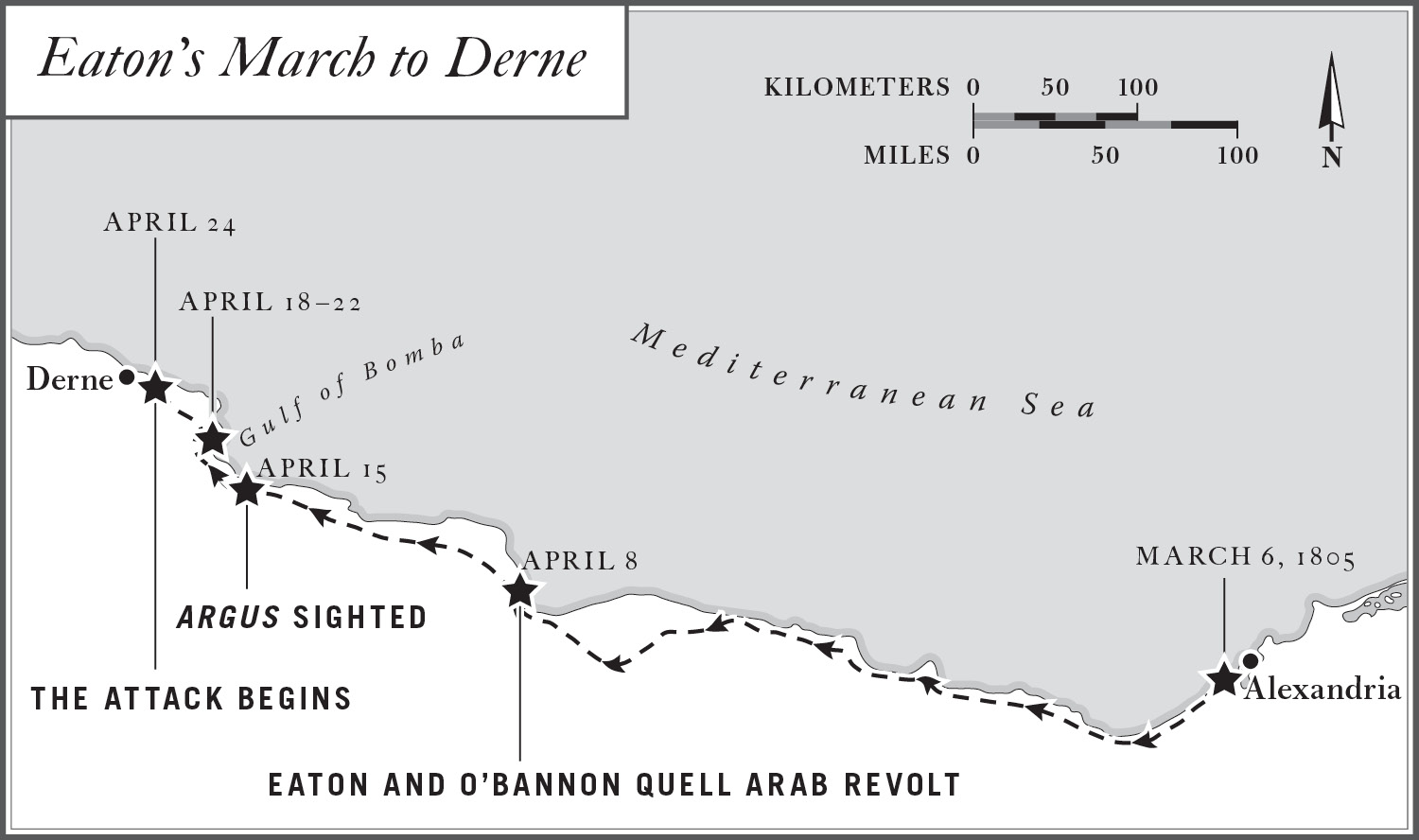
Things got no easier when, a week later, the caravan stumbled into Bomba, wild with hunger and thirst, and eager to rest with full bellies and no fear of starvation. They found Eaton’s often-repeated promise—that American ships awaited the army at Bomba—proved untrue: there were no American ships in the harbor. The Arabs and Bedouins alike immediately declared their intentions to leave in the morning, to countermarch home. The Americans could go forth toward whatever folly they desired, but they would do so alone.
“All began now to think of the means of individual safety,” Eaton wrote. “I went off with my Christians, and kept up fires upon a high mountain in our rear all night.” He desperately hoped that huge hilltop fire would not only provide security for their camp but also signal any American ships in the area, because native scouts had sworn to their presence just a few days earlier.
The plan worked. At eight o’clock the following morning a sail was sighted. “Capt. Hull had seen our smokes and stood in,” wrote a relieved Eaton. “Language is too poor to paint the joy and exultation which this messenger of life excited in every breast.”4
“MY HEAD OR YOURS”
The Argus, followed by the Hornet two days later, sailed into Bomba and unloaded its goods. For a week the army feasted and refreshed itself until, on April 23, the marchers resumed their progress toward Derne. En route again, word reached the caravan that Bashaw Yusuf had heard about their march and had dispatched an army to defend Derne. The news dampened the recently buoyant spirits and made poor Hamet fear for himself and his family. “I thought the Bashaw [Hamet] wished himself back in Egypt,”5 Eaton observed. Still, Hamet rallied. The little army pressed on and, on April 25, made camp on a ridge overlooking its destination.
The next morning, Eaton sent a letter to the governor of Derne. “I want no territory,” his message read. “With me is advancing the legitimate Sovereign of your country—give us a passage through your city, and for the supplies of which we shall have need, you will receive fair compensation. . . . I shall see you tomorrow in a way of your choice.”6
By early afternoon, Eaton had his reply. “The flag of truce was sent back to me with this laconic answer, ‘My head or yours!’”7
As the sun rose over the Sahara on April 27, Bashaw Hamet, William Eaton, Presley O’Bannon, and their unlikely army of mercenaries, midshipmen, Marines, Greeks, Arabs, and Bedouins—a brave band of misfits—prepared to storm the city gates.
CAPTURING THE CASTLE
Looking down upon the town of Derne on April 27, 1805, General William Eaton concocted the plan of attack.
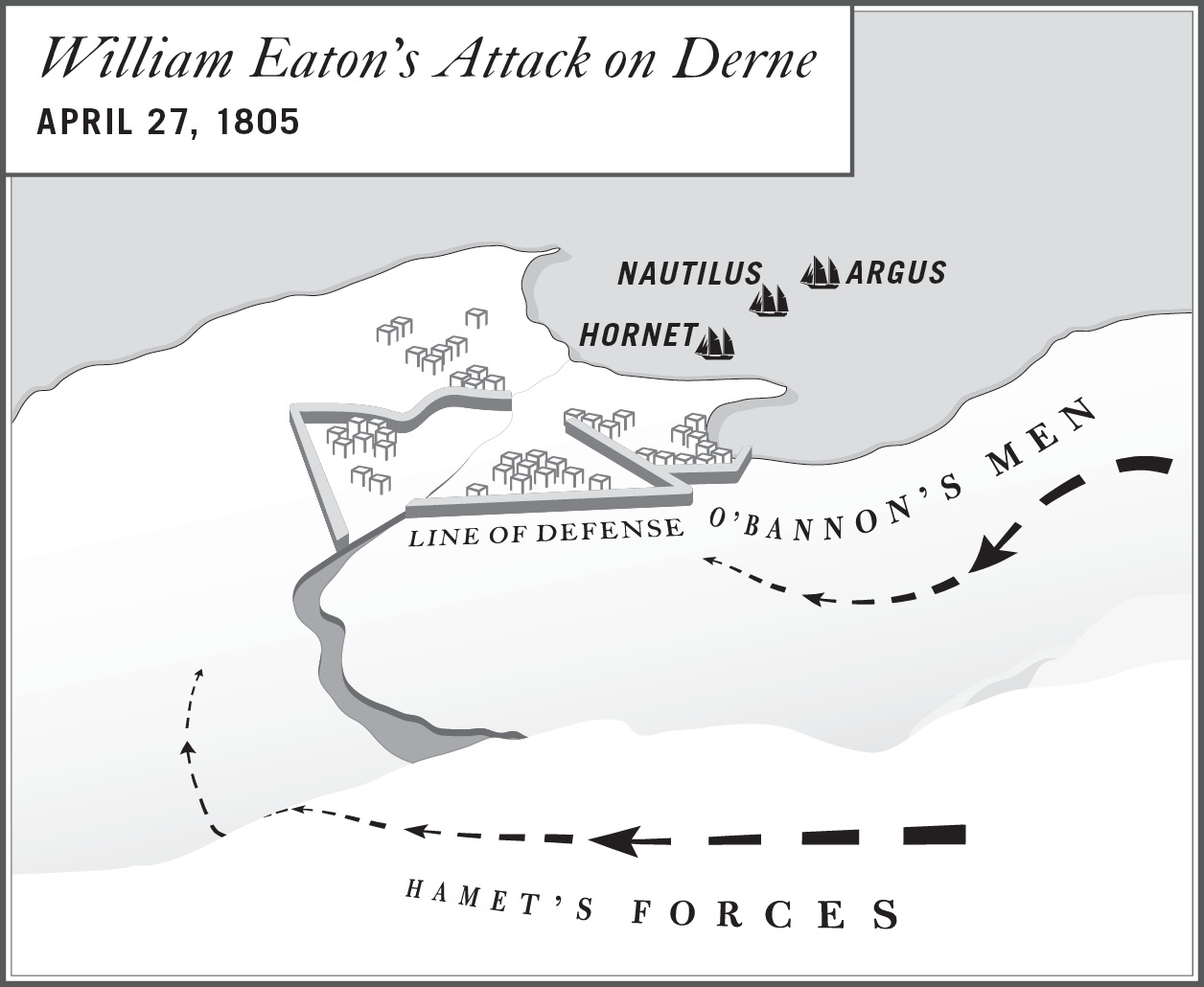
Derne was nestled into a crook of the Mediterranean coast. The governor’s palace sat upon an easterly spit of land that jutted into the blue waters of the bay. A ten-inch howitzer had been mounted on its terrace. Word having reached the provincial capital that an invading force approached, the town had been armed with a battery of eight guns aimed out to sea. To the landward, loopholes had been opened in houses along the city walls to form a line of defense.
Eaton’s plan called for an attack on Derne on three fronts. First, from the sea, the guns aboard the three American ships would bombard the city. Second, using field guns sent by Barron, Eaton and his men would fire upon the walls of the city from the southeast. Finally, a wave of men led by Hamet Qaramanli would descend on the rear of the town from the west.
On the morning of April 27, the Nautilus brought Eaton’s guns to shore. There a narrow beach immediately gave way to a steep climb, but the task of hauling a heavy carronade up the slope with block and tackle proved time-consuming. Eager to get to the coming fight, Eaton decided to settle for just one artillery piece.
Finally, at one-thirty on the afternoon of April 27, the assault began. From a distance of half a mile out to sea, the Argus and the Nautilus began firing into the town. From their vantage on the hillside, O’Bannon and his men maintained a steady musket fire, accompanied by round shot from the carronade. With the Hornet positioned in the bay to fire on the city from a distance of just one hundred yards, Derne was taking heavy bombardment.
At first, the attack seemed to go well. Within forty-five minutes, Derne’s harbor guns fell silent. Under heavy fire from the U.S. Navy ships, the Tripolitans operating the harbor guns had withdrawn and moved to reinforce the defenders of the more vulnerable south wall.
Eaton’s cannoneers kept up their fire until a cannonball shattered their rammer, the long wooden tool used to drive the shot and powder wad down the bore of the large gun. No longer able to load and fire the gun, the men around O’Bannon and Eaton were thrown into confusion.
Thinking fast, Eaton saw but one alternative: he ordered a charge down the hill, directly into the teeth of the enemy’s defense. The odds were not in his favor but he remained undaunted.
“We rushed forward against a host of savages more than ten to our one.”8 On horseback, Eaton led the charge at a gallop, an intimidating sight as he swung his custom-made scimitar over his head. By some miracle, he was not injured by the enemy’s gunfire, though he would find five bullet holes in his robes.9
• • •
On the other side of town, Hamet and his troops occupied an old castle and awaited their signal. Eaton had instructed the Tripolitan to lead his force of more than seven hundred men, some on foot, others on horseback, and attack the city via a deep ravine southwest of Derne. Sheiks sympathetic to the former bashaw had advised that he could expect support from most of the population in that part of the city. Other horsemen in Hamet’s force were to take positions in the surrounding hills to the rear, ready to cut off any Tripolitan forces attempting to retreat from the city.
As a dense cloud of blue smoke rose from the harbor, a delighted Eaton had seen Hamet’s horsemen swooping down to the city. Knowing that Hamet’s army was fighting fiercely on the other side of the city emboldened him for the daring charge of the city walls. Cannon fire from the ships offered cover as Eaton, O’Bannon, and their men crossed the beach, but the men still faced volleys of musket balls from the ramparts.
One of O’Bannon’s seven Marines fell, seriously wounded. Another took a bullet to the chest, dying immediately. Then Eaton himself took a musket ball to the left wrist. Yet the wave of men and their flashing bayonets continued their charge.
To the surprise of the small brigade of invaders, the city’s defenders began to retreat into the city as the Americans approached. The frontal assault produced a growing panic. The ragged fire from behind the walls ceased, and the Tripolitan defenders melted into the dizzying maze of the city’s twisting streets and stacked houses. The retreating army managed only sporadic fire as they retreated.
With Eaton wounded, O’Bannon took full command. Breaching the city’s walls, he led the charge directly to the oceanfront guns. There, after lowering the bashaw’s ensign, O’Bannon planted the American flag on the ramparts. He then turned the enemy’s own guns on them—abandoned in a rush during the naval bombardment, many were still loaded, powdered, and ready to fire. In a matter of minutes, the Americans held the high ground and the artillery.
Meanwhile, at the other end of town, Hamet’s flag could now be seen flying from the governor’s palace. After years of planning, months of preparations, and a fifty-two-day march that covered more than five hundred miles, the city had fallen in the short span of two and a half hours.
All told, there were fourteen dead and wounded among the contingent of Americans and Greeks led by Eaton and O’Bannon. Two of the dead were O’Bannon’s Marines. The number of casualties among Hamet’s party and the Tripolitan forces was not recorded but totaled in the hundreds.
Eaton was elated. His plan had worked thus far, and an army of fewer than a thousand men had overrun a fighting force of four thousand. The governor of Derne was still at large—he found refuge in a mosque—but Eaton felt certain the victory would win many Tripolitans to Hamet’s side—and it would demonstrate to the world that the Americans were not to be trifled with. Eaton had proved that distance was no barrier to the Americans and put the world on notice that Hamet, the rightful ruler of their country, had his sights set on regaining his throne and his family. Rejoicing at the prospect of victory, Hamet is said to have offered his sword to O’Bannon as a token of his thanks.
Word of the fall of Derne was bound to anger and panic the bashaw. Hamet and the Americans were coming for him, and Bashaw Yusuf knew it. But Eaton’s victory would be stymied by a surprising source.