
CHAPTER 1
Americans Abroad
It is not probable the American States will have a very free trade in the Mediterranean . . . the Americans cannot protect themselves [as] they cannot pretend to [have] a Navy.
—John Baker-Holroyd, Lord Sheffield, Observations of the Commerce of the American States, 1783
In 1785, the same year Richard O’Brien was captured by pirates, Thomas Jefferson learned that all politics, even transatlantic politics, are personal.
He was a widower. The passing of his wife in September 1782 had left him almost beyond consolation, and what little comfort he found was in the company of his daughter Martha, then age ten. The two would take “melancholy rambles” around the large plantation, seeking to evade the grief that haunted them. When Jefferson was offered the appointment as American minister to France, he accepted because he saw an opportunity to escape the sadness that still shadowed him.
Thomas Jefferson had sailed for Europe in the summer of 1784 with Martha at his side; once they reached Paris, he enrolled his daughter in a convent school with many other well-born English-speaking students. There he would be able to see her regularly, but he had been forced to make a more difficult decision regarding Martha’s two sisters. Mary, not yet six, and toddler Lucy Elizabeth, both too young to travel with him across the sea, had been left behind with their “Aunt Eppes,” his late wife’s half sister. The separation was painful, but it was nothing compared with the new heartbreak he experienced just months into his Paris stay when Mrs. Eppes wrote sadly to say that “hooping cough” had taken the life of two-year-old Lucy.1
As a fresh wave of sorrow rolled over him, Jefferson longed for “Polly the Parrot,” as he affectionately called his bright and talkative Mary, to join his household again. The father wrote to his little girl that he and her sister “cannot live without you” and asked her if she would like to join them across the ocean. He promised that joining them in France meant she would learn “to play on the harpsichord, to draw, to dance, to read and talk French.”2
“I long to see you, and hope that you . . . are well,” the now seven-year-old replied. But she added that she had no desire to make the trip, harpsichord or no harpsichord. “I don’t want to go to France,” she stated plainly. “I had rather stay with Aunt Eppes.”3
Jefferson was undaunted and began to plan for her safe travel. Having already lost two dear family members, he did not want to risk losing Polly and looked for ways to reduce the dangers of the journey. He instructed her uncle, Francis Eppes, to select a proven ship for Polly’s crossing. “The vessel should have performed one [transatlantic] voyage at least,” Jefferson ordered, “and must not be more than four or five years old.”4 He worried about the weather and insisted that his daughter travel in the warm months to avoid winter storms. As for supervision, Polly could make the journey, Jefferson advised, “with some good lady passing from America to France, or even England [or] . . . a careful gentleman.”5
Yet an even more intimidating concern worried Jefferson: more frightening than weather or leaky ships was the threat of pirates off North Africa, a region known as the Barbary Coast. The fate of the Dauphin and the Maria was a common one for ships venturing near the area, where the Sahara’s arid coast was divided into four nation-states. Running west to east were the Barbary nations Morocco, Algiers, Tunis, and Tripoli, which all fell under the ultimate authority of the Ottoman Empire, seated in present-day Turkey.
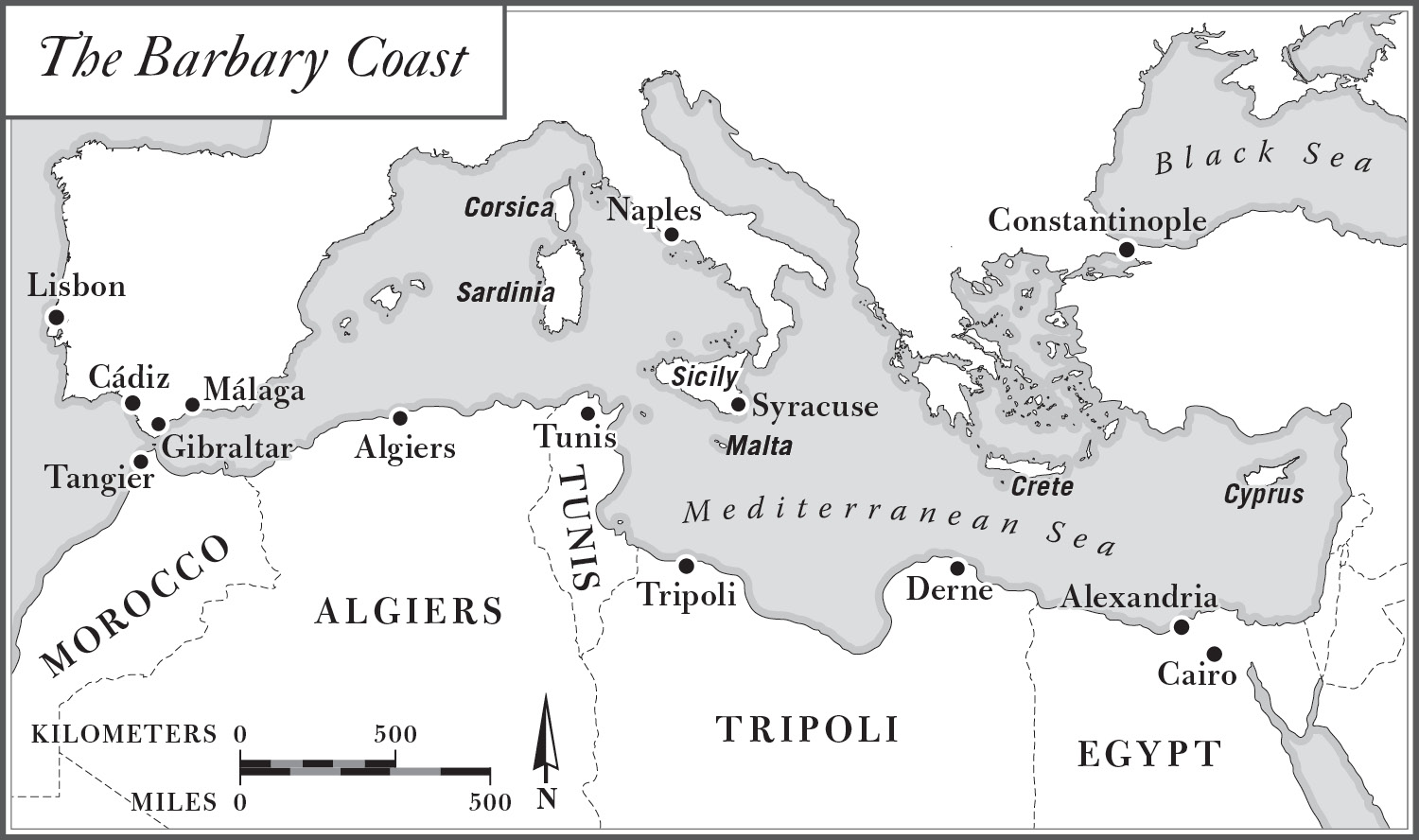
The Islamic nations of the Barbary Coast had preyed upon foreign shipping for centuries, attacking ships in international waters both in the Mediterranean and along the northwest coast of Africa and the Iberian peninsula. Even such naval powers as France and Great Britain were not immune, though they chose to deal with the problem by paying annual tributes of “gifts” to Barbary leaders—bribes paid to the Barbary states to persuade the pirates to leave merchant ships from the paying countries alone. But the prices were always changing, and the ships of those nations that did not meet the extortionate demands were not safe from greedy pirates.
To the deeply rational Jefferson, the lawless pirates posed perhaps the greatest danger to his sadly diminished family. He knew what had happened to O’Brien and could not risk a similar fate for his child. As he confided in a letter to brother-in-law Francis Eppes, “My anxieties on this subject could induce me to endless details. . . . The Algerines this fall took two vessels from us and now have twenty-two of our citizens in slavery.” The plight of the men aboard the Maria and the Dauphin haunted him—if their hellish incarceration was terrifying to contemplate, “who can estimate . . . the fate of a child? My mind revolts at the possibility of a capture,” Jefferson wrote. “Unless you hear from myself—not trusting the information of any other person on earth—that peace is made with the Algerines, do not send her but in a vessel of French or English property; for these vessels alone are safe from prize by the barbarians.”6 He knew those two countries paid a very high annual tribute, thereby purchasing safe passage for their vessels.
As a father, he could feel in his bones a fear for his daughter’s safety. As an ambassador and an American, Jefferson recognized it was a fear no citizen of a free nation embarking on an oceanic voyage should have to endure.
A MEETING OF MINISTERS
A few months later, in March 1786, Jefferson would make his way to London to meet with his good friend John Adams. Together they hoped to figure out how to deal with the emerging threat to American interests.
His waistline thickening, his chin growing jowly, fifty-year-old John Adams welcomed Jefferson into his London home. Overlooking the tree-lined Grosvenor Square from the town house Adams had rented, the two men sat down to talk in the spacious drawing room.
Adams was the United States’ first ambassador to Great Britain. Just arrived from Paris after a cold and blustery six-day journey, Jefferson was minister to the French government of Louis XVI. To Adams and his wife, Abigail, their old friend looked different, as Jefferson had begun powdering his ginger hair white. The stout New Englander and the tall, lean, forty-two-year-old Virginian might have been of different breeds—but then, in the years to come, they would often be of two minds in their political thinking as well.
Unlike most of the European diplomats they encountered, neither Adams nor Jefferson had been born into a tradition of diplomatic decorum. Adams was a rough-and-tumble lawyer, the son of a yeoman farmer from south of Boston, known for a damn-all attitude of speaking his mind. A man of quiet natural grace, Jefferson was learning the cosmopolitan ways of Paris but, at heart, he was a well-born country boy, heir to large farms outside Charlottesville, a tiny courthouse town in central Virginia. Both men were novices in the game of international negotiation, a game their country needed them to learn quickly.
When the Americans and British signed the Treaty of Paris in 1783, bringing to an end the Revolution, the United States’ legal status changed in the view of every nation and world leader. No longer under British protection, the fledgling nation found that its status was lowly indeed. Adams’s letters to the British government tended to go unanswered, and Jefferson’s attempts to negotiate trade treaties with France and Spain were going nowhere. Now a more hostile international threat was rearing its head, and Adams had summoned Jefferson from Paris to discuss the danger posed by the “piratical nations” of North Africa.
In earlier days, the colonies’ ships had enjoyed the protection offered by the Union Jack; but because U.S. ships no longer carried British passports, the British navy provided no protection against pirates. The French, America’s wartime allies against the British, did not protect them now that there was peace. Americans abroad were very much on their own, especially in international waters. And because America had no navy to protect its interests, insurance for American ships skyrocketed to twenty times the rate of that of European ships.7
The expense of insurance was insupportable, but America’s economy could not afford to end trade on the high seas; the Revolution had been fought with borrowed money, and repayment of those debts depended upon ongoing international commerce. One key piece of the nation’s economic health was trade with southern Europe, accessible only by sailing into the Mediterranean—and within range of the Barbary pirates. According to Jefferson’s calculations, a quarter of New England’s most important export, dried salt cod, went to markets there, as did one sixth of the country’s grain exports. Rice and lumber were also important exports, and the merchant ships provided employment for more than a thousand seamen. The trade and employment were essential to the growing American economy, and John Adams thought the numbers could easily double if a diplomatic solution in the Barbary region could be reached.
The American government had initially approved payment to the North African nations. But the bribes demanded were impossibly high, many hundreds of thousands of dollars when the American treasury could afford only token offerings of a few tens of thousands. In an era when not a single American was worth a million dollars, and Mr. Jefferson’s great house, Monticello, was assessed at seventy-five hundred dollars, paying such exorbitant bribes seemed almost incomprehensible. Unable to pay enough to buy the goodwill of the Barbary countries, America was forced to let its ships sail at their own risk. Sailors like those on the Maria and the Dauphin had become pawns in a very dangerous game.
On this day, Adams and Jefferson worried over the fate of the Dauphin and the Maria. It had been nearly a year since the pirates from Algiers had taken the ships and cargoes the previous July, and now the regent of Algiers had made known his demand: until he was paid an exorbitant and, it seemed, ever-escalating ransom, the American captives were to be his slaves.
Despite their pity for the captives, Jefferson and Adams knew the new nation couldn’t afford a new war or a new source of debt. They understood that the cost of keeping American ships away from the Barbary Coast would be greater than the cost of addressing the problem. That left the two American ministers, as Jefferson confided to a friend, feeling “absolutely suspended between indignation and impotence.”8
Yet neither Jefferson nor Adams could afford to remain paralyzed in the face of the danger. Not only had American families and the economy been endangered, but rumor had it that the pirates had also captured a ship carrying the venerable Benjamin Franklin, Jefferson’s predecessor as minister to France. (As one of his correspondents wrote to Franklin, “We are waiting with the greatest patience to hear from you. The newspapers have given us anxiety on your account; for some of them insist that you have been taken by the Algerines, while others pretend that you are at Morocco, enduring your slavery with all the patience of a philosopher.”9) To everyone’s relief, the reports proved false, but the scare brought the very real dangers posed by the Barbary pirates too close for comfort.
Sitting in the London house, John Adams and Thomas Jefferson discussed the idea of a negotiation that might break the impasse. Adams had a new reason to hope that the Barbary rulers could be reasoned with, and the two ministers set about deciding upon the right approach.
“MONEY IS THEIR GOD AND MAHOMET THEIR PROPHET”
A few weeks earlier, Adams had made an unannounced visit to the Barbary state of Tripoli’s ambassador, freshly arrived in London. To Adams’s surprise, the bearded Sidi Haji Abdrahaman had welcomed him warmly. Seated in front of a roaring fire, with two servants in attendance, they smoked tobacco from great pipes with six-foot-long stems “fit for a Walking Cane.” Adams had promptly written to Jefferson. “It is long since I took a pipe, but [we] smoked in awful pomp, reciprocating whiff for whiff . . . until coffee was brought in.”10
Adams made a strong impression on the Tripolitans. Observing his expertise with the Turkish smoking device, an attendant praised his technique, saying, “Monsieur, vous êtes un Turk!” (“Sir, you are a Turk!”)11 It was a high compliment.
Abdrahaman returned Adams’s visit two days later, and Adams decided his new diplomatic acquaintance was “a benevolent and wise man” with whom the United States could do business.12 He believed Abdrahaman might help broker an arrangement between the United States and the other Barbary nations, bringing an end to the capture of American merchantmen. Now reunited with his friend and fellow American, he shared his plan with Jefferson and invited him to join the conversation.
On a blustery March day, Adams, Jefferson, and Abdrahaman convened at the house of the Tripolitan envoy. The conversation began in an improvised mix of broken French and Italian, as the Tripolitan envoy spoke little English. The discussion was cordial, and Adams and Jefferson began to believe that a solution was in sight. When the talk turned to money, however, the bubble of optimism soon exploded.
Jefferson had researched the sums paid as tribute by European countries, including Denmark, Sweden, and Portugal, so he knew the going rate. But the gold Abdrahaman demanded that day was beyond the reach of the United States: a perpetual peace with Tripoli would cost some 30,000 English guineas, the equivalent of roughly $120,000, not counting the 10 percent gratuity Abdrahaman demanded for himself. And that amount bought peace with only one of the Barbary states. To buy peace in Tunis would cost another 30,000 guineas, to say nothing of what would be required to pay Morocco or even Algiers, the largest and most powerful of the four. The $80,000 that Congress had been hard-pressed to authorize for an across-the-board understanding was no more than a down payment on what would be needed to meet the Barbary demands.13
Although he now despaired of an easy solution, Adams wasn’t ready to stop talking. He could understand financial concerns, and he was already beginning to realize what O’Brien would later say of the pirates: “Money is their God and Mahomet their Prophet.”14 Yet greed alone couldn’t explain the madness and cruelty of the demands. Unsatisfied, the famously blunt Adams wanted a better answer. While maintaining the best diplomatic reserve he could muster—whatever their frustration, the American ministers could hardly leap to their feet and walk out of the negotiations—Adams asked how the Barbary states could justify “[making] war upon nations who had done them no injury.”
The response was nothing less than chilling.
According to his holy book, the Qur’an, Abdrahaman explained, “all nations which had not acknowledged the Prophet were sinners, whom it was the right and duty of the faithful to plunder and enslave.”
Christian sailors were, plain and simple, fair game.
Jefferson tried to make sense of what he was hearing. He was familiar with the Muslim holy book. He had purchased a copy of the Qur’an during his days of reading law in Williamsburg twenty years before but found its values so foreign that he shelved the volume with books devoted to the mythology of the Greeks and Romans. This conversation left him even more perplexed. The man who had written that all people were “endowed by their Creator with certain inalienable rights” was horrified at Abdrahaman’s religious justification for greed and cruelty.
Dashing Adams’s high hopes, Abdrahaman refused to play the role of “benevolent and wise man.” Despite the Americans’ horror, he wasn’t apologizing in any way. He showed no remorse or regret. He believed the actions of his fellow Muslims fully justified.
“Every mussulman,” he explained, “who was slain in this warfare was sure to go to paradise.”
To Abdrahaman, this was not complicated. In his culture, the takers of ships, the enslavers of men, the Barbarians who extorted bribes for safe passage, were all justified by the teaching of the prophet Muhammad. “It was written in our Qur’an,” he said simply.15
When the meeting ended, the two American ministers, disheartened and outraged, left empty-handed. They had found no solution, no peaceful answer to protecting American shipping or freeing their countrymen enslaved in North Africa.
THE PRICE OF PEACE
Their initial attempt at making peace foiled, Adams and Jefferson began to plan their next approach. They agreed that the status quo was not workable, but that’s where their agreement ended.
In the coming months, the two old friends would find they disagreed about how to deal with the Barbary pirates. Adams remained determined to continue the negotiations. The Americans should be willing to pay for peace, he believed, even if they had to borrow money to pay the tributes. “If it is not done,” he wrote to Jefferson from London that summer, “you and I . . . ought to go home.”16
In Paris, Jefferson expressed another view. He did not wish to “buy a peace,” as he put it. He did not trust the Barbary powers to keep their word. At the same time, he did not think America could afford to stop trading with the Mediterranean. He believed in freedom on the seas, and he proposed a tougher position.
“I should prefer the obtaining of it by war,” he wrote to Adams from France.17 Jefferson argued that America needed a navy to deal with the pirates of the Barbary coast, to confront and destroy them.
He told Adams that justice, honor, and the respect of Europe for the United States would be served by establishing a fleet in “constant cruise” in Barbary waters, policing and confronting ships of the outlaw states as necessary. He argued that an armed naval presence made budgetary sense. According to his calculations, establishing a small navy would be less costly than the sum of the ransoms, bribes, and maritime losses.
Adams disagreed. He believed that a war against the Islamic nations would be costly and possibly unwinnable. It would certainly require too large a military force for America’s budget. Opposing Jefferson’s belief that a small navy could solve the problem, he told Jefferson, “We ought not to fight them at all unless We determine to fight them forever.”18
Despite their differences, the two men worked tirelessly to gain the freedom of the enslaved sailors. They sent American agents to conduct negotiations with the Barbary governments. Jefferson contacted the Mathurins, also called Trinitarians, a Catholic religious order that had worked to free Christian captives since 1199. All efforts failed. O’Brien and his men remained in captivity, and eventually diplomacy between the United States and Algiers went quiet. More than five years would pass before American negotiators would return to Algiers to resume talks. During those years, several hundred more Christian men, women, and children would join the ranks of the imprisoned, as the pirates collected more ships, booty, and slaves.
But the situation continued to trouble Jefferson deeply. Remembering his fear for Polly’s safety, he sympathized with the terrible worry and sleepless nights that American families endured on behalf of loved ones who made a living on the sea. In a world where the Barbary pirates roamed the eastern Atlantic and the Mediterranean, who would they capture and enslave next? Would the next captives ever make it home again, or would they die of disease or under the lash in a foreign land?
The Barbary powers, with their mixture of greed, religious fanaticism, and self-interest, would not listen to reason. They might listen to force, but with no navy, the Americans could not bring power to bear on the pirates. Both Adams and Jefferson were stymied and returned to America without solutions, but they did not give up entirely. Soon enough, Jefferson would confront the issue from a fresh vantage.