
CHAPTER 6
The First Flotilla
I hope the next Opportunity that I have of writing you, that I shall have the pleasure of Informing you that some of the Squadron has made some Captures of the Tripolitan Corsairs.
—Richard Dale to the secretary of the navy, July 19, 1801
An ocean away from Cathcart’s splintered flagpole, Jefferson’s four warships prepared for their voyage. The flagship would be the President, commanded by Commodore Richard Dale. The Philadelphia and the Essex, captained by Samuel Barron and William Bainbridge, respectively, would add additional strength. A fourth vessel, the trim schooner Enterprise, guided by Lieutenant Andrew Sterett, completed the flotilla. Though modest in numbers, the flotilla was surprisingly powerful due to a new design. Because of innovations in American shipbuilding, the American frigates would be able to outrun much larger ships or, in heavy seas, match up with them.
Adding to the military might of the four ships were members of the relatively new United States Marine Corps, reactivated by President Adams with the birth of the U.S. Navy in 1798. Skilled combatants, the Marines were invaluable during boarding actions and landing expeditions, and they also served to protect a ship’s officers in the event of a mutiny by the crew. The fighters had a reputation for being bold, fearless men—though sometimes a little brash and reckless. Their presence would be invaluable should any of Dale’s ships encounter pirates or need protection on land.
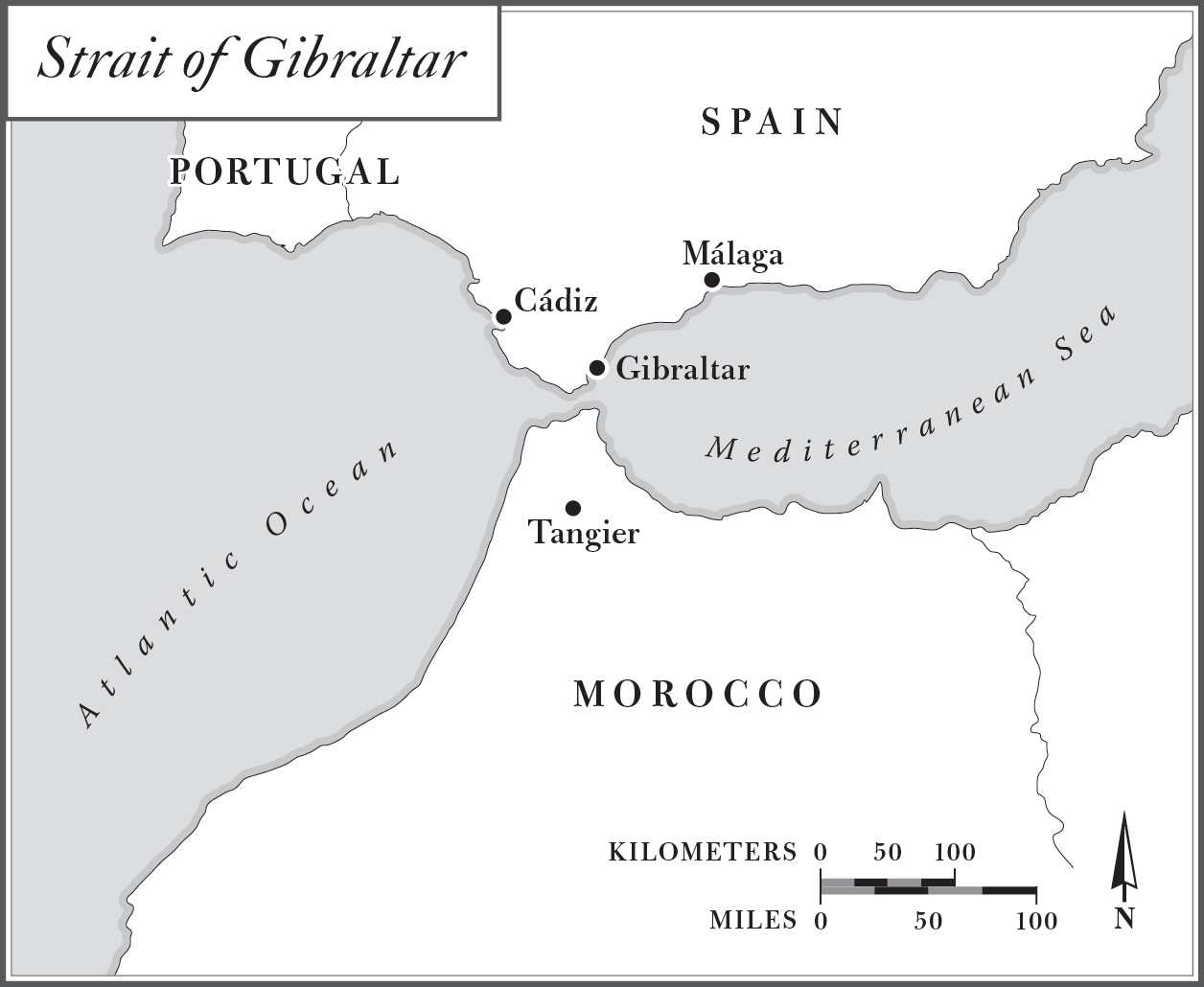
Once fully provisioned, Dale’s squadron finally made sail for the Strait of Gibraltar on June 2, 1801. Soon after losing sight of the American coast, they met with rough seas. Swirling squalls made the first ten days of the crossing difficult, as easterly winds and heavy rains buffeted the ships. As the newest of the four American vessels, the USS President had only a few months of sailing to her credit, and the storms found every flaw in her construction. Wracked by the thrashing of the sea, she soon had rain and seawater leaking through seams that opened in her deck. Life below became damp and unpleasant, and many of the crew fell seasick. But she was a fine ship, from the top of her three tall masts to her bottom. A little stormy weather would not prevent the USS President from reaching her Mediterranean destination.
JEFFERSON’S COMMANDERS
The President’s commander was no less sturdy. At forty-five years of age, Richard Dale’s portly bearing, kind eyes, and crown of graying hair hinted at the maturity of long experience that he brought to his command. He had gone to sea at age twelve, and after making his first Atlantic crossing aboard a merchant vessel owned by an uncle, he worked himself up to the rank of mate by age seventeen.
During the American Revolution, Dale served as John Paul Jones’s second-in-command aboard the converted French merchant ship USS Bon Homme Richard. Swinging by a rope under a moonlight sky, he had been the first American sailor to land on the deck of the HMS Serapis during a battle with the British ship, an act of bravery that won him widespread fame. After the war he settled for a quieter life, establishing a profitable merchant business based on trade with China and India. When the U.S. Navy was reestablished, however, Dale had been quick to accept President Washington’s offer to return to the sea as one of its first captains. While a sense of duty drove the men aboard the American ships, Commodore Dale understood firsthand the need to protect American ships from capture—he himself had been imprisoned by the British during the Revolution.
Aboard the USS Essex, Captain Bainbridge had been chosen to go back to the region where he had suffered his degrading experience aboard the George Washington, and revenge was on his mind. But there were younger men about the Essex with simpler motives, among them the lust for adventure. Lieutenant Stephen Decatur was one.
Every now and then, fate seems to smile on an individual, gifting him with an extraordinary measure of good looks, character, and opportunity. Stephen Decatur’s curly dark hair, sparkling eyes, and devil-may-care attitude caught the eye of many a woman when he entered a room. But his bravery—known to verge on recklessness—and his intense sense of honor were equally distinguishing features.
Once, when a British merchant insulted Decatur and the American navy, Decatur challenged him to a duel. Knowing his pistol skills were far superior to his foe’s, Decatur confessed to a friend that he planned only to shoot for the man’s leg, hoping to wound him slightly and teach him a lesson. The duel went as Decatur had planned. The Englishman missed entirely and Decatur’s bullet went into the man’s hip, rather than his heart. Decatur sustained no injury and his pride was satisfied. He did not want to kill the man, but he could not let the slur pass unpunished. To insult the U.S. Navy was to insult Decatur, his country, and his family.
The sea had been a part of Decatur’s life for as long as he could remember. His father, Stephen Decatur Sr., had served as a naval captain in the Revolution before becoming a successful merchant. When his eight-year-old son and namesake had come down with a case of whooping cough, the doctors prescribed a regimen of sea air to help clear the recovering child’s lungs, so the boy joined his father on his next voyage. When he returned from the trip to Europe, the young Decatur was cured of his cough—but freshly infected with a desire for the nautical life. Despite his mother’s dearest hope that he would join the clergy, he left college after one year to pursue a naval career.
Even in the face of the stormy conditions of June 1801, Lieutenant Decatur counted himself the luckiest of men to have a place on this mission. Every creak of the frigate as she rocked on the waves whispered of glory ahead. The salty air filling his lungs gave him an invigorating sense of the honor of simply being an American—a child not of old borders and ancient alliances, but of ideals and liberty. And he took pride in his ship; although the Essex was smaller than the President, Decatur felt a swelling of pride as he considered the line of cannons, more than thirty in all.
Neither he nor any of the sailors in the four-ship fleet had any way of knowing what was brewing in Tripoli. They had their suspicions, of course, and Commodore Dale had provided Bainbridge with orders in case they should encounter hostilities. If the Essex should get separated as they crossed the Atlantic, Dale instructed, Bainbridge and Decatur and their men should head for Gibraltar. If they learned there that the Barbary states had declared war, they were to wait five days. If the remaining ships failed to arrive within that window, Bainbridge was to leave a message for Dale with the American consul and then proceed into the Mediterranean to provide protective escort for American merchant ships. In the event that war had not been declared, the Essex was to wait twenty days for the other ships before departing to carry out its mission, leaving a letter at every port of call so that Dale could trace her.
Dale’s detailed orders covered other matters, too. Professional decorum and propriety were stressed, and the commodore’s orders for gallantry suited young Lieutenant Decatur just fine. He was confident, handsome, and brave. He was setting off on a grand voyage for the honor of his country to an exotic place he had only ever dreamed of visiting. If there was peace, let it be lasting; if there was war, then let it be swift and decisive—and let him be bold in the heat of battle and bring honor, esteem, and victory to his country. Whatever lay ahead on the Barbary Coast, Stephen Decatur was certain it would be a great adventure.
RULES OF ENGAGEMENT
When Dale’s ships emerged from the gales, the commodore began running his men through cannon drills. Each man had a precise role in the exercises, and soon the air was filled with orders—“Level your guns” . . . “Take off your tompions” . . . “Load with cartridge” . . . “Shot your guns” . . . “Fire!” With a deafening roar, cannonball shot flew hundreds of yards before disappearing into the waves.
The captains were training their men, veteran and novice alike, for a kind of warfare peculiar to the Barbary Coast. There would be no lines of battle, with opposing enemy fleets facing off. When attacking, Barbary ships closed rapidly, their first strategy to board their opponent. Thus the best defense for a ship under Barbary attack was coordinated cannon fire to keep the pirates at a distance.
To Dale’s frustration, though, a good defense was all he was authorized to do. Beginning with the debate in his cabinet in Washington two and a half months before, President Jefferson hesitated to claim with certainty that he had the constitutional right to declare war. Thus, the orders transmitted down the line of command—via the secretary of the navy, to Commodore Dale, and on to his captains—were abundantly clear. “Should you fall in with any of the Tripolitan Corsairs . . . on your passage to Malta,” Dale wrote, “. . . you will heave all his Guns Over board Cut away his Masts, & leave him In a situation, that he can Just make out to get into some Port.”1 American ships were not to capture any Barbary ships. They could hobble ships that attacked them, but they were to take no captives and to let their enemies escape.
Fortunately, American guns were fired only in practice during the journey across the Atlantic, and the USS President sailed into Gibraltar on July 2. The imposing frigate was followed by the smaller Philadelphia and the Essex. The fourth ship, the Enterprise, greeted her. The heavy seas off North America had slowed the Enterprise and, rather than slow the pace of his little fleet, Commodore Dale permitted the sloop to break company. Once the weather cleared, however, Lieutenant Sterett had set a speedy pace en route to Gibraltar and actually beat the other ships by five days.
The fleet may have been modest by the standards of Europe’s largest navies, but the four warships of the United States made an impressive showing. Whether they would be able to secure peace was not yet known, but for the first time, a flotilla of American warships would make anchor in a Mediterranean port.
PIRATES IN PORT
On arrival at Gibraltar, Commodore Richard Dale’s first duty was to find out the status of the fragile Barbary peace. But first, he wanted to settle into the harbor.
The harbor was emptier than usual. Gibraltar was home to a Royal Navy base, but all of the British ships, engaged in the war with Napoleon, a conflict that the Americans hoped to avoid, had been sent out to blockade French and Spanish forces. On spotting the USS Enterprise at anchor in the nearly vacant harbor, Dale made to join her, relieved that Lieutenant Sterett and his men had arrived safely, with no apparent harm to their vessel. The American squadron had been reunited.
As his ship neared the American schooner, however, Dale’s attention was drawn to another vessel moored nearby. It was unlike any he had ever seen.
The ship’s stern sat unusually low in the water, but it was the brightly colored hull that caught Dale’s eye. As the President neared, Dale saw that the yellow two-masted ship, a white stripe running its length, carried many guns. A closer look with a spyglass revealed she was heavily manned, her crew much larger than normal for a ship her size.
He also noted that the ship was not alone. A second, smaller vessel accompanied her, a brig armed with fourteen guns. Both ships were elaborately painted with festoons of flowers, but the larger ship had a much more disconcerting ornament: a woman’s severed head suspended above the deck.
These were pirate ships, Dale knew in an instant—most likely from Tripoli.
The presence of Barbary ships made Dale uneasy, but he didn’t fear an attack. Whether a state of war existed or not, he knew neither side would open fire within the confines of a neutral harbor. Even if the two garishly painted ships were foolish enough to try, they would be no match for his firepower.
As his ship glided toward its mooring, Dale looked upon the larger of the two vessels—it bore the name Meshuda—and the unnamed brig. There, rocking gently in the harbor swell, lay the answer he was looking for. The Tripolitan commander of this little fleet would know whether a state of war existed between their countries.
Commodore Dale decided all he had to do was ask; whether the pirate would give him a straight answer remained to be seen.
If the Meshuda seemed familiar to the Americans, it was because she had once been an American ship, known as the Betsey, but captured by Tripolitan pirates five years earlier. Her crew had been taken captive, but all had been quickly released—except for one.
Along with the ship, a single deckhand stayed behind when his shipmates sailed for home. He did so by choice. Born in the Scots port of Perth, the fair-haired and bearded Peter Lisle had turned renegade.
Bolstered by his fluency in Arabic acquired on earlier voyages, the deckhand quickly converted to Islam and abandoned his Christian name, adopting the name Murat Rais in honor of a great sixteenth-century Ottoman admiral. Over time, Peter-Lisle-turned-Murat Rais won the trust of the bashaw, even marrying the bashaw’s daughter. Abandoning loyalties to his own king and country, he became a feared and cunning pirate, and he was now the captain of the renamed Betsey, the flagship of the Tripolitan fleet.
When Rais and his men had arrived at Gibraltar on June 29, 1801, they paid no mind to the Enterprise, already three days in port, but the appearance in Gibraltar Bay of the three American frigates on July 1 represented trouble on the horizon. Rais knew that his country had declared war on America. But did the Americans know about the war?
Rais realized these tall ships were not a direct response to the flagpole incident; that news could not have reached American shores in time to prompt the dispatch of this fleet. Yet with rumors of war rapidly crisscrossing the streets and market stalls of Gibraltar, Rais wondered how soon the men of these great fighting ships would learn of the sawed-off staff and the defiling of the American flag. And because the American government could not yet be aware of the declaration of war from Tripoli, just what were these warships doing in Mediterranean waters?
Watching the American sailors securing their ships at anchor, High Admiral Murat Rais devised a plan. He would feign ignorance once the Americans sought him out, as they were sure to do. He would not be the one to deliver the word of war.
UNANSWERED QUESTIONS
Before approaching the pirate ship to ask about the state of the peace, Dale decided to ask friendlier powers for information first. The U.S. consul to Gibraltar came aboard to welcome the fleet, but he had no information. Dale went ashore to pay his respects to the British governor, who confirmed the Meshuda’s loyalties and history, but he also had no answers.2
Dale would have to ask the pirate commander—and his 392 men.
The Meshuda and the brig were in quarantine (the Gibraltar Health Office wanted to be certain they did not carry disease), but Dale approached within hailing distance. Portly but imposing, his voice amplified by a hailing trumpet, he called out to Murat Rais. “The Comodor made Enquiry of the admiral,” the U.S. consul noted, describing the exchange: “were they at War or Peace with the U. States?”3
From the deck of the Meshuda, Murat Rais replied—in the King’s English—that they were at peace.
A doubtful Dale tried another tack. He inquired after Consul Cathcart. On departing Tripoli, had the American seemed well?
The reply was a surprise. A fortnight before, said Rais, Cathcart had gone from Tripoli.
Why?
Rais responded that Cathcart “was no friend to the Americans.”
After this odd piece of news, Dale was able to extract nothing further. The exchange left Dale no less perplexed than when it began.
As for Murat Rais, he was under no illusions that he had fooled Commodore Dale, but his years in the Maghreb had taught him the art of deception. His adopted home was a place where one felt bound to dicker over the price of fruit in the market. Small scenes of drama—indignation, refusal, acceptance—unfolded before the purchase of a string of figs. When it came to the elaborate rituals of diplomacy, it was essential to act as if both parties were old friends, each concerned first and foremost with the comfort and reassurance of the other. To jump straight to the point was rude and disrespectful. It was also dangerous. To have admitted at the outset in his exchange with the American that their nations were at war would have been paramount to surrender.
For Dale, what he learned in the town—if not from Murat Rais—enabled him to reach one firm resolve. Charged by Jefferson and the secretary of the navy to safeguard American ships in the Mediterranean, Dale could not take the other man’s word. Instead he had to make a judgment based upon the scraps of intelligence he had gathered, as well as upon his well-honed instincts. “From every infermation that I can get here Tripoli is at war with America,” he reported. That meant he had to act.
He set about issuing orders. The Essex was to take under convoy the merchant ship Grand Turk, readying to sail for Tunis, its hold full of naval stores and other goods as tribute. There were relationships with other Barbary states to be maintained.
Dale learned that more than two dozen American vessels at nearby Barcelona awaited escort, as did many other merchantmen at other ports of call along the southern European coast. He instructed Bainbridge, after completing his errand to Tunis, that the Essex was then to escort as many of those ships as possible out of the Strait of Gibraltar, protecting them from roving pirate cruisers. Dale hoped that the sight of the frigate, its hull lined with gun ports through which its dozens of guns could be seen, would inspire awe and deter would-be pirates of all stripes from challenging unarmed American vessels.
Dale wrote orders for Lieutenant Sterett aboard the Enterprise. The schooner was to accompany the President on its mission to deliver official correspondence from President Jefferson to Algiers and Tunis. Dale would attend to diplomatic matters there before heading to his ultimate destination, the regency of Tripoli.
For the fourth ship in the squadron, the commodore planned a special duty. Not fooled by the infamous Rais’s assurances, Dale decided that the Meshuda’s sailing must be prevented. He ordered Captain Barron of the frigate Philadelphia to linger near Gibraltar. “Lay of[f] this port & watch his motions and (act in such manner as your good sense will direct) to take him when he comes out.”4 The American frigate mustn’t sail too close, he warned, because the Americans could not be seen to be blockading the British-controlled territory. But if he could, when circumstances permitted, he was to free the seas of Murat Rais’s murderous little convoy.
On July 4, Dale set sail for the Barbary Coast, leaving the Tripolitan’s yellow flagship just where he found it. The natural protections of Gibraltar’s harbor made it the perfect place to observe Rais—the watchful eye of the Philadelphia and the threat of her powerful cannons would keep the pirate just where Dale wanted him. In the meantime, the other American ships would do their best to restore peace in Tripoli and salvage relations with the remaining Barbary states.