

There was much social, legal, and medical discrimination against gay men and lesbians in the 1950s and 1960s. In reaction to those threats, gay men and lesbians established two major organizations to create safer communities for themselves in order to work toward being better accepted in society.
A HOSTILE COUNTRY
In 1965, the United States was undergoing great changes socially and politically. President Lyndon Baines Johnson proclaimed his vision of a “Great Society,” in which education, medical care, and social welfare programs would be expanded and problems of urban and rural poverty and violence would be reduced. The Civil Rights Act of 1964 sought to end job discrimination and segregation for black Americans, and the Voting Rights Act of 1965 tried to assure voting rights for them. These laws proposed to remove unequal treatment among blacks and whites and reduce discrimination against other nationalities or ethnic minority groups. For many, it seemed that society would become better for African Americans, Hispanics, and other minorities. At the same time, tolerance on a social level was hard won. For example, white supremacists hindered the Selma to Montgomery march that Martin Luther King Jr. led, and riots in the Watts neighborhood in Los Angeles were sparked by a violent arrest after a long period of discriminatory policing.

President Lyndon B. Johnson signs the Civil Rights Act of 1964 to create a legal framework for outlawing employment, housing, and voting discrimination based on race, color, sex, national origin, and religion.
The Vietnam War was escalating on both sides, and the number of American troops on the ground was increasing. In response, the group Students for a Democratic Society managed to get more than twenty-five thousand protesters to fill the streets of Washington, DC, in response.
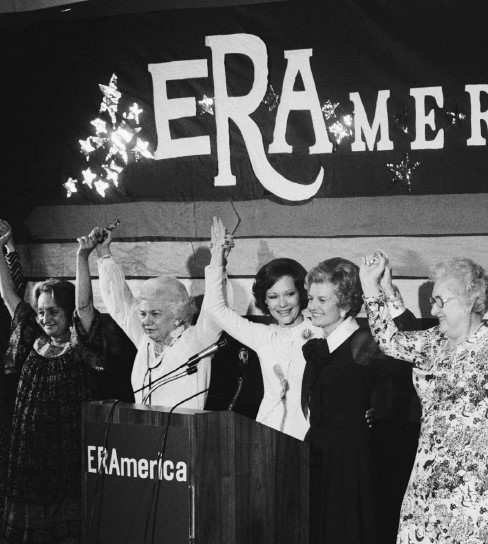
Betty Friedan (far left) and other notable women, including Rosalynn Carter and Betty Ford (third and fourth from left), rallied for the Equal Rights Amendment at the 1977 National Women’s Conference in Houston, Texas.
In 1966, the National Organization for Women was founded by prominent leaders such as Betty Friedan, Shirley Chisholm, and Muriel Fox. The resistance of the civil rights movement helped inspire the anti-Vietnam War movement and the women’s liberation movement. For queer people, life was full of discrimination because they lacked certain legal rights. They could be fired at any time by their employer and denied service in retail establishments, refused work, and denied access to health care. The ability to adopt children, marry, have domestic unions, or serve openly in the military was also not legal or allowed for them. They were often excluded from churches, holding church and government positions, and social clubs. Cross-dressers, then called transvestites, were also discriminated against in this manner.
The reason they were so shunned is that mainstream society viewed them as deviants, both socially and psychologically. Fictional works exposed the attitudes people had toward the existence of homosexuality. A 1959 lesbian pulp fiction novel, Private School, written by J. G. Priest, had this announcement on its front cover: “Every parent should read this shocking novel of adolescent girls who first tolerated vice—then embraced it—then could not live without it!”
The cover of another pulp fiction book, Edge of Twilight, by Paula Christian, called same-sex love “that outcast world of ‘twilight’ love.” The cover of The Third Sex, by Artemis Smith, stated, “Here is a penetrating study of society’s greatest curse: homosexuality!” Homosexuality was commonly called “the love that dare not speak its name,” which indicates a general uneasiness to even openly talk about it or admit that it existed.
While civil life was already difficult, the law and medical institutions made life much harder for LGBTQ+ people, specifically those labeled as “homosexuals” or “transvestites.” Whether or not a person labeled as such was actually gay didn’t matter to those who “treated” or imprisoned them. There were laws in every state called sodomy laws that made sexual acts between same-sex couples punishable by fines and/or imprisonment. In conjunction with these laws, serious works of science reflected an intolerant attitude toward LGBTQ+ people and prescribed a solution for dealing with them. Such publications legitimized medical professionals treating that minority horribly. The Diagnostic and Statistical Manual (DSM-I), in particular, used the word “homosexual” as a medical term, thereby labeling homosexuality as a type of illness. The word was actually coined by Austrian writer Karl-Maria Kertbeny, himself a gay man who opposed sodomy laws.
What the world wanted of LGBTQ+ people was for them to become heterosexual and gender normative. Doctors and laymen alike regarded homosexuality and transvestitism as mental disorders, ones that were somehow contagious to others. Medical and psychiatric opinion was that people with such identities were violent sex offenders. The medical establishment thought that gay people in particular were unable to control their sexual desires and that they were “sexual psychopaths.” They, along with transvestites, were viewed as criminals who needed to be rounded up and put in a psychiatric ward or prison until cured. In fact, in the 1930s, New York City special deputy police commissioner Carleton Simon and Congressman Arthur L. Miller were among influential officials who thought that the best way to deal with homosexuals should be to attempt to cure them of homosexuality.

Seen here from left to right are William B. Bradley, Arthur Miller, Reverend L. Sylvester Odom, and Rabbi Samuel Adelman.
Doctors recommended conversion therapy, and since various psychiatrists and those associated with them wrote the DSM-I, that book also offered at least implicit justification for using conversion therapy. Miller was the author of legislation, which he referred to as a “sex pervert bill,” that made sodomy punishable by up to twenty years in prison. Drugs, chemical castration, and antipsychotic medicine were routinely administered to homosexual patients.
WHAT DO THESE WORDS MEAN?
The names used to describe nonheteronormative attraction changed dramatically in the nineteenth and twentieth centuries. Karl-Maria Kertbeny, an Austrian journalist, first used the terms “homosexual” and “heterosexual” in 1869. By the early twentieth century, “homosexual” and “heterosexual” had become the preferred terms used by the scientific community.
Many LGBTQ+ people used the term “homosexual” to describe themselves, although other terms existed, such as “invert” in Britain and “Urning,” for a gay man, in Germany. “Homosexual” was primarily used for men but gradually also included women, just as the term “mankind” means “all men and women.” By the second decade of the twentieth century, “gay” acquired the meaning of “same-sex attracted person,” a meaning that gained more popularity in the 1960s. But its original meaning is “happy” or “carefree.” Gay often refers to men, but it can refer to either sex. Similarly, the term “lesbian,” which describes only same-sex attracted women, has been in use since the midnineteenth century, alongside its earlier meaning, “a person or export from the Greek isle of Lesbos.”
“Transgender” is an umbrella term describing someone whose gender identity doesn’t match the sex they were assigned at birth. “Transsexual” was used to describe a transgender person who desires to undergo or has completed transition, a process that involves causing the body to match one’s gender identity. The term “transgender” is now more commonly used to describe those who undergo a medical gender transition and those who do not. Virginia Prince, a transgender woman who coined the word “transgenderal” in 1965, used the word to describe gender identity on strictly psychological terms. According to Prince, gender had nothing to do with genitalia but was more psychosocial in nature.
“Queer” is an umbrella term that describes being either non-heteronormative, non-gender normative, or both. It was originally used as a pejorative term, but LGBTQ+ communities have reclaimed it.
THE MATTACHINE SOCIETY AND THE DAUGHTERS OF BILITIS
Some gay people began to organize in response to their need to survive in a hostile world. Harry Hay and others established the Mattachine Society in 1950 to protest the firing of alleged homosexuals in the US government, which continued throughout the 1950s and 1960s. Once fired or arrested, these people had no paths for legal redress. Men and women often could not get another job, and divorces and suicides were common.

This is a portrait of Harold L. "Hal” Call from 1953. He became the president of the Mattachine Society that year.
The Mattachine Society originally was a secret society because of the risk of being exposed in the McCarthy era. Under McCarthyism, communists and homosexuals were treated as the greatest enemies of the nation. Hal Call, who was elected the society’s president in 1953, was determined to make it a public organization. His goal was to make the society more visible and to be able to work with local experts to further research and gain professional expertise in homosexuality.
The Daughters of Bilitis (DOB), founded in San Francisco by the couple Phyllis Lyon and Del Martin and others in 1955, sought to be a social group for lesbians and to promote tolerance in mainstream society for them. Martin and Lyon’s home soon became a lesbian community center. It wasn’t long before they published a newsletter, The Ladder, to proclaim their mission to increase tolerance of lesbians.
These organizations and others like them around the world were called homophile movements. The word “homophile,” which first appeared in a 1924 doctoral thesis written by the German psychologist Karl-Gunther Heimsoth, and came from the Greek words for “same” and “love” to emphasize an emotional connection between people and not simply sexual activities. These homophile organizations expressed that people who actually were homosexuals should be discreet and that they should work to prove to mainstream society that they were not promiscuous, violent, or pedophiles. They sent out newsletters, spoke with psychologists, and organized peaceful protests. However, neither of these organizations had many people in them, and they often served the needs of middle-class men and women instead of working-class people.
GAY BAR RAIDS
Many working-class queers found that bars were one of the few places they could be even somewhat open about who they were. There were middle-class men and women in these establishments, too, but these bars were often dingy and located in rough neighborhoods. There were also specific lesbian bars, like Rusty’s in Philadelphia, as well as coed bars, like the Black Cat.
Many states did not allow bars to cater their services, specifically alcoholic drinks, to queers at gay bars. So-called gay bars generally strived to serve people across the entire LGBTQ+ spectrum, not just gay men. Men, especially, though, were routinely picked up in bars and parks for vagrancy and lewdness charges, and bars were commonly raided. These raids involved arresting people, revoking liquor licenses, and shutting down the entire bar. The New York State Liquor Authority sought control over queer people’s access to liquor and thus the ability to congregate with other queer people. Often it was only bars that were owned and run by the Mafia that would defy these laws and serve queer people, and even though the Mafia paid the cops to allow them to stay open, police raids were still commonplace.
While more men than women tended to be arrested, women were not exempt from arrest and prosecution. Effeminate men, who were called queens, drag queens, and cross-dressers, and masculine women, called butches, were especially targeted, but even femmes whose dress habits matched what was typical of their sex were arrested. One Mattachine member, Jim Kepner, stated, “Bars [were] raided. Guys murdered by someone they had picked up or someone saw them on the street and thought they were queer. Public officials [were] arrested in public tearooms.” Hal Call, executive director of the Mattachine Society said,
“Back in the 1960s, the police were playing cat and mouse with the guys, not the women. The male homosexual was a threat to the straight man. That’s where the problem was. Females didn’t count. [...] The cops could do anything they wanted. All we could do was run and hide"
But lesbians did count; their bars were not exempt. In Philadelphia, on a night in March 1968, policemen raided the lesbian bar Rusty’s. They kicked out the owner of the bar, Rusty Parisi, and arrested at least ten lesbians.