
PART I

Nations! What are nations? Tartars! and Huns! and Chinamen!
Like Insects they swarm. The historian strives in vain to make them memorable.
It is for want of a man that there are so many men. It is individuals that populate the world.
HENRY DAVID THOREAU,
journal entry for May 1, 1851
1
There is fire in his eyes and light in his face.
THE SECRET HISTORY OF THE MONGOLS
OF THE THOUSANDS OF cities conquered by the Mongols, history only mentions one that Genghis Khan deigned to enter. Usually, when victory became assured, he withdrew with his court to a distant and more pleasant camp while his warriors completed their tasks. On a March day in 1220, the Year of the Dragon, the Mongol conqueror broke with his peculiar tradition by leading his cavalry into the center of the newly conquered city of Bukhara, one of the most important cities belonging to the sultan of Khwarizm in what is now Uzbekistan. Although neither the capital nor the major commercial city, Bukhara occupied an exalted emotional position throughout the Muslim world as Noble Bukhara, the center of religious piety known by the epithet “the ornament and delight to all Islam.” Knowing fully the propaganda value of his actions by conquering and entering the city, Genghis Khan rode triumphantly through the city gates, past the warren of wooden houses and vendors’ stalls, to the large cluster of stone and brick buildings at the center of the city.
His entry into Bukhara followed the successful conclusion of possibly the most audacious surprise attack in military history. While one part of his army took the direct route from Mongolia to attack the sultan’s border cities head-on, he had secretly pulled and pushed another division of warriors over a distance longer than any other army had ever covered—two thousand miles of desert, mountains, and steppe—to appear deep behind enemy lines, where least expected. Even trade caravans avoided the Kyzyl Kum, the fabled Red Desert, by detouring hundreds of miles to avoid it; and that fact, of course, was precisely why Genghis Khan chose to attack from that direction. By befriending the nomads of the area, he was able to lead his army on a hitherto unknown track through the stone and sand desert.
His targeted city of Bukhara stood at the center of a fertile oasis astride one of the tributaries of the Amu Darya inhabited mostly by Tajik or Persian people, but ruled by Turkic tribesmen in the newly created empire of Khwarizm, one of the many transitory empires of the era. The sultan of Khwarizm had, in a grievously fatal mistake, provoked the enmity of Genghis Khan by looting a Mongol trade caravan and disfiguring the faces of Mongol ambassadors sent to negotiate peaceful commerce. Although nearly sixty years old, when Genghis Khan heard of the attack on his men, he did not hesitate to summon his disciplined and experienced army once again to their mounts and to charge down the road of war.
In contrast to almost every major army in history, the Mongols traveled lightly, without a supply train. By waiting until the coldest months to make the desert crossing, men and horses required less water. Dew also formed during this season, thereby stimulating the growth of some grass that provided grazing for horses and attracted game that the men eagerly hunted for their own sustenance. Instead of transporting slow-moving siege engines and heavy equipment with them, the Mongols carried a faster-moving engineer corps that could build whatever was needed on the spot from available materials. When the Mongols came to the first trees after crossing the vast desert, they cut them down and made them into ladders, siege engines, and other instruments for their attack.
When the advance guard spotted the first small settlement after leaving the desert, the rapidly moving detachment immediately changed pace, moving now in a slow, lumbering procession, as though they were merchants coming to trade, rather than with the speed of warriors on the attack. The hostile force nonchalantly ambled up to the gates of the town before the residents realized who they were and sounded an alarm.
Upon emerging unexpectedly from the desert, Genghis Khan did not race to attack Bukhara immediately. He knew that no reinforcements could leave the border cities under attack by his army, and he therefore had time to play on the surprise in a tortured manipulation of public fear and hope. The objective of such tactics was simple and always the same: to frighten the enemy into surrendering before an actual battle began. By first capturing several small towns in the vicinity, Genghis Khan’s army set many local people to flight toward Bukhara as refugees who not only filled the city but greatly increased the level of terror in it. By striking deeply behind the enemy lines, the Mongols immediately created havoc and panic throughout the kingdom. As the Persian chronicler Ata-Malik Juvaini described his approach, when the people saw the countryside all around them “choked with horsemen and the air black as night with the dust of cavalry, fright and panic overcame them, and fear and dread prevailed.” In preparing the psychological attack on a city, Genghis Khan began with two examples of what awaited the people. He offered generous terms of surrender to the outlying communities, and the ones that accepted the terms and joined the Mongols received great leniency. In the words of the Persian chronicler, “whoever yields and submits to them is safe and free from the terror and disgrace of their severity.” Those that refused received exceptionally harsh treatment, as the Mongols herded the captives before them to be used as cannon fodder in the next attack.
The tactic panicked the Turkic defenders of Bukhara. Leaving only about five hundred soldiers behind to man the citadel of Bukhara, the remaining army of twenty thousand soldiers fled in what they thought was still time before the main Mongol army arrived. By abandoning their fortress and dispersing in flight, they sprung Genghis Khan’s trap, and the Mongol warriors, who were already stationed in wait for the fleeing soldiers, cut them down at a nearly leisurely pace.
The civilian population of Bukhara surrendered and opened the city gates, but the small contingent of defiant soldiers remained in their citadel, where they hoped that the massive walls would allow them to hold out indefinitely against any siege. To more carefully assess the overall situation, Genghis Khan made his unprecedented decision to enter the city. One of his first acts on reaching the center of Bukhara, or upon accepting the surrender of any people, was to summon them to bring fodder for his horses. Feeding the Mongol warriors and their horses was taken as a sign of submission by the conquered; more important, by receiving the food and fodder, Genghis Khan signaled his acceptance of the people as vassals entitled to Mongol protection as well as subject to his command.
From the time of his central Asian conquests, we have one of the few written descriptions of Genghis Khan, who was about sixty years old. The Persian chronicler Minhaj al-Siraj Juzjani, who was far less kindly disposed toward the Mongols than the chronicler Juvaini, described him as “a man of tall stature, of vigorous build, robust in body, the hair on his face scanty and turned white, with cats’ eyes, possessed of dedicated energy, discernment, genius, and understanding, awe-striking, a butcher, just, resolute, an overthrower of enemies, intrepid, sanguinary, and cruel.” Because of his uncanny ability to destroy cities and conquer armies many times the size of his own, the chronicler also goes on to declare that Genghis Khan was “adept at magic and deception, and some of the devils were his friends.”
Eyewitnesses reported that upon reaching the center of Bukhara, Genghis Khan rode up to the large mosque and asked if, since it was the largest building in the city, it was the home of the sultan. When informed that it was the house of God, not the sultan, he said nothing. For the Mongols, the one God was the Eternal Blue Sky that stretched from horizon to horizon in all four directions. God presided over the whole earth; he could not be cooped up in a house of stone like a prisoner or a caged animal, nor, as the city people claimed, could his words be captured and confined inside the covers of a book. In his own experience, Genghis Khan had often felt the presence and heard the voice of God speaking directly to him in the vast open air of the mountains in his homeland, and by following those words, he had become the conqueror of great cities and huge nations.
Genghis Khan dismounted from his horse in order to walk into the great mosque, the only such building he is known to have ever entered in his life. Upon entering, he ordered that the scholars and clerics feed his horses, freeing them from further danger and placing them under his protection, as he did with almost all religious personnel who came under his control. Next, he summoned the 280 richest men of the city to the mosque. Despite his limited experience inside city walls, Genghis Khan still had a keen grasp of the working of human emotion and sentiment. Before the assembled men in the mosque, Genghis Khan took a few steps up the pulpit stairs, then turned to face the elite of Bukhara. Through interpreters, he lectured them sternly on the sins and misdeeds of their sultan and themselves. It was not the common people who were to blame for these failures; rather, “it is the great ones among you who have committed these sins. If you had not committed great sins, God would not have sent a punishment like me upon you.” He then gave each rich man into the control of one of his Mongol warriors, who would go with him and collect his treasure. He admonished his rich prisoners not to bother showing them the wealth above the ground; the Mongols could find that without assistance. He wanted them to guide them only to their hidden or buried treasure.
Having begun the systematic plundering of the city, Genghis Khan turned his attention to attacking the Turkic warriors still defiantly sealed inside the citadel of Bukhara. Although not familiar with the Mongols in particular, the people in the urbanized oases of central Asian cities like Bukhara and Samarkand had seen many barbarian armies come and go through the centuries. Prior tribal armies, no matter how brave or disciplined, never posed a severe threat because urban armies, so long as they had food and water, could hold out indefinitely behind the massive walls of their forts. By most measures, the Mongols should have been no match for the professionally trained career soldiers they encountered at Bukhara. Although the Mongols had excellent bows in general, each man was responsible for making or acquiring his own, and the quality of workmanship varied. Similarly, the Mongol army was composed of all the males of the tribe, who depended on the ruggedness of their upbringing herding animals for their training; and while they were hardy, disciplined, and devoted to their tasks, they lacked the professional selection and training of the defenders of Bukhara. The greatest factor in favor of the soldiers holed up behind the massive stone walls of the citadel was that no tribal army had ever mastered the complex technology of siege warfare, but Genghis Khan had something to show them.
The attack was designed as a show of overwhelming strength for which the audience was not the already conquered people of Bukhara, but the still distant army and people of Samarkand, the next city on his march. The Mongol invaders rolled up their newly constructed siege engines—catapults, trebuchets, and mangonels that hurled not only stones and fire, as besieging armies had done for centuries, but also pots of burning liquids, exploding devices, and incendiary materials. They maneuvered immense crossbows mounted on wheels, and great teams of men pushed in portable towers with retractable ladders from which they could shoot down at the defenders of the walls. At the same time that they attacked through the air, miners went to work digging into the earth to undermine the walls by sapping. During this awesome display of technological prowess in the air, on the land, and beneath the earth, Genghis Khan heightened the psychological tension by forcing prisoners, in some cases the captured comrades of the men still in the citadel, to rush forward until their bodies filled the moat and made live ramparts over which other prisoners pushed the engines of war.
The Mongols devised and used weapons from the different cultures with whom they had contact, and through this accumulation of knowledge they created a global arsenal that could be adapted to whatever situation they encountered. In their flaming and exploding weapons, the Mongols experimented with early forms of armaments that would later become mortars and cannons. In the description of Juvaini, we sense the confusion of the witnesses in accounting for exactly what happened around them. He described the Mongol assault as “like a red-hot furnace fed from without by hard sticks thrust into the recesses, while from the belly of the furnace sparks shoot into the air.” Genghis Khan’s army combined the traditional fierceness and speed of the steppe warrior with the highest technological sophistication of Chinese civilization. Genghis Khan used his fast-moving and well-trained cavalry against the enemy’s infantry on the ground, while negating the protective power of the fortress walls with the new technology of bombardment using firepower and unprecedented machines of destruction to penetrate the fortress and terrorize its defenders. With fire and death raining down on the men in the citadel, the warriors of the sultan, in Juvaini’s words, quickly “drowned in the sea of annihilation.”
Genghis Khan recognized that warfare was not a sporting contest or a mere match between rivals; it was a total commitment of one people against another. Victory did not come to the one who played by the rules; it came to the one who made the rules and imposed them on his enemy. Triumph could not be partial. It was complete, total, and undeniable—or it was nothing. In battle, this meant the unbridled use of terror and surprise. In peace, it meant the steadfast adherence to a few basic but unwavering principles that created loyalty among the common people. Resistance would be met with death, loyalty with security.
His attack on Bukhara ranked as a success, not merely because the people of that city surrendered, but because when word of the Mongol campaign reached the capital of Samarkand, that army surrendered as well. The sultan fled his kingdom, and the Mongol juggernaut pushed onward. Genghis Khan himself took the main part of the army across the mountains of Afghanistan and on to the Indus River, while another detachment circled around the Caspian Sea, through the Caucasus Mountains, and onto the plains of Russia. For precisely seven hundred years, from that day in 1220 until 1920, when the Soviets moved in, Genghis Khan’s descendants ruled as khans and emirs over the city of Bukhara in one of the longest family dynasties in history.
Genghis Khan’s ability to manipulate people and technology represented the experienced knowledge of more than four decades of nearly constant warfare. At no single, crucial moment in his life did he suddenly acquire his genius at warfare, his ability to inspire the loyalty of his followers, or his unprecedented skill for organizing on a global scale. These derived not from epiphanic enlightenment or formal schooling but from a persistent cycle of pragmatic learning, experimental adaptation, and constant revision driven by his uniquely disciplined mind and focused will. His fighting career began long before most of his warriors at Bukhara had been born, and in every battle he learned something new. In every skirmish, he acquired more followers and additional fighting techniques. In each struggle, he combined the new ideas into a constantly changing set of military tactics, strategies, and weapons. He never fought the same war twice.
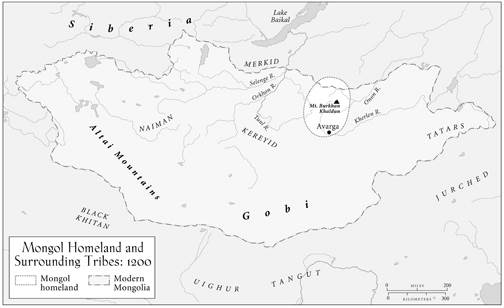
The story of the boy who was destined to become the world’s greatest conqueror began six decades before the Mongol conquest of Bukhara in one of the most remote places in the inner expanse of Eurasia, near the border of modern Mongolia and Siberia. According to legend, the Mongols originated in the mountain forest when Blue-Gray Wolf mated with Beautiful Red Doe on the shores of a great lake. Because the Mongols permanently closed this homeland to outsiders when Genghis Khan died, we have no historical descriptions of it. The names of its rivers and mountains are virtually unknown in the historical literature, and even modern maps give conflicting names to its features, in a great variety of spellings.
This territory of the Mongol clans occupied only a small part in the northeast of the country now known as Mongolia. Most of the country now spreads across a high plateau in north-central Asia, beyond the range of the Pacific Ocean’s moisture-bearing winds that water the lush coastal plains of Asia’s agricultural civilizations. By contrast, the winds that reach the Mongolian plateau mostly blow from the Arctic in the northwest. These winds release what little moisture they carry onto the northern mountains and leave the southern part of the country dry, a terrain known as govi, or to foreigners as the Gobi. Between the harsh Gobi and the moderately watered mountains to the north lie vast stretches of steppe that turn green in the summer if they get rain. It is along these steppes that the herders move in the summer, searching for grass.
Although reaching only about ten thousand feet above sea level, Mongolia’s Khentii Mountain Range consists of some of the oldest mountains on the planet. Unlike the jagged, youthful Himalayas, which can only be ascended with climbing gear, the ancient Khentii Mountains have been smoothed by millions of years of erosion so that, with only moderate difficulty, a horse and rider can reach all but a few of the peaks in summer. Marshes dot their sides; in the long winter, these freeze into a solid mass. The deeper indentations in the mountainsides collect snow and water that freeze into what looks like glaciers in the winter, but in the brief summer, they turn into beautiful lakes of cobalt blue. The spring thaw of ice and snow overflows the lakes and spills off the mountains to form a series of small rivers that flow out onto the steppe that in the best of summers shimmers with grass as green as emeralds, but in the worst of times can remain a burned brown for several consecutive years.
The rivers that flow out of the Khentii Mountains are small and remain frozen for much of the year—even in May, when the ice is usually thick enough to support a team of mounted horses and sometimes even a loaded jeep. The long, broad steppes that stretch out along these small rivers served as the highways for the Mongols toward the various regions of Eurasia. Spurs of this grassland reach west all the way into Hungary and Bulgaria in eastern Europe. To the east, they reach Manchuria and would touch the Pacific Ocean if not barred by a thin ridge of coastal mountains that cut off the Korean Peninsula. On the southern side of the Gobi, the grasslands slowly pick up again and join the heart of the Asian continent, connecting with the extensive agricultural plains of the Yellow River.
Despite the gentle roll of the landscape, the weather can be fierce, and changes abruptly. This is a land of marked extremes, where humans and their animals face constant challenges from the weather. The Mongols say that you can experience all four seasons in a single day in the Khentii. Even in May, a horse might sink into snowbanks so deep that it could barely keep its head up.
On this, the land by the side of the Onon River, the boy destined to become known as Genghis Khan was born. In contrast to the natural beauty of the place, its human history was already one of constant strife and hardship long before he was born in the spring of 1162, the Year of the Horse by the Asian calendar. On an isolated and bald hillock overlooking the remote Onon River, Hoelun, a young, kidnapped girl, struggled to give birth to him, her first child. Surrounded by strangers, Hoelun labored far away from the family that had raised her and the world she knew. This place was not her home, and the man who now claimed her as his wife was not the man whom she had married.
Only a short time before, her destiny had seemed so different; she had been the wife of another young warrior, Chiledu of the Merkid tribe. He had traveled to the eastern steppe to find and woo her from the Olkhunuud, a tribe noted for the beauty of its women. According to steppe tradition, he would have given her parents gifts and worked for them, perhaps for several years, before taking their daughter back to his tribe as his bride. Once married, the two had set out alone for the trek of many weeks back to his homeland. According to the Secret History, she rode in a small black cart pulled by an ox or a yak, and her proud husband rode beside the cart on his dun horse. Hoelun was probably no more than sixteen years old.
They traveled easily over the steppe, following the course of the Onon River, and then prepared to enter the mountainous range that divided them from the Merkid lands. Only a few hard days of travel through the isolated mountain valleys lay ahead of them before they would drop down into the fertile grassland of the Merkid’s herds. The young bride sat in the front of her small black cart unaware of the horsemen about to swoop down upon her, a violent assault that would not only forever change her life, but alter the course of world history.
A solitary horseman out hunting with his falcon looked down on Hoelun and Chiledu from his unobserved perch at the top of a nearby cliff. Hoelun and her cart promised greater game than he could capture with his bird.
Without letting the newlyweds see him, the hunter rode back to his camp to find his two brothers. Too poor to afford the presents necessary to make a marriage with a wife such as Hoelun, and perhaps unwilling to perform the traditional bride-service for her parents, the hunter chose the second most common way of obtaining a wife on the steppes: kidnapping. The three brothers set out in pursuit of their unsuspecting prey. As they swooped down toward the couple, Chiledu immediately galloped off to draw the attackers away from the cart, and, as expected, they chased after him. He tried in vain to lose them by circling around the base of the mountain to return to his bride, but even then Hoelun knew that her husband had not fooled the attackers, not on their own land, and that they would soon be back. Although only a teenage girl, she decided that in order to give her husband a chance to live, she must stay and surrender to her kidnappers. If she fled with Chiledu on one horse, they would be captured and he would be killed. But if he fled alone, only she would be captured.
The Secret History recounts that to convince her husband to cooperate with her plan, she told him, “If you but live, there will be maidens for you on every front and in every cart. You can find another woman to be your bride, and you can call her Hoelun in place of me.” Hoelun then quickly slipped out of her blouse and commanded her new husband to “flee quickly.” She thrust her blouse into his face as a parting gesture and said, “Take this with you so that you may have the smell of me with you as you go.”
Smell holds a deep, important place within steppe culture. Where people in other cultures might hug or kiss at meeting or departing, the steppe nomads sniff one another in a gesture much like a kiss on the cheek. Smelling carries deeply emotional meanings on different levels that vary from the familial sniff between parent and child to the erotic sniff between lovers. Each person’s breath and unique body aroma is thought to constitute a part of that person’s soul. By thrusting her blouse at her husband, Hoelun offered him a deeply important reminder of her love.
After that day, Hoelun would have a long and eventful life ahead of her, but she was indeed destined never again to see her first love. As he fled his wife’s kidnappers, Chiledu clutched her blouse to his face and turned back to look at her so many times that his long black braids beat like whips back and forth from his chest to his shoulders. As she saw her husband ride over the pass and slip forever from her sight, Hoelun gave vent to the full emotion of her heart. She screamed out so loudly, according to the Secret History, that “she stirred up the Onon River” and “shook the woods and valley.”
Her captor and the man destined to be her new husband was Yesugei of the small and insignificant band that would one day be known as the Mongols, but at this time he was simply a member of the Borijin clan, subservient to its more powerful Tayichiud relatives. Even more troubling for Hoelun than the status of her captor was that he already had a wife or concubine, Sochigel, and a son with her. Hoelun would have to struggle for her position within the family. If she was lucky the two women probably lived in separate gers, the domed tent homes made of felt blankets tied around a lattice framework, but they would have been in close daily proximity even if not in the same ger.
Hoelun grew up on the wide, open grassland where one could see over vast expanses in any direction and where great herds of horses, cows, sheep, and goats grazed and grew fat during the summer. She was accustomed to the abundant and rich diet of meat and milk offered by the life of the steppe. By contrast, the small tribe of her new husband subsisted on the northern edge of the herding world, where the steppes pushed up against the wooded mountains, without enough grassland to feed large herds. She would now have to eat harsher hunter’s foods: marmots, rats, birds, fish, and the occasional deer or antelope. The Mongols claim no ancient and glorious history among the steppe tribes. They were considered scavengers who competed with the wolves to hunt down the small animals, and, when the opportunity arose, steal animals and women from the herders of the steppe. Hoelun would rank as little more than captured chattel by them.
According to an often repeated account, Hoelun’s first baby supposedly struggled into the world tightly clutching something mysterious and ominous in the fingers of his right hand. Gently, but nervously, his young mother pried back his fingers one by one to find a large, black blood clot the size of a knucklebone. From somewhere in his mother’s warm womb, this boy had grasped the blood clot and brought it with him from that world into this one. What could an inexperienced, illiterate, and terribly lonely young girl make of this strange sign in her son’s hand? More than eight centuries later, we still struggle to answer the same questions that she had about her son. Did the blood clot represent a prophecy or a curse? Did it foretell good fortune or evil? Should she be proud or alarmed? Hopeful or fearful?
In the twelfth century, dozens of tribes and clans lived on the steppe in, as is characteristic of nomadic people, shifting combinations. Of all the steppe tribes, the Mongols’ closest relatives were Tatars and Khitan to the east, the Manchus yet farther to the east, and the Turkic tribes of central Asia to the west. These three ethnic groups shared a common cultural and linguistic heritage with some of the tribes of Siberia, where they possibly all originated. Located between the Tatars and the Turkic tribes with whom outsiders often confused them, the Mongols were sometimes known as Blue Turks or as Black Tatars. As speakers of Altaic languages, named for the Altai Mountain range in western Mongolia, their languages bore a distant similarity with Korean and Japanese, but none with Chinese or the other tonal languages of Asia.
Although the Turkic tribes and Tatars had coalesced into several tribal confederacies, the Mongols were divided into many small bands headed by a chief, or khan, and loosely based on kinship ties. The Mongols themselves claim a distinct identity from the Turkic and Tatar groups. They asserted, then and now, a direct descent from the Huns, who founded the first empire on the high steppe in the third century. Hun is the Mongolian word for human being, and they called their Hun ancestors Hun-nu, the people of the sun. In the fourth and fifth centuries, the Huns spread out from the Mongolian steppes to conquer countries from India to Rome, but they were unable to sustain contact among the various clans and were quickly assimilated into the cultures they conquered.
Shortly after he had kidnapped Hoelun, Yesugei had gone on a campaign against the Tatars and killed a warrior called Temujin Uge. Returning just after the birth of his son, he named the boy Temujin. Since people of the steppe received only one name in life, its selection carried much symbolism, often on several levels; the name imparted to the child its character, fate, and destiny. The bestowal of the name Temujin may have stressed the lingering enmity between Mongols and Tatars, but much scholarly and imaginative discussion has surrounded the precise meaning of Temujin’s name or what was being conferred upon him by his father. The best hint of the intended meaning comes from the Mongol practice of giving several children names derived from a common root word. Of her four subsequent children born after Temujin, Hoelun’s youngest son bore the name Temuge, and the youngest child and only daughter was named Temulun. All three names seem to have the common root of the verb temul—which occurred in several Mongol words meaning to rush headlong, to be inspired, to have a creative thought, and even to take a flight of fancy. As one Mongolian student explained to me, the word was best exemplified by “the look in the eye of a horse that is racing where it wants to go, no matter what the rider wants.”
Despite the isolation of the Mongolian world, the tribes who lived there were not cut off entirely from the currents of world events. For centuries before the birth of Genghis Khan, Chinese, Muslim, Hindu, and Christian civilizations filtered into the Mongol homeland; little of their culture proved adaptable, however, to the harsh environment of the high steppes. The nomadic tribes had distant but complex commercial, religious, and military relations with the constantly changing configuration of states in China and central Asia. Living so far to the north, the Mongols were essentially out of range of the trade routes that later became known as the Silk Route, which ran south of the Gobi, tenuously and sporadically connecting Chinese and Muslim societies. Yet enough trade goods filtered north to make the Mongols aware of the treasures that lay in the south.
For the nomads, trading with their neighbors and fighting with them constituted an interrelated part of the yearly rhythm of life, as customary and predictable as tending the newborn animals in the spring, searching for pastures in the summer, or drying meat and dairy products in the fall. The long, cold winter was the season for hunting. The men left home in small parties to roam the mountains and penetrate the forests hunting rabbits, wolves, sables, elks ibex, argali (wild sheep), boars, bears, foxes, and otters. Sometimes the whole community participated in hunts, where they would encircle as large an area as they could and drive the game toward a central slaughtering point. The animals provided not only meat, leather, and fur, but also antlers, horns, tusks, teeth, and bones that the nomads fashioned into a variety of tools, weapons, and decorations, and various dried organs that were used as medicines. The forest also supplied other goods for trade and daily life, including hunting birds that were taken from their nests in infancy.
The nomads traded the forest products, from family to family, ger to ger, toward the south, while manufactured products such as metal and textiles slowly moved north from the trading centers south of the Gobi. The Mongols survived on the most northern edge of this world, just at the juncture of the steppe and the northern Siberian forest. They lived as much through hunting in the forest as by herding animals on the steppe, and they exemplified the most extreme characteristics of both groups. They clung to the frayed ends of thin, delicate threads of trade connecting the northern tundra and the steppe with the agricultural fields and workshops of the south. So few goods penetrated the far north that it was said that among the Mongols the man with a pair of iron stirrups ranked as the highest lord.
Some years the hunting was poor, and the people would grow hungry early in the winter, without a supply of forest products to trade. In those years, the Mongols still organized their hunting parties. Only instead of heading north into the forest to hunt animals, they moved out across the steppe to hunt for humans. If the Mongols had nothing to trade, they raided the herders they could find out on the steppe or in isolated valleys. The attackers used the same tactics in approaching human prey as animals, and at first sign of attack, the targeted victims usually fled, leaving behind most of their animals, the material goods of their homes, and whatever else the attackers might want. Since the object of the attack was to secure goods, the attackers usually looted the gers and rounded up the animals rather than pursuing the fleeing people. Because the raiders wanted goods, casualties in this type of struggle remained low. Young women were kidnapped as wives and young boys as slaves. Older women and the youngest children were usually exempt from harm, and the men of fighting age usually fled first on the swiftest and sturdiest horses since they stood the greatest chance of being killed and the future livelihood of the entire group depended so heavily on them.
If the escaping men managed to summon allies quickly enough, they set off in pursuit of their attackers in an attempt to track them and recover their goods. If not, the defeated tribesmen rounded up as many of their animals as had managed to elude the captors, and they reorganized their lives as they nourished plans for their counterattack at a more propitious time.
For the Mongols, fighting functioned as more of a cyclical system of raiding than of true warfare or even sustained feuding. Revenge often served as the pretext for a raid, but it rarely acted as the true motivator. Success in battle carried prestige for the victor based on the goods brought back and shared with family and friends; fighting did not revolve around the abstract prestige of honor on the battlefield. Victorious warriors showed pride in their kills and remembered them, but there was no ostentatious collecting of heads or scalps, nor making notches or other emblems to represent the number of men killed in battle. Only the goods mattered, not the kill.
Hunting, trading, herding, and fighting formed a seamless web of subsistence activities in the lives of the early Mongol tribes. From the time that he could ride, every male began to learn the skills for each of these pursuits, and no family could live off only one activity without the others. Raiding followed a geographic pattern originating in the north. The southern tribes that lived closest to the trade cities of the Silk Route always had more goods than the more distant northern tribes. The southern men had the best weapons, and to succeed against them, the northern men had to move quicker, think more cleverly, and fight harder. This alternating pattern of trade and raiding supplied a slow, but steady, trickle of metal and textile goods moving northward, where the weather was always worse, the grazing more sparse, and men more rugged and violent.
Only a few details have survived from Temujin’s earliest childhood, and they do not suggest that he was highly valued by his father. His father once accidentally left him behind when they moved to another camp. The Tayichiud clan found him, and their leader, Targutai, the Fat Khan, took him into his own household and kept him for some time. Later in life, when Temujin became powerful, Targutai boasted that he had trained Temujin with the same careful attention and loving discipline that he would train a colt, a herder’s most prized possession. The details and sequence are unknown, but eventually the child and his family were reunited, either because the Fat Khan returned the boy to them or because the family joined the camp of the Fat Khan.
The next known episode in Temujin’s life occurred when his father took him in search of a wife at the early age of nine by the Mongol count, eight by the Western count. Yesugei and Temujin set out alone on the quest to find Hoelun’s family in the east, since, perhaps, Hoelun wanted her son to marry a woman of her own tribe or at least to know her family. More important than Hoelun’s preferences, however, Yesugei seemed to have wanted to be rid of him. Perhaps the father sensed the coming struggle that would erupt between his son Temujin and Begter, the slightly older son born to him by Sochigel, his first wife. By taking Temujin far away at this early age, the father probably sought to prevent the full eruption of the rivalry into trouble for his small family.
With only a single extra horse to present to the parents of the prospective bride, Yesugei needed to find a family that would accept Temujin as a laborer for several years, in return for which they would give him their daughter in marriage. For Temujin, this trip probably was his first venture away from his homeland along the Onon River. It was easy to become lost in unfamiliar territory, and the traveler faced the triple dangers of wild animals, harsh weather, and, most of all, other humans. As things turned out, the father did not bother taking Temujin all the way to Hoelun’s family. Along the way, they stayed with a family whose daughter, Borte, was only slightly older than Temujin. The children apparently liked each other, and the fathers agreed to betroth them. During his time of apprenticeship, or bride-service, Temujin was expected to live and work under the protective eyes of his in-laws. Gradually, the intended couple would become ever more intimate. Because the girl was normally slightly older than the boy, as was the case with Borte and Temujin, she would initiate him into sexual intimacy at the rate and in the timing that seemed appropriate to the two of them.
On the long ride home alone after leaving Temujin, Yesugei happened upon an encampment where the Tatars were celebrating a feast. The Secret History explains that he wanted to join the party, but he knew that he must not reveal his identity as the enemy who had killed their kinsman, Temujin Uge, in battle eight years earlier. Despite his attempted deceit, someone is said to have recognized him and secretly poisoned him. Although quite ill from the poison, Yesugei managed to leave the Tatars and return home to his family’s camp, whereupon he immediately sent a man to find and bring back Temujin, who had to leave Borte behind in the rush to his father’s deathbed.
By the time the boy arrived back at his family encampment, his father lay dead. Yesugei left behind two wives and seven children under the age of ten. At the time, the family still lived along the Onon River with the Tayichiud clan. For the last three generations the Tayichiud had dominated Yesugei’s Borijin clan. Without Yesugei to help them fight and hunt, the Tayichiud decided they had little use for his two widows and their seven young children. In the harsh environment of the Onon River, the clan could not possibly feed nine extra people.
By steppe tradition, one of Yesugei’s brothers, who helped to kidnap Hoelun, should have taken her as a wife. Under the Mongol system of marriage, even one of Yesugei’s sons by his other wife, Sochigel, would have been an appropriate husband for her if he had been old enough to support the family. Mongol women often married much younger men in their deceased husband’s family because it gave the younger man the opportunity to have an experienced wife without having to pay an elaborate set of gifts to her family or to put in the years of hard bride-service. Although still a young woman, probably in her mid-twenties, Hoelun already had too many children for most men to support. As a captive wife far from her homeland, she offered a potential husband neither family wealth nor beneficial family ties.
With her husband dead and no other man willing to take her, Hoelun was now outside the family, and as such no one had any obligation to help her. The message that she was no longer a part of the band came to her, the way Mongols always symbolize relationships, through food. In the spring, when two old crones, the widows of a previous khan, organized the annual ceremonial meal to honor the family’s ancestors, they did not inform Hoelun, thereby cutting her off not only from the food itself but from membership in the family. She and her family were therefore left to feed and protect themselves. As the clan prepared to move down the Onon River toward summer grounds, they planned to leave Hoelun and her children behind.
According to the Secret History, as the band moved out, deserting the two women and seven children, only a single old man, from a low-ranking family in the band, objected loudly to what they were doing. In an incident that apparently made a deep impression on Temujin, one of the deserting Tayichiud bellowed back to the old man that he had no right to criticize them, turned back, and speared the old man to death. Upon seeing this, Temujin, at this point a boy of no more than ten years, is said to have dashed up to try to help the dying man; unable to do anything, he just sobbed in hurt and anger.
Hoelun, who had shown such clearheadedness during her kidnapping a decade earlier, showed the same determination and strength during this new crisis. She made a violent and defiant last effort to shame the Tayichiud into keeping her family. As the clan deserted their encampment, she grabbed up the horsehair Spirit Banner of her dead husband, mounted her horse, and chased after them. Raising the Spirit Banner over her head and waving it furiously in the air, she circled the fleeing people. For Hoelun to wave the banner of her dead husband was not merely to wave his emblem but to parade his very soul in front of the deserting tribesmen. They indeed felt such shame in the presence of his soul, and fear of possible supernatural retribution from it, that they temporarily returned to the camp. They then awaited nightfall and, one by one, sneaked away, taking with them the family’s animals, thereby condemning to a nearly certain winter death both widows and their seven children.
But the family did not die. In a monumental effort, Hoelun saved them—all of them. As related in the Secret History, she covered her head, tucked up her skirt, and ran up and down the river searching for food day and night in order to feed her five hungry children. She found small fruits, and used a juniper stick to dig up the roots of the plants growing along the river. To help feed the family, Temujin made wooden arrows tipped with sharpened bones to hunt rats on the steppe, and he bent his mother’s sewing needles into fishhooks. As the boys grew older, they hunted larger game. In the words of the Persian chronicler Juvaini, who visited the Mongols fifty years later and wrote one of the first foreign accounts of the life of Temujin, the family wore clothing “of the skins of dogs and mice, and their food was the flesh of those animals and other dead things.” Whether precisely accurate or not, the description shows the desperate, isolated struggle of these social outcasts on the verge of starvation, living almost as much like animals as like the other tribes around them. In the land of harsh lives, they had fallen to the lowest level of steppe life.
How could an outcast child rise from such a lowly station to become the Mongols’ Great Khan? Searching through the account of Temujin’s coming of age in the Secret History, we find crucial clues about the powerful role these early traumatic events must have played in shaping his character, and, in turn, his rise to power. The tragedies his family endured seemed to have instilled in him a profound determination to defy the strict caste structure of the steppes, to take charge of his fate, and to rely on alliances with trusted associates, rather than his family or tribe, as his primary base of support.
The first of these powerful associations was with a slightly older boy named Jamuka, whose family camped repeatedly nearby Temujin’s on the banks of the Onon River and as a member of the Jadaran clan was distantly related to the clan of Temujin’s father. In the ideals of Mongol culture, kinship reigned above all other social principles. Anyone outside the kinship network was automatically an enemy, and the closer the kin, the closer the tie should be. Temujin and Jamuka were distant relatives, but they wished to be closer, to become brothers. Twice in their childhood, Temujin and Jamuka swore an oath of eternal brotherhood, becoming blood brothers according to Mongol tradition. The story of this fated friendship, and the pivotal events of his life in this early period, reveal many telling details about Temujin’s extraordinary ability to rise above adversity and marshal the resources he needed to ultimately tame the unbridled violence of tribe against tribe that ruled the steppe.
Temujin and Jamuka formed a close friendship as they hunted, fished, and played the games the children were taught to improve their everyday skills. Mongol children, both boys and girls, grew up on horses. From infancy, they learned to ride with their parents or older siblings until, after only a few years, they managed to hold on by themselves and ride alone. Usually by age four, children had mastered riding bareback, and eventually how to stand on a horse’s back. While standing on the horse, they often jousted with one another to see who could knock the other off. When their legs grew long enough to reach the stirrups, they were also taught to shoot arrows and to lasso on horseback. Making targets out of leather pouches that they would dangle from poles so that they would blow in the wind, the youngsters practiced hitting the targets from horseback at varying distances and speeds. The skills of such play proved invaluable to horsemanship later in life.
Other games included playing knucklebones, a type of dice made from the anklebones of a sheep. Every boy carried a set of four such knucklebones with him, and they could be used to forecast the future, to settle disagreements, or simply as a fun game. In addition, Jamuka and Temujin also played a more vigorous game on the frozen river that was somewhat like curling. Although the Secret History does not mention their use of skates, a European visitor in the next century wrote that hunters in the area frequently tied bones onto their feet to be able to race across frozen lakes and rivers both for sport and in pursuit of animals.
These skills later gave the Mongols a great advantage because, unlike almost every other army, the Mongols easily rode and even fought on frozen rivers and lakes. The frozen rivers that Europeans relied upon as their protection from invasion, such as the Volga and the Danube, became highways for the Mongols, allowing them to ride their horses right up to city walls during the season that found the Europeans least prepared for fighting.
Most of Temujin’s youth was consumed by the work of helping his family survive. The games Temujin and Jamuka played on the Onon River are the only known frivolities mentioned in any source on the life of the boy who became the great conqueror. The first time that Temujin and Jamuka swore loyalty to one another was when Temujin was about eleven years old. The boys exchanged toys as a symbol of this oath. Jamuka gave Temujin a knucklebone from a roebuck, and Temujin gave Jamuka one inlaid with a small piece of brass, a rare treasure that must have traveled a long distance. The next year they exchanged the adult gift of arrowheads. Jamuka took two pieces of a calf’s horn and, by drilling a hole through them, made a whistling arrowhead for Temujin, who, in turn, gave Jamuka an elegant arrowhead crafted from cypress. Like hunters had done for generations, Temujin learned early how to use the whistling arrow to communicate secretly through sounds that other people ignored or simply could not decipher.
As part of the second oath-swearing ceremony, boys often swallowed a small amount of each other’s blood, thereby exchanging a part of their soul. In the case of Jamuka and Temujin, the Secret History quotes Jamuka as saying that the two of them spoke to each other words that could not be forgotten and together they ate the unnamed “food that could not be digested.” With this oath, two boys became andas, a bond that was supposed to be stronger even than that between biological brothers because andas freely chose their tie. Jamuka was the only anda Temujin had in his life.
Jamuka’s clan did not return the following winter, and the coming years separated the boys. This bond forged in childhood, however, would later become a major asset and a major obstacle in Temujin’s rise to power.
In contrast with the early intimacy shared with Jamuka, at home Temujin chafed under the sometimes bullying authority of his older half brother Begter, and the sibling rivalry grew more intense as the two approached adolescence. A strict hierarchy normally ruled the family life of Mongol herders then, as it does now. In the face of so many daily dangers from both predators and weather, Mongols developed a system in which children had to obey their parents unquestioningly. In the absence of a father, whether for a few hours or for months, the eldest son assumed that role. The elder brother had the right to control their every action, to assign them any task, and to take from them or give them whatever he pleased. He exercised complete power over them.
Begter was slightly older than Temujin, and gradually after the father was killed, he began to exercise the power prerogatives of the eldest male. In an account known only from the Secret History, Temujin’s resentment erupted in an episode that initially appears quite trivial. Begter, it seems, seized a lark that Temujin had shot. Begter may have taken it for no other reason than to enforce his claim as the head of the family; if so, he would have done well not to have lorded his power over Temujin. Soon thereafter, Temujin and his full brother Khasar, who was next to him in age, sat together with their two half brothers Begter and Belgutei fishing in the Onon River. Temujin caught a small fish, but the half brothers snatched it from him. Angered and frustrated, Temujin and Khasar ran to their mother, Hoelun, to tell her what had happened. Instead of taking the side of her own sons, however, she sided with Begter, telling them they should be worrying about their enemies, the Tayichiud, who had abandoned them, and not fighting with their older brother.
Hoelun’s siding with Begter portended a future that Temujin could not abide. As the eldest son, Begter not only could command the actions of his younger siblings, but he had wide prerogatives, including rights of sexual access, to any widow of his father, aside from his own mother. As a widow not taken in marriage by one of her late husband’s brothers, Hoelun’s most likely partner would be Begter, since he was her husband’s son by another wife.
At this moment of tremendous family tension and potential disruption, Hoelun angrily reminded her own sons of the story of Alan the Beautiful, the founding ancestress of the Mongols, who bore several more sons after her husband died and left her living with an adopted son. The implication of the story seemed clear; Hoelun would accept Begter as her husband when he became old enough, thereby making him the head of the family in every sense. Temujin, however, decided not to tolerate such a situation with Begter. After the emotional confrontation with his mother over Begter, Temujin threw aside the felt covering over the doorway, a highly offensive gesture in Mongol culture, and angrily rushed off, followed by his younger brother Khasar.
The two brothers found Begter sitting silently on a small knoll overlooking the steppe, and approached him cautiously through the grass. Temujin instructed Khasar, who was the best shot in the family, to circle toward the front of the knoll while he himself climbed up the back side. They crept up on Begter quietly, as if stalking a resting deer or grazing gazelle. When they came within easy striking distance, each silently placed an arrow in his bow, and then suddenly rose out of the grass with bows drawn. Begter did not run, or even attempt to defend himself; he would not deign to show fear in front of his younger brothers. Admonishing them, in the same words as their mother had, that their real enemy was the Tayichiud clan, he is reported to have said, “I am not the lash in your eye, the impediment in your mouth. Without me you have no companion but your own shadow.” He sat cross-legged and still as his two younger brothers continued to approach him. Knowing clearly what fate lay ahead, Begter still refused to fight. Instead, he made one final request of them, that they spare the life of his younger full brother, Belgutei.
Maintaining their distance from him, Temujin and Khasar shot their arrows straight into Begter, Temujin striking him in the back, while Khasar hit him from the front. Rather than approach him and risk contamination from his blood, which was flowing onto the earth, they turned and abandoned him to die alone. The author of the Secret History does not state whether he died quickly or bled to death in a long, lingering end. According to Mongol tradition, mere mention of blood or death violates a taboo, but this killing was deemed of such importance to Temujin’s life that it was recorded in detail.
When Temujin and Khasar returned home, Hoelun is said to have read immediately in their faces what they had done and screamed out at Temujin: “Destroyer! Destroyer! You came from my hot womb clutching a clot of blood in your hand.” She turned to admonish Khasar: “And you like a wild dog gnawing its own afterbirth.” Her screaming rage at Temujin is vented in one of the longest monologues in the Secret History, during which, in repeated insults, she compares her sons to animals—“like an attacking panther, like a lion without control, like a monster swallowing its prey alive.” At the end, exhausted, she repeated Begter’s earlier warning as though it were a curse: “Now, you have no companion other than your shadow.”
Already, at this young age, Temujin played the game of life, not merely for honor or prestige, but to win. He stalked his brother as if he were hunting an animal, just as he would later prove to have a genius for converting hunting skills into war tactics. By putting Khasar, who was the better shot, in front while he himself took the rear, he also showed his tactical acumen. Like the horse that must be first in every race, Temujin had determined he would lead, not follow. In order to achieve this primacy of place, he proved himself willing to violate custom, defy his mother, and kill whoever blocked his path, even if it was his own family member.
While the killing of Begter freed Temujin from the grip of his half brother’s dominance, he had committed a taboo act that put his family in still greater jeopardy. They would have to immediately flee the area, and did so. According to Mongol tradition, they left Begter’s body to rot in the open, and avoided returning to that spot for as long as any trace of him might remain. Just as both Begter and Hoelun had admonished, Temujin now found himself with no protector or ally, and he would soon be hunted. He was head of a household, but he was also in danger as a renegade.
Until this time Hoelun’s family had been a band of outcasts, but not criminals. The killing changed all that and gave anyone who wanted it an excuse to hunt them down. The Tayichiud considered themselves the aristocratic lineage of the Onon River and sent a party of warriors to punish Temujin for the killing in their territory and to forestall what he might do next. With no place to hide on the open steppe, Temujin fled toward the safety of the mountains, but his pursuers still captured him. The Tayichiud took him back to their main camp where, in an effort to break his will, they strapped him into a cangue, a device something like an ox yoke, which permitted him to walk but immobilized his hands and prevented him from feeding himself or even getting a drink of water unaided. Each day a different family assumed responsibility for guarding and caring for him.
The Tayichiud band had several households of subordinate lineages, as well as war captives, living with them as their servants, and it was to these servant families that Temujin was turned over as a prisoner. Unlike the Tayichiud, who treated him with disdain, he found sympathy and comfort among these families when they took him into their gers at night. Protected from the view of the Tayichiud leaders, they not only shared food with him, but in one episode highlighted in the Secret History, an old woman gently tended the raw wounds cut into his neck by the cangue. The children of the family also persuaded their father to violate his orders by removing the cangue at night, to let Temujin rest more peacefully.
The story of Temujin’s escape from this impossible situation is further testament to his character, which would shape his rise to power. One day while the Tayichiud men got drunk and Temujin had been assigned to the care of a simpleminded and physically weak boy, the captive suddenly swung the cangue around violently, struck the boy’s head with it, and knocked him out. Rather than face almost certain death by fleeing on foot across the steppe wearing the cangue, he hid in a clump of weeds in a nearby river. Shortly after a search began, he was quickly spotted by the father of the family that had treated him kindly. Rather than sounding an alarm, the old man told him to flee when darkness fell. After dark, Temujin left the river, but did not flee. He slowly made his way to the old man’s ger and entered it, much to the horror, and danger, of the family. But despite the great risk to their own lives, the reluctant hosts removed the cangue and burned it. They hid Temujin in a pile of wool during the next day when the Tayichiud resumed their hunt for him. That night, they sent him on his way, and despite their poverty, cooked a lamb for him and gave him a horse with which he managed to elude his trackers for the long flight back to his mother’s distant and isolated camp.
For a poor family to risk their lives to help him and to give him such valuable resources, Temujin must have had some special attraction or ability. Meanwhile, this humble family impressed him as well. The Tayichiud, with whom he shared a close kinship tie, had once put his family out to die and now appeared eager to kill him. This other family, which had no kinship tie to him, proved willing to risk their lives to help him. This episode seems to have instilled in him not only a distrust of higher-ranking people, but also the conviction that some people, even those outside his clan, could indeed be trusted as if they were family. In later life, he would judge others primarily by their actions toward him and not according to their kinship bonds, a revolutionary concept in steppe society.
Mongol traditions and sources acknowledge only this one brief period of capture and enslavement of Temujin, but a contemporary Chinese chronicler wrote that Temujin endured more than ten years in slavery. He may have been repeatedly enslaved, or this episode may have lasted much longer than the Secret History suggests. Some scholars suspect that such a long period of enslavement accounts for the glaring absence of detailed information on his childhood. In later years, the time of enslavement would have been an episode of shame for Genghis Khan, but even more importantly would have been a tremendous danger to the descendants of the families that had enslaved him. Virtually everyone associated with the slavery episode had good reason to keep silent about that connection, and to make it seem briefer would be in keeping with Mongol sensibilities that would dictate only barely mentioning the bad while emphasizing instead the heroic nature of the escape.
In 1178, Temujin turned sixteen. He had not seen his intended wife, Borte, since his father’s death seven years earlier, but he felt confident enough in the matter to go out to find her again. Accompanied by his surviving half brother, Belgutei, he set off down the Kherlen River in search of her family. When they found the ger belonging to Borte’s father, Dei-sechen, Temujin was pleased to discover that Borte still waited for him, even though at age seventeen or eighteen she was now nearly past the age of marriage. Dei-sechen knew of Temujin’s troubles with the Tayichuid clan, but was nevertheless still amenable to the match.
Temujin and Belgutei set off toward home with Borte. By custom, a new bride brought a gift of clothing to her husband’s parents when she came to live with them. For nomads, large gifts are impractical, but high-quality clothing carries high prestige and also serves a valuable practical function. Borte brought a coat of the most prized fur on the steppe, black sable. Under normal circumstances, Temujin would have presented such a gift to his father, but in the absence of a father, he perceived a greater value to which he could put the coat. He decided to use the sable coat to revive an old friendship of his father’s, and thereby make an alliance that might offer him and his now growing family some security.
The man was Torghil, more commonly known later as Ong Khan, of the Kereyid tribe that lived on some of the most luxuriant steppes in central Mongolia between the Orkhon River and the Black Forest of larch trees along the Tuul River. Unlike the scattered lineages and clans of the Mongols, the Kereyid constituted a powerful tribal confederacy that embraced a large group of tribes united under a single khan. The great expanse of the steppe north of the Gobi fell, at this time, under the rule of three major tribes. The center was controlled by Ong Khan and his Kereyid tribe, the west was dominated by the Naiman tribe under their ruler Tayang Khan, and the Tatars occupied the area to the east as vassals of the Jurched of North China under their ruler Altan Khan. The rulers of the three large tribes made and broke alliances and waged wars with the smaller tribes along their borders in a perpetual effort to enlist them in campaigns against their more important enemies. Thus, Temujin’s father, Yesugei, had no kinship tie with the Kereyid, but he had once been the anda of Ong Khan, and they had fought together against many enemies. The tie between the men had been stronger than merely patron and vassal because when they were quite young, Yesugei helped Ong Khan become khan of the Kereyid people by overthrowing his uncle, the Gur-khan, or supreme ruler. In addition, they had fought together against the Merkid and were allied at the time of Temujin’s birth, when Yesugei was on the campaign against the Tatars.
According to steppe culture, politics were conducted through the idiom of male kinship. To be allies, men had to belong to the same family, and therefore every alliance between men not connected through biology had to be transformed into ceremonial or fictive kinship. Thus, with Temujin’s father and the would-be Kereyid leader having been ceremonial brothers as andas, Temujin now sought to be treated as a son to the old man. By giving Ong Khan the wedding gift, Temujin was recognizing him as his father; and if Ong Khan accepted, he would be recognizing Temujin as his son and therefore entitled to protection. For most steppe men, such forms of ceremonial kinship stood as adjuncts to their real kin relations, but for Temujin, such chosen forms of fictive kinship were already proving more useful than the ties of biological kinship.
The Kereyid, and the Naiman to the west, represented not just larger political units but more developed cultures tied, ever so tentatively, into the commercial and religious networks of central Asia via their conversion to Christianity several centuries earlier by missionaries of the Assyrian Church of the East. Without churches or monasteries among the nomads, the tribal branch of Christianity claimed descent from the Apostle Thomas and relied on wandering monks. They practiced their religion in sanctuaries located in gers, and de-emphasized theology and rigidity of belief in favor of a varied reading of the Scriptures combined with general medical care. Jesus exercised a strong fascination for the nomads because he healed the sick and survived death. As the only human to triumph over death, Jesus was considered an important and powerful shaman, and the cross was sacred as the symbol of the four directions of the world. As a pastoral people, the steppe tribes felt very comfortable with the pastoral customs and beliefs of the ancient Hebrew tribes as illustrated in the Bible. Perhaps above all, the Christians ate meat, unlike the vegetarian Buddhists; and in contrast to the abstemious Muslims, the Christians not only enjoyed drinking alcohol, they even prescribed it as a mandatory part of their worship service.
After leaving his bride, Borte, with his mother in their ger, Temujin set out with his brother Khasar and half brother Belgutei to take the coat to the Christian Ong Khan, who eagerly accepted the gift, thereby signifying that he acknowledged each of them as a sort of stepson. The khan offered to make Temujin a local leader over other young warriors, but in a telling display of his lack of interest in the traditional system, Temujin declined. Instead, he seemed only to want the khan’s protection for his family, and with that assured, he and his brothers returned to their encampment on the Kherlen River. There, the young groom sought to enjoy his hard-earned time with his bride and family.
The many troubles of Temujin’s early years must have seemed behind him and his family now that everyone was old enough to work in some way. In addition to his brothers, Temujin’s household expanded to include two other young men. Boorchu had joined the group after a chance encounter while Temujin was tracking some stolen horses; Jelme was apparently given to Temujin by his father, although the Secret History does not explain why. With these two additions, the camp consisted of seven teenage boys to hunt and protect the group. In addition to his bride, Borte, Temujin’s household also included his sister and three older women: his mother, Hoelun, who was matriarch, as well as Sochigel, the mother of Temujin’s half brother Belgutei, and yet another old woman of unknown origin who stayed with them.
According to the account of the Secret History, Temujin would have preferred to remain simply the ruler of this intimate clan, but the roiling world of tribal attack and counterattack all around them would not allow so idyllic a life. For generations stretching back through hundreds of years, the tribes of the steppes had been preying on one another mercilessly. The memory of past transgressions lingered. An injury inflicted on any family within a tribe served as a license for retribution, and it could serve as a pretext for a raid even after many years. No matter how isolated they might attempt to be, no group such as Temujin’s could go unaccounted for, or untouched, in this world of continual turmoil.
After all his family had already suffered, now, after eighteen years, the tribe from which Temujin’s mother had been abducted, the Merkid, decided to seek their vengeance for that slight. The Merkid came not to reclaim Hoelun, the widow who had grown old struggling to raise her five children, but after Borte, Temujin’s young bride, who would serve to repay the kidnapping of Hoelun from them. The alliance he had so shrewdly made with Ong Khan was to prove decisive in Temujin’s response to this crisis, and the challenges of the Merkid would prove the decisive contest that would set him on his path to greatness.