
2
Ancient British Weapons: London 1673
The first palaeolith to be recognised and described in the historical record was a handaxe, found in London, England, in 1673. The finder was John Conyers (1633–1694), a respected and well-connected apothecary, inventor and antiquary with premises in Fleet Street (Burnby 1984). One of Conyers’s main pleasures in life was “to make curious observations and to collect such antiquities as were daily found in and about London” (Bagford 1715, LXIII), and he took full advantage of the rebuilding of the city after the Great Fire of 1666 in furthering this pastime. By closely investigating the ground beneath London, as revealed in foundations, ditches and gravel pits, Conyers amassed a wealth of Roman, Saxon and ‘British’ finds (Burnby 1984).
On Monday 11 December 1673, Conyers investigated some gravel pits on the floodplain of the River Fleet, including one on the right bank near to Battlebridge (modern Kings Cross), and another ~800m south-southeast and on the other side of the river, close to the lost landmark of Black Mary’s Well (Conyers BL MS Harl 5953; Bagford 1715; White et al. 2018). Both pits yielded unusual bones and teeth belonging to very large animals, found lying pell-mell through sands and gravels 3–4m beneath the surface, and in one of them, the pit near Black Mary’s, these bones were associated with a flint object shaped like a lance or spear head (Figure 2.1). Conyers had no hesitation in identifying it as a stone tool or weapon made by the ancient ‘Brittish’ (sic) and suggested that the bones had belonged to elephants brought to Britain as part of Emperor Claudius’s invasion force, beasts of war killed in a documented historical event. Both made perfect sense in terms of Conyers’s educated understanding of the world.
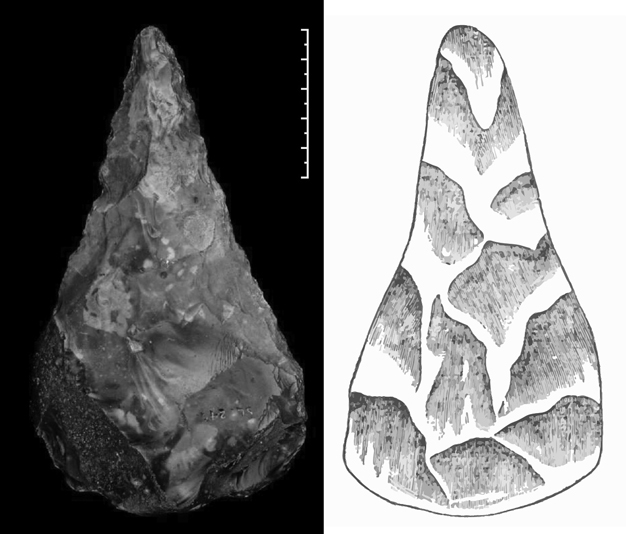
Figure 2.1 Roman frontiers: photograph and 1715 line drawing of the Gray’s Inn Road (London) handaxe, discovered by John Conyers on 11 December in 1673. Fossilised elephantid remains were recorded in the same pit on the same date. S cale = 5cm.
Source: Photograph © Trustees of the British Museum. Drawing after Bagford 1715.
Flint objects in the shape of arrowheads and axes had been known for centuries but had been generally thought to be natural phenomena caused by thunder and lightning strikes (hence the historical name for them, ceraunia, from the Greek for thunderbolt: Evans 1872). This belief is archaeologically visible at least as far back as the Romans. In the 1970s–1980s, archaeologists excavating a second-century Roman settlement at Ivy Chimneys, Witham (Essex), discovered a cache of 44 Lower Palaeolithic handaxes which, judging by the range of condition and form, were collected from different sources and deliberately deposited in two large depressions (Turner and Wymer 1987). The excavators concluded that the site was a temple complex dedicated to Jupiter or a native sky god, the thunderbolts presumably offered as a tribute to the deity’s power.
Beyond oral tradition and folklore, biblical and classical writers also mentioned ancient peoples who used stone to make arrowheads, spears and axes, yet it was not until the mid-1600s, after ethnographical information from the Americas and South Pacific provided contemporary examples of stone tool–using peoples, that new ideas about ceraunia began to take hold (Evans 1872; Trigger 1989). In Britain, William Dugdale (1605–1686) attributed stone tools to ancient Britons who lacked knowledge of metals as early as 1656 (Dugdale 1656), an opinion later shared by his son-in-law and keeper of the Ashmolean Museum, Robert Plot (1640–1696). By the time Conyers’s friend and fellow antiquary John Bagford (1650–1715: Gatch 1986) published an account of the ‘Gray’s Inn Road’ handaxe in 1715, important antiquarians across Enlightenment Europe had amassed collections of stone tools and knew them, without doubt, to be ancient human artefacts. Just a generation or so earlier this would not have been true – the famous seventeenth-century Danish antiquarian, Ole Worm (1588–1655), went to his grave believing that ceraunia were of celestial origin (Trigger 1989).
As early adopters of new ideas about ancient stone tools, Bagford and Conyers were not much troubled by the status or character of the stone implement, for them the main question was “How this elephant came here?” (Bagford 1715, lxiv). Their biggest problem here was essentially that of time. Their temporal compass was guided by the study of chronology, which used scripture and other ancient writings to calculate the age of the world and length of human history. Archbishop Ussher’s (in)famous and near-contemporary (1650) calculation – that the earth was formed in 4004 BC – was just one among many,1 most of which followed still older notions that 4,000 years separated the Creation from the birth of Christ (Daniel 1962; Gould 1991). Perceptions of the ancient Britons, the peoples who inhabited the British Isles in the period between the Flood (2349 BC according to Ussher) and the coming of the Romans in 55 BC, were similarly limited to the information provided by classical writers. Interestingly, these texts also revealed pagan philosophies that promoted a natural origin for humans and a deep prehistory in which our species gradually progressed from a bestial state to civilisation. Such ideas had been rejected by Christian thinkers in the early Medieval period and replaced with the more familiar biblical narrative of divine creation and a short human history (Goodrum 2004a). Renewed enquiry into these ancient texts during the Renaissance brought new and sometimes controversial ideas2 but had little immediate impact on the status quo (ibid.).
In reaching his conclusion, written some 40 years after the discovery, Bagford rejected the myth held by ‘some’ (he doesn’t specify whom) that the elephants were relics of the Biblical deluge, drowned animals that had simply floated north on the flood waters, as well as the folk legend that they represented an ancient race of giants. Having no concept of deep time, extinction or prehistoric humans, and having rejected any suggestion that the finds were of mythical or supernatural origin, the only known historical facts that fitted the available evidence were the Roman army and the ancient Britons.
Bursting the Limits of Time: Hoxne 1797
The idea that handaxes might be extremely ancient was first publicly voiced by John Frere (1740–1807), an English antiquarian and politician whose curriculum vitae included the office of High Sheriff of Suffolk and MP for Norwich. In the spring of 1797, Frere was wandering the village of Hoxne, Suffolk, when he ‘found’ a number of ‘flint weapons’ in a local brick pit. He reported his find to the Society of Antiquaries of London in a letter read before the fellows on 22 June 1797 and published in their journal Archaeologia three years later (Frere 1800). Frere’s handaxes (Figure 2.2) came from a bed of gravel 12ft (3.65m) below ground level, over which lay a sand bed containing mollusc shells and animal bones. Like the London discovery a century earlier, it was not the handaxes that were seen as unusual; indeed, Frere stated (1800, 204) they were ‘not particularly objects of curiosity in themselves’. What amazed Frere was their geological context: the fact that there was no higher ground from which they could have fallen and the way they lay suggested that the gravel was truly their place of origin and manufacture. The bones included enormous unidentified animals, while the shells were (erroneously) identified as belonging to marine species, suggesting that the land had been inundated by the sea on at least one occasion since their deposition. Given all the evidence, Frere assigned his ‘weapons of war’ to ‘a very remote period indeed’, one ‘beyond that of the present world’ (1800, 205). This must have been quite a surprise to the workman at the pit, who had previously considered them so commonplace he had used basket loads to mend ruts in the road.

Figure 2.2 Beyond the present world: two handaxes discovered by John Frere at Hoxne in 1797. Scale = 5cm (after Frere 1800).
Although flint axes were widely recognised as artefacts, eighteenth-century antiquarians still had to explain why the earliest peoples of Europe had used only stone for their tools. The Bible recorded that metalworking had been invented by Tubal-Cain some seven (biblical) generations after Adam, meaning that metal weapons and tools must have been wellknown to Adam’s descendants before the deluge and to Noah’s lineage afterwards. This left about a millennium at the beginning of human history when people in different countries would have been without the benefits of metals (e.g. Mahudal 1740). Adapting the biblical tradition, John Woodward (1728), argued that conditions after the flood had been so difficult that the survivors and their descendants had become culturally degenerate, forgetting metalworking and other arts. His was one of several similar proposals made in this age of reason (Goodrum 2002, 2004a, 2004b). Others ignored the biblical narrative entirely. Charles Lyttelton (1714–1768), a fellow of the Royal Society and the Antiquaries, suggested that stone tools were relicts of the earliest times, made by barbarous people who had no knowledge of metals (Goodrum 2002), an assertion that applied not just to Britain, but the whole world. Whether primitive relicts or degenerates, the implication was still that the earliest occupants of Europe had been like the ‘savage’ Americans and Pacific Islanders who had never known or rediscovered metals, a somewhat alarming concept for Georgian society (Goodrum 2002).
As human artefacts, stone tools were an antiquarian problem, but the contexts in which they were now being found made them a geological one too. Frere’s precise choice of words – ‘beyond the present world’ – suggests that he was well informed in this field of enquiry. The eighteenth century had seen the publication of several influential ‘Theories of the Earth’ (or Geotheories, see Rudwick 2005). As early as 1749, Comte de Buffon (1707–1788) proposed a steady-state theory, which argued that since its creation, an immeasurable but finite length of time ago, the Earth had existed in a state of dynamic equilibrium, continuous erosion balanced by the creation of new continents forming a succession of worlds, all more or less the same. In a series of publications from 1785, James Hutton (1726–1797) likewise saw the Earth as a well-calibrated and well-balanced machine. His Earth, however, was eternal, with no beginning and no end, just an endless cycle of similar worlds, all potentially fit for human habitation. By this time Buffon had changed his mind (Rudwick 2005). His second geotheory, developed from 1778 onwards, was a directional model that took then-current ideas that the Earth had gradually cooled through time and defined a series of seven stages or ‘epochs’ through which it had passed. Each epoch had possessed a unique and unrepeatable character, only the last of which had been suitable for the late-appearing humans.
At around the same time, the British-based Swiss geologist Jean-Andre de Luc (1727–1817) proposed a binary model that saw in the geological record evidence of one previous cycle, a former world separated from the present world by a sudden rupture, which he equated with the biblical flood. As his rupture had seen the sea and land exchange places, no evidence of the unfortunate pre-deluge humans would be expected on Earth today. By the end of the century, de Luc had modified his theory to include six geological epochs, modelled on the six days of Creation (de Luc 1798). Thus, as Rudwick (2005, 2008) has been at pains to emphasise, these early geologists were not handicapped by literal adherence to a biblical chronology, nor were they engaged in a constant battle with religious authorities. There were certainly outspoken scriptural literalists, but for those who understood the teachings of natural history and geology, including numerous members of the clergy, the first chapter of Genesis was allegorical not historical, and the Earth was much older than the 6,000 years favoured a century or more earlier. Theirs was a natural theology (Rudwick 2008), which saw God’s guiding hand and ultimate design in all natural phenomena: they had little use for a revealed theology that took the entire Mosaic narrative literally. Nothing in the geological record, however, seriously challenged the biblical account of our relative time and place in nature, as many devout geologists were no doubt relieved to point out.
What unites most of these theories – other than the fact that they were well-known among the savants of Europe via a ‘republic of letters’ that persisted despite several wars (Rudwick 2005) – is the notion that the present world was preceded by at least one former world with different characteristics. The most recent transition, evidence of which was contained in the unconsolidated ‘superficial’ deposits at the top of the geological stack, was undoubtedly recent, perhaps only five or six millennia in the past. Most eighteenth-century geologists accepted that humanity had only appeared afterwards, our arrival marking the division between the present and former worlds. By assigning the handaxes at Hoxne to a period before the present world, Frere was therefore not only saying that these finds were old but was pushing human antiquity beyond recorded history and into the deeper past of geological time. It was a deeply significant claim, although it seems unlikely that Frere would ever have imagined a period much greater than 6,000 years.
Frere’s letter had little immediate impact and was quietly forgotten for almost 60 years. According to Grayson (1983), this was likely because he failed to prove that the shells found at Hoxne were marine, which would have been conclusive evidence of a rupture between worlds, or that the enormous animal bones belonged to extinct species. He had just made bold assertions that more experienced geologists could choose to ignore. In fact, Frere probably never even saw the bones. These had been given to Sir Ashton Lever (1729–1788) over a decade earlier, and in 1787 had passed into the hands of James Parkinson (1730–1813), founder of the Rotunda Museum at Blackfriars; when the museum failed, the collection was widely dispersed.
The lack of promotion at home may partly explain why the eminent French geologist and ‘father of palaeontology’ Georges Cuvier (1769–1832), who in the next century would systematically examine all claims for ancient human presence before the last revolution (Cuvier 1811, 1825; Rudwick 2005, 2008), never mentioned the Hoxne fauna or stone tools. If he were aware of the finds, which seems likely given how far his networks spread from the Museum d’Histoire Naturelle and Académie des Sciences in Paris, he probably considered them dubious or of more recent origin, like other stone tools (Martin Rudwick, pers comm, October 2018). The Gray’s Inn Road find, at this time in the custodianship of the British Museum, had similarly faded from memory. Other early finds, such as the handaxe found in 1830 at Dallow Farm near Luton (Bedfordshire), were just curios that remained unreported until much later (Smith 1894).
The Last Revolution: Kent’s Hole 1824
While it is unclear whether Cuvier knew of the Hoxne finds, he was certainly familiar with the stone tools found in association with extinct animals at Kent’s Hole (or Cavern) between 1825 and 1829, having corresponded with their excavator, Rev. John MacEnery (1796–1841, see more on this later in the chapter). So too was Cuvier’s English counterpart William Buckland (1784–1856), who has frequently been accused of suppressing the obvious conclusions because they did not conform to the ‘diluvial theory’ that dominated British geology throughout the 1820s (e.g. Evans 1872; Sollas 1911; Kennard 1945; Daniel 1950, 1962; Marsden 1983; cf. Trigger 1989; Sommer 2007), a decade that saw debate on human antiquity assume much greater prominence.
Buckland was the first Reader (and later Professor) of Geology at the University of Oxford who enjoyed scholarly and popular acclaim for his work on cave geology and extinct faunas, published under the title Reliquiae Diluvianae – Relics of the Flood (Buckland 1823). He was gloriously eccentric and possessed of a ribald, slapstick sense of humour, which he would often use to his advantage to defuse difficult situations (Gordon 1894; Sommer 2007). For both Buckland and Cuvier, the geological and fossil record revealed a series of sudden and dramatic ‘revolutions’, each of which had seen the extinction of more archaic forms of life and the appearance of increasingly ‘higher’ animals. They also agreed that the last of these took place around 5,000–6,000 years ago, but only Buckland explicitly associated the most recent ‘revolution’ with the biblical Noachian deluge, adopting the terms diluvial and diluvium to describe the event and its deposits.
Buckland’s cave explorations at Kirkdale Cave, North Yorkshire, in 1821 had furnished him with strong factual evidence that this was indeed the case (Rupke 1983; Rudwick 2005, 2008; Sommer 2007). At Kirkdale, Buckland meticulously recreated an ancient world using the most modern scientific and deductive techniques available, including chemical analysis of coprolites and actualistic comparisons with living hyaenas held captive in zoos. He was able to show that the cave had been used by denning hyaenas, who had left the chewed remains of their meals, their faeces and ultimately their corpses strewn over the cave floor: they had not been washed in from afar by the flood but represented animals living in England in the period immediately beforehand – the antediluvial period. Only a thin layer of diluvium covering the bone bed had been deposited by the ‘Universal Deluge’. This meant that there had been no wholesale exchange in the location of the oceans and land as envisaged by de Luc and Cuvier (note: Cuvier had also begun to realise this: Rudwick 2005, 558), and that the limestone forming the cave had not been formed by the flood, as held by some biblical literalists, but had grown aeons beforehand (Rupke 1983).
Despite antediluvian humans being clearly recorded in the Bible, Buckland could find no satisfactory evidence for their actual contemporaneity with antediluvian mammals. He had interrogated all existing claims and found them wanting (Buckland 1823). This absence initially troubled Buckland, who mused that humans must have been geographically restricted to Asia prior to the flood, only reaching north-west Europe long afterwards (Rupke 1983). Nonetheless his diluvial theory required antediluvial humans to be found somewhere, and he hoped they would. Cuvier, on the other hand, had no such expectations. For him, humans had either not existed before the last revolution, or any that had now rested at the bottom of the oceans.
When reports of mammoth and other exotic fauna from Goat’s Hole, Paviland, in Wales reached Buckland in December 1822 he immediately arranged to visit (Sommer 2007). In the event, Buckland probably spent little more than a day in Goat’s Hole (Sommer 2007; Weston 2008), over the course of 21–22 January 1823, during which time he uncovered a partial human skeleton (the famous Red Lady of Paviland, see Aldhouse-Green 2000), marine shells, ivory rings and animal bones, including a sheep scapula (shoulder blade). The cave had been disturbed by previous explorers, but enough evidence remained to convince Buckland that this cavern was not of the hyaena-denning type and that the fauna had, in this case, been swept into the cave during the flood or fallen in through a fissure before it. The burial could only be more recent, dug into the older diluvium, while the people who had carried out the interment were also responsible for mixing recent and ancient materials: on finding ancient ivory, they had redeployed it for ornaments and rods. Buckland at first joked that the body had belonged an exciseman, presumably one buried in the cave under suspicious circumstances (Sommer 2007). He also briefly entertained the possibility that it might belong to a witch or a prostitute linked to a ‘British’ encampment situated above the cave, before settling on a more neutral interpretation that still associated ‘her’ with the ancient military camp, but made no comment on her profession (Sommer 2007; Weston 2008).3
Kent’s Hole came to Buckland’s attention the following year, too late for inclusion in his highly popular book. In September 1824, Thomas Northmore, writer and unsuccessful parliamentary candidate from Cleve in Devon (1766–1851), investigated Kent’s Hole searching for a Mithraeum (a temple to the sun-divinity Mithras), but having recently become aware of Reliquiae Diluvianae was also alert to the possibility of finding fossil bones (Pengelly 1868a). He quickly amassed about 30 specimens, which he duly reported to Buckland. The following month the natural historian and geologist Sir W.C. Trevelyan (1797–1879) made similar discoveries, and likewise reported them to Buckland. Buckland visited the cave (perhaps not for the first time, see Sommer 2007) in January 1825, with Northmore and Sir Thomas Acland, MP (1787–1871), finding bones and a ‘flint knife’, the first from a cave in England (Anon 1825). It was interpreted as belonging to the ancient Britons. He returned in the summer of 1825, accompanied by Northmore and Rev. John MacEnery, chaplain to the Cary family at Tor Abbey. The clergyman had no geological knowledge and joined the group out of idle curiosity (Pengelly 2004), but he was fortunate enough to find a rhinoceros tooth and another flint knife, identified and interpreted by Buckland as a ‘supposed British relick’ (Pengelly 1869a, 443).
MacEnery returned to Kent’s Hole in October 1825, when he discovered more bones in an area where the stalagmite floor was broken and the underlying sediments more easily accessed. He sent them to Buckland who encouraged him to continue the search, which he did, intermittently, from November 1825 until August 1829. Buckland was a frequent correspondent. At first, Buckland and MacEnery both believed the cave to be of the ‘denning type’, at different times being home to both bear and hyaena. MacEnery was initially reluctant to accept the stone objects as human artefacts at all, finding the idea ‘repugnant’ (MacEnery and Vivian 1859), but Buckland was in no doubt and believed them to be later intrusions that had fallen into ovens and pits dug by ancient Britons. The disturbance at the entrances, where flints, human remains, charcoal and exotic animals would soon be found in association, confirmed these suspicions – these objects were, for Buckland, a typical ancient British hearth-assemblage (Sommer 2007). After March 1827, however, MacEnery became increasingly convinced that the stone tools, among which were several ‘hatchets’ (i.e. handaxes, Figure 2.3), occurred beneath intact stalagmite and were contemporaneous with the extinct fauna (Pengelly 1869a, 339): they were both antediluvian. Buckland’s visit to Torquay in the same month can hardly be coincidence, and although Buckland did not accept MacEnery’s conclusions, the two agreed to produce 18 plates showing the finds that they could both use in their planned forthcoming publications: a second edition of Reliquiae Diluvinae from Buckland and a monograph on his own research by MacEnery. Prospectuses were issued, but neither book materialised.

Figure 2.3 British ‘relicks’: three handaxes recovered by John MacEnery between 1824 and 1826 in Kent’s Cavern, Torquay. Scale = 5cm (after MacEnery and Vivian 1859).
MacEnery died in 1842, leaving his Cavern Researches unpublished. His sprawling manuscript (Pengelly 1869a), written at various points between 1827 and 1837 (Kennard 1945) and lost for several years, was rediscovered around 1846 and eventually published in condensed form by Edward Vivian, a banker, naturalist and life-long diluvialist from Tor-quay (1808–1891). The manuscript was later reproduced in its entirety by William Pengelly (1812–1894), who would spend 19 years excavating Kent’s Cavern from 1865 to 1884. The text shows, on the one hand, the scale and character of MacEnery’s work inside the cave, and his wider geological research, which earned him recognition and election to the Geological Societies of both London and Paris. They tell of careful stratigraphical observations and correspondence with key figures of the day, including Cuvier, to whom he sent specimens and who he visited in Paris in 1831. They are quite clear that MacEnery disagreed with Buck-land (as did Northmore and Trevelyan) over the integrity of the cave floor and underlying sediments and was certain that the artefacts occurred beneath intact stalagmite, yet they also show he changed his opinion several times, at points positive humans and extinct animals were contemporaneous, at others declaring them post-diluvial.
In the absence of a secure timeline for when different parts were written (see Kennard 1945), MacEnery’s manuscript appears to us today as a confused, fragmentary and contradictory account penned by a man wracked by his own observations, but this might conceal some logical developments in his thinking as he struggled to assimilate new finds and hypotheses in a rapidly developing subject. Ultimately, with Buckland dismissive and Cuvier apparently nonplussed, MacEnery never did manage to write a definitive account. Given the generally negative reception met by similar claims on the Continent, it is also arguable to what extent the opportunity to bring the burgeoning ‘Antiquity of Man’ debate to a very early close was missed (White and Pettitt 2009), but was Buckland really to blame for MacEnery’s reticence, and, if so, how?
Doctor Buckland’s Reserve: Oxford 1825–1830
Buckland was by no means a biblical literalist; indeed, his reading of geological events and interpretations of the Genesis narrative brought him into unwanted conflict with members of such groups (Rupke 1983). It was true that for a time Buckland did firmly believe that the diluvium and diluvial landforms had been produced by a biblical ‘universal deluge’ around 6,000 years ago and that humans were of low geological antiquity (i.e. historic rather than prehistoric), but Kent’s Cavern did not jeopardise this theory and could have been manipulated to add further support. Although religious observance declined in general during the nineteenth century, religion and the Church still dominated the great seats of learning at Oxford and Cambridge (but not University College London, the ‘godless’ institution of Gower Street) and shaped intellectual discourse to a greater or lesser degree. What seems to have worried Buckland most was maintaining the good reputation of geology within Oxford, an ancient university steeped in the Anglican Church and the Classical Tradition, which still harboured internal doubts about the new ‘historical’ geology of Cuvier, however much Buckland may have dressed it up to suit English tastes (Rupke 1983; Rudwick 2005; Sommer 2007). He had, as was traditional among poorly paid Oxford Fellows, taken holy orders, and when petitioning the Prince Regent to instigate his readership at Oxford (established 1818) had implied that only by bringing historical geology closer to the Church could they prevent its usurpation for devilish ends (Sommer 2007). Before making what would have been truly transformational and, in all probability, socially destabilising claims for ante-diluvial humans, Buckland needed irresistible evidence, evidence that could withstand the inevitable backlash that would come from dissenters of all kinds. Even his caution did not please everyone: the geologist James Parkinson (1755–1824) chastised Buckland for not fully discussing the absence of human remains in his inaugural address – the VindiciaeGeologicae, or, the connexion of Geology and Religion (Buckland 1820) – and in doing so failing to fully corroborate the biblical account. Cuvier, who did not face quite the same political or theological pressures and who did not equate the last revolution with the biblical deluge, nonetheless demanded the same high levels of rigour, although his position, originally empirically arrived at through careful analysis of the facts, did become increasingly entrenched throughout the 1820s (Rudwick 2008, 235).
It should also be remembered that Buckland had initially welcomed MacEnery’s discoveries, describing them as “a desideratum of no small magnitude, namely that man in a savage state inhabited England before the deluge” (MacEnery Fasciculus C in Pengelly 1869a, 332). When, in 1829, Jules de Christol (1802–1861) found human fossils in the same physical and chemical state as hyaena, rhinoceros and cave bear in two caves at Pondres and Souvignargues near Sommières, Department du Gard (Christol 1829), Buckland was again hopeful that it would provide “the most important geological discovery that I can ever hope to witness” (Buckland to Featherstonehaugh 27 June 1829, cited in Rupke 1983, 93). He was also, in 1838, one of the first British geologists to champion the new glacial theory proposed by Swiss scientist Louis Agassiz (1807–1873), which he thought provided ‘the grand key’ to the troublesome diluvial phenomena (e.g. Agassiz 1840). In each case, however, Buckland’s initial enthusiasm quickly waned. When others failed to rally to the cause, personal doubts crept in, and he apparently lost his nerve: in the case of Kent’s Cavern this caused him to “change the direction of his influence” (Sommer 2007, 84).
By the time his Bridgewater Treatise was published in 1836, Buckland had renounced the connection between the geological evidence and the biblical flood altogether, arguing now that antediluvian animals had not been witness to the flood but had lived vast ages before the creation of humans; decoupling geology and theology as his European colleagues had done decades earlier. The flood, initially conceived as a giant tsunami that deposited vast swathes of gravel, sand and mud, moved large erratic blocks and gouged bedrock, had been reduced to a quiescent event that had left little trace. The absence of evidence had become evidence of absence. Only after this would Buckland not have wanted nor expected to find humans in association with extinct animals. At around the same time Buckland also became exercised with the theologically and socially dangerous concepts of transmutation of species (i.e. evolution) as popularised by Cuvier’s colleagues at the Museum d’Histoire Naturelle in Paris, Jean-Baptiste Lamarck (1744–1829) and Etienne Geoffroy Saint-Hilaire (1772–1844) (Buckland 1836; Sommer 2007). Pushing humans back into the distant past would simply have raised the awful spectre of an ape-like ancestor. Buckland followed Cuvier, who had waged battle with his colleagues throughout the 1820s, in preferring extinction and novel creation as the model for species change through time: a ‘chain of organised beings’.
In the period 1825–1830, then, Buckland and his diluvial theory would seemingly have welcomed evidence of humans before the flood, even if this required some adjustments to the geographical spread of humans at that time. He had no problem in accepting the flint implements – he had himself identified the first one from Kent’s Hole, and it was probably Buckland who described the handaxes in Figure 2.3 as hatchets. His primary scientific motive in not accepting the evidence at Kent’s Cavern might thus just have been that he did not believe the evidence for contemporaneity was good enough, the complexity of cave deposits and the many religious and political risks he faced in Oxford instilling a natural and entirely reasonable degree of caution. He was similarly minded over discoveries of extinct animals and human remains/artefacts made by Johann Esper (1732–1781) at Gailenreuth Cave, Germany, in the 1770s (Esper 1774) and by Paul Tournal (1802–1872) at Bize Cave, near Narbonne, France, in 1827 (Tournal 1827, 1830), and, as mentioned, retreated from supporting Christol, a man whose work he otherwise respected. Even with his widespread reputation for tomfoolery (Rupke 1983; Sommer 2007), Buckland was perhaps just not prepared to make that claim until he was sure the facts were watertight – which, in his opinion, described none of the known cave sites, and probably never would.
MacEnery had no such doubts, knowing for a fact that the cave sediments were intact, at least in places, yet while he (reluctantly) disagreed with Buckland, he respected his urge for caution (MacEnery and Vivian 1859; Pengelly 1869a). While clearly believing in the historical reality of the flood, his religion seems not to have been an insurmountable obstacle: if he had ever entertained a literal interpretation of the bible, it had quickly evaporated as his work at Kent’s Hole progressed and his knowledge grew, along with the initial awe and unease his discoveries had caused him (Lyon 1970). Only with Buckland’s decoupling of the diluvium and the biblical flood in the later 1830s did antediluvial humans become a theological problem for MacEnery and others who took a more allegorical view of the early verses of Genesis. By this time MacEnery had made several aborted attempts at a monograph (Pengelly 1869a), the long delay in publishing providing time to reflect upon the evidence and develop the cultural sequence in the cave. It was no longer enough for him to prove beyond doubt that the stone tools occurred under intact stalagmite, he had to prove that the humans and extinct mammals were truly contemporaneous, and in the absence of human fossils, stone tools were just not enough (Clark 1925). Ultimately, MacEnery concluded the stone tools were post-diluvial (MacEnery and Vivian 1859, 65; Pengelly 1869a), noting that they were found only in the upper half of the bone-bearing diluvium, not all the way through as one would expect if they had all been washed into the cave by the deluge. He therefore argued that they belonged to a group of people who had quickly colonised Europe after the deluge, losing many cultural skills, including the use of metals, on the journey. Arriving in the cave when the diluvium was still soft, their rough stone tools sank into the mud, where they came to rest alongside the remains of antediluvian animals. Although now post-diluvial, they were still the earliest representatives of the humans in Britain. Later inhabitants of the cave rediscovered more complex technologies, including the more refined stone tools, pottery, copper ornaments and burials found above the stalagmite, some of which had indeed been found in ovens and pits, as maintained by Buckland. MacEnery’s journey reads like a classic fall-from-grace narrative (Sommer 2007) and it has a ‘hollow ring’, sounding like a man trying to convince himself that what he knows for a fact ought not to be true (Lyon 1970, 83). In the end, the lack of support from the most important geologists in England and France certainly had an impact on MacEnery, vicarious caution or reluctance being major factors that prevented him from publishing in his lifetime, but it was not, at least in Buckland’s case, because MacEnery’s ideas were inconveniently incompatible with his own theories or beliefs. Instead it may have been that the reputational stakes were too high, and that the necessary pieces of the puzzle had just not yet been set in place. The acceptance of handaxes as witness to deep human history would need to wait for another revolution.
Men and Mammoths on the Somme: Abbeville 1847
The role of Jacques de Crevecoeur Boucher de Perthes (1788–1868) in bringing about this revolution is an intriguing if relatively well-known one. Boucher (as we shall call him) was Director of Customs at Abbeville, northern France, from 1825 until 1852, when the role was abolished (apparently because of an imprudent pamphlet Boucher had published on the policies of Napoleon III: Cohen and Hublin 1989; Sackett 2014a). He has been variously described as narcissistic, vainglorious, hyperactive, eccentric and autodidactic with strong Romantic leanings and ambitions of being a poet or playwright. At the time of his death in 1868, he had produced 49 books in 69 volumes, much of it impenetrable and much eminently forgettable (Sackett 2014a). Yet he was well liked and respected by the people of Abbeville, where he was generous with his time and money and was, for three decades, president of the local Sociétie d’Émulation, where townsfolk met to discuss the arts and sciences, including archaeology. He was certainly aware of claims for antedilivian humans from the bone caves of Europe, but until late in life his interests in the past lay in more Romantic topics, such as megaliths and druids (ibid.).
By his own account,4 Boucher began to explore the ancient fluvial deposits of the River Somme exposed in the gravel quarries around Abbeville in 1837 (Cohen and Hublin 1989). These open-air formations were easier to understand that the stratigraphies found within cave settings, with more obvious differentiation between older and younger deposits. Handaxes were already known from the older Somme sediments – so well known to the local quarry workers that they had given them a name: langues de chat (cat’s tongues, possibly after the traditional French biscuit of the same name). They had also been studied by Boucher’s friend Dr Casimir Picard (1806–1841), research he had begun shortly after his arrival in Abbeville in 1828 (Picard 1834–5, 1836–7). Indeed, by the time of his death in 1841, aged just 34, Picard had developed a rudimentary understanding of lithic technology, and had divided the record into chipped stone handaxes (hâches ébauchées) and ground stone axes (celts), arguing that the former were not unfinished versions of the latter, as suggested in 1819 by François Jouannet (1765–1845), but separate tool types with different functions (Grayson 1983; Sackett 2014a). In 1836, the same year that Christian Jürgensen Thomsen (1788–1865) published his definitive three-age system that divided the past into Ages of Stone, Bronze and Iron, Picard (1836–37, 235–236) provided the first techno-morphological description of handaxes: ‘spatulate’ shaped, with one broad extremity, a wavy cutting edge and formed by large and irregular flake removals over the whole surface. There was no possibility they were hafted, and the consistency of form showed they were clearly deliberate end-products. Of their artificial origin he had no doubt, although whether he had also worked-out they were also much older than the celts is unclear. Picard was interested in stone tools for their own sake and was largely unconcerned with their age or potential for demonstrating human antiquity, noting only that some of the animals associated with the lithics were extinct or gone from the region. F.-P. Ravin’s (1934–1935) conclusions that the deposits around Amiens contained different faunas, the lowest and oldest suite being similar to those found in putative antediluvian deposits, were published in the same volume, but seem not to have been assimilated with Picard’s observations on the tools until much later (Boucher de Perthes 1847; Grayson 1983, 121). Picard’s influence on Boucher, however, is unquestionable (Boucher de Perthes 1847; Grayson 1983; Sackett 2014a).
Shortly after Picard’s papers were published, the question of human antiquity became an obsession for Boucher: he initially gave the date of this epiphany as 1837 but later claimed to have had the idea in 1826, retrospectively giving him priority over almost everyone else (Boucher de Perthes 1847, 1857; Grayson 1983, 130–131). In fact, he did not discover his first handaxe until 1841, in a gravel quarry at Menchecourt (~5km north-north-west of Abbeville) long known as a source of extinct mammalian fauna (Prestwich 1860b), after which he amassed a large collection of handaxes and other palaeoliths from various quarries in the neighbourhood of Abbeville, many coming from the same beds as fossil rhinoceros and elephant bones. Convinced he had solved the problem of human antiquity, he published his results in Les Antiquités Celtiques et Antédiliviennes, which, although dated 1847, appeared in 1849. The book was the proverbial curate’s egg (a term that would not be coined until November 1895), although the bad parts made the whole rather unpalatable for most gentlefolk of science.
Viewed positively, the book showcased Boucher’s pioneering field research at Menche-court, Moulin Quignon and the l’Hôpital site in Abbeville. Unlike Picard, who had concentrated his efforts on understanding the artefacts, Boucher placed greater emphasis on context. He noticed that similar artefact types could be found at different depths, demanding careful stratigraphical observations in order to understand the integrity of the finds and the nature of the relationship between the artefacts and extinct megafauna (Grayson 1983). He recorded which finds he had made personally, and which came from workmen (a collection that unhelpfully included home-made forgeries), and provided geological sections (Figure 2.4), which, although few, showed the undisturbed nature of the beds and marked the locations of stone implements. This enabled him to demonstrate that the sediments were intact and that, whatever mechanism was involved, the animal bones and the human artefacts had been laid down at the same time. This stratigraphical approach to the archaeology of terrace deposits he called geo-archaeology (Boucher de Perthes 1847; Sackett 2014a).

Figure 2.4 Boucher’s section at the hospital site, Abbeville. The locations of stone tools are marked by solid horizontal lines (after Boucher de Perthes 1847).
Unfortunately for Boucher, he ultimately failed to present his discoveries in anything like a convincing fashion. He drew his own illustrations with pen and ink, and while his figures of bones and polished stone tools are passable, his depictions of handaxes were little better than Bagford’s effort of 130 years earlier (Figure 2.5). They would certainly not have convinced a critical reader of their artificial origin. Worse, Boucher devoted a far greater number of plates to clearly spurious but more convincingly drawn ‘figure stones’, fortuitously shaped pieces of stone in which he saw animals, human faces and hieroglyphs, and which he believed showed an early stage in the development of language (Figure 2.5). He had similar thoughts on the handaxes, which he regarded as symbolic: “this form, consecrated by use, necessity, politics or religion, was a representative sign, a means of exchange, a sort of money, or as well a myth whose meaning is no longer known” (Boucher de Perthes 1847, 124). (Picard had thought they were weapons, giving them the nickname ‘skull-breakers’: Grayson 1983, 126.)

Figure 2.5 A curate’s egg: handaxes, flakes and figure stones published by Boucher de Perthes to support his arguments of deep human antiquity. All have been roughly sketched and inked using a dip-pen, and unfortunately the figure stones, all completely natural, are often more convincingly rendered than the genuine implements. Note also the lack of standard orientation for the handaxes, which was far from obvious (composite image after plates in Boucher de Perthes 1847).
Boucher’s romantic archaeological musings were situated within a geological framework that was equally autodidactic and idiosyncratic (Sackett 2014a). His basic view of Earth history echoed the diluvialism of the 1820s, envisaging a series of Cuvier-style revolutions, each marked by the total destruction of life on Earth and a remodelling of its topography. While an influential and evolving paradigm during Boucher’s earlier years in Abbeville (e.g. Buckland’s Bridgewater Treatise of 1836), by the time he published his work in 1849 glacial theory – whether in the form of valley glaciers, terrestrial ice sheets or submergence by frozen arctic waters (see Rudwick 2008) – had provided new and compelling mechanisms for the formation of the diliuvium, mechanisms simply not imagined a generation earlier. This had also given rise to a new name for the diluvium – the drift – reflecting new ideas that many of the superficial deposits had been emplaced by drifting icebergs during periods of extremely cold conditions and marine inundation (Lyell 1840).
During the 1830s, the old catastrophist notions of Buckland and Cuvier had also been fatally challenged by Charles Lyell’s (1797–1875) uniformitarian geotheory (Lyell 1830–1833). This demanded that geological phenomena should be explained in terms of actual causes, the processes that could be observed in operation today, not random catastrophic events (Lyell 1830–1833, 1838). More controversially, it also rejected any notion of direction or progress in the history of life on Earth, rather seeing overlapping cycles of different animals, each set distinct, and each perfectly suited to its prevailing environmental conditions. Critically, however, Lyell followed Buckland and the Paris Academicians in denying the existence of humans in the Pleistocene (a name he coined to describe the geological epoch immediately preceding the ‘recent’ period (Lyell 1839). He had even, again following his learned peers, rejected Schmerling’s (1833–1834) evidence from the cave-site at Engis near Liege in Belgium, evidence he had seen first-hand and which he had privately admitted had been the most difficult to overcome5 (Rudwick 2008, 416). Difficult indeed – Schmerling’s finds, which he published with technically precise yet elegant drawings, were sealed beneath an intact ancient breccia, were weathered and therefore not modern, and contained stone artefacts, bone artefacts such as needles and fossils of extinct animals and humans, all in the same state of preservation. Lyell was no doubt helped in his internal struggle by Saint-Hilaire’s (1838) conclusion that the Engis skulls (Figure 2.6) were not from an ancient or extinct type of human but within the bounds of modern Caucasian skulls, just as Huxley (1863) would later conclude in relation to the Neander Valley specimen discovered in 1856.

Figure 2.6 The Engis skulls: two skulls discovered by Schmerling at Engis in Belgium. Engis 1 (left) is the skull of an adult modern human; Engis 2 (right) is that of a Neanderthal child (after Schmerling 1833–1834).
Given this geological context, it is perhaps unsurprising there was little support for Boucher’s badly packaged claims for antediluvian humans, an inevitability that he further compounded by arguing that the handaxes were not a mere five or six thousand years old, but hundreds of thousands or, in earlier manuscript notes, millions of years old (Grayson 1983, 128). In fact, Boucher saw no connection between the people who had produced the handaxes, and the descendants of Adam. For him, all the antediluvian people had been wiped out in one of the earth’s earlier violent catastrophes, and God had started afresh with Adam. Boucher also suggested a rather mystical alternative to the transmutation of species, arguing that the essential spirit of humanity had existed since the beginning of time and had passed from species to species after each revolution: what Sackett (2014a, 7) has described as evolutionary metempsychosis, or progressive reincarnation. Thus, while he had the evidence to close the antiquity debate from at least 1841, he buried his geo-archaeological account within a geological and metaphysical framework that invited rejection. Charles Darwin dismissed it as rubbish (F. Darwin 1887, Vol. 3, 15–16).
There was a two-year delay between the publication date printed in the book and its actual appearance for sale. This resulted from Boucher’s request to the Académie des Sciences (made in 1846) that they endorse his claims prior to release, to which end they set up an evaluation commission. When they eventually reached their verdict – that they could not support Boucher’s claims – they declined to write a report, fearing it would not help his cause or his sales (Grayson 1983, 121). Boucher published the book anyway. If the Académie had hoped that the provincial crank (Sackett 2014a, 7) would slip back into obscurity, as had Tournal, MacEnery and others before him, they were to be equally disappointed, although it would not be on Boucher’s own authority that, 12 years later, handaxes would finally bring the human antiquity debate to a close.6
Raking Over Old Ground: 1846–1856
Back in England, the question of Kent’s Hole refused to go away. A decade after MacEnery abandoned his work in the cave, the geologist R.A.C. Austen (1808–1884, after 1854 Godwin-Austen), fellow of Oriel College and ex-student of Buckland’s at Oxford, conducted his own research (Pengelly 1868a). He was of course familiar with MacEnery’s work, as well as his old professor’s well-rehearsed reservations, which he implied were disingenuous and designed to protect a cherished theory. Austen was forthright, describing his own finds from beneath intact stalagmite, and stating that there were no a priori reasons why humans and the ancient animals should not be contemporaneous. He could, furthermore, find no evidence at all for the supposedly later intrusive burials required to support Buckland, but his arguments had all been heard before and had a predicatable and limited impact.
The Torquay Natural History Society re-visited the cave in 1846, setting up a committee tasked principally with obtaining specimens for the local museum (Pengelly 1868a, 517) and resolving the ‘date of its occupation by humans’ (Pengelly 1878, 161). The Committee excavated new trenches in Clinnick’s Gallery and the Lecture Hall, as well as a horizontal shaft that extended eastwards underneath the stalagmite floor from MacEnery’s old trench in the Sloping Chamber (Pengelly 1878, 177–180). Vivian described the great care taken to prepare the excavation areas, cleaning all extraneous materials from the surface and inspecting the integrity of the stalagmite (Pengelly 1868a, 518). Satisfied that stone tools occurred alongside the remains of extinct animals under a continuous and undisturbed stalagmite floor, a report of the excavations was read by Austen before the Geological Society on 12 May 1847 and subsequently submitted for publication in their transactions (Kennard 1945; White and Pettitt 2009). The paper progressed no further. It was sent to Buckland for validation, where it remained until his death in 1856. The only contemporary accounts were the brief abstracts published by the Geological Society and British Association (Vivian 1848; Pengelly 1878) and a short article in the Torquay and Tor Directory for 6 November 1846 (Pengelly 1878, 161–166).
When writing to Boucher in 1848, the Académie des Sciences in Paris had predicted his work would lead to heated debate. Most respected scholars, however, simply rejected it or ignored it (Grayson 1983). In 1849 Boucher sent a copy of his book and some specimens to Charles Roach Smith at the British Archaeological Association, which were exhibited at one of their meetings, but not deemed worthy of publication (Evans 1949). Gideon Mantell (1790–1852), provincial geologist and ‘dinosaur hunter’, felt that all existing claims failed to meet the standards of rigour required to accept deep human antiquity, dismissing most of Boucher’s evidence as natural forms of pebbles and stones (Mantell 1851). French physician and archaeologist Louis Ferdinand Alfred Maury (1817–1892) largely agreed. Although Maury found much to commend in Boucher’s geological work, he felt that the archaeological evidence had depended too much on the honesty of the quarry workers who had collected most of the specimens, suspecting that they had lied about their real provenance and passed off natural stones and forgeries as human artefacts (Maury 1852). The Swiss palaeontologist François-Jules Pictet (1809–1872), who, like Austen, proceeded from the premise that there were no a priori reasons to reject a deep human antiquity, and who favourably reviewed the decades old evidence presented by Tournal and Schmerling, made no mention of Boucher at all (Pictet 1853).
At the same time debates over the origin of human racial variation increased the demand for a much longer human history. Lyell (1847, 1853) argued that tens of thousands of years would have been required, although in reviewing the usual suspects for the ninth edition of Principles of Geology (Lyell 1853, 740), concluded that the evidence was still not sufficient to ‘admit a high antiquity for the human race’. Prof. John Phillips of Oxford and Henry de la Beche of the Geological Survey were similarly cautious in their own handbooks of geology (Phillips 1855; De la Beche 1853). Not one of them so much as mentioned Boucher’s work. For the most part, support for Boucher seems to have come only from the fringes of the geological world, as, in the opinion of many savants, did Boucher himself (Grayson 1983, 172).
But for the untimely death of Marcel-Jérôme Rigollot (1786–1854), mainstream endorsement for Boucher’s handaxes might have come both sooner and from closer to his home town. Rigollot was a doctor from Amiens, 40km upstream of Abbeville. He was also a respected antiquary and geologist, one of Cuvier’s regional correspondents and sometimes president of the Société des Antiquaires de Picardie. In 1849, the Academy in Amiens asked Rigollot to review Boucher’s work, a task which would also serve the purposes of the Antiquaries at Picardy (Grayson 1983). He approached it with skepticism and reluctance (and no little delay), but in 1854 excavated two sites at St Acheul and St Roch after hearing of discoveries of handaxes and elephant bones. Working with two geologists, Rigollot confirmed that handaxes, over 400 of which were found by him and workmen between August and December 1854, occurred in undisturbed deposits alongside extinct mammals of diluvial age.
Rigollot’s report was everything Boucher’s was not: concise, detailed, factual, geologically orthodox and containing drawings that left little doubt that the handaxes were carefully shaped human artefacts (Figure 2.7). The results were presented to the Société de Picardie on 14 November 1854 (Rigollot 1854, 1856), and on 28 November Rigollot belatedly wrote to Boucher offering unequivocal support and acknowledging his priority over the claims (Rigollot 1856). Rigollot died a month later, on 29 December 1854, the same day he was elected a corresponding fellow of the Académie des Arts et Belles Lettres Boucher then unsuccessfully tried to gain for himself, the rejection leading him to an even greater sense of righteous injustice (Sackett 2014a).
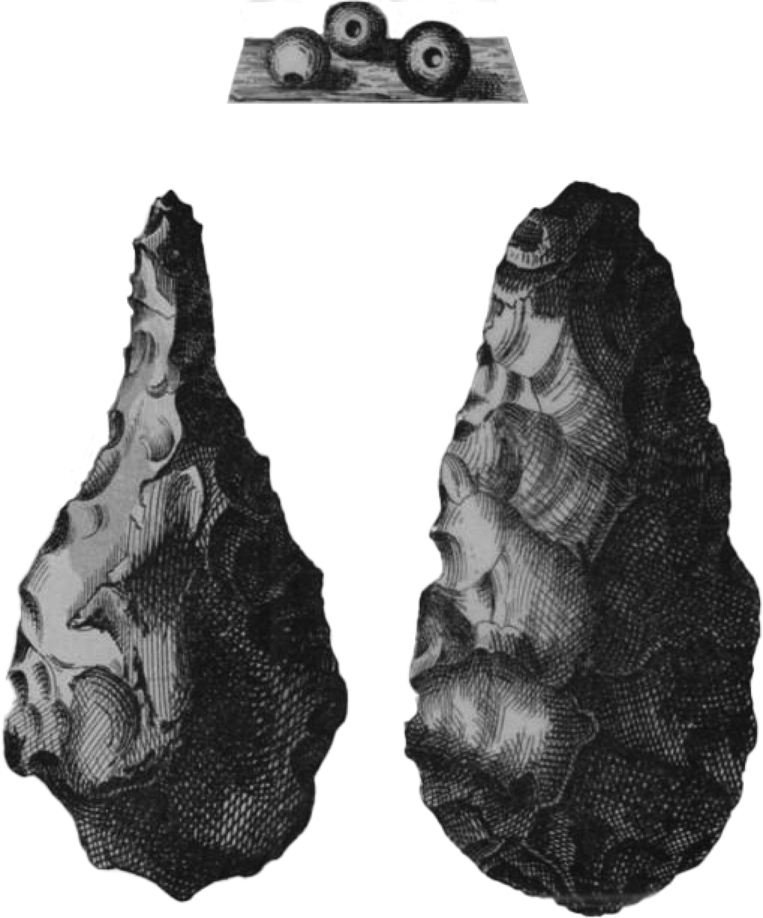
Figure 2.7 Unreasonable doubt? Two of the hundreds of handaxes recovered by Rigollot from St Acheul in 1854. Also shown are three naturally perforated flint ‘beads’ found in the same deposits. No scale was provided in the original paper, although Rigollot 1856, 36 states the average implement was 10–12cm, and that the largest found was 28cm. The beads normally have a diameter of 10–15mm (after Rigollot 1856, Plate XIV).
Rigollot’s conclusions were met with typical ambivalence, even by one of his own geologists. The more influential of the two, Edmond Hébert (1812–1890), had not seen any handaxes in situ and therefore could not confirm their stratigraphic position or integrity (Grayson 1983, 175). The other, Charles-Joseph Buteux (1794–1876), was more supportive (Buteux 1856) but his opinion carried less weight. At a posthumous discussion of Rigollot’s publications at the Société Geologique de France, fellows voiced well-worn concerns regarding whether the handaxes were genuine artefacts, whether they were in their original position and whether the workmen who found them could be trusted (Grayson 1983). Rigollot was obviously not there to defend them or himself.
Rigollot’s endorsement of Boucher’s work was, however, trumpeted in the second edition of Les Antiquités Celtiques et Antédiliviennes published in 1857, although fears of being robbed of priority prompted Boucher to rewrite parts of his personal history and reject all caves as unreliable (Boucher de Perthes 1857; Sackett 2014a). Boucher cited Rigollot in a strong rebuttal to claims of mixing, forgery or a natural origin for the handaxes, which he situated in a less contentious, if not entirely orthodox, geological framework. Following Agassiz, Lyell and most of the contemporary geological world, Boucher now saw glaciation as explaining many diluvial phenomena, and he had abandoned his metaphysical ideas about the origins of human beings in favour of an evolutionary model of transmutation. Modern people were now descended from antediluvian ones, who may have been more ape-like in appearance. But he still believed in figure stones, still thought handaxes were symbolic, and he neglected to repeat his description of Menchecourt and the Hospital site, leaving readers no option but to return to the weird and wonderful world of the first edition (Grayson 1983, 179). Neither book, therefore, had much impact.
Doctor Falconer’s Casebook: Brixham 1858
By 1858 the deep antiquity of handaxes, and by extension of the humans who made them, was still unresolved, although all the necessary evidence was in place, including a trending evolutionary framework (Darwin and Wallace 1858). The delay was largely caused by a combination of risk-aversion and reluctance among authoritative individuals and societies, and the provincial status of many of the people involved, which sometimes conferred a distinct amateurishness to their interpretations. Since the seventeenth century most of the Anti-quaries who had seen handaxes agreed that they were genuine human artefacts. Likewise, few geologists doubted that the fauna was antediluvial (preglacial, glacial and postglacial as John Phillips at Oxford (1855) had renamed different parts of this period), occurred in intact sediments of the same age and had previously lived in the regions where they were found. What had thus far proved impossible was to bring these two things together (Prestwich 1866), at least to the satisfaction of anyone that mattered.
In October 1858, Doctor Hugh Falconer (1806–1865), physician, botanist, geologist and palaeontologist, and his recently widowed niece, Mrs Grace McCall (1832–1899, later Lady Prestwich), passed through Abbeville on the first leg of a European tour that would eventually take them to the bone caves of Italy. Falconer had written ahead from London, stating his intention to stop in Abbeville for two hours and expressing his hope that they might find Boucher at home (G. Prestwich 1901).
Falconer had a special and long-standing interest in seeing Boucher’s evidence. He had spent over two decades working for the British government in India, first as a surgeon and then as superintendent at the Botanical Gardens in Suharunpoor and Calcutta, where his research time was mainly spent studying the fossil fauna of the Siwalik formation. For this he had won the Geological Society of London’s Wollaston Medal in 1837. Collaborative work with the engineer and geologist Sir Proby T. Cautley (1802–1871), undertaken in the 1830s, had also led him to question Cuvier’s global revolution and Buckland’s universal deluge which he later described as ‘lazy and convenient … delusions’ (Falconer 1868, 576). The pair found no evidence for a recent and sudden rupture in the Indian geological record. Instead, they saw gradual sedimentation that captured the slow turnover of species, showing piecemeal extinctions and arrivals, as well as long-term survivals (ibid., 571–575). They had also speculated on the antiquity of humans, which they believed must have been significantly longer in the subtropical climate of India than in glacial Europe (ibid., 576–579). On his eventual return to England in 1855 Falconer set about mastering the cave and drift faunas of Britain and Europe, undertaking lengthy study tours to museum and private collections.
On a visit to Devon in April 1858, Falconer learned from local geologist William Pengelly of a new cave at Windmill Hill, Brixham, which had only recently been discovered during limestone quarrying. For Falconer, this was an opportunity to examine a virgin cave and establish the exact sequence of preglacial, glacial and postglacial mammals in Britain, a question that was still unresolved, largely due to a decline in interest since Buckland’s day but also because the evidence was in a parlous state (Falconer 1868). Earlier collectors had assumed that cave faunas were more-or-less the same everywhere, duplicates of one another even, so they paid little attention to context. Fossils from different sites and beds had been indiscriminately mixed together, and species had not been properly differentiated (several types of elephant were subsumed under the name mammoth for example), all of which simply served to reinforce the assumed homogeneity (Prestwich 1873). Falconer agreed terms with the landowner to investigate the cave (Pengelly’s own negotiations in March had failed), and wrote to the Geological Society on 12 May 1858, asking them for financial support (Prestwich 1873; G. Prestwich 1899). One-hundred pounds was required just to cover the cost of a lease agreement on the cave and its contents but having no available funds the Geological Society passed the request to the Royal Society. By the end of following day, Falconer had secured sufficient financial support from the Royal Society and private benefactors to fully fund the project (Falconer 1868). If the possibility of finding human remains or artefacts was on Falconer’s mind, his letter does not betray it.
Falconer next convened a committee to oversee the excavations, which included geologists Charles Lyell, R.A.C. Godwin-Austen and Joseph Prestwich (1812–1896), and palaeontologists George Busk (1807–1886) and Richard Owen (1804–1892), all men of national and international standing. William Pengelly, himself a fellow of the Geological Society of London since 1850 (H. Pengelly 1897), served on both the London committee and the local sub-committee; he was joined on the latter by Edward Vivian, who was asked to delay plans to publish MacEnery’s rediscovered manuscripts (MacEnery and Vivian 1859), which even then preceded the Brixham report by 14 years. Pengelly superintended the day-to-day work in the cave, instructing a foreman (Henry Keeping [1827–1924] who later worked with him at Kent’s Cavern) and a small team of workmen where to dig and how to dig (Van Riper 1993). The research objectives of the project demanded precise geological control, and the cave was the first in England to be excavated using Pengelly’s careful stratigraphical methods. Each layer was completely removed in turn, and each find was numbered and carefully recorded, noting the distance from the cave entrance, the geological stratum in which it was found and its depth below that stratum’s surface (Prestwich 1873).
Work began in July. Falconer was initially ambivalent to the reports of stone tools sent from Devon (Figure 2.8), but following a visit to the site in September accompanied by the geologist Andrew Ramsay (1814–1891), he became convinced that the solution to the antiquity question was within his grasp (Van Riper 1993, 92). By the time Falconer left for the continent in October, the excavations had produced 1500 mammalian fossils plus a small number of securely provenienced stone tools, including a crude hatchet (handaxe). Falconer was thus able to confidently state before a council meeting of the Royal Society on 28 October 1858, that ‘rhinoceros, hyena, reindeer and man were at one period joint inhabitants of this island’ (Royal Society Minutes Book, October 28 1858). Not everybody on the Brixham committee in London shared Falconer’s confidence, however, and a report submitted on 9 September 1858 was only accepted after the claims of contemporaneity had been significantly qualified. Prestwich explicitly warned against airing such controversial claims at the next annual meeting of the British Association for the Advancement of Science, due to take place in Leeds at the end of September (Van Riper 1993, 95). Ultimately, while several members of the committee were persuaded by some of Falconer’s arguments, especially concerning the human authorship of the flints, Brixham Cave still had one major disadvantage: it was a cave, and as such was subject to all the usual caveats surrounding contemporaneity, no matter how carefully it had been excavated.

Figure 2.8 Brixham Cave 1858. Top: the entrance to Brixham Cave after removal of the talus. Bottom: a convergent scraper, a rough handaxe and a dejete scraper found during the excavations. Scale of artefacts: the handaxe in the centre is ~15.5cm long (after Prestwich 1873).
This was Falconer’s mindset when he and Grace McCall arrived in Abbeville on 1 November 1858, direct from the boat to Boulogne and with the frost not yet melted (G. Prestwich 1899). The travellers spent the day with the be-wigged and rouged Frenchman (ibid.), his collection of implements and fauna far exceeding Falconer’s expectations. Where French savants demurred, Falconer found the evidence persuasive, strengthening his commitment to Brixham. He immediately wrote to his friend and fellow Brixham committee member, Joseph Prestwich, urging him to visit Abbeville. No other English geologist, Falconer flattered Prestwich, would approach the question ‘con amore’, and he feared that English geology had fallen behind in the question of human antiquity. Falconer then went on with the rest of his journey, his initial enthusiasm for what he had seen in Abbeville apparently fading with time and distance (Van Riper 1993, 101–103), yet he had nonetheless set in motion a series of transformative events.
Time and Chance: St Acheul, April 1859
Prior to 1859, Joseph Prestwich (by day a wealthy, city wine merchant) was best known for his work on the Tertiary Formations of southern England and the geology of the industrial town of Coalbrookdale, Shropshire, based on which he had been elected FGS in 1833 and FRS in 1853. He had also, however, begun to publish some of his long-standing research into the drift (Prestwich 1851, 1855a, 1855b, 1855c, 1856, 1858), and his opinions on these matters were actively sought out by his geological colleagues, including Sir Charles Lyell (G. Prestwich 1899). A life-long francophile (part of his school education had been in Paris), Prestwich was equally esteemed by his French colleagues. Concerning the Brixham case, and the antiquity question in general, Prestwich was characteristically cautious (even diffident). On reading Falconer’s report to the Brixham committee, Prestwich had concluded that while there was “much evidence tending in the same direction” and that Falconer had a good case, he nonetheless felt he must “hesitate to accept the conclusions”, warning that many others would probably do the same (Prestwich to Falconer 21 September 1858, in G. Prestwich 1899, 117). A visit to Brixham on 1 November, while Falconer was being entertained by Boucher, did little to assuage Prestwich’s doubts. While he could not deny that the flint implements occurred in the same strata as the bones, he was not yet satisfied that “every other possible explanation besides that of contemporaneous existence had been eliminated” (Prestwich to Falconer, 4 February 1859, in G. Prestwich 1899, 120), although his companion on that visit, Godwin-Austen, predictably harboured no such doubts. Prestwich promised to visit Abbeville at an ‘early opportunity’, but he would do so as a skeptic (Prestwich 1860b). Prestwich’s reply reached Falconer in Palermo, Sicily, where he was celebrating his discovery of flint implements and fossils in the Grotta di Maccagnone, further evidence, in Falconer’s mind, that the case for contemporaneity at Brixham was genuine (Falconer 1860).
Prestwich’s earliest opportunity to visit Abbeville came at Easter 1859. He wrote to several prominent members of the Geological Society, inviting them to join him on the trip, but in the end he set off for France alone.7 On the other side, his French colleagues were similarly indisposed. He arrived at Amiens on 25 April where he was shown around the local gravel pits by resident archaeologist, architect and Boucher-supporter, Charles Pinsard (1819–1911: Gamble and Kruszynski 2009). Nothing was found. The next day Prestwich took a 30-mile train journey to Abbeville, where he was joined late in the evening by John Evans (1823–1908), a paper mill manager by profession but also a respected archaeologist, FGS and specialist in coins who shared Prestwich’s interest in the drift8 (Evans 1943). Evans also went to Abbeville a skeptic, not believing “in the slightest degree in the probability of this reputed discovery” (Evans 1868, 93). The Englishmen spent the morning of 27 April with Boucher, examining his collection and unfruitfully investigating the pits around Abbeville: three flakes were found at Menchecourt, but Prestwich would not be satisfied with anything but “the so-called flint hatchets” (Prestwich 1860b, 287).
After luncheon, a telegram arrived from Pinsard informing the visitors of a discovery at St Acheul, so the pair immediately took the train back to Amiens. Waiting for them at the station were Pinsard and the president and secretary of the Société des Antiquaires de Picardie (Prestwich 1860b, 291), who took their English guests to a gravel quarry near the Seminary at St Acheul. Here they were shown a ‘hatchet’, half-exposed in the quarry face and clearly lying in its original position, an undisturbed bed of gravel 17ft (~5.2m) below the original ground surface (Prestwich 1860b, 291–292; Evans 1861, 295: Figure 2.9). It was clearly not planted; even a gentle tap would have caused the loose gravel around it to collapse. Prestwich was thus the first geologist to observe an in situ palaeolith, and it was the evidence he had come to see, “the stone that shattered the time barrier” (Gamble and Kruszynski 2009, 461) along with Prestwich’s remaining reservations (Figure 2.10).

Figure 2.9 Seminary pit, St Acheul: two workmen in the gravel pit near the Seminary of St Acheul, 27 April 1859. The standing workman is pointing to the in situ handaxe (after Gamble and Kruszynski 2009; Creative Commons).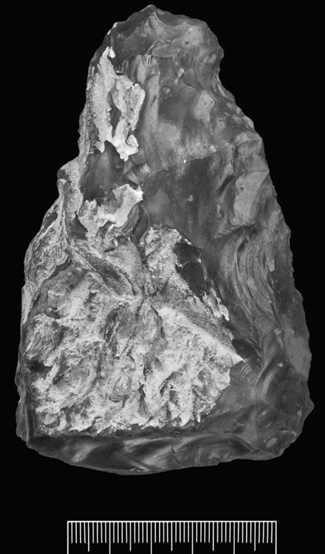
Figure 2.10 The stone that shattered the time barrier. Specimen E5109 from the Prestwich collection in the Natural History Museum, London. The edge of E5109 corresponds exactly to the handaxe in the section in Figure 2.9, and despite its historical significance was lost for many years until rediscovered by Clive Gamble and Robert Kruszynski (2009). They suggest that its unfinished state, as it was described by Prestwich, could account for its being forgotten, as better more symmetrical examples that left no room for any doubt were soon recovered. Scale = 5cm. (© Natural History Museum.)
So that others might see this definitive piece of evidence for themselves, the handaxe was photographed in situ (Cohen and Hublin 1989; Gamble and Kruszynski 2009: Figures 2.9). Prestwich and Evans also acquired several more specimens from the quarry workers, no longer suspicious of their authenticity. They returned home on the afternoon of Friday 29 April, having spent the morning “in and about Abbeville” (Evans 1943, 102). Convinced themselves, they wasted no time trying to convince others. Prestwich held a soiree for selected geologists and others at his home on 5 May (Evans 1943, 102), and less than a month after their visit he presented his conclusions before the Royal Society. Evans followed suit at the Society of Antiquaries in June. The Acheulean world was about to start turning.
Notes
· 1 It became the most well-known and widely quoted largely because, from 1701, it was used as a marginal note at the start of Genesis in the Authorised (King James) English version of the Bible, not because it was thought to have any particular divine merit (Gould 1991).
· 2 A combination of apparent contradictions in the biblical narrative, difficulties in reconciling textual evidence from other, possibly more ancient civilisations, and the discovery of New World ‘savages’, led the French theologian Isaac de la Peyrère (1594–1676) to argue that there had been two creation events, first of the gentiles, and then of Adam (Peyrère 1656). Adam was therefore only the father of the Jewish people. The ‘pre-adamitic’, people had existed across the globe before the narrative in Genesis (Goodrum 2004a). This led to the burning of his book and brief imprisonment, until he apparently recanted (Popkin 1987). His dangerous idea was later appropriated for racist ends.
· 3 Buckland had, in fact discovered the remains of a Gravettian man, who had been interred ~31,000 years ago, covered in red ochre and adorned with shells and ivory, but this would not be recognised until the twentieth century.
· 4 It is well documented that Boucher rewrote the story of his life to suit his own agendas (e.g. Grayson 1983). Some of the revisions, particularly those which alter specific details about the finds in the Somme gravels, however, border on deliberate deception designed to strengthen his evidence (Sackett 2014a).
· 5 Buckland’s (1836) rejection of the evidence from Engis rehearsed the familiar argument that the human remains were more likely to be a later intrusion buried long after the animals had perished.
· 6 One wonders if the British stamp of approval would have been necessary had Casimir Picard, who would probably have replaced Boucher’s imaginings with a cogent technological and functional interpretation of the handaxes, and whose illustrations of stone tools were excellent, not died of pneumonia in 1841 (cf. Sackett 2014a).
· 7 One of those asked was John Lubbock, banker, archaeologist and, later, Member of Parliament, who in the first two editions of Pre-historic Times stated that he would forever regret not being able to make the trip.
· 8 The pair had met on a train around 1854 (Evans 1943), travelling in the same carriage to appear as witnesses in the Croydon Water Question. Because of his geological expertise, Prestwich was to appear for the water companies, while Evans, who managed Dickinson’s paper mills at Nash Mills, Herts, was there on behalf of the mill owners. After the trial was adjourned, they shared a carriage back, when they struck up a conversation and discovered many shared interests.