
FOREWORD
MYCOLOGY IS A DARK ART. Mycologists perceive things that others miss. They traffic in the scarcely visible. They make meaning out of what they see through hand lenses or what they smell when they turn over logs, tip over mushrooms, or sink their hands into the soil. In amongst toadstools, moulds, and yeasts, they find answers to questions but also evidence of mysteries. Augury is the practice of interpreting signs and omens from the behavior of birds. Mycology can be the practice of interpreting the meaning of the world from the behavior of fungi.
The offices of mycologists are rarely new and gleaming. Instead, they tend to be in basements and other forgotten corners of buildings. Like fungi, mycologists often dwell in neglected places. In those places, any extravagances that might be encountered are typically engineered not on behalf of the mycologists themselves, but instead for their quarry, fungi. At my university, for example, air conditioners poke out of broken basement windows where the mycologists work. The air conditioners keep collections of fungi from getting too hot or too wet; the offices of the mycologists, meanwhile, are not nearly so climate controlled.
In their neglected places, mycologists guard a secret. The world, they know, is not as it seems. If you walk outside, you may hear birds singing and you will see plants busily turning light into sugar. The birds and the plants then suggest the rest of life—mice and insects, for example. But this view of life is wrong, entirely wrong. Beneath the world you see and hear, and inside that world, and over and above and around that world, are fungi. Fungi are busy, nearly everywhere (and perhaps everywhere) there is terrestrial life (though also in the sea), carrying out strange slow-motion sexual dances, eating what seems inedible, signaling to one another and to other species too, and then also connecting organisms, one to another. By most accounting, there are more kinds of fungi than there are mammals, birds, and plants combined, perhaps ten times as many. Fungi are the connective tissue of life—not just that, but certainly that. They hold the living world together. This is what mycologists know. And they see the evidence everywhere they go. It is unavoidable to them, the fungal world of particulars and grandeur. They live in it, they sniff it out, they breathe it in, and, when they get together, they talk about it constantly, using names of species that sound like spells or incantations. Their minds are bubbling flasks of Saccharomyces cerevisiae, Aspergillus, Candida, and Penicillium. And maybe even some Entomophthora muscae—spore of fly—to boot.
Mostly, the secret world mycologists know, the true world, is secret because it is not obvious and, after years of trying to convince other people to love fungi, mycologists tend to realize it is easier to just talk to other mycologists about what they know and to leave the rest of us out. They retreat to their lairs where they talk about beetles whose brains are taken over by zombie fungi, ants that farm fungi the way that humans grow grain, fungal pathogens that threaten global food supplies, or, just as often, lovely, delicate, poorly known species that they have somewhere seen and just what those species might mean about the broader world.
I have been lucky enough, every so often, to be welcomed by mycologists into their world and, while there, to see things a little more as they are, which is to say to see them a little more fungally. It is a great privilege. Like an astronaut having gone to the moon and then returning to Earth, I return from each visit to the mycologists changed, with a different perspective on everything around me.
It is the extraordinarily good fortune of readers everywhere that Keith Seifert has decided to serve as a guide to the world of fungi, the world as seen by mycologists. In this wonderful book, The Hidden Kingdom of Fungi: Exploring the Microscopic World in Our Forests, Homes, and Bodies, Seifert introduces the reader to that which is obvious to mycologists but hidden to nearly everyone else. His is an insider’s tour to, as he puts it, the hidden kingdom.
This book provides snapshots of what are, in essence, the great wonders of the fungal world. There are stories of fungal evolution, tree roots and fungi, plant evolution, beer, agriculture, homes, human bodies, and more. In these stories, one confronts the extraordinary diversity of ways that fungi alter and, really, control the rest of life and even some of non-life. One also finds beautiful details. Seifert has spent his life among the fungi; he knows as much about fungi as any-one knows about anything. Here, though, rather than use his detailed knowledge of the fungal world to catalog each bit of what he knows, Seifert uses that knowledge to heighten the reader’s understanding of the big stories; one has the feeling of having been invited as a novice to the mycologists’ table. The experience is, at once, surprising, thrilling, and engrossing.
And that we are invited is important, because the truth is that mycologists can lead us to see the world as it is (or closer, anyway, to how it is). They can lead us to understand our own place in things. Such an understanding is important, because as Seifert shows in the final chapters of the book, fungi not only control much of the world, they also offer many of the most extraordinary solutions to our future challenges. The fungi have shown the mycologists the way to a great many answers, and Seifert concludes by holding those answers up for the rest of us. “Look to the fungi. Learn from their ways.”
It’s become common to describe our geological epoch as the Anthropocene, the human epoch. The Anthropocene is defined primarily as a function of the extent to which the impact of humanity is clear on the composition of life on Earth and biogeochemical cycles of life and nonlife on Earth. It is true that our impact is great and the naming of our time as the Anthropocene reminds us of that horrible greatness, reminds us of the consequences of each of our days and each of our actions. And yet, from the broader perspective of Seifert and the other mycologists, it is clear that we are not living in the Anthropocene. Instead, we are just in one particularly unusual period of a broader epoch, what one might call the Mycocene. Ours is a fungal world, and by the time I finished this lovely book, I was convinced that however great our human impact might be, it pales in comparison to that of fungi, as it long will.
When humans go extinct, our crops will disappear and so too many of the strange species that depend upon us, from German cockroaches to pigeons. Forests and grasslands will grow back. Populations of medium-sized fish and terrestrial and marine predators will rebound. As our presence is felt, so too will be our absence. But, as Seifert shows through his stories of the fungal world, were fungi to go extinct, the situation would be something else entirely. Wood would cease to decay. Tree roots would be unable to get nutrients. Millions of species would undergo population explosions, their abundances no longer kept in check by their fungal pathogens. The climate would be altered in ways so dramatic as to be difficult to even think about, much less predict. The world is so very deeply and comprehensively fungal that to think about a world without fungi is nearly impossible.
And yet, we do think about the world without fungi. We do it all the time. We pretend they aren’t there at all. So here is my suggestion. Read Seifert’s book. Then, once you have, tell other people about it. Tell them about the fungi. Help them to understand a little bit more about just how wrong so many of our daily perceptions are. Initiate them into the secrets of mycology. Then go outside and take a deep breath. Sink your fingers into the soil. Crawl up upon a mushroom. Swirl and sniff your beer. Look at the discolorations on grains. Practice reading the secret signs. Mycology is a science in which we can all engage, one that begins with something like a little meditation. Go ahead and say it out loud: “I am human in a fungal world, a new arrival in the hidden kingdom.” And after you do, breathe in deeply. Let the thousands of fungal species in the air land on your tongue and travel into your lungs. Then exhale. You are surrounded. You have always been surrounded. Mycology is the dark art of knowing this reality; mycology is the dark art of knowing the truth.
ROB DUNN, author of Never Home Alone
A NOTE ABOUT NAMES
ABSORBING THE NAMES OF ORGANISMS can be like trying to follow characters in a Russian novel. Everyone seems to have several names—formal names, family names, nicknames—that are only clear to those steeped in the culture. The rest of us mentally bleep over them and end up confused about who loves whom and who kills whom.
Scientific names are a necessary evil that you can’t avoid when talking about fungi, because they are often all we have.1 Over the past few decades, mycologists have made a determined effort to come up with distinctive common names for conspicuous mushrooms and lichens,2 but the multitude of yeasts, moulds, rusts, smuts, and mildews were left behind. I use common names in this book when I can because they are easier to remember and pronounce, but I have tried to avoid inventing new ones. Unfortunately, these names don’t always translate coherently from English to other languages, and often they don’t precisely match how scientists think about the same species. So scientific names are used when needed.
But before you decide to sidestep them and lose track of the plot, let me give you a quick primer. The system for naming, defining, and classifying groups of fungi follows the standard hierarchical structure used in biology, from a single species to gradually larger and larger groups: genus, family, order, class, phylum (pl. phyla), and kingdom.3 Each group has its own latinized label that is usually only used in discussions or presentations of classification.
Everyday language has terms roughly equivalent to a genus name for groups we recognize as sharing common traits—ducks, roses, pines—although these folk categories often do not correspond exactly with how scientists group the same species. There are a few such words for fungi in English; for example, larger mushrooms like chanterelles (= Cantharellus) or honey mushrooms (= Armillaria).
The two-part Latin scientific name for a particular species is known as a binomial. The first word in the binomial indicates the genus (pl. genera). The second word (the epithet) labels the species within its genus. The combined binomial is unique for each species. For example, the scientific name for brewer’s yeast is Saccharomyces cerevisiae, just as we are Homo sapiens. The binomial is set off in italics. An increasingly common practice in mycology is to italicize formal scientific names at all other levels as well (phylum, class, etc.). I have followed this new practice in the appendix (page 221).
I’ve spent a lot of my career obsessing over Latin names of fungi, and I assure you they can be humorous.4 Sometimes the jokes are obscure, but who could miss the point of a mushroom called Spongiforma squarepantsii? It really does resemble SpongeBob (sort of)! And because no one ever noticed, I’d like to point out that I once named a fungus after Homer Simpson, although my hidden agenda to honor the whole Simpson family in this way never materialized.
Though it may not seem like it, most binomials do tell you something about a fungus—and catching the innuendos makes them easier to remember. Take Saccharomyces cerevisiae. Saccharo means “sugar” and myces means “fungus.” If you’ve ever ordered beer in a Spanish-speaking country, you’ll know that cerveza is the Spanish word for “beer.” So the Latin name describes brewer’s yeast perfectly as “the sugar fungus from beer.” After all, one reason we love this fungus is that it takes the sugar in barley or grapes and converts it into ethanol.
Some university professors quiz their students about the hidden nuances of scientific names; it’s a rite of passage into a broad palette of knowledge. Most of us don’t study Latin in school anymore, so parsing out the hidden messages in the names of fungi takes some study. Saying them out loud helps you remember.
Learning Latin names opens the door to appreciating the awe-inspiring diversity of the millions of species of animals, plants, fungi, protists (mostly one-celled organisms, like amoebae), and bacteria that await you in nature. The appendix puts the fungi mentioned in the following chapters into the modern classification system. Think of it as a phone book for looking up the evolutionary address of a fungus.
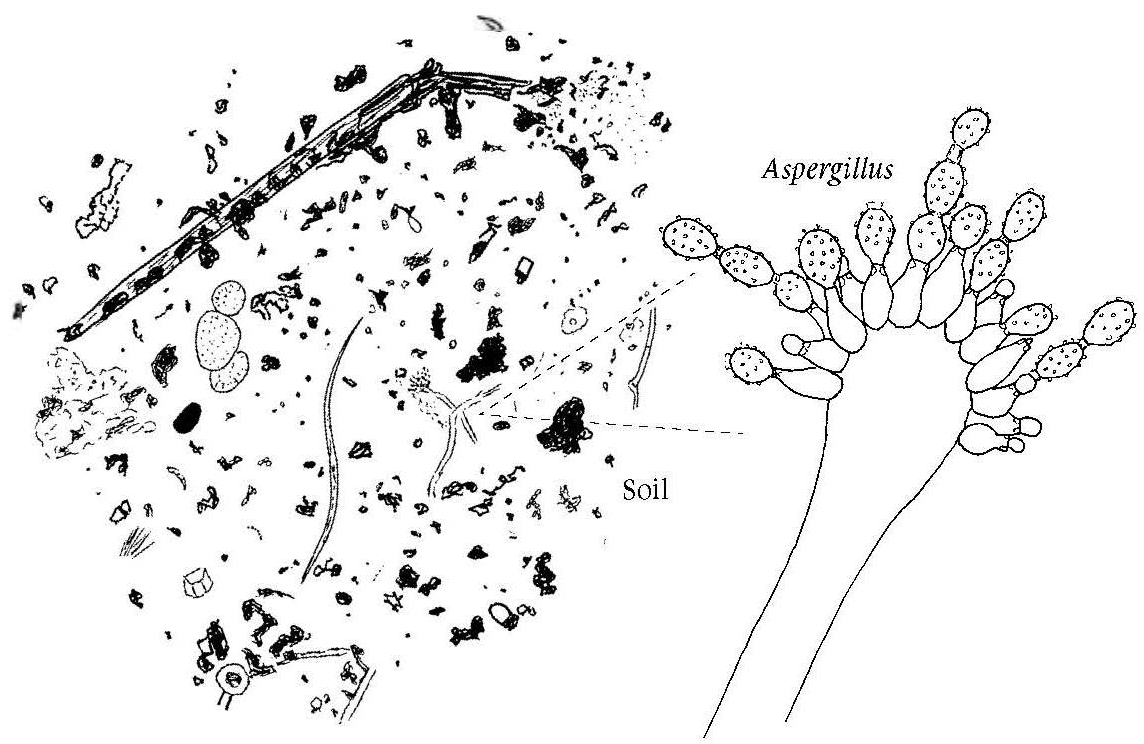
FOR MOST OF US, dust is dust.1 We don’t think much about what it is or what it might mean. It is simply the powder of our world. It drifts onto the floors of our homes and hospitals, blows through farms and forests, and settles on the sea floor. It swirls around the globe, wafting across oceans from one continent to another, from one country to another. Its parts are too tiny for our senses to register; it seems too banal to be important.
When we were kids, mud caked between our toes and in the creases behind our knees as we raced around the yard. We built castles in the sandbox. Our mothers scrubbed our faces too hard with the washcloth trying to make us presentable, to create the illusion that we were clean. But we were always going to get dirty again. It was inevitable.
When you’re a kid exploring your world, everything is wonderful and just as it should be. You learn the important laws of life, like “Don’t eat dirt.” If candy falls on the floor, the five-second rule comes into play: How long can it stay there before it’s too nasty to eat? A little dirt, a little dust—if you don’t see it, or if you can rinse or wipe it away, it doesn’t matter.
But what happens if you take a tablespoon of dust or dirt and stir it into a quart of water? Add a tablespoon of that slurry into another bottle, then press repeat and dilute it one more time. If you looked at the murky blend through a microscope, you’d start to appreciate the complexity of dust. Tiny crystals and mineral chunks mix with flakes of rotten wood, legs and hairs of insects, soot, odd-looking eggs, and fibers from plants and your clothes. Microscopic algae and protists bump into each other and veer off like windup toys. Dust is alive.
If you treat the diluted mud with a dye that binds to DNA—the chemical compound that makes up the genes of all living things—and shine ultraviolet light through it, microscopic life lights up like the Milky Way, a universe in a drop of water.2 Bacteria and viruses shine like stars. Pollen grains drift by like glowing blimps. And among all these particles are the extending tubular cells, geometrical spores, and budding yeast cells of fungi.
This book is a journey through the hidden world of fungi and their relationships with humans, other living things, and our environment. We will look at how we use fungi, and how they use us, as we strive for a sustainable future.
Looking back, I can see that my family history and childhood experiences set me on a path with an unexpected result. I didn’t plan to be a fungus guy—who does?
The Promised Land
My dad’s parents emigrated from Germany to Canada more than a hundred years ago. They were patented a quarter section of land in the province of Saskatchewan, purchased three more, then farmed wheat and raised their family through the Great Depression. My parents met in Regina at Normal School—teachers college. When World War 11 started, my father enlisted in the Royal Canadian Air Force. He was color-blind and couldn’t be a pilot or serve overseas, so he worked as a mechanic. His oldest brother inherited the farm. So after the war, with support from the family and the Veterans Rehabilitation Act, Dad’s best-laid plan was to study architecture at the University of Manitoba in Winnipeg. When it was time to look for a job, he climbed aboard an eastbound train with my mother and my two older sisters. They disembarked and settled in the mining town of Sudbury, Ontario, where my third sister and I were born. Perhaps the desolate wasteland reminded them of rolling prairies.
In the late 1800s in Sudbury, metals were mined in giant open pits on the edge of town. Stacks of layered rocks and wood were set alight and smoldered day after day. Dense sulfur smog rolled over the lips of the pits and across the hills, killing plants, blackening granite, and leaving treeless barrens that lingered for generations. Industrial smelters replaced the so-called roast yards, but the chimneys only carried the soot so far. The city resembled a grayscale pencil sketch because of the 116 tons of nickel, copper, zinc, and iron that belched from the smelters every day.
Starting in 1970, the Inco Superstack steadily rose above the city’s western horizon. After two years of construction, the completed 1,250-foot chimney discharged clouds of sulfur dioxide and nitrogen dioxide into the upper atmosphere. The plumes showed the direction of the prevailing winds that carried the noxious gases and acid rain to distant northern Europe. Sudbury’s desolate lands had drawn attention from NASA by then. The basin that cradles the city is the remnant of a huge prehistoric meteorite crash. In 1971 and 1972, before their missions, the Apollo 16 and 17 astronauts tested the lunar rover outside town and studied the geology of an impact crater similar to what they would see on the moon. This degraded environment was my home. It wasn’t a typical introduction to the love of nature, but to me it was still a world of wonders. The thrill of space exploration led to my love for science.
My parents planted rock gardens with vegetables, fruits, and a wildflower or two that tolerated the city’s polluted air and acidic soil. My sisters loved these plants and the scruffy weeds sprouting in the gravel of vacant lots. On summer weekends, my father drove for hours—my sisters in the back, me propped between my parents in the front—along the winding, roller-coaster roads outside Sudbury. If we got far enough from the mines, there started to be tree cover. Long stretches of road were punctuated by Do Not Trespass notices. If Dad found a stretch with no signs in sight, he led us over the fence. He told us that the barrier was not for us, but to prevent bears or moose from wandering onto the road.
Our favorite spot was within sight of the white, quartz-laden hills near the town of Killarney. We scrambled through gullies between granite hills scraped and scratched by ice-age glaciation to reach the shore of the Bay of Islands on Lake Huron. Extended patches of shoreline, in between the acrobatic jack pines, were blemished with black, leathery lichens. If it rained, they swelled into slippery, rubbery scabs. Any misstep ripped the root-like anchors of the lichen off the rock and sent me skidding onto my knees, “It’s called rock tripe,” Dad said—one of the few snippets of mycological trivia he ever shared with me. “Some people say you can eat it. Supposedly it tastes like scrambled eggs.” And then, relaying something from one of the history books he was always reading: “They made soup out of it on the Franklin Expedition.”3I never met anyone who could comment on its flavor, but I did learn its scientific name: Umbilicaria.
These expeditions weren’t quite roughing it, but they were still agony for me. My sisters stopped to discuss every plant. They picked edible flowers for salads and boiled the pith from the inside of swamp cattails and served them up like exotic vegetables. I was more interested in the skinks and worms that our dachshund unearthed in her frantic excavations of soil and rotting wood. Her short legs whirled like rototiller blades when she dug holes. Surfacing, she’d glance over with a demented, conspiratorial grin, encouraging me to share her discoveries, thrusting her snout deep between the roots. The smells! The smells! She perceived things that I missed. I wanted to smell the world the same way that she did. Taking her as my role model, I started to appreciate details in the surroundings that I’d never noticed before.
With little sense of direction, I entered university as a science student. After false starts in astronomy and biochemistry, I emerged nine years and three institutions later as a specialist in mycology.4 My fellow grad students and I had the mad idea that “mycologist” was a prestigious job. Mycology is a profession where you spend a lot of time explaining what it is you actually do, and when people finally understand that you study fungi, they usually don’t believe you. Who would pay you to play around all day with moulds and yeasts and mushrooms?
Despite the absence of a sensible career path, as the years ticked by I remained a contentedly employed researcher studying farms, forests, and the built environment, spending time on five continents along the way. Sometimes I stopped crawling in the duff and gazed up from the diseased plants and rotting logs long enough to notice a few prosaic tourist attractions—but just sometimes.
The Fungal Kingdom
Most people are unaware of fungi, although we pass them every day and inhale their spores with every breath. Fungi are stereotyped as agents of decay, disease, rot, and mould, spoiling everything that is clean and pristine. We tolerate moulds in compost buckets but not on our bread. We have strong opinions about whether mushrooms are acceptable as food. The rest—the thousands of species we encounter every day—remain unseen and unimagined.
We understand the larger, conspicuous fungi—or macro-fungi—best.5 Mushrooms are the most familiar, but they are transient structures that last just a few days. Our preoccupation with food makes us wonder how to distinguish poisonous and nonpoisonous mushrooms—a recurring plot device in murder mysteries.6 Edible fungi, like oyster mushrooms, shiitake (it’s important to remember the double i), porcini, chanterelles, morels, and the underground truffles, keep naturalists and chefs busy for a lifetime. Even lichens (see chapter 2) are sometimes used as food, or to dye clothes.
This book focuses on the microscopic fungi that we rarely notice and understand so poorly. They are commonly called moulds, a casual term that covers thousands of distantly related fungi, just as the word “shrub” is used for unrelated plants sharing a similar pattern of growth. Moulds are usually betrayed only by a dusty, cottony, slimy, or powdery haze, sometimes surrounded by a faint array of filaments. Most fungi, including macro-fungi, spend the majority of their lives as an almost invisible network of microscopic threads (hyphae). Occasionally, some form larger structures (for macrofungi, again, these may be “mushrooms”), which release clouds of nearly invisible spores. The spores float through the air and settle almost everywhere, including on our food and in our beds.
Over our long history together, fungi have often been our rivals, but they also help us out quite a lot. We often join forces with single-celled fungi called yeasts. There are thousands of wild species, but a few are essential for producing our staple foods and drink. Yeasts grow in many sorts of liquid, including the water-saturated bodies of insects and humans. There they help keep the digestive tract ticking along as part of our friendly gut flora, and they form part of the microbial coating that protects our skin.
Moulds are critically important hidden partners on farms and in forests as intimate associates inside plants and animals. We adapt many chemicals fungi make for their own purposes as medicines like antibiotics. Fungal enzymes—proteins that break down, put together, or rearrange other molecules in biochemical reactions—are used as additives in industry to boost detergents or to help make biofuels. They were among the most successful early products of modern biotechnology.
Unfortunately, when we aren’t looking, fungi also cause problems, such as plant diseases like rusts, blights, smuts, mildews, and cankers. With their talents for biodegradation-breaking down organic matter—fungi rot out the floorboards of our houses, or spoil our food and lace it with toxins. Doctors are familiar with itchy fungal skin conditions, like dandruff, ringworm, and athlete’s foot, and more frightening infections called mycoses. And like some human viruses that concern us, fungi sometimes jump from continent to continent causing new diseases to spring up in distant locations.
Despite the fact that humans and fungi have different body designs, our cells and biochemistry have a lot in common. This similarity makes fungi useful for medical research, but it also means that if we try to hinder them, we must ensure our chosen weapon doesn’t rebound on us. Chemicals toxic to a disease-causing fungus might also affect humans. This is one of the reasons we have so few effective antifungal drugs, and why fungicides for crops should be assessed so carefully.
Cultural attitudes towards fungi vary from one society to the next, depending on how people weigh their helpful and harmful properties. So many Westerners have such an inbred revulsion towards fungi that there is an adjective for it: mycophobic. In many parts of the Western world, “fungus” and “mould” are punch lines for jokes and used as intentional insults or indicators of moral degeneracy or poor hygiene. But many northern or eastern European, Asian, and Indigenous cultures regard fungi with an affection similar to what we usually reserve for kittens or puppies. The adjective then is mycophilic.7 As an example, one of the most popular anime characters on Japanese television is the kōji mould (Aspergillus oryzae): a happy round yellow face, with five small cones of stacked round spores radiating outward, who bobs through the air smiling and singing.
Why this difference in cultural attitudes? It reflects the differing responses, fear or curiosity, that we feel when confronted by the unseen parts of nature. Fungi can be good or bad, but most are somewhere in between. Now, with so much effort in society to correct ancient wrongs, the time seems right to set aside our prejudices.
The Fungal Umwelt
The German word Umwelt, a poetic and philosophical convention, imagines how animals perceive their surroundings with their eyes, ears, and brains. We are confident in the reliability and completeness of our animal senses. We seldom imagine that other living things have capacities we lack or that they send and receive different kinds of signals than we detect. Our lack of empathy—our impaired Umwelt—is reflected in how we treat other living things. We enjoy a modest camaraderie with animals of a certain size: our pets and the charismatic mammals on television or in zoos. Their babies remind us of our own babies. They relate to us in some social manner. But our warm, fuzzy feelings dissipate when we consider other animals. How do you feel about insects? Or frogs or bats? Peering into the eyes of these creatures feels like staring into the eyes of an alien. Empathy for invisible life-forms seems a long way off.
Humans are often surprised by the complex behavior of microorganisms. It is easy to dismiss microbes—micro-organisms like fungi, bacteria, slime moulds, and protists—as miniature machines, or automata, that act and react with a predictable mechanical response to external cues. This philosophical approach is called animal chauvinism or speciesism. It’s a barrier to recognizing decision-making, creativity, and any sense of control or agency in other forms of life. At the very least, fungi are living beings that react, eat, excrete, send out and receive signals, mate, and strive for a better life. In those ways, they are just like us.
Interpreting the behavior of other living beings as equivalent to human cognition, emotion, or agency is anthropomorphism. In science, this is often considered an unforgivable error. But the very notion of anthropomorphism seems anthropomorphic. We too are locked into our version of existence by our senses and consciousness. Anthropomorphism is the best tool we have to imagine creatures that are so dissimilar—that operate at such diverse scales, move around by such peculiar means and at variable speeds, and transmit and receive different signals than we use to communicate ourselves.8
Imagining our world from the point of view of a fungus is a challenge, but because this book is about fungi I will be unapologetically fungopomorphic (or, if you prefer, mycopomorphic). But an analogy is just an analogy. It’s a tool to help us understand and empathize. I am not a fanatic (a fungatic?). I don’t pretend that fungi are more important or interesting than the other kingdoms of life. But I am an unashamed fungal partisan. We are living in an era of declining biological diversity at the same time as we are becoming aware of an unexpectedly vast interconnectivity among all life. In this book, fungi are both the heroes and the villains—humans are just the supporting cast.
Fungi are our close neighbors in the evolutionary tree of life, more closely related to animals than to plants. We think there may be between 1.5 and 15 million fungal species (with 5.1 million a reasonable compromise), but only about 140,000 are cataloged and named despite two hundred years of study by mycologists with microscopes. This means we may have seen and classified less than 5 percent of them.9 Over the past twenty years, DNA signals have revealed the presence of an unexpectedly large number of unknown species. Slowly, we are filling in the missing pieces of a greater puzzle.
I hope this journey through our neighbor’s kingdom will help you appreciate the complexity of the living world and the need to acknowledge, understand, and respect all organisms, no matter how small.
Let me introduce you to some of my friends.