
VIEWS FROM AN AIRPLANE don’t immediately bring fungi to mind. After all, most of the hidden kingdom is microscopic or tucked away underground. But from an altitude of 30,000 feet above the surface of the Earth, evidence of fungal activity is everywhere. From there, you see the blocky outlines of commercial plantations that long ago replaced natural forests, vibrant from the activities of their endophytes and ectomycorrhizae. Disrupting the green canopies are irregular patches of gray, brown, or rust where trees attacked by bark beetles and the symbiotic fungi they carry are slowly dying. Above the flatlands, vast farms nourished by arbuscular mycorrhizae (AM) and rhizosphere fungi stretch out like squares on a checkerboard, except where native prairie hangs on in gullies or along the banks of meandering rivers. Some-times you can see faded green crop circles that look like the landing sites of UFOS, a sign that crop pathogens are running amok.1 Around agricultural towns, shiny tanks and fermenters sprout beside the grain silos and elevators. These are biofuel factories, where fungi work their magic turning plant and animal waste into renewable sources of energy.
A few specialized satellites remotely monitor crop and forest health by recording changes in the wavelengths of light reflected off foliage, which sometimes identify precise diseases.2 Foresters and farmers receive weekly, monthly, or annual planting, spraying, and harvesting advice based on weather information, disease models, and the exact species or cultivars they grow combined with satellite observations of their land. It’s kind of like “personalized medicine” for plants.
We have maps to illustrate continental drift, the migration of peoples, the flow of crops and livestock from continent to continent, and the lopsided distribution of prosperity. Maps of fungal migration, when we have them, trace the same paths. The view from above reminds us that all the living creatures of our world—including humans—are interconnected and depend on a healthy environment. We know this at an intuitive level, but the precision and increased sensitivity of DNA barcoding surveys have brought the scope and intricacy of the biological world into sharp focus. We are learning more about our own genomes and microbiomes, microbes like fungi that we scarcely noticed before, and the complex relationships that drive ecosystems as varied as forests, farms, food, buildings, and our bodies. Everything interacts and nothing acts alone. The better we understand how these systems work, the more problems we will be able to solve.
As we learn, we become more aware of the gradients between conflict and cooperation, and the tensions between the needs of various species, the environmental forces of the Earth, and our economic activities. Fungi play a role in many of these situations, for good and for bad. To attain a sustainable world, we will need to balance competing interests. And in any realistic scenario, we have to remember that our experiences with fungi will not always be positive. Among collaborators will be opportunists. New fungal pathogens and epidemics will affect us and our oceans, forests, and farms. New fungal toxins will be discovered in foods and products that we previously thought were safe. As medicine continues to learn about the complexities and shortcomings of our immune systems, and the nuances of balancing our microbiomes, new allergies and hypersensitivities will emerge. How do we protect our own interests, and those of other living organisms, without disrupting Earth’s balanced and interconnected ecosystems? How do we stall the so-called sixth extinction, where one species—us—wipes out thousands or millions of others?3
Symbiosis is a critical biological phenomenon and plays a big role in our interactions with fungi. Most forests are human-designed ecosystems where the symbioses are still intact and continue to be discovered and investigated. The significance of symbioses on farms was discovered only recently. Because we were unaware of them, AM symbioses in crop plants are much weaker than they are in native grasslands, and the endophytes that should protect leaves from insects seem to have disappeared. If these symbioses can be restored to their original state, or even strengthened beyond that, it will reduce chemical use. But the improvements can only be done in steps. In some cases we may need to go back to the beginning and re-create domesticated crops, being sure to carry along the symbionts this time. In the built environment, the ecology is almost completely accidental and symbioses are few. We now know we are symbionts ourselves, but our preoccupation with disease and the naive use of medicines seem to have thrown our microbiomes off balance. The real hope is that we come to understand that just about every ecosystem is built from communities of symbionts, and that every living thing has a microbiome. Now, when we construct artificial ecosystems, we can take these partners into consideration. These symbioses are critical to our health and to environmental health, and this realization may motivate us to actively restore the balance.
There are more questions than answers. But our progress highlights promising ways that researchers, citizen scientists, and policy makers are rethinking our relationships with fungi and proposing thoughtful solutions.
Policy and Regulations: Balancing Trade and Biodiversity
The migration of species has always happened, but it used to be that almost everyone stayed more or less where they started out. Countries and continents were discrete territories with their own assortments of creatures, plants, and microbes. Migration usually occurred at the velocity of plate tectonics; or the speed of a swimming spore or a drifting plume of spores, pollen, or flies; or occasionally faster when a hurricane, tsunami, or volcanic eruption stirred things up. In recent centuries, the global melting pot—the diaspora of people and their technology—gradually erased the geographical barriers that used to keep everything in place. Contemporary trade continues the tradition of deliberately transporting plants, animals, microbes, and people between continents. It is as if the planet is in the process of reblending itself into one giant ecosystem, the way it was 200 to 300 million years ago in the time of the supercontinent Pangaea. The process is sometimes wistfully referred to as Pangaeaficatiom.4 Humanity is a big part of this process: invasion is in the eye of the beholder, and the biggest invader of all is us.5
Trade brings many benefits but also many problems. The movement of plants, animals, and microbes across oceans can overcome millennia of geographical isolation. Green lumber crosses oceans to be used for buildings, furniture, pulp and paper, and many other products we use to prop up our day-to-day lives. Wheat (from the Middle East), maize (South America), and rice (Asia) now grow almost everywhere, and much of the world’s human population depends on these crops. With these raw materials come fungi, either in and on the wood and grains, or hitching a ride with other microbes, insects, or rodents interested in the same commodities.
Diseases and pests don’t respect political boundaries, and our forests and farms often feel the effects. Quarantine agencies actively monitor borders, trying to prevent or slow down the passage of the most economically and ecologically threatening species—those on their “most unwanted” lists.6 Monitoring allows us to detect diseases before they become established, and before foresters, farmers, or consumers are aware of them. Most of this scouting still happens on the ground. Experienced plant pathogen detectives learn the patterns of healthy and ailing crops and the typical field symptoms of disease. Quite often these surveys fulfill their purpose, and quarantined species are detected before they have a chance to start an epidemic.
As an example, outbreaks of potato wart, a disease caused by the chytrid Synchytrium endobioticum, have occurred in Europe and North America for at least a century.7 The disease is spread in infected potatoes or by thick-walled microscopic cysts that survive in farm soils for up to thirty years. So, shipments of potatoes are checked by inspectors whenever they cross borders. Infected tubers develop galls that swell into thick black cankers and are easy to spot. As well, to keep potato wart from spreading from its focal point in New-foundland to other potato-producing parts of North America, the undercarriages of all vehicles leaving the island by ferry must be sprayed with disinfectant. Despite the care to contain potato wart, an outbreak on Prince Edward Island (PEI) in 2000 halted all potato exports from Canada to the United States, which did not have the disease. No DNA diagnostic test was then available, so inspectors used microscopes to search for cysts in thousands of soil samples collected from every square mile of PEI farmland. Meanwhile, my colleagues generated DNA sequences from potatoes involved in the outbreak and compared them to dried specimens kept as reference material from previous infections. The DNA from infected PEI potatoes was a match for a tuber from an out-break of potato wart in 1908.
To develop a diagnostic test, molecular biologists evaluate DNA sequences from several genes. The scientific community agrees which are most useful as a barcode to identify the target fungus. Then they compare sequences from different fungi to tease out signature sequences that only occur in the target species. Our culture collection also held archived strains of other Synchytrium species that cause diseases on wild plants and weeds. After comparing all these barcodes, we found unique sections of the potato wart sequence and used them to develop a PCR test (see chapter 1) to detect and identify the fungus. This more sensitive diagnostic tool made surveying the soils much faster, and potato shipments waiting for export were quickly checked. The Americans accepted the results of these tests and reopened the border, and Canadian farmers sighed with relief as regular trade resumed.
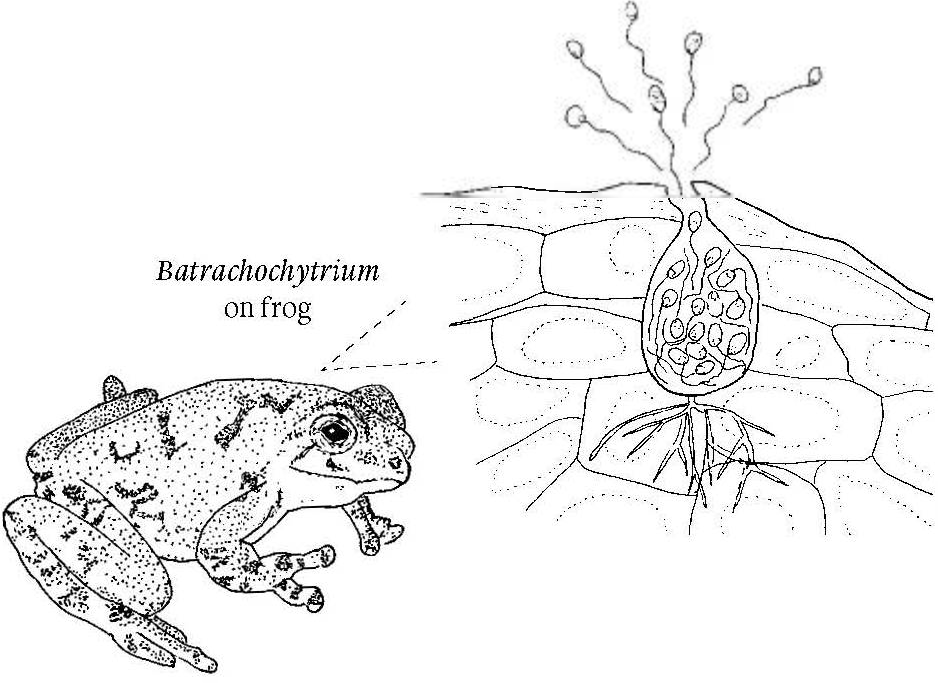
Quarantine only works when we know what to look for. Lots of microorganisms slip under the radar, most of them harmless. But half the planet’s frog species have declined since 1980, and about a hundred species of frogs, toads, and salamanders have gone extinct, largely due to chytridiomycosis. This fungal disease is caused by Batrachochytrium dendrobatidis, or Bd. Its zoospores encyst on the outer skin of the frogs but don’t penetrate; nevertheless, the disease is about 90 percent fatal. The pandemic (or panzootic) apparently emerged from Asia in the early twentieth century and was probably spread initially by frogs hiding in pools of water in unexpected corners of machinery, like mining equipment. Then it spread widely with the deliberate trade of frogs as pets, for food, or for use in human pregnancy tests. Currently the DNA of Bd is found on the skin of about half the world’s frogs, not only in waters close to urban areas and national parks but also in wilderness ponds and remote lakes, where the species can also survive as a saprobe. The current epidemic (one of several events lumped together as the “amphibian apocalypse”) may be a consequence of the evolution of more aggressive strains, or perhaps cold-water amphibians are more prone to infection when exposed to climate change and pollution.8
Some pet frogs have been treated with the antifungal drugs terbinafine or itraconazole, otherwise used for human skin infections, but such applications are impractical outdoors. However, microbiologists discovered that the few frogs naturally immune to Bd often have a bacterium named Janthinobacterium lividum (Jliv) as a part of their skin microbiome. Letting susceptible frogs swim around in water spiked with Jliv wins some of them immunity, but not all.9 Managing native bullfrog populations and putting tighter reins on frog farming and export may be our best bets to slow the spread.
In 2013, a second fungal species, Batrachochytrium salamandrivorans, or Bsal, was found attacking the dramatic orange and black European fire salamander.10 Originally from Southeast Asia, this disease seems also to have spread to Europe on imported pets. So far, Bsal has not been found in North America, home to 40 percent of the world’s known salamander species. After loud croaking from activists sensitized by the slow international regulatory response to Bd, the United States Fish and Wildlife Service implemented a temporary ban on the importation of two hundred salamander species as pets in 2016. For once, the regulatory process acted faster than zoospores could swim.
Until recently we’ve been reluctant to discuss the risks of modern travel and world trade. Epidemics and pandemics of people, animals, and cultivated plants make us realize we have to do better. When neighbors cooperate, vigilance often pays off to stop invasions. (Unfortunately, some countries use allegations of infections and threats of quarantine as bargaining chips to lower prices on imported products.) We also understand better how and where fungi move across borders. In the past, we relied on expert taxonomists who knew what to look for. Now, the regular use of next-gen sequencing that allows us to survey DNA barcodes changes the game. Using these huge datasets, we can plot maps that show the true distribution of various fungi all over the world. Once we have a DNA barcode for what we think is a rare fungus, we can check archived next-gen data to see if it actually is rare. Our assessments of the risks of fungal disease transmission can be based on robust evidence.
Biological Collections: Balancing Scientific Research and Sustainability
For centuries, scientists removed plants and insects and rocks and fossils from their natural habitats to study and preserve them. Naturalists like Alexander von Humboldt (1769-1859), Charles Darwin, and Alfred Russel Wallace (1823-1913) explored the globe gathering specimens for their collections. Taxonomists in particular tend to be hoarders. We stuff as many species as we can find into our satchels or backpacks as we explore outside our own territories or on international expeditions. Some dried collections, called fungaria, are hundreds of years old and contain millions of specimens sorted into customized archival folders, bottles, or containers and preserved in climate-controlled cabinets.11 Cultures of fungi, too, are isolated and saved for future observations or use in experiments. Microbial culture collections contain tens of thousands of living strains. Vials of spores and mycelium are also kept in suspended animation by freeze-drying or by freezing in liquid nitrogen at about minus 300 degrees Fahrenheit.
Improved DNA sequencing technology has suddenly made dead archival specimens of plants, fungi, and insects more important. If these reference samples were carefully stored, we can amplify and study their genes using new methods developed for ancient or fossil DNA. For fungi, we can access two centuries of the genetic legacy of invasive diseases, symbionts, and species making interesting metabolites.
Naturalists and taxonomists are no longer the only scientists interested in these specimens. Governments use them to resolve quarantine issues, as we did when dealing with potato wart. Scientists working for pharmaceutical companies and other enterprises collect fungal specimens hoping to develop proprietary drugs, new foods, or exotic mycelial building materials. But the commercial potential of fungi—historical and contemporary—has raised new concerns about biopiracy and the ethics of removing specimens from their natural habitat, whether for research or for profit. The genes recovered from the dead specimens are not just barcoding genes, but also functional genes. They can be spliced into workhorse lab strains to make genetically modified organisms that produce enzymes or metabolites that have never been studied before, and that may have commercial potential.
Fungi, especially microscopic ones, are an unopened Pandora’s box in most countries. The millions of fungal species in nature are critical components of our natural heritage, and the tropics are home to most of them. Traditionally, researchers from Europe and North America simply took what they wanted and often then tried to sell it, or a product made from it, back to the countries where the material came from. In an effort to protect biodiversity and the property rights of nations, an international treaty called the Convention on Biological Diversity (CBD) was established at the 1992 Rio Earth Summit of the United Nations and extended by the 2010 action plan, the Nagoya Protocol on Access and Benefitsharing.12 These agreements oblige bioprospectors—explorers who collect biodiversity for any reason—to obtain written permission from the country, Indigenous Peoples, or landowners where they collect specimens or samples and to negotiate an agreement to share any profits.13 Any effort to develop new drugs or other products from any kind of organism must now conform with these laws.
In addition to protecting species, the goal of these agreements is to support lower-income countries in the development of biotechnologies based on local microbes, and to include them as full financial partners in any products developed elsewhere from their biodiversity. The vision is that profits from future drug and industrial successes will support education and the development of local biotechnology. This will take decades, and the interim period is a heavy burden for economies that lack resources to support modern science. Until recently, taxonomic expertise and biological collections were concentrated in Europe and North America. But several programs to train students from lower-income countries in prestigious scientific institutes have changed the landscape.
As a start, individual countries are encouraged to establish their own culture collections. Cultures of indigenous microbes provide research material and the potential for innovation. For rare fungi or those in danger of extinction in nature, cultures offer the possibility to reintroduce species to the wild. So far no one has tried this at a large scale, but researchers in Finland reintroduced seven locally extinct wood decay fungi into spruce forests using cultures isolated in nearby localities.14 Because of the risk of unwanted spread, the release of living microorganisms is carefully regulated in most countries. Usually only microbes that occur naturally in a region can be deliberately let go. For example, plant breeders often assess disease resistance in new crop cultivars by spraying spores harvested from Petri dishes or fermenters onto their test plots. The cultures have to come from the same area. Most strains in collections are used only in laboratory experiments, and if they are grown in large-scale fermenters, containment measures are enforced to ensure they don’t accidentally escape.
Like the Svalbard Global Seed Vault or the proposed all-life lunar ark, our culture collections—or “Guardians of the Microbial Galaxy”15—preserve the genetic diversity of today’s fungi for the benefit of unborn generations. Under the CBD, countries have the responsibility to study and preserve their own indigenous organisms, which gives them further incentive to survey, preserve, and control the distribution of their own resources, including fungi. All inhabited continents now host at least one major fungal culture collection and fungarium.
Previous efforts to stimulate economic development focused on exporting so-called appropriate technology from richer to poorer nations. Foreign aid organizations promoted crops, technologies, pesticides, and fertilizers that worked well in temperate countries but gave ambiguous results in the tropics, as seen in the Green Revolution. Now, biotechnology and mycotechnology are framed by international initiatives with labels like “bioeconomy” or “circular economy,” which promote the development of sustainable, small-scale industries based on local organisms. The few species mycological entrepreneurs have explored are already producing value-added mycotechnologies. With the enormous fungal diversity indigenous to tropical countries, a broad spectrum of local symbiotic, saprobic, and biochemical fungal biodiversity waits in the wings to stimulate economic growth and encourage innovation. The key is to enhance rather than degrade local environments while developing robust economies.16
Citizen Science: A New Relationship With Fungi
Without realizing it, some people already know quite a lot about fungi. Orchid growers, for example, quickly learn about mycorrhizae because without them they would have no orchids. Out of necessity, gardeners learn about plant diseases and how to avoid them. People who make bread get interested in sourdough starters. Home brewers experiment with different strains of yeast. Anyone with access to a computer, a mobile phone and its camera, and an internet connection can take advantage of many of the scientific advances that have let us peer deeper into the microbial world. For a few hundred dollars you can purchase a pretty nice microscope with a built-in camera and start to document the microbes in your neighborhood. You can even send specimens to commercial services and buy a DNA barcode. Contributing fresh observations and data to science is no longer restricted to people with PhDs in industry and academia—we can all take part.
Increasingly, citizen scientists—regular, everyday people in cities and rural communities around the globe—are documenting the biodiversity of their own surroundings and sharing it on digital platforms like the iNaturalist website and mobile app. You can upload photographs (with the GPS coordinates, time, and date embedded in the image files), and the artificial intelligence (AI) algorithms will suggest the identity of the organism in the picture. The iNat community of specialists, both amateur and expert, checks the results. After two people have confirmed the identification, it is considered “research grade” and a dot is added to the international map of that species’ distribution. At the moment the system works best for larger animals and plants and some groups of insects. Interest is growing and identifications of larger fungi, like mushrooms, lichens, and polypores, are improving. Special projects, such as time-limited bioblitzes (like the Continental MycoBlitz) or ongoing surveys, unite local, national, or international naturalists with common interests, building a solid sense of community. When I travel, I use the app as a portable field guide, and at home, I lurk in the background and try to help people identify their moulds.
In recent years, information about historical specimens and cultures—previously only accessible to specialists through card catalogs and institutional databases—was put online at the behest of the CBD. The Global Biodiversity Information Facility (GBIF) database collates the catalogs of the world’s biological collections and complements the information collected by iNaturalist and similar citizen science initiatives.17 Combined, they show the distribution of species as verified by professional researchers and as observed by citizen scientists. If a species seems like it might occur in a particular area but we have no specimens or cultures, iNaturalist can mobilize local participants to try to fill the gap. This allows dedicated amateurs, who often become experts without formal academic training, to contribute specimens to public collections and work with taxonomists who can access state-of-the-art technology. New observations and specimens accumulate at an increasing rate, along with knowledge about where species live and what plants or animals they associate with. This enhances molecular detections made in DNA-based surveys. If potential impacts on biodiversity are well understood, they can be balanced against economic concerns when political decisions, such as imposing quarantines, are being made. And if you like, you can look to see when and where in your area you might hunt for a particular fungus-chanterelles, for example.
It’s an exciting time. We are learning which species are truly rare and which just appeared that way because only a few specialists were looking for them. Eventually we should be able to watch distribution maps of fungi shift in the same way we now watch weather patterns. A dispersed community of interested naturalists can monitor species of interest much more effectively than a small number of border officials and field scouts, something that is already happening with invasive plants. The energy of citizen scientists helps to carry knowledge about microfungi gained from the Petri dish back into nature to help find answers to that critical question: “What does it do?”
Apart from wandering in the wilds, there are other ways you can enjoy the benefits of the mycelial revolution. If you have a garden, growing native plants—which are ideally suited for conditions in your area—helps maintain the integrity of the ecosystem you call home. By cultivating these plants, you also preserve native microbial biodiversity. The mutualistic endophytes and mycorrhizae evolved along with these plants and should also be ideal for your local conditions. To optimize growth and keep weeds at bay, look for biofertilizers and biocontrol agents at garden centers or online. You can also buy little tins and bags of AM inoculum for flowers and shrubs in your garden. And for your lawn, look for premium grass seed that includes endophytes that protect the plants from hungry insects without having to use insecticides.
If you are able, contribute to the Trillion Tree Campaign.18 This project aims to reduce atmospheric carbon by locking it away in the cellulose and lignin of a trillion newly planted trees. One of the founders is a mycorrhizal researcher. The success of this initiative will depend on endophytes and ectomycorrhizae, of course. Eventually, the project will also benefit the wood decay fungi, but preferably after a few centuries pass and we have more leeway with our carbon budget.
One Health: A Vision for a Sustainable World
Economic or political theory often portrays problems as a choice between two solutions, but our civilization is an interdependent network of collaborating and conflicting interests, many of them beyond human perception or control. The One Health movement promoted by the World Health Organization in partnership with many national bodies acknowledges that human health, the environment, and biodiversity are an interdependent triad.19 In other words, robust communities of plants, animals, fungi, and bacteria contribute to healthy, productive, and resilient ecosystems. And to survive and prosper, humans depend on the health of these ecosystems—forests, farms, cities, and others—and the species that live in and modify them. One Health is built upon a network of treaties (conventions), action plans (protocols), and institutions that are responsible for addressing these overlapping priorities. For example, the World Health Organization, national and regional Centers for Disease Control, and the lesser-known World Organisation for Animal Health oversee aspects of human and animal welfare. These agencies actively monitor most of the fungal diseases that affect humans and they share information, especially with countries that lack expertise in medical or veterinary mycology. As data and knowledge grow, they will ensure that our microbiomes and mycobiomes are managed to maximum benefit.
The environment part of the triad is subject to many international initiatives, the best-known being the United Nations Framework Convention on Climate Change (with the Kyoto Protocol and subsequent accords as its action plan). A complex network of related national, provincial or state, and civic laws and regulations are often inconsistently applied indifferent jurisdictions. Still, together, these initiatives aim to stabilize global environmental systems to ensure a sustainable future, including improving our carbon balance and reducing pollution. Both are tightly bound with fungi. Part of the plan focuses on quarantine and preventing potentially invasive species (including fungi) from threatening entire ecosystems.
The Convention on Biological Diversity provides the back-bone for protecting and conserving nature and educating citizens about Earth’s biological heritage. The Convention on International Trade in Endangered Species of Wild Fauna and Flora (CITES) coordinates international protection of 669 animal and 334 plant species considered in danger of immediate extinction. Fungi generally need not apply, but two lichens, the rock gnome lichen (Gymnoderma lineare) and the Florida perforate cladonia (Cladonia perforata), are listed as endangered in the United States. Will social media ever try to crowdfund either of them back to health? The International Union for Conservation of Nature publishes the Red List of Threatened Species, with the International Society for Fungal Conservation contributing risk assessments for species considered at risk on the Global Fungal Red List. That list is now approaching 1,000 species, most of them mushrooms.20
Beyond lists of countries, institutions, agreements, and action plans, One Health is a philosophy that focuses collaborators from different economic sectors, and at every scale from local to global, on a shared vision of a sustainable future. It is also a multidisciplinary initiative encompassing public health, the environment, biodiversity, scientists, citizens, doctors, politicians, economists, government institutions, special interest groups, and entrepreneurs within this shared vision. One Health is a kind of mutualistic symbiosis at a policy-making level. As much as possible, we all need to work towards mutualism.
Reconsidering our attitude towards fungi is an important part of modifying our actions. I hope more people will become curious about our microscopic neighbors—or at least less suspicious or fearful of them. Fungi are among our closest relatives, and we are already deeply embedded with them. We should work with them a lot more than we do now. The future is fungal. It is also bacterial, algal, protistan, viral, buggy, wormy—full of all sorts of creatures, the big and beautiful, the small and ugly. Most of the life-forms around us were here long before we arrived and will remain long after we are gone. Let’s learn what we can from them and hope for a long, rich journey together.
ACKNOWLEDGMENTS
THIS BOOK began with an email out of the blue from Jennifer Croll, Editorial Director at Greystone Books. I am grateful to Jennifer and her colleagues for their encouragement as this project grew, and to Ashlynne Merrifield (Radcliffe Cardiology) for her comments on the draft proposal. I learned a lot about the editorial processes behind “real books” from Linda Pruessen, who nurtured my early chapters to respectability. Lucy Kenward was as much a collaborator as an editor in bringing the book to its final form, and I will be forever grateful for her patience, insight, and tolerance for my caffeine-induced rants and sometimes adolescent sense of humor. Jessica Sullivan designed a wonderful cover and molded my cartoons into stylish vignettes with her design acumen. The insightful copy edit by Dawn Loewen gave the book a final polish.
Early in the process of planning this project, I decided not to name living mycologists, partly because I did not want this to be a book about me and my human friends. Despite that, with their permission, some of them do appear as friendly ghosts in the background. I am grateful to Charlene Hogan, Dave Malloch, David Miller, Linda Payne, and Richard Summerbell, who commented on earlier drafts of the book. Matt Nelsen and Joey Tanney provided valuable input on specific chapters. Other colleagues clarified specific details or provided insight, including Jan Dijksterhuis, Mark Goettel, Gareth Griffiths, Sarah Hambleton, André Lévesque, Brent McCallum, Henrik Nilsson, Scott Redhead, and Franck Stefani. I benefited from the excellent library resources of Carleton University, the online Biodiversity Heritage Library, and consultations with the staff at the Uppsala University Archives and the International Churchill Society. Any errors that remain are, of course, my own.
Love and appreciation to Charlene for all her support during our year of quarantine, which I escaped by working on this book. Scratches under the chin and hugs for Rebus, who kept me moving over those months and who is now sorely missed by us both. There are several sets of three sisters in my life, including my own, who can interpret my dedication as they wish.
The writing of this book was supported by a grant from the Alfred P. Sloan Foundation’s Public Understanding of Science, Technology and Economics program. My thanks to Paula Olsiewski, Doron Weber, and their staff for their encouragement.