
12
A. Claire Cutler
Intellectuals on the right and left are challenging the continuing relevance of Marxism, socialism, and the historical materialist tradition. Liberal triumphalism is sounding the death knell for socialism and progressivist histories. Indeed, Francis Fukuyama contemplates the ‘end of history’ in the ‘end point of mankind’s ideological development and the universalization of Western liberal democracy as the final form of human government’ (1989: 3). The globalization of the market is thus associated with the universalization of liberalism and democracy. Others on the left challenge the relevance of Marxism and the concepts of class analysis and mode of production for understanding the proliferation of ‘identities’ reflecting fundamental political differences and even irreconcilable interests (Polan 1984: 77; Held 1989: 135–9). Anthony Giddens identifies important gaps in Marxism, including forms of politics, like the environmental, human rights, and peace movements, that cannot be understood from the perspective of class alone (1990a, 1990b: 20–2). Yet others question the ability of the Marxist ‘metanarrative’ to capture the increasingly fragmentary and diverse nature of global capitalism with its postmodern culture and post-Fordist political economy (but see Jameson 1991: 399; Harvey 1990: 388).
This chapter makes a case for the continuing and, indeed, pressing analytical and practical relevance of historical materialism. Historical materialism is conceived of as a ‘critique of capitalism’ that insists on the ‘historical specificity of capitalism’ and ‘approaches capitalism in a way exactly antithetical to the current fashions: the systemic unity of capitalism instead of just post-modern fragments, but also historicity – and hence the possibility of supersession – instead of capitalist inevitability and the end of History’ (Wood 1995: 2–3). Moreover, as Ellen Meiksins Wood further notes, this involves taking into account major transformations that have occurred in capitalism and ‘a constantly renewed critique of the analytical instruments designed to understand it’ (1995: 4). This chapter hopes to contribute to greater understanding of contemporary transformations in capitalism and to assist in the development of the analytical foundations of historical materialism. The analysis suggests that the concepts of class and mode of production continue to be relevant, but must be adapted to accommodate transformations in both class and productive relations associated more generally with the globalization of capitalism. However, the focus is not on globalizing capitalism, class relations, nor the mode of production per se. Rather, the focus is on the role that law plays in the global transformation of class relations and the mode of production. Indeed, it argues that the law is not neutral in impact and that a significant challenge for historical materialism is recognizing the significance of law. The focus on law is important for a number of reasons. First, law is ubiquitous, domestically, internationally, and transnationally. Increasingly legal regimes codify and regulate our social, political, and economic lives. In the economic realm, particularly, the ubiquity of law is ever more apparent in the deepening of legal disciplines on trade, investment, and financial relations (Cutler 2000). Second, law links local and global political and economic orders, in complex ways (see Cutler 1999a). For example, when GATT disciplines are enacted into domestic law they become part of the lawyers’ stock-in-trade, losing their international character as they become part of the domestic legal order. Or when codes or sets of uniform rules, which are developed by private transnationally organized bankers, insurers, maritime shippers or the like, are transmitted to governments for enactment into domestic law, the transnational-local link becomes obscured by the move to legislate nationally and domestically (Cutler 1999b). The rules of private and public international law thus form a juridical link between local and global political-legal orders. Third, the globalization of law is an integral aspect of the globalization of capitalism. The law globalizes rules that facilitate transnational patterns of capital accumulation, attenuating certain regulatory capacities of states, while advancing others. Thus the ability of states to regulate production, trade, and finance for national policy purposes is subordinated to the need for states to act as market participants or ‘competition states’ in the search for ever expanding market opportunities (Cerny 1997; also Scheuerman 1999). The globalization of law is integral to the internalization of neoliberal discipline by elites and its reproduction in local laws and in the growing corpus of transnational economic law. Globalized law advances the interests of a transnational class whose members function as the ‘organic intellectuals’ for the globalization of capitalism (Gramsci 1971: 3–23). This class advances a particular legal culture informed by neoliberal values and the privileging of private ordering as the most natural, efficient, consensual, and just manner of regulating international commercial and productive relations (Cutler 1995). In the economic and commercial realms particularly, the law that is being globalized is essentially American or Anglo-American in origin, promoting the values of neoliberal regulatory orders (Wiegand 1996; Cutler 1999c). These values and beliefs are in turn embodied in legal rules that provide the foundation for the expansion of property relations based on the private appropriation of surplus value.
However, the political significance of the law, in terms of determining ‘who gets what’, is lost on most analysts (but see Gardner 1980). In general, neither conventional nor Marxist analysts of politics and international law capture the political nature and distributional function of law. For surprisingly similar reasons, they both miss the crucial role played by law in the globalization of capitalism. This chapter thus argues that there is a need to problematize the nature and role of law and hopes to advance critical analysis of law by identifying two competing conceptions of property These conceptions reflect the dialectical relationship between capital and labour and the tension between national and transnational productive relations. Understanding their significance thus sheds light on important aspects of class and productive relations, the analytical foundations of historical materialism.
Moreover, understanding the tension between competing conceptions of property also informs our understanding of significant qualitative transformations in the mode of production. Globalization operates dialectically to disembed and displace certain processes of national capital formation in favour of transnational capital formation.1 One conception of property is associated with national patterns of capital accumulation, while a competing conception relates to transnational patterns of accumulation. The latter works to facilitate the denationalization of productive relations. In providing new legal forms, ad hoc, informal, and private methods for settling commercial disputes, the law both adjusts to post-Fordist changes in production and facilitates the creation of new productive relations.2 It does so by providing security of possession for increasingly denationalized, deterritorialized, and even dematerialized property relations. However, while legal innovations enable the development of new business techniques, expanding the possibilities for productive relations into new spaces (or non-spaces), they also threaten the security of capital. It is difficult to protect intangible property, like intellectual property and property in information and new technology. Thus, new forms of security and discipline must be developed to make the law safe for capitalism.3 Hence, we see an opposing tendency in the enhanced surveillance and enforcement capacities of states and efforts to reterritorialize and renationalize certain property relations. States, in turn, work in harmony with the interests of transnational capital as they deepen and internalize neoliberal discipline. Competing conceptions of property underlie these opposing tendencies and thus provide critical insight into the dialectical nature of the mode of production of global capitalism.
In addition to providing analytical insights, these competing conceptions provide very practical insights into the possibilities for emancipatory politics – for the clarification of alternate world orders and the promotion of change in social relations.4 They signal sites in which contemporary capitalism is being contested and where there are very specific openings for human agency to affect real change. Recognition that law is not neutral in effect, when coupled with the recognition that it is made and can be unmade by human action, provides new avenues for emancipatory politics.
Before addressing these competing conceptions of property, it will be useful to consider the inadequacy of both conventional and critical approaches to legal theory. To that end, the next section addresses the limitations of liberal and Marxist analyses, arguing for a more critical understanding of law. The following section presents two competing conceptions of property and links them to changes in class and productive relations more generally. The final section addresses important analytical dimensions of class and the mode of production. It makes a case for the urgent need for historical materialism to develop its understanding of the role of law in constructing and reproducing the foundations for global capitalism.
Law and the analytical foundations of historical materialism
For liberal and Marxist analysts alike, the political and distributional dimensions of law are minimized and are, as a result, under-theorized. For conventional legal and political analysts, liberalism and formalism block the recognition of the social and political dimensions of law (Silbey 1997). Indeed, law, politics, economics, and society, both globally and locally, are regarded to be separately constituted and existing domains. The liberal distinction between public and private spheres – between politics and economics – assists in constructing these separations by confining politics to the public realm (Cutler 1997, 1999a). Commercial law is regarded like markets as existing externally, as some private and neutral order that is created and endowed with objectivity and, hence, authority by legal formalism. Legal formalism posits law to constitute an objective and neutral order, comprised of laws created through positive legislative methods and ascertainable through the application of reason.5 For domestic law, judges apply the law – they do not make it. Legislatures create the law and are limited by the constitutional principles and practices of responsible government. For international law, the law is traced in origin to the consent of states, as evidenced in positivist sources like treaties and in customary law, where consent is implied. In both realms, the authority of law is thus traced by liberal theory to the natural acts of free willing agents in a highly individualistic and atomistic world and is endowed with legitimacy through allegedly consensual acts of choice that are consistent with the laws of nature (Cutler 1999a). The possibility for the law to exhibit bias or to serve unrepresentative interests or undemocratic ends is ruled out by presumptions of the law as a natural, neutral, and consensual order. The challenge for conventional legal theory is to recognize that law is not external, but internal to and constitutive of social, political, and economic worlds and is thus inescapably implicated in the politics of ‘who gets what’.
However, more important in my mind is the challenge for historical materialism.6 For many Marxists, the separation between economics and politics appears as a differentiation between the base and superstructure of capitalism, similarly obscuring the crucial role of law in constituting, reflecting, and reproducing the dominant mode of production. According to Marx, legal relations derive from the ‘material conditions of life’ and not from the ‘human mind’. Relations of production form the ‘real foundation, on which rises a legal and political superstructure and to which correspond definite forms of social consciousness. The mode of production of material life determines the social, political, and intellectual life processes in general’ (Marx 1983a: 159–60). Law, as a product of political and intellectual life therefore, takes its place as part of the superstructure, or does it? In addressing law and historical materialism Marx attempts to displace the ‘illusion that law is based on the will’ divorced from material interests as part of a criticism of the nature attributed to law by liberal political economy (Marx 1983b: 184). Liberal political economy posits the law governing commercial relations to be based upon the free will of contracting parties. However, in discussing how civil law evolved and facilitated exchange among medieval merchants and later the bourgeoisie, Marx clearly suggests that law was linked to the mode of production. While he does not address how, it is clear that he regarded the law as serving and advancing the interests of the powerful through the establishment of the institution of private property as an unassailable right, ‘independent of the community’ and based ‘on the private will, the arbitrary disposal of things’ (Marx 1983b: 184). This illusion then led to the further development of new property relations and property rights, suggesting that law works to expand the possibilities for relations of production.
Such a view finds support in Marxist criticisms of the prevalent theoretical understandings of domestic law. These critics argue that ‘law, or rather the legal ground rules that structure bargains between competitive/cooperative groups, plays a “larger” “causal” role in distribution than is allotted either in conventional marxist or conventional liberal accounts’ (Kennedy 1991: 332). For some Marxists, distribution is determined by the relations of production, which, though rendered in legal form, are said to merely reflect the underlying material conditions. The way in which legal rules structure the bargaining process, alternatives to the bargaining process, and ultimately the distribution of income between capital and labour, is thus obscured.7 For the liberal, law plays a major role in the form of ‘the rule of law’, a defining element in the liberal conception of a good society. But the content of the background of the legal rules is seen to flow either as a matter of logic from regime-defining first principles (rights of bodily security, private property, freedom of contract) or from the will of the people, or from both together in some complex combination. The distributive issue is present, but understood as a matter of legislative intervention (e.g. progressive taxation, labour legislation) to achieve distributive objectives by superimposition on an essentially apolitical private law background (Kennedy 1991: 333).
The challenge for historical materialism is to show how the law relates to the mode of production and to class relations. Ellen Meiksins Wood’s analysis of the nature of the separation between economics and politics and the base-superstructure distinction sheds useful light on ways of thinking about these relationships. Wood observes that E.P. Thompson’s insight that the law, although in some respects is an element of the superstructure, is in others ‘deeply imbricated within the very basis of productive relations’, ‘is a different way of understanding the base itself, as it is embodied in actual social practices and relations’ (Wood 1995: 74). It is worth quoting at length her description of this way of understanding, which she calls ‘Political Marxism’.
Bourgeois political economy, according to Marx, universalizes capitalist relations of production by analysing production in abstract from its specific social determinations. Marx’s approach differs from theirs in his insistence that a productive system is made up of its specific social determinations – specific social relations, modes of property and domination, legal and political forms. This does not mean simply that the economic ‘base’ is reflected in and maintained by certain ‘superstructural’ institutions, but that the productive base itself exists in the shape of social, juridical and political forms – in particular forms of property and domination. …
‘Political Marxism’, then, does not present the relation between base and superstructure as an opposition, a ‘regional’ separation, between a base ‘objective’ economic structure, on the one hand, and social, juridical and political forms, on the other, but rather as a continuous structure of social relations and forms with varying degrees of distance from the immediate processes of production and appropriation, beginning with those relations and forms that constitute the system of production itself. The connections between the ‘base’ and ‘superstructure’ can then be traced without great conceptual leaps because they do not represent two essentially different and discontinuous orders of reality. …
Some legal and political institutions are external to the relations of production even while helping to sustain and reproduce them; and perhaps the term ‘superstructure’ should be reserved for these. But relations of production themselves take the form of particular juridical and political relations – modes of domination and coercion, forms of property and social organization – which are not mere secondary reflexes, nor even just external supports, but constituents of these productive relations. The ‘sphere’ of production is dominant not in the sense that it stands apart from or precedes these juridical-political forms, but rather in the sense that these forms are precisely forms of production, the attributes of a particular productive system.
A mode of production is not simply a technology but a social organization of productive activity and a mode of exploitation is a relationship of power.
(Wood 1995: 22–7)
Wood continues that the whole point of this understanding is to present productive relations in their ‘political aspect’, being the aspect in which they are ‘actually contested as relations of domination, as rights of property, as the power to organize and govern production and appropriation’. This is a ‘practical’ objective for the point is to ‘illuminate the terrain of struggle’ by viewing modes of production ‘as they actually confront people who must act in relation to them’ (1995: 25). This is, indeed, the challenge for historical materialism today. It is both analytical and practical, for the continuing practical significance of historical materialism will turn on the adequacy of its analytical foundations. The potential practical costs for emancipatory politics of failing to analytically capture the nature and role of law today as both an attribute and a constituent element of the mode of production are huge. There is a homology between the rhetoric of legal globalization and neoliberal discipline; both are advancing class interests that do not fit easily into conventional Marxist analysis that tends to focus on the mode of production as nationally based and conceives of class in terms of national formations.8 Indeed, the law advances the interests of a transnational class and articulates processes of transnational capital formation. As a result the law is working an unprecedented expansion of private corporate power in the world. The law is a significant element of neoliberal discipline and the expansion of private power in ways that both expand capital transnationally and threaten domestic aspects of capital formation. We see law working dialectically, to increase the mobility and expand the scope of processes of capital accumulation, while simultaneously creating a predominantly state-based protective, disciplinary network. The argument advanced here is that this dialectic is linked fundamentally to a tension between two competing conceptions of property, which both reflect and constitute competing political and social relations of production. The mode of production as thus conceived is ‘not a “total system”’, but includes ‘a variety of counterforces and new tendencies within itself, of “residual” as well as “emergent” forces, which it must attempt to manage or control (Gramsci’s concept of hegemony). Were those heterogeneous forces not endowed with an effectivity of their own, the hegemonic project would be unnecessary.’ Capitalism thus ‘produces differences and differentiation as a function of its own internal logic’ (Jameson 1991: 406).
Contemporary efforts of corporate and government elites, of a transnational mercatocracy or a transnational merchant class9 to create a transnational and global legal order, are best analysed as responses to developments and challenges that are internal to the changing nature of the capitalist mode of production. The globalization of the rule of law is an integral aspect of neoliberal discipline, which is expanding the private sphere of capital accumulation, while constraining potentially democratizing influences (Gill 1995b). Indeed, notions of ‘a rule of law’ advance the rhetoric of globalization, which posits that the expansion of private corporate authority and private property rights are natural, organic, efficient, and ultimately more just means of adjusting to the challenges posed by globalization (see Cutler et al. 1999; and Scheuerman 1999). We will turn now to consider two competing conceptions of property.
Two conceptions of property
It has been noted that the ‘idea of property is rather like an iceberg. It is more complicated than it looks, and much of its significance is submerged’ (Minogue 1980: 10). Indeed, property laws and their underlying theories of entitlement define key elements in the material constitution of societies. In a famous essay Morris Cohen theorizes that ‘the essence of private property is always the right to exclude others’ (1927–8: 12). While, as will become evident, this overstates the extent to which real property (land) has been characterized historically by excludability, the right of excludability also involves both a protective and an acquisitive function.
The extent of the power over the life of others which the legal order confers on those called owners is not fully appreciated by those who think of the law as merely protecting men in their possession. Property law does more. It determines what men shall acquire. Thus, protecting the property rights of a landlord means giving him the right to collect rent, protecting the property of a railroad or a public service corporation means giving it the right to make certain charges. Hence the ownership of land and machinery, with the rights of drawing rent, interest, etc., determines the future distribution of the goods that will come into being – determines what share of such goods various individuals shall acquire.
(Cohen 1927–8: 13)
Cohen continues in the same passage that the acquisitive element of property in fact determines the distribution of ‘future social product’, including the powers to tax the future social product and to command the services of a great many people in business enterprises. These distributional and authoritative powers, he argues, are ‘the essence of what historically has constituted political sovereignty’. Cohen thus directly links private property and sovereignty, two concepts generally regarded as belonging to two different legal/political orders. Sovereignty is most often regarded as a conception bound up with the public sphere and its public law and politics. Private property, in contrast, is associated with the private sphere of economy, civil society, and private law. Indeed, distinctions between private and public, economics and politics, and markets and states, obscure the distributional and authoritative dimensions of private property (see also Cutler 1997).
Today, two conceptions of property compete for recognition. They provide very different rationales for the sovereignty of private property, giving rise to competing theories of entitlement.
First conception: property as ‘bundles of rights'
One conception posits property to be ‘bundles of rights’, wherein ownership is not absolute, but contingent, conditional, fragmented, and based upon diffuse and overlapping claims to authority. This conception is associated generally with the feudal mode of production and property relations that were paternalistic, protective, and embodied an organic view of society. During the feudal period, the law regulating local political economies embodied this conception and advanced and protected property rights that were generally consistent with securing and reproducing the private power of local authorities, both secular and religious.
Under the feudal mode of production10 relations of distribution and authority, while less absolute and more contingent, were more transparent in terms of their historic origins and lineage in customary law and practice. Perry Anderson describes the feudal mode of production as
dominated by the land and a natural economy, in which neither labour nor the products of labour were commodities. The immediate producer – the peasant – was united to the means of production – the soil – by a specific social relationship. The literal formula of this relationship was provided by the legal definition of serfdom – glebae adscripti or bound to the earth: serfs had juridically restricted mobility.
(Anderson 1974a: 147)
They did not own the land they worked, nor did they control it. A class of feudal lords controlled land privately, extracting value from the peasants through coercive political and legal arrangements. These arrangements included labour services, rents in kind or customary dues owed to the individual lord by the peasant. The peasant owed duties to his lord, while the lord in turn held his property under duties to a superior noble to whom he owed knight-service, military service or the like. So it went up the feudal hierarchy, as Appendix A illustrates.
The absence of a distinction at this time between private and public realms reflects the conditions of the feudal, pre-capitalist world, when ‘locating authority’ posed many problems (see Cutler 1999b). Local political authorities shared ‘authority’ with other political and religious authorities in a system mediated by customary laws and historic entitlements. As one historian notes:
the dominant note of the period was authority. The social organization was a hierarchy of controls: the individual, if such there was, owed allegiance to priest and bishop of Holy Church, to lord and Baron of Feudal order, to gild and town of a rising third estate. The foundations of obedience, which underlay all human activity, were established by churchmen.
(Hamilton 1931: 1136–7)
Indeed, the multiple and overlapping sources of authority are evident in the ambiguity of the social foundations of the period. The feudal mode of production was ‘characterized by a complex unity … a juridical amalgamation of economic exploitation with political authority’ (Anderson 1974a: 147). Political sovereignty was ‘never focussed in a single centre. The functions of the state were disintegrated in a vertical allocation downwards, at each level of which political and economic relations were … integrated. This parcellization of sovereignty was constitutive of the whole feudal mode of production’ (Anderson 1974a: 148). Although Anderson (1974b: 19) describes the feudal mode of production as ‘an organic unity of economy and polity’, it was not territorially centralized; nor was it fixed. In addition, fractures in the social foundation were evident in resistance from those at the interstices of society, the tensions between town and manor, and the search for public authority resulting from ambiguity as regards political authority (Anderson 1974a: 148–9, 152). In feudal society the right to rule was neither territorialized nor centralized, but diffuse and ambiguous. Due to the absence of a distinction between public and private to provide the foundation for social unity or political authority, the feudal mode of production gave rise to ‘a constant struggle to establish a “public” authority outside the compact web of private jurisdictions’ (1974a: 152). While commercial developments in merchant communities in parts of Europe gave rise to a system of commercial law, the law merchant (lex mercatoria), that operated largely independent of the feudal political economy, this was a general exception to the paternalistic and authoritarian protection in local markets of just prices, quality controls, and the enforcement of merchant offences aimed at providing security of market supplies (see Cutler 1995; and Rosenberg 1994).
Appropriately, the feudal system of property rights embodied similar ambiguity and indeterminacy of ownership. As Cohen (1927–8: 9) observes, the ‘essence of feudal law … is the inseparable connection between land tenure and personal homage involving often rather menial services on the part of the tenant …’. Moreover, a ‘multiplicity of estates, tenures and customary arrangements’ embodied these personal obligations:
[l]and could sustain multiple overlapping claims by many individuals and casual or regular uses by many others. The primary relations of an individual to a parcel of land, what lawyers called the ‘right’, could be maintained without physically excluding others. Indeed, land had little value to the rightful holder if others were entirely excluded.
(Seipp 1994: 87)
The suggestion here is that excludability was not a dominant characteristic of the feudal land tenure system. Insofar as the property relation pointed to the person who had capacity to bring actions in court and to initiate transactions out of court, excludability probably approximated the proprietary nature of one’s relations with goods and animals rather more than with land.
In the practical arrangements of life in late medieval England, it was goods and animals, not land, that came closest to what Blackstone [a leading jurist of the eighteenth century] would later call ‘that sole and despotic dominion … in total exclusion of the rights of any other individual in the universe’.
(Ibid.)
If one consults the depiction of the feudal land tenure system in Appendix A, the various and overlapping claims to the same piece of land seem to work against notions of absolute excludability and illustrate why the feudal system is described in terms of ‘bundles of rights’.
Importantly, the word ‘ownership’ ‘in terms of an immutable legal idea’ was not used much by English medieval lawyers who tended to speak of real property (land) in terms of uses and rights. This was a direct result of the feudal land tenure system, by which land was held, as opposed to owned, on a particular use or tenure. This dates to 1066 with the Norman conquest of England when the lands of England were declared to be the property of the Crown and tenancies or rights to use were granted to a few Norman families. This worked a renegotiation of landholding arrangements. All land was held ultimately by the King who then parcelled out tenancies in chief to a few Norman families in return for various services. They in turn parcelled out their holdings to tenants in return for services, creating the chain of tenures through the process of subinfeudation (Baker 1990: 257).
On the European continent, in contrast to England, the reception of Roman law in the sixteenth and seventeenth centuries provided notions of unconditional and absolute ownership. This was an important development, replacing medieval conceptions of conditional and contingent property rights and facilitating the centralization of political control. The law merchant drew on Roman sources as well, facilitating the development of notions of absolute and unconditional property. In England, where Roman law was not received, the imprint of Roman notions of ownership was nevertheless felt through the gradual incorporation of the law merchant into English private commercial law (see Cutler 1995, 1999a). These were significant developments because they formed the foundation for commodity relations that were crucial to the transition from feudalism to capitalism in the West (Anderson 1974b: 26). The Roman law distinction between civil law (jus), regulating private and economic relations among citizens, and public law (lex), regulating relations between the state and its subjects, assisted in this transition. The recognition of two distinct private and public spheres facilitated ‘commodity exchange in the transitional economies of the epoch’, while at the same time enhancing the consolidation and ‘concentration of aristocratic power in a centralized state apparatus’ (Anderson 1974b: 27). Increasingly, property came to be regarded as part of the private sphere where exclusivity and excludability became the litmus test of ownership. In England, the enclosure movement of the sixteenth century, enclosing large estates in land, displaced customary manorial tenants with more lucrative sheep raising. This marked the beginning of the end of the traditional rights of ‘common’ to pasture field animals, replacing the collective cultivation of manorial lands with private and individual management and holdings. As the distinctions between the public and private realms took shape, it became increasingly more difficult to conceptualize property in terms of overlapping ‘bundles of rights’.
Second conception: property as the ‘ownership of things'
The second conception posits property to be the ‘ownership of things’, contemplating a more absolute and exclusive form of ownership. This accompanied the advent of local and national capital accumulation and political theories that facilitated the dismantling of feudal entailments and restraints on the transmissibility of land and the commodification of property relations in general. While the transition from feudal structures of authority to centralized and absolutist states facilitated the development of notions of absolute and exclusive ownership, the advent of the liberal state and liberal theories of political economy effected the transformation of property to the ‘ownership of things’ (see Macpherson 1978). Central to this transformation was the erosion of the fusion of the polity and economy. This organic unity was transformed into separate spheres of civil society and political jurisdiction with the growing territorialization, localization, and centralization of political authority in the absolutist state. The right to rule came to be located in centralized states, which gradually worked an erosion and eventually the disappearance of the law merchant as an autonomous legal order. In international law, the recognition of separate private and public realms translated into the distinction between public and private international law: public international law applied to states and their international relations, while private international law applied to private individual and corporate actors. The law merchant was incorporated into domestic legal systems and there reconfigured as private international trade law.
However, the separation of the public and private spheres was neither simultaneous nor uniform in Europe. It occurred at different times and in different institutional and legal contexts. In addition, the advancement of capitalism and the demise of the feudal order were necessary to complete the separation between politics and economics. Significantly, capitalism broadened the scope of politics, but narrowed the scope of economics.
The ‘polity’ in traditional states is limited to the active participation of the few, whose policies and internal conflicts mainly determine the distribution of authoritative resources. With the arrival of modern capitalism, a definite sphere of the ‘economic’ – as ‘the economy’ – comes into being. Traditional states, of course, had economies in the sense that their existence depended upon the generation and distribution of allocative resources. But the modern ‘economy’ is a (relatively) distinct sphere of activities from other institutional sectors in capitalist societies. ‘Distinct’ in this context has to be understood as ‘insulated’ from political life, not as cut off from it. ‘Politics’, on the other hand, has a broader definition in modern societies (that is, in nation-states), encompassing the mass of the population.
(Giddens 1987: 67–8)
A significant transformation occurred with the transition to a capitalist mode of production. Under a capitalist mode of production,11 as distinct from the feudal or mercantilist modes of production, the relationship between owners and producers – between capital and labour – ‘assumes a purely economic form’, distinct from feudal tribute or mercantilist domination (Rosenberg 1994: 84). It is crucial to note, as I argue elsewhere (Cutler 1997, 1999b), that the separation of economic exchange relations from political relations under capitalism is not simply a separation of different and independent spheres. As Justin Rosenberg (1994: 85) notes, it is a distinction that is ‘internal to the mode of production’. This distinction has not effected an ‘evacuation of relations of domination from the realm of production’ (Rosenberg 1994: 84). Rather, as Giddens (1987: 68) observes, the distinction has ‘insulated’ economic relations from political control. Ellen Meiksins Wood captures the essential nature of this separation:
the differentiation of the economic and the political in capitalism is, more precisely, a differentiation of political functions themselves and their separate allocation to the private economic sphere and the public sphere of the state. This allocation reflects the separation of political functions immediately concerned with the extraction and appropriation of surplus labour from those with a more general communal purpose … the differentiation of the economic is in fact a differentiation within the political sphere.
(Wood 1995: 31)
As noted earlier, Wood persuasively argues that modes of production take the form of distinct ‘juridical and political relations’, which she identifies as ‘modes of domination and coercion, forms of property and social organization’ that are ‘constituents of the productive relations themselves’ (Wood 1995: 27). Under feudalism, power was diffuse, parcellized, and privatized because the ‘instruments of appropriation’ were controlled by private feudal lords. Wood argues that under the capitalist mode of production the privatization of political power was effected by the ‘complete expropriation of the direct producer and the establishment of absolute private property’ and centralized public power. The state ‘divested the appropriating class of direct political powers and duties not immediately concerned with production and appropriation, leaving them with private exploitative powers purified, as it were, of public, social function’ (Wood 1995: 39). The capitalist mode of production transformed political powers into economic powers and defined the latter as a separate ‘apolitical’ sphere.
In law, property as ‘ownership of things’ became the template of modern conceptions of property. This in turn reflected a number of related assumptions concerning the exclusivity, commodifiability, objectivity, and individuality of private ownership.12 As Thomas Grey notes,
[i]t is not difficult to see how the idea of simple ownership [thing-ownership] came to dominate classical liberal legal and political thought. First, this conception of property mirrored economic reality to a much greater extent than it did before or has since. Much of the wealth of the preindustrial capitalist economy consisted of the houses and lots of freeholders, the land of peasant proprietors or small farmers, and the shops and tools of artisans. … Second, the concept of property as thing-ownership served important ideological functions. Liberalism was the ideology of the attack on feudalism. A central feature of feudalism was its complex and hierarchical system of land tenure. To the rising bourgeoisie, property conceived as a web of relations among persons meant a system of lord, vassal, and serf from which they were struggling to free themselves. On the other hand, property conceived as the control of a piece of the material world by a single individual meant freedom and equality of status. Thus Blackstone denounced the archaisms of feudal tenure. The French Civil Code marked the culmination of a revolution that abolished feudal property. Hegel wrote that the abolition of feudal property in favor of individual ownership was as great a triumph of freedom as the abolition of slavery. Jefferson contrasted the free allodial system of land titles in America with the servile English system of feudal tenure.
(Grey 1980: 74)
Moreover, property as ‘thing-ownership’ was more consistent with the treatment of private property as a natural right, as posited by theories justifying private property. One theory drew upon Locke’s labour theory of property wherein property in a good follows from the mixing of one’s labour with nature, while another drew on the views of Hegel and Kant and regards property as an extension of one’s person and personality (Grey 1980: 74; see also Cohen 1927–8). Both theories posit private property in things to be a natural and organic right. Moreover, the law served to objectify this condition as feudal restrictions on the transmissibility of land were progressively removed and land became commodified along with other things (Polanyi 1944). This marked the constitution of the private sphere of capital accumulation as the sphere of autonomy, individuality, and freedom from want, carving private property and its law out of the domain it had once shared with polity (Horowitz 1982; and Klare 1982).
Significantly, as part of this transformation, commercial law was privatized. Nationally, commercial relations between individuals were regulated by a growing corpus of law which conceptualized property as thing-ownership. Internationally, the law merchant was privatized and neutralized of political content as it became a component of private international trade law.13 As such it was regarded as a body of commercial law and practice, operating neutrally among market participants, deemed to be of equal bargaining power. This facilitated the consolidation of nationally based capitalism by providing the legal framework for the emergence of market society. Its laws and procedures provided the security of ownership required for domestic capital accumulation, while also providing a juridical link with other states. Importantly, too, it provided the ideological framework for the recognition of private corporate power as the legitimate authority for regulating international commercial relations.
Theorizing class and the mode of production: property in disintegration or rebirth?
The notion of property as ‘thing-ownership’ came under attack in the United States by legal realists seeking to establish the legal foundation for both the welfare and the regulatory state.14 In addition, the growth of corporations and corporatist forms of association expanded notions of ownership. The attack on property as thing-ownership began with the ‘dephysicalization’ of property by severing property from things and attaching it to abstract rights and with the erosion of the exclusivity of property.15
Property, howsoever owned, meant that one stood in a certain relationship to others, a relationship which could be broken down into powers, privileges, duties, rights, immunities and so on. Thus both the elements of physicalism (property as thing) and absolutism (property as exclusivity) in Blackstone’s concept of property were subject to attack.
(Edgeworth 1988: 97)
These attacks reconstituted property as a ‘bundle of rights’. Welfare rights, along with other forms of wealth created by the expansion of governments’ regulatory powers and the development of new corporate forms and claims to property, developed new bases of entitlements. These emerged as property in the 1960s and were declared to be a ‘new property’ (Reich 1964: 733). Government-generated wealth in the form of social insurance, government contracts and other corporate-generated wealth, like franchises, equities in corporations, the right to privately provided services and utilities, came increasingly to be regarded as part of the complex ‘bundle of rights’ that constitute private property. The proliferation of new corporate forms of organization along with novel methods of finance and investment created bases of entitlement that were no longer linked to things physical or material. Property as a ‘bundle of rights’ enabled corporate reorganization and, indeed, the reconstitution of capital in non-physical and non-exclusive ways. Corporations operating transnationally devised new methods of transacting, spreading their operations over multiple jurisdictions and creating complex webs of corporate rights and entitlements (see Cutler et al. 1999).
Importantly, this conception of property was
inextricably bound up with a specific politics. ‘[L]egal realists’ were, by and large, staunch interventionists as far as the economy was concerned. … So the attack on the Blackstonian desocialised concept of property was also an attack on the anti-regulatory character of the U.S. Supreme Court’s constitutional jurisprudence of the time.
(Edgeworth 1988: 97–8)
Indeed, legal realists regarded these as fundamentally progressive social moves. However, critics on both the left and right have criticized this development for expanding corporate power in America. Some note that corporations have probably benefited more than individuals by the ‘new property’ because they have responded with new and varied uses of the Bill of Rights to protect against state intervention and to expand the range of corporate entitlements (Meyer 1990).
This diffusion, fragmentation, and deterritorialization of corporate power has been characterized as a ‘remedievalization’ of the political economy (Bull 1977; Strange 1996). In my view, however, this characterization obscures more than it clarifies. These developments reflect only one dimension of the dialectical transformations occurring. Moreover, they are not reversions to an earlier, feudal mode of production, but constitutive of a new mode of production. The fragmenting tendencies of ‘bundle of rights’ conceptions of property may evoke images of medieval politico-legal relations, however they are being advanced by a systematic and global unification movement organized by a transnational merchant class. Emphasis on the fragmentary nature of corporate property relations thus risks obscuring the underlying unity of the mercatocracy. In addition, these fragmenting tendencies pose clear risks for property and capital and are being met by countervailing forces that seek to unify and stabilize property protections through reassertions of territoriality and nationality. These contradictory tendencies flow from the internal logic of capitalism; they are the mechanisms that ensure the continued reproduction and expansion of capital, revealing tensions between national and transnational forces and between related competing conceptions of property. Property as ‘ownership of things’ speaks to processes of national capital accumulation and control, whereas property as ‘bundles of rights’ frees capital from national limitations and enables transnational expansion. However, enforcement remains a prerogative of states, so capital is driven back to thingness and the state for its protection. But the attempt to treat intangible property as ‘things’ poses problems. These problems are so severe that some are led to the conclusions that the concept of property is in disintegration and that we are moving into a fundamentally different mode of production.
For some, the dephysicalization of property is a transformation internal to the contemporary mode of production associated with a transition to a mode of information characteristic of post-industrial or post-Fordist and late capitalist society (Edgeworth 1988: 98–9; also Castells 1989). This, Brendan Edgeworth argues, is driving the concept of property ‘to the margins of political and economic discourse’ and undermining the notion of labour ‘as the central concept of critical theory’:
First, the modern economy is now structured along increasingly complex corporate lines. Whereas in times past the means of production were in the main family farms, artisans’ workshops and traders’ personal effects, today the huge limited liability company is the definitive form of economic organization. The legal nature of such organizations comes to resemble less and less thing-ownership. Ownership itself fragments by virtue of the separation of the formal ownership of share capital by shareholders and the control of the day-to-day business operations by a managerial class. As a result company law effectively operates as a mechanism to allow for complex and variegated bundles of rights to be created and combined. As well, the absolutely central role of essentially anonymous financial institutions in the economy further complicates the notion of ownership. These bundles of rights come to be even further removed from any determinate thing or things and it becomes progressively more difficult to identify a particular owner or owners. Moreover, an increasing share of economic wealth resides not in tangibles but in intangible intellectual property.
(Edgeworth 1988: 98)
Thomas Grey (1980: 74) also argues that the ‘disintegration’ of the concept of property as a central organizing or crucial category is a result of ‘a process internal to the development of capitalism itself’. The expansion of corporate property, forms of association, and finance based upon new theories of entitlement have been central to this process. He argues that the disintegration of property is eroding the moral foundations of capitalism because the traditional rationales of private property, like labour and personality theories, attach to property as things and not as bundles of rights. However, for Grey this is not ultimately fatal for class analysis. He argues that other rationales of private property and capitalism survive (enhanced efficiency and wealth and the protection of individual liberty) and that the bundle of rights conception, while masking the existence of private economic power, does not change the ‘view that capitalist society is fundamentally divided into two sharply distinct and opposing classes, the bourgeoisie and the proletariat’ (Grey 1980: 81). Thus, Grey, although positing the ‘disintegration’ of property, does not go as far as Edgeworth in questioning the extent to which capitalism has lost or is losing its materialist basis in class-based productive relations. Moreover, although Grey’s article was published almost twenty years ago, his view is arguably even more relevant today. When one considers contemporary developments in the area of intellectual property it is clear that bundle of rights thinking has not impaired the expansion of capitalism nor undercut its material base. Indeed, to the extent that fragmented ownership has facilitated the reconstitution of capital and its relation to the state, such thinking has enabled the transnational expansion of capital. Rather than in disintegration, property is being reconstituted. In the area of intellectual property, clearly the intangible nature of the property lends itself to bundle of rights thinking and is reflective of many of the attributes said to accompany postmodern or late capitalist property. Here, critics assert the inadequacy of intellectual property law concepts, like copyright and patents to accommodate the increasingly dephysicalized and deterritorialized nature of intellectual property. John Barlow (1994: 8) has observed about the challenge posed by digitized property that ‘[l]egal efforts to keep the old boat floating are taking three forms: a frenzy of deck chair rearrangement, stern warnings to the passengers that if she goes down, they will face harsh criminal penalties, and serene, glassy-eyed denial’. He argues that digital technology is erasing the physicality of intellectual property and with it the legal jurisdiction of states. While in the past copyright and patent secured property in the vehicle giving expression to thought, now, with the technological ability to transmit ideas without making them physical, it is the ideas themselves that we seek to appropriate, for which copyright and patent laws are ill-suited.
One might ask how is it that there has been such an expansion in information technology given the seeming inadequacies in intellectual property law concepts. The answer lies in part in a contrary tendency. While intellectual property is indeed intangible, and is probably the archetypical form of dephysicalized and deterritorialized property, its protection remains very exclusive, physical, and territorial. Moreover, intellectual property rights ‘represent governmental authority to exclude’ and are expanding the power of corporations claiming such rights (Gerber 1996: 466). Indeed, the emerging intellectual property regime is reasserting a territorial notion of rule quite out of synch with what is argued to be the deterritorialization of the postmodern or late capitalist moment. Intellectual property rights emerged out of and are associated with first world corporate interests and recent developments in the construction of an intellectual property regime suggest that despite their intangible character, their enforcement remains very much linked to physical space through legal jurisdiction (Bawa 1997; also Sell 1999).
So, too, transnational corporations, which operate in multiple territorial locations and are generally averse to the development of legal regimes that hamper their freedom to relocate production processes, actively support the development of strong national laws that attach civil liability on the basis of nationality and territoriality. Corporations can manipulate the rules governing nationality and use their corporate status strategically to shield themselves against liability coming from the actions of foreign subsidiaries, foreign shareholders and creditors, and injured third parties, like consumers. Indeed, many suggest that the intensification of interjurisdictional competition for incorporations is producing a ‘race to the bottom’ as jurisdictions engage in the competitive deregulation of corporate standards (Blackburn 1994; Charney 1991). The problem is particularly acute in the case of rules of corporate nationality and conflict of laws that allow corporations to use their subsidiaries as shields against liability for environmental disasters, hazardous waste disposal, or wrongs suffered by foreign shareholders.16
The move to reterritorialize and renationalize property is evident as well in the global sweep of private arbitration services that, while replacing national adjudication with private processes, remain very much dependent upon national control for the recognition and enforcement of arbitration awards (Cutler 1995; Dezalay and Garth 1996).
These contrary tendencies in the enforcement of property reflect a strategic use of property rights and are linked to broader developments in the global political economy. These developments are reconstituting property, capital, state, and class relations in a manner consistent with a globalizing corporate ideology and business culture. This ideology and culture is being advanced by private international regimes (see Cutler 2002) and by a transnational mercatocracy through the principles and practices of the modern law merchant. The modern law merchant is a central mechanism for the globalization of disciplinary neoliberal norms. These forces are restructuring state-society relations through globalized production and finance and through competitive deregulation. Stephen Gill identifies the globalization of the state with the ‘restructuring of state and capital on a world stage towards a more globally integrated and competitive market-driven system’ which transforms the state ‘so as to give greater freedom to the private aspects of capital accumulation in the extended state at the local, national and transnational levels’ (Gill 1995b: 85). Indeed, there has been a general decline in the corporate control functions of states and an expansion of their role in facilitating and enabling corporate activities (Muchlinski 1995). In some instances, states are experiencing a loss of control in relation to corporations, whereas in others state enforcement of property and contract rights and the ability of states to shield corporations from liability are strengthening the enforcement powers of states. Corporations are clamouring to incorporate in state jurisdictions like the United States’, which offer handsome damage awards and well-developed procedural protections.
These trends appear to be out of synch with the deterritorialization and dephysicalization of property. However, they are consistent with the idea of flexible accumulation and the need to adjust property relations to changing terms of global competition. Property, like the chameleon, can change colour as the needs of capital dictate. Law is one of the mechanisms of flexible accumulation. David Harvey offers the following explanation of what he regards as a ‘central paradox’ of postmodernity:
the less important the spacial barriers, the greater the sensitivity of capital to the variations of place within space, and the greater the incentive for places to be differentiated in ways attractive to capital. The result has been the production of fragmentation, insecurity, and ephemeral uneven development within a highly unified global space economy of capital flows. The historic tension within capitalism between centralization and decentralization is now being worked out in new ways.
(Harvey 1990: 295–6)
The reassertion of territoriality and exclusivity in the enforcement of certain corporate property rights is part of the process by which capital and state are readjusting to the contemporary crisis of late capitalism. For Harvey, it is a crisis of overaccumulation. I believe that it is a crisis of legitimacy in that neither national nor international law is attempting to restrain the influence of expanding corporate power.17 However one characterizes the crisis, the expansion of corporate power and authority is a central element. This expansion is being driven by a transnational mercatocracy comprised of both private and public authorities who are deeply committed to the globalization of the rule of law (Cutler 1999c). Significantly it is a particular sort of law and a particular rhetoric of globalization. The law facilitates the expansion of capital through permissive rule structures that grant merchants great freedom to transact and through mandatory enforcement procedures operating through the agency of the state. States, in turn, have taken up their enforcement role enthusiastically as part of the restructuring process. The rhetoric of the globalization of law constitutes a number of narratives or stories that
not only describe how social relations are organized globally; they also construct ethical claims about the way the world should be organized and how social relations should be governed. Each globalization narrative reveals a particular construction of justice and its possibilities.
(Silbey 1997: 211)
One narrative frames globalization as a triumph of reason over nature, while another emphasizes the triumph of global markets over national and regional particularisms. Silbey describes the latter thus:
[it] communicates clear moral lessons, the most important of which is that private property rights are paramount and should be inviolable. The major actors or characters in this story are private persons. This means that states should cease engaging in economic activity and state-owned productive enterprises should be privatized. In this political and moral economy, national borders should cease being barriers to trade; all national economies should be open to trade. Exchanges and engagements in this moral universe are marked solely by market prices (which are the means of rewarding good action and punishing bad). Public regulation of private enterprise, as an alternative to price regulation, should cease. As a corollary to the dominant role of prices as the major form of communicating participation in the market economy, domestic prices should conform to international prices and monetary policies should be directed to the maintenance of price and balance of payments stability. These are the universal constants – the morality – of market economics.
(Silbey 1997: 215)
The law’s role in this story is to render liberal market morality into legal norms, which, through the globalization of the rule of law, are transmitted throughout the world, creating for some the promise of a unifying global commercial code, common law, or transnational lex mercatoria (Cutler 1999c). These norms promote the private regulation of commerce as the most natural, neutral, efficient, and just method possible (Cutler 1995). However, ‘the question of globalization raises the issue of globalization for whom and for what purposes’ (Gill 1997: 205). Echoing Robert Cox’s view that theory always serves someone’s purpose, Stephen Gill (1997: 206) notes that increasing social polarization, ‘a sense of political indifference, government incompetence, and a decay of public and private responsibility and accountability’ are aspects of the contemporary crisis. In my view, the basic contradiction between globalization and democratization portends a legitimacy crisis wherein ‘the ruling class has lost its consensus, i.e. is no longer “leading” but only “dominant”. … The crisis consists precisely in the fact that the old is dying and the new cannot be born’ (Gramsci 1971: 275–6). Globalized law functions to expand the hold of powerful corporations through the global reproduction of first world corporate normative structures, which are then enforced through the instrumentality of states. The complicity of states in advancing the interests of transnational capital is a crucial element in the restructuring of property, capital, and class relations. Bundle of rights notions of property facilitate the expansion of corporate power in novel ways, quite in keeping with contemporary trends in communication and information technologies. However, the delinking of property from territory, save for purposes of enforcement, contributes to the disengagement of law and state, paving the way for transnational legal norms to evolve relatively free from democratic controls. When coupled with the reassertion of property as exclusivity, the globalization of law advances a rhetoric of equality, efficiency, and justice while creating global regimes of private protectionism and exclusivity of ownership. The growing disjunctures of law and fact and of the rhetoric of globalization and the material conditions of the global political economy are important aspects of the crisis of late capitalism. The corporate world is responding to intensified competition brought about by processes of globalization with very specific and limited attempts to relink property with territory, state, and law. Corporations are contesting the impact of globalization through manipulating the laws governing intellectual property and the foreign liabilities of transnational corporations and strengthening territorial links for purposes of protection and enforcement. However, the corporate-state monopoly of protective and enforcement measures is nowhere preordained nor inevitable. Indeed, these areas provide important and potentially fertile sites of contestation for consumers, investors, purchasers, and inventors to organize efforts to re-democratize the processes through which property rights and their underlying theories of entitlement are constructed and protected. This is evident in the field of intellectual property where novel claims by indigenous peoples to ownership of cultural property are challenging the corporate/statist monopoly of intellectual property and effecting a fundamental reconsideration of the nature of property rights protected by intellectual property laws.18 Similar challenges to the laws governing corporate liability from consumer groups, environmentalists, and human rights and labour activists would assist in expanding the responsibilities of transnational corporations under national and international laws. The vocal opposition of labour and consumer groups to the Multilateral Agreement on Investment, which attempted to limit the restrictions that states could place on foreign corporations, and mounting criticism of the privileged position of corporations under the North American Free Trade Agreement and the Canada-US Free Trade Agreement indicate openings for resistance and challenge to corporate power (Cutler 2000). Such efforts might work powerful and urgently needed correctives to the expansion of private power and authority in the world. The law can be used by the disenfranchised and dispossessed as a powerful instrument of change once the mythology of its inherent objectivity and neutrality is displaced by the sort of critical analysis provided by historical materialism.
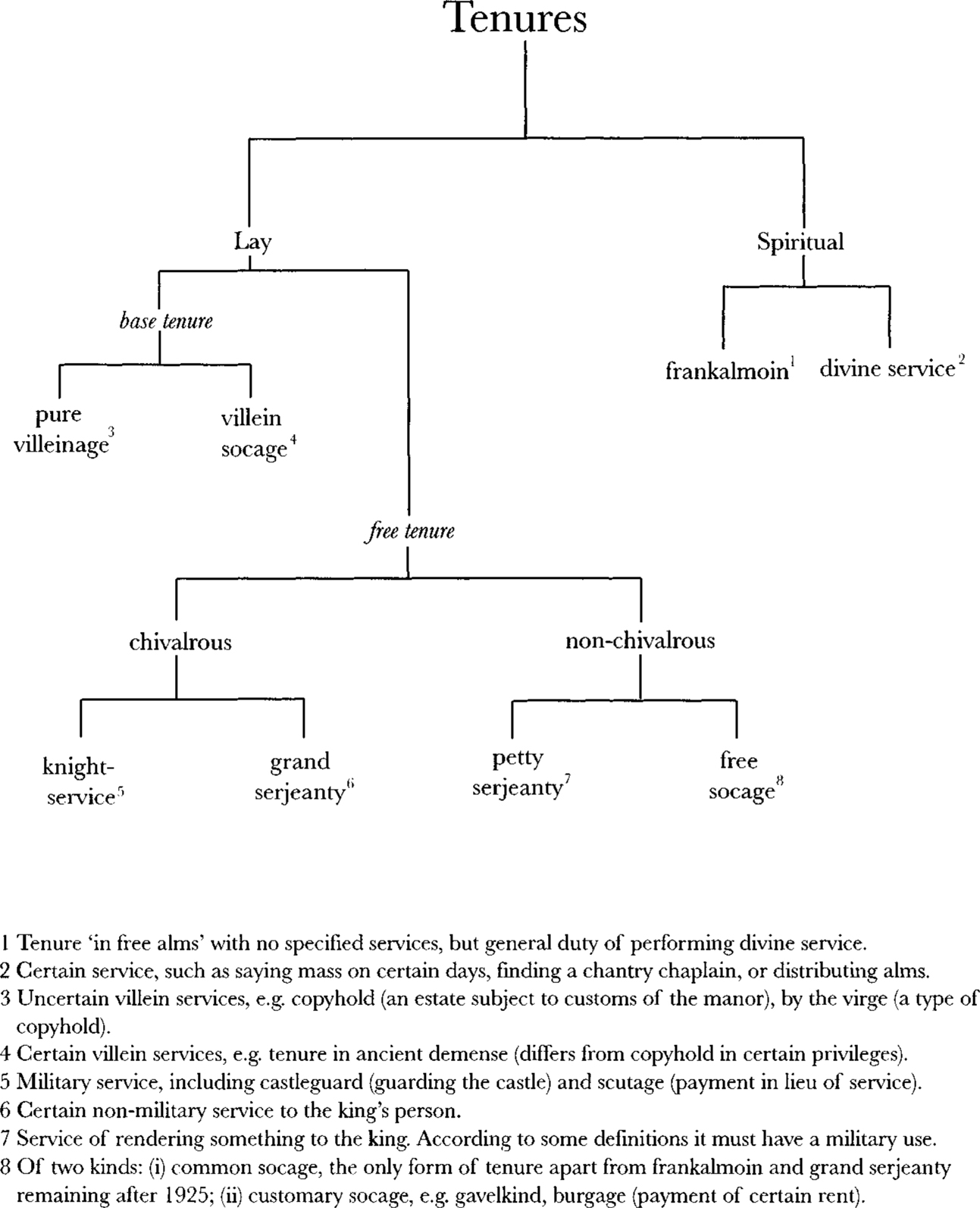
Appendix A Types of tenure
Source: Adapted from J.H. Baker (1990) An Introduction to English Legal History, 3rd edn, London: Butterworth, p.282.
Notes
1. Jameson (1991: 4, 38) refers to the contemporary mode of production as a ‘decentered global network’ of ‘multinational capitalism’, but it is unclear whether he is referring to a fundamentally interstate system or a transnational system. For transnational capital formation see Gill and Law (1993), also Robinson (1996, 1998), van der Pijl (1984, 1997).
2. Harvey (1990: 147) associates post-Fordism with enhanced capital mobility and flexibility, which he refers to as ‘flexible accumulation’ (‘flexibility with respect to labour processes, labour markets, products, and patterns of consumption’; the emergence of new sectors of production, new financial services and markets; and intensified rates of technological, commercial and organizational innovation) and the resulting time-space compression as the time horizon for decision-makers shrinks.
3. I would like to thank Warren Magnusson, a colleague at the University of Victoria, for this crucial insight.
4. I here adopt the emancipatory goals associated with critical theory in the works of Robert Cox (1996).
5. Singer (1988: 496, 499) notes that the term legal formalism has been used in many ways to denote mechanical jurisprudence; the belief that a legal system could be reduced to a small number of general principles; that the principles can be rigidly separated; that the process of applying the principles to generate conclusions is a logical, objective, and scientific process of deduction; and that the legal standards applied are objective. Legal formalism was associated with the classical era of legal scholarship which
started with the notion of a self-regulating market system, a private sphere insulated from government interference, influence and control. It then added the belief in a formalistic method of legal reasoning. … Judicial method was seen as scientific, apolitical, principled, objective, logical, and rational. Legal argument was pervaded with a sense of certainty. This sense of certainty, coupled with a commitment to the self-regulating market ideal, allowed classical judges to nullify hundreds of pieces of regulatory legislation to protect ‘property’, ‘freedom of contract’, and ‘liberty’. They seldom recognized that their own definition of property and contract embodied forms of regulation of exactly the sort that was being struck down. Nor did they recognize that their own definitions of property and contract embodied forms of government regulation and involvement in the market system.
6. Drawing on this now familiar distinction made by Cox (1996: 88–9), I would argue that the challenge for conventional theory is not as significant as that for historical materialism because the former tends to be ‘problem-solving theory’, while the latter represents ‘critical theory’ engaged in emancipatory politics.
7. Kennedy (1991) identifies rules governing the rights to organize, to secondary boycott, to picket; the rules governing dismissal, sabotage blacklisting; labour torts and the enforcement of contracts, contractual remedies, and the like, as examples of laws with distributional consequences.
8. See Robinson (1996, 1998) for analysis of the largely national-based nature of Marxist theorizing about class and productive relations. For important exceptions, see van der Pijl (1984, 1997) and Gill and Law (1993).
9. I derive the term mercatocracy from the medieval lex mercatoria, Latin for the law merchant, which was an autonomous body of private law that governed the commercial activities of medieval merchants. Today, the modern law merchant forms the ideological core of transnational capitalism.
10. The concept ‘mode of production’ is here being used in the terms formulated by Robert Cox (1989: 39):
Production here is to be understood in the broadest sense. It is not confined to the production of physical goods used or consumed. It covers also the production and reproduction of knowledge and of the social relations, morals, and institutions that are prerequisites to the production of physical goods. … Production is both a social process and a power relationship.
11. Marx defines the capitalist mode of production thus:
[t]he specific economic form, in which unpaid surplus-labour is pumped out of direct producers, determines the relationship of rulers and ruled. … It is always the direct relationship of the owners of the conditions of production to the direct producers … which reveals the innermost secret, the hidden basis of the entire social structure, and with it the political form of the relation of sovereignty and dependence, in short, the corresponding specific form of the state.
(quoted in Rosenberg 1994: 84)
12. Edgeworth (1988: 89) identifies these four properties in the works of modern theorists like Locke, Hegel, and Kant. He also criticizes Macpherson’s interpretation of the movement from feudal to modern property rights for linguistic essentialism and historicism, in assuming the existence of a single dominant conception of property at different historical times. However, it would appear that while there was indeed considerable variation on the themes of exclusivity and absolute property, as Seipp (1994) so clearly shows as regards the early common law and Patrick Atiyah (1979) shows in the context of later common law, it is difficult to deny that the prevailing notions of Anglo-American property were premised on what was regarded as an objective right of an individual to exclude others from the enjoyment of commodities or things.
13. In Cutler (1999a) I analyse the evolution of international maritime transport law in the context of the construction of two separate regimes of private and public international maritime laws. I argue that the private international legal regime created and sustains an exploitative regime of private protectionism that serves the interests of powerful maritime shipping, insurance, financial, and legal corporations.
14. Legal realism was a movement that emerged in the United States, primarily at Yale and Columbia, as a reaction to legal formalism. Legal formalism, or ‘classical legal thought’, dominated jurisprudence from the late nineteenth century to about the 1930s and is known for its strengthening of business corporations. Legal realists attacked the public/private distinction in domestic law in an effort to expose the political dimensions of private law concepts. They were interested in limiting the power of corporations and in creating a more powerful, centralized administrative state. However, after the war, legal realism was itself suspect as being anti-democratic (see Fisher et al. 1993).
15. Edgeworth (1988: 97) attributes this move to Wesley Hohfeld who conceived of law in terms of abstract legal relations and jural correlatives (Hohfeld 1913).
16. Notes, ‘Liability of Parent Corporations for Hazardous Waste Cleanup and Damages’, Harvard Law Review, 99 (1986): 986–1003; also Ismail (1991).
17. In Cutler (2001), I argue that the doctrine of international legal personality functions to obscure the expansion of corporate power and authority in the world, producing a disjuncture between law and fact. The disjuncture lies in the theoretical insignificance of corporations as ‘subjects’ of law in the face of their overwhelming factual power and authority. This disjuncture portends a crisis of legitimacy in international law because the law is incapable of theorizing its ‘subject’ in any meaningful way. See also Twining (1996).
18. See Doucas (1995), and the efforts of indigenous peoples to change international law evident in the ‘Initiatives for Protection of Rights of Holders of Traditional Knowledge, Indigenous Peoples and Local Communities’, Roundtable on Intellectual Property and Indigenous Peoples, World Intellectual Property Organization, Geneva, 23 and 24 July 1998, WIPO/LNDIP/RT/98/4A and The Mataatua Declaration on Cultural and Intellectual Property Rights of Indigenous Peoples.
Bibliography
· Anderson, P (1974a) Passages from Antiquity to Feudalism, London: Verso.
· Anderson, P (1974b) Lineages of the Absolutist State, London: Verso.
· Atiyah, P. (1979) The Rise and Fall of Freedom of Contract, Oxford: Clarendon Press.
· Baker, J.H. (1990) An Introduction to English Legal History, 3rd edn, London: Butterworth.
· Ball, C. (1996) ‘The Making of a Transnational Capitalist Society: The Court of Justice, Social Policy, and Individual Rights Under the European Community’s Legal Order’, Harvard International Law Journal, 37 (Spring): 307–388.
· Barlow, J. (1994) ‘The Economy of Ideas’, Wired, March: 8–12.
· Bawa, R. (1997) ‘The North-South Debate Over the Protection of Intellectual Property’, Dalhousie Journal of Legal Studies, 6: 77–119.
· Blackburn, T. (1994) ‘The Unification of Corporate Laws: The United States, the European Community and the Race to Laxity’, George Mason Independent Law Review, 3 (1): 1–95.
· Bull, H. (1977) The Anarchical Society, New York: Columbia University Press.
· Castells, M. (1989) The Informational City, Oxford: Blackwell.
· Cerny, P. (1997) ‘The Paradoxes of the Competition State: The Dynamics of Political Globalization’, Government and Opposition, 32 (2): 251–274.
· Charney, D. (1991) ‘Competition among Jurisdictions in Formulating Corporate Law Rules: An American Perspective on the “Race to the Bottom” in the European Communities’, Harvard International Law Journal, 32 (2): 423–456.
· Cohen, M. (1927–8) ‘Property and Sovereignty’, The Cornell Law Quarterly, 13: 8–30.
· Cox, R. (1989) ‘Production, the State, and Change in World Order’, in E. Czempiel and J. Rosenau (eds), Global Changes and Theoretical Challenges, Lexington, MA: D.C. Heath.
· Cox, R. (1996) ‘Social Forces, States, and World Orders’, in R. Cox with T. Sinclair , Approaches to World Order, Cambridge: Cambridge University Press, pp.85–123.
· Cutler, C. (1995) ‘Global Capitalism and Liberal Myths: Dispute Settlement in Private International Trade Relations’, Millennium, 24 (3): 377–397.
· Cutler, C. (1997) ‘Artifice, Ideology, and Paradox: The Public/Private Distinction in International Law’, Review of International Political Economy, 4 (2): 261–285.
· Cutler, C. (1999a) ‘Private Authority in International Trade Relations: The Case of Maritime Transport’, in C. Cutler , V. Hauñer and T. Porter (eds), Private Authority and International Affairs, New York: SUNY Press, pp.283–329.
· Cutler, C. (1999b) ‘Locating “Authority” in the Global Political Economy’, International Studies Quarterly, 43: 59–81.
· Cutler, C. (1999c) ‘Public Meets Private: The Unification and Harmonization of Private International Trade Law’, Global Society, 13 (1): 25–48.
· Cutler, C. (2000) ‘Globalization, Law, and Transnational Corporations: A Deepening of Market Discipline’, in S. McBride and T. Cohn (eds), Power in the Global Era, Basingstoke: Macmillan, pp.53–66.
· Cutler, C. (2001) ‘Critical Reflections on the Westphalian Assumptions of International Law and Organization: a Crisis of Legitimacy’, Review of International Studies, 27 (2): 133–150.
· Cutler, C. (2002) ‘Private Interactional Regimes and Interfirm Cooperation’, in R. Hall and T. Biersteker (eds), The Emergence of Private Authority in Global Governance, Cambridge: Cambridge University Press.
· Cutler, C., Haufler, V. and Porter, Tony (eds) (1999) Private Authority and International Affairs, New York: SUNY Press.
· Dezalay, Y. and Garth, B. (1996) Dealing in Virtue: International Commercial Arbitration and the Construction of a Transnational Legal Order, Chicago, IL: University of Chicago Press.
· Doucas, M. (1995) ‘Intellectual Property Law -Indigenous Peoples’ Concerns’, Canadian Intellectual Property Review, 12: 1–5.
· Edgeworth, B. (1988) ‘Post-Property? A Postmodern Conception of Private Property’, University of New South Wales Law Journal, 11: 87–116.
· Fisher, W., Horowitz, M. and Reed, T. (eds) (1993) American Legal Realism, Oxford: Oxford University Press.
· Fukuyama, F. (1989) ‘The End of History?’, The National Interest, 16: 3–18.
· Gardner, J. (1980) Legal Imperialism: American Lawyers and Foreign Aid in Latin America, Madison, WI: The University of Wisconsin Press.
· Gerber, D. (1996) ‘Intellectual Property Rights, Economic Power, and Global Technological Integration’, Chicago-Kent Law Review, 72: 463–476.
· Giddens, A. (1987) The Nation-State and Violence, Berkeley, CA: University of California Press.
· Giddens, A. (1990a) The Consequences of Modernity, Cambridge: Polity Press.
· Giddens, A. (1990b) ‘Modernity and Utopia’, New Statesman, 3(125): 20–22.
· Gill, S. (1995a) ‘Globalisation, Market Civilisation, and Disciplinary Neoliberalism’, Millennium, 24 (3): 399–423.
· Gill, S. (1995b) ‘Theorizing the Interregnum: The Double Movement and Global Politics in the 1990s’, in B. Hettne (ed.), International Political Economy, Halifax: Fernwood Publishing pp. 65–99.
· Gill, S. (1997) ‘Globalization, Democratization, and the Politics of Indifference’, in J. Mittelman (ed.), Globalization, Boulder, CO: Lynne Rienner.
· Gill, S. and Law, D. (1993) ‘Global Hegemony and the Structural Power of Capital’, in S. Gill (ed.), Gramsci, Historical Materialism and International Relations, Cambridge: Cambridge University Press, pp.93–124.
· Gramsci, A. (1971) Selections from Prison Notebooks, Q. Hoare and G. Smith eds and trans., London: Lawrence & Wishart.
· Grey, T. (1980) ‘The Disintegration of Property’, in J. Pennock and J. Chapman (eds), Property, Nomos: Yearbook of the American Society for Political and Legal Philosophy, New York: New York University Press.
· Hamilton, W. (1931) ‘The Ancient Maxim Caveat Emptor’, Yale Law Journal, 40 (8) (June): 1153–1187.
· Harvey, D. (1990) The Condition of Postmodernity, Oxford: Blackwell.
· Held, D. (1989) Political Theory and the Modern State, Cambridge: Polity Press.
· Hohfeld, W. (1913) ‘Some Fundamental Legal Conceptions as Applied in Judicial Reasoning’, Yale Law Journal, 23: 16–59.
· Horowitz, M. (1982) ‘The History of the Public/Private Distinction’, University of Pennsylvania Law Review, 130: 1423–1428.
· Ismail, H. (1991) ‘Forum Non Conveniens: United States Multinational Corporations, and Personal Injuries in the Third World: Your Place or Mine?’, Boston College Third World Law Journal, 11: 249–276.
· Jameson, F. (1991) Postmodernism or the Cultural Logic of Late Capitalism, London: Verso.
· Kairys, D. (ed.) (1982) The Politics of Law: A Progressive Critique, revised edn, New York: Pantheon Books.
· Kennedy, D. (1991) ‘The Stakes of Law, or Hale and Foucault’, Legal Studies Forum, 15 (4): 327–368.
· Kennedy, D.W. (1994) ‘Receiving the International’, Connecticut Journal of International Law, 10 (Fall): 1–26.
· Klare, K. (1982) ‘The Public/Private Distinction in Labour Law’, University of Pennsylvania Law Review, 130: 1358–1422.
· Macpherson, C. (ed.) (1978) Property: Mainstream and Critical Positions, Toronto: University of Toronto Press.
· Marx, K. (1983a) ‘A Contribution to the Critique of Political Economy’, in E. Kamenka (ed.), The Portable Karl Marx, New York: Penguin Books.
· Marx, K. (1983b) ‘Law and the Materialist Conception of History’, from The German Ideology, vol. 1, in E. Kamenka (ed.), The Portable Karl Marx, New York: Penguin Books.
· Meyer, C. (1990) ‘Personalizing the Impersonal: Corporations and the Bill of Rights’, The Hastings Law Journal, 41: 577–667.
· Minogue, K. (1980) ‘The Concept of Property and its Contemporary Significance’, in J. Pennock and J. Chapman (eds), Property, Nomos: Yearbook of the American Society for Political and Legal Philosophy, New York: New York University Press.
· Muchlinski, P. (1995) Multinational Enterprises and the Law, Oxford: Blackwell.
· Polan, A. (1984) Lenin and the End of Politics, London: Methuen.
· Polanyi, K. (1944) The Great Transformation, Boston, MA: Beacon Press.
· Reich, C. (1964) ‘The New Property’, Yale Law Journal, 73: 733–791.
· Robinson, W. (1996) ‘Globalisation: Nine Theses on our Epoch’, Race & Class, 38 (2): 13–31.
· Robinson, W. (1998) ‘Beyond Nation-State Paradigms: Globalization, Sociology, and the Challenge of Transnational Studies’, Sociological Forum, 13 (4): 561–594
· Rosenberg, J. (1994) The Empire of Civil Society, London: Verso.
· Scheuerman, W. (1999) ‘Economic Globalization and the Rule of Law’, Constellations: An International Journal of Critical and Democratic Theory, 6 (1) (March): 3–25.
· Seipp, D. (1994) ‘The Concept of Property in the Early Common Law’, Law and History Review, 12 (1) (Spring): 29–91.
· Sell, S. (1999) ‘Multinational Corporations as Agents of Change: The Globalization of Intellectual Property Rights’, in C. Cutler , V. Haufler and T. Porter (eds), Private Authority and International Affairs, New York: SUNY Press.
· Silbey, S. (1997) ‘Let Them Eat Cake: Globalization, Postmodernism, Colonialism, and the Possibilities of Justice’, Law and Society Review, 31 (2): 207–235.
· Singer, J. (1988) ‘Legal Realism Now’, California Law Review, 76: 465–544.
· Strange, S. (1996) The Retreat of the State, Cambridge: Cambridge University Press.
· Twining, W. (1996) ‘Globalization and Legal Theory: Some Local Implications’, Current Legal Problems, 49: 1–42.
· van der Pijl, K. (1984) The Making of an Atlantic Ruling Class, London: Verso.
· van der Pijl, K. (1997) ‘Transnational Class Formation and State Forms’, in S. Gill and H. Mittleman (eds), Innovation and Transformation in International Studies, Cambridge: Cambridge University Press, pp. 115–133.
· Wiegand, W. (1996) ‘Americanization of Law: Reception or Convergence?’, in L. Frieden and H. Schuker (eds), Legal Culture and the Legal Profession, Boulder, CO: Westview Press, pp. 137–152.
· Wood, E. (1995) Democracy Against Capitalism: Renewing Historical Materialism, Cambridge: Cambridge University Press.