
7
Before his grueling time as a concentration camp boxer, the young Harry Haft was tortured by a sadistic Nazi. The Nazi grabbed one of Haft’s hands, placed it on the jamb of a doorway, then slammed the door against the young man’s hand. All five fingers broke like pretzels. He screamed in pain and stared at his hand gloved in blood. His knuckles and fingers never healed correctly. And then, years later, for $200 he was given a chance to fight the future undefeated world heavyweight champion Rocky Marciano. Had he won, it would have been a stunning victory, placing him on the road to being a big name in boxing, a possible contender for a shot at the heavyweight or light heavyweight title. But according to a bitter and traumatized Harry Haft, he was ordered to take a dive. If he didn’t he would be killed. And so the young man who had survived the concentration camps where he had been forced to fight other Jews saw his boxing career end in defeat. The SS had not been able to defeat him, but the Mafia did.
Harry Haft was born on July 28, 1925, in Belchatow, Poland. He was fourteen years old when the Nazis invaded his country. Because he was a Jew, his days of freedom were limited. Yet he made the most of his life. He was as clever as a hunted urban coyote, avoiding the clutches of the Gestapo while managing to feed himself and his fatherless family (his father had died when Harry was three years old). He became a successful smuggler, a dealer in contraband. He stole what was not nailed down and then traded or sold it for food and clothing. He was a Jewish Artful Dodger with a double price on his head: one for being a Jew and the other for being a thief. His career as a minor criminal came to an end when he was finally arrested in 1942.
Rather than being tossed in a jail cell, Haft was compelled to work in a cement factory that was part of Auschwitz. He was one of many Jews forced into slave labor, beaten, cursed, and given starvation rations of barely edible food. Yet he had a strong will to survive; he would not let the Nazis destroy him. He used his smuggling skills to stay alive, bribing his way to better treatment with stolen commodities. In his biography of his father, Alan Scott Haft writes,
Harry made his way easily to the middle of a large freight train and crouched underneath a sealed boxcar. He picked up a piece of scrap metal and used it to pry open the lock. Then he slid open the door just enough to see what good fortune lay inside. The boxcar was full of tobacco products. He quickly chose to take a case of cigars rather than cigarettes. He pulled the door shut, secured the lock, and concealed the case as he walked back to the construction site.1
Haft turned his treasure of cigars into currency that was used to bribe a guard named Naparella, who was the foreman of the construction crew to which Haft had been assigned. The guard had Haft place the box of cigars in the trunk of his car and drove both of them to the town of Poznan, where the guard had three girlfriends, each of whom helped to stash all that Haft was able to steal. Prior to the theft, Naparella had been minimally friendly to Haft. Now he became become Haft’s protector, a fellow thief and a fence.
For weeks Haft continued to enjoy privileges denied to others, but his privileged position would not last long. As a Jew he was designated for extermination. So he was packed into an overcrowded bus and shipped from the cement factory to Auschwitz, where his arm was tattooed with the number 144739. There Haft was thrown together with an old friend named Schlemek. They were assigned to take the bodies of Jews who had been gassed and heave them like garbage into ovens to be incinerated. Alan Scott Haft writes,
Harry tried not to look at the faces of the dead, but he could not help it. It took two men to toss an adult into the fire, but Harry was expected to handle the bodies of children on his own.
Harry and Schlemek were directed by the guards to throw [a fellow worker’s] body into the fire. Harry grabbed the legs and Schlemek the shoulders, and just before they heaved forward, Harry caught sight of the man’s face. His eyes were open; he was not dead. Next, they reached for the man’s wife and threw her in beside him.2
The SS guards took note of Haft’s muscular physique. They thought he could be of more profitable use and so relocated him from the crematoriums to the coal mines, where he encountered a former thief and smuggler, now an SS guard, named Schneider. They had previously stolen diamonds, and Schneider decided that they should forge a new and mutually advantageous relationship. Schneider, thinking of what might be in store for him if Germany lost the war, decided that Haft could serve as a postwar witness to testify that Schneider had not been a war criminal. In return for his future testimony, Haft would receive sausages, chocolate, and whiskey. But the relationship had another dimension, which was presented to Haft a few days after it had begun: “You are going to entertain my friends the other officers and soldiers. You are going to be a boxer, and on Sundays you will fight. Next Sunday, we will hold boxing matches in the street in front of the officers’ quarters.”3
Haft would have to engage in bare-knuckle brawls with other prisoners. The winner would receive extra rations. The bouts would end when one fighter could no longer continue fighting. A makeshift ring of four posts connected by ropes was set up in front of the officers’ quarters. There were three rows of seats surrounding the ring. A band of Jewish prisoner-musicians with string instruments would provide the musical accompaniment for the pounding of fists and the flow of blood. The SS assembled amidst much joking, laughter, and imbibing of whiskey. Haft’s first opponent was a skeletal, half-starved creature who had been yanked from his barrack to be beaten for the entertainment of the officers. The man’s eyes were large with fear. His large bony hands trembled. He looked as if a single punch might kill him. Haft felt sorry for the man and initially tried to spare him the effects of a beating. He delivered less than killer punches. But that wasn’t what the audience bellowed for: “Kill the little Jew bastard, kill him.” They shouted for the men to fight like tigers, not pussycats. They howled for blood. They hurled anti-Semitic tropes like grenades. Haft was finally told by Schneider to finish off his opponent or suffer the consequences. The consequences were enumerated: kill or be killed. Haft quickly knocked out his opponent, who was carried from the ring. Haft beat five other men that night, knowing that the more brutal his attacks, the louder the guards’ cheers. If he didn’t satisfy their thirst for blood, they would demand his blood, Schneider continued to warn him. Fight to the death if you want to live. The SS rewarded Haft’s brutality by nicknaming him “the Jew Animal.”
The Jew Animal’s reputation spread beyond the camp, and generals and other high-ranking officers wanted to see the renowned Jewish gladiator pummel Jewish opponents into bloody unconscious submission or be killed trying. This was sport not seen since the days of the Roman Coliseum, and the SS officers loved it. They then decided to heighten the excitement: rather than watch Haft fight skeletal opponents, the Nazis arranged for a more evenly matched bout during which even more blood than usual might flow. Haft at 5'9" would tangle with a 6'3" unbeaten Jewish-French fighter, a favorite of the Nazi generals. The generals brought their man to the camp in a limousine. The fight would consist of three-minute rounds and would go on until one man could no longer fight.
Haft was not a trained pugilist. He had seen the typical German boxer, stand in the ring and trade punches, toe to toe, with an opponent. Haft imitated what he saw. The Frenchman, however, was a trained boxer. He could dance around the ring, darting in to land a punch then darting out to avoid being hit. Haft stood in the center of the ring and yelled at his opponent to meet him in a face-to-face fight. The Frenchman did not oblige. He darted in, pounded Haft’s nose and eyes with a series of powerful jabs and combinations, then darted out of the range of Haft’s fists. The skin around Haft’s eyes was bruised and swollen, the lids nearly closed. Cuts were soon opened around Haft’s eyes and on his lower lip; blood veiled his cheeks and chin. Realizing that he was losing the fight and perhaps his life, Haft set a trap: retreating into a corner of the ring, he all but seemed to ask the Frenchman to finish him off. The Frenchman came at Haft, delivering powerful jabs and right crosses; it looked like the end for Haft. Then with the desperate ferocity of a cornered animal, Haft threw a series of uppercuts and hooks that landed on the Frenchman’s chin and head. The blows were driven with the angry force of sledgehammers. The Frenchman’s head rocked from side to side, snapped backward as if on a spring. He wobbled, his eyeballs rolled up into his head like a pair of unlucky numbers in a slot machine. He thudded to the ground like a large uprooted tree. The generals cursed their fighter because they’d just lost thousands of marks to the camp’s SS guards. The defeated boxer was dragged by his legs from the ring. Dirt and blood were smeared on his unconscious face. A few minutes later, several shots from a Luger pistol were heard, but that did not break the merriment and laughter of the guards.
As if his gladiatorial combat and work in a crematorium had not sufficiently traumatized Haft, he witnessed acts of such base depravity that he not only lost faith in God but also in the possibility that humanity could maintain even a sliver of decency in the face of organized genocide. In the barracks late one night, he witnessed a group of Russian prisoners approach an inmate who had fallen into a deep sleep on his bunk. One of the Russians took a cord that held up his pants, wrapped it around the neck of the startled prisoner and began to choke him. Fully awake, the prisoner grabbed for the cord as his legs thrashed about like the tail of a beached fish. He screamed for help, but soon he had no breath. He lay on his bunk dead, the cord still tightly wrapped around his neck. Now the group of Russian prisoners took out crude knives and cut slices off the dead man’s buttocks. They devoured the bloody flesh with the rapaciousness of hungry wolves. Once satiated, they fell asleep with their victim’s drying blood on their own faces.
The camp was hell on earth, worse than anything in Dante’s Inferno. Haft desperately needed to escape. How could one go on living amidst such misery and sadism? He and his friend Peretz decided that they would find a way to escape at the first opportunity. That opportunity occurred as the Americans and Soviet troops were closing in on Poland and Germany. The prisoners were to be evacuated via what became known as a death march: Laggards and those too weak to trudge the long distance were shot on the spot.
As the long line of skeletal marchers in their prison rags proceeded, yelled at and periodically whipped by their SS guards, Allied bombs exploded nearby, providing a distraction and cover for an escape. As the guards and inmates scattered to avoid being blown to bits, Haft and Peretz took off running. As they approached a ditch, they were hit by flying debris from a nearby explosion; gunshots followed. The two men fell into the ditch, Peretz, a bloody mess, flopping on top of Haft. He was dead. Two SS guards approached, searching for escaped prisoners. When they saw the two bloody bodies in the ditch, one of the guards was about to fire his gun to make sure the escapees were dead but the other guard told him not to waste his ammunition on a pair of corpses. Covered by Peretz’s blood, Haft breathed in the smell of death; though scared, he was glad to still be alive.
Haft lived in the forest for several days. He fed himself with roots, berries, leaves. As he wandered, he was drawn to the sound of a man singing in German. Haft spied the man bathing in a nearby river, his clothes and rifle and holstered pistol lay on the nearby shore. Haft picked up the SS soldier’s rifle, pointed it at the bather, and fired. The bullet missed the astonished victim, who ran out of the river toward Haft.
Harry reached for the handgun and emptied the contents of the chamber into his target. The soldier was probably dead, but Harry was blind with rage. He battered the man’s skull with the butt of the rifle until it was a bloody, pulpy stump.
The SS man had rations of food and water near the clothing, and Harry sat under the tree and nourished himself. He removed his bloody clothing and washed himself in the river. He dressed himself in the soldier’s uniform, baggy on his 110-pound frame. He pulled an eye patch out of the shirt pocket and placed it on his left eye to complete the disguise. He gathered the soldier’s remaining personal belongings and continued on his way.4
Haft made his way to a farm house, where an old couple took him in, provided food, and offered him shelter for the night. After a satisfying dinner, the couple began to interrogate Haft. His German was not that of a native. His answers to their questions were unconvincing. When the farm woman saw him getting ready for bed, she noticed that he had removed the patch from his left eye and there was no wound visible. The couple accused him of being an impersonator. Haft pulled out the pistol and shot first the farmer and then his wife. He gathered up as much food as he could carry and cautiously, but quickly, left the farmhouse.
Haft wandered for days in the forest. Finally, he came across a platoon of American soldiers. Seeing his uniform, the soldiers demanded that Haft drop his rifle and pistol. Haft, not being able to understand English, dropped his rifle and pistol, then raised his hands above his head. As the American soldiers drew near, Haft dropped to his knees and with one finger traced a Jewish star in the dirt. His eyes pleaded for understanding. Then he rolled up the sleeve of one arm and revealed the numbers that the SS had tattooed on him. Again he looked up at the faces of the soldiers and could see sympathy in their eyes. One of the American soldiers was able to converse with Haft in Yiddish. Haft could not contain himself. The hair-raising story of life in the camps, of having had to fight to survive, of his fortunate escape from the death march all poured out of Haft like rivers from a burst dam. For the first time in years, he felt safe.
It was not long afterward that Haft was placed in a displaced persons camp in Deggendorf along with thousands of other Jewish survivors of the camps. He spent much of his time thinking about what his future would be. Europe was a bloody land of murderous anti-Semites, their helpers, and those who remained silent. What Jew would want to remain there?
Haft was not trained for any profession. His only skill was that of a boxer. Might he try for a career in boxing? His question was answered when he heard of a Jewish boxing championship to be held in Munich in January 1946. Haft decided to enter the competition. He figured that he had developed sufficient pugilistic skills while in captivity. Still he knew he would have to prepare himself for bouts against men who would be spending hours each day training themselves. So he threw himself into a rigorous training regimen. At 160 pounds, he decided to fight in the light-heavyweight division but he also thought he might test himself as a heavyweight.
There were dozens of elimination bouts, and Haft proved himself a winner in all that he entered. His reputation as a fearless and fearsome pugilist spread among the American soldiers. They said that Haft had the makings of being a real champion back in the States. They were further impressed when in a period of two hours Haft knocked out both a heavyweight contender and a light-heavyweight contender. Then when it came to a final bout, Haft was told he had to chose between fighting as a light-heavyweight or a heavyweight. The heavyweights were the more popular fighters so Haft opted to enter the ring as a heavyweight.
Haft was like a recently caged and hungry tiger released to attack and kill its prey. He trotted into the ring almost unable to wait for the first round to begin. As soon as the bell sounded, he rushed at his opponent, landing lefts and rights, uppercuts and hooks, again and again. Slowly but surely his opponent caved, finally collapsing in the ring. He had barely countered any of Haft’s blows. In less than one minute of that first round, Haft emerged as a dynamic pugilistic force. He was voted the outstanding boxer of the tournament and received a medal from General Lucius Clay. The crowd cheered and whooped their appreciation.
Haft now knew he would go to the United States and become a professional boxer. A few months later, he boarded a troopship, the Marine Marlin, sailing from Bremerhaven, Germany, and bound for New York City. It was a city that had welcomed millions of Eastern European Jews. Through an uneventful crossing, Haft could barely wait to see his new land. On finally disembarking he reflected that neither the Gestapo nor the SS would ever again throw him into a concentration camp. He was surprised that his reputation as a boxer had preceded him, for shortly after taking up residence at a relative’s home, he was the subject of a local newspaper story that informed readers that Harry Haft, a former inmate of Nazi concentration camps who had successfully fought in seventy-five boxing matches as a prisoner and then won a postwar heavyweight championship, was now settled in the United States.
However, before Haft could embark upon his career as a professional boxer, he had to unlearn the German style of toe-to-toe boxing. His career would be stillborn if he boxed flat-footed, attempting to trade punches with an opponent. Haft hired a manager, a man named Harry Mandell, who was little help in getting Haft the kind of training he needed for they didn’t have the money to hire a sophisticated trainer. A few of the well-known trainers who were fixtures at Stillman’s Gym in Manhattan thought Haft had potential, but none of them embraced Haft as a client. Yet they gave Haft pointers and he was able to spar in the ring with a few notable boxers. From them Haft was able to add to his skills, but he still remained a crude ring performer. Nevertheless, Mandell was able to arrange for Haft to have several fights, and he won all of them. The money he earned for the fights was just barely enough to keep a roof over his head and food on his table. He did, however, benefit from the freebies that many boxers are given.
Mandell stopped off at the Everlast factory in the Bronx. Harry was treated to all the courtesies given to professional boxers. He was given all of his boxing equipment, headgear, shorts, gloves, robes, cups and shoes for free by Everlast for promotional purposes. The clerk asked about Harry’s accent and when he heard Harry’s story he had a white Star of David stitched on his purple fight trunks. The Jewish emblem on his trunks was very important to Harry, who wanted to be known as a Jewish fighter.5
One of the professional fighters who befriended Haft was Harold Green, a powerful welterweight and middleweight who had defeated Rocky Graziano in two fights and then was paid to lose in their third encounter. Haft was surprised to learn of the fix, and this would prove portentous for his fight with another Rocky, the bruising heavyweight slugger Rocky Marciano. Green warned Haft to be wary of the mob. As his career advanced they would attempt to get their hooks into him. Yet without the mob, Green himself had compiled an impressive record of 71 wins, 23 by knockouts, 14 losses, and 2 draws. Green’s daughter, Allyce Schwartzbart told the Las Vegas Sun, “My father fought in an era where you did what you were told to do. He never had the management that could get him a shot at a title. But my father was never bitter.”6 After all, he beat two future title holders, not only Rocky Graziano, but also Joey Giardello.
Beginning in 1948, Haft had a series of fights that would elevate and spread his reputation, leading to a possible shot at the light-heavyweight title. He knocked out Jim Letty in the 2nd round of their bout, earning $70. For his next fight, a week later, he knocked out Gilbert Cardione, also in the 2nd round. Rather than enjoying an increase in earnings however, Haft was paid $60 for the fight. Following his fight with Cardione, Haft had 5 more fights in 1948, winning each one, 4 by decisions, 1 by a knockout.
However, the following year would not be one of multiple wins for Haft: he lost a series of fights, the first one to Pat O’Conner, then one to Dom Bernardo, and then one to Toby Reid followed by loses to Henry Chemel and Danny Ruggerio. Managers and fight fans no longer viewed Haft as an up and coming fighter, someone who could pack an arena. He had to prove himself, or his fight career would stall. On May 30, 1949, a determined Harry Haft, professional boxer, proved invincible in his fight with Johnny Pretzie. Haft fought as if his life depended on the outcome; certainly his future as a boxer did. So brutal was his devastating attack on Pretzie that the referee had to stop the fight in the 4th round.
His next fight would be against the talented and undefeated boxer Roland La Starza, a fighter who came close to defeating Rocky Mariciano. In a career that included 57 wins and 9 losses, from July 1947 to August 1961, La Starza fought some of the most talented heavyweights of the era, including Rocky Marciano in 1950 and 1953. On March 4, 1950, La Starza came as close as any opponent had to beating Marciano. The scoring for that fight was 5–4, 4–5, and 5–5, which should have amounted to a draw; however, New York and Massachusetts had a supplemental scoring system that permitted Marciano to be declared the winner. Up to that bout, La Starza had been undefeated with a record of 37–0. Feeling that he was a victim of a manipulated scoring system, he told the sports reporter for the New York Herald Tribune, “The fact is [Marciano’s] manager Al Weill was matchmaker for the Garden. I would say that had a lot to do with the decision.” La Starza never backed down from his belief. On February 13, 1953, La Starza defeated Rex Layne at Madison Square Garden in New York City. That set up a rematch with Marciano for the heavyweight title on September 24, 1953, in the Polo Grounds (the hometown stadium for the New York Giants). While Marciano was a 4 to 1 favorite, La Starza hoped to prove that his previous loss could be overcome. The fight did not turn out as La Starza had hoped.
Life magazine reported:
Trying to knock the challenger out with one punch, the 29-year-old Marciano was over-eager and awkward. He lunged, butted, hit below the belt, on the break and after the bell. Once, he swung so wildly that he missed and slipped clumsily to the canvas. Outboxing the champion and avoiding his blows, La Starza managed to win four of the first six rounds. In the seventh, Marciano changed his tactics, started aiming at La Starza’s body as well as his head in an attempt to wear the challenger down. He succeeded.
The Associated Press reported:
Sliced around both eyes and bleeding from a cut on the bridge of his nose, the well-battered La Starza took a tremendous beating in the last five rounds before Referee Ruby Goldstein wisely stopped the slaughter.7
La Starza commented after the fight that Marciano is “a great fighter. He’s definitely a better fighter than when I fought him before—5,000 percent better.”
Haft was just itching to have a shot at the hard-hitting La Starza. A win could put him in position to be a title contender. Haft didn’t believe that their weight and height differences would have an effect on his ability to either outpoint or even knock out La Starza. Haft weighed 175 pounds to La Starza’s 185. Haft was 5'9" to La Starza’s 6'0". Haft had sparred with La Starza at Stillman’s Gym in New York and had never been hurt by the hard-hitting heavyweight from the Bronx. On June 27, 1949, at the Coney Island Velodrome in Brooklyn, the bout took place. Haft, full of confidence and eager to prove that he was a winner, was the fired up aggressor, chasing La Starza around the ring, challenging him to fight toe to toe. But La Starza was as quick and untouchable as the wind. He would occasionally pause and Haft would land a few hard combinations, but Haft was unable to stop La Starza. In the 4th round, La Starza had had enough of the dance and landed a series of hard rights to Haft’s jaw. Haft either went down from the rights or he slipped on the wet canvas, as he later claimed. He did not take the 8 count on one knee as he was supposed to but stood up with his right hand gripping the rope and his left hand down at his side as he was taught to do in Europe. In such a position, he would not have been able to defend himself. Referee Teddy Martin stopped the fight and awarded a TKO victory to La Starza. Haft and his manager, Mandell, bitterly complained about the decision. But the ruling was chiseled in cement, and nothing they could do would turn it to dust. Commentators said that Haft, having had numerous bouts in the United States, should have known how to take an 8 count. They said he screwed himself. Then on July 18, 1949, with less than a month to barely recover from his defeat, Haft got a second chance to prove himself to fans and promoters: he was scheduled to get a shot at Marciano in the Rhode Island Auditorium in Providence. It would be the fight that changed Haft’s life.
Mandell and his new partner, Saul Chernoff, who had bought a piece of Haft, took their fighter to train at Greenwood Lake in upstate New York. They stayed at the famous Brown’s Hotel (where Jerry Lewis allegedly got his start as a young comedian and waiter). Haft ran three miles every morning and worked out on the heavy bag and speed bag in the afternoons. He also skipped rope, shadowboxed, and sparred. One day he bumped into Charley Goldman, Marciano’s trainer. Goldman, a derby-wearing character out of a Damon Runyon story, had trained five world champions. As a young bantamweight fighter, the diminutive 5’1” Goldman had 137 recorded fights but his career as a boxer ended because he repeatedly broke the brittle bones in his hands in the ring. Now his fingers and knuckles were as gnarled as old tree branches. Haft had originally met Goldman at Stillman’s Gym. The two had established an immediate bond when they discovered that many of their Polish relatives had been murdered in SS–run concentration camps. Though he was Marciano’s trainer, Goldman gave Haft a number of tips on how to fight Marciano: stay away from him so he can’t pound your midsection. With short arms, he’s an inside fighter. Punch and get away from him. In addition to this advice, Goldman arranged for Haft to spar with another heavyweight whose style of fighting was similar to Marciano’s.
While Mandell was pleased with Haft’s progress and rigorous training, he wanted to make sure that his fighter was psychologically prepared for the fight with Marciano so he arranged for Haft to have a session with a hypnotist, hoping that the session would reduce Haft’s vulnerability to feeling the pain of Marciano’s notoriously hard punches. Following the session, the hypnotist told Haft he was ready for the fight.
On the evening of July 18, 1949, Haft entered his dressing room at the Rhode Island Auditorium. He was getting advice from Mandell when Charley Goldman burst into the room. Red-faced Goldman was furious, indignant, a hornet about to sting. He accused Haft of hurting his reputation, for Haft had told former light-heavyweight champ Maxie Rosenbloom that Goldman had given him tips on how to fight Marciano and said he might even have a chance to defeat Marciano. Word had gotten back to Al Weill, Marciano’s manager, who screamed at Goldman, denouncing him as a traitor. Goldman demanded to know if Haft had been so indiscreet as to blab to Rosenbloom. Haft apologized and was able to cool Goldman’s red-hot anger. It didn’t matter because Weill had banned Goldman from Marciano’s corner, an indignity for any trainer but especially for one as admired and proud as Goldman. Haft again apologized and Goldman departed, repeating a few words of advice about staying away from Marciano and saying he would watch the fight from a seat near the ring.
Haft put on his trunks with the Star of David stitched on one side. It was reminiscent of the yellow star that all of Hitler’s Jews had to wear, though the one on Haft’s trunks was worn with pride. A few minutes later three tough-looking mobsters entered the room. They told Haft that if he didn’t take a dive in round 1, he would be killed. Haft was nonplussed. He couldn’t believe that such a thing could happen in America, but the threat entered his consciousness and grew, a counterweight to the session with the hypnotist. By the time he entered the ring he was fearful of even attempting to win. But he didn’t take that dive in the first round. Something of his survival instincts came to the fore and drove him to fight on. This was no Nazi concentration camp fight, but like those fights, his life depended on the outcome. In the first round, Haft landed a hard right to Marciano’s gut but it had little effect. In round 2, Marciano poured on a series of powerful blows, and just before the bell sounded ending the round, Marciano delivered a hard right to Haft’s jaw and then delivered a pair of lefts to Haft’s head. Haft was damaged and not ready for the fight to resume in round 3. Alan Haft quotes John Hanlon from the Providence Journal on the fight’s final round:
Two hard punches to Haft’s head—a left and a right—were Marciano’s openers in the third. At the halfway mark, Haft rallied briefly. But it was too late. After several damaging blows to Haft’s head, Rocky delivered the crushers. The first was a left coming up to the midsection. Then, as Haft doubled up from the force of the wallop, Marciano shot a short right—down and across to put Haft out of the action.
Haft received a fine reception as he left the ring, for the spectators realized that he had made a game attempt against forbidding odds. Not once did he back away from Marciano’s punishing right hand and on several occasions stood toe to toe and slugged it out with his heavier opponent.8
Though his career ended in frustration that night, Haft soon married and had three children. He operated a fruit and vegetable store in Brooklyn. His experiences in the camps had traumatized him, leaving him angry and bitter. His hair-trigger temper could be explosive, and his wife and children were often frightened by his outbursts. Boxing writer Robert Mladinich told me that when he interviewed Haft, he met a broken man.
Alan Scott Haft sent me the following letter that he’d written to his father.
Dear Popsie,
You’ve been gone nearly 12 years, and I miss not having a father. Growing up, you beat me, for my childish misbehavior. The rage you had inside, you often took out on me. I feared your very presence. You broke furniture and punched out windows—abused mom to no end. Despite the abuse, mom always protected you—excused your behavior because of your “background.” I could not excuse you, until I learned what that background was. I was ashamed of you. You could not read or write. You spoke broken English with a thick accent—and had those green numbers on your arm.
I wish I knew then, what I know now. You suffered terribly at the hands of the Nazis. You saw horror, and were forced to participate in it. After you told me all about your ordeal, what you had to do just to live another day, it helped me understand why you were who you were and are who you are. I now see how sorry you are for the abuse—
How can anyone judge you? They call you a Holocaust survivor—but does anyone really survive. It has been said that the Nazi’s murdered your soul.
Popsie, I have spent my later years trying to make the world better for you. Your story was published by Syracuse University, you were inducted into the Jewish Sports Hall of fame, there is a major motion picture about your life; I know that you would have been happy that I made you famous.
Despite the physical and psychological abuse—I would want you to know I forgive you. Mom died this summer. She was the angel sent by God to care for you.
Now it’s your turn to take care of her.
Love,
Alan9
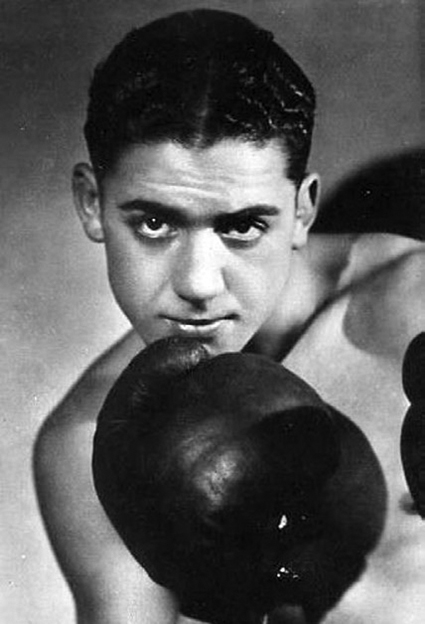
victor “young” perez. Cyber Boxing Zone
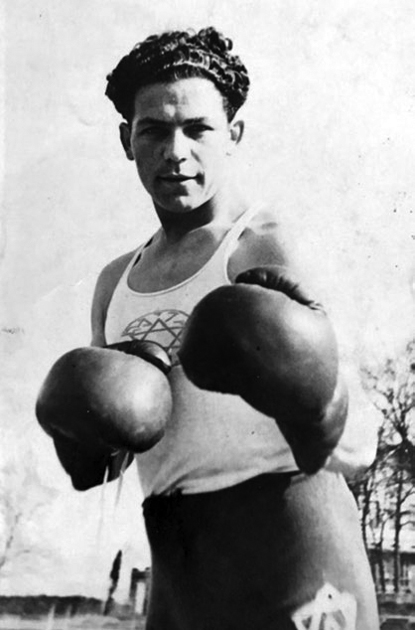
A young Harry Haft. Alan Haft

Harry Haft, heavyweight boxer. Alan Haft
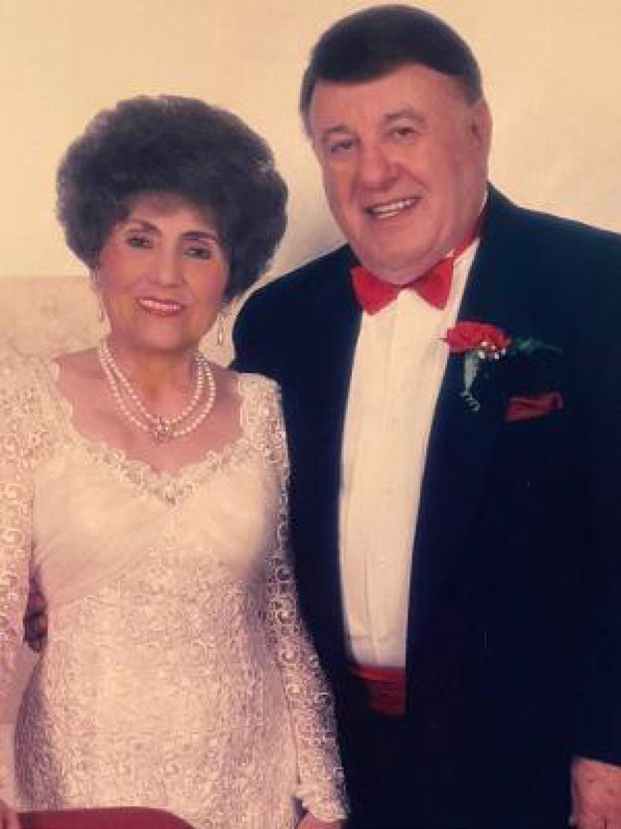
Nathan Shapow and his wife, Hela. Dr. Morris Shapow and Adina Shapow

Witold pilecki, polish anti-Nazi resister. Polish National Digital Archives
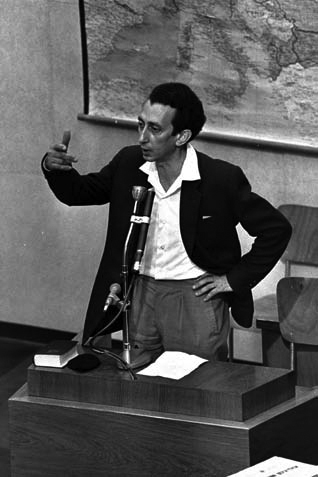
Abba Kovner, leader of the Avengers, testifying at Eichmann trial. Israel Government Press Office

Heinrich Himmler and Reinhard Heydrich. Anonymous

U.S. Supreme Court Justice Robert Jackson, Nuremberg prosecutor. Maurice Consant, U.S. government photographer

Senator Thomas J. Dodd, Nuremberg prosecutor. U.S. Senate Historical Office

german boxing champion Max Schmeling. U.S. Library of Congress