
Chapter 18
The Americans are a queer people; they can’t rest.
—Stephen Leacock
The essential factor in the destiny of a nation … lies in the quality and quantity of its will.
—H. G. Wells
This country with its institutions belongs to the people who inhabit it. Whenever they shall grow weary of the existing government, they can exercise their constitutional right of amending it, or their revolutionary right to dismember or overthrow it.
—Abraham Lincoln
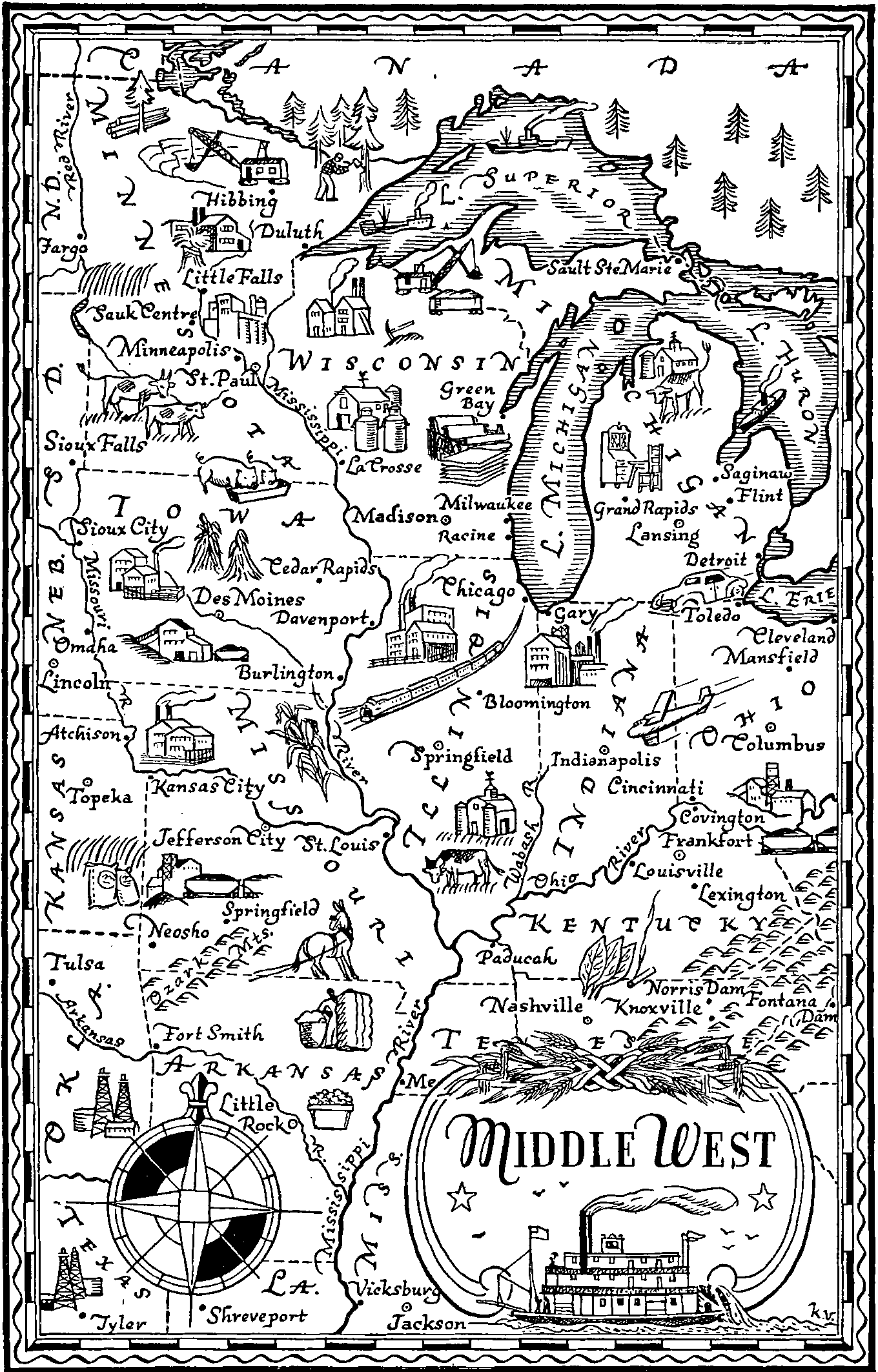
TO DEFINE the Middle West is comparatively easy; it is the upper basin of the Mississippi and its tributaries. The region cannot, however, be precisely bounded by state lines, though commonly it is assumed to consist of Minnesota, Wisconsin, Iowa, Missouri, Illinois, Indiana, Michigan, and Ohio. But the eastern fringes of the Great Plains states—the Dakotas, Nebraska, and Kansas—also belong to the Middle West by most standards. Conversely part of Minnesota (which calls itself the “Northwest” or “Upper Midwest” incidentally) hardly seems middle western at all, and Missouri has, as we shall see, pronounced characteristics of the South. Ohio is in a category mostly its own. Most Ohioans, at least in the rural areas, think of themselves as Middle Westerners, but towns like Akron and Cleveland belong much more to the orbit of the industrial East, and Cincinnati is southerly as well as eastern. One remark I heard is that Toledo is “where the Middle West ends.” All this being true, we shall abide by those authorities who consider the Middle West to be the eight great states named above.
There are other criteria, of course, aside from the Mississippi basin. It might be said that the Middle West is that part of the nation where moist black soil of great depth and richness is to be found, in contrast to the red soil of the South, the mongrel stone and sand of New England, and the red, yellow, or dry sparse soil of the West. But there is plenty of middle western soil, like some in Minnesota and the marginal southern areas of Indiana and Missouri, not black at all. Another definition might be that it is that part of the country mostly laid out in townships six miles square; it is where the farmer owns his own quarter-section (160 acres) and works it himself. But there are plenty of middle western farmers with more or less than 160 acres, to say nothing of the fact that the whole region is pre-eminently one of great cities too. Another simple definition might be that the Midwest is the broad flat area blocked off by the Rockies and the Alleghenies at each end, where people tend to look inward rather than outward, where few ever see the sea. Similarly a narrow delimitation might be that it is an area coterminous with the circulation belt of the Chicago Tribune.1
At any rate one thing is corelike and indisputable. This great block of states is the central pivot and umbilicus of the nation.
Great Lakes and Great River
Rolling, rolling from Arkansas, Kansas, Iowa
Rolling from Ohio, Wisconsin, Illinois,
Rolling and shouting:
Till, at last, it is Mississippi,
The Father of Waters; the matchless; the great flood
Dyed with the earth of states; with the dust and the sun and the seed of half the states.
—Stephen Vincent Benet
Many years ago in London I happened to be telling an English lady about Chicago, and how its most challenging feature was the great imperturbable expanse of lake. “Lake?” she asked. “What lake? Can you see across it?” (It was this same lady who was similarly astonished to hear that in Chicago we could see some of the best Renoirs in the world, hear Chaliapin and Galli Curci regularly although New York did not, watch Katchaloff and Moskvin of the Moscow Art Theater in the flesh, and go to a university with three Nobel prize winners on its staff.)
Lake Michigan (22,400 square miles in area) is bigger by a comfortable margin than Spanish Morocco or Switzerland, and as every American knows it is one of five, with a total area of 95,160 square miles—almost twice the size of England. These lakes, called “Great” with reason, are the fresh-water Mediterranean of the western hemisphere, as has nicely been said. They are the Middle West’s equivalent of a coastline.2 Of course they are more than merely a midwest phenomenon, since Pennsylvania abuts on one, and New York on two. They carry the Middle West right out into the Atlantic, and they are as important to Canada as to the United States. Originally, a couple of hundred thousand years ago, they were hollowed out by the glaciers which at the same time ground the rocks into what is now fine soil. They are the source not merely of a prodigious commerce but of mythology; Paul Bunyan is a Great Lakes character. One extraordinary thing about them, as de Tocqueville noted a century ago, is that unlike almost all European lakes they are not walled in—they merge flatly into the plains and prairie. But do not think that they cannot be angry! I have seen weather on Lake Erie that made the China Sea seem calm. Normally one does not associate such turbulent outbursts of nature with a mechanical civilization, but Lake Erie is also the greatest industrial waterway in the world, a lake almost as big as Palestine with a cordon of railways drawn tight around it like a noose.3
Define the Middle West again. It is where industry and agriculture both reach their highest American development and coalesce. This theme, even if I do not mention it explicitly, will recur time and again in the chapters following. The Great Lakes are so important because, aside from much else, they feed half the nation with (a) grain and (b) steel. From the western tip of Lake Superior, at Duluth (Minnesota) and Superior (Wisconsin) flows an inordinate, colossal tonnage of iron ore and wheat destined for the furnaces and breadbaskets of the East. In return, coal flows up. The life of the freighters carrying this cargo has an authentic romance hard to match in contemporary affairs. Also it is a fact perhaps hard to believe, and realistic in the extreme, that Duluth-Superior is the second biggest port in the United States. Lake Superior is artificially connected with its sisters by the Soo Canal at Sault Ste. Marie. This canal, which charges no tolls, carries more traffic than the Panama and Suez Canals combined.4 Professor Hatcher makes the point that, if the locks here had been destroyed during the war, the United States might have lost it. More than 90 million tons of iron ore, destined to become steel, passed through the Soo Canal in 1942 alone.
Finally think of the great cities on the lakesides. “Blot out of the North American continent the cities that rim … the Great Lakes and it is astonishing to consider how much would be lost,” writes Hatcher. “The heart of Canada would cease to beat.” On the American side forget the medium towns—dozens like Racine, Ashtabula, Sandusky, Marquette, Gary, Menominee, Ashland, Erie, Ludington, Escanaba, Niagara—and reflect merely on the goliaths: Milwaukee, Chicago, Detroit, Toledo, Cleveland, Buffalo.
The Mississippi River, which we must also mention briefly now, has never been described better than by Mark Twain seventy-odd years ago:
The Mississippi is not a commonplace river…. Considering the Missouri its main branch, it is the longest river in the world—4,300 miles. It seems safe to say that it is also the crookedest river in the world, since in one part of its journey it uses up 1,300 miles to cover the same ground that the crow would fly over in 675. It discharges three times as much water as the St. Lawrence, 25 times as much as the Rhine, and 338 times as much as the Thames. No other river has so vast a drainage basin; it draws its water supply from 28 states and territories, from Delaware, on the Atlantic seaboard … to Idaho on the Pacific slope.
The Mississippi receives and carries to the Gulf water from 54 subordinate rivers that are navigable by steamboats, and from some hundreds that are navigable by flats and keels. The area of its drainage basin is as great as the combined areas of England, Wales, Scotland, Ireland, France, Spain, Portugal, Germany, Austria, Italy, and Turkey.
It is a remarkable river in this: that instead of widening toward its mouth, it grows narrower … and deeper.
Mark Twain, who was a prescient reporter, also mentions that as of his day the Mississippi empties every year 406 million tons of mud into the Gulf of Mexico. Change the word “mud” to “soil,” and we are up to date. It is a striking commentary on the way that rivers don’t change that the best contemporary figure on soil loss is almost precisely that which Mark Twain uses, 400 million tons. Harnessing of this mastodon of rivers and its tributaries remains, as Professor Brogan has said,5 incomparably the greatest engineering problem in the western world.
Another description of the Mississippi is that of Charles Dickens in the 1840’s. He sees it first at Cairo, Illinois, “a slimy monster hideous to behold.” Mr. Dickens pays his respects to Cairo (“a hotbed of disease, an ugly sepulchre, a grave uncheered by any gleam of promise”) and proceeds:
But what words shall describe the Mississippi, great father of rivers, who (praise be to Heaven) has no young children like him! An enormous ditch, sometimes two or three miles wide, running liquid mud, six miles an hour; its strong and frothy current choked and obstructed everywhere by huge logs and whole forest trees … now rolling past like monstrous bodies, their tangled roots showing like matted hair … or wounded snakes. The banks low, the trees dwarfish, the marshes swarming with frogs, the wretched cabins few and far apart, their inmates hollow-cheeked and pale, mosquitoes penetrating into every crack and crevice of the boat, mud and slime on everything …
For two days we toiled up this foul stream.6
Dickens would find a change or two today, though the river is certainly a “Big Muddy” still, and it remains what it always was—a kind of huge rope, no matter with what knots and frayings, tying the United States together. It is the Nile of the Western Hemisphere. Its banks and levees are not all that they might be, and it still shows an uncontrollable tendency to spit and wander, but Dickens would be interested in two developments at least—the way it has become a tremendous industrial waterway, fit for two-way navigation the year around, and the proposal made last year to build a “Mississippi River Parkway,” an automobile road that would be a “scenic highway” along its total length, through ten states. But when one stops to reflect, it is rather odd that such a parkway has never been proposed before.
Three Brief Observations about the Middle West
(1) More than any other American region, except possibly New England, it represents the full flowering of the “gadget mind.” Most American boys, and in particular those from midwest farms, are born mechanics; they can do anything with their hands. Out of this and much else has come what Detroit, let us say, symbolizes better than any other American city—the assembly line and mass production.
Perhaps the “mechanical approach” is the curse of modern America. It has put a sharp metallic edge on events and phenomena in many fields, and it serves to make utility, practicalness, the dominant American measuring stick in almost everything. What really runs this country, one might say, is the spirit that wants to know what makes an automobile go. What really distinguishes the Middle West is the combination it affords of black soil and the tractor; it is where corn and the jeep work together.
Details in this field are innumerable. The skyscraper was invented in Chicago. Henry Ford once made the nation laugh, witlessly, by talking about the synthetic cow. The scientific work that most interested Charles A. Lindbergh was on an artificial heart.
(2) The most interesting single thing about the Middle West is probably its actual middleness, not only in geography or in the sense of moderation, but in its averageness, its typicalness. This is America uncontaminated. Here sounds the most spontaneous natural note in the nation. Any good politician knows that, if he can’t carry the Middle West, he can’t carry anything. The region has, as a result, a profound veto power over the rest of the country. Another aspect of this “middleness” is that, since the Midwest is like a governor controlling the oscillations of a wheel, it is the part of the nation that most strongly resists change. One might also say that, for the Japanese to have assumed that an attack on Pearl Harbor could win a war or for the Germans ever to have had any idea of beating the United States at all, proves that they knew nothing of the Middle West whatsoever.
This middleness can be expressed in another dimension. The Mississippi Basin was filled by the pushing out of the first thirteen states, and therefore it became a kind of bridge between New England, Virginia, and the migrations later. The influence of the South is often ignored, but it is considerable, particularly in Ohio, Missouri, and southern Illinois and Indiana. The father of the Middle West was, as Graham Hutton points out, none other than Thomas Jefferson, and Patrick Henry (believe it or not!) was the first governor of Illinois.7
New England, however, outranks the South as a progenitor. In a way the Midwest is exactly what one would expect from a marriage between New England puritanism and rich soil.
Middleness in still another direction is expressed by the suggestive fact that the area is, all at once, a producer, processor, distributor, and consumer. Two-thirds of the entire retail market of the nation, Hutton calculates, is in the middle states. The West is as we know primarily a producer; the East is primarily a consumer; the Middle West is both, and also the link between them.
(3) It would be absurd to call the Melting Pot specifically a Midwest phenomenon; it exists conspicuously in New England and all the industrial cities of the East; from this point on until we reach the South many chapters hence, the foreign-born and the sons of foreign-born will never be far absent from these pages. But the challenge of opening up and settling a continent was first met in the Middle West. Some of the earlier strains, like those of the French and Dutch, are recessive nowadays. But think of the Scots, Germans, Irish, Italians, Canadians, Russians, Scandinavians, Bohemians, Poles, that came later!
Except for a few Indian full-bloods, all Americans are, of course, the product of foreign immigration—Puritan, Cavalier, Chinese, Greek, Negro, Montenegrin, or what you will. This point, though astonishing to some outsiders, need not be labored. “The United States,” a British historian wrote once, “is the greatest single achievement of European civilization.”
A phrase every middle western boy hears a thousand times is “the old country,” uttered by his elders usually in a tone of nostalgic affection plus relief that it is far away plus a desire to return for a visit someday but not to stay. The United States is a country unique in the world because it was populated not merely by people who live in it by the accident of birth, but by those who willed to come here.
How well the melting pot has melted is a question not the province of this chapter. “The temperature at which fusion takes place,” as André Siegfried wrote once,8 varies according to locality and the nature of the stock. But surely, of all American achievements in the past century and the early years of this, the successful absorption of millions upon millions of immigrants is the most notable. Free primary education was, of course, a major factor in this. What is the more remarkable is that this ponderous influx was assimilated without a declension in the national standard of living; indeed, the standard actually went up. As recently as 1927, Siegfried thought that the problem of assimilation was still the most onerous that America had to face. In 1945, all that he would have had to do was glance at the crew of almost any B-29.
There are, however, some striking examples in the Middle West today of foreign-born and foreign-descended groups still tightly cohesive. If the reader happens to be a Chicagoan, he will know what an American city is like when it contains a Greek city, a Lithuanian city, a Sicilian city, a Slovak city, a Hungarian city, and a Negro city. Chicago is the biggest Italian community in the world after Milan, and the biggest Polish community after Warsaw. According to Hutton, two-fifths of all Chicagoans, even today, do not customarily speak English at home.9 Or take the massive and extremely American state of Michigan, where more than half the entire population is foreign born or had parents foreign born. Michigan has one community that, in a literal sense, is unique: Hamtramck. This has a population of roughly 50,000, almost exclusively Polish. Hamtramck is entirely surrounded by Detroit geographically—it is impossible to get in or out of it without going through Detroit—but it is a quite separate and independent community, no part of Detroit politically. It has its own city council, laws, and mayor.
Cities, Nomadism, and Labor
But for my children, I would have them keep their distance from the thickening center; corruption
Never has been compulsory, when the cities lie at the monster’s feet there are left the mountains.
—Robinson Jeffers
The important midwest cities are not merely those on the lakes; they are deep in the interior, too, like Indianapolis, which is one of the few big American towns not on any navigable waterway at all. Of fourteen cities in the country with more than 500,000 people, five are in the Middle West; of the ninety-two with more than 100,000, twenty-seven; of the 197 with more than 50,000, fifty-eight.
One of the most exasperating of familiar criticisms of the United States is that the cities are so much “alike.” Some in the Midwest are indeed alike physically—and for this there is a good reason, that they were built at roughly the same time, and as products of the same westerly march. But most will be found to be highly contradistinctive and dissimilar—even those close together in the same state—if one knows them well.10 I cannot imagine any two communities more unlike than Kenosha, Wisconsin, and Green Bay, Wisconsin, though both have almost the same population and both are on the water within a hundred-odd miles of one another, or Muskegon, Michigan, and Jackson, Michigan.
The medium middle western cities, with what H. G. Wells once called their “long defiles of industrialism,” are the ugliest, least attractive phenomena in the United States. They represent more bluntly than anything else in the country the worst American characteristics—covetousness, ignorance, absence of esthetic values, get-rich-quickism, bluster, lack of vision, lack of foresight, excessive standardization, and immature and undisciplined social behavior.
Because so many American cities are painfully crowded, noisy, and packed with dirt and squalor, thousands of Midwesterners are constantly on the move, not so much fleeing the cities for the country, however, as seeking other cities. The United States is, as is notorious, a nation on wheels. Often we have mentioned nomadism. This is not so important for its own sake, perhaps, as for the concomitants it brings. One of its results, paradoxical as this may seem, is the deep-seated American instinct to join—clannishness. People are forever fleeing from one residence to the next, and so more than normally they seek some kind of identification. This country, as a New York friend of mine put it recently, is the most “overclubbed” in the world. Think merely of the great fraternal orders like the Elks and Moose. The national foot-looseness has another consequence in that rootless people have little interest in local civic problems; corruption in municipal affairs, the generally low level of the local judiciary, defective public services, juvenile delinquency, slum conditions—all these may be explained in part by this phenomenon. But also, it is only fair to mention on the other side, nomadism and the flight from city to city are one of the chief centripetal forces, like chain stores and comic strips, that binds the United States together.
The Midwest discharges itself outward without halt. If I were asked to mention the most typical “middle western” phenomena I know, I should answer first a country club in Westchester, New York, and second, on a different level, a pier dance in Los Angeles.
Finally, a word on labor. Here in the choked midwest urban areas, we come across labor as a really major political and social force for the first time. Of course this is mostly for the good. But one should at least mention in passing two factors that, more than anything else, have damaged the labor movement in the United States: (1) Exploitation by criminal racketeers; (2) Communist infiltration.
Mail Order and Agricultural Machines
Nobody can possibly understand the Middle West who has not, for fun or profit, once looked through the catalogue of a great mail order company. Houses like Sears Roebuck and Montgomery Ward are beyond doubt one of the chief unifying and co-ordinating of all American forces. Sears normally puts out about seven million catalogues (they are as bulky as a telephone book) twice a year, and Ward about six million.11 They are free, of course, and the printing bill is one of the biggest in the United States.
The cover of a recent Sears catalogue is a mellow autumnal scene by Inness; inside is a pretty girl in blue, wearing an Ann Barton Sears Famous Dress, price $4.98. It looks very fetching too. A heavy paper insert describes how to measure linoleum, and the inner back cover explains the Sears Easy Payment Plan. Perhaps I have not looked minutely enough, but in the more than nine hundred closely printed pages the most expensive item I found was a 3½ carat diamond ring for $3,800. There is also a 1/100 carat ring for $12.25. The cheapest thing I saw was a nail hole patch at 8¢. But on one page (Get More Eggs and Meat with 4A Grade Trapnest Pedigree Sired Chicks) are day-old baby chicks at 14¢ in lots of a hundred. In between is a luxuriant variety of material. Americans take this for granted. Non-Americans, not so lucky, may not. The span runs from duck and crow calls (Authentically Toned Bean Lake Duck Call, $1.95) to vaginal suppositories, from window sashes to shrubs for fall planting, from automobile Insurance to the Peoples Book Club to Slumbersound Mattresses, layer-felted for resilience, inner straps for durability, 54-inch mattress, only $18.95.
About the differences between Sears and Ward, pages might be written. Sears had behind it for years the tradition of a truly great and sound man, Julius Rosenwald. Its chairman of the board nowadays, General Robert E. Wood, was as everybody knows once president of America First. Ward’s president too gets his name in the papers quite often. He is none other than that antique fogram Sewell L. Avery.
My friend Lloyd Lewis, historian of Sherman and the Lincoln legends, told me once that the wholesale dry goods business, which along with the meat packers traditionally dominated the Chicago commercial world, has been all but squeezed out in recent years, having been caught between the mail order houses and the small merchant in the minor cities. Mr. Lewis explains this by saying that obviously the old wholesalers can no longer survive in the contemporary “Expense Account Era.” Macy’s and the other big New York stores take the small out-of-town buyers to the Stork Club, no less, and the old-time wholesalers can’t compete with that.
Another force not to be neglected in any survey of midwest affairs is agricultural machinery. International Harvester, McCormick-Deering, Oliver, Ferguson, Allis-Chalmers, John Deere, and the other great manufacturers are important factors in several ways. For one thing they assist the industrialization of agriculture, which should mean greater earning power for the farmer. For another they promote a healthy diversification of crops because, the more varied a man’s crop is, the more will he need different types of farm machinery. For another their advertisements bring a considerable revenue to the agricultural newspapers and magazines. One healthy trend is the development of new types of small machinery for small farms, together with prefabrication of farm buildings.
Note on Religious Influences
All the principal Protestant denominations are active in the Middle West; ditto the Catholics; ditto the Jews. Cultist extremism is fairly widespread. Most folk who grew up in or around Chicago will remember the Holy Rollers in Benton Harbor, Michigan, and the Voliva community near Waukegan, Illinois, which believed that the world was flat, and where automobiles were forbidden. Today, in Minneapolis (a quite effervescent town religiously, and one with strong tinges of anti-Semitism), you may hear “Catechism Comes to Life” on the radio, and attend services at the River-Lake Tabernacle of Cowboy Bill Durbin, “Famous Western Cowboy Evangelist and Former Radio Singer.” In Des Moines you may go to the “First Church of the Open Bible” and listen to tabernacle ceremonies of “Christ Centered”; in Detroit (the most touchy and violent of midwest cities) you may applaud a southern evangelist who has a “rapier-like wit and inimitable style” (adv.) and listen in to an institution known as “the GospelLiteHouse of the Air.”
The situation of Jews in the Middle West, especially rich Jews, is peculiar. The plain fact of the matter is that they are, in effect, segregated. Near the University of Chicago when I went there, a handsome, dignified, stately residential district existed that was almost as Jewish as Tel Aviv; here lived—and pursued very useful lives—a cluster of Rosenwalds, Adlers and so on almost as dynastically interlocked as Hapsburgs. In Chicago certainly, and in other big middle western cities to an extent, the Jews who could afford it were driven by goy prejudices and discriminations not only to establish their own clubs of various sorts (downtown and country), schools, kindergartens, and college fraternities, but even neighborhoods.12
There are some notably liberal Roman Catholics in Chicago and the other midwest cities; there are some notably illiberal. A sharp line of demarcation is that provided by Franco Spain; some of the most militant Catholic propaganda about Spain comes out of the Middle West. The Missouri State Council of the Knights of Columbus (St. Louis) recently published advertisements in eastern newspapers pleading the Franco “case” and urging action now “before another Christian nation is enfolded in the foul embrace of the Red Fascists.” In Cincinnati the Catholic Telegraph-Register, official organ of the archdiocese, similarly bought space to accuse the republican government that preceded Franco of “killing 300,000 citizens.” One advertisement begins with a grammatical error that has greater impact, perhaps, than the rest of the text: “Looting, pillaging, violation of women, the burning and burial of people alive (people like you and I)—these are the horrible historical facts!” And so on for half a page.
Finally, let it not be forgotten, the Detroit area is the home base of two men whose names—and reputations—are flavorsomely known, Father Charles E. Coughlin and the mucid Gerald L. K. Smith.
Midwest Miscellany
Years ago in Inside Europe, writing about that baffling country England, I listed some forces and things heard and seen in British public and private life. One might do likewise for the Middle West:
Church suppers.
County and state fairs—particularly on Governor’s Day as in Iowa.
The ole swimmin’ hole, the red brick schoolhouse, and the ritual of “working one’s way” through college.
Juke boxes.
Cartoons like that by John McCutcheon of the Chicago Tribune about Indian Summer, football teams like the Green Bay Packers, and social phenomena like wrong-side-of-the-trackism in regard to where a person is born.
Canals and the memory of portages.
The tradition of great independent newspaper editors, living and dead, like Charles H. Dennis and Henry Justin Smith of the Chicago Daily News, H. E. Newbranch of the Omaha World Herald, William T. Evjue of the Madison (Wisconsin) Capital Times, W. W. Waymack of the Des Moines Register and Tribune, and Oliver K. Bovard of the St. Louis Post-Dispatch.
Small lakes in northern Indiana like saucepans full of limp bathing suits; the lawns, six inches deep with autumn leaves, before frame houses with big porches in middle-sized Wisconsin towns; the rows of pumpkins outside the filling stations in Ohio villages.
Country (as distinct from city) clubs.
The recreation and travel industry, which produces an income of 300 million dollars a year in Michigan alone.
The great state universities, their athletics and their alumni.
Bulletin boards in the local post offices, with their wide variety of reading matter—reports on migratory birds, advices on criminals by the FBI, and civil service jobs open at $1,140.25 per year.
Automobiles with wooden bumpers in the winter of 1946–47—as strange a sight as an eagle wearing gloves.
Splendid teachers (to name only a few from a single university) like Robert Morss Lovett, Frederick Starr, the late James Weber Linn, Charles E. Merriam, Ferdinand Schevill, Edith Foster Flint, and Anton J. Carlson.
Nuggets of political conversation like “Don’t know if he can vote his own wife, but he carries a lot of punch,” “When we’re in a war I’m for the president as long as it lasts,” “There’s a pretty high brand of government in this here state,” (how many times did I hear that!) “He’s the best rough-and-tumble swivel-chair lawyer in the county,” and “The guy is so honest that there’s nothing he’d steal but an election.”
Utterly nauseous conditions in the state insane asylums.
The use of the word “visit” as a synonym for the verb “see.”
Public worship of vitamins, golf, and Frank Sinatra.
The signs in hotel lobbies, made of small white letters set into black felt, like MAX BERKOVITC BRKL KNIT SWEATERS CHIC TOGS BLOUSES 590, and those in hotel restaurants, like LUNCHEON GUESTS WITH A 75¢ MINIMUM ARE INVITED TO PLAY CARDS FROM 2 TO 4:30 P.M.
The fact that the most conservative vote is not, contrary to general opinion, that of the farmers but of businessmen in small towns.
Middle western (and American) awe of a really good department store, like Marshall Field’s in Chicago.
The elevator boy in Indianapolis who said of his car, “This jitney o’ mine is a piece o’ junk.”
Painters like Grant Wood, John Steuart Curry, and Thomas Hart Benton.
The stupendous effect of women on adult education, in that it is generally women who promote lecture tours by visiting celebrities and the like.
The look on the GI’s face when the MP poured his bottle of bourbon down the toilet in a Pullman washroom between Elkhart and Toledo.
The crushing social pressure exerted on youngsters by the corner drugstore.
Place names like What Cheer, Iowa, and Peculiar, Missouri.
Night schools—especially their courses in law.
Motels and tourist camps, which, what with hypocrisy, puritanism, and the housing shortage, have become the chief haunts of the amorous.
The hired man who comes to work at 7:50 A.M. or 8:02 instead of 8 sharp, to “avoid regimentation” and demonstrate his independence and equality.
Slovenly cemeteries in remote Indiana villages; Iowa streets absolutely silent after 7:30 P.M.; bank nights in an Ohio hamlet (population 2,172) with a pot of $635.55; weddings performed in Missouri on an open truck.
Fishing.
The fact that the United States is the country where most luxuries are cheap.
A great instinct for horseplay and a terrific gambling impulse in most Americans.
The gap between a basic good will in citizens and a lack of concrete know-how; the gap between sound and generous social ideals and inadequate performance; the gap between what most people believe in as regards political and civic affairs, and what they actually do.
Note on Politics
Considering the Middle West to be twelve states instead of merely eight, with the Great Plains thus included, it will control about a third of the delegates to the next party conventions. It is not without interest that, in January, 1947, the Republican chairmen in these states met and adopted in Chicago a resolution to the effect that their nominee should be “one who is symbolic of the ideals and heritage of the Middle West.” In fact as of the moment of writing all serious contenders for the Republican nomination, except Warren of California, are Mid-westerners by birth if not residence: Vandenberg, Taft, Stassen, Bricker, and Dewey who was born in Michigan.13
Also, the political leverage exerted by the Midwest was shown sharply by the chairmanships assigned to congressional committees after the 1946 elections. The position of Taft and Vandenberg in the Senate is well known. In the House, Charles A. Halleck of Indiana (a Dewey man) won the majority leadership after a contest with another Middle Westerner, Clarence J. Brown, the Ohio favorite. Leo E. Allen (Illinois) became chairman of the powerful Rules Committee, and Leslie C. Arends (Illinois) the party whip. All told New York got two chairmanships out of nineteen, New Jersey four, Massachusetts one, the Pacific coast one, and the Midwest all the rest—eleven. Five went to Michigan alone. Of course seniority was the prime reason for all this. Of the eleven Midwest chairmen, two at least are vehemently narrow and intractable isolationists, Clare E. Hoffman of Michigan and Harold Knutson of Minnesota.
Negroes in the North
Eenie, meenie, minie, moe,
Catch a nigger by the toe,
If he hollers make him pay
Fifty dollars every day.
Between three and four million American Negroes live north of the Mason and Dixon’s line, and we must make brief mention of those in the Middle West. The great northerly migration of southern Negroes began after World War I, and has continued intermittently ever since, though no mass movement occurred after World War II to compare with that of the early 1920’s. Most educated Negroes, looking at the Negro problem from the broadest point of view, think that this hegira is healthy. It makes things better for those Negroes remaining in the South, by thinning them out. It proves that the Negro can learn skills and earn a living in new fields. Above all, it distributes the Negro problem better over the whole country, by “nationalizing” it.
Some old-time Negro residents of Chicago or Milwaukee or Cleveland fear and resent the newcomers, however. For one thing most of them are undereducated and they serve to lower the common denominator of the community. For another they add painfully to the difficulties of a housing situation already grievous. I heard Northerners say, almost with desperation, that they “simply couldn’t take any more Southerners in.” Yet a steady continuing influx is inescapable. More and more Negroes are being forced out of the South by the mechanization of agriculture, and experts say that, of the seven and a half million now on southern farms, only four million will, within a predictable future, be needed there. How, the North asks, can it possibly feed and house and send to school three and a half million Negroes on top of those it already has?
By and large the northern Negro is much better off and more secure than his brother in the South. First, the living standard is higher, and there are more opportunities for jobs. Second, whereas in the South segregation is a matter of law, in the North (though it can be highly unpleasant as we shall see) it is one mostly of habit and procedures. A Negro can be a juror in the North; he can be a policeman; he escapes a considerable number of the indignities we shall inspect when we reach the South; his children may, with luck, even be able to go to a tolerable school. Another difference is that very few Negroes in the North go into agriculture. Southern whites say, of course, that Northerners mistreat Negroes “worse than we do.” But such ill-treatment is not, as a rule, based on law. Also the fact that Negroes may often suffer injustices in the North, to say nothing of murder and mutilation in race riots, does not excuse the South for the way it handles the selfsame problem.14
Northern Negro communities are, because of greater advantages, considerably more variegated than southern; there are at least half a dozen lines of stratification:
(a) Color. Here the pattern is roughly the same as in the South. Most Negroes have a lively sense of shadings within color, as we shall see later. Like members of all depressed classes, they are acutely conscious of anything that contributes to their caste status.
(b) Social “class.” What makes a northern Negro an aristocrat? Of several hallmarks, which are complexly blended, one is certainly nonslave origin. The Negro whose forebears were freed before the Civil War is, as a rule, likely to think of himself as superior. Many slaves became freedmen in pre-Civil War days, and some were sent north by their masters to get an education; their descendants are apt to say “My people were never slaves!” Then again, under slavery in the South, house servants among Negroes were the superior class; the farm workers were the proletariat. The cook’s children mingled freely with the white master’s children; sometimes they learned to read and write together. One may, in the North today, meet two Negro physicians or Ph.D.’s; one will be self-conscious in a mixed gathering, one will not; like as not the one not self-conscious derives from this special servants’ class.
(c) Education. Obviously the Harvard graduate has a better position in the community than an illiterate sharecropper out of Arkansas. Similarly a Negro whose father and mother both went to school is above his fellows.
(d) Rich and poor. Overwhelmingly the Negro community in the North is poor, though not so poor as in the South. Wealthy Negroes are extremely rare anywhere in the United States, though a few do exist. The richest American Negro is probably the president of an insurance company in Durham, North Carolina; running him close—but again I must write “probably”—is a publisher and real estate owner in New York. Insurance is, by and large, the business in which most northern Negroes make the most money; an important item in this field is funeral insurance.
(e) Religion. Most northern Negroes, like their southern brethren, are Protestant and predominantly Baptists.
(f) Attitude to segregation. Here, perhaps, we find the chief difference between North and South. Northern Negroes are of course more outspoken and radical. They can afford to say publicly what most Southerners could not possibly risk saying, and they sometimes criticize them for “weakness” on the segregation issue. But like as not the miserably crushed southern Negro has no choice. But in the North, too, a few of what modern Negroes call the “take-it-easy boys” still exist, those who want “to stay in good” at all costs, who will accept white strictures without protest, who for instance consent to ride in the freight elevator of a hotel. Some compromisers on segregation are called “handkerchief heads.” This relates to the bandannas traditionally worn by old mammies, and among the political minded it is the worst of epithets.
(g) Politics. In the 1944 elections the country-wide Negro vote was Democratic by the staggering figure of 80 per cent. This onesidedness may not last. Negroes of course range from conservatives to radicals, within both parties, exactly as do whites. There are Bourbons among Negro political leaders, middle-roaders, Communists. Also, a point not generally appreciated, there are some 250,000 Negroes (mostly northern) in the federal civil service.
The most pressing Negro issue in the North is housing. Negroes in Chicago, in Detroit, in Pittsburgh live in what are in effect ghettos. These are not as a rule directly established by the municipality; they rise through restrictive covenants set up by white landlords, many of them absentee. A real estate group or local association of landowners will, for instance, get every owner in a district to sign a contract limiting, say, tenancy to “people not of African descent” for a period of years. Negroes have protested the legality of this, but unsuccessfully on the whole. The result of such closing off of Negroes from opportunities in housing is, first of all, the equivalent of segregation in the South; the Negro community is forcibly cooped up in whatever districts it now inhabits, and cannot spread no matter how much it multiplies. This, in turn, means that schools in the closed area become solidly Negro, exactly like the segregated schools in the South; it means congestion, violently high rents, the perpetuation of slums, breakdown in municipal facilities like street repair and garbage disposal, hoodlumism especially among the young, and serious problems in police and fire protection.15
One interesting minor problem has to do with sports. Negroes are admitted to college football, and are often very good at it. A northern team with a Negro member will not, however, be able as a rule to play a southern team, at least in the South. On the other hand, by an unwritten Big Ten rule, Negroes are excluded from basketball. This is an indoor sport, and taboos are strong (though not so strong as in the South) against any contact between half-clad, perspiring bodies, even on the floor of a gym. Probably Ohio State, among the great midwest universities, has the best record in these matters. A Negro was president of one of its chief student organizations last year, and a Negro girl led its YWCA. Negroes at Ohio State may go into the swimming pool (the sudden explosive vibration you hear is caused by a southern white reading this), live in dormitories, and even go to proms—with Negro partners.
The worst racial outbreak in the United States for many years occurred in Detroit in 1943. Six hundred people were injured, mostly Negro, and thirty-one were killed, twenty-five of whom were Negro. A race riot is, to paraphrase Myrdal, “urban lynching.” A superb account of the Detroit riots, well worth the most serious attention still, may be found in A Primer for White Folks, by Earl Brown. The most shocking thing about the whole ugly episode was, as Mr. Brown reports, the fact that “such an outbreak had been foreseen for more than a year before it occurred.” Detroit is the most explosive town in the Western Hemisphere, Buenos Aires not excepted; it is here, more than anywhere else in America, that the Negro problem is exacerbated by what is called “three-dimensional incompatibility.” There were many contributing factors to the disorders. The behavior of the police, for the most part, was the most disgraceful ever known in an American city. That, overwhelmingly, most aggressors were white is proved by the briefest glimpse of photographs in Life of the massacre, among the most remarkable photographs ever printed in a magazine. Detroit is packed with southern white hillbillies, who had never in their lives seen Negroes on a quasiequal level; many of its policemen were southern; it has an angry tradition of labor violence; it is full of company thugs, ex-Bundists, and Ku-Kluxers; and it houses the automobile business, which means that life is tremendously competitive with rewards high and accustomed to being fought for.
Middle West and Isolation
With foreign policy as such this book does not deal; there must, however, be a word about isolationism. That the Middle West is the most isolationist area in the country is usually taken for granted; whether this is really so is not certain. Actually, whether you like it or not, isolationism to some degree exists wherever America exists. Polls carefully made by the Gallup and Roper organizations do not indicate that the Mississippi Basin states are much more decisively isolationist than other areas, except perhaps the South and Texas which are of course interventionist in the extreme. Questionnaires in Iowa do not have results much different from those in, say, upper New York state or Oregon. Consider too the personal item that three of the most outspoken and ardent internationalists of our time—Willkie, Wallace, Stassen—were or are all Middle Westerners.
Let us say a word first about the tenacious grip that isolationism can indubitably exert. It is old stuff to most of us; it may not be such old stuff to the man in Zanzibar. For instance during the whole of World War I the United States was never an “ally” of Great Britain and France, but only an “associated power.” Until just before Pearl Harbor. 32 per cent of the American people thought it was more important to stay out of war than to beat Hitler.16 Some small personal items seem, nowadays, almost too singular for belief. No American distinguished himself more for friendship to Britain during World War II, or more endeared himself to the British public, than Herbert Agar, once editor of the Louisville Courier-Journal. But before the war Mr. Agar—I mean no reproach—had been a convinced and quite vocal isolationist. No paper has a more broadly generous record of public service than the St. Louis Post-Dispatch, but even this newspaper attacked with ferocity, as late as 1941, the arrangement whereby we “gave” Britain fifty overage destroyers. Thousands of Americans of every stamp and category, in the prehistoric days before 1939, failed to realize that the Atlantic Ocean, in the false sense of security it gave, was one of the worst enemies the United States ever had.
To an extraordinary extent classifications became mixed. It is a tribute to the depth and width of the issue that before Pearl Harbor, Colonel McCormick, Norman Thomas, the Communist party, distinguished folk like Charles A. Beard and Stuart Chase, the La Follettes, Oswald Garrison Villard, and William Randolph Hearst, were all in the same camp. In the interventionist camp, be it noted, was an equally odd assortment—J. P. Morgan & Co., the liberal weeklies, almost all non-Communist radicals, Yankees to whom the word “radical” connoted a touch of hell, the cotton millionaires, most Jews, William Allen White, and southern senators full of frounce.
Shrill isolationist notes may still be heard. Consider the following bleat from a Missouri congressman named Dewey Short:
I am against it [the UNRRA appropriation] with all my heart and soul. I talk as I vote and vote as I talk. So long as I know they have crown jewels of the King and the Czar—and I have seen them—they are brilliant and would bring a neat sum on any market today, enough to run any government for quite a while—as long as they wear ermine and emeralds in London and Moscow, as long as foreign assets are hidden in nearly every country of the world, I am not going to vote for $1 to take butter and bacon, cornpone and sowbelly out of the mouths of my poor people.17
The leading forces behind isolationism, with particular reference to the immediate pre-Pearl Harbor period in the Middle West, might be listed as follows:
First, and above all, the simple factor of geography. The Midwest is, as Hutton puts it, “surrounded, shielded, insulated,” by the rest of the country. Probably not 1 per cent of the people of the eight central states have ever seen New York or San Francisco. There were no submarine nets in Lake Michigan, or bombs in Calumet, and the idea that the United States could be in any physical danger seemed (and still seems to some) preposterous.
Second—so I heard it put once—the Middle West was so rich that “it could afford not to care.”
Third, powerful religious influences, both Protestant and Catholic. Innumerable preachers told their flocks that it was morally wrong to fight and taught the evilness of war. Probably this had as much to do with the growth of American pacifism, which in many instances became identical with isolationism, as any single factor between 1919 and 1941. In addition many Catholics had strong appeasement tendencies, and appeasement in Europe was what most isolationists wanted or tended to defend.
Fourth, racial background. This country is largely populated by people (and their descendants) who left Europe to find a new life; hence, they resisted vividly anything that brought them back to Europe. Also formidable numbers of Middle Westerners are of German background, and many of these had German sympathies. Again, the region is full of Scandinavians, who were traditionally isolationist even in Europe itself. One should not, however, draw too sweeping conclusions about this. Nebraska is a strongly German state, and Kansas has scarcely any Germans at all; yet Kansas was much more isolationist than Nebraska. Usually, in a community where isolationism was abnormally acute, several factors were at work in combination. Milwaukee for instance is a town even more markedly Polish than German; also the Catholics are powerful there and so is the Chicago Tribune.
Fifth, a curious lack of self-confidence among Americans generally as far as things international are concerned, an innate provincialism. I have heard people say, “We don’t really know what we are ourselves, and so how can we throw our weight around in the rest of the world?”
Sixth, the paradox alluded to early in this book to the effect that so many American Westerners, particularly liberals who might have been expected to be strongly internationalist, were on the contrary powerful conservative influences in the field of foreign affairs, because they hated the eastern banking interests and the big cities of the East. Also, absorbed to the hilt in the field of domestic reform, they had no energy left for other matters. Mr. Willkie’s “one world” idea simply did not exist; rather, there was only one world, and it was the United States.
Seventh, ignorance, fed by ill-educated leadership. Think back to some of the moonshine prophecies made before the war, and what a burlesque atmosphere they led to. Father Coughlin said (January 15, 1942), “We lack the guns, tanks, ammunition, without which an army can be slaughtered like sheep. We have not the ships to transport a mass army.” Herbert Hoover said (June 29, 1941): “Does any sane person believe that by military means we can defeat two-thirds of the military power of the whole world in even years and years?” Charles A. Lindbergh said (April 19, 1941): “This war is lost. … It is not within our power today to win the war for England, even though we throw the entire resources of our nation into the conflict.” Former Governor La Follette of Wisconsin said (June 6, 1941): “Nothing that Britain can do now can pull the chestnuts out of the fire. It matters nothing to America which group controls Europe, be it England or Germany.”18
Eighth, in contrast to the feeling that England was bound to be defeated, a widespread hands-off sentiment existed on the ground that Britain was bound to win in the end anyway and so why worry.
Ninth, the United States, in so far as it faces anywhere, has during all its history faced the Pacific. Europe is what is behind it. This may have contributed to the phenomenon whereby almost all isolationists turned into fervent admirers of General MacArthur, and urged more and more support to him even if this meant weakening American forces in Europe. Once the war was under way, most isolationists thought that it was much more important to beat Japan than Germany. (On the other hand, the late General Patton was also a hero to most isolationists, maybe because they felt that he too hated Europe, or perhaps because they are so often apt to be hypnotized by flamboyant military figures, no matter whom.)
Tenth, domestic political considerations. People hated Roosevelt; therefore they hated “his” war.
Eleventh, international considerations. A few isolationists, at least, foresaw that Stalin was going to reap the chief rewards from the war, and hence the great number of folk who hate and fear Russia on a wide variety of grounds opposed American intervention, on the ground that this would ultimately serve to further a “Russian” victory.
A fascinating turnabout has come in this realm. The professional Russia-haters, who were once ardent isolationists for the most part, and many of whom were pro-German, are now equally ardent interventionists, since they want to beat the Soviet Union down, and think that the United States should do so.
Equally, former interventionists who favored Russia generally are now, after World War II, under considerable compulsion to face around and become isolationists, because anything that serves to diminish American influence in Europe will serve to strengthen the Russian position there.
Twelfth, the McCormick dialectic and the influence of papers like the Chicago Tribune.
Tweaking the Lion’s Tail
Beyond all this is still something else, the zealous anti-Britishness of so many midwest Americans. Many people who are classified as isolationists are not so at all. They are merely anti-British.
Not one American in ten thousand ever looks at the Congressional Record, and so most citizens are dulcetly unaware of some of the concrete shapes Anglophobia may take.
Fred Bradley, Congressman from Michigan, said during the debate on the British Loan (July 13, 1946): “Britain still owes us from the first World War $6,500,000,000 in principal and interest that she has not made one single move to repay … but she has unmined gold reserves worth at least $15,000,000,000 and $8,000,000,000 in diamond reserves.’’ Gerald W. Landis of Indiana (July 12, 1946), said: “Why should we make this loan to Britain? The British are by no means strapped… They own 1,500,000 shares in United States industries: General Motors, 434.000 shares; Radio Corporation, 177,000 shares; Amerada Petroleum, 133.000 shares; Chrysler Corporation, 36,000 shares; Standard Oil of New Jersey, 198,000 shares; Socony Vacuum Oil Co., 130,000 shares; Standard Oil of Indiana, 315,000 shares; American Telephone & Telegraph Co., 70,000 shares; U.S. Steel Preferred, 21,000 shares.”
Time and time again, during this debate, midwest senators and congressmen submitted lists showing what the loan would “cost” each county in their constituency. The figures were ingeniously worked out, down to the last alleged cent. Representative Karl Stefan of Nebraska (July 2, 1946) put it this way:
Mr. Speaker, calculated upon the basis of 1940 census figures, and utilizing the accepted figures of $2,000 for the share of each individual in the Nation in the Nation’s debt and $28 for each individual in the Nation as his share in what will be taken from the Nation by the proposed British loan, Nebraskans must assume $2,631,668,000 as their share of the national debt and $36,843,352 as their share of the loss to this country through the British loan.
Broken down into counties, this means:
|
COUNTY |
SHARE OF NATIONAL DEBT |
SHARE OF BRITISH LOAN |
|
Adams |
$49,152,000 |
$687,128 |
|
Antelope |
26,578,000 |
371,092 |
|
Arthur |
2,090,000 |
29,260 |
Mr. Stefan’s list of counties then fills a solid column. Marion T. Bennett of Missouri proceeds further and presents a similar list subdivided by cities:
The share of each community in my district can be computed in the same way. The present estimated population of Springfield, Mo., my home town, is 76,450. Springfield’s share of the British loan would therefore be $2,140,000.
I do not mention these details to give circulation to the financial views of these congressmen, or to rebut their premises which would be easy enough. Foreign policy—good foreign policy anyway—cannot be measured in dollars and cents. I do mention them to demonstrate on what a specific and particularized intimate local level midwest politicians are apt to consider any matter having to do with (a) international co-operation (b) world peace.
We return to slightly broader vistas. Nobody, it would seem, can easily be an isolationist in an era when you can cross the Atlantic between lunch and dinner and when the atomic bomb can make mincemeat of any ideology. Chicago is as near Moscow by air as New York. Foreign policy is, or should be, as much a matter of survival to the Middle West as the price of corn. Many points may, in fact, be adduced to show an internationalist trend everywhere in the nation, the Midwest included. Not only were Wheeler, La Follette, Shipstead, and Nye beaten recently, as we know; so, among other isolationists, were Danaher, Gillette, Holman, Davis of Pennsylvania, Clark of Idaho, Clark of Missouri, Walsh of Massachusetts, and Ham Fish. Of the thirty-one senators who voted against Lend Lease in 1941, only thirteen are still in the Senate, and of these several are much less intransigently isolationist than they once were.
As a counterbalance to the congressional views quoted above I am tempted to mention, though it does not have any official status, a remarkable pamphlet called Crossroads Middletown.19 It begins with the sentence, “This booklet is the story of the awakening of the people of Middletown, Ohio, to the realization that they are today at the crossroads between peace and war.” It describes then, with vivid impact, the various steps Middletown took to inform itself of the nature of the crisis, its education of local opinion toward effective international collaboration, the town meetings it held and the “quota force plan” it suggests for establishing an “effective world authority” with the United States participating. And hundreds of middle western communities feel exactly as does Middle-town, though not all have expressed themselves so effectively.20
Two polls taken recently by the Roper organization should be noted:
1945
Which one of these comes closest to expressing what you would like to have the United States do after the war?
|
PER CENT |
||
|
a. |
Enter into no alliances and have as little as possible to do with other countries |
9.7 |
|
b. |
Depend only on separate alliances with certain countries |
4.8 |
|
c. |
Take an active part in an international organization |
71.8 |
|
Don’t know |
13.7 |
1946
If every other country in the world would elect representatives to a World Congress and let all problems between countries be decided by this Congress with a strict provision that all countries have to abide by the decisions whether they like them or not, would you be willing to have the United States go along on this?
|
PER CENT |
|
|
Yes |
62.4 |
|
No |
19.8 |
|
Don’t know |
17.8 |
But to conclude. Is isolationism finally, actually, and completely dead in the Middle West? Of course not. It is, however, much tempered and diluted. Perhaps the fundamental emotional bias has not changed. But there has been a distinct change in practical attitudes. A man who has had a succession of bad colds will carry an umbrella the next time he goes out into the rain. This is a rough approximation of the way the Middle West is feeling. The UN may not be a very good umbrella. But at the moment it is the only thing it has.
1 Baseball provides another definition. Nothing could possibly be more middle western than seven of the eight cities whose teams play in the American Association—Indianapolis, Milwaukee, St. Paul, Columbus, Toledo, Minneapolis, and Kansas City (Mo.). The eighth, Louisville, is a border city.
2 Cf. Who Are the Americans, by W. D. Whitney, p. 66.
3 For this subject see The Great Lakes and Lake Erie, by Harlan Hatcher, books so solid, conscientious, and alive, that few things in American regional writing can compare with them except, say, the best work of Carey McWilliams.
4 Life, April 22, 1940.
5 In The American Character, p. 3.
6 American Notes, p. 183.
7 See Mr. Hutton’s balanced and lucid Midwest at Noon, pp. 24 et seq.
8 In America Comes of Age, p. 22.
9 Op. cit., p. 143.
10 Cf. Hatcher, The Great Lakes, p. 260–1.
11 Total merchandise sales in the calendar year 1946 were $1,666,458,120 for Sears, $1,021,584,833 for Ward. Moody’s Industrial Manual.
12 There is, however, so far as I know, no exclusively Jewish university, at. Notre Dame in Indiana is a Catholic university.
13 See Luke B. Carroll in the New York Herald Tribune, January 19, 1947.
14 See An American Dilemma by the Swedish sociologist Gunnar Myrdal. Word about this book is in Chapter 41 below.
15 See pamphlet, Hemmed In, the ABC’s of Race Restrictive Housing Covenants, published by the American Council on Race Relations.
16 What America Thinks, by W. A. Lydgate, p. 64.
17 This was plucked from the Congressional Record of December 6, 1945, by the vigilant New Republic.
18 These gems are from PM, August 19, 1945. and the Milwaukee Journal, August 26, 1945.
19 Not to be confused with the “Middletown” of the Lynds, which I believe was Muncie, Indiana. This Middletown is an actual community in Ohio.
20 Not the least interesting aspect of this is the variety of bodies that co-operated. I print a list of them not merely for its connotation in this particular issue, but as an example of the number of clubs and associations a typical midwest town may have. American Citizens Club, American Hellenic Educational and Progressive Association, American Legion Post 218, Ancient Order of Hibernians, Armco Employees Independent Union, Armco Girls Association, Blythe-Williams American Legion Post (colored), Business and Professional Women’s Club. Chamber of Commerce, City Commission, Civic Association, Civitan Club, Congress of Industrial Organizations Middletown Chapter, Co-Operative Club, Fabricating Foremen’s Club Armco, Federation of Women’s Clubs, Independent Unions, Industrial Council, Insurance Underwriters Association, Junior Chamber of Commerce, Kiwanis Club, Lions Club, Ministerial Association, N. A. L. C. Branch No. 188 (postal employees), Poasttown Grange, Real Estate Board, Red Cross, Retail Merchants Association, Rotary Club, Spanish American War Veterans, Sulphite Paper Workers Unions (AF of L), Trades and Labor Council AF of L, Veterans of Foreign Wars Miami Valley Post, Veterans of Foreign Wars Hunter Clark Post.