
Chapter 40
O for a beaker full of the warm South!
—John Keats
Bright and fierce and fickle is the South.
—Alfred Lord Tennyson
WE FACE now the South. The simplest over-all definition of this complicated and engaging area is that it consists of ten states below the Mason and Dixon’s line—Virginia, North Carolina, South Carolina, Georgia, Florida, Alabama, Tennessee, Mississippi, Arkansas, and Louisiana. Underlying most of it is the harassing pressure of the Negro problem.
As we know well by now, and as is the case with every American region except New England, the regional “frontier” does not follow state lines with exactitude. The South, like the West, is a fluctuating entity; it spills over. St. Louis, Washington, D.C., and Louisville are almost as southern in some respects as Atlanta; and Miami, the most southerly of important American cities from a geographical point of view, is about as “southern” as the Bronx. Indeed purists will object to almost any definition of the South, and refinements can be listed ad infinitum. Maryland, Kentucky, and Missouri often consider themselves “southern,” and indeed they are marked by some conspicuous southern characteristics; however, for purposes of this book, it is easier to call them border states. One conventional definition is that the South consists of the eleven confederate states that seceded from the union; these are the ten I have listed above plus Texas. But Texas is, as we shall see, too much of a world of its own to be included here, though east Texas is certainly more “southern” than eastern Tennessee. Another definition is that, politically, the South consists of the seven poll tax states; similarly the “white primary” states make a unit. André Siegfried says in his America Comes of Age (p. 91) that the South “comprises Maryland (southern section), Viriginia (eastern), North Carolina (eastern), Texas (eastern), Oklahoma (eastern), Missouri (southern), Kentucky (western) and Tennessee (western),” aside from the more obvious states; he excludes from the “South” the whole Allegheny area, cutting across four states, because there are so few Negroes in the Alleghenies. By this listing only seven states remain purely of the South—South Carolina, Georgia, Alabama, Florida, Mississippi, Louisiana, Arkansas.
Gunnar Myrdal, in An American Dilemma (of this prodigious tome more anon) makes his definition by applying the following criteria: secession in the Civil War; slave states in 1860; states that maintain laws prohibiting intermarriage between white and Negro; segregation in the schools; and Jim Crowism in both railways and local transportation. He might easily have added another—cotton culture. Texas, Oklahoma, and even West Virginia are southern by several of these criteria, though West Virginia is by most accepted classifications a northeastern state. Maryland, Delaware, and Kentucky were slave states, but they did not secede; they still prohibit intermarriage and have Jim Crow laws, but they grow no cotton. Missouri has segregation in education, but no Jim Crow.
The greatest authority of all from a regional point of view, Professor Howard W. Odum of the University of North Carolina, divides the entire United States into six big regions, and he supplies a fantastic amount of data to prove that there are only six—Northeast, Middle States, Northwest, Far West, Southeast, Southwest. He puts Texas, Oklahoma, New Mexico and Arizona into “Southwest,” and in “Southeast” includes the ten states I have named, plus Kentucky. Interestingly enough the Mississippi River is not the boundary between.Southeast and Southwest, since Arkansas and most of Louisiana, both of which are indisputably southern states, lie west of it.
To proceed and considering the South to be only ten states, we may of course subdivide them further. By normal definition, the “upper” South consists of Virginia, Tennessee, and North Carolina; the “deep” South is Florida, Georgia, Alabama, Mississippi, Louisiana, Arkansas, and South Carolina. Let us keep the region as a whole in mind. It has, in any number of respects, a most remarkable homogeneity. The total area of the ten is 485,214 square miles, and the total population about 26,500,000 by 1944 estimates. Thus the South comprises roughly 16 per cent of the nation in area, and contains something over 19 per cent of its people. Of the total population about one-third is Negro.
The region is extraordinarily homogeneous, yes; but there are also extraordinary sectional differences and distinctions. Once again we observe the incomparable variety of America. Of the ten states VIRGINIA has the richest history, and it likes to think of itself as the most “superior” southern state, with somewhat dubious justification. Virginia has a more diversified economy than most of its neighbors, and it is pulled almost as much toward Washington, D.C., as toward Richmond.
NORTH CAROLINA is in most respects the most progressive southern state. It has tobacco as a great staple crop, a considerable amount of industry, and a splendid university at Chapel Hill which is a kind of intellectual capital for the whole South. In contrast, SOUTH CAROLINA, a stubborn and rebellious entity with pronounced sectionalisms, is very backward by most criteria. It is a curious kind of graveyard of various economies, having successively lived on indigo, turpentine, and rice, as well as cotton. GEORGIA is the crossroads of the South, “the State of the Angle,” where the north-south railways turn off toward the West. Its capital, Atlanta, has a great distribution trade; its former governor Ellis Arnall is the most considerable man of politics the South has produced in many years. In FLORIDA we find a totally different background; Florida is a special case: a playground, a citrus grove, a cattle ranch all in one. It has a strong underlay of Spanish culture, and it is the only southern state with an Indian problem.
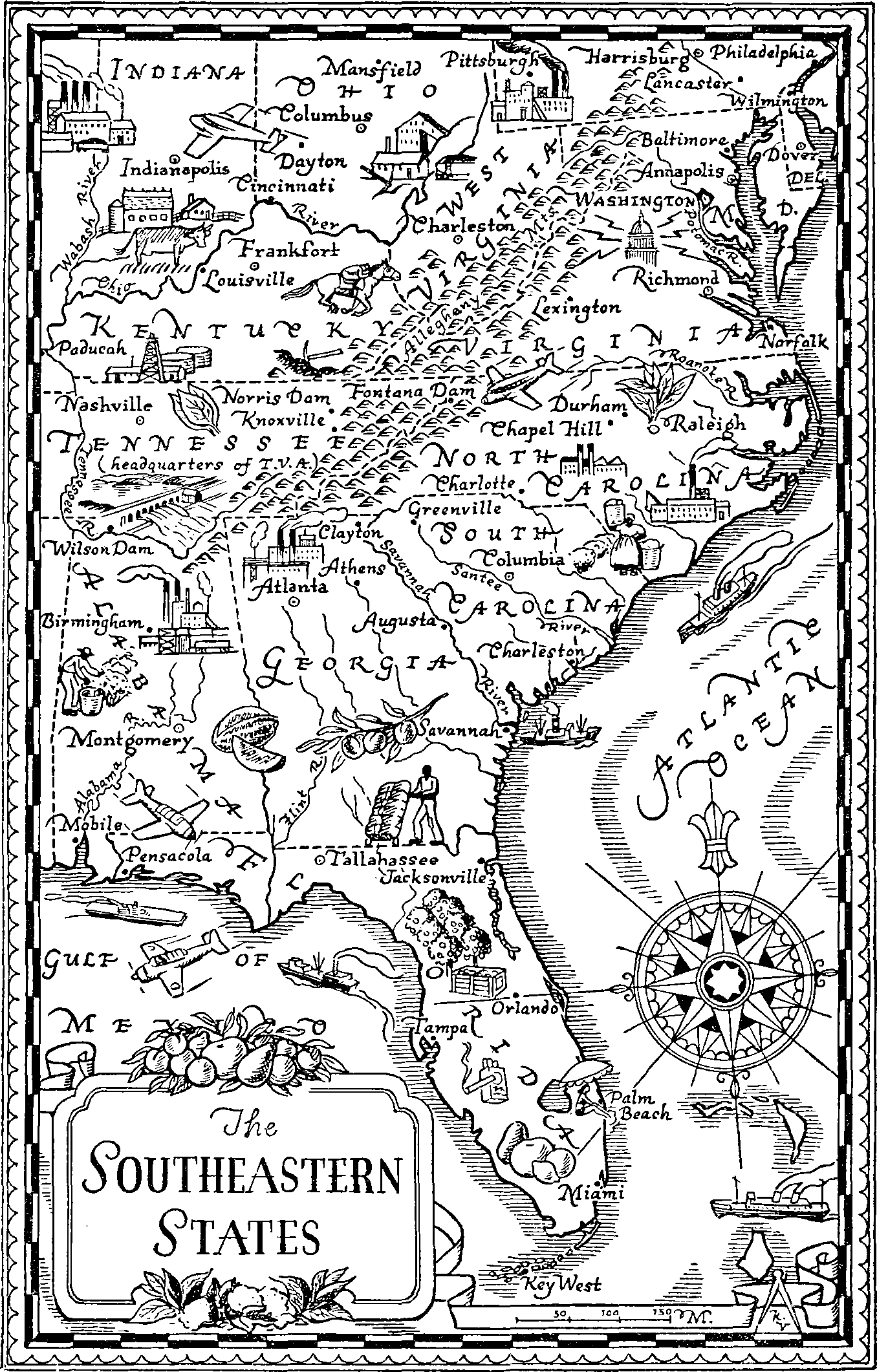
ALABAMA, a highly important state, with a sizable iron and steel industry at Birmingham, is in the process of political upheaval and economic fermentation. In MISSISSIPPI, “the worst American state,” we will find Rankin, Bilbo, and the most discreditable statistics. TENNESSEE, a virile, lively, and strongly bifurcated state, is one of the most complex and fascinating in the entire union; it contains TVA, the river culture of Memphis, Vanderbilt University, and Boss Crump. As to LOUISIANA it is like Florida something quite special and distinct, largely because of its French and Creole background. ARKANSAS, a kind of inland Mississippi, is probably the most untouched and unawakened of all American states; the South is inclined to be ashamed of it and says that it belongs more properly to the West, which it doesn’t.
It will be almost literally impossible for an outsider, whether a man from Mars, the moon, Moscow, or Jersey City to understand the South, if he does not accept as a concrete and contemporaneous living fact the cataclysm of the Civil War or, as it is usually called by die-hard Southerners, the War Between the States, together with what followed. Perhaps the four years of actual warfare were not quite so important as the aftermath. For instance—a minor but suggestive item—I happened to be in Richmond on an important anniversary of Appomattox; the event got no more than an inconspicuous few inches tucked far inside the newspapers. But nobody in the South ever forgets Reconstruction. To this day the South has not recovered from Reconstruction. This was one of the most cruelly outrageous episodes in all the wantonness of history. Lincoln, had he lived, might have been able to make a generous peace. The peace that came was far from generous; and the roots of white supremacy, the. Negro problem, and a dozen other inflamed and derivative issues, are all to be found in what occurred in Reconstruction days. The South lost a quarter of its adult male population during the war; the property loss is calculated at six billion dollars. Bad enough! But what came after was much worse. The carpetbaggers began to arrive in about 1867, and in 1870 the 15th amendment, which enfranchised the Negroes, went into force. The South was divided into five districts, under rule of the United States (i.e. Northern) Army and white Southerners themselves, classified as rebels, were not allowed to vote.
If you read the history of those days you must inevitably be reminded of contemporary analogies: Atlanta in the 1870’s must have startlingly resembled Budapest or Warsaw under the Nazis in the 1940’s. I do not mean to be invidious. But chopping up the South and ruling it by an absolute dictatorship of the military, while every kind of economic and social depredation was not only allowed but encouraged, is so strikingly like what is going on in Germany at present that the imagination staggers. “The war,” writes James Truslow Adams, “left the South prostrate; Reconstruction left it maddened.”1 The period of Reconstruction lasted for varying periods in different southern states. Georgia was not finally readmitted to the union until 1870, and federal troops were not withdrawn from Florida, Louisiana, and South Carolina till 1877.
One brief word about secession as an instrument of policy. Comparatively few people in the United States, whether of the North or South, associate the idea of secession with that of outright treason, strange as this may seem to a non-American. On the whole secession was accepted as a fairly respectable phenomenon, though of course the North lamented it and fought it bitterly. But the New England states had several times talked of leaving the union, on different issues. The southern point of view about this may take extreme forms. Plenty of Southerners like to argue that it was the North that seceded, not themselves. The idea of an enveloping and overembracing American unity was seldom forgotten, even in the fiercest days of warfare;2 this is one reason why Southerners today seek to avoid such terminology as the “Civil War,” hate to be called rebels, and insist on such euphemisms as “War Between the States.” The official American name for the war is, incidentally, “War of the Rebellion.”
Red clay roads curving around unkempt hills and time passing slowly; lazy drawling accents and Jim Crow water taps; brides marrying in the evening and the drooping of moss; moldy lawns and crinolines and broken-down greasy shacks near the railway tracks; names like Shiloh and Chickamauga; afternoons hot as cotton—these are familiar stigmata of the South. They are part of what might be called the Magnolia Myth. But the South is more than just hot biscuits. I must add, however, that I did actually meet one antediluvian colonel who, rocking on the soft rotting boards of a sagging back porch, gave me a mint julep mixed by someone who was obviously Uncle Remus himself, while we stared straight at a grove of magnolias blatantly in bloom. But if we are to apply sandpaper and emery to much of the so-called “romance” of the South, we must operate similarly with the realities; the debunking should go both ways. The South is no longer full of elegantly fainting ladies—if it ever was. On the other hand the South is not Omaha or Pittsburgh, The South contains some wonderfully courageous and emancipated liberals, as we shall see. On the other hand it does indubitably contain Mister Bilbo.
Great commotion came to the region recently when the Richmond Times Dispatch printed a brief editorial about that distinguished contemporary southerner Senator Claghorn:
CLAGHORN, THE DIXIE FOGHORN
For years, yes, decades, we’ve been battling to bring some measure of rationality into the fried-chicken-watermelon-mammy-magnolia-moonlight-mocking-bird-moon-June-croon school of thinking on Southern problems, and now we’ve run up against the toughest proposition yet. We refer, of course, to that bombastic bumbling, brou-ha-ha of the air waves, Senator Beauregard Claghorn, “from the deep South, that is.” …
This amazing character on the Sunday evening Fred Allen program must have given millions in the North and West the notion that southern Senators spend their time in making frightful puns, and bellowing “That’s a joke, son!” and in such professionally southern deliverances as: “When in New York ah only dance at the Cotton Club. The only dance ah do is the Virginia reel. The only train ah ride is the Chattanooga Choo-Choo. When ah pass Grant’s tomb ah shut both eyes. Ah never go to the Yankee Stadium! Ah won’t even go to the Polo Grounds unless a southpaw’s pitchin’.”
We “southrons” have been kept sufficiently busy asserting to our northern friends that we aren’t all morons and degenerates à la Tobacco Road, or banjo-picking mammy-singers, à la Al Jolson, but now we have to go around protesting that we aren’t all raucous nitwits and foghorns like Senator Claghorn, “from the South, that is.” Gad!
I suspect that my friend Virginius Dabney wrote this skit, but I’m not sure. At any rate Mr. Dabney was obliged to report later in the New fork Times that his paper had been swamped with protests, especially when a chauvinistic southern congressman caused the offending editorial to be inserted in the Congressional Record. Mr. Dabney stuck to his point, but he did handsomely admit that Claghorn brought in plenty of laughs, for instance when he said, “In college ah was voted the member of the senior class most likely to secede and ah was graduated magnolia cum laude.” (New York Times, May 4, 1946.)
The South, I once heard it put, is full of people whose only profession is to be southerners. Once or twice, traveling from town to town. I felt that I wasn’t in the United States at all, but in some utterly foreign land. Yet, more than any other region, the South highlights almost every American problem—education, nutrition, the valley authority idea, the growth of industry, religious impulses, agricultural techniques, the Negro of course, and also the culture of the white. It is a kind of laboratory, an exotic testing ground. Also the South lives dangerously—I don’t know any other American area about which this may be said in quite the sense I mean it. That it is the problem child of the nation is of course indisputable. But how it resents being told so!
How “solid” is the solid South? From the point of view of sociology and basic economic patterns it is, as I have said, by far the most homogeneous of American regions. Nowhere else, not even in New England, is it so comparatively easy to generalize over a broad body of states on the basis of such similar characteristics; the South is a genuine region in the strict sociological meaning of that term. From the point of view of politics, however, the solidarity is not quite so great as is commonly supposed. In fact, if we want to be pedantic, the really “solid” South should be defined as comprising only seven states. Virginia, North Carolina, Florida, Texas, all voted for Hoover and against Al Smith. Of course some very special circumstances attended this election. The fact remains that as recently as 1928 four extremely important southern states went Republican, and I have heard several responsible Southerners say, “The South is breaking up hard and fast.”
Some Generalizations About the South
We Southerners are of course a mythological people.
—Jonathan Daniels
Nevertheless, if it can be said that there are many Souths, the fact remains that there is also one South.
—W. J. Cash
(1) The foreign-born and sons of foreign-born, who have been traveling along with us for most of the course of this book, now leave our story to all practical intent. The South is overwhelmingly of native-born Anglo-Saxon origin; this, along with cotton, poverty, and the Negro question, is a major common denominator for the entire region. I say “Anglo-Saxon”; I might add, “predominantly of Scots-Irish, Ulster, or Celtic stock.” There are towns in North Carolina almost as Scottish as Aberdeen; there are backwoods in Tennessee and Arkansas as implacably Celtic as anything in Wales. Most southern states are, moreover, extremely proud of their background. I think it was in Mississippi that I first heard someone say, “The state of Mississippi has a smaller proportion of foreign-born than any other American state.” I then heard the precisely identical remark in three other states. The detailed figures do not matter; in every state except Florida and Louisiana 90 per cent or more of the white citizens come of parents who were both American born. The figure reaches 98.7 per cent in Arkansas, if Arkansas statistics are to be believed. That Arkansas should also be one of the most unquestionably backward of American states naturally gives the observer slight pause, and makes one wonder what peculiar characteristics the Celts and Gaels, when transported, contribute to a civilization.
Of course minor qualifications are necessary to all of the above. The seaports, like Mobile and New Orleans and even including Charleston, have a definite foreign sprinkling, and industry during the war brought in some alien workers. The Bell aircraft plant at Marietta, Georgia, just outside Atlanta, once employed 28,000 men and women; it was bigger than Willow Run, incredible as that may seem; even so, a large proportion of the workers were backwoods Anglo-Saxons, and the number of foreign-born was not so great as might have been assumed. That this overwhelming preponderance of English-Celtic-Gaelic background should have produced corollary phenomena in several fields goes without saying. For instance it means that there is no buffer foreign group between the ruling whites and the Negro. Nor, politically speaking, are there any “foreign blocs” to be delivered, like the Poles in Buffalo or the Czechs along the Monongahela. Another relevant point is that the under-educated semimountaineer Scots-Irish are, almost beyond question, those who believe most firmly in “white supremacy,” and are therefore a continual exacerbation to the Negro problem.
(2) Some early landowners among the original American immigrants—a Cavalier from a British dukedom was, let us point out, just as much an immigrant as is a Greek shoeshine boy from the slums of Athens—were distinctly of aristocratic blood and they definitely maintained and nurtured an aristocratic tradition, but the idea that all old-line southern planters were, or are, of a superior social class is of course nonsensical. An oligarchy of wealthy planters did indeed grow up, who worked their land mostly through factors, but they were a minority, and only an infinitesimal proportion were substantial slave owners. More often the pattern was that of a lonely Virginia or North Carolina pioneer working his land to the limit, and then pushing west when it was exhausted. Successively a family might own, and ruin, a tract in tidewater Virginia, then in the Virginia mountain country, then in Tennessee or Kentucky bluegrass, then in Ohio or Missouri; its present descendants may, in fact, have very well carried on this process in the Okie and Arkie migrations of the 1930’s. The origin of Tennessee was in this movement, and Tennessee itself is responsible for other westward marches. To revert: the notion that the majority of the southern ruling class came from “columned mansions” is very far from the truth. Take such a representative and distinguished family as that of splendid old Josephus Daniels, who has been inextricably conjoined with the life of North Carolina for fifty years. Mr. Daniels’ father was a ship’s carpenter in Rhode Island. He helped build the Merrimac. He died of blood poisoning when, after a wound, he refused to have his arm amputated, since this would have meant that he could no longer work at his trade. So his widow went to Wilson, North Carolina, where she became the postmistress, and so supported—and sent to the university—her three sons.
(3) Intervention and the martial spirit. The South was, as everybody knows, the part of the nation that from the beginning and most vividly took the allied side in both World War I and World War II. This phenomenon, which we shall elaborate upon when we come to Texas, has deep and legitimate natural origins. Several southern states have military records which even rival that of Texas. For instance in 1940–41, according to the well known Birmingham journalist John Temple Graves,3 the proportion of volunteer enlistments to induction under selective service was 49.8 per cent for the nation as a whole; the corresponding figure was 85.3 for South Carolina, 92.6 per cent for Georgia, 98.6 per cent for Texas, and not less than 123.4 per cent for Kentucky. In October 1941, by terms of the Gallup poll, 88 per cent of Southerners thought that it was more important to beat Germany than to keep out of the war, as against a national average of 70 per cent. Mr. Graves has an interesting chapter wherein he asks various southern specialists of great renown how they account for such striking figures. One factor is obviously the Anglo-Saxon origin of most Southerners. Another (this we shall also see in Texas), is that southern economy is based on the export of raw materials, chiefly cotton and tobacco, of which Europe in general and England in particular have been immemorially important customers. Still another is the peculiar and ineffaceable persistence of the martial tradition, the fighting impulse. The South has always been fond of military heroes, and it has produced generals by the carload, from Andrew to Stonewall Jackson. General George C. Marshall is by residence a Virginian—and incidentally the Virginia Military Institute at Lexington has an importance in the training of American officers second only to that of West Point—and General Douglas MacArthur was born in Arkansas. But read the first chapter of Mr. Graves’ book. It is an illuminating anthology. For instance Mark Ethridge, publisher of the Louisville Courier-Journal, gave as his reason for southern militancy that “we know better than anybody else that war settles questions,” and Professor Odum replied that “the South has been invaded so often … by thousands of reformers and accusers that it is automatically prepared to defend itself.”
Dr. Douglas Southall Freeman, the eminent biographer of General Robert E. Lee and his lieutenants, told me a nuggety little anecdote pertaining to the Army maneuvers held in Louisiana in 1941. A farmer asked a visiting northern newspaperman what all the excitement was about. “We’re training,” the newspaperman replied. “For what?” “We think we may be getting into this European war.” “I thought so! Been thinkin’ so for a good long time. But one thing bothers us down here. Do you reckon that when we do get in, you Yankees are goin’ to help us any?”4
Another point worth making is that just as the South is vehemently pro-British, in peace as well as in war, so it is at the moment vehemently anti-Russian. Nowhere else in the country except in Catholic Irish groups such as those in Boston, did I find such belligerent and effervescent anti-Russian sentiment.
(4) Poverty. This is a most salient and pervasive item. The South is by all odds the poorest region in the nation; for instance the average income per capita in ten southern states was $716 in 1944, as against $1,284 in New England, $1,459 on the West coast, and $1,117 for the country at large. In almost every species of conceivable statistic having to do with wealth, the South is at the bottom. Professor Odum, in his massive Southern Regions,5 prints a munificent galaxy of charts and maps; in map after map after map, drawn to illustrate various economic indices, the South appears as a solid bloc ranking lowest in the nation. This bloc, in some maps colored white, in some black, but always demonstrating the South’s deficiencies, is precisely coterminous with similar maps showing the extent of cotton culture, the percentage of white native stock, and the heaviest concentration of Negroes. Professor Odum uses hundreds of criteria; among literally dozens of categories in which the South is lowest in the country are per capita bank resources, per capita savings deposits, wages per wage earner, value of product per wage earner, number of automobiles (Florida excepted), gross agricultural income, average value of land, amount of life insurance in force (Oklahoma, Arizona, New Mexico join the South here), number of families per radio (not, as it might be in the North, number of radios per family), percentage of farms with telephones, taxable property per capita, estimated true wealth per inhabitant (Texas is also included here), average value per farm of domestic animals, horsepower available per worker, retail sales (Florida again excepted), and milk production. In value of farm property per farm, Mississippi is the forty-eighth state, Arkansas forty-seventh, and Alabama forty-sixth. (Nevada first, California second, Iowa third.) In percentage of farms having tractors, Mississippi is forty-eighth, Alabama forty-seventh, Arkansas forty-sixth. (North Dakota first, South Dakota second, Montana third.) In average annual wage per wage earner in all manufactures, the three lowest states are North Carolina, South Carolina, Georgia. Conversely, in percentage of families receiving unemployment relief from public funds (as of 1933), the three highest states were South Carolina, Florida, and West Virginia. A final almost unbelievable figure, not from Odum but from Dabney6 and more up to date, is that eleven million Southerners have annual cash incomes of $250 or below.
From statistics like these we may derive much ancillary matter. One item is that, as in the West, most of the bright young men get out, if only because the simple circumstances of earning a living are so onerous. Erosion of the southern soil is an important problem, as we shall see; so is the erosion in human beings. A second item would have to do with a complex mass of intellectual dilemmas. Why is the South so flame headed, obdurate, and irrational so often? Because, if I may paraphrase David L. Cohn in a recent article in the Atlantic Monthly, it hasn’t the means to afford the golden mean.
(5) At this juncture a word about agriculture is essential, though we shall mention cotton in a separate section later. Overwhelmingly the South is rural. We are far away now from the thickets of great cities in the Middle West. In fact, the whole South has only three cities over 300,000 in population by the 1940 census, and one of the Odum charts shows that only 29.8 per cent of Southerners live in urban areas, as against a figure of 67.2 for the far West and 74.4 for the northeastern states. Southern agriculture is a good deal more diversified than most people think—consider for instance peaches, melons, citrus, peanuts—but cotton and tobacco are still the two great staple crops. Now both these crops, it happens, cause extremely heavy loss to soil. We have talked almost endlessly of soil erosion in this book, it would seem, and we know well how dangerous a problem it is in the West. But erosion in the South is incomparably more dangerous. Fully half of all the eroded land in the nation is in the southern states, and loss to the soil is calculated at something like 300 million dollars per year;7 significantly enough the poverty-smitten South, which is such a laggard in so many statistics, leads the country in the amount of fertilizer it has to buy. Former Governor Arnall of Georgia has cogently pointed out that the average southern farmer pays $2.71 per year for fertilizer (making the total fertilizer bill a staggering 160 million dollars), and loses $9.00 worth per year of exactly the same substances he is putting in—potash, phosphate, nitrogen derivatives, and the like.
One encouraging new sign has been a swing to cattle. Under cotton culture, the number of work days per year is comparatively small; about 180 days out of 365 grows a cotton crop. So the average cotton worker is idle half the year; no wonder living standards are so pitiably low. The problem has been one of diversification not only from the point of view of soil, but of soul: to give more men more kinds of work. Livestock provides a possible solution, inasmuch as cattle require plenty of attention, and except in those areas where erosion has made the earth look as barren as the blank face of the moon, they can live on marginal land. At any rate cattle have become an energizing and lucrative southern industry. Florida lives on cattle today almost as much as on citrus or even the tourist trade and gambling; the figure may seem hard to believe, but 40 per cent of Georgia’s present farm income derives from livestock, as against 32 per cent from cotton; Montgomery, Alabama, has become the cattle capital of the Southeast, and is a miniature Fort Worth; the eyes of men in Memphis glisten when they talk of Herefords, and some Tennessee cattle, of all things, won prizes last year in a Texas cattle show.
There is poor land in the South; there is land that is not even land, like the notorious area around Ducktown, near the Tennessee-Georgia border, where nothing whatever remains but savagely gutted and defiled dirty gullies; there is also the land of the Delta, as rich as Croesus. The Delta which, oddly enough, is not a delta, is the area adjacent to the Mississippi River between Memphis and Vicksburg; it is a region of large farming rather than small, and it is where the mechanical cotton picker is working one of the cardinal revolutions of our time. Nothing quite like the Delta exists in the nation except, perhaps, Central Valley in California, but Central Valley depends for life on artificial rainfall, as we know. In the Delta the rain still comes from God and heaven.
Almost all southern problems interlock; and the future of agriculture in the South is very closely wrapped up with the future of the Negro. Let more Negroes become small landowners, owning their own small farms, and the lot of both agriculture and the Negro will be improved.
(6) This brings us to two phenomena famous in the South: the luckless, miserable group of millions known as poor whites, and sharecroppers and tenant farmers. Poor whites live in the towns too of course, but it is in the rural districts that their gross poverty is most conspicuous; the rural slums of the South are almost beyond doubt the most revolting in the nation. No one can define the term “poor white” with much precision; originally poor whites were the small landowners who did not own slaves or the frontiersmen who reached the mountain areas and did not progress further; they do not live like most Negroes in segregated enclaves, but spread their poison through the whole community; they exist almost everywhere in the South, perhaps more conspicuously in the Piedmont than in any other specific region; they are the whites who hate and fear the Negro most; many of them bear the most gallant and distinguished of old Scottish names; they are a living exemplar of a famous remark by Booker T. Washington, “The white man cannot keep the Negro in the ditch without sitting down there with him.” The kind of piquant sociological detail known to readers of William Faulkner still crops up in the news from day to day. While I was in Atlanta the papers printed a handsome little story about nine sisters, all of whom were prostitutes in the same room. Lillian Smith, the author of Strange Fruit, told me in Clayton, Georgia, of a recent case in which a baby died. The parents left it on the bed to rot. They were not rendered helpless by grief. They made no effort to bury the body because they simply didn’t know any better.
The line between the sharecropper and the tenant farmer isn’t always easy to draw. Both derive, in first analysis, from slavery and the plantation system that was for generations the chief hallmark of southern agriculture. Always the area has had a substantial big landowner class, and also a very large completely landless element, both white and black. The process arose whereby the owner of a sizable plantation, having more property than he himself could till, let out part to a tenant, who then worked it; the owner as a rule contracted to supply a house to the tenant, and the tenant on his side supplied tools, perhaps a team, and his own labor. But, the key to the system as it operates today, the tenant does not pay rent for the use of this land; what he pays is a share of the crop he grows. The usual bargain is that the tenant pays as rent one half of the cotton he himself grows, and about one third of the corn, if corn is part of the crop. This ratio may, however, vary according to locality and the price of the commodity. Of course this procedure is, from the point of view of the tenant, completely heathen, in that he provides both tools and labor and yet is permitted to retain only one half (or some other variable proportion) of the rewards of his own endeavor.
There are other evils. The average tenant, holding the use of the land for a limited interval only, attempts to suck out of it all he can; operating under short-range tenure, he can eviscerate a property, ruin it utterly, with three or four successive cotton or tobacco crops. There is no incentive to scientific agriculture, no stimulus to soil conservation or rotation. Another factor is migrancy. Most tenant farmers are continually on the move. They proceed from property to property because nothing fixes them to the soil; hope (since most are miserably poor) sometimes spurs them on; sometimes they quarrel with the landlord. Usually contracts are made in the near-by rural town on a Saturday night at the end of the year. A tenant hears of a new landowner in the next county. He goes to him, saying, “I’m tired of working for Mr. Tom. Any farm land open on your property next year?” The new land-lord, if he wants a tenant, straightens things out with Mr. Tom, and makes the bargain. Then early in February the new tenant moves over. Each move is calculated to cost about fifty dollars. Some tenants move every year. It is an expensive way to farm.
In Chapter 30 above, quoting the opinions of a typical New England legislator, I said that he knew that no peasants existed in the United States. Perhaps my New England legislator is wrong. He has not met some black belt8 sharecroppers. These, he might find, are not merely peasants; they are peons. And at one time there were eight million sharecroppers in the South, most of them clustered in a wide series of pools lying outside the Piedmont, and stretching—with interruptions—all the way from North Carolina to east Texas. This is the shrunken core of what was once the slave area. A sharecropper differs from a tenant farmer in that he has no tools, no teams, no stock. He has, in fact, nothing whatever except his own labor. Thus his bargaining power is less than that of the tenant farmer, and he gets as a rule less favored treatment. His house, hardly even a dilapidated shack, may be part of a deserted bus, or almost literally a heap of packing crates; he has no cash, and has to live exclusively on credit; often he cannot educate his numerous children for the simple reason that he cannot afford to buy them clothes decent enough to permit school attendance. The tenant farmer is in a bad enough situation; the plight of the sharecropper is a good deal worse. For one thing, he gets a smaller share of the crop as a rule. For another, no matter how intolerable his circumstances, he can’t afford to move; sharecroppers in the strict sense are seldom migratory. The only hope for a sharecropper, and it is a slim one, is that he may pull himself up the ladder one rung by becoming a tenant. But to do this he must be able to buy tools and a team. Which is difficult considering that interest rates in his locality may run as high as 40 per cent.
(7) Out of poverty in the material domain arises inevitably poverty in education. I gave above some few of Professor Odum’s electrifying indices on economic factors, and similar chartings are available in regard to schools. Using no fewer than 152 different indices, Odum finds that the South (including Texas in most charts) is at the very bottom of the nation, not only in the general amount of expenditure on public education, but in such items as total enrollment in high schools, per capita expenditure on public day schools, length of the school term, and teachers’ pay. In percentage of white literacy, South Carolina is the forty-eighth state, Louisiana the forty-seventh, New Mexico the forty-sixth, Mississippi the forty-fifth, Alabama the forty-fourth. An auxiliary item, not covered by Odum so far as I know, is textbooks; all over the South textbooks are a lively issue. Huey Long early in his career set out to provide textbooks for the children of Louisiana free; this was a substantial contribution to his rise in power. In several southern states scandals over textbooks, free or otherwise, have made angry political crises, as we shall see.
(8) Similarly in such matters as public health, the South is at the bottom of the heap. It is lowest in the nation in number of hospital beds, and in physicians per unit of population; it is highest in maternal deaths in childbirth, infant mortality, and venereal disease.9 As of selective service records, Louisiana, Mississippi, Georgia, South Carolina, and Florida had up to 171.5 cases of syphilis per 1,000 of men examined. The corresponding rate in thirteen northern and western states was under fifteen.
(9) We come now to the general rubric of culture, which overlaps some of the foregoing material. H. L. Mencken once wrote a famous essay, “Sahara of the Bozart,” in which he slaphappily throws at the South everything about the Boobus americanus he can think of; he began with the little jingle:
Alas, for the South! Her books have grown fewer—
She ne’er was much given to literature.
Among Mr. Mencken’s choicest remarks are that the South is “an intellectual Gobi or Lapland,” that its culture is like that of “Asia Minor, resigned to Armenians, Greeks, and wild swine,” and that “one could no more imagine a Lee or a Washington in the Virginia of today than one could imagine a Huxley in Nicaragua.” But as to the lack of southern writers, Mr. Mencken might have to change his tune today. Consider Thomas Wolfe, Ellen Glasgow, Margaret Mitchell, Erskine Caldwell, William Faulkner, Eudora Welty, Roark Bradford, Allen Tate, Harnett T. Kane, Hamilton Basso, Julia Peterkin, Marjorie Kinnan Rawlings, Lillian Smith, Josephine Pinckney, to say nothing of Negroes like Richard Wright. I am not saying that all these writers are of the very first flight; I will say that contemporary American literature would be considerably the poorer without them.
In some other fields, however, many of the Mencken strictures still apply. There are sixteen major symphony orchestras in the United States; not one is in the South. There is no southern philosopher of consequence. There is no southern theater worthy of the name, and there are comparatively few painters, sculptors, or other artists of talent, though some southern architects have considerable distinction. The South has become highly self-conscious about these lacunae in cultural fields, it might be added; for instance the Atlanta Journal, a lively and progressive paper, includes “a symphony orchestra, expanded art museums, and libraries” in the ‘“Platform for Georgia” that appears under its masthead every day. North Carolina has the only orchestra in the United States supported by the state (it does not count among the majors), and Virginia has decided to set up a state theater.
We must, finally, turn once more to Professor Odum’s terrifying charts. In one passage he takes twenty-six widely differing cultural criteria, and finds that the South (Texas, West Virginia, and Kentucky included) is lowest in every one; in another, with no fewer than 130 indices “selected to represent all aspects of culture from land use … to educational institutions,” he finds Mississippi to be the lowest state culturally, with South Carolina next and Georgia and Arkansas closely following.10 Take the single item of libraries. The south is lowest in the union in per capita expenditure for public libraries, in per cent of population registered as library borrowers, and in number of libraries of all kinds.
(10) Religious factors. Just as the South is the region of Anglo-Saxon white stock in excelsis it is also the region par excellence of militant protestantism. More than three-quarters of the population of Arkansas, Mississippi, Alabama, Georgia, and the Carolinas are either Baptists or Methodists; in the other states the rate is over half. Six southern states, it is interesting to learn from Bryce, once excluded from public office any person who did not believe in the supreme being; the whole area today, especially the Piedmont, is still the “Bible belt,” the “infant damnation belt,” and the “total immersion belt,” replete with Bible marathons, revivalists, Gaelic fundamentalism, and a fierce retentive hostility to other creeds. This is the region where Al Smith was thought of as an agent of the Pope, and where a young schoolmaster named Scopes, was, not so many years ago, tried and found guilty of the crime of teaching evolution in the hamlet of Dayton, Tennessee. Tennessee’s present junior senator, Tom Stewart, was incidentally the prosecuting attorney at this celebrated but now largely forgotten trial. And be it noted: the law forbidding evolution to be taught still stands on the books of the sovereign state of Tennessee.
A passage from the cross-examination of William Jennings Bryan is illuminating:
Q. Do you claim that everything in the Bible should be literally interpreted?
A. I believe that everything in the Bible should be accepted as it is given there.
Q. But when you read that Jonah swallowed the whale—or that the whale swallowed Jonah—excuse me, please, how do you literally interpret it? … You believe that God made such a fish, and that it was big enough to swallow Jonah?
A. Yes, sir. Let me add, one miracle is as easy to believe as another.
Q. Perfectly easy to believe that Jonah swallowed the whale?
A. If the Bible said so.
Perhaps the reader who chances to pick up this book in Mukden or Tirana and who has never heard of Mr. Bryan may be reminded that he was the Democratic party’s most important leader for a generation, and ran for the presidency of the United States three times. Also in his earlier days he was unquestionably a great man.
An unusual number of southern papers carry a daily quotation from the Bible at the head of their editorial columns. Among them are the Raleigh News and Observer (the Daniels paper), the Florida Times-Union, the Tampa Morning Tribune, and the Nashville Banner. I make this observation as a matter of interest to the reader, not in a critical sense.
The Methodists and Baptists in the deep South not only have, by and large, a yeasty suspicion of other religions; they can attack their own kind savagely. Politics gets mixed up in this. Dr. Louie D. Newton, president of the Southern Baptist Convention and thus a man of no mean substance, returned from a visit to Russia recently and said that he had detected evidences there of a growing religious freedom (New York Times, August 25, 1946). As a result, even though he attacked Communism as such, Dr. Newton was picketed when he spoke at the Atlanta municipal auditorium, and placards were borne, Is LOUIE D. NEWTON SELLING COMMUNISM TO THE U.S.A.? At about the same time clubs were organized in Knoxville, Tennessee, to prevent a public appearance there of no less a personage than Dr. G. Bromley Oxnam, bishop of the Methodist church and former president of the Federal ‘Council of Churches of Christ in America.11 It was alleged that Bishop Oxnam, a great many years ago, had belonged to some mildly leftist political organization.
Roman Catholics are a minority in most of the South (of course Louisville and New Orleans are heavily Catholic towns); the Celtic backwoodsmen resent them fiercely. There would appear to be three reasons for this aside from religion per se. First, most Catholics are wet. Second, Catholic children in the South have a fair chance of getting a better education than Protestant, since the quality of the public schools is generally so low. Third, Catholics by and large are more liberal than Protestants in regard to Negroes, and they proselytize the black communities with vigor. Let us explore. Baptist and Methodist churches in the South operate, of course, under segregation; most Negroes are Baptist or Methodist but they have their own separate church organizations and churches. But any Negro may go into any Catholic church, and, though he may not be enthusiastically welcomed, he will not as a rule be rebuffed. Catholics do, however, accept the segregation principle in their schools and hospitals, and they maintain many exclusively Negro churches.
Jews play less of a role in southern life, on the whole, than in any other American region except the West. Some big department stores, particularly in Atlanta and Richmond, are Jewish owned; a few rich plantation owners are Jewish (Bernard Mannes Baruch of South Carolina for instance); some able journalists are Jews. But by and large—let us repeat it once and for all—the South is Protestant, of English stock, and above all rural. This does not mean that biting anti-Semitism does not exist. It does exist. It is the hallmark of the backward in the South as everywhere else in the nation. The Ku-Klux Klan has, as everybody knows, three enemies—Negroes, Catholics, Jews.
(11) Prohibition. This is of course closely associated with religious factors, and the South is technically the driest area in the country, the stronghold of the Anti-Saloon League and the Woman’s Christian Temperance Union. Partly, this is a result of a general Puritan inheritance; the South is, or has been, fundamentalist not only about God and whisky but about card playing, dancing, and cigarettes; at one time Coca-Cola was forbidden Sunday sale in Richmond. Another aspect of the close association between drinking and religion is, as a wise lady once pointed out, that Catholics (and also some Protestants in the upper echelons) use wine in celebration of the Mass; the backwoodsmen hate Catholicism, and hence hate wine too, with which they associate the Catholic ritual.
Everywhere I went in the South I asked why it was so dry, legally speaking, and I got a considerable variety of answers. One was that Southerners fear outbursts of drunkenness by Negroes. Surely what this means is that they also fear outbursts of drunkenness by themselves. Lillian Smith, when I visited her school and camp in Georgia, had some pertinent remarks to make in this field. The Freudian hypothesis, she points out, provides a useful tool. The South contains a great number of pronouncedly schizoid people; the whole region is a land of paranoia, full of the mentally sick; most Southerners feel a deep necessity to hate something, if necessary even themselves. Their hatred (=fear) of alcohol is partly a reflection of bad conscience; the South fears that liquor will release its own most dangerous inhibitions. The Negro problem is inextricably involved; so is the sexual problem. A Southerner will, perhaps without expressing it consciously or concretely, work out an equation something like the following: “We are not going to give up the Negro; therefore we must give up something else. We will not give up fundamentalism, sex, white supremacy, or slavery; so we give up rationality instead.”
All this being mentioned, let me at once add something else, namely that “dry” as the South may be in some spots, it is also the hardest-drinking region I have ever seen in the world, and the area with the worst drinking habits by far. There are no bars permitted in most cities; hence, people drink by the private bottle, and as always hypocrisy begets disorderly behavior. Never in Port Said, Shanghai, or Marseilles have I seen the kind of drinking that goes on in Atlanta, Houston, or Memphis every Saturday night—with officers in uniform vomiting in hotel lobbies, seventeen-year-old girls screaming with hysteria in public elevators, men and women of the country club category being carried bodily off the dance floor by disinterested waiters.
Similarly in sexual affairs the South combines a heavy puritanical façade with almost epochal lubricity. In one hotel, one of the best in the nation, I found a printed manifesto, “Persons Entertaining Visitors of Opposite Sex Must Notify Office to Prevent Possible Embarrassment.” In another city, the most renowned of the local restaurants has a big sign on the door, UNESCORTED LADIES NOT ADMITTED.
(12) Coca-Cola. All through the South, socially and economically and even politically, Coca-Cola has an importance hard for Northerners to appreciate; this drink is one of the few things that the South developed of itself, and that the North hasn’t taken over. Almost everywhere below the Mason and Dixon’s line the Coca-Cola dealer (or maybe the local cotton ginner) is the richest person in town; quite often one man fills both these posts, and he has something of the position that the Ford agency proprietor once held in the North. O. Max Gardner, till recently under secretary of the treasury and one of the most distinguished of contemporary Southerners, has filled usefully many jobs; he was once governor of North Carolina, and the nearest thing to a boss that state ever had; he was for a time president of the Cotton Textile Institute of the United States; also the fact that he was one of Coca-Cola’s lawyers certainly didn’t diminish his power and fame. Late in 1946 Mr. Gardner was named ambassador to the Court of St. James’s.
(13) Crime and civil liberties. In both these categories the South is probably the darkest place in the nation. According to Dabney,12 six of the eleven major “centers of repression” in the United States as listed by the American Civil Liberties Union are in the South—Harlan County in Kentucky, the area in Arkansas where the sharecroppers sought to organize, New Orleans, Birmingham, Tampa, and Atlanta—and as to crime it leads every other area; even excluding lynchings, the murder rate from Kentucky through Texas (but not in the Virginias or North Carolina) is the highest in the land. Charlotte, North Carolina, was once known as the “murder capital” of America; a savory touch is that it also calls itself “the greatest churchgoing town in the world, except Edinburgh.” This noteworthy and curious community contains about 100,000 people and has 114 churches; it has been legally dry for forty years, and in 1940, sixteen of its forty-seven murders took place on a single street corner. As to more general figures W. T. Cash has some remarkable comparisons in his Mind of the South. For instance in 1935, according to the FBI, the murder rate in certain sizable towns in the eleven confederate states was 23.23 per 100,000. The analogous rate for New England was 1.3.
(14) We should add a brief note on weather. I thought I had seen some cataclysmic storms in Montana; but the noisiest weather I ever did encounter was in Alabama. I thought once that the roughest trip I had ever taken in an airplane, in several hundred thousand miles of flying, was across the Andes in Bolivia; but a recent trip near Miami made Bolivia seem dulcet. For a time, traveling in preparation for this book, I thought I had emerged with a splendid new generalization about the United States as a whole: that this is the country where the South is cold, the North hot. This was after I had come near to freezing to death in South Carolina and when I was broiling at 104 degrees in Bismarck, North Dakota. Seriously of course the general temperateness and mildness of southern climate is an extremely important factor in economy and behavior. Most homes in the South don’t, at least in theory, need central heating during the winter; if they did, the circumstances of life in a hundred areas would be very different. Why don’t more poor Southerners move north, and thus allay their privation and discontent with the better wages of northern industry? A highway policeman near Montgomery, Alabama, gave me one answer: “I’m scareda coal weatha.”
(15) Sport. The South, like the West, is excluded from major league baseball, though teams in St. Louis, Cincinnati, and Washington, D.C., certainly impinge on the southern frontier. But as to football the South has tremendous teams. These, and this is true elsewhere in the nation, help to subsidize education, in that wealthy alumni give more money when the football scores are best. Among teams consider the formidable records of Duke, Alabama, Georgia Tech, Georgia. In 1945 the historic Army team, with Blanchard and Davis, won four places on Grantland Rice’s All-American. But of the other seven four were from Texas or the South, and Blanchard is from South Carolina.
(16) Economic factors aside from agriculture. The South has considerably more industry than most people give it credit for having. The list is virile—cotton shirts and sheets and towels in the Carolinas, cigars in Tampa, chemicals and aluminum in the Tennessee valley, bathtubs and agricultural machinery in Chattanooga, cigarettes in Durham and Richmond, lumber in Alabama and Mississippi, bauxite in Arkansas, shipbuilding in Virginia, petroleum in Louisiana, iron and steel in Birmingham, and Coca-Cola bottling almost everywhere, to say nothing of potential atomic by-products from Oak Ridge, Tennessee. Most responsible Southerners both hope for and fear further industrial extension; they don’t want any more slums like those in the Carolina milling towns. What they would prefer as an ideal is development of small decentralized industries making use of southern resources at present only partly tapped—-such as mica, specialized types of timber like black walnut, pottery clays and so on. The South does not want to industrialize à la New England; what it seeks is a balance between the present overwhelmingly rural economy and the growth of new industry in modest semiurban units.
Of course the war changed things vastly. As in the West, the federal government planted fabulous amounts of new industry in localities never industrialized before; eleven billion dollars went into southern installations. But some Southerners are apt to make acrid complaints in this general field. One is that the Defense Plant Corporation, for reasons best known to itself and Jesse Jones, but which were perfectly legitimate, strongly favored Texas as against other states in distributing new industry. Mark Ethridge13 has calculated that Texas got 31 per cent of the total war investment, though both North Carolina and Georgia outranked it in prewar industrial employment. On a per capita basis Texas got $103.37 in new industry, Kentucky $66.33, Alabama $27.12, Georgia $1.44, and Mississippi 81¢ Many of the new southern war plants were, after the war, forced to shut down. There was no possibility of reconversion, and this too is something that the South laments, though there is very little that anybody can do about it.
Another standard and general grievance is freight rates; for the background of this the reader is referred back to Chapter 10, since the situation in the South exactly parallels that of the West, except that, if possible, discrimination is more severe. Merchandisers in Arkansas, I heard, operate under what is in effect a penalty of 75 per cent; I even heard that to ship a gasoline engine from Little Rock, say, to Chicago, costs fifty dollars more than to ship the same engine from Chicago to Little Rock. Other figures, like those I gave in Chapter 10, are equally remarkable. For instance if a textile mill in Macon, Georgia, and one in Philadelphia both ship goods to a point in the Middle West an identical number of miles away, the freight charges from Macon will be 39 per cent greater. The South resents the manifest injustice of this; also it resents (like the West) the aspect of “double squeeze”; for instance it has to pay a stiff differential in shipping out its own raw materials, and then must pay a further stiff charge when these raw materials are shipped back in the form of manufactured goods. It was, as we know, former Governor Arnall of Georgia who first catapulted this vexing matter to national attention. But perhaps the chief interest in Arnall’s celebrated suit was not so much that he brought up the freight rates question as such, but that he set a precedent whereby an American state was permitted to plead as an aggrieved party against a private monopoly.
Finally, like the West, the South has complaints in the realm of absentee ownership and “colonial economy.” The great Tennessee Coal, Iron & Railroad Company in Birmingham, Alabama, is a subsidiary of United States Steel, and several of the chief utility and private power companies link up with holding companies in New York. About one-third the total number of cotton spindles in the South (18,100,000) are owned in the North, and more are being transferred to northern control month by month. One of the largest cotton plantations in the world, in the Mississippi delta near Greenville, is British controlled. Mark Ethridge in the speech cited above asserts that “85 per cent of Georgia” is owned by people outside and that 50 per cent of money on deposit in Georgia banks is northern. During the depression, I heard in Atlanta, when thousands upon thousands of small farms were foreclosed, at least half the land in the state came under ownership by northern insurance companies. Why didn’t southern insurance companies enter into this? Because they were not large enough to lend money on such a scale.
(17) Labor. Inescapably conjoined with this is the Negro question. Labor in the South consisted first of white indentured servants; it took them seven years to pay for their passage to America, whereupon their owners turned them loose; as a rule they were given an ax and a pair of jeans, and they pushed behind the coastal plantations and hacked farms out of the Allegheny wilderness. Second came the slaves. Third came developments that followed invention of the cotton gin. As cotton production thus became “mechanized,” and as big plantation owners, employing slaves, reached out for more and more land, the original whites became displaced. Some, as we know, went west. A good many, however, stayed; many of these went into the towns and constitute, by and large, the origin of the white mill-working class today. The first big industry was textiles, and labor in the textile mills is still overwhelmingly white and violently Negrophobe. It became established that work in a mill was a white man’s business; a mill such as that at Enca, North Carolina, making rayon, is still 97 per cent white. Negro labor went into different types of industry; for instance the fertilizer plant at Henderson, North Carolina, is 95 per cent black.
Another point is the extreme dearth in the South of trained and skilled craft workmen. Before emancipation, if a slave owner wanted an iron balustrade wrought, say, he trained a slave to the job, which was less expensive than hiring a white craftsman. But when slavery ended, this procedure necessarily died out; emancipation put a premium on the exercise of skills by whites for a time, and the great majority of Negroes turned to agriculture. But then the whites got lazy, and many forgot their specialized aptitudes. Meantime, in another swing of the pendulum, many Negroes returned to industry in the towns when their land wore out. As a general result of all of this, the great body of southern labor today is the least skilled in the civilized world, and its wages are the lowest.14
No one can understand the present labor situation in the South without some appreciation of this background. In the Alabama coal mines the United Mine Workers accepted white and Negro members both, and this precedent was followed when iron and steel were organized at Birmingham. This provoked bitter resistance and animosity on the part of the companies, and especially of their white foremen; presently the companies, to break the back of the unions, began to encourage racial rifts. Nevertheless the CIO endorsed mixed unions, despite obvious dangers and embarrassments, from the beginning, and many CIO unions—for instance in cotton-seed oil, peanut processing, some furniture plants, and shipbuilding—are mixed to this day. The majority of AF of L unions are on the contrary white. Textiles are the biggest southern industry; textile labor is overwhelmingly white; this is why the AF of L has led the CIO in the unionization of textiles by five to one, and it is the chief handicap against the CIO in its present drive to organize the South.
The organization and procedure of a mixed union are curious. A white is usually president, a Negro vice president; a white is secretary-treasurer, and a Negro is the chaplain; the posts alternate right down the line, to “inner” and “outer” guards. As a rule most participation by Negroes in union activity is in the local, and meetings of locals, even in the CIO, are semisegregated; that is, Negroes sit on one side of the aisle, whites on the other. There is very little, if any, mixed social participation, and no fraternization after the meeting is over. The white chairman will seldom call a Negro member “Mister”; he uses the euphemism “Brother” instead. At a recent Atlanta meeting, a speaker addressed a Negro as “Mister” by mistake, and simply added, “I mean Brother.” There were no protests one way or the other. Despite this type of equivocation, the CIO system has done a good deal for racial harmony. People in analogous jobs come to trust one another; simple acquaintance on the business level of union activity makes for friendlier relations. At any rate the CIO intends firmly to abide by its policy of no discrimination, and to maintain and encourage mixed unions in every direction possible.
At least three southern states have recently passed drastic antiunion legislation; one reason for this is resentment by the ruling whites against the CIO, because it has tended to break down segregation to an extent. The CIO is nice to “niggers”; hence down with it ! Also of course white supremacy addicts know well that the CIO is a powerful influence furthering the right of Negroes to vote; it persistently propagandizes on such questions as the poll tax and white primaries. At best, the white rulers of the South hate labor unions. When labor unions start mixing up in political and racial affairs, they are twice accursed.
For all these reasons and several others, the CIO effort to increase its power in the South, which began as a major campaign in the spring of 1946, proceeded slowly. Van A. Bittner, leader of the drive, with four hundred organizers in twelve states, set about to acquire one million new members; the cost of the project was estimated at a million dollars. The movement was at any rate successful enough to prompt an immediate counter drive by the AF of L.
(18) Suppose we conclude now on a different note. Somehow we must take the curse off those earlier statistics, their aroma of clamor and despair. Consider the quality of charm. Despite everything, the South probably leads the nation in this respect. Life doesn’t move too fast, and people take more time to live. I know few things in the nation more delightful than the plantations outside Charleston, or restaurants in New Orleans underneath their ancient iron balconies, or the way the placid roads in North Carolina look painted by Cézanne.
Politics Southern Style
The South, the poor South!
—Last words of John C. Calhoun
Famously the South is the land of demagogues, of cumulus-cloudy politicians who emit wads of opaque cotton wool every time they open their mouths. Think back a little, to the time when men now mostly forgotten were household names—“Cotton Ed” Smith of South Carolina, who was probably the worst senator who ever lived, no mean honor; Tom Watson of Georgia and Tom Heflin of Alabama, one of the most fanatic reactionaries in American history, especially about things religious; John Sharp Williams of Mississippi, Cole L. Blease of South Carolina, one of the typical “spittoon senators,” and of course Huey Long of Louisiana.
Also the South contains men of politics not demagogues, but of dwarf-like character and an intelligence positively wizened. There are do-nothing governors in the South today who are little more than nimble ferrets; some have about as much spine as an Eskimo pie. Sprinkled through the South are soapy miscreants who want a war with Russia for the fun of it, and irresponsible wretched politicians who talk about “Communists” exactly in the accents of the late Dr. Goebbels fifteen years ago, who invent a myth in order to have excuse for demolishing not merely the myth but such realities as civil liberties.
But—the point is important—the South has a good many first-class liberals too. The notion that the area is a debauched hinterland occupied exclusively by reactionaries is as far from the truth as the notion that everything above the Mason and Dixon’s line is progressive. Jonathan Daniels once asserted in conversation that the South is in fact the most radical area in the United States. There is hyperbole in this statement of course; also there is truth, and much of the South is foaming today with a progressive crisis. Consider some southern liberals. The region has senators like Spessard Holland of Florida, John J. Sparkman of Alabama, young Bill Fulbright of Arkansas, Lister Hill of Alabama, who might well be considered to be as good a liberal as any man ever sent to Washington by any state, Alben Barkley of Kentucky, and particularly Claude Pepper of Florida. The South contains congressmen like Priest, Kefauver, Folger, administrators like David Lilienthal, university presidents like Frank Graham, Supreme Court justices like Hugo Black, mayors like de Lesseps S. Morrison of New Orleans, and a circle of useful editors—Dabney and Ethridge whom I have named several times, Ralph McGill of the Atlanta Constitution and the whole group that edits the Atlanta Journal, Jennings Perry, formerly of Nashville, and Hodding Carter, editor of the Greenville (Mississippi) Delta Democrat Times and the Greenwood Star, and author of The Winds of Fear, one of the ablest progressives not merely in the South but in the nation. Consider too such an organization as the Southern Conference for Human Welfare in Nashville and the Southern Regional Council in Atlanta. The president of this latter is Professor Odum; one of its vice presidents is Carter Wesley of Houston, Texas (Negro); its executive director is Guy B. Johnson (white); his assistant is Professor Harold Trigg (Negro). The work of mixed organizations of this kind is of particular importance because a good many Southerners are what Westbrook Pegler once called “Jim Crow liberals”; that is they are “liberal” up to the frontier of the Negro problem, but not beyond. Bodies like the Southern Regional Council do what they can to destroy this line of demarcation.
All this being said it should also be said that, so far as the national scene is concerned, the over-all impact of southern influence is conservative in the extreme. Take Congress. That the representation of the South is largely reactionary is something we all know, but it is not so commonly known that quite aside from its reactionary quality this representation is also very powerful—so much so that it may be fairly said that the southern bloc of Tory Democrats is the chief single factor in the United States militating against the progress of the nation as a whole. When this cohesive and impenetrable southern bloc votes against FEPC, for instance, it is not merely exercising a racial bias; it is exercising a direct dominance in basic national affairs. This it does mainly by coalition with the Republicans. The New Republic printed a chart on September 23, 1946, demonstrating the combined southern Democrat plus Republican vote on recent Senate issues. It was a Republican-southern Democrat coalition that passed the Case antistrike bill, that defeated unemployment compensation and that killed minimum wage legislation. A similar coalition in the House approved the bill to establish the permanent Wood-Rankin (ex-Dies) committee, and a bill to legalize speculation on housing prices. Only 21 southern Democrats of 117 in Congress “consistently supported the administration in social legislation.”
Why did the South become Democratic in the first place? How can it be both Democratic and reactionary at the same time? How can it vote for Roosevelt with one hand and Bilbo with the other? These questions comprise one of the great paradoxes of American life, and their roots go variously into history; everything from the Jeffersonian tradition to Andrew Jackson to the tariff to the Negro issue is involved. In the early days the southern Democrats were an agrarian party representing that part of the nation which lived by exports abroad and hence wanted free trade. Came the Civil War and the Democrats became the white man’s party, in contradistinction to the northern Republicans who freed the slaves. This, in a convoluted way, produced a development in which the whole South became a kind of split personality; on one set of issues it was liberal, and on the other conservative to the last bitter ditch.
An exceptionally important factor in all this is that the South operates under the so-called one-party system; practically all electoral decisions come, as everybody knows, in the primaries. Why, since the southern Democrats comprise such disparate groups, do they not divide and make two parties? One answer is of course that this would mean loss of patronage and seniority. There is no real contest in many constituencies, no real opposition; hence the incumbent stays on in office for year after year. Why is the South so powerful in Congress? Why is the South so conservative? Because the one-party system naturally serves to produce oldsters who hang on and above all because it leads to seniority in committees. There are forty-eight standing and seven select and special committees in the House of Representatives. In the standing committees twenty-eight out of forty-eight chairmen are southern Democrats; in the select committees seven out of seven.
One brief word about Republicans in the South. They cannot control any southern state; nevertheless they are by no means without specialized local power. No fewer than thirty-eight Tennessee counties are Republican; so are seventeen North Carolina counties. The Republicans are by and large of three varieties: a peppering of bankers, manufacturers, merchants; the mountaineers, “Valley farmers,” and backwoodsmen; and office holders. We shall have more to say about Republicans in this third category when we come to Texas. After all, the federal administration in Washington controls a great number of appointments all over the nation, from judges to postmasters; until Roosevelt, this had been Republican for twelve long years. Hence—though most are getting old now and the group has thinned out considerably—the South was filled with Republican office holders (federal). An auxiliary point is that, by terms of the American electoral system, the Republican voter in Mississippi, say, is in effect disfranchised in national elections. His vote can never count for the presidency, because (under normal conditions) his state’s total electoral vote will always be Democratic.
Another curious paradox is that the South, so solidly Democratic, carries very little weight in a Democratic national convention. This is because the national party leadership knows that the South will vote Democratic anyway, no matter what happens (unless Al Smith is running), and hence does not need to buy it off with big favors. Only one man born in the South has been president of the United States since the Civil War, Woodrow Wilson. It is very rare for a southerner even to get the vice presidential nomination. The last one I can think of is Joe Robinson of Arkansas, though Cactus Jack Garner is of course a Texan.
That a great many southern conservatives feared and detested Roosevelt and the New Deal is well known; there was a definite but abortive movement in 1944 to bolt the ticket, for instance in South Carolina; the idea was that a split vote might throw the election into the House of Representatives. But when election day came Roosevelt carried South Carolina by fifteen to one. People may have loathed him; but to vote against him meant cutting their own throats. (In Texas, however, the revolt, though unsuccessful, did become concrete and actual.) Roosevelt on his side attempted famously to purge some southern senators, like George of Georgia; he too was unsuccessful. A final extraordinary point is that Roosevelt would have won in 1944, and also in his earlier campaigns, even if the solid South had voted solidly against him. The South, despite its hatred of the New Deal, gave tremendous majorities to Roosevelt; but on the basis of electoral college figures it had no responsibility whatever for electing him.
1 Epic of America, p. 286.
2 One little-known fact is that three of Lincoln’s brothers-in-law were killed fighting with the South; two half-sisters-in-law were married to southern officers. See The United States of America, by R. B. Mowat, London, 1938.
3 See The Fighting South, published by Putnam, New York. Chapter 1.
4 This story also appears in Graves. Incidentally it was these Louisiana maneuvers that first brought General Eisenhower to the foreground. He was a lieutenant colonel then, and his work on the staff of one of the competing generals was so brilliant that he was pulled forward to Marshall’s personal attention.
5 Southern Regions of the United States, by Howard W. Odum, published for the Southern Regional Committee of the Social Science Research Council, University of North Carolina Press, Chapel Hill, 1936. This book is of the most stunning value. But I should perhaps point out that most of its vast plethora of statistics, of date 1930 and thereabouts, may be somewhat outmoded today. On the other hand nothing else has been assembled that even approaches Odum’s work.
6 Below the Potomac, by Virginius Dabney, p. 291.
7 The figure 300 million dollars is from Fortune, “The Industrial South,“ November, 1938, p. 49. The Arnall calculations are from the Atlantic Monthly. “The Suuthern Frontier,” September, 1946.
8 Black in the sense of black soil, not Negro.
9 The Southern Patriot, May, 1945.
10 Southern Regions, p. 565. Again let us point out that the utterly blank spaces on the Odum maps are precisely coterminous with the areas of cotton culture and lowest per capita income.
11 Lowell Mellett in the New York Post, August 27, 1946.
12 Below the Potomac, pp. 128, 192, 247.
13 In a speech to the Georgia Academy of Political and Social Science, February 16, 1945.
14 For much of this material and for some preceding passages I am indebted to George S. Mitchell, for many years an official of the Farm Security Administration and later regional director of the Political Action Committee in Atlanta.