
Chapter 6
Kentucky is said to be the land of fair women and fast horses; Oregon is the land of man-sized men and happy homes. It is the absolute truth that I have never heard an Oregonian speak evil of another Oregonian…. The Oregonians are typical aristocrats. … No Oregonian is a snob because no Oregonian imagines for a minute that anyone could look down on him.
—John Leader, Oregon Through Alien Eyes
Or lose thyself in the continuous woods
Where rolls the Oregon, and hears no sound
Save its own dashings.
—William Cullen Bryant
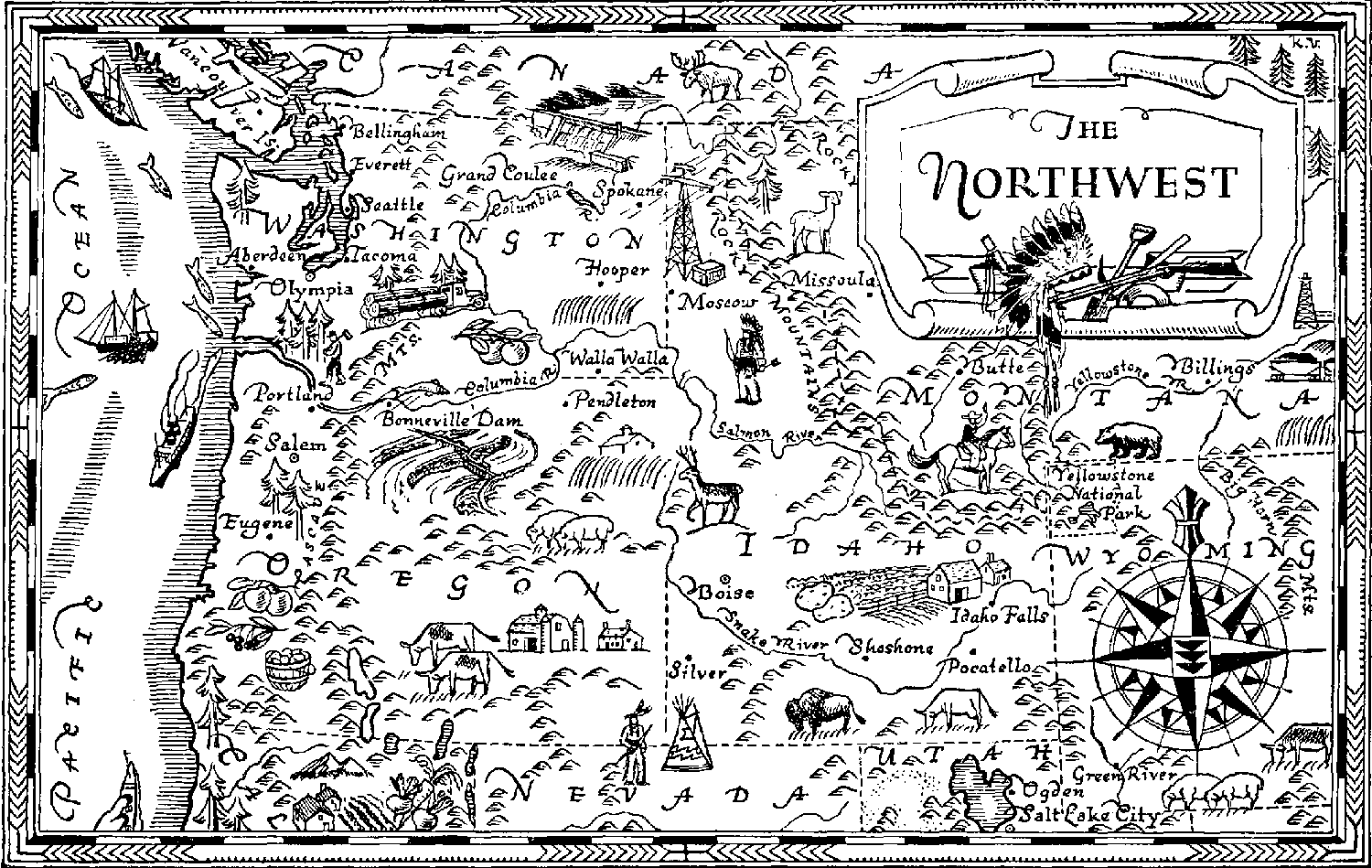
OREGON and Washington are twins except as to character; they fit together like chunks of a well-constructed jigsaw puzzle. They form an almost perfectly integrated natural unit, and their history, geography, climate, natural resources, problems, are closely similar. This—with Idaho as a sort of pendant—is the splendid open world of the Northwest, which means the world of the Columbia River basin. Roses at Christmas, salmon that climb ladders, the greatest timber stands in the nation, personalities like Wayne Morse and Dave Beck, the tall tales of Paul Bunyan, spacious and maximal issues like public power, wheat fields that look painted by Van Gogh, and more social energy, more social vision than in any comparable region in the country—these are some distinguishing characteristics of Oregon and Washington.
Also, mostly on account of the variegated weather, the Northwest is an area of violent contrasts within the whole. The town of Port Angeles, Washington, has the heaviest rainfall in the U.S.A., 141 inches per year. Across the mountains, not more than a metaphorical stone’s throw away, is Grand Coulee, the greatest irrigation project ever built by man.
History of the region—and this too is vital and diversified—-begins with the early fur traders, like John Jacob Astor who established a post at Astoria in 1811, explorers like Lewis and Clark and, of course, the Indians. Whereas in California, as an example, the Indians were largely passive, almost totally backward and without culture, those of the Northwest were so picturesque and well developed that the whole area is still vividly underlaid with an Indian tradition. Both Washington and Oregon were, as is well known, originally part of the same Oregon Territory, as were Idaho and parts of Montana and Wyoming. British influence was very strong in the early days, and in fact the territory was ruled jointly by the United States and Great Britain for twenty-eight years, something which can be said of no other region in the U.S. “Had the question of ownership been decided on the respective merits of the rival nations’ claims,” says the Washington State Guide pertly, “no reasonable doubt exists that England would hold the Oregon country today.” The United States neither fought for Oregon nor purchased it; the huge territory fell into our lap—with some assistance from the power politics of President James K. Polk. But just as Washington and Oregon might well be British today, had not the irresistible pressure of American westward expansion intervened at a time when the British were anxious to avoid a quarrel, so might British Columbia be American today, had we not receded from our original claim to the celebrated “54–40 or Fight” frontier.
One colorful item in the Oregon story is that Dr. John McLoughlin, chief factor of the Hudson’s Bay Company west of the Rockies, ruled it almost singlehanded for more than twenty years from his citadel at Fort Vancouver. Another is that Daniel Webster dismissed the whole area as perfectly useless, saying on one occasion, “What can we do with the western coast, a coast of 3,000 miles, rockbound, cheerless, uninviting, and not a harbor on it? What use have we for such a country? I will never vote one cent from the public treasury to place the Pacific Ocean one inch nearer Boston than it is now!” Still another is that when the bill creating Oregon Territory became law, the governorship was first offered to a comparatively unknown young politician from Illinois—Abe Lincoln.
Both Oregon and Washington are split straight down the middle by the Cascades. Also the Cascades cut the weather in half, so to speak. Humid air rises from the Pacific, which is fed here by the warmish Japan Current, and drops as rainfall when it bumps into the Cascades. So the western or coastal slope of both states is temperate, moist, hazy; the eastern half is hot, high, semiarid. So, in turn, the western slope is largely industrial, with great ports and towns like Portland and Seattle; the east is agricultural—wheat and cattle country. The west is thickly populated but in the east—especially in Oregon which contains one of the loneliest and least-known regions in America—you can travel 150 miles between communities. Even the elemental timber is absolutely different. The line of the Cascades cuts down like a sharp welt. On the west side, the forests are mostly Douglas fir with hardly a single ponderosa pine; on the east, they are solidly ponderosa pine, with hardly a single Douglas fir.
Plenty of people have suggested that Oregon and Washington be split up and put together a different way, with the Cascades as a north-south boundary. But then the new state on the east would be nothing more than an agricultural hinterland to the industrial west. Each new state would be almost perfectly homogeneous, but correspondingly it would lack balance and variety.
So much for general background—and for the all-of-a-piece physical similarities. I said in Chapter 5 that no traveler, flying across Utah and Nevada, could possibly tell the difference between them. The same thing is even more strikingly true of Oregon and Washington. They look as much alike as twin peas or marbles. But—and this “but” is the heart of the Northwest story—there is a tremendous difference between the two states otherwise. Nowhere else in the country can the extraordinary tenacity of state characteristics be better observed, the deep-rooted instinct of a state to grow its own way without regard to its neighbor. Oregon and Washington are, except in physiognomy, almost as different as Maine and Florida. Let us explore.
Oregon was settled by New Englanders in the first instance, and has a native primness, a conservatism, much like that of New Hampshire or Vermont. It is, indeed, one of the most astonishing things in America that Portland, Oregon, should be almost indistinguishable from Portland, Maine. But Washington—in acute contrast—is a gold-rush state, explosive, articulate, intractable. Jim Farley is supposed to have said once that “there are 47 American states—and the Soviet of Washington.”
Oregon is one of the most consistently Republican states on the local level; Washington, with a tradition of Populism and Progressivism, has been as consistently Democratic. Labor is weak and diffuse in Oregon, whereas in Washington it is strong and getting stronger. Oregon is very conservative socially and financially; Washington has a more come-easy go-easy atmosphere. In social legislation, Washington is probably the most progressive state in the country; Oregon is one of the least though it inaugurated many reforms that its neighbors promptly picked up. That all this should be so, in two states not only adjacent but geographically indistinguishable, is one of the strangest paradoxes in the United States.
Washington points out proudly that it has had the direct primary since 1907, woman suffrage since 1909, and the initiative and referendum since 1911. Its unemployment compensation rates are the highest in the country, twenty-five dollars per week for twenty-six weeks (the scale that President Truman sought unsuccessfully to extend to the nation as a whole in 1946), and it pays fifty dollars a month old age pensions to everybody over sixty-five. This pension scheme—probably the most advanced in the United States—has, moreover, been in effect ever since 1933 though the rates were lower then. Washington spends seventy-two million dollars a year (almost 20 per cent of the total budget) on state aid to schools, and it has an admirable record in such things as nursery schools, otological clinics, aid to the blind and to needy children, coal mining safety laws, equal pay for women, expansion of bus services, antituberculosis legislation, and the like. It pays the highest wages in the nation, next to Detroit, and went through the war without a single strike. It has more bathrooms per capita than any other state, and more electric light.
By contrast look at Oregon. It is one of the lowest states in financial aid to schools. It was the first state in the West to pass an enabling act under the Federal Housing Authority but the last actually to create such an authority. Nevertheless it has to hand plenty of the mechanism for progressive social legislation. It was here, following the reforms of William S. U’Ren at the turn of the century, that the recall, initiative, and referendum were, in fact, first invented; the whole system was called the “Oregon system” in the beginning. Oregon has, indeed, as good a setup for liberal government as any state—but it makes comparatively little use of it. The promise was superb, and the performance relatively indifferent.1
Washington is extremely liberal in regard to civil liberties; Oregon is less so. In the early 20’s—largely because so many Southerners had moved in—Oregon was, in fact, strange as it may seem, the strongest Ku-Klux Klan state in the union outside the solid South, and hangovers of this still show. Agitation against the Nisei was fiercer in Oregon than anywhere else in the West; the Portland police department for years maintained a “red squad” like that in Los Angeles; Portland was considered one of the main Nazi centers in the country by the FBI, and I heard more and more bitter anti-Negro talk there than in any other northern city. I even heard people speak with indignation about Jack Reed, a Portland boy, who has been dead and interred in the Kremlin wall these many years. His father was a U.S. marshal, and the feeling is that “he let the community down” by siring a famous radical.
But—let us be scrupulously careful to inspect both sides and not generalize too much in one direction—Oregon was one of the first states to have a Jewish governor, and Wayne Morse, its junior senator, is one of the two or three most vigorously outspoken liberals in the Senate today. Late in 1946 the radical Townsendites succeeded in getting on the ballot, for subsequent decision, a “Little Townsend Plan” which, if it becomes law, will pay one hundred dollars a month to everybody in the state over sixty-five, to be financed by a tax on all gross incomes. Finally, Reed College, Portland, is one of the most progressive schools in the country, and Oregon like Washington has a splendid record in the development and use of public power.
An Attempt to Explain These Differences
First, settlement. Oregon was, I have noted, first settled in the main by New Englanders. The place names—not merely Portland and Salem, the capital—are New Englandish all over the state; consider Pendleton, Medford, and so on. (In Washington, by contrast, most conspicuous place names are Indian, like Yakima, Tacoma, Spokane, Walla Walla.) The second wave of immigration came largely from the middle South—the Ozark country and Arkansas—and consisted of folk who didn’t care much about the Gold Rush in either Alaska or California, of middle-aged people who wanted to settle down. Washington, on the other hand, got proportionately a more adventurous and vital stock, though Oregonians will assassinate me for saying so. Also to Washington came a tremendous influx of Scandinavians, which strongly contributed to its progressivism. A Scandinavian name—like Wallgren, Magnuson, and so on—is almost as useful a political asset in Washington as in Minnesota, and it is proverbial that farmers of Scandinavian descent, moving westward out of the Dakotas, are radically inclined.
British influence is, incidentally, still strong in parts of Oregon, particularly Portland. British traders, wheat exporters, cattlemen, came in after the Hudson’s Bay days; mortgage loan companies, owned in Britain, flourished and were manned by young Englishmen. This had a marked effect on recreation, among other things. Portland is, I should imagine, the only American city (except Philadelphia) where cricket has been regularly played, and it was the first city on the West coast to have a golf links. Thirty years ago there were not less than twenty-seven golf courses in the town.
Second, railways. Oregon had its famous Trail, but the railways that came later cut across Washington instead; today Washington has three transcontinental lines and Oregon only one—moreover this one only touches a small corner of the state. Hence, the Oregon interior has never been fully opened up; it has been less accessible to the irrigation of new influences and ideas.
Third, religious factors. The Roman Catholic church is stronger in Oregon than Washington, which tends to make the former more conservative. Washington is mostly Lutheran and freethinking.
Fourth, land tenure. The lumber barons, who were the most flagrant of all American despoilers, grabbed off considerably more land in Oregon than Washington. Hence Oregon has less state land to provide income for schools and public services.
Fifth, the labor movement, which as mentioned above has always been strong in Washington, and in Oregon comparatively weak.
Beyond all this there are, one might add, elements mysterious and unknown. No listing of simple facts can wholly or satisfactorily explain why communities differ, or why their specialized characteristics may be unique. Why, for instance, to jump far afield, should Texas have what seem to be the prettiest girls in the world? This phenomenon can hardly be explained purely on grounds of climate, sunshine or outdoor life; Arizona has more sunshine, and California is probably healthier. But walk across the campus at Austin, or roam the downtown streets of Dallas; there are more Miss Americas per square yard than anywhere else in the country per square mile. A manifestation like this must, it would seem, derive from some kind of spiritual or irrational salt-and-pepper that no itemization of other factors can altogether account for. And so it is with the progressivism of Washington, the conservatism of Oregon.
Finally, a word on one striking similarity between the two states. Each has a peculiarly complex system of liquor regulation, or semiprohibition, which may cause acute anguish to the uninformed or unwary traveler.
Portland and Seattle
Nothing could better illustrate the differences between Oregon and Washington than their two chief cities, which are as unlike as tea and gin. Many years ago a magazine writer called Portland a “spinster city,’’ and except that in recent years it has been a spinster city with a war baby, the description still holds good. The baby grew hard and fast; Portland rose in population from 305,394 to 660,600 in less than a decade, and just to the north a completely new town, Vanport, was built from scratch to a population of 32,400 almost overnight. The conservative Portland citizenry did not altogether like this influx; I heard a hotel clerk say, with an elegant wrinkle of the nose, “The only streetcar left that you can ride on without getting grease spots is to Council Crest,” Council Crest being the most fashionable section of the city.
Yankee traders who went around the Horn founded Portland in 1845. Francis W. Pettygrove of Portland, Maine, and Amos L. Lovejoy of Boston, Massachusetts, each wanted to name it for his own home town, and Pettygrove won by tossing a coin. Otherwise, we should be talking today of “Boston, Oregon,” The Puritan atmosphere persists heavily. The streets bear names like Everett and Hawthorne; it is a city of homes and the chief bookstore is admirable; on the main street is a large illuminated sign JESUS LIGHT OF THE WORLD.
Portland was, during the war, the port for Russian lend lease, just as it was Russia’s chief port in America during the days of Catherine the Great. The Russian sailors, sometimes under the command of women captains stout as barrels, behaved well, did not fraternize, and seemed to spend most of their time at the big department stores buying cheap consumers’ goods like bolts of cloth.
Portland has no symphony orchestra. It has no civic center. Everybody wants one, in theory, but Portlanders don’t spend money easily, and the community has a horror of a white éléphant; so the proposal to create a civic center like that in San Francisco was brutally voted down. Portland, despite its respectability, has the second highest rate of incidence of venereal disease in the nation, and its city jail, with a “drunk tank” in which prisoners were sometimes found dead from beatings, has been a major source of scandal. Its biggest department store, Meier and Frank, is Jewish owned, and Aaron Frank is probably the richest man in the city (though some of the timber fortunes are still very big); its chief club, of the same superior category as the Hope in Providence or the Pendennis in Louisville, is the Arlington; its most distinguished citizen is a liberal banker, E. B. MacNaughton, president of the First National. One striking thing about Portland is the number of four-tap water fountains all over the city. These were built by a lumber tycoon named Simon Benson, a virulent prohibitionist; he thought that his lumbermen might be weaned from hard liquor by a copious availability of fresh water, and the fountains are still there—together with still-tippling lumbermen.
What liberalism there is in Portland—and its good spirit of noblesse oblige—-was well symbolized by Charles Erskine Scott Wood. His corporate clients were the city’s leading bankers, steamship operators and railroad magnates. But Wood had two offices. At the other he conferred with Emma Goldman, Eugene Debs and IWW organizers. He called himself a “philosophical anarchist,” and addressed wobbly meetings wearing the old U.S. Army campaign hat he wore as a young lieutenant with the 21st Infantry when he was pursuing Joseph, the Nez Percé chieftain. Wood died in February of 1944, the oldest living graduate of West Point. To the end he flailed out at the Dies Committee, supported FDR, and denounced the “wicked” utility corporations.
Mount Hood, the exquisitely beautiful peak just behind the city, startlingly resembles Mont Blanc. But it is almost as difficult to see Mount Hood from Portland as Mont Blanc from Geneva, because of the semiperpetual drizzling mist. Just the same Portland loves it. Hundreds of citizens from legless newsboys to seventy-year-old widows attempt to climb it day in and day out, and many do. Lately a proposal was heard to build a cog railway or aerial tramway to the summit. It was howled down by indignant Portlanders who insist on keeping their precious mountain unspoiled.
Portland was a healthy young metropolis while Seattle, founded in 1852, was still a remote village. The population of Seattle only numbered 3,533 as recently as 1880. Then it streaked out like a skyrocket and, a fast tough town, has been streaking out ever since. The two cities do not, however, have anything of the rivalry of, say, San Francisco and Los Angeles. Portland is too superior to worry much, and Seattle too chaotic. I did, however, hear one Portlander complain, “Seattle just figures to get the best of everything,” in a wan and decrepit voice.
No city in America, not even San Francisco, has quite the spectacular beauty of Seattle; and no city has so few hours of what the health authorities call “effective sunlight.” Mount Rainier (which is still stubbornly called Mount Tacoma by Seattle’s rival city, Tacoma) is—when you can see it—an incomparably beautiful sentinel, and resembles the Jungfrau much as Mount Hood resembles Mont Blanc; the town as a whole, built on seven hills between Puget Sound and the glistening cobalt mirror of Lake Washington, has not less than two hundred miles of waterfront. Its streets are so steep, like those of San Francisco, that you practically need spikes in your shoes, and its politics are almost as spectacular as the scenery; this is a town where mayors have been twice recalled in recent years, where fabulous characters like Victor Aloysius (“Just Call Me Vic”) Meyers2 leap straight out of night clubs into public office, and where the Boettigers worked for Hearst. Seattle has the highest suicide rate of any American city (people blame the weather); it is the city where your car is dragged off instantly and impounded if you park it incorrectly and where jaywalkers are incontinently arrested; where chunks of smoked salmon are called “squaw candy” and where a rough frontier civilization has not quite jelled.
The story of Seattle is, in a way, an Alaskan story. It is the great gateway to Alaska, being two days nearer by sea than San Francisco, and the totem poles in public squares still give you a sniff of the Klondike air. Seattle’s position vis-à-vis Alaska may be appreciated if you realize that it is not merely the jumping-off place to Juneau, but also to New York; Seattle lies almost halfway between the extreme western tip of the Aleutians and Montauk Point. Gold made Alaska, and Alaska made Seattle. In 1897 the Klondike mines came in, and a boom started that has gone on practically without interruption ever since. Nowadays gold is not so important. But Seattle lives on Alaskan timber and Alaskan fish. An acute issue at the moment is airline communications with Alaska. Seattle thinks of itself as the natural and inevitable jumping-off place for Alaskan traffic, but the Civil Aeronautics Board, working out an over-all route to the Orient, chose Minneapolis instead. The route will be Chicago-Minneapolis-Edmonton-Anchorage-Tokyo, as at present planned, leaving Seattle out and wounding its feelings badly.
Alaska itself is not part of this book, but one should at least mention that the Alaskans are rebelling at what they consider “domination” by Seattle. They point out that virtually everything of value in the territory—canneries, steamship lines, gold mines, trading companies—is owned in Seattle. Of the proceeds of the 59 million dollar salmon industry, less than six million dollars stays in Alaska where the fish are caught. Alaskans have, indeed, rejoiced lately at the fact that the Alcan Highway as well as the new air route will apparently go through Edmonton and Minneapolis instead of Seattle; they say that this will help release them from their “bondage.”
Seattle is very proud of its rambunctious origins; it has learned a lot through growth and struggle. People believe in merit in this hard-boiled town; there are few fictitious values, either among rich or poor. Most of the big money, made out of western resources, flowed east; this is still bitterly resented. What happened first was that Seattle had to fight hard to get a railway, during the brawl and bluff days of Hill and Harriman. The Northern Pacific wanted its western terminus at Tacoma, its own company town, even though this meant strangling Seattle just as it was beginning to bud nicely. In retaliation Seattle set out to make a railway of its own, and—literally—the town folk started to build one with their own bare hands. This was a heroic gesture, but it didn’t quite work. Finally in 1890 the Northern Pacific came in and Jim Hill’s Great Northern followed three years later.
Everybody knows the story of the Mercer girls, a yarn nicely expressive of the Seattle spirit. In the 60’s the new community had, as was natural, a great woman shortage. So a venturesome citizen named Asa Mercer, who was also president of the university, traveled east to the Atlantic seaboard and came back with a covey of virgins who were willing to marry, sight unseen, the lonely but stalwart pioneers. There were eleven girls in the first Mercer shipment. When they arrived, “the single men of the town turned out looking like grizzlies in store clothes and with their hair slicked down like sea otters.”3 In 1866, Mercer went east again, and brought back forty-six more women; some of these were Civil War widows, and, as if to prove the virtue of his wares, he married one himself. The Mercer family had a real colonizing zest. A brother was the first man to bring horses into Seattle.
We should have one word at least for the pleasant city of Spokane. It lies in eastern Washington, and is the “capital” of an area that includes the Idaho panhandle and parts of Montana and Oregon; this region—largely pivoted on wheat production—is sometimes known as the Inland Empire, and once a semiserious agitation began to make it a separate state, to be known as Lincoln. Spokane is the largest inland city in the West except Denver; it is the old home town of Eric Johnston and Lewis Schwellenbach; its leading newspaper is one of the most rigorously conservative in the United States; it has considerable charm and pictorial distinction; and it contains one of the best hotels in the country, the Davenport, where every coin is washed before being given in change.
Politics in Oregon, Plus Snell
Fifty years ago if you should have asked “Who runs Oregon?” the answer would have been triple: (1) the Portland Oregonian, (2) the Southern Pacific, (3) the lumber kings. Nowadays all three have lost most of their direct influence, though the Oregonian is still a force. Twenty years ago the answer might have been “the McNary machine,” but Senator Charles L. McNary is dead—-and even when he was vice presidential candidate under Willkie, Roosevelt carried the state.
The governor of Oregon, Earl Snell, has done his best to build up a machine similar to McNary’s, but it creaks at the joints, and no one knows how long it will last. Snell is an interesting enough man, but Oregon does not go in for strong governors; usually the governor, treasurer, and secretary of state form a kind of triumvirate.4 Snell’s chief political characteristic is, it would seem, an ability to get along with everybody. He is genial, mediocre, and perpetually on the fence. He owns a garage and filling station in Arlington, and spends a good deal of time there. He was secretary of state for some years, and as such did favors for practically everybody; his name appeared on all such routine documents as applications for automobile licenses and the like, and he became widely known and popular. Snell is one of the world’s greatest joiners. He belongs to everything. He was an active Townsendite. He is a pillar of the American Legion, and the Legion is in turn a central pillar of his machine.
He never makes any kind of move until he is sure that it will be greeted favorably; he works hard to please the farmers and, if labor puts on enough pressure, he will sign prolabor bills; thus his labor record is fairly good. He is not a student; toss him into a controversy, and he will blow up. He can make three speeches a day and say nothing whatsoever; he can be black and white at the same time. That a man like Snell, who has no discernible principles, can at the same time be a quite good governor with a quite good program, is both a characteristic and a somewhat baffling American phenomenon. He carries water on both shoulders; yet the upshot is that he gives most people what they want. Certainly Snell is one of the most triumphant vote getters in the history of the state. In the 1946 primaries he beat his opponent, a Portland house painter, by five to one, and in the November run-off coasted through to an easy victory.
Snell aside, the two most interesting political personalities in Oregon are Charles Sprague, a former governor who is editor of the Salem Statesman, and the present state treasurer, Leslie Scott. Sprague, a firm civil liberties advocate and a fine type of western liberal Republican, cannot be budged on a principle, and as a result has often made himself unpopular. Scott, a wealthy man with varied interests, is earthy, cautious, suspicious, conservative in the extreme, and without a dishonest hair.
Oregon, on the state level is overwhelmingly Republican; within this circumscription the main power factors might be outlined as follows:
First, the Townsendites. But these are a steadily declining force if only because most are old, and are progressively dying off. Second, the Legion. Third, in a less reputable rubric, leftovers from the Ku-Klux and the Bund. Fourth, the farmers, with the Grange as the dominant agriculture group, followed closely by the Farmers Union. Perhaps it is another Oregon paradox, but the farmers in this conservative state are for the most part liberal. This is because they want public power and rural electrification; hence they tend to oppose the private utility interests. Most Oregon farmers detest labor, on the other hand. They want cheap utilities and cheap labor both. Fifth, women. Oregon was one of the earliest woman suffrage states, and the Parent Teachers Association, the Federation of Women’s Clubs, the League of Women Voters are all conspicuous and forceful. Sixth, the churches and denominational schools. Describing Oregon twenty years ago, Charles H. Chapman tells how every settler’s camp had its school—“the Methodists at Salem, the Congregationalists at Forest Grove, the Presbyterians at Albany, the Baptists at McMinnville, the Wesleyan Methodists at Corvallis, the Quakers at Newberg, the Campbellites at Monmouth.”5 Finally, as in New England, Unitarian influence is very strong, especially in “upper” circles.
Turn now to labor. The AF of L outnumbers the CIO in a ratio of about seven to one, and the two organizations—in great contrast to Washington where a sort of Popular Front is in operation—don’t even walk the same side of the street; more than anywhere else in the West, they dislike and distrust one another. Of course, conservative elements, which naturally profit by this split, try to widen and extend it. Even the AF of L is thought to be pretty “red” in Oregon; the CIO is considered positively insurrectionary. But, a nice point, as the CIO goes further left, there is a tendency to think of the AF of L as being more respectable.
A major political issue in Oregon is—as in so many American states—redistricting. The state has not been redistricted for something like twenty-five years; yet in these years there have been important population shifts, like that of labor coming in to the towns. This is one reason why labor has been at such a disadvantage politically. Portland, the focus of labor strength, has only thirteen seats in the state legislature; it should have, by basis of present population, at least twenty-one. I talked to one state senator who, representing three counties with a population of well over half a million, has exactly the same vote as a colleague from a single county of twenty thousand. This is the rotten borough system in excelsis; what it amounts to is a not-so-subtle form of disfranchisement.
Richard L. Neuberger, America’s best informed journalist on Northwest affairs, wrote recently in The Progressive:
As a member of the Oregon Legislature in 1941, I remember attempting to raise the salaries paid our schoolteachers…. The average salary for teachers in California is $2,201, in Washington $1,746, and in Oregon only $1,286…. Our bill to reserve new educational funds for the pay of classroom teachers … was defeated by a vote of 33 to 27. The votes of the over-represented sagebrush areas defeated it…. But if the various counties had been represented in the legislature as the state founders intended, the bill would have passed approximately 42 to 18.
Oregon has one unusual political characteristic; it permits slogans, not to exceed twelve words in length, on the ballot. McNary ran in 1930 with the slogan, “Present United States Senator; Oregon development; improved agriculture; law enforcement.” Snell won the governorship in 1942 with “Leadership for Oregon’s war effort and tax problems—Snell gets things done.” Wayne Morse ran in 1944 with “Aggressive, experienced, respected. Protect America by forceful leadership in the Senate.”
Washington Politicians: Gallery in Miniature
MON C. WALLGREN, Congressman 1932–40, senator 1940–44, and now governor of the state—one of the few senators ever to quit Washington, D. C., for a governorship. Able, close to Truman, not a rabble rouser, strongly prolabor. Elected governor in 1944 mostly on the Roosevelt wave. Was a watchmaker by trade, worked as a boy in his father’s jewelry shop in Everett, a lumber town north of Seattle. One of the best three-cushion billiard players in America; was once a runner-up to Hoppe in straight billiards, and a semi-pro champion in 18.2 balkline. When I asked a Washington worthy once what Wallgren “had,” the answer was (a) amiability, (b) a Scandinavian name. But Mon Wallgren has more than just that. Nobody pushes him around, and his record has been first rate.
WARREN G. MAGNUSON, U. S. senator. The best-looking man in the Senate, one of the most forward looking, and at forty-one the second youngest. Blond, husky, squarely built. Born in Minnesota, orphaned in childhood, followed the harvests west as a farmhand, peddled ice for Dave Beck’s teamsters, worked his way through the University of Washington law school. A Lutheran. A good football player, and his football record helped him considerably when he went into politics. Minor posts on the state level until 1936, then four times Congressman—he campaigned in the beginning by personal house-to-house canvassing—and senator in 1944. Three days younger than Bill Fulbright of Arkansas, and hence the youngest man in the Senate until Hugh Mitchell, also from Washington, a state which certainly picks men young, got there. Magnuson is a great one for being concentratedly busy, for making friends, for being unaware of time. At 4:30 P.M. he will be apt to say, “Have I had lunch yet?” He and Wallgren were Congressmen at the same time, and are close friends; Magnuson carries the ball in Washington, D.C., so to speak, and Wallgren in the state. Believes in tolerance, hard work, social service. Highly ambitious. Has a good liberal record in the Senate, and thinks that his state has the greatest potential future of any in the union.
HUGH B. MITCHELL. Aged 39. For some years Wallgren’s secretary, and was appointed by him to fill out his unexpired term; he is the third member of the Wallgren-Magnuson-Mitchell triumvirate, and possibly the ablest of the three. An emphatic progressive—yet the New York Daily News warmly praised him recently. Mitchell is a student, somewhat lacking in color, a former newspaper reporter, and the son of Harry B. Mitchell, the president of the Civil Service Commission. Had an outstanding Senate record—though the real estate lobby and such agglomerations of monopoly as the Aluminum Company of America didn’t like him much. He fought hard for the OPA and for cheap housing for veterans. Chief sponsor of the bill to create a Columbia Valley Authority like the TVA. Defeated in the Republican landslide of 1946.6
Pressure Groups Fore and Aft
Neither political party has a real machine in Washington. The chief pressure groups might be listed as the following, cutting across both parties:
1. The railways, which are perforce involved in land and lumber interests, both as carriers and because of their original land grants.
2. The pensioners, who in Washington have an organization of their own, the Old Age Pension Union.
3. The Grange, which takes a fairly strong liberal line, and the other agricultural organizations.
4. The public power interests, of which more hereunder.
5. The Swedish population and the Lutheran church and other religious groups.
6. Above all, labor, and the powerful leftist coalition that labor controls.
These disparate groups function better together in Washington than in any other state. Consider for instance the Advisory Commission to the Department of Conservation and Development, which represents an attempt at democratic planning at its best. Wallgren set this up—the first organization of its kind in the United States—as a nonpartisan experts’ group to deal with problems bound to afflict Washington after the war; the fifteen members could not possibly represent more divergent special interests, but all have worked together well and amicably. The chairman is Henry Cartensen, master of the Washington State Grange; the executive secretary is Howard G. Costigan, a pronounced left winger; others are Nicholas Bez, the chief representative of the Slovene community and a celebrated salmon-fishing magnate who has also lately acquired important king-crab interests in the Bering Sea; both Roy Atkinson, the regional director of the CIO, and Dave Beck of the AF of L;. Claire Egtvedt, chairman of the board of the Boeing Aircraft Company; Colonel W. B. Greeley, representing the big lumber interests; and on the extreme left Karly Larsen, president of the International Woodworkers of America, who was once a member of the IWW.
Finally, a word on a remarkable organization known as the Washington Commonwealth Federation. This, dormant now, was a considerable force in the 1930’s; it was, in essence, the first effective popular front in America. What broke it up, largely, was Communist infiltration and the bewildering twists and turns after 1939 in the Communist party line—though the Communists never numbered more than five thousand out of roughly two hundred thousand members—and then a fraying out and a frittering away as a result of the splintering that curses almost all leftist movements. Also much of its vitality arose out of hard times, and with the war boom everybody had jobs and the times turned soft.
The WCF—its story is worth a brief line—derived chiefly from an Unemployed Citizens League that sprang up in the Northwest in 1932–33; then too it was strongly influenced by the Commonwealth Federation in Canada.7 During the depression, relief in Washington was largely a matter of self-help at first. People had the old western spirit; they banded together to cut wood and make shoes. Fifty per cent of Kings County was at one time on local relief; in some lumber areas, like Gray’s Harbor, the figure rose to 80 per cent. Then came FDR and federal relief. The local organizations did not shrivel up, however; they turned their energy to politics. First came something called the “Commonwealth Builders,” which launched a production-for-use program closely paralleling the EPIC movement in California; it elected no fewer than forty-one members out of a legislature of ninety-nine in 1934; it was the rock bottom basis of the careers of almost all Washington liberals, like Magnuson, former senator Homer T. Bone, Lewis Schwellenbach (now secretary of labor), and the remarkable congressman who died a suicide, Marion A. Zioncheck. Schwellenbach and Howard Costigan called a convention in Tacoma representing all leftist groups in 1936, and the WCF was born. But splinter feuds began almost at once; for instance an attempt was made to “recall” Schwellenbach because he wasn’t radical enough. Nevertheless the state has an extremely effective leftist movement. AF of L, CIO, and the railway brotherhoods have combined to maintain a “joint labor lobby” at Olympia, the only one of its kind in America, with forty-nine representatives who meet every morning, plan concerted action, and see legislation through. They work in close harmony with the pension groups, Negro groups, and the Farmers Union. Operating in 1944, this coalition elected Wallgren, Magnuson, four out of six congressmen, and every state official.
Came a pungent episode in 1946. Costigan and thirty-six-year-old Representative Hugh DeLacy, an active left winger, ran against one another in the primary race for Congress. Both had been former presidents of the Commonwealth Federation. Costigan accused DeLacy of complete subservience to the Communists; DeLacy accused Costigan of various sins. The real issue was Communism. In the 1939–41 period DeLacy, taking the straight party line, had called the war an imperialist adventure; later of course he reneged. This fracas aroused more than local interest, because members of the Roosevelt family became involved. Colonel Jimmy Roosevelt warmly endorsed DeLacy, and Anna Roosevelt Boettiger (whose husband had been publisher of the Seattle Post-Intelligencer for some years) supported Costigan. DeLacy won the primary, but was badly beaten in the general election in November. Communism beat him.
Also in 1946 came a development highly embarrassing to another Washington congressman, and one with a strong liberal record, John M. Coffee, who also lost his seat in the November debacle. It was discovered as an offshoot of the Garsson investigation that Coffee had, in 1941, accepted a check for $2,500 from a Tacoma contractor, which he failed to list among his “campaign contributions.” Coffee promised never again to accept any more such gifts, and after a minor furor the case was dropped.
What’s happened to the IWW? No one can easily visit the Northwest without asking this question. The organization still exists—it publishes a paper in Chicago and maintains a hall in Seattle—but it has little but academic importance nowadays. Shades of Centralia and Big Bill Haywood! Some of the old wobblies are now Communists, like Elizabeth Gurley Flynn; some, like one Tacoma editor, are now fanatic Commy baiters; some, like Larsen, are in the CIO. The loggers are organized now into Larsen’s union, conditions of work are much better (for which the IWW should get some credit). What killed the IWW was of course the growth of political training in the labor movement. Gradually its remnants were integrated into the CIO.
Back to Beck
Dave Beck, international vice president of the Teamsters Union, has a pink moon face and icy blue eyes that look like an albino’s; he is the most powerful labor leader in the Northwest, and one of the most important in the country. Seattle is 90 per cent unionized, the AF of L overwhelmingly dominates the labor field, and Beck’s Teamsters dominate the AF of L.
Beck was born in Stockton, California, in 1896 and moved to Seattle at the age of four. He left high school at sixteen to go to work driving a laundry wagon and he has been driving them, figuratively, ever since.
He went into Navy aviation in World War I and became what was then called a “flying engineer.” He chased Zeppelins and took part in bombing raids on Helgoland. If the weather was bad, the planes had to go back for want of gas; he smiles now when he remembers this, thinking of the range of modern bombers.
In his first labor election in 1925, Beck became secretary of the Laundry Dye and Drivers Union in Seattle, one of the outstanding locals in the country. In the same year, at the national convention of the Teamsters in Seattle, he met his boss Dan Tobin for the first time. Tobin asked him to join the national pay roll, and presently he was in charge of the Teamsters in eleven western states, which he still is.
Beck has been called the businessman’s business agent in the labor movement. He is probably the most ardent exponent of the capitalist system in the Northwest, and his speeches are almost indistinguishable from what might come from the NAM. His basic belief is that private enterprise must be supported at all costs, since business cannot pay good wages unless it makes a profit.
He believes, however, that government regulation of business may be necessary. “But,” he told me, “don’t put the government in as a competitor!” He loathes anything that smacks of socialism.
On the federal level he was a Roosevelt New Dealer; on the state level he takes a much more conservative line; he is probably the only Washington laborite of consequence who believes in private as opposed to public power. One reason for this is his fear that public power may frighten capital away.
He thinks that the lumber industry is hopelessly reactionary, and that the lumber barons brought the old violence of the IWW on themselves, by a totally parochial labor policy.
He is enormously proud of the Teamsters’ record during the war. There are 175,000 teamsters in the western states; as of the date we talked, late in 1945, there had not been a single strike since Pearl Harbor, without an iota of sacrifice in wages, hours, or conditions.
His relations with the CIO are peculiar. The CIO still has the waterfront, which Beck severely lets alone. He cordially hates Bridges in San Francisco, and Bridges hates him back.
His relations with his own AF of L are also in a way peculiar. The Teamsters withdrew from the State Federation of Labor some years ago following a complex three-way split.
Recently Governor Wallgren appointed Beck to the Board of Regents of the University of Washington. The Seattle press greeted this with sobriety, and pointed out that although Beck was not an alumnus (of the University of Washington or any other) he had once taken some extension courses.
Politically Beck has great power, through his Teamsters Promotion League which helps get out the vote, and by financial support of candidates he likes.
Beck is a competent and capable executive, and has had several offers to go into business, with companies like Boeing; he has always turned them down out of fidelity to the labor movement.
There are few fixed patterns in American life and Beck, to sum up, is a wonderful example of the chaotic individualism of much of the United States. He is a labor boss who devoutly believes in capitalism; a strict and firm conservative who strongly supported FDR; and an employer of brawn and muscle who is listened to with extreme respect by any chamber of commerce he chooses to address.
1 An important point in qualification of the above is that Oregon has no sales tax, whereas Washington has a comparatively heavy one. Yet, by general definition, a sales tax is a kind of poor man’s income tax, since a man earning fifty dollars a month has to pay the same tax on commodities as a millionaire. But Oregon has four times voted against a sales tax, on the ground that it is unjust to the poor. It has an income tax instead. The situation in Washington is the reverse. Mostly this is the result of pressure by the Washington State Taxpayers League, a powerful group dominated by the lumber interests, which wants to keep all taxes but the sales tax down.
2 Meyers, lieutenant governor of the state, is really something. For years he was master of ceremonies and a band leader at his own boite de nuit, the Club Victor. During his last campaign one of his slogans was “I don’t believe in daylight saving time. Seattle should have two-four time, allegro.” Another was, “Habitually I go without a vest so that I can’t be accused of standing for the vested interests,” and another, “There’s going to be no cheap chiseling at the City Hall; I intend to take it all myself.” His slogan in 1944 was “Me and Roosevelt will win in a walk.” In plain fact he did win by some 430,000 votes to 190,000. The details above are from Richard L. Neuberger’s Our Promised Land, pp. 272–290
3 Washington, in the American Guide Series, p. 216.
4 Oregon is one of the few American states with no office of lieutenant governor.
5 These United States, Vol. I. p. 283.
6 Mitchell’s successor is the 40-year-old war veteran and former nonpartisan mayor of Tacoma, Harry B. Cain. He is a former Democrat who turned Republican (cf. Thomas L. Stokes, New York World-Telegram, Oct. 5, 1946) in 1944, and has a distinct liberal record though he is not so liberal as Mitchell. He is Washington’s first Republican senator since 1932. So again we see the Roosevelt era ending.
7 A similar federation also existed in Oregon for a time.