
2
James Slotta
Donald Trump’s rhetoric has been a regular topic of media reports from the moment he announced his campaign for the presidency. It has been labeled “violent,” “heated,” “anti-Muslim,” “misogynist,” and “racist,” and generally taken to be conspicuously different from that of other presidential candidates, past and present. Not only is the content of his rhetoric criticized, but so is the linguistically unsavory delivery of it. Among other linguistic sins, Trump’s oratory has been held up as a model of incoherence. “His spelling and grammar are disastrous, he contradicts himself, trails into incoherence, never sounds dignified or recognisably presidential – but none of it does him any harm. In fact, it seems to help,” marvels an article headlined “Trump’s rhetoric: a triumph of inarticulacy” (Leith 2017).
A variety of explanations have been offered. Trump’s rhetorical style is an indication of his mental abilities, according to linguist Geoffrey Pullum, who compares Trump’s use of language unfavorably to the complex syntax used by “more sophisticated thinkers and speakers (including many past presidents)”:
You get no such organized thoughts from Trump. It’s bursts of noun phrases, self-interruptions, sudden departures from the theme, flashes of memory, odd side remarks … It’s the disordered language of a person with a concentration problem.
(Golshan 2016)
Others see Trump’s incoherence as a residue of the privilege he has enjoyed his entire life, which according to media scholar Todd Gitlin (2017) has given rise to a belief that “[h]is power is such that he is not subject to laws of ordinary grammar.”
Whatever the motive, there is a cunning effectiveness in Trump’s “word stroganoff” in Slate staff writer Katy Waldman’s view:
Ironically, because Trump relies so heavily on footnotes, false starts, and flights of association, and because his digressions rarely hook back up with the main thought, the emotional terms take on added power. They become rays of clarity in an incoherent verbal miasma.
(Waldman 2016)
In fact, Trump’s “incoherent verbal miasma” may be a key part of his message. Contemporary electoral politics in the US, as Michael Lempert and Michael Silverstein (2012) have argued, is centered on conveying “message”: a set of values, character traits, and social affiliations embodied in a candidate, crafted through stylized public behaviors, and set within political, religious, and other narratives salient to voters.
As part of “message politics,” verbal incoherence is not necessarily a liability. According to linguist Jennifer Sclafani, “[Trump’s] unique rhetorical style may come off as incoherent and unintelligible when we compare it with the organized structure of other candidates’ answers … On the other hand, his conversational style may also help construct an identity for him as authentic, relatable and trustworthy, which are qualities that voters look for in a presidential candidate” (Pappas 2016). One might say that Trump’s positioning as a political outsider who promised to “drain the swamp” is signaled by a lack of the verbal skills characteristic of the managerial and professional class, epitomized in particular by the former lawyer and president of the Harvard Law Review, Barack Obama. In this, Trump resembles former President George W. Bush, for whom incoherence and ungrammaticality were not bugs, but features of his message (Silverstein 2003).
But I’d like to suggest that Trump’s speech is not as incoherent as it may appear at first. Rather, Trump’s “bursts of noun phrases” and “odd side remarks” are often coherent enough, though not in a way that some audiences can detect. That is to say, for some audiences, Trump makes a great deal more sense than for others. This, as we’ll see, is a significant feature of Trump’s rhetoric, one that highlights communicative divisions in the American public and undermines a vision of the United States as a political community forged through participation in a common national conversation.
2.1Who Is Sidney Blumenthal?
In the first presidential debate, moderator Lester Holt asked Trump why he had finally accepted that Obama was born in the United States after claiming for five years that he was not. Trump responded:
I’ll tell you very – well, just very simple to say. Sidney Blumenthal works for the campaign and close – very close friend of Secretary Clinton. And her campaign manager, Patti Doyle, went to – during the campaign, her campaign against President Obama, fought very hard. And you can go look it up, and you can check it out.
And if you look at CNN this past week, Patti Solis Doyle was on Wolf Blitzer saying that this happened. Blumenthal sent McClatchy, highly respected reporter at McClatchy, to Kenya to find out about it. They were pressing it very hard. She failed to get the birth certificate.
When I got involved, I didn’t fail. I got him to give the birth certificate. So I’m satisfied with it …
(Blake 2016)
In her analysis of the debate, Amy Davidson Sorkin (2016) described Trump’s response as “an undiagrammable sentence structured around the name Sidney Blumenthal.” And that name does not help much to clarify what appears to be a typical example of Trump’s incoherence. After all, who is Sidney Blumenthal?
In the first two debates of the 2016 US presidential campaign, Donald Trump mentioned the name “Sidney Blumenthal” five times. One can identify when the debates happened simply by looking at a timeline of searches for the name Sidney Blumenthal on Google Trends (Figure 2.1).
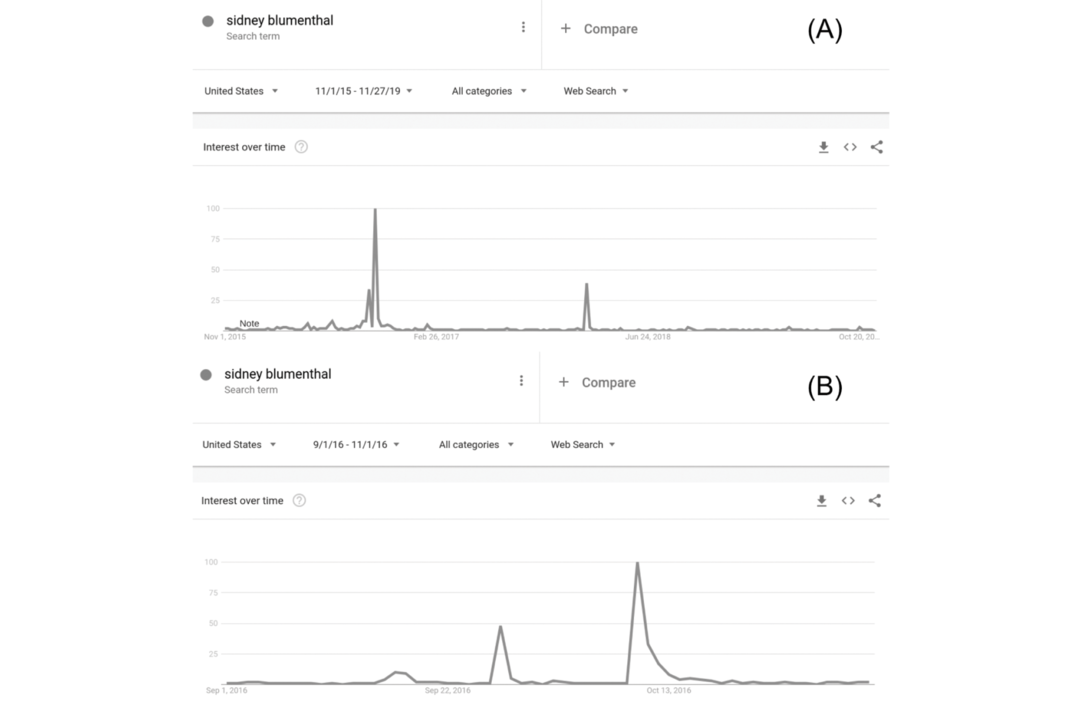
Figure 2.1
“Sidney Blumenthal.” Screenshots of Google Trends graphs depicting search requests to Google for the name Sidney Blumenthal over periods of time that include the first and second presidential debates (September 26, 2016 and October 9, 2016). Graph (A) charts trends between November 1, 2015 and November 27, 2019, with the highest spike the week of the second presidential debate (October 9–15, 2016); (B) narrows the timeframe for searches of the name Sidney Blumenthal to the days between September 1, 2016 and November 1, 2016, showing peaks on September 27 and October 10, the days after the first and second presidential debates.
Source: Google Trends, www.google.com/trends.
One finds people asking on Twitter (@AmandaBecker, September 26, 2016: “Who is Sidney Blumenthal? – Most of America about 30 minutes ago”; @shansquared, October 9, 2016: “Serial Season Three: Who is Sidney Blumenthal”), and on the live blogs of the debate (Marcus Wohlsen: “Two debates in a row, Trump brings up Sidney Blumenthal. Two debates in a row, nearly every American says, “Who?” [WIRED Staff 2016]).
For those unfamiliar with its bearer, the name may still carry certain connotations which help to clarify its coherence in this context. The Jewish-sounding name Blumenthal could be seen as a “dog whistle,” a political message that has an innocuous meaning for a general audience and a coded meaning for a different audience (Haney López 2014). In this case, the ethnic overtones of the name Blumenthal may be inaudible to much of the audience, but they are undoubtedly heard by anti-Semites and White supremacists.
But that is not all there is to this name. Sidney Blumenthal is a name familiar to anyone attuned to right-wing media outlets: as an advisor to Bill Clinton from 1997 to 2001, he earned the nickname “Sid Vicious” for his no-holds-barred defense of President Clinton during the lead-up to his impeachment. More recently, as a close friend and confidant of Secretary of State Hillary Clinton, he featured as a major figure in the 2015 Benghazi hearings, which centered on Secretary of State Clinton’s handling of an attack on the US diplomatic mission in Benghazi, Libya and which were heavily hyped by right-wing media outlets. And, most salient in this context, Trump and right-wing media circulated the claim that, back when Blumenthal was a senior advisor to Hillary Clinton during her presidential primary campaign in 2008 against Obama, he had been among the first to push the Birther claim that Obama was not born in the United States.
Let me suggest that Sidney Blumenthal and many of Trump’s other seemingly incoherent noun phrases and inscrutable side remarks serve as something like titles of artistic works. In his “Theory of Entitlement,” literary theorist Kenneth Burke (1962) notes that words often function like titles. As titles, they not only serve as labels for things in the world, but as summaries and abbreviations of complex situations and narratives. For instance, Romeo and Juliet can be used to refer to a play by Shakespeare or to the two main characters in it, but it has also come to stand for a situation involving star-crossed lovers whose families are at odds with one another. When Kanye West describes his relationship with Kim Kardashian as “a Romeo and Juliet kind of thing” (Dawn 2013), he is referencing the complex scenario of true loves who come from two different worlds (in Kanye’s case, “she’s a reality star and I’m a rapper”; ibid.).
Similarly, the name Sidney Blumenthal considered as a title serves as an abbreviation of a whole Zelig-like set of appearances Blumenthal has made in the reporting of the right-wing media, in which he is not so much a person as he is a character: the Clintons’ evil henchman. Once one is familiar with right-wing media and its narratives, it becomes much easier to recognize the relevance of the name Sidney Blumenthal to Lester Holt’s question.
In this respect, Trump’s apparent incoherence recalls Keith Basso’s (1996) account of a Western Apache speech genre called “speaking with names” (yaɬti’ bee’ízhi). In the example Basso provides, friends of a woman named Louise “speak with names” in an effort to console her, after she informs them that her younger brother had been taken to the hospital early that morning after coming down with a serious illness. This, Louise suspects, is likely because her brother rejected advice to see a “snake medicine person” after he had stepped on a snakeskin several months before. Lola responds to the news, and Louise’s worry, by speaking with names: “It happened at Line of White Rocks Extends Up and Out, at this very place!” After a long period of silence, another woman, Emily, adds: “Yes. It happened at Whiteness Spreads Out Descending to Water, at this very place!” More silence. Lola: “Truly. It happened at Trail Extends Across a Red Ridge with Alder Trees, at this very place!” Louise laughs softly, and Lola’s husband begins to wrap up this intervention: “Pleasantness and goodness will be forthcoming.”
Basso’s presentation is deliberately puzzling. What do these place names have to do with each other, or with Louise, her brother, and his predicament? In Basso’s words, “We are unable to place a construction on the text that invests it with coherence” (1996: 80). Basso translates the place names into English for us, but though we know what the words mean we do not understand what they mean in this context. The text remains incoherent.
The key to the puzzle, it turns out, are the historical tales associated with these places. Line of White Rocks Extends Up and Out is the place where, in a historical tale, a girl who disobeys her grandmother’s warnings gets bitten by a snake. The girl heals physically and is morally improved as a result of the experience. The story, interpreted as a kind of allegory of Louise’s brother’s predicament, is at once obliquely critical of him and consoling for Louise.
Historical tales among the Western Apache are, in a sense, titled with the names of places. A story begins and ends with the name of the place where it occurred: “It happened at Line of White Rocks Extends Up and Out” is the first and last sentence of the historical tale. And once we grasp the stories associated with the place names, the act of “Speaking with Names” gains coherence. For the Western Apache participants who know the stories associated with these place names, there is nothing incoherent about the genre. But for readers who do not know the stories, it appears inscrutable.
There are two points in Basso’s essay that are particularly relevant to an understanding of Trump’s rhetoric. First, names are more than labels for people and places; they serve as abbreviations for stories and other forms of cultural knowledge, entitling complex situations in the way that Kenneth Burke described. Second, knowledge of names and their associated stories circulates from person to person, group to group along what Asif Agha (2007) has called “speech chains.” Not everybody is exposed to the stories associated with particular names. Until Keith Basso shares the story that happened at “Line of White Rocks Extends Up and Out” with us, Lola’s remark appears incoherent. But once we become participants in the “speech chain” through which the historical tale circulates, the comment makes perfect sense.
Similarly, until we encounter right-wing media narratives, Trump’s “bursts of noun phrases” and “odd side remarks” can appear completely incoherent. Once we know the stories, Trump’s titles for them make a great deal more sense. We return, then, to the theme of Trump’s incoherence, but now with the recognition that what may be incoherent to some in Trump’s audience is perfectly coherent to others. It all depends on whether or not you are part of right-wing media speech chains.
2.2From Speaking with Names to Living in Bubbles
For those unfamiliar with right-wing media narratives, the incoherence of Trump’s speech has had an interesting effect: It has drawn attention to the speech chains through which stories circulate, and to the limits of that circulation. The name Sidney Blumenthal leaves some viewers of the presidential debates wondering and googling: “Who’s Sidney Blumenthal?” That, in turn, points them toward a world of right-wing media discussion that they never knew existed and had never, until that moment, been a part of.
Even more, Trump’s noun phrases and odd side remarks draw mainstream media attention to the circulation of stories in the right-wing media, which has become a focus of reporting in the Trump era. Trump’s perplexing statements consistently flummox the mainstream media, which each time note the lack of evidence for Trump’s claims and send reporters in search of their source. There are a number of exemplary instances we might look at: there’s Trump’s claim that 96 million are looking for work, his assertion that the media does not cover terrorist attacks, his remark about “what’s happening last night in Sweden.” There’s his tweet about Obama tapping his wires. His mentions of the Uranium One deal and South Africa land seizures. There’s his comment that Google search results are rigged, that the Kurds did not help us with Normandy, and on and on.
See if you can identify all of the “stories” Trump gives titles to in this tweet from February 17, 2018. In it, Trump refers to his national security advisor at the time, General H. R. McMaster, who had said that there was “incontrovertible” evidence of Russian meddling in the US election:
General McMaster forgot to say that the results of the 2016 election were not impacted or changed by the Russians and that the only Collusion was between Russia and Crooked H, the DNC and Dems. Remember the Dirty Dossier, Uranium, Speeches, Emails and the Podesta Company!
(Trump on Twitter, February 17, 2018; my thanks to Bruce Mannheim for calling this tweet to my attention)
The search for the sources of these titles again and again points back to the realm of right-wing media, where Trump’s apparently inscrutable messages turn out to be often canny or highly abbreviated titles for well-known storylines in circulation. Consider Trump’s allegation that President Obama had had Trump’s “wires tapped” in Trump Tower, which Trump tweeted early in the morning on March 4, 2017. The tweet was met with the usual response from the mainstream media and left-wing outlets, which described the accusations as “explosive” and “wild,” repeatedly noting they were “unsubstantiated” and “offered without evidence to back them up.” The source of the claims – an article in Breitbart from March 3 (Pollak 2017) – was relatively quickly identified by the Washington Post’s Robert Costa (Costa on Twitter, March 4, 2017), and widely reported by mainstream media outlets. Over the next few days, the mainstream media reported on the circulation of wiretapping claims in the right-wing media going back to January 2017 (e.g. Bloomberg: “Trump Calls for Probe into Wiretap Report He Read on Breitbart”; BuzzFeed: “Trump Repeats Talk Radio Rumor That Obama Wiretapped Him During Election”; see Olorunnipa et al. 2017 and Melville-Smith and Mack 2017).
This is just one example of a genre of reporting that has arisen in response to the incoherence and inscrutability of Trump’s remarks: we might call it “the annotated Donald Trump,” a genre in which reporters annotate Trump’s words with their sources in right-wing media. This journalistic account of the circulation of messages through the right-wing media ecosystem and out of Trump’s Twitter feed takes a variety of forms, some quite elaborate. For instance, a CNN Business article, “From Conservative Media to the White House: Anatomy of Trump’s ‘Diversity Visa’ Tweet” (Kludt 2017), examines the history of right-wing media reporting behind a Trump tweet on “Diversity Visas,” which followed a deadly vehicular assault in New York City that killed eight and injured twelve on October 31, 2017. The article reports how the suspect in the attack got linked to Democratic Senator and Minority Leader Charles Schumer as the story circulated through right-wing media outlets over a twelve-hour period, starting with right-wing websites Breitbart (Binder 2017) and Gateway Pundit (Caplan 2017) before migrating to Tucker Carlson, Sean Hannity, and Laura Ingraham’s programs on Fox News the evening of the attack and finally to Fox and Friends the next morning. That is likely where Trump learned of the connection between the suspect in the attack, the Diversity Visa Program, and Charles Schumer. While Fox and Friends was still airing, Trump tweeted: “The terrorist came into our country through what is called the ‘Diversity Visa Lottery Program,’ a Chuck Schumer beauty.”
This sort of reporting on the speech chain leading up to Trump’s comments is now quite common. In a real-time version of the Annotated Donald Trump genre, journalists now keep one eye on Fox and Friends and another on Trump’s Twitter feed to more easily track the speech chains behind his pronouncements. For instance, Trump tweeted: “Ungrateful TRAITOR Chelsea Manning, who should never have been released from prison, is now calling President Obama a weak leader. Terrible!” (Trump on Twitter, January 26, 2017a). Brian Stelter noted on Twitter (via @brianstelt) that fourteen minutes earlier, Fox News aired a segment on Chelsea Manning that labeled her as an “Ungrateful Traitor,” during which Fox News commentator Abby Huntsman described Obama “as a weak leader with few permanent accomplishments” (Wright 2017). Later that year, Trump tweeted: “Going to the White House is considered a great honor for a championship team. Stephen Curry is hesitating, therefore invitation is withdrawn!” (Trump on Twitter, September 23, 2017b). Stefan Becket of cbsnews.com noted (via @becket) that twenty minutes earlier, Fox and Friends reported that “Curry wants to skip white house visit” (Becket on Twitter, September 23, 2017). Examples like these are plentifully documented on Twitter and in the mainstream media.
I highlight this genre of reporting – and Trump’s incoherent and inscrutable speech that has given rise to it – because together they have helped to reshape a vision of political communication in the contemporary United States. In this vision, the US populace is increasingly divided along the lines of media ecosystems, living in separate echo chambers and information cocoons (Sunstein 2018) isolated by their filter bubbles (Pariser 2011). Public intellectuals, media commentators, and members of the public alike lament this communicative condition as a cause of increasing polarization and the decline of what Jürgen Habermas (1991) called the public sphere. For Habermas, the public sphere is where citizens in a democracy engage in debate over issues of broad public concern, supporting their arguments with reasons and evidence. Ideally, debate in the public sphere provides a way for all citizens to become informed, to have a voice, and to reach a consensus about future action. In that respect, public sphere debate is essential to a vision of democratic governance in which all citizens have the opportunity to shape public opinion and, ultimately, law and government policy.
Bubbles, echo chambers, and cocoons fall short of Habermas’ ideal of an all-inclusive public sphere. They are less-than-public spheres, in which people interact only with the like-minded, not the public at large. Commentators worry that in echo chambers, citizens are not exposed to different views, to new information, or to counter-arguments, giving rise to increased polarization. Citizens not only fail to reach a consensus, they do not even participate in a common discussion. Less-than-public spheres, then, pose a danger to democratic governance.
Though these sorts of concerns about bubbles are likely as old as democracy itself, in the past two years they have become a regular part of discussions about the nature of public discourse in the United States. And all sorts of remedies have been proposed that are designed to encourage a more fully public debate, including curated reading lists (e.g. Burst Your Bubble: “The Guardian’s weekly guide to conservative articles worth reading to expand your thinking” [The Guardian 2019]), browser extensions (e.g. PolitEcho: “Is your news feed a bubble?” [PolitEcho 2019]), and apps (Read Across the Aisle: “Break out of your social media filter bubble with Read Across The Aisle!” [BeeLine Reader, Inc. 2019]).
Of course, for right-wing media outlets, bubbles are nothing new; they have been decrying the biases and blinders of the mainstream media bubble for years. But in the mainstream media, talk of bubbles has largely accompanied the emergence of Donald Trump as a national political figure. Indeed, the day after his election – November 9, 2016 – media discourse about “filter bubbles,” “online bubbles,” and “information bubbles” peaked (Leetaru 2017).
Trump’s campaign and election have induced a sense among many in the mainstream media and its audience that we live in a communicative dystopia of bubbles, echo chambers, and cocoons that threaten American democracy. And Trump’s incoherence and media annotations of it have nurtured this vision of a country divided into less-than-public spheres. As the mainstream media and its audience trace the circulation of stories around the right-wing ecosystem and out of the West Wing, they trace the outline of the bubble the president inhabits. And in doing so, they discover that they too inhabit a bubble. In this way, a bubble-filled vision of the US populace springs from Trump’s rhetoric and, particularly, its apparent incoherence.
References
Agha, Asif. 2007. Language and Social Relations. Cambridge University Press.
Basso, Keith H. 1996. Wisdom Sits in Places: Landscape and Language among the Western Apache. University of New Mexico Press.
Becket, Stefan (@becket). 2017. “Fox & Friends, 20 minutes before Trump’s tweet.” Twitter, September 23, 2017. https://tinyurl.com/y65ljsy5.
Bee Line Reader, Inc. 2019. “Read across the Aisle.” Accessed November 4, 2019, https://tinyurl.com/yxajcd7o.
Binder, John. 2017. “Report: NYC Foreign Terror Suspect Entered U.S. with ‘Diversity Visa’ Trump Wants to End.” Breitbart, October 31, 2017. https://tinyurl.com/y33sd6vy.
Blake, Aaron. 2016. “The First Trump–Clinton Presidential Debate Transcript, Annotated.” The Washington Post, September 26, 2016. https://wapo.st/2dms94f.
Burke, Kenneth. 1962. “What Are the Signs of What?: A Theory of ‘Entitlement.’” Anthropological Linguistics 4, no. 6: 1–23.
Caplan, Joshua. 2017. “Manhattan Terrorist Sayfullo Saipov Entered U.S. on Chuck Schumer’s ‘Diversity Visa’ Program.” Gateway Pundit, October 31, 2017. https://tinyurl.com/ycs93784.
Costa, Robert (@costareports). 2017. “Per an official, I’ve confirmed that several people at the White House have been circulating this Breitbart story.” Twitter, March 4, 2017. https://tinyurl.com/y44s56cq.
Dawn, Randee. 2013. “Kanye West Compares Relationship with Kim Kardashian to ‘Romeo and Juliet.’” Today, November 27, 2013. https://on.today.com/2kW2bck.
Gitlin, Todd. 2017. “The Bad Art of the Non Sequitur: Gibberish Is the White House’s New Normal.” Salon, March 27, 2017. https://bit.ly/2mpgjeA.
Golshan, Tara. 2016. “Donald Trump’s Strange Speaking Style, as Explained by Linguists.” Vox, October 19, 2016. https://bit.ly/2Qw9NMM.
The Guardian. 2019. “Burst Your Bubble.” Accessed November 4, 2019, https://tinyurl.com/hoh3len.
Habermas, Jürgen. 1991. The Structural Transformation of the Public Sphere: An Inquiry into a Category of Bourgeois Society. Translated by Thomas Burger. MIT Press.
Haney López, Ian. 2014. Dog Whistle Politics: How Coded Racial Appeals Have Reinvented Racism and Wrecked the Middle Class. Oxford University Press.
Kludt, Tom. 2017. “From Conservative Media to the White House: Anatomy of Trump’s ‘Diversity Visa’ Tweet.” CNN Business, November 1, 2017. https://cnn.it/2mmDXs7.
Leetaru, Kalev. 2017. “Why 2017 Was the Year of the Filter Bubble?” Forbes, December 18, 2017. https://bit.ly/2ktuJK6.
Leith, Sam. 2017. “Trump’s Rhetoric: A Triumph of Inarticulacy.” The Guardian, January 13, 2017. https://bit.ly/2jcFAD5.
Lempert, Michael, and Michael Silverstein. 2012. Creatures of Politics: Media, Message, and the American Presidency. Indiana University Press.
Melville-Smith, Alicia, and David Mack. 2017. “Trump Repeats Talk Radio Rumor That Obama Wiretapped Him during Election.” BuzzFeed News, March 4, 2017. https://bit.ly/2kYwRcX.
Olorunnipa, Toluse, Jennifer Jacobs, and Margaret Talev. 2017. “Trump Calls for Probe into Wiretap Report He Read on Breitbart.” Bloomberg, March 4, 2017. https://bloom.bg/2kwTpBy.
Pappas, Stephanie. 2016. “Trump’s Broken Speech Appeals to the Masses.” Live Science, March 14, 2016. https://bit.ly/2mohvPj.
Pariser, Eli. 2011. The Filter Bubble: What the Internet Is Hiding from You. Penguin Press.
PolitEcho. 2019. “Is Your News Feed a Bubble?” Accessed November 4, 2019, politecho.org.
Pollak, Joel B. 2017. “Mark Levin to Congress: Investigate Obama’s ‘Silent Coup’ vs. Trump.” Breitbart, March 3, 2017. https://tinyurl.com/y6kch2k8.
Silverstein, Michael. 2003. Talking Politics: The Substance of Style from Abe to “W.” Prickly Paradigm Press.
Sorkin, Amy Davidson. 2016. “Donald Trump, A Failed Bully in His Debate with Clinton.” The New Yorker, September 27, 2016. https://bit.ly/2muEad1.
Sunstein, Cass R. 2018. #Republic: Divided Democracy in the Age of Social Media. Princeton University Press.
Trump, Donald (@realDonaldTrump). 2017a. “Ungrateful TRAITOR Chelsea Manning …” Twitter, January 26, 2017. https://bit.ly/2kYz2x8.
Trump, Donald2017b. “Going to the White House is considered a great honor for …” Twitter, September 23, 2017. https://bit.ly/2Geolw3.
Trump, Donald2018. “General McMaster forgot to say …” Twitter, February 17, 2018. https://bit.ly/2mu3Bve.
Waldman, Katy. 2016. “Trump’s Tower of Babel.” Slate, November 2, 2016. https://bit.ly/2ktL0ih.
WIRED Staff. 2016. “Wired Live Blog: Fact-Checking the Second Presidential Debate.” WIRED, October 9, 2016. https://bit.ly/2dCFrdS.
Wright, David. 2017. “Trump Calls Manning ‘Ungrateful TRAITOR.’” CNN Digital, January 26, 2017. https://cnn.it/2kwEes7.