
6
Donna M. Goldstein, Kira Hall, and Matthew Bruce Ingram
6.1Introduction
This chapter, adapted from Hall, Goldstein, and Ingram (2016),1 argues that Trump’s campaign to become the Republican nominee was successful because it was, in a word, entertaining – not just for his alleged white rural working-class voting bloc,2 but also for the public at large, even those who strongly opposed his candidacy. Whether understood as pleasing or offensive, Trump’s ongoing show was compelling. Our analysis refrains from defining segments of the population as economically, socially, or psychologically vulnerable to Trump’s messaging and instead explores why we are all vulnerable. Many good analyses offer insights on Trump’s popular appeal, and we draw on some of these discussions here. But we believe it is important to consider the specifics of Trump’s entertainment value – that is, how Trump’s comedic media appearances over the course of the Republican primary season, and indeed continuing into his presidential term, built momentum in a celebrity and mediatized culture.
Specifically, we consider how Trump elevated his entertainment value by crafting comedic representations of his political opponents as well as himself. These representations take the form of a kind of bodily performance primarily discussed by scholars studying embodied communication. Characterized by several interrelated terms that include bodily quoting (Keevallik 2010), transmodal stylizations (Goodwin and Alim 2010), full-body enactments (Mittelberg 2013), gestural reenactments (Sidnell 2006), pantomime (Streeck 2008a), demonstrations (Clark 1996), and ventriloquizing (Tannen 2010), these performances involve the dramaturgical replaying of an actual or imagined event, action, or behavior (cf. Goffman 1974), often by assuming another’s alleged subjectivity. Trump’s impersonations of political opponents are most clearly seen in his campaign rallies. Through the use of gestural methods, Trump reduces others to laughable portrayals while elevating himself. During the Republican primaries, some of Trump’s more notorious gestural enactments (as we call them here) included contorted wrist and facial movements when rebuking a disabled reporter (Trump 2015a); downward hand chops and sidewise throat slices to convey how ISIS has treated American citizens (Trump 2015b); and a slumped torso with closed eyes to depict Republican competitor Jeb Bush (Trump 2015b). Many of these enactments were repeated across multiple campaign speeches and became emblems of the political persona that Trump presented to his electorate. The media’s conflicted response to the social meaning of these bodily displays, together with Trump’s easy deniability of what he intended by them, suggests that comedic gesture may accomplish ideological work that exceeds even what can be conveyed in the already protected category of verbal humor.
The electoral allure of Trump’s “grotesque body” – to borrow a phrase used by Mikhail Bakhtin (1984) to describe the subversive humor of the medieval marketplace – suggests that scholarship on society as well as gesture may benefit from a deeper consideration of comedic entertainment as an effective persuasive strategy at this transitional moment in US political history. Trump’s enactments received unprecedented attention during the campaign by inspiring countless news discussions, video compilations, and comedy skits, many of which we reviewed for the writing of this chapter. Together we observed twenty-seven hours of video data to make the claims expressed here, with nineteen of those hours coming from campaign speeches delivered in sixteen different locations. We argue that Trump’s humor worked because it incorporates that central Bakhtinian trope of vulgarity. In Trump we find a Rabelaisian character that deploys bawdy humor to entertain his audience. He provides carnivalesque moments as he pokes fun at other candidates, at their bodies, at their fluids, at their stiffness. Like Rabelais, Trump understood that crude humor has the power to bring down the princely classes – aka, the political establishment – as well as anyone who opposed him. He used it to advance the “antipolitics politics” that has been building in the US public sphere since at least the early 1990s. Viewers stayed amazed by Trump’s expressions of physical disgust regarding the embodiment of others, whether in reaction to Megyn Kelly’s menstruation, Hillary Clinton’s toilet behaviors, or Marco Rubio’s sweating. By reducing his opponents to exaggerated bodily behaviors and habits, Trump assumed the position of a Rabelaisian clown, bringing down the old guard by exposing the grotesque body beneath. This strategy is key to understanding the political effectiveness of Trump’s gestural enactments in the 2016 presidential campaign and beyond.
6.2Trump’s Gestures as Comedic Entertainment
Trump’s gestures during the Republican primaries deviated from the gestural rules and constraints that have dominated the American political arena by bringing to politics a bodily style more prominently seen in entertainment venues. Consider Trump’s use of the pistol hand during his stump speeches. In a speech in Raleigh, North Carolina, Trump abruptly interrupts a woman as she asks, “I was wondering what you would say to President Obama …” with the reply, “You’re fired!” (Trump 2015b). The performative has a vulgar emphasis on the [f] as he throws his index finger forward (see Figure 6.1) to make the shape of a gun. The crowd gets the allusion to Trump’s role as an entertainer and irrupts explosively into cheers, whistles, and screams.
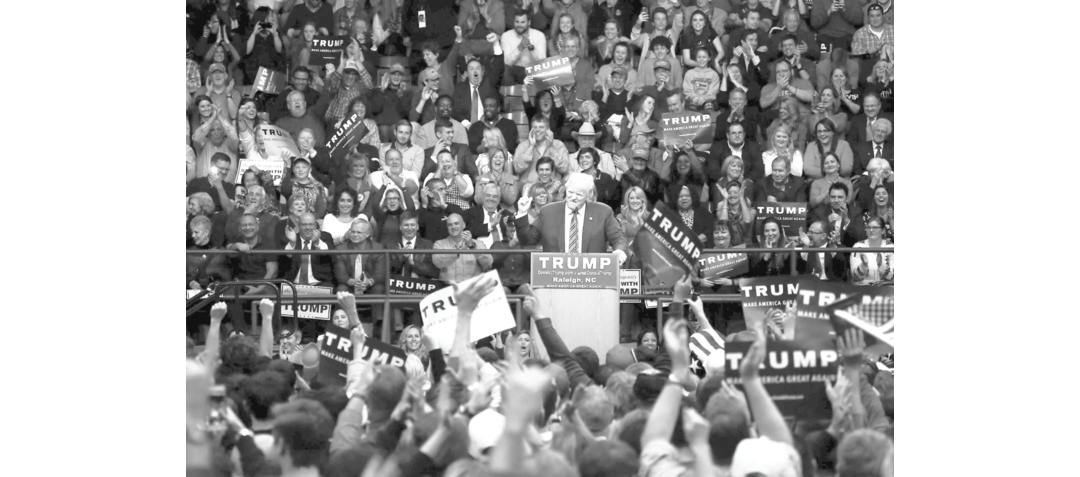
Figure 6.1
Trump’s Pistol Hand gesture.
AP Photo/Ted Richardson.
Trump’s use of this gesture can be traced back to his boardroom executive persona on The Apprentice (see Figure 6.2), and before that to his involvement with professional wrestling, an entertainment genre in which competitors craft a persona through a particular move that is packaged for fan consumption through staged comedic routines of violence. When Trump used the pistol hand on The Apprentice to fire unworthy contestants (where producers called it “the Cobra”; Grynbaum and Parker 2016), it conveyed arrogance, sovereign power, and commanding force. Trump is the kind of guy who will never admit to his own failures and rarely gives others a second chance. In his Raleigh stump speech, Trump brings this meaning to the realm of competitive politics. The gesture is understood through the iconicity of its production (that is, its physical resemblance to what it stands for), where swiftness and precision accompany a gun shape in the striking down of an unworthy opponent. Yet the gesture is also playful: When Trump thrusts his hand forward to mimic the firing of a gun, he converts the sovereign force behind the performative “you’re fired” into comedic appeal. He brings a child’s pantomime of shooting an enemy – the use of hands to imitate the action of killing – to the firing of an adult in an entrepreneurial battle. The repeated image of a grown man using the pantomime of a child’s gun-hand to dismiss contestants (“Bang! You’re dead”) functions as comedy. Celebrity businessman and politician are brought together in a playful image of executive power.

Figure 6.2
Trump’s Pistol Hand gesture, The Apprentice 2006.
AP Photo/Stuart Ramson.
A comparison between this highly emblematic gesture and those normatively used by presidential candidates reveals the semiotic limitations of politics-as-usual. Trump’s pistol hand is depictive, a show move, flashy. Typical gestures used by presidential candidates are didactic and emphatic, used as accompaniments to speech to promote clarity. Jürgen Streeck (2008b) observed in his analysis of gestures used in the 2004 Democratic presidential primary that candidates avoid pictorially oriented depictive gestures (also called iconics in McNeill’s [1992] taxonomy). He notes that even as early as the first century ce, the Roman orator Quintilian was critical of these gestures, viewing them as theatrical and lacking rhetorical gravitas. Instead, presidential candidates tend to use interactive or pragmatic gestures (Bavelas et al. 1992, Kendon 2004), hand movements such as beats or points that do not depict the social world but rather accentuate or illustrate the rhetorical structure of a speech. Pragmatic gestures are now the subject of a growing body of research on political style, which includes analyses of Barack Obama’s precision-grip (Lempert 2011) and Howard Dean’s indexical point (Streeck 2008b). But the depictive gestures deployed by Trump – especially the type that caricatures opponents by embodying a behavior or activity associated with them – rarely surface in the same literature. How do we explain the success of Trump’s divergence from what appears to be normative gestural behavior for politicians seeking the Oval Office?
We make sense of Trump’s gestural repertoire by viewing it as part of a comedic political style that accrues entertainment value as it opposes the usual bodily habits expected of US presidential candidates (cf. Jamieson and Taussig 2017 on Trump’s rhetorical signature). When used in coordination with verbal strategies similarly designed to lampoon opponents, Trump’s enactments craft stereotyped and reductive characterizations of identity categories – essentialized representations – that simultaneously cast their members as problematic citizens, whether Democrat, disabled, lower class, Mexican, Black, or female. These depictive gestures operate across a range of contexts to signal that he challenges what is widely viewed by Trump’s base as the political establishment’s debilitating rhetoric of political correctness. When Trump promises to tell the “truth” (e.g. Muslims are terrorists; some women are uglier than others; Mexicans are rapists), he aligns himself with an increasingly well-organized right-wing opposition to political correctness, rejecting rhetorical caution regarding minority religions, genders, and ethnicities. Yet as entertainment, his gestures intensify the force of his words, attracting and holding the attention of the wider public as they dominate the news cycle.
6.3Trump’s Gestures as Political Ideology
Depictive enactments are formed by incorporating bodily knowledge of the social world, abstracting qualities exhibited by the targeted object such as height, weight, shape, and speed (LeBaron and Streeck 2000, Mittelberg and Waugh 2014, Streeck 2008a). Because this incorporation is selective, such bodily acts may produce a kind of social meaning that is ideological (see also Bucholtz and Hall 2016). For instance, Trump’s use of a firing squad gesture (see Figure 6.3) does not merely resemble the action of execution; it also unites moral and material worlds to critique Obama as losing ground, being weak in confronting terrorism, and making poor deals. When imitating a firing squad in a campaign speech in Greensboro, North Carolina (Trump 2016a), Trump registered a critique against the US government for exchanging five Guantanamo prisoners for Sergeant Bergdahl, a US army soldier captured in Afghanistan and thought by some to be guilty of desertion if not treason. “In the old days,” Trump says, “you know what would have happened to him, right?”; then he pauses to enact the sideways firing of a rifle as if part of a firing squad. When performing this same routine in a campaign speech in Doral, Florida (Trump 2015c), he repeats the gesture twice before professing his love for the Second Amendment. The gesture materializes both a time period and a moral position that preceded political correctness, when corporal punishment for betrayal was acceptable practice. In this way, gestural enactments have much in common with what linguistic anthropologists and sociolinguists such as Niko Besnier (1993) and Deborah Tannen (1986) have identified for reported speech: They are citations disguised as quotes that “leak” the citer’s own imagining of social life and the ideologies that constitute it. Even the most conventionalized of depictive gestures map broader societal discourses onto movements of the body, transforming these discourses into an action.

Figure 6.3
Trump’s Firing Squad gesture.
Johny Louis/Film Magic via Getty Images.
For many viewers, the exaggerated displays that we outline in this chapter recall a moment-to-moment reality television star whose character role is built on spontaneity. Linguist Jennifer Sclafani has observed that Trump is “turning political discourse into reality TV,” noting in particular the way he uses large gestures to remind viewers of his “big personality” (cited in Atkin 2015; see also Sclafani 2018). Sclafani is not alone in noticing an iconic relationship between Trump’s gestures and Trump’s personality: Certainly, widely circulating metacommentary on the meaning of Trump’s gestures play off this reading (Taylor-Coleman and Bressanin 2016, Bloomberg Politics 2016, Civiello 2016, Rozzo 2016). Donald Trump has done for presidential campaigns what Jerry Springer did for tabloid talk shows: he has inserted a level of lowbrow drama, humor, and violence into the genre through exaggerated appeals to the body. Trump’s body matters to advocates as well as opponents. To advocates, Trump’s gestures suggest a man who is spontaneous and real instead of scripted. He is an unplanned man, even an honest man, who tells it how he sees it. To opponents, Trump’s gestures suggest a man who is vulgar if not offensive. They reveal a different sort of spontaneity: a buffoon, even a fake, who only poses as a politician.
Trump exploits both kinds of attention when he uses bodily performance to characterize the less competent behaviors of political opponents. This strategy is an important one for an entertainer new to politics; above all, it enables Trump to reposition the job experience of his opponents as a drawback instead of a qualification. Tellingly, the most common enactments used by Trump for established politicians involve the performance of small or restricted gestural space. Although gesture scholars often discuss gestural space (the personal space appropriated in the execution of gesturing) as a matter of individual, cultural, and contextual concerns (McNeill 1992, Sweetser and Sizemore 2008), Trump’s essentializing poses, repeated multiple times across campaign speeches, make it clear that gestural space can also be a matter of ideology (Hoenes del Pinal 2011, Lakoff 1992). They include the performance of a hunched body reading from a script for Hillary Clinton (see Figure 6.4), a stiff upper body for Mitt Romney (see Figure 6.5), and a huddled sleeping body for Jeb Bush (see Figure 6.6).

Figure 6.4
Script-Reading Hillary.
AP Photo/Ted S. Warren.
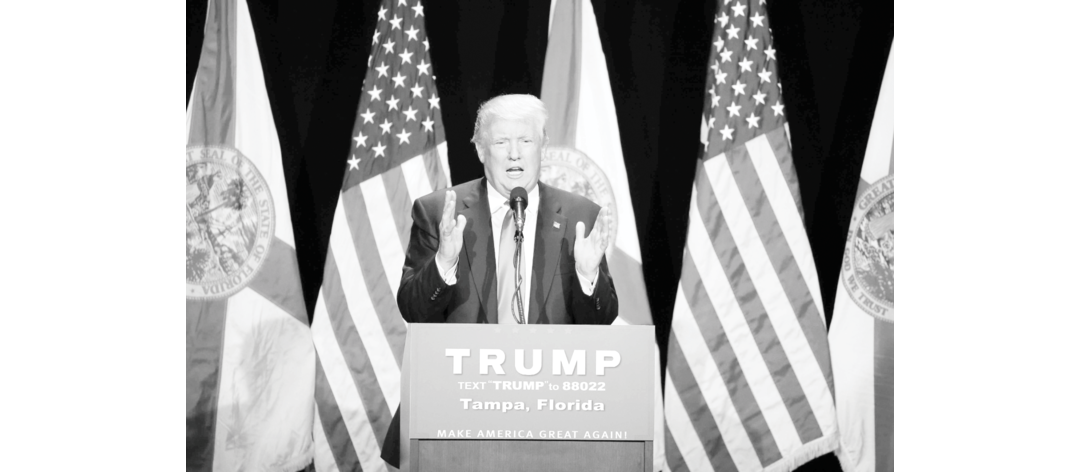
Figure 6.5
Stiff Mitt Romney.
AP Photo/Chris O’Meara.

Figure 6.6
Low-Energy Jeb.
AP Photo/Alan Diaz.
With depictions like these, Trump uses gestural space to drive home his critique of the political establishment. The discourse goes something like this: Politicians are people who do not act, who are not business people, and who do not know real risk. When mapped onto a restricted torso, an elite political class materializes as bookish, stiff, lackluster, and – perhaps most critically to Trump’s identity as an entertainer – boring. The mimicked gestural spaces of his opponents contrast sharply with the gestural space Trump inhabits in his own persona. Excessive gestural space is often negatively associated with recurring representations of social groups (e.g. the flamboyant gay man, the sassy Black woman), but Trump uses gestural excess to convey the impression he is a new kind of politician, unconstrained by petty rules and competent at accomplishing daunting tasks. His performance of a large gestural space thereby becomes acceptable, if not politically desirable. In effect, Trump has expanded the space allowed for political gesture (at least for outsider politicians like himself).
Trump’s gestural enactments function similarly to nicknames, crafting a reductive representation of the referent that purportedly captures some essential truth. In the early anthropological literature, nicknames were discussed as part of the brick and mortar of local social systems (Pitt-Rivers [1954]1961, Cohen 1977, Gilmore 1982, McDowell 1981). But nicknames also form part of an oblique naming system that belongs to comedic insult and “can be understood as a play upon form: that is, as a joke, or rather, the punchline of a joke” (Blok 2001: 157). In other words, the purpose of a nickname is not just to mock but also to entertain. In the new political process orchestrated by a comedic billionaire, the public watched as Trump rolled out nicknames for each successive opponent. The gestural enactments were initially coarticulated with verbal nicknames such as “Low-energy Jeb” (Trump 2015d) but later took on their own independence as detachables (cf. Spitulnik 1996) that could recall the verbal nickname independently of speech. In Bakhtinian perspective, this naming process accomplishes something important: Nicknames connect the subject to the grotesque body, thus becoming comic and provoking hilarity. By mocking the subject and making the named person look foolish, nicknames give special powers to the provider. After all, the one who is the master of nicknaming is the person declaring the public secret.
6.4Trump’s Gestures as Political Weapon
We turn now to five widely mediatized gestural enactments that display Trump’s antagonism to political correctness by invoking discourses of disability, class, immigration, race, and gender, respectively. As we would expect for nicknames waged in the modality of gesture, these enactments reduce a target perceived as an opponent to an action of the body: the Wrist-Flailing Reporter, the Food-Shoveling Governor, the Border-Crossing Mexican, the Choking Presidential Candidate, and the Wobbling Democratic Nominee. Trump’s bodily parodies deliver the message that he rejects progressive social expectations regarding how minority groups should be represented. In each case, the media responded by moving away from an initial critical stance to a discussion of the meaning conveyed by Trump’s body.
6.4.1The Wrist-Flailing Reporter
One of the most cited of Trump’s gestural spectacles involves a full-body enactment of the Washington Post reporter Serge Kovaleski. Trump quoted Kovaleski on the campaign trail as saying fourteen years earlier that Muslims were celebrating in response to 9/11 (Trump 2015e), an allegation Kovaleski denied. At a rally in Myrtle Beach, South Carolina (Trump 2015a), Trump responded to this denial by framing Kovaleski as one of many “incompetent dopes” together with the president, politicians, and journalists. The theme of the speech is thus about incompetence. As with the firing squad example, Trump’s speech is particularly focused on the ineptitude wrought by political correctness, which in his view keeps politicians from speaking the truth and doing the right thing. But Kovaleski also happens to be afflicted by a muscular condition that involves contracture of the body muscles and joints. In his full-bodied depiction of Kovaleski (AP Television 2016), Trump transforms a discourse of incompetence into the action of flailing, limp wrists (see Figure 6.7a–c) and produces a multimodal image depictive of disability. (Owing to space constraints, the images included in Excerpts 1–3 capture only a single frame of the extended depictive gestures used in these enactments; Trump also uses a number of pragmatic gestures that we do not notate in the transcripts. In addition, we have selected a few transcription conventions to represent the sound of Trump’s speech, among them underlining for emphasis [e.g. ‘years’] and letter repetition for vowel lengthening [e.g. ‘smaaall’]).

Figure 6.7a
Wrist-Flailing Reporter.
AP Television.

Figure 6.7b
Wrist-Flailing Reporter.
AP Television.

Figure 6.7c
Wrist-Flailing Reporter.
AP Television.
Excerpt 1 The Wrist-Flailing Reporter
Written by a nice reporter. Now the poor guy, you gotta see this guy. ((Mimics Kovaleski’s voice and actions.)) [“Uhaaaaaaaaaaaa I don’t know what I said uhaaaaaa!]6.7a [I don’t remember!”]6.7b He’s going like [“I don’t remember uh doh, maybe that’s what I said.”]6.7c ((He returns to his own voice, shouting.)) This is fourteen years ago he still – They didn’t do a retraction? Fourteen years ago, they did no retraction.
In this excerpt, a perceived opponent is represented by a flailing body (uncontrolled, limp-wristed movements), facial contortions (rounded o-lip), and incoherent speech (loud elongated vocalizations produced in the back of the throat). The depiction thus produces a recognizable emblem in US popular culture of physical and mental disability. Gestures may sometimes be used in place of speech to displace responsibility for taboo topics (see, e.g. Brookes’ 2011 discussion of a three-finger gesture used in South Africa for “HIV”), but the highly negative public response to Trump’s enactment suggests that this gesture cannot easily escape its performative associations. Yet Trump was nevertheless able to deny this interpretation in a follow-up statement: “I have no idea who Serge Kovaleski is, what he looks like, or his level of intelligence. I merely mimicked what I thought would be a flustered reporter trying to get out of a statement he made long ago. I have tremendous respect for people who are physically challenged” (BBC News 2015). Trump thus retroactively characterizes his act as “mimicry,” but he denies the public interpretation of that mimicry as a biographically specific impersonation targeting a category of disabled persons. Although the media response was initially condemning, Trump’s defense transformed the critique into an interpretive discussion. Regardless of the relationship between the performance and the object depicted, Trump moved political discourse to a new place by highlighting gestural ambiguity through comedic routine.
6.4.2The Food-Shoveling Governor
A second gestural enactment that caught the attention of the media is Trump’s depiction of Ohio governor John Kasich shoveling a pancake into his mouth (see Figures 6.8a–d), which was performed at a rally in Warwick, Rhode Island (Trump 2016b) in response to widely circulated images of Kasich eating at a New York restaurant (e.g. Tani 2016). The depiction invites comparison with the Wrist-Flailing Reporter, except that it draws from discourses of social class instead of disability. (Again, the images below, taken from The Free Beacon 2016, are provided as single-frame examples of the main gestural depictions used in the excerpt.)
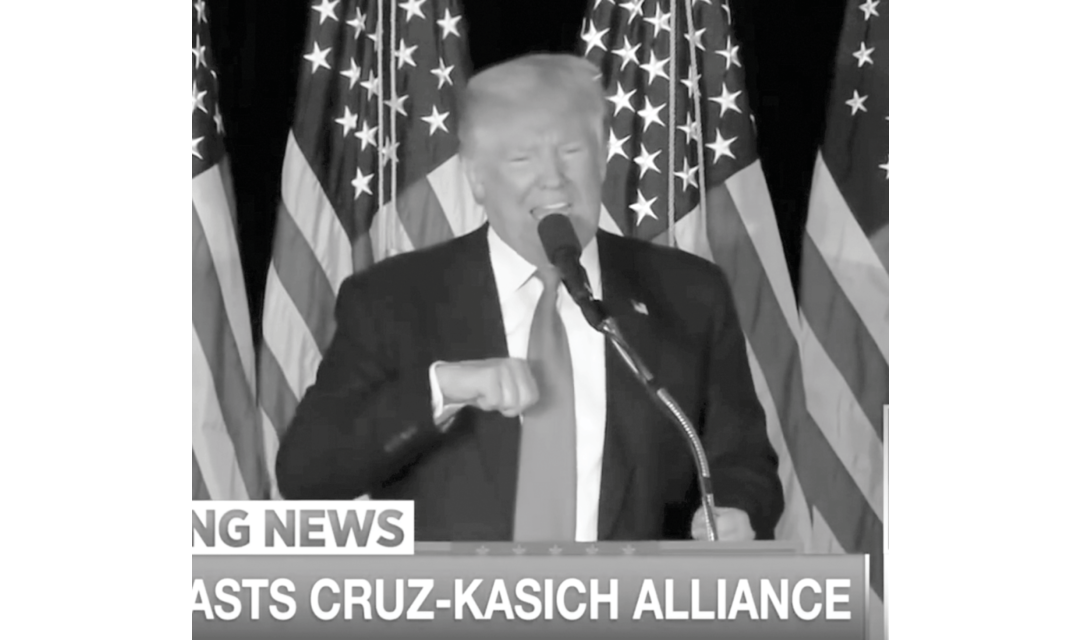
Figure 6.8a
Food-Shoveling gesture.
MSNBC.
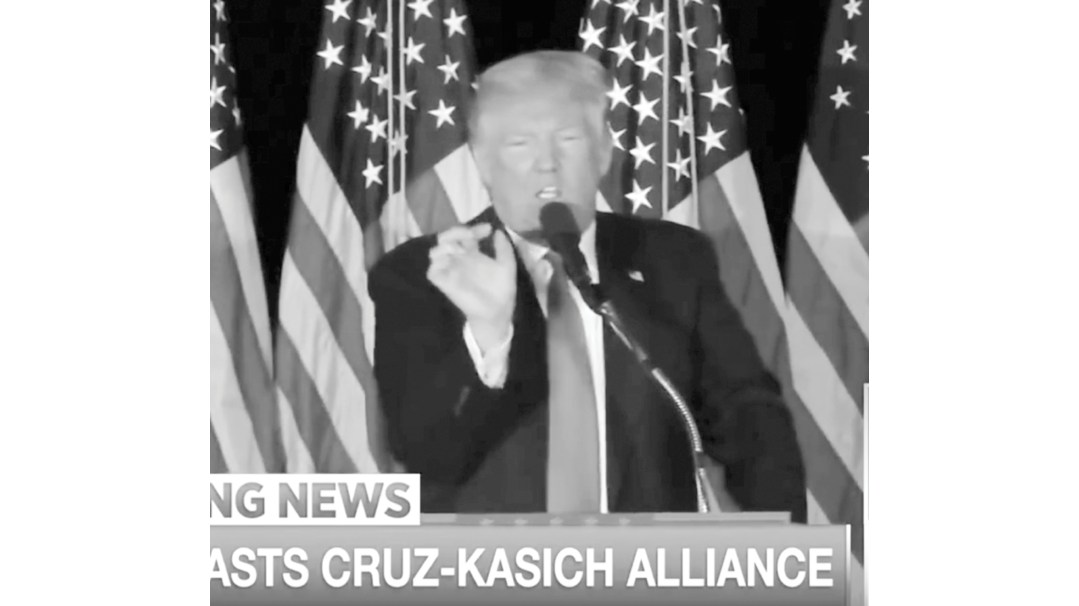
Figure 6.8b
Small Bites gesture.
MSNBC.

Figure 6.8c
Big Pancake gesture.
MSNBC.

Figure 6.8d
Food-Stuffing gesture.
MSNBC.
Excerpt 2 The Food-Shoveling Governor
Now you look at Kasich, I don’t think he knows what – you know, did you see him? He has a news conference [all the time when he’s eating.]6.8a ((Crowd laughs.)) I have never seen a human being eat in such a disgusting fashion. ((Crowd laughs and cheers.)) I’m always telling my young son Barron, I’m saying – and I always with my kids, all of ’em – [I’d say, “Children, smaaall little bites,]6.8b small.” ((Crowd laughs.)) This guy [takes a pancake]6.8c and he’s [shoving it in his mouth]6.8d you know. ((Crowd laughs and cheers.)) It’s disgusting. Do you want that for your president? I don’t think so. ((Crowd boos “no!”)) I don’t think so. It’s disgu – honestly, it’s disgusting.
In this dramatization of Kasich’s table manners, we are again confronted by a display of discomfort with “nonnormative” bodies. It is well known that Trump avoided the fray of vernacular embodiment on the campaign trail by rarely eating with locals, even though this activity is expected of presidential candidates. In fact, Trump is famous for eating even fast food with a knife and a fork (e.g. Zaru 2016). Anthropologists familiar with the work of Norbert Elias (1982) and Pierre Bourdieu (1984) on the importance of table manners to class distinction would recognize Trump’s enactment as a veiled class assault: Kasich is a slob, a lowlife, a “sub-human” who would have difficulty being presidential. Trump, in contrast, is a man who teaches his children to exhibit good manners and eat politely in “small bites.” When returning to this same routine later in the speech, Trump illustrates that even his youngest child (named Barron) knows that Kasich’s behavior is wrong: “He said, ‘Daddy, look!’ I said, ‘Don’t watch. Little bites, little bites’” (Trump 2016b). Trump performs versions of this routine in several campaign venues (e.g. Trump 2016c). Each time, as in the above excerpt, the crowd’s laughter, cheers, and boos suggest alignment with Trump’s perspective, even as he portrays Kasich as eating like a pig.
We again turn to the power of entertainment to understand the rhetorical effects of Trump’s display. His stint on Kasich incorporates recognizable techniques from impromptu stand-up comedy: He performs the voices of others as prompts for mockery (his young son), involves the audience through call-and-response (“Did you see him?” “Do you want that for your president?”), and uses a repetitive verbal refrain to thematize a mocking stance toward his target (“disgusting”). Perhaps most critically, he employs the method of abjection (Kristeva 1982) by characterizing a fellow candidate’s eating habits as a kind of corporeal “horror” that betrays unfitness for presidential office. Trump creates the caricature of Kasich by assuming the roles of punishing father and naughty son, with Kasich in the role of the latter. In sum, these cross-modal stylizations provide the ground for the rhetorical call-and-response that comedic routine relies on while also signaling the inability of Kasich to perform competently as president.
6.4.3The Border-Crossing Mexican
Trump has developed a series of depictive gestures that coordinate with his promise to build a wall at the Mexican border. These depictions work together to construe Mexicans as bodies out of place. The “huuuge” wall that Trump performs in several campaign speeches (e.g. Trump 2016d) – wide outstretched arms to illustrate width, tall upright arms to illustrate height, a sharp L-shaped drawing pattern to illustrate strength – positions Mexicans as migrating invaders who need to be stopped. In a campaign rally in Harrisburg, Pennsylvania (Trump 2016d), Trump even performed a gestural enactment of Mexicans as “candy grabbers” when discussing outsourcing (with fingers pulling toward the palm), again suggesting a greedy people who put their hands in places they do not belong (“Mexico has been taking your companies like it’s candy from a baby, right?”). With these and related gestures, Trump expresses disdain for individuals whose lives are structured around migration.
A prominent media spectacle during the Republican primary season was a video broadcast of Trump disembarking from his car, climbing through a fence to cross over a concrete structure, and walking across a field to enter the back door of a stadium surrounded by protesters in San Francisco, California (NBC Bay Area 2016). When he finally arrives at the podium of the California GOP convention, knowing that his actions are being followed in real-time on cable news, Trump leads his audience in laughter by comparing his trek to “crossing the border” (Trump 2016e). His darkly satirical portrayal draws its humor from the absurd image of Trump the billionaire in the role of a border-crossing Mexican immigrant. This enactment differs from the previous two examples in that it is a reinterpretation of Trump’s own bodily movements televised earlier. Yet the performance has all the elements of comedy. It turns something tragic and deadly for so many who attempt the crossing into something funny, and even absurd (Goldstein [2003]2013). A privileged well-dressed body is reimagined in the role of impoverished migrant: Trump-the-immigrant crossing dangerous regions filled with protesters in order to get to his podium.
6.4.4The Choking Presidential Candidate
The three preceding examples reveal the rhetorical strength of Trump’s gestural enactments. A stylistics of comedy shrouded Trump’s movements in ambiguity, enabling supporters to position his actions as humor instead of cruelty. And in each case, the media responded by putting Trump’s movements on trial, recirculating the offending videos while commentators debated Trump’s “true” intentions. Sociocultural linguists using the method of ethnography have amply shown that social meaning is never singular. The determination of what a sign “means” in the social world is cultivated diversely across social groups as speakers engage in everyday practice.
Our fourth example illuminates how the 2016 presidential election, perhaps more than any other, exposed the disunity in American society with respect to semiotic interpretation, particularly across racial lines (see also Rosa and Bonilla 2017). This became acutely apparent in divergent interpretations of a choking gesture performed by Trump in Rome, New York on April 12, 2016 (Trump 2016f; see Figure 6.9a). In the preceding month at a campaign rally in Portland, Maine (Trump 2016 g), Trump had characterized Mitt Romney, the Republican presidential candidate who lost to Obama in 2012, as a “choke artist.” This attack surfaced shortly after Romney, in a widely publicized speech at Utah’s Hinckley Institute, identified Trump as a threat to the country’s future and urged Republicans to choose a different candidate. In Portland, Trump explained his choice of the term “choke artist” with characteristic hyperbole: “Mitt is a failed candidate. He failed. He failed horribly. He failed badly.” The use of a choking metaphor to illustrate losing – or in this case, political death – was not new to Trump. He had used it at a 2015 Oklahoma City rally (Trump 2015f; that time accompanied by a choking gesture) when characterizing his Republican competitors as “losers” (see Figure 6.9b).

Figure 6.9a
Choking Mitt Romney, Rome, New York 2016.
LesGrossman News Video 2016.

Figure 6.9b
Choking Republican Competitors, Oklahoma City, Oklahoma 2015.
AP Photo/J Pat Carter.
But for audiences who had been attentive to the death of Eric Garner at the hands of New York City police in 2014, there was something newly sinister about Trump’s use of this gesture at his campaign rally in New York. Garner, a Black cigarette salesman, was killed on the street in 2014 by a police officer who used an illegal chokehold and ignored Garner’s pleas. Garner’s final words, “I can’t breathe,” repeated eleven times in the video recording that later emerged from a friend’s mobile phone (The Guardian 2014), came to stand for the incident. The expression was thus well known to New Yorkers by the time Trump’s rally took place. In fact, the global network Black Lives Matter had adopted Garner’s final words as a slogan against police violence and as a call to action. Yet in spite of the phrase’s notoriety, Trump introduced it into his New York routine when describing how Romney had “choked like a dog” in the previous election. Wrapping his hands around his neck, sticking out his tongue, and bobbing his head, Trump added the words “I can’t breathe, I can’t breathe” to his routine – allegedly imitating what an imaginary Romney would have said when losing the election to candidate Obama. Many progressive viewers, and especially African Americans, understood the gesture as a thinly veiled attempt to attract New York supporters who would hear the racist dog whistle connecting Romney’s choking to Garner’s choking (Roland 2017; see also Goldstein and Hall 2017, Maskovsky 2017). Here again, the ambiguity of a comedic gestural form incited debate regarding the form’s “true” meaning (e.g. The Young Turks 2016). For some audiences, the performance benignly positioned Trump as a winner, as someone who, unlike Romney, doesn’t lose – or “choke.” For others, the performance was a mocking reference to Garner’s death, calling out to racist supporters behind the disguise of political theater.
6.4.5The Wobbling Democratic Nominee
The final gestural enactment we analyze in this chapter, performed by Trump just five weeks before the national election, was perhaps his most effective. Exploiting stereotypes surrounding aging women (see also Bordo 2017), the impersonation caricatured the Democratic presidential candidate Hillary Clinton as physically weak. “She has been a disaster,” Trump states at an early October campaign rally in Manheim, Pennsylvania (Trump 2016h). “Here’s a woman, she is supposed to fight all these different things, and she can’t make it 15 feet to her car. Give me a break.” In the performance that follows (see Figure 6.10a–c), Trump teeters side to side, mocking Clinton as unable to be stable on her feet. He continues this mimicry as he moves out from behind the podium, slowly hunching over while walking and fading downward as if to exit the stage. “Give me a break,” he says again to a cheering crowd as he stands back up and tosses his wrists outward in dismissive gesture, bonding with an audience who could now visualize the lack of stamina he had projected onto Clinton throughout his campaign. Trump had been using the gendered term “stamina” in reference to Clinton since at least 2015 (“No strength, no stamina, she cannot lead us”; Trump 2015b). In late September 2016, just one week before his Manheim performance, Trump brought this term with him to the nationally televised First Presidential Debate: “She doesn’t have the presidential look. She doesn’t have the stamina … To be president of this country, you need tremendous stamina.” But it was not until Trump upgraded this evaluation to pantomime in the Manheim rally that Trump’s rhetoric fully caught the attention of the broader public.

Figure 6.10a
Swooning Hillary Clinton.
AP Television.

Figure 6.10b
Swooning Hillary Clinton.
AP Television.

Figure 6.10c
Swooning Hillary Clinton.
AP Television.
Excerpt 3 The Wobbling Democratic Nominee
As with many of these impersonations, the source of Trump’s display was a video recording that this time featured Clinton in the distance wobbling to her van after a ceremony commemorating the fifteenth anniversary of 9/11 (BBC News 2016). Clinton’s physician later revealed that she had been diagnosed with pneumonia shortly before this event (Martin and Chozick 2016). Her wobbling body – or the “worrisome wobble,” as some commentators came to call it (Warnke 2016) – was a highly citable form, casting doubt on her ability to be president while affirming for many the sexist stereotype that Trump had already built into his comedic routines. In the end, Trump’s performance drew broad attention to a video that may have otherwise faded from the public’s notice, with news outlets circulating Trump’s impersonation alongside the video that inspired it. By aligning Clinton with weakness and illness (Neville-Shepard and Nolan 2019), Trump’s unsteady feet and hunching back fed the fears of an electorate who already had doubts about electing a female president. But even as Trump called attention to Clinton’s gender by connecting her to physical weakness, the sexism behind this representation could be plausibly denied as simply a “fact” about the health of a presidential contender. Five weeks later, propelled by the gestural insults analyzed in this chapter, Donald Trump became the forty-fifth president of the United States.
6.5Conclusion
Trump’s one-upmanship form of humor reinforces his superiority to those he critiques, a process noted by laughter theorist Henri Bergson (1921) almost a hundred years ago. His gestural enactments produce the comedic callousness that is central to his political persona. The emblematic gesture that accompanies “You’re Fired!” lacks the power to have any effect on the status of Trump’s political competitors, making it all the more comical for its absurdity. This explains why commentators posting about Trump’s pistol hand on video sharing platforms, such as YouTube, indicate a playful enjoyment of the gesture even when they do not necessarily agree with its message (“Not a fan of him at all. But honestly, that was actually funny”; Live Satellite News 2015). It also explains why audience members at a campaign rally in Madison, Alabama (Trump 2016i), break into uproarious laughter when Trump fires his pistol hand three times at a random plane flying overhead (“What is that? Oh. Uh oh, it’s ISIS, get them down!”), and why audience members laugh in Manchester, New Hampshire (Trump 2016j), when Trump points to another plane and suggests it might be carrying Mexicans. These are packaged comedy routines, cliché gags, and shticks. If Trump brags about his ability to deliver a speech without a teleprompter (“I don’t really need those notes because I don’t need notes. Aren’t I lucky?”; Trump 2016j), it is because he knows how to exploit what is unfolding in the world around him as a comedic prompt. Specifically, he incorporates the immediate environment into the performance of his own comparative competence. Trump’s gestural enactments, as with parody more generally, exhibit a dual social meaning that points to the teller of the joke as much as to its target (Hill 1998; cf. Hall 2005). They may denigrate a social group by linking them to stereotyped body movements, but they also point back to him as a fun-loving guy who breaks the rules to enjoy a good joke. In short, Trump’s body becomes a spectacle that resembles stand-up comedy, where politically correct language and sensitive topics are breached for entertaining effects.
Throughout the 2016 presidential campaign cycle, circulating videos of the verbal and gestural enactments discussed in this chapter kept Trump at the forefront of national attention. As each day of the campaign passed, news consumers wanted to know: Who did Trump offend this time? The question we pursue in this chapter is a relatively uncharted area for gesture studies: How do Trump’s bodily acts keep supporters as well as adversaries coming back for more? Scholars working on conversational interaction provide one possible answer by illustrating how gestural enactments elicit heightened displays of attention, build a form of shared common ground, enlist coparticipation, and provoke laughter (Sidnell 2006, Thompson and Suzuki 2014). This body of research offers empirical support to Bergson’s early characterization of gesture as “something explosive, which awakens our sensibility when on the point of being lulled to sleep and, by thus rousing us up, prevents our taking matters seriously” (1921: 144). Perhaps it is true that Trump has become America’s newest “guilty pleasure” (Grossman 2015), dominating newsrooms, comedy sketches, social media, classrooms, and everyday conversation. Through these bodily performances, Trump creates a spectacle to be consumed. It does not matter whether the spectacle is respected, simply tolerated, or even abhorred, the outcome remains the same: We keep on watching.
Notes
1.We have adapted this chapter from an essay published by HAU: Journal of Ethnographic Theory shortly before the 2016 presidential election (Hall, Goldstein, and Ingram 2016). Some sections of this chapter are taken directly from the original publication, but we include a new analysis of two additional gestural enactments performed by Trump during the primaries that we believe respectively embody discourses of race and gender: a choking gesture to caricature Mitt Romney and a wobbling gesture to caricature Hillary Clinton.
2.Although scholars, journalists, pollsters, and the media have repeatedly referred to Trump’s “white rural working-class voting bloc,” there is more complexity to Trump’s enduring base than suggested by this simple reduction. See, for example, Goldstein and Hall (2017), Smith (2017), and Walley (2017).
References
AP Television. 2016. “Trump Appears to Mock Reporter.” Online video. November 26, 2016. https://bit.ly/34myFNA.
Atkin, Emily. 2015. “What Language Experts Find So Strange about Donald Trump.” Think Progress, September 15, 2015. https://bit.ly/33atf9k.
Bakhtin, Mikhail. 1984. Rabelais and His World. Translated by Helene Iswolsky. Indiana University Press.
Bavelas, Janet Beavin, Nicole Chovil, Douglas A. Lawrie, and Allan Wade. 1992. “Interactive Gestures.” Discourse Processes 15, no. 4: 469–89.
BBC News. 2015. “Donald Trump Denies Mocking Disabled Reporter.” November 27, 2015. www.bbc.com/news/world-us-canada-34940861.
BBC News2016. “Hillary Clinton ‘Stumbles’ at 9/11 Event.” Online video. September 12, 2016. https://www.youtube.com/watch?v=Onb88xnMlo8.
Bergson, Henri. 1921. Laughter: An Essay on the Meaning of the Comic. Translated by Cloudesley Brereton and Fred Rothwell. The Macmillan Company.
Besnier, Niko. 1993. “Reported Speech and Affect on Nukulaelae Atoll.” In Responsibility and Evidence in Oral Discourse, edited by Jane H. Hill and Judith T. Irvine, pp. 161–81. Cambridge University Press.
Blok, Anton. 2001. Honour and Violence. Polity Press.
Bloomberg Politics. 2016. “Donald Trump’s Hand Gestures: A Huge List.” Bloomberg video, April 19, 2016. https://bloom.bg/2kVYovJ.
Bordo, Susan. 2017. The Destruction of Hillary Clinton. Melville House Publishing.
Bourdieu, Pierre. 1984. Distinction: A Social Critique of the Judgment of Taste. Translated by Richard Nice. Harvard University Press.
Brookes, Heather. 2011. “Amangama Amathathu ‘The Three Letters’: The Emergence of a Quotable Gesture (Emblem).” Gesture 11, no. 2: 194–218.
Bucholtz, Mary, and Kira Hall. 2016. “Embodied Sociolinguistics.” In Sociolinguistics: Theoretical Debates, edited by Nikolas Coupland, pp. 173–200. Cambridge University Press.
Civiello, Mary. 2016. “The Brilliance behind Donald’s Trump’s Wild Hand Gestures.” Fortune, April 30, 2016. http://fortune.com/2016/04/30/donald-trump-hands/.
Clark, Herbert H. 1996. Using Language. Cambridge University Press.
Cohen, Eugene N. 1977. “Nicknames, Social Boundaries, and Community in an Italian Village.” International Journal of Contemporary Sociology 14: 102–13.
Elias, Norbert. 1982. The Civilizing Process, Volume 1: The History of Manners. Translated by Edmund Jephcott. Pantheon Books.
The Free Beacon. 2016. “Trump Rips Kasich Eating Style: ‘I Have Never Seen a Human Being Eat in Such a Disgusting Fashion.’” Online video. April 25, 2016. www.youtube.com/watch?v=kDOWzQGu8Oc. (Fair Dealings, Transformative Use.)
Gilmore, David D. 1982. “Some Notes on Community Nicknaming in Spain.” Man 17, no. 4: 686–700.
Goffman, Erving. 1974. Frame Analysis: An Essay on the Organization of Experience. Harvard University Press.
Goldstein, Donna M. [2003]2013. Laughter out of Place: Race, Class, Violence, and Sexuality in a Rio Shantytown. University of California Press.
Goldstein, Donna M., and Kira Hall. 2017. “Postelection Surrealism and Nostalgic Racism in the Hands of Donald Trump.” HAU: Journal of Ethnographic Theory 6, no. 4: 397–406.
Goodwin, Marjorie Harness, and H. Samy Alim. 2010. “‘Whatever (Neck Roll, Eye Roll, Teeth Suck)’: The Situated Coproduction of Social Categories and Identities Through Stancetaking and Transmodal Stylization.” Journal of Linguistic Anthropology 20, no. 1: 179–94.
Grossman, Seth. 2015. “Donald Trump, Our Reality TV Candidate.” The New York Times, September 26, 2015. https://nyti.ms/2kWstLH.
Grynbaum, Michael, and Ashley Parker. 2016. “Donald Trump the Political Showman, Born on ‘The Apprentice.’” The New York Times, July 16, 2016. https://nyti.ms/38BkoA6.
The Guardian. 2014. “‘I Can’t Breathe’: Eric Garner Put in Chokehold by NYPD Officer – Video.” Online video. December 4, 2014. www.theguardian.com/us-news/video/2014/dec/04/i-cant-breathe-eric-garner-chokehold-death-video.
Hall, Kira. 2005. “Intertextual Sexuality: Parodies of Class, Identity, and Desire in Liminal Delhi.” Journal of Linguistic Anthropology 15, no. 1: 125–44.
Hall, Kira, Donna M. Goldstein, and Matthew Bruce Ingram. 2016. “The Hands of Donald Trump: Entertainment, Gesture, Spectacle.” HAU: Journal of Ethnographic Theory 6, no. 2: 71–100.
Hill, Jane. 1998. “Language, Race, and White Public Space.” American Anthropologist 100, no. 3: 680–89.
Hoenes del Pinal, Eric. 2011. “Towards an Ideology of Gesture: Gesture, Body Movement, and Language Ideology Among Q’eqchi’-Maya Catholics.” Anthropological Quarterly 84, no. 3: 595–630.
Jamieson, Kathleen Hall, and Doron Taussig. 2017. “Disruption, Demonization, Deliverance, and Norm Destruction: The Rhetorical Signature of Donald J. Trump.” Political Science Quarterly 132, no. 4: 619–50.
Keevallik, Leelo. 2010. “Bodily Quoting in Dance Correction.” Research on Language and Social Interaction 43, no. 4: 401–26.
Kendon, Adam. 2004. Gesture: Visible Action as Utterance. Cambridge University Press.
Kristeva, Julia. 1982. Powers of Horror: An Essay on Abjection. Translated by Leon S. Roudiez. Columbia University Press.
Lakoff, Robin T. 1992. Talking Power: The Politics of Language; From Courtroom to Classroom, from Summit Talks to Small Talk: How What We Say – and How We Say It – Influences Every Aspect of Our Lives. Basic Books.
LeBaron, Curtis, and Jürgen Streeck. 2000. “Gestures, Knowledge, and the World.” In Language and Gesture, edited by David McNeill, pp. 118–38. Cambridge University Press.
Lempert, Michael. 2011. “Barack Obama Being Sharp: Indexical Order in the Pragmatics of Precision-Grip Gesture.” Gesture 11, no. 3: 241–70.
LesGrossman News Video. 2016. “Donald Trump Rome NY Rally.” April 12, 2016. www.youtube.com/watch?v=yQWdE9n2tD8. (Fair Dealings, Transformative Use.)
Live Satellite News. 2015. “Donald Trump Tells President Obama ‘You’re Fired.’” Comments section. www.youtube.com/watch?v=RPfxyFMUd1k. Link no longer available; accessed August 2015.
Martin, Jonathan, and Amy Chozick. 2016. “Hillary Clinton’s Doctor Says Pneumonia Led to Abrupt Exit from 9/11 Event.” The New York Times, September 11, 2016. https://nyti.ms/2Pitt9m.
Maskovsky, Jeff. 2017. “Toward the Anthropology of White Nationalist Postracialism: Comments Inspired by Hall, Goldstein, and Ingram’s ‘The Hands of Donald Trump.’” HAU: Journal of Ethnographic Theory 7, no. 1: 433–40.
McDowell, John H. 1981. “Toward a Semiotics of Nicknaming: The Kamsá Example.” The Journal of American Folklore 94, no. 371: 1–18.
McNeill, David. 1992. Hand and Mind: What Gestures Reveal about Thought. University of Chicago Press.
Mittelberg, Irene. 2013. “Balancing Acts: Image Schemas and Force Dynamics as Experiential Essence in Pictures by Paul Klee and Their Gestural Enactments.” In Language and the Creative Mind, edited by Mike Borkent, Barbara Dancygier, and Jennifer Hinnell, pp. 325–46. University of Chicago Press.
Mittelberg, Irene, and Linda Waugh. 2014. “Gestures and Metonymy.” In Body-Language-Communication, Vol. 2, edited by Cornelia Müller, Alan Cienki, Ellen Fricke, Silva H. Ladewig, David McNeill, and Jana Bressem, pp. 1747–66. De Gruyter Mouton.
NBC Bay Area. 2016. “RAW VIDEO: Trump Jumps Wall to Get Past Protesters.” Online video. April 29, 2016. https://tinyurl.com/yapwcggh.
Neville-Shepard, Ryan, and Jaclyn Nolan. 2019. “‘She Doesn’t Have the Stamina’: Hillary Clinton and the Hysteria Diagnosis in the 2016 Presidential Election.” Women’s Studies in Communication 42, no. 1: 60–79.
Pitt-Rivers, Julian A. [1954]1971. The People of the Sierra. University of Chicago Press.
Roland, L. Kaifa. 2017. “How Bodies Matter: Yesterday’s America Today.” HAU: Journal of Ethnographic Theory 7, no. 1: 441–47.
Rosa, Jonathan, and Yarimar Bonilla. 2017. “Deprovincializing Trump, Decolonizing Diversity, and Unsettling Anthropology.” American Ethnologist 44, no. 2: 201–08.
Rozzo, Mark. 2016. “Was This Robert De Niro Role the Inspiration for Trump’s Wild Hand Gestures?” Vanity Fair, April 18, 2016. https://bit.ly/2m1wrTy.
Sclafani, Jennifer. 2018. Talking Donald Trump: A Sociolinguistic Study of Style, Metadiscourse, and Political Identity. Routledge.
Sidnell, Jack. 2006. “Coordinating Gesture, Talk, and Gaze in Reenactments.” Research on Language and Social Interaction 39, no. 4: 377–409.
Smith, Jessica. 2017. “Blind Spots of Liberal Righteousness.” Society for Cultural Anthropology, January 18, 2017. https://culanth.org/fieldsights/blind-spots-of-liberal-righteousness.
Spitulnik, Debra. 1996. “The Social Circulation of Media Discourse and the Mediation of Communities.” Journal of Linguistic Anthropology 6, no. 2: 161–87.
Streeck, Jürgen. 2008a. “Depicting by Gesture.” Gesture 8, no. 3: 285–301.
Streeck, Jürgen.2008b. “Gesture in Political Communication: A Case Study of Democratic Presidential Candidates during the 2004 Primary Campaign.” Research on Language and Social Interaction 41, no. 2: 154–86.
Sweetser, Eve, and Marisa Sizemore. 2008. “Personal and Interpersonal Gesture Spaces: Functional Contrasts in Language and Gesture.” In Language In the Context of Use: Discourse and Cognitive Approaches to Language, edited by Andrea Tyler, Yiyoung Kim, and Mari Takada, pp. 25–51. De Gruyter Mouton.
Tani, Maxwell. 2016. “GOP Candidate John Kasich Just Ate a Crazy Amount of Italian Food in the Bronx.” Business Insider. April 7, 2016. www.businessinsider.com/john-kasich-italian-food-the-bronx-2016–4.
Tannen, Deborah. 1986. “Introducing Constructed Dialogue in Greek and American Conversational and Literary Narrative.” In Direct and Indirect Speech, edited by Florian Coulmas, pp. 311–32. De Gruyter Mouton.
Tannen, Deborah.2010. “Abduction and Identity in Family Interaction: Ventriloquizing as Indirectness.” Journal of Pragmatics 42, no. 2: 307–16.
Taylor-Coleman, Jasmine, and Anna Bressanin. 2016. “What Trump’s Hand Gestures Say about Him.” BBC News video, August 16, 2016. https://bbc.in/2kWFZyU.
Thompson, Sandra A., and Ryoko Suzuki. 2014. “Reenactments in Conversation: Gaze and Recipiency.” Discourse Studies 16, no. 6: 816–46.
Trump, Donald. 2015a. Trump Campaign Rally, Myrtle Beach, SC. November 24, 2015.
Trump, Donald.2015b. Trump Campaign Rally, Raleigh, NC. December 4, 2015.
Trump, Donald.2015c. Trump Campaign Rally, Doral, FL. October 23, 2015.
Trump, Donald.2015d. Trump Campaign Rally, Dubuque, IA. August 25, 2015.
Trump, Donald.2015e. Trump Campaign Rally, Birmingham, AL. August 21, 2015.
Trump, Donald.2015f. Trump Campaign Rally, Oklahoma City, OK. September 25, 2015.
Trump, Donald.2016a. Trump Campaign Rally, Greensboro, NC. June 14, 2016.
Trump, Donald.2016b. Trump Campaign Rally, Warwick, RI. April 25, 2016.
Trump, Donald.2016c. Trump Campaign Rally, West Chester, PA. April 25, 2016.
Trump, Donald.2016d. Trump Campaign Rally, Harrisburg, PA. April 21, 2016.
Trump, Donald.2016e. Trump GOP Convention Speech, Burlingame, CA. April 29, 2016.
Trump, Donald.2016f. Trump Campaign Rally, Rome, NY. April 12, 2016.
Trump, Donald.2016g. Trump Campaign Rally, Portland, ME. March 3, 2016.
Trump, Donald.2016h. Trump Campaign Rally, Manheim, PA. October 1, 2016.
Trump, Donald.2016i. Trump Campaign Rally, Madison, AL. February 28, 2016.
Trump, Donald.2016j. Trump Campaign Rally, Manchester, NH. October 28, 2016.
Walley, Christine J. 2017. “Trump’s Election and the ‘White Working Class’: What We Missed.” American Ethnologist 44, no. 2: 231–36.
Warnke, Melissa Batchelor. 2016. “Opinion: Hillary Clinton’s Worrisome Wobble.” Los Angeles Times, September 11, 2016. https://lat.ms/2mv7bVZ.
The Young Turks. 2016. “Did Trump Dog Whistle ‘I Can’t Breathe’ for Racist Votes?” Online video clip. April 14, 2016. www.youtube.com/watch?v=bYKe7fuHY4c.
Zaru, Deena. 2016. “Feathers Fly over Donald Trump Eating Fried Chicken with a Fork.” CNN, August 2, 2016. www.cnn.com/2016/08/02/politics/donald-trump-eats-kfc-knife-fork/index.html.