
CHAPTER 10
Andrew Leigh
My grandfather, Roly Stebbins, was born in a tent in 1922. His father was a veteran, who had suffered what we would now call post-traumatic stress disorder while serving in the navy during the First World War. The condition affected him so badly that he lost his job. In 1936, at the age of 14, my grandfather left school and found a job at a holiday resort. The job didn’t pay much, but he did extra tasks to earn a few more shillings and sent most of it back to his parents.
When the Second World War broke out, Roly went with his two best friends to enlist. Because they were under-age, the recruiter needed parental permission. The other two boys’ parents said yes. Roly’s parents said no. His two best mates were killed on the battlefield. If Roly’s parents had allowed him to enlist, I might not be writing this chapter.
So brutal were the First and Second World Wars that we can sometimes forget the hardships that came between them. Almost all the gains that had been made in the ‘roaring twenties’ were wiped out by the Great Depression. Average earnings, in today’s dollars, averaged $6.42 per week in 1921. They rose to $7.58 in 1930, before plunging during the crash. By 1937, average earnings were back at $6.42 a week.1 In 16 years – half a generation – Australian workers got zero real wage gains.
During the interwar period, new forms of entertainment emerged, such as radios and talkie-pictures. Australians thrilled to see Don Bradman on the cricket pitch, and Phar Lap on the racetrack. Max Dupain and Albert Namatjira shook up the art world. But for millions of Australians, this all took place amid a backdrop of relentlessly high unemployment, falling real wages and grinding poverty.
By the end of the Second World War, momentum was growing for a new social compact. Prime Minister John Curtin promised Australians ‘Victory in War – Victory for the Peace’. Although Curtin would not live to see a single day of the postwar era, he set in motion many of the coming changes. As the historian Liam Byrne puts it, ‘The Curtin government moulded the age. It actively created a new era, transforming our economy, our politics, and our society. It defied the inherited orthodoxies and expanded the bounds of the possible.’2
The Curtin government’s slogan was not ‘Let’s Snap Back to 1939’. For the governments of Curtin and Chifley, victory was about advancing the nation. Their ambition was to build a more prosperous and egalitarian society. It is testament to their vision that they laid the foundations for that work. From our present standpoint, it is especially remarkable that it continued to be implemented by the Menzies government, elected in 1949.
Roly Stebbins was one of the millions who benefited from these changes. He and his wife, Jean, got a cheap plot of land in Seaholme, near Melbourne’s Williamstown. With help from mates in the neighbourhood, he built a home – firing bricks in a friend’s kiln, and doing nearly all the construction himself. Roly loved cars, and bought his first in 1949. The man who was born in a tent raised his four children in a solid seaside home.
To a surprising extent, my grandfather’s story is the story of the postwar era. Unemployment fell. Home ownership skyrocketed. Car ownership roared ahead. The economy grew, but inequality declined. To anyone who claims that a growing gap between rich and poor is ‘the price of progress’, the postwar decades are a clear rebuke. It is possible for wages to grow faster on the factory floor than in the corner office. We know it can be done, because that’s precisely what happened from the late 1940s onwards.
What spurred on these changes? In part, they were a reflection of the sense among many returned soldiers that too little had changed after the First World War. Despite the horrific loss of life (one in 40 Australian men were killed), the ensuing decades saw high levels of inequality and unemployment. There was little evidence of a ‘peace dividend’ in the 1920s. Many of the leaders of the 1940s had been shaped by their experiences in the First World War, and wanted to ensure that the benefits of peace were felt by everyone.
A mark of this shift in attitudes can be seen across regional Australia. Many small towns have a memorial – often in the form of an obelisk – listing the local soldiers who died in the First World War. And then they will have public amenities – such as a swimming pool or a set of tennis courts – built in the years following the Second World War. After the first global conflict, Australian towns built symbolic memorials. After the second, Australian towns built amenities that improved the quality of life for their residents.
The nation-building response that followed the Second World War can serve as an example to today’s policymakers, at a local, state and national level. After the fighting ceased, there was a determination to invest in human and physical capital, and to create public infrastructure that would tangibly improve the quality of life for everyday people. Postwar reconstruction gave substance to the words so often intoned at remembrance ceremonies: that the dead should not have died in vain. Australia’s postwar reconstruction captured the spirit of the age so powerfully that the key reforms endured when a conservative government took office in 1949. In this chapter, I focus on four aspects of reconstruction: jobs, homes, cars and economic inequality.
Jobs
In public policy, a key milestone was the White Paper on Full Employment, drafted in 1944 and 1945 by H.C. (Nugget) Coombs and a team of fellow economists in the Ministry of Post-War Reconstruction. It began with an excoriating denunciation of the way that the economy in the interwar years had served Australians:
Despite the need for more houses, food, equipment and every other type of product, before the war not all those available for work were able to find employment or to feel a sense of security in their future. On the average during the twenty years between 1919 and 1939 more than one-tenth of the men and women desiring work were unemployed.3
The White Paper on Full Employment didn’t mince words. Traditional economists might have called unemployment ‘inefficient’. The White Paper said unemployment was ‘evil’. Yet it also recognised that work needed to be meaningful. The White Paper praised workplace flexibility. It celebrated technological advances. It rejected ‘schemes designed to make work for work’s sake’. It might be true that jobs could be created by paying one group of people to dig holes, and another group of people to fill them up again. But the authors of the White Paper recognised that for many people, work is integral to their sense of dignity. This means that if the goal is to raise wellbeing, then jobs must be fulfilling. In effect, the 1945 White Paper rejected what US anthropologist David Graeber recently dubbed ‘bullshit jobs’.4
In the First World War, Australia supplied hundreds of thousands of men, but relatively little industrial production. By contrast, the Second World War saw a surge in manufacturing employment, as Australian factories produced munitions and equipment for the troops. After fighting ceased, many factories were repurposed to produce consumer goods.5 This included consumer durables such as fridges and washing machines, as well as cars. In the food manufacturing sector, households that had previously made jam, pickles and biscuits at home now began purchasing them. Canning and bottling technologies allowed families to buy canned meats, vegetables and beverages. The increased uptake of refrigerators expanded the market for frozen foods.
A similar trend occurred with clothing. In the nineteenth century, clothing was typically tailored to the buyer. This might have suited the most affluent. But it meant that working people generally owned only a couple of sets of clothes (sometimes made at home). As an off-the-shelf clothing market developed, it created more opportunities for employment in the clothing and footwear manufacturing sector, as well as in the growing retail market. In the building sector, an increase in residential construction expanded the demand for bricklayers, electricians, plumbers and tilers.
Job creation in the postwar era was not merely a function of consumer demand. Throughout the war, government had played a major role in the economy. After the war, governments looked to grow employment in strategic industries and focused on demand management through control of wages, policies and key lending rates. Union density grew from around one-third of the workforce in the 1930s to almost half the workforce in the 1950s. The size of the federal public service quadrupled between 1939 and 1951.6
The Commonwealth Ministry of Post-War Reconstruction (1942–50) coordinated many of these efforts, aided by the fact that full employment was widely recognised as the nation’s top policy goal. Not all of the measures adopted would prove themselves in the long run (tariff protection limited the growth of firms that had a comparative advantage on a global scale), but the overall effect was to reshape the labour market. Where work had been scarce in the 1930s, it was plentiful by the late 1940s.
Figure 1, page 154, shows the unemployment rate since Federation, with the years 1945 to 1960 denoted by a shaded area.7 From a double-digit jobless rate in the interwar period, unemployment dropped to around 2 per cent for the next three decades. From Federation until the outbreak of the Second World War, Australia’s unemployment rate only once dipped below 3 per cent. From the end of the Second World War until the early 1970s, unemployment only once went above 3 per cent. French economists refer to this 30-year postwar period as Les Trente Glorieuses (‘The Glorious Thirty’). The same could be said of the Australian labour market over these three decades.
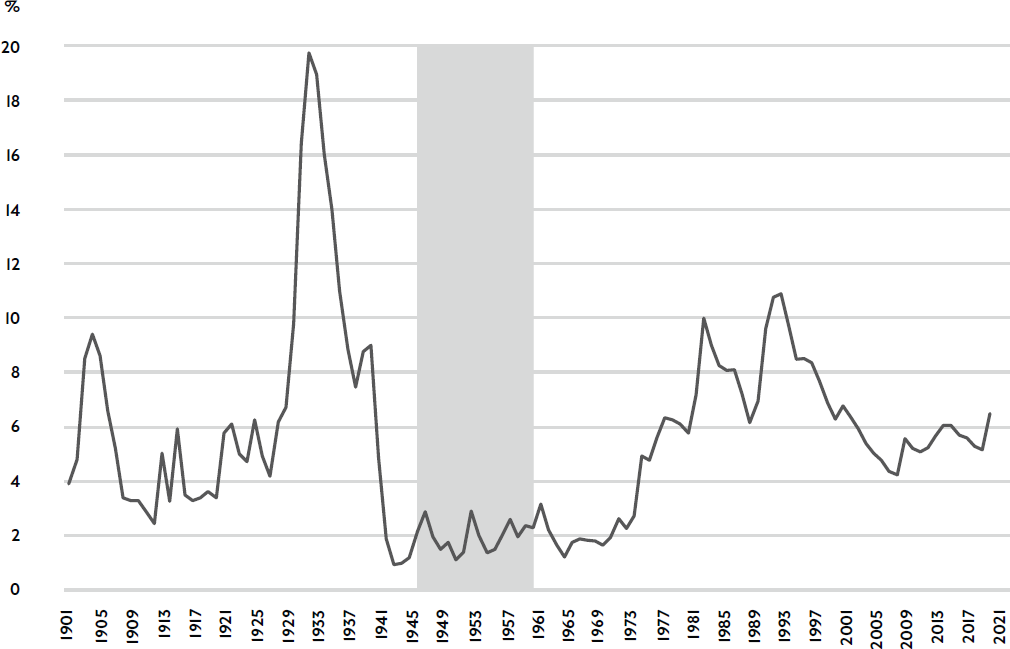
FIGURE 1Unemployment
This impact flowed through to wages. According to one estimate, real wages grew at just 0.71 per cent per year from 1922 to 1941, but 2.44 per cent a year from 1942 to 1971.8 Average working hours fell. The 1947 Arbitration Court ruling for a 40-hour week can be readily seen in the average number of hours worked, which fell from around 45 hours per week in the 1930s to 40 hours per week in the 1950s. Paid annual leave increased from one week per year in the 1940s to three weeks per year in the 1960s. Plentiful jobs, rising wages and falling hours led to a sense of shared prosperity. New workplace technologies were increasing productivity, with employees getting a fair share of the benefits.
Homes
Through the Great Depression, reformers had been drawing attention to the inadequacy of the Australian housing stock. For example, Methodist social reformer Oswald Frederick Barnett highlighted the conditions of Melbourne slums, which resulted in the state government establishing a Housing Investigation and Slum Abolition Board. Increasingly, poverty was seen as a result of poor circumstances, rather than individual moral failings. Perhaps the most visible manifestation of these poor circumstances were homeless people, with a tent encampment even springing up on the Sydney Domain during the Great Depression.
Nationally, one report estimated a housing shortfall of 300 000 dwellings.9 Given the population of the time, this is the equivalent of a one-million house shortage in modern-day Australia.
In 1942, the Australian Parliament’s Joint Committee on Social Services linked housing to health and child wellbeing, writing that ‘without provision of housing for all on such a scale we cannot hope to establish and maintain the proper standards of public health, child welfare and morality, which are prerequisites to the building up of a healthy, virile and great people’.10 Inadequate housing was regarded as a constraint on population growth, on the grounds that people would be reluctant to have children – or would limit family size – in response to overcrowding. Poor housing was seen as a disease risk, and even as a factor that might lead to a decline in moral standards (though in this case the causal connection was perhaps more dubious).
This era featured major planning exhibitions, aimed to educate and excite the public about developments in urban design and architecture.11 In 1944, the Commonwealth Ministry of Post-War Reconstruction sponsored a major exhibition in Sydney that showcased a ‘modern urban development’, featuring a community centre, schools and shops. Many of the streets were cul-de-sacs, intended to reduce through-traffic and encourage families to socialise on their front lawns. Architectural models showed the latest home designs, using new building materials and featuring spacious living areas. The exhibition travelled to Newcastle, Brisbane, Adelaide and Perth. A similar exhibition in Melbourne subsequently toured through regional Victoria and Tasmania. Sparked by urban exhibitions in the United Kingdom and the United States, these events were a conduit through which modernist design ideas were transmitted to the public and helped inspire investment in housing.
Between 1945 and 1949, 200 000 homes were built. Some of these were the product of the first Commonwealth-State Housing Agreement, which constructed new dwellings for rental, many on the outskirts of major cities. But many of the new homes were owned outright, leading to an unprecedented increase in the home ownership rate.
Figure 2 charts the home ownership rate since the start of the twentieth century, with the earliest reliable estimate being for 1911.12 From 1911 to 1947, just over half of Australians owned their homes. Then, over a seven-year period – from 1947 to 1954 – the home ownership rate shot up by a remarkable 10 percentage points. Home ownership continued to rise in the ensuing decade, peaking at a remarkable 73 per cent in 1966. Not only was this historically high by Australian standards, but it exceeds the home ownership rate in the United Kingdom, Canada and the United States at any point in the twentieth century.13 Since then, the home ownership rate has declined, falling to 66 per cent in the 2016 census.
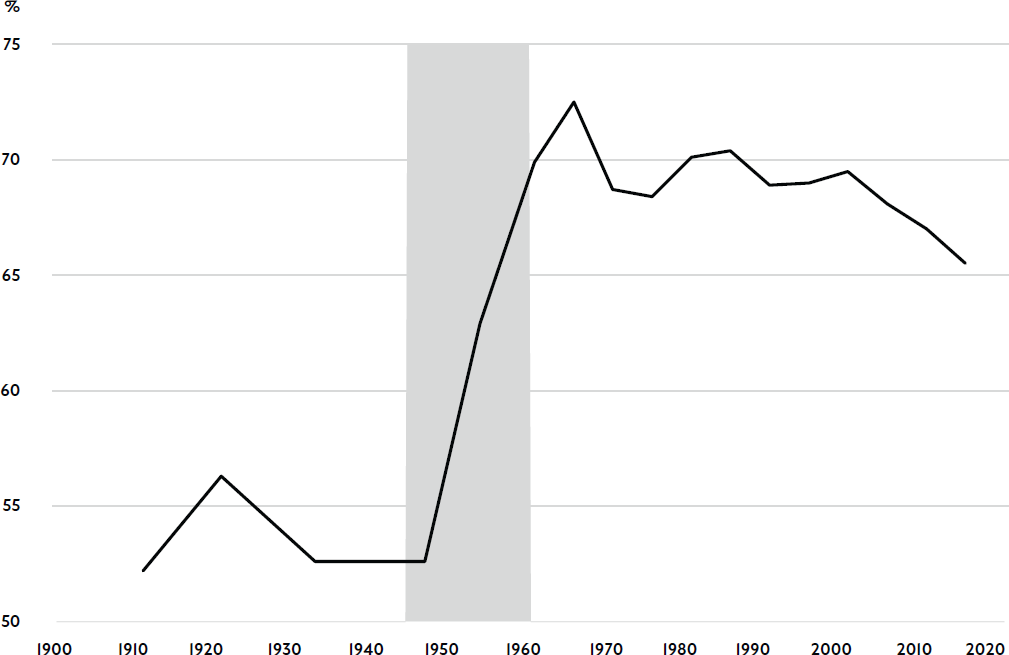
FIGURE 2Home ownership
The quality of Australian homes also improved in the early 1940s and early 1950s. When my grandfather was born in 1922, living in a tent was not all that remarkable, even for the family of a naval veteran. Even a generation later, living under canvas was not unheard of. In 1947, 15 450 Australian households lived in tents.14 Just seven years later, this number had halved. From 1947 to 1954, there was also a marked drop in the share of people who lived in homes made from stone, iron or tin; and a substantial rise in the number of homes with outer walls made from brick, concrete or fibro cement.
Cars
For many Australians, car ownership represented a vast increase in wellbeing. Owning a car meant not having to walk to work in the rain and not having to carry groceries home by hand. It made it easier for families to see loved ones who lived in places that were not connected by public transport. And it enabled people to take a holiday away from home (sometimes sleeping in the car). When the first Holden sedans rolled off the assembly line in Fishermans Bend in 1948, they cost about two years’ wages for a minimum wage worker. By the mid-1960s, a new Holden cost one year’s work on the minimum wage.
Figure 3 charts the growth in Australian car ownership.15 National figures are only available from 1922, so to produce the longest possible time series, I extend this back to 1910 using figures for New South Wales. Cars are typically shared within a household, but because average household size falls from five people to three people over this period, it risks distorting the trends. Accordingly, I present vehicle ownership both as cars per person, and as cars per household.
These estimates show that at the end of the Second World War, there were just 0.07 vehicles per person in Australia. By 1955, this had doubled to 0.15 vehicles per person. By 1970, it had doubled again to 0.31 vehicles per person. Today, there are 0.57 vehicles per person in Australia; a figure that has remained steady since 2014.
On a household basis, car ownership was 0.28 vehicles per household in 1945, 0.57 in 1955, and 1.09 in 1970. Assuming that few households owned multiple vehicles in the 1940s and 1950s, the household results suggest that car ownership passed 50 per cent in 1954. In the modern era, multiple car ownership is commonplace, with an average of 1.7 cars per household.
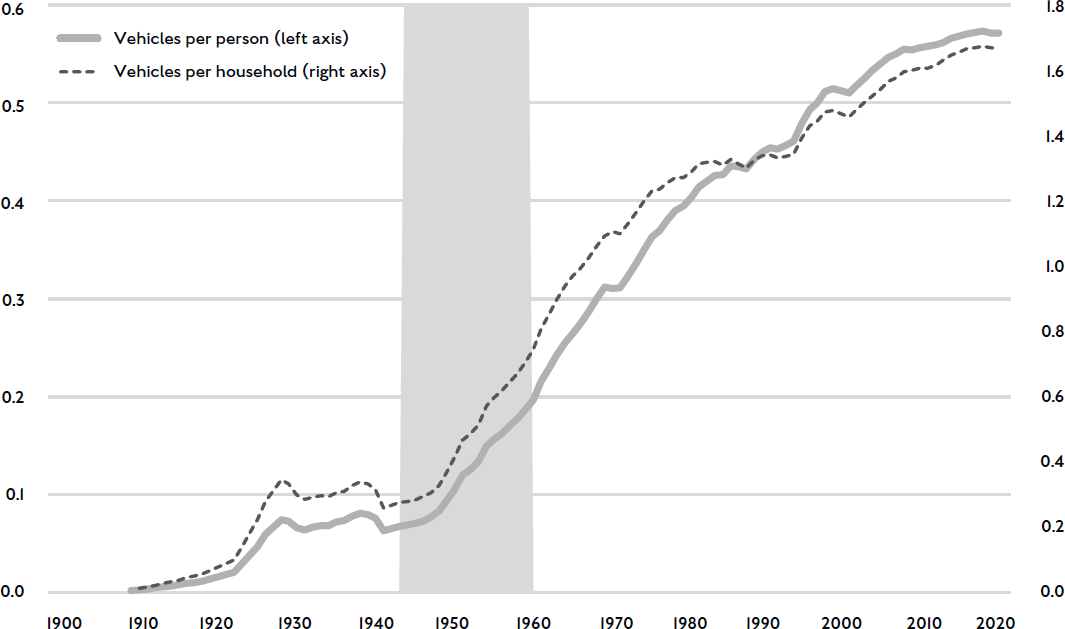
FIGURE 3Car ownership
A different source of data – the population census – also provides some insights on this question. The 1966 census was the first to ask Australians whether their household owned a car. Fully 76 per cent of households reported having at least one vehicle, with 23 per cent reporting owning multiple vehicles. Car ownership had gone from just over one-quarter of households at the end of the Second World War to three-quarters of households a generation later.
Inequality
Australia has always prided itself in a distinctively egalitarian ethos. You’re more likely to be called ‘mate’ than ‘madam’ or ‘sir’. We don’t have private areas on our beaches. Many of us sit in the front seat of taxis, while few of us stand up when our prime minister enters the room. In his 1895 poem ‘Since Then’, Henry Lawson captured this masculine egalitarianism:
And I almost wished that the time were come
When less will be left to Fate –
When boys will start on the track from home
With equal chances, and no old chum
Have more or less than his mate.16
Yet despite this, levels of inequality around the time of the First World War were high. A survey of wealth in 1915 found that the richest 1 per cent held over one-third of the nation’s assets: a greater level of inequality than in the United States in 2020.17 Many soldiers who left to fight in the First World War had formerly been unemployed.18
To gain an accurate picture of inequality across the twentieth century, it is insufficient to rely on surveys. The Australian Bureau of Statistics only began asking about incomes on a regular basis in the late 1960s, so surveys provide a patchy picture of income distribution in the 1940s and 1950s.
The alternative is to use taxation statistics, which are published annually, and can be analysed using external control totals for population and personal income. In Figure 4, I present two data series.19 The first is the income share of the top 1 per cent of adults, which can be calculated at a federal level back to 1921, and back to 1912 using Victorian taxation statistics (NSW did not publish the relevant figures for this period). The second series is the Gini coefficient of male incomes – an index which ranges from zero (perfect equality) to one (complete inequality).20 From 1942 onwards, a majority of adult men paid tax, so taxation data – combined with census records where available – make it possible to estimate the Gini coefficient for men. While men constitute less than half the population, they report most of the income earned by households, so it turns out that the male Gini coefficient tracks the household income Gini coefficient quite closely in contexts where both can be estimated.
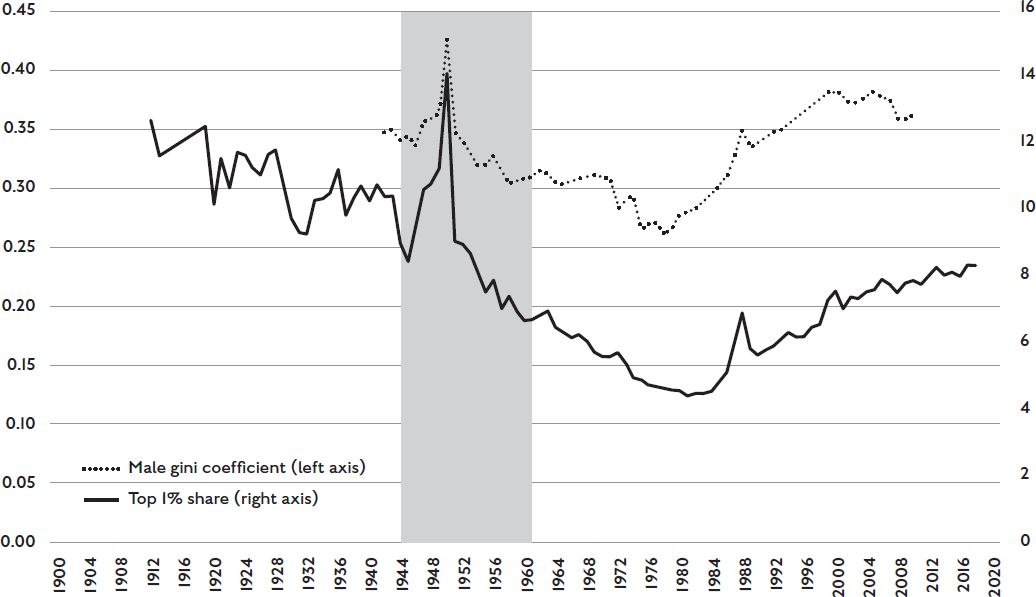
FIGURE 4Inequality
An immediately striking fact about inequality in the postwar era is the huge spike in the 1950–51 tax year, which was driven by the Korean War wool boom. Setting this aside, both male income inequality and the top 1 per cent share fell steadily. From 1945 to 1980 (the low point for Australian inequality across the twentieth century), the top 1 per cent share dropped from 8 per cent to 5 per cent, and the Gini coefficient of male incomes dropped from 0.34 to 0.28. To put this change in perspective, the reduction in inequality is equivalent to the modern-day inequality gap between Australia and the highly egalitarian countries of Scandinavia.
In addition to rising home ownership and increasing car ownership, increasing middle-class incomes led to increasing ownership of appliances. By the 1960s, the typical Australian household had a vacuum cleaner, washing machine, radio and television. In that era, most British, German and Italian households lacked a refrigerator, but 97 per cent of Australian homes had one.21
Another metric can be found in William Rubinstein’s ‘All Time Australian 200 Rich List’, which identifies those people whose wealth exceeded a fixed cut-off (0.17 per cent of national income) from 1788 onwards.22 Rubinstein focuses on wealth at the time of death, but if we consider those who were in their last two decades of life, then there was an average of 22 all-time Australian rich people in any given year. However, these people are not evenly spread across the centuries. In the 1820s and 1880s, there are an excess of all-time rich listers. But from 1940 to 1980, there were precisely zero members of the all-time rich list living in Australia. For these four decades, Australia became a mogul-free nation.
The equalising era would not have occurred without the Second World War. As historian Walter Scheidel notes, the history of inequality is of long periods of rising or stable inequality, punctuated by sudden compressions. Those levelling episodes have typically been due to four causes: warfare, revolution, state collapse and plague. ‘All of us who prize greater economic equality’, Scheidel notes, ‘would do well to remember that with the rarest of exceptions, it was only ever brought forth in sorrow’.23 In the 1940s and beyond, the impetus for egalitarianism was warfare. In the 2020s and beyond, might the plague of COVID-19 inspire a more equal era?
Lessons from history:
Striding boldly forward, not snapping back
At the end of the Second World War, my grandfather Roly Stebbins was 23 years old. For today’s 23-year-olds, what should the federal government’s priorities be?
As a federal member of parliament, one of the joys of my job is the chance to speak with a wide variety of Australians in their early twenties. From these conversations, clear themes emerge. Young Australians want their nation to play a leadership role in reducing our carbon emissions, and encouraging other countries to do the same. No advanced nation is more affected by dangerous climate change than Australia, and our abundant wind and solar resources make this an opportunity to create jobs and boost the productivity of the economy.
In the world of work, someone who is just hitting the labour market today may not retire until the 2060s, 2070s or 2080s. By then, many of today’s jobs will not exist, and a plethora of new jobs will have been created. We don’t know what those jobs will be (a generation ago, who would have predicted the growth of data scientists and speech pathologists?), but we do know that they will require more education than the jobs of today. In the past generation, automation has supplanted the jobs of many ‘routine’ workers, who perform repetitive tasks in factories and offices. Over the next generation, it may take over the work of many manual workers.24 The best bet is to have a broad base of skills, and the ability to continue to learn. Getting that right means improving the quality and quantity of education.
Young Australians are as passionate about fairness as any cohort in society today, and keen to link up with the world (an enthusiasm that has only grown with the closure of our international border). They tend to be less racially prejudiced, and more open to the gains from immigration and ethnic diversity.25 An ambitious federal government today would be pursuing a strategy of ‘engaged egalitarianism’ – seeking the productivity gains from migration, trade and foreign investment, while ensuring that the costs of engagement do not fall unfairly on any segment of society. This approach would be quite different from the high tariff barriers of the postwar decades, reflecting the widespread recognition that trade not only provides a greater variety of affordable products and services, but also gives a dose of competitive pressure to local firms. Managing our relationship with China has become more complex under President Xi, as the country has become more powerful, militarised and authoritarian. But China has never been a democracy, and it ought not be beyond the wit of the Australian government to work together on shared challenges such as climate change and economic development in the Pacific, while standing firm for liberal democratic values.26
Finally, there is a strong yearning to build a healthier civic community.27 Over the past two generations, Australians have become less likely to join community groups, play organised sports, volunteer their time, donate to charity or engage in the political process. A reconnected Australia would draw on the strengths of successful groups such as Pub Choir (which brings strangers together to sing a three-part harmony in a Brisbane pub), parkrun (which organises hundreds of free running events every Saturday morning), and Puddle Jumpers (a fast-growing Adelaide charity that provides camps for children who don’t live with their birth parents). A more connected nation will not only be happier, but more productive too.28
In the early days of the COVID-19 crisis, it was common to hear members of the federal government talking about their hope that Australia would ‘snap back’ to its pre-crisis state. But a philosophy of ‘back to 2019’ exhibits what might be called the soft bigotry of low ambitions. Australia needs a step forward, not a snap back. The success of the postwar reformers in tackling the challenges of their era should inspire us in addressing the opportunities of our age.