
7
There are arguments about why Henry decided to return to war in 1542. He is alleged to have wanted to put his advancing years (he was fifty-one) and deteriorating health on one side, and rediscover the zest of youth. He is also alleged to have been humiliated by the infidelities of his fifth wife, Catherine Howard, and keen to restore his self-respect. However, the real reasons, although equally selfish, were probably less introspective. Once Catherine of Aragon was dead, and Anne Boleyn had followed her (January and May 1536), the Emperor had reluctantly come to terms with the King’s idiosyncratic religious policy. This in turn meant that when the brief Franco-Imperial entente of 1538–9 fell apart, there was a chance to return to a traditional political orientation. From the end of 1541 onward Henry began to seek a closer alliance with Charles, and this inevitably meant participating in the latter’s renewed war with France. In June 1542 they came to a secret understanding, which committed Henry to a joint attack in the summer of 1543. His willingness to do this was fuelled partly by a long-standing desire to increase the size of the English bridgehead in France, an ambition relinquished after the surrender of Tournai in 1518. It was also relevant that he now had the means to pay for such a campaign. The dissolution of the smaller religious houses in 1536, and the surrender of the major ones between 1538 and 1540 had given Henry an enormous disposable wealth. For the first time since 1514, he could actually afford to go to war, and it is not surprising that the temptation was irresistible.
Henry launched his first assault, not to the south but to the north. Working on the assumption that an invasion of France would inevitably bring the Scots over the border behind his back, he decided to take them out first. The Scots had no desire for war, but the Duke of Norfolk’s provocative (and hopelessly inefficient) raid in October 1542 could not be ignored. This was supported by a small naval squadron, but since the victualling arrangement totally disintegrated (again), nothing was achieved beyond stimulating a Scots counter-attack. As it happened, this served the King’s purpose just as well as a victory by Norfolk, for on 25 November the invading Scots army was routed at Solway Moss, and a large part of the Scots nobility carried prisoner to London. The French evaded a rather feeble English naval blockade to convey reinforcement to Scotland, but they arrived too late and, when James V died a couple of weeks later, it was uncertain what role they would be called upon to perform. In the meantime, Henry had concluded another agreement with the Emperor in February 1543, and began to prepare for his promised campaign in France. Sir Francis Bryan managed to get out of the Tyne with a small force of ships in the same month, but was driven back by a combination of weather and superior Franco-Scottish numbers. William Woodhouse fared rather better, and in the easier weather conditions of the summer remained on station in the Firth of Forth, inflicting some damage, and much inconvenience. His ships appear to have been medium-sized or small, and the Mary Rose was certainly not among them.
Henry had now decided that the accession of James’s daughter, Mary (barely a week old), combined with his victory, had opened a golden opportunity to take over Scotland through a matrimonial union with his own son Edward, aged five. A more diplomatic approach might actually have achieved that, because Scottish representatives did agree to such a treaty at Greenwich in July 1543, but the King’s bullying tactics divided his supporters and handed the initiative to their opponents, so the treaty was never ratified. Meanwhile, grasping after a Scottish prize Henry missed his cue to join in the continental war, in spite of having renewed his Imperial treaty in April. The Emperor was not pleased.
In fact there was little real friendship in the Imperial alliance, as each party was trying to use the other for its own purposes. In December 1543 the Scottish Parliament repudiated the Treaty of Greenwich, and after containing his fury for several months in the hope of a diplomatic solution, Henry launched another destructive raid into the Scottish Lowlands in May 1544. This was again supported by a fleet, but again of modest dimensions, not involving any of the Great Ships. Now, though, the great attack on France could not be delayed any longer, and in the middle of June the King himself crossed to Calais with a large army, escorted by most of his fleet. By this time the Navy was expanding rapidly. The Henry Grace à Dieu had been rebuilt in 1540 (and somewhat reduced in size), and since then ten other vessels had been built, purchased, or taken as prizes. The total at the time of the summer campaign of 1544 was over forty, and still rising. In one sense, the campaign was a success; by September Henry had taken Boulogne, which had become his prime objective. But in another sense it was a disaster; strategic coordination with the Emperor broke down totally, and recriminations followed. Both sides were to blame, but the result was that Charles felt no obligation to his ally, and signed a separate peace with Francis, just at the time when Henry was entering Boulogne in triumph.
This was extremely bad news for the English, because there was no chance that they could also settle while retaining control of Boulogne. Henry would either have to surrender his cherished conquest, or fight on on his own. He chose to do the latter. So in 1545 he was faced with an unresolved conflict in Scotland, a French King determined to recover what he had lost, and no allies. Although England had a much more efficient naval infrastructure, and Henry had by this time about fifty ships of his own, the resources of France, both in men and ships, were potentially far greater. Peace with the Emperor also meant that the French Mediterranean fleet was available for deployment in the north. This consisted mostly of galleys, and as has already been seen from the events of 1513, they were most effective in the right circumstances. Warship technology had moved on, and the ships of 1545 were not as vulnerable as those of a generation earlier. Nevertheless, Viscount Lisle, the new Lord Admiral, was understandably worried that his opposite number, Claude d’Annebault, had about twenty-five such vessels available, while he had only one or two, together with a dozen very small galleys, known as rowbarges, which did not carry heavy guns. The French strategy was straightforward. As long as the English had the command of the sea, any siege of Boulogne would be doomed to failure, and his prime objective was the recovery of that town. So d’Annebault needed to take out the English fleet, and destroy its advance base at Portsmouth. To that end, he began to assemble a huge fleet of some 200 ships in the Seine estuary.
It was slow work, and the English, as usual, were at sea first. By the end of May their privateers (encouraged by royal proclamation) had taken some fifty prizes, and inflicted heavy damage on French trade. Lisle’s main concern, however, was to disrupt d’Annebault’s preparations, and it was with that in mind that he led out a warfleet of some thirty to thirty-five ships early in June. It would appear from his letter of the 24th that his flag was not in either the Henry or the Mary Rose, but there was a fair amount of choice by this time, and both were old ships (59). Lisle’s tactics, as far as they can be reconstructed, seem to have depended upon using a number of captured merchantmen (hulks) as fireships to destroy as much as possible of the French fleet at anchor in Le Havre. Because of the bad weather, a number of these prizes escaped, but he reckoned that the seven which remained would be sufficient for his purpose. His intelligence was accurate; d’Annebault was still waiting for his galleys and other ships from Brest, and would not be ready to set out for some time. Nevertheless, Lisle failed to turn this initiative to advantage, and when he attacked Le Havre on 6 July, he was repulsed. This was partly due to the continuing bad weather, and partly to the effectiveness of the French galleys, which had by then arrived. Lisle also seems to have been handicapped by the King’s insistence that he await specific orders, which were then delayed. Why Henry should have done this is not clear. Perhaps he wanted to feel in control, but the consequences were unfortunate.
However, fate to some extent performed what Lisle had failed to do. As the English retreated and the French celebrated, d’Annebault’s 100-gun flagship, the Philippe, caught fire and burned to the waterline. The ship to which he then transferred his flag ran aground and had to be abandoned. Quite apart from the loss of two large fighting ships, many would have taken this for an ill omen, but d’Annebault was unperturbed. He put his fleet to sea on 12 July, and having made a diversionary raid on the Sussex coast on the 18th, entered the Solent the following day, landing 5,000 men on the Isle of Wight. He had somewhere between 150 and 200 ships, and between 30,000 and 50,000 men, which was probably the largest invasion armada ever assembled. In naval terms these figures are somewhat misleading, because the great majority of his ships would have been troop transports. He had between 20 and 30 large warships, and 25 galleys. Against him, Lisle had about 80 ships, but they were all fighting ships of various sizes, including about 20 large ones (over 400 tons).
D’Annebault’s arrival seems to have taken the English by surprise. The whole fleet was at anchor within Portsmouth harbour, and the King was actually dining on the Henry when the alarm was given. Having sent his landing force ashore, the French Admiral then deployed his fleet in three squadrons, keeping the transports well out of the way. The total absence of wind then gave him the initiative. He could not get his sailing warships into Portsmouth harbour, and the English could not get out, but his galleys, being moved by oars, remained mobile. They advanced, firing their basilisks, although to little effect. Then, in the late afternoon, a fitful wind sprang up, and Lisle began to move his big ships forward to attack. The galleys retreated in some haste, because they were no longer a match for the sailing ships in open combat. The Mary Rose, possibly leading the fleet, fired guns from one side (it is not clear which, but historical sources favour the starboard); then, in coming about to fire from her other broadside, she was caught by a sudden strong gust of wind. She heeled over and with the gunports being open for action, the water rushed in and she went down like a stone. There were only a handful of survivors, and the captain, Sir George Carew, was among the dead.
There has been much debate about how this tragedy, which the King witnessed from the shore a few hundred yards away, came about. Twenty years later, Martin Du Bellay claimed that she had been sunk by French gunfire (63), but nobody thought that at the time, and there is no trace of damage upon the existing remains. There was also a theory that the crew were running riot, and although the Carew family favoured this explanation in order to exonerate Sir George, it is an unnecessary and improbable thesis (82). What seems to have happened is that the ship had been to some extent destabilized by her rebuilding ten years before. On top of that, she had been overloaded with guns and men in preparation for battle, and far too many of these men were on the top deck and in the castles. It is also likely that Sir George, in his zeal to show his mettle to the King, attempted to bring her about too sharply. It is known that the weather that summer was unusually squally, and both fleets had already suffered from such conditions (59). So it seems that an unstable ship, turning too steeply, was caught at the crucial moment by a fierce, brief squall, and the open gunports did the rest. The enormous loss of life was partly down to the fact that few sixteenth-century seamen could swim, and partly to the deployment of the anti-boarding netting in the waist of the ship. Intended to prevent enemies from jumping down onto the deck, it also effectively prevented those on the deck from leaving the ship. An engraving made in the late eighteenth century from a contemporary painting at Cowdray Park, subsequently destroyed (see p. 181), shows the scene immediately after the disaster. It portrays the top of the Mary Rose’s mainmast rising forlornly out of the water, with a solitary survivor clinging to it.
The loss of one ship, however, did not decide a battle, let alone a war. The wind having failed again, Lisle skilfully used the tides and currents to get the rest of his fleet to sea, and in the process frustrated d’Annebault’s attempts to manoeuvre his big ships into position. The result was a deadlock, which suited Lisle very well because his strategy was defensive and he had supplies and reinforcements to hand. In reporting this satisfactory situation to the King on 21 July, he rather surprisingly made no allusion to the loss of one of his most powerful ships; perhaps he felt that the King hardly needed reminding (60). Over the next two days, the French Admiral sought for some decisive action, but was totally frustrated, by Lisle’s skill, the weather, and his lack of local knowledge. Even his landing party on the Isle of Wight made no progress because Henry had reinforced the garrison. With supplies running low, and disease beginning to afflict his overcrowded troop ships, d’Annebault had no choice but to retreat. Evacuating his troops from the Isle of Wight on the 23rd, he quit the Solent the following day. Although unspectacularly achieved, and overshadowed by the loss of the Mary Rose, this was in fact a major and decisive English victory.
At first, it seemed that the campaign was not over, and the threat to Boulogne certainly remained. If d’Annebault could deploy his large fleet to prevent the English from supplying the town, it might still fall to a land-based assault. He disembarked about 7,000 of his soldiers to enhance the attacking army, and then returned to the Channel, his galleys carrying out some small-scale raids on the south coast. At the end of the first week of August, and with his fleet enhanced to nearly 100 fighting ships, Lisle came in search of d’Annebault, this time seeking battle. It was in this connection that he drew up his innovative fighting instructions, proposing to use a squadron battle formation, and laying down a system of identifying flags. His intention was to fight, somewhere off Beachy Head, on 10 August, and the fleets did, in fact, encounter on that day. There was an inconclusive exchange of gunfire, and then the wind failed again. This time it was d’Annebault who stalled. Plague already raged in his fleet, and he was in no fit condition to offer battle. On the night of 10/11 August he withdrew under cover of darkness, and returning to the Normandy coast, immediately demobilized. The siege of Boulogne failed and the following spring Francis made peace, leaving Boulogne in English hands. Henry had, in a sense, won his final war, although the Scottish situation remained unresolved when he died in January 1547.
Documents
58. Extract from the Anthony Roll inventory, completed 1546.
This is the second entry in the roll (the Henry Grace à Dieu taking first place). It was not presented to the King until after the Mary Rose had sunk, but salvage was still in prospect. Anthony’s professional concern was ordnance, to which his inventory is restricted. He also painted the illustrations which accompany each entry.
The Mary Rose. Tonnage – 700. Men: soldiers – 185; mariners – 200; gunners – 30; [total] – 415.
For the Mary Rose. Ordnance, artillery, munitions, habiliments for the war, for the arming and in the defence of the said ship to the sea.
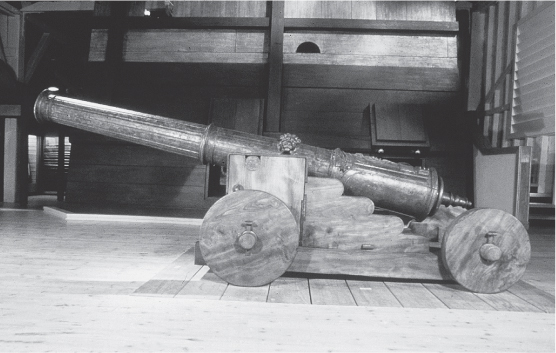
A bastard culverin, on a precise replica of the carriage on which it was found on the wreck site. (Mary Rose Trust)
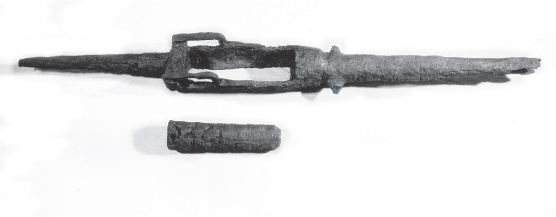
A corroded example of a base. (Mary Rose Trust)
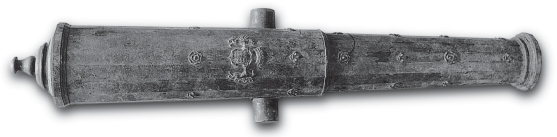
A bronze demi-cannon. The Mary Rose is said to have carried six, of which two have been recovered by the Mary Rose diving team. (Mary Rose Trust)
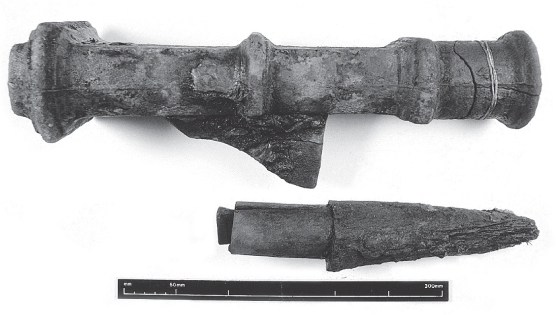
Hailshot piece, a hand-held gun that fired a type of shrapnel. The hook would fit over the side of the ship to absorb the recoil. (Mary Rose Trust)
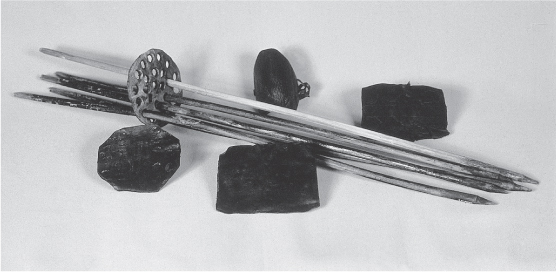
Over 3,500 arrows have been recovered, mostly poplar. Some were held in sheaves of twenty-four by leather spacers, helping to protect the feather flights (of which only fragments, probably swan, have survived). (Mary Rose Trust)
Guns of brass. Cannons – 2; demi-cannons – 2; culverins – 2; demi–culverins – 6; sakers – 2; falcon – 1; sum – 15.
Guns of iron. Port pieces – 12; slings – 2; demi-slings – 3; quarter-sling –1; fowlers – 6; bases – 30; top pieces – 2; hailshot pieces – 20; handguns complete – 1.
Gunpowder. Serpentine powder in barrels – 2 lasts. Corn powder in barrels – 3.
Shot of iron. For cannon – 50; for demi-cannon – 60; for culverin – 60; for demi-culverin – 140; for sakers – 80; for falcon – 60; for sling – 40; for demi-sling – 40; for quarter-sling – 50; dice of iron for hailshot – [blank].
Shot of stone and lead. For port pieces – 200; for fowlers – 170; for top pieces – 20; for bases, shot of lead – 400; for handguns, shot of lead – 1,000.
Bows, bowstrings, arrows, morris pikes, bills, darts for tops. Bows of yew – 250. Bowstrings – 6 gross. Livery arrows in sheaves – 400; morris pikes – 150. Bills – 150. Darts for tops, in dozens – 40.
Munitions. Pickhammers – 12; sledges of iron – 8; crows of iron – 12; commanders – 12; tampions – 4,000; canvas for cartridges – 20 ells; paper royal for cartridges – 1 quire; forms for cartridges – 6.
Habiliments for war. Ropes of hemp for woulding and breeching – 10 coils; nails of sundry sorts – 1,000; bags of leather – 8; firkins with purses – 6; lime pots – 10 dozen; spare wheels – 4 pairs; spare truckles – 4 pairs; spare axle-trees – 6; sheep skins for sponges – 12; timber for forelocks and quoins – 100 feet.
59. John Dudley, Viscount Lisle, Lord Admiral, to the Privy Council, 24 June 1545.
This is the last surviving letter to refer to the Mary Rose afloat.
After my most hearty recommendations unto your good lordships, I have received your letters of the 21th of this present, perceiving thereby that the King’s majesty’s pleasure is to have the enterprise whereof I advertised his highness to be put in ure [effect]. These shall be to signify unto the same, that since my said advertisements unto his majesty, we have been so tormented with storms and strainable winds, the like I suppose hath not been seen this time of the year so long continuing, And upon Sunday last, being the 21st of this present, we were all together a quart seas over athwart Beauchef [Beachy Head], lying on hulling, the wind veering at North-East, and being very fair weather, having with us the fleet of the hulks, whereof I advertised the King’s majesty; thinking thereabouts to remain until answer came from his highness or from your lordships of such advertisements as I had written unto his majesty. And the same night in the dark of the evening, the wind beginning to blow up, divers of the hulks came under their sails, thinking to have stolen from us. Which being perceived, we followed with sundry of the swiftest ships of the fleet, wherof Sir John Berkeley in the Less Galley was foremost; who, thinking with the shooting of a piece to have caused them to have turn again, commanded his master gunner to shoot off a saker, which being fired, brake all to pieces; and standing himself at the recoil of the same, one piece, not so much as half the quarter of a hazel nutshell, struck him besides the pap and out at the top of the shoulder; of which misfortune I suppose your lordships be before this advertised from the Captain of Portsmouth. It was the next day, at 9 of the clock in the morning, before we could get all the hulks together, and with following of them, we were put Westwards a kenning beyond the Wight. And that night following there came down so unreasonable pairs of winds at the South and South-South-West that it was as much as many of our ships could do to brook the seas; by reason whereof we were constrained to hold up again with the Narrow Seas or else to put ourselves in with the Wight, which I thought not convenient, conjecturing that with those strainable winds, the rest of the army coming out of Thames, and also the Henry with the Mary Rose, should be in the Downs. Which place, although it was more painful than to have come in with the Wight, we made towards, where we arrived in safety yesterday at afternoon. Finding there the Harry and the Mary Rose, and none of the ships that cometh out of the Thames, neither small nor great, saving only the small shallop that conveyed my lord Great Master [Suffolk] to Queenborough, which came unto me upon Saturday last in the morning, and hath been with me ever since. The residue remained at Gravesend, upon payment, which I would had been deferred until their arrival in the Downs, for they had no winds since to bring them about the Foreland. In this foul night we lost the company of all the said hulks, saving seven, which I trust shall serve for the purpose, that shall be put in ure with as much diligence as wind and weather will serve, God willing. It may please your good lordships also to understand that, by sundry hoys which since my coming into the Narrow Seas have passed out of Rouen into Flanders, whereof I have advertised your lordships of sundry of them, I had intelligence of certain Breton ships that came with the Bordeaux fleet, which should be ready to depart from Rouen with the next easterly wind, newly freighted with merchandise for the parts of Brittany. Whereupon I appointed two of the ships of Bristol and my two ships, with one handsome bark, which a servant of Mr Southwell’s hath here upon his own adventure, and John Winter’s bark, and two of the boats of Rye, which departed from us upon Sunday last, the wind being at North-East, to lie in wait upon the coming forth of the said Breton ships; of whom as yet I hear no word; but if the weather hath done them no harm, there is no doubt of them, for there is not a man of war abroad on this side Brest. And the same day I sent the New Bark and the Jenet with two of the boats of Rye to scour the coast as far as Dieppe; who met with two hoys laden with canvas coming from Rouen, which seemeth to be free men’s goods; and they met also three Flemish pinks laden with powdered cod, bound for Rouen, and chased them 5 miles before they could take them; which hoys be brought into Rye for that they were not able to hold up to this place. And the masters of them being examined of the towardness of the French navy in Newhaven [Le Havre] and those parts, saying that the same will not be ready to come forth this month and more, and that they tarry for the coming of the galleys and army from Brest, which they look for daily. The said pinks, with the fish, I intend to cause to be delivered unto Thomas Rolf, the King’s majesty’s purveyor of victuals, until your lordships shall advertise him of his highness’s pleasure therein. And as touching the said hoys with the canvas and the like, when they shall be met withal, I beseech your lordships that I may be advertised of the King’s majesty’s pleasure in that behalf. And thus etc.
Endorsed: Copy for my lord of Hertford.
60. Lord Admiral Lisle to the King, 21 July 1545.
The first letter written from the fleet since the sinking of the Mary Rose on 19 July, to which no reference is made.
It may please your most excellent highness to understand that I do perceive by my lord of Surrey it is your majesty’s pleasure that I should declare unto the same by writing the effect of a certain purpose which, by occasion of a little gale of wind that he had for a while yesternight, came in my mind, which is after this sort; in case the same gale of wind had grown to be stable, being then at ‘plank weste’, and had blown too a course and a bonnet off, which were the terms that I examined the masters by, whether then the French fleet were able to ride it out in that place where they lie, and they said, very well they might do it. And then I asked whether if they saw or perceived us to come under sail making towards them, whether they would bide us at anchor or not; and they said, if they did bide us at anchor, they were cast away; for we, coming with a fore-wind, should bear over whom we listed into the sea, and therefore they would not sure bide that adventure, but rather come under their small sails to abide us lose, for that were their most advantage. I asked, if they were once loose and put from their anchor with that strainable wind, whether they could seize any part of the Wight again, and they said it was not possible for them to do it, but of force must go roam with the high seas, and much ado to escape a danger called the ‘Avers’; and that some of them, of likelihood, would rest there, if such a wind should come, and that if they were put from their anchors as is before said. So thought I, and said then to my lord of Surrey that these Frenchmen which be here, if they land, they may happen find such a blast that they shall never see their own country again. This is the effect of this purpose, serving to none other end, but, if such a wind should chance, this I doubt not would follow. If it shall so like your highness that we shall endeavour us to the same, wherein neither in no other enterprise to be done upon them being never so feasible, I will not attempt, your majesty being so near, without first making your highness privy thereunto, and not without your grace’s consent to the same, albeit that I would for my own part little pass to shed the best blood in my body to remove them out of your sight. But have your grace no doubt in any hasty or unadvised or presumptuous enterprise that I shall make, having the charge of so weighty a matter under your majesty, without being first well instructed from your highness. For if I have any knowledge how to serve you in any kind of thing, I have received the same from your self, and being so near the fountain, and would die for thirst, it were little joy of my life. And thus I wish all joy and continual felicity unto your most excellent majesty’s person. In the Harry Grace à Dieu, the 21th of July at 8 of the clock in the evening.
Your majesty’s most humble and obedient subject and servant, John Lisle.
61. John, Lord Russell, to Sir William Paget, Principal Secretary, 23 July 1545.
Extracts.
Right worshipful, after my most hearty commendations. This is to signify to you that I received your letters yesternight late, dated the 19th of this instant at Portsmouth, for which your most gentle remembrance of me I heartily thank you … I am very sorry of the unhappy and the unfortunate chance of the Mary Rose; which, through such rashness and great negligence should be in such wise cast away, with those that were within her; which is a great loss of the men and the ship also, notwithstanding you give me good hope by your letters that the ship shall be recovered again, which I pray God may be so. I understand also that there are besides St Helen’s Point to the number of 8 score sail, and that the King hath determined that my lord Admiral shall give them battle if they abide. And that even then, at the writing of your letters, 17 of the galleys came in the order of battle to the fight, of the which one was sunk, and the ships began to retire, which I believe will not come again …
Thus I bid you heartily well to fare. From Bodmin, the 23th of July. Your own assured,
J. Russell.
62. François van der Delft, Imperial ambassador to Charles V, 23 (postscripted 24) July 1545.
This ciphered dispatch from Portsmouth is the closest contemporary account of the loss of the Mary Rose. It establishes the explanation, confirmed by archaeological evidence and evaluation, that she sank because she went about with open gunports. Enemy action is not mentioned as a factor.
… On the following day, Sunday [19 July], whilst the King was at dinner on the flagship, news came that the French were only five short leagues away. This turned out to be true, for within two hours their fleet in great force was seen in front of this port, and the King hurriedly left the flagship, The English fleet at once set sail to encounter the French, and on approaching them kept up a cannonade against the galleys, of which five had entered well into the harbour, whilst the English could not get out for want of wind, and in consequence of the opposition of the enemy.
Towards evening, through misfortune and carelessness, the ship of Vice-Admiral George Carew foundered, and all hands on board, to the number of about 500, were drowned, with the exception of about five and twenty or thirty servants, sailors and the like, who escaped. I made enquiries of one of the survivors, a Fleming, how the ship perished, and he told me that the disaster was caused by their not having closed the lowest row of gunports on one side of the ship. Having fired the guns on that side, the ship was turning in order to fire from her other, when the wind caught her sails so strongly as to heel her over, and plunged her open gunports beneath the water, which flooded and sank her. They say, however, that they can recover the ship and guns.
63. Account of Martin Du Bellay, 1569.
This extract represents the widespread belief (or propaganda) on the French side.
In the morning, with the aid of the sea which was calm, without wind or force of current, our galleys could be steered and managed at their pleasure and to the damage of the enemies, who, being unable to move for lack of wind, lay openly exposed to the hurt of our artillery, which had more impact on their ships than they could on them, the more because they are higher and stouter, and also by their use of oars, our galleys could withdraw, avoid danger, and gain the advantage. Fortune supported our army in this way for more than one hour, during which time, among other damages the enemy received, the Marirose, one of their principal ships, was sunk by cannon fire, and out of five or six hundred men who were on board, only thirty-five were saved. The Grand-Henry, which carried their Admiral, was so damaged that, had she not been supported and assisted by nearby ships, she would have had the same end; there would have been more memorable losses if the weather had not changed in their favour, and not only freed them from this danger, but was most propitious for attacking us, as a land wind rose which, with the current, bore them under full sail upon our galleys. And this change was so sudden that our people had barely time or facility of turning our prows; for, during the calm weather and in the heat of battle, the galleys were so close that, when the ships came at them so suddenly and with such speed, they would have been caught and sunk without any remedy, had it not been for the boldness of our chiefs and the skill and experience of our mariners and oarsmen, who forcibly and quickly turned the galleys. And by these means our people, having turned our prows with agility of oars and help of sails, distanced themselves in a short time from the range of the cannon and started to change their stroke and slow down in order to attract the enemies, as were their orders, out of range and away from the difficulties of the place just described.
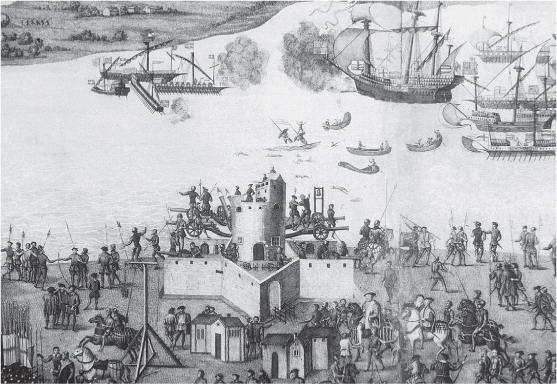
This eighteenth-century picture was made from a painting, since destroyed, at Cowdray House in Sussex. It shows the engagement of 19 July 1545, with (centre of this detail) the Mary Rose already beneath the waters of the Solent, survivors clinging to her mainmast. Below, the King passes outside Southsea Castle. The accurate topography of this image gives authority to its depiction of the fleet dispositions. (Mary Rose Trust)
64. From the chronicle of Charles Wriothesley, Windsor Herald, 20 July 1545.
This entry in one of the best-known Tudor chronicles is in line with the explanation given by the Imperial ambassador. The chronicler was a kinsman of one of the Privy Councillors on the scene (cf. 74 below).
The 20th day of July the Mary Rose, one of the King’s Great Ships, by great misfortune by leaving the port holds open, as she turned sank, and all the men that were in her, saving a 40, were drowned, which were above 500 persons; Sir George Carew, knight, captain, which was drowned; this was done before Portsmouth haven.