

AS SOON AS I BEGAN reading about the flatboat era, I knew that I had to get to Natchez, Mississippi. The charmingly preserved town sits majestically on the tall bluffs 250 miles above New Orleans, and for much of the 19th century it was one of the most fabled places in America. Natchez was mystical and lyrical and famously bipolar, a glorious clash of Creole suave and upriver crude. At the base of the bluffs, a shantytown called Natchez Under-the-Hill sloped down a cramped gravel bar to the river. As many as two hundred flat-bottoms were parked there every night, and the Kaintuckers drank and gambled and whored until dawn. The fistfights were so rough that men bit off the end of their opponent’s noses. Above the bluffs, on Natchez On-Top-of-the-Hill, the cotton millionaires of the South lived grandly, building sumptuous mansions with the alacrity of an Ottoman collecting wives. They were called the Natchez nabobs and they were perhaps the most famous and envied oligarchs in the world. The Forks of the Road slave market just outside town was the second largest in the country, supporting the extraordinarily cruel extension of slavery into the Deep South. All of the fractious contradictions of America were concentrated on the Natchez bluffs.
In the 19th century, Natchez had the reputation of being a place where anything could happen, and often did, and the landing of the Patience there proved this point. I was sailing that day with my most memorable crew member, a burly, Whitmanesque continental wanderer named Jamie Buckley. Jamie was a veteran thru-hiker who had walked thousands of miles of ridges along the Appalachian Trail, the Pacific Crest Trail, and the Continental Divide Trail, and I met him along the river while he was nearing the end of a 2,300-mile kayaking trip down the Mississippi. In Vicksburg, I suggested that he lash his kayak to the stern kevel of the Patience, to rest and relax for a few days while continuing his voyage down the river. He settled into a living space amid the cots on the roof deck and was still with me three hundred river miles later, when the Patience reached New Orleans.
Since the flatboating days, most of the acreage of the old Under-the-Hill gravel bar has been carried away by storms, and there is no inlet or even a break in the levees to provide protection from the flow while landing. On the afternoon in early October when we got to Natchez, we had a strong southwest wind pushing us from behind. I asked Jamie to jump off the Patience and threw him a line to tie us up on one of the barge cables on the levee. But the boat was being pushed so hard by the current and the wind that it was impossible for Jamie to run beside it and secure a line. He stumbled several times on the riprap. The only way to stop the Patience was to ram the bow onto the levee near the remains of an old casino landing. I scrambled up the riprap myself and found a barge cable to tie us up. Then I had to wait for half an hour on the boat, until enough tug wakes reached the old casino landing and floated me off the rocks, to secure the Patience with lines in a few feet of water.
That afternoon, after a pleasant tour of the mansion district and the national cemetery out past the bluffs, I was standing on Silver Street above Under-the-Hill and enjoying the river views when a paddle wheel–style cruise ship, the America, wheeled in from the channel and parked at the old casino landing, about thirty feet from where the Patience was riding her lines. The boat lowered a long gangplank to the cement ramp at the landing and passengers began filing off to have meals and see the town.
At Memphis and Vicksburg, cruise ships and Coast Guard boats had parked right beside me and I had spoken to the captains. I knew the drill. Even though I had priority because I had landed first, it was considered good manners to ask the cruise boat captain if I was in his way and to offer to move my boat. When I walked down and yelled up to the captain, he stepped to the edge of the deck high above.
“You’re okay where you are,” the captain said. “But if you’d like to help, it would be better if you moved fifty or sixty feet down the levee.”
Jamie was inside the Magnolia Grill on Silver Street, commencing a taste test of the martinis in town. He wasn’t going to be much help moving the boat, so I walked across the levee by myself, laboriously resetting all of my lines, pulling up my anchors, and then starting the Patience to move her down the levee. After I reset my anchors, I waited on the boat for a few minutes to see how she settled in the current. The captain of the America was standing on his gangplank as his passengers got off and thanked me as I went by.
It was getting dark as I walked up the embankment to Silver Street, where I noticed a police car with its blue lights flashing, parked sideways into the driving lane, partially blocking traffic. Police officers are so addicted to obstructing traffic with their patrol cars that it must be required in their operating manuals. They would do it out of loyalty to protocol even if it wasn’t required. Natchez must be a great town, I thought.
The cop was walking toward me with an angry expression on his face. He was one of those hideous mannequins of redundancy with multiple walkie-talkies and shiny pouches of handcuffs, pepper spray, and mace hanging from his belt.
I took one look at him and thought, Oh, here we go. The rogue cop. There’s always at least one on every trip.
“Is that your boat down there?”
“That’s my boat.”
“Take it away. Homeland Security regulations. You’re not allowed within two hundred fifty feet of a cruise ship.”
I started off softly, even though I didn’t feel like displaying an ounce of politeness toward this Attila. I explained that I was the first in the harbor, and that the cruise ship had parked after me. I had already moved my boat for the cruise ship captain. I had parked close to cruise ships before and, in Memphis, the Coast Guard had boarded my boat while I was parked next to a cruise ship and never said a thing. There was no other room in the harbor and I didn’t consider it safe to operate in a commercial channel at night.
“You’re not in Memphis,” the cop snarled. “You’re in Natchez. Homeland Security regs are Homeland Security regs. Move your boat or I’m calling the Coast Guard to tow you away.”
I asked the cop where he suggested that I move my boat. The landing area in Natchez is quite small.
“That’s not my problem,” the cop said. “Move your boat or I’m calling the Coast Guard.”
I knew that this bonehead was bluffing and, later, when I called the section office in Vicksburg, the Coast Guard said that the only thing they would have done was to call the captain of the America and ask him if I was a threat to the cruise ship. They didn’t even have a boat available that night. But the cop wasn’t looking for a solution. He was looking for a confrontation to appease his deep inner need to exercise authority, reasonable or not.
A deep sadness for my country sinks inside me whenever I have to deal with another rogue cop. I always have the same thought. If this guy is hassling my white privileged ass, how is he treating everyone else? But I wasn’t in the mood for crying for my country that night. My ribs ached, and I was exhausted from sailing all day and then tying up twice in one afternoon. I was pondering what to do.
“Let’s call the police chief, or your desk sergeant,” I said to the cop. “I’m not sure you’re correct about the regulations.”
“Not going to happen. I’m not calling anyone for you. Move your boat or I’ll have it towed.”
A group of tourists and motorcyclists who were visiting Under-the-Hill, and several passengers from the cruise ship, had gathered on the green lawn beside us overlooking the river, to watch my fracas with the cop. It was gratifying to hear their comments. One of them yelled to the cop, “He’s already moved his boat, you jerk,” and another said, “Welcome to Mississippi, home of dumb cops.” But they weren’t making any progress with this moron either.
While I was still getting nowhere with the cop, I noticed two men who looked to be in their early twenties standing on the edge of the crowd, occasionally adding their own insults to those yelled out by the crowd. One of them, a chisel-faced man in cowboy boots, walked over and motioned me away from the cop. His name was Garrett Yelverton. Garrett was a kind of modern-day Natchez nabob. He was a member of a prominent business family in town. He told me that the cop was well known around Natchez for being a troublemaker. Garrett owned a small company that reprovisioned the tugs running on the river with groceries and other supplies. He had his own dock across the river in Vidalia, Louisiana. I could park the Patience there as long as I wanted. I was immediately tempted by his offer because parking in a protected slip across the river would be a lot better than the Patience hanging out in the current on the Natchez side. But I was worried about running at night, which I had vowed not to do.
Garrett motioned with his chin across the river.
“The whole way is lit. That’s my dock right there, and there’s lights under the bridge. I run at night all the time, supplying the tugs. I’ll go with you.”
I didn’t have much choice, and it seemed like the better decision.
“All right, thanks,” I said. “Let me just say good night to this asshole.”
“Suit yourself,” Garrett said. “But just remember what my father says. The assholes are never worth it. It’s better to leave them in the dark.”
I liked that. Garrett asked the young employee who was with him to meet us over in Vidalia with his pickup. I looked back as we turned to walk down the levee toward the Patience. The cop was still standing on Silver Street, scratching his head while the blue lights from his cruiser flashed on his walkie-talkies and mace, still drawing insults from the crowd.
Garrett seemed like a pretty capable riverman. He told me to get up to my console, start the Patience motor and put it in reverse, to hold the boat gently against her lines while he freed the ropes. I picked him up on the banks and he gave me careful instructions for getting around the stern of the America. In the chill night air, we had a nice run across the river, with the headlights from the cars on the Natchez-Vidalia Bridge casting spooky shapes, and our motor reverberating loud echoes when we got underneath the span. We tied up at Yelverton’s dock and drove back across the river.
When we returned to Silver Street, the cop and his obnoxious blue lights were gone, and Under-the-Hill seemed festive with tourists. College students and middle-aged motorcyclists with their helmets on their laps sat at tables on the outdoor patios of the bars, laughing, enjoying the river view, feeding leftover chicken wings and sliders to their dogs. I decided that I liked Natchez—it was going to be a nice respite after more than two months of running on the rivers.
Natchez was also going to be a land of instant friendships, and I could tell I was going to enjoy several nights carousing with Garrett and his friends. When we pushed through the door of the Magnolia Grill, Jamie was seated at a table by the window with the best view of the river. He and his best new friend, the town attorney, were enjoying their third martini.
Natchez was one of those wilderness intersections that grew because of the accidents of history. The cleared bluffs developed as a river port before the American Revolution because of its strategic location, just a few days’ sail from New Orleans. The low country inland from the bluffs also stood at the beginning of an old Indian trail, which would eventually be called “The Natchez Trace,” and led 450 miles north to the Tennessee and Cumberland rivers and the prized hunting and trapping lands of Kentucky. Initially, the Natchez Indians, a mound-building tribe who were successful farmers and trappers, acted as intermediaries for the other southwestern tribes, brokering Cherokee, Chickasaw, and Choctaw pelts, dried fish, and vegetables to be sent downriver, which turned the Natchez bluffs into a busy trading and canoeing center. The endless conflict and pitched battles of the fur-trapping era after 1760 scattered the tribes and destabilized the region. But the fur era also filled western Mississippi with roving bands of native and mixed-race men, as well as French and British trappers, who began to rely on Natchez as a kind of Scuffletown on the next river, a rendezvous point with good river access for moving product from the interior to points south. The French and Spanish colonial authorities unwittingly contributed to the growth around Natchez by perpetually ceding the lands of western Mississippi back and forth as the spoils of war, drawing in new blood, and new traders, with each change of power. During this period, when frontier North America was administered as an extension of the endless wars between the European powers across the Atlantic, no one was really in control, or at least not for very long. Order was maintained, and goods shipped through, according to a Hobbesian state ruled by local trading and fur-trapping warlords and their bands of men. The frontier along western Mississippi was, essentially, a violent melting pot that worked because the system, however chaotic it was, continued to deliver the furs and dried goods that the rest of the world wanted. At the Natchez bluffs, lawlessness begat prosperity.
Natchez boomed anew during the Revolution and then the War of 1812, as boatloads of soldiers, gunpowder, and contraband flooded up and down the Mississippi to supply the fighting. This created the host environment for the next wave of development, the boisterous Kaintuckers drifting south in ever greater numbers after 1800. The waterfront areas of the crude ports along the Ohio and the Mississippi—Pittsburgh, Steubenville, Wheeling, Memphis, and St. Louis—had always had unsavory reputations, but among the river Gomorrahs, Natchez was the most notorious. Below Silver Street, wandering groups of Cherokee and Chickasaw men, trappers, Kaintuck boatmen, card sharks, Creole sailors, and amazed Hoosier farm boys freely mingled in the bustling shantytown that began to be known as “Under-the-Hill.” The flatboat crewmen were bored after six weeks floating downriver and easy marks for the prostitutes and the cockfight promoters. Decisions by colonial administrators only made things worse. In 1798, the Spanish governor Manuel Gayoso de Lemos panicked about the conditions in Natchez and decreed that, henceforth, boatmen passing through the Natchez district were no longer allowed into the gridded section of town above the bluffs. After the Louisiana Purchase in 1803, American territorial officials and then town officials pursued a similar plan, organizing sheriff’s raids and making tax collection visits to bars and whorehouses that they wanted to run out of town. It was a beautiful example of the unintended consequences of government reform. The taverns and the whores were simply chased down the bluffs, where they marvelously concentrated their offerings into a depraved port for the growing population of flatboaters.
The growth industry of sin was a brilliant economic development plan for Natchez Under-the-Hill, just like meatpacking along the Cincinnati waterfront or shipbuilding in Marietta. Business at Under-the-Hill also benefited from the reluctance of steamboat owners to operate very far upriver before the 1820s, because very few river towns had dredged for harbors or installed landing ramps or wharves that could accommodate steamboats. But steamboat service from New Orleans to Natchez began in 1814, giving Natchez a head start. An estimated twelve thousand flatboat crewmen disembarked every year to congregate in traveling groups before returning north on the Natchez Trace. A few days of aggressive womanizing and drinking before departure became embedded in the flatboating culture.
During his famous birding tour down the Mississippi over the winter of 1820–21, John James Audubon counted between 150 and 160 flatboats a night on the Natchez waterfront. Depending on crewing levels, that guaranteed between 750 and 1,000 sex-deprived, alcohol-needy, fistfight-loving Kaintuckers cruising the limited space between the bluffs and the waters of the Mississippi every night. The steamboats probably delivered another five hundred caterwauling boatmen every week. In the Under-the-Hill community, there were at least fourteen clapboard and cedar-shingle grog shops, with names like Kentucky Tavern and Under-the-Hill, a quarter track for horse races, gambling pits, shanties for fighting cocks and pit bulls, a flea market for guns and powder, a slave auction, stalls for selling jewelry and knives, and cobblers who sold “Spanish-style shoes with brass buckles.” The whorehouses slanted down from the bluffs in pods and continued right down to the river, where “gun boats” swayed from their lines in the current. The fighting was constant and often included hair-pulling, ear-boxing, and biting off a portion of an opponent’s nose.
In the 1830s, the rapid expansion of steamboat travel, and the more sophisticated travelers that steam power brought to the river, did little to improve conditions at Natchez Under-the-Hill. This 1833 description of Under-the-Hill, by the Scottish explorer and British army officer Captain J. E. Alexander, paints a river scene that was typical for Natchez until the Civil War.
In the evening a steamer stops at Natchez to land or take in goods, and passengers observe several houses lighted up, and hear the sounds of fiddles and merriment, and they run up to see what is going on; they find men and women dancing, gambling, and drinking, the bell of the steamboat rings to announce that she is about to continue her voyage, the lights in the houses of entertainment are immediately extinguished, and the passengers rush out, afraid of being too late for the boat, and run down towards the landing; ropes are drawn across the road, the passengers fall heels over head, a number of stout ruffians thrown themselves upon them, and strip them of their money and watches, and they get on their board in doleful plight, and of course never see or hear more of their plunderers.
During Audubon’s fabled 1820 trip, a servant left a portfolio containing fifteen drawings of birds and ducks on the banks of Under-the-Hill. Audubon knew that it was useless to go back and search for his sketches and thus some of America’s most priceless art was lost. At Under-the-Hill, the “flat boats and houses [are] filled with the lowest of Caracters [sic],” Audubon lamented. “No doubt My Drawings will serve to ornement their Parlours or will be Nailed on Some of The Steering Oars.”
Audubon was supporting himself by selling his artwork, and the loss imperiled his journey. As he continued downriver, he comforted himself by observing the riverscape below Natchez.
“We passed to day A Long Line of Bluffs exquisiting grand to the sight.”
On the top of the bluffs, quite a different reality was emerging. By the 1830s, Natchez was commencing one of the grandest building sprees in American history, becoming not only one of the best mansion districts along the river, but one of the most renowned house-proud towns in the world. The architecture and style of what eventually became known as Natchez On-Top-of-the-Hill mirrored the opening acts of the young country’s development, defining America as an economic order based on stark inequalities. A system that relied either on slave labor or the sweatshop toil of desperately poor immigrants produced extraordinary wealth for those at the top.
In the late 18th century, under Spanish administration, Natchez’s natural advantages as a shipping location along the Mississippi had drawn a small but determined cadre of traders, commodities brokers, and plantation owners who had established their outpost on the bluffs as a kind of upriver extension of New Orleans. The adventuring sons of French and Spanish aristocrats, ambitious British and Scottish entrepreneurs, and a few outliers from old Virginia families had initially been drawn to the Natchez bluffs through contacts with merchant firms in Baltimore and Philadelphia, which were now probing the inland rivers during and after the American Revolution. The East Coast traders had occasionally made considerable profits supplying gunpowder and foodstuffs for the Continental army, and later for Mad Anthony Wayne’s Northwest Indian Wars in the 1790s, and now they were establishing networks for river trading after flatboat traffic picked up in the 1790s. Meanwhile, ocean traders from Boston and New York, who were primarily rum, spice, and sugar brokers with strong ties to the merchant dynasties in New Orleans, were hoping to extend their trade routes upriver. The Natchez bluffs were ideally located as a nexus for a great deal of this traffic. Natchez was also conveniently located in the center of the alluvial plains that were rapidly being developed for cotton and sugar plantations.
Natchez was also ideally positioned to take advantage of one of the most significant developments after the American Revolution. In the 1790s, the economy of tidewater Maryland and Virginia, and the dissolute aristocracy that exploited it, was collapsing. The Virginia planters had always lived beyond their means by lavish spending and borrowing against future crops from their London creditors, but now the disruptions of the Revolution and the depletion of their tobacco lands had turned the proud and haughty Jeffersons and Randolphs into some of the best-dressed debtors in the world. They could no longer afford wine cellars filled with Madeira and port, the shiny broughams imported from London and Paris, or their overspending and underachieving children. The introduction of the cotton gin and the shifting of the textile and clothing industries toward short staple cotton had drastically altered the geography of farming. Short staple cotton, which produced a more durable cloth, grew best in the low-country coastal regions of the Carolinas and Georgia, or along the floodplains of the Mississippi around Natchez. The economic center of gravity was rapidly moving southwest. By the early 19th century, the tidewater of Virginia had become, as historian Alan Taylor describes it in Thomas Jefferson’s Education, a “landscape of decay,” with long stretches of country roads now lined with fallow tobacco fields and tree saplings pushing up through the porches of abandoned plantations. Planter-politician John Randolph lamented the decline of the country that had birthed so many leaders of the Revolution. “Nothing… can be more melancholy than the aspect of the whole country on tide-water,” he wrote to a friend in 1814, “—dismantled country-seats, ruinous churches, fields forsaken, and grown up with mournful evergreens,—cedar and pine.”
Virginia’s loss was Natchez’s gain. Many scions of the old Virginia families were now migrating to Mississippi and Louisiana to plant the new strains of cotton, or to join the boom in sugarcane production along the river. The rise of “King Cotton,” during which the exporting of cotton would grow from 720,000 bales in 1830 to 5 million bales in 1860, had begun. Short staple southern cotton would eventually dominate the American economy, representing 60 percent of all exports and playing a mighty role in New England’s industrial revolution. The 19th-century boom in sugar production was just as staggering. After 1795, when Jean Etienne de Boré, a Creole who had migrated to New Orleans from the Kaskaskia River in Illinois, invented a granulation process, sugarcane production would make the Louisiana banks of the Mississippi the single richest agricultural region on earth. By the Civil War, Louisiana was producing almost 500,000 barrels of sugar a year. It was a stunning achievement that dramatically transferred a huge amount of capital and resources to the Louisiana banks of the Mississippi. In the 19th century, the global demand for sugar was insatiable, not only as a food preservative and sweetener, but as a base material for the fermentation of whiskey and rum. Before 1800, America wasn’t even a player in sugar—most of it came from the European colonies in India, the Caribbean, and Brazil. By 1850, Louisiana was producing one-quarter of the world’s supply. “King Cotton” and the “white gold” of sugar, shipped down the river, rocketed America to global dominance.
Natchez, where fortunes could quickly be made by investing in plantation lands, or in supplying the rapidly expanding cotton and sugar empires that lined the banks of the Mississippi, became the hot place to be. The city on the bluffs gained a reputation as a cosmopolitan town where the remnants of old Virginia and Maryland planter families joined their destinies with ambitious, colorful migrants from Europe, or with the olive-skinned and fastidiously dressed Louisiana Creoles. A large contingent from Philadelphia and New York, looking for opportunities along the frontier, but unwilling to rough it in the crude pioneer villages, joined the march to Natchez. The elite social class formed from this global mixing became known as the Natchez “nabobs.” The nabobs considered themselves existing in a world of their own, an elite defined by a shared code of manners and style. There were few good roads into town across the swampy bayous, and the entire social and economic order was defined by the exotic European and Asian fabrics, cuisine, and furniture reaching the bluffs via the river. The town’s outlook was global, substantially European and Creole, and not local, specifically not American, because that’s where its elites and most of its supplies originated.
The nabob style was sui generis, a blending of Paris, New York, and the old James River plantations in Virginia. Natchez became a tiny Venice hermetically sealed off from the rest of the frontier. The nabob men wore European-style waistcoats and Spanish straw hats, and the nabob wives and teenage daughters spent weeks planning their dresses for the fall cotillions, fussing over bolts of lush satins and laces imported from Belgium and France. Their children were assigned liveried slaves their own age and rode around town in upholstered carts pulled by donkeys or white pony mules. The nabob families adopted a style of absentee plantation management that had long been practiced by European colonials, or along the sea islands of South Carolina and Georgia, a system that had created the mansion districts of Charleston and Savannah. To avoid the heat and insects of the swampy lands along the river, nabob tycoons built elaborate mansions along the breezy bluffs in town, turning the management of their sultry, distant plantations over to professional “masters” who supervised day-to-day affairs. The holdings were staggering—the planter and judge John Perkins, a migrant from tidewater Maryland, owned eighteen thousand acres of cotton fields in Mississippi and Louisiana, controlling it all from a graceful mansion with a wide porch with Doric columns, overlooking the bluffs, called the Briers. You weren’t a pedigreed nabob until you had fretted over a mansion-building project or two. When Thomas Henderson, a wealthy planter and cotton broker descended from Scottish pioneers, built Magnolia Hall at the corner of Pearl and Washington Streets, he hired a Massachusetts architect who specialized in creating the “brownstone” look of the fashionable homes that were all the rage at the time among the Knickerbocker blue bloods in New York. The imposing features of the Greek Revival masterpiece were achieved, in part, by importing New York stonemasons expert in laying brick, then coating the facade and porch columns with a rich veneer of luxe stucco the color of chocolate.
Over on Main Street, Henderson also built an attractive brick warehouse as a headquarters for his new cotton exchange, which remains today as an outstanding example of commercial architecture in the South. The nabobs typically extended their business empires by investments in related fields, building cotton and tobacco exchanges, cotton gin facilities, metal plants that fabricated cotton-baling equipment and, later, after the introduction of steam power, cotton looms and barge and tow companies. Politically and socially, the nabobs considered themselves above petty regional or party affiliations. They were Natchez nabobs, not southern planters. They rarely married outside their own elite group of families, often sent their children north for Ivy League educations, and vacationed every summer with their wealthy northern counterparts at Newport, Rhode Island. Natchez was believed to have more millionaires than any other town in America. The nabob families never numbered more than one hundred, but their influence was considerable. In early 1861, when Natchez voted on whether or not Mississippi should secede from the Union and join the southern Confederacy, the nabobs prevailed and the town officially remained neutral.
The mansion district of Natchez was eventually named Ellicott Hill, after the U.S. Army major Andrew Ellicott, who defied the old Spanish regime in 1797 and raised the American flag over the bluffs, claiming the Natchez territory for the United States. Initially, the houses facing the Spanish Esplanade along the bluffs were built in the style of the Creole “cottages” of New Orleans, with wide, long porches facing the river and filigreed cast-iron grillwork mounted at the corners, or as porch railings. Later, the porch ceilings were raised to allow light into second-floor ballrooms and bedrooms, and the crazes of the Greek Revival and Victorian movements were indulged with fluted columns, cupolas, and bay windows with scalloped shingles. Because of its location on the river, Natchez also benefited from the postbellum boom in cast-iron facades, and the city is considered one of the best locales for studying metal adornments. The bluffs protect Ellicott Hill from flooding, and Natchez’s Unionist sympathies largely protected it from damage during the Civil War. Today there are over 1,000 buildings in the city listed on the National Register of Historic Places. That’s a lot of preserved architecture for a relatively small town, and Natchez is now a mecca for art and architecture students, and a new house-proud class, similar to the Savannah characters described in John Berendt’s Midnight in the Garden of Good and Evil, has moved in. The wealthy couples from New York and California, songwriters, art collectors, and software tycoons trade the old Creole cottages and columned manses back and forth like expensive paintings, or yachts. In this way, the old nabobs are still there and Natchez retains its identity as a refreshing outpost of cosmopolitism in the South.
Natchez lay at still one more intersection that would determine the future of the country, the extension of slavery into the Deep South, under terms that made it a considerably harsher institution over the course of the 19th century. As tidewater Virginia and Maryland declined and the Mississippi plantation country boomed in profits from cotton and sugar, a massive “slave deficit” in the South could only be supplied by the new surplus of slaves up north, especially after the importing of slaves from Africa and the Caribbean was outlawed in 1808. Over the next fifty years, at least a million tidewater slaves were sold “down the river” and brutally transported to plantations along the Mississippi banks, creating one of the ugliest chapters in American history, and one that has been assiduously ignored by professional historians and schoolteachers. In his magisterial The Half Has Never Been Told, Cornell historian Edward E. Baptist has begun the task of reversing a century and a half of official neglect of the “Black Trail of Tears.” Initially, in the 1790s, the slaves were carried south to the Kentucky frontier as soon as the Monongahela and the Ohio could be reached, because overland routes provided too many opportunities for escape. “Once enslavers got their captives through the mountains and onto the Ohio River,” Baptist writes, “these escape attempts declined. The flatboats didn’t stop until they reached the growing frontier port of Louisville.” By 1820, Natchez was the busiest port along the frontier, and conveniently located for the end-buyers, the owners and managers of cotton and sugar plantations.
It’s not hard to see today why this huge stain on the history of the country was never taught in the schools. The marching of the slaves between Virginia and the Mississippi was so brutal that it would be hard to get children to recite their Pledge of Allegiance after they learned about it. As they were loaded onto flatboats that would carry them on the first leg of their one-thousand-mile route to the sugar coast, or at the trailheads of the routes they would follow over the Appalachians, the female slaves were fitted out with neck halters and connected by a rope in a tandem line. Male slaves were considered a greater escape threat. They were met at departure points on the river by a blacksmith who fitted them with a thick iron neck band that couldn’t slip off, and manacles for their wrists, which were attached by chains to the slave who would march ahead of them. Often, padlocks were attached to each neck band, and rings were welded on, so that a single heavy chain could be slid from the front to the back of the line. Groups of forty or fifty slaves chained together this way were called “coffle lines,” a term that is believed to have derived from the Arabic word cafila, for the caravans of slaves traded in Africa and the Middle East.
Between 1790 and 1850, at least a million African American slaves were transported one thousand miles to the interior South or the Sugar Coast in coffle lines, under conditions of exceptional brutality. A variety of routes were followed. Sometimes, after an overland route over the Appalachians, the flatboats transporting the slaves, who remained in coffles for the entire trip, stopped in Louisville, where the slaves were disembarked for the long march to plantations and slave markets in interior Kentucky or Tennessee. The conditions were abominable. The slaves in the coffle lines were marched in the searing heat up to twenty miles a day, flanked by mounted slave traders armed with rifles. The few slaves who managed to escape, or attempted escape, were immediately executed when caught, to set an example for the others. At night, when the march was stopped, the slaves slept while still in their coffle chains out in the open, or all crammed together in a single, squalid tavern room. They shared a dinner of cornmeal mash served in cast-iron pots, which they ate with their hands. Cholera outbreaks were common in the cramped, unsanitary conditions of the coffle line transport.
The cruelest aspect of the system delivering an expanded slave labor force to the Deep South was the sudden, unexpected separation of families. On the old tidewater plantations, slave families had lived together for several generations. The new cotton and sugar plantations along the Mississippi generated a large demand for relatively young, fit field-workers, and the slave traders traveled north with lists demanding young men below the age of twenty-five, or teenage girls. Candidates for transport were selected regardless of family ties—young fathers were abruptly separated from their families, mothers were separated from children, brothers and sisters were sent off in coffles in separate groups to cross the Appalachians for the Ohio, and would never see each other again. Baptist and other scholars estimate that at least a third of the families working on the old tidewater plantations were broken up to satisfy the insatiable needs of the expanding agrarian economy of the South.
Initially, the rapid growth of flatboat travel down the Ohio helped to keep the extent of the coffle line transport system hidden from the American public, because slave traders generally avoided the dense floating villages of settlers and cargo flats, to reduce the possibility of slaves escaping. But as Ned and Constance Sublette point out in their The American Slave Coast, the slave transport system became harder to ignore after the rise in steamboat traffic in the 1830s, when the coffle lines were transferred to steamboats. Americans learned to look the other way. The Sublettes quote from the autobiography of William Wells Brown, a mixed-race slave who escaped from a plantation in Kentucky and crossed the Ohio River when he was nineteen, eventually settling in Boston and Europe, where he became a successful essayist, novelist, and abolitionist. In the 1830s, before he was sold to the Kentucky plantation, Brown “worked out” for his owner on Missouri River steamboats.
“A drove of slaves on a southern steamboat, bound for the cotton or sugar regions,” Brown wrote, “is an occurrence so common, that no one, not even the passengers, appear to notice it, though they clank their chains at every step.”

At their former plantations in tidewater Maryland and Virginia, African American slaves were chained together by a blacksmith into “coffle lines” and then carried in flatboats and marched a thousand miles to the Mississippi Sugar Coast.
On arrival at their new cotton and sugar plantations along the Mississippi, the slaves were confronted by a ruthlessly efficient system of managing forced labor, which is why so many African American chattel dreaded being sold downriver. Quotas for each slave’s daily harvest—so many baskets of cotton, so many wagonloads of sugarcane—were enforced by keeping records with chalk and slate, and slaves who fell short were regularly whipped. A “pushing system” that determined how many acres each slave was supposed to plant and keep free of weeds all season was gradually increased from five to ten acres. Slave-on-slave discipline was enforced by assigning “captains,” who goaded the labor gangs to move more quickly through the field. The intensification of the labor system showed results. At the beginning of the 19th century, on the old tidewater and North Carolina plantations, slaves were expected to pick twenty-eight pounds of cotton a day. By 1828, Baptist writes, “in Alabama, the totals on one plantation ranged up to 132 pounds, and by the 1840s, on a Mississippi labor camp, the hands averaged 341 pounds each on a good day.”
Productivity gains like this only increased the demand for slaves transported south, and Natchez’s favorable position at the bottom of the trace, at the port below the bluffs, soon made it one of the largest slave-trading centers of the South, second in size only to New Orleans. During the early years of American territorial control after 1803, slave markets were haphazardly organized, as in many other southern cities, with auctions taking place at Under-the-Hill and on many street corners above the bluffs. But the nabobs, many of whom were originally northerners or educated Europeans, who didn’t mind making profits off slavery, were uncomfortable being known for it. They soon placed restrictions on the sale of slaves within their oasis of brick walks and mansions. A cholera outbreak in Natchez also built resentment about the trading of slaves. In a series of town ordinances passed after 1830, slave trading was severely limited on city streets, which gradually drove the trade to an open space just east of town, which came to be known as the Forks of the Road.
The cluster of buildings at the busy intersection of Liberty Road and Washington Road had long been a busy slave market, probably because America’s largest slave trader, Franklin and Armfield, had established its southern headquarters in Natchez in 1819. From its northern headquarters in Alexandria, Virginia, Franklin and Armfield sent overland coffles down the Natchez Trace, and delivered additional slaves down the Atlantic and through New Orleans. Under the supervision of partner Isaac Franklin, the Forks developed into one of the most profitable and unique markets in the country. Instead of the usual practice of auctioning off slaves individually to the highest bidder, Franklin encouraged visits by plantation owners or their representatives by selecting choice slaves from the one thousand or more detained at the Forks into large “field groups.” He negotiated the sale of these groups with each buyer, eliminating the pricing uncertainty of auction bidding. Alternately, a planter traveling to Natchez in search of, say, six or seven female slaves for housework or as seamstresses, could negotiate a separate deal for them. Franklin drummed up interest every morning, and emphasized his large selection, by conducting a circus-like march on the open grounds in front of the Forks sales buildings. Joseph Holt Ingraham, a young writer and former seaman from Maine, who collected his observations about the South in an 1835 book, The South-West by a Yankee, described the spectacle every morning at the Forks of the Road.
“A line of negroes… extended in a semicircle around the right side of the yard.… Each was dressed in the uniform of slaves, when in market, consisting of a fashionably shaped, black fur hat, roundabout and trousers of coarse corduroy velvet, precisely such as worn by Irish laborers.… Good vests, strong shoes, and white cotton shirts, completed their equipment.”
When the parade was over, buyers from throughout the neighboring plantation country walked down the lines, inspecting each slave. Then they could step inside and see the field groups organized by Franklin’s workers, and negotiations could begin. Once they were sold, the slaves turned their fur hats and corduroy suits back in at the Forks clothing lockers. They would be worn by a new group of parading slaves the next day.
In 1863, as Ulysses Grant’s Army of the Tennessee worked its way down the Mississippi, gradually splitting the Confederacy in two, Union troops dismantled the Forks slave market, using the lumber to expand nearby Fort McPherson. The old Forks market lay abandoned and virtually ignored for the next 160 years. Recently, however, with the encouragement of a new mayor, the Forks has been developed by the National Park Service into a major visitors site, on three acres of land donated by the city. Eventually, with federal funds, the Forks of the Road area will be developed into an eighteen-acre park with a large interpretive center, outdoor exhibits, and a memorial to the hundreds of thousands of slaves who were processed through Natchez in the 19th century.
When I drove up on the electric bike to visit the Forks, the old slave market area east of town felt deserted, with car traffic droning past the few interpretive signs. The quiet at the Forks contrasted sharply with the crowds of tourists, delivered by the cruise boats, thronging in the mansion district downtown. Even with a new federal park on the way, the site will be a reminder that, at too many historic shrines, there is nothing of consequence left to see, and only words can describe what the place once meant. Now, at least, there’s a new generation of scholars like Edward Baptist, finally exploring the truth about how “the coffle chained the early republic together.”
“So enslaver-generals took land from Indians,” Baptist writes in The Half Has Never Been Told, “enslaver-politicians convinced Congress to let slavery expand, and enslaver entrepreneurs created new ways to finance and transport and commodify ‘hands.’ ”
After five days of plantation tours, rides up to the Forks, and lavish dinners at the Monmouth Inn, I felt relaxed, ready to take on the last, arduous leg into New Orleans. My ribs pierced with pain whenever I coughed or laughed, and the roof deck was hot under the unrelenting Mississippi sun. But I was overjoyed about the bonus I had just received. Obsessing on the flatboat era had delivered me to the hidden history of my country, the truths that for too long too many feared to teach. Natchez was a miniature of a more troubled America, a more iniquitous America, than the country I was raised to love. But the truth about our past is also the truth about our present and I was reckoning with the America that is.
As I left the Vidalia docks and swung out into the channel beneath the bridge, I looked east to the bluffs below town. The low clouds nearby seemed to meet the rim of the cliffs and extend them into the sky, and the morning sunlight had turned them into sharp bands of bronze, matte black, and salmon pink. They were indeed, as Audubon wrote, exquisiting grand to the sight.
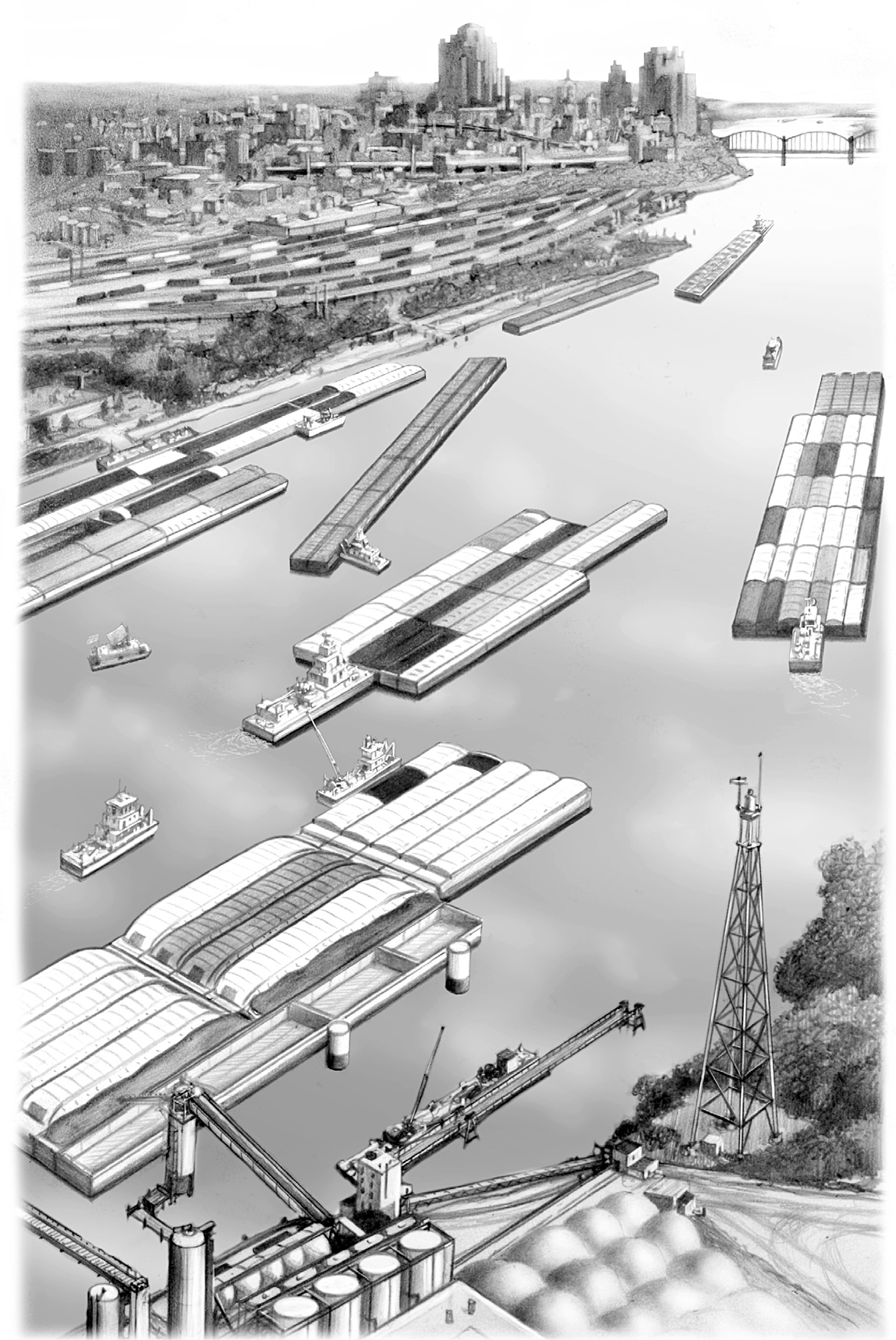
Maintaining safe clearance from the commercial barge traffic was especially challenging as we got closer to New Orleans. We often shared the channel with almost a dozen ships and barge strings.