
4
Beliefs are most clearly and systematically articulated when they are formed via negativa. The boundaries of what is true and acceptable are marked through a systematic identification of what is false and unacceptable. . . . It is through battles with heresies and heretics that orthodoxy is most sharply delineated.
—Lester Kurtz (1986:1)
The transformationalist position is adopted in much recent work, for example Lakoff (1965) . . .
This solution is proposed by Lakoff (1965, p. A–15f), but on the transformationalist grounds that he adopts there, there is no motivation for it. . . .
The scope of the existing subregularities, I believe, has been considerably exaggerated in work that takes the transformationalist position. For example, Lakoff (1965) . . .
—Noam Chomsky (1972 [1967] 17, 20, 23, et passim)
The George and Haj Show
Almost everyone who talks about the beginnings of Generative Semantics uses the same image about Lakoff and Ross, even if only to downplay its applicability; in Lees’s phrasing, “It may well not have been so important that the cat was away while those two mice played, but only that the two had come together.” That is, almost everyone involved sees a noteworthy correlation between Chomsky’s 1966 sabbatical visit to Berkeley and the dramatic rise in the fortunes of Abstract Syntax as it segued into Generative Semantics. The reasons for this correlation are clear, and by this point, very familiar. I’ll let Ross say it this time: “Chomsky is extremely intellectual, brilliant, amazingly quick in debate, and hard-working, and reads everything, at huge speed, and retains everything: just an overwhelming intellect”—qualities whose effect on the MIT community is to make it very much a one-man show. Chomsky sets the agenda whenever he is there, and setting the agenda at MIT in the first half of the 1960s was setting the agenda for Transformational Grammar. When he left, there was a vacuum.
Lakoff, who had a lectureship at Harvard, and Ross, who had just been appointed at MIT, had the energy, the ideas, and the charisma to fill that vacuum, at least for a while. They had conducted an informal seminar at Harvard the previous year, in which they mined the Abstract Syntax program to unprecedented depths—articulating, elaborating, and augmenting Postal’s proposals, as the telephone wires to Chicago sung with their McCawley exchanges. Now they were both teaching similar paradigm-stretching courses. Their students were cross-registering. And their ideas were getting airtime outside of Cambridge.
There is clear motivational ambiguity surrounding all of this work, the Lakoff-Ross work that pushed Abstract Syntax over the Generative Semantics brink. Undoubtably, there was a driving attempt to be, in Lakoff’s phrase, “good little Chomskyans,” to greet the founder of the movement, on his return from Berkeley, with “Hey Noam! [Your theory] is even greater than you already think it is!” But what on earth is a good little Chomskyan—a generic noun formed from the name of perhaps the most enigmatic linguist of all time, an intellectual even in these early days not unfamiliar with a little scholarly parricide, misrepresentation, and paradigmatic imperialism?
Our protagonists had imbibed all three of these factors in various measures and deployed them rhetorically; so, good little Chomskyans on that front certainly, with particular emphasis on imperialism. As one of Lakoff’s students recalls, “Haj and George went wild. They carved up a syntactic empire rather like the Pope dividing up the Western Hemisphere between Spain and Portugal, such that Haj was going to deal with rules involving unbounded movement . . . and George was going to deal with the rest.” But the methods and data part of it all, the linguistics, considered in the abstract terms, the good little Chomskyan part there, that was much less clear. “We were always perplexed,” Ross says.
I could never figure out, for instance, in my work, which things he would like, and which things he thought were just completely off the wall, that he would fight against tooth and nail. Going right back to my thesis, we had terrible fights.
What Ross knew then, that reading Chomsky’s mind is impossible, the field was just about to discover. Almost any linguist in 1966 willing to bet on Chomsky’s reactions and the future of transformational research would have given Ross and Lakoff’s extensions pretty good odds, though certainly not huge ones, of success. But, on the other hand, the modifications to the Aspects model Chomsky did come to endorse, chiefly articulated by his student, Ray Jackendoff, would have received miniscule odds. They flew utterly against the defining core of transformational research since 1957.
There should not have been a mystery, however, in how things would play out once the contest was obvious. Everyone knew, in virtually every corner of Transformational-Generative Grammar at the time, what was expected of the contestants: the willingness—indeed, the obligation, the drive—to wrangle fiercely about everything from the grammatical nuts and bolts of specific analyses to the overall architecture of linguistic theory. Chomsky has a bloodsport view of science, which his students absorb year after year. One of the highlights of the early transformational students’ reading list, for instance, was the record of Chomsky’s battles with the Bloomfieldians at the 1958 Texas conference; another was his withering dismissal of Skinner; another was his fiercely polemical dismissal of Bloomfieldianism at the 1962 Congress of International Linguists; another was his and Halle’s brutalization of Householder.
Brought up in a linguistic household built to foster the clash of adverse opinions and the eradication of opponents, Lakoff and Ross naturally followed some ideas that were pointedly antithetical to some of Chomsky’s. It is hard to miss the sense of challenge in many of their specific proposals. Chomsky was unsympathetic toward Postal’s suggestions that verbs and adjectives were members of the same category. Lakoff took up the the case and argued it forcefully. Ross’s re-analysis of English auxiliaries went after a set piece from Syntactic Structures and an exemplar of the first decade of Chomskyan linguistics, in a whimsical if not taunting syle. “Is Deep Structure Necessary?” attacked the Aspects model’s most spectacular success.
With Chomsky away on the other coast, their proposals became notably more daring, more original. Ross advanced his performative analysis. Lakoff elaborated his abstract verb proposals to include quantifiers (many, all, etc.), and explored arguments against Deep Structure. Their classes were as exciting as their proposals. Bolinger, then a Romance languages professor at Harvard, a decidedly unBloomfieldian older generation scholar, remembers the “sparkle and fireworks” of the classes vividly:
I attended quite a few sessions, watching those two throw ideas back and forth with each other, and listening to the always bright, sometimes brilliant comments from the class. One had the feeling of grammar in the making, as if we were out exploring a freshly turned field, with everyone retrieving specimens before the bulldozers moved in.
Bolinger also views this period as “the time of greatest TG ferment, out of which challenges to the Master were bound to emerge.”1
As Lees’ use of the cat’s-away metaphor suggests, though, the vacuum may have been a sufficient but not a necessary condition for the growth of Generative Semantics. There was something particularly vital in the combination of Ross and Lakoff. Some found their catalytic relationship extremely grating, others found it inspiring, but there is a common thread to the reactions: that Ross is a tremendously gifted naïf, while Lakoff’s gifts are more sophistical, more superficial. A thinly veiled dialogue à clef which played on these perceptions made the mimeograph rounds at the time:
G: H, I’m going to prove that your eyes are purple.
H: How will you do that?
G: You see this pencil? It’s not purple, and it’s not your eyes. You see this book? It’s not purple, and it’s not your eyes. [Twelve more arguments on this template.] So, I have fourteen arguments that your eyes are purple.
H: Great data, but when I look into the mirror, I see that my eyes aren’t purple.
G: Yes, but that’s a fact about mirrors. There are many strange and wonderful facts about mirrors that we don’t yet understand.
H: Thank you, G, for explaining this to me.
This dialogue is astute about some of the elements of Generative Semantics—it parodies the data-copia argument style nicely, for instance—and it also captures a broader strategy in the transformational community very well, one that Chomsky exemplifies as much anyone and that is still visible in linguistic argumentation, the shifting of argumentative focus from data to instrument, instrument to data (it’s not your eyes, it’s the mirror). But it misses the mark on Ross and Lakoff’s give-and-take collaborative dynamism rather widely. The dialogue does Lakoff a rather severe, if common, injustice; G[eorge] is far more of a shyster than a researcher here. But Ross clearly comes off worse; H[aj] is a linguistic rube being taken for a ride by the big-city con man.
In fact, Ross is both an incisive judge of argumentation and (almost) Lakoff’s equal in volubility. You can take Jerrold Sadock’s word for it. He became an important Generative Semanticist and he describes his initiation in the terms of a classic conversion story, Ross breezing into Urbana like Elmer Gantry:
In 1966 Haj Ross stopped by the University of Illinois. He was actually on a big tour across the country. He spent four days in Urbana, and he lectured almost nonstop. It was absolutely awesome. He was so good and this work he was doing was so intricate and so neat that I immediately fell in love with it. I decided then and there [about my dissertation topic]. 1 was going to find more arguments and push that theory.
Ross was not the only one on tour; he and Lakoff were on a dedicated round of conference and visiting-talk appearances—arguing the virtues of Abstract Syntax and insinuating the virtues of a Generative Semantics—from California to Texas to Illinois. They used the lectern like a pulpit. Of the two, Lakoff was the more forceful, and in this sense the purple-eyes dialogue reflects his professional relationship with Ross. The parody goes way too far. G just leads H around by the nose. They were both gifted analysts and brilliant arguers. But Lakoff was the one driving the car in their partnership. Bolinger calls their Harvard sessions a kind of duet: “George was the lead voice, but Haj harmonized at intervals in a lively exchange that kept the class on its toes” (1991 [1974]:29), and Ross is remembered from this period principally for a few technical innovations; in particular, for his performative hypothesis and, something we will see a little later, his “squishoids.” (If you’re wondering why his magnificent island work isn’t one of the accomplishments for which his activity in the growth of Generative Semantics is best remembered, it’s because subsequent ideological developments detached that work from Generative Semantics, and even to some extent from Ross.) Lakoff’s contributions are recalled on another scale. He was the Prophet of abstract verbs, lexical decomposition, rule government, and Generative Semantics’ most notorious innovation—also reserved for a later appearance—global rules. He wrote the major policy statement of the movement, “On Generative Semantics” (1971b), and confronted Chomsky at every turn. He was the most tireless boundary-crosser, swelling the movement with material he brought back from forays into philosophy and psychology.
Built on their extravagant analysis of Floyd broke the glass, Lakoff and Ross’s performances were tireless and inspiring. The preface to the proceedings of the 1967 Texas Conference on Universals, for which they were invited commentators, gives a good picture of the impression they cut:
We would give a totally false picture of the symposium if we did not mention the contribution of Ross and Lakoff, who not only played a role as discussants but were kind enough to remain in Austin to devote approximately six hours to a presentation of some of their recent work [followed by an epitome of the Floyd analysis]. (Bach & Harms, 1968:viif)
Generative Semantics was well on its way.
Lo, out of the west, Chomsky.
The Backlash
Should they, urging the minds of their listeners into error, ardently exhort them, moving them by speech so that they terrify, sadden, and exhilarate them, while the defenders of the truth are sluggish, cold and somnolent?
—Augustine of Hippo (De doctrina Christiana, 4.2.3)
Of his first venture into Generative Semantics, Lakoff says “Chomsky didn’t like it from the beginning” (compromising, it is hard to miss, his remarks that the Ross/Lakoff seminars were all about being good little Chomskyans; Lakoff knew of Chomsky’s distaste). Although he means here only to date Chomsky’s antipathy from his 1963 paper, “from the beginning” might be seen to hold more widely of Chomsky, all the way back to the start of his career. As early as 1955, in a paper that Sledd (1962 [1958]) takes to represent the hardest of Bloomfieldian hard lines on meaning, Chomsky was crystal clear on this point—“if it can be shown that meaning and related notions do play a role in linguistic analysis, then . . . a serious blow is struck at the foundations of linguistic theory” (1955a:141)—and he has only rarely softened this position since, never abandoned it. Indeed, Chomsky’s position can be traced even earlier, to Goodman and Harris, Chomsky’s teachers, certainly to Bloomfield, who had a deep influence on Harris, back to Whitney, an influence on Bloomfield, and earlier. Chomsky comes to what looks like the brink of Generative Semantics in Cartesian Linguistics, true, when he describes Deep Structure as something “that is purely mental, that conveys the semantic content of the sentence” (1966a:35), but he does not take that final step. He qualifies it in an aside, giving it as the Port-Royal stance without a full endorsement. Chomsky has often expressed a commitment to meaning, on his own terms. But he is a devout and practicing syntactic fundamentalist.
In the commingle of meaning and mentalism surrounding and pervading Aspects—that is, in exactly the themes picked up and run with in Abstract Syntax—the asides were easily overlooked, and Chomsky’s early hyper-Bloomfieldian arguments about keeping structure and meaning separate, went either ignored or unread by most everyone.
So, it was, in Ray Jackendoff’s phrase, “a dreadful surprise” when Chomsky returned to MIT from his Berkeley sabbatical in 1967, and seemed to take Generative Semantics developments as “a theoretical slap in the face” (Fox 1999). He launched a series of lectures that abruptly reversed the Abstract Syntax trend of deepening Deep Structure.2 His students, after some initial shock and puzzlement, found these lectures invigorating; Jackendoff, a second-year doctoral student, was particularly thrilled that his own recent research, research which compromised the Aspects model considerably, was out of sync with Abstract Syntax, and had no home at all in Generative Semantics, resonated with Chomsky.
Nobody was puzzled about the aim of these lectures (known as the “Remarks” lectures, after the famous article that came out of them, “Remarks on Nominalization” (1972b [1967])). Everyone immediately saw them as targetting the abstract legs propping up Generative Semantics. The best term for the lectures is Newmeyer’s. He calls them a counteroffensive (1980a:114; 1986a:107), which captures the air of reaction, assault, and upping-the-ante in which they were received. They zeroed in particulatly on an emblematic move in Lakoff’s dissertation, the use of transformations to change lexical categories. Chomsky painted a target on Lakoff’s back, but category-changing transformations were hardly Lakoff’s invention. They went back to the very beginnings of Transformational Grammar, all the way back to Zellig Harris’s work. Syntactic Structures featured several category-changing transformations. Category-changing demonstrations were widely depoyed rhetorically to demonstrate the power of transformations. Category-changing transformations had entered the New Grammar curriculum. Lakoff, in short, was working with a prominent and venerable generative tool. He was torquing on it heavily, though.
Chomsky reports very different motives than the ones everyone ascribed to him. He says he wasn’t much interested in Generative Semantics or in Abstract Syntax at the time, that he knew virtually nothing about either, that he barely noticed the work Postal, the Lakoffs, Ross, and McCawley were doing. His 1967 MIT lectures, he says, were just a time-delayed response to Lees’s work on nominalizations, Chomsky says; work, we might add, that Lees did under Chomsky’s direction, and that Chomsky added to the recommended reading list in multiple reprintings of Syntactic Structures. Not for the only time, do we find the record in less than full accord with his characterization.
There is no particular reason to disbelieve half of the story Chomsky tells, that he was ramping up a program which had lain mostly dormant in his overall enterprise since the late 1950s, a program of constraining the power of transformations generally and reducing the welter of idiosyncratic details in specific transformations. In his major 1962 Congress of International Linguists address, in among the recurrent arguments that semantics became more tractable as syntax went deeper, were exploratory suggestions about limiting transformational power; chiefly, the A-over-A Principle, which curbed movement transformations. But there were other developments in this line as well. Recoverability of Deletion constrained deletion transformations. The cycle constrained rule application. The Katz-Postal Principle is itself a transformational constraint, licensing only those transformations which were semantically neutral. In terminology Lakoff would shortly introduce, these principles were all various forms of derivational constraints.
But the other half of the story—that Chomsky was unaware of, or indifferent to, the consequences his arguments had for Abstract Syntax and Generative Semantics, that he was perfectly open to this work, that there was no counteroffensive angle to his proposals at all—that half does not stand. For one thing, it is wholly incompatible with Chomsky’s fiercely agonistic approach to competing ideas. For another, it doesn’t align with the memory of anyone else who was present at the lectures, neither the emergent Generative Semanticists nor the incipient Interpretive Semanticists, all of whom remember blistering attacks on Lakoff’s work. But even if we had only the relatively denatured publication, the more temperate residue of those lectures, there is little doubt left about who was in Chomsky’s crosshairs. Lees, the putative fountainhead in this half of the story, is mentioned seven times in “Remarks,” Lakoff eight. Far more tellingly: Lees gets mostly in-passing citations with exculpatory framing, while Lakoff gets substantive discussion, almost always including objections. Lees is a point of reference; Lakoff, a focus of attack.3
The two dissertations were up to the same thing, Lees’s and Lakoff’s: a project to account for a wide number of nominalizations with a smaller number of underlying categories. Lees, for instance, accounted for the nouns transgressor, transgression, and transgressing (as a gerundive) as all arising from the verb, transgress. So far, so good. This is Grammar 101, relating words through morphology. And, in terms of reduction, that puts only one word in the base, rather than four. The others all get built later on. But, as the adage goes, to the linguist who has only a hammer everything looks like a nail. Lees pounded transgressor, transgression, and transgressing out of transgress with his transformational hammer. Abstract Syntax put that hammer to even more work, taking over this category-reduction project with a vengeance, reducing deep lexical categories to just two, nouns and verbs, and deriving everything else (as well as a lots of higher nouns and verbs as well) transformationally.
Chomsky recalls thinking that Lees was “way overdoing the use of transformations,” an understandable concern, though Lees was religiously following the program laid out in Chomsky’s own work (in particular, 1975a [1955], 1957a, 1962a [1958]), and following it out with regular input from Chomsky, which Lees acknowledges gratefully, noting in the preface that Chomsky’s influence appears on every page (1968 [1960]:i). This concern with Lees’s overuse of transformations, Chomsky says, preyed on him for a long while, simmering on some cortical back burner for the better part of a decade, when it boiled over into his work, coincidentally taking a completely inverse approach to the one that Abstract Syntax had adopted and coincidentally coming just months after Lakoff and Ross had declared Generative Semantics open for business.
The big shocker of the “Remarks” lectures, the dreadful surprise Jackendoff mentions, was their theoretical direction. One of the flagships of the transformational program had always been what Syntactic Structures called “the very interesting and ramified set of nominalizing transformations” (1957a:72). Lees’s Grammar had become a how-to lesson in Transformational Grammar, a template on every linguist’s shelf and on every student’s desk which had gone through five printings by this time. But Chomsky organized his 1967 MIT lectures around the proposal that some nominalizations are better treated without transformations. In particular, where Transformational Grammar had always derived 1a from 1c by Transformation (with 1b also related transformationally), Chomsky now argued that words like refusal should go directly into the lexicon.
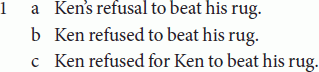
For everyone who sat in on the lectures, or read the paper distilled from them, the immediate motive of this approach seemed clear. It went right at the kidneys of Generative Semantics. Generative Semantics was reducing the deep lexical inventory; Chomsky was restocking it.
The implications of Chomsky’s arguments went, as Chomsky’s arguments will, considerably beyond a specific procedural matter, like how to handle nominalization. He proposed an overall approach—he called it the Lexicalist hypothesis, but it soon attracted an -ism, becoming widely known as Lexicalism—which greatly diminished the heretofore divine right of transformations to change syntactic categories, a right which virtually defined the Abstract Syntax program underlying Generative Semantics. Building an implied antithesis—what’s a position without an enemy?—Chomsky systematically opposed this approach to something he called the Transformationalist hypothesis. That hypothesis was really the only game in town at the time, so there were many works he could associate it with (including, naturally, Syntactic Structures and Aspects). But he connected it closely and relentlessly with the unpublished thesis of a precariously employed junior lecturer by the name of George Lakoff. Chomsky very briefly mentions Lees in connection with Transformationalism, but says that the correctness of that approach was taken for granted at the time of Lees’s work, then deals him a second get-out-of-jail-free card with “there was really no alternative as the theory of grammar was [then] formulated” (1972a [1967]:17).4 So, it was taken for granted and there was no alternative anyway, but Lakoff, one supposes, should have known better, and so is declared the poster child for the now-understood-to be-mistaken Transformationalist hypothesis. What Chomsky is doing here, in one of his signature rhetorical moves, is taking ownership of a position so he can manhandle it. “The transformationalist hypothesis” is a thinly veiled synonym for “Abstract Syntax.”
Chomsky’s formulation of Lexicalism (1972b [1967]:22) rapidly came to mean, in Lakoff’s attempt to firm it up, that words “may not change category in the course of a transformational derivation” (1967:8); or in Jackendoff’s version, “transformations do not perform derivational morphology” (1972:12–13): once a category, that is, always a category. This move (1) immediately declares a huge swath of the Abstract Syntax program illegitimate and (2) reverses the historical course of Transformational Grammar.
Let’s tally up a sub-total, then, shall we? The founder of the field, a well-known evangelist for nominalizing transformations, prominently in both Syntactic Structures and Aspects, proclaimed the arguments behind all such derivations misguided. In the process, he disowned much of the work elaborated under his specific endorsement (he had virtually directed Lees’s thesis on nominalizations). He advocated a position he specifically dismissed in the New Testament: “Clearly,” he says in Aspects, the book that guided Lakoff’s work, “the words destruction, refusal, etc., will not be entered into the lexicon as such. Rather, destroy and refuse will be entered into the lexicon . . . [and] a nominalization transformation will apply at the appropriate stage in the derivation” (1965 [1964]:184). “Clearly.”
In the bargain—perhaps the most dreadful surprise of them all—he cast suspicion on one of the cornerstones of the Aspects model, the Katz-Postal Principle. If 1a and 1b no longer have the same Deep Structure one might always maintain the letter of principle, because scientists can do ingenious things with letters, but the spirit of the principle has been abandoned. Certainly, Chomsky kicked the Katz-Postal heuristic to the curb. That heuristic, you recall, directed linguists—peope like, say Lakoff—to seek out data of the 1a and 1b sort, so they could link them to Deep Structures of the 1c sort.
As Chomsky’s student at the time, Susan Fischer, recalls of these lectures, “The shit hit the syntactic fan.”
Lexicalist Wranglings
One reads “Remarks” on Nominalization without a clue that the description there of the lexicon and of deep structure existed nowhere before and was developed only because [Generative Semantics] pushed Chomsky to redefine his position—quite radically.
—Robin Lakoff (1989:983)
Almost everyone outside of MIT, and some inside, took the Lexicalist lectures to be little more than crackpot revisionism. There are actually a few more indications in Aspects that the Lexicalist hypothesis is one potential future for Chomsky’s framework than Robin Lakoff prefers to remember, and there are a few more clues in “Remarks on Nominalization” that it is a reaction to Generative Semantics as well, especially its fixation on her husband. But the tenor of her account is right on the mark: Aspects looks generally to endorse Abstract Syntax (aka “the transformationalist position”) far more than to endorse Lexicalism; and “Remarks” does play its cards pretty close to the vest. It dresses up surprising new proposals as natural extensions of the Aspects model, and characterizes the natural extensions pursued by the Transformationalists as a misguided detour.
In support of these partly reactionary, partly radical, moves, Chomsky’s arguments can be vague, half-baked, and ad hoc. To get out of one pickle, for instance, he appeals to analogy—the common-sense notion that a speaker might coin the word prioritize on analogy to an existing word like civilize, or oxidize—said to be a property of performance rather than competence. Well and good, you might say, analogy is a long-accepted tool of linguistic innovation—except that Chomsky’s dismissive views on the role of analogy were well known. He calls analogy “of dubious validity” in an article with Halle, for instance (1968 [1964]:356n12). He uses Bloomfield’s and Hockett’s appeal to analogy as a symptom of their misguidedness (1966a:12,81 n21, 82n22). And, in any case, the “Remarks” deployment of analogy was a blip. “Analogy seems to be a useless concept,” he returns to saying afterwards, “invoked simply as an expression of ignorance about what the true operative processes and principles really are” (1988a:24; also 1986:32). In short, analogy is a weakness relied upon by weak linguists. Unless it suits his purpose.5
There is this, too: the use to which he puts analogy, in support of Lexicalism, is a rather odd one. For reasons we needn’t go into, the following two grammaticality claims feed Chomsky’s argument for Lexicalism:

“Suppose that we discover, however, that some speakers find [expressions like 2b] quite acceptable,” Chomsky adds (and, indeed, some people do, including me), then analogy can come to the rescue: “We might propose that [2b is] formed by analogy to the gerundive nominals [criticizing in 2a], say by a rule that converts X-ing to the noun X nom (where nom is the element that determines the morphological form of the derived nominal) in certain cases” (1972b [1967]:27–28). If this analysis is correct, he goes on, then it “indicates that speakers who fail to distinguish [2b] from [2a] are not aware of a property of their internalized grammar” (1972b [1967]:28); in short, for speakers who do not conform to the grammaticality judgments required by the Lexicalist hypothesis, 2b is still ungrammatical, but acceptable due to analogic rules of performance. If your judgments accord with Chomsky’s about 2b—namely that it is bad English—then you have the same grammar in your head as he does. If they don’t accord with Chomsky’s judgments, then you still have same grammar in your head as he does, but some superficial phenomenon of no interest to linguistics is leading your judgments to betray your grammar. Yeah, right.
Even more curious at the time than such offhand appeals was the schema he proposed for Phrase Structure Rules, which has become known as x-syntax (pronounced “x-bar syntax”). It completely reoriented the phrase-structure component, critically required an amorphous and undefended entity called specifier, and harkened back in some nonspecific way to earlier work by Harris (“reminiscent of the system of phrase structure analysis developed by Harris in the 1940s”—1972b [1967]:54). Worse: its only role in the paper is to explain certain correspondences (the structural similarities between sentences like “Chomsky criticized Lakoff” and noun phrases like “Chomsky’s criticism of Lakoff”) that were already explained to everyone’s satisfaction under the transformational account—just not under the new Lexicalist hypothesis. That is, the only purpose of x-syntax seemed to be to prop up the Lexicalist hypothesis, and the only purpose of the Lexicalist hypothesis seemed to be to undermine Abstract Syntax. Within the decade, x-syntax had become a spectacular success and Lexicalism was seen as a necessary corrective on the power of transformations, but in “Remarks” x-syntax looked like a house of ad hoc cards sheltering a questionable hypothesis.
Chomsky repudiated successful early work, proposed radical changes to the Aspects model, and opened makeshift escape channels for those changes—all on the basis of quite meager evidence—with no more motivation, as far as anyone could see, than to hamstring the work of his most productive colleague (Postal) and of some of the most promising junior scholars in the field, including some of his own former students.
Lakoff and Ross were shaken to the bone. They were expecting some sort of brouhaha when Chomsky returned, no doubt, but it was taking a completely different route than anyone could have predicted, and, from their perspective, a distinctly bizarre one. They sat in on the lectures (which included specific attacks on many of the abstract analyses presented in Lakoff’s dissertation), and argued with Chomsky every step of the way. They also tried to talk about these issues with Chomsky outside of class, with very little success. Chomsky was getting thickly involved in political activism at the time, and his popularity was exploding inside and outside of academia. He had very little free room in his schedule. Lakoff, in particular, felt snubbed, but Postal says that Chomsky probably just didn’t see any potential profit in the meetings:
Viewed from [Chomsky’s] perspective, I don’t think he had any great desire to talk to them. It certainly was no urgent matter for him. They viewed it with some urgency. They felt that they probably had something important to tell him, but I doubt if he felt they had anything important to tell him.
I doubt that he really avoided them. I suspect he didn’t care one way or the other, and if he had more pressing things to do, he would do them. He would certainly much rather talk to some guy from Time magazine than them, so they probably got shunted off, and got pissed, and gave up.6
Lakoff’s interpretation is far less generous, and he dates the animosity that characterized much of the next ten years from exactly this point: “[Since we couldn’t talk to him in private] we figured that the only way to talk to him was to start bringing up counterexamples in class, and that infuriated him.” Chomsky’s classes became increasingly contentious, heated arguments breaking out frequently, and Lakoff was usually at the center of them.
A letter that Lakoff wrote to Chomsky during the course of “Remarks” lectures gives us a nice window into the dynamics of the emerging dispute. For one thing, Lakoff quickly mimeographed it for underground circulation, so that he could put his objections on the record. It wasn’t directed to Chomsky, that is, so much as at Chomsky (it’s a rhetorical figure called apostrophe, argumentation that is meant not so much to be heard by the guy in the witness chair or on the address line as to be overheard by others). But the tone is also very revealing—haranguing and superior, but cheery. Lakoff is not famously deferential, at least not when there are ideas at stake, but the difference between his and Chomsky’s statures was so immense as to put them in separate galaxies. Lakoff was a contract lecturer. Chomsky, in addition to having built the framework which utterly defined the debate, and having become the unquestioned leader in North American linguistics, had gained (and was continuing to gain) considerable fame outside of linguistics—as a proponent of rationalism, as the sharpest critic of behaviorism, and as a tireless, trenchant opponent of the Vietnam War. He was rapidly ascending to the reputation he now holds, as one of the foremost and influential thinkers of the contemporary era. Lakoff, in fact, says of his antagonist’s position in the late 1960s, “Chomsky was a Holy Presence.”
But holiness apparently did not inspire much reserve in Lakoff. The letter is full of sharp counterargumentation, but his principal criticism is that Chomsky is dodging all the real issues, and he uses an ancient tool of needling, the rhetorical question, to hector Chomsky about facing up to the facts. Many of Lakoff’s questions read like commentary a bullying professor might write on an undergraduate term paper. Since our document is a quasi-public letter, not a term paper, this kind of hectoring is manifestly insulting, implying sloppy reasoning if not sloth:
Is there anything to stop this sort of [absurd] argument? If not, why don’t you embrace it? (4)
A personal question: Do you believe this? Do you use it as a heuristic principle in doing grammar? If not, what exceptions can you think of, or envision? (8)
If you have some linguistically relevant sense of the word natural in mind, please say what you mean. While you’re at it, you might explain why your “by Δ” analysis of the passive is “natural” by this criterion. (12)
In the discussion of causatives, why don’t you answer my S-deletion argument (at the end of the causative paper)[?] It’s crucial that you do. (13)
The harping is surely in sync with the tone Lakoff adopted in his oral clashes with Chomsky, in Chomsky’s class, and helps to explain much of the antipathy, but we need also to keep in mind that “Remarks,” however monumental its influence became, is a very sketchy paper, unclear and hesitant about substantial, wide-ranging alterations to the beautiful Aspects model, and the lectures were surely similar: Lakoff did have a lot of questions to ask.
And, for all the prodding and the badgering, Lakoff’s tone remains breezy and lively throughout, with occasional suggestions of camaraderie—a kind of ribbing here and there—and the letter closes with

Back in the lecture theater, Chomsky, a grand master of debate, handled Lakoff’s objections to the satisfaction of virtually the entire audience. His own graduate students were especially impressed. Chomsky is not just relentless in argumentation, he approaches it like a blood sport. “If you want to talk with Chomsky,” Bob Ingria has said, “wear boxing gloves” (quoted in Nevin 2010:106). His students had ringside seats.
And let’s not forget that sketchiness has its virtues in science. However weak the vagueries looked to the Generative Semanticists under attack, the lectures’ suggestive indeterminacy was incredibly rich for his students, a smorgasbord of new research delights. There were the x-adumbrations to flesh out, the Lexicalist hypothesis to turn upon data old and new, and projects aplenty refuting the arguments of Postal, Ross, the Lakoffs, and McCawley. The lectures set off a flurry of activity among his students, activity which rapidly bloomed into the Interpretive Semantics model.
But this was only the beginning. Chomsky followed the “Remarks” lectures with an unprecedented period: several years of almost exclusively negative rhetoric, documented in two long papers (1972b [1968]:62–119; [1969]:120–202), whose express aim was to play whack-a-mole with Generative Semantics arguments; Jackendoff calls them “the bashing papers.”
Chomsky has certainly devoted considerable time and energy to assaulting other people’s work. He lets very little criticism escape his withering notice, if only to condemn it as beneath his notice, in repeated acts of paralipsis (the preeminent rhetorical figure of snideness, insinuating moral failures or crimes and misdemeanors or bad breath while pretending to ignore them). Take, for instance, this typical dismissal:
I will not consider Reichling’s criticisms of generative grammar here. The cited remark is just one illustration of his complete lack of comprehension of the goals, concerns, and specific content of the work he was discussing, and his discussion is based on such gross misrepresentations of this work that comment is hardly called for. (1966b [1964]:9)
But, even given Chomsky’s penchant for returning the fire of his critics tenfold, and for attacking any and all views he regards as unsound or specious, this period is anomalous.
Most of his arguments against the Bloomfieldian program are scattered among specific original linguistic proposals. But compare B. F. Skinner, the apostle of everything Chomsky considers evil in twentieth-century psychology. Skinner received only two papers, over a decade apart, the famous review of Verbal Behavior, and a more general, more clearly ideological assault in the New York Review of Books (Chomsky 1970a). Attacking Generative Semantics, a development within his own framework, by colleagues and former students, occupied most of his linguistic energy for three years. Lecture after lecture, he took up, dissected, and discarded Generative Semantics proposals: one lecture to McCawley, one to Postal, three to Lakoff, another one to McCawley . . .
Students, supporters, and opponents alike were all alarmed. One of the most fecund minds of the century was doggedly stamping the life out of a heresy, producing little (by his standards, extremely little) original research. Even the “Remarks” work, epochal as it proved to be, was too loose to make much immediate impact, especially on people who weren’t present for the lectures, actively shopping for methods and ideas (that is, his students), who only had a mimeographed version to go by. The evidence he presented for Lexicalism was inconclusive at best, spliced in with unconvincing appeals like the one to analogy, and came with a vaguely roughed-out proposal (x-syntax) for completely overhauling the highly successful Phrase Structure Rules. As one of his most sympathetic students at the time puts it, apropos of Chomsky’s seminal influence: “We all thought he had shot his wad.”
The Extended Standard Theory
Every question selects a field of battle, and in this selection it forms the nature of the answers.
—Kenneth Burke (1941:67)
Is the hypothesis correct in the case of particular grammars?; is the class of grammars restricted in a way that facilitates the choice of grammars?; are there further conditions on derivations that can be expressed in terms of the level of representation (deep structure) defined as the set of phrase markers that appear in derivations after all transformations of L have applied?; is there any further explanatory value to this concept? and so on.
—Noam Chomsky (1972b [1969]:128)
Chomsky wasted little time in capturing the nominal high ground by promptly but not at all inaccurately dubbing the Aspects model the Standard Theory, and his Lexicalist revisions to it, with much less basis, the Extended Standard Theory. Most linguists thought that Postal’s program and the Generative Semantics that it spawned were the most natural extensions to Aspects. In fact, Lakoff’s public-letter answer to “Remarks” lectures speaks repeatedly of both Chomsky’s and his own proposals as extending transformational theory or extending the assumed theory of grammar.7 More significantly—most significantly—the convergence of transformations and Semantic Interpretation Rules into Generative Semantics seemed like the inevitable fulfillment of Aspects’ promise, virtually the inevitable fulfillment of linguistics. “We know what we want to say,” Lakoff said in his 1963 argument for Generative Semantics, and then “we find a way of saying it” (1976a [1963]:50). After the innovations leading to Aspects and the surety of the Katz-Postal Principle, it seemed apparent to almost everyone that transformations were the way of saying it.
We can trace the relationship of transformations to meaning with sentences like 3a and 3b:

With 3a effectively the kernel of 3b, and their meanings are distinct (3a open about the languages ‘Yallis Islanders speak, so long as each one speaks at least two; 3b saying they all speak the same two languages) for the Chomsky of Syntactic Structures these two sentences indicate that “not even the weakest semantic relation can be maintained in moving from an active underlying form to a passive surface form” (1957a:101); therefore the passive transformation alters meaning; therefore transformations won’t take you cleanly from an underlying meaning to a surface form.
Katz and Postal tried to patch this hole unconvincingly, saying 3a and 3b are ambiguous in the same way, wholly synonymous with each other for both readings of both sentences (1964:72). Both 3a and 3b have the maybe-different-two and definitely-same-two readings. It’s only post-grammatical interpretation that leads speakers to prefer the maybe-different-two-languages reading for the active, 3a, and to prefer definitely-the-same reading for the passive, 3b. (This is a performance argument, but it comes before Chomsky had developed that label).
But they’re not done. “Even if the [grammar-internal] meaning of samples like [3a and 3b] are different,” they say, “the argument that some transformations affect meaning does not hold.” The reason? They have those abstract trigger morphemes up their sleeves:
Strong syntactic motivation has been found which . . . derives [passives] not from corresponding active forms, but rather from underlying P-markers containing an Adverbmanner constituent dominating by plus a passive morpheme dummy (Katz & Postal 1964:72)
So, 3a has something very much like itself for a Deep Structure, but 3b’s Deep Structure looks more like 3c

Passive doesn’t change meaning, in other words, and even if it does, who cares? It’s a classic heads-I-win, tails-you-lose argument.
What Katz and Postal offer us here, dear Reader, is a textbook case of what physicist and historian-philosopher of science, Pierre Duhem, called “saving the phenomena”: fiddling with the knobs of a theoretical apparatus in order to accommodate the theory to the relevant observables. Duhem was concerned with Ptolemaic astronomy, which had among its devices, he says, some “which save the phenomena by means of epicycles, others which do so by means of eccentrics, still others which save the phenomena by means of counterturning spheres devoid of planets” (2015 [1908]:21). Whatever the strong syntactic motivation might be (and it is far from negligible), in the context of the Katz-Postal Principle and data like our ‘Yallis Island sentences, byˆpassive looks an awful lot like an epicycle.
For the Chomsky of Aspects, 3a and 3b have become a minor puzzle. They seem to suggest that the Katz-Postal Principle is too strong; but, on the other hand, we might maintain that in such examples both interpretations are latent, a maintenance that he finds attractive (1965 [1964]:224n9); but, on one more hand yet (we sometimes get into Vishnu territory with Chomsky’s hands), it doesn’t matter anyway because we have that byˆpassive (Chomsky 1965 [1964]:103–105). In short, he endorses Katz and Postal’s heads-I-win, tails-you-lose treatment of such sentences, epicycle and all, saving the principle. In his most authoritative statement on the principle in Aspects Chomsky says:
It is clear, as Katz and Fodor have emphasized, that the meaning of a sentence is based on the meaning of its elementary parts and the manner of their combination. It is also clear that the manner of combination provided by the surface (immediate constituent) structure is in general almost totally irrelevant to semantic interpretation. (1965 [1964]:162)
That’s right, Surface Structure is almost totally irrelevant to semantic interpretation. There is that razor’s edge of a qualifier, almost totally irrelevant, but Chomsky’s policy statement here looks to be an almost totally done-deal Katz-Postal Principle lockdown, which is precisely how everyone took it. Surface Structure does not matter to meaning.
But down the road from Aspects scripture, when the matter seemed well in Transformational Grammar’s rear-view mirror and linguists were contentedly looking forward Chomsky’s almost came out to play. Quantifiers, like the every- in everyone, were soon back on the meaning-derangement table, in ways that most linguists found alarming (prominent exception: Ray Jackendoff).
It is impossible to recover exactly what Chomsky said in the lectures, but in the accompanying paper, he hints about the renewed relevance of such examples as 3a and 3b, now describing the Semantic Interpretation Rules of his Aspects not as interested solely in Deep Structure; rather, we hear that Aspects had “semantic rules that assign each paired deep and surface structure generated by the syntax a semantic interpretation” (1972b [1967]:12). The statement is strictly, letter-of-the-law true about the Aspects framework, of course, but it is a remarkably casual distortion of not just Aspects itself, the house that Deep Structure built, but of the five or so years of research that preceded it. Chomsky says clearly and repeatedly in Aspects that Deep Structure is where the semantic action takes place. This new Deep-Structure-and-Surface-Structure phrasing signals a major change in the winds. More explicitly, but still with a coyness that many found exasperating, he also said in print that same year:
I think that a reasonable explication of the term “semantic interpretation” would lead to the conclusion that surface structure also contributes in a restricted but important way to semantic interpretation, but I will say no more about this matter here. (1967b:407)
Such remarks may well have been elaborated in his lectures. His students surely knew more about his reasons and his arguments; Jackendoff was coming up with some of them. Everyone else was puzzled and disconcerted.
In 1968, that coyness on the nature of Deep Structure to meaning was receding, and he says that “surface structure determines (at least in part) the scope of logical elements [like quantifiers, such as the every- of 3a and 3b] and consequently plays a role in determining semantic interpretation” (1972b [1968]:209).8 By this point, too, his students had begun circulating papers, over and under the ground, with analyses that invoked surface structure interpretation. The Katz-Postal hypothesis apparently had a best-before date, and its time was up: if Surface Structure plays a role in meaning, then transformations can’t be semantically neutral. By 1969 for Chomsky quantifiers were hopelessly problematic for the Aspects model and, a fortiori, for Generative Semantics, requiring significant extensions to the former and a wholesale rejection of the latter.
But much of the research that Chomsky deftly dubbed the Extended Standard Theory, especially after “Remarks,” extended nothing. It was negative—looking not for solutions to specific pre-existing problems but only for data that compromised or disconfirmed the Katz-Postal hypothesis, and, therefore, hung Generative Semantics out to dry.
Why the shift? Chomsky, again suggesting his move was wholly incidental to Generative Semantics, says it was occasioned by his student, Ray Jackendoff:
The first person who offered a substantial critique of the Standard Theory, and the best as far as I can recall, was Ray Jackendoff—that must have been in 1964 or 1965. He showed that surface structure played a much more important role in semantic interpretation than had been supposed; if so, then the Standard hypothesis [the Katz-Postal hypothesis], according to which it was the deep structure that completely determined [meaning], is false. (1979 [1976]:151; also 1975b:239n8)
Chomsky’s chronology is off by a few significant years here. Jackendoff didn’t even show up at MIT until the fall of 1965. And (although this would depend on how he chooses to define the phrase, substantial critique of the Standard Theory) Chomsky’s notions of priority are further off yet. Lakoff’s thesis, which many people regarded as a (constructive) critique of Aspects—indeed, as an extension of the (not yet labeled) Standard Theory—was in circulation before Jackendoff finished his first semester, and several other linguists were revamping the Aspects model substantially before Jackendoff—including Gruber, Postal, Ross, and Fillmore. The only terminological point we can grant Chomsky here is best, since that is a subjective evaluation and he’s entitled to his opinion.
Too, the development of this Surface-Structure-semantics theme is not as simple as Chomsky seems to recall. In particular, Jackendoff himself remembers that Chomsky was entertaining this critique of the Aspects model at least as early as he was. “During my second year,” Jackendoff remembers, with Chomsky away writing Cartesian Linguistics,
I started thinking about rules of interpretation, and in an independent study under Halle during the fall semester of 1966 wrote three papers—one arguing for base-generated pronouns whose antecedents are determined by rules of interpretation; one arguing that selectional restrictions are enforced in the semantic component, not as part of lexical insertion (as in the Aspects position); and one trying to work out a theory of base-generated PRO and relative pronouns instead of the deletion rules then in fashion. Ross pointed out to me that this would require surface structure interpretation, in contradiction to the then-dogmatic assumption that deep structure determines interpretation. This worried me a lot. I remember a discussion with Chomsky on one of his brief reappearances on campus during that year, in which I brought up this worry, and he said calmly, “Of course Surface Structure plays a role in interpretation.” So evidently he was thinking along those lines too by at least early in 1967.
In one way, Chomsky’s calm “Of course Surface Structure plays a role” looks like just another example of something many people say of Chomsky; in Lees’s phrasing, “Chomsky is so smart that any idea you came up with he had already thought of, and thought over long and deeply.” Chomsky’s quantifier-scope quandaries date at least to Syntactic Structures, and his Lexicalist developments (on his chronology) germinate from 1960 or so, in partial reaction to The Grammar of English Nominalizations.
In another way, though, the issue has less to do with Chomsky’s vaunted depth of analysis than with his enigmatic choice of which particular thread of which analysis to pick up at any given time. The quantifier-scope, semantic-neutrality-of-transformations question, raised very early, seemed to be solidly resolved by 1964; raising it again looked like a step backward, and a betrayal of everything the transformational community had been working toward. Even after several years of MIT arguments against the Katz-Postal hypothesis, Barbara Partee expressed her bafflement over the effort in familiar anti-Bloofieldian terms:
The position that transformational rules don’t preserve meaning is of much less inherent interest than the contrary position, since it amounts simply to the position that a certain strong hypothesis is false. It may of course turn out to be the correct position, but it doesn’t seem like anything one could rationally want to champion—it is analogous to the position that synchronic rules don’t reflect historical development, or that not all languages use the same stock of phonological features, and so forth, the sum of all such positions being [in the notorious Joos quotation] that languages can differ from each other without limit and in unpredictable ways. (1971 [1969]:8; Partee’s italics)
Now, add to this program against the Katz-Postal hypothesis Chomsky’s arguments on the use, or overuse, of category-changing transformations, and his efforts looked odder yet. Why swim against the current of the most productive post-Aspects line of research in Transformational Grammar, particularly on the basis of the slim arguments of “Remarks”? And, in retrospect, why not raise his concerns about category-changing transformations seven years earlier, since they clearly had ramifications for the whole movement toward Deep Structure that characterized Chomskyan linguistics in the early 1960s?
Who knows?
But it seemed to many linguists that Chomsky had simply lost the courage of his convictions, that he couldn’t follow through on the natural implications of his own work, that his Bloomfieldian roots were finally showing, that he was retrenching rather than advancing, that he was, sadly, being left behind by more vigorous, more visionary linguists.
The Best Theory
The fact is that Homogeneous I is . . . the best grammatical theory a priori possible.
—Paul Postal (1972a [1969]:136)
Meanwhile, Generative Semantics continued to gather momentum, the principals each playing somewhat distinct roles in its propagation, as they had in its genesis. Certainly, there was much scatter and overlap in these roles, and an element of caricature shows up if the tendencies are pushed too far, and they were all theory generators while serving these other roles, but their respective impacts on the movement are quite clear. George Lakoff and Ross were the evangelical salesmen, taking Generative Semantics to the consumers. Robin Lakoff was probing sociolinguistic and pragmatic phenomena that shaped the later developments of the framework. McCawley, as we will see shortly, was the resident genius of a research-and-development incubator in Chicago that brought along a second generation of Generative Semanticists. Postal was the Big Gun.
Though just into his thirties, Postal was a venerable force, below only Chomsky and Halle in stature, second in reputation only to Chomsky in the prized domain of syntax. His endorsement of Generative Semantics did a great deal to foster its success. He did not proselytize for the model with the same fervor he had sold the earlier versions of Transformational Grammar; he went to conferences to argue, but less so to attack. He was, as always, prolific during the dispute, with almost all of his publications organized around reasons to pursue Generative Semantics, most containing asides on why not to pursue its almost completely open-ended rival (Postal 1972b [1970]:37n4), and some even carrying the resolutely polemical, doggedly certain tone of his anti-Bloomfieldian campaign. But his mere presence in the camp was almost enough on its own. Postal gave the movement its greatest source of credibility.
He looked, in fact, like its inventor. His spearheading of the movement toward deeper, more Abstract Syntactic analyses, everyone could see, grew into Generative Semantics. So, even though he didn’t publicly align himself with Generative Semantics until 1968, his influence suffused and supported it from the beginning. His and Katz’s formulation of their meaning-preservation principle, and their performative prefiguration, and their abstract morphemes, gave Generative Semantics a clutch of developmental warrants. His sponsorship of Lakoff’s dissertation went a long way toward its validation, and therefore toward the validation of many Abstract Syntax arguments. His offstage (but acknowledged) participation in Lakoff’s deep verb arguments, in Ross’s auxiliary analysis, in McCawley’s arguments, all gave them increased authority. The progression from Abstract Syntax to Generative Semantics seemed so inevitable to many linguists at the time (both supporters and opponents) that they assumed Postal was the latter’s real progenitor. In Jackendoff’s assessment,
The key person in motivating that kind of work was actually Postal, even though by the time the dispute got going he was sort of secondary. All the people around MIT who were attracted to a Generative Semantics point of view were people who had been taught by Postal. . . . He was probably thinking around those lines before anybody else. I think it started with the Katz-Postal theory.
Jackendoff then adds, “That means he was the originator of the Standard Theory, too” (quoted in Huck & Goldsmith 1995:98), reinforcing the sense in which Generative Semantics was the most natural outgrowth of the Aspects model.
Many people also found Postal’s arguments, which exemplified Aspects-era rigor, the most challenging. Katz says that Postal’s work
was the sort of thing that I found I could take seriously. I felt that I had to come to terms with his work in some way. From an outsider’s point of view, it seemed to me that he was the brains behind the outfit.
Keyser says, simply, “He was the guru.” Much of this perception had to do with style of presentation; Katz, Keyser, and Postal spoke the same language. The younger Generative Semantics principals are given to more informal and breezy presentations. Postal’s publications are—uniformly—very detailed, very careful, and the reasoning is laid out explicitly: if x, then y; given y, we can see that z, . . . But part of the perception also had to do with ethos. Postal worked with Katz, studied alongside Keyser, went to battle on behalf of Chomsky. He was their colleague. The Lakoffs, Ross, and McCawley: they were seen as barely more than students. For the brood of younger interpretivists Chomsky was rearing at MIT, the situation was similar. Postal had been a professor, in addition to being something of a legend; the others made up a junior quartet, even Ross, who was also their professor but whose PhD was more recently minted and whose style was resolutely just-another-guy humble. Postal’s arguments are also, frankly, among the strongest for Generative Semantics; his remind paper in particular (1971b [1969]) is a model of Generative argumentation, and contains, for Ross, “the best articulation of what Generative Semantics is about.”
Postal’s most remembered contribution, though, is unquestionably “The Best Theory.” In part its reputation comes from its thoroughly polemical nature—polemical in terms definitive enough to be called Postalian—the “best theory” of the title referring, of course, to Generative Semantics, with the suggestion that anyone choosing not to work on the model was likely in need of psychiatric counseling. In part it is remembered because it was the losing entry in a rhetorical showdown with Chomsky at one of the most heated conferences of the dispute, the 1969 Texas Conference on the Goals of Linguistic Theory. The “Best Theory” title stuck with Chomsky. When he discussed Generative Semantics with me twenty-five years later, he invoked the title mockingly to dismiss Postal’s representation “as the worst theory, in fact as the worst possible theory . . . the worst imaginable theory.” I wouldn’t think I am the only one with whom he went through this routine, though the closest he seems to come in print is to repudiate the title because its theoretical proposals were “virtually empty” (Ronat 1972 [1970]:150). In part the paper is remembered because of its ironic prescience. When scholars began commenting, somewhat later in his career, that “the Chomsky of the 21st century reads like a reincarnation of the Postal of the 20th,” it was this paper they had in mind (Pullum 1996:138, Boeckx 2006:72, Newmeyer 2003:591, 2009:418).
In part it is remembered because it’s a sharp and compelling argument.
The Texas Goals conference was particularly fractious. As Ross recalls: “By then it was clear there was going to be no quarter asked nor given.” And Postal’s paper was in the middle of it all, designed for provocation. The title makes it rather clear that intransigence would be the order of the day, not compromise, and provides a nice contrast with Chomsky. The paper Chomsky gave at the conference was published under the title, “Some Empirical Issues in the Theory of Transformational Grammar”—as neutral and mild-mannered as one could get—offering stark relief against Postal’s titular (and textual) claim to a priori superiority.9 In contrast to the title, however, Chomsky’s tenor was more intransigent than anything in Postal’s paper. The tone is unrelenting truculence, bullying even; as far from compromise as possible.
Postal’s paper is an unbudging but straightforward Occam’s razor case for the strong theoretical priority of Generative Semantics over more complicated models, especially all versions of Interpretive Semantics, with a few aspersions and digressive counterarguments thrown in. Chomsky goes after every Generative Semantics argument he can squeeze into the paper (taking the opportunity to attack Fillmore’s partially related Case Grammar proposals to boot), and offers nothing but vague promissory notes for an alternative. As always, the performance is impressive. He begins and ends with conciliatory statements, adopts a removed, disinterested tone, and exhibits concern only for the good of linguistics. But he attacks relentlessly, constantly characterizing Generative Semantics as “uninteresting” and “vacuous” and “totally obscure” and “[having] no substance” and “permitting any rule imaginable” and “[incorporating] at best dubious rules” and “[constituting only] a terminological proposal of an extremely unclear sort” and “not only unmotivated but in fact unacceptable” and much, much more. Postal’s belligerence pales in comparison. Interpretive Semantics, though, “is probably correct, in essence” and “very interesting” and “more natural” and “somewhat more careful” and “well-supported” and “to be preferred” and “again to be preferred” and “more restrictive, hence preferable” and, of course, considerably more.10
McCawley in Chicago
This note is concerned with a counterexample to the outrageous claim made by the bourgeois imperialist linguist McCawley. . . . Consider the idiomatic sense of shove X up Y’s ass. As is well known, Y must be coreferential to the indirect object of the next higher clause (including the deleted indirect object of a deleted performative verb).
Yuck Foo [James D. McCawley] (1992 [1971]:19)
McCawley was something of a proselytizer, more than Postal but less than George Lakoff and Ross, and he published a number of important foundational papers. Notably, he was the mildest polemicist. In conferences, he was especially compelling when he showed (gently) how a given Interpretivist account couldn’t pull the weight its author claimed for it, coupling the demonstration with a suggestion that Generative Semantics was better suited to the task. On paper, his arguments were usually more fully fleshed and persuasive, and, in hindsight, his publications are more definitive even than Postal’s.11 McCawley also lectured winningly and participated in several crucial gatherings. He was at the important 1967 Texas Universals conference, arguing about the need for deeper, more semantically transparent Deep Structures; he was at the 1968 Urbana Linguistic Institute; he was at all the major Chicago Linguistic Society (CLS) meetings; he taught semantics at the 1969 First Scandinavian Summer School of Linguistics and the 1970 Tokyo International Seminar in Linguistic Theory, while Ross taught syntax. He got around. And he took Generative Semantics with him. But he had a major sociological contribution as well: stabilizing the movement, giving it a home, and nurturing a second generation of Generative Semanticists in and around the University of Chicago.
Postal was at IBM, with no students, by the time Generative Semantics began to bloom, though he also took occasional teaching assignments. Ross was at the only Interpretive enclave, MIT, under a formidable shadow which he says (much too gloomily) kept him from ever “influencing a single mind there.” Neither had any students who contributed to Generative Semantics. The Lakoffs moved from Cambridge to Michigan to Berkeley (with a brief stint at Stanford’s Center for Advanced Study in the Behavioral Sciences), making it very difficult to cultivate a stable base of graduate students. George had a few notable students who made an imprint on the model—especially Guy Carden at Harvard, and later John Lawler, at Michigan. Robin, less so, though her later contribution to gendered sociolinguistics has been developed and propagated by her students; most prominently, Deborah Tannen.
McCawley’s second-generational impact was by far the most substantial. He was comfortably ensconced in Chicago, attracting a group of bright young students, many of whom made significant contributions to Generative Semantics (among the more notable, Robert Binnick, Alice Davison, Georgia Green, Judith Levi, and Jerry Morgan). Moreover, Lees was at the nearby University of Illinois (Urbana) and very tolerant of the new trend, as was Zwicky, an inspiring teacher who also attracted bright young graduate students to the theory.
When McCawley’s (and Lees’s, and Zwicky’s) students encountered the inspirational fervor of Lakoff and Ross, Generative Semantics made the transition from an alternative version of Transformational Grammar to a movement. Two events were especially important for the growth of Generative Semantics, for its roots in Illinois, and for defining its genius: the 1968 Linguistic Institute at Champaign-Urbana and the fifth meeting of the CLS the following spring.
Lakoff and Ross taught at the institute (officially, the course was “Abstract Syntax”), McCawley also taught, and brought many of his more promising students over from Chicago. Lees, the legendary polemicist and articulator of the romantic pre-Aspects days, was the Institute’s director. The mix was, in the argot of the period, “outasight.” The spirit of the institute has been immortalized by several of the participants in “Camelot, 1968” (Lancelot of Benwick et al. 1976 [1968]), a paper so recklessly enthusiastic for Generative Semantics and so concomitantly hostile to Interpretive Semantics that even McCawley, a free-speech advocate and itinerant pornographer, felt compelled to bowdlerize it (1976b:249). The paper, in its own words, is “an account of some of the linguistic Events of that Year: wherein are detailed the Declarations of the New Court and the Weapons used in the Awefull Battle to repeal Certain Decrees of the Old Court” (1976 [1968]:249). Newmeyer, a University of Illinois student who attended the institute, has somewhat less enthusiastic words for the Events of that Year, saying the institute
stands out not only as the high-water mark in the ascendant tide of Generative Semantics, but also as the epitome of mixing reasoned argument with pure showmanship and pure salesmanship. (1980a:152; 1986a:102)
A pervasive mood of camaraderie bound the Institute participants, something of a reincarnation of the spirit that suffused MIT’s Research Laboratory of Electronics less than a decade earlier. But, as the tone of “Camelot, 1968” suggests, the presiding ethos of Urbana was not the caustic pugnacity of Noam Chomsky and the revolutionary zeal of Morris Halle; it was the cheery defiance and new-order gusto of Lakoff, Ross, and, especially, McCawley. The latter, in particular, had written a few pieces under the pseudonym of Quang Phuc Dong, from the South Hanoi Institute of Technology; S.H.I.T. T-shirts were printed up and worn for years thereafter with pride. (Quang’s other position in the relevant period was at the Free University of Central Quebec, but that affiliation apparently had no sartorial impact.12)
By the following spring, says Ross, “the forces of light and truth had gotten their act together.” The fifth CLS meeting included cornerstone Generative Semantics articles by Postal and George Lakoff; significant contributions to the theory by Ross and Robin Lakoff; and a wide range of papers investigating the implications of the model by members of the second generation—Green, Morgan, Newmeyer, Laurence Horn, and Lauri Karttunen. (McCawley’s paper that year, on Tubatulabal phonology, was out of the fray.) The proceedings of the conference (Binnick et al. 1969) constitute, if not quite a manifesto—Generative Semantics never spawned one—a much more thoroughly explored, carefully reasoned, and challenging articulation of the theory than any other document in its brief history. Certainly, it represented a more comprehensive invitation to linguists outside the central group than Lakoff and Ross’s “Is Deep Structure Necessary?” or even than McCawley’s several, isolated early papers.
Naturally, all the participants had a great deal of fun. One of the Generative Semanticists’ most distinctive qualities was the ability to combine probing scholarship with thoroughgoing levity. This feature is reflected in, among other mirrors, the movement’s papers—in frivolous titles, amusing data constructions, and a loose-jointed style. Ross’s paper at the conference, for instance, was titled “Guess Who?” and Postal’s included a whole range of sentences like 4.

Ross’s paper explored a rule which operates under very sophisticated conditions and phenomena which create havoc for interpretive theories. Postal’s example (4) illustrates that words like blonde, although they are referential for constructions like has hair which is blonde cannot sponsor a pronoun that refers to hair.
Generative Semantics was in the sun, out from under the shadow of Aspects, and well ahead of Chomsky’s new, ill-specified, Lexicalist,  -syntax, surface-semantics, interpretive model in the Generative Grammar sweepstakes.
Bad Blood
The enmity of one’s kinfolk is far worse than that of strangers.
—Democritus of Abdera (DK 90)
Postal’s label for this period—“The Linguistic Wars”—looks extreme to anyone outside the field, and to many linguists who have entered the field in its wake, but war is a fitting analogy, civil war. It was a divisive, aggressive, frequently ignominious period, with martial attitudes all round. On one side, there were the spirited and abrasive Generative Semanticists, who had already captured much of the high ground. On the other side, there was Chomsky with a growing number of supporters, young and eager for the types of giant-killing episodes that had made legends out of Lees and Postal and were virtually definitive of Chomsky. Toward the middle, Katz was buttressing the Aspects model against both hordes. And around them all was a vast wash of ill-formed issues, underdetermined proposals, and amorphous data. Like Verdun, there were no dry footholds.
Chomsky’s papers were severe but superficially mannered, with only occasional jibes—especially in the notes, and especially directed at Lakoff—about “misleading” (1972b [1969]:141n19) and “totally obscure” (1972b [1969]:148n22) arguments. His lectures, though, were considerably more agonistic. He argued in the classroom and throughout this period as he always argues—calmly, dispassionately, even convivially. When his voice rose (again the target was usually Lakoff) it was out of exasperation with his interlocutor’s vehemence, or outright rudeness. And a little testiness is understandable. It was, after all, Chomsky’s class.
But even with his placid and assured tone—or rather, partially because of his placid and assured tone—Chomsky’s polemics are almost always very hard for their targets to take. George Lakoff is quoted in the New York Times as saying “Chomsky . . . fights dirty” (Shenker 1972), and that impression is very widespread. In particular, it is vanishingly rare for people to recognize themselves in the representations Chomsky gives of their arguments when he attacks them.
Lakoff recalls Chomsky’s principal tactic during the “Remarks” lectures as systematic misrepresentation, and his own reaction as furious umbrage:
[In one lecture] he took up McCawley’s paper on respectively, and he put forth the argument that McCawley was arguing against as McCawley’s position, and he himself put forth the position that McCawley was arguing for, and he said “See how dumb McCawley is.”
There were a hundred people present, or so. And I raised my hand and I said “No. You’ve got it wrong. You’ve got the positions reversed.”
He said, “No. No. I’ll read you the text.” And he read a bunch of things out of context. Of course, nobody in the room had the text, except him. I just got furious about this.
The following week, he took a paper of mine and did the same thing. He put forth as my position a position I specifically avoided saying. And then he argued, correctly, against this position. And I said “No. I specifically did not give that position in the paper.” Then he began, with me in the room, to take quotes out of context from my own paper, with no one else having the text. It was mortifying.
Lakoff’s memory is surely blurring and smudging things a bit here, and he has called upon his poetic license to render the dialogue, but it is the kernel in his story that is important: the Generative Semanticists found Chomsky’s presentation of their positions to be willful, mean-spirited distortions, and the result was a series of heated exchanges, and lasting bitterness.
Others remember the lectures a little differently, particularly about the source of aggression. Chomsky certainly did not take pains to spare others, but everyone could see he had a particular, thinly veiled animus for Lakoff. Why Lakoff was the special target, the scapegoat upon whose back the sins of the heresy were heaped, why he was the one driven most aggressively from the village, is surely a function of many factors. While he was certainly a Cambridge insider and had taken undergraduate courses from Chomsky, he was also the only one of the four horsemen without a close institutional tie to Chomsky (Ross and McCawley were his students; Postal, one of his most devout early colleagues). Lakoff’s degree was supervised by Fred Householder, who was high on Chomsky and Halle’s enemy list.13 But Lakoff, like Chomsky, albeit in a quite different mode, did not avoid the spotlight of vituperation. Accounts of his behavior in Chomsky’s classes consistently position him as an agent provocateur (French for “pain in the ass”):
•“Lakoff would sit in the back row and say ‘Noam! Noam! You’re wrong! You’re wrong! Everything you say is wrong!’ He just basically made a pest of himself.”
•“The typical scenario at Chomsky’s course would be that Chomsky would say something, then Robin, who was pathologically shy but smart, would whisper into George’s ear, then George would raise his hand and in his smarmy pseudo-civil way make some comment.”
•“[Lakoff] was combative and impolite . . . [He] would go to Noam’s class and sit at the front of the room. One time Noam said something, and George said, ‘I have been saying the same thing.’ Noam asked ‘Where did you write about it?’ And George responded, ‘I have been lecturing about these things, and if you are interested, you should come to my class.’ ”
The level of gall required for anyone, let alone a junior lecturer, to tell the inventor of the field to attend his classes if he wanted to stay current goes right off the chutzpah meter. It may well go right off the accuracy meter as well (though perhaps not—it is not entirely out of character for Lakoff, who is very self-assured, and several people report the same incident); there are clear veridical inconsistencies in a collection of quotations that have Lakoff exclaiming “Everything you say is wrong!” one minute and being smarmily pseudo-civil the next, sitting in the back row and at the front of the room. And the animosity was probably more evenly distributed than most of the participants recall. Most tend to lay the blame for all evils and misunderstandings squarely on one side or the other, rarely seeing fault with both. But two constants emerge from all the reports: Chomsky was allergic to Lakoff, and Lakoff was pushy with Chomsky.
Hosts of grievances, large and small, accumulated. Take the “Sanctius Affair” around Chomsky’s Cartesian Linguistics. Many of his it-all-starts-with-Descartes arguments had been circulating for a few years, in various publications (including Aspects), and in lectures at MIT and elsewhere, but they came out in Cartesian Linguistics the year after Aspects, to a warm greeting in the citadel and other transformation-friendly enclaves. Its wider scholarly reception was largely unwelcoming, though. Historians of ideas reviewed it and were not impressed. Chomsky’s scholarship had looked iron-clad and impeccable to this point in his career. He was, literally, the paragon of generative linguistics. But his feet were made of clay after all. The history he serves up in Cartesian Linguistics was quickly exposed as careless, if not arrogantly shoddy.
There was no such thing as a Cartesian linguistics, ever; the ideas Chomsky associates with that label predate Descartes by centuries; his anchoring of those ideas in the Cartesian Port-Royalists is suspect; the channels in which those ideas subsequently propagated were very different than he depicted; and the alignment he gives of philosophers, grammarians, and rhetoricians with the prized themes of rationalism and empiricism is, at best, impressionistic.14 One might have expected at least some humility in the face of thoroughly documented counterargument from people whose professional field he had entered, but humility is not Chomsky’s strong suit, not about ideas in any case. The book itself already slags the “sorry state of the field of the history of linguistics” (1966a:57), and he received criticism from its scholars with silence. He simply went on repeating his Cartesian claims without mentioning allegations of their scholarly unreliability. His stubbornness on this point was galvanizing for the Generative Semanticists, a frequent entry in the “Can you believe Chomsky would . . .” hallway jaw droppers. It hit particularly close to home, because the book’s subject was in Robin Lakoff’s wheelhouse. Her review of Grammaire generate el raisonee seems to have been motivated largely to spank Chomsky and it airs Cartesian Linguistics’ more glaring limitations—in particular, that Descartes is not mentioned as an influence by the Port-Royalists, or even as a source, who instead prominently highlight the influence of a very different figure, the rhetorician Sanctius. Legend has it that Lakoff had told Chomsky how pervasive Sanctius is in the Grammaire before Cartesian Linguistics was published, but that he brushed her off; in any case, Sanctius is buried in a footnote (1966a:134n67).
Her review asks explicitly why Chomsky “speak[s] of the Port-Royal school as embodying Cartesian linguistics, not Sanctian linguistics?” (R. Lakoff 1969b:359) and suggests that the answer lies with ideology and incompetence. She is exquisitely snide about Chomsky’s lack of a rather crucial tool for the intellectual history of the seventeenth century and beyond: “since [Sanctius’] Minerva is inaccessible to anyone who does not read Latin, Chomsky has been forced to rely on the judgments of writers . . . whose comments on S[anctius] demonstrate an amazing lack of perception” (R. Lakoff 1969b:359). As it turned out, though, no one cared about Chomsky’s sloppiness but the historians and the Generative Semanticists. The former, after a brief flap because of Chomsky’s stature, returned the favor by ignoring Cartesian Linguistics, the latter had many other axes to grind, and the book remains a venerated classic in Chomsky’s oeuvre, now into its third edition and invoked as an important philosophico-historical foundation for Biolinguistics (e.g., Boecx 2009:28, et passim); more on Biolinguistics later.15
Such episodes further entrenched both sides. The Generative Semanticists found Chomsky intractable, if not perverse, and consequently felt that much of his criticism was empty. Chomsky’s students found him to be eminently reasonable, and his opposition—mostly embodied in George Lakoff, whose fuse was easily the shortest, but also in Ross, and in scattered sympathizers, like Carden—to be intractable, if not perverse.
Katz was there too, attending the lectures, and he played an especially interesting role in all this, one much like the role Herbert Butterfield describes for Marin Mersenne, an important presider at the birth of modern science, “a man who provoked enquiries, collected results, set one scientist against another, and incited his colleagues to controversy” (1957:83). Katz certainly made valuable contributions of his own, but his most prominent role was that of a bidirectional polemicist, attacking both sides and fanning the fires in every corner. One student of the period remembers Katz’s participation in Chomsky’s lectures thusly: “Jerry Katz was very contentious—not just about Generative Semantics and interpretive issues, about all kinds of stuff.” Katz’s particular bugaboo was any analysis that threatened the Integrated Theory-Aspects notion of Deep Structure, what he called at the time, “the CKP thesis about deep structure” (1970:221)—an ironically appropriate designation, since the initials stand for Chomsky-Katz-Postal, and Katz now stood midway between his old allies on the question of Deep Structure. For Katz, Chomsky was Momma Bear, whose Deep Structure was too shallow, Postal was Poppa Bear, whose Deep Structure was too deep. His own Deep Structure, the one everybody had agreed upon only a year before, was juuust right.
The friction and rancor at Chomsky’s lectures set the tone for the several years of bickering that followed. There were a few frothing publications, like Ray Dougherty’s (1974) “Generative Semantics Methods: A Bloomfieldian Counterrevolution,” and an exchange between Katz and McCawley that saw titles like “Interpretive Semantics Meets Frankenstein” (McCawley 1976b [1971]:333–42) and “Interpretive Semantics Meets the Zombies” (Katz 1972a).
Most of the blatantly abusive papers, however, were confined to the mimeograph circuit—“Camelot, 1968,” for instance, and Dougherty’s “Generative Semantics: Galileo Died for Your Sins,” and a best-kept-anonymous parody of Jackendoff, in which he is portrayed as a Nazi scientist attacking a Jew.
There was plenty of squabbling in the publications, but little of it was overt. It usually took one of two general forms, neither of which look like squabbling to the uninitiated. One form is best represented by Chomsky’s many attacks on Generative Semantics—explicit in its disagreement with theoretical stances or proposed mechanisms, but not betraying much obvious hostility. The other form is best represented by many of the Generative Semantics papers—for instance, George Lakoff’s syntactic amalgams paper (1974). It contains implicit attacks on two foundations of the Chomskyan program (transformational derivations and the competence-performance dichotomy), and was delivered to the initiated, at CLS. They all knew exactly what he was talking about and who the target was. But Lakoff does not, except in passing, mention either of these issues, or even Chomsky, or, for that matter, even appear to be participating in a controversy of any sort.16
Most of the explicit enmity was not in journals or proceedings. As in the first round of Chomskyan hostilities, against the Bloomfieldians, the bulk of the invective and discourtesy was oral. There was, for instance, a celebrated flare-up in 1967 at a small conference in La Jolla which was something of a coming-out party for Generative Semantics. Jackendoff rode west, as he recalls, essentially “as Chomsky’s point man,” and the Generative Semanticists regarded him as a gunslinger dispatched to put down an uprising by the homesteaders. There were several shrill shoot-outs, including the loud exchange of graphic imprecations between him and an earlier Chomskyan gunslinger of much renown, Postal. There was an equally vitriolic, and even more public exchange between Jackendoff and Lakoff a few years later, at a plenary session of the 1969 Linguistic Society of America (LSA) conference, which got increasingly heated until Lakoff said, “Well, fuck you.” Jackendoff, as Ross remembers it, “looked like he’d been slapped in the face, and then said, ‘Well, fuck you, George’ ” (Huck & Goldsmith 1995:125), and “for several minutes [they] hurled amplified obscenities at each other before 200 embarrassed onlookers” (Newmeyer 1980a:162; 1986a:126). (Readers for whom the use of the word fuck in public settings does not have quite the outrageous incivility it had in 1969 can substitute racist or homophobic slurs, which now have a taboo status similar to that of sexual and bodily excretion terms then.)
The watershed moment for almost everyone was an encounter between Chomsky and Ross at the 1969 Texas Goals conference. They had flown down together, Chomsky to give the final chapter of his bashing trilogy (“Empirical issues”), Ross to read a paper for Morris Halle, who couldn’t attend. After Chomsky’s paper, Ross got up to ask him a question. The question did not get very far, however, before Chomsky cut it off and gave a long aggressive answer to some question he apparently assumed Ross might be planning to ask. Ross tried a few more times to continue, but Chomsky, with the microphone, at the podium, just kept talking over him until Ross turned around and went back to his seat. This moment is less scandalous in the telling than the Jackendoff/Lakoff fuck-you fireworks or the Jackendoff/Postal shoot-out. But, taking academic kinship into account, the discourtesy is stunning. “Ross’s gesture signaled that . . . he felt that Chomsky had broken the rules,” Postal says, “Which I believe he had” (Huck & Goldsmith 1995:134). Let’s spell it out: Chomsky was the founding icon of a framework in which Ross was still a relatively minor contributor, the senior professor of a department in which Ross was a junior, untenured, member, and the supervisor of Ross’s recent dissertation. The last relationship is especially defining of Chomsky’s churlishness on this occasion; supervisors are expected to promote and nurture their students, to bring them into the profession, to advance their careers, but Chomsky belittled and denied Ross. It is of this conference, you will remember, that Ross says it became clear to him that no quarter would be asked nor given.17
There was more, much more. Every linguist even close to the mainstream at the time has a host of anecdotes about individual firefights, in colloquia, job interviews, classrooms, chance hallway meetings . . . seemingly wherever and whenever representatives of the two sides came into contact; and almost everyone had taken sides. The stories range widely in color and credibility, and it is difficult to take many of them at face value. They have grown epic in the retelling: the stupidity of the antagonists, the forbearance of the protagonists, the simplicity and clarity of the point under dispute, are all surely exaggerated. One account even has Chomsky and Lakoff, very unlikely in the roles of Achilles and Hector, physically wrestling for a microphone.
But, in concert, these tales have the general cultural value that all bodies of folklore have. Take the several versions of a Generative Semantics story which has Jackendoff (or sometimes Dougherty), up against thorny opposition and unable to think for himself, thumping Aspects like the gospel and intoning plaintively “but Noam says . . . .” Or take the multiple versions of a story which has some Interpretive Semanticist attempting to use an argumentum ad absurdum of Abstract Syntax (say, arguing that the is a verb), for which a Generative Semanticist falls, hook, line, and theoretical sinker. (“By golly, the is a verb. We’ll have to change the theory right away to accommodate this new fact. I’ll get on the phone this afternoon. The mimeographs will be busy in the morning.”) Some approximations of these stories may have played themselves out, but their veracity is less important than the attitudes they reveal. The Generative Semanticists felt that the other camp consisted largely of Chomsky and his puppets. The Interpretive Semanticists felt the other camp far too rhetorically pliable, far too willing to overhaul its general theory on whatever scanty evidence they heard over lunch that day. Each side thought the other uncritical and obtuse to self-evident points.
Although the general level of mutual tolerance was pretty low, and many tempers ran high in individual encounters, and there is lasting bitterness still, and there were clear casualties of the debate, it is important to note that courtesy, friendship, and respect for one another’s work were not completely absent. Newmeyer, for instance, recalls a patient and genial Jackendoff trying to help him see the error of his gargantuan-derivational ways (2015: xvi) in chats at MIT. Even the most public of antagonists expressed mutual gratitude in various ways. Postal, for instance, at the height of the wars, dedicated his through-and-through-Generative-Semantics book, On Raising (1974), to Chomsky. Jackendoff saluted the Generative Semanticists in the preface to his Semantic Interpretation, for motivating his research. Neither speech act could have been performed without some level of irony. Postal credits Chomsky’s recent work for being “among the chief stimuli leading to the preparation of this volume” (1974a:v), and Jackendoff says that he built his model “due to my being in sufficiently violent disagreement with [Generative Semantics] work to want to do something about it” (1972:xii). But both acts also demonstrate abiding respect, and Postal cites “a certain framework containing many underlying agreements [that is, the Aspects model]” that forms the backdrop to the disagreements. He is also generous about Chomsky’s “many fundamental, ground-breaking insights and the radical reorientation of the goals and methods of linguistic inquiry which he has played such an enormous role in bringing about” (1974a:v). Chomsky himself was supportive in the careers of at least some of his opponents—endorsing Ross’s appointment and advancement at MIT, for instance, in marked contrast with his behavior in Texas. McCawley and Chomsky corresponded about their respectively arguments, with warmth and mutual respect, albeit with little agreement. Partee and George Lakoff modeled civil exchange in the pages of the journal Foundations of Language (Partee 1970; Lakoff 1970c).
Still, the battles went on, boiling over into more public forums, first to include linguists outside the Chomskyan tradition, and then to include scholars in neighboring disciplines. Chomsky had acquired massive prominence by this point—psychologists and philosophers routinely debated his work, his books were reaching a fairly broad public, there were profiles and articles in magazines like The New York Review of Books, Horizon, Time, The New Yorker, appearances on TV shows like Firing Line, even a walk-on part in Norman Mailer’s Pulitzer-Prize-winning novel, The Armies of the Night (“a slim sharp-featured man with an ascetic expression, and an air of gentle but absolute moral integrity. . . Chomsky, although barely thirty [sic], was considered a genius at MIT for his new contributions to linguistics”; Mailer 1994 [1968]:180). Most notably, he was at the forefront of protests against the U.S. invasion of Vietnam. Additionally, the Generative Semanticists became very wide-ranging in their interests, drawing on the work of logicians like Lotfi Zadeh, philosophers like H. Paul Grice and John Searle, psychologists like Eleanor Rosch, and sociologists like Erving Goffman. They shopped far and wide for data and mechanisms around which to build their theory, and they were never reticent about letting their discontent with Chomsky be known. Inevitably, the sectarian spat within Chomsky’s framework found a wide audience.
A notorious symptom of the public dimensions of the dispute is an exchange of letters between George Lakoff and Chomsky in the New York Review of Books. The Review had just published an article by Searle (1972) on Chomsky’s revolution. While revealing the familiar tendency of outsiders to be a few years behind the work in any field, it is fairly even-handed and offers a good précis of Chomsky’s major contributions to that point, their implications for linguistics, and their ramifications for other fields. It certainly includes some lionizing, but the praise is neither undue nor excessive. Still, it got under Lakoff’s skin. He felt compelled to write a letter to the editor (1973c), a letter with two purposes. The stated motive is to spell out recent Transformational-Generative developments more clearly. Searle, for instance, had said that the Interpretive–Generative Semantics dispute was occurring “entirely within a conceptual system that Chomsky created” (1972:20), which (as we will see) was no longer true by the early 1970s; the grounds of the debate had shifted considerably. It is the barely hidden motive, though, that brought the notoriety: to diminish Chomsky. Lakoff accuses Chomsky of dishonesty both about the Bloomfieldians and about the Cartesian parallels of his own work. He says that the important results about Chomsky’s transformational work are its disconfirmations, mostly at the hands of Generative Semanticists. He shoos away psychologists who might be interested in examining Chomsky’s hypotheses. He discounts the importance of Chomsky’s early work and depicts his current work as misguided. Several of Lakoff’s individual points have merit, but the constraints of a brief, nontechnical letter, and Lakoff’s temperament, led to many conflations and simplifications of the sort that are common in popular fora (Fahnestock 1986)—and, in the event, much of it is completely irrelevant to Searle’s article anyway. The letter is little more than a catalog of reasons to suspect and devalue Chomsky, if not to dismiss him entirely. It is simple invective, of which the kindest characterization one might offer is gratuitous.
Chomsky, of course, responded (1973b). His letter tries to clarify his position on a number of the issues Lakoff raised, and to vindicate his general approach to the study of language, but he faces the same limitations of space and audience that constrain Lakoff, giving rise to similar conflations. He is also on an eye-for-an-eye mission—or more like an eye-and-a-half-for-an-eye, in Chomsky’s routinely upping-the-ante polemical style—and the pitch of the attack increases exponentially. As a result, the strongest message that comes across in the letter is his extreme disregard for Lakoff’s intellect, if not for Lakoff’s person. The letter is littered with unsubtle ad personams, and far outstrips Lakoff’s in the category of denigrating his opponent:
•“Lakoff presents a very confused picture . . .”
•“is completely wrong . . .”
•“misrepresents my account . . .”
•“has thoroughly misunderstood the references he cites . . .”
•“is confused beyond repair . . .”
•“presents a hopelessly garbled version . . .”
•“[has] discussed views that do not exist on issues that have not been raised, confused beyond recognition the issues that have been raised and severely distorted the contents of virtually every source he cites.”
This list is only a representative sample, not a comprehensive record, of the aspersions. Lakoff’s letter is invective in the technical sense of epideictic rhetoric which aims to devalue its object, though it shades toward the ordinary language sense in some passages; Chomsky’s letter does not bother much with shading, and its invective closely fits the common definition of venting venom. Lakoff was naturally incensed, though by this time in the debate he had no love left to lose for Chomsky. He tried to publish a longer and more vituperative response to the response. The editors wisely decided the matter had gone far enough.
The Linguistics Wars reached an even more public forum the same year, getting aired in over forty column-inches of the Sunday New York Times. The story, by a childhood schoolmate of Chomsky’s, Israel Shenker, skews the dispute somewhat, and oversimplifies it drastically, but it is a reasonable epitome of how things looked to a good many people at the time, including many linguists: that Chomsky had, rather sadly, stopped short of fulfilling his own revolution, which another generation of Young Turks was now bringing to fruition. By this time the theme was becoming familiar in popular articles. The New Yorker, for instance, had quoted Janet Dean Fodor saying “Chomsky was once a revolutionary. Now he has been forced into the position of a conservative” (Mehta 1971b:218), and the Searle article that spawned the Lakoff-Chomsky pissing contest had commented on the irony that “the author of the revolution now occupied a minority position in the movement he created. Most of the active people in generative grammar regard Chomsky’s position as having been rendered obsolete” (1972:20). But Shenker’s piece was the first one devoted exclusively to the dispute, and its verdict echoes all the others. The debate is rendered nicely by Shenker’s quotations from all the key players:
ROSS:There’s no question that Chomsky is a genius and has revolutionized linguistics, and created a field of mathematics which didn’t exist before, and helped in the revolution of psychology and the rebirth of interest in problems like cognition and perception. But I think that he’s so committed to the truth of this view he grew up in that he can’t see where it’s inadequate.
POSTAL:By ignoring meaning [as Chomsky does] you get an artifact.
LAKOFF:Since Chomsky’s syntax does not and cannot admit context, he can’t even account for the word please. . . . But it’s virtually impossible to talk to Chomsky about these things. He’s a genius, and he fights dirty when he argues. He uses every trick in the book.
MCCAWLEY:Chomsky assumes that there are sentences which belong to the language and other sequences of words which don’t—and the grammarian’s task is to write rules which will determine which belong and which don’t. Postal and Lakoff and I say this isn’t a coherent notion.
And, getting the last word,
CHOMSKY:I’d gladly accept parts of their work if these turn out to be right, and all of it if it is right, and I assume they’d do the same.
Lakoff feels he was misquoted here, though it is clearly his opinion that Chomsky’s eristic techniques are pretty underhanded. The others may also feel poorly represented in one way or another, though everything seems of a piece with both their published statements and their personal dispositions. But the point here is not whether these quotations are accurate. The point is just that the dust-up was loud enough for the neighbors to hear.
Chomsky is clearly outgunned in the piece. The only quotations in the article that could even remotely be ascribed to “his side” in the schism are from Katz, who dismisses it all as inconsequential bickering over formalisms, and from Bever, who simply fills in some historical detail. Indeed, there is little to no impression that he has a side at all; he has simply been eclipsed. All the defining criteria are negative: he can’t see certain implications because of his Bloomfieldian blinders, he doesn’t attend to meaning, he doesn’t attend to context, his central methodology lacks coherence. He looks isolated and stuck in the past. At best, in the remarks of Ross, he looks something like Einstein, who broke the ground for quantum physics, but whose classical prejudices wouldn’t allow him to follow its implications to the governing consensus. At worst, in the remarks of Lakoff, he looks like a petulant old Freud, scheming to ostracize and marginalize his erstwhile followers.
It is the petulant-Freud image that Shenker fosters. The headline is “Former Chomsky Disciples Hurl Harsh Words at the Master,” though only Lakoff’s remarks are truly harsh, and the article is framed by a discussion of Freud and his heretical disciples, particularly Victor Tausk, whom Freud treated the most shamefully. Although Chomsky is just into his forties, and he gets the last word, and the word is very politic, he comes off pretty much as a sorry old crank.
By this time, Generative Semantics was not just well established in conferences and grad schools, and cresting as avant-garde in psychology and literary studies, it was making its way into undergraduate classrooms and showing up in textbooks. As early as 1968, Postal’s Abstract-Syntax treatment of pronouns shows up in Jacobs and Rosenbaum’s English Transformational Grammar, and other textbooks of the period sample from the literature of Generative Semantics in their basic articulations of what otherwise looks like the Aspects theory, giving no sense of the controversy. Suzette Haden Elgin’s What Is Linguistics? includes a cutting-edge section on Generative Semantics (1973:34–35). Donald Frantz, one of McCawley’s students, produced Generative Semantics: An Introduction, a low-rent overview available through the Indiana University Linguistics Club (Frantz 1974). A review of Stockwell’s (1977) textbook, Foundations of Syntactic Theory, comments that “the appropriate title . . . would have been Introduction to Generative Semantics: the book is permeated with the ideology and assumptions of Generative Semantics” (Gazdar 1979b:197). There was still uncertainty and division, and alternatives were glimmering in various corners of the field, but Generative Semantics was now the imminent orthodoxy.
Imminent was as close as it got.