
CHAPTER 8
Надоело говорить и спорить,
И любить усталые глаза …
В флибустьерском дальнем море
Бригантина подымает паруса …1
Exactly a decade after the publication of Brezhnev’s memoirs the state, under the leadership of the same Mikhail Gorbachev who had met Brezhnev in Novorossiisk in 1974, decided to tear down the statue in Moscow erected on his death:
Where a monument to Leonid I. Brezhnev once stood, there is now an uneven sidewalk, covered with a dusting of snow and frozen dirt. The large black Cyrillic letters that spelled out his name on a nearby metal and concrete billboard have been erased.2
With Brezhnev consigned to national political oblivion and Moscow’s Brezhnev Square renamed,3 the war cult of the Brezhnev era was formally dismantled. Indeed, following his discredited predecessors, two marble statues of Brezhnev are now to be found off the beaten track in Moscow’s Muzeon sculpture park, adjacent to Gorkii Park, where they are relegated to the periphery next to the portable toilets in a corner full of superfluous Lenins and Stalins. These busts depict a statesman fallen from his pedestal, both literally and metaphorically, reinforcing the inflexibility in interpretation of monuments, which are rarely able to accommodate changes in the political scenery around them.4
In the light of Brezhnev’s national fall from grace as a victim of Gorbachev’s revised official narrative of the Brezhnev era, it is all the more remarkable that public opinion in Novorossiisk would be so out of tune with the capital as to consider a new monument to Brezhnev in the twenty-first century. The political debate and a decision-making process revealing flexibility in interpretation of a superficially static monument shed light on the attitude to Brezhnev and the local interpretation of his role in the history of the hero city he created and patronised.
So interlinked are the reputations of Novorossiisk and Brezhnev that in 2004, exactly 30 years after his famous visit of 1974, the town decided to erect the only public monument to Brezhnev in the whole of Russia. Brezhnev was already integrally linked with the large Malaia zemlia memorial complex, completed at his instigation in 1982 and studded with quotations from his memoirs. Since 1974 he had also been linked with the cluster of monuments in the Valley of Death, but more recent proposals to name a street after Brezhnev had come to nothing.5 This new statue would mark a further reverberation of the 1974 event, catapulting memory of Brezhnev’s connection with Novorossiisk and Malaia zemlia well into the twenty-first century. The process of decision making around the commissioning and erection of the statue acted as a catalyst for renewed discussion of both Brezhnev’s role in the war and the visit itself, setting off an after- shock of further reverberations and some revision of memory during the heated debate involving local and regional officials and the public. The conclusion of what may be viewed in retrospect as a protracted seven-year heritage controversy would eventually fix the collective image of Brezhnev within the identity of Novorossiisk, thereby formalising the rift between the national and the local view of Brezhnev’s links with the hero city.
New monuments in Novorossiisk are normally subject to planning permission granted by the Krasnodar Region. Smaller planning applications may be decided locally by the regional manager in charge of maintenance and planning of monuments in Novorossiisk, while larger projects such as the Brezhnev statue need to be accepted by the regional council as a whole. The decision-making situation is complicated by the multi-layered structure of local government in Russia. Within the town itself, the local duma, or town council, makes policy decisions, which are then implemented by the municipality’s head of administration, the town’s chief executive officer, popularly known as the mayor, who heads the local authorities. The most influential mayor of Novorossiisk in recent times has been Vladimir Siniagovskii, who served from 2003 to 2016 and was named an ‘honoured citizen’ of the town in 2009. Siniagovskii, a member of President Putin’s United Russia political party, was elected to the national parliament in 2016 to represent Novorossiisk. His successor, and the majority of town councillors in the duma, are also members of the same party.6 The other relatively large party in local and national politics are the old-style communists, still retaining some popularity since the collapse of the Soviet Union. The mayor of Novorossiisk has six deputies responsible for different areas of administration.
The first proposal for a statue to Brezhnev by a Novorossiisk member of the regional council in Krasnodar was rejected following one of several disagreements between the region and the town, but a second proposal was accepted in 2004.7 The successful project was sponsored by Dmitrii Shishov, a communist member of the regional council in Krasnodar, who not only had a vested ideological interest in reviving the connection of Novorossiisk with the longstanding general secretary of the Communist Party of the Soviet Union, but also the financial funds to back it. However, despite the support of the mayor of Novorossiisk and another member of the Communist Party on the Novorossiisk town council, the vote to erect the statue was by no means unanimous.
The leader of the minority Democratic Union voted against the statue, referring to the perceived lack of democracy in the country and suggesting that the decision to erect it was only to be expected ‘in a country of slaves’, made by ‘people who have no need of freedom’.8 This minority opinion reinforced a controversial letter from a certain Mikhail Prorok published by newspaper Novorossiiskii rabochii when the statue was first mooted early in 2004. Citing the oppression of dissidents and ethnic minorities during the Brezhnev era as a reason not to erect the statue, he claimed that Novorossiisk would have developed naturally in the past without the alleged support from the general secretary.9 The newspaper was deluged with responses, the majority of those published arguing robustly for the erection of the statue on the grounds of the postwar aid given by Brezhnev to Novorossiisk, with only one (published) letter reminding readers of the waste of lives in unpopular wars in Czechoslovakia and Afghanistan under Brezhnev. Furthermore, one writer, Vladimir Aleksandrovich, was particularly indignant about the number of undeserved awards worn by Brezhnev in his latter years: ‘He had more decorations than a New Year tree.’10
The statue was first proposed about a year before it was actually erected, but the arts committee charged with its implementation was still making the most important decisions on its form and site three weeks before the envisaged dedication date.11 On 23 August 2004 the sculptor, Nikolai Bugaev from Krasnodar, presented a scale model which won the support of committee members, sponsor Shishov and other local businessmen funding the project, pending final approval from the mayor.12 However, a prolonged debate failed to reach a conclusion about the best site for Brezhnev. It was decided not to stand him on a main road near the sea, as this would entail cutting down too many trees. More importantly, a site on Malaia zemlia itself was also excluded, not only because the relatively small statue would fade into insignificance beside the huge Brezhnev-era Malaia zemlia memorial on the shore, but also because of fears that this would reinforce ‘past mistakes’, when Brezhnev’s role in the campaign had been inflated, which would reflect badly on both Brezhnev’s memory and the identity of Novorossiisk itself.13 This strategic political decision no longer overtly to associate Brezhnev with Malaia zemlia marked the formalisation of the rift between opinion in Novorossiisk and the national attitude to Brezhnev.
Local opinion was voiced by Tigran Martirosian, former chief executive of the commercial port and honoured citizen of Novorossiisk since 1997, who felt that Brezhnev’s role after the war was far more important in the town’s socio-economic development than his war service, an argument that was incomprehensible to the national press, who could only see Brezhnev’s infamous connection with Malaia zemlia as the impetus for the monument. Following due consideration of political, historical and green issues, it was therefore decided to site the statue somewhere in the centre, in a place to be determined by the mayor, possibly on a crossroads with connections to Lenin.14 Two days later, the mayor agreed that the postwar argument prevailed, stating: ‘The people of Novorossiisk remember, know and value Leonid Il’ich’s contribution to the development of Novorossiisk.’15 With this in mind and possibly to put the communists in their place, he overruled links with Lenin and decided on a spot even closer to the centre, on the avenue Ulitsa Novorossiiskoi respubliki.
The final stages in the sculpture of the statue were hurried – it was reported that the sculptor hardly slept for the final two weeks of the project – but Brezhnev was finally lowered into position just in time for the official dedication of the statue on the anniversary of the liberation of Novorossiisk in 1943, 16 September. It may be questioned why this date was chosen, in view of the desire to avoid links with the war, but it also represented the culmination of Novorossiisk’s ‘town days’, lasting from about 11 to 16 September annually. Although 7 September, the date of Brezhnev’s famous speech, or 12 September, the date of the town’s foundation, may have been more suitable, it is unlikely that the statue would have been ready, in view of its hasty completion at the end of the decision-making process. Brezhnev’s grandson, Andrei, was invited to the ceremony. Fighting off autograph hunters from Brezhnev admirers, he declared himself ‘shocked’ to receive the invitation: ‘I never would have thought that, with our current leaders, anyone would have the idea of erecting a monument to my grandfather.’16
The national press expressed equal surprise to be faced with a bronze statue depicting not the decrepit general secretary remembered by the joke-tellers, well into his dotage with a chest covered in medals, but a much younger Brezhnev in civilian clothes, stepping out in fluid motion on his pedestal with knee bent, casually loosened tie, jacket slung over his shoulder. Shishov declared that he and the sculptor ‘wanted to depict Brezhnev not as a leader, but as a person [. . .] much loved in Novorossiisk’.17 This is not a statesman or a war hero, but a normal human being, shown strolling through the town. Furthermore, in contrast to the huge Malaia zemlia war memorial, or even the statue of Lenin in the town centre, this bronze monument is on a more realistic human scale, being just over two metres tall and standing on a red granite pedestal 1.8 metres high. This statue represents the simple, very human Brezhnev who public opinion perceives came to award the gold star as an old friend of the town,18 albeit, as pointed out by the chair of the Novorossiisk Historical Association, rather younger than the statesman who had visited in 1974, and substantially older than the wartime colonel.19 Brezhnev’s character as recognised in Novorossiisk is implied by the working title of the statue: ‘A man walking through the town’.
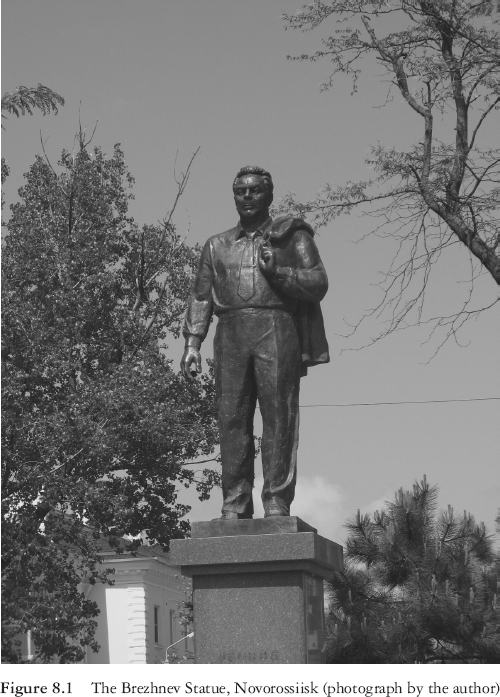
Outsiders, however, had to pose the question ‘through which town?’, as they linked Brezhnev solely with his army uniform and military service on Malaia zemlia.20 The statue portrays Brezhnev’s mythical modesty, simplicity and his respect for the town and its citizens, referred to by four older respondants, just as several war memoirs refer formulaically to Brezhnev’s love for the troops and their love and respect for him in return.21 Elderly interviewees Anna, Mariya and Vasilisa even giggled as they recalled how handsome Brezhnev looked in his younger days, remembering his common, populist touch, while Raisa Sokolova, the museum’s chief archivist, has a portrait of the younger Brezhnev hanging on her office wall – a place where the current leader of the country would normally hang. Perhaps people are actively looking for examples of Brezhnev’s more positive characteristics as if in denial of any weakness of character evident in Brezhnev’s later years. If Brezhnev propagated the myth of Malaia zemlia through his memoirs, so Novorossiisk is now propagating through this statue the image of the charismatic man still loved by local collective memory – the mythical Brezhnev in his prime, before his physical and mental decline.
William Tompson, Edwin Bacon and Mark Sandle have posited a plausible periodisation of the Brezhnev era which may serve to explain the apparent difference in recollection of Brezhnev between Novorossiisk and the rest of the country.22 The citizens of Novorossiisk saw Brezhnev at his peak, a memory of the 1974 visit fixed in the new statue, which took place months before his first stroke led to a steady deterioration in his physical and mental stamina. In contrast, it appears that the older generation of the rest of the country recalls the later, ailing Brezhnev confused, highly dependent and open to flattery. This apparent change in character is discussed by Sergei Semanov in a nuanced defence of the general secretary, contrasting the old man of the caricatures, with slurred speech, thick eyebrows and weighed down with medals, with the genuine patriot who remained ‘less hysterical’ than Khrushchev, less cruel than Stalin and less corrupt than present-day politicians, if lacking in decisiveness and somewhat weak-willed.23
The centenary of Brezhnev’s birth in 2006 provided an opportunity for a national reappraisal of the legacy of his lengthy term in office, with a protracted debate in Literaturnaia gazeta, the appearance of new biographies and the publication of a plethora of survey data. In an attempt to get to grips with the apparent paradoxes of the era, the national press contrasted the stern realities of Soviet tanks entering Czechoslovakia, the war in Afghanistan, domestic censorship, the repression of dissidents and the non-availability of beer, with leadership in space exploration and, on the ground, the germination of a middle class, free and improving education and health services, high levels of employment and personal security, the building of new housing stock, development of industry and steady economic development.24 Some recent Russian works remain as critical of Brezhnev today as Gorbachev and historians Roi and Zhores Medvedev in the past; Leonid Mlechin, for example, highlights the stagnation of the Brezhnev era and mocks Brezhnev’s wartime role.25 Despite this, a more nuanced and empathetic view is coming into fashion, with the benefit of greater historical perspective and a political climate that is searching for positive aspects of the Soviet past.26 Most recently, Aleksandr Khinshtein’s biography of Brezhnev defends an era of stability, while others argue that twenty-first century wars, widespread corruption, the removal of free state benefits, high levels of unemployment and homelessness make the Brezhnev era seem like a golden age of the past. As Khinshtein points out, there is a dichotomy between the current mood of nostalgia for the Brezhnev era and continuing criticism of its economic, political and social stagnation.27 Some nostalgia for the time when the Soviet Union was regarded as a significant world power is certainly evident in recent official surveys and is probably indicative of the political conservatism of the Putin regime. There have even been re-interpretations of the ‘stagnation’ label aimed at Brezhnev, emphasising rather the stability, peace and calm enjoyed in the country for the first time in the twentieth century.28
One possible answer to this apparent paradox lies in the periodisation of the era that is the subject of increasing nostalgia amongst the older generation, for whom it represented their youth. While it is tempting to suggest that the nostalgia may be predominantly reserved for the early part of the era, with the criticism aimed largely at the latter years, the official survey data is not so discriminating.29 In the specific case of Novorossiisk, however, many residents maintain that Brezhnev’s personal patronage led to a change in gear in the developmental progress of this town in the early 1970s.30 In contrast, the later era of national stagnation was overseen by the older Brezhnev who instigated the construction of a spate of what some scholars deem to be unnecessarily large war memorials, including those at Stalingrad and Malaia zemlia, and ‘wrote’ his memoirs, which still link Novorossiisk and Brezhnev in the mind of a generation.
Otto Boele has claimed that the erection of the Brezhnev statue in Novorossiisk developed from of a sense of nostalgia for the Brezhnev era amongst people of a certain age.31 However, my research indicates that much more than nostalgia for an era was behind its erection. The protracted town council and media debate indicates that the majority of those involved, both elected councillors and the public across a wide age-range, speak of their affection for and gratitude to Brezhnev himself, rather than the Soviet regime he represented. This reveals a further dichotomy, whereby the people of Novorossiisk are now apparently sufficiently at ease with the Brezhnev connection to separate the politics of the era from the character of its leader, applauding his good traits while not seeming totally blind to his faults, and still telling the same Brezhnev jokes as elsewhere. Remembered no longer for the memoirs that put Novorossiisk on the map, but rather for his postwar contribution to the town, Brezhnev is now regarded in Novorossiisk if not with absolutely uncritical worship, certainly with empathy on a human scale, like his statue. In agreement with local historian Tamara Iurina, several more informed respondents offered a relatively balanced retrospective view of Brezhnev as a man who had definitely been on Malaia zemlia, simply doing his duty courageously in the war, while probably not deserving four Hero of the Soviet Union medals. Furthermore, ten interviewees across the age spectrum agreed with Iurina that Brezhnev was so busy leading the country in the 1970s that he had to have professional help with his memoirs, just like many other leading statesmen of the era.32
Re-location of the Brezhnev Statue
With memory of Brezhnev formalised and stable in Novorossiisk, if different from that in the rest of the country, the news that it had been decided to move the statue less than six years after its installation on Ulitsa Novorossiiskoi respubliki marked the start of a public debate to determine the new site and, with it, a battle for the ownership of the similarly re-positioned memory of Brezhnev’s connection with Novorossiisk. Even if the issues remained local with an agreed positioning of memory, the significance of the statue and its location were still hotly debated in a decision-making process that provides a fascinating case-study in local politics of remembrance.
Monuments are usually expected to stay in one place for well over a human lifetime, despite any potential need for re-interpretation as the political climate changes. Their very longevity has led Jan Assmann to see ‘objectivised culture’ as being even more permanent in society and better at reinforcing social identity than orally transmitted memory, a view endorsed by Mikhail Yampolsky.33 On the other hand, Paul Connerton, arguing from a postmodern temporal perspective, points to increasing human longevity, which renders the lifespan of objects such as monuments increasingly insignificant with respect to their human counterparts.34 In any case, six years cannot be regarded as a long time from the point of view of a statue or the community in which it stands. Furthermore, Connerton has argued that, once monumentalised, the subject of a memorial may safely be forgotten, partly because the scale and relative instability of modern city space undermine it as a focal point.35 The latter may be true in the case of the modest Brezhnev monument although perhaps Connerton, with modern American cities rather than provincial Russia in mind, is not familiar with the enormous scale of many Soviet edifices. Certainly, the gigantic Malaia zemlia war memorial at Stanichka stands immovable and unconquerable in the face of changes to the promenade nearby, a testament to the stability in both space and time of many Soviet monuments and confirming Yampolsky’s position.
The small Brezhnev statue was definitely not forgotten for long, with the 2004 debate on its siting clearly unfinished business, thereby defying Connerton’s assertion that monuments quickly fade into the background. When it had been originally positioned no-one had counted on the rapidity of the mayor’s extensive urban renewal programme along the promenade and Ulitsa Novorossiiskoi respubliki, bulldozing everything in its path; nor of the subsequent erection in December 2008 just metres from the Brezhnev statue of an enormous column commemorating the short-lived independent revolutionary Novorossiisk Republic of 1905 after which the avenue was named.36 Bearing in mind the monument to the town’s founder nearer the sea at the bottom of the avenue, the road was becoming increasingly crowded with memorial statues with arguably conflicting symbolism, such that the small ‘alien’ Brezhnev statue was at risk of being ‘swallowed’ in the shadow of the double-headed eagle on the new column.37
Katharine Hodgkin and Susannah Radstone properly question who has the right to decide where a memorial should be sited possibly years after the event it commemorates, in view of potentially conflicting political, economic and emotional interests.38 In this case, with different vested interests of various groups of citizens, it was decided to reassure the public by the convening of a committee of experts to advise on the best site for the monument’s re-location. To allay potential public concern, an open consultation for citizens was announced, with a full-scale media debate launched on local television and in the press.39 Although the monument was built with private money, the original sponsors do not seem to have been consulted, although, towards the end of the discussions, the issue was also debated in the local duma.
It was necessary firstly to establish if the statue should be moved at all and, if so, then to where. There was some initial conflict between the committee of experts on the one hand and ordinary citizens on the other: the former was under the mayor’s remit to find a suitable alternative location, while the latter, mainly the elderly and financially-conscious largely anti-communist younger residents, vociferously questioned the sense of the move at all, citing in letters to Novorossiiskii rabochii the projected financial burden on the town of 500,000 roubles for the exercise, while warning of the worst excesses of communism.40 Despite their differences, however, most parties were united in wishing to retain the statue in Novorossiisk due to Brezhnev’s strong connection with the hero city, at the same time rejecting calls to place him on Malaia zemlia for the very reasons discussed in 2004.
It became obvious through local television coverage in February 2009 that the committee of experts was seriously advocating a move from the centre of the town to the periphery, namely to a small square in front of the Hotel Brigantina on Anapa Shosse, the main road entering Novorossiisk from the north-west.41 The justification for this proposed move stemmed paradoxically from the informal character of the statue itself. Whereas on its erection the statue was described as depicting Brezhnev’s beloved simplicity and modesty, it was conveniently recalled in 2009 that it could also convey something more temporally and locationally specific to the town, based bizarrely on the hotel in which Brezhnev stayed on his 1974 visit, the Hotel Brigantina.
Back in 1974 the national press had made no mention of where Brezhnev stayed, but since 1999 attention has been firmly focused on this aspect of his visit, which has become almost as important as his official schedule. According to journalist Tat’iana Besedina, the proposed hotel among the vineyards of Abrau-Diurso, the champagne-producing region of the Black Sea coast, at that time offered insufficient suites of a suitably high standard. Furthermore, the long, winding road from the hotel to Novorossiisk was deemed by his staff to be uncomfortable for the general secretary. For these reasons, on the day before Brezhnev’s arrival, they suddenly started to assess other options in Novorossiisk itself, finally deciding on the Hotel Brigantina, which offered luxury suites, if not luxury furniture within them. In a last-minute compromise, the better quality furniture from the rejected hotel in Abrau-Diurso was rapidly transferred to suite 309 of the Hotel Brigantina, displacing existing guests.42
According to the local press, the statue commemorates the evening of 6 September 1974, when local social memory holds that Brezhnev gave his bodyguards the slip to stroll down the road from the hotel towards the town centre. He apparently popped into a shop, ‘striking the assistants dumb with surprise’, and then ‘bumped into someone or other in the street’ where he exchanged a few words incognito. It is this simple rumour, unmentioned in the official TASS reports of Brezhnev’s visit, which has become a living legend in Novorossiisk since it appeared in the public domain in 1999, a generation after an alleged evening stroll whose actual occurrence seems highly improbable, in view of the tight security arrangements around the general secretary’s visit.43
A wealth of alleged details has been built up around the walk, with some sources claiming that an old woman engaged Brezhnev in conversation; although she did not recognise the general secretary, she spoke well of him, saying that she had known him during the war, thereby moving Brezhnev to tears.44 In view of its similarity with Brezhnev’s documented meeting with old women in Myskhako and at Mar’ina roshcha, it is probable that this detail is in fact an incorrect compilation of circumstances. Eyewitnesses to Brezhnev’s alleged walk are hard to find, just as very few ordinary soldiers or marines seem to have met Brezhnev on Malaia zemlia during the war.45 This is an example of a narrative trope whereby an important personage dons common dress to mingle with the people. It indicates the people’s wish to believe the best of their often distant rulers and in England may be traced back to Richard the Lionheart.46 Here is a potent example of the robustness of a legend, even when faced with virtually no evidence of individual corroborative memory, perhaps just a wish that has developed into collective consciousness and so-called historical fact. What matters is the social memory that has developed, a perception of the past expressed by some in the town as a coherent narrative. Jeffrey Olick points out that public memory is not necessarily located in the mind of any one person, such that, in this case, the legend is based on a collective representation of Brezhnev’s positive qualities which underline his love for the town and its citizens.47 Gillian Bennett and Paul Smith argue plausibly that such ‘contemporary legends’, while untrue by definition, are ‘generally believed by gullible people’, indicating the reinforcing nature of rumour on a large scale whose original source cannot be identified and which can therefore be neither confirmed nor disproved. According to Bennett and Smith, such legends ‘appear to be substantiated, though they are ultimately unsubstantiated (and probably unsubstantiatable)’.48 It seems that this urban legend which did not arise until 1999 informed the representation of Brezhnev in the statue erected in 2004, thereby taking on a long-lasting life of its own which has fixed it in official memory. Thus the interpretation of the statue reinforces the local perception of Brezhnev as a man of the people, an indication of the power of memory as a social construction.
It does not necessarily matter to the residents of Novorossiisk whether the story is true or not: in either case the legend depicts the Brezhnev they own, whose characteristic traits are transmitted both by the media and the statue itself, helping to fix the role of Brezhnev in local remembrance in an agreed episode within the town’s past. In this respect the legend of Brezhnev’s evening stroll differs from the war myth projected in his memoirs of Malaia zemlia, whose veracity was subject to substantial doubt.
With this legend in mind, the re-location committee remained adamant that the Brigantina location was more historically justified than anywhere else in Novorossiisk for the statue. However, many residents of Novorossiisk, especially the older generation, preferred Brezhnev’s presence in the centre, where it was convenient to pop by, lay flowers and pay their respects. After all, they argued, Brezhnev did not only walk in the vicinity of his hotel, but brought the gold star to Heroes’ Square in the centre of the town. The committee stuck to its guns, however, strengthening its argument with the fact that, unlike the town centre or the promenade, there are no significant monuments in the area where Novorossiisk is entered from the north-west, deeming the Brezhnev statue to be a prime attraction for incoming tourists.49
The role of the press in the protracted debate was key in offering an opportunity to ordinary citizens to have their say through letters and online comments. When interviewed, the editor of Novorossiiskii rabochii saw the role of Novorossiisk’s most popular daily newspaper as a platform for public debate. Indeed, emotive letters and articles on both sides of the argument were published in the paper in the spring of 2009.50 On the other hand, the mayor’s official publication, Novorossiiskie vesti, targeting the educated middle class, acted as a mouth-piece for the opinions of its editor, Sergei Novikov, key proponent of the move to the Brigantina.51 The town that was always united in its love of Brezhnev was thus divided over where to put him, in an open battle over the ownership of public memory. In the end, the argument favoured by the committee of experts won the day, aesthetically linking the Soviet statesman with the concrete Soviet-era hotel. In October 2009 a postanovlenie (notice of intent) appeared in Novorossiiskie vesti signalling the decision to relocate the statue to the square in front of the Brigantina.52
However, a further notice reversing this decision appeared four weeks later, apparently following a deluge of adverse comments from citizens. It was therefore assumed that the statue would, after all, remain in its original position, with the solitary response on the official town website exclaiming ‘Thank God!’.53 This was still not the final word on the affair, however. Seven months later it became apparent that the statue would, after all, be moved, but not very far, staying on the same avenue where the majority of citizens had demanded he remain. Moreover, in a further about-turn, Brezhnev would be rotated through 180o to face the sea, appeasing those who still preferred to connect him with his role on Malaia zemlia, while officially billed as for architectural reasons.54 Following the 18-month decision-making process, Brezhnev was finally moved to his new location 200 metres from the original site in July 2010.
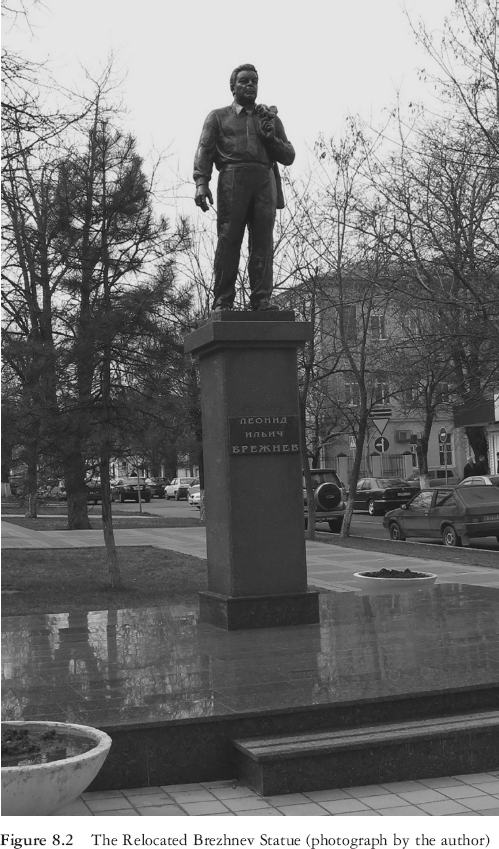
If the committee thought that it should have been the main decision-making body in the process, it was wrong, having been over-ruled by the mayor, with backing from the town council. My interviews with two key committee members eight months later demonstrated that the decision remained controversial, with one claiming that the mayor had succumbed to political pressure from several older citizens who had lobbied him directly by telephone. Ten of my interviewees with no connection to politics indeed perceived the decision to have been made by the mayor, while nine others saw the discussions as reflecting communal will, perhaps facilitated by the public debate in Novorossiiskii rabochii, whose editor felt that his paper had played the key role as ‘the defender of truth’ in the town. The very fact that such a prolonged and complex debate took place underlines the fact that social myth and memory may be collective, but that their significance remains personal and debatable. This analysis of the issues of agency in memory construction does not indicate a clear-cut case of top-down or bottom-up decision making, but demonstrates the important role of the mayor, who, according to the local press, did occasionally over-rule previous decisions.55 In the case of the statue, it appears that the mayor apparently rejected the officially appointed committee and acted according to the wishes of those people who had lobbied him directly in the old Soviet way, in an act of political self-defence. It seems that the case was swung by older citizens, more emotionally connected with the Brezhnev image, and more used to the old fashioned, direct approach which had occasionally succeeded in the past with petitions to the tsar or even Stalin. Their last-minute intervention prevailed over the much-vaunted democratic discussions in the media or the planned, more academic debate of the committee of experts.
The paradox of the twists and turns of the debate with its many last-minute decisions represents the success of informality over the more formal approach and a victory of political utility over historical accuracy, following a decision-making process that seems to have moved one step forwards towards democracy and two steps back to the old Soviet ways. The statue’s location was influenced not by the appointed ‘trustees of memory’,56 but by the generation that remembered Brezhnev’s visit, who selected their own image of Brezhnev’s link with Novorossiisk to be projected to their successors. It seems that the mayor’s political power for the present and the foreseeable future is built on the past, employing a more traditional, patriarchal type of authority and manipulating social remembrance for his own political utility, much as Brezhnev did himself.
Most of my respondents were not too concerned with the re-location and remained philosophical or even pleased about the outcome, although their positive verdict had much to do with the general refurbishment of the area and the installation of new gardens and a fountain. Young Elvira and Viktor, in his late sixties, thought the affair to have been unnecessarily protracted, while Boris, a veteran of the war in Afghanistan, considered the whole debate to have been a ‘potoploka’ (a quagmire), blaming the duma for the outcome rather than the local authorities. Other citizens expressed sentiments that would seem totally out of place in the capital: one contributor to a newspaper accorded Brezhnev god-like status by referring to the ‘blasphemy’ of moving his statue, while ‘Anya’ saw the re-location as traumatic as the exhumation and re-interment of a close friend: ‘Poor Brezhnev – he should be left in peace after his death.’57
For the moment, Brezhnev has settled into his current position. Despite the fact that several trees have been cut down to improve the line of sight from the sea – trees that have suddenly been judged ‘unstable’, but which in 2004 were hotly defended – the whole avenue, with its new fountain on the original spot of the monument, looks pleasingly open and symmetrical. The tall Novorossiisk Republic column in the centre is flanked by the smaller monuments to the founding father and to Brezhnev, effecting an implicit comparison between Nikolai Raevskii, the town’s nineteenth-century founder, and Brezhnev, its twentieth-century patron. Similarly, the symbol of the state in the form of the double-headed eagle atop the new monument complements the smaller statesman, linking the first bright days of communist ideology with the later days of stagnating socialism. In a re-signifying of space in the town centre there is now an historical continuum along the central reservation of the avenue, with an arrow of time running from the town’s foundation in 1838, via the 1905 republic to the Brezhnev era, such that the street may be read as a spatial memorial device within the topography of the modern town, where the image of Brezhnev on a human scale and with a human lifespan seems totally in proportion.
Now that the memory controversy is over and interest in it gradually wanes with the death of the older generation who fought with and for Brezhnev, it is possible that he may rest in rather too much peace as the statue fades comfortably into the memorial background of the town, as Connerton would suggest.58 Although popular as a background for wedding photographs,59 it is notable that the statue is not to be found on the tourist trail catering for the few cruise ship passengers from England and the United States occasionally visiting the town.60 The role of the tour leader is crucial in setting the mood and selecting the itinerary for tourists. According to guide Kseniya, she does not want to mention the statue to tourists, as she connects Brezhnev with his memoirs which she believes are false. Visitors are therefore shown the impressive Malaia zemlia memorial complex, which still evokes emotion, although its inscriptions are often no longer recalled to be quotations from Brezhnev’s memoirs. The Brezhnev connection apparently remains Novorossiisk’s private secret as far as foreigners are concerned, despite the fact that many of them would have heard of the former leader of the Soviet Union, demonstrating some continuing embarrassment on the part of some, at least, in Novorossiisk about the notorious Malaia zemlia memoirs.
If 2004 led to a debate about Brezhnev’s character and 2006 to a reappraisal of his political legacy, the 2009 discussion focused on whether Brezhnev should remain in the centre of town or on the periphery, while confirming the re-positioning of memory to privilege the 1974 visit over Brezhnev’s wartime role in 1943. Thanks to the continuing impact of the visit and its perceived economic consequences on the local consciousness, a decade of reverberations took place from 1999 to 2009, long after the 1974 visit, itself three decades after the Malaia zemlia campaign which originally saw Brezhnev’s involvement and led to the conferment of hero city status on the town. With this background still dominating public opinion, particularly amongst the older generation, Brezhnev was eventually deemed too important to be relegated to the outskirts of the town, which gave rise to a new commemorative discourse of the legendary walk in a revision of social remembrance, such that Novorossiisk now officially commemorates the charismatic private man rather than the statesman or soldier. This is in contrast to, but complements, memory of the general secretary elsewhere in the country which has remained caricaturised and largely static since his death, if with some softening evident around the time of his centenary. In Novorossiisk, it is Brezhnev’s perceived largesse and his more intimate side which are recalled: personal conversations and informal repartee. In line with the rest of the country, however, the Brezhnev era is loved or hated in equal measure by those who remember it, another facet of the town’s paradoxical identification with the man, if not always with the state he represented.
Brezhnev’s once-dominant wartime role may be on the wane in the local narrative, but it is still subject to political exploitation on a modest scale. Most notably, the mayor of Novorossiisk distributed specially reprinted copies of Brezhnev’s Malaia zemlia to veterans during the 2002 local election campaign.61 Two middle-aged women gave me bags of metal badges issued by the mayor since 2010 as rewards to children accompanying parents and grandparents to political meetings. In 2010 the young Colonel Brezhnev was one of a series of local Heroes of the Soviet Union on the badges, linking the forthcoming sixty-fifth anniversary of Victory Day with local elections in Novorossiisk. In a further series issued before the parliamentary elections, Brezhnev was depicted as the older statesman in a series of Soviet and Russian leaders from Tsar Aleksandr to Prime Minister Putin who had visited Novorossiisk. Whereas in the first series, the image of the genuine hero Tsezar’ Kunikov is juxtaposed against the giant Malaia zemlia memorial, in the later series, it is the Soviet leader who is clearly linked with the monument erected at his instigation. These badges use Brezhnev as a political tool to attract both the young and the elderly, just as Brezhnev himself employed his connection with Malaia zemlia for his own political ends.
In contrast, the main political driver for the re-location of the Brezhnev statue was simply the mayor’s rather sudden plans for urban regeneration, which altered the physical and political landscape around the statue to the extent that its very meaning was subject to a process of re-examination. The debate over the positioning of the new statue in Novorossiisk indicates that there is room for some individuality and personalisation within a local myth. Following a heritage controversy that exposed differences of opinion towards memory of Brezhnev and his role with respect to Novorossiisk, Brezhnev’s position nonetheless remains central both physically and metaphorically to the town’s identity today. The statue has enabled differences between memory of the elderly statesman and the younger private person to be publicly resolved in Novorossiisk. Largely thanks to memories of 1974 fixed in the minds of older citizens and now crystallised in the statue, the town has collectively selected the image of Brezhnev to be propagated to future generations: that of an energetic man in the prime of life rather than the caricature of the overseer of a period of stagnation, embraced by much of the rest of Russia. This significant difference between the local and the national verdict of history underlines the importance of personal contact and direct communication with the general secretary in an era when attitudes were generally formed and dictated by the more remote official mass media, which were instrumental in building up the war cult and disseminating Brezhnev’s memoirs nationwide. In contrast, Brezhnev’s 1974 visit to Novorossiisk was key in determining the town’s current interpretation of their own Leonid Il’ich, largely by means of the legends which have grown up around this charismatic and very human being.