
CHAPTER 14
To you from failing hands we throw The torch; be yours to hold it high.1
A special guest at the central Veterans’ Council in May 2010 was Prime Minister Putin, who took tea with a group of veterans on his visit to Novorossiisk,2 just as Brezhnev had socialised with former 18th Army combatants during his visit in 1974.3 Veterans of the Great Patriotic War are not only valued within the confines of the family circle, but have become increasingly esteemed within Russian society as a whole, which recognises the role they play in the propagation of the war myth to the young.
In the postwar years formal meetings of veterans were few, but, with a planned exhibition in the Novorossiisk museum on the fifteenth anniversary of the Malaia zemlia campaign in 1958, an official organisation for veterans of the Great Patriotic War was established to collect and organise exhibits. Crucially, at the time of the exhibition, veterans collectively and individually started publicly to recount their memories to young people under the auspices of the local Komsomol. Viktor Golikov, an historian by training, explained the reasoning behind this, stating that it was important for young people to learn about historical events from live witness testimony rather than from manuscripts or legends. The intention may have been laudable, but the reception by children of these often repetitive stories was not always positive.4
The duty of veterans as ‘authorised witnesses’ to educate the younger generation was also reflected in the stated motives for the publication of war memoirs during the war cult of the Brezhnev era. In exchange for their political loyalty the state implemented a new national policy for war veterans, such that, from 1965, veterans increasingly enjoyed privileged access to health services, housing, transport and sanatoria in line with the growing war cult in what Natalia Danilova terms a ‘reciprocal contract’.5
Mark Edele suggests that clashes of veterans with Communist Party organisations often took place nationwide, thanks to the transfer of power from party organs to local veterans’ clubs.6 However, in Novorossiisk collaboration with the Komsomol developed, involving significant educational work by the Veterans’ Council with young people in the Pioneers organisation.7 Grassroots lobbying of Brezhnev by the public forced the government to acknowledge the preferred status of veterans by increasing their benefits, consolidating the mutually beneficial implicit social contract between the state and veterans of the Great Patriotic War. By 1978 they were entitled to interest-free loans for the construction of houses and an annual holiday, with a 50 per cent reduction on long-distance travel to state sanatoria, all supposedly in return for their public loyalty and educational role.
The status of veterans came under closer state scrutiny with the onset of the war in Afghanistan in 1979, resulting in veterans of the Great Patriotic War enjoying greater recognition and privileges than those of this later, less successful conflict.8 The Novorossiisk Veterans’ Council moved to new premises in 1981, where the central branch is still housed, and the first women joined the group in 1982, reflecting an increasing national recognition of the role of women in the war.9 The preferred status of Great Patriotic War veterans was confirmed in the law ‘On Veterans’ in 1995, until the de facto failure of the reciprocal contract thanks to the economic crisis at the end of the 1990s, when many benefits were cancelled and the status of veterans devalued with the rouble.10
Today the reciprocity embedded in the implicit contract between veterans and the state is even more evident than in the Brezhnev era. The new war cult under Putin has led to a re-mobilisation of the few remaining veterans to appear in ceremonies of remembrance and to educate the young, such that it now appears that their public identity is linked predominantly with the war. Veterans are therefore in a position of key responsibility for the transmission of memory through the vospitanie of children, looking Janus-like in two directions: backwards to the past and forwards towards the younger generation. In a mutually beneficial role, they have become national treasures as probably the most important emotional ingredient of the war cult, to be wheeled out, bedecked with medals accrued over the years, by national and local politicians on every occasion connected with the Great Patriotic War, to the extent that I propose that there is now a veritable cult of veterans. In return, veterans have at last obtained the state and public acknowledgment they demanded during the final years of the twentieth century with a whole range of privileges amongst other less tangible marks of respect which provide evidence of their new, special position within society. However, it is their current status in comparison with the poorer treatment of veterans of more recent conflicts that reflects the importance attached to this particular group in their twilight years.
Victory Day celebrations are particularly significant, when every Great Patriotic War veteran receives an annual congratulatory letter from the president. Since 2013 younger citizens have been encouraged to pick up a postcard in a post office to send their thanks to a local veteran.11 In Novorossiisk the mayor issues invitations to all local veterans to attend theatre performances and concerts, dinners and the main Victory Day procession, where they are placed in seats of honour. Gifts are showered on veterans at this time. To celebrate the sixty-fifth anniversary of Victory Day in 2010 the mayor of Novorossiisk gave every veteran in the town a collection of items full of symbolism to recall their war years, including a folded triangular ‘letter from the front’, writing paper and a pencil, a bar of soap, a pouch of rough tobacco with a box of matches, a canteen and a bottle of wine. This recent special treatment is evident in a campaign of banners and posters on buses, kiosks and walls put in place across the town by the local council: ‘Dear veteran, your victory is eternal’, ‘Memory of your exploits will live forever’ and ‘Thank you for the victory, liberators of the town’. Improvements in their circumstances are also acknowledged by veterans themselves, and are linked by some younger interviewees to the fact that there are now very few remaining veterans and that the country is finally economically able to honour and care for them properly in their old age.
In 2010, for the sixty-fifth anniversary, the Novorossiisk town council supplemented golden signs marking the graves of veterans with new red plaques on the walls of the homes of living veterans. This gesture of respect was welcomed by three younger respondents, who for the first time were able to recognise and offer congratulations and help if necessary to their elderly neighbours, while those with cars were encouraged by posters throughout the town to ‘pick up a veteran’. Sealing the social contract, most schools in Novorossiisk look after their sponsored veterans: teachers and children give support throughout the year by cleaning or shopping, and special gifts are offered on Victory Day, for example a new refrigerator full of food.
However the most important year-round work with veterans in the community is provided by the chain of Veterans’ Councils in the region. According to a regional representative from Krasnodar, there were eight remaining Heroes of the Soviet Union living in the region in 2013, while the head of the town veterans’ councils claimed that about 6,000 veterans of the Great Patriotic War still lived in Novorossiisk. In 2006 the responsibility for veterans’ welfare was devolved to local authorities, although veterans of the Great Patriotic War still receive their pensions from the federal government.12 Although many veterans still cling to the belief that the state has a ‘moral duty’ to compensate them for their valuable war service,13 the ongoing social obligation to veterans in return for their role in the propagation of war memory is largely met by committed locals rather than any state mechanism. Funded partly by the region and partly by the town council,14 the smaller area councils in and outside the town look after their local community veterans, who form what Jay Winter terms ‘fictive kinship groups’ or ‘families of remembrance’,15 which promote common memorial interests whilst also comprising a mutually supportive social group.
In the outlying village of Myskhako, the head of the Veterans’ Council has worked there on a part-time basis for 16 years for the tiny sum of 500 roubles per month. Her office is located in the main town council building, which also houses the post office, guaranteeing a stream of visitors who often stop by for a cup of tea and a chat. The central position of the office is convenient for collaborative work with staff responsible for youth affairs and the local mayor himself in adjacent offices. The veterans are all known personally to the officers of the Veterans’ Council. Indeed, the organisation is so mutually supportive that it is difficult to distinguish between the veterans themselves and those slightly younger elderly people who help organise the series of activities throughout the year. Encouraged by the local mayor and councillor, the Veterans’ Council contributes substantially to the morale of members through commemorative activities.
Over the period running up to Victory Day in early May vintage war films are shown in the palace of culture in Myskhako, to which veterans have free entry.16 The library, also located in the palace of culture, similarly welcomes veterans, who not only still read the occasional book of war memoirs, but often attend anniversary parties organised by the Veterans’ Council and librarians jointly. For example, children presented flowers to veteran Lyubov at a ceremony held in her honour, with a presentation showing images of her both today and as a young person in the war, stressing her current identity as that of a war veteran. Vasilisa, another Novorossiisk veteran, stated that she appreciates flowers given to her by children as an indication of their vospitanie. In return for this attention from the state, region and town, many veterans are conscious of their continuing implicit duty to educate (vospityvat’) children in a revived tradition harking back to the postwar Soviet Union.17
However, the most important sign of loyalty to the state in exchange for the receipt of benefits is the public appearance of veterans at ceremonies of remembrance, especially Victory Day, a cultural indicator of the influence of the current war cult. From my observations, most veterans appear to welcome the recent increase in pomp of the Victory Day celebrations, while some particularly appreciate the participation of young people, who, since 2005, have been encouraged by the state to distribute St George ribbons prior to and on Victory Day.18 Flying from car bumpers, wing mirrors and aerials, these symbols of war memory are superficially reminiscent of British poppies or French bleuets (cornflowers), being offered in exchange for contributions to veterans’ welfare charities.19
Like the poppy and the bleuet, the official St George ribbon website proclaims it as a symbol of remembrance, respect and thanks to veterans. However, the distribution of the Russian ribbons, through the support of the political youth organisation Molodaia gvardiia (The Young Guard) and the educational movement Studencheskaia obshchina (The Students’ Society), is largely effected thanks to the involvement of young people. In this key respect, the distribution of the St George ribbon bears little resemblance to the work of often elderly members of the Royal British Legion.20
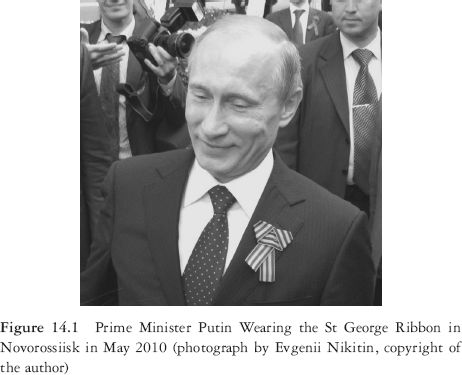
Wearing of the St George ribbon effects a sense of social unison on a national scale – what Benedict Anderson would term an ‘imagined community’ – emphasising a shared political, social and cultural background.21 This recent addition to social remembrance increases the political utility of the celebrations through a public proclamation of social cohesion. The lentochka (ribbon) movement has been both praised and condemned as a top-down exercise in the intergenerational marketing of remembrance across the country and beyond, a potent symbol of the widespread propagation of the current war cult and its values.22
The lentochka movement has already gained the status of a tradition in Novorossiisk. Based upon the much older award made to military personnel in the reign of Catherine the Great and named after the patron saint of Russia, it is a further example of a newly invented tradition built on a past system that resonates particularly well in the current memory climate, as evidenced by its universal acceptance within a very short period of time. This national badge of membership is yet another invented tradition grafted onto an earlier, established ceremony. Like the Candle in the Window movement, it has the effect of enriching, rejuvenating and refreshing the Victory Day celebrations, thereby rendering them more attractive to a newly mobilised younger generation.
This symbol has been recycled for current mnemonic and political use, promoting shared ownership of memory and capable of stimulating a spectrum of nuances as each generation reads something slightly different into the ribbon. Vera, a headmistress, recognises it as a longstanding symbol that has recently been resurrected, supported by Sonia, who feels that it retains its association with the pre-revolutionary Cross of St George, with its implications of heroic exploits and love of the fatherland. The St George ribbon poster, distributed widely in the region in 2010, contains an overt reference to the great USSR at its centre, but the ribbon itself demonstrates military continuity from prerevolutionary, through the Soviet period to the present.
Stephen Norris finds that the ribbon resonates well with veterans, who remember its use on Stalin’s Order of Glory awarded to rank and file soldiers. Despite this, he argues persuasively that it successfully fills the national need for a symbol of war memory not tainted with Stalin.23 The lentochka tradition appeared to be popular in Novorossiisk on my Victory Day visits in 2010 and 2015, when it was hard to see anybody without one. In addition to its fund-raising function, it is seen by many as an aid to memory in its own right. For example, veteran Vasilisa regards it as the declaration of a national wish to remember. A Novorossiisk newspaper journalist sees in the orange and black stripes a memory of the flame and smoke of war,24 while Dmitrii recalls it as the ribbon worn on a Soviet sailor’s cap, the legendary beskozyrka, whose symbolism needs no further explanation in this maritime town. It is not surprising that the ribbon that offers something for everyone should be so popular: indeed, Katherine Verdery argues that a political symbol is particularly potent ‘not because everyone agrees on its meaning but because it compels interest despite divergent views of what it means’.25 In an overt connection with the resistance to the occupation of the Soviet Union in 1941, it was even appropriated by pro-Russian fighters in Ukraine in 2014, not only as a symbol of memory and (Russian and Soviet) victory, but also of continued resistance to a government which some perceive to be illegitimate. In marked contrast, politically aware Elvira wishfully reads into the lentochka something particularly relevant to the domestic political climate: the gift of democracy from the Russian state to the people who crave it.
In the hands of energetic young people, the St George ribbon enables the propagation of memory from young people to the now passive oldest citizens, as the transmission of memory undergoes a process of reverse propagation. On Victory Day the memory message, with its new symbolism, defies the traditional propagation mechanism from older to younger generations, ensuring an evident solidarity between generations.
Through its attraction to young people, the lentochka movement introduces a new, youthful element into the already successful Victory Day celebrations. My observations indicate that young university students in bright red ‘uniform’ tee-shirts bearing the slogan ‘Ia pomniu! Ia gorzhus’!’ (‘I remember! I am proud!’) seem to control the mayor’s invited Victory Day audience, marshalling veterans as they hand to each a lentochka and an anniversary baseball cap. Victory Day, in this respect, has been appropriated by the new younger generation, not necessarily at their instigation, but apparently without coercion and with their tacit agreement, as evidenced by the enthusiasm with which they perform their duties. The Deputy Director of the Maritime Academy admitted that this may be exceptional behaviour, as his students do not always want to attend ceremonies of remembrance, deploying barely relevant excuses about lack of time. With their strong link to the military, however, students of the Maritime Academy seem bound by an inescapable social duty to be official representatives of their generation at Victory Day and other commemorative rituals.
If the official Victory Day ceremony in the centre of Novorossiisk is orchestrated by the local authority and largely in harmony with events on Red Square, less formality was observed on the town periphery in Myskhako in 2010. Veterans were gathered together in a brown military tent at a soldatskii prival (military field kitchen), feeding their nostalgia with wartime rations, mainly kasha (buckwheat porridge) washed down with quantities of vodka, all served by Cossacks. The old people gathered together in groups around the tables to sing war songs, pausing only at the interruptions of modern ring-tones as family members called to congratulate their own veteran. Such was the camaraderie among this community of remembrance that the pensioners seemed deaf to the official entertainment by children, local dancers and singers, in an example of overwhelming bottom-up ownership of a remembrance celebration by the oldest citizens. Eventually, the official speeches over, all participants came together on the same intergenerational wavelength as the vodka flowed, the officials retired and the unofficial dancing started. Apparently these veterans are not only enjoying their official role and recognition, but are happy to have taken full ownership of their new privileged social status in their twilight years.