
Section 1
In the stairwell of Komsomol’skaia pravda’s new offices, near Timiriazevsky Park in Moscow, hangs a plaque. Designed by Ernst Neizvestnyi, the sculptor harangued by Nikita Khrushchev at the 1962 Manezh exhibition, it commemorates the sixteen correspondents who died during World War II. The paper’s wartime sacrifices and its front-line reporting seemed to have restored its image in the eyes of the authorities after the Terror; the paper proudly displayed the ‘Order of the Patriotic War’ on its masthead. But hopes for a more harmonious relationship between journalists and officials were soon dashed. A Central Committee resolution of 1946, which accused the literary journals Zvezda and Leningrad of ideological deviations, illustrated the narrowed possibilities for artistic expression, with cultural production reduced to a purely edifying role.1 The resolution had obvious repercussions for the press. In the months and years that followed, journalists at Komsomol’skaia pravda constantly found themselves in the Komsomol’s crosshairs for its coverage of ideological questions both domestic and international.2 In June 1948, Mikhail Suslov, then a secretary in the Komsomol’s Central Committee, even attacked the paper’s Thursday night public events for focusing on entertainment over ideology.3
The anti-cosmopolitanism campaign, which reached the press in January 1949, was the most profound challenge to face the paper after 1945. The campaign took the form of an attack on ‘anti-patriotic’ (read Jewish) theatre critics, before broadening its focus to include academia.4 Whether because of a failure to read the signs, or out of a genuine desire to resist the campaign, editor-in-chief Anatolii Blatin kept the paper out of the fray even as other newspapers were sharpening their pens. By the start of February, following harsh criticism, Komsomol officials forced Blatin to apologise for the paper’s employment of ‘cosmopolitans’, and for printing articles by ‘bourgeois aesthetes’.5 A month later, Komsomol officials compiled a secret report which railed against the paper’s hiring policy, criticising the number of non-Party members in leading positions, and singling out an ‘abnormal’ number of Jews on the paper’s staff.6 It was ‘absurd’, the report’s authors concluded, to have a Jewish member of staff write the report from a Writers’ Union meeting on cosmopolitanism. By way of conclusion, the report earmarked nine members of the Moscow staff and two local correspondents for dismissal within the next year, though some continued to write under pseudonyms.7
But the use of pen-names would be the cause of the campaign’s next eruption, which took place long after Blatin was forced from the editor’s chair in late 1949. An article from the nationalist writer Mikhail Bubennov attacked a number of Jewish writers for using pseudonyms, and implied that this was a cover for ‘cosmopolitans’.8 After an angry riposte from Konstantin Simonov on the pages of Literaturnaia gazeta, the paper printed an article from Mikhail Sholokhov, author of the Stalin Prize–winning novel Quiet Flows the Don, which chastised Simonov for his ‘intemperate’ response.9 Simonov long wondered who was responsible for what he considered a ‘test balloon’ for a new anti-semitic campaign.10 Memoirs from insiders later revealed that Simonov was right: the article was brought to the paper by a ‘factionalist’ with links to the Kremlin who was soon forced out of the paper.11
The paper’s baleful entanglement with anti-semitism reached its peak in January 1953, as newspapers began to report on the so-called Doctor’s Plot. As part of a co-ordinated media campaign in which Stalin played a leading role, the paper published a front-page editorial, calling on readers to ‘Be Sharp-Eyed and Vigilant’, and recalled the just punishment meted out to a parade of ‘low-lives’, from Trotskyites to Nazis, who had been exterminated by the ‘punishing hand of the Soviet people’.12 The article, dripping with fears of spies, saboteurs and spilled secrets, was penned by Aleksei Adzhubei, a journalist who would play an important role in the development of Thaw journalism, and whose actions in the final days of Stalinism would be a source of considerable regret.13 While historians are divided about the ultimate goals of the campaign—prelude to a new wave of show trials or merely an attempt to maintain control over the security apparatus?—given the previous four years of anti-semitic campaigning, a new eruption was likely had it not been for Stalin’s death less than two months later.14
The strained atmosphere of Stalin’s final years, in which a single slip or a Party campaign could mean the termination of one’s job, was visible on the pages of the press. After a period of successful mass journalism in early 1930s, in which new construction projects and a parade of heroes encountered an enthusiastic response from readers, the Terror seriously undermined the press’s credibility.15 This crisis abated during the war, but as restrictions intensified so, too, did the press’s problems. With Kremlin officials reimagining the media as a hierarchical system (with Pravda setting the political agenda and TASS, the country’s main press agency, providing news) a climate of ideological mimicry became all-pervasive. In place of the ‘long-form’ writing (publitsistika) that had become more prominent during the war, the dominant genre of the late-Stalin period became the editorial, the importance of which can be ascertained by the lengthy discussions of such items in letuchki. Journalists could do little to criticise the Party’s priorities, but observations that the paper was ‘exceptionally grey’ and other negative epithets became increasingly frequent as the years passed.16 It was clear, then, that the ‘crisis of the propaganda state’ that David Brandenberger dates to the late 1930s deteriorated in the intervening decade and a half.
Thaw journalism did not suddenly begin on 6 March 1953, the day that newspapers announced Stalin’s death to shocked readers: habits and ideas formed over two decades are not transformed overnight. Behind the scenes, however, there were signs that the climate was gradually changing. Editorial meetings became noticeably less fraught as journalists used the calmer atmosphere to rethink their work. Newspapers began to recognise the damage caused by years of Stalinist control and sought to make themselves more attractive to readers, some by printing shocking news stories, others by seeking more involvement from readers. Even Pravda, the hidebound flagship of the Soviet press, began to innovate by offering more front-page space for reader-friendly news stories, rather than official announcements. An article published in that newspaper in May 1953 criticised its youth-focused namesake for failing to take into account its young readership.17 The paper was ‘striving to copy other general-political newspapers’ and, in doing so, it was alienating its audience, who needed articles to be ‘illustrative, accessible and interesting’. The article asked the paper’s journalists to essay a more youthful approach by increasing its coverage of reader-friendly subjects: more heroes, more discussions of love, and more on ethics and morality.
That more popular approach would bear fruit in the latter part of the 1950s and 1960s, and formed the foundation of the paper’s attempt to become the reader’s ‘friend and mentor’.18 But in 1956, a year that was to become a turning point in Soviet history, journalists also tried to be their protectors. Readers’ letters gave journalists ample evidence of miscarriages of justice, bureaucratic wilfulness and brazen corruption. Khrushchev’s ‘secret’ speech, with its frank discussions of violations of ‘socialist legality’, seemed to demand a decisive response to stamp out these ills. For the remainder of the year, journalists printed exposés of the most egregious examples of injustice, and sought redress for those affected. But as unrest stirred amongst the country’s students and in the Soviet Union’s European satellites, officials came to believe that the country’s stability was in danger from these revelations about the darker side of Soviet life.
1 ‘On the Journals Star and Leningrad’, 14 Aug. 1946 in Soviet Culture and Power: A History in Documents, 1917–1953, ed. by Katerina Clark, Evgeny Dobrenko (New Haven: Yale University Press, 2007), 421–4. On the background to this resolution see Yoram Gorlizki, Oleg Khlevniuk, Cold Peace: Stalin and the Soviet Ruling Circle, 1945–1953 (Oxford: Oxford University Press, 2004), 31–8.
2 M. Suslov, ‘Nekotorye zamechaniia ob osveshchenii voprosov ideinogo vospitaniia molodezhi v Komsomol’skoi pravde’, 24 Nov. 1947, RGASPI, f.1, op.32, d.450, ll.155–77 and ‘Ob osveshchenii voprosov mezhdunarodnoi zhizni v gazete Komsomol’skaia pravda’, 11 Dec. 1947, Ibid., ll.193–5.
3 ‘O ‘Chetvergakh’, provodimykh redaktsiei gazety Komsomol’skaia pravda’, 4 Jun. 1948, RGASPI, f.1M, op.32, d.510, ll.164–8. This complaint dated back to 1946: N. Mikhailov to A. Kuznetsov, ‘O chetvergakh, organizuemykh redaktsiei gazety Komsomol’skaia pravda’, 10 Jun. 1948, RGASPI, f.1M, op.32, d.366, ll.104–5.
4 ‘Ob odnoi antipatrioticheskoi gruppe teatral’nykh kritikov’, Pravda, 28 Jan. 1949, 3. On the campaign see Konstantin Azadovskii, Boris Egorov, ‘From Anti-Westernism to Anti-Semitism: Stalin and the Impact of the “Anti-Cosmopolitanism” Campaigns on Soviet Culture’, Journal of Cold War Studies, 4.1 (2002), 66–80.
5 N. Mikhailov to VLKSM Secretariat, ‘O pozitsii KP v bor’be s kozmopolitizmom’, 9 Mar. 1949, RGASPI, f.1M, op.32, d.586, ll.28–9.
6 ‘O krupnykh oshibkakh i nedostatkakh v rabote s kadrami v redaktsii gazety Komsomol’skaia pravda’, 20 Mar. 1949, RGASPI, f.1M, op.32, d.587, ll.1–10, quoted in Gol’dfarb, Komsomol’skaia pravda, 262–3.
7 Sofia Finger’s work, for example, was published under the name ‘Mokhovoi’, 20 Mar. 1950, d.89, ll.47–8.
8 M. Bubennov, ‘Nuzhny li seichas literaturnye psevdonimy?’, 27 Feb. 1951, 3.
9 K. Simonov, ‘Ob odnoi zametke’, Literaturnaia gazeta, 6 Mar. 1951, 3; M. Sholokhov, ‘S opushchennym zabralom…’, 8 Mar. 1951, 4; K. Simonov, ‘Eshche ob odnoi zametke’, Literaturnaia gazeta, 10 Mar. 1951, 2.
10 Konstantin Simonov, Glazami cheloveka moego pokoleniia. Razmyshleniia o I.V. Staline (Moscow: Kniga, 1990), 190.
11 V. Ordzhonikidze, Iu. Filonovich to Secretariat TsK VLKSM, 16 Dec. 1951, RGASPI, f.1M, op.32, d.662, ll.154–7; Boris Pankin, Preslovutaia epokha, 76–7.
12 ‘Byt’ zorkim i bditel’nymi!’, 15 Jan. 1953, 1. See also ‘Shpiony i ubiitsy poinmany s polichnym’, 13 Jan. 1953, 1. On the campaign see Gorlitski, Khlevniuk, Cold Peace, 153–9.
13 Aleksei Adzhubei, Te desiat’ let (Moscow: Sovetskaia Rossiia, 1989), 64–7.
14 For interpretations of the campaign see and David Brandenberger, ‘Stalin’s Last Crime? Recent Scholarship on Postwar Soviet Antisemitism and the Doctor’s Plot’, Kritika, 6.1 (2005), 187–204.
15 David Brandenberger, Propaganda State in Crisis: Soviet Ideology, Indoctrination, and Terror under Stalin, 1927–1941 (New Haven: Yale University Press, 2011), 181–97.
16 9 Apr. 1951, d.105, l.77. See also 11 Jul. 1949, d.79, l.50; 26 Feb. 1951, d.103, l.195.
17 ‘Byt’ drugom i nastavnikom molodezhi’, Pravda, 22 May 1953, 2.
18 Ibid.
1
The Stalinist newspaper is not the first place one looks for new ideas. The late Stalin period, spanning the years from the war’s end to Stalin’s death, has been called the ‘nadir’ of the Soviet press, and anybody leafing through a newspaper of the time would probably agree.1 From hectoring editorials demanding new sacrifices, news items detailing record-breaking grain yields, to fawning praise for the country’s ‘leader and teacher’, newspapers of the first post-war decade offer a vivid example of the ritualisation of Stalinist public life.2 That is the way it has looked to some scholars who have emphasised the press’s place at the forefront of the Stalinist ‘performance’. In this view, the Stalinist newspaper becomes a kind of ‘magical theatre’ whose productions can only be understood as a sort of alchemy.3 But even as the codes of Stalinist ritual became dominant, they were also being challenged. Reformist ideas began to appear—if only fleetingly—in thick journals and newspapers, while discussions of manners and morals allowed journalists to communicate with readers in a less hectoring tone.4 Most strikingly, journalists themselves—both in private and in public—began to challenge the rigidity of Soviet discourse. This chapter examines the apparent tension between a Stalinist press that was becoming more ritualised in its depictions of the world, and ample evidence of journalists’ dissatisfaction at those rigid discursive norms. It first outlines the tense atmosphere in which late Stalinist newspapers were produced, detailing the daily routines which served to discipline journalistic production, before moving on to examine the paper’s role in a key Soviet ritual: the Supreme Soviet election. Then, in the final part of the chapter, I show how, even as it participated in and perpetuated Stalinist rituals, the press offers glimpses of dissatisfaction at the ossification of public life. By criticising formalism in Komsomol settings and criticising disciplinarian approaches in schools, journalists envisaged a different kind of public life—not so much in opposition to Stalinist ideological precepts, but certainly as an antidote to empty ritual.
The processes outlined in this chapter both support and challenge existing ideas about Soviet ideology. Ronald Suny, for instance, has argued for its division into dogmatic and discursive poles: one characterised by the Party’s urge to systematise and canonise, the other by the everyday (mis)interpretations and adaptations that resulted when discourse reached the public.5 In this chapter we see numerous examples of journalists working to formulate and replicate Party dogma, but also examples of them reinterpreting this dogmatic language to create articles that might spark change. But from the polling booth to the meeting hall, the Stalinist public sphere was a performative space in which the two poles were supposed to coincide.6 Citizenship certainly depended on adhering to the form of the ritual and not necessarily the content—in elections and Komsomol meetings participation was validated, not the content of one’s soul.7 Yet journalists wanted to overcome the gap between form and content, dogma and discourse, by breathing life into tired rituals and harnessing the frozen language of Party propaganda to argue for a more holistic approach to the individual. Once we glance behind the scenes, then, the dogma–discourse binary comes under stress. The rituals and routines of late Stalinism were damaging to public life, but journalists’ activity during this tense period suggest that they could be used in creative ways that pointed towards the future.
Editorial Routines
Let us begin our exploration of routines and rituals on Pravda Street, Moscow, on the sixth floor of the constructivist building that Komsomolka’s journalists shared with Pravda, Trud and Sel’skaia zhizn’.8 An all-Union newspaper like Komsomol’skaia pravda was a complex organisational entity with its own routines: by 1950 it employed 179 staff, not including the printing plant next door.9 Complex organisations require complex bureaucratic structures to organise their activity: the newspaper’s redaktsiia was divided into fourteen editorial departments, a large group of local correspondents and a number of other departments, including a press bureau which distributed stories to other newspapers, and a typing pool. The staff list, which includes photo laboratory assistants, couriers, librarians, typists, cleaners and cooks, gives some indication of the living organism that constituted Komsomol’skaia pravda.
As the Komsomol’s official organ, and one of the country’s biggest newspapers, its activities were monitored both by the Komsomol from its offices on Old Square [Staraia ploschad’], as well as the ‘big’ Central Committee in the Kremlin. The editor attended regular meetings with Central Committee representatives to discuss current priorities, while editors sometimes called their overseers for advice on potentially tricky articles.10 The duty censor was not part of the staff, but very much a part of the newspaper’s everyday activity. In common with all printed publications, the bottom right-hand corner of the final page contained a code which stated the publication and the identity of the censor.11 Each day, a representative from Glavlit, the country’s censorship agency, occupied an office on the premises. Their job was to ensure articles did not reveal state or military secrets, then give their stamp of approval.12 But that was only the last of the ‘circles of hell’ that journalists had to go through to get their article approved.13 The process began with individual departmental editors, then passed to the paper’s secretariat, a ‘centre, co-ordinating the working of all departments of the newspaper’, and whose workers included correctors, photo retouchers, artists and staff responsible for layout.14 A responsible secretary, alongside a member of the editorial board, would either accept the material, or suggest corrections, then return the draft to the relevant department.15 Approval from one member of the editorial board was in theory sufficient for an article to appear, but contentious articles required more than one signature. Some baulked at such restrictions, but others were glad of the protection: ‘Our newspaper would have been shut down long ago if we printed your material with just one sign-off; thank God there are at least some checks’, said one journalist in response to such a complaint.16 Editors were able to override these procedures and print articles at their own risk, but it was not until after Stalin’s death that they began to do so routinely, meaning that this gauntlet of supervision was a day-to-day reality for Stalin-era journalists.
Aside from the paper’s network of local correspondents, the majority of the paper’s staff worked on-site. Every Monday morning, those journalists would meet in the ‘Blue Room’ for an editorial ‘letuchka’, one of three regular meetings at the paper, the other two being the weekly meeting of the editorial board (redkollegiia) and a daily planning meeting (planerka). The format of the letuchka was repeated every week: a journalist from the paper’s editorial staff would be charged with reviewing the previous week’s editions (the paper was printed six days a week, from Tuesday to Sunday), selecting the most important articles and linking them with the paper’s overall priorities. This would be followed by a general discussion, in which staff members developed the reviewer’s thoughts, and discussed broader priorities. The meeting would conclude with a round-up from the editor or, if he was absent, the deputy editor or Responsible Secretary.
Editorial meetings were not limited to the Soviet Union, nor to the Stalin era, but the way they unfolded challenges the idea that Stalinist culture was entirely performative. By drawing on long-established traditions of criticism and self-criticism journalists were able, as former staff-member Iurii Poliakov recalled, to ‘speak freely about the works of colleagues, without regard for written or unwritten censorship’, as long as they maintained an objective tone.17 Even when journalists came under attack, as Poliakov was for omitting to discuss an important article on ‘cosmopolitanism’, colleagues did not pursue the matter after the meeting. That was the tradition: ‘Criticise mercilessly, sharply, without the slightest intellectual spinelessness, but don’t go looking for punishment’.18 The transcripts of letuchki offer proof that under Stalin there existed ‘limited-public spheres’: spaces in which expert publics could discuss matters pertaining to the social good, albeit hidden from public view.19 Journalists’ animated discussions of even the most authoritative articles suggest that Stalinist language, as citational as it was, constituted a work in progress.
Such meetings suggest that Stalinist journalism could be a creative pursuit, but they also attest to an all-pervasive fear of errors, which were thought to ‘disorient’ readers and undermine their trust.20 Journalists blanched at the presence of ‘political’ errors in articles, and emphasised the importance of a group of ‘fresh heads’ who would re-read the paper at the dead of night to ensure correctors hadn’t missed something.21 It was correctors who did the bulk of the work to eliminate errors, but in doing so they also silenced the authorial voice. When influential novelist and critic Ilya Ehrenburg was asked to contribute an article—a major coup—he found that correctors had ‘worked on’ his writing to such an extent that it became a ‘grey editorial, identical to all the others’.22 Such practices were so pervasive that colleagues noticed when it was absent: ‘You get the feeling that the literary correctors didn’t work on this material; they didn’t make it dry. The material is written the way Russian workers speak’, commented one staff member approvingly.23 The corrector’s work was not literary, but political: a form of self-defence in political conditions where suspicion was widespread—and sometimes justified, given the presence of known ‘factionalists’ planted within the paper’s staff.24
Given this paranoid atmosphere it was imperative for everyone—not least the correctors themselves—to avoid accusations of subversion: it was all too easy for an innocent error to become a political error. A case in point was the panic over swastikas, a symbol which could appear anywhere from the lock of hair on a forehead to the threads in Stalin’s buttonhole.25 In one case from the final days of Stalinism, a corrector’s mark was not removed before a photograph went to press (Figure 1.1). A Komsomol official from Irkutsk noticed that the arrangement of pixels resembled a swastika and wrote to alert the paper.26 Given widespread perceptions of the unforgiving atmosphere, it is noteworthy that the paper tried to defend the responsible parties as a result of their long service, and handed out relatively lenient punishments (a verbal warning and a 10 percent reduction of their monthly bonus). The correctors were probably lucky that Stalin died between publication and the subsequent investigation. Nevertheless, the Komsomol Secretariat considered the paper’s punishment to be too ‘liberal’ and referred the matter to the Head of the organisation, Aleksandr Shelepin.27
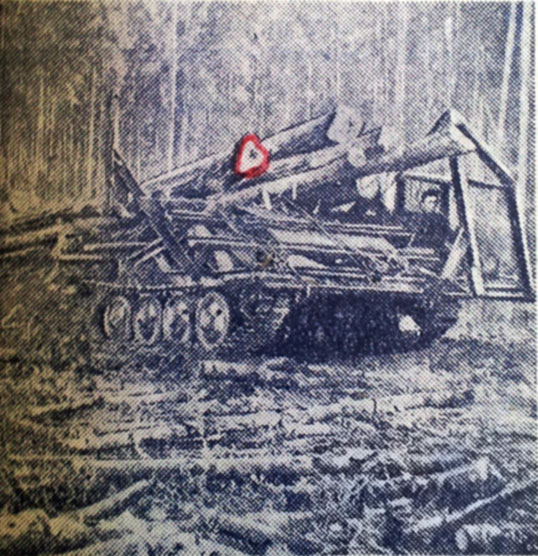
Figure 1.1 Picture of a logging vehicle with the offending ‘swastika’ marked by an official (Russian Archive of Socio-Political History)
Despite journalists’ frantic attempts to avoid errors, officials frequently upbraided the paper’s journalists and editors for mistakes. ‘Five years working in the Department of Propaganda left more scars on my heart than the next fifty years writing feuilletons’, recalled Il’ia Shatunovskii, whose spell in the Department of Propaganda between 1947 and 1952 was followed by a long and distinguished career as a satirist. He described a climate in which journalists were forced to second-guess the tastes of a capricious set of political overseers: ‘This was our work and our life. We got an article, checked the citations, sent it for typesetting and checked again. And once it was laid out we checked with colleagues from the bureau of corrections twice, maybe three times.’28 Barely a month went by without discussion of some transgression or identification of another which might yet attract the authorities’ attention.29 In 1950, the paper’s editor Iurii Goriunov was sanctioned by Politburo member Georgii Malenkov for an unacceptably large number of mistakes. Goriunov spoke of the paper ‘walking a knife’s edge’, and pointed to a list of mistakes that had been narrowly avoided ‘at literally the last moment’.30 His conclusion was that, given the gravity of the paper’s errors, he and the paper had got off lightly.31 Less senior journalists had been fired for inaccuracies in their work.32 But even when errors were avoided at the last minute, that still meant the paper was late to the presses so editions would not reach subscribers in outlying areas of the Soviet Union until the day—or sometimes two or three days—after. Journalists were subject to official censure for this, too.33
Terror, censorship, suspicion, pedantry: all of these added up to a fraught working atmosphere, reflected in editorial routines that tried to minimise both factual and political errors, and a professional existence which was highly precarious. It comes as little surprise that the journalism that emerged in this atmosphere was risk-averse. Rather than innovate, journalists preferred to copy tried-and-tested models from leading newspapers—especially Pravda. This was how things were meant to work: Stalin saw Pravda as the ‘newspaper of newspapers’ and wanted it to serve as the model for other titles.34 This hierarchical system made Soviet newspapers highly repetitive, both in form and phraseology. Articles composed of formulaic phrases and authoritative quotes from Stalin are one of the characteristic features of late Stalinist newspapers.35 They bear the hallmarks of the discursive hypernormalisation that Alexei Yurchak identified in the press of the Brezhnev era, but the hegemony of form weighed even heavier upon Stalinist journalists.36 Our exploration of editorial practices adds weight to Aleksandr Etkind’s contention that violence, or the threat of it, was one of the enabling factors for this normalisation of discourse.37 Journalists’ daily work was never more fraught than during the showpiece occasions to which Stalin’s name was connected. National elections, anniversaries and Party Congresses all imposed tight deadlines where errors were an ever-present danger. It is to one of those rituals that we now turn.
Public Rituals: Supreme Soviet Elections
In late 1949, as the dust settled on the festivities for Stalin’s seventieth birthday, editor Iurii Goriunov launched a post-mortem. The previous few weeks had been highly stressful, as the paper’s journalists worked day and night to ensure a suitable stream of festive material. Despite their best efforts, they failed. One authoritative article failed to materialise because its prospective author had a heart attack, another was so bad that ‘a schoolchild would be embarrassed to put their name to it’.38 Because of the tight deadlines, some articles went out without proper authorisation. Il’ia Shatunovskii’s autobiography suggests that the paper almost permitted an inadvertently subversive poem into print and were forced to stop the presses to avert a catastrophe.39 In the early hours of the morning, long after the birthday issue was supposed to be printed, journalists were forced to ring colleagues at Pravda to beg for a spare article.40 In the aftermath, correspondent Iurii Filonovich reflected that this should never be allowed to happen again: ‘after all, we have to answer for it, it’s our heads’.41 Such discussions give an impression of the fraught conditions in which the press’s supposedly authoritative words were produced: illness, staff shortages, tiredness and overwork were all ways that Stalinist discourse, once it left the Kremlin, was not so much sculpted from marble as nailed together from scraps.
Stalin’s birthday was of the most elaborate political rituals of the post-war era, alongside the Nineteenth Party Congress in 1952 (the first to be held for thirteen years) and another staple of Soviet political life: Supreme Soviet elections. In 1946 and 1950, Soviet citizens returned to the ballot box to elect the members of the country’s supreme law-making body.42 The only previous elections to the body had been held in December 1937 as part of the package enshrined in the 1936 Constitution.43 Now, after a gap of more than eight years, and against a backdrop of wartime rubble, new elections would take place. Over more than four months and hundreds of articles, journalists defined the campaign’s key issues, while agitators across the nation knocked on doors and held public meetings. Elections forced journalists to get to grips with the nature of Soviet power, describe its advantages over ‘bourgeois democracy’, and redefine the relationship between rulers and ruled for the post-war era. In doing so, they illustrated the paradoxical nature of a ritual positioned as an expression of Soviet democracy, but which simultaneously defined the terms of devotion to the Party and its leader (Figure 1.2).
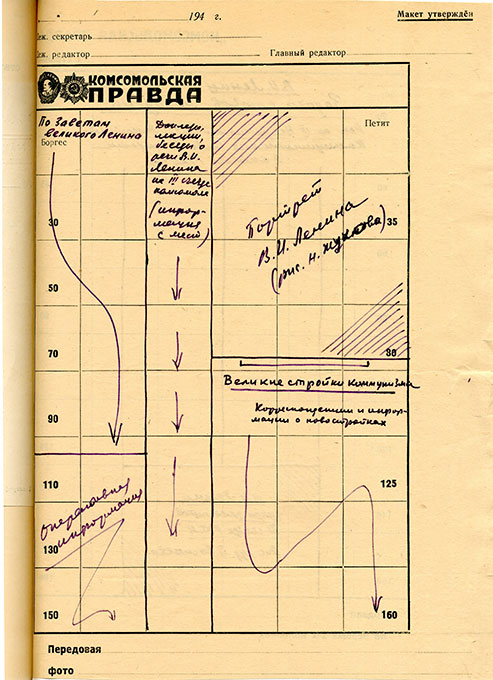
Figure 1.2 Mock-up front page for a special edition commemorating the 80th anniversary of Lenin’s birth, April 1950 (Russian Archive of Socio-Political History)
Campaign Messages
Before we examine the situation behind the scenes, let us first focus on the messages of this months-long campaign. Editors were expected to send periodic plans (weekly, monthly, quarterly) for verification from Agitprop, as well as post-campaign reports. One such document, sent to the Komsomol’s Central Committee after the 1946 campaign, divided the paper’s coverage into two main tasks: propagandising the benefits of Soviet democracy, and offering advice to Komsomols.44 Journalists dubbed the newspaper ‘a textbook for the agitator’s work’, offering talking points for conversations with voters, advice to Komsomol organisations in how to organise their work, as well as practical information on how the vote should be carried out (how to set-up polling stations, compile lists of voters, etc.).45
Another set of reports reveals another goal of the paper’s coverage in 1946: to help extend Soviet power to its new western borderlands. The paper sent senior journalists to the Baltic states and two ‘roving’ editorial teams to Belarus and Ukraine.46 This was a major undertaking: one team of twenty-one staff went to Western Belarus, where they stayed for forty-five days; another team was stationed in L’viv and Transcarpathia, where they stayed for seven weeks. Armed with a mobile printing press and typesetters, these editorial teams produced daily newspapers for locals, as well as agitational posters, photo albums, and canvassing letters. Working in difficult conditions—the reports suggest that working days of fourteen to eighteen hours were common—journalists tried to spread the communist message, while also providing assistance to the fledgling Komsomol organisation in its election preparations. As a subsequent report showed, the teams faced considerable difficulties in spreading the word to these new—and often unwilling—Soviet citizens. The report on Belarus admitted that the ‘unique’ political situation in Belarus had required a long period of ‘mastering the locality’ [osvoenie mestnosti], while in Ukraine, nationalist insurgents attacked polling stations and some voters crossed out the names of Soviet candidates.47 This was not mentioned in the report, however, which emphasised Western Ukrainians’ love for the Russian language, culture and song.48
Alongside this crucial organisational assistance to agitators, journalists’ main task was to proclaim the wonders of Soviet power by showing how life had improved since 1917 and would get even better in the future. At the heart of the 1946 and 1950 elections was a message that elections were a flowering of Soviet democracy, and voting was a crucial manifestation of citizens’ rights.49 Newspapers exhibited little squeamishness about the existence of one-candidate elections. Having eliminated antagonistic classes it was natural that class unity should lead to unanimous acclamation of candidates.50 ‘Genuine democracy’, claimed one article, was when ‘workers define policy for themselves, and carry it out in their daily conscious activity’.51 But to argue that voting in single-candidate elections was a ‘right’ was a tough sell. Voters asked many unwelcome questions about the practice of Soviet elections and offered examples of how their putative rights were violated.52 Journalists bolstered their arguments by offering examples of how the freedom of the press and multi-candidate elections in capitalist nations were undermined by inequality, racism and sexism, and rigged voting.53 Whatever citizens of bourgeois democracies offered in theory, journalists claimed that they were a poor substitute for a comprehensive system of welfare.54 This was one of the novelties of Soviet democratic discourse: ‘traditional’ legal rights (freedom of speech, equality under the law, etc.) formed part of the same legal universe as the right to employment, pensions, medical care and education.55
Dar’ia Garmash, the head of a tractor brigade and candidate for the Supreme Soviet, spoke of her happiness that women had the right to vote and stand as candidates, and contrasted these rights with life under Tsarism.56 A recent delegate at the International Women’s Congress in Paris, Garmash related her experiences in France, where she proudly explained to an American and a French woman how her work on a collective farm guaranteed her food and a salary, which allowed her to ‘live in comfort, without wanting for anything’. She then recounted meetings with French working class women in the French capital, painting a picture of poverty, ill-health, and hopelessness.57 This contrasted with a glowing portrayal of life in the Soviet Union in 1950, which cited rising living standards, greater availability of consumer products, lower prices for foodstuffs, a wave of housing construction and access to educational and cultural goods.58 Capitalist laws protected citizen rights in the abstract, but were monopolised by capitalist interests; Soviet rights allowed citizens to exercise those rights through access to work, leisure and education.
The 1936 Constitution made these rights contingent on the performance of duties, such as observing the law, protecting socialist property and undertaking military service.59 But even though it was not expressed in the Constitution itself, the document’s unofficial moniker as the ‘Stalin Constitution’ showed how Soviet legal rights rested on the generosity of the country’s leader. Soviet citizenship thus mixed two, seemingly incompatible, constellations of thought: the ‘enjoyment of new rights and privileges’ with ‘a perpetual being-in-debt’.60 Where citizenship was predicated upon legal norms, it gave itself to the language of constitutions, to procedural explanations of the workings of elections, to electoral lists and the counting of ballots. Journalists offered their readers tutorials on electoral law, and provided information to ensure they could exercise their rights in full.61 But where rights were presented as a gift, journalists adopted a different register, characterised by happiness and pride: ‘This is what it means to be a citizen of the Soviet Union! Great happiness’, wrote one correspondent from a village in Transcarpathia. ‘For this happiness we are obliged to the great Stalin. He, as our native father, cares for every Soviet person.’62
It was to express these bonds of obligation that the election campaign reached its most fevered. At each of the major staging posts of the campaign attention turned to the Stalin Electoral District, the only constituency whose residents could vote for Stalin directly. Journalists’ accounts of meetings held in honour of Stalin’s decision to stand describe ‘stormy applause’, ‘continued applause’, or even ‘continued applause leading to an ovation’ (like laughter, applause had its own codes).63 Such reports often concluded with a sequence of ritual exclamations such as ‘Long live our native father, the great Stalin!’64 By the week of the election, coverage of the election was almost indistinguishable from coverage of Stalin’s birthday: both featured a large, front-page portrait of the leader, reports of general rejoicing, as well as several poems dedicated to the country’s ‘father and friend’. Stalin’s pre-election speech in 1946, in which he gave a class analysis of World War II and outlined goals for production, became almost the sole focus of coverage in the days before the election; the paper’s election-day editorial spent more time discussing this speech than the vote itself.65 Similarly, the Central Committee’s decision to lower prices on foodstuffs in 1950 became one of the centrepieces of the campaign, with poems and letters offering thanks for this manifestation of ‘Stalinist care for the Soviet people’.66
Soviet citizens could offer partial recompense for this care through their labour.67 The election itself, the decision to lower prices, the announcement of the election results were all spurs to greater labour feats.68 Workers and collectives who donated a ‘production gift to the Motherland’ by fulfilling the plan ahead of schedule and socialist competitions between enterprises became staple news stories.69 To promote this wave of gift-giving, the paper’s editorial board devised detailed plans for articles aimed at metallurgists, coal-miners, oil workers, and tractor brigades, as well as reports on how to meet the five-year plan.70 Voting, too, was seen as a way of repaying debts. One voter was reported as saying that his vote was ‘a token of thanks to our Bolshevik party, to our Soviet government, to our native Stalin for his unceasing care for us’.71 Casting one’s ballot for the Stalinist slate was therefore depicted as a result of both deliberation and devotion: it was the outcome of deep reflection on the Soviet system’s benefits but a way of repaying the state’s care.
The two modes of newspaper rhetoric—one embedded in the language of rights and the other in the language of devotion—coincided on election day. Newspapers carried reports on turnout and the counting of votes, and they printed a sober announcement from the Election Commission of the results. But as Soviet citizens went to the polls, this language of rights was overwhelmed by outpourings of joy, pride and love for the country’s leader. Journalists stressed the ‘holiday’ atmosphere of election day, spoke of the excited hum on the streets, and the friendly relations between individuals.72 The election thus produced a liminal space where the social relations that were hitherto hidden—comradeship, patriotism and pride—became visible on the streets and in polling stations.
To the extent that citizens were voting for Soviet power as one, election day crystallised a key value that journalists had emphasised throughout the campaign: unity. Various kinds of togetherness came into play during the election campaign: unity between the peoples of the Soviet Union, unity between classes, unity between Party members and non-Party members, unity between the people and their leader and finally, unity of the people through their unanimous vote for Soviet power.73 Reports showed how difference had been eliminated: ‘Voting were the old Lieutenant Aleseev, housewife Ruchkina, the farmer Parushkina, on assignment in Moscow. Different people, different clothes, different ways of walking, different ways of speaking…But all this is one: our, Soviet people. One thought. One feeling. One will.’74 So repetitive were these messages of togetherness that the paper’s staff began to tire of them: ‘unity, unity and unity again’, remarked one journalist.75 But such rhetoric allowed journalists to claim that the electoral ritual had bridged the gap between representation and reality, turning togetherness on the page into something readers had experienced for themselves.
The View from Backstage
Aside from published letters and inscriptions to Comrade Stalin on ballot papers, which offer a highly skewed sample of responses, it is unclear how Komsomol’skaia pravda’s readers responded to the paper’s coverage.76 Diaries of the period display mixed feelings about the election, but whether they described their excitement at voting or described the ritual as a ‘comedy’, diarists appear to have understood what was expected of them and positioned themselves—positively or negatively—in relation to the campaign’s key messages.77 This suggests that, whether from newspapers, radio, oral agitation or posters, the main messages of the campaign reached the Soviet public.
But when our focus turns from the printed page to conversations in the paper’s offices, we are reminded newspaper coverage was the result of decisions taken in the heat of the moment, which often satisfied neither authors nor their colleagues. When we peer behind the curtain of the 1950 campaign, the negative mood is striking.78 Journalists and editors were deeply depressed by the paper’s performance and, following on from the debacle of Stalin’s birthday, the event prompted bitter conversations on how to move forward. The paper’s failure—for that is exactly how journalists saw it—can be partially blamed on a lack of staff: the campaign simply overloaded the paper’s capacities. The 1950 election was the final event in a stressful few months, with staff members already over-extended during Stalin’s birthday celebrations months earlier. The high stakes of the campaign meant the paper sometimes went out seven days a week, rather than the usual six, while also necessitating more rigorous checking of articles. Senior figures complained that they were unable to file copy because of a raft of new responsibilities, including checking junior colleagues’ work for errors—a task that was especially important given activists’ use of the paper to inform their own electoral agitation.79 That those events coincided with the removal of editor Anatolii Blatin, who departed under a cloud, only made the subsequent election campaign more fraught.80
Given the tense ideological climate of the late Stalin period, we might expect Party and Komsomol oversight to have prevented errors. As we noted earlier, editors were called in for regular meetings with officials, spoke to them over the phone and requested prior approval for important articles. Censorship, too, remained ever-present. But officials could hardly vet every article, as the need to stop the presses shows. Indeed, it is clear that a system of post-publication checking, rather than pre-publication approval, was already pervasive before 1953.81 Though a lack of documents means that our picture of these interactions is incomplete, journalists at the paper appear to have been more bothered by a lack of guidance from the authorities than by an excess of supervision. The need for such guidance is clear from journalists’ frequent glances in the direction of Pravda, a newspaper whose name was mentioned constantly in editorial meetings.82 The paper’s attitude to its prestigious rival is summed up by Dmitrii Goriunov’s comment advising colleagues that Pravda’s profiles should ‘serve as an example’, but also warned against ‘copying Pravda completely’ because of the difference in audiences.83
Despite the editor’s warning, Komsomol’skaia pravda’s coverage cleaved closely to the campaign at the country’s most prestigious newspaper. Aside from Komsomol’skaia pravda’s focus on the voices of young, first-time voters, the paper’s use of its senior cousin’s headlines and even phraseology is obvious. Journalists complained that the paper had ‘lost its specificity’, and that its headlines and articles looked just like those of any other newspaper.84 It was easy to offer a parade of Stakhanovites who had over-fulfilled their norms, but journalists considered such clichés to be ‘pitiful, meagre and stereotypical’.85 The question was how the paper could translate those heroes into icons for young people, which the paper struggled to do. Much derision was heaped upon the paper’s local correspondent for Armenia, Iurii Karapetian, for his profile of an agricultural worker in a mountainous region, who had collected record yields.86 While the article presented a positive picture of the heroic actions of a young Komsomol, colleagues castigated the article as ‘absurd’, and suggested that he had inadvertently painted Armenian agriculture as backward.87 Even when an article presented a positive message, journalists were attuned to the possibility of audiences reading it against the grain. What did it say about Armenian agriculture, they wondered, if agricultural students from Yerevan were learning from an uneducated girl in the countryside?
Karapetian’s article, tucked away on page three, was a short profile that probably went unnoticed by many readers. But journalists were similarly harsh on more high-profile articles and editorials, the latter a genre which was supposed to offer authoritative instructions but frequently fell short of expectations. Correspondent V. Semenov described editorials as a ‘painful place’ for the paper, and the process for publishing them as a ‘bacchanal’.88 His comments came off the back of an error-strewn editorial aimed at activists, which contained an abundance of incorrect information and non-standard ideological formulations, which led to the article being corrected at four in the morning.89 If we combine this evidence with the panicked atmosphere during Stalin’s birthday a few months earlier, it is clear that the paper was struggling to improvise a convincing line during the most strenuous months of the post-war period.
An abundance of errors was the first of three main criticisms aimed at the paper’s coverage of the election. The second was that articles were poorly written: editorials were condemned as ‘clichéd’, ‘repetitive’, ‘dry’, ‘boring’ and ‘grey’.90 They linked this lack of inspiration to a third complaint: that the paper’s materials were not ‘youthful’ enough. Journalists’ over-elaborate formulations were alienating for young readers, and the paper’s cast of protagonists was dominated by adults rather than young people.91 Both journalists and officials were beginning to acknowledge that this state of affairs was untenable. As the next section will show, journalists and officials were increasingly of the view that propaganda should be targeted to specific audiences, so journalists needed to ‘follow the lead’ of their readers.92 Audiences differed in their tastes, and an approach that worked with one reader might not work with another.
Broadly speaking, what journalists wanted—and this is evident in the rare occasions when they praised articles—was material that could be read by the broadest possible audience: something ‘lively and colourful’ and which avoided clichés.93 But the election campaign offered little opportunity for the kind of journalism the paper’s staff wanted to see. Save for the obligatory adjectives—ardent love for Stalin, boundless gratitude to the Party, enormous care for the Soviet people—there was little colour when articles touched on Bolshevik policies or contributed to the Stalin cult: that language was fixed. Where journalists could display a measure of creativity was in their portraits of election candidates. These potted biographies of the country’s best sons and daughters were far from perfect, and often veered into the improbable, as was the case during the 1951 RSFSR elections, when the paper depicted a Komsomol secretary who was a good public speaker, head of the activist circle, as well as an sportsman, artist, actor and orchestra conductor.94 At their best, however, candidate biographies offered a glimpse of a different kind of journalism, in which the drama of socialist construction and the individual’s self-development could be intertwined. Semyon Garbuzov’s profile of Danutė Stanelienė, a Stakhanovite from Plungė in Lithuania, took readers from the darkness of bourgeois Lithuania, in which she had been forced to finish her schooling because her parents couldn’t afford new boots, to the Stalinist Soviet Union, which provided her with an education and transformed her into a Stakhanovite hero.95 Articles like Garbuzov’s pleased journalists because they illustrated the rags-to-riches possibilities that Soviet power brought, but did so in a way that didn’t merely assert these benefits, but allowed readers to ‘feel’ how it had improved the lives of young people in the Baltic states.96 During the Thaw, as journalists searched for more productive ways of describing the individual, this combination of individual and national biography was one of the models to which they would turn.
Journalists’ discussions over the weeks and months of the election campaign lay bare their dissatisfaction, both with the disorganised state of the paper’s redaktsiia but also with the restrictive codes of propaganda. But their concern with broadening the compass of agitation didn’t mean that journalists stood outside the gravitational pull of Stalinist rituals. The closer they came to a sacral zone in Soviet society—a festive date, Soviet power or Stalin—the more likely they were to change the way they spoke, in a way that jarred with the language they were using just moments before. One reviewer spoke of the need to ‘convey to readers the rousing, joyful, celebratory mood of the Soviet people, to express their boundless devotion to Soviet power, the Communist Party and to their great leader, Comrade Stalin’.97 When talking about Stalin it was almost obligatory to employ a different tone. He was routinely described as a ‘genius’, and also as the ‘beloved leader and teacher’, or as a ‘leader of workers of the whole world’.98 There existed no dispassionate language for talking about him and an unadorned ‘Stalin’ in conversation sounded wrong: ‘Comrade Stalin’ was the most neutral formulation.99 That this authoritative discourse was required for other subjects, as we see in the reference to Soviet power, the Party and workers of the world, suggests that these, too, were sacred values. Stalinist authoritative discourse was an attempt, conscious or unconscious, to mark certain ideals—Stalin’s love and devotion, the Party’s beneficence, the unity of the people—as sacred; its force was undimmed even in private meetings.
We cannot know if journalists really believed in the ritual, and the question of belief is in any case ill-posed. Rituals produce common practices, not common beliefs.100 For our purposes it matters more what journalists said and did, and what others said and did because of it. On the evidence of their writings, both in private and in print, and from words uttered in editorial meetings, it seems that journalists were both orchestrators and participants: they spoke as professionals who recognised the limitations of their propaganda, but remained within the gravitational field of Stalinist ritual. The Party was never in complete control of the final iteration of that ritual: stopped presses and late-night phone calls show that politicians could supervise, verify and guide, but extending the performance beyond the walls of the Kremlin had unpredictable consequences. Editors sent plans, and even mocked-up front pages for officials; they sent drafts of articles if they wanted guidance. But hands-on supervision for every single article was unworkable, so journalists and editors had to make their own decisions. Editorial transcripts, which feature criticisms, arguments and even mocking laughter, suggest that they didn’t always make the right ones: ‘totalitarian’ power is rarely as total as it seems. It seems more appropriate to think of the makers of Stalinist rituals not as a well-trained orchestra, playing in perfect harmony, but as a rag-tag troupe of musicians of varying quality, improvising variations on a familiar melody. Most of the time, they managed to play something that approximated a well-known tune. But, as the performers were only too aware, there were a lot of wrong notes along the way.
An Individual Approach
At the start of January 1946, the paper published an article for agitators as part of the election campaign.101 Its author was Aleksandr Shelepin, then a member of the Komsomol’s Central Committee, who would serve as its First Secretary between 1952 and 1958. The article railed against the ‘formalistic’ approaches used by agitators, who often reeled off a series of statistics and slogans to convince listeners of the Soviet system’s superiority. This ‘once-size-fits-all approach’ to agitation failed to convince, Shelepin argued, because it failed to take into account the specifics of its audience. Such an approach was not simply ineffective, but also ‘contradict[ed] the spirit of Bolshevism’. In Shelepin’s reading, Bolshevism was a doctrine which made possible the ‘all-round development of the individual inclinations of Soviet people’, with the individual nurtured ‘as a gardener tends to a fruit-bearing tree’.102
Shelepin’s demand for an ‘individual approach to the person’ during the 1946 election campaign points to two important tendencies. The first was dissatisfaction with the predictability of Soviet propaganda and the rigidity of public expression. As journalists struggled, under pressure from officials, to produce readable material, the pages of Soviet newspapers registered doubts about the stifling forms of communication that characterised the public sphere. The second trend concerns the relationship between the individual and society. Since the late 1930s, a subtle but crucial rhetorical transformation had painted the individual not merely as the product of the socio-economic base, but as the possessor of innate talents and abilities which dictated their future.103 Journalists, among others, were at the centre of this shift from nurture to nature.104 They painted the Soviet Union as a meritocratic society, in which ‘neither riches nor fame, but only one’s own abilities…dictate the position of a person.’105 Shelepin’s idea of an ‘individual approach’ existed at the intersection of these two trends: it was an expression of frustration at Soviet propaganda’s inability to motivate its audience but also stemmed from a belief that every individual was unique, and might not be swayed by general phrases and slogans. Amidst the stultifying climate of late Stalinism, this was a sign that officials were beginning to doubt the effectiveness of propaganda and seeking an exit from its worst excesses.
The lack of inspiration in Soviet discourse was noticeable most of all in the halls, lecture theatres and classrooms where public gatherings took place. From the 1930s onwards, as ideals of public speaking shifted from the spontaneity of ‘people’s oratory’ to pre-written speeches following the norms of written language, tedious meetings became an unavoidable part of public life.106 A poem by the well-known poet and lyricist Vasilii Lebedev-Kumach, published in the run-up to the 1946 election, nodded to these problems: ‘I am a young voter / and I’m voting for the first time…/ I don’t want a speech / From a piece of paper, like a lesson / A speech should be from the heart, / beating and lively!’107 The poem suggests that the opposite was the norm: most speeches in public settings were scripted, didactic and dull. Such complaints were voiced frequently before the war, but in an post-war era where Stalinist discourse was becoming ever-more ossified, their appearance in the public sphere was significant. At a celebration of the paper’s 25th anniversary in 1950, editor-in-chief Dmitrii Goriunov complained of members ‘run[ning] like the wind’ from Komsomol meetings and criticised the paper for failing to do more to ensure that Komsomol activities could ‘attract’ and ‘rouse’ young people.108
But, perhaps unbeknownst to the paper’s new editor, the paper had long tried to counter these formalistic tendencies. They criticised meetings that wasted attendees’ time, formulaic questions with formulaic answers, and internal elections where positions had already been allocated.109 Most strikingly, in 1948, in consultation with the Komsomol’s high command, the paper launched a campaign to improve the culture of speech within the Komsomol. The opening salvo in the campaign was launched by two Komsomol secretaries from Moscow, who argued that it was more important for speeches to be spontaneous than read from a script. In a letter published in February, they related their experiences at a meeting of Stakhanovites in Kiev.110 There, the Head of the Organisational Department demanded that all speeches be submitted to him in advance and took the liberty of editing their texts. What followed, the writers argued, was a procession of dreary addresses which sounded more like reports than genuine speeches. Each contained a mass of facts and figures, combined with vague statements divorced from the everyday practice of Komsomol work. The writers argued that the practice of using crib-sheets [shpargalki] had damaging consequences: ‘People have forgotten how to speak in lively, conversational language; forgotten how to think, to search for new words, new turns of phrase, for vivid examples.’ Only when all speakers had learned these skills once more would meetings become ‘more lively and more interesting’.
Behind the question of crib-sheets was a subtle indictment of the post-war Komsomol. The cookie-cutter activities performed under the Komsomol’s banner contradicted the idea of meaningful action. Most Komsomol members had witnessed the kind of meeting the authors discussed, which descended into endless recitations of statistics, tasks carried out simply to fulfil ‘the plan’, motions carried ‘unanimously’ and, on the sidelines, the ordinary Komsomol member silently reading or staring into space. The question of ‘lively’ speech could be seen as a test case for the health of the communist idea. If speakers couldn’t turn Soviet discourse into something engaging, perhaps the discourse itself was at fault?
It is little surprise that readers responded enthusiastically to the call for ‘vivid, deep, accessible and convincing’ speech. In a selection of letters published a few weeks later, readers related their own experiences, either as speakers forced by officials to used pre-vetted scripts or as members condemned to listen to them.111 The paper organised a meeting of Komsomol organisers from Moscow, a condensed transcript of which was printed in the paper.112 Speakers criticised the practice of using written texts for speeches and shared their disheartening experiences of listening to such dreary orations. A certain Comrade Sitnikov, a member of the Komsomol Committee at an electro-mechanical institute in Moscow, complained that when speakers read from a text, ‘without soul, without expression’ then nobody listened to them. It was far preferable, Sitnikov argued, for someone to speak ‘maybe not so smoothly’ but nevertheless to ‘express their own thoughts, coming from the soul’.113
Who could argue against the idea that someone’s actual words—even if they were not so clear—was better than a speech that was edited to be smooth but lifeless? But the transcript of the meeting, held in the Komsomol archive, suggests that the paper’s journalists were guilty of editing the life out of Sitnikov’s speech:
|
Sitnikov’s original speech114 |
Published version115 |
|
When a speaker speaks from a pre-prepared prompt-sheet [konspektu], the audience goes to sleep, because the phrases are all memorised and learned, but when a lad comes up and speaks, maybe clumsily and badly, but from the soul, the audience livens up. The practice of pre-written speeches is a very harmful practice. These are all standardised speeches. A week before his speech a person takes a pile of newspapers and chooses various citations. I like it a lot more when a person speaks from the soul, without any prompt-sheets. Maybe they speak with bad Russian, maybe they stammer a bit, but they say what the masses are feeling, and not elevated phrases that are repeated in every meeting. |
When the speaker reads a text without soul, without expression, the audience doesn’t listen. Even if a Komsomol member is interested in the meeting, their active engagement decreases, their interest is extinguished. And then another orator comes to the tribune. They don’t speak as smoothly, but they express their own thoughts, coming from the soul, and the audience livens up, it starts to react sharply to the speech. Every speech should be the fruit of independent thought. Only that sort of speech can rouse another’s thoughts and interest Komsomol members. |
Seeing the two versions side by side, it is evident that the printed version is unfaithful to Sitnikov’s mode of expression, even if the sentiments are similar. The vivid phrase from which the article takes its title (‘Every speech should be the fruit of independent thought’) is the product of journalistic invention, while the most memorable phrase in the original—‘When a speaker speaks from a pre-prepared prompt-sheet, the audience goes to sleep’—is neutered to ‘the audience doesn’t listen’.116 Similarly, the idea that a speaker could do so with ‘bad Russian’ and ‘stammer[ing]’ was a step too far when cultured speech had acquired such enormous importance, so journalists referred instead to someone who doesn’t ‘speak as smoothly’.
Herein lies the paradox: even as the paper railed against the practice of Komsomol secretaries vetting and editing speakers’ words, its journalists were guilty of the same sin. The discussion of shpargalki thus points towards the possibilities and limits of reform in the final years of Stalinism. Although the paper often spoke out against ‘formalism’, its coverage of Komsomol issues too often focused on the formal aspects of the organisation’s work, with the unwelcome result that articles were, as correspondent Vladimir Dudintsev complained, ‘like two peas in a pod’.117 By sprinkling their articles with the leaden prose of Stalinist cliché, the paper kept readers at arm’s length from their organisation and negated the possibility of meaningful engagement with its affairs.
It also prevented Komsomol members from displaying ‘initiative’, a term which became a cure-all for the organisation’s ills. In the immediate aftermath of war, ‘initiative’ would be required if Komsomol members were to undertake reconstruction work based on their own assessment of need, rather than waiting for approval from above. But the term was more broadly used as a critique of certain modes of acting and thinking. By waiting for orders from above, Komsomols were hindering the country’s movement forward and turning communism into a series of rules and routines. Officials should get out of the obkom and into the real world: ‘Initiative is born through interaction with people’, argued one article, continuing with the assertion that ‘[a] worker who spends the majority of their time in their office, without interacting with youth, without knowing their needs and demands will not be able to take note of and direct initiative.’118
It wasn’t just that Komsomol officials lacked initiative, but that they neglected the caring sides of their work. Journalists writing about the Komsomol argued that an official who treated the rank-and-file callously, without regard to their individuality, was breaching their rights. Editorials and feature articles frequently asserted that Komsomol officials had a duty to rank-and-file members even when they stepped out of line, and asserted that they would perform their role more effectively if they knew and valued them as humans.119 A 1948 article attacked the over-zealousness of Komsomol officials who excluded a member for a minor infraction of factory discipline.120 Those officials, the article concluded, had contradicted the idea of the Komsomol ‘as a nurturing [vospitatel’noi] organisation with a burning interest in the fate of every young Soviet person’.
These references to the Komsomol’s duty of care brings us back to the article with which we began this section. There was no great distance between the idea that Komsomol officials should look beyond paperwork to ‘see a living person’ and Shelepin’s demand for agitation that treated its recipients as individuals.121 Both were premised on the idea that a formalistic approach to the Soviet person was alien to a movement which was in the business of transforming lives. This vision of the relationship between the state and its citizens relied on the notion the Party was the great protector of the Soviet individual: one of the most ubiquitous formulations in the Stalinist lexicon was to express the Party (or Stalin’s) ‘care’ for workers, peasants, youth, or any other social group. But out of this unpromising territory there emerged a new vision of moral upbringing—as well as a new vista for Soviet journalism.
This new journalism emerged from the Department of Schools [Otdel uchashchiesia molodezhi], a section which, in the form of Kira Iakovleva, Vera Benderova and Frida Vigdorova, boasted some of the paper’s most inventive writers. And it emerged in a period which, on the surface, would seem to be wholly inauspicious for journalistic invention. Not only was Soviet journalism labouring under the burden of citationalism, but schools had been subjected to disciplinarian reforms in 1943 and 1944 which gave teachers far greater authority over students and introduced single-sex schooling as a means of curbing misbehaviour.122 The ‘Rules for Pupils’ published in 1943 contain twenty directions, including demands for pupils to ‘sit up straight without leaning on the desk’ and not to speak unless spoken to.123 Far from reasserting discipline, these reforms created new problems. A heightened focus on exams gave rise to what today’s pedagogues call ‘teaching to the test’, where teacher and pupil focused on examinations to the detriment of their all-round education. This atmosphere of ‘rote learning and cramming’ proved inappropriate for preparing students for the world of work: it taught them to remember facts, but not the creative thinking necessary to function in the wider world.124 This renewed focus on exams also increased the number of failing students: it created an effective two-tier system which privileged gifted or adequate students over so-called ‘vtorogodniki’ who had to repeat the year.125 The reasons for failure were complex, and had much to do with the straitened material and social conditions of the post-war Soviet Union. Inadequate school facilities, teacher shortages and insufficient pedagogical training combined with the war’s baleful legacies—absent parents, psychological trauma, material deprivation—to create a bleak environment for learning.126 In spite of this, the Ministry of Education placed the blame for pupils’ failure on teachers. Pedagogues were expected to overcome material hardships, their own lack of training and overly ridged learning requirements to find an approach that would enable all children—even the less academically gifted—to thrive.127
After the death in 1946 of Vladimir Potemkin, the hard-line Minister of Education, both central and local officials seemed to agree with pedagogical experts that Soviet education needed fresh ideas.128 The final years of World War II to the early 1950s, the specialist and national press staged numerous discussions about the future of Soviet education, which helped forge a new educational orthodoxy after Stalin’s death. As a newspaper oriented towards young people, Komsomol’skaia pravda played a pivotal role in these debates. While it frequently carried boilerplate articles on the importance of patriotism or the state’s priceless gift of education, the paper’s provocative articles challenged educational orthodoxies and advocated a more child-centred approach to education. Teachers would not simply indoctrinate children, these articles argued, but also attend to their spiritual health.
At the head of these reformist currents stood the figure of Frida Vigdorova, a pedagogue and journalist who had just turned thirty at the end of the war. Born in Belarus just before the revolution, Vigdorova worked as a teacher in the 1930s, first in the under-construction city of Magnitogorsk and then in Moscow.129 After a few years, she transferred her energies to journalism, first at Pravda and then, from 1944, at Komsomol’skaia pravda, where she remained until 1948. After Stalin’s death, Vigdorova became an influential intelligentsia figure advocating reform through her novels and journalistic articles. She vigorously defended Joseph Brodsky, on trial for parasitism, in the months before her death in 1965: her reports of the trial circulated in samizdat, and Brodsky is said to have hung her portrait above his desk for many years.130
Maria Maiofis, who has explored Vigdorova’s influence on late Stalinist pedagogy in the most detail, emphasises the importance of My Class, Vigdorova’s 1948 novel about a schoolteacher, as a vehicle for her ideas.131 However, the thoughts outlined in this immensely popular novel first appeared in print a few years before, in a series of articles published in Komsomol’skaia pravda. In her role as schools correspondent, Vigdorova became one of the most passionate advocates of new thinking on education, helping to introduce new rubrics and publishing widely on pedagogical themes. Prominent in her articles is the image of the teacher as a thoughtful individual who should regard each child as a puzzle to be solved. Such humanistic language drew on the collectivist ideas of Anton Makarenko, the banned discipline of pedology, and also on the individualising rhetoric that had become increasingly ubiquitous in Bolshevik discourse since the 1930s.132 And it was also indebted to the notion of Soviet ‘care’ for the individual and the increasingly common idea, hinted at in Shelepin’s article, that individuals possessed different temperaments and capabilities that needed to be nurtured through an ‘individual approach’. In other words, Vigdorova’s journalism drew from an already-existing vocabulary of human development—just as the Thaw’s pedagogical discourse of independent thinking and initiative was influenced by Vigdorova’s concern for the flourishing of the child. By focusing on the paper’s pedagogical advocacy in the late 1940s, we begin to see the outlines of an alternative genealogy of the Thaw in which its characteristic humanism is a development of, rather than a break from, Stalinist discourses.
One exemplar of Vigdorova’s humanism was a two-part article published in late 1946, entitled ‘They Seemed to be Hopeless Causes’. The first part tells the story of one such ‘hopeless’ cause: Kolia Savenkov, a failing student who is rude, impudent and badly behaved.133 Marina Katilova, his teacher, has tried everything to improve Kolia’s behaviour, including the idea, familiar from pedagogical lore, of making him the class elder. But the established formulae don’t work, leaving his teacher infuriated: ‘Looks like we’ll have to expel you from school!’ she says in a fit of exasperation. But what follows is the story of Kolia’s integration into the collective. His epiphany comes from an unexpected source. Marina, against her better judgement, notices Kolia’s worn shoes and gives him a coupon for new ones. The new shoes have a positive effect: Kolia feels proud of his new footwear and his teacher spots him cleaning them with a handkerchief during a break. Marina draws the conclusion that disciplinarian approaches were inappropriate: ‘I had shouted at Savenkov, threatened him with expulsion…act[ing] according to pre-prepared recipes from a book, proceeding not from the heart but from the brain, as they say.’ But Marina was herself an orphan, and chides herself for not remembering ‘what it feels like to live without warmth, without kind words. Savenkov was just a twelve-year-old kid. Why couldn’t I have found a kind word for him?’ Having gained Kolia’s trust, she later reflected that she hadn’t managed to make him into a good class organiser, nor an outstanding student, but she had managed to stop him disrupting classes and persuade him to do his homework ‘as well as he could’. More than academic achievement, what really mattered was that teacher and child had found a means of communication: ‘patient, heartfelt, and full of deep trust’. Rather than a morality play about the need for disciplinarian pedagogues and meek pupils, Vigdorova depicted a child who was flawed but essentially good, and a teacher who was vulnerable and self-doubting.
According to the article’s introduction, Marina was a teacher in Moscow’s School No. 593, whom the editors of the paper had asked to talk about her work.134 In fact, this was artistic subterfuge: both Marina and Kolia were inventions. The fictional ruse wasn’t revealed until February 1949, when excerpts from Vigdorova’s articles become part of My Class. In the introduction to the finished volume, Vigdorova stated that the children she described came from real life, but that Marina was a composite who included ‘the traits of many young Soviet teachers whose work I have had occasion to observe’.135 The author also mentioned how she had drawn on readers’ enthusiastic responses to her articles, as her audience—many of them teachers—offered their own comments, reflections and experiences. A feedback loop thus developed in which articles generated responses from readers, which then generated further articles and novels.
Though semi-fictional, Marina’s story shared many features with Vigdorova’s run-of-the-mill propaganda work where references to love, the heart, to trust and to ‘human connections’ are similarly prominent.136 What Soviet pedagogues had in mind when they used the term ‘individual approach’ was an idea of a personal connection, whether between child and teacher or between child and collective. These connections would come about not through ‘pre-prepared recipes’, but rather from trial and error, from teachers finding a means to unlock the individual child’s soul.137 As she wrote in her December 1946 article: ‘One has to understand how to capture a person’s attention, how to attract their interest. One has to find in each person their very own secret, the button that you, the teacher, need to press.’138 Vigdorova set out to demonstrate the processes through which teachers could locate that button.
‘They’re All Different’ reads the title of one of Vigdorova’s articles from early 1947, expressing succinctly her key pedagogical idea.139 In it, she contrasts two teachers, both considered exemplary: Zoia Konstantinovna and Natal’ia Mitina. But it was obvious that Mitina’s pedagogical methods were closer to Vigdorova’s heart. The narrative centred on two ‘problem’ pupils: Vitia and Misha. Vitia’s story was deeply troubling: during the war a German soldier had asked him to fetch an axe and threatened him. He had been struck dumb with fear, and for a long time was unable to speak. He now had a stammer and during lessons he simply looked out of the window waiting for his mother. Two years late to begin school—he was already nine—he had become self-conscious of being older than the other children. Within the circumscribed parameters of post-war discourse, this candid discussion of Vitia’s wartime experience constituted one of the strongest possible expressions of trauma, given that journalists usually confined themselves to euphemistic mentions of ‘deep shock’.140
Vigdorova’s second example was less disturbing, but was still focused on a ‘problem’ child. Misha was a poor student who seemed unable to answer the simplest questions; his teacher warned his mother that he would probably need to repeat the year. Misha’s mother explained to his teacher, Zoia Konstantinova, that Misha was very shy: perhaps he was scared in class? But his teacher refused to adapt her approach to her pupil, telling Misha’s mother: ‘I’ve got forty, I can’t know each one in detail.’ This was the crux of the article: Konstantinova could reel off the academic achievements of each pupil—‘he’s usually a B student but he always gets an A for arithmetic’—but she had no idea about their personalities. Mitina, by contrast, kept detailed dossiers of each pupil, paying close attention to their disposition.141 Aware of Vitia’s embarrassment about being older than his classmates, the teacher made concerted efforts to include him in class. She made a virtue of his age (and height) by asking him to help hang pictures or reach books on a high shelf. She warned him in advance that she would ask him to speak so that he could prepare his words and ensured that every achievement was met with praise. As a result, Vigdorova related, Vitia gradually grew more confident in his abilities and was able to complete third grade.
Vigdorova drew a strong conclusion from this story of two teachers and two pedagogies. Konstantinova, who by all external markers was a good pedagogue, was failing her most vulnerable students. She asked how it was possible to teach if the teacher did not ‘know’ the children under her care: ‘How can you teach a child if you don’t understand: that little boy who just raised his hand and then turned away embarrassed—he’s doing that from shyness, and your steely gaze has just made him lose confidence?’ Mitina, by contrast, exemplified the virtues of the ‘individual approach’. In Vigdorova’s words, Mitina ‘knows how each one lives, what they dream of, what they’re attracted to. She knows what they want to be in the future.’ Such an approach to schoolchildren was not a matter of taste, but a question of successful pedagogy: ‘Not to know each of the children would mean she was averting her gaze and dooming herself to working blind, without the least hope of success.’ Each child is born with their own unique capabilities, Vigdorova argued, and it was the teacher’s task to know these capabilities so children could display their talents to the fullest.
In advocating the ‘individual approach’, Vigdorova countered disciplinarian approaches to education, exemplified by the ‘Rules for Pupils’. Physical force was common both in and even outside the school setting. In October 1947, Vigrorova and a colleague wrote a shocking exposé of conditions in children’s homes in Moscow. Visiting one such orphanage, Vigdorova found children who were hungry, dressed in rags and traumatised by their treatment at the hands of the director. As punishment, children’s hands were tied, and class courts were introduced to ‘teach a lesson’ to children who stepped out of line. On one occasion, children who failed to attack their classmate were forced to stand for hours on end, and dismissed only when they had physically attacked their classmate.142 This, Vigdorova claimed, was a travesty of the state’s ‘care’ for all children.143 Yet similar practices of collective disciplining—albeit without violence—were common in classroom and Pioneer settings: it was a means for the collective to place pressure on recalcitrant members to improve themselves.144 Maiofis shows how teachers who read Vigdorova’s attacks reconsidered the efficacy of such disciplinary forms.145
Vigdorova’s articles also reacted to the prevailing focus on rote learning, which meant that the teacher’s role was not to facilitate understanding, but to cram a certain set of facts into pupils’ brains. This was questioned neither by pupils nor by teachers, both of whom had also grown up with to this system. Given this overall focus on rote learning, which extended to the pedagogical curriculum, Vigdorova argued that teachers were unable to cope with unexpected situations in the classroom. In an article on pedagogical training, Vigdorova noted that when aspiring teachers took their oral exams they often turned up with crib-sheets.146 A mechanical recital of the pedagogy textbook was enough to earn a mark of satisfactory, even if their practical exam showed them to be a poor teacher. By contrast, a prospective teacher who performed well in the classroom but stumbled over their oral exam was destined for failure: reciting knowledge appeared to be more fundamental than practical ability, much to the detriment of Soviet children.
These references to rote learning, harsh discipline, worn shoes and ‘deep shock’ hint at a world beyond the printed page. In that world, teachers rushed through lessons to keep up with an overloaded curriculum, used harsh measures to keep children in line and struggled to deal with the material deprivation and psychological traumas suffered by their pupils. Seen in the context of these intractable problems, Vigdorova’s idea that these issues could be solved by attentiveness alone appears fanciful. Yet her articles were significant both as a challenge to the dominant disciplinarian model of teaching, but also for showing what Stalinist promises might mean in practice. Writing at the intersection of the rhetoric of ‘care’ and the demand for a holistic approach to the individual, Vigdorova’s journalism showed how the dead language of Stalinist propaganda might offer a space for a more humane form of socialism.
Epilogue: The Stalinist Roots of Thaw Journalism
The Stalinist newspaper, for all its pedantry and regimentation, offered opportunities for questioning and critique. On occasion, these debates found expression on the printed page, whether in the form of colourful profiles of election candidates, discussions of Komsomol formalism or pedagogical essays. Such material did not exist in opposition to Soviet norms—that possibility was firmly ruled out under Stalinist conditions—but in dialogue with them, as was the case with Vigdorova’s rethinking of the meanings of ‘Stalinist care’. In this way, ‘discourse’ and ‘dogma’, to return to Ronald Suny’s terms, could coexist.
Nevertheless, as this chapter has shown, Stalinist journalism was a seat-of-the-pants affair, where journalists could never feel comfortable. Censors, correctors and journalists policed the newspaper page, ensuring that colleagues conformed to ideological and linguistic norms. The spectre of violence, whether the result of errors or from political reprisal, haunted the lives of Stalin’s journalists.
Vigdorova’s departure from the paper in 1948 offers an example of the Soviet journalist’s precarious existence. She was caught in the maelstrom of a storm over her husband’s skewering of a Stalin Prize–winning novel, and her name swiftly disappeared from the paper’s pages. Vigdorova was at least afforded a platform as a freelance, and even entrusted with ghost-writing a hagiography of World War II martyr Zoia Kosmodem’ianskaia, but her husband Aleksandr Raskin lost his job at satirical magazine Krokodil and eked out an existence writing skits for circus clowns.147 Even stripped of her status at Komsomol’skaia pravda, Vigdorova’s writing would nevertheless exert a lasting effect on the development of Soviet letters, particularly in the form of her well-received novel My Class, published in 1949, and in her later docu-fiction and journalism.148 Indeed, Vigdorova’s exploration of the art of pedagogy, replete with explorations of teachers and pupils’ inner lives, set the tone for the moral and ethical journalism that characterised the Thaw era.
It is worth considering the relationship between Stalin era journalism and its Thaw successor, even if the comparison might at first glance seem absurd. Pick up a newspaper from the final years of the Stalin era and one is struck by the tortured phraseology, the ubiquity of the Stalin cult, and a general lack of reader-friendly material. The Thaw press, which in many ways gained its identity in opposition to the Stalin era, sought a more inclusive language, largely eliminated the leader cult, and was geared towards the general, rather than the activist, reader. But despite journalists’ zeal in overturning the Stalinist legacy, some of the rituals of that era remained in force long after 1953. Supreme Soviet elections, for instance, continued every four years until their final, multi-candidate, iteration in 1990. And while Khrushchev never occupied the same symbolic role as Stalin, the message was similar: Soviet elections were the most democratic in the world, the unanimous vote was an endorsement of the Party’s policies and a sign of the country’s unity, the vote was a holiday and an occasion for rejoicing.149 Even the rhetoric of the gift, typically connected to the moral economy of the Stalin era, remained on display in promises to overfulfill the plan and the idea that the election was an offering to the Soviet public.150 In this respect, the Stalin era bequeathed a set of tropes which endured long into the late Soviet period.151 As long as public life had a place for such elaborate political rituals, journalists would continue to reach for the superlatives, perhaps unaware of their Stalinist origins.
Though elections, congresses and celebrations provided ample space for ceremony, a more conventional definition of Thaw journalism would draw attention to its humanism, its concern with justice, its focus on morals and ethics, and its encouragement of the individual authorial voice. Those are not qualities that most scholars have associated with Stalinist journalism, though each of these values can be located in the 1930s and 1940s, from the press’s growing interest in relationships to the gradual emergence of long-form writing on social issues. Indeed, journalists’ discussions in editorial letuchki show that they recognised the need for a different kind of language: the paper’s attacks on ‘formalism’ and attempts to encourage more spontaneous speech within Komsomol settings suggest that, beneath its frozen exterior, the Stalin-era press corps was hungry for change. From the debate on crib-sheets in 1948 to Vladimir Pomerantsev’s essay on sincerity five years later there was not such a great distance: both sought to uphold the idea that speaking from the heart was more important than adhering to calcified linguistic formulations.
While Stalinist discourse often resembled a prison-house of clichés, the content of those clichés mattered. The language of ‘care’, which professed the state’s concern for the wellbeing of every Soviet individual, as well as the injunction to understand the inner lives of their charges, fed into the humanism of the individual approach. Komsomol officials needed to know what made the rank-and-file tick to spur them towards ever-greater feats; teachers needed to find the ‘key’ to unlock the child’s true potential. Drawing on the individualising threads that had been percolating since the mid-1930s, figures like Frida Vigdorova forcefully challenged Soviet pedagogy’s disciplinarian orientation, and pointed the way to a different mode of interpersonal relations. During the Thaw, well-known figures like Izvestiia’s Tat’iana Tess and Komsomol’skaia pravda’s Inna Rudenko would continue along the same path, eschewing moral judgement, and seeking explanations for wrongdoing—and suggestions for its rectification—in individuals’ personal circumstances.
Tess and Rudenko were able to speak more candidly about social and personal problems than their predecessors in the 1940s and early 1950s, however. The individual approach was a product of its time, and this is where Stalinist journalism and Thaw journalism part ways. Vigdorova’s articles spoke of individuals rather than systems, but in doing so they painted classroom issues solely as interpersonal problems. The limitations of this line became apparent when one of her colleagues in the Schools Department, Vera Benderova, wrote about an article about an unruly class. Appearing in September 1954, it argued that the class’s indiscipline was the result of their teacher’s lack of humanity.152 To solve the riddle of a difficult child, Benderova suggested, a teacher had to understand their pupils’ inner lives.
Though the article’s tone resonated with the Thaw’s humanism, journalists’ reaction was so polarised that the debate stretched over two meetings. While a few members of staff saw the article as a success, many others claimed to be ‘stunned’ that the it had been printed, arguing that Benderova had essentially excused pupils for their own misbehaviour.153 Pedagogues reacted with similar misgivings. One journalist read out an angry letter from a group of teachers at an institute who were offended by Benderova’s tone and argued that her ‘caricature’ would ‘compromis[e] the authority of the schoolteacher.’154 Children who had read the article had already used it as a weapon against their teachers, they claimed.155
Benderova’s article didn’t have the answers to the new questions journalists were asking about social problems. At the Twelfth Komsomol Congress in Spring 1954, many speakers, including new Komsomol chief Aleksandr Shelepin, expressed their concern about Soviet youth’s involvement in hooliganism, their ‘unseemly behaviour’ in public places, and rudeness towards adults and teachers.156 In reducing behavioural problems to a broken relationship between teacher and pupil, Benderova’s article offered a simplistic answer to a broader social problem: the teacher was at fault. Other articles offered a no-less-simplistic diagnosis of the issue: the pupils were at fault.157 But some journalists tried to foreground the social and pedagogical context, discussing overcrowding, school reorganisations, the problem of repeat students and a lack of youth facilities.158 Seen in the context of this expanded field of explanation, Benderova’s article—and the individual approach that had informed it—seemed out of place, even if Thaw journalists would harness its humanistic language for other purposes.
Journalists’ scope for discussing social problems greatly expanded after the Twentieth Party Congress. They had for many years shared anecdotes about corruption and violence in schools, but been unable to discuss them in print.159 But only weeks after the Congress ended, senior journalists at the paper began to reconsider their coverage of schools. Correspondent Allan Starodub spoke of a hostile relationship between pupils and teachers: ‘if you look at school life without varnishing it’, he claimed, ‘then you reach the awful fact that pupils and teachers hate each other.’160 The paper received many letters about teachers’ violence towards pupils, which fanned out into society in the form of ‘hooliganism, smashing people’s heads in [mordoboistvo] and the rest’. The blame for this state of affairs rested with teachers—and the system that created them. Pedagogical institutes were full of students who had failed to get into their first choice of specialism and thus ended up becoming teachers: ‘they turn out grey people, lacking in culture, who have nothing to offer their pupils’. Something had to change, Starodub argued, or else the quality of ‘cadres’ would start to decline: ‘A bad engineer is no great loss but a bad pedagogue can cripple people’.161 Colleagues agreed, and argued that teachers had benefited from a ‘cult of the teacher’ who could be criticised ‘neither at meetings nor in the press’.162 But, as the next chapter shows, that situation would soon change, as journalists engaged in a ritual of ‘criticism and self-criticism’ in a bid to uproot the cult of personality from Soviet soil.
News from Moscow: Soviet Journalism and the Limits of Postwar Reform. Simon Huxtable, Oxford University Press. © Simon Huxtable 2022. DOI: 10.1093/oso/9780192857699.003.0002
1 Thomas C. Wolfe, Governing Soviet Journalism: The Press and the Socialist Person after Stalin (Bloomington: Indiana University Press, 2005), 32.
2 On ritual and Stalinism see Alexei Kojevnikov, ‘Rituals of Stalinist Culture at Work: Science and the Games of Intraparty Democracy circa 1948’, Russian Review, 57.1 (1998), 25–52; J. Arch Getty, ‘Samokritika Rituals in the Stalinist Central Committee, 1933–38’, Russian Review, 58.1 (1999), 49–70; Graeme Gill, Symbols and Legitimacy in Soviet Politics (Cambridge: Cambridge University Press, 2011), 89–163; Jan Plamper, The Stalin Cult: A Study in the Alchemy of Power (New Haven: Yale University Press, 2012).
3 Jeffrey Brooks, Thank You Comrade Stalin! Soviet Public Culture from Revolution to Cold War (Princeton: Princeton University Press, 2000), xvi–xvii.
4 N.L. Volkovskii, Otechestvennaia zhurnalistika 1950–2000 (St. Petersburg: Izd. Sankt-Peterburgskogo universiteta, 2006), 47; Juliane Fürst, Stalin’s Last Generation: Soviet Post-War Youth and the Emergence of Mature Socialism (Oxford: Oxford University Press, 2010), 260–9 and passim; Anna Krylova, ‘Imagining Socialism in the Soviet Century’, Journal of Social History, 42.3 (2017), 315–41.
5 Ronald Grigor Suny, ‘On Ideology, Subjectivity, and Modernity: Disparate Thoughts on Doing Soviet History’, Russian History/Histoire russe, 35.1–2 (2008), 251–8.
6 Gabór T. Rittersporn, Malte Rolf, Jan C. Behrends, ‘Open Spaces and Public Realm: Thoughts on the Public Sphere in Soviet-Type Systems’, in Sphären von Öffentlichkeit in Gesellschaften sowetischen Typs, ed. by Gabór Rittersporn, Malte Rolf, Jan Behrends (Frankfurt: Peter Lang, 2003), 423–52.
7 Serhy Yekelchyk, Stalin’s Citizens: Everyday Politics in the Wake of Total War (Oxford: Oxford University Press, 2014), 4.
8 In this chapter, I differentiate between ‘routine’, which I define as any repetitive, patterned activity, and ‘ritual’, in which participation is connected with transcendent values. For definitions of ritual see Christel Lane, The Rites of Rulers: Ritual in Industrial Society: The Soviet Case (Cambridge: Cambridge University Press, 1981), 11–18; Nick Couldry, Media Rituals: A Critical Approach (London: Routledge, 2003), 3–5; David I. Kertzer, Ritual, Politics & Power (New Haven: Yale University Press, 1988), 9.
9 ‘Shtatnoe raspisanie redaktsii gazety Komsomol’skaia pravda na 1950 g.’, 27 Apr. 1950, RGASPI, f.98M, op.1, d.99, l.6.
10 On the origins of this practice see Matthew Lenoe, Closer to the Masses: Stalinist Culture, Social Revolution, and Soviet Newspapers (Cambridge, MA: Harvard University Press, 2004), 266–7.
11 On the workings of censorship in the 1950s and 1960s see Leonid Vladimirov, ‘How the Soviet Censor Works’, Index on Censorship, 1.3–4 (1972), 31–43.
12 Alex Inkeles, Public Opinion in Soviet Russia: A Study in Mass Persuasion (Cambridge, MA: Harvard University Press, 1950), 184–8.
13 Quotation from an unhappy journalist in Leonid Trofimov, ‘The Soviet Media at the Onset of the Cold War’, Unpublished PhD Dissertation, University of Illinois at Chicago, 2004, 57.
14 N. Bogdanov, B. Viazemskii, Spravochnik zhurnalista (Leningrad: Lenizdat, 1965), 251–4.
15 Ibid., 252–3.
16 21 Feb. 1949, d.77, l.78.
17 Iurii Poliakov, Istoricheskaia nauka: liudi i problemy (Moscow: Rosspen, 1999), 307–8.
18 Ibid.
19 Lorenz Bichler, ‘Public Secrets: Propaganda of the Chinese Communist Party and Correspondents (tongxun yuan) in Shanghai after 1949’, in Sphären von Öffentlichkeit, 357–85.
20 6 Mar. 1950, d.89, l.32; Otchetnyi doklad, Party Bureau Meeting, 10 Mar. 1952, TsGAM, f.1968, op.1, d.27, ll.15–16.
21 25 Jul. 1949, d.79, ll.109–10; 20 Feb. 1950, d.103, ll.137–8. Censors had a tendency to regard editorial errors as political errors, which explains their caution (Trofimov, ‘Soviet Media’, 57).
22 5 Feb. 1951, d.103, l.2.
23 9 Apr. 1951, d.105, l.42.
24 Party Bureau Meeting (Protocol), 26 Feb. 1953, TsGAM, f.1968, op.1, d.28, ll.163–4; Boris Pankin, Preslovutaia epokha: V litsakh i maskakh, sobytiakh i kazusakh (Moscow: Voskresn’e, 2002), 82–3.
25 Jan Plamper, ‘Abolishing Ambiguity: Soviet Censorship Practices in the 1930s’, Russian Review, 60.4 (2001), 526–44 [537–41]; Aleksandr Arkhipova, Anna Kirziuk, Opasnye sovetskie veshchi: gorodskie legendy i strakhi v SSSR (Moscow: Novoe literaturnoe obozrenie, 2020), Ch. 2.
26 P. Trusheva to 10 Mar. 1953, RGASPI, f.1M, op.32, d.732, ll.43–4.
27 The final outcome is unclear: Report to TsK VLKSM Secretariat, 12 Mar. 1953, RGASPI, f.1M, op.32, d.732, ll.36–8 (see also ll.39–44).
28 Il’ia Shatunovskii, Zapiski strelianogo vorob’ia (Moscow: Voskresen’e, 2003), 33.
29 E.g. 28 Feb. 1949, d.77, l.101; 20 Feb. 1951, d.103, l.137; 4 Jun. 1951, d.107, l.18; Closed Party Meeting, 25 May 1951, TsGAM, f.1968, op.1, d.26, l.39.
30 5 Feb. 1951, d.103, ll.40–4.
31 Ibid., l.43.
32 7 Mar. 1949, d.77, ll.142–3.
33 Spravka for Secretariat TsK VLKSM, 21 Jun. 1946, RGASPI, f.1M, op.32, d.510, ll.176–8; 28 Nov. 1949, d.81, ll.103–4.
34 Trofimov, ‘Soviet Media’, 119.
35 On the emergence of this ‘party-state voice’ see Michael S. Gorham, Speaking in Soviet Tongues: Language, Culture, and the Politics of Voice in Revolutionary Russia (DeKalb: Northern Illinois University Press, 2003). For a discussion of its formal elements see Liudmila Pöppel, The Rhetoric of Pravda Editorials: A Diachronic Study of a Political Genre (Stockholm: Acta Universitatis Stockholmiensis, 2007); Petre Petrov, ‘The Soviet Gnomic: On the Peculiarities of Generic Statements in Soviet Officialese’, in The Vernaculars of Communism: Language, Ideology and Power in the Soviet Union and Eastern Europe, ed. by Petre Petrov, Lara Ryazanova-Clarke (London: Routledge, 2015), 40–62.
36 Alexei Yurchak, Everything was Forever Until it Was No More: The Last Soviet Generation (Princeton: Princeton University Press, 2005), 10–14, esp. 13.
37 Aleksandr Etkind, Warped Mourning: Stories of the Undead in the Land of the Unburied (Stanford: Stanford University Press, 2013), 30–1.
38 26 Dec. 1949, d.81, l.208.
39 Shatunovskii, Zapiski, w.
40 26 Dec. 1949, d.81, l.212–13.
41 Ibid., l.214.
42 They were also asked to vote in republic-level elections in 1947 and 1951 and in judicial elections in 1948 and 1951. See Michael Kogan, ‘Shaping Soviet Justice: Popular Responses to the Election of People’s Courts, 1948–1954’, Cahiers du Monde russe, 53.1 (2012), 121–39).
43 Samantha Lomb, Stalin’s Constitution: Soviet Participatory Politics and the Discussion of the 1936 Draft Constitution (London: Routledge, 2018).
44 M. Blatin, I. Andreev, ‘Otchet o rabote redaktsii Komsomol’skoi pravdy po osveshcheniiu podgotovki i provedeniia vyborov v Verkhovnyi Sovet SSSR’, after 15 Feb. 1946, RGASPI, f.98M, op.1, d.47, ll.60–71.
45 Ibid., l.65.
46 A. Davidiants to Burkov, ‘Otchet o rabote vyezdnoi redaktsii Komsomol’skoi pravdy v zapadnykh oblastiakh Belorussii’, RGASPI, f.98M, op.1, d.47, ll.72–80; R. Depsames to Burkov, ‘Dokladnaia zapiska o rabote vyezdnoi redaktsii na vyborakh v Verkhovnyi Sovet SSSR (g. L’vov, Zakarpatskaia Ukraina, dekabr’ 1945–fevral’ 1946), Ibid., ll.100–7.
47 ‘Otchet o rabote vyezdnoi redaktsii KP’.
48 ‘Dokladnaia zapiska’, 100–7. On the situation in Western Ukraine see Yekelchyk, Stalin’s Citizens, 179–180, 259.
49 Mark B. Smith, ‘Popular Sovereignty and Constitutional Rights in the USSR’s Supreme Soviet Election of 1946’, in Voting for Hitler and Stalin: Elections Under 20th Century Dictatorships, ed. by Ralph Jessen, Hedwig Richter (Frankfurt: Campus, 2011), 59–80.
50 ‘Grazhdanin Sovetskogo Soiuza’, 11 Jan. 1946, 1.
51 ‘Sovetskaia demokratiia – torzhestvo leninskikh idei’, 26 Jan. 1946, 1.
52 Yekelchyk, Stalin’s Citizens, 153–63; Smith, ‘Popular Sovereignty’, 74–5.
53 V. Efimov, ‘Sovetskoe sotsialistichskoe gosudarstvo’, 1 Feb. 1950, 3; N. Nemov, ‘Lzhivost’ burzhuaznoi demokratii’, 14 Feb. 1950, 3–4.
54 E.g. A. Chakovskii, ‘Golos naroda’, 16 Mar. 1950, 1; ‘Vse na vybory!’, 11 Mar. 1950, 1.
55 Benjamin Nathans, ‘Soviet Rights-Talk in the Post-Stalin Era’, in Human Rights in the Twentieth Century, ed. by Stefan-Ludwig Hoffman (Cambridge: University of Cambridge Press, 2011), 166–90 [188].
56 Dar’ia Garmash, ‘Zhenskaia dolia ran’she i teper’’, 12 Jan. 1946, 3.
57 Similar sentiments can be found in ‘Za nashe schast’e, za liubimogo Stalina!’, 10 Mar. 1950, 1.
58 A. Larionova, ‘Na Barnaul’skoi ulitse’, 1 Feb. 1950, 2; S. Petrenko, ‘Pochta kolkhoznogo sela’, 2 Feb. 1950, 1; N. Zin’kovich, ‘Ulitsy radosti’, 4 Feb. 1950, 1; ‘Otechestkaia zabota o prostykh liudiakh’, 2 Mar. 1950, 2.
59 Draft Constitution of the USSR, 12 Jun. 1936 in Lomb, Stalin’s Constitution, 161–2.
60 Anna Toropova, Feeling Revolution: Cinema, Genre, and the Politics of Affect under Stalin (Oxford: Oxford University Press, 2020), 120.
61 ‘V kakikh sluchaiakh trebuetsia “Udostoverenie na pravo golosovaniia”?’, 31 Jan. 1946, 2.
62 N. Rybak, ‘S mysliu o vozhde’, 13 Mar. 1950, 1; E. Rachinets, ‘Vsem obiazany vozhdiu’, 26 Feb. 1950, 1. On the ‘economy of the gift’ see Brooks, Thank You, 83–105.
63 On Soviet transcription see Stephen Lovell, How Russia Learned to Talk: A History of Public Speaking in the Stenographic Age, 1860–1930 (Oxford: Oxford University Press, 2020), 266–94. On laughter see Natalia Skradol, ‘ “There Is Nothing Funny About It”: Laughing Law at Stalin’s Party Plenum’, Slavic Review, 70.2 (2011), 334–52.
64 E.g. ‘Rech’ tov. N.S. Khrushcheva’, 6 Feb. 1946, 1.
65 ‘Polnaia pobeda bloka kommunistov i bespartiinykh’, 12 Feb. 1946, 1.
66 ‘Stalinskaia zabota o sovetskikh liudiakh’, 1 Mar. 1950, 1. See also ‘Spasibo Stalinu!’, Ibid.
67 Brooks, Thank You, 85–9.
68 ‘Khochetsia rabotat’ s udesiaterennoi energiei’, 2 Mar. 1950, 1.
69 ‘Delo chesti, doblesti i geroistva’, 12 Jan. 1946, 1; ‘Na Stakhanovskuiu vakhtu, molodezh’!’, 24 Jan. 1946, 1; S. Garbuzov, ‘Slovo i delo kandidatov Donbassa’, 26 Jan. 1946, 1; ‘Oni podkhvatili boevuiu estafetu’, 30 Jan. 1946, 1.
70 ‘Plan vystuplenii Komsomol’skoi pravdy s rech’iu tovarishcha Stalin ana predvybornom sobranii izbiratelei stalinskogo izbiratel’nogo okruga g. Moskvy’, n/d 1946, RGASPI, f.98M, op.1, d.47, ll.50–1.
71 A. Chakovskii, ‘Golos naroda’, 16 Mar. 1950, 1.
72 F. Vigdorova, ‘Dva pis’ma’, 11 Feb. 1946, 1; ‘Za nashego Stalina’, 11 Feb. 1946, 1; Iu. Dobriakov, A. Prokof’ev, ‘Nash narod za Staliniym idet…’, 12 Mar. 1950, 1.
73 Or almost unanimous: 99.73 percent on a 99.98 percent turnout in 1950. Voting against Stalin could not be countenanced: he is said to have received 100 percent of the vote on a full turnout (‘Za rodnogo, liubomogo Stalina’, 13 Mar. 1950, 1).
74 ‘Za nashego Stalina!’, 11 Feb. 1946, 2.
75 13 Feb. 1950, d.88, l.3.
76 ‘Dokumenty liubovi i blagodarnosti vozhdiu’, 15 Feb. 1946, 2; ‘Nashemu liubimomu vozhdiu, ottsu, drugu i uchiteliu’, 14 Mar. 1950, 2–3.
77 See the diaries of Erlena Lur’e, 12 Mar. 1950 http://prozhito.org/notes?date=%221950-03-12%22&diaries=[163], Tat’iana T., 12 Mar. 1950 http://prozhito.org/notes?diaries=%5B1920%5D, Mikhail Privshin, 10 Feb. 1946, http://prozhito.org/notes?date=%221946-02-10%22&diaries=[52], Liubov’ Shaporina, 12 Mar. 1950 https://prozhito.org/notes?date=“1950-03-12”&diaries=[205] [Accessed: 12 Sep. 2020].
78 Editorial letuchki for 1946 were not preserved so this discussion will focus on the latter campaign.
79 13 Feb. 1950, d.88, l.33; 6 Mar. 1950, d.89, l.31.
80 For Blatin’s complaints about his sacking see his letter to Stalin, 5 Jul. 1950, RGASPI, f.558, op.11, d.899, doc.2.
81 See, for example, ‘O peredovoi stat’e gazety KP ot 6 fevraliia 1949 goda ‘Primer zaboty o politicheskom prosveshchenii molodezhi’’, n/d 1949, RGASPI, f.1M, op.32, d.586, ll.21–2. On this point see Lenoe, Closer, 266–7 n.19.
82 13 Feb. 1950, d.88, ll.23–9.
83 27 Feb. 1950, d.88, ll.140–3 [143]. See also 6 Mar. 1950, d.89, l.2.
84 20 Feb. 1950, d.88, l.57.
85 13 Feb. 1950, d.88, ll.30–1.
86 Iu. Karapetian, ‘Master gornogo zemledeliia’, 24 Feb. 1950, 3.
87 27 Feb. 1950, d.88, ll.96–9, 135–6.
88 13 Mar. 1950, d.89, ll.72–4.
89 6 Mar. 1950, d.89, ll.22–3, 31–2. The offending article was ‘Organizatsionnaia rabota v izbiratel’noi kampanii’, 3 Mar. 1950, 1.
90 13 Feb. 1950, d.88, ll.3, 30–1; 20 Feb. 1950, d.88, l.96; 6 Mar. 1950, d.89, l.3; 13 Mar. 1950, d.89, l.50.
91 20 Feb. 1950, d.88, ll.56–7; 6 Mar. 1950, d.89, ll.4–5.
92 25 Jul. 1949, d.79, ll.110–11.
93 6 Mar. 1949, d.89, l.6.
94 A. Iamshchikov, ‘Lichnyi primer aktivista’, 8 Feb. 1951, 2; 12 Feb. 1951, d.103, ll.64–5. See also Vadim Latyshev et al, ‘Svetlyi put’ Niny Nazarovoi’, 24 Feb. 1950, 3.
95 S. Garbuzov, ‘Dorogoi shirokoi i svetloi’, 26 Feb. 1950, 2.
96 27 Feb. 1950, d.88, ll.95–6. See also I. Pinksis, ‘Chto dala sovetskaia vlast’ latviiskoi molodezhi’, 11 Jan. 1946, 3.
97 20 Mar. 1950, d.89, ll.45–6. See also 20 Feb. 1951, d.103, ll.143–4, which ends with a series of exclamations and ends with a standing ovation.
98 19 Dec. 1949, d.81, ll.169–70; 20 Mar. 1950, d.89, ll.45–6.
99 In print, journalists permitted themselves a single exception, where one paragraph ended with the word ‘Stalin’ and the next began with ‘Stalin!’, followed by a list of his qualities.
100 Kertzer, Ritual, 68.
101 A. Shelepin, ‘Bol’she delovitosti i organizovannosti’, 2 Jan. 1946, 2.
102 See also ‘Agitator na izbiratel’nom uchastke’, 6 Jan. 1946, 1.
103 Krylova, ‘Imagining Socialism’.
104 Ibid., 334–5. See also Amir Weiner, ‘Nature, Nurture, and Memory in a Socialist Utopia: Delineating the Soviet Socio-Ethnic Body in the Age of Socialism’, American Historical Review, 104.4 (1999), 1114–55.
105 ‘Narodnyie kandidaty v deputaty Verkhovnogo Soveta SSSR’, 4 Jan. 1946, 1.
106 Lovell, How Russia Learned to Talk, 293; Gorham, Speaking, 120–40; Fürst, Stalin’s Last Generation, 96–102.
107 V. Lebedev-Kumach, ‘Ia – molodoi izbiratel’’, 18 Jan. 1946, 2.
108 D. Goriunov, ‘Vystupleniia v sviazi s 25-letiem gazety’, 24 May 1950, RGASPI, f.98M, op.1, d.99, ll.10–11.
109 V. Vinogradov, ‘Kak chleny raikoma stali passivnymi’, 13 Jun. 1947, 2; A. Bolkunov, ‘Zhizn’ i povestka dnia’, 24 Mar. 1948, 2; ‘Prodolzhim razgovor o sobraniiakh’, 7 Apr. 1948, 2; ‘Ne komandovat’, a ubezhdat’’, 3 Jun. 1950, 1. See also G. Osheverov, ‘Ob avtoritete lozhnom i nastoiashchem’, 7 May 1950; ‘Uvazhenie molodezhi nado zasluzhit’, 10 Jun. 1950; A. Prokof’ev, ‘A kto zhe vinovat?’, 23 Jul. 1948, 2.
110 G. Antoshin, E. Kaida, ‘Protiv “shpargalok” ’, 29 Feb. 1948, 2.
111 ‘Komsomol’skaia rabota ne terpit kazenshchiny i formalizma’, 18 Mar. 1948, 2.
112 ‘Kazhdaia rech’ dolzhna byt’ plodom samostoiatel’noi mysli’, 16 Mar. 1948, 2.
113 ‘Stenogramma soveshchaniia po obsuzhdeniiu voprosa o “shpargalkakh” i napisannykh rechakh’, 5 Mar. 1948, RGASPI, f.1M, op.32, d.510, ll.33–64 [38].
114 Ibid., l.36.
115 ‘Kazdaia rech’’, 2.
116 Ibid.
117 5 Feb. 1951, d.103, ll.4–5.
118 ‘Initsiativa v Komsomol’skoi rabote’, 14 Jun. 1945, 1.
119 ‘Povsednevnoe zabotit’sia o kazhdom komsomol’tse’, 13 Oct. 1949, 1; A. Kazakov, ‘Zhat’ i tsenit’ kazhdogo komsomol’tsa’, 7 Jan. 1950, 2; K. Devet’iarov, ‘Pochemu Vera Svetlova ne vosstanovlena v Komsomole, 23 Mar. 1950, 2; ‘Zabotit’sia o kazhdom komsomol’tse’, 9 Jun. 1951, 1; G. Ivanov, G. Osheverov, ‘Protiv bezdushnogo otnosheniia k Komsomol’tsam’, 2 Jun. 1951, 2; P. Kostarev, ‘Znat’, vospytivat’ kazhdogo studenta’, 12 Dec. 1951, 2.
120 A. Prokof’ev, ‘A kto zhe vinovat?’, 23 Jul. 1948, 2.
121 Kazakov, ‘Znat’ i tsenit’ kazhdogo komsomol’tsa’.
122 E. Thomas Ewing, Separate Schools: Gender, Policy, and Practice in Postwar Soviet Education (DeKalb: Northern Illinois University Press, 2010), 34, 47, 130–60.
123 Full list in K.A. Maslinskii, ‘Pravila povedeniia v Sovetskoi shkole. Chast’ 1: Slovo gosudarstva v ustakh uchitelia’, Vestnik PSTGU. Seriia IV: Pedagogika. Psikhologiia, 1.36 (2015), 56–72 [62]. On the reasons for these reforms see Maria Maiofis, ‘Predvestiia “ottepeli” v sovetskoi shkol’noi politike pozdnestalinskogo vremeni’, in Ostrova utopii: Pedagogicheskoe i sotsial’noe proektirovanie poslevoennoi shkoly (1940–1980-e), ed. by I. Kukulin, M. Maiofis, P. Safronov (Moscow: Novoe literaturnoe obozrenie, 2015), 35–106 [40].
124 Maiofis, ‘Predvestiia “ottepeli” ’, 41.
125 Ibid., 57–63.
126 Ann Livschiz, ‘Growing up Soviet: Childhood in the Soviet Union, 1918–1958’, Unpublished PhD Dissertation, Stanford University, 2007, 591–2; Juliane Fürst, ‘Between Salvation and Liquidation: Homeless and Vagrant Children and the Reconstruction of Soviet Society’, Slavonic and East European Review, 86.2 (2008), 232–58; Mirjam Galley, ‘ “Wir schlagen wie ein Fest”: Die Bande als Lebensform sowjetischer Straßenkinder unter Stalin’, Jahrbücher für Geschichte Osteuropas, 64.1 (2016), 26–53; Maria Cristina Galimarini-Kabala, The Right to Be Helped: Deviance, Entitlement, and the Soviet Moral Order (DeKalb: Northern Illinois University Press, 2016), 177–215.
127 Maiofis, ‘Predvestiia “ottepeli” ’, 63–71.
128 On wartime reforms see Ann Livschiz, ‘Pre-Revolutionary in Form, Soviet in Content? Wartime Educational Reforms and the Postwar Quest for Normality’, History of Education, 35.4–5 (2006), 541–60; Maria Mayofis, ‘ “Individual Approach” as a Moral Demand and a Literary Device: Frida Vigdorova’s Pedagogical Novels’, Partial Answers, 13.1 (2015), 29.
129 Mayofis, ‘Individual Approach’, 20.
130 ‘Neproshedshee vremia: O mame, Fride Vigdorovoi, rasskazyvaet ee doch’, Aleksandra Raskina’, Ekho Moskvy, TX: 8 Jan. 2012. Transcript: https://echo.msk.ru/programs/time/846560-echo/ [Accessed 27 Jul. 2018]; Michael R. Katz, Frida Vigdorova, ‘The Trial of Joseph Brodsky’, New England Review, 34.4 (2014), 183–207 [183]; Rebecca Reich, States of Madness: Psychiatry, Literature, and Dissent under Stalin (De Kalb: Northern Illinois University Press, 2018), 101–47.
131 Mayofis, ‘Individual Approach’; F. Vigdorova, Moi klass (Leningrad: Gos. izd. detskoi literatury, 1949). The following analysis is indebted to Maiofis’s work on Vigdorova and the individual approach.
132 In Vigdorova’s reading Makarenko almost becomes an advocate of the individual approach. See Frida Vigdorova and Nora Gal’, ‘Kniga i liudi’, 31 Mar. 1946, 2; Vigdorova, ‘Dragotsennoe nasledstvo’, LG, 19 Dec. 1950, 2–3 and 21 Dec. 1950, 2 and Vigdorova, Doroga v zhizn’ (Moscow: Detgiz, 1954). On the influence of pedology see Mayofis, ‘Individual Approach’, 30–3.
133 Frida Vigdorova, ‘Oni mne kazalis’ beznadezhnymi. 1: Uroki prepodannye uchenikami’, 19 Dec. 1946, 2.
134 Ibid.
135 Frida Vigdorova, Diary of a School-Teacher, trans. Rose Prokofieva (Moscow: Foreign Languages Publishing House, 1954), 9.
136 On the language of Vigdorova’s pedagogical writings see Maiofis, ‘Predvestiia “ottepeli” ’, 88–90.
137 Ibid.
138 Vigdorova, ‘Oni mne kazalis’ beznadezhymi. 2: V kazhdom ishchi khoroshee’, 20 Dec. 1946, 2.
139 Frida Vigdorova, ‘Oni vse raznye’, 19 Jun. 1947, 3.
140 Maiofis, ‘Predvestiia “ottepeli” ’, 68. The shadow of war is also present in Vigorova’s ‘Ravnodushie’, 17 Apr. 1945, 4; ‘Lilia i ee druzhina’, 25 Dec. 1945, 2, and in the cold-hearted father’s conduct in ‘Ottsovskii dolg’, 26 Jan. 1946, 2.
141 Vigdorova also wrote a follow-up about Mitina: ‘V dal’nii put’…’, 2 Sep. 1947, 1 and praised her as one of the country’s leading teachers in ‘Za kamennoi stenoi’, 5 Jul. 1947, 3.
142 F. Vigdorova, T. Kormilitsyna, ‘Ravnodushie i popustitel’stvo’, 3 Oct. 1947, 3.
143 L. Pomerantseva, ‘Stalinskaia zabota o detiakh’, 11 Dec. 1949, 2.
144 Maiofis, ‘Predvestiia “ottepeli” ’, 66.
145 Ibid., 96.
146 F. Vigdorova, ‘Za kamennoi stenoi. Preopdavanie pedagogiki otorvano ot shkoly’, 5 Jul. 1947, 3.
147 On Raskin and Vigdorova’s fate after 1948 see the interview with their daughter ‘Neproshedshee vremia’; Oleg Shuster, ‘Rifmovat on stal ran’she, chem chitat’’, Evreiskii mir, 12 Apr. 2007, http://evreimir.com/19626/ [Accessed: 19 Apr. 2019].
148 On later novels see Mayofis, ‘Individual Approach’.
149 ‘Za protsvetanie rodiny, za schast’e naroda!’, 14 Mar. 1954, 1; ‘Samyi predstavitel’nyi, samyi narodnyi’, 19 Mar. 1958, 1; ‘Prazdnik narodovlastiia’, 12 Jun. 1966, 1.
150 ‘Zamechatel’nyi prazdnik Moskvicham’, 14 Mar. 1954, 1; ‘Zavtra – vsenarodnyi prazdnik’, 15 Mar. 1958, 1.
151 Aleksandr Prokhorov, Unasledovannyi diskurs: paradigmy stalinskoi kul’tury v literature i kinematografe ‘ottepeli’ (St. Petersburg: Akademicheskii proekt, 2007).
152 V. Benderova, ‘Trudnyi klass’, 7 Sep. 1954, 3.
153 7 Sep. 1954, d.131, ll.39–44.
154 4 Oct. 1954, d.132, ll.33–40. A colleague from the Letters’ Department claimed that most responses were negative. Ibid., l.41.
155 Ibid.
156 ‘Doklad sekretaria TsK VLKSM tov. A.N. Shelepina’, 20 Mar. 1954, 3. For KP readers’ letters on hooliganism, which informed this speech, see D. Goriunov to A. Shelepin, 22 Feb. 1954, RGASPI, f.98M, op.1, d.135, ll.45–50. See also Gleb Tsipursky, ‘Citizenship, Deviance, and Identity: Soviet Youth Newspapers as Agents of Social Control in the Thaw-era Leisure Campaign’, Cahiers du Monde russe, 49.4 (2008), 629–50.
157 M. Panich, ‘Na tenevoi storone’, 8 Jul. 1953, 3.
158 N. Aleksandrova, S. Bol’shakova, ‘O tekh, kto nas trevozhit’, 10, 16, 17 Mar. 1954, 3.
159 5 Apr. 1954, d.128, ll.131–2; 4 Oct. 1954, d.132, ll.48–9.
160 19 Mar. 1956, d.170, ll.72–3.
161 Ibid., l.74.
162 Ibid., l.78.