
More praise for Nicholas and Alexandra
“Massie’s history covers two terrible decades in European history and re-creates the doomed Romanovs with admirable clarity.… He puts the obscene Rasputin goings-on into the context of the Romanov court—fatally rooted in the half-barbaric system of old Muscovy.” —Time
“Massie embarked on the task because, finding himself the father of a hemophilic son … he became fascinated by the sad case of Tsarevich Alexis, the effects of this tragedy on the conduct of his parents, and the impact of Rasputin on the course of history.” —The Observer (London)
“Reads as lightly as a novel, as authoritatively as a textbook.” —The Christian Science Monitor
“A larger than life drama, so bizarre, so heartrending and, above all, so apocalyptic, that no novelist would have dared invent it.” —Saturday Review Syndicate
“Intimate history at its magnificent best.” —Bestsellers
“I have a firm, an absolute conviction that the fate of Russia—that my own fate and that of my family—is in the hands of God who has placed me where I am. Whatever may happen to me, I shall bow to His will with the consciousness of never having had any thought other than that of serving the country which He has entrusted to me.”
NICHOLAS II
“After all, the nursery was the center of all Russia’s troubles.”
SIR BERNARD PARES
“The Empress refused to surrender to fate. She talked incessantly of the ignorance of the physicians.… She turned towards religion, and her prayers were tainted with a certain hysteria. The stage was ready for the appearance of a miracle worker.…”
GRAND DUKE ALEXANDER
“The illness of the Tsarevich cast its shadow over the whole of the concluding period of Tsar Nicholas II’s reign and alone can explain it. Without appearing to be, it was one of the main causes of his fall, for it made possible the phenomenon of Rasputin and resulted in the fatal isolation of the sovereigns who lived in a world apart, wholly absorbed in a tragic anxiety which had to be concealed from all eyes.”
PIERRE GILLIARD,
Tutor of Tsarevich Alexis
“Without Rasputin, there could have been no Lenin.”
ALEXANDER KERENSKY
When Nicholas and Alexandra was first published in 1967, the rule of Soviet-style communism in Russia seemed monolithic, implacable and eternal. I did not believe that I, or my children, or my children’s children, would ever see the fall of the Soviet system. And yet, so quickly that it was hard to keep track of what was happening, the monolith cracked, the Soviet Union dissolved, Leningrad became St. Petersburg, and the white, blue and red flag brought to Russia by Peter the Great replaced the red hammer and sickle banner floating over the Kremlin. Amidst the excitement and turmoil of looking to their future, Russians also began looking to their past. Russia, after all, has existed for a thousand years; the Soviet era lasted only seventy-four. The Romanov dynasty, which included such towering figures as Peter and Catherine the Great, had ruled for more than three centuries. It came to an end in brutal murders in a Siberian cellar, but many Russians never knew this had happened. Or how. Or why.
These were questions which also had interested me. I am an American and my interest in the life and reign of the last Tsar was that of an historian—and a father. I was curious because these events in Russia had made a profound impact on the history of the twentieth century, during which I have lived most of my life. In addition, the birth with hemophilia of my oldest son gave the tragedy of Nicholas and Alexandra and their only son, Alexis, a personal meaning.
When I began to write this book, I had no preconceived political views. My purpose was not to blame or excuse, but to discover and explain. What I found was both fascinating and frustrating. There was general agreement that the hemophilia of the Tsarevich Alexis, the heir of the last Tsar of All the Russias, had been a significant factor in the personal and political lives of his parents and, because of their exalted position, in the fall of Imperial Russia. In an effort to deal with the agonies inflicted by hemophilia on her son, the distraught mother turned to Gregory Rasputin, the charismatic and dissolute Siberian mystagogue. Rasputin’s presence near the throne—his influence on the Empress and, through her, on her husband and the government of Russia—helped to speed the fall of the dynasty.
This was fascinating. But it was frustrating to find that even those who attached great importance to the effect of the disease on events could not explain, either in human or medical terms, exactly what happened. If the illness of this boy and the aid given him by Rasputin had, in fact, helped to bring down the ancient Romanov dynasty and led to the Russian Revolution, why had there never been an attempt to decipher and explain these episodes of grim suffering and dramatic healing? As for Rasputin, who had not heard something of this extraordinary man and his lurid murder? But who knew precisely what he did to help the Tsarevich? In both historical and human terms, it seemed to me that only by understanding the basis of this relationship did the rest of the story become coherent.
I read the diaries, letters and memoirs left by the men and women who were intimately involved in this great drama and found in them a wealth of fragmented information that had never been collected and structured. My purpose was to weave all the available threads together and to interpret, in the light of modern medicine and psychiatry, an account of a family whose struggle with a disease was to have momentous consequences for the world
If, at first, my interest was in tracing the role of the hemophilia, I soon found it expanding to include the whole rich panorama of the epoch and reign of Nicholas II. Half a century after the revolution, some Russian émigrés still revered and idolized the last Tsar. Others continued to speak of him as the tyrant, “Bloody Nicholas.” Usually, however, he was described as shallow and weak, a two-dimensional figure presiding feebly over the last years of a corrupt and crumbling system. Historians admitted that Nicholas was “a good man”—the historical evidence of gentleness, charm, love of family, religious faith, sense of duty and strong Russian patriotism was too overwhelming to be denied. But personal characteristics are irrelevant, it was argued. What mattered was that Nicholas was a bad tsar.
Historically, the great leaders of the Russian people—Peter the Great, Catherine the Great, Lenin and Stalin—have been those who by force have thrust the backward nation forward. But Nicholas, whose hand was lighter than that of any tsar before him, was “Bloody Nicholas.” No one can say how well Nicholas II’s ancestors would have managed under the cascade of disasters which broke upon him. A more equitable comparison might be made beween the last Tsar and his contemporaries on the thrones of Europe: Kaiser William II of Germany and Emperor Franz Joseph of Austria-Hungary. Did either of them more successfully ride out the storm which Nicholas faced? History provided the answer: the same war which helped drive Nicholas off his throne also toppled the Hohenzollern and Hapsburg emperors and empires.
A comparison with another of Nicholas’s royal contemporaries, his first cousin King George V of England, creates melancholy shadows. For if Nicholas had not been instructed from childhood that constitutions were anathema, he would have made an excellent constitutional monarch. He was at least as intelligent as any European monarch in his day or ours; his qualities and tastes were surprisingly similar to those of King George, whom physically he so closely resembled. In England, where a sovereign needed only to be a good man to be a good king, Nicholas II would have made an admirable monarch.
But Fate did not intend for the last Romanov tsar so serene an existence or so comfortable a niche in history. He was Russian, not English, and he became, not a constitutional monarch, but Emperor-Tsar-Autocrat over a vast region of the earth. Nicholas stood at the pinnacle of a system that clearly had lived beyond its time, but Imperial Russia was not necessarily marked for total destruction. Indeed, in the years before the revolution, autocracy in Russia was in retreat. In 1905, the Russian people had a partial revolution. Absolute power was struck from the hand of the Tsar with the creation of a parliament, the Duma. In the era of Prime Minister Peter Stolypin and the Third Duma, cooperation between the throne and parliament reached a level of high promise. During the First World War, the nation asked not for revolution, but for reform, for a share of responsibility in fighting and winning the victory. Nicholas, however, fought doggedly against every attempt to further dilute his power. He did so because he believed that he was performing a duty assigned to him by God, a belief continually and fervently urged upon him by his wife. And here, prescisely, lies the point. Alexandra, driven by the agonies of her sons hemophilia, had turned to Rasputin to save her son. When the ultimate political crisis came, Alexandra, goaded by Rasputin, passionately objected to any further sharing of the Imperial power that she saw as her son’s legacy. By giving way to her, by fighting to preserve the autocracy, by denying every plea for increased responsible government, Nicholas made revolution and the eventual triumph of Lenin inevitable.
************
After the revolution, the Soviet government, assuming that rule of Russia was permanent, no longer needed Nicholas as a villain and the facts about his life and reign were sealed in state archives. Gradually, the Tsar and his family were forgotten. I remember standing before a glass exhibition case in the Armory Museum of the Kremlin in the 1960s. Inside the case, many Faberge Imperial Easter eggs were on display, inluding one which bore miniature portraits of the Tsar’s four daughters and his son. A group of Russian women also were standing in front of the case, looking at these portraits, wondering among themselves who these children might be. I told them that they were the children of Nicholas II and supplied their names. “What happened to them?” the women asked. “They were killed,” I said. “By whom?” they asked. “By the Soviet government. Lenin approved,” I said. They looked at me with a combination of curiosity and disbelief. “How do you know this?” one of them asked. “I am an American historian,” I said. “I have studied this family for a long time.” They nodded, not wholly convinced, and turned again to look at the faces on the egg.
Nor was it only in the Soviet Union that the memory of this family had faded. When I finished writing my book years ago, I began to think about a title. Eventually I realized that, in essence, the book was about two people, and I decided to call it Nicholas and Alexandra. My publisher, hearing this, was appalled. “Nicholas and Alexandra who?” he said. “Nobody will know whom you are talking about! Nobody’s ever heard of them!”
When it was published, Nicholas and Alexandra became a worldwide success. Two communities were particularly affected by the book. Russian émigrés and hemophiliacs both told me that the special circumstances of their lives had never before been so clearly explained. I was sad, however, to discover that neither of these groups had much interest in the other. The Russians cared little about hemophilia; they still blamed Alexandra, the “German woman,” for bringing the “German disease” to Russia and to her son. The hemophiliacs sympathized with the mother and the son but were unconcerned about Russia, Russians or the historical implications of the Tsarevich’s disease. In general, though, I was fortunate. The book stimulated a flow of other books and films about the Romanovs. Thousands of people, either in person or in writing, told me that reading my book made a difference in their lives. Some said that it led to an interest in Russia that they now manifest at many levels of scholarship and education. A large number tell me that Nicholas and Alexandra introduced them to history in general and that they now find interest in many areas of the human past.
The reaction of the Soviet authorities ranged from harsh criticism to guarded approval. An early review declared that the book was a stew of lies concocted by an agent of the CIA. Before long, however, Western visitors and tourists were taking the book into Russia and Russian translations were passing from hand to hand in privately typed samizdat. In the early 1970s, the official view was moderated. A Leningrad conference of university professors proclaimed that, while the author did not understand the Marxist-Leninist dialectic and had failed to assign proper weight to the role of Lenin, the description and analysis of Nicholas and his reign was accurate. As a result, they concluded that the book should no longer be regarded as a political and ideological provocation, but simply as flawed history. Since the early 1990s, when the communist regime disappeared, Nicholas and Alexandra has been openly published in Russia—although, in the spirit of Russia’s new entrepreneurial capitalism, all of these translated editions are pirated. In the State Hermitage Museum in St. Petersburg and the Manège Exhibition Hall outside the Moscow Kremlin, lavish exhibitions specifically titled “Nicholas and Alexandra” have been seen by tens of thousands of curious, fascinated Russians. Indeed, the director of the Hermitage and the director of the State Archive of the Russian Federation (the Rusian equivalent of the Library of Congress) now publish books and lecture internationally about the last Tsar, his wife, his four daughters and his hemophiliac son.
************
The coming of communism, brought by Lenin to Russia, its rooting there and the spreading of its ideology and power around the globe, was one of the pivotal events of the twentieth century. Russia, ironically, is the only great world power with which the United States has never warred. The Cold War, which divided the world and threatened nuclear annihilation, was not over trade or territory, but over ideology. This was the legacy of Lenin. And also the legacy of Rasputin and of hemophilia. Alexander Kerensky, the last prime minister of the post-tsarist Provisional Government, said, “If there had been no Rasputin, there would have been no Lenin.” If this is true, it is also true that if there had been no hemophilia, there would have been no Rasputin. This is not to say that everything that happened in Russia stemmed from the illness of a single boy. It is not to overlook the backwardness of Russian society, the clamor for reform, the strain and battering of a world war and the wrong decisions of the last Tsar. All of these powerfully affected events. But then, as if to ensure a terrible ending, Fate introduced hemophilia and Rasputin. It was a blow from which Nicholas and Imperial Russia could not recover.
Today, at the beginning of a new century, discussion fades away over the institution of autocracy and the political mistakes of the last Tsar, while horror and compassion remain fresh over the manner in which Nicholas and his family were killed. During the months before they died, this husband, wife and five children behaved with exceptional courage and dignity. In the end, this is what has redeemed them in national and historical memory.
Robert K. Massie
September 1999
Contents
Cover
Title Page
Copyright
Introduction
Illustrations
Cast of Characters
PART ONE
ONE 1894: Imperial Russia
TWO The Tsarevich Nicholas
THREE Princess Alix
FOUR Marriage
FIVE The Coronation
SIX The New Tsar
SEVEN Two Revolutionaries
EIGHT The Kaiser’s Advice
NINE 1905
PART TWO
TEN The Tsar’s Village
ELEVEN “OTMA” and Alexis
TWELVE A Mother’s Agony
THIRTEEN The Royal Progress
FOURTEEN“The Little One Will Not Die”
FIFTEEN Rasputin
SIXTEEN The Holy Devil
SEVENTEEN “We Want a Great Russia”
EIGHTEEN The Romanov Dynasty
NINETEEN The Long Summer of 1914
Photo insert
PART THREE
TWENTY For the Defense of Holy Russia
TWENTY-ONE Stavka
TWENTY-TWO “Poor Fellows, They Are Ready to Give Their Lives for a Smile”
TWENTY-THREE The Fateful Deception
TWENTY-FOUR The Government Disintegrates
TWENTY-FIVE The Prince and the Peasant
TWENTY-SIX Last Winter at Tsarskoe Selo
TWENTY-SEVEN Revolution: March 1917
TWENTY-EIGHT Abdication
TWENTY-NINE The Empress Alone
PART FOUR
THIRTY Citizen Romanov
THIRTY-ONE “His Majesty’s Government Does Not Insist”
THIRTY-TWO Siberia
THIRTY-THREE Good Russian Men
THIRTY-FOUR Ekaterinburg
Epilogue
Genealogy of Nicholas and Alexandra
Acknowledgments
Notes
Bibliography
Excerpt from Catherine the Great
Other Books by This Author
About the Author
Map
Illustrations
|
Nicholas II |
Courtesy of Thames and Hudson Ltd |
|
Empress Alexandra |
Courtesy of Mrs. Merriweather Post Collection, Hillwood, Washington, D.C. |
|
The Tsarevich Alexis |
|
|
Nicholas’s family |
Underwood & Underwood |
|
Mathilde Kschessinska |
Courtesy of SATURDAY REVIEW |
|
The Grand Tour |
N. Teliatnikow |
|
Alix before her first ball |
|
|
Nicholas II and the Prince of Wales |
|
|
Alexandra and her daughters |
Beinecke Library, Yale University |
|
The STANDART |
Beinecke Library, Yale University |
|
Pierre Gilliard and Alexis |
Beinecke Library, Yale University |
|
Nicholas and Alexandra aboard the STANDART |
Beinecke Library, Yale University |
|
Picnicking on the coast of Finland |
Beinecke Library, Yale University |
|
Derevenko and Alexis |
Beinecke Library, Yale University |
|
The Tsar |
Beinecke Library, Yale University |
|
The Empress |
Beinecke Library, Yale University |
|
Nicholas with his officers |
Beinecke Library, Yale University |
|
Nicholas with Alexis |
Beinecke Library, Yale University |
|
Alexandra in her mauve boudoir |
Beinecke Library, Yale University |
|
Alexandra with Alexis |
Beinecke Library, Yalne University |
|
Nagorny and Alexis |
Beinecke Library, Yale University |
|
Derevenko and Alexis |
Beinecke Library, Yale University |
|
Livadia: Pierre Gilliard, Olga, Tatiana |
Beinecke Library, Yale University |
|
At Spala: Alexandra |
Beinecke Library, Yale University |
|
After Spala: Alexis |
Beinecke Library, Yale University |
|
Gregory Rasputin |
Culver |
|
Nicholas and Alexis during the war |
Underwood & Underwood |
|
In a hospital: Olga, Tatiana, Alexandra |
Beinecke Library, Yale University |
|
The Tsar with Grand Duke Nicholas |
Combine |
|
Anastasia |
|
|
Marie, Tatiana, Olga |
Beinecke Library, Yale University |
|
Nicholas, Alexis, Tatiana |
Radio Times Hulton |
|
The Empress |
Beinecke Library, Yale University |
|
Imprisoned at Tsarskoe Selo |
N. Teliatnikow |
Cast of Characters
NICHOLAS II, TSAR OF RUSSIA, 1894—1917
Before 1894, the Tsarevich Nicholas
ALEXANDRA FEDOROVNA, EMPRESS OF RUSSIA
Born Princess Alix of Hesse-Darmstadt
ALEXIS, THE TSAREVICH
Fifth child and only son of Nicholas and Alexandra

ALEXANDER III, TSAR OF RUSSIA, 1881—1894
Father of Nicholas II
MARIE FEDOROVNA, DOWAGER EMPRESS
Mother of Nicholas II. Born Princess Dagmar of Denmark
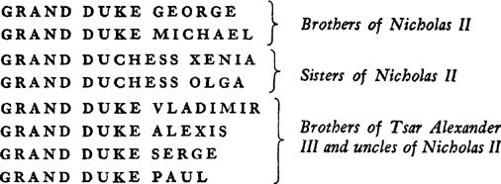
GRAND DUCHESS MARIE PAVLOVNA Wife of Grand Duke Vladimir

GRAND DUCHESS ELIZABETH (Ella)
Sister of Empress Alexandra and wife of Grand Duke Serge
GRAND DUKE NICHOLAS NICOLAIEVICH
Commander-in-Chief of the Russian Army in World War I
GRAND DUKE ALEXANDER MIKHAILOVICH (Sandro)
Husband of Nicholas II’s sister Xenia
PRINCE FELIX YUSSOUPOV
Murderer of Rasputin. Husband of Princess Irina, the daughter of Grand Duchess Xenia and Grand Duke Alexander Mikhailovich
GRAND DUKE DMITRY
Murderer of Rasputin. Son of Grand Duke Paul
EDWARD VII, KING OF ENGLAND, 1901—1910 (Uncle Bertie)
Brother-in-law of Dowager Empress Marie Fedorovna. Uncle of Empress Alexandra and Kaiser William II
GEORGE V, KING OF ENGLAND, 1910–1936 (Georgie)
Through his mother, first cousin of Nicholas II. Through his father, first cousin of Empress Alexandra
WILLIAM II, KAISER OF GERMANY, 1888—1918 (Willy)
First cousin of Empress Alexandra. Distant cousin of Nicholas II
COUNT VLADIMIR FREDERICKS
Minister of the Imperial Court
COUNT PAUL BENCKENDORFF
Grand Marshal of the Imperial Court, Fredericks’ subordinate
DR. EUGENE BOTKIN
Court physician. Botkin attended primarily the Empress Alexandra
DR. FEDOROV
A doctor who cared for the Tsarevich Alexis
DR. VLADIMIR DEREVENKO
A doctor permanently assigned to the Tsarevich Alexis
PIERRE GILLIARD
Swiss tutor of the Tsarevich Alexis
ANNA VYRUBOVA
The Empress Alexandra’s closest friend and confidante
DEREVENKO
A sailor assigned to watch the Tsarevich Alexis night and day. No relation to Dr. Derevenko
MATHILDE KSCHESSINSKA
Ballerina. Mistress of Nicholas II before his marriage
GREGORY RASPUTIN
A Siberian peasant
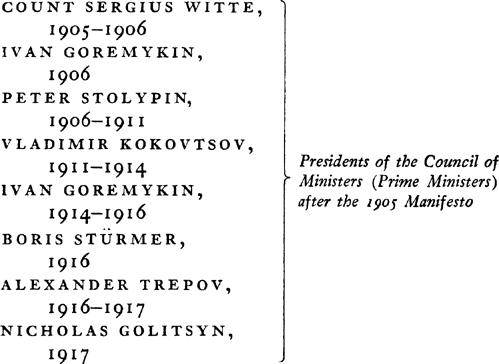
ALEXANDER KERENSKY
Prime Minister of the Provisional Government, 1917
VLADIMIR ULYANOV (Lenin)
First leader of the Soviet State