
PART II
CHAPTER 4
Black residents in Milwaukee, as in other troubled cities experiencing postindustrial transitions, encountered a number of setbacks in the effort to assert their rights and secure opportunities. They fought a highway that ran through a vibrant Black commercial district, only to see the area torn up a generation later to make way for upscale commercial development aimed at affluent whites. They mobilized to demand greater security in their neighborhoods, only to witness a sharp increase in the rate of incarceration of their young men. They heard about the promise that investment in projects of New Urbanist design would bring to alleviate the city’s budget deficit, only to see themselves more confined than ever in an area stigmatized as a ghetto. Years after embracing a vibrant civil rights movement and the power of the vote, the intensity of the effort declined and the height of their ambition shrank.
That condition appeared confirmed, with speculation that the cause of Hillary Clinton’s loss in Wisconsin to Donald Trump in 2016 by a mere 27,000 votes could be traced to a precipitous decline in the Black vote in Milwaukee. Despite some evidence that a new identification program aimed at suppressing that vote was to blame, a story in the New York Times suggested otherwise. Focusing on the reactions of Black clients in a North Side barbershop, the Times reporter quoted one of the four barbers at work that day: “Milwaukee is tired. Both of them were terrible. They never do anything for us anyway.” Having struggled to find health insurance he could afford after his divorce, he complained, “Ain’t none of this been working.” He did not vote in the election. One of his three fellow barbers wrote in his own name, and one did not vote at all. All four men had voted for Obama, without seeing much result, they claimed. Far from being unique in their judgments, these men expressed in their own lives what a number of critics, including Black Princeton University professors Keeanga-Yamahtta Taylor and Eddie Glaude concluded in subsequent years.1
Such assessments reflected the kind of weariness that came to affect Camden’s once-energized activist organizations and limited the range of dissent in Detroit, among other cities. Milwaukee was widely reputed to be the worst place in the country to live if you were Black,2 and it was no secret that the benefits of the city’s revitalization efforts were not making their way into the North Side ghetto. A close look at the city reveals, however, that the activism that so animated the Black community in the 1960s never died, that the outrage that following the police shooting of Sylville K. Smith only days before Trump campaigned in the city in 2016 was no exception, and that efforts to attain access to new investment and their benefits only grew in ensuing years. If downtown revitalization brought few immediate rewards to Milwaukee’s Black community, it opened possibilities on which to build.
A bastion of socialism through much of the first half of the twentieth century, Milwaukee, like so many other older cities touching the Great Lakes, owed its early success as an industrial powerhouse to the combination of fortuitous geography and workers—especially immigrants—willing to work hard for low pay. A world leader in the production of heavy machinery, Milwaukee’s machine shops completed most of the metal work for development of the atom bomb during World War II. A strong union tradition helped boost the fortunes of city workers, and though area manufacturing declined starting in the 1960s, it did so at a slower pace and with less damaging social effect than happened in other parts of the Rust Belt. Milwaukee lost 3 percent of its manufacturing employment during the 1970s compared to more than 10 percent losses in Cleveland and Baltimore. Partially as a consequence, Milwaukee’s unemployment and poverty rates were lower than those in other cities. Although Milwaukee lost 11.3 percent of its population in the period, the toll was lower than in other deindustrializing cities, such as Cleveland and St. Louis, each of which lost more than 27 percent. Still, the loss of household names such as Allied-Chalmers, Allen-Bradley, Schlitz, and American Motors in the mid-1970s took its toll.3
The city’s early Black community remained small and largely outside the area’s opportunity structure. Boosted by federal prohibitions on discrimination in defense work, African Americans gained access to the city’s booming manufacturing plants during World War II. The venerable A. O. Wilson Company, for instance, did not have a single Black worker in 1942, when it shifted production to bomb casings and torpedoes. By war’s peak, it had 800 Black employees, making up 5 percent of its workforce. Such gains stimulated further migration to the city. Adding to the 13,000 African Americans who migrated to the city in the 1940s, another 62,000 arrived in the 1950s, tripling their presence to 8.5 percent of overall population. Mobility remained limited. According to a 1952 report, while 167 firms hired almost 4,800 Blacks, primarily in manufacturing, of those employed only 10 were professional workers, while 47 held clerical positions and 345 were skilled laborers. Still, as late as 1970, 4 in every 10 Black adults were employed in manufacturing.4
Confined originally to a thirty-five-block “Black district” locally known as “Bronzeville” and later “the inner core” on the lower North Side in the city’s Sixth Ward, by 1940 that settlement had expanded to a seventy-five-block area as more affluent whites abandoned their large homes for suburban locations and saw the buildings converted to rooming houses. Overcrowding, absentee ownership, and growing reports of crime and social disorder added to the area’s bad reputation and prompted calls for urban renewal, even as such conditions encouraged invasive and discriminatory police practices.5 Like leaders in other cities, Milwaukee’s socialist mayor Frank Zeidler, first elected in 1948, recognized the need to rebuild much of the central city area where both the Black ghetto and the city’s declining business sector were located. Drawing, however, from a well-established Milwaukee planning vision dating back to the Progressive era, he staked out a different path than that followed in other cities, seeking to manage decentralization by annexing additional land at the outskirts of the city and using it both to accommodate regional growth and to relocate into public housing those whom redevelopment would displace. In response to plans the association of area businessmen, the Greater Milwaukee Committee, were pushing to create a riverfront showcase of food, music, fountains, and gardens modeled on Tivoli Gardens in Copenhagen, Zeidler retorted, “The city needs a more sophisticated type of planning that includes economic and social planning as well as physical planning.”6
Milwaukee had a long history of annexation, dating back to the 1850s. A central part of city policy in the 1920s, when the city expanded from twenty-five to forty-six square miles, annexation had been abandoned during the hard times of the Great Depression. In response to the acceleration of outmigration of manufacturing and population to the counties surrounding the city, however, Zeidler moved aggressively to use the carrot of water and sewer services to bring unincorporated communities at the city’s periphery under its control. The city found allies among area realtors, who recognized the savings city services would represent in their own effort to accommodate suburban growth. A few areas acceded to incorporation in the 1950s, helping expand the city limits, but they were the exception. Resisting loss of self-determination and seizing opportunities to keep their own costs down by accommodating business relocations, a number of communities managed to thwart the city’s intent. When the state Public Service Commission ruled in 1958 that Milwaukee had to provide water to suburban Wauwatosa at the city’s western edge, Zeidler’s ambition to ultimately consolidate every community within Milwaukee County under city control came to an end.7
Historian John McCarthy’s account of this contest stresses local factors distinct to suburban areas, but he also reveals how Zeidler’s desire to locate public housing there ignited opposition to the presence of African Americans. Undoubtedly the anonymous Northwest Side resident McCarthy cited was not alone when he questioned Zeidler’s intention to encourage poorer migrants to vacate the urban core by asking, “Why scatter them all over the city, creating trouble and problems for us?”8 Without the flexibility to locate public housing at the city’s periphery, public officials had to be content with building only one facility exclusively for poor residents, on the west side. As demand for affordable housing only got worse and conditions further deteriorated in Black neighborhoods, fears among whites that such contagion would spread made race a central issue in Zeidler’s 1956 reelection campaign.9 Rumors circulated on behalf of his conservative Democratic opponent that Zeidler had financed billboards throughout the South encouraging African Americans to migrate to Milwaukee and that he planned to import them into white neighborhoods were widely refuted, and Zeidler won reelection. But the level of vitriol during the campaign convinced him not to run again. Four years later he was succeeded by Henry Maier, who was decidedly less sympathetic to conditions in the Black community and an emerging civil rights effort to contest them. When civil disorder in Milwaukee followed the Detroit riots of 1967 by only a few days on July 30, Maier reacted harshly, calling out the Catholic priest Joseph Groppi, who had been leading demonstrations for fair housing for months, by saying, “I would have forgiven Wisconsin Senator Joe McCarthy, whom I despised as soon as forgiven Groppi.”10

Figure 12. Civil rights activist Father James Groppi, joined in protest by members of the Youth Council of the NAACP to whom he was an adviser, June 1967. Historic Photo Collection, Milwaukee Public Library.
Groppi’s unusual role as a white Catholic priest leading a civil rights campaign emerged only after more established leaders among Milwaukee’s Black community had agitated for years, for better housing, integrated schools, and full protection under the law. Those efforts, though gaining energy from the national civil rights and Black power movements, were largely frustrated until the mid-1960s, when Groppi was pulled into the movement. Brought up on Milwaukee’s South Side and having an interest in social justice that often set him apart from his ethnic peers, Groppi became fully active in civil rights following his participation in the 1965 civil rights march in Selma. Bolstered in the determination to fight injustice on his return from Alabama, Groppi converted his role as an adviser to the NAACP Youth Council into a sustained campaign for fair housing. The movement reached its most dramatic moment on August 29, 1967, when several hundred open-housing demonstrators massed on the city’s segregated North Side to march across the Sixteenth Street Bridge over the Menomonee River Valley, locally referred to as the city’s equivalent of the Mason-Dixon Line, into the predominantly white, working-class South Side. Met not just with stones and taunts from hundreds of counterdemonstrators, protesters also encountered an effigy of a white priest, defaced with a swastika and hanging from a rope. Waving Confederate flags and signs bearing hateful inscriptions, including “White Power” and “Bring Back Slavery,” some 13,000 spectators took up the chant “Kill … kill … kill.” The terror continued until police finally broke up the crowd. This was not the first such clash. A year earlier, Father Groppi had led a similar march from the North Side a full six miles to the home of Judge Robert Cannon, in the still-defiant suburban town of Watuwatosa, to protest Cannon’s membership in the all-white Fraternal Order of Eagles. Over several days of protest, a crowd that was joined by several robed Klansmen gathered to shout obscenities at the demonstrators. Police intervened, but only after more threats of violence were made against the demonstrators.11
Such clashes in the 1960s further hardened Milwaukee’s racial divisions. Many white workers, anchored in their neighborhoods both by continued employment and social attachments, remained, and when it came time for urban renewal, they escaped the worst, even as areas of Black residency were targeted. Seeking both to eliminate distressed areas near the downtown and to link a revitalized business sector with the suburbs, city and state officials embarked on an ambitious highway program. The chief result was the devastation of the Black community’s commercial area when the state built I-74 through the neighborhood.12 Black neighborhoods further suffered when city planners adopted a rationale for directing the city’s limited resources to its stronger neighborhoods. Drawing on economist Anthony Downs’s theory of urban decline and an associated rationale for strategic direction of resources, as proposed in New York City and applied to Detroit in the 1970s, Milwaukee planners divided each of the city’s 208 census tracts into five categories, determined largely by the strength of their real estate markets. Finding that Milwaukee lacked the depth of disinvestment found in New York in its own more beleaguered neighborhoods, planners dropped the two lowest classifications, marked by heavy decline and widespread abandonment, and expanded the middle category (“clear evidence of decline”) to include two additional categories at the bottom of the scale. In thus exercising what D. H. Schmidt calls urban triage, planners “sought to bolster the private housing market in savable, white neighborhoods as it prescribed and justified market-determined inevitable death for less healthy, Black neighborhoods.” Planners in one stroke thus took action that effectively redlined all over again the city’s Black neighborhoods despite the fact that their status was strong enough to have made them salvageable in other cities.13 Overall, the combination of homes lost to urban renewal, code enforcement, and highway clearance amounted to 9.7 percent of the city’s entire stock.14
Ultimately, renewal efforts did nothing to stem the flight either of jobs or the white working class. Between 1963 and 2009 Milwaukee’s manufacturing sector fell from 120,000 to 27,000 jobs, many of which moved to the suburbs. While Milwaukee lost 28,000 jobs from 1994 to 2009, Waukesha, Ozaukee, and Washington Counties gained 56,000 jobs in office parks, light manufacturing, and retail. Housing choices outside the city remained largely inaccessible to African Americans, through restrictive zoning, redlining, and overt hostility. When suburban New Berlin’s mayor expressed support for an affordable housing measure in his 93 percent white community, he was met with threats, including a sign in his yard reading “nigger lover.” By 2016, with only 11 percent of African Americans in the region living in the suburbs, Milwaukee had the lowest rate of Black suburbanization among the fifty largest metropolitan areas in the country.15
The election in 1998 of John Norquist, a moderate Democrat in the tradition of Bill Clinton’s “third way” in politics, brought new hope for the city’s revitalization but only as it solidified the turn to both conservative and market-driven solutions so evident nationally in the Reagan years. A fervid opponent of the way interstate highways were tearing up city neighborhoods in the 1960s when he worked as a lathe operator and community organizer, Norquist made the demolition of the Park East Freeway, part of a ring of highways encircling the city dating from that era, a priority of his administration. Casting his lot with 1960s liberals who opposed similar projects in New Haven, Baltimore, New Orleans, and elsewhere, Norquist nonetheless established his own identity by distancing himself from social welfare interventions of the kind called for by the Kerner Commission, choosing instead to chastise cities for drawing “attention to their own pathologies by crying out for help from a federal government encrusted in a $5 trillion debt.” Arguing that they could learn from what suburbs had done to attract consumers, he asserted that cities could not be built on fear or pity. What cities needed instead was lower taxes and greater public safety in order to prosper. Given those conditions, he claimed, cities could become self-reliant if they respected their true form.16 Removing the Park East Freeway, reestablishing the urban grid at street level, and enhancing traditional, walkable, and interconnected mixed-use neighborhoods were the keys, he argued, to restoring the city’s traditional values, which in turn would serve to attract former residents back from the suburbs.
Norquist and his philosophy drew the attention of the Congress for a New Urbanism, which set their national meeting in Milwaukee in 1999 and subsequently made him their chair. Showcasing Milwaukee made perfect sense, for in his first decade as mayor Norquist had widely applied New Urbanist principles that were moving to the center of planning practice in the 1990s. Freeway demolition remained the key. Never completed because of the strength of public opposition, Milwaukee’s Park East spur carried few enough passengers to gain the state’s reluctant permission and enough funding for demolition, which began in 2002 and cost $25 million. Although the land east of the spur had been cleared for the right-of-way needed to continue the freeway, it remained undeveloped until the state removed its designation as a transportation corridor. On that twenty-six acres of land emerged a new neighborhood, East Pointe. A $56.5 million, mixed-use redevelopment of a nine-block-long site north of downtown Milwaukee, East Pointe featured a 57,821-square-foot neighborhood commercial center as well as 438 market-rate residential units in rental apartments and condominium townhomes. Following New Urbanist principles, setbacks were small and garages were removed from the front property line. The street grid replicated that of the surrounding area, thus helping to integrate the new development into the existing neighborhood. Completed in 2002, its success boosted downtown investment, for residences as well as new office construction.17
A related factor in downtown revival was the city’s Riverwalk, a 3.1-mile pedestrian walkway on both sides of the once industrially oriented Milwaukee River in the city’s Third Ward. Following cleanup of the river through advanced sewage treatment, the city devoted $10 million to create a series of linked river parks, landings, plazas, and promenades. Launched officially in 1993, the Riverwalk initiative consisted of twenty-two proposed segments intended to build interest in the river as a destination for living, shopping, and recreation. Featured in the Congress for New Urbanism’s 2000 write-up of its charter, the pathway drew new investment dollars geared primarily to leisure activity, including brewpubs and restaurants, as well as condominiums and rental units.18
Related extensions of the effort were reinvestment drives in nearby areas of the downtown. In Brewer’s Hill to the northwest, where the 1967 riots had gutted the commercial area along Third (subsequently Martin Luther King) Avenue, the first of seven condominium projects under the name Brewer’s Hill Commons were constructed at the turn of the century. In addition to the conversion of factory space into lofts, new single-family homes featured New Urbanist design elements, such as alleys, front porches, and lot dimensions that conformed to the older, long, narrow lot configuration. Nearby, the city promoted the creation of an entirely new Beerline B (referring to a former industrial rail line servicing the Schlitz, Pabst, and Blatz breweries) neighborhood west of the river. Made possible through tax increment financing directed at removing rail lines, excavating contaminated soil, and introducing new streets, utilities, bridges, staircases, and public parks, the neighborhood’s more than 300 residential units added to the attractions of living downtown. With 15 condominiums in place as of 2017, ranging from 15 to 126 units, newcomers stood largely apart from residents who preceded them. “My objection to the new developments on Commerce Street is that they did not integrate,” one resident commented. “The objection is not race-based but class-based. In order to rebuild a community neighborhood, you have to integrate not based on income. A lawyer may be Black or white, but still a lawyer and costs keep going up. It would be nice if the city would do what we asked the suburbs to do and that is to integrate a variety of income levels into a neighborhood.” Instead, as a host of restaurants, bars, shops, and other small businesses soon joined the mix and prompted further extension of the Riverwalk to the Menomonee River, concerns mounted about gentrification.19 The redevelopment of two older public housing complexes nearby, each taking years for reconstruction as mixed-income communities, further upgraded the area, while dispersing a number of poorer residents with vouchers to other parts of the city. Together these changes helped realize the vision of the city’s downtown master plan of 1999 as an amenity-rich “traditional neighborhood” where people “live, work, learn, and play.”20
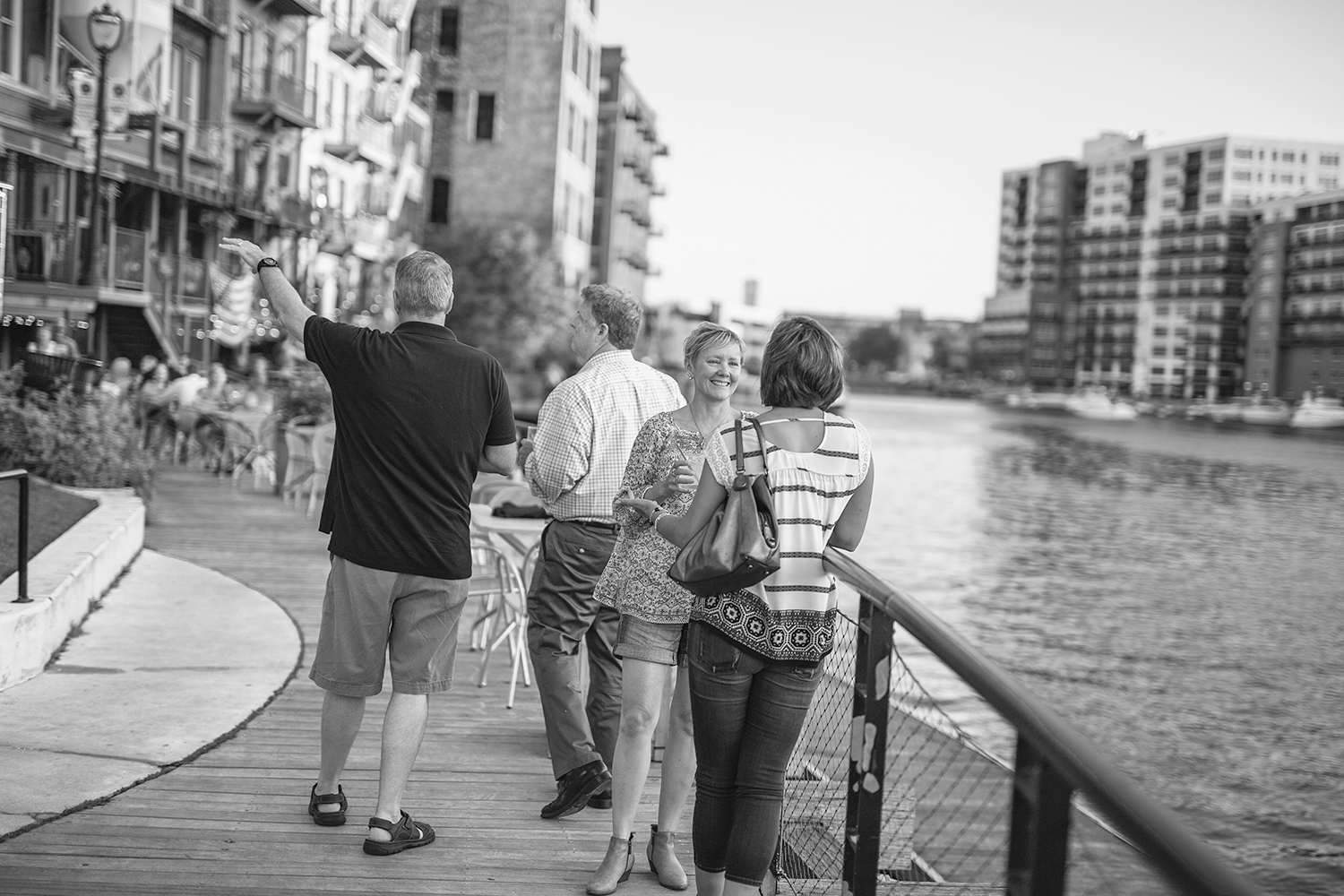
Figure 13. Launched in 1993 as a coordinated effort to create a leisure destination at the heart of the city’s Third Ward, the Milwaukee Riverwalk proved over time to be an immense success in attracting leisure activities and nearby investment. Courtesy Visit Milwaukee.
It was in that context that the fate of the area opened up when the demolition of the highway spur itself became contested. Covering sixty-four acres of prime land in the eastern portion of downtown, Park East, as the redevelopment area was named, was ripe for conversion from a number of marginal uses, including multiple parking lots at grade, to the kind of high-end mixed use that had been successful in East Pointe. City planners conceived a whole new neighborhood laced with desirable amenities: parks, pedestrian and bike-friendly pathways, and plenty of options for entertainment, as well as prime locations to rent or buy. In its own low-key fashion, the planning document laying out a vision for the area noted, “A portion of residential development could be built for young professionals just entering the job market.”21
Demolition began in 2002, but even a decade later hopes for the area had yet to be realized, though a few companies had begun to build on cleared sites. As the 2008 recession receded, however, the pace of development quickened, and the area’s first residential units began to materialize. A major contributor, the Mandel Group, began opening a series of apartment complexes clustered in a pattern of photography-related names: Vignette, Portrait, Silhouette, Aperture. The company described the area on its website as a “neighborhood by design,” rich with amenities, including nearby prime nightlife, restaurants, entertainment venues, and walking and jogging trails. The company boasted further access in its properties to bike-repair stations, car washes, electric vehicle–charging stations, and private pet spas. Rents at the Aperture, completed in 2016, ran from $1,555 to $1,780 for a one-bedroom unit and $2,130 to $2,190 for a two-bedroom unit.22
Park East emerged in close proximity to an area of historically Black settlement where working residents were largely closed out of the new development. As reconstruction began, activists saw an opportunity to extend a program that had been building for most of a decade and was aimed at securing jobs for unemployed or underemployed Milwaukee residents. Known as the Milwaukee Jobs Initiative, the effort emerged from a regional labor organizing effort that had aimed at including nonunion members. By 2002 the organization could take credit for placing some 1,400 participants in decent jobs, about two-thirds of them Black. When the organization folded that year, activists associated with the effort formed a new organization, the Good Jobs and Livable Neighborhoods Coalition. Ensuring access to the opportunities envisioned at Park East became their first objective. The campaign they orchestrated called for 20 percent of affordable housing units in new construction, 75 percent of all permanent jobs created paying a living wage, a guarantee that construction contracts go to locally owned firms paying prevailing wages, and a mandate that 50 percent of permanent jobs go to local residents. When city officials ignored the proposal, activists turned to the county, which owned sixteen acres of the land, and pressed officials to intervene. The result was agreement, finally, on a community benefits package (the Park East Redevelopment Compact) that embraced most of what the coalition had demanded. While the compact only stated that business and contractors “make a good faith effort to employ racial minorities consistent with their numbers in the County’s workforce,” the language was considered sufficiently specific to constitute a victory for organizers. And while the compact also allowed county officials to sponsor affordable housing options in areas outside the designated redevelopment area, organizers found that provision acceptable as well.23 But as the redevelopment of Park East evolved over time, public interest in monitoring the compact waned. Clearly, when apartment units materialized, they did little to realize the original hopes that project design would benefit the adjacent community. In one very visible way, however, the compact had real effect: in the construction of a new home for the NBA Milwaukee Bucks.

Map 2. Milwaukee Select Sites
The Bucks’ Bradley Arena, completed in 1988, was by the early part of the new century badly outdated, and with the team threatening to leave Milwaukee for another location, city, county, and state, authorities were pressed to help pay for a new arena. When public investment was not forthcoming, Bucks owner and former U.S. senator Herb Kohl sold the team to two New York City hedge-fund investors, Marc Lasry and Wesley Edens, with the understanding that they would put up $100 million each toward the new stadium and associated entertainment district. The new owners claimed an additional $200 million to $300 million in public funding was still necessary to make the deal work, and ultimately the largest share came from Milwaukee County after Governor Scott Walker failed to get the full state support he had requested. Most immediately, the community benefits compact proved effective, as the Bucks engaged two companies to monitor its hiring and contracting to ensure compliance. Although that monitoring cost team management more than $1 million, it reflected well on the process by exceeding requirements.24 But that proved not the only benefit to the larger community.
Objecting to the deep subsidies the Bucks were seeking to underwrite the new stadium, a successor organization to the earlier jobs-oriented coalition, Common Ground, sought to link that decision with an investment of $150 million to improve Milwaukee County public schools’ athletic facilities and recreational spaces. The effort generated a favorable column in the New York Times but failed to gain support locally, at least not until 2014 when an article in the Milwaukee Journal Sentinel publicized the connection Common Ground had discovered between Bucks co-owner Wesley Edens’s role as board chair of Northstar, the second highest holder of city mortgages, and Northstar’s responsibility for a number of abandoned and dilapidated properties in the city. Common Ground took its charges against Edens as a “slumlord” to Northstar’s annual meeting in Dallas, as well as to local officials, and succeeded finally in shaming the company into a serious community investment. In an agreement announced by Mayor Tom Barrett in August 2015, Northstar committed $30 million over the next three years to help homeowners modify their mortgages in order to escape foreclosure. The company also agreed to contribute $500,000 to the city’s home improvement loan program and to hold face-to-face meetings with customers three times a year over the same period.25 With a public relations disaster behind them, the Bucks took possession a month later of an additional ten acres within the Park East redevelopment area cleared for construction for a $30 million state-of-the-art practice facility and ancillary activities. Located directly across from the apartment complex, the sale price for land valued at $8 million passed to the Bucks for a single dollar. The Bucks assumed responsibility for remedial costs, which “could be substantial,” a news report concluded at the time. A year later, the Bucks’ owners agreed to pay the roughly one thousand full- and part-time workers at the new arena at least $12 an hour by 2017 and $15 an hour by 2023, and they embraced provisions protecting workers’ ability to unionize. The Bucks also agreed to and met the goal of hiring unemployed or underemployed local residents for construction work, though by one estimate they received as much as $1 billion in subsidies in completing the $524 million facility.26

Figure 14. Milwaukee’s Fiserv Forum. Located at the heart of the area repossessed from earlier freeway construction, the Bucks envisioned the new arena as “a 365-day destination, serving as a hub for Milwaukee’s vibrant future and connecting our existing downtown neighborhoods.” Courtesy Visit Milwaukee.
An affiliate of the Industrial Areas Foundation founded by labor organizer Saul Alinsky, Common Ground got its start organizing in Milwaukee in the Sherman Park neighborhood, where Sylville Smith was killed in 2016. One of those neighborhoods singled out for more help under the city’s targeted resource plan of the 1980s, Sherman Park was still a largely white area at the time, not far from the expanding area of Black residence. As demographic change accelerated, Sherman Park residents organized to maintain the stability of their neighborhood. Boosted by an ultimately successful effort to block two proposed highways slated to bisect the area, they formed the Sherman Park Community Association in 1970. Starting largely as a volunteer organization, the group’s devotion to maintaining an integrated neighborhood secured enough funding from multiple sources, including the Ford Foundation, to expand staff and tackle some of the worst urban problems in the city, most notably housing deterioration and school segregation. The challenges proved formidable, however, as fissures internal to the organization festered and citywide problems proved difficult to overcome. After a period of stability in the 1970s, the organization underwent a quick succession of directors amid charges that board leadership was not sufficiently inclusive of the Black population, which had grown from 5 percent in 1970 to 34 percent a decade later. Sociologist Juliet Saltman considered the association sufficiently effective in her 1990 assessment of neighborhood stabilization efforts nationally to list Sherman Park as a success, despite a twofold increase in the number of vacant housing units and a 50 percent drop in the median value of owner-occupied homes there over the previous decade. As rental housing spread from east to west, bringing more Black residents with it, Sherman Park’s white population fell overall to 38 percent in 1990 and 18 percent in 2000.27
Common Ground’s interest in the neighborhood dated to 2008. In its “Faces of Foreclosure” campaign, the organization targeted the five major banks owning a majority of neglected and foreclosed properties in the region. Acting very much like a community development corporation, it sought to stabilize the area through a program of housing rehabilitation and stable home ownership. Over the next decade the organization was responsible for reducing incidences of foreclosure and increasing tax revenue through rehabilitating seventy-five properties worth $6 million in aggregate. The effort was funded through the commitment of $33.8 million from the banks and $2 million in federal Neighborhood Stabilization Program funds for home rehabilitation costs.28 After Sylvie’s death, the city stepped in with a program to transfer properties in need of rehabilitation to developers for only $1 each. The generous terms came with a requirement that the companies—two of the five were for-profit—hire locally. A year later, however, progress on rehabilitation was uneven, and the number of locally hired workers was small.29 Despite promises to empower neighbors through access to homeownership, requirements that bidders buy a minimum of five properties, with the maximum set at fifty, revealed another intention—to accelerate development. “The community was almost entirely thwarted from participating in purchasing this low value real-estate,” columnist Sherwin Hughes asserted. “Determined not to leave the Sherman Park residents out completely, under or unemployed residents could apply for jobs offered by the developers for $11 per hour,” he reported. But the city only required developers to hire a worker for five hundred hours—roughly three months. At $11 an hour, Hughes noted, there would not be enough to pay rent in the homes the temporary workers were helping to renovate. “This shoddy attempt at recreating a once splendid, beautiful and beloved enclave is a prime invitation for the real urban devil: gentrification,” he concluded.30
Although nationally recognized for his orientation to uplifting city fortunes through attention to community design, John Norquist had put just as much faith in revitalizing Milwaukee through crime control. An enthusiast of Rudy Giuliani’s tough-on-crime approach in New York City, Norquist declared in his 1998 book, The Wealth of Cities, “Arresting and locking up criminals—separating them from our neighborhoods—is an act of social justice.… If we let criminals overrun low-income neighborhoods, we are destroying the best hope of many people who are struggling to get their piece of the American pie.”31 So it was not entirely unprecedented for a prominent politician to declare, as Trump did speaking outside the city in West Bend in his 2016 campaign, “Those peddling the narrative of cops as a racist force in our society, a narrative supported with a nod by my opponent, share directly in the responsibility for the unrest in Milwaukee and many other places within our country.”32 What was missing in Trump’s remarks was any interest in or sympathy for the rising incidence of incarceration that some fellow Republicans, notably Rand Paul, had made a cause of and had plagued Milwaukee for years.
Indeed, the very emergence in Milwaukee of a clearly demarked leisure and upscale housing zone downtown put increased pressure on police to contain any of the perceived forms of disorder in the nearby Northside ghetto from spilling over. Reflecting that obligation, 26,222 Black men from Milwaukee County were incarcerated during the period of downtown restoration, from 1990 to 2012. Closely associated with an accelerated war on drugs in the early 2000s, such figures meant that more than half of all African American men in their thirties and early forties in Milwaukee County had been jailed at some point in their lives.33 The civil disorder that followed the death of Sylville Smith in 2016 revived resentments that went back decades. Even as commentators invoked the death of Daniel Bell, a Black man framed by police in 1958 when officers placed a knife in his hand to justify his shooting after his arrest for fleeing a traffic incident, young people caught up in the aftermath of Smith’s death complained of police mistreatment. “The real issue is African-American individuals, especially in this area are tired and upset with the fact that we have been treated unjustly. We get racially profiled … daily,” one young man asserted. A resident of Sherman Park, where the violence erupted, responded to a reporter’s question saying, “It was wrong what (some violent protesters) did but they’re tired of cops shooting Black people.”34
Such complaints echoed those from Ferguson, Baltimore, and beyond, where Black men lost their lives to police actions. In Milwaukee, there was a ready retort from Sheriff David Clarke, a Trump ally and supporter, who fed back into national debate by tweeting “Black LIES Matter” to his quarter-million followers. Riding high from his reelection to a third term after successfully overcoming substantial outside money, including $150,000 from Michael Bloomberg’s anti–gun violence political action committee, Clarke remained unapologetic for his tough stand on crime. Describing protesters as part of a “culturally dysfunctional underclass,” he sought Governor Scott Walker’s intervention by enlisting the National Guard, an action that Milwaukee police chief Edward Flynn, whose jurisdiction overlapped with Clarke, rejected. Even as peace was restored, Clarke blamed Flynn for increases in violent crime in Milwaukee, arguing that the city’s police force should hire more officers to crack down harder on crime, encouraging residents in the meantime to exercise their right to arm themselves.35
Clarke’s visibility during the 2016 disturbances in Milwaukee only further enhanced his standing as a celebrity in GOP circles, despite his election to office as a Democrat. Much in demand on the national political circuit, he raked in speaking fees well beyond his salary as sheriff, hosted his own radio show, and served as one of only five Black speakers at the Republican National Convention. When he announced suddenly in August 2017 that he was resigning his position as sheriff, he was widely expected to join the Trump Administration. Whether from the controversy surrounding his tenure, during which six prisoners died while incarcerated under his watch, including one who had been denied access to water, or from charges that he had plagiarized his master’s thesis, the appointment was not forthcoming. Still, Clarke continued to advance his strident views, becoming a spokesperson for a pro-Trump political action committee, authoring a provocative memoir, and joining an effort to privately fund a wall along the Mexican border.36 His voice was but one of many in the strident Trump camp, but in the meantime Milwaukee voters were taking a significant step forward in an effort that would help determine his successor: the formation of Black Leaders Organizing Communities (BLOC).
Upset with Democrats who blamed Hillary Clinton’s loss on a drop in the Black vote, twenty-nine-year-old former union organizer Angela Lang sought to reframe the issue by asking, “How about we had a candidate that actually earned our votes?” “What I saw was people not being apathetic, but people choosing to not vote and using that as their power, as their political power, which was I think the first time I’ve ever really seen that,” Lang declared. Seeking to marshal that power by determining the issues that really mattered to area constituents, she set in motion a canvassing effort that sought to listen to people’s concerns before asking for their support. Informed by events of the previous few years, including the high incidence of death and incarceration suffered by young Black men, the effort aimed first at zip code 53206, the section of the city not just with the highest levels of incarceration but a target of the kind of derision conservatives like Clarke relished.37 “If we’re doing community engagement in 53206, that means not everyone will have the ability to vote unfortunately. But that doesn’t mean we just neglect people,” Lang said.38
Just how many new votes BLOC generated is hard to determine, but no doubt the effort helped elect a real reformer as David Clarke’s successor as sheriff in 2018. Recounting the shift in Washington away from interventions on behalf of social justice, a reporter for the Atlantic suggested the change was a part of a shift to piecemeal reform in cities and counties. As the victor in the primary and the certain victor in the fall election, Earnell Lucas credited get-out-the-vote efforts, including that of BLOC.39 And Lucas’s success had further effect. Among the 2020 Democratic candidates for president, Elizabeth Warren included Lang in a gathering of community organizers she hosted, and Amy Klobuchar, Cory Booker, and Julian Castro all joined BLOC canvass activities, though only Castro drew an individual endorsement for his effort.40 No one recorded how the Northside barbers felt or acted during the election, but it was clear that in Milwaukee, as elsewhere, grassroots organization made a difference. No one thought a single election would overturn entrenched patterns of uneven development and uneven application of justice, but seeing one change in leadership at least fostered hopes for more fundamental alterations in the administration of fairness and justice.
Thus buoyed by the support its voter drive had generated, BLOC extended its efforts to the heated issue of policing. In a campaign that drew together forty-five organizations operating under the name Liberate MKE, activists sought two amendments to the city’s 2020 budget to shift funds from policing and punishment into violence prevention: a test Universal Basic Income program and a fund dedicated to converting tax-foreclosed homes into emergency housing for the city’s most vulnerable residents. With BLOC facilitating resident input and training in budget analysis, community pressure prompted common council to eliminate sixty vacant police positions, at a savings of $575,000. Aiming to cut $25 million from allocations to policing, the campaign continued for a shift in budget allocations when savings were directed to other purposes.41
Coincidentally, another partnership—bringing together the city’s longtime business association, the Greater Milwaukee Committee, the Milwaukee Urban League, and the Greater Milwaukee Foundation—formed to support what it called the MKE United Greater Downtown Action Agenda. Created in the immediate aftermath of the 2016 Sylville Smith shooting in an effort “to ensure that all members of our community share in the prosperity and economic growth that are occurring in and around Downtown,” it stated its intention to “execute a civic engagement process that builds trust, creates cross-sector working relationships and partnerships, and establishes a well-informed and long-standing constituency for planning and implementation” in the cause of inclusive growth. Making an antidisplacement policy a primary objective, the organization issued in 2018 a thorough analysis of the development pressures in select census tracts where property values were rising and the number of minority residents was declining. Addressing at the outset the cumulative effects of redlining and other exclusionary real estate practices over time, the authors declared, in boldface, “The City of Milwaukee policy makers should prioritize choice and equity alongside traditional development goals.”42 The organization subsequently convinced the city council to set aside affordable housing units in new developments of twenty or more units in those areas it had identified where the chances of displacement were high. Although adopted only for a trial period of two years, the initiative had the advantage of being both targeted and flexible enough that it could be adjusted in time if market conditions changed. The organization also succeeded in forming an antidisplacement fund to aid homeowners faced with rising tax payments and secured $300,000 in donations to support the effort.43
Such efforts formed a backdrop to the Democratic National Convention in 2020, where the universal question was whether the decision to meet in Milwaukee would help reverse the results of depressed voting so evident in 2016. Democrats clearly hoped so. Before the coronavirus forced a shift online, the convention was slated to be held at the recently renamed Bucks facility, the Fiserv Forum, in the heart of the redeveloped Park East precinct, which continued to be praised for its sensitive replacement for a through-transportation corridor.44 More centrally, referring to Hillary Clinton’s failure to campaign in Wisconsin in the fall of 2016, U.S. Representative Mark Pocan, praised the choice of Milwaukee, commenting, “It’s a strong signal from the DNC that it gets what happened. There’s a lesson learned: Showing up is a big part of life.” But would showing up be enough? Even as Republican senator Ron Johnson used the announcement to claim the Democratic presence in Milwaukee would generate a backlash by giving Wisconsonites a firsthand look at their socialistic policies, such proclamations could well have passed over the heads of those like the Northside barbers who had not voted the ticket in 2016. Although Joe Biden’s tally in Milwaukee exceeded that of Hillary Clinton by six thousand votes, the Black vote was actually down 11 percent, a reflection not just of complications posed by the pandemic but of a lack of confidence in what a change of administrations might mean.45 What was socialistic about Milwaukee lay deeply in the city’s past, in the days before the Black community had even organized in an effort to secure the full promise of urban life. Even the considerable influence of Democratic Socialist Bernie Sanders and his supporters was unlikely to change that perception in an atmosphere where news of incarceration and dispossession dominated the lives of so many residents. The immediate question, in the aftermath of the virtual Democratic convention that barely touched Milwaukee, was whether the concessions organizers had wrung from new investments like the Fiserv Forum could be built on to create a more even playing field for those whose ambitions had been circumscribed for so long.