
2
Why do some countries articulate strong and inclusive states while others end up with ineffective bureaucracies, irresponsive government, and a pile of external debt? What prevents rulers—monarchs, emperors, presidents—from building capable states? And why is state weakness a highly persistent phenomenon? In this chapter, I shed light on these important questions by examining new political dilemmas that came to exist once external finance became a widespread option to fund government. I argue that foreign interference and myopic domestic policy hold responsibility—arguably to different degrees—for the abuse of foreign borrowing and underinvestment in state capacity in the Global South during key stages of state formation.
To come to this conclusion, I elaborate on the political motives that made rulers prefer foreign loans over taxes, and I advance a mechanism devised by foreign investors to minimize risk: extreme conditionality, the exchange of distressed debt for control over local assets. Access to cheap credit at the price of foreign foreclosure led to debt traps and fiscal erosion in large parts of the developing world, the opposite of state building. Although the perverse effects of external finance carried lasting consequences, history is not deterministic. Investment in tax capacity, which might occur by conviction or for exogenous (unplanned) circumstances, can push countries into a path of sustained state building. The theoretical discussion in this chapter informs the empirical design in the second part of the book, where I examine conditions under which war makes states and mechanisms that connect early fiscal decisions to long-run state capacity.
2.1 Public Finance Dilemmas
In examining the dilemmas of public finance, I focus on the costs and benefits accrued by a sitting incumbent at the time of financing war with domestic or external funds—taxes and foreign debt, respectively. Although the focus is on war—the prototypical example of a financial shock conducive to state building—the discussion is intended to apply to other situations in which a ruler is compelled to mobilize significant resources to fund government in a relatively short period of time: for example, critical infrastructure, health crises, or natural disasters.
The decision to finance war with taxes or debt depends on both domestic and international factors. First, I examine the advantages and disadvantages of each financial mechanism separately, and then the conditions under which one is preferred to another. The second part of the discussion articulates ways in which foreign lenders can discipline borrowers while not discouraging them from issuing external debt. I conclude by examining how early decisions about war finance affect long-term state building. The interested reader can refer to the appendix (section 2.7) for a simple formalization of the argument.
2.1.1 DOMESTIC RESOURCE MOBILIZATION
How do rulers secure funds to finance war? I focus on two common options—taxes and loans—which I assume to be mutually exclusive, (i.e., if one is used the other is not). Certainly, this is a simplification. War can be financed with a mix of taxes and loans plus other instruments, including inflation, confiscation, and natural resource royalties. But this assumption suffices to identify administrative and political obstacles to domestic resource mobilization via taxation.1
The literature on state building emphasizes the lasting fiscal consequences of war. Building on this intuition, I assume that the financial instrument to fund war today carries fiscal consequences—positive or negative—beyond wartime, namely, tomorrow. By establishing a time frame, we can examine intertemporal dilemmas of public finance for a sitting ruler and shed light on the persistence of weak states.
Throughout, I assume that the ruler is a revenue maximizer who cares only about rents from office. Perhaps exaggerated, this assumption allows us to investigate the conditions under which institutions limit predation.2 The share (or cut) of government revenue that the ruler can pocket is inversely proportional to the level of executive constraints. That is, the stronger the monitoring power taxpayers have over the public purse, the less the ruler can steal from the national treasury.
Taxpayers are wary that rulers use their tax money unwisely—from building a new presidential palace to waging war for personal aggrandizement.3 Central to the problem of taxation is that rulers cannot credibly commit to spending tax money wisely if they cannot be sanctioned for fiscal misbehavior. To solve credibility issues, rulers may be compelled to grant taxpayers veto power over spending decisions. Consistently, increases in taxation for the purpose of war yielded major advances in power-sharing institutions in early-modern Europe (1500–1800).4 Power sharing took the form of representative parliaments (e.g., Britain) or oligopolistic arrangements between rulers and domestic economic elites (e.g., France).5 In either form, big taxpayers and Crown lenders—often the same individuals—gained monitoring power over fiscal policy.
Once political power is shared with taxpayers, retracting the privilege might be difficult precisely because the new institutions strengthen the organizational capacity of taxpayers and their bargaining power vis-à-vis the ruler.6 From the point of view of sitting rulers, power-sharing institutions secure funds to wage war at the cost of losing fiscal autonomy vis-à-vis taxpayers on a lasting (even permanent) basis. In Charles Tilly’s words,
[Power-sharing institutions] were the price and outcome of bargaining with different members of the subject population for the wherewithal of state activity, especially the means of war.7
The implementation of taxes requires some bureaucratic infrastructure, or fiscal capacity. This refers to the technical capabilities to assess private wealth and monitor compliance. The stock of fiscal capacity establishes an upper bound to the total tax revenue that can be raised today. The stock can expand over time as a result of purposeful investment and learning by doing. When rulers invest a portion of government income in expanding tax capacity (e.g., building regional delegations of the tax agency), there are fewer government funds left to seize, decreasing the ruler’s present consumption or rents.8
The stock of fiscal capacity also expands by practicing taxation. Brewer shows an extremely detailed account of how excise inspectors in seventeenth-century England learned common avoidance and evasion techniques, turning beer excises into a major source of government revenue.9 Via investment or know-how accumulation, war in Europe acted as a catalyst of fiscal capacity expansion. Crucially, tax pressure seldom came back to prewar levels, a phenomenon known as the ratchet or displacement effect of war,10 growing the scope of the state as time passed.
The discussion above posits a key trade-off in financing government with taxation: tax efforts expand future fiscal capacity, hence the size of total government income, but they also limit the ruler’s discretion over tax yields going forward and reduce short-term rents in light of increased administrative expenses—the political and administrative costs of taxation, respectively. Whether rulers are willing to assume these costs depends on how much they value enhanced tax capacity in the future vis-à-vis rents today. The so-called time horizons of the ruler might reflect personal characteristics or be determined by the political context: for example, a history of rapid turnover in office may discourage forward-looking policy decisions. In principle, rulers with shorter time horizons will be less attracted by the future gains in fiscal capacity, thus less inclined to assume the political and administrative costs of financing war with taxes.
2.1.2 EXTERNAL RESOURCE MOBILIZATION
Loans are logical substitutes for taxation. Public credit comes with multiple benefits: At wartime, it allows states to outspend their rivals.11 More generally, loans help smooth tax pressure over time, minimizing negative effects on the aggregate demand while the war is ongoing.12
Before the nineteenth century, European powers had borrowed massively to finance war.13 Monarchs issued short- and long-term loans from local merchants and tax farmers, and sometimes from abroad too, although external finance played a subsidiary role before 1800.14 After the Napoleonic Wars, the newly created and historically isolated countries were compelled to invest in their military and infrastructure to maintain their sovereignty; however, most local capital markets were tight15 or collapsed in the presence of Western competitors.16 Low levels of capital accumulation caused interest rates of government bonds to skyrocket. Take the case of the Mexican War of Independence: Domestic loans in 1824 fluctuated between 10 and 50 percent, compared to the 5 percent nominal (8.6 percent effective) loan floated by the same country in London that year.17 Because domestic credit was scarce, governments in the periphery turned to foreign capital markets.
International lending is plagued with credibility issues. Rulers might finance their way out of a fiscal shock with foreign capital and renege on it later. To discipline rulers, international lenders may threaten borrowers with international sanctions, which can take various forms, including credit exclusion and trade embargoes.18 By the logic of credit exclusion, countries that default on their external debt are denied further issue until they resume debt service.19 For countries needing external capital to balance their budgets, credit exclusion might be highly problematic.
External default may also damage bilateral trade relations. Trade partners in countries where debt is held might refrain from trading with the country in default. In practice, credit exclusion and trade embargo are not independent. Exporters need short-term loans to conduct business, the “lifeblood of international trade.”20 Credit exclusion precludes these types of commercial loans, penalizing further the balance of payments of the embarrassed government.
By accepting the risk of international sanctions in case of default, rulers using external finance gain access to virtually unlimited resources to navigate a fiscal shock: war finance. In contrast to taxation, rulers do not have to concede political rights to international lenders to secure public funds—a good margin suffices. In addition, loans come with low public visibility, which preempts political scrutiny and social contestation during wartime. If only in the short run, external finance secures government funds while relaxing political constraints on the rulers’ actions.21
After war ends, the rulers decide whether to raise taxes in order to honor war debt or suspend debt service and assume the consequences of default. In honoring debt, rulers repay the principal plus an interest rate that, in principle, reflects market reputation: that is, countries with a history of default are expected to pay a premium to compensate for anticipated risks.22 Servicing debt carries the same political and administrative consequences as taxation: Politically, rulers are compelled to grant political rights to taxpayers in order to secure compliance with the tax code. Administratively, rulers need to strengthen tax capacity to secure enough funds for repayment. Together, the political and administrative costs of debt service limit executive discretion over government funds, thus the rents from office. Alternatively, rulers may prefer to dodge that bullet by suspending debt service after war and assuming the sanctions of default, a decision that affects the rulers’ future utility and, as it will become clear, shapes the best response of international lenders.
2.1.3 WHEN ARE EXTERNAL RESOURCES PREFERRED?
When do rulers prefer to finance war with external loans? Intuitively, they do so whenever the expected payoff of borrowing is greater than that of taxing. That depends on three elements: the initial conditions (political and administrative), the liquidity of capital markets, and the severity of the default sanction. Let me elaborate in order.
Initial Conditions
To overcome credibility issues in taxation, rulers may grant monitoring power to taxpayers, hence limiting the slice of total revenue the rulers can keep for themselves. It is not hard to imagine that the opportunity cost of taxation is bigger for rulers who face weaker executive constraints before war. That is, largely unconstrained rulers must forgo a disproportionally larger share of private consumption to overcome credibility issues in taxation, decreasing the attractiveness of this policy choice over external borrowing.23
The effect of fiscal capacity is rather similar. Intuitively, low initial levels of fiscal capacity are a disincentive to finance war with taxation because there is little revenue surplus (if any) that the ruler can seize for self-consumption. The main obstacle to taxation, however, may come from an anticipated small expansion in fiscal capacity, or ratchet effect. In Europe, the “tax state” was built over centuries by marginal increments in capacity.24 The large gains in tax progressivity found by Scheve and Stasavage during World War I built upon modern tax apparatuses that had been developed over decades, crucially after the adoption of income taxes as early as 1842.25 More generally, we can expect the marginal gains in fiscal capacity at times of war to be proportional to its initial stock: substantial when the stock is high, modest otherwise.
Anticipating strong resistance to taxation and little progress in mobilizing tax revenue, rulers of low-capacity states may forge weak preference for funding war with taxation, everything else being constant. This brings us to time horizons. When rulers do not care about the future consequences of their actions, no default sanction can stop them from financing war externally. Time horizons may reflect individual time preferences, general political instability, or the importance of winning a war for political survival. Either way,
borrowing provides the current leader with resources today, while repayment typically has to be made by a future government. From the national perspective, loans are not free resources, but unless the leader is fortunate enough to have a long tenure, they are from the leader’s perspective.26
Presumably, time horizons correlate with the type and stability of the regime: Elected officials who are held accountable for their decisions on a regular basis may be dissuaded from floating a loan that cannot be repaid. By constrast, rulers in countries with high turnover in government and weak executive constraints are likely to finance war externally and push the repayment dilemma to a future leader. This is to say, countries that would disproportionally benefit from administrative and political reform offer rulers the weakest incentives to put them in motion. Weak institutions call for bad policy. We can find a good example of this in late-Qing China, where a precarious fiscal structure and distaste for power-sharing institutions led the emperor to accept increasingly onerous conditions from predatory foreign investors, causing the demise of the dynasty and foreign financial control in 1911. I return to this case in chapter 5.
Liquidity in Credit Markets
Capital markets experience regular expansions and contractions, known as “boom-and-bust” cycles.27 In expansive times, more and cheaper credit is available across the board, also for countries with a history of default.28 Ballard-Rosa, Mosley, and Wellhausen show evidence of this in modern day.29 Exploiting cross-national data from 1990 to 2016, they find that investors are less averse to lend to weakly institutionalized and autocratic countries in boom times.
Rulers’ preference for external finance also covaries with international liquidity: it strengthens when capital is abundant (because credit is cheaper) and weakens otherwise. External finance is most expensive during global credit crunches, like the 2008 financial meltdown. Far from anecdotal, international financial shocks might be highly consequential for understanding why some rulers take the first steps toward tax reform. If they lack access to external funds because international lending is tight, incentives to finance war with taxes are likely to strengthen, leading to gains in fiscal capacity and power-sharing institutions. Simply put, state building can occur when rulers run out of alternatives to taxation.
Default Sanctions
Trade embargoes and capital exclusion are said to weaken incentives to suspend debt service, but the evidence of their effectiveness is mixed.30 The credibility of sanctions hinges on two conditions:31 First, creditors must overcome collective action problems in punishing the embarrassed government. Second, once coordination obstacles are overcome, creditors must still benefit from executing the sanction. Unless both conditions are met, default sanctions lack credibility and cannot prevent debt suspension.32
For credit exclusion and trade embargoes to be effective, the embarrassed government should not be able to shop around and pit one issue house against another. That is why market exclusion requires investors’ coordination and unity of action. The practice of market exclusion was adopted in London as early as 1826, and it was generally effective from the very outset in denying new credit to countries in default.33 Credit rationing is still applied today when countries show no willingness to repay.34
Even when creditors are able to overcome collective action problems, sanctioning defaulters with trade embargoes or lengthy exclusion might not be in the lenders’ best interest. Sanctions damage the export sector of the borrower, the main channel used to accumulate foreign reserves. Because debt is often denominated in foreign currency (in the Bond Era, British pounds sterling and French francs), harsh sanctions can make debt service next to impossible. To recover investment, foreign investors may prefer to impose mild sanctions on borrowers even if coordination issues are overcome.35
In the Bond Era, default generally carried transient penalties, casting doubt on the effectiveness of international sanctions. Flandreau and Zumer show that interruption of debt service increased the spread by 500 basis points in the short term; however, within 12 months the spread would be about 90 basis points and descend continuously thereafter.36 These scholars conclude the following:
While there is indeed a penalty for defaulting, this penalty turns out to be, over the medium run, of a smaller order of magnitude than the savings associated with the amount of debt that has been repudiated. Governments had a clear incentive for not repudiating their debt, but it was too small to act as a systematic deterrent.37
If threats of long-term exclusion and trade embargoes were not necessarily credible, how could international lenders discipline borrowers? Why would they lend them any money? To address this question, I introduce the notion of extreme conditionality.
2.2 Extreme Conditionality
Mitchener and Weidenmier define “supersanctions” as instances where external military pressure or political and financial control was imposed on defaulting nations.38 They contemplate two types of supersanctions: foreign financial control and gunboat diplomacy. Foreign financial control, also known as fiscal house arrest or receivership, put foreigners in charge of local tax collection until the debt was liquidated. Receiverships could be managed directly by bondholders (e.g., Serbia, Tunis, Turkey) or by the creditors’ governments (e.g., Egypt, Liberia, Nicaragua). Gunboat diplomacy, much less common, involved direct military repression. For instance, on behalf of private bondholders, Great Britain, Germany, and Italy imposed a naval blockade in 1902 to force Venezuela to resume debt service.
Mitchener and Weidenmier find that 28 percent of default episodes between 1870 and 1914 carried a supersanction. Forty-eight percent of countries that defaulted were supersanctioned; 70 percent if default happened more than once. And these estimates are only a lower bound because they do not include debt-equity swaps—the exchange of sovereign debt for control of public assets, such as railways, tobacco monopolies, and land. For instance, in 1906 a committee of external creditors based in London took control over coffee sales of Brazil to secure funds for debt service. With this operation, Brazil lost control over its major export staple.39 Swaps were frequent and affected all kinds of countries—big, small, friendly, and unfriendly.
Despite the frequency of use, Mitchener and Weidenmier argue that supersanctions were decided case by case and upon manifested bad behavior, that is, ex post. I argue that supersanctions gradually became part of the lending business model as a generally accepted and recognized mechanism for loan contract enforcement. As such, the possibility of imposing a supersanction to prevent or follow a service interruption was increasingly confirmed at the time of issue, or ex ante. Because access to cheap capital gradually required the hypothecation of national assets, I coined the expression extreme conditionality to describe the situation. That is to say, loans were conditioned to the extreme of losing national sovereignty in case of default.
The 7 percent loan to Costa Rica in 1872 is a good example of this phenomenon. This Central American republic floated in London a bond of £2.4 million, ten times the size of its three largest sources of revenue combined (coffee, tobacco, and liquor). The loan was meant to finance the construction of two new railways plus other works of the republic and repayment of a small debt with Peru dating back to the war of independence. Capital inflows were conditioned on a battery of severe sanctions in case of default: The government pawned its three largest branches of revenue. If insufficient, the railway to be built was also hypothecated, the estimated revenue of which accounted for £320,000 per year. If Costa Rica suspended debt service, bondholders were legally allowed to take control of tax collection and the railroad to be built, as described by article 14 of the loan contract (see figure 2.1).
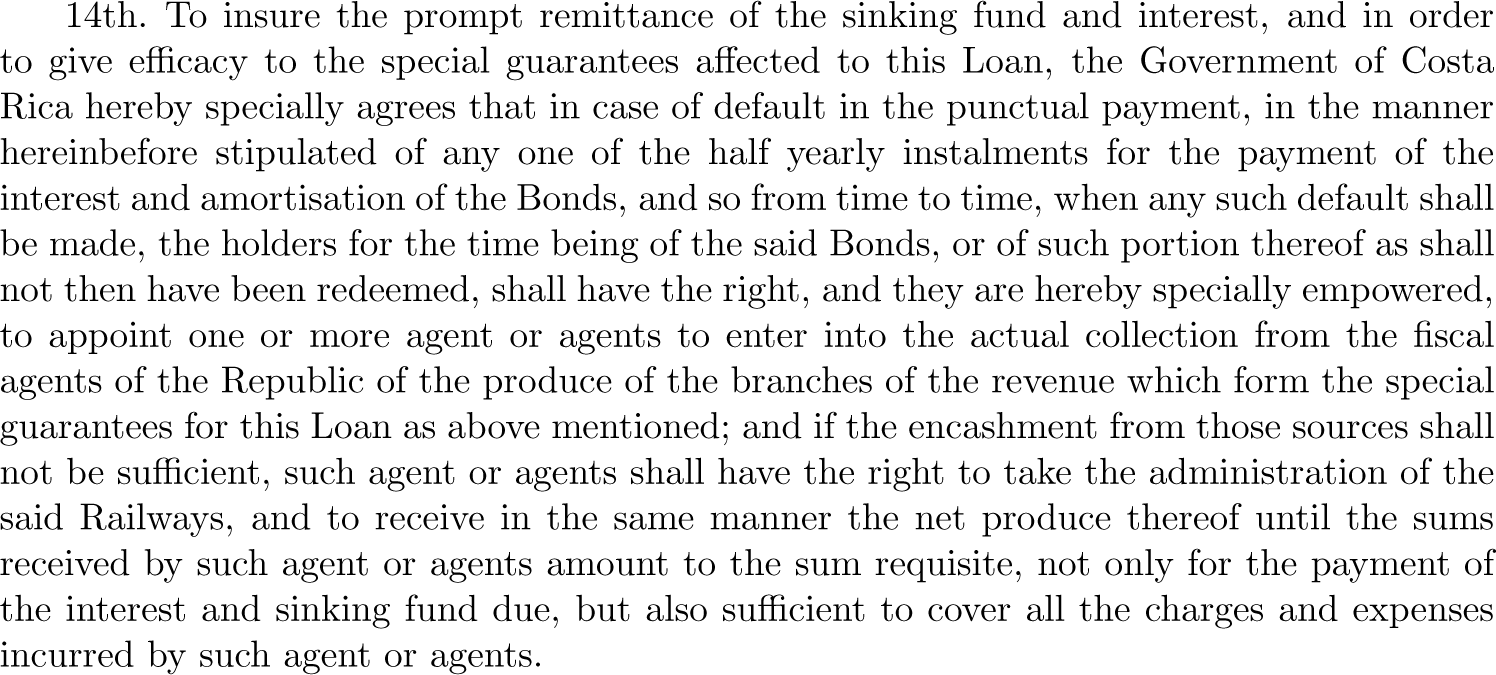
FIGURE 2.1. Article 14 of the 1872 Loan to Costa Rica. Source: The Stock Exchange Loan and Company Prospectuses. Adaptation of image digitized at the Guildhall Library, City of London.
The provisions of the 1872 Costa Rica loan mirror an extended practice in the Bond Era. By hypothecating (or pledging) key assets and sources of revenue, sovereign borrowers gained access to external capital even when they had a murky reputation in international markets. Now, for extreme conditionality to be credible, it had to be enforceable and profitable. How did private investors manage to take control of foreign assets? And conditional on enforceability, did they benefit from taking control of local assets?
Enforceability strengthened over time for three reasons (fully articulated in chapter 4): First, investors in London, the world financial capital, created in 1868 an encompassing organization known as the Corporationof Foreign Bondholders (CFB), which perfected collective action in negotiating debt settlements with embarrassed governments and lobbying for diplomatic assistance. Second, the new “gentlemanly class”40—the fusion of landed aristocracy and big banking families—assumed high-ranking positions in the British government, the diplomatic service, and the Bank of England, the pillar of British public credit. Third, in the era of high imperialism, finance became another fundamental aspect of foreign policy (coupled with colonialism and commerce). To balance the open interference of French and German governments in private capital markets, the Foreign Office often found itself interceding on behalf of its nationals in default and concession negotiations with foreign governments. Officially, the British government interfered only when “national interest” was at stake, as some have claimed.41 But that consideration grew in scope and frequency with the intensification of imperial competition and elite replacement in government.
Gunboat diplomacy—the use of military means to solve debt disputes— was the most punitive supersanction. If diplomatic pressures were effectively exerted, however, gunboat diplomacy would be observed only in cases where borrowers miscalculated the consequences of their actions.42 The rare possibility of using military resources to solve debt disputes had a more far-reaching consequence: It “influenced how policy makers perceived their choice set”;43 that is, it shaped expectations about how the loan market operated and what the consequences were if debt service were interrupted. When a country pledged key assets as part of a loan contract, both lenders and borrowers had an expectation of its enforceability.
Was extreme conditionality profitable for foreign investors? Surrendering assets to foreign investors was interpreted as a national humiliation, something any incumbent would like to avoid. But the credibility of extreme conditionality required that investors would benefit from executing the supersanction, be it in the form of receivership or asset foreclosure. Although no systematic study has been conducted on the profitability of foreign control, indirect evidence reviewed in chapter 5 suggests private investors fared well. In negotiating the terms of loan contracts, investors prioritized liquid assets, including but not limited to state monopolies, infrastructure, and customs offices of international ports, for which valuation data were readily available. These securities often were known pockets of revenue whose yields were included in previous budgets or loan prospectuses; other times, the very same projects financed with external capital were used as security, reducing information asymmetries and allowing for an accurate assessment of the returns of foreclosure.
To support that extreme conditionality was credible, hence enforceable and profitable, I provide two pieces of evidence: In chapter 4, I show that the inclusion of specific pledges in loan contracts reduced the premium paid at issue, holding time-invariant characteristics and secular trends constant. In chapter 5, I review qualitative evidence of the profitability of receiverships for foreign private investors.
2.2.1 WHY ACCEPT EXTREME CONDITIONALITY?
In the presence of extreme conditionality, sovereign default was intended to inflict substantial damage on the popularity of the local incumbent.44 Foreclosure of national assets in the form of receiverships and swaps was perceived as a national humiliation, and these episodes were instrumented by local opposition to erode the popularity of the incumbent.45 To minimize public contestation, local governments did everything to the best of their ability to keep these clauses secret. In Uruguay, for instance, port and banking concessions to British investors in 1883 were passed in secret sessions in the legislature to avoid alienating public opinion, already suspicious of British stakes in the country.46
Large popularity shocks may be counterproductive for investors if they weaken the borrower’s preference for external finance. After all, why would a ruler swallow such a bitter pill? The reason lies in the effect of extreme conditionality on interest rates, which reflect the perceived risk of an investment. The popularity shock of foreign control was deemed so damaging that investors anticipated low probability of default when extreme conditionality clauses were included in loan contracts.47 By agreeing to them, the ruler traded access to cheap external capital—the hook—for the possibility of foreclosure in the future—the catch.48
Although extreme conditionality reduced the cost of capital, it would be naive to expect rulers to eagerly accept the strings attached. Here is where financial markets were (and are) like no other: They “operate on the basis of both price and control by lenders of the supply of funds offered to borrowers.”49 If the borrower does not accept the conditions, creditors can simply negate capital. Credit rationing provides unmatched bargaining power to international lenders. A good example can be found in the negotiation of the 1891 Portuguese loan. A syndicate of French bankers wanted the concession of the public tobacco monopoly in Portugal for 35 years as a condition for a new loan. Despite initial opposition by Portuguese authorities, the deal was accepted. Why? The words of the Portuguese minister of finance in presenting the budget are self-explanatory:
“The last loan, besides being on very onerous terms, could not be obtained without security, and this security [the tobacco monopoly], which was the principal revenue of the country, had to be put into the hands of the creditor who paid himself with his own hands, delivering the excess to the government.”50
2.3 External Finance and State Unmaking
War makes states if the long-run equivalence between debt and taxes holds, that is, when rulers enhance the tax administration to honor war debt with tax money. Externally financed war may not translate into state building in these scenarios: (1) a country defaults on its external obligations and the debt relief or “haircut” is substantial; or (2) a country defaults and swaps war debt for foreign control of national assets. Either solution disconnects war efforts from state building by weakening incentives to revamp the tax administration to liquidate war debt.
In the Bond Era, debt relief could be substantial, reaching as high as 50 percent of outstanding debt;51 however, it was seldom pro bono. Debt relief was generally conditional on issuance of new loans with which to wash old debt.52 The fresh capital allowed old creditors to recover part of their initial investment while imposing newer debt obligations and harsher conditions on borrowers—key among them, foreign control over local assets.53
The hypothecation of national assets allowed countries to access credit at lower rates and avoid credit rationing, but exposed borrowers to financial control and debt-equity swaps, which if executed shrank the tax base—the opposite of a ratchet effect. By agreeing upon (or not opposing) a supersanction after default, embarrassed governments were again in compliance with international law and regained access to international markets;54 however, they did so with a smaller tax base and without having improved their tax capacity with respect to prewar years.
Suppose that the borrowing-default-foreclosure cycle repeats. Because debt obligations are now higher and the tax base narrower, creditors will likely require new hypothecation of assets for fresh loans, further eroding the effective tax base available to the local government. Intuitively, a couple of cycles like this can push any country into a debt trap—a steady state characterized by high indebtedness and low tax capacity, the opposite of state building. The history of foreign debt in Peru is a prototypical example of this slippery slope.
2.4 Foreign Finance and State Unmaking: The Case of Peru
Peru floated its first two foreign loans in the early 1820s in London to pay for the war of independence against Spain. The loans, secured by the net revenue of both the mint and customs, were defaulted in 1826.55 Two decades of internal instability followed. During this time, guano deposits in the Chincha Islands were discovered and nationalized in 1842. Revenue from guano rapidly became the first source of government funding.
A default settlement with foreign bondholders was accepted in 1849. The outstanding principal was refinanced with a new loan, secured by one-half of the proceeds derived from the sale of guano to Great Britain. Three new loans were floated in London in 1853, 1862, and 1865, all of them secured by guano deposits. The last loan included an explicit provision for a debt-equity swap in article 12:
Art 12. Should the declaration respecting the stocks of guano, not have been made during two consecutive half-years, the representatives of the Bondholders of this Loan are authorized to take possession, at any time, of the quantity of guano in the deposits of the Chincha Islands and of other places in Peru which may be required to complete the provision for three half-years’ service.56
The loan of 1865, the largest at £10 million, was issued to finance war against Spain. This loan was equivalent to 250 percent of annual revenue.57 Military expenses continued to increase, and one year later a new loan was floated in New York. “While loan after loan was contracted, the public finances were conducted with a reckless disregard of all sound fiscal principles. No attempt was made to develop a proper system of taxation.”58 The last two loans were ultimately insufficient to balance the budget.
Peru avoided default in 1869 by signing a contract with Dreyfus Brothers & Co. of Paris, which acquired the monopoly of the sale of guano to Europe and its colonies in return for advance payments to service external debt. For the duration of the contract (renewed in 1874), Messrs. Dreyfus were appointed the financial agents of the government abroad.
Motivated by increased liquidity, Peru regained access to credit markets and raised in 1872 the largest loan to date, £37 million, seven times its total annual revenue (£4.49 million in 1872).59 Two-thirds of the fresh capital was spent in refinancing old debt, and the remainder on railways. The loan was secured by the guano and customs revenues plus the two new railway lines. The financial situation deteriorated shortly thereafter, and debt service was interrupted in 1876.
The president of Peru, General Mariano Ignacio Prado, and bondholders in London negotiated a new settlement known as the Raphael Contract. A company formed by bondholders’ representatives, the Peruvian Guano Company, Ltd., was created and granted the sole right to sell guano in all markets of the world for a period of four years. This agreement, however, did not cancel the concession to Dreyfus, which had preferential access to the guano. The new company raised little revenue, and Peru remained banned from international markets.
In 1879, a new international military conflict arose—the War of the Pacific. The Peruvian government approved a loan to be floated in London, but exclusion held. The government turned inward, printing paper money, contracting some internal loans from Lima bankers, and raising some taxes, most notably an export tax on sugar.60 The bulk of tax revenue, however, was in the hands of foreigners. Peru lost the war and control of the main guano deposits. A new debt settlement with foreign bondholders was reached in 1889, years after the war had ended. Under the Grace Contract of 1889,
Peru was released absolutely by her foreign bondholders from all responsibility for the loans of 1869, 1870, and 1872. In return for this cancellation of the debt she ceded to them for a term of 66 years the state railways [seven lines]; assigned to them all the guano in Peru up to 2 million tons… gave them the franchise for the operation of steamers of Lake Titicaca.… In addition… the bondholders were empowered to select as a free grant unappropriated land to the extent of 5 million acres upon conditions of development and colonization… and certain concessions relating to the Cerro de Pasco mines.61
In sum, the 1869 loan had been collateralized with the guano deposits; the 1870 and 1872 loans, with railways. Peru lost control over these resources to bondholders in 1889. As part of the default settlement, Peru was readmitted to international markets despite not having put forward any meaningful fiscal reform. External finance in the nineteenth century distorted incentives to build a state in Peru and, arguably, ended in foreign looting.
2.5 Opportunities of State Building in the Era of International Finance
Although the case of Peru does not invite optimism, external finance does not necessarily cause debt traps. Some rulers are arguably more public spirited or forward looking than others and are committed to service debt—the Meiji Restoration comes to mind. Others might call the bluff of financial colonialism and opt for fiscal austerity, as Ethiopian and Siamese rulers arguably did.62
More generally, I expect opportunities to strengthen fiscal capacity and avoid debt traps to arise under imposed (or “exogenous”) circumstances, in particular, exclusion from international capital markets. If rulers need to fund government but lack access to external capital, their incentives to enhance taxation may strengthen, everything else constant. To mobilize domestic resources for war, the ruler may be compelled to grant taxpayers power over fiscal policy and reshuffle the tax administration, activating the political and bureaucratic mechanisms of transmission.
2.5.1 THE POLITICAL MECHANISM OF TRANSMISSION
The political consequences associated with taxation cannot be overemphasized. Power-sharing institutions are crucial to understanding the persistence of the fiscal effects of war mobilization, or why the effects of past warfare are felt today. By sharing power with taxpayers, rulers enable an accountability mechanism that helps them overcome credibility issues. Ironically, the ability of rulers to raise taxes grows by tying their hands.
The reinforcing effect of power-sharing institutions on taxation has been widely examined in the social sciences. Margaret Levi argues that limited government is conducive to “quasi-voluntary compliance” by taxpayers precisely because political accountability grants credibility to the promised returns for taxes.63 Besley and Persson formalize the opportunities for sustained cooperation in tax policy created by power-sharing institutions. In “common-interest states”—where government revenue is used to fund public goods (e.g., national defense)—taxation becomes a self-enforcing game: the ruler secures a constant stream of funds to enhance the public good while taxpayers are protected from arbitrary use of tax monies.64 Recently, Acemoglu and Robinson coined the term shackled Leviathan to characterize the complementarities emerging from a “powerful state” and a “powerful society.” The former involves high tax capacity (although not exclusively); the latter, taxpayers’ ability to hold government accountable.65 Meanwhile, David Stasavage emphasizes the stickiness of power-sharing institutions in Europe and beyond. Representative assemblies, which may have a marked oligarchic character, solve collective action problems of taxpayers to keep the ruler in check. Once summoned, the practices and the coordination gains they facilitate may be difficult to erase.66 Power-sharing institutions, in sum, propagate revenue mobilization efforts in the long run. This I call the political channel of persistence.
Under what conditions is taxation more likely to activate the political mechanism? The students of democratization suggest that the exchange of political rights for tax compliance happens when at least one of two conditions is met: small geographic scale and high capital mobility. Stasavage shows that the capacity of representative assemblies to monitor fiscal policy in early-modern Europe depended on the size of the polity.67 Poor technologies of communications and transportation limited the ability of distant elites to coordinate their monitoring of the Crown. French kings, for instance, exploited geographic scale by arranging separate tax contracts with different regional powers, limiting advances in executive constraints. Although their power was never absolute—tax farmers and regional assemblies exerted significant influence in fiscal policy—French monarchs had more leeway than their counterparts in smaller polities. In the Bond Era, Siamese kings took advantage of geographic scale to raise taxation while limiting power-sharing concessions.
Low levels of capital mobility are a second obstacle to the activation of the political mechanism of transmission. Bates and Lien, as well as Boix, argue that owners of mobile capital have a comparative advantage at extracting political concessions from the ruler because they can credibly threaten to withdraw tax payments or flee to other jurisdictions.68 When fiscal capacity is limited, rulers are compelled to grant owners of mobile capital some say in policy making to secure their tax compliance. Capital mobility increases with levels of monetization of the economy, which results from economic growth and international trade.
The foregoing discussion suggests that poor and geographically large countries are at a disadvantage in experiencing the activation of the political mechanism of transmission following an increase in the tax burden. For such countries, I expect the ratchet effect of war finance to be channeled through the bureaucratic mechanism.
2.5.2 THE BUREAUCRATIC MECHANISM OF TRANSMISSION
Professional tax administrations in Europe were created by and for war, completing a long and complex process of fiscal centralization.69 To secure bigger and more stable tax revenue inflows, central governments gradually substituted tax farms and locally appointed tax collectors (e.g., the landräte in German principalities) by professionally trained tax officials. Over time and not without setbacks, government-paid inspectors gained new monitoring powers, resources, and legal provisions to do their job.
There are at least two reasons why we can expect bureaucratic efforts to finance war to persist: First, tax administrations operate in the best interest of a revenue-maximizing ruler. Second, bureaucracies are “among those social structures which are the hardest to destroy.”70 In Europe, the same administrations once created to finance war gave rise to a class of state bureaucrats who safeguarded organization survival, carrying on the effect of war finance in the long run.71 This I call the bureaucratic channel of persistence.
Unlike the political mechanism, reserved for sovereign countries,72 the bureaucratic mechanism is meant to apply to both sovereign and nonsovereign entities. Colonies in the nineteenth century were expected to secure resources to fund local expenses.73 To finance infrastructure projects, colonies issued loans in European markets on a regular basis. Colonies were also expected to contribute to imperial and local war finance, but incentives to mobilize resources were weak because local governments relied on imperial bailouts.74 Keeping in mind this important difference with sovereign nations, tight capital markets were likely to strengthen the incentives to enhance local bureaucracies to fund colonial expenses, plausibly activating the bureaucratic mechanism of taxation.
2.5.3 THE LEGACY OF WAR FINANCE ON STATE BUILDING
The foregoing discussion suggests that rulers generally prefer to finance war externally because doing so minimizes short-term political and administrative costs. If, however, they resort to taxation—a decision that might be guided by exogenous circumstances—war finance might activate one or two mechanisms of transmission depending on scope conditions (i.e., geographic scale and income), raising the state’s capacity to collect taxes on a permanent basis.
In chapter 7, I examine long-run effects of war finance by taking advantage of global financial crises in the nineteenth century. These unanticipated and exogenous shocks in access to capital limited opportunities to finance war externally. I show that waging war while being exogenously excluded from international credit markets exerted positive effects on fiscal capacity in the short and long run. External finance, on the other hand, could easily lead to debt traps, particularly if they involved foreign control.
One may argue that debt-equity swaps and receiverships are positive for state capacity, particularly when they involve putting local tax administrations under the control of skilled foreigners. Potentially, European and American administrators could incorporate modern managerial techniques and know-how, but evidence of foreign financial control in the Bond Era does not support this claim. Gardner, Maurer and Arroyo Abad, and Reinhart and Trebesch, among others, find that foreign receiverships in Latin America, Africa, and Europe had detrimental effects on local taxation.75 Foreign financial control in Egypt may be an important exception;76 however, the expansion of fiscal capacity in that country was accompanied by the loss of political sovereignty.77 I resume this debate in chapter 5.
If war is financed domestically and the political and bureaucratic mechanisms are activated, I expect early fiscal efforts to last. In chapter 8, I show evidence of the activation of these mechanisms and subsequent endurance. In chapter 9, I submerge into a case study, Chile 1816–1913, to investigate the changing political calculus of war finance depending on access to external capital. Together, chapters 7–9 suggest that early decisions about war finance pushed countries onto starkly diverging paths—one characterized by endemic indebtedness and weak state capacity, the other by sustained state building and political reform.
2.6 Conclusion
I suggest that having access to external credit is consequential to understanding the conditions under which war makes states precisely because taxes and loans may not exert the same transformative effects on fiscal capacity. A key implicit assumption underlying the bellicist theory of state building—the workhorse model of this book—is the long-run equivalence between debt and taxes, namely, that loans operate as deferred taxes. According to this model, lenders recover their investment plus interest while borrowers assume full responsibility for war debt by enhancing the tax system, thus elevating fiscal capacity in the long run.
Although no scholar would defend a strict reading of the so-called Ricardian equivalence between debt and taxes, a general understanding holds that loans and taxes operate in roughly similar ways. The argument made in this chapter is that the conditions under which the debt-tax equivalence holds for sovereign borrowers may be narrower than previously thought. Whereas international investors in the Bond Era recovered their investment one way or another—in tax money or specie—the equivalence did not necessarily hold for local treasuries. Generalized debt relief coupled with foreign control short-circuited the long-run relationship between debt and taxes, shedding light on the perverse consequences of early access to external finance for state building.
The discussion in this chapter resonates with the dilemmas derived from investing in good (liberal) institutions in Acemoglu, as well as Besley and Persson.78 These scholars argue that political motives are responsible for underdevelopment in state capacity. The fear of future extraction via taxation by the opposition precludes investment in fiscal capacity despite the potential benefits for both parties. In the presence of external finance, the political dilemmas of state building identified by these scholars only amplify. Resorting to foreign loans, rulers secure government funds while dodging political compromise and fiscal efforts required to establish “good institutions.”
2.7 Appendix
In this appendix, I advance a simple decision-theoretical model to formalize the political dilemmas of public finance and extreme conditionality presented in this chapter. Consistent with the preceding discussion, I focus on the political calculus of war finance by a revenue-maximizing ruler. The world exists in two periods—today and tomorrow—and war begins and ends in period 1. I make two assumptions about war finance. First, war is paid with tax revenue or loans; intermediate combinations are ruled out. Wars are rarely funded with tax revenue alone because they are too expensive; however, this assumption allows me to explore the political calculus at stake (i.e., the exchange of taxation for political rights) with the simplest possible model. Second, I assume that the cost of war, W, is fixed. Endogenizing the size of war would be an interesting approach but is beyond the scope of the book. Combined, the two assumptions reduce the attractiveness of loans relative to taxes, expanding the states of the world in which war leads to higher fiscal capacity. That is, the assumptions are most favorable to the bellicist hypothesis.
The ruler can raise a finite amount of revenue via taxation, κ T > W, where κ denotes the stock of fiscal capacity in period 1 and T the tax base. The ruler seeks to maximize private consumption, financed by the share of public funds (1 − α), α ∈ [0, 1], the ruler can keep (i.e., the rents from office). The more closely α approaches 1, the stronger the power taxpayers have over fiscal policy (or the less the ruler can appropriate from the treasury’s coffers). The fiscal contract derived from taxation limits the share of total revenue that the ruler can use for private consumption to (1 − α)/2. Later I consider a more general expression.
For the sake of simplicity, I assume that tax capacity expands over time as a result of know-how accumulation. That is, tax collectors learn over time common avoidance schemes. This assumption suffices to capture one of the key dilemmas of fiscal capacity building: the exchange of tax revenue for political rights. Forgone consumption derived from pecuniary investment in capacity could be considered, but it would complicate the analysis unnecessarily.79 I assume that know-how expands fiscal capacity by η < 1 units, κ + η ≤ 1, between periods 1 and 2, capturing the ratchet effect of taxation in a simple reduced form.
The ruler’s payoff in period 2 is discounted at a rate δ ∈ [0, 1], hence the expected value of financing war with taxes is
Expression 2.1 captures in a stylized fashion an intrinsic dilemma in fiscal capacity building. The new tax expands the long-run volume of resources that can be mobilized via taxation in period 2, (κ + η)T, but it does so at the cost of granting taxpayers power over fiscal policy, hence limiting the share of tax revenue that the ruler can accrue from the national budget to (1 − α)/2. Because of credibility issues, higher taxation cannot be achieved without the ruler relinquishing fiscal powers in period 1. Once political power is shared with taxpayers, retracting the privilege might be difficult precisely because the new institutions strengthen their tax bargaining power vis-à-vis the ruler, hence the persistence of strong executive constraints in period 2.
Alternatively, the ruler may float a loan L > W to finance war. Servicing debt implies paying back the standing principal L plus interest i, that is, (1 + i)L. The interest rate is set in the international capital market, where loans are floated. The country-specific interest rate is broken down into two parts: i = r + p, where r < 1 is the interest rate of a risk-free sovereign bond (e.g., the British consol), and premium p = (1 + r)d/(1 − d). The latter is strictly increasing in the probability of default, d, which encapsulates the reputation of the borrower in international markets. The premium p is derived by setting the international investors’ profit when lending is risk free, L(1 + r) − L, equal to the international investors’ profit when the probability of default is nonzero, d × 0 + (1 − d) × (1 + r + p)L − L, and solving for p. Intuitively, lenders charge a premium to countries with a history of default to bring the expected value of lending to a potential lemon equal to the expected value of lending to a seasoned borrower. The interest rate of the risk-free asset, r, is set in the international market. For the sake of simplicity, capital supply is defined by the inverse linear function rs = αs + ϕsqs, where qs denotes the global supply of capital and ϕs > 0. Global capital demand is given by the inverse function rd = αd − ϕdqd, αd = 1, ϕd > 0. The international market clears at r* = 1 − (ϕd(1 − αs)/(ϕd + ϕs)).
Together, the ruler’s expected value of financing war externally is
where default carries a sanction S ∈ [0, 1]. Notice that by borrowing in period 1, rulers can keep loose executive constraints, meaning that in the short run they retain a larger share of the national budget for self-consumption, (1 − α). If they decide to service debt in period 2, they will need to share fiscal power with taxpayers in return for tax compliance. As a direct consequence, the share of the budget they can appropriate will reduce to (1 − α)/2.
When does a risk-neutral ruler prefer to finance war with external loans? Whenever the expected payoff of lending is greater than that of taxing, or
Let me comment on the various parts of expression 2.3.
Fiscal Capacity
Preference for loans is a function of the stock of fiscal capacityκ and the anticipated ratchet effectη. External loans are preferred when either of these parameters are low. That is easy to see. Historical accounts suggest that significant advances in tax capacity occur when rulers build on preexisting fiscal infrastructure. If the ratchet effect of taxation is lower at lower levels of capacity (i.e., the relationship betweenη andτ is convex or, more reasonably, S-shaped), then preference for taxation will be twice weakened when the initial stock is low.
Executive Constraints
Preference for external finance is a function of initial executive constraints and forgone consumption. When initial constraints α are weak, financing war with taxes reduces considerably the ruler’s private consumption, hence weakening preference for taxes. But as executive constraints increase, preference for taxation strengthens:
everything else being constant.
Notice that in expression 2.1 I assumed private consumption was sliced by half if the ruler opted for taxation. Forgone consumption can be generalized to (1 − α)/ψ, ψ > 1. That is, larger ψ makes war taxes less attractive relative to external finance. We may expect the relationship between initial constraints and forgone consumption to be concave rather than linear. That is, to overcome credibility issues, largely unaccountable rulers might be compelled to reduce their cut from the national budget more than other rulers who are already constrained. If that is the case, autocrats will disproportionally disfavor taxation because forgone consumption will be greatest for them.
The discussion about initial capacity and political conditions suggests that weakly institutionalized countries will be unlikely to finance war with taxation when external finance is available. In addition, the preference of loans over taxation will be strengthened in the presence of low discount rates, δ. Although these appear in both the numerator and denominator of expression 2.3, the effect is unambiguous. As δ decreases, the numerator decreases and the denominator increases, hence the stronger preference for loans.
Market Liquidity
The lower the liquidity in the capital market (higher r), the more taxation is preferred, everything else being constant. That is easy to see. When international capital markets experience a positive shock—for instance, following a capital surplus in a major economy—the international credit supply shifts to , , and a new equilibrium is reached, (r′, q′)*, characterized by lower interest rates (r′)* < r* and more trading (q′)* > q*.
Recall that the interest paid by a borrower with a shaky reputation is given by i = r + p, the baseline rate plus a premium. Because both i and p are a function of the baseline rate, an increase (decrease) in liquidity brings down (up) the price that a lemon pays for external capital. For a large enough negative shock, , international lending ceases, strengthening incentives to finance war with taxes. I build on this intuition in chapter 7, where I exploit credit crunches in international capital markets to identify periods in which rulers are most compelled to raise taxes to fund war.
Extreme Conditionality
In expression 2.3, preference for loans weakens as the magnitude of default sanction S increases, discouraging indebtedness. That outcome is not good for international lenders. Extreme conditionality can simultaneously facilitate cheaper credit while solving credibility issues. To see this point, assume that the probability of default d is a negative function of default sanction S. In other words, the bigger the anticipated sanctions are, the lower the probability of default is, everything else being constant. Clearly, this is a simplification. Default is a function of the capacity to pay, war outcome, and “political willingness.”80 With this in mind, this assumption facilitates understanding what lenders can do to secure debt service while not discouraging borrowing.
To make things as simple as possible, I assume that the relationship between the probability of default and default sanctions is linear, d = 1 − S. Define
with solving the first-order condition in the right-hand side of expression 2.3. Then we can divide the state of the world in two: For any , preference for taxation strengthens in proportion to the size of default sanctions; that is, in expectation of default sanctions, rulers prefer to tax instead of borrow. Although this might be good for building states and striking political bargains with taxpayers, it is bad business for international creditors. For , as the magnitude of default sanctions increases, preference for borrowing strengthens. The lower probability of default when sanctions are high reduces the price of external finance, ∂p/∂d > 0, making loans preferable over taxation for the sitting ruler.
By requiring the hypothecation of national assets, lenders in the Bond Era were able to push the cost of default to levels satisfying . Extreme conditionality facilitated cheap credit access to lenders with weak fundamentals but opened the door to high indebtedness, default, and foreign control.
1. Any funding alternative to taxation will weaken further the connection between war and state making. Refer to chapter 1 for details.
2. Levi (1988).
3. Gennaioli and Voth (2015); Hoffman (2015).
4. Ferejohn and Rosenbluth (2016); Hintze (1975); Spruyt (1994); Stasavage (2016). See Downing (1993) for a competing view.
5. The British case is treated by Bates and Lien (1985) and North and Weingast (1989), and the French case by Mousnier (1974) and Johnson and Koyama (2014). I return to them below.
6. Stasavage (2011); and Greif, Milgrom, and Weingast (1994) for a micro-foundation.
7. Tilly (1990, p. 64).
8. This type of intertemporal dilemma in fiscal capacity building is treated in detail in Besley and Persson (2011) and my earlier work, Queralt (2015).
9. Brewer (1988).
10. Peacock and Wiseman (1961).
11. Schultz and Weingast (1998); Slantchev (2012).
12. Barro (1979).
13. The edited volume by Yun-Casalilla and O’Brien (2012) offers an excellent survey of the use of domestic debt to finance war in Europe.
14. Refer to chapter 3.
15. Michie (2006, p. 101). See Calomiris and Haber (2014) and Summerhill (2015) for case-specific accounts.
16. Austin and Sugihara (1993, p. 19).
17. Bazant (1995, pp. 45–46).
18. Refer to Panizza, Sturzenegger, and Zettelmeyer (2009) for a comprehensive review.
19. Eaton and Gersovitz (1981).
20. Rogoff (1999, p. 31).
21. Cappella Zielinski (2016); Flores-Macías and Kreps (2017); Fujihira (2000); McDonald (2011); Shea (2013).
22. Tomz (2007).
23. See the chapter appendix for a formal discussion.
24. Schumpeter (1991). See Dincecco (2011) for historical evidence.
25. Scheve and Stasavage (2010, 2016) for progressivity, and Aidt and Jensen (2009) and Mares and Queralt (2015, 2020) for origins of the modern income tax.
26. Bueno de Mesquita and Smith (2013, p. 527).
27. Eichengreen (1990); Neal (2015); Reinhart and Rogoff (2009).
28. Frieden (1991a, p. 54); Panizza, Sturzenegger, and Zettelmeyer (2009, p. 676).
29. Ballard-Rosa, Mosley, and Wellhausen (2021).
30. See Panizza, Sturzenegger, and Zettelmeyer (2009) for an exhaustive review.
31. Bulow and Rogoff (1989); Schultz and Weingast (1998).
32. Schultz and Weingast (1998, pp. 21–22).
33. Flandreau (2020). A few exceptions, such as the independence war bonds of Greece, are noteworthy. Despite interrupting service of these loans, Greece was able to float fresh loans (Tomz, 2007, p. 228).
34. Frieden (1991a, p. 55).
35. Bulow and Rogoff (1989).
36. Flandreau and Zumer (2004, p. 39).
37. Flandreau and Zumer (2004, p. 39).
38. Mitchener and Weidenmier (2010).
39. Cain and Hopkins (2016, p. 284).
40. Cain and Hopkins (2016).
41. Fishlow (1985); Platt (1968); Tomz (2007).
42. Consistently, Tomz (2007) shows that gunboat diplomacy was infrequent.
43. Mitchener and Weidenmier (2010, p. 120).
44. Ahmed, Alfaro, and Maurer (2010); Borensztein and Panizza (2010); Panizza, Sturzenegger, and Zettelmeyer (2009).
45. Examples can be found in Cuba (Zanetti and García, 1998, pp. 244–246), Egypt (Hyde, 1922, pp. 535–536), Mexico (Wynne, 1951, pp. 38–39), and Greece (Wynne, 1951, p. 305).
46. Winn (1976, p. 112).
47. Refer to chapter 4 for evidence of this.
48. I formalize this argument in the chapter appendix by endogenizing the probability of default in the presence of extreme conditionality. There I show that the relationship between the severity of supersanctions and preference for external finance is U-shaped.
49. Frieden (1991a, p. 55).
50. Annual Report of the Corporation of Foreign Bondholders 1893, p. 202.
51. Lindert and Morton (1989); Jorgensen and Sachs (1988).
52. See, for instance, the default settlements in Latin America (Rippy, 1959, pp. 26–28).
53. Suter and Stamm (1992).
54. Notice that foreign bondholders running receiverships were also highly interested in returning the embarrassed government to capital markets because doing so would resume trade, replenish foreign reserves, and expand the tax base with which to service old debt. See, for example, the Ottoman Public Debt Administration in chapter 5.
55. Wynne (1951, p. 109).
56. Wynne (1951, fn.12).
57. Vizcarra (2009, table 4).
58. Wynne (1951, p. 114).
59. Vizcarra (2009, table 4).
60. Sicotte, Vizcarra, and Wandschneider (2010, p. 299).
61. Wynne (1951, p. 171).
62. Refer to chapter 9 for a brief history of public finance and state building in Japan, Ethiopia, and Siam.
63. Levi (1988).
64. Besley and Persson (2011).
65. Acemoglu and Robinson (2019, p. 65).
66. Stasavage (2020). In addition, Fujihira (2000) points out the role of two modern power-sharing institutions—representative parliaments and political parties—in facilitating sustained levels of taxation. These institutions aggregate competing tax preferences of capital and labor, facilitating compromise and sustained cooperation after war.
67. Stasavage (2011).
68. Bates and Lien (1985); Boix (2003).
69. Ardant (1975); Dincecco (2011); Ertman (1997).
70. Weber (1978, p. 987).
71. Schumpeter (1991).
72. Self-government colonies in the British Empire were allowed to elect local parliaments, as was French Algeria, but these were exceptions.
73. Berman (1984); Frankema (2011).
74. Davis and Huttenback (1986) show that self-governing colonies were better at resisting contributions to imperial war finance than Crown colonies. For details, refer to the paired comparison of South African republics in chapter 6.
75. Gardner (2017); Maurer and Arroyo Abad (2017); Reinhart and Trebesch (2015).
76. Owen (1981, ch. 9).
77. Cromer (1908); Owen (1981).
78. Acemoglu (2003); Besley and Persson (2011).
79. See examples of such models in Besley and Persson (2011) and Queralt (2015).
80. Reinhart and Rogoff (2009).