
25
NARVA
The Tsar’s declared objective in attacking Sweden was to seize the Baltic provinces of Ingria and Karelia. Ingria was a comparatively narrow strip of land extending seventy-five miles along the southern shore of the Gulf of Finland, from the mouth of the Neva to the town of Narva; Karelia was a much larger expanse of forest-and-lake country between the gulf and Lake Ladoga, extending as far west as Vyborg. Together, the two provinces, which had been taken from Russia during the Time of Troubles, would give Peter an adequate opening to the Baltic.
Narva, a coastal town and fortress in Estonia on the border of Ingria, had not been included in Peter’s original war aims; it was part of the territory which Patkul and Augustus had designated to go to Poland. Nevertheless, Peter felt that the surest way of securing Ingria would be to capture this town. And as he studied his maps of the region, it seemed that a thrust at Narva would not be difficult; the Russian frontier lay only twenty miles to the southeast of the town, a short march for an invading army.
Peter’s decision was received unhappily by Patkul and Baron Langen, Augustus’ representative in Moscow. They were not eager to see Swedes replaced in Estonia by Russians, even if, for the moment, the Russians were their allies. As Baron Langen reported to Patkul, “I have done everything possible, with the help of the Danish ambassador, to distract him [the Tsar] from this intention. We found him so stubborn that we feared to touch any more on such a delicate subject and must be satisfied with the Tsar’s break with Sweden in the hope that in time Narva will be in our hands.” Patkul worried that, having taken Narva, Peter would move down the Baltic coast, swallowing the whole of Livonia without Augustus being able to prevent him. But there was nothing to be done; the Tsar was determined.
By mid-September 1700, Prince Trubetskoy, Governor of Novgorod, had received orders to march on Narva and invest the city with an advance guard of 8,000 men. Command of the main army was given to Fedor Golovin, who had served as ambassador, foreign minister and admiral andnow was to be a field marshal. Under Golovin, the army was divided into three divisions, to be commanded respectively by Avtemon Golovin, Adam Weide and Nikita Repnin. In all, the army totaled over 63,000 men, but the troops were widely scattered. As Trubetskoy’s men were moving slowly in the direction of Narva, Repnin’s division was still assembling on the Volga, a thousand miles away. By October 4, 35,000 Russians were building trenches before the town and Peter himself had arrived to oversee the siege. He was awaiting only the arrival of cannonballs and powder to begin the bombardment.
The town of Narva, built by the Danes in the thirteenth century, had been a flourishing seaport in the time of the Hanseatic League, and even in Peter’s day it handled a substantial amount of Russian trade from Pskov and Novgorod. It was like many another Baltic German town, with gabled brick houses and the thin spires of Lutheran churches rising above tree-lined streets. Situated on the west bank of the River Narova on a neck of land made by a wide bend in the river, the town was in effect surrounded on three sides by water, and because it was so close to the Russian frontier, it was strongly defended. A high wall of stone laced with bastions encircled the city. Across a stone bridge was the squat, powerful castle of Ivangorod, built by the Russians in 1492 when the river was the frontier. Then, Ivangorod was intended to overawe the town of Narva, but now town and castle formed a single, integrated defense system. The garrison consisted of 1,300 infantry, 200 cavalry and 400 armed civilians.
Under the direction of Lieutenant General Ludwig von Hallart, a Saxon engineer lent to Peter by Augustus, the Russians established siege lines opposite the land walls on the western side of Narva. There, astride the only road by which a relief force could approach the town, the Russians entrenched themselves between double walls which cut off the town from the west and at the same time protected their own siege lines against attack from the rear. In time, these walls developed into earthworks four miles long, nine feet high, with a trench six feet deep in front.
The siege went more slowly than Peter had hoped. Although Narva was only twenty miles from the Russian frontier, it was well over a hundred miles from the nearest Russian cities, Novgorod and Pskov. The meager roads, sodden from the autumn rains, caused the transport wagons to mire and become bogged down. There were too few artillery harnesses, the carts went to pieces and the horses collapsed. Golovin did his best to move the soldiers quickly, seizing local horses and carts, but it was not until the end of October that most of his troops were in position.
The Russian artillery bombardment began on November 4. Meanwhile, Sheremetev was sent westward with 5,000 horsemen to report any sign of a Swedish rescue force. For two weeks, the Russian cannon battered the ramparts and towers of Narva with little success; the gun carriages were so badly made or so damaged in transport that many fell to pieces after three or four shots. Two Russian infantry assaults on Ivangorod were easily repulsed. By November 17, there was not sufficient ammunition to continue the bombardment beyond a few days, and the guns were silenced until new supplies could arrive. At the same time, two distressing reports arrived in Peter’s camp: King Augustus had given up the siege of Riga and retired into winter quarters. And King Charles XII had landed with a Swedish army at Pernau on the Baltic coast, 150 miles southwest of Narva.
Once the Peace of Travendal was signed, the Swedish army was rapidly withdrawn from Zealand. Charles’ officers were not anxious to leave their troops on the Danish island once the Dutch and English squadrons had departed for home, and these great ships were preparing to sail. True, the Danes had made peace, but who could tell what temptations might occur to them if the small Swedish expeditionary force was left alone and exposed on the wrong side of the sound. In addition, the King was eager to transfer the soldiers quickly in order to use them in a second campaign before winter. By August 24, the last Swedish soldier had been embarked and transported back to southern Sweden. During the last days of August and the first weeks of September, Charles refused to listen to any suggestions of peace, thinking only of deciding on the place where his counterblow against Augustus should fall. It was generally assumed that the army would sail for Livonia to relieve the city of Riga and drive the Saxon armies out of the province. But word began to reach him of Russian troops massing on the frontier of Ingria in such numbers that there could be little doubt of Tsar Peter’s warlike intentions. And in fact, before the end of September, Charles received the Tsar’s declaration of war and the news that a Russian army had crossed the frontier and appeared before the Swedish fortress of Narva.
The Swedish decision was for Livonia. Two enemies, Augustus and Peter, were attacking in that region; two major Swedish fortresses, Riga and Narva, were in danger. The king thereafter closed his mind to everything else and devoted his energy to getting his expedition under way before storms and ice on the Baltic made movement by sea impossible. In a letter from Swedish headquarters, one of Charles’ officers declared, “The King is resolved to go to Livonia. He refuses to see the French and Brandenburg ambassadors lest they be carrying peace proposals. He wishes at any price to fight with King Augustus and is annoyed at anything which seems likely to hinder his doing this.”
On October 1, spurning all warnings of danger from autumn storms on the Baltic, Charles sailed from Karlskrona for Livonia. Although the troops were crowded aboard the ships, there still were only enough transports to carry 5,000 men on this first voyage. On the third day, with the fleet in mid-Baltic, a storm swept down as predicted and scattered the ships far and wide. Some anchored and rode out the storm off the coast of Courland, others foundered and were lost. Many of the cavalry horses were crippled as the ships heaved and rolled in the waves, and Charles was desperately seasick.
On October 6, what was left of the battered Swedish fleet entered the port of Pernau at the top of the Bay of Riga. The mayor and the city council greeted the King on the quay, and an honor guard of soldiers fired its muskets in the air as he walked through the cobbled streets to his temporary lodgings. As soon as the storm damage could be repaired, the fleet was dispatched to Sweden to bring another 4,000 men, more horses and the remainder of the artillery. In Pernau, Charles heard that Augustus of Poland had lifted the siege of Riga, halted military operations and withdrawn into winter quarters. Back in mid-July, the Polish King had personally joined the siege with 17,000 Saxon soldiers, but the news of the Peace of Travendal with its sudden toppling of his once-bellicose Danish ally had surprised and disheartened him. Now, learning of the impending Swedish descent on Livonia, Augustus had prudently withdrawn to await developments. Charles received this intelligence with bitter disappointment. He had hoped to fight Augustus; he was determined to fight somebody. And, in this context, there remained a possibility. Only 150 miles away, Peter of Russia was in the field with a Russian army, besieging the fortress of Narva. Charles made his decision quickly: If the Saxons would not fight, he would fight the Russians. He would march against the Tsar to the relief of Narva.
Charles began by concentrating all his available troops. With the men he had brought and the additional soldiers sailing from Sweden, plus some of the Riga garrison now freed by Augustus’ retirement, he estimated that he could amass 7,000 infantry and 8,000 cavalry by November. For five weeks, he intensively drilled the army at Wesenberg, and during this period Swedish cavalry patrols skirmished regularly with Sheremetev’s horsemen along the road to Narva.
Not everyone in the Swedish camp was enthusiastic about the idea of a winter campaign against the Russians. To many of Charles’ officers, the enterprise seemed extremely hazardous. The Russian army, they argued, outnumbered them four to one—some rumors said eight to one; the Russians would be defending a fortified line which the Swedes, despite their inferior numbers, would have to attack; it was a seven-day march to Narva through a burned, despoiled countryside, on dangerous, boggy roads winding through three formidable passes which the Russians would certainly defend; illness had begun to spread among the Swedish soldiers and the ranks were thinning; winter was coming and no winter quarters had been prepared.
To these arguments Charles retorted simply that they had come to fight and an enemy awaited them. If the Swedish army withdrew and Narva was taken, the Russians would flood through Ingria, Estonia and Livonia and then all the eastern Baltic provinces would be lost. The King’s optimism and energy won over some of the officers and helped improve the morale of the troops. All understood that responsibility for the campaign, its success or failure, would belong entirely to the eighteen-year-old King. “If the King succeeds,” declared Rehnskjold before the march began, “there never was anyone who had to triumph over such obstacles.”
At dawn on November 13, without waiting for the arrival of 1,000 cavalrymen expected from Reval, the expedition set out. The columns following the blue-and-yellow flag included every man fit to march, 10,537 in all. The conditions were, as predicted, appalling. The roads were mired by autumn rains and the men had to march and sleep in thick, syrupy mud. The ravaged country was studded with burned-out farmhouses, set alight by Russian horsemen. There was no fodder for the horses and no food for the men except what they carried in their knapsacks. Throughout the march, a steady, cold November rain drenched the men to the skin. At night, when the temperature dropped, the rain turned to flurries of snow and sleet and the ground began to freeze. The King slept with his men under the open sky, receiving the rain and snow on his face.
Despite the bad weather, the Swedish army was pleasantly surprised to find its march almost unopposed. Two of the three passes along the road were entered and occupied without any opposition at all. On the fourth day, the leading troopers of the advance Swedish cavalry screen rode into the Pyhäjöggi Pass, eighteen miles west of Narva, where the road ran alongside a stream through a deep valley surrounded by steep hills. Five thousand Russian horsemen commanded by Sheremetev waited on the far side of the stream, but the bridge across had not been cut.
Charles, riding with the advance guard, was informed of Sheremetev’s presence. He ordered that eight pieces of horse artillery be brought forward. Then, at the head of a detachment of dragoons and a part of a battalion of Guards—no more than 400 men in all—the King charged down the valley. The Swedish horse artillery, screened from Russian eyes by the line of galloping dragoons and brought up unexpectedly to the very front line, was suddenly unmasked and opened fire at close range on the clusters of Russian horsemen on the opposite bank. The Russians, startled and frightened by the sudden flash and roar of cannon and having no guns of their own with which to reply, wheeled their horses and galloped away, leaving the pass undefended. Subsequently, it was learned that the Russian retreat was a planned withdrawal and not a flight, as Sheremetev had orders from Peter not to involve his troops in a fight with the main Swedish army. But by the weary Swedes, the charge of a small part of the army followed by what seemed a Russian rout was seen as a victory and provided much-needed encouragement. A pass which, properly defended, could have cost the Swedish army heavily to force had been taken for nothing. The road to Narva lay open.
That night, still soaked with rain and covered with mud, the Swedes pitched camp on the eastern side of the Pyhäjöggi Pass. The depth of the mire forced many soldiers to spend the night standing up. The following afternoon, the 19th, hungry and half frozen, the army reached the gutted manor house and village of Lagena, about seven miles from Narva. Not knowing whether the fortress was holding out, Charles ordered the firing of a prearranged signal of four cannon shots. Soon, four dull and distant sounds replied from the beleaguered fortress. Narva was still in Swedish hands.
Sheremetev had been sent westward with his cavalry only to observe and not to oppose any Swedish movements. Once the Swedish army began its eastward march, he followed instructions and retreated, devastating the country, as far as the Pyhäjöggi Pass. Here, the Russian commander, believing that, if fortified, the pass could easily be defended and the Swedish advance on Narva blocked, had wanted to stop and fight. But Peter, who did not fully appreciate the geography of the area, had rejected Sheremetev’s proposal. In Peter’s view, the pass was too far from the main camp and he did not want to divide the army. Instead, the decision had been made to fortify the land side of the Russian camp at Narva against an attack by Charles’ approaching force, while at the same time vigorously prosecuting the siege. Within the next decade, Marlborough was to take town after town in exactly this manner, first encircling the town with his army, and then fortifying the outer rim of his circular camp to hold off rescuing armies while he strangled the town or fortress within his constricting ring.
On November 17, Sheremetev led his horsemen back into camp, announcing that the Swedes had occupied the Pyhäjöggi Pass and were following close behind. Peter called his officers into council. Additional rounds of ammunition were served out and vigilance was doubled, but that night and the next passed peacefully. In fact, the Russians did not expect any sudden attack by the Swedes once Charles’ army arrived. Rather, they anticipated a gradual build-up of forces, a period of reconnaissance, skirmishing and maneuver, with a battle sometime in the future.
At three a.m. on the night of November 17–18, the Tsar summoned the Duc du Croy, a nobleman from the Spanish Netherlands who was with the army as an observer on behalf of Augustus of Poland, and asked him to take command. Peter and Fedor Golovin, the nominal Russian commander-in-chief, were leaving immediately for Novgorod to speed up the reinforcements and to discuss with King Augustus the future conduct of the war. Peter wanted Augustus’ explanation of his withdrawal from Riga, a move which had aroused Peter’s disappointment and suspicion, and it was for this reason that he took Golovin with him; Golovin, in addition to being commander of the army, was also minister of foreign affairs.
Some say that Peter’s departure from the army the night before the Battle of Narva was an act of cowardice. The picture of a trembling Tsar fleeing in terror before the approach of Charles and leaving the unhappy Du Croy to bear the responsibility for what was to happen has been added to the story of Peter’s earlier nocturnal flight to Troitsky to create an image of a man afraid of danger who panicked in moments of stress. The accusation is unfair, both generally and in this particular. Peter risked his life too many times, both on battlefields and on the decks of warships, for the charge of physical cowardice to have merit. The explanation is quite simple: Peter, the one man in Russia on whom all responsibility rested, was going where he felt he could do the most good. Accustomed to the measured pace of Russian military operations, the Tsar assumed that the Swedes would act with similar caution. No one dreamed that an army just arrived after a long, exhausting march would launch an immediate attack on an enemy four times its strength and protected by a ditch six feet wide and an earth wall nine feet high, studded with 140 cannon. Nor was anyone in the Russian camp fully aware of the impetuous character of Charles XII.
The unlucky figure in this decision was Du Croy. Charles Eugène, Duc du Croy, Baron, Margrave and Prince of the Holy Roman Empire, had served for fifteen years in the Imperial army in wars against the Turks, but had been forced to resign after he retreated before the approach of the Grand Vizier and an enormous Ottoman army. Seeking employment, he had presented himself to Peter in Amsterdam in 1698, but the Tsar did not engage him and he subsequently found work with Augustus. It was Augustus who had sent Du Croy to Peter to persuade the Tsar to send 20,000 men to help in the siege of Riga rather than embarking on his own campaign in Ingria. The Tsar followed his own plan, but took Du Croy along as an observer and advisor.
Now, suddenly, Du Croy was asked to take command. Perhaps, had Peter made his decision two weeks earlier, it might have been correct, but now it was too late. Du Croy argued that, lacking the Russian language and unfamiliar with the Russian officers, he would have difficulty issuing orders and ensuring that his commands were obeyed. And he was not happy with the disposition of the Russian troops—the line of circumvallation around the city was too long and the Russian forces were scattered too thinly along its length; a strong Swedish attack on one section of the line might easily succeed before troops from other sections could be brought to help.
Nevertheless, under strong persuasion from the Tsar, Du Croy consented. Peter gave him absolute power over the whole army. His written instructions were to postpone a battle until more ammunition could arrive, but to maintain the siege and prevent Charles’ army from breaking into the town. Baron Langen, in writing to Augustus, noted wryly the change of command: “I hope when the Duc du Croy shall have the absolute command, that our affairs will take quite another turn, for he has no more wine or brandy; and being therefore deprived of his element, he will doubtless double his assaults to get nearer the cellar of the commandant.” No one in the Russian camp had an inkling of what was about to happen.
At dawn on the morning of the 20th, the Swedish columns had been mustered at Lagena and were moving through the cold rain in the direction of Narva. By ten a.m., the vanguard of the army became visible to the watching Russians. The Duc du Croy, impressive in a red uniform and riding a gray horse, was in the middle of his morning inspection when early musket fire made him realize that the Swedes were approaching. He rode up in time to see the enemy emerging in rain-drenched columns from a wood on top of the Hermannsberg ridge. Du Croy felt no great anxiety: an assault on a fortified line of earthworks such as his was a slow and intricate procedure and he knew from experience that it would develop gradually. Nevertheless, studying the Swedish ranks through his telescope, he was surprised by their small size and he worried that this might be only the vanguard of a larger force. Even so, he would have sent part of his own army, perhaps 15,000 men, out to attack the Swedes, attempting to disrupt their formations and drive them back, had he not found his Russian officers strongly disinclined to leave the protection of their lines. Accordingly, he ordered his regiments to plant their standards along the earthworks, stand to arms and wait.
Charles and Rehnskjold meanwhile were standing on top of the Hermannsberg, sweeping their own telescopes up and down the Russian lines. The battlefield lay spread below them, bounded on both sides by the banks of the Narva River flowing in a wide curve around the town, with the Ivangorod fortress across the stream. Along the foreground lay the Russian siege line. A bridge that crossed the river behind the northern end of the Russian line was the only apparent Russian route of supply—or, should it come to that, of retreat. The defensive fortifications appeared impressive: a ditch, backed by an earth rampart studded with sharpened stakes, the chevaux de frise. Along the earthworks, separate bastions had been constructed, each lined with cannon. The Russian army inside the camp was obviously much larger than the Swedish force. Nevertheless, it was also clear from the activity that could be observed inside the Russian camp that no Russian attack was coming.
The situation Charles and Rehnskjold found themselves in was awkward; many commanders might have considered it desperate. Small and exhausted armies did not normally attempt to storm fortified lines manned by a force four times as large, but the very nakedness of the Swedish army dictated an attack. To remain inert in the face of an enemy this size was impossible, to retreat equally impossible; the only solution seemed to be assault. Besides, Charles and Rehnskjold had noticed the same weakness which Du Croy had pointed out to Peter: The Russian army was spread along the four-mile length of the line. A concentrated assault on one section of the line might pierce it before sufficient reinforcements could be brought up from other sectors, and Charles trusted his disciplined Swedish regiments, once inside the Russian camp, to exploit the chaos he hopedwould ensue. He therefore ordered Rehnskjold to attack, and the General quickly worked out a plan.
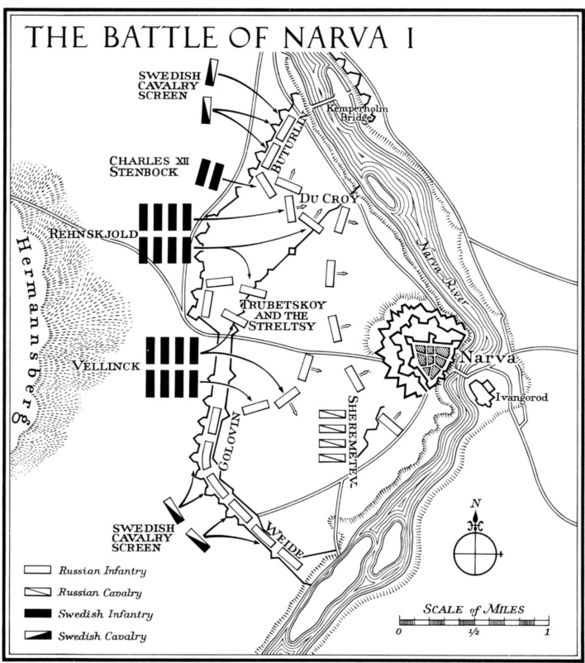
The Swedish infantry, heavily concentrated, was to deliver the main blow. Divided into two divisions, the infantry would assault the earthworks at a point near the center of the line. Once over the wall, the two divisions were to separate, one turning north, the other south, rolling up the Russian line from within and driving the Russians at each end toward the river. The Swedish cavalry would remain outside the earthworks, controlling the ground there, covering the flanks of the infantry as it advanced and dealing with any Russian sortie or escape which might be attempted. Rehnskjold would command the northern (left) wing of the Swedish infantry attack, Count Otto Vellinck would command the right. Charles himself was to command a small separate force on the far left in the company of Colonel Magnus Stenbock and Arvid Horn. As soon as the guns were unlimbered and served, the Swedish artillery opened a bombardment along the middle of the Russian line while the infantry assembled in the center and the cavalry squadrons trotted out to the wings. Thus, in a calm and orderly way, 10,000 Swedes prepared to advance on 40,000 strongly entrenched Russians.
From his position on the Russian rampart, Du Croy watched this activity with growing alarm. He had expected that, according to the rules of war, the Swedes would begin digging ditches and laying out their own fortified camps. His confusion grew when he saw that some of the Swedish soldiers were carrying fascines to use in crossing the ditch dug in front of his earthen rampart. It began to dawn on Peter’s commander that, incredible as it might seem, the Swedish army was about to storm his position.
Through the morning and into the early afternoon, the Swedes calmly continued their preparations. By two p.m., when they were ready, the rain had stopped, it had grown colder and a new storm was gathering in the darkened sky. Then, just as signal rockets soared up, setting the army in motion, a blizzard roared in from behind, sweeping snow horizontally toward the Russian lines. Some of the Swedish officers hesitated, thinking it would be better to postpone the attack until the storm was over. “No,” cried Charles. “The snow is at our backs, but it is full in the enemy’s face.”
The King was right. The Russians, with the swirling flakes biting into their eyes, fired their muskets and cannon, but most of their shots, aimed into a white void, went high and did no damage. Silently, swiftly, the Swedes advanced, suddenly looming before them out of the snow. Thirty paces in front of the earthworks, the Swedish line suddenly halted, muskets swung up to the shoulders, a single volley rang out and, on the parapet, Russians “fell like grass.” Throwing their fascines into the ditch, the Swedes swarmed across on top of them. Waving swords and bayonets, they climbed over the earthworks and threw themselves on the foe. Within fifteen minutes, a fierce hand-to-hand battle was taking place inside the works. “We charged directly sword in hand and so entered. We slew all who came at us and it was a terrible massacre,” a Swedish officer wrote afterward.
At first, the Russians fought stubbornly—“They returned a heavy fire and killed many fine fellows”—but a breach had been made through which fresh Swedish infantry now poured. Precisely according to plan, the two Swedish divisions separated and began to drive the Russians back along the inside of the earthworks in opposite directions. The southern Swedish column, pressing along the left side of the Russian lines, first engaged the Streltsy regiments under Trubetskoy. These they easily routed, thus sadly confirming Peter’s opinion of the value of the Streltsy in fighting a modern enemy. Farther down the Russian line, they encountered Golovin’s division, which, although without its commander, put up a strong initial resistance. Then, as one regiment after another of the inexperienced Russians began to crumble, the rest fell into confusion and retreated. Sheremetev’s cavalry, stationed on this wing behind the lines, should have been able to intervene, riding down on the advancing Swedish infantry, slowing or even scattering the advance by the weight of men and horses. But the Russian cavalry, made up mostly of mounted noblemen and undisciplined Cossacks, was seized with panic even before it was attacked. Seeing the determined Swedes approach, the cavalrymen wheeled their horses and galloped headlong into the river, trying to escape. Thousands of horses and a thousand men were lost in the small cataracts.
In the north, on the Russian right, the story was much the same. Attacked from behind their earthworks, the Russians attempted a stand, at first defending themselves bravely. Then, as their officers fell, panic set in and they began to flee, crying, “The Germans have betrayed us.” As the Swedish advance continued northward, rolling up bastion after bastion, the mass of fleeing Russians grew to huge proportions. So many ran toward the river that soon a dense herd of terrified soldiers, artillerymen and wagoners was stampeding to escape over the single bridge. Suddenly, the bridge cracked and sagged under their weight, sending scores of men sliding and tumbling into the river.
At only one point did the Russian line hold. At the northern end, near the collapsed Kamperholm Bridge, six Russian battalions, including the Preobrazhensky and Semyonovsky Guards regiments, under Buturlin, held their ground and refused to break. Hastily creating a new strongpoint by barricading themselves behind hundreds of artillery and supply wagons, they fought back vigorously, firing with muskets and artillery at the Swedes who now swarmed around them.
Except for this single stand, the Russian army on the northern end of the line and on most of the southern end as well had been reduced to a confused, fleeing rabble. Hundreds of Russian soldiers jumped over the earthworks, trying to escape the blades of the Swedish infantry, only to be ridden down and driven back by the Swedish cavalry. The foreign officers commanding the Russians found the situation impossible. “They ran about like a herd of cattle,” said the Saxon Hallart of his men. “One regiment was mixed up with another so that hardly twenty men could be got into line.” Once the Russians began to cry out against their foreign officers, there was no chance of making them obey. Seeing what was happening and hearing the threatening shouts of his own men, the Duc du Croy declared, “The Devil could not fight with such soldiers,” and, along with Hallart and Langen, made his way toward the Swedish line and surrendered to Stenbock. He felt safer under Swedish guard than in command of his own undisciplined and terrified troops. Stenbock received them politely and took them to the King.
Charles’ role in the action, once the attack on the earthworks had been launched, had mostly been to enjoy himself. He spent the greater part of the afternoon outside the earthworks, deliberately exposing himself to personal danger. Once, while trying to get around a mound of wounded and dying men, he fell with his horse into the ditch; he was extricated, but had to leave the animal, his sword and one of his boots behind. He mounted another horse, which was immediately killed under him, while he himself was hit by a spent ball which he found in his necktie after the battle. Seeing the King without a horse, a Swedish horseman leaped from his own mount and offered it to the King. Scrambling into the saddle, Charles said smilingly, “I see that the enemy want me to practice riding.”
As darkness fell, the King appeared inside the earthworks, covered with mud and still lacking a boot. He found that although Du Croy and most of the foreign officers had surrendered and many regiments of the Russian army had disintegrated, victory was not secure. In spite of the Russian losses, there still were 25,000 Russians under arms on the scene and scarcely more than 8,000 Swedes. The native Russian generals, Prince Dolgoruky, Prince Alexander of Imeritia, Avtemon Golovin and Ivan Buturlin, had not given up so quickly as Du Croy, Hallart and Langen. They had retreated to the wagon-train barricade at the northern end of the camp, and here, around this improvised bastion, the fiercest fighting of the day was taking place. Meanwhile, on the Russian left, General Weide’s division was still largely intact, having taken little part in the battle. If suddenly Weide’s troops had begun to attack toward the north and the regiments inside the ring of wagons had come pouring out to attack toward the south, the thin ranks of Charles’ soldiers would have been caught in between.
It seemed imperative, therefore, for Charles to capture the wagons. He brought up artillery and trained it on them, but this proved unnecessary: The spirit of the Russians inside was finally broken. Convinced that further resistance was hopeless, the Russian generals sent to make terms. Charles was secretly delighted. In the gathering darkness, his soldiers, who now completely surrounded the wagon train, had been unable to distinguish between friend and foe and accidentally were firing at each other. The Russian surrender stopped this, and near eight o’clock the King gave the order to cease firing. But the Russian capitulation was less than total. At first, the Russians insisted on marching out of the redoubt with full military honors. Eventually, they settled for an arrangement which allowed the private soldiers to keep their muskets and small arms, while the officers became prisoners of war. Charles also took possession of the regimental standards and all of the artillery.

Even then, with this mass of Russians on their hands, the situation remained dangerous for the Swedes. Most of their foot regiments were totally exhausted. Some of the men had found supplies of alcohol in the Russian camp and, drinking on empty stomachs, soon became drunk. Further, Charles was afraid that at dawn the Russians would be able to count the small number of men who had conquered and were guarding them. It was essential to get rid of the beaten Russians quickly, and to usher them off the field expeditiously. Charles ordered the Russian prisoners to get to work immediately repairing the sagging Kamperholm Bridge.
There remained also the potential danger of Weide’s division, still undefeated farther down the former Russian line. Wrote one Swedish officer, “If Weide had had the courage to attack us, he would certainly have beaten us, for we were extremely tired, having scarcely eaten or slept for several days, and besides this, all our men were drunk with brandy that they had found in the Muscovite tents, so that it was impossible for the few officers that remained to keep them in order.” But the Weide threat quickly evaporated. Although his troops had not been heavily engaged, Weide himself had been wounded. When he learned of the surrender of the northern wing, he had no stomach to continue alone. At daybreak, seeing himself alone and encircled by Swedish cavalry, he too capitulated. Through the rest of the morning, scattered troops across the battlefield surrendered to the Swedes.
By daybreak, the bridge had been repaired, and the beaten Russians began to cross it. Charles stood by the bridge and watched the long lines of enemy soldiers as they removed their hats, laid their banners at his feet and trudged off to the east, back to Russia. When muster was taken in the Swedish ranks, the losses were found to be 31 officers and 646 men killed, 1,205 wounded. Losses on the other side could only be estimated, even by the Russians themselves. Eight thousand at least had been killed or wounded, and the wounded stood little chance of getting home across the now freezing countryside. Ten Russian generals, including the Duc du Croy, ten colonels and thirty-three other senior officers were held as prisoners, along with Dr. Carbonari, the Tsar’s personal physician, and Peter Lefort, nephew of the Tsar’s dead favorite. The prisoners were sent to Reval for the winter, and in the spring, when the ice freed the Baltic, they went to internment in Sweden. Most of them remained there many years.*
The principal Swedish booty was the Russian artillery: 145 cannon, 32 mortars, 4 howitzers, 10,000 cannonballs and 397 barrels of powder. Peter’s army was effectively stripped of the Tsar’s favorite weapon. Seeing the mass of beaten Russians marching away, and contemplating the prisoners and the booty, Magnus Stenbock was moved to say, “It is God’s work alone, but if there is anything human in it, it is the firm, immovable resolution of His Majesty and the ripe dispositions of General Rehnskjold.”
News of the Battle of Narva made a sensational impression throughout Europe. Accounts of the brilliant victory and glowing praise of Sweden’s youthful monarch rippled westward. There was satisfaction in some quarters at Peter’s humiliation and much snickering at the Tsar’s “flight” on the eve of battle. A medallion struck by Charles showing a man with Peter’s face running away caused much amusement. Leibniz, who earlier had shown interest in Russia, now expressed his sympathy with Sweden and expressed his wish that its “young king reign in Moscow and as far as the River Amur.”
Although Rehnskjold’s “ripe dispositions” and seasoned command had played an indispensable part in the successful outcome, it is also true that without the King’s “firm, immovable resolution” to attack there would have been no victory at Narva. Certainly, Charles himself fully accepted the popular estimate of himself as an invincible warrior. He was exuberant—almost intoxicated with victory—when he rode over the battlefield with Axel Sparre, chattering excitedly like an adolescent boy. “But there is no pleasure in fighting with the Russians,” he said disdainfully, “for they will not stand like other men but run away at once. If the river had been frozen, we should hardly have killed one of them. The best joke was when the Russians got upon the bridge and it broke under them. It was just like Pharaoh in the Red Sea. Everywhere you could see men’s heads and horses’ heads and legs sticking up out of the water, and our soldiers shot at them like wild ducks.”
From that moment on, war became the great object of Charles’ life. And in this sense, while Narva was the King’s first great victory, it was also the first step toward his doom. A victory so easily won helped persuade Charles that he was unconquerable. Narva, added to the dramatic success of the descent on Zealand, began the legend of Charles XII—which he himself accepted—that with a handful of men he could rout vast armies. Narva also instilled in Charles a dangerous contempt for Peter and for Russia. The ease with which he had overwhelmed Peter’s army convinced him that Russians were worthless as soldiers and that he could afford to turn his back on them for as long as he liked. Years later, in the summer dust of the Ukraine, the King of Sweden would pay dearly for these moments of exaltation on the snow-covered battlefield of Narva.
* The Duc du Croy suffered a more curious fate. Allowed to remain at Reval after the defeat, he wrote from there to the Tsar asking for money to pay his expenses. Peter promptly sent him 6,000 roubles. In the spring of 1702, he died and was mourned by his former Russian employer. “I am sincerely sorry about the fine old man,” said Peter when he heard the news. “He was in truth an able and experienced military commander. Had I entrusted the command to him fourteen days earlier, I would not have suffered defeat at Narva.”
When the Duke died, he was once again insolvent. Peter was informed and intended to pay the debt, but never got around to it. Whereupon the Duke’s creditors in Reval invoked an ancient law which stated that those who died in debt could not be buried. The body was placed in a church vault, where in the dry atmosphere it did not decay but mummified. Eventually, it was taken out and placed under glass. For almost 200 years, visitors to Reval were taken to see the Duke lying before them still in his wig and uniform. A few years before the revolution, the imperial government decided that the spectacle was unseemly and the Duke was finally buried.