
21
Despite public opinion to the contrary, Jimmy Carter was well satisfied with his achievement of the two Panama Canal treaties early in his presidency. An avowed proponent of U.S. support for small developing nations, human rights, and better hemispheric relations, his decision to finish what Lyndon Johnson had initiated and his presidential opponent, Gerald Ford, had negotiated in the face of opposition from conservatives in both parties was a bold foreign policy and legislative triumph that seemed to embolden the new, “outsider” administration to tackle even greater international initiatives. Speaking on that in the foreword to Eizenstat’s biography of the 39th president, then Secretary of State Albright wrote: “Those who dismiss Jimmy Carter’s considerable accomplishments as president are doing a disservice to the historical record. This is particularly true in the realm of foreign policy. President Carter was idealistic; he wanted America to present a morally untainted image to the world.”1
By taking on the Laxalt-Reagan team and taking over efforts to deliver the Panama Canal to its host country as a gesture designed to promote democratic principles and hemispheric unity in the later, more advanced stages of America’s Cold War with the Soviet Union, Carter surprised the U.S. establishment. It was a signal of things to come. Equally surprising would be his next diplomatic move towards Middle East peace, a challenge other presidents had been hesitant to confront, especially early in their administrations, as Eizenstat established. Through his more pro-active approach, Carter would achieve an historic “first peace treaty between [the Jewish state of] Israel and any Arab [or Muslim] state,” when he consummated his hard-won “Camp David Accords” between the Israelis and their most powerful Middle Eastern rival, Egypt, in September 1978—a truly global diplomatic milestone that neither country would have achieved on its own. In so doing, he became the first American president to successfully negotiate an international peace treaty between warring nations since Theodore Roosevelt’s Nobel Prize–winning settlement of the Russo-Japanese War in 1905 (an irony of sorts given Carter’s previous giveaway of TR’s most iconic achievement, the Panama Canal).2
Ever since President Harry Truman went out on a limb in 1947 by officially recognizing the new nation of Israel over the objections of many within his administration, including Secretary of State George Marshall, “the United States had a moral commitment to Israel’s survival,” again according to Carter’s biographer. It was an unwritten rule of American foreign policy and public support that viewed Israel as the biblically ordained “Holy Land” and an “island of democracy in a sea of autocratic, Muslim regimes.” And by the time President Carter came along, in fact, Israel had established military supremacy over its surrounding Arab neighbors, as well as an overall reliance on the U.S. At the same time, Carter had been preparing to take on the major foreign policy issues of the era ever since deciding to run for president, knowing full well his lack of international experience could he used against him. As Georgia’s outgoing governor, he prepped for his next job by connecting with the likes of the Trilateral Commission in 1975, an organization of political, economic, and academic leaders from Japan, Europe, and the U.S., establishing contacts that could be pressed into service should he reach the White House. Special emphasis was also given during the ’76 campaign to the Middle East and Israel, which he had made a point to visit while a governor three years earlier.3
Initially, Carter’s lack of experience with the inner workings of Washington politics and his own, egotistical self-reliance were held against him. Democratic Speaker of the House Tip O’Neill once called him “The smartest public official [he had] ever known, but when it came to the politics of Washington, he never understood how the system worked.” As a result, his initial approach to the Middle East was somewhat disjointed, but he eventually settled on a more balanced view of the Israeli-Arab conflict that was fraught with pro–Israel, anti–Arab public opinion concerns, but necessary for meaningful diplomacy. The Six-Day War of 1967 had left Israel in control of far more territory than ever before, both the Sinai Peninsula and Gaza Strip from Egypt, the West Bank along the Jordan River from neighboring Jordan, and the Golan Heights of Syria, all of which contained remnants of the Palestinian population, many of whom had been displaced in the Jewish nation’s founding. In the aftermath of war, United Nations Resolution 242 attempted to restore (and return) the conquered territories to their previous boundaries (and governments), but Israel did not see it that way, instead allowing its own settlers to gradually move into the subjugated areas. And despite another, 19-day Arab-Israeli war in 1973, that was still the situation when Anwar el Sadat, the new president of Egypt, determined to seek a more progressive Arab future instead of the conservative Arab past, a development that would ultimately make Jimmy Carter’s Middle East peace initiatives possible.4
In November of 1977, Sadat engaged in the boldest possible step by deciding to visit Israel to begin peace negotiations, a previously unthinkable gesture by an Arab head of state who would be subjecting himself to condemnation from the other rulers of the six-nation Arab League and the rest of the Muslim world. By deigning to visit and negotiate with the Jews, Sadat would become the first Muslim leader to recognize Israel, an act of extreme political and personal courage that would eventually lead to his assassination four years later. That tragedy, however, was not until he had become part of an agreement that would surprise the rest of the world and elevate Carter to the pinnacle of his presidency.5
But, “how was the administration to proceed” to make it happen? That’s the question Eizenstat posed in writing about the Carter formula—what he hoped would be a lasting Mideast peace, a world-changing moment, and a major landmark for his own legacy. Just as with the Canal, gone would be the campaign’s more electable emphasis on Israel’s preferred position and security needs; on opposition to Arab arms sales; and on the dangers of Arab/Muslim states. Already Sadat had realized he needed American help. He needed American intervention to reclaim the Sinai Peninsula, which was still in Israeli hands since the Six-Day War. At the same time, because of that “other,” Arab-Israeli War in 1973 and the resulting Arab oil embargo, Carter needed Sadat to avoid another economic shakedown of the world’s economy that might cost him re-election. Eizenstat stressed that the President “was not” interested in an Israel-Egypt agreement alone, but instead hoped “to forge a comprehensive peace with all parties in the [regional] conflict,” including the other neighboring Arab nations, Syria and Jordan, and most “critically,” the Palestinians…. Arabs who had co-existed alongside Jews in Palestine for centuries, but who had become refugees in their own land when the suddenly insolvent British Empire ended its between world wars Palestinian Mandate. Thousands of European Jews had since returned to reclaim their “Promised Land.” Their lives and lively hoods had been devastated by World War II and more specifically by expansionist Nazi Germany’s immoral ethnic cleansing, and by whatever means necessary, these Jews intended to have a nation of their own.6
Cyrus Vance, a former New York City lawyer and veteran diplomat whom Carter had retained from his campaign team to be secretary of state, would be sent to the Middle East within weeks of the inauguration to begin the process. While there he would visit Israel, Egypt, Syria, and Saudi Arabia, with the latter already a behind-the-scenes regional force due to its oil dominance, even though not a bordering nation in the conflict. At the same time, “the Israeli elections of 1977 had changed the calculus,” according to Eizenstat, with the new prime minister, Menachem Begin, much more committed to the traditional Jewish view of Gaza and the West Bank as “liberated—not occupied—territories” and more symbolically, the restored biblical lands once called Judea and Samaria. Meanwhile, Sadat went from hoping the new American president would negotiate for Egypt with the Israelis to shocking the world on November 9, 1977, when he announced during a speech to the Egyptian Parliament that he would actually do the previously unthinkable for an Arab leader by going to Israel to meet with Begin, his new Israeli counterpart and someone who had previously called Sadat, “an enemy of Israel.”7
The 1999 PBS documentary, The 50 Years War: Israel and the Arabs, portrayed Sadat’s dramatic announcement as “writing his name indelibly in the history books.” Faced, in fact, with this courageous act, Begin had no choice but to issue an official invitation to the Egyptian president to address the Israeli Knesset. And so, with the eyes of the world watching, Sadat flew to Israel just over a week later on November 19, 1977, and was greeted, according to the documentary, like a modern day “Moses” while making his way to the Israeli capital, Tel Aviv, the next day. On the other hand, one member of the Egyptian entourage would confess it felt like he was visiting “outer space,” so unprecedented was that moment in the history of Israeli-Arab relations and the Middle East.8
Admittedly, Sadat’s address to the Knesset that day was not nearly as conciliatory as his visit had rather hopefully implied, and after seven more months of talks between the foreign ministers of the two countries amounted to nothing, a frustrated Sadat proclaimed the peace process “terminated” and his gesture in going to Israel “fruitless.” That’s when Carter, against the advice of his advisers, who repeatedly thought it a very bad idea, decided to enter the impasse by inviting both Sadat and Begin, and all of their respective advisers, to join him and his diplomatic team at the U.S. presidential retreat in the Catoctin Mountains near Washington, Camp David, for two weeks of intense negotiation that he hoped would broker a lasting peace agreement between the warring rivals and prove a starting point for lasting Middle East peace. That, after all, was the long sought dream ever since the modern state of Israel had come into being as an ongoing Cold War threat to world peace.9
Twice Carter had to literally issue personal appeals to keep the negotiations going, once each to both sides, but eventually he was able to achieve an historic agreement between the two that became the Camp David Accords. Actually, the compromise agreed upon included Israel’s return of the Sinai and the dismantling of its new settlements there by 1982 in exchange for Egypt becoming the first Arab nation to officially recognize the Jewish State. Not addressed (and a problem ever since) was the Arab call for a separate Palestinian state in the Israeli controlled West Bank. Nevertheless, on March 26, 1979, at the White House, two documents—a “Framework for Peace in the Middle East” and a “Framework for the Conclusion of a Peace Treaty between Egypt and Israel”—were signed by Sadat and Begin amid much fanfare, including their official handshake photo op with Carter that would be seen around the world. Both Begin and Sadat would win Nobel Peace Prizes (Carter would as well following his presidency for his work on peaceful solutions to international conflicts; his advancement of democracy; and his advocacy for worldwide economic and social development) and the peace between Israel and Egypt has lasted ever since despite many other Middle Eastern conflicts.10
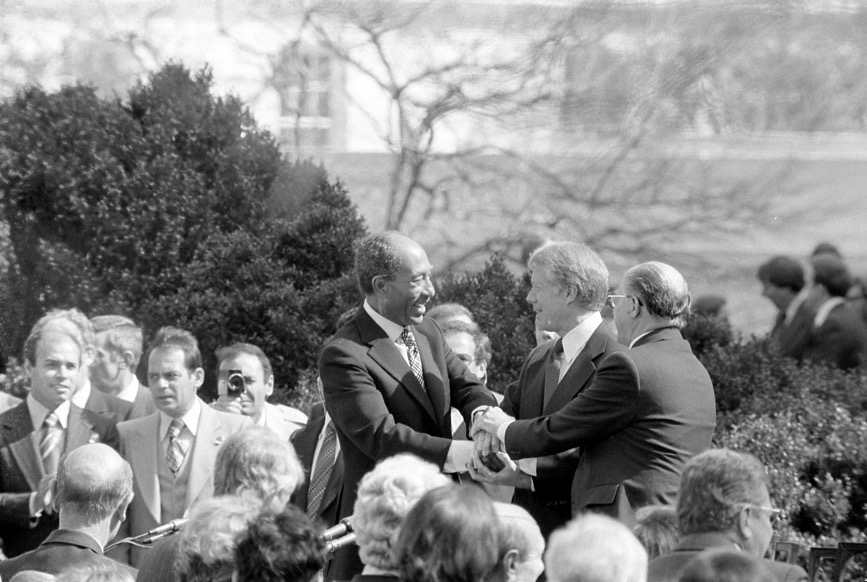
In perhaps the high point of his presidency, Jimmy Carter (center) joyfully congratulates Egyptian President Anwar Sadat (left) and Israeli Prime Minister Menachem Begin in the White House Rose Garden after the signing of the landmark Egyptian-Israeli peace treaty he negotiated at Camp David. Sadat, who was under intense pressure from the rest of the Arab/Muslim world for negotiating with the Jewish state, would be assassinated two years later. (Library of Congress Prints and Photographs Division Reproduction—Number LC-DIG-ppmsca-0324).
From the Canal and the Egypt-Israel peace agreement, Carter would move on to other tricky foreign policy issues. Unlike his six immediate predecessors, in 1979 Carter became the first president to establish diplomatic relations with Communist China, officially recognizing the government in Peking as the legitimate Chinese government instead of the exiled Nationalist Chinese regime on the island of Taiwan; he negotiated a second Strategic Arms Limitation Treaty with the Soviet Union, only to see its ratification denied by conservatives in the Senate; and he cut off humanitarian aid to the nation of Afghanistan in response to the slaying of the U.S. ambassador there, an unrelated prelude to the Soviet Union’s invasion of that country later the same year—an invasion that would spark a U.S. embargo on high tech equipment and grain, U.N. resolutions calling for the withdrawal of all foreign troops, and a 63-nation boycott of the 1980 Moscow Summer Olympics. All of those paled in comparison, however, to the last foreign policy dilemma of the Carter administration—the takeover the U.S. embassy in Tehran, Iran and the taking of 60 American hostages by government backed Islamist militants in response to the deposed Iranian Shah’s presence and medical treatment in the U.S. The militants demanded that the Shah (King) be returned to Iran to stand trial for human rights atrocities. Only eight of the hostages, all either African Americans or women, would be released and returned home immediately, while the 52 others were held captive for more than a year. Still, Carter would not negotiate and send back the Shah, a former U.S. ally, to what would have surely been his execution. Instead, he embarked on a major diplomatic, economic, and even secret military operation to try and gain the hostages freedom, all of which failed and as much as anything cost him re-election in 1980.11
On the domestic front, things got almost as bad for Carter, ensuring he was a one-term president. Inflation peaked amidst an energy crisis that featured long lines at gas pumps and the President didn’t help himself when he referred to “the malaise” of the American people. One presidential historian’s way of putting it: “His much-admired idealism ran up against the harsh reality of geopolitics in the 1970s,” which he was unprepared to deal with. As a result, he has long been revered for making his greatest contributions in the area of human rights after leaving office. At this writing, he was the longest living U.S. president ever at age 96 (and still counting with his next birthday just months away).12
As for Laxalt, who would be referred to as “The First Friend” once Ronald Reagan entered the White House in 1981, he would serve one more term in the U.S. Senate while also being general chair of the Republican National Committee from January 1983 until January 1987. Before leaving the Senate, he would become a special envoy for Reagan to the beleaguered Philippines government of U.S. ally Ferdinand Marcos, whom he advised to step down as president to avoid civil war and possible communist takeover, which Marcos famously did on February 25, 1986, after 21 years in power, leaving his homeland (along with his family) for asylum in the United States.13
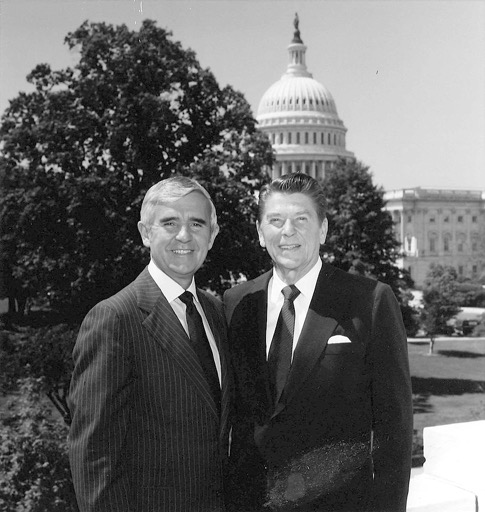
Dubbed the First Friend of President Ronald Reagan, Senator Paul Laxalt led Ronald Reagan’s efforts to stop transfer of the Panama Canal to Panama during the Carter Administration without success, but also served his good friend as a special envoy to the Philippines during their Washington years together in the 1980s (permission to use granted by the Paul Laxalt Group via Wikimedia Commons).
Along with an entire chapter on the Marcos affair in his memoir, Laxalt also devoted a significant amount of another chapter to the Iran-Contra controversy, which tarnished the Regan legacy, and yet another to his own controversial legal battle with the Sacramento Bee newspaper, which accused him and his family in November 1983 of an “illegal diversion” of up to $2 million in cash from their ownership of the Ormsby House, a former restaurant and casino in Carson City, Nevada. Purchased by Laxalt’s father in the early 1900s, it was rebuilt by then Governor Laxalt in 1972. The Bee indicated that his political connections at the time had “sidetracked any potential investigation and that there was evidence of organized crime involvement.” Following a complete denial, Laxalt entered into an extensive libel suit that took three years to win, an exoneration that netted him and his family a $647,452.52 settlement in 1987.14
At about the same time, Reagan was having to admit his administration’s trading in armaments to Iran in exchange for freeing seven American hostages held by the Iranian-backed terrorist organization Hezbollah in Lebanon. It would prove a dastardly reckoning considering how the Iranian regime had been vilified ever since the embassy takeover, but a reckoning nonetheless made worse by the fact proceeds from those arm sales were going to the “Contras,” a rebel insurgency battling the communist “Sandinista” government in the Central American nation of Nicaragua. It was a twisted tale of covert operations that Reagan denied knowing about, but it threatened to destroy his credibility, “his greatest strength,” according to Laxalt. After a special review board found fault with the process and the administration’s handling of it, Reagan had to take responsibility for the subversive action less than a year before the end of his second term. In conclusion, his First Friend wrote: “Undoubtedly, Iran-Contra was by far the most severe crisis of the Reagan administration, but Ron still survived. A president with less credibility with his people [might] have been destroyed.” Laxalt would outlive Reagan by 14 years, dying in 2018 at 96.15
1. William DeGregorio, The Complete Book of U.S. Presidents, 627–628; Stuart Eizenstat, President Carter, xv.
2. Stuart Eizenstat, President Carter, 409, 530; William DeGregorio, The Complete Book of U.S. Presidents, 628; F. Martin Harmon, The Roosevelts and Their Descendants, 181; F. Martin Harmon, Presidents by Fate, 25, 118.
3. F. Martin Harmon, Presidents by Fate, 190; Stuart Eizenstat, President Carter, 410, 411–412, 414.
4. Stuart Eizenstat, President Carter, 413–414, 415; Richard A. Baker and Neil MacNeil, The American Senate, 134; Norma Percy, “The 50 Years War: Israel and the Arabs,” PBS video, 1999.
5. Norma Percy, “The 50 Years War,” PBS video, 1999; William DeGregorio, The Complete Book of U.S. Presidents, 628.
6. Stuart Eizenstat, President Carter, 418–420; Norma Percy, “The 50 Years War,” PBS video, 1999; F. Martin Harmon, Presidents by Fate, 190.
7. Stuart Eizenstat, President Carter, 49, 420, 438–439; Norma Percy, “The 50 Years War,” PBS video, 1999.
8. Norma Percy, “The 50 Years War,” PBS video, 1999.
9. Ibid.; F. Martin Harmon, Presidents by Fate, 190.
10. William DeGregorio, The Complete Book of U.S. Presidents, 628; Moni Basu, “Carter Wins Nobel Peace Prize,” ajc.com, October 12, 2002.
11. William DeGregorio, The Complete Book of U.S. Presidents, 628.
12. Kenneth C. Davis, Don’t Know Much About the American Presidents, 541–542; Ernie Suggs, “Jimmy Carter Gets New Title—Oldest Living Former President,” ajc.com, March 21, 2019.
13. Norman Kempster, “By Leaving Quietly, Marcos Is Assured U.S. Asylum, Los Angeles Times, February 26, 1986; Paul Laxalt, Nevada’s Paul Laxalt, 271–280.
14. Paul Laxalt, Nevada’s Paul Laxalt, 359–367.
15. Ibid., 349–351; Adam Clymer, “Paul Laxalt, Senator from Nevada, Reagan Confidant Dies at 96,” New York Times, August 6, 2018.