
6
This book has used the Chernobyl disaster as a historical and conceptual window into the Soviet nuclear power industry because only by thoroughly analyzing Chernobyl's prehistory will we gain a deeper, more nuanced understanding of the accident's systemic causes. Everything about Chernobyl was Soviet—the reactor design, the operators, the bureaucracy. The disaster shook a system that designers intended to be safe, a system that, according to its own standards and norms, was perfectly functional. But while we need to look seriously at how the Soviet economic system, its bureaucracy, and ideology affected the industry's history and organization, we also need to avoid the Cold War fallacy of interpreting this context only as problematic. The Soviet state may have forced its nuclear managers to improvise in the face of inefficiency, red tape, and chronic supply shortages, but it also granted nuclear experts much more financial, regulatory, and political leeway than their peers in Western democracies enjoyed. Once we allow ourselves to recognize the many ways that Soviet ideology and economic planning supported the large sociotechnical system that the nuclear power industry became, we can acknowledge that that system achieved remarkable success—in spite of, but also because of, the political environment in which it developed.
But acknowledging this leads to a troubling conclusion. Although the disaster involved Soviet organizations, people, and technologies, we can't point to a singular, inherently Soviet aspect of operating nuclear power reactors as the root cause of the catastrophe. Chernobyl was the end point of a long history of decisions, processes, and practices, all of which had worked well for quite some time. Rather than retroactively condemning these practices and decisions—or communist ideology—as leading inevitably to worst-case scenarios, we need to fully understand what counted as normal, acceptable, and sufficient before hell broke loose, before the elements of a complex sociotechnical system lined up in an extraordinarily unfortunate way. Any industrialized society that utilizes sensitive, high-risk, and potentially dual-use technologies relies on some form of the processes I have described in this book. Sadly, Fukushima has demonstrated that we cannot dismiss the Chernobyl disaster as an outcome specific to the Soviet system.
I have argued that in order to appreciate Chernobyl's prehistory, we need to appreciate that Soviet nuclear reactors were simultaneously sensitive, potentially dual-use industrial facilities and the objects of considerable scientific and technological pride.1 The Soviet organizations that managed the nascent nuclear industry significantly shaped not only technical decisions but also prevailing ideas about what was important, desirable, or safe—and what, by contrast, was irrelevant, unacceptable, or risky. Although the 1966 transfer of responsibilities for nuclear power plants from the secret ministry in charge of nuclear weapons to the civilian ministry responsible for electricity production fundamentally normalized nuclear power generation, bureaucratic control continued to shift. The ongoing regrouping and reassigning of responsibilities for nuclear power plants not only contradicts many conventional assumptions about how a centralized, planned economy functions, but also illustrates the immense challenges involved in managing expertise, sharing experience, and transferring knowledge at a crucial intersection of authority and accountability.2 Organizational shifts, then, both reflected technology's requirements and served to establish and reconfigure the social, political, and legal order: they provided clear hierarchies, labor and power structures, and a system for attributing blame.
I have chronicled how scientists and engineers skillfully drew on specific political and economic aspects of the Soviet system to establish nuclear power as a legitimate technology that required long-term commitment and massive capital investments. These nuclear power specialists believed and argued that this technology would improve the economic foundations of Soviet society. They also understood that getting nuclear power included in long-term economic plans would let them push the technology in new directions, opening up some paths while closing others. The propagandistic rhetoric that early nuclear program advocates used shaped the emerging industry's organizational structure but gave way as the system matured to a focus on economic efficiency, rational development, and “nuclear normalcy.” 3
By tracing the division of labor between those who plan and those who operate nuclear reactors, I have shown how the corresponding organizational delineation of responsibilities shaped and reinforced the Soviet nuclear industry's professional identities and organizational culture, most notably emphasizing a distinction between atomshchiki and energetiki. I have also argued that the values of the civilian nuclear workforce—diligence, responsibility, and a deep faith in scientific rationality—made them less vulnerable to apathy and cynicism than other groups and institutions.
Because Soviet planners thought reliable human operators made redundant safety features unnecessary, they built nuclear power plants without some of the features most Western plants required. This fact made thorough operator training tremendously important, and I have argued that some facets of the Soviet system led to a significant gap in that training. While the architects of the Soviet civilian nuclear industry certainly knew the value of—and worked to preserve—experiential and tacit knowledge, that knowledge increasingly became formalized, compartmentalized, or appended to normal operations. This resulted in a rigid and contradictory structure of accountability in which managers saw human reactor operators as redundancy features and yet restricted their actions and undermined their preparedness to override the system when problems arose. Furthermore, the ongoing reorganizations within the civilian nuclear industry—although aimed at finding the ideal governance structure—ultimately prevented any stable set of institutional routines and practices from developing.
In reconstructing the history of Soviet reactor design choices, I have shown that it did not unfold in a logical sequence.4 Instead, an expensive, multidirectional research-and-development program, a series of contingencies, and an extraordinarily convoluted process led the Soviets to select their reactor designs. The whole effort to design reactors for power generation was surprisingly uncoordinated, despite the planned character and tight financial constraints of the Soviet economy. As I have shown, leaders made the Chernobyl-type RBMK reactor one of their two choices because they assumed that Soviet experts could convert a military reactor design to one optimized for civilian use, that the RBMK would technologically and economically surpass the already-operational graphite-water reactors, and that the country could produce these reactors quickly enough to help fulfill its ambitious plans for nuclear power generation.
I argued that Soviet nuclear power experts selected the reactors they did in part because their designs had military origins. But major political and economic reforms domestically and nuclear power engineering trends abroad also had a significant impact on the decision. In my view, all the preceding factors are more significant than dysfunctional organizations, individual career ambitions, and a certain recklessness. These latter factors certainly had a role, but in and of themselves they did not set the world on a direct course to disaster.
All technological development everywhere involves ambitious engineers, political alliances, and risk taking to some degree, and any retrospective account must acknowledge that what we consider good and safe always depends on context. With this in mind, I have emphasized that Soviet scientists, engineers, and planners chose the RBMK after extended negotiations—in other words, their choice represents the collective judgment of a community of experts.
While it certainly included dedicated, sophisticated experts, I have shown that the Soviet political apparatus was not uniform. The economic system was not monolithic either. While deficient in many ways, for the most part it worked in favor of the nuclear industry. The RBMK reactor design was not unproblematic, but those working in the industry understood it well, and industry leaders ensured that designers improved it continuously. Soviet operators, both at the Chernobyl site and at the central managerial level, were highly qualified, skilled, and loyal specialists. Neither the operators nor the scientists and engineers who designed and developed the RBMK were reckless, careless ignoramuses, though many accounts of the accident portrayed them that way. Finally, and perhaps most importantly, I have emphasized that we need to study further the organizational structures that bind together the politics, economics, technologies, and people in the civilian nuclear industry.5 Too often, scholars and practitioners alike focus on only one area—such as industry, economics, or universities—and disregard the complex interactions between these systems, the ways they shape, modify, and constrain each other. What Chernobyl has demonstrated (and Fukushima has only confirmed) is that organizing a civilian nuclear industry remains at best a high-stakes process of trial and error.
The Chernobyl disaster had complex causes that reached far back into the history of Soviet science, engineering, and economic management. The early Soviet nuclear program, although visionary, creative, and diverse, had to mature quickly if it was to survive economically. Leaders chose certain reactor designs as much because the supply industry could meet their requirements as because of their technical or economic merits and their international popularity. Training and recruiting specialists for the burgeoning nuclear industry was a challenge, and preserving and transferring the military nuclear program's experience and work ethos while quickly expanding the nuclear industry under civilian control was another (figure 6.1).
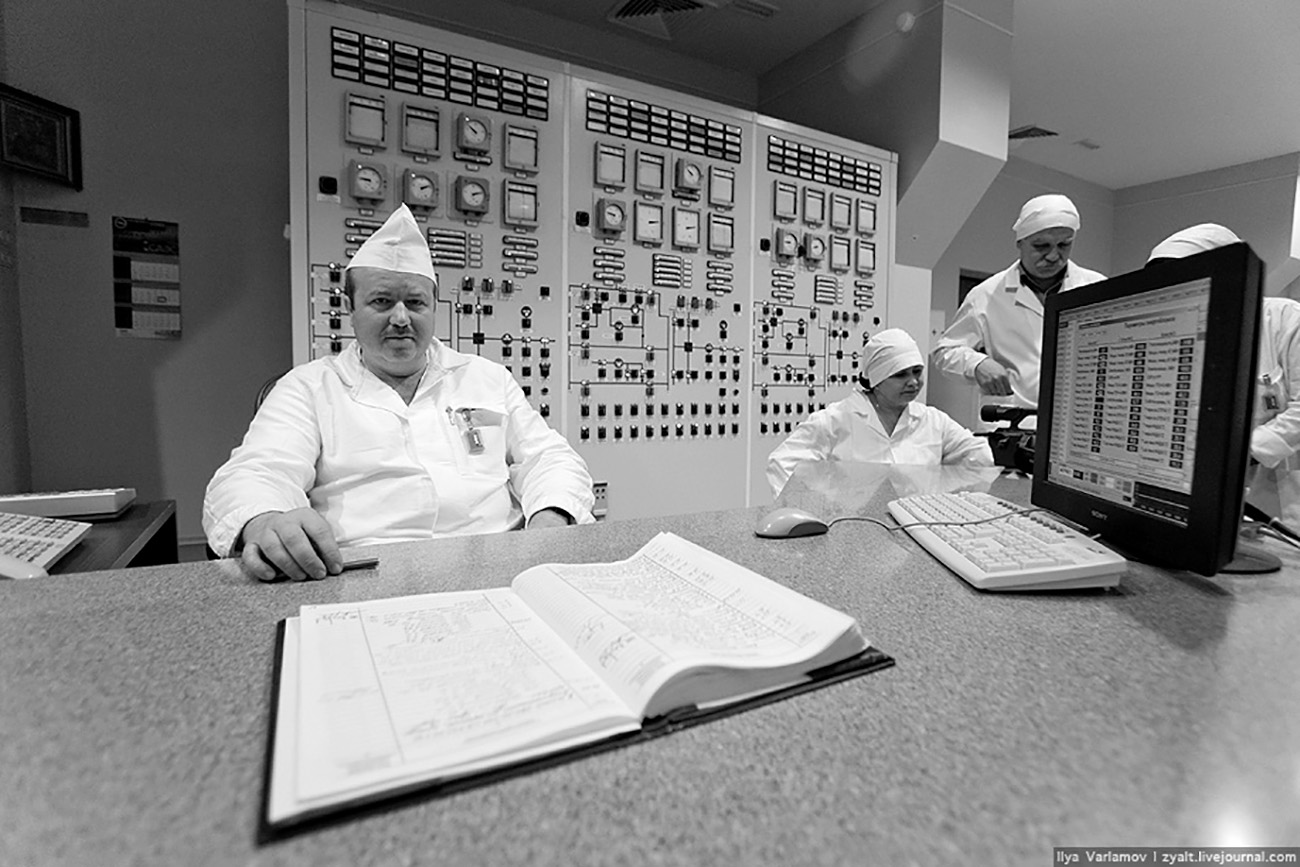
Figure 6.1 Nuclear reactor operators in the control room at the Smolensk nuclear power plant in 2009. Nothing epitomizes the challenges associated with the safe operation of nuclear power plants as clearly as the “human factor.” Technological advances notwithstanding, expertise, experience, and other skills will invariably remain significant elements of any nuclear future—in the former Soviet Union and elsewhere.
Source: Photograph by Ilya Varlamov, http://zyalt.livejournal.com. Reprinted with permission.
Organizations held together the different facets of the emerging nuclear industry: its economic objectives, technical specifics, and personnel strategies. Soviet scientists, planners, and industrial managers continued to modify and tinker with these organizational structures in an attempt to improve the industry's management as well as its profitability, reliability, and safety. High-level administrators and on-site reactor operators alike had both a personal and a professional stake in making the nuclear industry succeed; the Chernobyl disaster hit them on both levels.
The controversy that emerged in the years following the disaster sheds new light on the technical, organizational, economic, political, and personal complexity of events that may seem to have obvious causes. Why did Chernobyl happen in the Soviet Union? Was it because the confident technological enthusiasm exemplified by the motto “We are able to do it, and we can do it all” guided the mass production of nuclear power plants and turned yesterday's fossil fuel plant managers into nuclear specialists overnight?6 Was the Soviet industry's backwardness—for example, the absence of reliable supporting technology, especially computers—to blame?7 Did the loss of fundamental expertise during the transfer of nuclear power plants from the secret nuclear ministry to a general power ministry create the preconditions for the Chernobyl accident?8 Did Soviet leaders organize the Soviet nuclear regulatory agency too late, and did Sredmash's and NIKIET's leadership hamper its proper functioning?9 Or was the centralized management structure, with its acute attention to social standing and its disrespect for people of lower rank, in the way of an effective safety culture?10 Should Soviet industry leaders have retired earlier, rather than remaining in office for several decades?
Each of these questions has some validity. And yet, the Soviet Union is not the only place such problems have occurred: we find expert hubris, conflict between military and civilian organizations, supply problems in frontier science, mismanagement, and ambitious individuals in other politico-economic contexts as well. Processes and practices that are common in any society and any economy created the preconditions for this disaster. What is unique about the Chernobyl case is that it happened just as unprecedented political and economic changes made possible a debate about its causes that could not have occurred sooner.
That debate eventually led to the uncovering of an earlier controversy, a process enabled by the concurrent opening of the media under Gorbachev's policy of glasnost. As it became clear that powerful groups had ignored, or even silenced, cautious and critical voices, leaders reassessed the late 1960s decision to implement the RBMK as a standard Soviet design. The post-Chernobyl debates suggest that the RBMK had not been the best proposal technically. Rather, economic considerations and the designers’ rhetorical skills in invoking national security interests swayed the decision makers.
Chernobyl also affected how politicians portrayed nuclear power in the Soviet Union. Before the accident, they presented nuclear power as yet another Soviet science success story, one more technological achievement that served enlightened progress toward peace and communism. The disaster prompted the public to once again associate nuclear power with the horrors of nuclear war—an association that promoters of the “peaceful atom” had worked long and hard to annul. The accident thus reopened the question of the industry's political legitimacy, but in a changed political climate where government officials, planners, and scientists had to reestablish their authority, credibility, influence, and expertise in the face of a nuclear catastrophe.
Chernobyl also forced state planners to reconsider safety issues. The disaster revealed serious flaws in the complex and often duplicated management structure of Soviet science, industry, and government. Officials had two difficult and somewhat conflicting jobs to do: assigning blame and accountability in their own country and controlling political damage in the international arena. The international public had only recently warmed up to their (domestically contested) general secretary Mikhail Gorbachev; now, that public charged the Soviet Union with having put the entire population of Europe, and potentially the world, in harm's way.
In addition, the Chernobyl disaster added momentum to the emancipation of the Soviet people, although that process continued to be controversial and heterogeneous. It involved coping with the complexity of the post-Soviet media and the power struggles between state and private interests; learning how to evaluate new institutions and their contacts with or independence from the state, international organizations, or private capital; and developing skills to assess the credibility of political actors in a confusing young democracy. The media controversy over Chernobyl that raged in the late 1980s and early 1990s was something established scientists like Aleksandrov and dissenting experts like Shasharin, Volkov, and Dubovskii had never experienced. Then again, neither had anyone else who had grown up in Soviet times. Soviet citizens who were used to reading between the lines of ideological discourse struggled to orient themselves in an increasingly diverse, barely regulated universe where the mass media was unleashed. When science and technology became subject to critical scrutiny and when multiple experts presented plausible (but incompatible) arguments, Soviet citizens had to learn new ways of assigning credibility.
In the context of this fundamentally new phenomenon—public disagreement between experts—and of the gradual opening of Soviet society, any reference to Chernobyl threatened to become a state-breaking device. Given the close connection between nuclear power and the state, every criticism of Chernobyl turned into a criticism of the state. The emerging environmentalist, and especially antinuclear, movement deployed Chernobyl as a rhetorical resource to attack the long-established authority of the state and its scientists.11 At the same time, advocates of nuclear power eventually managed to turn Chernobyl into a state-making device by portraying the accident as a lesson that had to be learned, a crisis that was successfully overcome.12 By pointing fingers at the operators, these advocates could hold on to the image of heroic designers and stress continuity with the country's historical achievements. But they simultaneously revamped training programs for reactor operators, in effect admitting that such programs could be significantly improved. Similarly, when nuclear scientists modified design aspects of the RBMK to restore public faith that nuclear power was safe, they acknowledged that something had been wrong with the RBMK design all along. By reforming the management of the nuclear industry, planners and top managers followed the same strategy of continuous organizational change they had earlier condemned as yielding unsatisfactory results.13
Political transitions like the collapse of the Soviet Union tend to remind us how fragile a political system's organizations can be. The institutions that ensure the safety of a high-risk technology like nuclear power are crucial, particularly in times of crisis. The post-Soviet nuclear industry faced a difficult conversion: a sharp drop in military production, an abrupt decline in the commissioning of new nuclear power plants, the phasing-out of some reactor units, and a significant decrease in uranium mining and reprocessing.
When the disintegration of the Soviet system became imminent, and the country was preparing to transition to a market economy, Minatomenergoprom's leadership wanted to make sure the nuclear industry would remain one united complex and maintain its established infrastructure and economic connections. By suggesting a state corporation that would become a joint-stock company, they engaged in classic social engineering—that is, they designed social change as if it were a technical problem with exactly one correct solution.14 Political leaders resisted the plans as an undesirable legitimization of other Soviet republics’ desire for independence and turned down the scientists’ proposal. As a consequence, when the Soviet Union did fall apart, the nuclear energy enterprises outside of what emerged as the Russian Federation (about 30 percent of the former Soviet nuclear sector) were cut off from the previously centralized management, with no structure in place that would coordinate cooperation. Among the enterprises lost were all uranium mining organizations and about half of the previously Soviet nuclear power plants.15
The fact that nuclear scientists planned a stock company while most politicians were still resisting the imminent collapse of Soviet political and economic structures is telling: these scientists were experienced social engineers who expertly sailed troubled political waters.16 The solution they offered was a political plan for nuclear energy policy and industry governance that reached well beyond their narrow technical expertise. It was a proposal that anticipated political, economic, and institutional changes that many politicians at that time were still unable to see, or were at the very least unwilling to accept.17 This episode also reflects the confidence of nuclear experts that their word would be heard and respected in the highest councils of political power, a confidence they had acquired with the successful detonation of the atomic bomb and maintained for years as they built the civilian nuclear industry. But Chernobyl had forced the relationship between nuclear experts and political decision makers to take a sharp turn. Nuclear experts saw their political clout declining and instead of attributing that fact to the political upheaval in the Soviet system, they experienced it as a challenge to scientific rationality. They considered their prognoses and suggestions rational and therefore objectively best for society and the common good. For a short while after Chernobyl, the Soviet leadership seemed ready to favor public opinion over expert advice, even if that would risk jeopardizing a reliable energy supply for the country.18
Outlook
Since that time, the pendulum has swung back: leaders take public opinion and opinion research into account, but decision making is firmly in experts’ hands. And yet, there has not been a full return to technocratic rule: nuclear power managers in today's Russia have to work very hard for policymakers’ support. In a long, difficult process, large parts of the nuclear industry have shifted to a market-economic model that includes several separate corporations.
Under this model, the argument that top managers in the nuclear industry must have training in nuclear physics or engineering no longer applies. Where collaboration and consultation among managers with complementary skill sets is critical, there is in principle nothing wrong with, for example, a leader of a state's nuclear energy program whose training is in water transport engineering and economics. Sergei Kirienko, who fits this description, was appointed head of the Federal Agency for Atomic Energy (now Rosatom) in 2005, and after a difficult period of transition he has made the concern a profitable enterprise. Rosatom today is one of the few companies worldwide that supports every stage of the fuel cycle—from uranium mining, to enrichment, to power generation, to reprocessing, and waste storage.19 One of Rosatom's more attention-grabbing projects was the “floating nuclear power plant.” Construction of a prototype, the “Academician Lomonosov,” began in 2007; it would combine two small reactors (starting at 35 MW) on a mobile base that could be deployed to remote areas in the Far East and Far North.20
In 2008, the Russian Federation government authorized the construction of four new VVER-type reactors near Saint Petersburg, to replace the aging RBMK reactors currently operating there. Construction of units 1 and 2 is in full swing, and test-phase operation is scheduled to start in 2016.21 Site preparation began in 2010 for a new Baltic nuclear plant in the Russian enclave of Kaliningrad, but the project has since stalled.22 In November 2013, Putin's government approved a plan to build an additional twenty-one new nuclear power reactors by 2030. Planners designated ten reactors for entirely new plants, near Kostroma (350 km northeast of Moscow), near Nizhnii Novgorod (the former Gorky), in the Republic of Tatarstan (Western Russia), in Seversk (near Tomsk, Siberia), and in the Southern Urals (200 km south of Ekaterinburg). The Southern Urals plant will be the only new one equipped with fast neutron reactors—all other plants will feature latest-generation VVERs. In addition, ten more brand-new VVER-1200s will replace the aging reactors at the Kola nuclear power plant and the operating RBMKs at the Kursk and Smolensk nuclear plants.
The Southern Urals plant's sodium-cooled fast reactor, the BN-1200, is apparently still a technical design project at the Afrikantov Experimental Design Bureau for Mechanical Engineering, with a construction start scheduled for 2015. Plans call for its prototype to be built at the Beloiarsk site, which already hosts the operational BN-600 as well as the BN-800, where the physical start-up is underway. Planners urged the construction of these reactors to reduce the plutonium stockpiles that reprocessing spent nuclear fuel from other plants has created.
From 2011 to 2012, Rosatom increased its export orders by 30 percent, including orders to build new nuclear power plants in Turkey, Jordan, and Bangladesh, and the company plans to solicit orders to construct some thirty reactors abroad by 2030.23 Many of the design institutes, engineering bureaus, and large machine-building factories born under the Soviet civilian nuclear program have come back to life under Rosatom's new and all-encompassing expansion strategy. The former Moscow Engineering and Physics Institute (MIFI) in 2008 rebranded itself as the National Nuclear Research University and focuses on preparing specialists for the nuclear industry.24 The civilian nuclear sector in today's Russia is a highly successful enterprise. Under Kirienko's leadership, nuclear energy has become normalized again.