
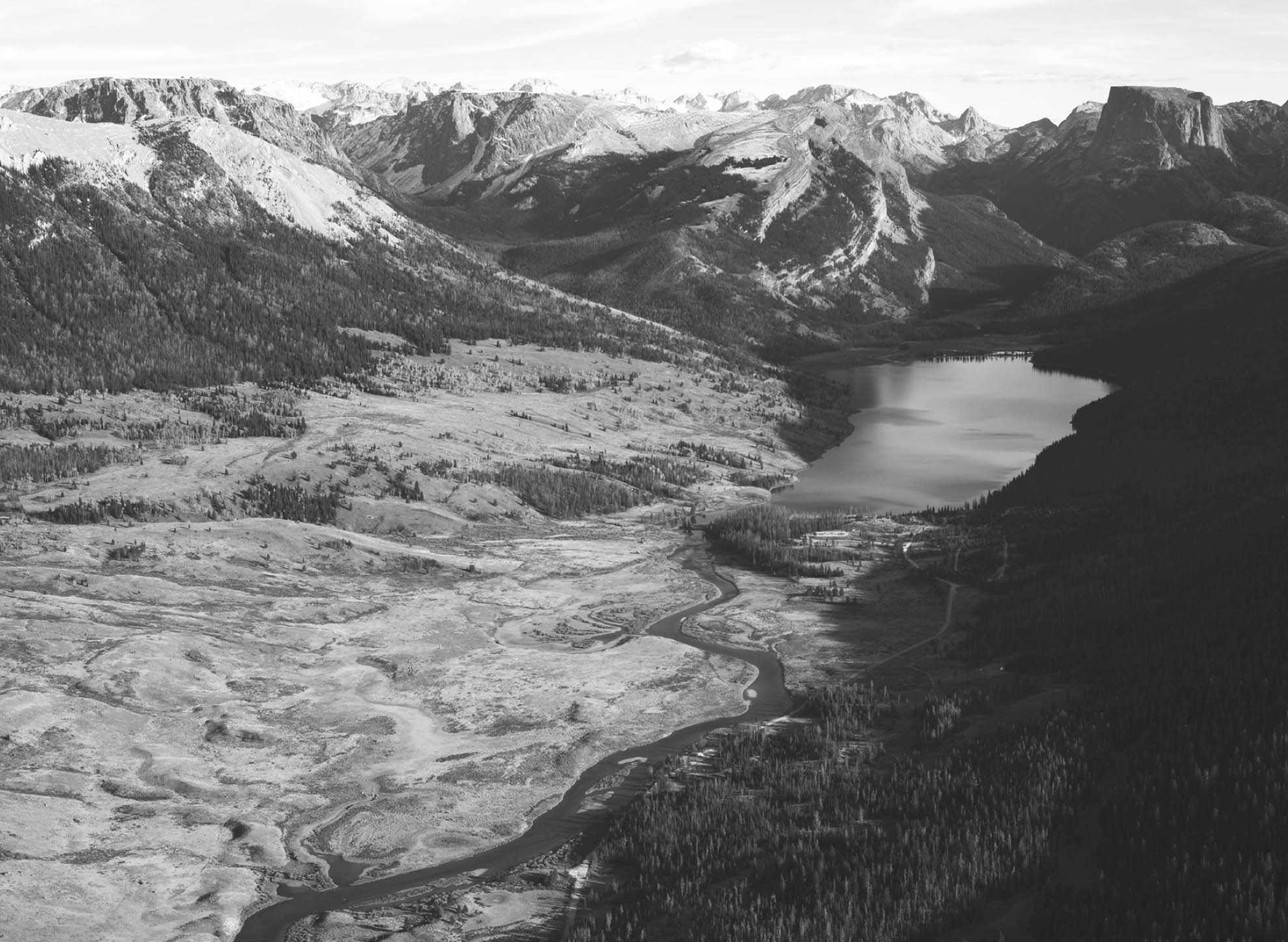
Green River Lakes, Wyoming headwaters of the Colorado River. Courtesy of Rita Donham / Wyoming Aero Photo.
Believing fully in the doctrine that public waters should remain a public property, and that to grant private perpetual rights is to sacrifice the welfare of future generations.
—ELWOOD MEAD, WYOMING STATE ENGINEER, 1890–18991
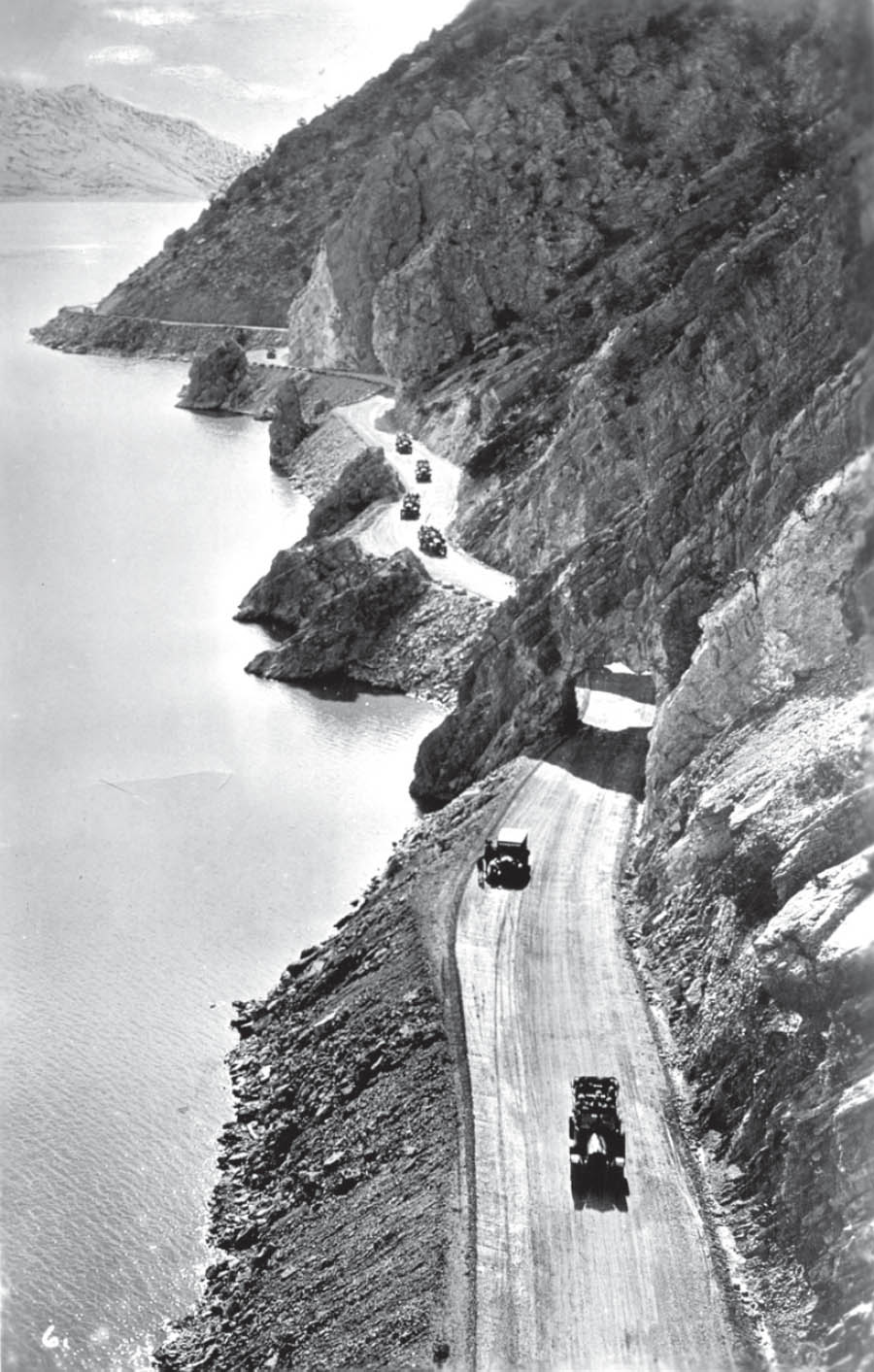
Heading to Yellowstone past Buffalo Bill Reservoir. Courtesy of Park County Archives.
UNCERTAIN WATER SUPPLY IS one of the most unsettling consequences of climate change and rapid population growth, the legacies of the twentieth century. Finding a way to govern the use of water so that this liquid resource can continue to sustain us and the world we live in is one of the major challenges of our time.
This book tells the story of how water has been used, shared, and sometimes used until it was gone, under a system of rights to water in one state in the western US: the high, cold, and dry state of Wyoming, where mountains gather the snowpack that feeds rivers crossing the dry lands below. It is the story of the rules people have made about using water, in a secluded place where the story is easy to trace.
Water is not to be taken for granted. It moves among us all, coursing through an endless cycle yet possible to deplete at any point on land where people might try to use it. And it can be hard to preclude people from using it. So one person’s water use affects the water use of others. It creates interdependence among people. It creates interdependence between people and the natural world. How water is used affects the well-being of whole societies and landscapes. What we deal with, therefore, are fundamentally public waters. For the welfare of future generations, and of our own, those waters demand governance.2
What has become of public waters? Over a century ago, the arid states of the US West, fearing monopoly private control over all access to water, adopted the idea that water resources should be public property. Then, to attract people and development, these states worked to put the use of public waters into private hands. State governments gave first comers, at no charge, a first right to use water, even when very little water was available; individuals could keep that right—perpetually—if they regularly put the water to use. Not surprisingly, water users and many courts came to see a water right as simply a matter of private property.3
Yet there remain odd twists to those private rights to use water. Not only can a water right be lost for non-use, but it can also be difficult to change to a new use or to use in a different place. Such changes typically shrink the amount of water that can be used. Private water rights are an “incomplete” property right, say the law treatises. That is because of the powers over water that remain in public hands—such as the crucial power to restrict changes to a new use or a new place. There is public oversight, with veto power, to ensure that the interdependency and overall social welfare issues inherent in water use are respected.4
The idea of public property in water thus manages to glimmer through western water law. By giving state governments license to guide their water systems into new paths, that idea may help western states to refresh their water governance. There are examples of that license in action now, as state water management agencies work with entities of all kinds—other states, water right holders, and groups of people who don’t have water rights—to find ways that water can serve all their needs.
The twists and turns of water law have usually been traced in prominent western states—Colorado, California, or Arizona. There, however, the development of the water governance system has been overlain by the growth of substantial and often corporate agriculture, a largely urban population, major hydropower generation and related industries, and considerable investment in massive infrastructure to turn wild western rivers into steady water suppliers.5
Wyoming, by contrast, is home to neither corporate agriculture nor genuine urban centers; its dominant industry has been energy, largely shipping raw materials out of state, plus running a few hydro- and coal-fired power plants and mineral-processing plants that use water locally. There are a few big federal reservoirs producing hydropower and irrigation water, but they serve only a small number of people on irrigated lands. The population is hardly urban.6
Wyoming is therefore ideal territory for documenting how western water law developed independent of the pressures of urban or industrial growth. Wyoming shows how water law is likely to be animated, everywhere, by local forces easily overlooked in the shadow of urban growth and massive water projects. Local experience with local terrain creates ideas about water that still play a role in water management.
In Wyoming, 130 years ago, there was an engineer who tried to set down a rational system, intending to improve upon California and Colorado water law. Committed to “public waters,” he sought to achieve a model system that brought new life and power to the idea of water as public property. But an ideal water code cannot simply be dropped down on a western landscape. The terrain asks for a system that responds to it. It requires water governance that reflects longtime interaction among people, land, and water, incorporates a learning process, and embodies the capacity to adapt to change upon change.7
Wyoming water law therefore morphed considerably over time, as the people using it encountered the high, cold, and dry landscape in which they sought to live. People experimented in shaping a water-law system that sustained them in that place. At first, they simply wanted their own secure, individual rights to water; they then felt their way to an understanding of the mutual interdependence that water use creates. They experimented and built on their experience of a harsh landscape. Water governance became the work of the community, with some powers over water in private hands and other powers held by the state government, as representative of the public—the relative extent of the powers of the private users or the public shifting back and forth over time. In the web of rules for water that the community devised to make it possible to live where they did, the concept of public property in water glints through.
By the end of its first hundred years, however, Wyoming’s system for governing water had become somewhat rigid. Local society and politics—and accordingly, the water-law system—responded stingily to two demands: the water needs of native people asserting their sovereignty, and the attention that other residents sought for the ecological needs of rivers throughout the state. The effect of climate change, particularly on major interstate rivers, where impacts can ripple back up to the headwater states like Wyoming, has since added to the issues that the state water-law system must address. Now the challenge for Wyoming is refreshing its water governance system. There is reason to believe it can do so, since water governance has been integral and responsive to people and place there for so long—and because the concept of public waters is still alive.
What has happened in Wyoming with water is a distilled version of what has been at play at the local level in other, bigger, more complicated places in the US West. Those other states share with Wyoming the evolution of local water governance in response to people and place; they share its potential for revitalized water management that draws on local experience.
Wyoming covers many square miles but hosts few people, and almost every moment of its water management history has been meticulously documented. The story is not too long to tell or to remember. It is worth a look.