
1
Imagine this: We are piloting our brand-new 1955 Plymouth up the driveway of the Delamarre Hotel and Resort Complex in McArthur, New Jersey. Bellhops spring into action. Our bags are whisked away. With spouse and kids, we are here for a week, creatures of absolute, if temporary, privilege at one of America’s best middle-rank resorts.
We can afford a week here because life is good. We were recently promoted to regional supervisor at our electronics firm, Hi-Fi-Stereo-Engineering. We have recently moved from an apartment in Canarsie, Brooklyn, to our brand-new suburban home in Hempstead, Long Island. The house, a ranch-style bungalow, is still waiting for the lawn and trees to fill in, but inside it’s stuffed with new kitchen appliances, drapes, rugs, and furnishings, many made out of new plastics and miracle fabrics. In a place of pride is our fresh-off-the-assembly-line TV from RCA.
The memories of the war years are fresh, but we are working hard to forget the horror and privation. It helps that America is growing spectacularly. The mighty industrial engine built to supply the war effort is now turning out consumer goods of new quality and rising quantity. Science and technology are making good on the promise of progress. Disposable income rises steadily. Personal mobility is a structural fact of life. Intellectuals like John Kenneth Galbraith and Newton Minow are inclined to scorn our good fortune, but really, who cares? Modernist confidence, personal advancement, and the apparent triumph of the American economic model make this a happy time.
The Delamarre encourages our belief that 1950s America is the best of all possible worlds. It is outfitted with not one but three swimming pools, not one but two restaurants, both a full-size golf course and a miniature one, a “real” nightclub, and a racetrack for go-karts. If we like, we can pick up a courtesy phone and order a meal anywhere. An army of waiters stands at our beck and call. We can drink anytime we want. We can smoke anywhere we want. This is a place dedicated to our happiness.
There is one small worm in the apple. Well, it’s a big worm, really. The Delamarre is a toxic place. It’s so dangerous it might as well be sitting on an abandoned uranium mine. The ugly secret: the Delamarre is dedicated to the willing consumption of dangerous substances.
In the next six days, we will consume impressive quantities of sugar, fat, salt, sun, chlorine, nicotine, and alcohol. These are rough estimates.
Two adults over six days will consume:
· 240 cigarettes
· 6 bottles of wine
· 24 cocktails
· 12 after-dinner drinks
· 12 breakfasts
· 12 lunches
· 12 dinners
· 12 desserts
· 24 hours of sun exposure
· 6 hours of chlorine exposure
· 24 cans of soda
· 24 candy bars
By my inexpert calculation, this represents great whacks of sugar, fat, salt, alcohol, nicotine, and chlorine.
The family may have arrived at the Delamarre in a brand-new Plymouth, but some of them must have felt like leaving on a stretcher. This was a killing diet, not in the short term, but in the long.
A friend of mine recently found a box of film in her basement. One reel showed her parents at a cocktail party they had evidently staged in the backyard. Susan said that, at first, she thought she was looking at a gag reel. The men were all wearing flattop brush cuts and Hawaiian shirts. The women were wearing bright, sleeveless, A-line dresses. Martinis appeared to be flowing freely. What really struck her was that everyone seemed to be unbelievably good-humored. It was, she said, as if they were toasting something.
It’s hard to know what Susan’s parents were celebrating, but it might well have been their good fortune. After all, they had recently departed a cramped and noisy city life for bucolic suburbs. They were not alone. In the twenty years between 1950 and 1970, the population of the American suburbs nearly doubled, to 74 million. In the twenty years between 1940 and 1960, homeownership rose by nearly 65 percent.1
Some of this good humor may have come from the sheer joy of acquisition. The suburban home was new and it was filled with things people had never owned before: dishwashers, barbecues, stereos. And that was just for starters. Commercial art published by Fred McNabb in 1956 gave people an idea of what they had to look forward to: moving stairways, picture phones, even personal helicopters with a landing pad on the roof.2
A belief in progress was a core Western preoccupation for many centuries.3 But in the 1950s this beautiful abstraction suddenly became a reality, driven by the accelerating confluence of commerce, science, technology, production, postwar optimism, and a newly vigorous marketing machine that produced glowing images like McNabb’s own. People were primed for relentless improvement. The future drew closer with each new shiny appliance.
One of the things Susan’s parents might have been celebrating was the electronic garage door opener, pictured here on the cover of Science and Mechanics in 1950.4
A garage door opener now seems a very commonplace technology. But for the reader of Science and Mechanics in 1950, it was a promissory note. An opener implied a garage, which implied a house, which implied a suburb, which demanded a car, perhaps one as futuristic as the one pictured on the following page. It was all so clear. To move out of the city brought you much closer to the future.
Thanks to the opener, the house bowed before your approach, opening like a drawbridge. Perhaps most thrillingly, the opener contained a push button, one of the celebrity objects of the moment.5 Push buttons were progress made literal, bending the world to your will with the smallest physical effort. Just… push… a button and the world sprang into action, eager to do your bidding.
It is easy to think of all this simply as runaway materialism, and indeed, the intellectuals of the time exerted themselves to do just that. But the shiny objects were animated by large ideas.
By the mid-1950s, American cars were exhibiting the “forward look,” thanks to the design work of Ned F. Nickles and Harley Earl, who pinched it from fighter jets they saw in World War II.6, 7 The eggheads saw this car as an exercise in conspicuous consumption and status seeking. But with the benefit of a half century of hindsight, we can now see that the forward look was designed to connect personal mobility to national progress, the advancement of technology, the promise of science, the drama of the Cold War, and the dynamism of the moment. Yes, these cars were inarguably status symbols; the new suburb was the perfect place to play out this ancient social motive. But their owners were also creating a new understanding of self, family, and society.8 It matters here because it helped obscure the artisan impulse. This was our pre-artisanal “before.” This is the world we eventually had to transcend to make way for the return of the artisan.
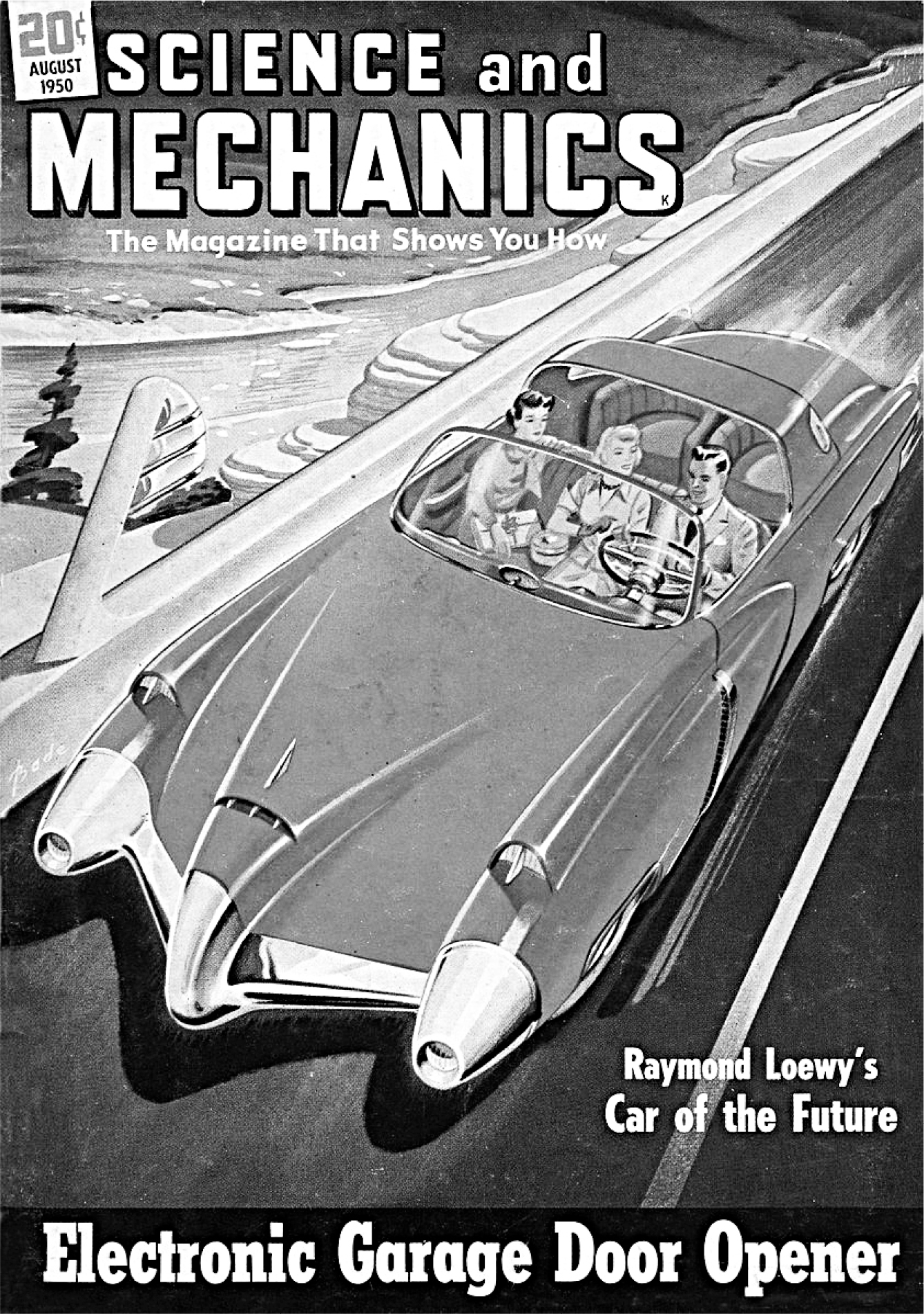
The garage door opener as celebrity tech in the 1950s. Published July 21, 1950, copyright registration B249565, Science and Mechanics Publishing Company.
INDUSTRIAL FOOD
For the comedian Jerry Seinfeld, growing up on Long Island, there was something miraculous about Pop-Tarts.9 He tells us that when he first grasped the reality of Pop-Tarts, the back of his head blew right off. What enthralled him must also have impressed the industrial engineer. Imagine the Pop-Tarts factory. You could load various raw materials at one end and out the other get a toaster-ready, shelf-stable foodstuff perfectly sized not only for the production line but also the package, the shelf, the shopping cart, and the grateful embrace of an eight-year-old. Pop-Tarts were the ultimate triumph of artifice. They were largely divorced from nature, virtually untouched by human contact, and mostly devoid of nutritional goodness. And they had the undying fealty of every American eight-year-old. For several decades after World War II, it looked as if no one, least of all the artisan, could challenge this hegemony.
Pop-Tarts made perfect sense to little Jerry Seinfeld. They came in two pieces because, well, a toaster had two slots. But of course, Jerry could not see the industrial agenda at work then. Pop-Tarts also took their shape and dimensions from the assembly line. You couldn’t tell where it had been farmed, who had farmed it, or what, indeed, was in it. Somehow Pop-Tarts existed sui generis.
The natural environment of Pop-Tarts was not nature. It was the factory and the grocery stores. The latter was a veritable cathedral of light and color, with thousands of products laid out for viewing. All the brands were here: dinner in a box from Kraft, cereal from Kellogg’s, soda pop from Coca-Cola, Chef Boyardee from American Home Foods, Cheetos from the Frito Company, all lovingly wrapped by design firms like Deskey and Walter Dorwin Teague, and promoted by advertising firms like McCann Erickson with inventive branding and relentless marketing.
To be sure, there was a small but persistent voice in the food community that scorned these products as mere delivery vehicles for salt, sugar, and fat. But the rest of America, recalling the deprivation of the ’30s and the rationing of the war years, looked at them and said, “Oh, thank goodness.”
Consumers wanted bright, shiny, immaculate, and clean. They wanted a world buoyed by optimism. They wanted a stream of innovation. They wanted to be pitched and wooed by Mad Men. Susan thought her parents might be celebrating something, and of course they were. Their world shone with beauty, novelty, advancement, indulgence, and solicitude. And at its height around 1963, this empire looked inviolable.
But quietly, the voice of skepticism grew. Leopold Kohr published his The Breakdown of Nations in 1957. Adelle Davis published Let’s Get Well in 1965. Frances Moore Lappé published Diet for a Small Planet in 1971. Kohr’s student E. F. Schumacher published Small Is Beautiful in 1973. Susan’s parents may have heard these radical sentiments, but their response is not hard to imagine: “Small? Natural? For crying out loud, who wants to live small? Have you seen my RCA? Have you?”
There was an alternative to the supermarket. It was called the health food store. This was grubby, little, disorganized. Brands were badly designed, packaging was amateurish, quality control looked iffy, and a lot of things came in barrels. You just had to trust that someone was paying attention, and what if they weren’t? Finally, it smelled. Consumers were bearded, sandaled, tie-died, and, yes, they smelled too.
It was a clear-cut David and Goliath story. In 1963, mass manufacturing, mass marketing, and mass media were so powerful they could literally tell Americans what they were going to have for dinner. This system made millions for executives and shareholders. Health food stores looked like an appallingly amateur exercise. Surely, this world was too little, too disorganized, too clueless, to take on and defeat the enemy.
Until it did. Toward the end of the twentieth century, it was increasingly clear who the winner was going to be. Grubby was going to triumph. The little world of natural, actual, unadulterated, unpreserved, untrucked food, this would win. Inexplicably, and against all odds, the food that threatened you with diabetes and early death was going to lose. People would fall out of love with the suburbs. They would begin to wonder whether the machine-made, the artificial, and the gifts of science and technology were really gifts at all. Everything that sang and shone in the 1950s now looked clueless, out of step, as dubious as the Delamarre Hotel and Resort Complex in McArthur, New Jersey.
The mystery: How did Americans pry themselves away from those beautiful supermarkets, that convenient food, those glowing packages, all that beloved sugar, fat, and salt? The answer: hippies persuaded them to adopt a different diet and a new way of seeing the world.