
{1} SECTION I
From the earliest times, swords were prized objects in Japan. The inscriptions found on swords provide some of the most extensive examples of early writing in the archipelago. These inscriptions also provide the best evidence about the earliest warriors and the ways in which swords were used as gifts and symbols of allegiance.
This section tells the story of ancient Japanese warriors through five swords created between 471 and 811. The oldest sword was discovered at the Inariyama tomb in Saitama, and the second oldest at Eta Funayama, hundreds of miles to the west in Kyushu. The inscriptions on these swords are among the earliest known examples of writing in Japan.
1. An Inscription on the Sakitama-Inariyama Sword1
The Sakitama-Inariyama sword was discovered in a mounded tomb in Saitama, in eastern Japan, in 1978.2 The inscription on this sword mentions the Great King Wakatakeru, or Emperor Yūryaku, who reigned from 456 until 479. “Shingai” is the name of a year in a cyclical sixty-year Chinese cycle. Though the word shingai was used to refer to the years 471 and 531, other evidence from the sword indicates it was forged in 471. Yūryaku was apparently discredited after his death, and this once-valued sword became the possession of a less prominent relative.
{2} Remarkably, this sword was found in a small coffin buried in a mounded tomb. The person buried there was a later descendant of the figure for whom the tomb was made and lacked the authority to have his own tomb; instead, he was buried humbly in his ancestors’ tomb. The tomb itself predates Yūryaku, but the coffin was dated from well after Yūryaku’s time.
[This inscription was] recorded in the seventh month in the year of shingai (471). Wowake-no-Ōmi’s forefather’s name was Ōhiko. His son was Takari-no-sukune. His son was Teyokari-wake by name. His son was Takahishi-wake by name. His son was Tasaki-wake by name. His son was Hatehi by name. His son was Kasahaya by name. His son was Wowake-no-Ōmi by name. From generation to generation, we have served as the heads of the Sword Bearers [and continue to do so] to this day. When the Great King Wakatakeru [Yūryaku] was in the Palace of Shiki, I helped [him] rule over the nation. Let [the swordsmith] make this hundred-times wrought sharp sword, recording the origins of my service.3

The Sakitama-Inariyama sword of 471. The inscription on the blade represents one of the earliest known instances of written Japanese and the use of the Chinese cyclical calendar.
{3} 2. A Fifth-Century Sword from the Eta Funayama Tomb4
Three groups of people were buried in the tomb, with the sword bearer among the second, or middle, group. As in the case of the sword discussed above, the placement of this sword owner’s body suggests he was a person of less than exalted status buried in an older tomb. Eta Funayama, where this sword was found, is in Kyushu, near the Iwai region and a source of silver. The author of the inscription, Chang An, most likely came to Japan from either China or the Korean peninsula.
During the Reign of the Great King Wakatakeru (Wakatakeru-no-Ōkimi), I served as a transmitter of records (tensō ni tsukae matsuru hito). My name is Murite. In the middle of the eighth month, I received a great iron cauldron and a four-foot-long sword (teitō), the metal of which had been folded over eighty or ninety times. The sword blade is three inches long5 and of high quality. Those who shall bear this {4} sword shall live long, and their descendants will prosper and will receive rewards (on). They must also not lose possessions that they control. He who made this sword is named Itawa. He who wrote these words is named Chang An.
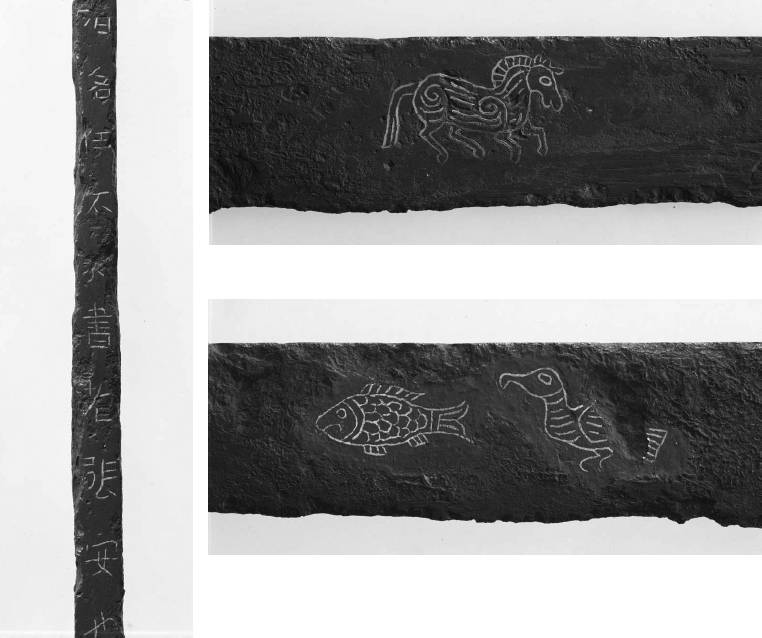
The fifth-century Eta Funayama sword, engraved by a foreign scribe.
3. Bright (yang) Sword and Shadow (yin) Sword6
In the seventh century, Japan became a powerful polity, one capable of conducting a census, creating a system of conscription, and establishing a large capital and administrative centers. In response to political turmoil and illnesses such as smallpox, which ravaged the land, one Emperor, Shōmu, decided to build a temple dedicated to Rushana (Sanskrit Vairocana), the Cosmic Buddha. It was the largest wooden structure in the world at the time, and people from India, China, and elsewhere attended the eye-opening ceremonies in 752. In 2010, two swords were discovered at the base of the temple’s statue of Buddha. Together, the two swords symbolized Shōmu’s martial authority as well as the importance of complementary yin-yang ideals. In ancient Chinese belief, the Great Ultimate was made up of two complementary forces: yang, which refers to brightness, heaven, activity, light, and maleness, and yin, which refers to darkness, passivity, absorption, and femaleness. The interaction between these two forces was thought to create the five phases of metal, wood, water, fire, and earth. These two swords were catalogued as important offerings. They were buried at the base of the statue by the time of the death of Shōmu’s wife, Kōmyō, in the year 760. Both swords are nearly identical in length (2 feet 6 inches) and appearance. The only difference is in their inscriptions: one is inscribed as the yin sword, the other as the yang. Together, the two swords were used to symbolize the importance of complementary yin-yang ideals, and presumably, the complementary role of the state in protecting Buddhism and Buddhism protecting the state.
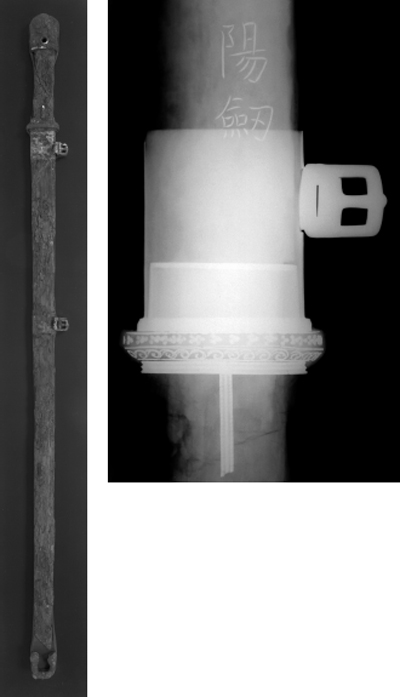
{5} A photo and X-ray of Bright Sword (yang). This sword was buried at the base of Tōdaiji temple and symbolized the protection of the realm. The name “Bright” is visible only in the X-ray image.
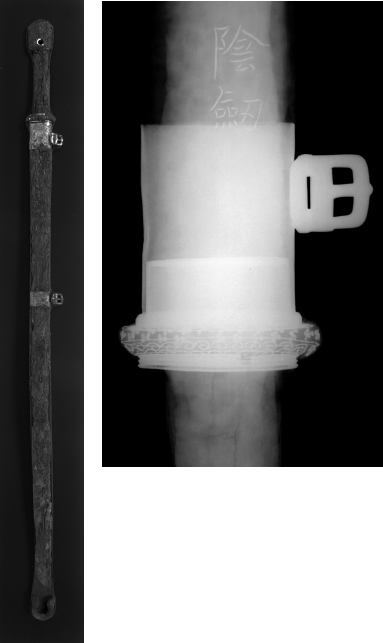
{6} A photo and X-ray of Shadow (yin) Sword. Together, this sword and Bright Sword (yang) represent the traditional Chinese belief that “bright” and “shadow” are complementary cosmological forces.
{7} 4. Sword of Sakanoue no Tamuramaro
In the year 749 gold was discovered in northern Japan. The region proved very productive: approximately two hundred pounds of gold a year were mined. Initially, the gold was intended solely for use in the Rushana statue of Tōdaiji, but it soon became the basis for Japanese continental trade. In 774, the emishi, or “barbarians” of the northern reaches of Honshu, launched a rebellion, and in 780 they conquered or destroyed several major Japanese forts and administrative structures, such as Fort Taga in the north. This barbarian incursion initiated a thirty-eight-year war for control of the north.
In 797 and 804, Sakanoue no Tamuramaro was granted the authority to wage war as he saw fit in the north with his appointment as Sei-i-tai shōgun (or “Barbarian-Subduing General”). He pacified the emishi and expanded the Japanese state’s control farther north, bringing an end to the conflict. After his success, his appointment to this office ended, and he returned to Kyoto, where, after his death, he was buried with his trusty sword. This sword, which has no inscription, was first discovered in 1919. In 2007, Professor Yoshikawa Shinji of Kyoto University identified this grave as belonging to Sakanoue no Tamuramaro. Its style is consistent with ninth-century blades and, as a sign of the prestige of its bearer, it most unusually has gold fittings attached. After Tamuramaro’s passing, order would be maintained by the Chinjufu shōgun who exercised authority over the Six Districts of Mutsu Province in the north through 1083. This Six-District Army would remain as a viable institution until it was destroyed by Minamoto no Yoritomo in 1189.

The sword of Sakanoue no Tamuramaro, appointed as Japan’s first “Barbarian-Subduing General,” in 797 and 804.
1. Translated by Thomas Conlan with Yoshikawa Shinji.
2. For more on this sword in English, see Anzawa and Jun’ichi, “Two Inscribed Swords from Japanese Tumuli,” 380. For an alternate translation of this sword, and further analysis, see Lurie, Realms of Literacy, 94.
3. The differing titles, or kabane of the sword, indicate differences in rank. Those without titles, such as Hatehi or Kasahaya, were not influential. The most remarkable individual mentioned in the sword, Ōhiko, corresponds with Ōhiko-no-mikoto in the Kojiki (the oldest written account dating from 712 [Ōpo-biko-no-mikoto in the Philippi translation]) and Ōho-hiko in the Nihon shoki, the second history of Japan, written in 720.
4. Translated by Thomas Conlan with Yoshikawa Shinji.
5. This is a mistake and should read “three feet long.” The scribe made an error.
6. Translated by Thomas Conlan.