
10
Alistair Henderson
Geographical variations have always been a difficult aspect of witch-hunting in Scotland to explain. Christina Larner held that witchcraft was essentially a rural phenomenon, reliant upon a ‘witch-believing peasantry’ whose face-to-face relationships fostered reputations and made neighbours willing to name witches to the authorities.1 The connection between witchcraft and rural areas has been generally accepted by historians of witch-hunting, in Europe as well as Scotland.2
It is perhaps not surprising that towns have not been associated with witch-hunting in Scotland. After all, only a small minority of Scots lived in towns even by the end of the seventeenth century. The Survey of Scottish Witchcraft confirms that a large majority of those accused of witchcraft lived in rural areas. There is no need to challenge Larner in her attribution of witch-hunting to rural society. However, towns were certainly not impervious to accusations; indeed, some towns were highly involved centres of panics. Analysing the urban minority may help us understand the witch-hunt in Scotland. The main approach is statistical, analysing variations in rates of intensity of prosecution. It is also suggested that some cases in towns may have had distinct urban features, relating to more intense local government, burgh politics and economy.
I
This chapter is about ‘towns’ in the sense of nucleated settlements of people pursuing non-rural occupations. Most such settlements were also ‘burghs’, in that they possessed institutional status. Larger towns were ‘royal burghs’ with international trading privileges, while smaller ones could be ‘burghs of barony’ entitled to trade internally. The chapter will also take account of some urbanised settlements without official burgh status but with a population density comparable to other towns.
Seventeenth-century Scotland was still a rural country by European standards, but it was urbanising faster than most. In the early sixteenth century, only 1.6 per cent of the population lived in towns with over 10,000 inhabitants, but by the 1750s, 9 per cent did so.3 Most towns were smaller than that, but small towns too were growing in size and number. By 1707, there were 51 burghs of barony that had been established since 1660.4 Prosecution of witchcraft in these smaller towns, this chapter will argue, may have been connected to their rapid growth and the economic pressures that affected their inhabitants.
We have little systematic information about the population of Scotland before the 1690s. However, evidence of urban populations can be gathered from a tax on valued rents in royal burghs in 1639.5 This shows that Edinburgh was by far the largest town, and that most urban settlements contained fewer than 2,000 inhabitants. This can be compared with the 1690s hearth tax information to show the growth and decay of particular towns. Urbanisation was limited to the Lowlands and especially to the areas along the Forth, with Edinburgh and West Lothian having the highest density of urban settlement.6 This region also saw the most severe witch-hunting.
The most obvious connection that could be made between witch-hunting and the towns is the intensity of urban government, compared with that of rural communities.7 Even the smallest burghs had a council that supervised the inhabitants closely and could take an interest in accusations of witchcraft. Typically the council would comprise twelve or more merchants (sometimes craftsmen could also be councillors) who would oversee economic matters in the town. The council would be headed by a smaller group with executive powers, the ‘magistrates’, typically a provost and about four bailies. The magistrates held a court that settled minor criminal, as well as civil, matters in the town. It was often the magistrates who sought a commission of justiciary necessary for the trial of a witch. Urban authorities were perhaps no more zealous in prosecuting witches than others, although their concerns – ultimately the economic prosperity of the town – might have influenced their desire to root out ungodly citizens and preserve social order.
Urban authorities also had religious responsibilities. Burgesses who served as councillors often also served as elders and deacons on their kirk session, which was likely to hear initial complaints of witchcraft and to carry out pre-trial investigations.8 Perhaps the prosecution of witches in towns helped to establish the status of townspeople within the urban hierarchy. Godliness supported their economic and political authority.
Another possible context for urban witchcraft accusations was the economic instability of medium-sized towns during the turmoil of the seventeenth century and what have been identified as ‘localised short-term urban crises’ during the sixteenth century.9 Fishing towns on the east coast of Scotland relied heavily on only one trade.10 If a sizable proportion of the workforce was killed in a disaster, the urban community was ruined. Similarly, coastal trading ports were affected by the loss of Dutch trade in the mid seventeenth century. Larner, who initially raised this question, was unsuccessful in drawing direct connections between such disasters and witch-hunting panics.11 However, as we shall see, the prevalence of accused witches in small east-coast settlements is significant and could be connected with an awareness of the economic vulnerability which accompanied their rapid rise to the status of burghs.
II
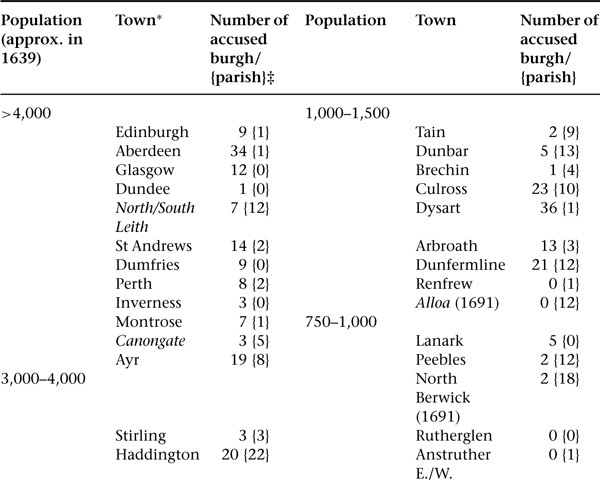
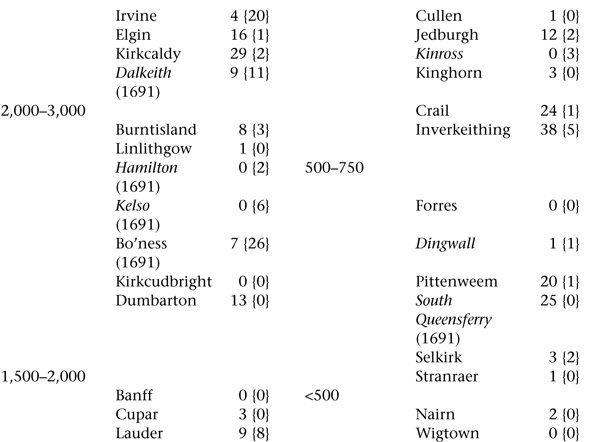
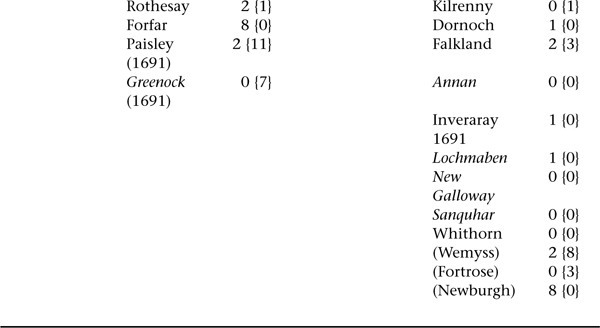
Any statistics for the seventeenth century must be treated with caution, and those for witchcraft are no different. The gaps in surviving evidence, or fleeting references to witch prosecution, mean that no statistics can be complete or reliable. In the statistics below, from the Witchcraft Survey, it is assumed that where an accused witch was recorded as living in a ‘burgh’ they resided or at least worked in the town itself; if they had been brought into town from a rural area, their parish or settlement would have been recorded instead. In Scotland, in fact, parish boundary and burgh boundary coincided much more often than they did in England, though there were exceptions like Haddington, whose parish was 36 square miles.12 The accused witches recorded as living in parishes containing burghs (but not specifically in burghs) are not considered ‘urban’, but rather as individuals potentially connected to the nearby town. In Table 10.1, therefore, two figures are given for numbers of accused witches in most burghs: a core figure for the ‘burgh’ and an additional figure, in brackets, for the ‘parish’. These figures are collated with urban population statistics and towns are grouped by size.13 These statistics include suspects from ‘towns’ that were urban parishes of comparable size to burghs but without burgh status.
A number of towns seem to have experienced few, if any, accusations. This is not really surprising, as other research has shown that around 65 per cent of parishes did not produce any suspects.14 In fact, only 11 per cent of towns contained no suspects at all, because towns were generally larger and had a more concentrated population than rural parishes. The larger the unit of study, the smaller the proportion that will contain no witches.
Table 10.1 Burgh and urban parish suspects by town size1
1 Data in all tables and charts taken from the Survey of Scottish Witchcraft.
*Towns listed are royal burghs from the 1639 valued rents of burghs, with the following exceptions. Towns listed in italics were burghs of barony (non-royal burghs) in 1639 (a few of these later became royal burghs, but this is not indicated). Those with no burgh status by 1691 but that could also be classed as ‘towns’ at this time are listed in brackets. Some towns appeared only in the later 1691 hearth tax, as indicated.
‡The main figures show numbers of accused witches in the burgh itself. Figures in brackets show additional accused witches from the urban parish, which may include the adjacent rural area.
The number of accused witches as a proportion of the total population of each town was lower for the larger towns and far higher for the smaller towns. Beginning with towns containing at least 4,000 inhabitants – of which Edinburgh was much the largest – the statistics show that Edinburgh, with its associated burghs of Canongate and Leith, had a typical absolute number of suspects for this group of towns, but this represents only a tiny relative number, because of Edinburgh’s size. The number of suspects in Dundee, Inverness, Montrose, Perth and Dumfries was lower. Aberdeen contained the highest number of suspects, although many of these were part of just one panic, in 1597. Most of these towns (Glasgow, Dundee and Aberdeen) may well have had populations of around 10,000 by the 1640s, and Edinburgh was larger still. The number of suspects as a proportion of these towns’ populations was very low.
By contrast, there were several smaller towns – with populations of between 500 and 1,500 – that actually contained a larger absolute number of suspects than the large towns. This of course translates into a very much higher proportion per capita. Within towns such as South Queensferry, Dysart, Inverkeithing and Newburgh, the urban population would have been well acquainted with suspected witches.
Figure 10.1 illustrates the proportional impact that witch accusations would have had on urban populations. This brings out the striking difference between the smaller and the medium to larger-sized towns in the number of suspects as a proportion of the overall town populations. For towns of between 500 and 1,500 inhabitants, the experience of witch accusations would have affected more of the town than in the larger towns, with approximately 10 per thousand townspeople being accused over the whole period. If one adds to this the friends, neighbours and family of the accused the wider impact can be appreciated. By contrast, in towns of over 4,000, only around 3 per thousand people were accused.
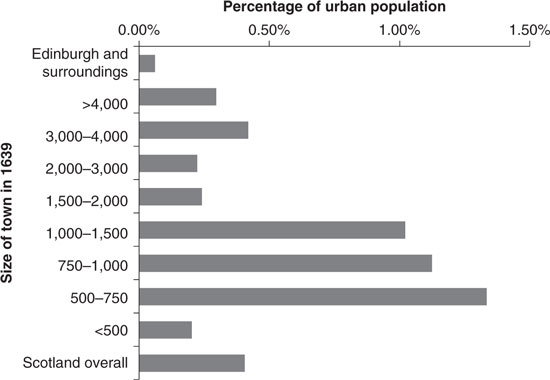
Figure 10.1 Urban suspects by town size, as percentage of town population
(Data are taken from the combined burgh and parish figures in Table 10.1 with approximate town sizes as in 1639. The ‘>4,000’ group includes Edinburgh, but Edinburgh figures are also given separately. Figures for Scotland overall (rural and urban combined) are shown at the foot of the table for comparison.)
III
A regional comparison of urban cases is revealing. The map on p. xiii above shows the locations of Scotland’s counties and principal towns. These counties can be aggregated into regions containing varying densities of urban settlement.15 Not all regions can be discussed here, but a comparison of urban–rural patterns in the three regions of Fife, Tayside and the East Borders takes in many of Scotland’s towns and illustrates the important issues.
The Fife region, comprising the counties of Fife and Kinross, contained by far the greatest number of urban cases, with a total of 232. Fife contained fifteen towns, only one of which (St Andrews) had over 4,000 inhabitants, while the majority had fewer than 1,000 each. This was nevertheless a remarkably urbanised region, especially along the Forth coastline. The poet Arthur Johnston (c.1579–1641) described how ‘Towns are so scattered on all the shore, that one/Might be described and many joined together in the one’ in his celebration of their courageous maritime communities.16 These small towns formed an almost continuously urbanised coastline. Ferry links between Burntisland and Leith must have facilitated the spread of news and ideas between Edinburgh and Fife, and also along the Forth coast. Trading contact with the centre of justice may have influenced the high number of trials in Fife towns.
Considering that the total number of suspects from Fife was 382, the 232 urban suspects represent 61 per cent. The combined urban population of the region can be estimated, using the 1755 census, as about 20,500.17 Out of a total county population of about 70,400 at that date, the urban proportion was just under 30 per cent. Thus, per capita, roughly twice as many suspected witches in Fife lived in its many small towns as in the countryside.
In the Tayside region (the counties of Forfar and Perth), the largest towns, Dundee, Perth and Montrose, produced only one, eight and seven suspects, respectively. The urban proportion of the Tayside population was 13 per cent. This region had a total of 192 suspects, and the total number of urban suspects was 38. The urban proportion was thus 20 per cent, showing somewhat more witches in the towns of Tayside than in its countryside; but this result should take into account the fact that thirteen of the thirty-eight urban witches came from just one small town, Arbroath. Tayside overall produced the fewest witches, fewer even than the Highland region as a proportion of its population.18
Despite an increasing national population, Dundee and Perth had stagnated, and this may help to explain why there were few witches there. Aberdeen, too, along with Dundee, suffered in the covenanting wars of the 1640s.19 Aberdeen had many witches, but only four cases after 1631. Instead of fuelling fears of witchcraft, it seems more likely that economic decline was tangible and self-explanatory. Economic dislocation has also been suggested as a reason for the lack of hostility to witches in towns of the southern Netherlands.20
The East Borders region, comprising the counties of East Lothian, Berwick, Selkirk, Peebles and Roxburgh, contained a large number of suspects (841), with an urban proportion of approximately 20 per cent of the total regional population. The fifty-two urban suspects therefore represented only 6 per cent of the total. But there were several small towns in this region, with populations comparable to those of the Forth fishing towns. Why did Lauder, Peebles, Kelso, Jedburgh and Selkirk produce far fewer suspected witches? These border towns did not contain much of the national population and the population density of the counties was about half of that for the central belt of Scotland.21 It should be borne in mind that this was the region of most intense witch-hunting in Scotland overall; perhaps what we are seeing is not so much an actual reluctance to prosecute witches in Lauder and Peebles, more an upsurge of rural witch-hunting in this region.
IV
Statistical patterns are useful for a general analysis, but must be complemented by local and individual case-studies in order to better understand how accusations and prosecutions developed within towns. West Lothian provides some valuable examples. The town of Bo’ness experienced a large outbreak of accusations in 1679–1680 in which twenty-one people from the parish were named. Out of these at least eleven can be identified as having lived in the town of Bo’ness, and another three would have had contact with the town through their husbands’ occupations. Elizabeth Hutcheson, a shopkeeper married to a merchant in Bo’ness, confessed to being visited by the Devil in her shop until other people entered and he disappeared.22 The four others whom she named were all married women; two had skipper husbands and one was married to a ‘cainer’ (an overseer of fishing). They may have been some of her customers. Hutcheson was tried with Elizabeth Scotland, also the wife of a merchant, who named one of the women and several other indwellers. They were obviously not poor people but part of a flourishing fishing community and engaging in business with each other. Their investigations were carried out by local men, many of whom were skippers or maltmen (making or dealing in malt), as well as a minister and the bailie depute. Together they would have formed an intense local authority. Complaints of torture resulted in their release by order of the high court.
The large number of men investigating this case and their occupations suggests that they probably all knew the accused women’s husbands. Their apparent attempts to force confessions by torture confirm that witchcraft was feared as much in the towns, where a large proportion of the West Lothian accusations are found, as in the fields. A male suspicion may have existed about what women were involved in while their husbands were out at sea. Moreover, the exchange of goods by married women in towns, like those in Bo’ness, is an urban version of ‘women’s work’ – a context for witch-hunting that has already been explored.23 This evidence supports an argument that cases of urban witch-hunting were not qualitatively dissimilar to rural cases. It also illustrates that in small urban communities the authorities, who were familiar with and possibly had personal motives against the accused witch, had a stronger desire to deal with them quickly and firmly than their counterparts in larger burgh councils.
Table 10.2 shows peak years of accusation in the towns of Fife. In each year of national panic, at least one town produced three or more suspects. One can also notice several years outside these periods when individual towns experienced small panics. Stuart Macdonald has looked carefully at this region, showing that witch-hunting was highly localised and that it was the presbyteries that took the initiative in prosecuting witches. However, he does not seem to consider the urbanisation of the Forth coastline as a facilitator in the spread of witch-hunting.24 Most suspects came from the towns which were situated closely together along the coastline rather than inland towns in entirely rural areas.
Table 10.2 Panics in Fife burghs
|
Panic year(s) [*national panic] |
Burgh(s) with three or more suspects [*including parish suspects] |
|
1597* |
Kirkcaldy (16); Pittenweem (5) |
|
1621 |
Inverkeithing (6) |
|
1623 |
Inverkeithing (12) |
|
1624 |
Culross (7) |
|
1626 |
Dysart (4); Kirkcaldy (3) |
|
1630* |
Dysart (10) |
|
1634 |
Culross (4) |
|
1637–1638 |
Dysart (4) |
|
1643* |
Crail (19); Dunfermline (15); Culross* (5); Pittenweem (4) |
|
1644 |
Dysart (4); Pittenweem (3); St Andrews (3) |
|
1649* |
Dysart (11); Inverkeithing (10); Burntisland (4); Dunfermline* (5); Culross (3) |
|
1661–1662* |
Newburgh (7); Falkland* (5) |
|
1675 |
Culross* (5) |
|
1704 |
Pittenweem* (4) |
Most of the Fife cases were concentrated in the southwest corner, around Inverkeithing, Dunfermline and Culross.25 These towns were all fairly small during the seventeenth century. Proximity to Edinburgh, in Fife at least, was probably not that important, as some other parishes in the same presbytery produced few, if any, suspects when others gave many. In 1643–1644, during the most intense panic to affect Fife, when (unusually) three out of four presbyteries had suspects, it was the coastal towns of Culross, Crail, Pittenweem, Anstruther, Kirkcaldy and Dysart that contained most witches. The presbytery of Cupar, on the other hand, contained comparatively few accused witches.26 The fact that it also had no significant towns apart from Cupar itself, and did not share any of the Forth coastline, where suspects were rife, might not be coincidental.
The density of settlement on the coast may have been a factor in the spill-over of cases in the panic of 1649. This was mainly confined to the presbytery of Dunfermline, along with suspects from the neighbouring parishes of Dysart, Torryburn and Wemyss.27 Table 10.2 shows that more urban suspects in the 1649 panic came from Dysart than the burgh of Dunfermline. Meanwhile, Kirkcaldy did not have a single accused witch in that year despite being so close to its witch-ridden neighbour. In fact there were few occasions when neighbouring towns had simultaneous panics. This reflects the extent to which townspeople on the coast of Fife identified suspects strictly within their own communities and how these small towns still possessed their own strong identities.
Recurring panics in Dysart, Culross and Inverkeithing suggest that local memory was important for the identification of witches in subsequent years. As these were mostly coastal towns built to capture trade it would seem likely that there was greater communication between them, allowing the fear of witches to spread, but only in years of national panics, especially 1643 and 1649, when towns further east of the witch-hunting core (Crail, Pittenweem, St Andrews) became involved.
V
For many of the urban witches, little information is recorded about their social status, but where such information survives it can be useful in providing a context to their accusation. An accused witch could complain to the local or higher authorities if they had the right connections. A number of urban suspects were wives or widows of burgesses and bailies, and their status within the town was perhaps a cause of resentment.28 Louise Yeoman has found such motives for the accusation of high-status suspects.29 Burgess status would have provided greater security, especially in old age, but could have made targets of the women who were fortunate enough to be married to a burgess.
Two cases from Fife illustrate how married women in this position were defended by their husbands. Margaret Young from Dysart was married to William Morrison, a merchant burgess. He appealed to the privy council in 1644 for his wife’s release, describing the witches who had accused her as ‘some malicious persons who wer brunt out of spleen and invy’. This implies resentment towards her status. The lack of reliable evidence against Young was confirmed when, despite attempts by the minister to gather complaints against her, she was finally released.30 The authorities might also have had financial motives for prosecuting married women – they were maybe easier targets than their husbands for rivals or enemies. Similar patterns have been found in a German case-study.31
Young’s case does not reveal an active ‘witch-hunter’ of the kind studied by Yeoman, but the case of Janet Finlayson in 1597, from Burntisland, does. It was the bailies who pursued her the hardest. They were finally brought before the privy council for persistently apprehending the suspect for witchcraft, their motive apparently ‘being to enriche thamesellfis with the said complenaris guidis and geir’.32 This is revealing of the vindictiveness behind accusations in a competitive urban setting. Both these cases were during peak years of prosecution when the witch stereotype of an unmarried or widowed woman was likely to have broken down and rivalries encouraged accusations. It is also a reminder of the intensity of urban government in addition to that of the kirk sessions that still had authority within burghs.
There are other cases of accused women married to burgesses, but often little information survives for their cases. The political and property motives in the cases referred to above differ from more typical reasons for suspected witchcraft. For skilled men, towns gave the opportunity for greater social advancement. Women married to successful men (especially in smaller towns) could have become targets because they shared in their husbands’ status and wealth. However, they could usually rely on male support to petition the authorities. Of course, there may have been other women accused who had burgess husbands who were not recorded because they did not become involved in the case themselves. Still, there is little doubt that widows were less fortunate. Scottish kinship was agnatic, and when their husbands died, women would become detached from the male kin group, losing their husbands’ protection. This hints at more distinctly urban characteristics in those cases where spouse information survives.
VI
One fascinating aspect of the geography of witch-hunting in Scotland is the rarity of cases in Edinburgh itself. This is particularly notable given the dominance of the surrounding Lothian region in providing most suspects overall. One can find a large number in the town of Haddington, a significant number in the towns of West Lothian (although few from the largest, Linlithgow) and a huge number in the towns of Fife. By comparison, very few suspects are recorded as inhabitants of the capital city, which was by far Scotland’s largest town in the sixteenth and seventeenth centuries. Only eighteen suspects can be identified as living in the town and its adjacent suburb of Canongate (a separate burgh in its own right), which contained eight of these cases.
A possible yet unproven explanation for the fewness of Edinburgh’s witches is that it was the centre of government and the seat of the court of justiciary. The higher number of cases tried in this court resulting in acquittals is probably relevant and a statistical comparison with acquitted suspects from towns would be useful.33 A more plausible context is the changing occupational structure of the town from the mid seventeenth century, from being based on foreign trade to central administration, including professionals such as lawyers and physicians. A greater involvement of educated townspeople and legal professionals in trials may have been a restraining influence.34 The size and occupational diversity of larger burgh councils such as Edinburgh’s could have reduced the interest the authorities had in individual cases. By comparison smaller burgh councils and kirk sessions, whose members were part of closer communities, may have had a more united interest to protect their wealth and trade against potentially catastrophic acts of witchcraft.
Although Edinburgh had a rising professional sector (about 8 per cent of the population in 1639), a large proportion of the ‘unfree’ (non-burgess) inhabitants of the town could be classed as ‘poor’; approximately one-third of families in 1694 were on or below the poverty line.35 If we accept that most witchcraft suspects in Scotland were of low social status, it is surprising that more witches were not prosecuted in Edinburgh. This might have less to do with the social status of the suspect than with the social structure of the society around them, the social difference which existed between neighbours or clients and the formally educated civic elite leading the trials.
What of the possibility of urban connections with the surrounding countryside, where healers more commonly resided? The North Berwick panic of 1590–1592 shows how a witch-hunt could begin with local accusations in rural Haddingtonshire and then involve higher-status Edinburgh suspects, Barbara Napier and Euphemia MacCalzean.36 On the whole, though, witch-hunting connections between Edinburgh and its hinterland are difficult to find. An analysis of burgh and urban parish cases by year provides an overview of this relationship.37 The results show very little or no correlation between cases in the rural county of Edinburgh and the capital itself during periods of ‘national panic’. For instance, during the 1661–1662 panic there were no cases in Edinburgh or Leith despite numerous suspects being accused in neighbouring Dalkeith presbytery and Liberton parish.38 Local research into witch-hunting in Dalkeith supports these findings.39 Despite trading links between Dalkeith and Musselburgh (both burghs of regality), the geographical range of accusations did not extend beyond single or immediately neighbouring parishes. Disputes that developed into witchcraft accusations tended to involve relations between family and friends that had turned sour, suspects spotted in suspicious places or money issues.40 Some of these would have been more likely in the smaller parish communities of Dalkeith than in the densely inhabited closes of Edinburgh. Proximity to the centre of justice does not appear to have acted as a restraining influence on local witch-hunting either; the justiciary court was sent out to Dalkeith to try some suspects in 1661 but found every witch guilty even after confessions were retracted.41
It might be helpful to compare the Edinburgh area with a similar pattern found in Geneva by William Monter.42 He showed that Geneva had strong connections with its witch-hunting neighbour, the duchy of Savoy, and that immigrants from the duchy appeared in Genevan witch trials. The republic of Geneva had around 12,000 urban inhabitants but only around 2,000 peasants in the surrounding rural mandements. The proportion of the county population of Edinburgh living in the capital itself during the seventeenth century would have been closer to a half, with comparably more in the surrounding rural settlements. In Geneva, the rural enclaves produced roughly half of the trials for witchcraft despite containing under a seventh of the Republic’s overall population.43 In the county of Edinburgh, a total of ten cases could be found in the burgh itself and its various urban parishes that extended into the countryside. A further twenty-seven suspects came from the adjacent burgh and parish of Canongate (eight) and nearby urban parishes of North and South Leith (nineteen). Combined with the Edinburgh suspects this translates as 12 per cent of the total number of cases in the county (374). The remainder came from Dalkeith and other rural parishes, including settlements like Gilmerton which were comparable with the Genevan mandements. With 45 per cent of the population, but responsible for 88 per cent of the cases, the rural and suburban hinterland of Edinburgh produced twice as many cases per person as the towns themselves.44
To a great extent, the localised nature of panics in the suburbs around Edinburgh (even in nearby Leith) explains the lack of simultaneous accusations in the capital. However, it fails to explain why there were so few Edinburgh cases overall. Monter showed that in Geneva there was a leniency towards witchcraft suspects, with only a small proportion being executed.45 Statistical similarities aside, specific comparisons with Geneva are difficult to find. Also, during Geneva’s religious and political disturbances between 1625 and 1650, prosecutions virtually disappeared. In the middle of the Covenanting wars, Edinburgh and Leith together had eight cases between 1643 and 1645 – something of an upsurge, although one would expect more of an effort by the reformers of the Scottish godly state to extirpate witchcraft from the home of government. Most of these cases preceded the outbreak of plague that killed between a quarter and a third of the population of Edinburgh from 1644 to 1649. In contrast to Geneva, where plague-spreading conspiracies led to panics, outbreaks of the disease in Edinburgh may have reduced the desire to hunt witches.46
How distinctively ‘urban’ were Edinburgh’s witchcraft cases? In other burghs such as Lanark and Peebles, livestock was frequently moving in the town.47 The rural context of most accusations of witchcraft (in particular acts of malefice directed against livestock) is usually given as a reason for the relative lack of urban suspects; this explanation may not entirely hold for smaller burghs. However, it may go some way to explaining the pattern in Edinburgh itself.
Where malefice did occur in Edinburgh it was often directed against humans, for example in the detailed case of Agnes Finnie, from Potterrow on the edge of Edinburgh, accused in 1645 of using witchcraft to harm and even kill her neighbours. Ten of the twenty charges against Finnie related to her occupation as a shopkeeper: dissatisfied customers, refusals of credit, and demands for small debts in connection with her moneylending. The sudden misfortune of a craft deacon was also attributed to her abilities, in which ‘his woraldlie estait and his hail meanes vanisched away fra him’, following an argument with Finnie over the punishment of her son-in-law for an offence.48 Further evidence of cases with urban characteristics would support the theory that witchcraft in towns contained distinctively urban features.
There is also strong evidence for witch-related folk belief in Edinburgh. The case of Janet Barker from 1643, also a shopkeeper in Edinburgh, reveals both demonic and folk elements of popular belief. As well as the detailed description of her relationship with the Devil and his promise to make her the best-dressed servant in town, her confession included a healing ritual of placing a black card under someone’s door.49 It is therefore incorrect to ascribe witchcraft to peasant conservatism, when middling members of the urban population had similar beliefs. As an ‘indweller’, Barker would probably have been brought up in the town;50 yet her folk beliefs play just an important role as those contained in the evidence of many rural witches.
To what extent Barker’s beliefs, and the folk traditions in other urban cases, can be regarded as distinct urban traditions is deserving of further research. The growth of Edinburgh at this time was due partly to the influx of servants and other people from the countryside;51 this would probably have facilitated exchanges of beliefs, and it is surprising that social advancement in the town did not result in more cases. Bernd Roeck has suggested that rural witchcraft beliefs could have been imported in German cities, a theory that might explain why cities still experienced accusations despite their appearance of being centres of rational behaviour and philosophy.52
The last sight of many more witches was of Edinburgh as they went to the stake. If they were brought in for trial in the court of justiciary and found guilty, they were usually executed on Castle Hill. Over sixty witches were put on trial and executed in Edinburgh, and the carrying out of the sentence was a spectacle for its inhabitants.53 Instead of fuelling the desire to prosecute witches, perhaps the greater frequency of public burnings in the capital actually reminded its inhabitants of the continued threat of witchcraft; they saw that executions had not brought it to an end and that proceeding against a witch was not necessarily a practical solution. Or perhaps people’s need for witch-hunting was satisfied if they saw witchcraft being punished, even if the guilty suspects came from elsewhere.
People in early modern Edinburgh certainly believed in witchcraft. The few cases from the burgh itself show that urban and rural belief was basically homogeneous. Research into some relatively late cases of witchcraft in London also supports this idea and is similar to other findings in Venice and Denmark. In large towns and cities, charges tended to concern harm to people, even though some urban areas like Southwark also had access to agricultural land.54 Urbanisation did not necessarily mean an end to previously rural belief systems, as often there was a continuity of the same social networks of kin from countryside to town.55 There could be parallels between rapid urbanisation in the seventeenth century and the disintegration of previously stable social networks in the nineteenth century due to immigration and urbanisation. Certainly the existence of stable social networks was important for reputations to develop. These might have been disrupted by outbreaks of plague, particularly in the 1640s. Generally speaking, towns still maintained close communities despite rapid population increases; as Edinburgh was growing on a greater scale, however, social networks would have been under more strain.
Just as the rapid growth of small towns appears to have provided a suitable context for witch-hunting, so in some cases their stagnation and decline might have been a factor in the last trials. From the mid seventeenth century Edinburgh and Glasgow were becoming the two dominant cities whereas previously the urban population had been more evenly distributed among the other regional centres. However, small towns like Pittenweem experienced decline from the mid seventeenth century and there was a panic there in the early eighteenth century. The late cases (1701 onwards) studied by Alexandra Hill reveal a high proportion of urban witchcraft suspects, mostly in small towns – Anstruther Easter, Kirkcudbright (two cases), Edinburgh, Pittenweem (eight cases), Bo’ness, Inverness (two cases), Dumfries and Thurso (five cases).56
VII
The nature of urbanisation in Scotland is an important context in which to understand the accusation and prosecution of witches. Statistics show that the proportion of ‘urban’ suspects varied with the size of the town. There was a strikingly high proportion – three times the national average – of suspects from small towns of between 500 and 1,500 inhabitants. The prevalence of suspects from towns in the most urbanised counties, such as Lothian and Fife, compared with those in more rural counties with dispersed urban settlements is also important. Around Edinburgh (but not in it), and in Strathclyde and Fife, there were high proportions of urban suspects.
Towns tended to have an intense experience of witch-hunting because in addition to their own witches, many rural witches were tried and executed in towns. Townspeople themselves were subject to greater authority. The concentration of suspects in the burghs of Fife is striking, as is the lack of direct witch-hunting connections between them. In generating accusations, networks between neighbours and family were probably just as important in these towns as in the countryside, but the government and burgess patriarchy of the burgh was essential for the identification and interrogation of suspects. The rarity of witch-hunting in Edinburgh is striking; explanations based on its unique occupational structure, sheer population size and proliferation of surrounding witch-hunting settlements seem most plausible.
The phenomenon of distinctively urban witchcraft needs more attention. Business rivalries, neighbourhood disputes and a male suspicion of women married to higher-status husbands in the town characterise some cases. Town dwellers could still have agricultural occupations in Scotland, and it is difficult to say that completely separate ‘urban’ and ‘rural’ types of witchcraft existed. For burgesses and indwellers, the burgh was a close community which relied upon neighbourly goodwill just like rural settlements. Moreover, even the smallest burghs on the Forth had economic interests of which merchants and craftsmen, and their spouses, were fully aware. Pressures to get on with family and neighbours were as apparent in small towns as in the countryside. In towns, as in the countryside, such relations could break down and lead to witchcraft accusations, though the content of some disputes was distinctively urban. Without Scotland’s urban structure it seems unlikely that so many witches would have been accused.
Notes
1. Christina Larner, Enemies of God: The Witch-hunt in Scotland (London, 1981), 193.
2. Robin Briggs, Witches and Neighbours: The Social and Cultural Context of European Witchcraft (2nd edn., Oxford, 2002), 265.
3. Ian D. Whyte, Scotland’s Society and Economy in Transition, c.1500–c.1760 (Basingstoke, 1997), 115.
4. Michael Lynch, ‘Urbanisation and urban networks in seventeenth century Scotland: some further thoughts’, Scottish Economic and Social History, 12 (1992), 24–41, at p. 34.
5. Michael Lynch, ‘Continuity and change in urban society, 1500–1700’, in R. A. Houston and I. D. Whyte (eds.), Scottish Society, 1500–1800 (Cambridge, 1989), 85–117, at pp. 101–4.
6. Michael Flinn (ed.), Scottish Population History (Cambridge, 1977), 188–90.
7. Julian Goodare, The Government of Scotland, 1560–1625 (Oxford, 2004), 190–1.
8. Michael Lynch, ‘Introduction: Scottish towns, 1500–1700’, in Michael Lynch (ed.), The Early Modern Town in Scotland (London, 1987), 1–35, at p. 16.
9. Lynch, ‘Introduction’, 8.
10. David H. Sacks and Michael Lynch, ‘Ports, 1540–1700’, in Peter Clark (ed.), The Cambridge Urban History of Britain, vol. ii, 1540–1840 (Cambridge, 2000), 377–424, at p. 420.
11. She argued that in Pittenweem, ‘witchcraft accusations began to rise’ after the burgh ‘lost over 100 adult males’ at the battle of Kilsyth in 1645, leaving fishing boats to rot at their moorings: Larner, Enemies of God, 82. However, this appears to be an error. The Survey of Scottish Witchcraft shows seven Pittenweem cases from the panic of 1643–1644 and then no more until the local panic there of 1704. Larner also misdated the battle to 1649.
12. Lynch, ‘Urbanisation and urban networks’, 28.
13. Where only the county or presbytery of residence is recorded, these suspects are excluded from the ‘urban’ total as they may have lived in rural parishes. The results therefore give a minimum number of cases from towns.
14. Lauren Martin, ‘Scottish witchcraft panics re-examined’, in Julian Goodare, Lauren Martin and Joyce Miller (eds.), Witchcraft and Belief in Early Modern Scotland (Basingstoke, 2008), 119–43, at pp. 133–4.
15. The following regions are among the ten used by Martin, ‘Scottish witchcraft panics re-examined’, 124.
16. http://www.nls.uk/maps/early/blaeu/page.cfm?id=951
17. Estimates for town sizes were based on the 1691 hearth tax returns. This had to be used in combination with data from the 1755 census.
18. Martin, ‘Scottish witchcraft panics re-examined’, 125.
19. Ian D. Whyte, Scotland Before the Industrial Revolution: An Economic and Social History, c.1050-c.1750 (London, 1995), 176.
20. Briggs, Witches and Neighbours, 265.
21. Whyte, Scotland’s Society and Economy, 115.
22. SSW; this is probably correct in linking her shop with her husband’s merchandise (see below).
23. Lauren Martin, ‘The Devil and the domestic: witchcraft, quarrels and women’s work in Scotland’, in Julian Goodare (ed.), The Scottish Witch-hunt in Context (Manchester, 2002), 73–89, esp. pp. 86–7.
24. Stuart Macdonald, The Witches of Fife: Witch-Hunting in a Scottish Shire, 1560–1710 (East Linton, 2002), 36–7 and passim.
25. Macdonald, Witches of Fife, 38.
26. Ibid., 39, 46.
27. Ibid., 83.
28. In the SSW database a total of twenty-four such cases can be found.
29. Louise Yeoman, ‘Hunting the rich witch in Scotland: high status witchcraft suspects and their persecutors, 1590–1650’, in Goodare (ed.), Scottish Witch-Hunt in Context, 106–21.
30. Macdonald, Witches of Fife, 82; RPC, 2nd ser., viii, 28; SSW.
31. Bob Scribner, ‘Witchcraft and judgement in Reformation Germany’, History Today, 40, no. 4 (April 1990), 12–19.
32. Macdonald, Witches of Fife, 73–5.
33. Julian Goodare, ‘Witch-hunting and the Scottish state’, in Goodare (ed.), The Scottish Witch-Hunt in Context, 122–45, at pp. 131–2.
34. Bernd Roeck, ‘Witchcraft in early modern Germany: urban witch trials’, Magic, Ritual, and Witchcraft, 4 (2009), 82–9, at p. 87. Roeck also points out that ‘the metropolises of early modern Europe – Paris, London, Madrid, Rome, Naples, Stockholm, Antwerp, and Amsterdam – represent blank spots on the map of the witch panic’ (p. 83).
35. Whyte, Scotland Before the Industrial Revolution, 202.
36. Normand and Roberts (eds.), Witchcraft, 54.
37. Such a table is too large to be included in this paper.
38. The most recent case found in Edinburgh was in 1659. However, the burgh of Canongate had three cases during the 1661–1662 panic. For detailed analysis, see Alistair Henderson, ‘The Urban Geography of Witchhunting in Scotland’ (MA Dissertation, University of Edinburgh, 2008).
39. Anna L. Cordey, ‘Witch-Hunting in the Presbytery of Dalkeith, 1649 to 1662’ (University of Edinburgh MSc thesis, 2003), 1–2, 17–18. Cf. Anna Cordey, ‘Reputation and witch-hunting in seventeenth-century Dalkeith’, Chapter 6 in this volume.
40. Cordey, ‘Witch-Hunting’, 28–30.
41. Ibid., 66–7.
42. E. William Monter, ‘Witchcraft in Geneva, 1537–1662’, Journal of Modern History, 43 (1971), 179–204.
43. Monter, ‘Witchcraft in Geneva’, 201–3.
44. These figures include 50 or so cases where the exact place of residence is unknown (only the county or presbytery are recorded as ‘Edinburgh’), but even taking this into account the disproportionate number of rural cases is still clear and corresponds with the results for Geneva. For a broader discussion, reaching similar conclusions to those drawn here, see Brian P. Levack, The Witch-Hunt in Early Modern Europe (3rd edn., Harlow, 2006), 137–40.
45. Monter, ‘Witchcraft in Geneva’, 186–7.
46. Ibid., 183–4.
47. Whyte, Scotland Before the Industrial Revolution, 186.
48. SJC, iii, 627–75.
49. Brian P. Levack (ed.), The Witchcraft Sourcebook (London, 2004), 210–12.
50. Whyte, Scotland Before the Industrial Revolution, 202. Whyte refers to Aberdeen, but Edinburgh would have been similar.
51. Whyte, Scotland Before the Industrial Revolution, 179.
52. Roeck, ‘Urban witch trials’, 85–6.
53. For more on this, see Laura Paterson, ‘Executing Scottish witches’, Chapter 11 in this volume.
54. Owen Davies, ‘Urbanization and the decline of witchcraft: an examination of London’, Journal of Social History, 30 (1997), 597–617, at pp. 597, 599.
55. Davies, ‘Urbanization’, 599–600, 603–4.
56. Alexandra Hill, ‘Decline and survival in Scottish witch-hunting, 1701–1727’, Chapter 12 in this volume.