
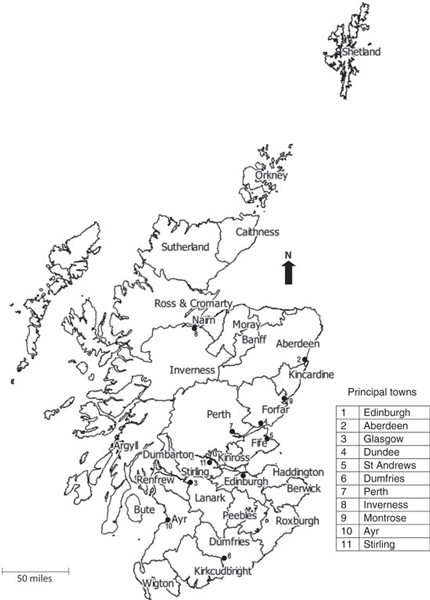
Map of Scotland showing counties and principal towns
Source: This work is based on data provided through EDINA UKBORDERS with the support of the ESRC and JISC, based on boundary mapping created by Great Britain Historical GIS Project, copyright University of Portsmouth.
Julian Goodare
Witch-hunting was on the mind of Christopher Lowther, an English visitor to Scotland, in November 1629. The third of Scotland’s five great witchcraft panics, that of 1628–1631, was in full spate. As Lowther stood on Salisbury Crags near Edinburgh, he took in a splendid view of the city and its surroundings, as he recorded in his journal: ‘The hemisphere’s circumference from Edinburgh is mountains, as is Westmoreland from about Lowther, but something plainer, and their mountains not so high. In view from Edinburgh 4 miles southwards is Keeth, a borough where all the witches are burned.’1
‘Keeth […] where all the witches are burned’ was in fact Dalkeith. Although no full study has been made of the panic of 1628–1631 as it took place there, its outline can readily be reconstructed with the aid of the online Survey of Scottish Witchcraft. This shows that in the presbytery of Dalkeith, a group of sixteen parishes to the south and east of Edinburgh, there were fourteen cases of witchcraft in 1628 and nineteen in 1629. This compares with a total of nine cases for all years before 1628. Lowther’s remark is relevant to several points that I will return to shortly, including panics, execution methods, and the role of towns in witch-hunting. Later in this introduction I will also say more about the Witchcraft Survey.
I
This book’s title phrase ‘Witches and Witch-Hunters’ is a starting point in indicating its contents. Witches and witch-hunters are inseparable. Witches would not have existed in early modern Scotland if people had not hated and feared them; witches were generally labelled by others rather than self-identified. Yet witch-hunters were unusual people. Most people in early modern Scotland, most of the time, lived with those neighbours whom they thought to be witches without displaying a desire to prosecute them. Only occasionally were there outbursts of panic.
The panic in Dalkeith featured some notable local witch-hunters. They included two local lairds, Mr Patrick Hamilton of Little Preston and Robert Cass of Fordell. They were involved as commissioners of justiciary in thirty-one cases altogether; in sixteen of these they acted together, while Hamilton handled eight further cases, and Cass seven, without the other. Cass was also requested to help arrest a suspect. All this activity occurred between 1628 and 1630. Usually there were between four and eight commissioners appointed to hold a trial, and in the Witchcraft Survey one can see teams forming and combinations changing.
Men like Hamilton and Cass were not only important in their localities, but were also able to connect these localities to central government – a necessary requirement, since Scottish witch-hunting was supervised centrally. Commissions of justiciary, which enabled lairds like Hamilton and Cass to act as judges and to convene a court to try a witchcraft suspect, were granted by the privy council. With Dalkeith so close to Edinburgh, both Hamilton and Cass had good central connections. Cass was an advocate (a lawyer representing clients in the court of session, the central civil court), while Hamilton was the brother of the earl of Haddington, a leading government minister.2 A systematic study of Scottish witch-hunters remains to be carried out, but several chapters of this book take the subject further.
The phrase ‘Scottish witch-hunters’ often brings King James VI to mind – the intellectual king who participated in the North Berwick witchcraft panic of 1590–1591 and in the subsequent panic of 1597, and whose book, Daemonologie, was published in 1597.3 There is some discussion of James in this book, but there are also reasons for looking more broadly at the question of ‘witch-hunters’.
One reason for looking beyond James comes in Michael Wasser’s chapter on the panic of 1568–1569.4 The idea that James initiated Scottish witch-hunting is surely mistaken. The Scottish Reformation occurred officially in 1560, the witchcraft act was passed in 1563, and the new church and secular authorities knew that witchcraft was one of the offences that they should punish. Yet, witchcraft prosecution was a complex business involving the co-operation of several different authorities. As Wasser shows, the Scottish authorities had not yet worked out how to carry out large-scale witch-hunting successfully.
During the North Berwick panic, James busily interrogated Agnes Sampson and stoked his suspicions of the earl of Bothwell. However, other witch-hunters had their own agendas. One such witch-hunter was William Douglas, ninth earl of Angus, whose predecessor as earl, his cousin Archibald Douglas, had died suddenly in 1588. Victoria Carr’s chapter meticulously follows the clues that enable her to reconstruct how the ninth earl’s suspicions fell on Jean Lyon, the eighth earl’s widow.5 We also learn that the ninth earl had a personal grudge against Lyon – which probably tells us, not that he pursued a witchcraft case against her cynically, but that he found it plausible that someone as bad as her could be a witch. I am not going to give away the plot here, but the drama of the earl and countess of Angus was surely, for a time, as intense as the drama of the king and the earl of Bothwell.
The panics of the 1590s are also relevant to another witch-hunter, discussed in Liv Helene Willumsen’s chapter.6 This was John Cunningham, the seafaring son of a Fife laird, who grew up in the 1590s during a period of intense witch-hunting in Fife. Cunningham’s career took him to Denmark, to Greenland, and finally to a job as governor of Finnmark in northern Norway. There, beyond the Arctic Circle, he used some of the ideas that he had learned in Scotland to launch his own witch-hunt, distinctively different from what happened in the rest of Norway.
Much Scottish witch-hunting occurred in bursts of panic. Paula Hughes’s chapter is the first published study of the panic of 1649–1650, one of the five biggest national panics.7 Until recently it has been a little-known episode, with the other four big panics – those of 1590–1591, 1597, 1628–1631 and 1661–1662 – having received recent scholarly attention.8 Hughes’s study, like Wasser’s, shows how administratively complicated it was to prosecute large numbers of witches. The revolutionary regime of the late 1640s, despite its many other commitments including warfare with England, made godliness and discipline high priorities, to deadly effect.
Hughes mentions a number of local commissioners, but does not single out any particular ‘witch-hunter’ or ‘witch-hunters’. This may be because she surveys the panic from the top down, and the most single-mindedly zealous witch-hunters were more likely to be found at a local level. Even the notorious Matthew Hopkins in England was essentially a local figure; national politicians had so many other calls on their attention that they could rarely be seen to pursue witches single-mindedly. I have outlined a definition of ‘witch-hunters’ in this sense as ‘men who did not merely carry out their duty in trials, but who went out of their way to orchestrate and promote them’.9 Using the example of the English magistrate Robert Hunt, Jonathan Barry has recently pointed out that apparent local ‘witch-hunters’ might in fact be zealous prosecutors of crime in general, rather than singling out witches for special attention.10 Further study of this is required. Hughes’s chapter reminds us that witchcraft panics could occur in unusual political conditions, and future studies of local panics and local witch-hunters should pay close attention to the local political context.
Panics involved prosecutions of multiple witches, with one prosecution leading on to another in a chain reaction. The smallest example of a chain reaction is the linked prosecution of two witches. This is relevant to the decline of the Scottish witch-hunt because part of the story is the decline of panics. The last of the really big panics was from 1661 to 1662; after that there were several smaller panics. One of these, in the west of Scotland from 1699 to 1700, resulted in a spate of acquittals and has been argued to be the last of its kind.11 Which may be so – but Alexandra Hill’s chapter shows that the period from 1701 to 1727 (when the last execution occurred) contained numerous instances of linked, chain-reaction prosecutions.12
II
Early modern Scotland was largely a peasant society, as Christina Larner, the influential pioneer of Scottish witchcraft studies, recognised.13 Yet she also drew attention to its status as a ‘middle-range’ society, neither fully primitive nor fully technological, and thus distinctively different from the tribal societies studied by anthropologists who had carried out some of the most influential witchcraft studies of the time when she was working. A ‘middle-range’ society required towns as well as peasants, but Larner regarded towns as unimportant for witch-hunting.14 Could there be more to be said about towns?
Robin Briggs, who has written influentially about peasants in a European context, has also dismissed the idea of urban witch-hunting:
For reasons which remain obscure, the urban milieu does not seem to have generated many witchcraft cases in most parts of Europe. The obvious exceptions are the pandemics which afflicted some German towns and the more routine persecution found in parts of the southern Netherlands, the latter an exceptionally urbanized region suffering from severe economic dislocation. It may be that elsewhere even these relatively small urban populations were just sufficiently mobile and anonymous to discourage the long build-up of hostility characteristic of witchcraft accusations in tight-knit rural societies.15
Briggs’s ‘long build-up of hostility’ is a familiar and indeed essential idea in witchcraft studies. I will come back to this, but I first want to use Briggs’s remarks about the ‘urban milieu’ to introduce Alistair Henderson’s chapter on that subject.16 Henderson employs a statistical analysis of the data in the Witchcraft Survey to reconstruct the varying intensity of witchcraft prosecution in Scottish towns of different sizes. The results show a fascinating and complex pattern, but one simple point can be made: Scottish towns were certainly not immune from witch-hunting, and small towns even seem to have hunted witches with particular intensity. Which is what Christopher Lowther seems to have been told when he looked out from Salisbury Crags. Witch-hunting was associated with small towns like Dalkeith, not large towns like Edinburgh.
The ‘long build-up of hostility’ is well exemplified by Lauren Martin’s chapter reconstructing the career of one witch, Isobel Young, in detail.17 Young’s trial for witchcraft took place in 1629, but Martin traces the development of her reputation back to the late sixteenth century, with a series of quarrels connected with landholding and money-lending, and reports of unauthorised ritual healing. Young had a long-running dispute with a neighbouring family, and quarrels with her own husband led him to testify against her at her trial.
On the other hand, Anna Cordey’s chapter on the presbytery of Dalkeith shows that the ‘long build-up of hostility’ was not the only pattern.18 She looks at two panics in the area, those of 1649–1650 and 1661–1662, and asks how many of the witches prosecuted in the area actually had reputations in their communities. Proving a negative is always difficult, but she finds strong indications that many witches were not identified as such in their communities before their arrest. She also contributes to the discussion of ‘witch-hunters’ by showing that William Scott, bailie of Dalkeith, seems to have gone out of his way to frame Janet Cock in 1661. The Witchcraft Survey shows that Scott took various roles in twelve witchcraft cases.
These chapters draw on a wide range of documents, such as property records and minutes of kirk sessions and presbyteries. This gives us a more holistic view of Scottish witch-hunting than we would have had by relying wholly on trial documents, as some Continental studies do. Trial records, the usual sources for witch-hunting, are indispensable – but, as Cordey and Martin both point out, they can be coloured by hindsight. The ‘long build-up of hostility’ was recorded after the event. In Martin’s and Cordey’s chapters, we can see some future witches in action before they become witches. Martin shows that Isobel Young was alleged in 1619 to have a Devil’s mark; this was not pursued at the time, but it came up again at her trial in 1629. This testimony from 1619 was given and recorded at the time, giving it a different quality from trial testimonies about events ‘ten years ago’.
This shows that we have much work still to do on the nature of people’s recollections, and we should beware of assuming that recollections were accurate. Cordey’s concept of ‘instant reputation’ outlines an important way in which testimony could be unwittingly reshaped to make it appear as if a reputation stretched back a long way. People reinterpreted earlier events to make it look as if there had been a ‘long build-up of hostility’ – but perhaps, at the time, nobody thought that the events had anything to do with witchcraft.
Another chapter using unusual sources is Laura Paterson’s chapter on the process of execution.19 Information about this is often found in burgh accounts, since both rural and urban witches were often executed in towns, and it was towns that bore the cost of the arrangements. When Christopher Lowther mentioned witches being ‘burned’, he may have been struck by Scotland’s difference from England, where witches were hanged like ordinary felons. Burning, as Paterson shows, had dramatic significance as a public spectacle. Condemned witches were usually strangled before the pyre was lit, but burning was still a particularly degrading way to die.
III
Recent research has begun to show that early modern Scotland was a stranger and more uncanny place than once thought. Some chapters of this book pursue themes related to popular belief and practice in the areas of visionary experience, magical healing and flying. Such phenomena were once the province of ‘folklore’, but historians have recently begun to investigate them as aspects of lived experience. Nobody is suggesting that early modern witches really flew through the air, or really visited the fairies; but we are beginning to take seriously the reports in which they said that they had done these things. Some strange confessions followed a demonological formula and can be assumed or suspected to have been shaped by leading questions, but close examination of confessions and other evidence has shown that there is also a layer of genuine folk belief and practice to be investigated.
It may seem unlikely that the modern experience of abduction by aliens could have anything to do with early modern witchcraft. However, the two are in fact linked by the condition of sleep paralysis, as argued in the chapter by Margaret Dudley and myself.20 Diagnosing medical conditions at a distance of centuries is usually difficult, but here the evidence seems clear enough. Dudley and I build on a brilliant pioneering study by Owen Davies, who argued that sleep paralysis lay behind many reports by witches’ victims complaining that the witch had assaulted them in their bed.21 However, we go beyond Davies in showing that sleep paralysis can also be used to explain some reports by witches themselves – confessions in which they were led to interpret an episode of sleep paralysis as a visitation by the Devil. This is literally nightmarish territory.
One of the most famous of all Scottish witches has always been Isobel Gowdie from Auldearn in 1662. Emma Wilby, who recently published a remarkable book analysing Gowdie’s extraordinary confessions in detail, here draws on anthropological studies of tribal societies to elucidate one of the strangest aspects of the confessions: dark shamanism.22 Shamanism has provided a useful, if sometimes controversial, set of concepts for scholars to analyse visionary magical practices. European visionaries did not engage in the public ritual performances of the tribal shaman in Siberia or elsewhere, so European ‘shamanism’ lacked some important attributes; nevertheless, visionaries like Gowdie did experience flight, trances and visits to spirits in other worlds. They also used these experiences in some similar ways to tribal shamans, bringing information from their spirit contacts to aid them in magical healing and divination. Even conventional shamanism of this kind was remarkable enough, but ‘dark shamanism’ takes us into a world of predatory flights and almost random destruction. The dark shaman, Wilby argues, was nevertheless not simply a killer, but a messenger of fate.
The recent discovery of a shamanistic cult in Scotland, the ‘seely wights’, provides some kind of context for Gowdie’s strange and gloomy world-view. Seely wights (the phrase roughly meant ‘magical beings’) were nature spirits similar to fairies, and human members of the cult flew out in trances to meet them.23 Fairies were the most important nature spirits in early modern Scotland, but there was a wider world of ‘spirits’ that is only now being opened up.24 Isobel Gowdie may or may not have been part of a ‘cult’, but her visionary activities were some of the most remarkable on record.
The broader topic of popular belief in witches’ flight is the subject of my own chapter.25 By arguing that witches were usually assumed to be able to fly, this underlines how remarkable witchcraft was. The chapter draws some of its concepts from neuroscience journals like Cognitive Neuropsychiatry and Cortex, where topics like ‘out-of-body experiences’ and ‘hallucinations’ are studied scientifically. Neuroscience is very different, incidentally, from psychoanalysis, the discipline that has more often been used by witchcraft historians who have drawn on ‘psychology’.26 Ultimately, though, my chapter argues for a cultural interpretation of witches’ flight, as a set of motifs that could be deployed to make sense of witchcraft and to tell stories about it.
IV
Most of the chapters of this book make use of the online Witchcraft Survey, a database of Scottish witchcraft cases.27 It may help to say a few words here about the Survey, its varied sources, and the varied uses to which it can be put. It can be used to trace statistical patterns and trends, or to identify individual cases with particular characteristics. This introduction, for instance, began with an outline of the panic of 1628–1629 in the presbytery of Dalkeith. The information in this outline was gathered by using the online user interface via the ‘Search the database/Search for accused witches by name, place’ options. Entering ‘Dalkeith’ in the ‘Place of residence’ query box, selecting ‘Presbytery’, and entering a pair of dates in the ‘Case dates between’ boxes, brings up a list of names of witches which can be counted or examined individually. The user interface allows straightforward searches of this kind to be undertaken online. Users wanting to approach the data in more sophisticated or unusual ways can also download the entire data set – the information that lies behind the website’s user interface. They can then run their own queries on it using Microsoft Access.
Any discussion of the Witchcraft Survey is indebted to the detailed analysis of it published by its two full-time researchers, Lauren Martin and Joyce Miller.28 This analysis provides answers to a number of important queries, with detailed information about the chronology of Scottish witch-hunting and the social profiles of accused witches. My purpose here is simpler: to comment on the ways in which the Survey can best be used, using some of the chapters of the present book to illustrate its strengths and weaknesses. Some of the weaknesses derive from the limitations of the sources, a few from limitations of its own design; avoiding these limitations will enable other users to get the most out of this resource.
There are three levels in the database: the ‘person’, the ‘case’ and the ‘trial’. In the online user interface, these are displayed with three different colours. Usually there is one ‘case’ for each ‘person’, but a few people were investigated more than once. And not everybody had a ‘trial’, or was known with certainty to have a ‘trial’. The most typical ‘case’ was based on a commission of justiciary – a document ordering a trial to be held. The Survey provides 3,212 names of people accused of witchcraft (a few of whom had more than one ‘case’), and has a further 625 records for unnamed people or groups of unnamed people, making a total of 3,837 cases (including some groups of unknown size). For statistical purposes, we counted all the groups as groups of 3 although many groups were probably larger.29 The Survey gathered detailed information on each case, with 634 data fields that could be filled. Even this number does not guarantee comprehensiveness; we neglected to include a field (or group of fields) for ‘flight’, an omission perhaps atoned for in my chapter below on that subject. My chapter does in fact indicate some fields from which relevant information can be drawn in the Survey.
One good thing about the sources for Scottish witchcraft is that they provide wide coverage, at least after 1608. The earlier coverage is less consistent, since it is only after that date that a central register of commissions survives.30 But once we have that register, we can gather the names of most accused witches. This contrasts with England, where most assize court records have disappeared, and where some of the most detailed sources are pamphlets that are more or less literary or even fictionalised.31 Studies of English witch-hunting have very few statistics with which to work. In Scotland, we can produce graphs and charts, and carry out studies of incidence and distribution, like those by Hughes, Cordey and Henderson below. Another good thing is that some very detailed material survives. We have depth as well as breadth, and can reconstruct quite a few cases – like those of Isobel Young or Isobel Gowdie – in detail.
However, most cases survive only in outline, with record survival being not only patchy but also skewed towards certain types of case – particularly those witches who, like Young, were tried in the central justiciary court. The records of the justiciary court survive better than those of evanescent local courts, but cases sent to that court may not have been typical of the others. Because the detailed cases are only a minority, one question must always be kept in mind: Is this case typical? One of the best-known Scottish witches is Alison Balfour from Orkney in 1594. She not only suffered severe physical tortures, but her husband, son and seven-year-old daughter were tortured in front of her until she confessed.32 There is quite a lot about Balfour on the internet, often seeming to assume that this was typical. In fact, as far as we know, it was unique.
Loss of most local trial records means that, for nine-tenths of our witchcraft cases, we have no direct record of whether the person was executed or not. We suspect they were in most cases, for various reasons. One reason is that it is fairly common to come across remarks like Christopher Lowther’s mention of ‘Keeth, a borough where all the witches are burned’. The Witchcraft Survey has only partial information on the fate of Dalkeith’s thirty-three witchcraft suspects from 1628 and 1629. For only eleven of them do we have any trial records, and for only two, Janet Bishop and Margaret Cuthbertson, do we have sentences (although these were both sentences of death by burning). Lowther’s remark indicates that many of the others were also burned.
Shortage of information about executions means that scholars studying statistical patterns of Scottish witch-hunting usually study ‘cases’ of witchcraft – people who were formally accused, whether or not we know what their fate was. There are three main categories of ‘cases’ of witchcraft with unknown outcomes. First, there are those for whom we have pre-trial documents showing them to have been formally investigated for witchcraft. Second, there are those for whom we know that a commission of justiciary – an order empowering commissioners to hold a trial – was issued. For these two categories we may not have any actual trial records. Third, there are those who are named as accomplices in another witch’s trial record. We know that many such people were subsequently investigated and tried, so we take this formal accusation as a significant first step towards such action. Looking beyond those who were executed can be an advantage, as Michael Wasser’s chapter shows. We may call these people ‘witches’ as a kind of shorthand, but if we do, we must bear in mind that it is shorthand for ‘someone who was formally accused of witchcraft’ rather than ‘someone who was executed for witchcraft’.
We also excluded people who were accused of other magical practices that were not called ‘witchcraft’ or anything like it. The church courts often prosecuted ‘charmers’ (magical practitioners) for ‘superstitious’ practices, usually making them do penance. This was hardly ever considered to be ‘witchcraft’ unless there was a suggestion of harm done or open demonic involvement. We also excluded people who merely had a popular reputation for witchcraft. In one of my early publications I mentioned as a witch Major Thomas Weir, executed in 1670 mainly for incest.33 He was said to have a magic staff, various strange occurrences were described around him, and his sister Jean Weir was formally charged with witchcraft. But my colleagues in the Witchcraft Survey persuaded me to omit Thomas on the grounds that he was never officially charged with witchcraft. He had a popular reputation, but if we included everyone with a reputation, then what about the reformer John Knox? – his Catholic critics sometimes accused him of necromancy.34 Better to stick to official accusations.
Gaps in the evidence can be interpreted in different ways. Wolfgang Behringer, quoting Larner’s remark that there was ‘no witch-hunting’ in the Highlands, ‘or none that reached the records’, interprets it thus: ‘In other words: nobody knows what happened up there.’35 Behringer seems to be willing to allow his readers to gain the impression that there may have been extensive witch-hunting in the Highlands, perhaps even more extensive for having been unregulated by the authorities. Recent studies of the Highlands have not taken this view, however, and have regarded witch-hunting there as having indeed been small scale.36
The Witchcraft Survey was fortunate to be able to draw on the researches of previous projects, notably the 1977 Source-Book of Scottish Witchcraft that resulted from a project directed by Christina Larner.37 The Survey used the Source-Book as a source for about 263 cases taken from out-of-the-way printed sources. Its ‘Case details’ for these cases typically include the phrase: ‘The project did not check Larner’s reference to this printed secondary source as part of the research.’ This is hoped to be rectified in a future update to the Survey (it is not being updated regularly at the moment, but I am gathering material and hope in due course to obtain funds for an update). In the meantime, scholars wanting to go from the Survey to the primary sources for these cases have to go via the Source-Book. Here it might be added that most of these cases were derived by the Source-Book from printed sources previously identified by G. F. Black or John Gilmore.38 Black and Gilmore hardly looked at any manuscripts, but they gathered many references to witches from out-of-the-way printed works – editions of primary sources, or local histories quoting extensively from primary sources. Their works are still worth consulting, with Black in particular having a convenient chronological arrangement and a paragraph or two of text summarising each case. His Calendar allows an introductory flavour to be gained of significant cases at any given date.
However, Black and Gilmore did not always use the same standards as the Witchcraft Survey. As a result, several cases have crept into the Survey that ought not to be there because they are not, by the Survey’s standards, cases of ‘witchcraft’. This is particularly so for the last few decades of Scottish witch-hunting, the period studied below by Alexandra Hill. The central register of commissions was discontinued when the privy council was abolished in 1708. References to later cases, though plentiful, are scattered through sources of varying nature, which provide no single guiding standard for what constitutes a case of ‘witchcraft’.
Hill has thus scrutinised and sifted the original sources more carefully than previous scholars. The need for this can be illustrated from a related pair of cases (originally identified by Gilmore) – cases that Hill wisely omits. In the parish of Minnigaff in 1702, Janet McGuffock, the young Lady Tonderghie, and her Irish servant Molly Redmond, were accused by the kirk session of ‘that piece of devilrie commonly called turning the riddle’ – a familiar divinatory ritual in which a sieve (riddle) was balanced and made to turn, and the turning was interpreted as answers to questions. Redmond was banished while McGuffock was made to subscribe a declaration, read out in church, ‘abhorring and renouncing all spelles and charmes usual to wizards’.39 Despite the use of the words ‘devilrie’ and ‘wizards’, neither McGuffock nor Redmond seem to have been suspected of actual witchcraft. The pair were punished simply as magical practitioners – quite mildly in the case of McGuffock, a member of the propertied elite.
As well as these avoidable shortcomings, the Witchcraft Survey also has unavoidable limitations which must be understood if it is to be used to best effect. It can easily generate misleading statistics for those unfamiliar with the source material on which it is based. For instance, a simple search for all cases mentioning any aspect of ‘Demonic pact’ retrieves 355 cases.40 Recalling the overall total of 3,837 cases, can we conclude from a quick calculation that only 9 per cent of Scottish witches made a demonic pact? Such a conclusion would be highly unwise, since for most of the remaining 91 per cent the documentation is insufficient for us to be able to tell, one way or the other. The role of the Devil in Scottish witch-hunting has generated some interest, so this is an important question.41 However, the question should be pursued primarily through qualitative study of the more detailed cases, rather than through statistics.
Another example of dodgy statistics concerns marital status. Here one can generate the precise-seeming statistic that 77 per cent of female witches (499 out of 650 with known marital status) were married, with the remainder being either single (1.5 per cent) or widowed (21.5 per cent). Yet, the total of individual female witches is 2,702, meaning that the marital status of 2,052 is ‘Not known’. Were the 650 women with known status typical of the total of 2,702? Almost certainly not. Marital status was not recorded systematically, but mentioned only when it seemed relevant to the narrative of the witch’s activities. There were various reasons to mention a living husband in the records: he had an interest in his wife’s case and might intervene actively in it (as with Isobel Young), or he might simply be mentioned as having been present (or absent) when witchcraft-related activities took place. By contrast, there were few reasons to mention the marital status of a woman without a living husband. This can be underlined by glancing at the Survey’s figures for male witches: 78 married, 5 single, 385 ‘Not known’. Not a single man was recorded as being widowed – surely not because there were no widowed men, but because no reason to record such a man’s marital status presented itself.42 The marital status of Scottish witches is an interesting question, but the Survey’s statistics in themselves cannot answer it. Here, as with the demonic pact, what the Survey can do is to guide the user towards the cases with more recorded information, which can then be analysed in their own right and assessed for their typicality.
V
Like all good databases, the Witchcraft Survey aims to stimulate and facilitate further research. The contributors to this book have used it in various ways. For some, like Hughes, Cordey, Henderson and Hill, it has provided a framework for their investigations. For others, like Paterson and myself, it has been a quarry for materials. The way it has been used goes beyond the specific reference notes citing the ‘SSW’, since it has often guided contributors towards sources that they could investigate in their own right. On the other hand, some contributors, like Carr, Willumsen, Martin and Wilby, have found it unnecessary to make much use of the Survey in their concentrated studies of individual episodes. In the future, the most important project that the Survey could facilitate would be a study of witch-hunters using a combination of qualitative and quantitative methods. In the meantime, here are twelve chapters that investigate Scottish witches and witch-hunters through a variety of methods.
Notes
1. [Christopher Lowther,] Our Journall Into Scotland, Anno Domini 1629, 5th of November, From Lowther, ed. W[illiam] D[ouglas] (Edinburgh, 1894), 22. Christopher Lowther (1611–1644) was the second son of Sir John Lowther of Lowther Hall, Westmorland.
2. RMS, viii, 331, 698.
3. See Brian P. Levack, ‘King James VI and witchcraft’, in his Witch-Hunting in Scotland: Law, Politics and Religion (London, 2008), 34–54.
4. Michael Wasser, ‘Scotland’s first witch-hunt: the eastern witch-hunt of 1568–1569’, Chapter 1 in this volume.
5. Victoria Carr, ‘The countess of Angus’s escape from the North Berwick witchhunt’, Chapter 2 in this volume.
6. Liv Helene Willumsen, ‘Exporting the Devil across the North Sea: John Cunningham and the Finnmark witch-hunt’, Chapter 3 in this volume.
7. Paula Hughes, ‘Witch-hunting in Scotland, 1649–1650’, Chapter 5 in this volume.
8. For studies of the other major panics, see in particular: Normand and Roberts (eds.), Witchcraft; Jenny Wormald, ‘The witches, the Devil and the king’, in Terry Brotherstone and David Ditchburn (eds.), Freedom and Authority: Scotland, c.1050–c.1650 (East Linton, 2000), 165–80; Julian Goodare, ‘The Scottish witchcraft panic of 1597’, in Julian Goodare (ed.), The Scottish Witch-Hunt in Context (Manchester, 2002), 51–72; Julian Goodare, ‘The Aberdeenshire witchcraft panic of 1597’, Northern Scotland, 21 (2001), 1–21; Elizabeth Robertson, ‘Panic and Persecution: Witch-Hunting in East Lothian, 1628–1631’ (University of Edinburgh MSc by Research thesis, 2009); Brian P. Levack, ‘The great Scottish witch-hunt of 1661–2’, in his Witch-Hunting in Scotland, 81–97.
9. Julian Goodare, ‘Men and the witch-hunt in Scotland’, in Alison Rowlands (ed.), Witchcraft and Masculinities in Early Modern Europe (Basingstoke, 2009), 148–70, at p. 152. A thought-provoking study of such men is Louise Yeoman, ‘Hunting the rich witch in Scotland: high-status witchcraft suspects and their persecutors, 1590–1650’, in Goodare (ed.), The Scottish Witch-Hunt in Context, 106–21.
10. Jonathan Barry, Witchcraft and Demonology in South-West England, 1640–1789 (Basingstoke, 2011), 26–51.
11. Michael Wasser, ‘The western witch-hunt of 1697–1700: the last major witchhunt in Scotland’, in Goodare (ed.), The Scottish Witch-Hunt in Context, 146–65.
12. Alexandra Hill, ‘Decline and survival in Scottish witch-hunting, 1701–1727’, Chapter 12 in this volume.
13. Her Gifford lectures of 1982 were originally published as Christina Larner, The Thinking Peasant: Popular and Educated Belief in Pre-Industrial Culture (Glasgow, 1982). For a revised edition, see Christina Larner, Witchcraft and Religion: The Politics of Popular Belief (Oxford, 1984), 95–165.
14. Larner, Witchcraft and Religion, 159; Christina Larner, Enemies of God: The Witch-Hunt in Scotland (London, 1981), 47–8.
15. Robin Briggs, Witches and Neighbours: The Social and Cultural Context of European Witchcraft (2nd edn., Oxford, 2002), 265.
16. Alistair Henderson, ‘The urban geography of witch-hunting in Scotland’, Chapter 10 in this volume.
17. Lauren Martin, ‘The witch, the household and the community: Isobel Young in East Barns, 1580–1629’, Chapter 4 in this volume.
18. Anna Cordey, ‘Reputation and witch-hunting in seventeenth-century Dalkeith’, Chapter 6 in this volume.
19. Laura Paterson, ‘Executing Scottish witches’, Chapter 11 in this volume.
20. Margaret Dudley and Julian Goodare, ‘Outside in or inside out: sleep paralysis and Scottish witchcraft’, Chapter 7 in this volume.
21. Owen Davies, ‘The nightmare experience, sleep paralysis, and witchcraft accusations’, Folklore, 114 (2003), 181–203.
22. Emma Wilby, ‘ “We mey shoot them dead at our pleasur”: Isobel Gowdie, elf arrows and dark shamanism’, Chapter 8 in this volume. For the book, see Emma Wilby, The Visions of Isobel Gowdie: Magic, Witchcraft and Dark Shamanism in Seventeenth-Century Scotland (Brighton, 2010).
23. Julian Goodare, ‘The cult of the seely wights in Scotland’, Folklore, 123 (2012), 198–219. This paper also reviews the debate on shamanism in more detail than can be undertaken here.
24. Julian Goodare, ‘Boundaries of the fairy realm in Scotland’, in Karin E. Olsen and Jan R. Veenstra (eds.), Airy Nothings: Imagining the Otherworld of Faerie from the Middle Ages to the Age of Reason (Leiden, 2013, forthcoming), 147–78.
25. Julian Goodare, ‘Flying witches in Scotland’, Chapter 9 in this volume.
26. A much-cited example is Lyndal Roper, Oedipus and the Devil: Witchcraft, Sexuality and Religion in Early Modern Europe (London, 1994). See also Katharine Hodgkin, ‘Gender, mind and body: feminism and psychoanalysis’, in Jonathan Barry and Owen Davies (eds.), Palgrave Advances in Witchcraft Historiography (Basingstoke, 2007), 182–202.
27. Julian Goodare, Lauren Martin, Joyce Miller and Louise Yeoman, ‘The Survey of Scottish Witchcraft, 1563–1736’ (www.shc.ed.ac.uk/Research/witches/, archived January 2003, updated November 2003).
28. Lauren Martin and Joyce Miller, ‘Some findings from the Survey of Scottish Witchcraft’, in Julian Goodare, Lauren Martin and Joyce Miller (eds.), Witchcraft and Belief in Early Modern Scotland (Basingstoke, 2008), 51–70.
29. See Hughes, ‘Witch-hunting in Scotland, 1649–1650’, for more on the issue of counting witches in groups.
30. For the interpretation of earlier sources, see Julian Goodare, ‘The framework for Scottish witch-hunting in the 1590s’, SHR, 81 (2002), 240–50.
31. James Sharpe, Instruments of Darkness: Witchcraft in England, 1550–1750 (London, 1996), 105–8. For a study of pamphlets, see Marion Gibson, Reading Witchcraft: Stories of Early English Witches (London, 1999).
32. Peter D. Anderson, Black Patie: The Life and Times of Patrick Stewart, Earl of Orkney, Lord of Shetland (Edinburgh, 1992), 49–52, 156–7.
33. Julian Goodare, ‘Women and the witch-hunt in Scotland’, Social History, 23 (1998), 288–308, at p. 305.
34. Julian Goodare, ‘John Knox on demonology and witchcraft’, Archiv für Reformationsgeschichte, 96 (2005), 221–45, at pp. 235–7.
35. Wolfgang Behringer, Witches and Witch-Hunts: A Global History (Cambridge, 2004), 124, quoting Larner, Enemies of God, 80.
36. Lizanne Henderson, ‘Witch hunting and witch belief in the Gàidhealtachd’, in Goodare, Martin and Miller (eds.), Witchcraft and Belief, 95–118; Ronald Hutton, ‘Witch-hunting in Celtic societies’, Past and Present, 212 (August 2011), 43–71.
37. Christina Larner, Christopher H. Lee and Hugh V. McLachlan, A Source-Book of Scottish Witchcraft (Glasgow, 1977). For the strengths and weaknesses of this work today, see my review of it when it was reprinted in 2005: SHR, 86 (2007), 338–40.
38. G. F. Black, A Calendar of Cases of Witchcraft in Scotland, 1510–1727 (New York, 1938); John Gilmore, ‘Witchcraft and the Church in Scotland subsequent to the Reformation’ (University of Glasgow PhD thesis, 1948).
39. P. H. McKerlie, History of the Lands and their Owners in Galloway, 5 vols. (Edinburgh, 1870–1879), i, 487–8.
40. A slightly different search, for cases mentioning ‘Non-natural beings’, reveals 392 mentions of such beings by 226 different people: Joyce Miller, ‘Men in black: appearances of the Devil in early modern Scottish witchcraft discourse’, in Goodare, Martin and Miller (eds.), Witchcraft and Belief, 144–65, at p. 160.
41. Stuart Macdonald, ‘In search of the Devil in Fife witchcraft cases, 1560–1705’, and Lauren Martin, ‘The Devil and the domestic: witchcraft, quarrels and women’s work in Scotland’, both in Goodare (ed.), The Scottish Witch-Hunt in Context, 33–50, 73–89.
42. Cf. Martin and Miller, ‘Some findings’, 60–1; Goodare, ‘Women and the witch-hunt’, 290. These figures do not add up to the headline figure of 3,837 because the latter incorporates groups of which the gender breakdown is unknown.