
5
Nostra Culpa: The Senate Apologizes for Failing to Pass Antilynching Legislation and Misses the Point
On June 13, 2005, by a voice vote the Senate passed a resolution apologizing “to the victims of lynching for the failure of the Senate to enact anti-lynching legislation.”1 The resolution and apology referred to the long and bleak era from the end of the nineteenth century to the mid-twentieth during which more than four thousand African Americans were lynched and almost no one was punished by local and state authorities. Indeed, and instead, lynchings—defined as the killing of a person or persons (as by hanging) by mob action without legal sanction—were not infrequently a form of public entertainment done in broad daylight with the full knowledge of both local law enforcement and the local press.2
Apologies and regret for the shortcomings and failures of the United States in regard to various aspects of slavery and civil rights are not novel. What made this apology interesting was that the Senate was singling itself out. It was a Senate resolution about the Senate—not a joint or concurrent resolution to be passed by the House or possibly signed by the president. Senator Mary Landrieu of Louisiana, one of the resolution’s principal authors and sponsors, put it this way:
Without question, there have been other grave injustices committed in the noble exercise of establishing this great democracy. Some have already been acknowledged and addressed by this and previous Congresses, and our work continues. However, there may be no other injustice in American history for which the Senate so uniquely bears responsibility. In refusing to take up legislation passed by the House of Representatives on three separate occasions and requested by seven Presidents from William Henry Harrison to Harry Truman, the Senate engaged in a different kind of culpability.3
The speeches that preceded and continued after the voice vote focused on the horrors of lynching and related civil rights matters in US history. Many senators covered this in considerable detail and with apparent emotion and sincerity. All fine and good, except that the resolution was about the Senate’s failure, not the horrors and national shame of lynching. Only a few senators even mentioned the cause—the only cause—of the Senate’s failure, almost in passing, and none bothered to do more than that. The cause was the filibuster. Despite majority support in each case, the antilynching measures were, in the face of filibusters, withdrawn from Senate consideration.
The resolution does not use the word or concept. Instead, as we have seen, the resolution apologizes for the “failure” of the Senate to pass antilynching legislation, also noting that the Senate “failed” to enact such legislation on more than one occasion. Twenty-seven senators (seventeen Democrats and ten Republicans) offered remarks on the resolution covering twenty-five pages or approximately 35,000 words in the Congressional Record. Only six senators (four Democrats and two Republicans) invoked the filibuster as the cause of the failure.4 And the word “filibuster” was used a total of seven times in any form. The senators who filled pages and pages of the Congressional Record with excruciating details of the history of lynching, including the stories and names of individual victims, barely mention the filibuster, cloture, or minority obstruction.
Only Utah Republican Bob Bennett, in the final remarks on the resolution, stated the matter plainly: “I note that it was the filibuster that made it possible for the Senate to be the body that blocked this legislation in the past. I would hope that in the future, we would all realize that the filibuster should be used for more beneficial purposes than that.”5 Bennett was alone in linking the filibuster’s regrettable past to its present and future use, even if the connection he was drawing did not transcend partisanship. This resolution of apology happened to come amid a small crisis over the use of the filibuster by Democrats to block President Bush’s judicial nominations. Although more Democrats than Republicans mentioned the filibuster in their remarks about the apology resolution, there is little doubt that Bennett’s more precise and pointed comment was directed at current events and Democratic obstruction of the nominees.
On the one hand, senators took time for this unprecedented collective recognition of its institutional failures more than seventy years earlier, when it, hardly for the first or the last time, failed to protect the rights of African Americans. Yet on the other, even when this rare moment of bipartisanship prevailed amid the increasingly rancorous and polarized battles between majority and minority in this century, the Senate still missed the point about the filibuster and, therefore, about itself.
I would argue that instead of representing an exception, even if a particularly abject one, to the Senate’s otherwise distinguished history as the world’s greatest deliberative body, the sad history of antilynching legislation is much more the rule. As far as civil rights are concerned, the Senate had much more to apologize for than this one issue. Moreover, the real “failure” of the Senate lies much less in this particular case from the early twentieth century than in that institution’s ongoing failure to realize and correct the dysfunction and injustice of its rules of procedure and debate that empower and encourage what we commonly think of as filibusters. The minority obstruction and vetoes those rules sanction created the “sixty-vote” or “supermajority Senate,” that is, a Senate characterized by the need to attain a supermajority of sixty votes to get almost anything done.
This chapter provides a history of the rise and dysfunction of the sixty-vote Senate, making a normative argument about its purpose, value, and even constitutionality. Unlike most work on the Senate’s peculiar procedures, the central objective of the chapter is not so much to describe supermajority processes and their effects as to evaluate them. Supermajority cloture, created as a way to limit filibusters and obstruction, instead and ironically became the principal cause of the Senate’s political dysfunction, as exemplified by the apology. For several decades this dysfunction was closely tied to efforts to defend and maintain white supremacy. More recently, the damage to accountable and effective government has been more general, especially in an era of strong partisan polarization. Overall, supermajority cloture, aided and abetted by the mythology of minority rights and the continuing body doctrine derived from equal representation and staggered terms, distorted the Senate’s constitutional purpose and place in the system of separation of powers and checks and balances. This chapter documents how that came to be, and argues that supermajority cloture is very hard to justify in theory and practice. The filibuster fails on pragmatic grounds alone. Instead of being a central element in what makes the Senate allegedly the “world’s greatest deliberative body,” the filibuster is counterproductive and undermines deliberation. Moreover, the supermajority Senate does not square with the republican theory of government in the Constitution. This version of the Senate is not based in the Constitution but rather violates the founding architecture of institutional power.
Rules of Procedure, Extended Debate, Filibusters, and Cloture
How did the Senate get to this point? How did a rule of the Senate that was created as a procedure—and one that would most likely be used quite rarely—to limit filibusters become not only the primary mechanism to support and facilitate filibusters and obstruction but also the de facto supermajority decision rule for most important Senate votes? How was it that political scientists and journalists come to refer to this body as the sixty-vote Senate or supermajority Senate?
Let’s start with the fundamentals. Every decision-making body sooner or later develops and codifies rules for how to proceed. Such rules of procedure, or rules of order, structure how that body considers and decides on its business. Many Americans are familiar with the title if not the details of Robert’s Rules of Order, first published in 1876.6 Drawing on British parliamentary procedures, Henry Martin Robert created a manual of procedures that could be used by nearly any organization that makes decisions. Despite the variations from student and city councils to state legislatures, Congress, the British House of Commons, and the UN General Assembly, these rules of procedure cover the same necessities and often in much the same way.
One necessity is the structure of what we can loosely call “debate.” Who can speak, when, for how long, and what motions are allowable? In particular, how is consideration or debate brought to a close to make a final decision on the bill or motion? Legislative bodies and other decision-making organizations typically have one or more ways, governed directly or indirectly by majority rule, of ending consideration of the matter on the floor or bringing it to a vote.
Most of us, whether we have participated on student councils, school boards, or in local government, are aware that among such procedures are motions to postpone or table, which remove the matter at hand from further consideration at least temporarily. A less familiar one is referred to as the “previous question,” a nondebatable motion leading directly to a vote on whether the main question should now be put to a vote. If decided in the affirmative, debate is immediately closed and the vote is taken on the main question. If the previous question motion is defeated, then consideration of the main motion continues. Indeed, the first rules written and agreed to by the Senate in April 1789 stipulated that “when a question is before the Senate, no motion shall be received unless for an amendment, for the previous question, or for postponing the main question, or to commit, or to adjourn”—all decided by simple majority votes.7
However, when the Senate revised its rules in 1806, it dropped the previous question. Scholars agree that the Senate felt such a provision was unnecessary in light of the small size of the body and its ability to hear from any or all senators on any issue, and the Senate retained other ways to end debate, including the motions to postpone or adjourn.8 From 1806 until 1917, for 110 years, the Senate had no other provision to close debate if any senator wished to speak. It also had no general restrictions on how long a senator could speak or on what subject. In fact, prior to 1917, Senate rules allowed essentially unlimited debate. For obvious reasons, senators have preferred and used the phrase “extended debate.” For more than a century, Senate debate was governed by forms of unanimous consent. Debate closed when no one else wanted to hold the floor, when every senator present agreed, in effect, that debate was over.
The ability of a senator to speak was protected by the right of recognition and noninterruption in what is now senate Rule XIX on debate: “When a Senator desires to speak, he shall rise and address the Presiding Officer, and shall not proceed until he is recognized, and the Presiding Officer shall recognize the Senator who shall first address him. No Senator shall interrupt another Senator in debate without his consent, and to obtain such consent he shall first address the Presiding Officer, and no Senator shall speak more than twice upon any one question in debate on the same legislative day without leave of the Senate, which shall be determined without debate.”9 The power to speak is augmented by the fact that the Senate has no general germaneness rule. That is, once recognized, a senator does not have to address the matter under consideration. Speech or amendments not germane to the issue at hand are not subject to a point of order.
These two simple principles embedded in the Senate rules, but backed as well by long tradition, norms, and precedents in the form of rulings by the presiding officer, produced the power of the individual senator to filibuster. Filibuster refers to the use of obstructionist tactics, especially prolonged speechmaking, for the purpose of delaying or preventing legislative action. It is, in the words of the Senate’s own website, an “informal term for any attempt to block or delay Senate action on a bill or other matter by debating it at length, by offering numerous procedural motions, or by any other delaying or obstructive actions.”10
Not every long debate qualifies as a filibuster, but a minority of senators can use various tactics, including holding the floor, with the obvious purpose of stopping a measure, even one with clear majority support, from receiving a final vote. The classic if somewhat mythical filibuster amounted to a physical and psychological contest of wills and endurance as the filibustering minority held the floor for as long as possible, preventing action by a frustrated but determined majority. But filibusters and obstruction were also governed by other factors, including norms that limited its use and a less busy legislative schedule that allowed for greater flexibility in debates. Moreover, filibusters and extended debate were not restricted to the Senate. Both characterized the nineteenth-century House, at times more than they did the Senate. As an early scholar of the filibuster observed, “Tactics patently obstructive, however, were characteristic of the House long before they became common in the Senate.”11 And more recent scholarship confirms this.12 The Senate is remembered for its “golden age” of great debates in the mid-nineteenth century, featuring the likes of Clay, Webster, and Calhoun. But the House also had lengthy and sophisticated debates on the same great national questions. They just weren’t noticed or covered as much as those in the Senate.13
But the Senate and the country changed around 1900, and those changes put some pressure on extended debate. In 1926, as part of a discussion about the regulation of debate in the Senate, Frank W. Mondell, who had been a Republican representative from Wyoming for twenty-six years, offered a nice if somewhat exaggerated summary of the original environment and the changes that made some procedure for closure or cloture (a word derived from a French term) seem logical if not universally desirable:
There was a time when the fact that the Senate had no cloture was of little importance. Originally it had but 26 Members, and there was so little for it to do that time hung heavily on the hands of the Senators and there was no reason for hurrying anything. In those days and for a long time thereafter no one thought of conducting a filibuster or talking a bill to death. As no one thought of doing it, why have a rule to prevent it? But times and conditions and the Senate have changed. August and dignified representatives of sovereign States, chosen by carefully selected legislatures, have made way for Senators the products of primaries and of universal suffrage. The Senate grew to a membership of 96 when all our contiguous continental territory came to Statehood.14
By the time Mondell offered this assessment, the United States had become a predominantly urban nation and the industrial giant of the world with greater involvement in international affairs. A larger and directly elected Senate faced a bigger and more complicated legislative agenda. While the Seventeenth Amendment, which produced direct election of the Senate, did not change everything, it did make senators more accountable to the public and perhaps more predisposed to use all the tools at their disposal to represent their constituents. In addition, the presidency and increasingly the bureaucratic executive branch were, if unevenly, showing their potential under such presidents as Theodore Roosevelt and Woodrow Wilson as the dynamic and activist branch of government.
Most of the same forces affected the House as well, which by the start of the twentieth century had 386 members. As the House grew, it tended to restrict debate and dilatory tactics, even if lengthy debate and obstruction were still possible and practiced. The House’s original rules contained a “previous question” motion, but each member was entitled to speak once after its adoption; that is, debate on the main question did not automatically end.15 In 1841, with a membership of 223 and some filibusters under its belt, the House added a notable restriction on debate to its rules, limiting members to one hour of debate on a particular matter before the House.16 Or, in the words of the current rule, a member “may not occupy more than one hour in debate on a question in the House or in the Committee of the Whole House on the state of the Union except as otherwise provided in this rule.”17 Another rule specified that “remarks in debate shall be confined to the question under debate, avoiding personality.”18 In other words, debate had to be germane, unlike in the Senate. Other details and developments need not detain us, but by the early twentieth century, the House had instituted various rules of procedure that were providing effective majority rule and control by the party with the most seats.19
Meanwhile, the late nineteenth-century Senate was feeling the effects of minority obstruction. Its ability to take effective action was suffering along with its public reputation. This was an era of intense partisanship and sectional tensions, and senators were growing accustomed to the exploitation of the rules in service of the resulting battles between parties and regional interests. Summarizing this era, Franklin Burdette claimed that “the power of the Senate lay not in votes but in sturdy tongues and iron wills. The premium rested not upon ability and statesmanship but upon effrontery and audacity.”20 The Congressional Record is replete with filibustering by individual or small groups of senators. And many among them made no pretense about their means and end: they made clear to their colleagues that they would talk about whatever they wished and that their goal was to kill any given measure or compel a compromise the majority did not want.
Moreover, until the Twentieth Amendment in 1933, Congress met after the elections in November of even-numbered years for a “short” or “lame duck” session that expired on March 4, the date set for the inauguration of new Congresses and presidents. One well-known problem with this arrangement was that the “old” Congress had nearly four months to meet and transact business while the newly elected Congress waited its turn. Particularly in the Senate, the March 4 deadline offered the temptation to obstruct as Congress attempted to finish its business. And so this short session became a particular target for filibusters. In turn, widespread knowledge of and disgust over this tactic was an impetus for what became the Twentieth Amendment, which moved up the meeting date for the incoming Congress to early January. While the Senate occasionally had fine debates about important questions, too often the right to speak and the power to use dilatory motions were in service of less noble purposes. For example, near the end of the lame duck session in 1903, Senator “Pitchfork Ben” Tillman threatened that unless and until a $47,000 claim by South Carolina for expenses from the War of 1812 was included in a supplementary appropriation bill, he would read from a nearby pile of books until Congress was forced to adjourn. He got his way, as did others using such tactics.21 Supporting a Republican short-session filibuster in early 1917 aimed at running out the clock on the Democratic legislative program in general and a Wilson war measure in particular, Ohio senator and future president Warren Harding held the floor for parts of two days, during which he regaled his colleagues with a story about his marital infidelity in Paris (his wife got a Parisian bonnet of her choosing for being such a good sport about his “night off without any inquiries afterwards”).22
Cloture: The Senate Tries to Limit Filibusters
However flip the future president’s comments, his lengthy speech was part of the dramatic end-of-session filibuster that provoked a change in the Senate rules to limit such calculated obstruction. Filibusters and obstruction had been increasing. In the thirty-three years from 1880 to 1913 there had been twenty-one filibusters, significantly under one per year. In the four years from 1913 to early 1917, fifteen filibusters, or nearly four per year, occurred.23 The consequence of such regular and persistent filibusters and obstruction was an early twentieth-century Senate often in disarray and disrepute, even if, depending on the issue, many in the nation supported particular filibusters. It took special circumstances, however, for the Senate, which had operated more or less successfully for more than a century without a procedural motion to end debate, to adopt supermajority cloture in 1917.
As with many important changes in American politics, war was involved. Woodrow Wilson, who had just been reelected president in November 1916 with the self-righteous slogan “He kept us out of the war,” was just a few months later, and with even greater self-righteousness and certitude, leading the country into war, which Congress would declare on April 6, 1917. Meanwhile, Wilson was pushing a bill through Congress to arm merchant ships against attacks by German submarines (the German resumption of unrestricted submarine warfare at the end of January had been an important factor pushing Wilson to support a declaration of war). The bill sailed through the House on a vote of 400–13 only to run aground in the Senate on the shoals of a filibuster conducted by what the president labeled “a little group of willful men” who had “rendered the great government of the United States helpless and contemptible.” Led by Robert LaFollette, these senators were able—with the help of Senator Harding, among many others—to run out the clock on the Sixty-Fourth Congress in the climactic example of a short-session filibuster. “Never had a filibuster,” according to one scholar, “so stirred the public mind.” And that public mind “was in agreement with the President: the situation had become unbearable and the Senate should at last be brought to provide the remedy.”24 Wilson then decided he had the authority to arm ships without congressional action. He nevertheless called a special session of the new Senate for the explicit purpose of amending the rules to curb filibusters.25 The Senate was under the gun, and the vast majority of senators were ready to act.
On March 8, 1917, and after a relatively short debate, the Senate added a rule of procedure that, for the first time since 1806, provided a motion and mechanism for bringing debate to a close. Referred to as “cloture,” this amendment to Rule XXII, in its original version, provided for a vote to end debate on any “pending measure” before the Senate. Rule XXII as amended that year required two-thirds of those voting to invoke cloture. Instead of a simple majority a supermajority was necessary, and two-thirds was a tall hurdle. Moreover, the rule also created the potential for a lengthy debate even after a successful vote on a cloture motion by allowing each senator to speak for a maximum of one hour after cloture was invoked.26 The moderate nature of the proposed rule facilitated the decision. Some senators wanted majority cloture; some wanted no change whatsoever. Several senators predicted that such a high threshold would be unlikely to do much to tame obstruction.27 This was anything but a majoritarian gag rule.
Unlike the Seventeenth Amendment, which had to scale the heights of the Constitution’s amendment process, cloture was just a change in the Senate rules requiring only a majority vote of its members. Whereas the direct election amendment received considerable fanfare over the years of its long march from proposal to ratification, cloture was the result of a very brief but intense burst of political pressure. Nevertheless, these two transformations marked a sea change in the Senate, seemingly bringing it into the twentieth century of industrial democracy by creating a Senate attuned to the popular will and able to take action. Whereas the constitutional change to direct election quickly became unremarkable and unnoted, the effects of supermajority cloture grew and became increasingly, if still episodically, controversial.
Although many recognized the somewhat compromised and moderate nature of the reform, supermajority cloture was produced as a way to bring minority obstruction under control. Like the unintended consequences of many reforms, however, the effect was at first ambiguous and then quickly on its way to becoming counterproductive. Cloture evolved into a powerful tool for obstructing the Senate’s business, magnifying the power of Senate minorities and even individual senators. Before Rule XXII, filibusters were more or less effective, but the responsibility—in principle and mostly in practice—was on the person or persons holding the floor to retain control.28 The implementation of a cloture procedure did not change everything, but it did have the effect of shifting the burden more to the majority, again in both principle and practice. The majority in favor of a measure or particular action has to actively muster a supermajority to successfully invoke cloture. The burden shifted from keep going if you can to stop us if you can. You have the tool; use it.
This shift was subtle at first because the rule was not frequently used or exploited by either minorities to thwart the majority or by the majority to control the minority. As many studies have shown, not much changed in the aftermath of Rule XXII. One metric is the number of cloture motions, cloture votes, and successful invocations of cloture over time (figure 6). From 1917 through the 1950s cloture motions were rare (only thirty in forty-four years), as were votes on those motions (twenty-three total). And cloture was invoked only four times. Things picked up a bit in the 1960s, but it was not until the 1970s—with the numbers for that decade far exceeding the totals from the preceding forty-four years—that cloture became a commonplace feature of Senate proceedings.
Such statistics, however, obscure the controversy that arose periodically over filibusters, controversy almost always due to one issue: the attempts, however limited or far-reaching, by Congress to protect the rights of African Americans, and the formidable intensity of the efforts by southern senators to protect white supremacy in their states. Such legislative efforts were not the only objects of filibusters from the late 1800s through the mid-1900s but they were the most frequent and by far the most intense targets.29 The extent to which the filibuster—whether before or after the creation of the cloture rule—was associated with white supremacy was evident even in the 1917 debate that produced supermajority cloture. Mississippi’s James K. Vardaman, who is famous for opining, on another occasion, that “if it is necessary every Negro in the state will be lynched; it will be done to maintain white supremacy,” revealed as much in his March 8 speech on cloture.30 Senator Vardaman let it be known that he was in favor of the proposed cloture rule even though “unlimited debate has served the people of the South” in the past. What had changed? Not Vardaman’s heart. Instead, the former animus between North and South no longer existed. The old “spirit” that sought “to put black heels upon white necks and enthrone congenital incompetency . . . no longer exists among our friends, the white people of the North.” In its stead was “broad patriotism, and disposition to do the right thing—the thing needful for the preservation of the purity of the white race and the conservation of our civilization—among the northern Republicans as there is among the northern Democrats.”31 Vardaman’s political assessment was in for a somewhat bumpy ride, but supermajority cloture would be there to serve white supremacy, if not the people of the South as a whole.
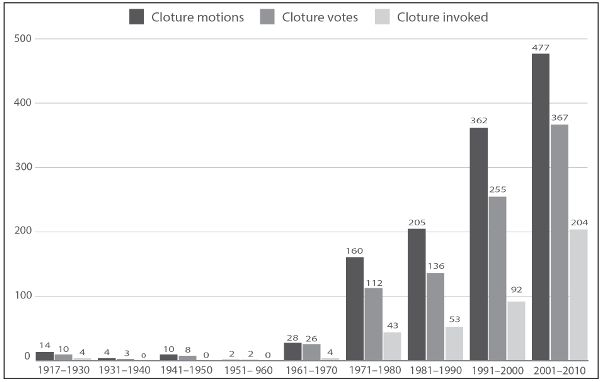
Fig. 6. Cloture in the Senate, 1917–2010
Data: US Senate, Legislation and Records, https://www.senate.gov/legislative/cloture/clotureCounts.htm.
The Filibuster and the Defense of White Supremacy
During the decades of the late nineteenth and early twentieth centuries the most noted—and, for some years, celebrated—filibusters targeted and destroyed the few attempts made by Congress at civil rights legislation (table 1). By the end of the nineteenth century, the Fifteenth Amendment’s uncomplicated mandate that the right to vote “shall not be denied or abridged on account of race” was being systematically undermined by the Democratic parties in control of states of the former Confederacy and enforced by vigilante terrorism. When the Republicans swept the elections of 1888, putting Benjamin Harrison in the White House after four years of Democrat Grover Cleveland and six years of Democratic control of the House, they were determined to enact their agenda. Although hardly a top party priority, one element was legislation to protect voting rights in the South. The resulting federal elections bill of 1890 would have implemented indirect mechanisms for limited oversight of national elections by federal courts. The weak and likely ineffective measure nevertheless was dubbed the “Force Bill” by southerners, and the moniker stuck. Despite this opposition, the bill enjoyed President Harrison’s support and passed the House. Once in the Senate, and layered in partisan and regional politics, the filibuster by southern Democrats consumed “thirty-three calendar days” from December 2, 1890, through January 26, 1891, in “the most remarkable spectacle of obstruction then known to the Senate.”32 A long and complex story, the fate of the bill involved as well a subsidiary southern filibuster of an attempt by Senate Majority Leader Nelson Aldrich to get a parliamentary ruling to end the filibuster on the elections bill. Eventually the Senate gave up, and the bill was set aside for good.33 With the elections bill foremost in mind, and from his perspective as a US representative in 1897, Alabaman Henry Clayton lauded the Senate “as the one deliberative body of the Congress; that Senate which has in the past, when all else failed, been the last refuge of the people of my beloved Southland.”34 As late as 1917 Vardaman and other southern senators would invoke the Force Bill as the great threat thwarted by the filibuster.
As moderate as it was, the elections bill of 1890 was an explicit attempt to enforce the voting rights of African Americans. Southern senators, however, were on their guard for any possible opening for federal interference. As we have seen, they put up a fight against what would become the Seventeenth Amendment because direct election of senators might have created such a breach. They unsuccessfully sought a change to the proposed amendment to prohibit any additional congressional regulation of Senate elections. A few years later, when female suffrage’s time finally came, southern senators resisted, largely for the same reason—the threat that such a broad expansion of the suffrage would invite intervention by doubling the number of Blacks in the South whose right to vote was denied. Whether southern senators engaged in a filibuster is less clear, but they fought the amendment and in 1918 prevented its passage in the face of passage by the House and direct support from the president, fellow southerner and Democrat Woodrow Wilson. The amendment cleared the Senate in 1919 but nearly fell short during ratification, in large measure because of the opposition of most southern states.35 But, to be clear, southern racists did not oppose all forms of constitutional imposition or government intrusion into what had hitherto been state prerogatives, as long as they had nothing to do with white supremacy. The South readily embraced the other two “progressive” amendments produced in the same eight-year period as the Seventeenth and Nineteenth Amendments. Both the Sixteenth, allowing Congress to create a national income tax, and the Eighteenth, the national prohibition of “intoxicating liquors,” received the support of southern senators and rapid ratification by their states.
|
Table 1. Civil rights legislation, constitutional amendments, and Senate rules reforms filibustered or opposed by southern senators, 1890–1975 |
|
|
1890 |
Federal Election Bill |
|
1913 |
Constitutional amendment: Direct Election of Senators (Seventeenth Amendment) |
|
1919 |
Constitutional amendment: Female suffrage (Nineteenth Amendment) |
|
1922 |
Antilynching |
|
1935 |
Antilynching |
|
1937–38 |
Antilynching |
|
1942 |
Abolish Poll Tax |
|
1944 |
Abolish Poll Tax |
|
1946 |
Abolish Poll Tax (preemptive cloture vote) |
|
1946 |
Fair Employment (FEPC) |
|
1948 |
Abolish Poll Tax |
|
1949 |
Cloture rule reform |
|
1950 |
Fair Employment (FEPC) |
|
1957 |
Civil Rights |
|
1960 |
Civil Rights |
|
1961 |
Cloture rule reform |
|
1962 |
Literacy Test for Voting |
|
1963 |
Cloture rule reform |
|
1964 |
Civil Rights |
|
1965 |
Voting Rights |
|
1967 |
Cloture rule reform |
|
1968 |
Civil rights workers |
|
1969 |
Cloture rule reform |
|
1970 |
Constitutional amendment: Abolish Electoral College/Direct Election of President |
|
1971 |
Cloture rule reform |
|
1975 |
Cloture rule reform |
|
Sources: Congressional Research Service, “Senate Cloture Rule: Limitation of Debate in the Senate of the United States” (Washington, DC: US Government Printing Office, 2011); Lauren C. Bell, Filibustering in the U.S. Senate (Amherst, NY: Cambria Press, 2011). |
|
The first direct legislative threat to white supremacy was taking shape as the women’s suffrage movement battled toward victory. This came in the form of antilynching legislation supported by the president and the House of Representatives. The first such bill was introduced by Representative Leonidas Dyer, a Missouri Republican, in 1918. The legislation would have made lynching a federal crime punishable in federal courts and subjected states and localities to liability for damages. Making it to the House floor in 1922, the Dyer bill passed by a vote of 231–119 in the overwhelmingly Republican chamber, with only a handful of Democrats voting for the measure.36 The Senate too was controlled by Republicans, who constituted almost 62 percent of the chamber. Despite the House vote, support from President Harding, and a favorable reporting from committee, the bill was withdrawn from Senate consideration after several days of southern filibustering following its introduction on November 27.37 Thus defeated, similar legislation did not make a return until the early 1930s. In 1935 and 1938 antilynching bills were once again defeated by southern filibusters despite having majority support.38
The Senate’s belated 2005 apology for its repeated failures underscores the fact that for much of the twentieth century, these early civil rights measures were explicitly or implicitly in the pantheon of supposedly ill-advised legislation stopped by the Senate filibuster. Writing in 1926, Columbia University law professor Lindsay Rogers argued that “no really meritorious measure has been defeated and some vicious proposals have been killed” by the filibuster. “Principal items” on Rogers’s brief list were the elections Force Bill of 1890 and the antilynching bill of 1922.39 In his comprehensive 1938 history of the Senate, George Haynes mentions several bills that died at the hands of Senate obstruction, including the civil rights measures, bills that otherwise “would have accorded ill with the sober second thought of the American people.”40 However dated and misguided from our perspective, such assessments both reflected and shaped perceptions of the filibuster’s importance in making the Senate the world’s greatest deliberative body.
Although typically supportive of the extended debate protected by the cloture rule, southern senators could themselves get annoyed by what they perceived as obstruction, with the occasional ironic result. As the clock was running out on the last day of the Sixty-Ninth Congress in 1927, Alabama senator and self-described white supremacist J. Thomas Heflin rose to denounce a filibuster—one that was derailing all Senate business—of a bill to extend the life of a select committee investigating election campaigns. In doing so at some length, Heflin perhaps unwittingly was aiding the filibuster. Spurred on by some of his colleagues, particularly George Moses of New Hampshire, Heflin vented his hatred for Catholics and Blacks while defending his earlier filibuster of the antilynching bill. Moses even goaded Heflin into a lengthy account of an incident nearly twenty years earlier when then US representative Heflin shot two people, one intentionally (a Black man) and the other inadvertently (a white man) from a Washington, D.C., streetcar after allegedly defending “a white woman against the insults and the insolence of a brutal, drunken negro.” Heflin, at least by his account, then took the white man to the hospital and later paid for his medical treatment and time lost from work.41 Heflin could not help but inject his inveterate racism even into comments originally directed against a filibuster. Unfortunately, during these decades such casual racism in Senate debate was far from the exception. Having read extensively in the Congressional Record of the late nineteenth and early twentieth centuries for various research projects related to the Senate, I would argue that a great deal of Senate debate and filibustering was a reflection of that era’s racialized conception of manhood, the glory and honor of Anglo-Saxon manhood premised on racial superiority, which transcended party and region and was elevated still further by senatorial status. Senators invoked minority rights but were often practicing little more than manly posturing amid a prevailing consensus on racial hierarchy and social order.
If antilynching legislation was the issue of the 1920s and 1930s, attempts to abolish poll taxes were the focus of the 1940s, and the efforts in this direction were no more successful. Poll taxes were one of the central tools of disenfranchisement in the South. Every state in the former Confederacy had administered one version or another of this device, many of which were added to state constitutions or laws in the Jim Crow era.42 Four times, in 1942, 1944, 1946, and 1948, bills to abolish poll taxes were stopped by filibusters led by southern Democrats.43 In each case defeat in the Senate had been preceded by the bill’s decisive victory in the House.44 Even a wartime measure to temporarily suspend poll taxes for African American soldiers was a tough sell in the Senate, but it prevailed because southern senators recognized the dangers of filibustering such a limited and popular measure.45 The problem of poll taxes would not be solved until the practice was banned by the Twenty-Fourth Amendment in 1964, with Tennessee and Florida the lone southern states supporting ratification.46
The years after the war saw the most intense confrontation between civil rights and the Senate filibuster. For a quarter century, postwar civil rights measures, both modest and far-reaching, were killed or obstructed by southern filibusters. Frustrations with the filibusters of civil rights measures in turn motivated the Senate majority over the years to seek adjustments to Rule XXII, efforts that were then filibustered.47 A few senators wanted some form of majority cloture, but others sought to preserve supermajority cloture even if modified. One of the most consistent proposals, though not successful until 1975, was to lower the threshold for cloture from two-thirds to three-fifths. The results, until 2013, were a few compromises that mostly eased but sustained supermajority cloture. The many attempts and proposals produced six changes from 1949 through 1986 (table 2), with the most important and contested changes all spurred by, and subject to, southern filibusters.
|
Table 2. The evolution of the filibuster: Senate rules governing debate |
|
|
1806 |
The Senate omits the “previous question” motion from its rules. |
|
1806–1917 |
No rule allowing a vote to end debate on a matter before the Senate and the ability of senators to hold the floor indefinitely protected particularly by Rule XIX. Only minor parliamentary precedents that restricted some obstructive tactics. |
|
1917 |
Rule XXII adopted with a provision for cloture by a vote of two-thirds of the Senate present and voting. |
|
1949 |
Rule XXII amended to (1) raise the threshold to two-thirds of the entire Senate membership and (2) specify that cloture can apply to procedural motions (such as the motion to proceed), except motions to consider changes in Senate rules. |
|
1959 |
Rule XXII amended to (1) lower the threshold back to two-thirds of those present and voting and (2) specify that cloture can be applied to motions to consider changes in Senate rules. |
|
1975 |
Rule XXII amended to lower the threshold to three-fifths of the entire Senate membership (or sixty votes) for cloture on all matters except consideration of changes in Senate rules, which retained the threshold of two-thirds present and voting. |
|
1979 |
Rule XXII amended to cap post-cloture debate at 100 hours. |
|
1986 |
Rule XXII amended to reduce post-cloture debate to thirty hours. |
|
2013 |
Rule XXII interpreted to mean that the threshold for cloture for all nominations other than for the Supreme Court is a simple majority. |
|
2017 |
Rule XXII interpreted to mean that the threshold for cloture for all nominations, including the Supreme Court, is a simple majority. |
|
Sources: Congressional Research Service, “Senate Cloture Rule: Limitation of Debate in the Senate of the United States,” (Washington, DC: US Government Printing Office, 2011); Sarah A. Binder, and Steven S. Smith, Politics or Principle? Filibustering in the United States Senate (Washington, DC: Brookings Institution Press, 1997), 7. |
|
Following filibusters of Truman’s civil rights agenda, which included a poll tax ban and legislation to create a permanent fair practices employment committee, the Senate began in 1949 one of the longest debates and filibusters in its history, over cloture reform. In many ways, this fight over filibuster reform was a surrogate debate about civil rights. “The only reason for the effort to amend Rule XXII,” Senator Kenneth McKellar of Tennessee told his colleagues, “is because of the failure to get the FEPC [fair employment practices committee] bill, the anti-lynching bill, and the anti–poll tax bill passed.”48 This monumental contest of wills culminated in the adoption of an amendment to Rule XXII that applied cloture to any business, including a motion to proceed. But this came at a price. The threshold for cloture was raised to two-thirds of all senators. And cloture would not apply at all to motions to proceed to proposed changes to the rules. Following weeks of obstruction, the application of cloture was expanded to all “matters,” which closed loopholes in the original version by specifying that Rule XXII applied to such things as nominations and motions to proceed. The latter requires brief elaboration. To begin consideration of a measure in the Senate, a motion to proceed must be made and agreed to. A motion to proceed is, however, debatable. It therefore can be filibustered. Southern senators in particular had been exploiting the ostensible loophole that cloture did not apply to the motion to proceed. Thus, until the 1949 reform, minority senators could filibuster the motion to proceed without any limitations. The application of cloture did not prevent obstruction of such motions, but it at least clarified that the Senate could use cloture to limit extended debate on motions to proceed. But as part of the compromise to allow this change, the threshold for cloture was raised to two-thirds of the entire Senate, rather than two-thirds of those present and voting, which could be a significantly smaller number of senators.
Other attempts to lower the barriers to cloture followed the filibuster of the 1957 Civil Rights Act, which infamously included Strom Thurmond’s record-setting twenty-four-hour-and-eighteen-minute “speech.” With Majority Leader Lyndon Johnson fending off more aggressive filibuster reform, the Senate reverted to two-thirds present and voting in 1959 as part of another compromise that, as discussed in chapter 4, resulted in the Rule V provision that the rules in the Senate continue from one Congress to the next unless changed as provided for in Senate rules, the codification of the continuing body doctrine. Southerners used the filibuster to defend white supremacy and to preserve the rule that allowed them to defend white supremacy.
This filibuster reform dynamic was disrupted by the passage of the Civil Rights Act in 1964 followed by the Voting Rights Act in 1965. With a full court press by the president and large pro–civil rights majorities in the Eighty-Eighth Congress, the Senate, after weeks of debate and obstruction, overcame the southern filibuster in 1964 with a 71–29 vote, “the first time that cloture was invoked on a civil rights measure.”49 A year later, passage of the Voting Rights Act required the second such victory in a cloture vote. Combined, the two measures were the de jure end of Jim Crow segregation and political disenfranchisement. Ardor for filibuster reform abated, but did not disappear. As a reminder that things had not changed entirely, southern Democrats were central to a successful filibuster in 1970 against a proposed constitutional amendment for direct election of the president by popular vote. As Senator James Allen of Alabama put it at the time, “The Electoral College is one of the South’s few remaining political safeguards. Let’s keep it.” Passed by an overwhelming and bipartisan margin in the House in 1969, the amendment died when the Senate failed repeatedly to reach cloture, with 75 percent of southern senators voting to not allow the proposal to come to a vote.50
With the constitutional and legal victories for civil rights by the 1970s having eliminated much but clearly not all of the contention around that issue, a more liberal and activist Senate was ready to make a more significant change to supermajority cloture, even if southern senators still engaged in a lengthy filibuster against it. In 1975 the threshold for invoking cloture, except for proposals to change Senate rules, was reduced from two-thirds present and voting to three-fifths of the entire Senate, or sixty votes if all Senate seats were filled. In 1986, post-cloture debate was reduced from a maximum of one hundred hours, instituted in 1979, to thirty hours. And that is pretty much how Rule XXII stood until 2013.
From Cloture to Supermajority Decision Rule and the Sixty-Vote Senate
The triumph of civil and voting rights legislation in the mid-1960s and the reduction of the cloture requirement to three-fifths of the Senate membership did not, however, end the problems with the filibuster. As the intimate association of the filibuster with white supremacy ended, its equally close association with wider governmental dysfunction was just getting started. As Senator Walter Mondale, one of the sponsors of the reform proposal at the heart of the 1975 debate, explained, “It can no longer be said the filibuster is the tool of the representatives of one section of the country or of one political philosophy or that it is used solely against one category of legislation . . . now it is being used by Senators from all parts of the country and of all political philosophies.”51 From the 1970s onward, the Senate moved decidedly and consistently toward becoming a supermajoritarian body. Obstruction and the use of cloture as a tool to circumvent or overcome it accelerated in the 1970s and 1980s. But as figure 6 shows, the number of cloture motions in the 1990s nearly equaled the total from 1971 through 1990, and the number of cloture votes exceeded the total from the preceding two decades. Obstruction and the use of cloture motions continued to increase from there into the 2010s. The use of cloture motions is an indicator rather than a precise measure of minority obstruction or filibusters. The two are definitely related. But the relationship is complicated by the tactics and strategies available to Senate majorities and minorities.
Many factors contributed to the increase in Senate obstruction, whether measured by cloture motions and cloture votes or by other indicators, including the strategic and tactical behavior of Senate leadership. The 1970s saw a more activist and liberal government, spurred on by a new generation of politicians who, among other things, began to transform the Senate. In general, members of Congress were more responsible for their campaigns and more closely connected to their constituents, who expected action.52 Senate elections became more competitive than House elections.53 A more activist Congress was responding to the formidable demands of the existing welfare-warfare state created by the New Deal, the Great Society, World War II, and the Cold War, and expanding the scope and responsibilities of the government by creating even more policies and programs. Congressional workload and the resulting strains for scheduling and considering legislation grew accordingly. All this was accompanied by a steady rise in partisan polarization, especially from the 1980s onward, which solidified party voting and, in the Senate, put an increasing premium on procedural fights, especially over cloture. Norms that restrained senators from the full exploitation of procedural warfare evaporated.
Senate leadership responded in several ways. In the 1970s, Majority Leader Mike Mansfield began employing what became known as the “track system” for scheduling business on the Senate floor.54 This practice enables the majority leader to move measures or other matters threatened by a filibuster to a side track, so to speak, while other business is considered. This allows the Senate to get other things done, but it also accommodates the obstructing minority, which does not have to hold the floor or engage in dilatory tactics. Instead, the result is one version of what is often called the “silent filibuster.” As many have noted, the track system lowered the cost of threatening obstruction. Any credible threat was likely to be accommodated in some way. Meanwhile, the majority leader might be working on a way to move the sidetracked matter forward by either negotiating with whatever minority was in the way or by preparing for a cloture vote at the right time.
And, speaking of cloture, another response was the increased proactive, prompt, even preemptive use of cloture motions. There is no doubt that from the 1990s onward the Senate minority and individual members increased their willingness to use obstructive tactics to extract concessions or defeat a measure. But the majority also responded in part with aggressive use of cloture motions as a tactic to deal with perceived obstruction. Instead of waiting to see whether debate would run its course or a compromise consent agreement could be constructed, the majority leader or other members of the majority often immediately or promptly filed cloture, sometimes as soon as a motion to proceed or measure was open for consideration.55 As noted, part of the increase in the use of cloture was a consequence of the increased willingness of members of the minority to filibuster the motion to proceed, that is, to block the bill or nomination from even being considered by the Senate. This, of course, is the opposite of extended debate or deliberation. Under such circumstances it is understandable that the majority would immediately file for cloture on the motion to proceed if there was any objection to moving forward.
One of the most discussed accommodations of supermajority cloture is what the Senate refers to as a “hold.”56 A hold is “an informal practice by which a senator informs his or her floor leader that he or she does not wish a particular bill or other measure to reach the floor for consideration. The majority leader need not follow the senator’s wishes but is on notice that the opposing senator may filibuster any motion to proceed to consider the measure.”57 As the definition implies, holds are not in the formal rules and procedures of the Senate. Instead, holds are a practice that evolved from the rules that empower minority obstruction. Senators have frequently placed holds on nominations, for example. In so doing, a particular senator may have an objection to the actual nominee or may be attempting to use the leverage of a hold to bring attention to another matter, even one unrelated to the nomination. The latter have been referred to as “hostage” holds. As one example, in 2003 Idaho’s Larry Craig placed holds on more than 850 promotions of Air Force officers as a protest against the Defense Department’s failure to provide four cargo planes to the Idaho Air National Guard.58 Examples of such petty holds abound. In another bit of aircraft-related parochialism, Senator Richard Shelby in 2010 put a blanket hold on all of President Obama’s executive nominations because he was frustrated with how the Pentagon was handling a procurement decision on air-refueling tankers—one that would directly affect his state of Alabama.59 In all such cases, the majority leader must do something if he or she wishes the nomination or bill on hold to go forward. The leader can capitulate, negotiate, or call the bluff of the requesting senator or senators by ignoring the hold request and moving forward with the measure or nomination, and then seeing if those opposed are willing or able to obstruct.
The hold is another form of the “silent filibuster,” like the track system but even more so. Until 2007 holds were by custom anonymous, insofar as there was no stipulation that hold requests had to be recorded and publicized in any way. Instead of eliminating holds as a practice, the best the Senate could muster was a provision included in a 2007 law, the Honest Leadership and Open Government Act, which was touted as ending secret holds. The provision required senators to provide official notification of their holds by sending a letter to the majority or minority leader within six days. The name or names attached to the request would then be published in the Congressional Record. But for six days the senator or senators could have a secret hold, and that might be all the time needed, especially toward the end of a congressional session. Moreover, because another like-minded senator could place her or his own hold at the end of the six days, both the hold and anonymity could be extended.60 As a result of their often quiet and confidential nature, the effects of holds, even after the 2007 reform, are not readily recorded or systematically recognized. Regardless, the hold emerged and proliferated as another accommodation of minority power that lowers the cost of obstruction and has often resulted in some degree of success for the senator or senators behind the hold. In short, holds often cause the Senate to do what it would otherwise not have done, which is the basic definition of the effective exercise of power.
As part of all this, Senate leadership increasingly relied on the constant and creative use of unanimous consent agreements, often negotiated between the majority and minority leaders, to move legislation forward. The Senate had always done most of its business by unanimous consent, but before the 1980s, it tended to be easier to attain it. As Congress became more polarized and contentious, important business was increasingly structured by what became known as “complex” unanimous consent agreements, that is, negotiated plans for how to proceed with a measure or other matter, such as a nomination. It might include such things as the amendments that will be in order, the order and threshold for the voting on amendments, and the time for the final vote, which determines how long the matter will be considered.61 This all makes perfect sense, but the evolution of complex unanimous consent agreements produced further Madisonian ironies as far as Senate deliberation is concerned. In the era of the supermajority Senate—fueled by hyperpartisanship—such agreements increasingly have involved an extraordinary degree of top-level centralization in the form of dealmaking by the majority and minority leaders or their staff. The resulting agreement is then ratified by their troops as the only way to break deadlocks to get at least something, anything, done.62 This was confirmed by interviews I did with senior Senate staff, including the principal floor strategists for the majority and minority leaders. That is, for nearly any issue that divides the parties, instead of having a public debate, the leaders of the parties negotiate a deal, in the form of a complex unanimous consent agreement to structure the process on the Senate floor, and often determine the outcome on the issue. This is a strange form of bipartisanship and not exactly the kind of deliberation Madison had in mind. Instead of supermajority cloture being the rule that fosters debate by the self-styled “world’s greatest deliberative body,” it produces secretive bilateral negotiations among a few senators and staff.
All this to avoid threatened, or to end actual, filibusters. By and large, the effect of these strategies and accommodations—the track system, tactical use of cloture, holds, complex unanimous consent agreements—has been to empower the minority while diminishing the likelihood of anything resembling deliberation. As a consequence, supermajority cloture became so important in shaping and determining Senate action that scholars started referring to it as the “sixty-vote Senate” or “supermajority Senate.”63 And the rise of the sixty-vote Senate put cloture-related obstruction repeatedly in the national spotlight. The great filibusters of the past were often controversial for their relation to important issues, particularly civil rights, as we have seen. By the 1990s filibusters and supermajority cloture were becoming associated with divided government and governmental dysfunction in general. The threat of obstruction and a minority veto was becoming the norm rather than the exception.
In all this, what qualified as a filibuster, and did that even matter? Senate scholars have long debated how to measure filibusters. Not all extended debate or dilatory motions qualify as a filibuster. Cloture motions have been used a rough measure of levels of obstruction, but they are no more than that. Partly as a result, some scholars have gone beyond cloture motions and produced more robust measures of when a filibuster is taking place.64 This point is well taken, but I think this approach needs to be turned on its head because the search for the somewhat elusive filibuster is beside the point. The point is minority obstruction, all the forms it takes, and its effects. If such things as the tracking system and holds produce invisible or silent filibusters, or if, as we shall see, sixty-vote thresholds are readily added to a unanimous consent agreement for votes on individual amendments, then the search for “filibusters,” as such, can become somewhat of a distraction. It fails to account for much of the behavior that created and sustained, with all its controversy, frustrations, and acrimony, the supermajority Senate.
As Frances Lee has documented with insight and precision, a great deal of Senate behavior must be viewed through the prism of partisan competition rather than ideological principle. In her words, “To routinely attribute disagreement between congressional Republicans and Democrats to individual members’ ideological differences is to overlook how the parties’ competition for elected office and chamber control systematically shapes members’ behavior in office.”65 The parties in the House and Senate often fight over issues about which liberals and conservatives might agree. In particular, “legislative partisans engage in reflexive partisanship, in which they oppose proposals because it is the opposition party’s president that advances them.”66 Much of the Senate’s action is geared toward partisan electoral strategy rather than lawmaking. Polarization, divided government, and a sixty-vote Senate facilitate a rational calculation by many senators that substantive legislation is unlikely to pass. The objective becomes to try to make the other side look bad. Such partisan combat feeds directly into Senate obstruction. When many senators are electorally secure—or at least highly sensitive to the constituency that matters in the primary election in their state—then obstructive behavior is often politically advantageous from an individual or partisan perspective, or both.
One result is what congressional scholar Steven Smith’s calls the “Senate syndrome.” What is this syndrome? It is “a pattern of behavior” created by the “combination of minority-motivated obstruction and majority-imposed restrictions.”67 The syndrome is characterized by a spiraling effect wherein exploitation of the rules by the minority engenders majority efforts to undermine or get around such obstruction. The minority then claims it is forced to obstruct because the majority acts so precipitously to restrict minority participation. This “‘obstruct and restrict’ pattern has dominated the Senate in recent Congresses—obstructive strategies by the minority are met by majority strategies to limit debate and amendment. ‘Regular order’ evaporates, and the Senate, known historically for its informality, becomes tied up in parliamentary procedure”68 And as with some physical syndromes, what is causing what gets hard to pin down. But there is no denying that the various behaviors are logically related.
One product of the syndrome and the ironic centralization of decision-making is yet another innovation or adaptation to deal with supermajority cloture. In another procedural twist, the Senate of the twenty-first century began incorporating sixty-vote thresholds on amendments or even the bill itself into unanimous consent agreements as a way to evade the difficulties of cloture.69 The procedural logic is pretty straightforward. If the majority seeks to advance a measure and it is clear a minority is determined to obstruct in such a way that cloture will be required, whether on the motion to proceed, the measure itself, or both, then why not speed things up by making the key thing or things at stake—the measure itself or amendments—subject to a sixty-vote threshold and bypass cloture entirely? Although examples of the incorporation of such sixty-vote thresholds into such agreements “can be found from at least the early 1990s,” the practice grew amid the partisan polarization and frequent minority obstruction, especially from the mid-2000s onward.70 One compilation of roll call votes shows forty-four such supermajority decisions on amendments or bills during the 110th Congress (2007–8), forty-four in the 111th, and 127 in the 112th.71
These dry statistics are telling but fail to breathe life into this practice, which can show Senate behavior—structured by its rules—at its most ineffective and cynical. On December 14, 2012, twenty-year-old Adam Lanza slaughtered twenty-six people, six teachers or staff and twenty elementary school students, at Sandy Hook Elementary School in Newtown, Connecticut. The age of the victims—the children were all first graders—and the role of the murdered teachers and staff in trying to protect their charges made Sandy Hook like no other mass shooting. For many it was the last straw in a relentless march of American mayhem. Only weeks after his reelection, President Obama seized the moment to demand action. In Republican hands, the House would not act first, if at all. Instead, all eyes turned to the Senate, which was controlled by a 55–45 Democratic majority. On Wednesday, April 17, 2013, the Senate began consideration of the gun bill, titled the Safe Communities, Safe Schools Act. The majority leader negotiated a highly structured unanimous consent agreement to determine consideration of the bill. In this one, the focal provision was that the key amendments that would determine the core substance of the legislation would be subject to a sixty-vote threshold for approval, instead of having to reach cloture on each separately. The supermajority provision all but guaranteed that nothing of substance would be approved. Overall, five of the eight amendments achieved the simple majorities that are needed to decide ordinary legislation in the Senate but were defeated by the supermajority threshold specified in the unanimous consent agreement. As a result, it turned the entire proceeding into a bit of bipartisan political theater, of the tragic variety. That in turn certainly made a mockery of deliberation: because everyone knew what the outcomes would be, any speeches were political grandstanding.
Let’s consider the two obvious implications of this practice. First, it strips bare the pretense that cloture is primarily a rule about deciding when to end debate. Instead, it has evolved into the decision rule. Second, the practice is another acknowledgment that cloture is not about voice but victory. Such agreements not only bypass cloture, they bypass debate, sometimes altogether. There is no deliberation, no persuasion; only one thing matters: sixty votes. Why waste time on anything else?
As a result, sixty-vote thresholds have become far more common and frequently required for the Senate’s most consequential business. First, as to frequency, if we examine the thirty-nine sessions of Congress from 1975 through 2013 (before the Senate made an important change to cloture), we see that as a percentage of total votes the recorded votes that had a three-fifths requirement versus those requiring a simple majority increases from negligible to quite substantial (figure 7).72 The increase seems to fall into three steps, with the sixteen-year period of the first eight Congresses seeing a slow rise to barely 10 percent, with an average of 4.2 percent per Congress. It then jumps to an average of 15 percent over the next five Congresses. Finally, from 2001 through 2013, the average skyrockets to almost 30 percent. Setting the record was the “Fighting 112th” Congress, which saw almost as many supermajority votes (234) as it did those by simple majority (244).
These overall figures underestimate the importance of supermajority votes because many uncontroversial decisions on relatively unimportant matters are achieved by simple majorities. That is, the figures represent not only the raw increase in three-fifths thresholds but also the increase in the proportion of important decisions made by a supermajority vote. Even in the contemporary era of extreme polarization, a good number of things in the Senate receive unanimous or nearly unanimous support, particularly presidential nominations to the executive branch and even many judicial nominations. As well, on a few important bills and resolutions, the Senate can allow for a more or less open amendment process. For example, the Senate budget resolution, which is protected from filibusters by the Budget Act, facilitates the consideration of amendments, most of which are dealt with very quickly, one after another, in what has been dubbed a vote-a-rama. As an example, in the first session of the 113th Congress in 2013, forty-six such amendments were decided by roll call votes as part of the Senate’s consideration of the budget resolution. Most of these were offered by the minority and were doomed to fail. Those forty-six constituted nearly 23 percent of all the simple majority roll call votes that session.73
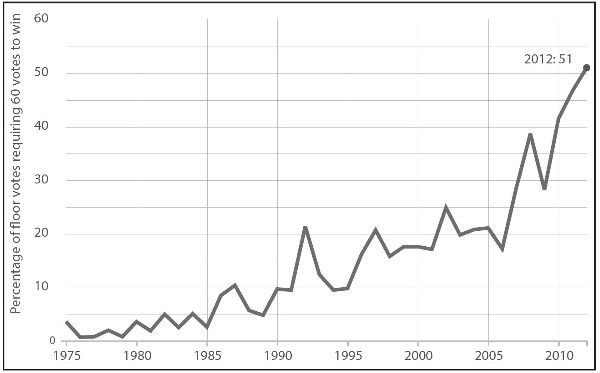
Fig. 7. The rise of the sixty-vote Senate
Note: Excludes votes carrying a constitutional requirement of a two-thirds supermajority, such as veto overrides and treaties.
Almost by definition, the more important or controversial a bill is, the more likely it is to be the target of some level of obstruction. For example, the percentage of major legislation experiencing what one scholar terms “extended-debate-related problems” increased steadily from 8 percent in the 1960s to 51 percent from 1990 through 2006, reaching 70 percent in 2007.74 In general, major or controversial legislation is often subject to either one or more cloture votes, or to one or more supermajority thresholds structured by a unanimous consent agreement necessary to end the procedural obstructions and allow the Senate to vote.
The Constitutional Construction of the Fourth Veto Point in the American System
How might we think about supermajority cloture in the Senate? What is its status as a feature of the system of government? To what should we compare it? One way is to see Senate supermajority cloture as a constitutional construction.75 The implementation of the Constitution required many decisions and actions with constitutional implications and significance but which were not specified in that document. These include the formalization of the cabinet system and creation of executive departments, judicial refusal to issue advisory opinions, the specification of the size of the Supreme Court, and the creation of the congressional committee system.76 The Constitution does not specify the number of justices that are to make up the Supreme Court; this rather important detail was left to Congress. We now take nine to be the inviolable number, but that was not settled until well into the twentieth century. It is difficult to imagine the House or the Senate attempting their legislative responsibilities without the division of labor provided by committees, but the Constitution is all but silent on the organization of both chambers. Legislative committees were created and evolved at different rates in the House and Senate to become a fundamental part of the lawmaking process.
Many constitutional constructions have required or inspired little debate, such as the creation and evolution of the presidential cabinet, or the system of committees in both the House and Senate. Some might have seemed innovative and even controversial initially but then became routine, and now evolve with relatively little opposition. Supermajority cloture began with a brief and evanescent debate, and seemed at first to follow the same pattern of fading into the background. But supermajority cloture became more rather than less controversial over time. Rarely has a constitutional construction, let alone a congressional procedure, become so contested and contentious. All along, and especially as supermajority cloture became increasingly the source of partisan division and public frustration, arguments were mustered to support and attack its utility, merit, and constitutionality. And the arguments for and against it have been invoked over and over with increasing fervor as the sixty-vote Senate developed.
It is also a very powerful constitutional construction in its effect on the system of government. As scholars have argued, the scope and power of the sixty-vote Senate produced a fourth veto point in the lawmaking system.77 For any proposal to become a law, it must receive majority support in the House and Senate. That means the House and Senate majorities are two veto points in the system—each can stop a proposal from becoming law. The president is the third veto point directly in the text of the Constitution. Any proposal making it past the first two veto points requires presidential approval, whether actively or passively.78 A presidential veto presents Congress with the formidable task of mustering a two-thirds vote in both chambers to override and make the bill a law without the president’s approval. Those are the three veto points specified in the Constitution as part of the normal lawmaking process.
The ability of Senate minorities, especially a united partisan minority, to use the high hurdle of supermajority cloture to kill proposals has become another veto point in the legislative process. In this way the traditional and constitutional veto points of the House majority, Senate majority, and the president have been joined by the Senate minority. The sixty-vote Senate evolved into one of the central features of a revised system of checks and balances and a focal aspect of partisan combat. Its matter-of-fact status can be illustrated by myriad quotations from senators and commentators. As just one example, it was no surprise when during a 2018 debate on immigration reform Judiciary Committee chair Charles Grassley elevated the sixty-vote Senate to constitutional status, asking his fellow senators, “Are you interested in a good bill or are you interested in getting a law passed? That takes 60 in the Senate, takes a majority in the House, and takes a Presidential signature.”79 No one objected to Grassley’s revision of Article I of the Constitution. Indeed, “sixty-vote Senate” does not just describe the internal process that has increasingly determined Senate decision-making; that epithet captures as well the impact of supermajority cloture on the lawmaking process as a whole. Do the president and his party have the ability to overcome Senate filibusters? Should the House even act if this or that proposal is unlikely to garner sixty votes in the Senate? Or does the Senate minority have the numbers and unity necessary to thwart the president and a House majority? These are not hypothetical questions. They often dominate discussions of what might or might not happen in Washington.
Short of a highly improbable intervention by the Supreme Court, no other governing institution has any means of influencing or altering the Senate’s supermajority procedure.80 Is there another controversial feature of any other branch’s institutional power that is (1) not reachable by one or more of the other branches and (2) not readily amendable by a new majority within or new occupant of (in the case of the presidency) the institution?81 By “reachable” I mean that it is potentially subject to some level of direct intervention if not interdiction by another branch. The president may have the edge in the off-and-on struggle with Congress over war powers, but if Congress has the will it can stop presidential warmaking in its tracks. President George W. Bush’s use of signing statements did not preclude congressional challenge, and Obama could have foresworn them entirely.82 No one questions judicial review or supremacy tout court, only some of its very specific applications—and even many of those are subject to revision or even reversal. The minority party in the House might complain about that chamber’s form of majoritarianism, but it is hardly constitutionally or comparatively suspect, and moreover, it is amendable by majority rule. Congress might employ ostensibly unconstitutional legislative vetoes but it does so as part of a cooperative relationship between itself and the executive branch. Only the Senate has created an internal rule of procedure that so fundamentally alters the distribution of power in the legislative process and then protected it from change by a supermajority barrier.
In recent years, many from both parties have lamented the use and abuse of the filibuster. However, a frequent refrain has been that it is the increasingly partisan behavior of senators and not the rule that is the problem, as though at some point things were better. That perspective requires, as we have seen, a distorted view of a bipartisan past that did not go so well for many Americans, a view that overlooks how successful the rules were in thwarting or pointlessly obstructing the sober assessment and determination by the majority of what the country needed to do, especially for African Americans. Instead, as represented by the politics and misdirection of the Senate apology that opened this chapter, the Senate continued to embrace the mythology that the filibuster was central to its deliberative function as intended by the founders and the Constitution.