
6
To perceptive eyes music, scenery, and novels must look different with every three-degree change in latitude.
—Stendhal, La vie de Henry Brulard
“Provincial drama theater,” wrote one of the sterling historians of the Russian stage, “reflected more clearly than the other arts the characteristic features of the inner spirit of society.” And, she reminds us, the provinces, plus the two little dots St. Petersburg and Moscow, are Russia.1 Was she arguing that, in order to get the biggest gulp of cultural understanding of serf-era Russia, one must desert the capitals and move into Gogol’s and Saltykov-Shchedrin's stinking marshes of corruption; to realms that possessed, travelers warn us, no charm, no society, no intellectual life; regions that historians often call simply the periphery? What out there could possibly await and reward the patient seeker after Russian cultural life? If one reads “society” as a demographic indicator, the provinces loom as the largest spatial and human arena where culture “happened.” Leaving aside religious ways and folk art, theater ruled provincial cultural life; it reached out to many more consumers than did literature, classical music, or fine art. Illiteracy and underdeveloped institutions accounted for this. In the pre-reform era, the stage graduated from an elite engine of amusement and enlightenment in the capitals and on rural
221 estates to a network of public entertainment centers open to all in scores of provincial and district towns. Yet though Russian and Soviet and a few Western scholars have been publishing material on it for decades, this socio-cultural domain goes unnoticed in general treatments of Russian culture and the arts, to say nothing of works on Russian history.
As in Britain and France, Russian provincial audiences tended to be noisier than those in the capitals—thus the “civilizing process” had to work its way geographically outwards as well as downwards through the estate or class system. Theater lovers in those two countries looked to London and Paris; just as—via a similar mechanism—their American counterparts looked to Europe. Naturally the expectations of many provincial Russians were set by the Imperial Theater system. Theatergoers and actors who traveled from the capitals to provincial houses were often appalled at what they saw. The by-product of this reaction is that theater history has been largely written not only from the top down but also from the center outward. In Russian histories of theater—pre- or postrevolutionary—the treatment of provincial theater often reeks of condescension. Yet provincial Russia—almost universally pictured as a vast cultural wasteland—contained a multicolored world teeming with life. Its theatricality comprised manorial serf theaters, itinerant or permanent town theaters, domestic amateur theatricals in town or country, folk drama, fairground shows, and performances of all kinds, in gentry and merchant clubs, barracks, schools, and universities. That world invites us to ponder the words of Laurence Sterne in A Sentimental Journey: “I pity the man who can travel from Dan to Bersheeba, and cry, 'tis all barren. And so it is; and so is all the world to him, who will not cultivate the fruits it offers.”2
Manorial Stagecraft
When in 1910 the folk ensemble director Mitrofan Pyatnitsky brought the Voronezh and Ryazan peasants he had gathered onto the stage of the Moscow Gentry Club and directed them to “sing your songs and dance your dances,”3 older people in the audience may have remembered a long-gone private version of what they were seeing now in public: serfs on stage, playing sometimes peasants, but more often Carthaginian queens, Byzantine admirals, orphans of Geneva, Spanish barbers, Muscovite heroes, or classical cupids. From the reign of Catherine II to the emancipation of 1861, serf actors trod hundreds of stages all across Russia. Theatrical serfdom lay along a continuum of entertainment that ran from manorial to urban theaters. In the former, the setting ranged from serfs in impromptu performances at home right up to formal scripted stage presentations in built theaters. The Soviet investigator Tatyana Dynnik defined serf theater as one with a regular repertoire and audience, a trained cast of serfs, some technical equipment, and an owner.4 But an important distinction must be made between private manorial serf theaters; public gentry-owned serf theaters; and “free” public theaters hiring serfs on obrok. The crucial feature of the latter two can be summed up in a word: “ticket.” In town theaters, the public entered with a paid-for piece of paper. In the manor house, entree was gained by face, person, family, name. Estate theaters served a private audience, the seigniors and their guests, sometimes entire families of neighboring gentry, with retainers, servants, and dependent relatives.
Certain rural practices contributed to the growth of estate theater. The eighteenth-century nobility had a fondness for watching their villagers “sing their songs and dance their dances” inside or outside the manor house. A print of the late eighteenth century shows a gentry family and their guests ensconced in a loge-like veranda enclosure. Below on the stairs, musicians are playing. Further down, on the ground, serfs perform folk dances as others in festive costume await their turn (see the dust jacket of this book). Scenes like this were represented in prose and graphic arts right up to the end of the period. P. E. Zabolotsky’s painting, After Harvesting (1822), has serf women dancing to a folk instrument, the domra. The master looks on admiringly from the stoop, but his wife seems to glare at him (fig. 39). During Church festivals such as the twelve days of Christmas, masters and serfs sometimes reveled together in song and dance and feasting. Although many varieties of Russian folk dances such as the barina or golubets, a flirtation narrative, required grace, supple body language, and precise timing, the folk dance could also descend to vulgar licentiousness, especially at public celebrations such as fairs. For this and other reasons, the gentry—while often joining in the song—seem to have been ambivalent about emulating their social inferiors, at least until the brief outbreak of imitative folkish patriotism in 1812 when nobles actually took folk dance lessons from peasants and others. This is the background that gives such force to the scene in Tolstoy’s War and Peace where Natasha Rostova, a noble miss, executes a folk dance.5
A much greater impulse for serf theater was the desire of cultivated nobles to harness the Western art forms flowing into Russia in the eighteenth century. After 1762 many nobles freed from obligatory service chose a life of leisure to absorb and adapt that imported culture. The delights of amateur theatricals led some families to expand the experience into full-scale serf theaters. The most affluent among them, with ancestral holdings of lands and serfs (or newly enriched by Empress Catherine’s generosity), set about building for themselves miniature rustic paradises. The shortage of trained actors, musicians, singers, and dancers led the gentry to utilize their serfs, a practice that originated in the capitals and provincial centers and spread to rural manor houses. The movement peaked in the years 1800-1812 and dwindled thereafter. Owners began to rent, sell, or put out on obrok their serf artists to theaters, or sell entire troupes to the Imperial Theaters. Estate “theaters” are hard to count and even to define. Yu. V. Sobolev claimed forty-five for the eighteenth century; a drop to twenty-six in 1800 due to Tsar Paul’s interference; and sixty-nine in the reign of Alexander I. In the 1920s, V. Vsevolodsky-Gerngross listed only about seventy-five sites (see below). Dynnik’s study of serf theaters, manorial or otherwise, counted 173,156 of them in known locations. Of these, fifty-three were rural manorial stages located in twenty-three provinces. A recent count, based on a looser definition, brings the tally to eighty-six manorial serf theaters in twenty-seven provinces and one unplaced.6
Since most manorial theaters are marginally documented in memoirs, only a sampling of the more interesting ones can be offered here. A few rivaled the great court theaters in St. Petersburg in luxury of design and quality of performers, though most were modest efforts created to accommodate holiday productions for family and guests. The great houses in or near the capitals set the tone for most provincial theaters. The Yusupov palace on the Moika, later notorious as the murder site of Rasputin, had a luxurious theater which can still be seen by visitors. The Shuvalovs and Sheremetevs had theaters on the Fontanka, and Sheremetev had one on the Millionaya as well; Prince Potemkin’s nested in his Tauride Palace, future site of the Duma and the Petrograd Soviet in 1917. At Varfolomei Tolstoy’s theater in Tsarskoe Selo, Pushkin as a boy first became enamored of theater. One Petersburg nobleman, noted for his outlandish self-authored scripts, performed only in the role of animals, coming out on all fours as a ferocious tiger. Vsevolod Vsevolozhsky, a rich patron of the arts, maintained a dacha in the Petersburg suburb of Okhta where, on his name day, some five hundred guests would watch performances of his serf troupe, chorus, and orchestra—transferred from his Urals estate—followed by the evening ball.7 In Moscow, S. S. Apraxin, in his home on Arbat Square, put serfs and aristocrats on stage in an opera which featured live deer and dogs cavorting to the sound of hunting horns. P. A. Pozdnyakov, who was wont to dress as a Persian or a Chinese at masquerades, ran an estate theater that mounted magnificent opera performances. His serfs were treated well and, it was said, acted better than some free actors, a tribute no doubt to teachers from the Imperial Theaters. The Moscow elite eagerly turned out for his presentations. The French destroyed the theater in 1812. N. A. Durasov transported huge parties of Moscow gentry to his estate, treated them for weeks at a time to opera and ballet, and provided tutors for their children. Grandmother Yankova claimed that one of Count Orlov’s estates possessed almost five hundred serf musicians, actors, and painters.8
Moscow and its environs formed a dense center of estate theater. A magnate of the Catherinian era, Pëtr Sheremetev (1713-88), built an outdoor wooden theater in 1787 at Kuskovo near Moscow where plays could be performed in summer to thousands of spectators, including commoners if properly dressed. The indoor theater, built earlier, ranked with court theaters in magnificence. Foreigners played beside serfs in the orchestra, and the serf Ivan Argunov worked as scene designer. The lavish productions impressed Catherine II but offended the conservative moralist Mikhail Shcherbatov who railed against Sheremetev’s extravagance. The Sheremetev heir Nikolai (1751-1809), a musician who had studied in Paris, built the Ostankino palace and serf-designed theater north of town. He established a major school of performing arts, with Imperial Theater actors as teachers. The theater staff of 170 included about a hundred paid serf actors. Females—given names like “Garnet,” “Pearl,” and “Ruby”—learned proper etiquette and social dancing in order to mingle at the Sheremetev balls. The repertoire included comic operas dealing with the peasantry, three of which— Anyuta, Roseanne and Lyubim, and Misfortune from a Carriage—dramatized social tensions between lords and serfs. Yet the master permitted serfs to watch performances from the gallery—a practice illustrating how comfortable were grandees with public shows of bondage; and how little they thought about how their real serfs would react. After the peak of its fame in the 1790s, Ostankino declined and its troupe was sold or transferred to the Imperial Theaters where Sheremetev served briefly as director in 1799.9
Prince Nikolai Yusupov who, according to Alexander Herzen, ''reduced love for women to a sort of voracious gourmandise," is always remembered as the magnate who had his serf ballerinas strip on the stage of his theater. While director of the Imperial Theaters in the 1790s, “the girls of the theater choir,” housed in one of his Moscow homes, were nicknamed “the Yusupov seraglio.” A gentry memoir of boyhood days tells a less well-known story about him. A. P. Milyukov, invited to the Moscow home of his classmate Kolya (Nikolai Nikolaevich) Yusupov, witnessed a huge ceremonial dinner with orchestral accompaniment. He then attended the father’s theater where the audience stood and faced the host as he entered the loge with a ballerina. After the performance of Zephyr and Flora by an all-serf cast, “Flora” came to the prince’s box and kissed his hand. Kolya told the surprised Milyukov that if she did not kiss the master she would be whipped. To Milyukov’s expression of puzzlement that “such a great and beautiful star” could be beaten, his friend replied that “Well, she is a serf girl.” Yusupov’s family owned over 21,000 serfs. On acquiring Arkhangelskoe west of Moscow in 1810, he created a theater and an art school which over the years trained fifty-one male and twenty-five female serfs. After Yusupov’s death in 1831, the school closed, and the company was freed and scattered. Some actors joined provincial theater companies.10
Outlying manorial theaters fit a rough geographical pattern. Rolled up in a corner of the Bakhrushin Theater Archives in Moscow is a huge crumbling wall chart crudely drawn in colored ink and entitled Map of Serf Theater. Produced in the 1920s by students in the eminent Professor Vsevolod Vsevolodsky-Gerngross's theater history seminar, its purpose was to indicate roughly the major manorial theaters and orchestras. Only about seventy-five sites are plotted and so the map was incomplete, given what was known even then. What is striking about Vsevolodsky-Gerngross's map is the blunt visual impression it gives of Russia as two distinct cultural regions. The map has fallen apart from age or careless handling. As it happens, the northern half is virtually empty except for the few theaters plotted around St. Petersburg and a few at the bottom. In this respect, the professor’s map is entirely accurate. Manorial theater took hold where serfdom did, in the forest-steppe and steppe-black earth regions. The northern provinces, thinly populated mostly by state peasants rather than privately owned serfs, were virtually bereft of manorial theaters. In a rare exception, the magnate P. A. Mezhakov maintained in the early nineteenth century a forty-one-room castle in Vologda Province with a picture gallery, large library, symphonic orchestra, and serf theater which attracted practically the entire province’s gentry. The vacant regions of Olonets and Arkhangelsk, with few estates, held no known manorial theaters except the probably short-lived one in Petrozavodsk that produced the scandal over Dido Inside Out. Pskov Province had one serf theater; Novgorod and Tver Provinces, two each.11
The provinces widely circling Moscow show a much different picture. At the end of the eighteenth century, theater caught on in the heavily enserfed Smolensk Province, where fifty-six families (1 percent of the landowners) owned 30.8 percent of all serfs. The Glinkas, Baryshnikovs, Brovtsyns, Nakhimovs, and a few others enjoyed the pastime. The Griboedovs had a Gypsy ensemble housed together with their serf actors. In 1827, town dwellers of Smolensk and Vyazma saw the serf actors of the Lopukhin and Bezobrazova estates perform melodrama and comedy. Of the half-dozen estate theaters in Kaluga Province, that of Princess Dashkova maintained one where in 1803, in the words of her Irish upper-class guest Martha Wilmot, ''our labourers, our Cooks, our footmen, and femmes de Chambres [sic] turn into Princes, Princesses, Shepherds and Shepherdesses."12
In Orël Province in 1805, A. D. Yurasovsky made an unusually large purchase from another landowner of a choir and orchestra that accompanied performances of ballet and drama, with carpenters doubling as the cast. Yurasovsky and a brother provided a wide variety of entertainment. An oft-cited surviving affiche advertised Fëdor Scholtz’s ballet Barbary Pirates, or the Benevolent Algerian. On the same bill appeared Vaska and Filatka, The Berdichev Fair, or Recruiting a Jew, and various other diversions.13 Although sources briefly mention nine other manorial theaters in the province, details survive only on a few. Ivan Turgenev’s mother ran a kind of theater school and sent her serfs on obrok to perform elsewhere. The Taneevs built a stone theater for guests and a wooden one staffed by serfs and free provincial actors for an unspecified “public.” Connected to the manor house by a long road, the latter was equipped with machinery and with sets from Moscow. Almost daily during autumn and winter in the 1840s, it put on drama, ballet, and opera with an orchestra of forty-five players. The crowds grew so large that the owner deployed mounted huntsmen to maintain order. In 1848 the estate was auctioned off.14
The Orël theater of Field Marshal Count Mikhail Kamensky (1738-1809) gained notoriety because of a story, “The Makeup Artist” (1883), by one of Russia’s greatest writers, Nikolai Leskov. Kamensky had been a comrade in arms of Suvorov and a favorite of Tsar Paul and Arakcheev. The retired count was murdered in his bed by serfs: in one version by two musicians; and in another by his serf mistress and her fifteen-year-old lover. In Leskov’s story, the lord has his maiden serf actresses dress up as St. Cecilia, “the virgin and martyr,” for his rituals of defilement. The makeup artist, a young serf in love with the master’s next victim, flees with her. The horror piles up as in a Gothic romance, with torture chambers and bestial acts. The lovers are saved from death to live out other miseries. But the murder of Kamensky is unrelated to the central plot. Though highly fictionalized, the Leskov tale is among the most arresting of many backstage atrocity stories, and the atmosphere of private tyranny, blighted love, and permanent fear is captured in high melodrama.15
Though one scholar speaks of the spread of Tula Province serf theaters, only one lordly owner is recorded in the eighteenth century and two in the nineteenth. Notable among the latter, P. M. Yablochkov, though austere in his personal life, gave his wife big sums to produce her own plays, acted by serfs. In Ryazan Province, landowner Rzhevsky, a ballet fanatic, maintained a dancing school for his house serfs; like many a prodigal noble, he eventually had to give up his expensive pleasure and in 1829 sold his company to the Imperial Theater system. In the provincial capital, a barely literate ennobled former pie hawker and liquor agent, Gavriil Ryumin, ran a theater in the 1820s that, rumor had it, set him back ten thousand rubles. All properly dressed towns people were permitted entry.16 In Vladimir Province arose a half-dozen estate theaters. Field marshal Suvorov issued from distant battlefronts meticulous instructions about roles, acting styles, and personnel in his serf theater. Near the end of his life, the eminent diplomat of the Catherinian era, Count Alexander Vorontsov, in 1794 moved his theater from a Tambov estate to one in Vladimir Province. His serf and free paid performers—forty-eight males, seventeen females, thirty-eight musicians—put on works to full houses thrice weekly in a plain wooden building. Three-fourths of the ninety-three-piece repertoire were drama, including Fonvizen, Krylov, Molière, Goldoni, Kotzebue, and Sheridan—an unusual assortment in estate theater, which tended towards spectacle. Vorontsov, a witty, brave, and independent-minded figure, who remained a friend of Radishchev even after his sentence, was the only serf theater owner to show Fonvizin’s Minor and Brigadier. When Vorontsov passed away in 1805, the theater died with him.17
In the remote back country of Nizhny Novgorod Province stood the holdings of the Tula manufacturers, the Batashëv brothers, owners of the Vyksunsky Iron Works, other factories, extensive lands, a multitude of serfs, and an enormous manor house. Andrei Batashëv (d. 1799) tyrannized weaker local gentry and bribed officials, and, according to one story, he had some miners, who were illegally minting money for him below ground, buried alive to prevent government inspectors from discovering them. Ivan Batashëv (17411821) in 1806 erected in the park behind his ninety-room three-story palace one of the finest theaters in the Russian empire. Mikhail Zhdanov, a friend with a critical eye, reported a splendid orchestra of forty players. Ivan’s granddaughter inherited all this and married D. D. Shepelev, a hussar general who aspired “to live by effect.” Shepelev invited an entire regiment to bivouac on his grounds and enjoy his gargantuan feasting, and invited “all Moscow society” in winter to attend his theater. His truly eccentric son, I. D. Shepelev, grandfather of the dramatist A. V. Sukhovo-Kobylin, became a railroad magnate who owned eighteen thousand factory peasants. Dressed up as an Ottoman sultan, the son would lounge among the cushions and divans of an “oriental” tent attended by black-faced lackeys. In the serf theater he inherited, the actors put on drama, comedy, ballet, and operas such as Weber’s Der Freischütz and Hérold's Zampa in which Shepelev himself sang baritone.
In the 1840s Shepelev hired as a conductor N. Ya. Afanasev at thirty-five hundred rubles from the Imperial Theater where he had been getting only eight hundred as a first violinist. Afanasev immediately abolished corporal punishment in the orchestra. As ballet master, Shepelev hired the famous Moscow dance teacher (and a character in Tolstoy’s War and Peace), P. A. Jogel (Iogel). The set decorator installed gas lights at a time when the capital was still using oil lamps. The grand theater on the Vyksa River gained wide renown. Forestry and mining officials and neighboring landowners were admitted free, except for benefits to which the owner made his guests subscribe. Shepelev was, like many landowners, robbed blind by his serfs and had the son of a steward flogged in his father’s presence for imagined cheating. Since the master tutored his cast with the stick, females wore cushions under their garments to soften the blows. He punished musicians with fines and incarceration. For receiving a note from one of his favorite female actresses, his choir leader landed in a dungeon and perished during the night. Yet Shepelev paid the serfs and artists whom he imported from Moscow and Petersburg and protected his female performers by having their carriages guarded by jaegers to and from his music school. Given the outlay for a theater of this scale, it is hardly surprising that in 1846 the Vyksa estate was mortgaged.18
In Saratov Province on the Lower Volga lay the estate theaters of the Bakhmetevs and Kurakins. A theater mounting comedies and operas appeared in the provincial capital in the 1810s under the auspices of Governor A. D. Panchulidze (1762-1834), a Georgian prince in Russian service. When the governor was fired for embezzlement in 1826, his successor helped faltering attendance at the theater by pressuring Old Believer merchants into buying tickets, though their religion prevented them from attending. In Simbirsk Province, the Tatishchevs, Ermolovs, Stolypins, and a few others owned serf troupes. A former house serf described a performance at the estate of Prince Gruzinsky at the end of the eighteenth century. In a pastoral scene inhabited by a dozen young serf women, daughters of the landowner’s weaver and huntsman, sang verses of love and praise to the prince in a gesture common in everyday manorial culture. In Penza Province, inland from the Volga, the Gorikhvostov troupe specialized in opera and Italian music. Vasily Kozhin and his wife ran a modest serf troupe that did comedies at the Gentry Club for “the quality.” They had one professional actor; and Kozhin’s wife taught one of the serfs a role she had played while a pupil at the Smolny Institute. According to Dynnik, serf theater ended in Penza province in the 1830s.19
In the south, a half-dozen magnates of the fertile province of Kursk owned thousands of serfs. In the years 1820 to 1826, Prince Ivan Baryatinsky on his Marino estate had serfs do Russian plays and tutors and governesses do French ones. I. O. Khorvat, author of the opera Martha of Novgorod, entertained nobles, officials, and hussar officers from the nearby encampment, occasionally feasting his guests for weeks and months. He maintained separate quarters for his serf actors, addressed them courteously, and acted side by side with them.20 Out of the theater of Count Wolkenstein (Volkenshtein) emerged Mikhail Shchepkin. The Ukrainian provinces of Poltava, Kiev, Volynia, and Kharkov each had one or two recorded manorial theaters, and Chernigov had three. The estate known as Buda, alleged to be the richest in Ukraine, stood on an island in an unspecified province. The owner, D. I. Shirai, organized nightly spectacles and balls for his numerous guests in an effort to make his home a new Athens. The effusive Shalikov, who attended performances around 1803, noted a scale of production matching Sheremetev’s theaters. In his usual saccharine tone, he reported on the beauty of the serf women performers and praised the master for raising up his “children” (i.e. peasants) from nothing.21
The marshy and thickly forested Belorussian provinces have left few traces of Russian manorial theater. A notable exception was the mini-court and theater at the Shklov estate of the magnate Semen Zorich (d. 1800) in Mogilev Province. Positioned at a gateway to the interior, Zorich, a Serbian-born officer in Russian service and one-time lover of Empress Catherine, lavishly entertained travelers entering Russia; and he welcomed as house guests incoming artists who, in return for his hospitality, performed together with his serf troupe. This protean company of cadets, serfs, professionals, and amateur aristocrats performed for Empress Catherine II and Emperor Joseph II of Austria in 1780. The spendthrift Zorich left debts of more than a million rubles and his heirs sold some of the dancers to the Imperial Theaters. But due to financial complexities in the sale, these remained in serfdom for another twenty years.22
Motivations for most founders of manorial theaters excluded monetary gain, an impulse that went against the ethos of lordly hospitality and reeked of loathsome commerce. Yet repugnance to moneymaking in public was by no means universal, and strapped or profit-seeking landowners from time to time took their troupes to town and opened up shop. The notable gentry owners of ticket-selling serf theaters all appeared between 1798 and the early 1820s. Prince N. G. Shakhovskoi of Nizhny Novgorod Province, possessing a hundred performers, ran two theaters, to one of which he invited the peasants. In 1798, he moved the troupe to the city of Nizhny Novgorod and converted it from a manorial to a public theater, the first in provincial Russia to leave important traces. By 1811, Shakhovskoi’s profits and some gentry subsidies enabled him to rebuild the theater and maintain drama, opera, and ballet troupes in daily performances. Shakhovskoi took his troupe to the nearby Makarev Fair every July up to 1817 when that fair closed down. He then built another theater which survived until a fire took it in 1853. Since the owner disliked plays about everyday Russian life (except for Alexander Shakhovskoi’s comedies), he offered Shakespeare, Calderón, Schiller, Kotzebue; Russian neoclassical and historical plays; and operas of Mozart, Boiledieu, and Martin y Soler.23 Mikhail Zhdanov, historian Mikhail Pogodin, and other observers gave Shakhovskoi’s theater high marks. But the opinion of I. M. Dolgoruky, amateur librettist, actor, and all-round theater enthusiast, is shaded with ambiguities. The costumes were marvelous and the acting sometimes good, he thought. It was “lots of fun to have the chance three times a week to mingle with people in this public place.” Dolgoruky’s Love's Magic with music by D. Ya. Davydov opened there in 1813. In a much-quoted report, Dolgoruky described hilarious errors in the production: the violinists’ beards caught on their strings as they cranked their bows in a frantic effort to catch up with the conductor; the prompter screamed audibly to change the set; and the set man, foaming at the mouth, forgot to move away the “forest” at the right moment.24
Although critics mocked, Shakhovskoi’s house as a rule filled up three times a week in season and every night at fair time with local gentry and their families and servants in boxes, merchants clapping loudly from the stalls, and the lower classes on benches. The proprietor, bewigged and powdered, attended all performances. For a visitor like the roving official Gavril Gerakov, the Nizhny theater in the 1820s was a special treat. There is no reason to contest aesthetic judgments on the quality of the performances by connoisseurs like Dolgoruky. But pleasure derived from attendance clearly did not always depend on the quality of the piece or of the acting, as the prince himself admitted. A visitor found it odd that the actors tried to do tragedy, which was beyond their talents, when ordinary people came to enjoy comedy and light operetta. Gatsisky recalled the childhood thrill of being in the theater itself and peeking through the curtains at the people backstage. In the early 1820s, V. V. Selivanov sat entranced in his aunt’s loge in the yellow wooden theater with its white painted columns and five gendarmes in the lobby. The public knew the serf actors by their familiar names only—Yasha, Ivanushka, and Minai. Fans adored Minai the comic long after his decline, a familiar habit of Russian audiences whose attachment to personalities was so strong that it forgave the faults. In the calculus of pleasure, power, and art, Shakhovskoi scored high on the first two.25
Down the Volga in the port city of Kazan, landowner P. P. Esipov founded a town theater in 1803 with a troupe from his nearby estate. Some sources claim that he kept his actresses in a harem. When Vigel dined there, the host, in a breach of custom, sat them between the male guests at table, together with actors and musicians who rose to serve and then dined with the guests. After some kissing and flirting, the guests repaired to filthy quarters and next day watched the serfs perform Martin y Soler’s Una cosa rara. One of Esipov’s serf actresses, Kuzmina, told Shchepkin that he was a kindly master and she made no reference to sexual matters. Though Esipov’s Kazan theater performed poorly, it was animated periodically by visiting stars from the capital. Esipov, an improvident man, went broke and died in debt in 1814 and his troupe dispersed. Audiences had responded in different ways. Sergei Aksakov, a student in the newly opened university, thrilled to Plavilshchikov playing in Kotzebue’s Child of Love. Students would cut class or leave early to get good seats in the gallery. For Muslim Tatars who attended, the effect was one of shock. At a performance of Voltaire’s Mahomet, when the prophet’s turban appeared on stage, the Muslims in the audience fell on their knees; some, fearing the wrath of Allah for mingling with infidels, prostrated themselves and threw off their shoes.26
In the city of Penza, landowner Grigory Gladkov maintained a serf theater from 1807 to 1821. The cast comprised female serfs and male stable hands, servants, and—by one account—clerks and seminary students, an extraordinary fact, since the last were prohibited from even attending theater. Combining a passion for theater art with a profit motive, Gladkov trained his actors in tragedy. Visitors commented on mediocre performances, lower-class audiences, and the owner’s mistreatment of the cast. The poet Vyazemsky noticed bruises beneath the actors’ makeup. One, Gladkov’s recently beaten serf mistress, was unable to sit, lie, or walk. Vyazemsky even repeated a rumor that Gladkov had actors beaten to death in order to take out his rage at the poor performance of his dogs during the hunt. The alert traveler Vasily Insarsky spoke of watching two simultaneous performances: on stage, where serfs cavorted as kings and heroes; and in the front of the house, where Gladkov roared at actors, flew on to the stage, and struck them. After his death, the theater held on under his son until 1829.27
Sergei Mikhailovich Kamensky (1771-1835), the most notorious serf theater owner, brought his father’s troupe to Orël, ran it from 1815 to 1835 and, like his father, found an unenviable niche in fiction. A decorated infantry general, he avoided war talk; a cruel martinet to his house serfs, he donated generously to the poor; a hater of theater spongers, he gave free tickets to those he liked; as the ruler of a legion of serfs to serve him, he lived in the midst of unspeakable squalor. This short, fat, bald dandy, the owner of seven thousand souls, created an elaborate complex on Cathedral Square with residence, church, theater, and actors’ dorms—housing altogether about four hundred people.28 Sparing no expense, Kamensky engaged a German ballet master; sold five hundred serfs to buy a few good actors; bought an acting couple and their six-year-old tap-dancing daughter for 250 souls; maintained a well-trained serf orchestra and horn band; and unsuccessfully offered twenty thousand rubles for Shchepkin, who appeared only in short runs. The serf cast doubled as tailors, shoemakers, and barbers. The leading actor alternately played a Spanish grandee, a Venetian gondolier, a Russian coachman, a Turkish pasha, and a Tyrolean huntsman. In a regiment-like operation, actors took their meals standing up and were marched back and forth to the music of drum and horn. A jail cell was on hand for infractions. Kamensky closely monitored actresses and had them flogged for leaving their quarters at night, corresponding with officers, or even looking at spectators. He dictated stage gestures as if from a lexicon, had actors memorize lines without a prompter, and beat them between the acts when they fumbled.29
Kamensky apparently did not fear suffering his father’s fate. One of his serf actors allegedly killed himself after Kamensky refused an offer of a thousand rubles from the Moscow Imperial Theaters to buy him.30 A more famous case inspired the antiserfdom story of Alexander Herzen, “The Thieving Magpie.” Kamensky had purchased serf actress Kuzmina (or Kozmina; no other names in the sources) from Esipov’s heirs. Orël audiences greatly admired her in such roles such as Cordelia in Lear and “Edelmona” in Othello, as well as in lighter genres. Shchepkin, a guest actor there in 1822, saw her in Caigniez’s Thieving Magpie, the tale of a falsely accused servant girl. Shchepkin, interviewing Kuzmina, learned that Esipov had given her an education, training, foreign travel, exposure to a broad culture, and a promise of freedom which did not materialize. She was cheated of her promised freedom by Esipov’s heirs. When the new owner Kamensky besieged her with sexual advances, she rejected them. Kamensky insultingly implied that she was selling her body in order to purchase costumes. Kuzmina replied that, though innocent, she would spite him by taking a lover. Her experience was in fact commonplace for actresses of the era—and not only serfs. But the pathos of her exceptional talent in thrall to such an unworthy master led to a sharp treatment of her case at the hands of Shchepkin who recounted it to Herzen. The latter, the most important Russian radical of the age, added extra force by having his heroine-victim die in childbirth. The role of the wronged female was constantly being played on stage by serf actresses, themselves subjected to all kinds of mistreatment and false accusations in their everyday lives.31
The poignancy of the magpie story and its resonance down through theatrical history should not obscure the contribution of Kamensky’s theater to cultural and social experience. The Orël public was regaled, in one season alone, with eighteen operas, fifteen dramas, forty-one comedies, six ballets, and two tragedies. One production mounted simulated naval battles, shipwrecks, and live gunfire. Gerakov found the acting excellent, except for a few performers who were “obviously slaves”; and he praised the owner for providing a cultural service to the town. The owner’s behavior was sometimes off-putting. When several generals and their ladies jeered at his productions, he barred them from the theater. He also tried to prohibit loud applause except when he or the governor signaled it, a ban constantly violated by the macho officers. Prince Dolgoruky noticed Kamensky’s ambivalence toward money and class: he admitted the prince free of charge, but expressed annoyance that mere acquaintances were always expecting gratis tickets—a sign of social disdain for the impersonal mechanisms of the market, or just plain stinginess? The theater was rarely empty. The governor recommended it to visitors. Though as an opera lover, the Guards officer Buturlin, stationed in Orël in 1827-28, scorned Kamensky’s singers, he saw the theater as a refuge from garrison life. Gury Ertaulov, as a young boy in a military family posted there in 1826-27, recalled the town’s pride at having a permanent theater as opposed to touring troupes. The theater drew some fifteen to eighteen hundred spectators a week and all the proceeds went to Kamensky, though neither these nor his personal wealth could ward off the financial ruin caused by lavish outlays.32
The last known gentry-owned commercial serf theater arose in the 1820s when Kostroma landowner Vasily Obrezkov (Obreskov) brought his manorial company to the provincial capital and set it up in a tannery. Obrezkov’s serf cast was supplemented by two professionals: Andrei Shiryaev, a former Maly actor; and Vasily Vasilev, one of the rare gentry career actors. Obrezkov also had the use of two choruses and a seventy-piece orchestra loaned to him gratis by retired general A. S. Kartsev, a wealthy landowner and patron of the arts. Cheap tickets brought in large audiences. The writer Alexei Pisemsky, inspired by what he saw there a child, organized his own shows at home and later as a student at Moscow University. In time Kartsev withdrew his people from Obrezkov’s theater and set up his own, which became part of an emerging circuit involving several cities. Obrezkov died in debt in 1830.33
What happened on the stages of serf theater? Their repertoires were as diverse as those of the capital theaters, the principal source. Catherine II apparently feared the growth of estate theater, but did not limit it. Tsar Paul tried to control the content of performances by allowing manorial theaters to stage only what had been approved for the capital stages. Owners had to pay a percentage of the take—whether public or private—to charity, a device that soon faded into oblivion.34 Alternative inspiration was occasioned by the visit of a literary or theatrical connoisseur who could recommend or even bring along a play or opera, by a landowner’s exposure to other theaters, or even by reading reviews. Tatyana Dynnik’s list of 297 vehicles performed in serf theaters contained 114 comedies, 94 operas, 28 ballets, 18 vaudevilles, 12 “dramas,” 6 tragedies, 5 prologues, 2 patriotic pieces, and 18 of unknown genre. Thus comedy (including vaudeville), opera (mostly comic), and ballet dominated both the manorial and the public serf theaters. Tragedy and other drama made up only about 6 percent of the repertoires. As elsewhere, some of the works floated themes of social conflict. In Martin y Soler’s opera Una cosa rara (1788), a virtuous Spanish peasant wife resists seduction by a haughty prince and is saved from dishonor by the queen’s intervention. This stage display of triumph over sexual and class hegemony was performed by serfs (whose own triumphs were all too few) at, among other places, the Sheremetev, Kamensky, Esipov, and Gorikhvostov theaters. Luigi Cherubini’s Water Carrier (1800) offered a comic reversal involving a spoiled upper-class wife who is transformed for a time by a fairy into the wife of a water carrier who beats her, a concept that has actually been called “democratic” by a noted music historian.35 It is fair to conclude that, with a few exceptions, manorial theater repertoires remained conservative, unreflective of the broadening social ambit that was being explored on imperial stages.
The Russian national theme, as inscribed in folkish performances, fared better, though not for long. For the Saltykov outdoor theater on the Marino estate, Karamzin in 1803 wrote a stylized rustic comedy, Only for Marino, with himself, Vigel, and the owner in the cast. In the late eighteenth century, Count Razumovsky put on an annual “haying” tableau in his garden: as the serfs acted out mowing, they sang in chorus and danced in bright costumes. At the peak of patriotic feeling in the Napoleonic era, folkloric divertissements attained great popularity. Among a half-dozen productions, Semi, or Funfair at Maria Grove was the most enduring, and major variants of it are found later in Ostrovsky, Tchaikovsky, Rimsky-Korsakov, and Stravinsky. With staging by Isaak Ablets and music by S. F. Davydov, Semi first played at Ostankino in 1814, and then in the capitals and the provinces. It featured a chorus of Russian soldiers praising their army to the sound of old instruments, spoons, bells, and fifes. Buturlin’s family mounted a variation on serf theater on May 1, 1816: they had the peasants perform Semi and then held a real folk fair with feasting, dance, and songs.36
The nationalizing pathos of Westernized Russian nobles, eagerly grasping at what they took to be the essence of village life and peasant sensibility, stylized their pleasant, harmless, and entertaining side and allowed nobles to enjoy peasant frolic without losing a semi-European identity. Even when—as in Razumovsky’s tableau—they recognized that backbreaking work such as haying was also part of true Russian “peasantness,” they embellished it. In this way, the gentry’s journey of “discovery of the folk” took them barely a step closer to reality than when they watched serf actors performing as “peasants” on stage. The “labor” in folk entertainments remained mediated through the filter of spectatorship. In many ways, this resembled early Russian painters who idealized on canvas scenes of peasants at work in the fields (see chapters 7 and 8). The practice of alternating between the performances of folk material and that of European opera reflected the ever-present ambivalence about the national self.
Witnesses testify to the high level of performance art in the great estate theaters in or near Moscow, Petersburg, and at a few of the big rural complexes. At the other extreme lay stories of disastrous production. In 1811, the Drama Journal presented a pair of examples of the unintended farcical level reached on some manorial stages. One was an allegorical ballet in which a hefty Amour and a portly Psyche sashayed across the stage with a vigor that set the stage hands howling and sent the audience into raptures. The other concerned a performance of the comic opera Two Hunters, in which the hunters’ “forest” consisted of peasant lads standing with birch branches in their hands. The host explained to his visitors that “we have no Gonzago here.” During the opera, cast members kept bumping into each other, and a Great Dane began attacking an actor dressed as a bear. The enraged landowner shouted “Keep at it, idiots. We’ll hang the dog, and let’s see how the opera ends.”37
Given such episodes, too numerous to recount, manorial theater as a cultural practice became an easy object of attack. From the capital issued the arch comments of critics who were used to metropolitan productions. From the pens of witty playwrights flowed the mocking send-ups: Alexander Shakhovskoi’s Semi-Lordly Amusements which actually anticipated the bear incident, and Mikhail Zagoskin’s Noble Theater (1827) were made popular in the 1830s and 1840s by Shchepkin and Mochalov. Zagoskin’s piece concerned a theatrical production which included family, friends, house serfs, and a retired actor, to which “the whole town” was invited. The ploy—repeated endlessly in works about the stage—was a race against time to untangle love intrigues, elopement, mutinies, and other disasters before the high-toned spectators arrived. Posters advertised the admission fee as “friendship and indulgence,” a clear signal not to expect too much. One of the subthemes is the constant bickering between the lord and his wife, and her all too prescient warnings that theater will ruin the family. On the central theme of marrying for money, one of the characters says: “ten thousand souls is but naught if you have no soul of you own,” echoing a real argument in the host family. Indeed, when the play within the play proceeds, the stage audience does not even notice that it parallels what is happening in the household.38 This touch embodied Zagos-kin's dubious belief that manorial theater audiences made no connection between stage action and social realities. A strong sense of ascription and a dose of competitive scorn operated in the mocking of provincial theater, an argument that theaters did not belong “out there,” lacked resources and talent, and posed financial hazards to those who kept them.
Impulses for establishing manorial theaters varied immensely among serf owners: family entertainment, love of stage art, imitation of the court, display of wealth, gargantuan hospitality, organizing human beings, creating an erotic hothouse, and in a few cases making money—many of them in combination. Pedagogy moved Andrei Bolotov to form a children’s theater. In the 1840s, Elizaveta Vodovozova’s father started a “theater” in his home in a Smolensk district town. In order to promote noble feelings in his family through the plays of Molière, Fonvizen, Griboedov, and assorted musical works done up in peasant costumes, he tutored the cast which included his children, a half-dozen serf actors, and five musicians. Though little investment was needed, the habit became ruinous because of the continuous flow of guests from a radius of thirty to forty versts who were fed and housed for days at a time. Despite financial drain and the malicious envy of some neighbors, the father persisted in sustaining the family’s pleasure and enlightenment.39
Spurred by quite a different kind of motivation, one landowner, during a performance by his serf actors, exclaimed to his guests: “These are all my people, my servants!” Landowner A. A. Kologrivov, who still wore a wig in the 1820s, had his serf cast painted black and shorn like monks. On visiting Moscow, he would bring along a huge entourage of orchestra, actors, singers, and dogs because, as he put it, “at home in my own theater, when I arrive all the actors and choristers bow to me. I come to your theater here, and no one wants to know me or bow to me.”40 What we might see as gargantuan ego was in reality an almost unself-conscious arrogation of power and prestige. This quaint articulation of domestic grandeur, shared in varying degrees by many serf owners, reflected a deeply rooted revulsion against a public sphere that was enmeshed in unfamiliar social and cultural relations. The iron law of personal authority over property and chattel among the gentry intensified a cosmic sense of unresponsiveness to modern life among many privately empowered people. More subtle psychological mechanisms operated as well, such as theatricality and the compensatory deployment of “subjects” by otherwise powerless nobles.41 In these blends of seigniorial pleasure and power—pleasure in consuming the product and power over the production—the lords had much greater sway than the managers of the imperial houses. Out on the landed estates, there were no contests among audience, cast, and management; no real backstage force; no appeals over the owner’s head. The tsarist government refrained from controlling life inside the manor house and rarely prevented the abuse of serfs and other kinds of malpractice on far-flung estates.
Estate theater essentially committed financial suicide. With the few exceptions noted above, all revenue went out for expenses, and none came in. This accounts for the difference between the estate and the commercial town theaters and for the eventual decline of the former after 1812. Moscow Province, heartland of manorial serf theater, especially felt the blows of war: ruined homes and the lavish spending of landowners-turned-officers on the European campaign trail. Expenditures on education, travel, and luxurious appointments made it hard for all but the most affluent to maintain domestic theaters: in 1859 half of all nobles owned only twenty serfs; as early as 1837, those with one thousand or more accounted for only 2 percent. Hard times forced some noble families to sell their troupes to the Imperial Theaters. A few held on by taking their operations to a town and converting them into businesses, but even these eventually collapsed. Still others, adapting the institution of obrok labor, sent their serf actors and musicians for hire to public theater companies, thus feeding what was to become the major element of provincial theater.42
Serf as Actor
The lives of manorial serf actors differed from those of the Imperial Theater performers in several ways, aside from greater vulnerability to persecution. Those locked in like lepers, hospital patients, or convicts lived under a kind of social prophylaxis. Most were, like musicians, youngsters taken from the field or household serfs: waiters, cooks, cleaners, tailors, shoemakers, painters, carpenters, maids. At N. A. Durasov’s estate near Moscow, Martha Wilmot attended a performance in 1806 with about a hundred serfs on stage and in the orchestra. Her host apologized for the poor showing since, he explained, most of the cast was at the harvest. G. I. Bobrikov had the children of his servants trained as dancers, taught French, and renamed as la Fleur, la Tour, and so on. He then invited the dance teacher Jogel to mount ballets at his estate theater. Those lacking Bobrikov’s fortune often used the stick to turn a maid into a tragic queen.43
To a greater degree than serf musicians, actors had to deal with multiple roles and identities. Around 1812 or earlier, General Komarovsky, visiting Count Ilinsky’s estate in Ukraine, observed that the Italian actors from Odessa, whom his miserly host had engaged, dressed as princes in the opera, but went around hungry and in rags when the show ended. These performers were free people. How much greater the swing for serf actors from the stage’s world of noble birth, mighty deeds, courage, refined tenderness, regal bearing, and sweeping acts of mercy back to the real world of servitude. The German scholar Baron August von Haxthausen, observing what he wrongly took to be serf actors in Nizhny Novgorod in the 1840s, commented on the polarity between roles and reality: “What endless contrasts must this have produced in their feelings.” Laurence Senelick aptly likened the serf’s reversion to inferiority to the fairy tale in which, after a lofty dream, a peasant awakes in a “stinking byre.” Serfs often appeared on stage with masters, family, and friends. Alexander Stolypin permitted his daughter to act in his troupe of seventy-four serfs. Serfs impersonating monarchs in tragedy or opera alongside a noble in the role of a subordinate created anomalies, especially if the serf’s talent exceeded the owner’s. The actor P. M. Medvedev recalled a wealthy landowner who acted alongside her serfs at home. When they reached a sufficient level of excellence, she took the troupe to Vitebsk. They flopped because she, devoid of ability, insisted on playing the lead beside her genuinely talented serf actress. For gentry, acting no doubt produced pleasure. But at curtain time, serf actors resumed a posture of deference, and might endure punishment or a return to field or pantry. Playing—and seeing other serfs playing—serfs or nobles, serf actors experienced “doubling”: on stage before an admiring public; and as the character in the plotted role. Letkova, who coined the term “serf intelligentsia,” remarked on the actor’s multiple roles as performer, stage character, and servant—with the additional role of concubine for the actress.44
Stories abound of serf owners’ manipulative use of their human chattels for theatrical effect. In a culture where dwarfs and fools could still be found on estates, where peasants were marched around in close-order drill for the amusement of a retired officer, where serfs were dressed up as counts and countesses for a mock court ball, and where nude girls were made to stand in the garden as living statues, this could be expected. Some of it was harmless, as when Herzen’s servants, dressed as Turks for his birthday party, performed a puppet show. Dmitry Putilov of Samara, a rich and intelligent minor versifier and friend of composer Alyabev, went far beyond this when he gathered all the hunchback males and females in the district, married them to each other, and organized a Hunchback Ball.45 Serf actors were subject to the same rhythm of physical punishment for lapses, or for no reason at all, as were musicians and other servants. A particularly observant village priest recounted how a seignior had an actress sent to the stable to be whipped by the coachman for showing insufficient dignity in her role as a countess; she then returned to play in another piece with the scars on her back, thus adding humiliation to the physical pain. All the evidence of abuse is anecdotal—direct observation or hearsay. I have found no litigation. But too many accounts from different kinds of people have come down to us to be ignored: traveling landowners and officials, journalists, serf and nonserf actors, literary figures, foreigners, a priest. Tatyana Dynnik, writing in the early 1930s, set out to “explain the historical role of serf theater in the class struggle of feudal Russia.” But serf resistance was rare: at the Yurasovskys, in 1816 an enraged female dancer broke a rib and possibly injured the testicles of a French ballet master.46
Sexual exploitation of female (and probably male) performers in serf theater, subject to little or no control and thus more widespread than in the imperial houses, forms the nub of many victim stories. At Sheremetev’s Ostankino, guests would mingle and dance with the artists after an opera performance. On some estates actresses were passed around from owner to guests. The owner could easily avail himself of “the glamour and sexual licence associated with the actor,” show off the trophies of his sexual power, take pride, display generosity, or generate envy. Lyubov Nikulina, an ex-serf and provincial actress in the early 1840s, while visiting the home of a Tambov Province landowner, spent time with an involuntary member of his serf theater and a harem of ten women. Her informant told Nikulina how the master would take away young girls from their families for training as actresses, debauch them, and then marry them off to some brute. Villages were emptied of their young women, and helpless peasant men were bereft of their fiancées. Desertions, beatings, a wife murder, and attempted suicide ensued. One serf stabbed his wife to death for being ''the master’s paramour."47 In this as in some other cases, “theater” was simply a ruse for maintaining a collection of concubines. The female body, in some cases, served multiple functions as an acting device, a sexual object, and a target for the knout. Aside from the concrete abuses, some serf actors must have felt the disorientation that comes from a change of life circumstances, especially if sudden, which often generates previously unused energy. That energy could feed either creativity or despondency and unruly behavior.
The literary assault on the social practices of manorial theater found expression in a now-forgotten novel by sometime playwright and amateur composer Prince Grigory Kugushev (1824-71). Cornet Otletaev (1853) combines some of the Kamensky-Herzen material with other examples of real-life kidnaping, fraud, and mistreatment of serf actresses. The married villain, a retired junior officer and landowner, lures away a recently freed servant from a good household with promises of marriage and then sets her up as an unfree actress in his serf theater. Housed in a separate building called Mon Plaisir, the troupe offers vaudeville performances. Obsessed with sex, money, and power—all of which he loses—the master rudely berates the players, calls them “things” and “toys,” and furiously says to the kidnaped actress: “I am a lord. And you? a slave, the daughter of a lackey.” The mark of a man, in his words, is “to serve, to love, to drink.” In the end the young woman is rescued but soon languishes and dies of consumption. The villain, bankrupted by the extravagant entertainments he puts on for a nearby garrison, becomes a homeless and forlorn wreck who, on the last page of the novel, in an almost literal replication of the famous Pavel Fedotov painting Encore (1851-52), is presented as a miserable provincial officer amusing himself with dog and stick (see chapter 8).48
The fairy tale of maid into mistress and goatherd into prince rarely came true. Nowhere in Russia, apparently, did a prince steal into the sultan’s harem and rescue the slave girl. Freedom for manorial serf actors, often promised, was rarely granted. The oft-told case of Zhemchugova resulted from a poignant love story that fitted the archetype of the rich boy-poor girl romance. Praskovya Kovaleva (Zhemchugova, or The Pearl), the diva of the Ostankino opera troupe, was born a serf in 1768, the daughter of a blacksmith on one of the Sheremetev holdings in Yaroslav Province (fig. 40). At seven her training in languages and music began and at eleven she debuted at Kuskovo. Nikolai Sheremetev fell in love with her and, in order to hide it, showered gifts on the entire female cast. Later he freed Praskovya, endowed her with a fictitious Polish genealogy, and secretly married her in 1801, a major violation of the social code. A Russian scholar justifiably speculated that Sheremetev and Zhemchugova got inspiration from the lines she sang or spoke from Paisiello, Gretry, and Voltaire that breathed the spirit of a love that conquers social prejudices. She died two years later, a few weeks after childbirth.49 Serfs not lucky enough to marry out of bondage had to rely on kindly masters or on patrons and admirers willing to pay the redemption price. Ivan Sibiryakov, a serf actor who had served in the Napoleonic wars beside his master, won the admiration of General Miloradovich and other grandees, who sought his freedom. The owner demanded ten thousand rubles and the actor died in bondage. Agafiya Guseva, in a rare case, gained freedom while a manorial serf. As an actress on a Saratov estate in the early nineteenth century, she suffered the usual grief. When she displeased her master, he took her off the stage, married her to the coachman, and refused to free her. The arts patron Afanasy Stolypin raised the redemption money from Saratov society through a subscription. Guseva then joined a commercial troupe. In a rather daring act, she received her freedom publicly at a benefit performance along with her husband.50 But the escape route from serfdom for most bonded actors lay only through the purchase of bankrupt seigniorial troupes by commercial troupes or by working in the latter as obrok serfs on loan where they might gain notoriety in public performance.
In being exposed to rich theatrical and musical art, was the serf actor in the manor house the servant of two masters, the muse and the lord? Did serfs attain a significant measure of creativeness in their work? Aside from Shchepkin, who spoke freely about his art, we have few articulations from serf actors. A Soviet scholar argued that serfs performed to a “socially hostile public” and lacked that “internal contact with the audience” so necessary for theatrical art.51 There is some truth in this, though free actors often faced the same problem. I. M. Dolgoruky, speaking from wide experience, was blunt on the subject. After the 1813 production of his opera in Shakhovskoi’s theater he made this comment:
What can you expect from a dense slave who can be beaten or sat on a punishment stool at a whim? And so [Shakhovskoi's] numerous actors perform just the way an ox pulls his load when goaded by the driver’s switch. I will not go into the reasons why a serf cannot have exceptional talent. I simply say that the theater performances are quite good in Nizhny Novgorod for people of a certain rank. But to call [the performers] actors is almost impossible unless you avert your eyes from their bodily movements. They do not act but rather—to put it plainly—they pose. To repeat: this is no more than one can hope for from slaves.52
As Dolgoruky hinted, Prince Shakhovskoi’s management of serf actors required an imposed schizophrenia. On the one hand, the owner tried to imbue them with the outward features of gentry style. His wife taught serf actresses the ladylike arts of conversation and needlework. Female stars were permitted to dance with guests at balls. To ready his actors for upper-class roles, the master took them all the way to Moscow to view performances at the Imperial Theater and afterwards had them sit in the gallery of a ball at the Gentry Club “in order to learn the manners of the beau monde.” On the other hand, he subjected his crew to the lash and punishment stool, a device with three spear-points held at the neck so that the victim could not move. He had them double as waiters at lavish dinners. If Kamensky chose the regiment as his model, Shakhovskoi, a pious husband and a puritan, preferred the nunnery. He never touched his charges, imposed strict monastic discipline through separate dorms, and forbade contact between actors on threat of punishment. He censored suggestive lines and prohibited physical contact between the sexes even when someone fainted in the play. Actresses were not allowed to read and write out of fear of billets-doux, and so they had to learn their lines by rote. Held in check by watchful duennas, they were married off at age twenty-five to other actors and given dowries. For Dolgoruky, Shakhovskoi’s dual formula for actors—treat them as slaves but drape them in good manners—failed to have the desired effect.53
Dolgorukov accurately assessed what he saw in Nizhny Novgorod, Orël, and elsewhere, and others echoed his views. But he was wrong in generalizing that a serf could not be a real actor. Even the few examples of successful individual actors in bondage such as we have in these pages disprove the assumption, as do the convincing reports about the Sheremetev, Yusupov, and Pozdnyakov ensembles. A related argument concerns the moral and aesthetic balance sheet. In 1822, the poet Vyazemsky wrote that “to sanction by lawful authority the extravagant whims of a serf owner who wishes his slaves without talent or inclination to dance, sing, and act comedies is a civil enormity and should be prohibited by the authorities and the marshals of the nobility as an abuse of power.” Yet, a few years after emancipation, he lauded the opportunities given to serf performers and their exposure to the great works of drama. Nikolai Evreinov, a noted theatrical figure of the early twentieth century, observed in 1911, fifty years after emancipation, that serf theater had often been used as evidence in the indictment of serfdom. He himself recounted the usual atrocities and conceded that in the final quarter-century of serf theater, it had lost its lofty and lordly (barskii) quality and had become a vehicle of petty tyranny and sexual exploitation. But he rejected the charge of unqualified evil by recalling the pleasure it gave and the culture it spread. Landowners were justified, he said, in their pride at turning “a raw peasant into some duke.” Serf theater, he maintained, nourished many talents. A mid-twentieth-century scholar, Bertha Malnick, shared this sentiment by stressing the expert training, and in some cases the payment, that some serf actors received. “There can be no apologia for a serf theater,” she wrote, “but indignation at serfdom must not blind one to the fact that some Russian serf theaters made theatrical history.”54
The vaunted Russian peasant’s gift for dissembling55 may have helped on stage. But did the exposure to greatness enrich many performers? Did they, as actors must, leave their other identities in the dressing room when they stepped on stage? General Suvorov’s serf actor Nikita may have never understood or felt anything spoken by the kings and heroes he played, and for this Suvorov threatened to box his ears and send him to the stable. One of Kamensky’s serf actors, Evgeny Bystrov, a skillful performer, was almost illiterate. An old-time serf character in Turgenev’s Notes of a Hunter tells the narrator about his life as an "akhter" in a "keyatr." They dressed him up, put him on stage, told him what and when to speak. The provincial actor Medvedev met an old serf actor in Tula who, when asked what his emploi as a raisonneur meant, said: “Forgive me, sir. I am a serf, they told me I am a raisonneur and so I say I am a raisonneur, but what the word means, the lord only knows.”56 Soviet historians may have tediously rehearsed the evils and abuses of power in serf theater57 —manorial or otherwise—but their ultimate verdict must be placed against the argument for pleasure and art.
The Theatrical Circuit
In the eighteenth century, a dozen or so towns had semipublic stages. Under Catherine II, provincial town theaters distinct from manorial stages appeared on local initiative or from above. After the great Pugachev peasant revolt of the 1770s, governors were encouraged to institutionalize gentry self-entertainment in their capitals. As part of the state-building process of linking provinces and society to the center through cultural institutions, in 1784 Catherine decreed the creation of theaters in selected provincial capitals. According to one source, this was to ''bring people together for the spread of social life and politesse."58 During her and Paul’s reigns, theaters appeared in Tver, Smolensk, Kaluga, Tula, Kursk, Ryazan, Orël, Tambov, Voronezh, Penza, Kazan, Vologda, Tobolsk, Irkutsk, and Kharkov.59 These early “opera houses” hosted balls as well as performances which favored comic operas and mythological shows over drama. Ill-defined admission policies ranged from invitation, to gratis opening for the public, to ticket selling. Nor had casting yet rigidified. In Smolensk, the governor’s daughter played in Nikolev’s serf-themed opera, Rosanne and Lyubim. A Tula nobleman, defying a class taboo, played the lead in a mixed cast before an appreciative public that included “the nonaffluent Tula inhabitants.” The Tula theater had its roots in governors’ celebratory occasions of 1777 that, by the 1780s and 1790s, had developed into regular performances. Visiting and local actors took to the boards in works by Molière, Beaumarchais, Sumarokov, and Knyazhnin, among others. Praised by Andrei Bolotov and directed by the enlightened writer P. S. Baturin, the enterprise was inspired by the remarkable cultivated musician and salon hostess Varvara Yushkova, grandmother of the Slavophile Kireevsky brothers. Yushkova’s case, and the number of insistent “female legislators,” wives and daughters who pressured men into opening theaters, suggests a much greater role of women in theater life than has so far been recorded.60 Enforced mourning of deceased monarchs in 1796 and 1801 brought the curtain down on some of these theaters. Most of the others disappeared by the early nineteenth century due to fire, lack of support, the transfer of an enthusiast, competition from manorial stages, or Tsar Paul’s rigid censorship.
The new provincial circuit of commercial town theaters in the early nineteenth century drew from both the governors’ theaters and the manorial system, replacing the first around the turn of the century and outstripping the second in the reign of Nicholas I. This represented in various degrees a shift from manorial to public culture, from ascription to the market, from gentry to all-class audiences, from country to town, and in a few cases from serfdom to freedom. Seignorial serf troupes in the towns at first coexisted with and were eventually superseded by a commercial system of markets, fairs, and urban networks linked by rivers and roads. When railroads spread and rural freedom sprang up starting in the 1860s, the pattern for the late nineteenth-century provincial theater network was already in place, whereas the archipelago of estate theaters constituted a diagram for archaeologists. The new theater entrepreneurs (antreprenër, soderzhatel), a different breed from the manorial lord, included merchants, townsmen, government officials, retired officers, actors, foreigners, even serfs; and in one case, a barber and a prompter.61 They bought, built, or leased houses; formed or hired troupes; and took them from town to town. Around the practice emerged an actors’ bourse in Moscow, bargaining, bidding, star-hunting, pirating, and other mechanisms of a free market.
Remarkably, most of the casts on the commercial stages came from the serf estate. Some of the ex-serfs were those sold individually or in troupes by economizing landowners to nonnoble theater entrepreneurs and thus set free. Beside them on stage worked serfs on obrok. Itinerant actor Pëtr Medvedev observed that even in the 1850s the majority of the older circuit actors were serfs on obrok or ex-serfs, and that the younger ones were mostly children of serfs. Serf actors, though expected to bow low to their superiors, shared the lives of their free male and female colleagues. Playing a dual role, they performed as fictional free people on stage, and masqueraded in the relative freedom of their lives. Like serf entrepreneurs, they roved the country, earning money for themselves and their owners. An English visitor in the 1850s encountered the case of an obrok serf singer who had moved from a manorial theater to the Nizhny Novgorod stage and made much more that the mere ten to twelve rubles a year she paid her owner until his death. When his heir threatened to take the star performer back into the manor house, the local merchants paid a ransom to keep her.62
A tour of early nineteenth-century provincial town theaters courses through a little-known stretch of social and cultural relations that contrasts starkly with the world of capitals and manor houses. The survey of the three great regions where town theater flourished—the central provinces, the middle and lower Volga, and the “south” (Kursk, Ukraine, and the Black Sea coast)—begins in central Russia, moving in roughly clockwise fashion.
The town of Yaroslavl, on the upper Volga, had a continuous theater from 1819 when the province’s official architect set up a troupe of serfs and ex-serfs who alternated between it and Rybinsk. After a few subsequent owners, the merchant’s son M. Ya. Alexeev acquired it in the 1830s. He had deserted his wealthy family to act on stage, but finally got his inheritance and bought the troupe. He raised salaries and erected a new stone theater. In 1848, the traveler Zhdanov saw only ten persons in the stalls and a dozen in the loges—all draped in warm clothes. On stage, an actor who had been fired from the Moscow theater butchered Hamlet. On Alexeev’s death in 1848, V. A. Smirnov, a serf musician and theater cashier turned actor, bought up his debts; then, like a melodrama villain, pressured Alexeev’s daughter to marry him, with the theater as dowry. In the 1850s, Smirnov, an eager exploiter, upgraded the theater. A reporter for the provincial gazette spoke of a brilliant season in 1856: drama, vaudevilles, comedies, benefits for Crimean War victims, and patriotic pieces by the orchestra and the band of the local rifle regiment. Society filled the house and Yaroslavl burst with civic pride. Visitors spoke of “a second Moscow.” The local paper, rhapsodizing about the physical charms of the city and its social happenings, praised the theater as a unifying site for the upper classes. “For the first time in quite a while,” the newspaper reported, ''the cream of high society has been concentrated in this place and has brought its members closer than ever to each other."63
The ancient city of Vladimir-on-the-Klyazma boasted medieval churches, cathedrals, a monastery, an active merchantry, and the Hotel at the Golden Gate, but it lacked factories, trade fairs, and a permanent resident gentry. Vladimir got a public theater only in the 1850s where the self-taught serf lackey F. D. Bobkov saw comedies performed. Though the boxes stood empty, the stalls and gallery were full in this small house which resembled a fairground booth due to the raucous and drunken crowd in the upper tier.64 In Tambov Province a town theater built in 1815 by a local landowner left no traces and a new one had to wait decades. A reporter for Repertoire and Pantheon was negatively impressed by a performance there in 1842. By the time the actor Lavrov arrived in the spring of 1846, Tambov, a dirty wooden town of about twenty thousand with a public library of thirteen thousand volumes, had the usual assortment of churches, schools, shops, taverns, a few factories, a twice-weekly market, and two annual fairs. Lavrov found a creaky theater on a muddy street, leased by an entrepreneur from a merchant who refused to make repairs.65
The capital of neighboring Voronezh Province, center of the vast black earth region, boasted the broad Great Nobility Street, with governor’s mansion, homes of wealthy nobles and merchants, and a theater. After the gentry stage disappeared in the 1790s, a dozen Moscow players arrived in 1802 to form the first professional theater in the city. Magic operas and works by Molière, Sheridan, Kotzebue, and a local dramatist were shown. The ever-present Vigel, commenting favorably on the cast’s performance of Kotzebue’s Misanthrope, remarked that it was the only one of that time composed of free actors (in fact some were ex-serfs), a rarity indeed. Troupes came and went, with several periods of closure from then until the late 1830s. From 1839, Voronezh theater experienced rejuvenation, full houses, and good reviews (fig. 41). The provincial gazette gleefully covered the visits of stars such as Shchepkin and Mochalov in the 1840s. According to A. V. Koltsov (1809-1842), renowned as a poet of the people, the eminent visitors “awakened our sleepy town.” The drama repertoire expanded to Griboedov, Gogol, Shakespeare, Schiller, and the patriotic melodramas of Polevoi and Kukolnik.66
Tula hosted only visiting troupes in the decade and a half after the closing of its eighteenth-century theater. The Freemason and minor Decembrist S. D. Nechaev initiated a revival, and the theater’s subsequent organizers included men of all free classes including an emancipated serf. By 1821-22, the I. F. Stein company performed there at a merchant’s residence used as concert hall and theater. The next year Shchepkin appeared with great success. Gerakov around 1821 witnessed an opera followed by a troupe of Gypsies in a “bacchanalia” of dance on stage. The ladies in the audience stood up and left. From the 1830s onward, the Tula theater offered a rich menu of productions, eventually including French drama, comedy, vaudeville, and melodrama; Shakespeare, Schiller, and Kotzebue; and Russian works by Knyazhnin, Fonvizen, Shakhovskoi, Ozerov, Gogol, Polevoi, Lensky, Sukhovo-Kobylin, Pisemsky, and the ubiquitous Verstovsky opera, Askold's Grave. Tula broke the rules in 1829-30 by showing part one of the prohibited Gentry Elections by G. F. Kvitka (1778-1843), a raw indictment of the provincial gentry’s card playing, bribery, election rigging, and place seeking. In 1849, when the actor Lavrov arrived, the theater was racked with problems. Though the owner enjoyed the protection of the provincial government, police were preventing free actors from moving, talent scouts had infiltrated the cast to recruit for their theaters, and an able but trouble-making actor fell drunk on stage in the middle of a performance. Furthermore, although in the 1850s this beautiful city of over fifty thousand people could boast numerous schools and religious institutions, merchant stalls, shops, taverns, two seasonal fairs, and a renowned arsenal, the dirty and run-down theater was in decline.67
Enter actor and entrepreneur N. K. Miloslavsky. Arriving in Tula in 1851, he refurbished the theater, imposed stability on the company, pocketed the lion’s share of the take, paid good wages, but kept half of them in reserve to protect the actors and himself. By 1853, Tula had both a winter and a summer theater, with a fairly good orchestra and permanent troupe, amplified by visiting actors from the capitals. After one of the numerous times when the theater burned down, the company performed in district towns. Tula audiences of the 1840s and 1850s saw many an actor who earlier or later gained prominence on the capital stages, including Mochalov, Lavrov, Evelina Schmidthoff (Shmidtkova), Nikulina-Kositskaya, and Prov Sadovsky. In 1859, on the eve of emancipation, appeared the unusual Chernyshev troupe composed exclusively of gentry actors who had decided to defy social prejudice. A visitor in the 1850s said this about Tula theater life: “As a whole, it must be admitted that I left the Tula theater—which was almost always full—with a feeling of genuine satisfaction that among provincials a taste for elegance has grown so quickly and vigorously, and that the actors here give their all just in order to pay back the flattering attention of the public.”68 Kaluga, Smolensk, and Tver had a spotty theatrical experience in the early nineteenth century. Kaluga, 188 versts from Moscow with a population of 30,475 in 1843, boasted large squares, numerous bridges, thirty-three churches, a monastery, nine schools, three hospitals, a jail, an asylum, a Gostiny Dvor, twenty-nine taverns, twenty eating establishments of various sorts, and twenty-five mills. But the aristocratic noses of Buturlin and of Anna Smirnova, the wife of a governor, turned up when recalling this town. Shchepkin played to a nearly empty house in 1846. Even as late as 1864, a reporter noted that Kalugaites scorned theater. The majority of its merchants hated it as a den of iniquity, and their sons attended only in great secrecy.69 In turn-of-the-century Smolensk, theater appeared sporadically until the war of 1812, which reduced the city to ashes. The record shows amateur performances in 1813 and touring company visits in 1819, 1845 (from Kiev), and 1849 (from Vitebsk). Smolensk apparently had no market for a permanent theater. A half-dozen or more rich families had manorial stages and the poorer gentry visited them as guests or did without. By the 1850s well-off gentry finally decided to create a permanent town theater on the Blone—now Glinka Square.70 The first touring companies came via the Volga in the 1830s to Tver, a third of the way from Moscow to St. Petersburg, and to Vyshny Volochok further north in the 1830s, both outliers of a Kostroma theater company. Yet a guidebook of 1847 mentions only the Vauxhall as a public culture site. This reinforces a picture, suggested in travel accounts, of a relative cultural vacuum along the chief magistral connecting Russia’s two most important cities. Neither Tver nor Vyshny Volochok became stopover centers in the constant traffic between the capitals. When, starting in 1852, cheap third-class railway fares packed the cars between the two capitals, the Petersburg-Moscow line still did not feed the beaten paths of the theater circuits, though it did enable actors to entrain from Moscow to Tver and Vyshny Volochok.71
On the watery road from the middle Volga to the Caspian Sea, Nizhny Novgorod offered the biggest and the best shows. Over four hundred versts from Moscow, the fortress town grew in population from 14,000 in 1811 to over 41,000 in 1862 and the engineers who planned Russia’s first railway dreamed of linking it to Moscow by rail. Its fair, which succeeded the Makarev Fair in 1817, was the largest in Europe, even surpassing the renowned Leipzig Fair. Fair season doubled the city’s population which thronged its thousands of shops in trading rows, its dozens of churches, and its even more numerous taverns, restaurants, and inns. The theater stood a few feet away from the main center of trade rows. Multitudes from all corners of Russia and many parts of Asia, and the constant mix and brawl of fair life made Nizhny noted for public and private celebrations. Governors held a grand table with dinner music and a round of balls, and local magnates followed suit. The gentry came to the fair to shop, attend theater, and—from the 1840s—to dance to Strauss waltzes at the Main Building. The Nizhny merchants generously welcomed strangers to their lavish celebrations. Sociability boiled up in merchant inns and teahouses where tea flowed in such volume that it was called the “third river” after the Oka and Volga.72
A few years after Prince Shakhovskoi died in 1824, a remarkable thing happened. His heirs sold the theater company not to the Imperial Theaters but to private entrepreneurs for 100,000 rubles. As a result, the hundred or so serf actors gained their “freedom.” One of the new owners, I. A. Rasputin, a petty official with no right to possess serfs, signed a contract with the actors, freeing them on condition of their remaining in the troupe for ten years under salary. One of the largest serf manumissions to occur in the world of the arts, this transaction surpassed the earlier bulk sales of serfs to the Imperial Theaters. The ex-serfs had to work off their redemption payment by performing at low wages. Gender differences prevailed: the comic Minai (Polyakov) earned 240 rubles a year and the rising star Anna Vysheslavtseva only 170. When the ten-year period ran out and Vysheslavtseva was free to move, Rasputin increased her salary. The market was clearly at work with other actors as well: when some were denied raises, they transferred to the theaters in Kazan, Simbirsk, and Saratov, thus making Nizhny Novgorod a feeder to the middle and lower Volga. A British traveler of the late 1830s, who mistakenly called the Nizhny Novgorod house “the most easterly theatre in Europe,” described the full houses, expensive tickets, merchants in the pit, wits in the stalls, a few ladies, and a generally multiethnic audience. He also commented on a very condensed staging of an adaptation of Othello, without a Iago or an Emilia!73
In 1838, Rasputin sold out to the Moscow actor V. I. Zhivokini. Mikhail Zhdanov, who called Nizhny Novgorod’s theater the best in the provinces—a claim made for several other towns—was impressed by the full houses in 1843. Around the same time, Haxthausen recorded that on one occasion less than forty people attended an opera (Verstovsky's Askold's Grave) at the town theater, though the fair theater was filled each night in season. Neglect of opera had hurt attendance under the new owners and their immediate successors fared no better. The theater revived when taken over in 1847 by F. K. Smolkov, an ex-provincial official. He upgraded the troupe and restored opera to first place. A tightwad, Smolkov withheld wages and refused to buy an axe for the beheading of Mary Queen of Scots in Schiller’s tragedy; he had the hapless queen executed on stage with a pistol. Smolkov was blessed by the presence in the company of the Strelkova sisters and the Vysheslavtseva sisters.74 In 1850 the first Italian opera troupe descended on the city. Like many foreign touring companies in Russia at midcentury, it was second-rate and thinly staffed. By then the Nizhny Novgorod audience was sufficiently educated to notice its glaring faults. In the years 1846-53, the writer Pëtr Bobory-kin was attending gymnasium in Nizhny Novgorod where he and his schoolmates went to the theater in winter wearing fur coats and boots.75
Unlike Shakhovskoi’s serf theater whose troupe became free, P. P. Esipov’s in Kazan collapsed after his death in 1814 and the actors were bought up by various landowners. After decades of only occasional visiting companies, actor-entrepreneur P. A. Sokolov arrived in Kazan in 1833 at the invitation of the governor, bought a serf troupe from a landowner, freed the actors, and opened a theater which he ran until it burned down in 1842. Sokolov catered to the light entertainment tastes of a Kazan paying public where money flowed rather freely. A Soviet scholar made much of an alternate audience. Students of Kazan university demanded more serious fare, he claimed; especially a contingent from Vilna University, recently closed by the authorities for subversive activity. But the popular repertoire prevailed. By the 1840s, the multiethnic city had grown into a bustling center of commerce with numerous churches and mosques, almost a hundred factories, and a population of over fifty thousand. By the 1850s, the large, newly finished stone theater on the square near the Gentry Club seemed luxurious to Boborykin compared to the wooden one in Nizhny. Its audience comprised gentry and Russian and Tatar merchants. When the “Italian opera epidemic” broke out, opera audiences, like those in the capitals, quarreled over rival divas.76
When in 1842 Sokolov and his actors from the burned-out theater in Kazan set sail along the Volga, Kama, and Belaya rivers, they entered an orbit that diverged sharply from the Volga towns. The vast region lying between Perm on the Kama, Ekaterinburg in the mountains, and Ufa on the steppe throbbed with mining and metallurgical works and had a prehistory of theatrical activity. The Stroganovs and Vesvolozhskys, big factory owners, maintained troupes and occasionally brought them to the towns. In 1807 Count Stroganov founded a theater at his Ocherksky Factory. Perm audiences in 1821, in what was probably their first such experience, witnessed the Ocherksky players performing in a salt barn on the shores of the Kama. To that same building came Sokolov and the first professional troupe in the region. He offered a varied repertoire. Though he had only a few singers and a twelve-piece band, he put on Verstovsky’s Askold's Grave and Rossini’s Semiramida. Sokolov relocated to Ekaterinburg, the hub of a minicircuit in which his troupe moved from Ekaterinburg in February to the Irbit Fair, in the spring to Perm, and then back to the base. From the 1850s onward, permanent theater was on offer to Ekaterinburg, a mining and gold center of ten thousand people, dominated by industrial tycoons with money to burn, government administrators, and a large body of technicians. Sokolov fed them operas, vaudevilles, and a few performances of Gogol’s Inspector General, but apparently fell out of fashion in the 1850s when he failed to pick up on the success of the new Ostrovsky corpus. Sokolov went broke in 1857 and the orbit of Perm-Ekaterinburg-Irbit continued under new management.77
In the 1840s and 1850s, Saratov had a commercial theater whose troupe, run by D. Zalessky, also worked in Samara and Astrakhan. During the 185859 season, some former serfs of Shakhovskoi were still acting in the Saratov house. In Penza, theater owner Ivan Gorstkin during the 1840s formed a vivid contrast with the brutish Gladkov earlier in the century. It was rumored that Gorstkin had been exiled to Penza for his associations with the Decembrists. A landowner who displayed the polished manners of an aristocrat, Gorstkin had some acting ability as well and opened a public theater in his home and later built one. No esthete, he specialized in vaudeville, comedy, and operetta, with an occasional opera—Verstovsky's Askold's Grave and Anyuta. A visiting troupe who performed at Gorstkin’s was well treated by the owner, well paid, and even introduced socially to the local gentry who wintered in Saratov.78
Little is known of theater life in Astrakhan at the mouth of the Volga except that the much-traveled Ivan Lavrov was converted to being an actor there in 1843, and that the dramatist Alexei Pisemsky walked out of a performance in that city in 1855. Like Odessa and Kazan, this multiethnic port stood at a crossroads of the empire. But the dirty, sprawling semi-Asian city on the Caspian Sea never had the cultural energy of the other two. Taras Shevchenko in the 1850s found this alleged “southeastern Venice” of the Russian Empire “a large pile of refuse.” Medvedev strode the boards in Astrakhan. Arriving in 1859 by barge, he did see a resemblance to Venice in this town with its ninety mouths of the Volga debouching into the sea. When he got into the city, however, his eyes met trash, mud, and dead dogs on the street.79 The whole Volga subsystem, while continuing to grow, felt the constant blows of audience fall-off, fire, and the splintering of companies.
To the southern cluster of Ukrainian theatrical towns, adjacent Kursk Province in Russia proper stood as an outpost. Its capital, set on picturesque bluffs, was one of the loveliest provincial cities in Russia. Though hosting few gentry residents, by the 1830s Kursk’s life was animated by occasional visits of a dragoon regiment,80 and by its theater. The original theater, sited at the Gentry Club high atop a ravine beside the cathedral, had twenty-six loges and seats for 115 more spectators (fig. 42). From 1792, it operated during elections but had little success. So big landowners such as Khorvat, Wolkenstein, and Annenkov pooled their serf troupes and, some time before 1805, put them under the management of an unusual team of entrepreneurs: the Barsov brothers—Nikolai, Pëtr, and Mikhailo—the first two Annenkov serf actors on obrok, the third a freed serf. The trio owned the scripts, music, and costumes, and they rented the troupe and premises at the Gentry Club. Aside from being one of the first commercial theaters in Russia, the Kursk theater, run by serfs in a gentry establishment, clearly displayed a growing, and still little-studied, habit of interclass entrepreneurship; and it offered space for landowners unable or unwilling to sustain private theaters. It also gave status to the serfs who ran it. Shchepkin was quick to observe that they were “treated differently”—in fact as freemen. He eventually formed a kind of partnership with them and later adopted Pëtr's children. The troupe moved to Kharkov in 1815 or 1816 and Kursk was absorbed in a Ukrainian theatrical circuit. Though its ever-broadening audiences were sometimes tormented by a scandalously bad Hamlet without skulls for the graveyard scene or goblets for the poisoning, the Kursk theater remained a key site on the circuit.81
Kharkov looked north toward Kursk, Orël, Eletsk, Tula, Ostrogozhsk, Voronezh, Ryazan, and Tambov as well as to Ukrainian towns and fairs. After several theatrical ventures prior to 1812, it became a vital theatrical center of commercial touring companies. In the 1840s, Shakespeare, Schiller, Fonvizen, Griboedov, and Gogol shared the stage with local Ukrainian favorites I. P. Kotlyarevsky and Kvitka and French melodramas. Its renditions won praise from Zhdanov, the historian Mykolay Kostomarov, and the Moscow actor Mochalov.82 The university—founded in 1804 and the oldest after Moscow—had begun its role in theater life with riots in 1817 and 1823, involving dozens of students who threw fruit at the cast. In the quieter 1830s and 1840s, students and schoolchildren formed ties with the actors. In 1835, P. D. Seletsky, a fifteen-year-old gentry pupil, had to smuggle himself into the theater dressed as a girl—for which he was put on bread and water for a week in the school jail. The city’s numerous schools, as well as its many squares and public gardens, attracted gentry visitors and residents. When a new theater was erected in 1842, Baron Rosen pronounced that it had “all the attributes of a capital theater.” Officers stationed at nearby Chuguev lent tone to society. The city’s intelligentsia had ties to Belinsky and to the stage. A constant influx of visitors to Kharkov’s fairs enlivened the town whose population grew from about 10,000 to 52,000 between 1811 and 1862. The theater played no small role in leading Baron Haxthausen, with Kharkov in mind, to state that “these new Russian [provincial] cities are becoming the centres of national life, the parents of social development, cultivation, and progress.”83
Prince N. G. Repnin, governor-general of Poltava and Kharkov, a hero of the Napoleonic wars turned theatrical autocrat, tried to make the town of Poltava in the 1810s a major military center and the Athens of Ukraine. Repnin’s theater was intimately tied to Mikhail Shchepkin’s epic struggle for freedom. It closed for financial reasons in 1821. The dreamed-of Athens failed to materialize. Poltava—renowned for the historic 1709 victory of Peter the Great—long remained unimpressive and lacked even a hospital or an alms-house, things possessed by almost every provincial capital, for its nearly ten thousand inhabitants. But in the 1830s, a new theater in the City Garden became a regular stop for touring companies; and a stationary Poltava troupe worked there for a time while fanning out to nearby towns and fairs. In 1838, during the gentry elections held simultaneously with a fair, a troupe put on Othello and Hamlet (in Polevoi’s translation) and Zhdanov got to hear the foremost male opera singer of the era, Osip Petrov, later of the Petersburg Imperial Theater. Additional delectation was provided by a ballet of children doing Cossack and folk character dances. The boxes were occupied by gentry families of two to three members each with their lackeys standing behind them. Zhdanov also mentioned, without comment, two daughters of a wealthy local Jewish merchant in the audience.84
On the right bank of the Dnieper River lay ancient Kiev, cradle of the Russian Orthodox Church, state, and civilization. In this town the Poles, who had previously ruled it for several centuries, played a visible role in public life. In the wake of the Polish rebellion of 1830, Kiev’s autonomous civic institutions with their colorful flags, uniforms, and parades, were curtailed for a time, though the city remained a hotbed of Polish and Ukrainian nationalism and a center of vibrant social, cultural, and commercial activity. Throughout the period, Kiev’s famous Contract Fair in February provided much entertainment and full houses. A permanent theater had appeared in 1806 or 1807 on Kiev’s main street, Kreshchatik, where Polish, Ukrainian, Russian, and foreign companies played. Buturlin related that early in the century, when there were no balls or soirées, the theater was “the meeting place for society,” and mentioned en passant the performance of a French vaudeville at the Polish theater. Gerakov saw a Kotzebue play done there in Polish around 1820. Indeed, all over Ukraine, the language of performance was so fluid in this era that the journal Pantheon praised an actress for speaking good Russian. By the 1840s, a Russian theater was functioning under the management of the actor-owner K. I. Vasilkov. The dancer Bogdanova performed at the fair and the university with great success. In 1855 one of the local magnates, an Engelhardt, bought the troupe and put on only vaudevilles because, as he said, ''I like them and I play them for myself."85
Recently founded Odessa on the Black Sea—with its semitropical climate, huge multiethnic population, and spectacular staircase designed by Francesco Boffo—possessed a theatrical character of its own. Russian, Ukrainian, Italian, Yiddish, Greek, and a half-dozen other tongues battled for a hearing all over the town. Its casinos, restaurants, and public entertainments made it more like New Orleans than any Russian town. Odessa’s elegant theater, built in 1804-9 with seven to eight thousand seats, became essentially an opera house. Nowhere in Russia was the passion for this art so ardent and continuous. An opera news sheet actually preceded regular newspapers. When Italian singers arrived each spring, the house filled up with foreign businessmen and Russian merchants, landowners, high officials, Guards officers, and high-society women. Seletsky compared the audiences of the early 1840s to a colorful bed of flowers, and he offered lyrical and sometimes salacious descriptions of women’s physical charms. An exceptionally vocal and diverse general public formed claques that usually pitted Odessa Italians and Greeks against the Jews. As in the capital, claque politics among the upper classes sometimes led to fights and duels.
Opera became the chief focus of Odessa civic patriotism. The garrison commander permitted the use of his troops for the Procession of the Empress in Rossini’s Semiramida. After Bellini’s Norma premiered, Odessa mothers had their daughters learn “Casta Diva,” Around 1841, the Italian manager of both the opera and the quarantine service pumped the revenue of the latter into the former. Arias were sung in the streets; and guests at costume balls dressed up as Faust, Quasimodo, Bertram, and Leporello. Jews dominated the parterre by the 1830s; and by the 1860s some had graduated to the stalls. A Russian traveler was amused by their wild enthusiasm that deafened the audience. Opera helped enrich the cantorial traditions of the Jewish community, and—to the chagrin of some—got its members interested in what was called “lemonade music,” popular songs heard in the numerous restaurants.86
The theater offered vaudeville, plays, and concerts; and touring virtuosos such as Liszt dazzled audiences. Opera frenzy inhibited the success of dramatic art in Odessa. In 1846, a performance of excerpts from Inspector General flopped because it lacked arias. The city was so opera-centric that two touring drama companies who came to town in the 1840s had to combine, and even then had to abandon the effort and leave town. Shchepkin’s visiting performances of Molière, Gogol, and Griboedov could not break the spell. In 1847, he helped to found a Russian dramatic troupe in Odessa, partly staffed by his Moscow colleagues and pupils, which lasted until the shelling of the city in the Crimean War temporarily closed the theater.87 Until the revival after the war, Odessa’s main role in the theater circuit lay in its location as a stopover for Russian and Italian troupes who would then branch out into other Black Sea towns. Beyond Odessa, a southern minicircuit was in full working order at the time of Shchepkin’s 1846 tour. In the years 1836-52, Kishinëv in Bessarabia—a theatrical satellite of Odessa—received visits from ten troupes: four Russian, two French, two German, one from Jassy in neighboring Moldavia, and one ballet company. The southern towns of Nikolaevsk, Kherson, Sevastopol, and Simferopol were enmeshed in a network run by Danila Zhurakhovsky, an extremely mobile and businesslike ex-actor who hired the cheapest performers and was apparently ready to place his players anywhere, regardless of accommodations. Shchepkin, accompanied by the ill-tempered Belinsky, soon found out how primitive these could be when he departed Odessa for this circuit: bad supporting casts, an interfering governor, and other discomforts. Sevastopol audiences included a large and appreciative contingent of naval officers who had attended theater in the Hapsburg Adriatic ports of Venice and Trieste. At Simferopol, a Russian resort in a sea of Tatars, the composer Alexander Serov praised the performance of Shchepkin, while bemoaning everything else about the theater. In Taganrog, the theater founded in 1828 by the governor of Novorossiisk and Bessarabia, and subsidized with town funds, stood opposite the Gentry Club with a complement of about thirty well-paid actors and a fifteen-man orchestra, all Germans.88
References to theater in the thinly populated regions are scant. The northwest provinces of Novgorod and St. Petersburg (outside the capital) were apparently bereft of town theaters. In Vologda, the nobleman V. A. Kokarev created the first public theater in his home in the late 1820s or early 1830s, with house serfs for cast and an orchestra borrowed from a landowner. Kokarev later mixed his own house serfs with a visiting troupe. Still later, a theater building appeared in Vologda. Siberian public theaters came and went. In 1793, the Englishman John Parkinson in Tobolsk reported on “an opera in the evening at the theatre which did not go off ill. Their prettiest and best actress was a common girl taken from the Streets.” Kotzebue found that people in Tobolsk and Kurgan knew his name and work, and the friendly governor offered to stage one of his comedies.89
Irkutsk in eastern Siberia experienced two eras of town theater. In 1787, the professional actress Tatyana Troepolskaya, who had performed in Moscow and St. Petersburg and then married a prominent official, organized a Theater of the Nobility there. The Livonian diplomat Jacob Sievers was impressed in 1789 by the acting and by the strong moral impression made on young spectators. “A theater?—I hear you ask. In this distant land?—Yes, indeed. You will be even more puzzled when I tell you that all the actors are local people who had never before seen a theater in their lives. Nevertheless, their performances are excellent.” It remains unclear whether the actors were paid and the spectators ticketed. This theater ended in 1809 and revived only forty years later under the aegis of the vigorous Governor General N. N. Muravev-Apostol who ruled the vast territory from 1847 to 1861. The demand had resurfaced: the population of Irkutsk had risen in the decades 1810 to 1860 from 10,000 to 23,000. Exiles worked on the local newspaper, and amateur theater groups had formed in the 1840s. In 1851, Muravev established and oversaw a new theater. This stage mounted, in addition to the usual vaudevilles, the works of Shakespeare, Gogol, and Ostrovsky—including an illegal premiere of his Family Affair in 1858, two years before it was done on the Moscow stage. The theater burned down in 1861. Scattered notices show brief theatrical flurries in Eniseisk and Krasnoyarsk in the 1850s.90
The Don Cossack town of Novo-Cherkassk in 1857-58 played host to a touring company that played Shakespeare, Griboedov, Gogol, Kotlyarevsky, and Ostrovsky. The great provincial tragedian N. Kh. Rybakov played the small theater of Stavropol, operated in the 1840s by his brother-in-law, K. M. Zelinsky. Medvedev played Mogilev in Belorussia in 1854. Vasily Obersky (Wassili Oberski?), the entrepreneur, had led many large Polish troupes before the uprising and repression of 1830-31. He then moved into Lithuania, Belorussia, and Russia. In Dvinsk, he acted as a front man for the real owner, N. I. Hagelstrom, a colonel of engineers and therefore not permitted theatrical activity. The colonel broke the officers’ social code, not for profit but out of uncontrollable passion: on the sly he conducted the band, sang, and played as one of Schiller’s bandits.91
The mighty A. M. Gedeonov, director of the Imperial Theater system, 1834-58, just before leaving his post, revealed an important fact about provincial life: forty-three public theaters were operating in provincial Russia outside the control of the Imperial Directorate in St. Petersburg. The estimate stands as roughly accurate. Dynnik’s count of a hundred or so urban theaters included noncommercial manorial stages and long-gone governors’ theaters. Working backward may help to assess claims about numbers, all of which hinge upon definition of provincial theaters—though all concern only urban, public, and commercial theaters, not manorial stages. S. S. Danilov in the 1970s stated flatly that by 1875, seventy-five commercial provincial theaters existed in Russia. Ira Petrovskaya, in a more recent and more complete tabulation, put the number for the 1860s at about a hundred. It is unclear how many of these arose after 1861. My own tally for the last two decades or so of Nicholas’s reign, drawn from the sources and including those mentioned but not discussed in Petrovskaya, shows that at least forty-nine towns had theaters, permanent or visited regularly by troupes, but excluding most fair theaters except for Nizhny Novgorod. If one adds the makeshift barns at summer fairs that annually staged plays or operas as well as novelty acts, the number expands. Performers and managers on the provincial circuit were acutely aware of these refinements, but most of them had to be able to set up shop almost anywhere, from tent to lavish opera house. Thus stood the provincial theatrical map, constantly shifting and interlaced by circuits, around which human lives and livelihoods circulated in the era before emancipation.92
Lives on the Road
The inner story of provincial theater emerges from the wanderings among towns and fairgrounds where actors, musicians, stage hands, and entrepreneurs showed their wares, lived their lives, formed companies, split up, and moved onward. The epicenter of the provincial circuit lay not in St. Petersburg, but in the smoke-filled White Marble Hall of the tavern in Barsov’s Inn near Theater Square in Moscow, the provincial actors’ informal labor exchange (aktërskaya birzha). In autumn and during the Lenten off-season, actors and entrepreneurs arrived to seek work, start hiring, and court each other. Actors, deep into their acting mode while in search of a booking, turned the bourse itself into a stage. Lavrov and Pëtr Medvedev, writing of the mid-1850s, archly described how romantic leads strutted around in gaudy costumes, comics clowned and table-hopped with their success stories, and tragedians and Ostrovsky specialists held aloof. The rest comprised minor character actors and technical personnel. Bargaining styles ranged from pride to asperity, greed, contempt, and desperation—the level of confidence modulated by the amount of money in the actors’ pockets. Owners proved more skillful at bargaining than their hirelings. Market forces hovered around each table: entrepreneurs watched and waited for days before making their skimpy offers until the actors’ refreshments dwindled from sturgeon and vodka to cups of tea. By offering strong liquor to their prospects and listening to mendacious disclaimers about sobriety, owners tried to gage the dependability of the hires. Women, barred from taverns, waited in hotel rooms for news from husband or friend about job prospects. Once the deal was struck, the actors would pack up and head out with the company into the interior for a summer, a full season, or an indefinite spell. Entrepreneurs and agents of the Imperial Directorate also scoured the provinces for talent, negotiating backstage at some town theater or in a local drinking establishment. Pirating of performers and even entire troupes was common. Governors and wealthy landlords were not averse to prying talented theater people away from private companies by means of allurements or just plain force.93
The circuit map took shape from town audiences—population, class composition, wealth, and linguistic makeup. In Belorussia the swamps, and in the far north distance, scarcity of residents, bad roads, and climate accounted for low activity. Once on the road, actors had to face the formidable difficulties of Russian travel. Threading their way through a web of fairs and provincial towns, caravans of carts and carriages in summer and sleighs in winter, laden with actors, sets, props, and costumes bulging out of the conveyances, astonished villagers along the way. Actors carried everything with them—even curtains. Unattached actors such as the young Medvedev hoofed it or hitchhiked in carts, wagons, or rowboats in order to reach a promising venue. Barge travel on the Volga could take whole companies from Tver to Yaroslavl, Kostroma, Nizhny, Kazan, and the lower Volga towns down to Astrakhan. The route from Yaroslavl to Nizhny Novgorod, almost impassable overland in winter, was easily managed along the Volga in summer. Yet, even with steam power the journey from Astrakhan up to Saratov took ten days in 1859. River traffic had its own hazards. Early in the century, a company, complete with costumes and props, sailed up the Volga to the Makarev Fair near Nizhny Novgorod along an established mercantile barge route. They were surrounded by a band of pirates led by an ataman who mistook them for wealthy merchants ready to be plundered. When the actors pointed their prop firearms at the pirates, the latter broke into laughter and allowed them to pass. Housing always presented problems. Actors were denied entry to some inns, or could not afford them and had to board with a family or even sleep at the theater.94 The wide range of provincial troupes owed a good deal to Russia’s thousands of fairs, sites of trade and sociability. With a few exceptions, they clustered in relatively fertile and densely populated regions. A “broad swath of territory” from Ukraine through the Central Provinces and along the Volga, with numerous outposts beyond the swath, roughly matched the geography of town theaters. At special fair-like events, a theater could make a momentary appearance. In 1839, during military maneuvers at Borodino, Anton Rubinstein saw a troupe perform Der Freischütz at a nearby temporary theater. Fair theaters operated in an atmosphere resembling the folk fair—fluid, visual, kinetic, and plebeian.95 I. M. Dolgoruky at the Korennaya Fair near Kursk in 1810 saw the comedy Shakespeare in Love and the opera The Prince and the Chimney Sweep. In a wooden shed jammed between merchant stalls, the performers—including the fledgling Shchepkin—aped the fair booth in broad raucous interchange between audience and stage. In Kremenchug, Dolgoruky heard actors, oblivious to each other, doing Molière in their own native tongues—“this one in Russian, that one in Circassian, one in Ukrainian, and another in Polish.” When Shalikov squeezed into a barn in Ukraine around 1803 to watch acrobats, wire walkers, clowns, and mimes, he found it hard to believe that the public, including the gentry troupe owner, could actually enjoy such entertainment. Most fairground personnel sprang from the lower classes. Kirill Tyufyaev, the much maligned governor of Vyatka, originated among Tobolsk townspeople. As a fairground acrobat, he worked across Russia to the Polish provinces and ended up as a satrap in the half-empty regions of Vyatka, Perm, and Western Siberia.96
The fairground region with the greatest density and interlock with town theaters covered a northeastern Ukrainian quadrangle of Chernigov, Romny, Poltava, and Kharkov—with the Russian province of Kursk as an outlier. The cycle encapsulated eleven fairs in seven towns. Amidst these lay smaller urban and village fairs (roughly 425 in Kharkov Province and 372 in Poltava), usually based on feast days. The little Poltava provincial town of Romny came alive during the fairs, where the gentry congregated. Its theater and circus from early in the century was short-lived. When Shevchenko saw a performance of Kotlyarevsky’s Moskal the Sorcerer there in 1845, it was probably at the fair. The Kreshchenskaya Fair in Kharkov, the biggest and most important, and three others in the vicinity, made the Kharkov fair scene second only to that of Nizhny Novgorod. Many of these fairs came to be dominated by Russian merchants who were more wont to travel longer distances than their Ukrainian counterparts. Some merchants managed to visit in the course of a year every one of these emporia in a crooked route of about 2,566 kilometers from Romny to Kharkov. Jews, despite official restrictions and local prejudice, entered the trading system, and for the most part maintained good relations with the Great Russian merchants.97 This did not prevent the performance in the local theaters of coarsely anti-Semitic comedies.
The Korennaya or Root Fair near Kursk, one of many monastery fairs, formed a connecting link to the networks of the north and constituted a Russo-Ukrainian meeting ground and an assembly point for the local gentry. The Korennaya Monastery, built on a slope near the river Tuskar about twenty-eight kilometers from Kursk, got its name from the story of a peasant who found an icon at the root of a tree around 1300. During the annual two-day-long procession from Kursk to the monastery, the icon was passed from hand to hand among the thousands of pious marchers who included clergy, governor, city fathers, merchants, and townspeople, all animated by the doleful and joyful peasant voices in Russian folk songs. The tail of the procession was still in Kursk when the head arrived at the monastery. Ilya Repin later immortalized this procession in a famous canvas. For two weeks in June, visitors poured in from Kursk, Orël, Kharkov, Tula, Kaluga, Tambov, and Voronezh to purchase garments and other products, deal in horses, join the revelry, and attend the five-hundred-seat theater, the two-story stone Gostiny Dvor designed by Quarenghi, and the town’s fifty-eight hotels and taverns.98
These southern regions formed the core of the first Russian commercial theater circuit for itinerant troupes, which did not so much blaze new trails as follow well-worn patterns of movement laid out by generations of merchants and mobile serfs. Millions of serfs moved over vast distances, seasonally and for long spells, in the well-established practice of legally working on obrok in all kinds of jobs.99 This provided ample precedent for the wandering serf actor. From Polish and Ukrainian cultural zones came repertoires and persons. The works of the Ukrainians Kvitka and Kotlyarevsky filled the stages, and a local Pole named Piotrowski translated Molière. The territory attracted energetic figures, unencumbered by serfdom, from the Baltic and Poland proper. Antoni Zmiewski’s theater company in Ukraine was one of a dozen provincial Polish troupes working Vilna, Grodno, Minsk, Lvov, and Cracow in the first decades of the century.100 Russian companies there were long dominated by two men, Stein and Mlotkovsky. These pioneers differed sharply from earlier ticket-selling theater owners, such as Prince N. G. Shakhovskoi of Nizhny Novgorod or Count Sergei Kamensky of Orël, in that they hired all their actors—whether serf or free—and were ready to move wherever audiences could be found.
A German actor, Johann-Friedrich Stein (Ivan Fëdorovich Shtein, birth date unknown, d. late 1830s), had come from Silesia to play in the German theaters of St. Petersburg and Moscow in the years 1804-7. He fashioned fifteen purchased serfs into a ballet troupe which he later sold to Count Kamensky of Orël. Around 1814, he traveled to Kharkov, then the corner of a touring company run by a Pole, Jozef Kalinowski (O. I. Kalinovsky), that played the fairs in a triangle which included Poltava and Kremenchug. Disorder reigned: one night, actors refused to perform the opera Zemira and Azor until they were paid back wages; Azor had to be brought to the stage from home by force. Stein joined forces with Kalinowski, brought discipline to the company, and in 1816 built a new theater in Kharkov under his exclusive ownership which inaugurated a period of continuous vigor in that town, and widened the touring circuit. Shchepkin joined the troupe. In 1817, he and a split-off group left Kharkov for Poltava but then returned to Stein in 1822 when the Poltava business folded. The Kharkov company now had forty actors and twenty musicians, serf and free. Aside from regular tours in the 1820s, the company sometimes divided, one group for Kharkov and one for Kursk which, with its Korennaya Fair, became a satellite of Kharkov. Stein’s company was un-equaled in the provinces at the time for its size, talent, and the scope of its circuit which came to include Tula, Odessa, Kiev, and other towns and fairs. The company played all genres: at Kiev, in 1831 it eluded the censors and put on Woe from Wit. Though most of the actors were free, this did not save them from harassment by the mayor, the police, aristocrats, and rich merchants, who punctuated their lives with abuse and intrigue. In 1835, after another schism, Stein retired. Out of his company emerged future entrepreneurs P. A. Sokolov, D. D. Zhurakovsky, P. P Mikulsky, and K. M. Zelinsky.101
Ludwig Mlotkowski (Lyudvig Mlotkovsky, c. 1795-1855), a Jesuit-educated Polish nobleman of Kiev province, broke with his family over his theater career. As an actor, he toured Poland, Bessarabia, and Ukraine with a Polish company until the 1820s when he joined Stein, shared the management with him, and oversaw drama while Stein directed ballet. In 1833 while playing in Kursk, a cohort of younger actors led by Mlotkovsky broke off from Stein and set up shop there while Stein’s group went off to Kharkov and Kiev. Thus the “young” and the “old” troupes competed for venues as they crisscrossed the southern belt for a few years until Stein retired and Mlotkovsky absorbed his troupe in 1835. Mlotkovsky made Kharkov his base with out-stations in Chernigov and Poltava. After he built a new theater in Kharkov in 1842 with a school attached, Mlotkovsky reached the pinnacle of his success as actor and entrepreneur. Obeying his own taste—or, as a Soviet historian argues, that of the progressive Kharkov intelligentsia—Mlotkovsky introduced Shakespeare and Schiller and unleashed his more “realistic actors.” He spent lavishly on production but always kept an eye on the box office which showed him that vaudeville and melodrama remained the staple favorites. Kvitka and Kotlyarevsky wrote for his company, university students supported it, and fame raised its reputation so high that some called it the best provincial theater of the era. Yet in 1843, Mlotkovsky went broke and had to rent his theater to a Kharkov directorate composed of local notables and rich merchants. Mlotkovsky moved to Orël where he had little success; he acted and managed in later years in Voronezh, Saratov, Astrakhan, Voznesensk, and Nikolaevsk, and died in 1855.102
The grand provincial actor of the time, Mikhail Shchepkin, before gaining his freedom and moving to stardom in Moscow, spent the years 1805 -22 on the road, mostly on the southern circuit (fig. 43). He was born into a serf family in 1788 in a village of Kursk Province belonging to the Wolkensteins. Although Shchepkin’s grandfather had been tricked into servile status, Mikhail’s masters were relatively kind and never beat him. The boy heard about and witnessed abuse of serfs, but stood mute before these domestic dramas. Laurence Senelick, without in any way justifying serfdom, convincingly argues that Shchepkin’s childhood status helped his formation as an actor. His “background as a house serf, hovering unnoticed and silent at all sorts of gatherings, sharpened his observation even as it provided him objects to observe.” His father, a steward, got Mikhail a primary education at a district school amid serf and gentry pupils. With his schoolmates, Shchepkin put on a play at the mayor’s house. At home, the master, who owned serf musicians and singers, formed a theater composed of child performers with the purpose of uplifting them and entertaining the household. At fifteen, Shchepkin debuted there in Knyazhnin’s Misfortune from a Carriage. Although Shchepkin later had much to say about the peculiar lot of serf actors, curiously enough he did not meditate upon this encounter with one of the best-known stage depictions of a system under which he and his fellow serfs lived; the more so in that he, still a serf, played the role of Firyulin, the flighty Francophile who nearly brings tragedy to his own serfs.103
In 1805, Shchepkin apprenticed at Barsov’s Kursk Theater as prompter and stand-in, then in regular roles as the clever servant in sentimental comedies. He owed his debut to a common occurrence in theater life: the leading man had literally lost his shirt (and all other garments) at cards and could not appear. Despite his bondage, Shchepkin was virtually free to choose his place of employment. He moved with the Barsov company to join Stein and was thereafter involved in all the subsequent schisms and relocations. All the while Shchepkin engaged in a struggle for release from servitude. The chief patron of the circuit, Governor General Repnin, initiated proceedings to free Shchepkin by means of a redemption subscription. An irony of this process arose from the Jews of Romny who were avid theater goers. When the anti-Semitic Success out of Failure, or Adventures in a Jew’s Tavern was presented there, the Jews were unable to buy it off stage, and Repnin even ordered a local Jewish community leader—openly satirized in the play—to attend. Yet although Shchepkin appeared in it, the Jews contributed to his subscription. The road remained rocky. When Wolkenstein died, a combination of his widow’s asking price, her heirs’ delaying tactics, competing bids, Repnin’s own devious and lethargic role, and the lumbering red tape of the Senate turned the struggle into a saga of hopes and disappointments lasting from 1818 to 1822 when the actor and the family he had acquired got their freedom.104
Shchepkin's experience with serfdom and acting had been unusual. Aside from his debut performance in Knyazhnin, he had not been a manorial serf actor. Nor was he an actor on obrok, but rather a “free actor”—free to move and earn his own wages but still enserfed. In 1822, an official of the Moscow Directorate of Imperial Theaters went hunting in the provinces for promising material. On a visit to the Ilya Fair theater, he saw Shchepkin put on a dazzling quick-change display in seven roles including a soldier, a German woman, a Ukrainian teacher, and a matchmaker. Shchepkin stood out brilliantly in the barn-like structure amid tattered curtains and awful musicians. He was hired into the Moscow theater at one thousand rubles a year. Though he was getting six thousand rubles from Stein, Shchepkin clearly preferred the prestige of the Moscow stage. There he found himself doubling identities once again when he debuted in 1823, replaying his old role in Zagoskin’s Mister Bogatonov, or a Provincial in the Capital. Following Mochalov’s lead in touring the provinces, Shchepkin returned to his home grounds in the late 1820s, and subsequent excursions took him to twenty or so cities. Notable were an 1846 tour in the company of Vissarion Belinsky, and his final tour of 1863. Shchepkin had experienced all the modes of provincial theater: the schisms, the centripetal force which pulled actors into the capitals, and the centrifugal force which spun them out again, now as stars, across the country. Shchepkin embodied the interaction between manorial theater, the provincial circuit, and the imperial houses. His vertical rise to spectacular success and his horizontal trajectory outward to the provinces helped raise the art of actors by setting an example. Shchepkin profited from the tours because he could do roles there not allowed in Moscow. Not that provincial actors were always happy to see him in the outlands. Lavrov’s troupe found Poltava “occupied” by Shchepkin at one point, leading one actor to call him “a locust from the capital” who ate up all the receipts and stole work from provincials.105
Nikolai Khrisanfovich Rybakov (1811-76), the actor who complained about Shchepkin, was the son of a Kursk estate steward. At age eleven he became enthralled by a Kotzebue melodrama at Stein’s theater. At fifteen, while a government clerk, he worked for Stein as an unpaid extra; a few years later he quit his day job and joined the company. Later he worked with the Mlotkovsky group on the southern and Volga circuits. He failed twice to get hired by the Moscow Imperial Theater, and returned to the provinces. When Mlotkovsky’s company dispersed, Rybakov became a floater, subject to the rigors of itinerant acting. Roaming the country brought hardship but also useful contacts and mutual learning. Rybakov came to value the freedom of movement and the eternal kaleidoscope of new audiences, faces, and places. The limited repertoire enabled the actor to play favorite roles over and over again. Employment in permanent town theaters, by contrast, required learning new roles every week and subservience to tyrannical managers and to the tastes of merchants and other patrons who preferred vaudeville and melodrama. Rybakov defined his style by critiquing other actors. He agreed with a reviewer’s ridicule of a colleague who, while declaiming, pushed out his chest, cocked his head, extended his right arm, and thrust out his right foot. Rybakov rejected the wild shouts that alternated with silken whispers and the persistent habit of entering majestically rather than simply walking on stage. By the 1840s, he was considered the best provincial tragedian for his roles in Shakespeare and Schiller and his humanization of the grandiose Lyapunovs and Belisariuses. Rybakov sometimes ignited jealousy among actors because of his high salary. As a star, he bragged that he had once gotten through a city gate by showing the guard an affiche announcing him in the role of Skopin-Shuisky, thereby convincing the guard that he was a boyar.106
The career of actor-entrepreneur Nikolai Ivanov provides a perspective on provincial theater management, in this case in an Upper Volga circuit. Born in 1811, the son of a German factory owner, as a boy in Kostroma he changed his name, entered the Cadet Corps, and sang in the church choir. After landowner Obrezkov hired him to sing at his theater in the mid-1820s, Ivanov made the stage his career. In 1827, when General Kartsev created his own theater, he hired the teenager to direct it and teach his serfs. Ivanov found himself caught between two powerful rival magnates. Obrezkov had the governor arrest him; Kartsev got him released. When Kartsev died, Ivanov set out on his own in 1829. A canny businessman, he ran two or three theaters with the same troupe and made the most of each town’s resources and character. In winter they played Yaroslavl to a small but stable audience. In summer they traveled to Rybinsk, a lively emporium of Volga shipping situated at a major junction of river systems. Its large transient population of merchants and clerks with money to spend filled the theater. Ivanov then offered winter showings in Tver and Kostroma and summers in Vyshny Volochok. When his enterprise entered the Lower Volga, the troupes switched monthly between Simbirsk and Samara. Aside from these, Ivanov acted in and managed, alone or in partnership, theater companies working in Vologda, Vyatka, Smolensk, Tula, Orël, Kazan, Saratov, and Orenburg.107
Swindles, scandals, intrigues, pirating of actors, and bitter rivalry with other entrepreneurs occupy many pages of Ivanov’s memoirs. He also related how the gentry actor Vasily Vasilev was beaten to death in the late 1820s by the serfs of a landowner with whose wife he was having an affair. The landowner remained unpunished. Ivanov was able to hire temporarily such luminaries as Mochalov, Shchepkin, Zhivokini, and Sadovsky for his circuit. They not only earned extra money but also showed off their talents to local audiences. A famous dramatic actor, V. V. Samoilov (1813-87), actually began his career in one of Ivanov’s productions. In Vyshny Volochok, Ivanov in 1855 ran into the all too familiar bureaucratic sandbagging over a technical matter involving the posting of affiches and the mourning period for Tsar Nicholas I. He was obliged to delay production for months. The earnings from provincial theater apparently compensated for the eternal grief: Gedeonov of the Imperial Theaters offered Ivanov six hundred rubles a year as an actor, whereas a rich landowner paid him fifteen hundred. Ivanov continued his life as a theater entrepreneur well beyond the emancipation of the serfs.108
Pëtr Medvedev (1837-1906) covered even wider ground. We have met him at Barsov’s Inn in Moscow and on far-flung stages from Lithuania and Belorussia in the west to the mouth of the Volga at Astrakhan—with many stops in between. His original trajectory was unusual. Medvedev was born into a family of actors, and he breathed amateur theatricals at home, though his father was a minor official of the Senate. On his first visit to a theater, the youth was so excited by the religious scenes in Verstovsky’s Askold's Grave that he stood and made the sign of the cross. In 1845, he entered the Imperial Moscow Theater School and at sixteen began life on the road in Tula. Medvedev provides a wealth of theatrical anecdotes: he was hospitalized for two weeks after being accidentally defenestrated during a performance of Skopin-Shuisky. But there is much novelty in this life on the road that began less than a decade before the end of serfdom. During the Crimean War, when he met two Piedmontese prisoners of war, Medvedev noticed that a straightforward propaganda play, For Faith, Tsar, and Fatherland, flopped while a naval spectacle, The Battle of Sinope, was a hit. Since the little town of Vyshny Volochok lay on the high road between Moscow and St. Petersburg, by the time Medvedev was working there in the 1850s—together with a ruined nobleman and two American-born actors, the Bravo brothers—he could take a train there from Moscow. Unique in his memoirs are his encounters with homosexuality and with Jews. In Tver, the young Medvedev experienced, and warded off, advances from one of the male actors. Throughout his travels in Lithuania and Belorussia, Medvedev, in contrast to the silence of other Russian actors who worked in the Jewish Pale, made frequent references to kindly Jews.109
The remarkable N. K. Miloslavsky (Friedeburg, 1811-82), a Baltic noble, retired hussar officer, and actor-manager, played briefly on the Petersburg imperial stage but returned by choice to the provinces. One of the mystery figures of the provincial theater world, Miloslavsky was said to be exceptionally unpleasant and was even accused by innuendo of burning down his own theater and leaving one of his colleagues to die in the flames. The episode found expression in a play by A. N. Samsonov, A Provincial Actor, and in M. L. Mikhailov’s novel, Birds of Passage (1854). Many theaters did in fact burn down, and Mikhailov’s novel contains a lurid scene of arson and theft perPetrated by a principal character. Otherwise the charge remains unproved. Mikhailov’s fictional character does not fit with other things we know about Miloslavsky. Medvedev recalled him as a legendary thespian Robin Hood who played up his social background, exquisite manners, and knowledge of languages to thwart abusive authority and defend the dignity of actors. As one of the rare entrepreneurs received in society, Miloslavsky established excellent relations with the local gentry and governor by offering special performances where his actors mingled with the guests. According to theater lore, when local bigwigs tried to interfere with his business, Miloslavsky always seemed to outwit or intimidate them by his social bearing. He certainly won admirers for a perfectionist approach to acting, a broad range of roles, and a serious attitude toward rehearsals. Miloslavsky was the closest thing to a cultural knight that Russian theater history produced.110
The rich memoirs of I. I. Lavrov (Barsukov, 1824 or 1827-1902), The Stage and Life in the Provinces and the Capital, vividly recapture the theatrical circuit on the middle and lower Volga in this era. The son of a small shopkeeper deep in rural Tambov, Lavrov worked in all kinds of menial occupations. When he was six, the family moved to Nizhny Novgorod and lived in monasteries, where he began to read popular chivalry tales. When his father died, Lavrov was apprenticed to a Rostov-on-Don merchant and then worked in a factory where he was subject to a strict regimen enforced by bells, punishments, and mandatory church attendance. This gave him singing experience in the choir. In 1843, he began peddling goods at fairs along the Volga and served in a fisheries office in Astrakhan. There Lavrov saw his first play: Ducange’s Theresa, or the Orphan of Geneva. The young spectator reacted exactly as had audiences all over the Western world for decades: he wept for the victim and felt a passionate abhorrence for the villain. Lavrov also witnessed something not in the script. When the villain denied his guilt on stage, a spectator cried out “You lie, you son of a dog, what a bandit! You killed [her]. Look, these good folks [in the theater] are witnesses.” Stalls and loges erupted in laughter as the police took the man away. Lavrov, now hooked on theater, started in Zalessky’s troupe as an unpaid apprentice. Initiation to backstage life in the dingy actors’ quarters began with the greeting: “What kind of actor will you be, if you don’t drink?” Lavrov entered that nexus of town and theater so common in the provinces where actors socialized with clergy, police, professionals, and officials of various ranks. Part of that mingling took place backstage in the form of what Lavrov called orgies.111
The troupe sailed up the Volga from Astrakhan to Tsaritsyn and then veered westward deep into the interior of Voronezh and Tambov provinces. By now Lavrov had gotten his first speaking parts. His major break came in 1846 as a stand-in when a famous singer asked too much money to play the lead in Verstovsky’s Askold's Grave. Lavrov henceforth got regular roles in drama and opera. Tambovites at first shunned the impoverished actors. Merchants treated them as pariahs, not deigning to bow in greeting, and most gentry did not even know the theater existed. But a gentry patron invited his reluctant friends to see Askold's Grave, the house filled up, and Lavrov had a success. The patron invited the cast for supper where they socialized with the local gentry. Lavrov described how the ill-clad actors gradually shed their embarrassment. When the troupe divided in order to play two local towns, Lavrov went to Kirsanov which had no theater and whose people, Lavrov believed, had never seen a performance. In a makeshift building, by the light of oil lamps and candelabra, the actors improvised a production of Polevoi’s Parasha the Siberian which entranced the audience and drew tears from its female sector. After a sojourn in neighboring Penza, the reunited troupe worked the fairs of the Don Cossack territory. At Taganrog, a plan to put on The Plague in Milan was forbidden by the authorities because an earlier production of it had seemed so realistic that many in the audience fled from the theater in panic. In fact, disease always lurked on the horizon for the troupe itself: in June 1849 at Rostov, the raging cholera took the lives of several actors.112
During his provincial days, Lavrov suffered constant scrutiny and harassment by the police because of his liability for military service. His remarkable tale of evasion illustrates how easily a wanderer could fall between the cracks of the system. Each time he was threatened with charges of desertion, his occupation gained him temporary relief. Petty interference from officials stalked the touring company. In Rostov-on-Don in 1848, the town prefect, perhaps unnerved by revolutionary events in Europe, bristled at seeing in Gogol’s Inspector General a prefect ( gorodichny) with two separate families, a situation that all too accurately paralleled his own domestic arrangements. When the directors explained that it was nothing personal, he threatened them with jail. At the Korennaya Fair, the profits were offset by the governor’s demand that the Polish violinist Apolinary Katski play between the acts and get two-thirds of the take. Lavrov’s colleagues generated problems of their own. Males lacked adequate costumes, especially when they pawned them for drink money after a performance. Actors had to dress the same way for all historical periods. Those without socks had their ankles painted black or brown. Obliging lackeys of local gentry would give actors garments stolen from their masters’ wardrobes in return for theater tickets. Drink was a more serious scourge. A gentry actor in the troupe, Porfiry Aksakov, once got so offensively drunk on stage that the audience departed. Clever entrepreneurs would avoid stopping on the road where hard beverages were sold. At Tambov one of the actors, probably drunk, attempted to shoot a stage eagle in Weber’s Der Freischütz and almost hit another actor, causing the audience to flee in terror. Lavrov himself was wounded by a bayonet-wielding actor on stage.113
For almost a decade Lavrov traveled with his company to thirty cities and returned again and again to previous ones, seemingly destined to a life on the road. In the 1840s, Lavrov had been approached at the actors’ bourse by a Moscow scout, but had to decline because of his lack of the passport required of lower-class subjects. In 1853, while working in Ryazan, he sought and obtained a successful audition for the Moscow stage by singing a number from Verstovsky’s opera, Askold's Grave. Verstovsky received Lavrov warmly, but the auditionee heard catty comments from other cast members about himself: “Really, how does all this provincial trash make it to our stage?” Verstovsky and other protectors helped him solve his passport and draft problems, and all was settled by the time of the coronation of Tsar Alexander II. Thus like Shchepkin, Ivan Lavrov, a man of humble background, managed—after performing for years in towns and fairs in eighty-two different works (sometimes in multiple roles)—to make it to the big time, to the Maly and the Bolshoi in Moscow.114
An outstanding theater figure on the middle Volga, Anna Vysheslavtseva (1818-95), has been lamentably neglected in the literature. Her trajectory took her through three distinct social roles: as the outright serf of Prince Shakhovskoi and his heirs whose Nizhny Novgorod theater they sold when she was ten; as an indentured servant who spent her first years on stage laboring under a binding contract; and as a completely free actress who rocketed to success not only in her own Volga stronghold but in a dozen towns of the Russian empire. Vysheslavtseva’s wide range enabled her to triumph in roles as different as the doomed Desdemona and the resourceful aspiring actress in Lev Gurych Sinichkin where she essentially played herself. Her portrayal of underdogs brought the most acclaim: Theresa in The Orphan of Geneva, and Gudula, the Gypsy mother of Esmeralda in Hugo’s Notre Dame de Paris. Like Shchepkin, Vysheslavtseva became known as one of the first provincial actors to speak lines in a plain manner. Born only a few hours journey upriver from the birthplace of Kuzmina who was destined to remain in bondage, Anna Vysheslavtseva gained her freedom. She owed her long career on the stage to her talent; but that life in freedom had hinged on the economic decision of her owners.115
As in any theatrical venue, provincial women had their own problems. In Lyubov Nikulina-Kositskaya's (1827-68) family of house serfs, her father was jailed by the owner and regularly beaten. The master and his brothers were so cruel, she records without further comment, that their peasants murdered two of them, one by crucifixion. After being sold several times, Nikulina’s father managed to earn enough money in Nizhny Novgorod to purchase the family’s freedom for two thousand rubles. Lyubov as a little girl worked in the home of a merchant’s wife with cultural interests. This kindly woman took the child to her first theater performance where the vaunted Vysheslavtseva was playing in K. L. Bakhturin’s Red Veil, a melodrama based on an “eastern” tale of Alexander Marlinsky about an innocent woman slandered, redeemed, and then married to an emir. When the stage-struck Nikulina declared her intention to act, her family waged a futile struggle against her aspiration because they identified theater with the devil and an acting career as literally a fate worse than death. Stricken by these objections, she fell victim to fever and loss of weight. Then, displaying a precocious sense of pride and self-esteem, essential for life on the stage, Nikulina surmounted all obstacles and, once ensconced in the theater, found that she could retain her religious piety as she learned the arts of the stage. At fourteen, she roamed the Volga circuit from Nizhny to Yaroslavl to Rybinsk, working in all genres: she sang the beggar’s romance in Belisarius; danced in Mozart’s Magic Flute; and played Agathe in Weber’s Der Freischütz, Michaela in Daughter of Charles the Bold, and a maid in The Orphan of Geneva.116
Nikulina (fig. 44) later observed that the continuous peregrinations along the Volga circuit produced a psychology of homelessness among provincial actors. A few themes surface constantly in her memoirs: the Volga river which is invoked, often poetically, over and over—nine times in one paragraph alone; and her victimization as an innocent woman. Both may have been selfconsciously inscribed in the memoirs from her later experience in acting the part of wronged Volga women in Ostrovsky’s plays. The teenage actress encountered sexism at every turn: serf harems, stage door Romeos, and lethally jealous admirers. She was especially offended by the widespread male opinion that theater women possessed no moral code. The old roues in Bulgarin’s novel Ivan Vyzhigin had put it bluntly about an object of their lust: “Too bad she is virtuous! Virtue in an actress is a luxury, it even ought not to be tolerated!” Nikulina in the 1840s heard almost the same words when a merchant in Rybinsk, contemptuous of her resistance to his advances and her allusion to a woman’s honor, asked her “What's honor for an actress?” As with Lavrov, Nikulina’s fortune was changed by Askold's Grave. In 1844, Verstovsky auditioned her as the female lead and hired her into the Imperial Moscow Theater in 1846. After she performed dramatic roles as Anna in Ostrovsky’s Poverty Is Not a Vice (1854) and Katya in Storm (1859), the playwright created parts for her. She also starred in Pisemsky’s Bitter Fate (1859). Nikulina eventually became the highest paid actress in the Moscow Imperial Theaters.117
The dancer Nadezhda Bogdanova (1836-97; fig. 45) came from a balletic dynasty: the Karpakovs—mother, uncle, and cousin—all danced for the Moscow Imperial Theaters, as did her father who trained her. After his wife died, the father, to test his children’s skills, put them in front of the public. Nadezhda’s first performances took place in a Moscow merchant club. She then went off with the family to the provinces in 1848-50 where she danced excerpts from romantic ballets. Vasily Insarsky, lodging at a Kursk hotel in 1850, saw the Bogdanovs who were rehearsing in the next room. They performed at gentry homes for a mere five rubles. The son played the violin while the father and Nadezhda danced. Lacking contacts, advance booking, or agents, they traveled to Yaroslavl in the middle of winter in 1848 where the theater owner treated them rudely during the bargaining. She or her father must have possessed some special charm: in Kostroma, through a letter of introduction from the governor, Bogdanova danced in a benefit concert for fire victims; and in Kursk she was assisted by the marshal of nobility. Her memoirs offer very little about her performance repertoire as she traveled through Kaluga, Tula, Kharkov, the Kiev Contract Fair, Odessa, Nikolaevsk, and Sevastopol. The rigorous circuit experience paid off. Bogdanova went on to Paris where she studied and successfully performed in a lead role at the Opera. Her remaining career was studded with successes in major roles on the Petersburg and Moscow imperial stages from 1855 to 1864.118
Theater-Land
What meaning can we give to life on the theatrical circuit? A professional musician’s verdict as of 1835 is fairly typical. Yury Arnold viewed provincial theater as an enterprise involving mostly obrok serfs and servants earning payment for their masters who leased them out from their serf theaters to replenish squandered wealth. Talented people were few in number, Arnold argued, and the best of them went off to the capitals. Those who did not make it frittered away their gifts in the harsh conditions of the backwaters. A journalist reporting from Tambov rendered a similar judgment in 1842. After describing how a troupe of forty actors had to tote the curtain and stage equipment from Voronezh to Tambov only to perform in front of twenty people, he wondered how they could even eke out a living in what he called this “ignoble and useless vocation.” Much later, the Imperial Theater official Rafail Zotov looked back with contempt on the provincial theater “nomads” of this era on the grounds that commerce sullied the noble art of theater.119 Although these judgments contain truths, they paint an exclusively dismal and dismissive picture of the provincial performance landscape.
The huge arc of travel flung the nomadic troupes over hundreds of miles. “Every provincial actor who has served Melpomene for ten years,” wrote a reporter for Pantheon in 1852, “knows at least half of Russia as well as his own favorite role.” This entailed physical exhaustion for the itinerants as well as a certain exhilaration for some. Geographical mobility, aside from whatever personal enrichment it brought, might have heightened observation of social types. It certainly enhanced actors’ possibility of being “discovered.” The entrepreneur Sokolov redeemed his wife, a serf actress, and several of her colleagues. Not many serfs on the theatrical circuit won their freedom, but for the brightest and luckiest, the endless travel could lead to auditions, invitations, freedom, and a career in a Moscow imperial theater—even though it might take years of wandering and subservience. Appointment to the Imperial Theaters did not end all the unpleasant aspects of stage life, but it did offer the chance of considerably reducing them. And, while the persisting provincial practice of requiring actors to play every genre may have developed versatility, the capital system of increasing specialization from the 1830s onward granted them an opportunity to hone their specialties and achieve celebrity.120 There were of course actors who stayed in permanent town theaters or who moved in tight geographical circuits. These tended to marry each other, settle in one place, have children, and even raise livestock. Such “settlers” resisted all attempts by newcomers to replace them.121
Serfs on the circuit enjoyed a semifreedom unknown to manorial actors: they lived, as Bulgarin rightly put it, “on their passports,” far away from the master’s house where they could be enclosed, controlled, punished, and made to play to a limited audience. Although serf actors lacked an organized body of patrons such as serf painters enjoyed, they held an advantage over most other creative serfs: exposure to a large public. Those estate serf actors permitted to work in town theaters and touring companies in return for obrok entered the wider world and expanded their social ambience. They could sharpen their talents by watching fellow actors and visiting celebrities. Those who remained in bondage and in the provinces may have had to endure insults and indignities—the least of which was having their names listed on the affiches without a polite “Miss” or “Mister” in front of them; but at least they were able to take a gulp of liberty. That semifreedom should not be idealized. Even totally free actors felt the torrents of abuse that all the memoirs record. Like imperial actors, they suffered the double jeopardy of class and occupation. Local potentates were more arbitrary than those in the capital. Actors were often at the mercy of those whom Lavrov called “kulak-entrepreneurs.” The men were additionally liable for the military draft and the women to sexual harassment. Merchants and tavern owners plied them with drink, but seldom food. Yet memoirs also tell of unexpected politeness from owners and local people. Medvedev recalled that in Saratov in 1858, the Gentry Club allowed his troupe to hold a New Year’s ball downstairs; and that Astrakhan merchants in their stalls thanked the actors for the previous night’s performance and offered them goods as tokens of appreciation.122 It is surely not romanticizing to imagine also the sheer fun, high jinks, and mischievousness of backstage life, to say nothing of the euphoria that most actors feel performing in front of a paying public. Fiction of the period provides a mixed picture of life on the road. Faddei Bulgarin’s Ivan Vyzhigin (1829) introduces a Kiev troupe of the 1820s with a character’s scornful words, “a troupe of wandering actors composed of under-educated schoolboys, expelled seminary students, semiliterate [serf] actresses from domestic theaters who were freed or living on their passports.” The troupe displays éclat amid shabby conditions, stages benefits during provincial elections and hunts, and divides profits in each town when there are any. Bulgarin adds authentic details on the physical setting, interaction of character types, and repertoire.123 Alexander Veltman (1800-1870) anticipated Gogol’s Inspector General by a year in the amusing Provincial Actors (1835). During the performance of a visiting troupe, the actor playing Orlando Furioso in a vaudeville fails to appear. While the audience waits, the town constable searches for him behind the curtain. Meanwhile, a cry announcing the imminent arrival of a governor general empties the theater. As the owner apologizes for what he takes to be the cause of the egress—the absent Roland—the spectators fly home to don uniforms and take up their duties. The missing actor, drunk and quite mad, then arrives and is of course taken for the important emissary. The unintentional impersonator proceeds to scold the town officials with lines from Julius Caesar (“Et tu, Brute”) which confuses them; and Othello (“I have killed my wife”) which frightens them. In the end, the real general comes to town and sorts everything out.124 Through all the fun and games in this story can be seen a fair depiction of the enormous tolerance of audiences for lapses in stage etiquette; the interference of town officials in theater life; and the ubiquitous bad boy who throws production awry.
A fuller and more somber reconstruction of that world is found in M. L. Mikhailov’s engrossing novel about provincial actors, Birds of Passage. Mikhailov, though known mostly as a radical litterateur, also wrote librettos for Anton Rubinstein’s shorter operas and knew the provincial theater intimately. The “homeless herd” of characters in the novel live turbulent lives on the road. In the mythical town of Kamsk, they play the popular opera Rusalka to a modest house with stalls, benches, and standing room. They spend their offstage lives in small hotels and taverns, traveling from one town to another, looking for stardom and fighting a greedy entrepreneur who has risen from nowhere. Along the road, they squabble, fall in love, marry, graduate to entrepreneurship, languish and prosper, suffer and rejoice. The central dramatic moment—all too familiar in real life—is a theater fire which takes the life of their entrepreneur. Some give up, others go on. The main character, when asked “how we live,” replies: “Well everyone knows how! We roam from place to place! We are nomads or, so to say, birds of passage.” Mikhailov’s novel, though full of harrowing scenes, presents rich complexity rather than dark simplicity. The memoirs of real-life actors reinforce his fictionalized account.125 What did the provincial public see? Until 1865, censors required entrepreneurs to order approved scripts from the Imperial Theaters library. On receiving a copy, they had to present it to the local governor who would send it back to the Third Section in the capital for approval, a process that could take months. Theoretically, only plays—and not all of them—already seen on imperial stages could be put on in the provinces. Enforcement was another matter. In 1842, the Ministry of Internal Affairs claimed that few city theaters obeyed the rules. Gedeonov was still complaining in the late 1850s that, despite numerous efforts, the Directorate and the Third Section were unable to catch everything. Local writers and actors often got their works performed sub rosa, and government officials could be made to look the other way. Scholars estimate that some forty thousand manuscript copies of Griboedov’s Woe from Wit circulated illegally up to 1861 and that it was read aloud in private circles everywhere. In the first two decades of Nicholas’s reign, Woe from Wit was performed in public illegally ten times. After an Irkutsk performance in 1852, exiled Decembrists engaged in a hot debate about its merits and the play was ordered off the stage by the police. Gogol’s Inspector General, legally permitted, had immense success in the provinces by 1843 but, as we have seen, was closed down in some places by local authorities who feared that they were being satirized in it.126
Provincial audiences saw pretty much what the capital public saw, and, allowing for national works, pretty much what provincial Europe saw (fig. 46).127 A vivid impression of the range can be gotten from the recollections of an inveterate provincial theatergoer, Alexander Artynov, born in 1813 in a freed peasant family on a Yaroslav provincial estate. After an itinerant apprenticeship, he became a wealthy merchant. He traded widely from the 1830s through the 1850s all over the provinces and the capitals, stopping at hotels and taverns, and recording his sights, including the public scourging of a convicted murderer. Artynov listed about fifty plays or musical shows that he saw in Yaroslavl, Moscow, Rostov, the southern circuit, and a dozen other locations. These included tragedies, historical works, comedies, melodramas, operas, ballets, and vaudevilles—works by Shakespeare, Schiller, Hugo, Mozart, Meyerbeer, Ozerov, Griboedov, Gogol, Kukolnik, and Glinka; and featuring such performing artists as Karatygin, Mochalov, Bryansky, Tolchënov, Zhivokini, Karatygina, and Taglioni. Artynov’s catalog of things seen and heard, confirmed by other sources, attests to the astonishing variety and richness of the repertoire presented to virtually every social class among the non-serf (and sometimes serf) population of the provinces.128
Intelligentsia lamentations about the relative lack of serious drama notwithstanding, tragedies were always on offer in the provinces. Tragedians rated high in town theaters, and landowners often trained obrok serf actors in tragedy because they would earn more for their masters. The peasant hero of an 1852 Pisemsky story liked “unrealistic plays with 'foreign princes in bright clothing'.” Though neoclassical drama was weak due to the lack of knowledgeable actors and to audience tastes, other tragic forms flourished. In the years 1846-53, young Boborykin and his schoolmates of Nizhny Novgorod savored Shakespeare and Schiller alongside Molière, Griboedov, and Gogol; and these alternated with French melodramas and the Polevoi and Kukolnik pageants. Everywhere, vaudeville, melodrama, and historical-patriotic plays led the field. In the late 1830s and early 1840s, Polevoi’s Parasha the Siberian played on sixteen provincial stages, and Lensky’s Lev Gurych Sinichkin and Kukolnik’s Skopin-Shuisky each on seven. The melodramas of Kotzebue, Caigniez, and Ducange flooded provincial houses. Seletsky and his Kharkov classmates adored Victor Ducange’s Thirty Years, or the Life of a Gambler (1827) which dealt with a degenerate gambler who kills a traveling companion for money to feed his gaming frenzy—and discovers that the victim is his son.129
A Soviet scholar argued unconvincingly that conservative ideology and social influence rather than genuine popular demand caused the constant showing of “lesser” genres; and he implied that the actors resented this. But he did make one indisputable point: that merchants loved melodramas, no matter how “unrealistic” they were. This may seem to contradict the fact that merchant audiences, in their love of realism, helped launch Alexander Ostrovsky’s career in the 1850s. The simple truth, and the key to the great variety of the repertoire, is that, like most other people, merchants equally enjoyed and patronized the most extravagantly fantastic productions as well as realist plays. Spectators who may have felt rapture at hearing the ponderous classical cadences of Ozerov’s Dmitry Donskoll130 could also delight in seeing familiar Russian types on stage speaking in language closer to the vernacular. The taste for parody and farce also ran high, as it did on American stages of the same era. The popularity of Lensky’s irreverent Hamlet Sidorovich and Ophelia Kuzminishna in Russia and Hamlet and Egglet which played the United States circuit testifies to that appeal.131 Nor did the provinces seem to mind inferior production values. Eyewitnesses noted inappropriate costumes: African tribes in Spanish wigs, medieval women in nineteenth-century dresses, and Venuses in peasant sarafans. Critics saw visual anomalies on the imperial stage as well, but in reverse as when Anyuta, the peasant lass of Filatka and Miroshka, appeared in an opulent velvet sarafan.132
The rampant complaints about poor acting in commercial theaters were not limited to the printed page. In Nizhny Novgorod, Ulybyshev, an ardent theatergoer and arbiter of acting skill, would shout his judgments to the cast from his seat in the front row and the audience would follow his lead.133 What kind of acting was it? The master narrative of how a Russian realist style emerged from the provinces and got taken to Moscow, though not wholly wrong, must be desimplified. Against the many stories of the few realistic provincial actors must be set, in Senelick’s words, the “hoards of scenery-chewing hams ... [who] clung to declamation and mannered gesticulation long after they had become obsolete in the capitals.” Yet provincial actors owed at least some of their inflated style to veterans of the capitals. One of them admired Mochalov’s ability to turn pale in the face of disaster. When, in Polevoi’s bloodcurdling Ugolino, he discovered his stage wife dead, he zipped behind the curtain and poured flour over himself. An observer in Rybinsk in 1860 complained that actors from Petersburg had a harmful influence on the provincial stage; one tore his hair and beat his breast as he screamed the lines in Kukolnik’s bloody potboiler Skopin-Shuisky. The entrepreneur N. I. Ivanov endlessly lamented the overacting, forgotten lines, ad-libbing, tampering with the classics, and audiences with “no sense of scenic truth.” Yet his anecdotes show clearly that the audience loved the unrehearsed witticisms, one-liners, and interactions with the public. When naughty players in a historical drama had Ivan the Terrible say “merci” and make bows, the “none too keen” audience rewarded them with applause.134
Shchepkin, Pavlov, Ugarov, Vysheslavtseva, and a few others are often mentioned as pioneers of realism. The best-known of these, Shchepkin, is credited with spreading realism both from the provinces to Moscow and back again on his tours. Notions about what is realistic representation in stage, fiction, or graphic art vary greatly across time and space. Spectators exposed to examples of an alleged turn to realism, for example in cinema, will often be puzzled at what their elders considered true to life. We can never know exactly how Shchepkin or his contemporaries acted. Eyewitnesses, reviews, and recollections of the stage often contradict each other. We do know that Shchepkin, long considered the doyen of realism, was dubbed old hat at the end of his career; and his acting had not changed significantly. Shchepkin’s repertoire helped gain him the reputation as a naturalistic Russian actor, particularly in vehicles that were not in the dramaturgical canon. Laurence Senelick aptly reminds us of the “the prejudice that entitles the art of acting to be an art only when it is linked to literary values,” and especially to tragedy. Nevertheless, what contemporaries thought of as realistic stagecraft took root in provincial theater, where stage rules and customs were relatively fluid and where the neoclassical style remained weak. The kind of acting required for works on contemporary Russian themes began to appear. Gradually the Russian inflections and sensibilities nourished by lower-class actors trained in the outlying towns and fairs rose in value for directors and audiences and were occasionally brought to Moscow. That often despised center of patriarchalism and alleged merchant backwardness was the principal gainer from the influx of provincial actors to its stages. Theater became one of the main embellishments of Moscow’s Russian face.135
Identifying agents of stylistic change is notoriously difficult in any art. Playwrights’ “national” pride, actors’ quest for novelty, trial and error at the box office, and sheer audience exhaustion with a particular brand of drama all played their parts. In many towns—not only university centers such as Kharkov and Kazan—a vocal intelligentsia of journalists, critics, teachers, and writers advocated realist acting and serious drama. In Novo-Cherkassk, capital of the Don Cossack Host Territory, the critic A. G. Filonov complained of the 1857-58 season that the troupe’s actor-owner scanned the house as he “acted” in order to count his profits. Most galling was the glut of vaudevilles and non-Russian subjects. Speaking ironically for “[us] poor provincials,” he warned visiting companies to respect the taste of the locals—meaning the intelligentsia. Filonov, drawing constant comparisons with the capitals, scolded the strolling players and their public for bad taste. From the 1840s onward, the voice of Vissarion Belinsky, promoter of naturalism in literature, was heard far and wide. Local critics sympathetic to the new wave formed a chorus of cheerleaders and denouncers. They deplored popular genres and nonrealistic acting. The Slavophile Ivan Aksakov admitted in a fit of candor that “in the stinking swamp of provincial life,” disciples of his ideological rival, the Westernizer Belinsky, offered a breath of fresh air. Soviet scholars condemned popular taste, sided with the intelligentsia in their battle against it, and tended to exaggerate their power to shape repertoires. But those scholars were essentially correct in tracking the increase of press coverage which reflected an educated demand. The press intelligentsia spoke for itself, but may well have induced other readers to take a critical and respectable position.136
The intelligentsia aside, most provincial spectators had catholic tastes in theater. Boborykin believed that the eclectic offerings in that era helped common people and children to develop their imaginations and taught them concepts of nobility, fear of evil, and sympathy for heroes. Even vaudeville brought out the laughter and joy, he said, in those last obscurantist years of Nicholas I. Students and merchants everywhere, though sometimes devoted to particular stars, seemed eager to devour all genres of the stage. Unhappily, the voluble merchants Ivan Tolchënov of the eighteenth century and Artynov of the nineteenth, though ever ready to list what they saw, say little about how they reacted. The diary of Voronezh merchant Alexei Kapkanishchikov (b. 1800), mentioned his viewing experience in Petersburg but offered only an occasional reaction (“touching,“ ”very touching”). Lower-class tastes are also hard to chart, since there were no theater surveys or questionnaires. The Kursk provincial gazette in 1840 printed an alleged reaction of a local peasant to a performance: “I see three noblewomen sitting before us talking about something; they talked and talked and then stood up and broke into song; they sang and sang and then, I guess, got tired and stopped. I see running around some long-legged fellow, not quite a lord, not quite a lackey. He must be a lackey because masters don’t make such faces. . . . then those actresses leave and they send in some kind of barrel maker. . . .” Little can be learned from such fragments about audience understanding. Primitive though the peasant’s observations may have been, he at least perceived the difference between the meaningless (to him) arias, the guffawing comedian, and the “cursed” wood goblin. However, audience reactions collected in the late nineteenth and early twentieth centuries for Popular Theaters catering to lower-class urbanites may offer clues to what went on in the preceding period. Popular Theater audiences brought certain expectations, moral judgments, and cultural baggage with them to the theater: experience with village rituals, calendric celebrations, folk drama, and fairground entertainments. Escape and entertainment were major motivations for theatergoing. Popular audiences could “like” a play without fully understanding it, show solemn respect for some genres, identify with certain characters, condemn others, and even display skepticism about implausible resolutions. By extrapolation, we can at least speculate that the known experience of 1900 or so did not differ much from that of 1850 and before. As with any audience, reactions to the stage gave no firm evidence on what new ideas or principles were taken out of the theater and applied to personal lives—except for those who became stage-struck. In our own day, even with a wealth of opinion technology, experts disagree about the impact of theater (and film and television) on people’s behavior.137
Religious taboos on theater apparently had little effect, except for Old Believers. The Orthodox Church informally opposed theater and yet, to my knowledge, made no strong utterances in that vein, presumably because this would imply a critique of the dynasty and the aristocracy who supported the capital’s theaters. The merchant Tolchënov (1754-1824/5) traveled widely in the capitals and provinces, attended theater, mingled with the aristocracy, joined clubs, and felt no conflict between his genuine Orthodox piety and his attendance at court performances of French comedies and ballets.138 His son became a prominent actor. In the reign of Nicholas I, as the Church tried to enforce Orthodox social and cultural norms, the public went to the theater and attended mass as well. So did clergy. Travelers and memoirists routinely report the presence of priests at theatrical performances. Count Kamensky of Orël once told a deacon that the theater was no place for churchmen, who ought to be singing hallelujahs and ringing bells. The deacon attended none the less. In the 1820s, the actor Andrei Shiryaev tried to sell a ticket to the bishop of Kostroma who told him that clergy did not attend theater because it distracted from pious thoughts. When the actor recited Derzhavin’s ode, “God,” the bishop bought a ticket (the price of which Shiryaev promptly spent on liquor). A story set in 1860 vividly contrasted the fanatical devotion to theater of provincial divinity students to the dire punishments they suffered when caught. We have seen Muslim Tatars in a Kazan theater. Jews, despite stringent restrictions of Orthodox Judaism and its Hasidic variant, made their way to the stalls and boxes from Poltava to Romny to Odessa, even though some comedies were salted with anti-Semitic remarks or even centered on an anti-Jewish theme.139 Neither cultural and religious sensibilities nor a low quality of production sufficed to keep people out of the theater. What brought them in, mutatis mutandis, were the plays, the operas, the stories. It is hardly surprising that a paying public could feel joy and wonder and revelation in an amateurish and crude production. If theater did not always stimulate the brain, it could dazzle the eye and arouse the senses.
What did the theater circuit contribute to provincial life in the early nineteenth century? Most of all it created new publics. In Laurence Senelick’s words, it ''broadened the audience base, and began to create a theater public, made up not of aristocrats who continued to prefer French drama and Italian opera, but of the lesser gentry, the merchant class, the military, tradesmen and bureaucrats, and even the common people."140 Since admission etiquette was laxer and ticket prices cheaper than in the great houses of Petersburg and Moscow, provincial stages afforded entertainment where few alternative modes existed. Aside from the church and the folk fairs, the theater was the only place where everyone could assemble: poor townspeople, merchants, gentry, priests, and even peasants and lackeys. Social intercourse may have been inhibited by the seating structure, but the shared experience was probably greater than in the imperial houses. As in the capitals, theater served as a site of mutual social inspection, and many visitors made pronouncements about local life on the basis of what they saw in the boxes, stalls, and galleries. The content of foreign and Russian dramatic fiction, the ways of theatrical art, varieties of acting styles, and a whole range of music performed by artists who criss-crossed the country became available to townspeople otherwise unexposed to such secular goods. While the bulk of the upper classes and the burgeoning intelligentsia took their literary pleasures more from texts than from the stage, lower-class audiences took theirs almost exclusively from “literature that walks,” presented to them by provincial actors whose own literary culture was mostly confined to the roles they played. In a broader sense, the network of provincial theater represented an expansion of public cultural space at the expense of the private sphere. As estate theater gradually gave way to town stages, private to public entertainment, and seigniorial power and largesse to market forces, tens of thousands of Russians over the decades publicly participated in a shared cultural experience. Increasingly, that culture filled up with themes from contemporary Russian life. Theater circuits created interesting opportunities and fed the daydreams of starry-eyed commoners with few exciting prospects. Indirectly provincial theater also seems to have enlivened civic life. From time to time, foreign observers, Russian travelers, and local papers reported a connection between the presence of a theater or a particular performance and town pride. Theater fueled lively local debates about its function, and it served in several places as a focal point for charitable activities. When fire ravaged a town, officials in some places had the theater mount a benefit evening for the victims.141 Benefit plays and concerts assisted in aiding orphans and in school funding. In some towns, maintaining a theater generated a certain amount of self-organization and interclass collaboration. Market forces found an additional base. Both serf and free actors came and went, obeying the lure of higher salaries or more promising venues. Entrepreneurs bought and sold their troupes, props, costumes, and buildings. Rental contracts appeared; boarding houses and inns received actors. The most striking thing about the whole system of town theaters was the sheer variety of ownership and management, labor relations, repertoires, and audiences. The very entrance and departures of theatrical caravans and their hoopla around town preceding the shows offered a kind of people-friendly alternative pageantry to military reviews and the orchestrated ceremonies of visiting dignitaries such as the tsar.142
A final note. In surveying the empire of theater as a whole, Moscow pops into view again and again as a vital center of Russian performance life. Three buildings, within a block or two of each other, functioned as its collective headquarters: Pechkin’s coffee house and the Maly Theater on Theater Square; and Barsov’s Inn up the street. Petersburg, though possessing vibrant salons and theaters, had no equivalent to Pechkin’s, where a socially variegated collection of actors and writers held forth together in a permanent discourse on letters and the stage. Across the square, deep in the interior of the Maly, Alexei Verstovsky (fig. 47) sat at his desk in the Moscow office of the Imperial Theaters Directorate. He and his staff, in addition to managing the two Moscow houses, handled bookings for actors going out to the provinces, recruited those it would bring in, and helped organize provincial tours for Russian and foreign singers and instrumentalists. The actors’ hiring hall at Barsov’s provided the hub of the provincial theater circuit. It is worth noting that the cultural capital, St. Petersburg, aside from designing buildings and training artists, played little role in organizing the public culture of Russia as a whole. Theater Square in Moscow became, figuratively speaking, the Rogozhskaya Gate—the great stagecoach depot—of the cultural network, soon to be overlaid by the template of railway lines, many of which radiated from Moscow along routes already trodden by the nomads of a performing empire.

1. The tsar’s residence, epicenter of Petersburg aristocratic life. V. Sadovnikov, View of the Winter Palace at Night, 1856. Massie, Land of the Firebird, following p. 128.]

2. Moscow, late eighteenth century: Starikova, Moskva starodavnyaya, 303.]

3. The glory of country living. Ya. Ya. Filimonov, View of A. B. Kurakin’s Estate, c. 1794. Courtesy of the State Historical Museum, Moscow.]

4. Gentry interior. L. K. Plakhov, Portrait of A. S. Strumilov and His Family, 1842-43: Courtesy of the Tropinin Museum, Moscow.]

5. Serf as servant. P. Bezsonov, Portrait of a Lackey Sweeping, 1836. Courtesy of the State Historical Museum, Moscow.]

6. Serf as actress. Nicolas de Courteille, Anna Borunova in Rehearsal, 1821: Roosevelt, Life on the Russian Country Estate, 149. Arkhangelskoe Museum, Moscow.]

7. Domestic muse, ensemble: music-making with Glinka, mid-1830s. Khoprova, Ocherki po istorii russkoi muzyki, 60.]

8. Domestic muse, solo. Pavel Fedotov, Portrait of N. P. Zhdanovich at the Piano, 1849. © 2004 State Russian Museum, St. Petersburg.]

9. Music-making at General A. F. Lvov’s: Fradkina, Zal Dvoryanskogo Sobraniya, following p. 199.]

10. Courtier, composer, impresario: Mikhail Vielgorsky. Fradkina, Zal Dvoryanskogo Sobraniya, following p. 199.]

11. The home of Mikhail Vielgorsky on Mikhailovsky Square. Stolpyanskii, Muzyka i muzitsirovanie, following p. 128.]

12. Evening with the Brotherhood, early 1840s: at the piano, Glinka; at table Bryullov (left) and Kukolnik (right). N. A. Stepanov, Wednesday at Kukolnik’s. Courtesy of the Tretyakov Gallery, Moscow.]

13. Serf as musician. I.-A. Atkinson, Horn Orchestra: Starikova, Moskva starodavnyaya, 309.]

14. Out of the forest: Mikhail Glinka. Livanova, Glinka, 1: 168.]

15. Ball at the St. Petersburg Gentry Club. Fradkina, Zal Dvoryanskogo Sobraniya, following p. 199.]

16. The St. Petersburg Gentry Club, later the Philharmonia. Fradkina, Zal Dvoryanskogo Sobraniya, following p. 199.]

17. V. Sadovinkov, Engelhardt House. Stolpyanskii, Muzyka i muzitsirovanie, following p. 128.]

18. Aristocrat-cellist: Matvei Vielgorsky. Duleba, Wieniawski, 114.]

19. John Field. Pamyati Glinki, 281.]

20. Wunderkind: Henryk Wieniawski Duleba, Wieniawski, 18.]

21. Petersburg concert. Stolpyanskii, Muzyka i muzitsirovanie, following p. 128.]

22. Out of the Pale: Anton Rubinstein. Duleba, Wieniawski, 114.]

23. Bolshoi Stone Theater, St. Petersburg. Teatr Opery i Baleta imeni. S. M. Kirova, 7.]

24. Andrei Martynov, Alexandrinsky Theater, St. Petersburg. Lithograph, 1830s. Shevchenko, Povest Tarasa Shevchenko, 180.]

25. Mikhailovsky Palace and Mikhailovsky Theater (left), St. Petersburg. Lithograph, unknown artist, 1850s. Lotman, Velikosvetskie obedy, 287.]

26. The Bolshoi (left) and the Maly (right) Theaters, Moscow: Gosudarstvennyi Akademi-cheskii Malyi Teatr segodnya, 1.]

27. Charles Didelot, ballet master. Krasovskaya, Istoriya russkogo baleta, fig. 10.]

28. Catterino Cavos, opera director. Krasovskaya, Istoriya russkogo baleta, fig. 13.]

29. The Green Carriage taking female ballet pupils to the theater. Deshkova, Illyustrirovannaya entsiklopediya baleta, 182.]

30. Audience at the Bolshoi Theater, Moscow. M. Zichi, 1856. Zarubin, Bolshoi Teatr, 48.]

31. The gesticulating actress. M. Kirzinger, costume sketch. Starikova, Moskva starodavnyaya, 291.]

32. Moscow actor: P. S. Mochalov as Meinau in August von Kotzebue’s Misanthropy and Repentance. Laskina, P. S. Mochalov, 179.]

33. Petersburg actor: P. A. Karatygin as Hamlet. Laskina, P. S. Mochalov, 217.]
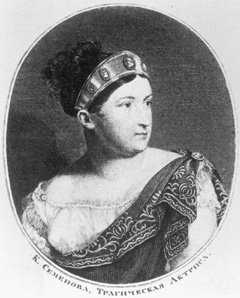
34. A protagonist in a Moscow theatrical duel, 1811: Ekaterina Semënova. N. Utkin, woodcut, 1810. Starikova, Moskva starodavnyaya, 367.]

35. The other protagonist (see fig. 34): Mlle. Georges. Starikova, Moskva starodavnyaya, 367.]

36. National dramatist: Nestor Kukolnik. Shevchenko, Povest Tarasa Shevchenko, 69.]

37. Master of comedy: A. A. Shakhovskoi. Laskina, P. S. Mochalov, 125.]

38. Vaudevillist: D. T. Lensky. Laskina, P. S. Mochalov, 365.]

39. Outdoor performance at a country estate. P. E. Zabolotsky, After Harvesting, 1822: State Russian Museum, St. Petersburg.]

40. A magnate’s favorite. P. I. Zhemchugova-Kovalëva in costume: Starikova, Moskva starodavnyaya, 283.]

41. Provincial theater in Voronezh, mid-nineteenth century. Anchipolovskii, Staryi teatr: Voronezh, 1787-1917, following p. 192.]

42. Commercial provincial theater, Kursk, early nineteenth century. Bugrov, Svet kurskikh ramp, 1:11.]

43. Up from serfdom: M. S. Shchepkin. Senelick, Serf Actor, 53.]

44. Up from serfdom: L. N. Nikulina-Kositskaya as Katerina in Ostrovsky’s The Storm (1860). Morov, Tri veky russkoi stseny, 198.]

45. Out of the provinces: Nadezhda Bogdanova, ballerina. RB, 65.]

46. A provincial performance, early nineteenth century. Zhikharëv, Zapiski sovremennika, 2: following p. 160.]

47. Cultural power broker: A. N. Verstovsky. Laskina, P. S. Mochalov, 218.]

48. P. Alexandrov, View of the Academy of Arts. Lithograph, 1827. Shevchenko, Povest Tarasa Shevchenko, 38.]

49. G. K. Mikhailov, The Second Antique Gallery at the Academy of Arts, 1836. Shevchenko, Povest Tarasa Shevchenko, 150.]

50. A. N. Ladurner, Ceremonial Session, Academy of Arts, 1839. Courtesy of the Tretyakov Gallery, Moscow.

51. Alexei Venetsianov, Life Drawing Class at the Academy of Arts, 1825. Fourth Version: © 2004 State Russian Museum, St. Petersburg.]

52. Karl Bryullov, The Last Day of Pompeii, 1830-33. © 2004 State Russian Museum, St. Petersburg.]
53. V. Timm, Exhibition at the Academy of Arts of A. Ivanov’s The Christ Appearing to the People. Lithograph, 1858. Lotman, Velikosvetskie obedy, 298.]

54. V. I. Borovikovsky, Portrait of A. B. Kurakin, 1801-2. Courtesy of the Tretyakov Gallery, Moscow.]

55. G. G. Chernetsov, Parade, October 6, 1831, on Tsaritsyn Meadow (Mars Field). RKh, 673.]

56. N. I. Podlyuchnikov, Class at the Moscow Art School. © 2004 State Russian Museum, St. Petersburg.]

57. V. A. Tropinin, Self-Portrait Against a View of the Kremlin, 1844. Courtesy of the Tropinin Museum, Moscow.]

58. Serf as artist. Grigory Soroka, Threshing Floor, 1842. © 2004 State Russian Museum, St. Petersburg.]

59. The Iron Foundry. Unknown artist, early or mid-nineteenth century. IIRR, p 173. Vologda Regional Museum.]

60. At the Ale-House. Unknown artist, mid 1850s. © 2004 State Russian Museum, St. Petersburg.]

61. Provincial town scene. Evgraf Krendovskii, Alexander Square in Poltava, 1830s-1840s. Courtesy of the Tretyakov Gallery, Moscow.]

62. Russian provincial merchant. I. V. Tarkhanov, Portrait of an Unknown Person, c. 1837. Kirsanova, Stsenicheskii kostyum i teatralnaya publika, 234.]

63. A. Orlovsky, St. Petersburg Winter Market, 1820s. Lotman, Velikosvetskie obedy, 197.]
64. An early photo of workers, Moscow: The Zlakozov Brothers. Daguerreotype, c. 1856. Courtesy of the State Historical Museum, Moscow.]

65. M. M. Zaitsev, Liberation: Peasants Discussing Alexander II’s Emancipation Manifesto of February 9, 1861. Nikitenko, Up from Serfdom, 201.]

66. N. G. Dobrolyubov. Dobrolyubov, Selected Philosophical Essays, frontispiece.]

67. Musical evening at A. G. Rubinstein’s. Fradkina, Zal Dvoryanskogo Sobraniya, following p. 199.]

68. Mily Balakirev of the Mighty Five. P. I. Chaikovskii, 60.]

69. Alexander Ostrovsky. McReynolds, Russia at Play, 31.]

70. Vasily Perov, Easter Procession, 1861. Courtesy of the Tretyakov Gallery, Moscow.]

71. S. M. Tretyakov’s Moscow mansion, later the Tretyakov Gallery. Buryshkin, Moskva kupecheskaya, following p. 128.]

72. Passenger station on the St. Petersburg-Moscow Line. Zheleznodorozhnyi transport, following p. 160.]