
5
Be on the alert; rest not supine in your easier lives, but remember
‘Mankind is one,
And beats with one great heart.’1
After his stay in revolutionary Paris, Arthur Clough returned to London to hear Emerson’s last lecture series in June 1848, and then the two travelled to Clough’s home city of Liverpool where, on 16 July, Emerson set off on the steamer Europa back across the Atlantic to Boston. After Emerson’s departure, Clough was restless and moved between London, Liverpool, and the Lake District uncertain of what to do now that his Oxford career was definitely behind him. In the spring of 1849 he decided to travel back to Continental Europe: this time to Rome, arriving in the newly declared Roman Republic on 16 April, about ten days before Garibaldi entered the city with his legion of 3,000 men.2 Clough found the Hotel d’Angleterre deserted by tourists because of the recent revolutions. Undeterred, he set off to see the sights: St. Peter’s, the Pantheon, the Coliseum, Sta. Maria Maggiore and S. Giovanni Lateran. A tourist in a revolution once again, he was annoyed that the Vatican Galleries were closed due to the political upheavals, but he eventually got Giuseppe Mazzini’s special permission to see them and then ‘how the officials skipped about for me!’ He had to give up on some of the sights outside of Rome that he had hoped to see: ‘[b]ulbs from the fountain of Egeria I have no chance of getting, not shall I see Tivoli, Albano, or Nemi, for it requires a permit from the Minister of War, and I cannot for shame bother the Dictator any further with my trivial English-tourist importunities’.3 By 30 April, only a couple of weeks into Clough’s stay, Rome was under siege as French troops under the command of General Oudinet attempted to take the city back for Austria. The fighting was serious and bloody. Clough wrote to his sister:
[P]erhaps it will amuse you hereafter to have a letter commenced while guns are firing, and I suppose men falling dead and wounded. Such is the case on the other side of the Tiber while I peacefully write in my distant chamber with only the sound in my ears. I went up to the Pincian Hill and saw the smoke and heard the occasional big cannon, and the sharp succession of skirmishers’ volleys—bang, bang, bang—away beyond St. Peter’s.4
Much as in Paris, the letter reveals the partiality of Clough’s knowledge of what is going on around him: he can only ‘suppose’ the battle which is ‘away beyond’ his ‘distant chamber’ and extrapolate events from ‘the smoke’ and the noise of cannon fire. On 2 May, he reported that ‘they say’ 600 prisoners had been taken and 500 had been killed and wounded in the battle.5
Many of the wounded, both Italian and French, were taken to the Fatebenefratelli Hospital on the Tiberina Island run by the American journalist Margaret Fuller, who had been made regolatrice of the hospital by her friend La Principessa Cristina Belgioioso.6 In America, Fuller had worked on the New York Tribune since 1844. In the summer of 1846, she had left New York for Europe with a commission from Horace Greeley, the newspaper’s editor, to send back dispatches to the paper on the social and political state of the European countries she visited. She visited England and France and then moved to Rome in March 1847—although she took a tour of northern Italy that summer, and only returned to Rome in October. Her uncertain command of French had made Paris difficult for her, so she had worked ‘sedulously’ on learning the Italian language in order ‘to know the common people, and to feel truly in Italy’.7 When the European revolutions flared across the Continent, she had decided, unlike most of her American compatriots, to stay in Rome and to hope to put her fervent Republican sympathies to practical use.8 On 1 January 1849, she exulted that ‘Rome has at last become the focus of the Italian revolution and I am here’.9
Clough had certainly met Fuller by 20 May, when he passed a pleasant day with her and the American sculptor William Wetmore Story, and he spent a lot of time with her in late May and June that year. He visited her hospital and gave her a gift of eau de Cologne for her patients, for which she wrote to thank him.10 She later described Clough as ‘[s]o generous, tender, and advanced in thought’, and in autumn 1849, after the Republic had fallen and both had left Rome, he seems to have trusted her enough to send her a manuscript of some of the ‘Elegiacs and Hexameters, written at Rome during my visit there in the time of the siege’.11 These verses were to become his great epistolary poem of the French siege, Amours de Voyage, not published until 1858, when it appeared in America in the Atlantic Monthly in four parts between February and May. It is a long poem in hexameters, which ends ‘I was writ in a Roman chamber, | When from Janiculan heights thundered the cannon of France.’12 While Clough sat ‘peacefully writ[ing]’ in the rooms he had taken at 74 Via della Croce, composing this most modern of epics, Fuller was trying to keep up a regular stream of articles about the political situation in Italy for Horace Greeley’s New-York Tribune, despite the exhaustion of working long hours in the hospital. On 6 May she opened her dispatch to the Tribune dramatically: ‘I write to you from a barricaded Rome. The Mother of Nations is now at bay against them all.’13 On 11 May Clough wrote to his mother that ‘the gates are all shut, and the streets strongly barricaded. The Pincian gardens, the great resort for walking, are closed and fortified, and between the Trinità dei Monti and Sta. Maria Maggiore, in one line of streets, you can count, I think, six barricades, beside smaller ones in the side streets.’14 Both were writing as ‘foreign correspondents’, albeit one as a journalist and the other as a poet, and both were now writing under siege. The difficulty of knowing or predicting an outcome, the feeling of obstruction and blockage in a city under siege, the danger of the situation and the loss of life around them, and the longing to communicate with the world outside of the city walls forces both these writers to develop a peculiarly urgent epistolary style of address.
Clough and Fuller both wrote from inside the Roman Republic for a transnational audience, feeling that they needed to engage their readers’ support for the Italian national cause. Both try, therefore, to create an imaginative form and meaning for ‘Italy’, which was in reality still a divided collection of separate regions and states. Common concerns emerge from their work: both are interested in communications networks, the relationship between speed and delay, between mediation and presence, between cosmopolitanism and committed internationalism. Both strain to find a literary form for disappointment and delayed political hopes. And both eschew conventional genres and instead develop highly artificial conversational styles in an attempt to collapse the distance between themselves and their readers. ‘Newspaper writing is next door to conversation and should be conducted on the same principles’, declared Fuller in her essay on ‘American Literature’.15 But the conversational voice is not a lazy fantasy of unmediated transparency for Fuller, and still less so for Clough. Making their voices into print was hard toil for both of them, although the relative success of both their projects now masks that labour. In 1848–9, ‘news’ and ‘history’ were drawing very close together. Both Fuller and Clough responded energetically to this challenge in their different ways: he by retooling the classical epic poem for this contemporary crisis, she by writing journalistic literature which was emphatically not literary journalism. It was to the form of the letter that both Clough and Fuller turned in their attempts to place themselves in an ongoing current of fast-moving and unpredictable events, and to clear a space for their own commentary on these events. Clough’s modern verse epistle on the fall of a Roman Republic knowingly echoes Horace’s attempt to ‘regenerate the Republic’ of ancient times in elegant hexameters in his Epistles.16 Fuller’s Tribune letters deliberately join a Romantic epistolary tradition which allowed, as Mary Favret has shown, ‘women writers [to] use…the familiar letter for entry to the world of politics’.17 In her dispatches, Fuller found a way of combining authority and affect by pitching her printed voice somewhere between a public and a private register.
This chapter shows how Clough and Fuller both turned to literary tradition to improvise something new under the pressure of war. Rome under siege in 1849 was much more frightening than Paris had been in the heady days of spring 1848. Effectively imprisoned in the city, with shooting often audible all night as battles raged around the city walls, it became increasingly difficult to maintain an identity as a tourist in Rome. Walking about the city was dangerous as even inside the walls citizens found themselves shelled from time to time. Foreigners were distrusted as possible spies for the French. These were serious risks for those left in the city and the stakes were high. Both Clough and Fuller believed passionately in the cause of Italian unity, and their writing reflects a desire to fully inhabit and interpret what they understood to be a watershed global political moment. They framed their response in writing that had recourse to both ancient classical texts and modern serial forms. The urgent improvisation forced upon them by the revolutionary fighting emerged as a new genre of self-consciously transnational writing that challenged generic, gendered, and national boundaries.
Clough: ‘Le Citoyen malgré lui’
Margaret Fuller and Arthur Clough were thrown together by the Roman siege. They were very different: Clough had a quieter and more ironic nature than Fuller.18 Critics have since unfairly characterized Fuller’s writing as ‘overwrought’, but Clough greatly admired her energy and spirit.19 He held himself at more of a political distance from the events unfolding around him in Rome than the passionate and committed Fuller.20 When the real fighting started both were watching and listening at a distance from the windows of their apartments. Fuller wrote in her dispatch, ‘[t]he attack began before sunrise and lasted all day. I saw it from my window, which, though distant, commands the Gate St. Pancrazio.’21 She wrote privately to Emelyn Story, ‘[o]n Sunday, from our loggia, I witnessed a terrible, a real battle. It began at four in the morning; it lasted till the last gleam of light. The musket-fire was almost unintermitted; the roll of the cannon, especially from St. Angelo, most majestic. As all passed at Porta San Pancrazio and Villa Pamfili, I saw the smoke of every discharge, the flash of the bayonets; with a glass could see the men.’22 Like Arthur Stanley peering at the Paris revolution through an opera glass, Fuller spectates the Roman battle from her loggia through a glass. Clough had less success trying to watch this same battle from his lodgings: ‘June 3. No, your letter won’t go to-day, for the French are attacking us—there! There!’, he wrote to his friend J. C. Shairp, recording the rhythm of the shots in his letter. At 10 p.m. that night he continued, ‘[s]eventeen blessed hours they have battled—3.30 A.M. to 8.30 P.M., and the French, I am told, have been unable to plant their cannon against the wall. The Villa Pamfili has been taken and retaken several times. But to us only smoke and occasional flashes are visible.’23
Clough’s second revolution in Rome was rather less comfortable than his Paris one had been. Although he reassured his mother in his letters that ‘[t]he war would seem to you very small if you saw it and except for the nuisance of all galleries being shut, I should be very well content. We are all safe and comfortable, with British flags hanging out of our windows’, as the situation worsened and the French siege began, Rome became an unpredictable and potentially dangerous place.24 It started slowly. The mob-killing of five priests produced a tense few days for everybody. Clough described the situation with characteristic English understatement as ‘awkward’, but Mazzini was successful in enjoining the people to remain calm and to abjure violence.25 Clough was impressed, reporting back to England that ‘[p]riests, by the way, walk about in great comfort—arm-in-arm with a soldier, perhaps;…they are seen circulating as freely as government paper’.26 For all his sangfroid, though, by the end of June Clough was clearly quite frightened and was trying to get out of Rome as the fighting and shelling intensified. ‘Shall I date one more letter from Rome?’, he wrote to Palgrave: ‘I hope to get off to-day, but Frenchmen break down bridges. Here we are in the nineteenth day of our siege, expecting immediate assault.’27 When the assault started though, Clough manfully went out to meet it:
I found a crowd assembled about 9 P.M. in the north-east corner of the Piazza Colonna, watching these pretty fireworks, ‘ecco un altro!’ One first saw the ‘lightning’ over the Post-office; then came the missive itself, describing its tranquil parabola; then the distant report of the mortar; and finally the near explosion, which occasionally took place in the air.28
Clough imagines the bombs being delivered like ‘missives’ over the Post Office, and missives, letters, and communications of all kinds were highly charged during a siege when any contact with those outside the city was censored and suspect.29 Meanwhile, Fuller and Clough were firing their own missives out of the city, and sending complicated instructions to their correspondents for getting letters into besieged Rome, as Fuller complained that, ‘[m]any addressed to me have been lost’.30 She was indefatigable in keeping her conversation with New York and America going.
Margaret Fuller Broadcasts from Rome
Margaret Fuller was an excellent talker. ‘She was chiefly known in America, I believe, by oral lectures and a connection with the newspaper-press, neither of them happy means of publicity.’31 So Elizabeth Barrett Browning later remembered her friend.32 Fuller was indeed a lecturer and a newspaper journalist, as well as an essayist. She used the lecture, the essay, and the newspaper article to develop a modern style of democratic address which was closer to radio broadcasting than to literary writing. Thoreau recognised that Fuller’s Woman in the Nineteenth Century (1845) was ‘rich extempore writing, talking with pen in hand’.33 She made her voice heard. ‘Victorian print culture was also a vocal culture’, Ivan Krielkamp reminds us, and ‘voice persists in the discourse of print culture, where it remains as trace and residue capable of giving rise to inchoate new forms’.34 For Fuller, it was the American voice that would have the power to create new forms and a new national literature, but voice needed to emanate from consensus and commitment. In her essay on ‘American Literature’, she claims that without a strong national idea ‘all attempts to construct a national literature must end in abortions like the monster of Frankenstein, things with forms, and the instincts of forms, but soulless, and therefore revolting. We cannot have expression till there is something to be expressed.’35 In the meantime, journalism would just have to hold the place of literature.36
Like many of the writers who travelled around Europe during the 1848 revolutions, Fuller was fascinated by the technologies of communication. The ways in which Europe was beginning to join and connect, as we have seen, were technological but also imaginary. In England in 1846, Fuller had read Bradshaw’s Railway Guide with great attention, remarking that ‘this little hand-book [is], more likely, in an era like ours, to influence the conduct of the day than would an illuminated breviary’.37 As ever, Fuller is sharp and specific with her analogy: the medieval breviary was a liturgical book for praying the canonical hours marking the divisions of the day. Bradshaw’s was a daily railway timetable. The divisions of time in the modern world are no longer, therefore, divided up and marked by prayer, but by steam, locomotion, and standardized ‘railway’ time. And when she put Bradshaw’s to the test, ‘[t]raveling by railroad’ from Birmingham, Fuller found that ‘the advantages are immense; you can fly through this dull trance from one beautiful place to another, and stay at each during the time that would otherwise be spent on the road’.38 Her experience of seeing Britain by train was entirely episodic, comprising periods of dullness interspersed with bright intervals of beauty. And such a mode of travelling proved just the thing for a travel writer contributing a series of sketches to a newspaper. Travelling by rail, Fuller wrote about Manchester, Liverpool, Birmingham, Chester, Lancaster, Newcastle, Sheffield, Glasgow, Edinburgh, and Stirling, as well as London.39
Once she arrived in Rome, Fuller took her informational duties very seriously. She quickly translated into English a petition from the people to the Duke of Modena to be printed in full in the Tribune, including requests for railroads and freedom of the press.40 Railroads and freedom of the press had become the staples of the revolutionary demands issued by the people across Europe: to a much greater extent than any of its predecessors, 1848 was a revolution about communication and connection. ‘Every day produces these remarkable documents’, exults Fuller, ‘[s]o many years we have been suffocated and poisoned by the atmosphere of falsehood in official papers.’41 She also translates a ‘Letter to the Most High Pontiff. Pius IX. from Joseph Mazzini (Printed at Paris, 1847)’. In this letter, Mazzini uses the rhetorical paradox of the printed voice as both living, in its collapse of distance, and dead, in its remoteness from its speaker, writing to the Pope, ‘[i]f I could be near you, I would invoke from God power to convince you, by gesture, by accent, by tears; now I can only confide to the paper the cold corpse, as it were, of my thought’. Fuller made similar rhetorical appeals in her letters to the Tribune, insisting on the authenticity of her printed epistolary voice.42 For example, in the Tribune she fulminates against the ‘cancer’ of slavery in America, then makes a rhetorical gesture towards the sincerity of her ‘speech’: ‘[h]ow dare I speak of these things here?…receive them [these words] kindly, my friends; it is, by itself, some merit for printed words to be sincere’.43 Like Mazzini’s imagined appeal, ‘by gesture, by action, by tears’, Fuller’s dispatches were designed to provoke, to convince, and to elicit emotional and well as intellectual responses. She wrote, absolutely and deliberately, ‘for the newspapers’. It is for this reason, perhaps, that those who knew her lamented after her death that her writing bore little resemblance to her sparkling and animated talk. Elizabeth Barrett Browning, who actually liked Fuller very much, said, ‘her written works are just naught… never read what she has written’.44 Henry James echoed this judgement, asking archly, ‘but to what would she have corresponded, have “rhymed” under categories actually known to us?’ He wonders whether Fuller would now appear ‘a somewhat formidable bore’, or ‘a really attaching, possibly picturesque New England Corrine’.45 Like Corrine, the improvvisatrice of Madame de Staël’s celebrated 1807 novel, Fuller had offered a live performance, ephemeral and now lost, and both Barrett Browning and James seem to have instinctively understood that Fuller’s real work was on the airwaves, albeit long before Marconi had dreamt of wireless.
Fuller wrote to her brother Richard in February 1849 from Rome that ‘I read little except the newspapers: these take up an hour or two of the day. I am ardently interested in these present struggles of the nations. I have my thoughts fixed daily on the bulletins of men and things.’46 Clough was equally enthralled by the news: ‘I buy a newspaper every day for a half-penny’, he wrote, ‘which is perhaps extravagant for one can get them read in the cafés for nothing.’47 Victor Considerant, a disciple of the socialist Fourier, whom Fuller had met in Paris, sent her regular copies of his socialist paper La démocratie pacifique while she was in Rome, and she relied on it, along with the English and the American press, although she remarked in one of her dispatches that
I am surprised to see the air of perfect good faith with which articles from the London Times, upon the revolutionary movements, are copied into our [American] papers. There exists not in Europe a paper more violently opposed to the cause of freedom than the Times, and neither its leaders nor its foreign correspondence are to be depended upon. It is said to receive money from Austria. I know not whether this be true, or whether it be merely subservient to the aristocratical feeling of England, which is far more opposed to Republican movements than is that of Russia, for in England fear embitters hate.48
Fuller hated partisanship in the press: ‘[t]he confidence in uprightness of intent, and the safety of truth, is still more needed here [in newspapers] than in the more elaborate kinds of writing’.49 Clough agreed with Fuller about the lies in The Times: ‘I see the “Times” tells very odd stories of Rome’, he wrote back to England, and Mazzini told him that he felt the same. ‘The “Times”, he said, must be dishonest, for the things it spoke of as facts were simply not facts! Emeutes where emeutes had never been thought of.’50 Fuller deliberately used her column in the Tribune to correct ‘fake news’ in the Anglophone press.51 For example, when General Oudinot claimed that his troops had not bombed any antiquities in Rome, Fuller was able to retort, ‘I am eye-witness that they did.’52 And when the conservative British and American press reported that the Italian Republicans were enforcing a brutal rule of terror in besieged Rome, and republican soldiers were harassing women and robbing Roman houses, she was able to contradict that too:
As to not being able to go out in safety, I reiterate what I have before said, and it ought to be enough—I, a woman, walked alone at all hours, in all quarters of Rome; I stood alone amid the throng of soldiers and of citizens; I took with me little girls to help me at the hospitals, and their parents thought my protection sufficient; I was at the gates, at the post-office, in the nearer quarters of Trastevere, in the Vatican gardens—I never saw an act of violence, was never jostled in the excitement of the crowd; I do not believe people or soldiery ever showed a finer spirit.53
While newspaper readership was already a powerful force of American democracy, in Italy it was a different story. The Papal State, the Piedmontese government, and the Bourbon government of the Kingdom of the Two Sicilies were as draconian as the Austrians as censors, the Papal State perhaps even more so than the others. 1849 freed the press in Rome to an extent, but it would never become as active or outspoken as the Tuscan press discussed in Chapter 9. Nevertheless, Fuller read a good cross section of the new Italian papers: Il contemporaneo (a Rome daily); La patria (a Florentine paper); L’alba (Tuscan); and ‘Don Tirlone, the Punch of Rome, has just come in’, she writes in December 1848.54 She describes a cartoon in the paper: ‘[i]n the background a young republican holds ready the match for a barrel of gunpowder, but looks at his watch waiting the moment to ignite it’.55 By the following April the barrel had been ignited, and the forces of counter-revolution were already at the gate in the shape of French troops. The irony of this was not lost on Fuller who exclaimed in a dispatch: ‘the soldiers of republican France, firing upon republican Rome! If there be angel as well as demon powers that interfere in the affairs of men, those bullets could scarcely fail to be turned back against their own breasts.’56 Oudinet had declared a siege, a curfew was in operation, and newspapers were no more: ‘the Press is stifled—everybody is to be in the house at 9 1/2 P.M.’57 The siege meant no news from the outside world could get into the city, but Fuller was determined to get some out. She was already an experienced newspaperwoman, and now she set to work to write as vivid an account as she could of the siege that kept her in Rome.
Serial Dispatches
When Fuller had been working in New York on the Tribune, she had edited her predecessor, James Nathan, who was Rome correspondent for the paper before she took up the role herself. Fuller had told him, ‘[s]end…[dispatches] as often as you can that the interest may be kept alive’.58 As an editor, she well understood the importance of the ongoing series over the occasional article, and how each dispatch must remain open, appearing ‘as part of a potentially ongoing sequence’.59 But she herself struggled to keep her letters going to the Tribune, interrupted as she was by travel, sickness, pregnancy, and revolutionary war. ‘I am very sorry to leave such a wide gap between my letters’, she had written from Paris in 1846 in a dispatch that had also to encompass a retrospect of her trip to London.60 A recurring phrase in her letters to the Tribune is ‘but time fails.’61 It is time that fails her, as if time pushes on so forcefully, eventfully and fast that her writing simply cannot keep up. On 10 January 1849, she ended her new year’s dispatch, ‘now the hour of closing the mail for the Steamer is so near I shall not have time to look over it, either to see what I have written or make slight corrections. However, I suppose it represents the feelings of the last few days…’ .62 The immediacy of the copy dashed off in haste, written to the moment, and consigned hastily to the steamer surely added to the frisson for Tribune readers. Fuller’s presence in distant revolutionary lands was brought alive in her prose by her breaking off her narrative to dash to the mailbox, with the promise of the next instalment, her ‘feelings’ of excitement, and the uncertainty of the future in such extraordinary and unruly times.63 But there was another clock ticking, and another form of expectation and anxiety in her life, too. Through the spring and summer of 1848, at the relatively late age of 38, she was secretly pregnant by her republican Italian lover, Count Ossoli. She concealed this, for the couple were not married, but the pregnancy made her feel physically sick and exhausted. And she was naturally anxious about the future for a baby who was destined to be born in the midst of considerable political turbulence.
The series of dispatches that Fuller produced for the Tribune is about political uncertainty, but it also enacts that uncertainty in its own structure: ‘[a]ll things seem to announce that some important change is inevitable here, but what? Neither Radicals nor Moderates dare predict with confidence, and I am yet too much a stranger to speak with assurance of impressions I have received. —But it is impossible not to hope. Time fails, as usual. The clock strikes, the postbag opens and leaves only time to make the sign of *’.64 Fuller always used a single asterisk in place of a signature on her dispatches. This was not an uncommon practice: the German journalist Claire von Glümer’s reports from Frankfurt in 1848 for the Magdeburger Zeitung are also signed only with an asterisk.65 But the repeated asterisk as signature to Fuller’s dispatches comes to suggest a deferral of authorship, a hasty incompletion, an ongoing enquiry. The difficulties of prediction, the necessity of hope, the inevitability of change, the possibility of disaster: these are the vital underpinnings of liberalism, and they are also the affective structure of the serial. Fuller crafts a powerful narrative out of political uncertainty in Italy. If a serial is, as Laurel Brake has put it, a ‘time-released text’, Fuller was adept at creating a sense of the lived uncertainty of her experiences in Rome.66 During the revolutionary period and the siege, she knew that her dispatches would take longer to arrive than bare news about the political events around her, and so she developed a technique of extending time in her texts, slowing down the process of making ‘news’ and disaggregating the bald newspaper facts by reporting hearsay and gossip from her landlady, snatched glimpses and scraps she had picked up on the streets, at the Post Office, or at the Hospital. She recounted frustrated attempts at finding out information, casting her narrative as speculation to create suspense. In January 1848 she reported that ‘Sicily is in full insurrection; and it is reported Naples, but this is not sure’.67 Then, ‘[t]here is news that the revolution has now broken out in Naples…in particulars these news is [sic] not sure, though, no doubt, there is truth at the bottom’.68 She sometimes played with the idea of suspense during the French siege: ‘I have suspended writing in the expectation of some decisive event, but none such comes yet.’69 She always left her readers with a cliffhanger, a promise of continuing action and eventfulness: ‘[e]very day the cloud swells, and the next fortnight is likely to bring important material for the record of * ’, and ‘[n]ext week I shall have more news, and I shall try to write and mention also some interesting things want of time obliges me to omit in this letter.’70 Fuller’s ‘way of writing, to the moment’, as the novelist Samuel Richardson had done in his epistolary novel Clarissa, published in seven volumes between 1747 and 1748, is a novelistic technique. Like Richardson, she knows that ‘in the minutiae lie often the unfoldings of the Story, as well as of the heart’, and she aims to prevent her readers ‘judg[ing] of an action undecided as if it were absolutely decided’ by offering a variety of possible points of view and keeping her narrative open and contingent at the end of each dispatch.71
Then in February came a ‘decisive event’: the news of the Paris Revolution and the flight of the French King, and Rome was swept into revolutionary fervour itself. ‘[T]he news comes from day to day’, wrote Fuller in April 1848, but ‘there has been no decisive battle, no final stroke.’72 Throughout the revolutionary spring of 1848, she was daily expecting revolutionary action in Rome. ‘To-day is the 7th May, for I had thrown aside this letter, begun the 19th April, from a sense that there was something coming that would supersede what was then, to say.’73 It did: she had to leave Rome as it was no longer possible to conceal her pregnancy. Her son, Angelo Eugenio Filippo Ossoli, was born on 5 September 1848, and she returned to Rome in early December, having left the baby at Rieti, outside Rome, with a wet nurse. Greeley in New York was not at all pleased by her six-month intermission of duty; and she could not explain the real reason for her silence to him, but just about a week after she returned to Rome, events conveniently ramped up. On 15 November 1848, the new Prime Minister of the Papal States, Count Pellegrino Rossi, was assassinated as he entered the Chamber of Deputies. The next day, in the confusion that followed, Pope Pius’s secretary was killed by an angry crowd, and on the night of 24 November the Pope fled from Rome in disguise, betraying all hope of his support for the Republic and for Italian national liberation.74 ‘These events make indeed a crisis’, cried Fuller in the Tribune, re-engaging her neglected readers. Fuller later reported that ‘Rome, so long supposed to be the Capital of Christendom, certainly took a very pagan view of this act [the assassination], and the piece represented on the occasion at the theatres was “The Death of Nero” ’.75 At the time, though, the Swiss Guard at the Vatican were ordered to fire on the people, causing widespread panic. Fuller writes hastily of the events and then signs off: ‘[b]ut enough of politics for the present; this letter goes by private hand, and as news, will be superseded before it can arrive’.76 As we have seen, this was a problem for Fuller: news reached her readers before her dispatches did. But as a first-hand witness, the power of her writing would not be superseded. This is how she describes the events of the day:
The Padrona ran up and down crying with every round of shot, ‘Jesu Maria, they are killing the Pope! O! poor Holy Father—Tita, Tita, (out of the window to her husband,) what is the matter?’
The lord of creation disdained to reply.
‘Oh! Signora, pray, pray, ask Tita what is the matter?’ I did so. ‘I don’t know, Signora; nobody knows.’
‘Why don’t you go on the mount and see?’
‘It would be an imprudence, Signora; nobody will go.’
I was just thinking to go myself when I saw a poor man borne by, badly wounded, and heard that the Swiss were firing on the people.77
The domesticity of the scene, and the revelation of the wounded man carried past the house, tells the reader more about the experience of unforeseen political violence in the city than any simple news report. Ossoli, the father of Fuller’s child, was now fighting with the Italians, so that she was much closer to the Italian nationalist side, and, for Ossoli’s sake, much more fearful of French gunfire, than her American readers could know. Her enthusiasm about the crisis is not merely partisan, though. It came from her growing sense of a transnational struggle for emancipation. She describes the Roman revolution in what initially seems to be conventionally apocalyptic imagery: ‘[t]he waters that flowed so secretly beneath the crust of habit that many never heard their murmur, unless in dreams, have suddenly burst’, but this transforms into an ecstatic bursting into ‘light in full and beautiful jets; [and] all rush to drink the pure and living draught’.78 The destructive explosion becomes the life-restoring fountain. Fuller’s radicalism is also apparent in her countenancing of the assassination of the Minister, Pellegrino Rossi, as part of the political necessity of the moment. Her experience of the revolution in Rome hardened her attitudes to the political necessity of violence, and her writing was powerfully influential in changing the tone of the anti-slavery campaigns in America in the years running up to the American Civil War.79
Fuller arrived in Europe believing that the periodical and newspaper press was crucial to the development of America. In her view, ‘the most important part of our literature…lies in the journals, which monthly, weekly, daily, send their messages to every corner of this great land’.80 And the newspaper press was developing fast in America: ‘[t]he life of intellect is becoming more and more determined to the weekly and daily papers, whose light leaves fly so rapidly and profusely over the land’.81 Unlike her friend Emerson, who retreated from New York complaining of the ‘endless rustle of newspapers’ in the city, Fuller saw the potential of the newspaper first to create and then to transform the American nation: ‘[t]his mode of communication is susceptible of great excellence in the way of condensed essay, narrative, criticism, and is the natural receptacle for the lyrics of the day’.82 And while she was in Europe, she used the aerodynamic mobility of the daily and weekly ‘receptacle’ of the newspaper to float her commentary on European politics back to her American readers.
Literary critics have concentrated on serialized fiction in the nineteenth century but, as we have seen, this was a period in which everything was being serialized—from cookery books, to Bibles, to poetry. In this context, Fuller’s vision of the newspaper as the potential vehicle of serialized culture, knowledge, and debate is a rational one, although she admitted that, for the present, American newspapers did not carry much good poetry or criticism. Significantly, though, her interest is less in content than in format: the potentiality of what she called this ‘mode of communication’ itself. Her imaginary newspaper whose ‘light leaves fly so rapidly and profusely’ is a fantasy about transmission across distance and about wide distribution, extending the broadcast of information to the whole nation. Expatiating on her idea of journalism as ‘conversation’, she made a significant move from a model of personal conversation to that of national address: ‘[w]e address America rather than Americans’.83 Fuller took journalism seriously as an apparatus for what Charles Capper calls her ‘protodemocratic transnational Romantic maneuvers’, and, as he points out, ‘[o]n the magazine side…more than literary historians have noticed’, Fuller was an important innovator.84 Fuller’s transnational work has been repeatedly misunderstood by a discipline that has historically divided ‘literature’ from the media, and worked within rigid national boundaries. If we can begin to understand better the intensely transnational moment of 1848, we can learn to read many texts, and not only Fuller’s, as more significant than they have seemed from the myopic point of view of resolutely ‘national’ literary traditions.
It was only through her experience of the Italian Risorgimento struggle that Fuller realized the extent of the brutal illogic at work in American democracy. Before she left the United States, she had already moved from a position of near indifference to slavery (and boredom with the earnestness of the abolitionists in Boston) to a Garrisonian position of non-violent resistance to slavery. In Italy she realized that ‘I listen to the same arguments against the emancipation of Italy that are used against the emancipation of our blacks; the same arguments in favor of the spoliation of Poland as for the conquest of Mexico. I find the cause of tyranny and wrong everywhere the same.’85 The distance from home, and her passionate engagement with the Italian struggle, helped her to see the enormity of the injustice that was so self-evident as to be almost invisible in her own country. At the same time, she excoriates the ‘slothful and prejudiced view’ taken of Italians by Americans living in Rome, very few of whom take the trouble to ‘penetrat[e] beyond the cheats of tradesmen and the cunning of a mob corrupted by centuries of slavery, to know the real mind, the vital blood, of Italy’.86 The reference to ‘centuries of slavery’ is unlikely to be casual from a writer who is so disgusted by ‘the horrible cancer of Slavery [in America], and this wicked War, that has grown out of it’.87 And Fuller goes on to make the analogy explicit: ‘[Americans in Rome] talk about the corrupt and degenerate state of Italy as they do about that of our slaves at home’.88 Seeing ‘the slave’ as a serial transnational category, not exceptional to America, might initially seem to diminish the horror of the American situation. Yet in fact it helped Fuller to understand the limitations of liberal categories, for alongside ‘citizen’ and ‘revolutionary’, ‘slave’ remained a serial category too, a category that existed transnationally. She was beginning to grasp the politics that produce and maintain inequality across the globe, the politics of what we now might call the ‘global South’. She maintained that ‘[m]y Country [is] the darkest offender’, and in that ‘darkest’ she alludes perhaps to racialized slavery in America, but her transnational perspective also decouples race from slavery and thus breaks the logic of racial determinism.89 She sees the problem very clearly that, as Domenico Losurdo has put it, ‘slavery in its most radical form triumphed in the golden age of liberalism and at the heart of the liberal world’.90 Bell Gale Chevigny describes Fuller’s attempts to square the liberal circle: ‘[a]t the edges of ideology, where its vulnerabilities are most nearly exposed, its contradictions magnified, Fuller pushes at the boundaries of an ideological system, as if struggling at the edges of a magnetic field, without being able to break away’.91 But Fuller had already broken away from Boston and America, and perhaps her greatest achievement was this achievement of distance, allowing her to see ‘the system’ for what it was: a transnational system of exploitation and a global problem of the exclusion of some from the freedoms of others.
Rome enlarged Fuller’s politics. Margaret Allen claims that ‘[t]he Roman revolution completed the process of Margaret Fuller’s radicalization’, but the idea of completion is wrong.92 Fuller’s radicalization hinged on her realization of the incompleteness of the revolution, and the open-endedness of global injustice. Certainly, Fuller seems to have shocked even the liberal-minded Brownings with her uncompromising politics when they met in Florence in 1849 after the fall of the Roman Republic. The Ossoli-Fuller family stopped for some months in Florence on their way back to America. ‘I see a good deal of Mr. and Mrs. Browning—that is a great pleasure’, wrote Fuller.93 Both she and Elizabeth Barrett Browning had had their literary work interrupted by the birth of a child during the revolutions of 1848 and 1849.94 Elizabeth Barrett Browning later described Fuller as ‘one of the out & out Reds’, and reflected after Fuller’s death that the history of the Italian revolution that Fuller had intended to write in America would have been distinguished by ‘those blood-colours of Socialistic views, which would have drawn the wolves on her, with a still more howling enmity both in England and America’.95 As we shall see in Chapter 10, Barrett Browning’s own views would radicalize after she wrote this, as Fuller’s had already done. Like her friend, Barrett Browning would herself begin to realize the immensity of the work left uncompleted by the 1848 revolutions across the whole globe.
Diaries, Letters, Poems: The Serial-Epistolary Form
The written forms that were available to Clough and Fuller under siege conditions were similar, but they adapted them to the politics of 1848 in very different ways. Like Fuller, Clough calls his letters ‘dispatches’, and he clearly expects them to be circulated by their recipients. He writes to Palgrave, ‘[m]edium of all desirable communication with my brethren at home! You shall receive one more despatch.’96 He even incorporates the frantic sequentiality of the newspaper edition into his correspondence: sitting down on the evening of 31 May to finish a letter he had been writing since the 26 May, he gives the next section of his missive the heading ‘Edition du soir’.97 Many of Clough’s letters are dated across a series of days as he narrates the unfolding story of the siege, day by day, and then sends this ‘serial’ as one letter. But his audience is more restricted than Fuller’s ‘America’, mostly consisting of Oxford friends and Paris revolutionary tourist-veterans, Tom Arnold, Arthur Stanley, and Francis Palgrave. Nevertheless, he writes with an eye to posterity, to Stanley, for example, he says, ‘Your historic soul shall be gratified—better late than never— with an account of the fight of 30th April…“Yes, we are fighting at last.” ’98 The nature of Clough’s ‘we’ is intriguing. John Goode says that Clough ‘is conscious of the historical vacuum of the tourist who can be no more than reporter’.99 But the internationalism of the Risorgimento struggle allowed Clough to include himself in that ‘we’, and he did so. After all, Clough and Fuller were trapped in a city that was under military siege, while neither of them was a citizen of Rome. This inevitably produced a complicated interplay of attachment and detachment in their writing.
As had been the case in Paris, it was difficult to locate and follow the resistance-fighters around the city. To Francis Palgrave, Clough wrote that ‘[i]t is curious how much like any other city a city under bombardment looks. One goes to the Ara Celi [sic] or the Palatine to look at the firing; one hears places named where shells have fallen; one sees perhaps a man carrying a bit of one.’100 In between bombardments Clough continued with his sightseeing, although he risked being apprehended as a spy: ‘[w]andering about alone and with the map I have been twice hailed by the civicas as a “spione” ’, but he had his lasciapassare issued by Mazzini and his Italian was good enough to get him out of trouble—‘after some prattle [I was] affectionately dismissed’.101 But while Clough was a tourist with his map, like Claude in Amours de Voyage with ‘Murray as usual under my arm’, he was also a travel-writer, a war correspondent, and a poet. Rome under siege created generic problems for Clough and Fuller as they attempted to create texts that would answer to the accelerated experience of revolutionary politics in 1840s Europe.
Fuller had started her writing life among the Transcendentalist writers of Boston, and she was therefore unconventional in her attitude to genre. Lawrence Buell is right to defend her work against the tyranny of genre, reminding us that ‘the Transcendentalists were exceedingly weak in the genres most in favor today (poetry, drama, prose fiction); but they had strong affinities with other genres and subgenres about which less is known’.102 These writers did all share one form: the serial. It is, nevertheless, difficult to diagnose genre in Fuller and Clough’s Roman writings. They both offer travelogue-like picturesque details of Roman life, oddly mixed with uncensored details of the ugly reality of the siege. Fuller writes:
I…entered the French ground, all mapped and hollowed like a honey-comb. A pair of skeleton legs protruded from a bank of one barricade; lower a dog has scratched away its light covering of earth from the body of a man, and discovered it lying face upward all dressed; the dog stood gazing upon it with an air of stupid amazement.103
The siege made their writing tense and loaded as enthusiasm for the Italian nationalist cause reattached them to the city in more immediate ways than the merely touristic. Dailiness in a siege situation demands a representation more plangent and elastic than the plodding dailiness of the travelogue.104 Fuller characteristically turns from the half-buried corpses to address ‘America’ directly: ‘I pray you do something; let it not end in a cry of mere sentiment.’105 Clough’s writing in 1849 was as hybrid and uneasy as Fuller’s dispatches which ‘wander far outside the boundaries of conventional travel writing and take on the qualities of the history, the sermon, the political manifesto, the historical romance, and especially the diary’.106
Both Clough and Fuller were also keeping private diaries in Rome. Hers was a thirty-eight-page octavo notebook. On the first page she wrote ‘Rome, 1849’. His was a buff-coloured exercise book with a blue linen binding that he had previously used on the Long Vacation he had spent in Grasmere in the Lake District in 1845: ‘Roma -MDCCCXLIX’ is inscribed on the book’s cover inside a pen-drawing of a wall-plaque, although the notebook also contains entries made in Paris in 1848.107 That he used Roman numerals for his date and she did not seems a gendered disparity, and perhaps also a national one. On New Year’s Day 1849 Fuller announces to herself that ‘I shall in this book make brief notes of the events of the day to be filled out as a journal at my leisure’, and she proceeds to do just that, intending the book as an aide-memoire for her future history-writing project.108 But Clough’s notebook is more chaotic and only part diary. He does note his activities in neatly compressed lists, day by day, written in small tidy handwriting. For example, in April his sightseeing, the arrival of the attacking French troops at the nearby port of Civitavecchia, and the closing of the city jostle together [Fig. 5.1]:
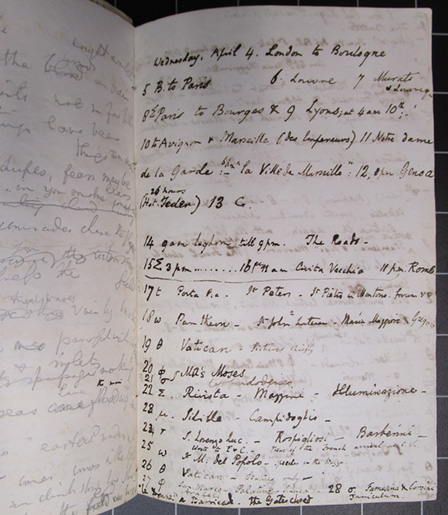
Fig. 5.1 Arthur Clough’s Rome Notebook, 1846–48.
[Reproduced with the kind permission of Balliol College Oxford archives]
21σ MA’s Moses [Michael Angelo]
left from lodgings
22 Σ Rivista –Mazzini—Illuminazione
23 μ Sibilla—Campidoglio.
24 ι S. Lorenzo Luc. – Rospigliosi—Barberini.
Wrote to P & C—News of the French arrival at C.V. [Civitavecchia]
25 ω St. M. del Popolo. Speeches in the Piazza.
26 θ Vatican—Statues only
27 ϕ San Marco—Palatine—S. Luca:. 28 σ. Farnesina & Corsini
Ara Celi Janiculum.
‘Le Donne’ a Barricade. The Gates closed.109
But these tightly compressed day-by-day accounts of his perambulations fight for space with pencilled maps and scribbled thoughts about ethics and science, and interrupted stretches of verse that will later be reassembled into his masterpiece, Amours de Voyage. The drafted lines of poetry are scrawled in a much larger looser hand than the diary-type entries. ‘Will they fight? God knows!…Will they fight? What a bore if they do!’—this is cancelled out, although the lines ‘Will they fight? They say so. And will the French? I can hardly, | Hardly think so; and yet—’ appear in the published version of the poem.110 Fuller asks the same question in her diary: ‘Will the Romans fight? Outwardly they express great order. The chamber of deputies has warmly and unanimously voted to resist…yet somewhere I doubt them all.’111
Fuller keeps to a strict daily sequence in her diary, suggesting that strict dailiness is the raw material of history. ‘I have my thoughts fixed daily on the bulletin of men and things. I expect to write the history, because it is so much in my heart.’112 Fuller is concerned to transform daily events into retrospective sequence, and thereby to transmogrify news into history. She had been working on ‘The History of Italian Liberation’ since 1847. She seems to have conceived of it as a conventional ‘history’ in form: ‘[t]his work if I can accomplish it will be a worthy chapter in the history of the world’.113 The Italian struggle is a chapter to be added to a long series of chapters: this is history imagined as a series. Clough’s diary reveals a different relationship to history and seriality, although he also is concerned with both. The poetry in the diary is written against and across (sometimes literally) the orderly sequence of diarized days. Clough’s history is less orderly than Fuller’s, its seriality less assured, and its modality more generically unsteady. This is partly a gendered difference, as Ann Douglas pointed out long ago: ‘[s]ignificantly, Fuller’s subject was current events—history, not literature’.114 She argues that Fuller deliberately eschewed fictional forms and thought of her work in Rome, including the Tribune dispatches, as ‘historical’ not journalistic, partly in a bid to assume authority and a public voice despite her sex. Clough, with his public-school and Oxford education, experiments more fully with ideas about history, ancient and modern, and tries out different voices. The anxious discipline of Fuller’s Rome diary in 1849 contrasts strongly with the chaotic confidence of Clough’s. Phrases and facts ricochet around from diaries and private letters and find their way into published dispatches and poems. In a letter to Palgrave from Rome, Clough writes:
I told you that Garibaldi lost his negro on the 3rd. ‘Il Moro’ as they called him, was the son of a rich negro merchant at Monte Video, who, though married and father of a family, yet, for love of the Italian captain, came over to fight by his side, which they say he never quitted.115
Garibaldi’s ‘negro’ jumps straight out of the letter and into Amours de Voyage:
Rome is fallen, I hear, the gallant Medici taken,
Noble Manara slain, and Garibaldi has lost Il Moro;—
Rome is fallen; and fallen, or falling, heroical Venice.116
But it was the letter form, and not the diary, that both Fuller and Clough chose to make the basis of their published writings. The letter in print, poised between private and public address, suited Fuller and Clough, both of whom were striving to give an informed political account to a wide readership without sacrificing the authenticity of the first-person witness. Fuller went so far as to define all ‘Literature’ as ‘an epistolary correspondence between brethren of one family’, pitting the proximity of ‘family’ against the distance of ‘correspondence’.117 Fuller’s balance between a ‘feminine’ familial intimacy of address and a ‘masculine’ view of politics and war is a particularly delicate one.118 The letter form allows her to put herself in dialogue with the daily newspapers and to question the official account of events. Epistolary form is always a proto-serial form because it supposes a sequence of individual letters across time, and in Rome in 1849 Fuller and Clough both found and exploited a serial-epistolary form. Claude, the central ‘character’ in Clough’s Amours de Voyage, is crucially not even a character as such, but ‘a writer of letters’.119
Amours de Voyage is composed of a series of letters from the traveller Claude to his ‘clerical’ friend Eustace, and also includes letters from two girls, the Trevellyn sisters, to their friends. As David Masson was to put it, the story is ‘stragglingly told in the form of letters from Claude himself, or from one or other of the girls’.120 The straggling is part of Clough’s plan. Claude starts the poem, ‘Dear Eustatio, I write that you may write me an answer, | Or at the least to put us again en rapport with each other.’ But Claude receives no answers within the text of the poem, which presents a series of non-rapports, blocked views, and failed meetings.121 Claude’s experience of the French attack on the ‘poor little Roman Republic’ is oblique and partial, partly due to the bewilderment of the tourist who is self-confessedly lagging behind and ‘slow at Italian’ (unlike Clough himself). The battle with the French troops on 30 April, which both Fuller and Clough had described themselves watching at a distance from their windows, is represented in Clough’s poem as a distant spectacle by the non-participant tourists in the city:
So we stand in the sun, but afraid of a probable shower;
So we stand and stare, and see, to the left of St. Peter’s,
Smoke, from the cannon, white,—but that is at intervals only,—
Black, from a burning house, we suppose, by the Cavalleggieri;
And we believe we discern some lines of men descending
Down through the vineyard-slopes, and catch a bayonet gleaming.122
They are afraid, not of the battle, but of a probable shower, speculating (‘we suppose’, ‘we believe’, ‘we discern’) without adequate information, piecing together what they see. The distant scene fragments into details which cannot be fully decoded and converted into narrative by Claude or the reader. Later the violence moves closer as Claude sees a priest killed in the street, or rather thinks that perhaps he has seen a man killed in the street, but even at this proximity his view remains partial and blocked:
So I have seen a man killed! An experience that, among others!
Yes, I suppose I have; although I can hardly be certain,
And in a court of justice could never declare I had seen it.
But a man was killed, I am told, in a place where I saw
Something; a man was killed, I am told, and I saw something.
…
Passing away from the place with Murray under my arm, and
Stooping, I saw through the legs of the people the legs of a body.123
Somewhat absurdly, Claude has to bend down and peer through the legs of the crowd to catch a glimpse of what might be the lifeless legs of a corpse: a comic movement so perfectly controlled so that it also remains serious. Clough is interested in contemporary questions of mediation and transmission, in the limitations of reportage and finally of experience itself. In Amours de Voyage, he expertly creates the illusion of unmediated or badly mediated experience. Claude’s Murray’s tourist guide is, after all, utterly inadequate to the task of explaining ‘the stir, shouting, and gossip of war’ in Rome, and Clough’s poem expends a great deal of creative energy in making this lack of clarity clear.
The second half of Amours de Voyage follows a relay of broken and mistaken journeys around Europe, when Claude leaves Rome in pursuit of Mary Trevellyn, with whom he has somewhat grudgingly fallen in love, or thinks he might have done.
She goes—therefore I go; she moves,—I move, not to lose her.124
He travels to Milan, hoping to overtake her and her family, misses them, he ‘posts’ to Como, taking a relay of horse-drawn carriages, where Mary has left a letter for him telling of their change of plan, ‘but the cameriere had lost it’; he turns back to Florence, but the friend who could have put them in touch has left for Lucca for the summer, and so it goes on.125 At each relay point on Claude’s journey—Milan, Florence, Como, and so on—he arrives too late and the connection is lost. Amours de Voyage is structured by an obsolescent technology: it is epistolary at the dawn of the telegraphic age. Quite self-consciously it makes the shift from the epistolary to the ‘epistolary mode’, in a wider, looser and less connected sense.126 The failed series of relays in the second half, as Claude pursues Mary around Europe, echoes the ricocheting of the revolutions the previous year, and the poem ends as inconclusively as they had done. The looseness and seemingly frictionless movement of this section are created by the repeated failures to connect. Bernhard Siegert has written that ‘[t]he relay is not only the nexus of power in the economies of transport and circulation, but also potentially the least secure point in the entire communications system’.127 The point at which the message arrives is also the point at which it can get lost or, encountering a blockage, leak out its energy and dwindle into faintness and incoherence. Clough’s poem seems to understand the entropy of communications systems. The curious bifurcation of Amours de Voyage into a political narrative and a romantic plot creates two separate circuits of energy that constantly promise a connection, but always fail to deliver. ‘Rome is fallen; and fallen, or falling, heroical Venice’: the Roman siege of 1848 had indeed blocked the onward progress of the republican message and exhausted it, and the fall of the Venetian Republic followed soon after. Neither of the dual sequences in the poem is satisfactorily completed. Claude sits ‘moping and mourning’ for the loss of Mary. For Hungarian Marxist critic György Lukács, 1848 was the year that the European bourgeoisie abandoned its revolutionary role and the classical historical novel started its decline into bourgeois decadence.128 It almost seems as if Amours de Voyage is ironically dramatizing the Lukács-like gap which is appearing between the bourgeois-novel plot and world history, avant la lettre. Clough himself, returning to London from Rome and to ‘the position at University Hall’ which he had accepted ‘with a good deal of misgiving it must be confessed’, faced the problem of squaring his disappointed socialist sympathies with the bourgeois plot of his own life: his professional duties and his plan to marry.129
The eventual publication of the poem in parts in the Atlantic Monthly was attenuated over four months and Emerson reported to Clough on his experience of reading the poem in this form: ‘I read the first livraison of your poem with joy.’130 By the time he got to the end, however, he was less impressed: ‘I cannot forgive you for the baulking end or no end of the Amours de Voyage’, he complained.131 Clough responded that ‘I always meant it to be so and began it with the full intention of its ending so.’132 Clough was surely ahead of the game in realizing that the remorseless logic of the serial will ultimately undo genre. The very form of his poem was about the nightmarish open-endedness of history, and the impotence of genre to hold things in place. In Amours de Voyage, Clough created travel without direction or destination, and multidirectional motion without end. Charles Kingsley recognized with admiration that ‘[t]he scandalized scansionist stumbles on occasional trochees in every foot in a verse, to stop at last, horror of horrors! at a line which will not scan at all—forward, backward, or sideways’: Clough’s English hexameters refuse to scan properly and proceed bumpily, obstinately kicking things out of their proper places.133
Clough’s Frightening Hexameters
‘The hexameters frightened some citizens’, Emerson admitted.134 Since then, Clough’s repurposing of the classical hexameter into English has sometimes seemed to be the only aspect of his poetry discussed by critics. It continues to be evaluated as if it were a gentlemanly classical puzzle set by a dusty dry Oxford don to amuse himself.135 Clough had been intrigued by the affordances of the hexameter in English when reading Longfellow’s Evangeline out loud to his mother and sister in the autumn of 1848, and American contemporaries would see much more quickly and clearly than British friends what was fresh and important about Clough’s project.136 Charles Eliot Norton wrote in 1862 that Amours de Voyage shows ‘the fulness [sic] of his sympathy with the intellectual conditions of the time’.137 Crucially, by 1849 Clough was no longer an Oxford don and was himself facing a frighteningly uncertain future when he wrote the poem during an upsurge of politically revolutionary activity. As Norton said, ‘[h]e had nothing of insular narrowness’, and his poem moves outwards, its ripples touching on the past and the future, before running out into an endless uncertainty.138 Its untidiness and restless onward flow is the hallmark of the modernity of Clough’s writing.
In Rome in 1849, Clough’s deep classical education was no doubt helpful. It allowed him to play constantly with the superimposition of ancient and modern Rome, jokingly writing to Tom Arnold that ‘[t]he barricades are very strong. A perfect agger Servianus and fossa Quiritium crosses the road between the Palatine and the Aventine.’139 To Arthur Stanley, he gives a long description of a battle and then says: ‘There—to be translated into the style of Livy!’140 In adopting a classical metre in English for his own poetry, he is making a translation, but it is a bold one, and closer to a transformation. David Masson recognized in 1862 that Amours de Voyage ‘is a thoroughly contemporary poem’, but Clough’s first readers complained about its oddness.141 His friend Shairp, for example, felt that ‘the Hexameter…always has a feeling of parody.’142 Amours de Voyage is not a parody but Shairp was right that it has ‘a feeling of parody’. For both Fuller and Clough, the re-enactment of the ancient Roman Republic in 1849 teetered precariously between the heroic and the parodic. In her diary, Fuller described the Republican government processing ‘to the Capitol which was illuminated carrying the urns with civica banners, music, torches and all that sort of thing. Marcus Aurelius looked astonished and refuses to retain the tri-color in his hand, it always drops and droops most pitifully.’143 For both Clough and Fuller, the past offered no firm guarantee for the future.
Markovits does sense something new, a kind of ‘generic explosion’ in Clough’s writing, but this makes him sound much less in control than he really was.144 Clough himself referred to Amours de Voyage as his ‘5 act epistolary tragi-comedy or comi-tragedy.’145 The tragic and the comic, the heroic and the satiric, the epic and the domestic, the dramatic and the lyric, the war and the peace: all are exquisitely calibrated one against the other in a multi-vocal, multidirectional affective network.146 So, when Barbara Hardy declared that ‘his central form is of course narrative’, she was surely wrong.147 The strong gravitational pull of the Victorian novel for critics and scholars of the Victorian period has made it difficult to read the long poems (by Clough, but also by Browning and Barrett Browning) on their own terms.148 Judged as narrative, ‘Clough’s storytelling is…disordered and foreshortened’ for sure.149 But judged as a political form that creates a peculiarly modern affect, that same foreshortening is about distance and proximity, the distortions of political and social networks, uncomfortable relationships to the past and to the atrophied possibility of the future. Clough is not telling a ‘story’. He is very close-up to events and very angry in Amours de Voyage. He is furious about the failure of the Roman Republic and furious about Britain’s underhand support of France in putting it down. His fury is partly transmuted and softened into the ironic and rueful tone of the poem, but it is nevertheless also always betrayed by the relentless unstoppability of the hexameter lines, which spool on and on in big loose galloping loops. John Goode has written that this ‘expansiveness gives us the opportunity to watch available languages, metaphors and intonations work themselves out and mutate into something else’.150 This is Clough’s great innovation: a serial which works through ‘juxtaposition’ (in Clough’s own word) towards change. The placing of things side by side and their evaluation creates an engine of relativism in the poem. In his Rome notebook, Clough wrote ‘[t]his is the worth of all Physics:…to supply similes for Ethics. This is the worth of human life to collect similes : i.e. to be conscious.’ Clough’s poetic method is restlessly comparative, finding this like or unlike that, and moving ever on. Amours de Voyage collects similes because it is a poem about being conscious and about the inconclusiveness of the conscious mind which must always be alighting on the next thing and generating the next thought.
Both Fuller and Clough left Rome deeply saddened by the fall of the Republic. Both of them would die young: Fuller in 1850, and Clough in 1861.151 Neither lived to see the dramatic change in international opinion which meant that Garibaldi was welcomed as a hero when he visited Britain in 1864. Clough lived just long enough to see the Italian nation united in 1861, and he died in Florence.152 As David Masson pointed out in a discussion of Clough’s work published not long after the poet’s death, ‘[w]hat man among us, what newspaper, but now holds the doctrine of the necessary unity of Italy, exults in that doctrine, treats it as an axiom in European politics?’153 But Clough and Fuller had been lone voices in the fearful atmosphere of 1849 during the ‘Springtime of the Nations’. They were both soon to turn their backs on the Old World and look to the New. Margaret Fuller wrote that she would ‘leave Italy until she has strength to rise again, and stay several years in America. I should like to refresh my sympathy with her great interests and great hopes.’154 She felt her best chance was to return to the United States and publish her Italian History. The small Ossoli-Fuller family set sail for New York from Livorno in May 1850. They never made it—Fuller, Ossoli, and their little child, Angelo, not yet two years old, drowned when their ship was wrecked off the American coast. Fuller’s Italian History was never recovered.155
Like Fuller, Clough left Italy after Rome fell. As the dream of ’48 receded, Clough sighed ‘I am full of admiration of Mazzini. But on the whole, “Farewell, politics, utterly! What can I do?”’156 Clough may have announced his retirement from politics when he left Rome in 1849, but his experiences of revolutionary Paris and Rome would underpin much of his (sadly short) subsequent life. He is remembered, if at all, today as the poet of failure. G. H. Lewes described him as ‘one of those prospectuses which never become works…they fail’, and in 1920 James Insley Osborne speculated that Clough’s poetry will continue to find a few readers but ‘they will probably, even though they like him, keep finding him something of a failure’.157 More recently, Stefanie Markovits has offered a diagnosis of Clough’s ‘crisis of action’, and Adam Phillips, in a sympathetic essay, reflects on how often Amours de Voyage has been misread, although it is itself a poem about misreading, and how Clough’s interest in failure has ironically led to him being remembered as a failure.158 Barbara Hardy rather did for Clough in an important essay of 1969 when she set him on the mantelpiece of literary history, ‘visibly imprisoned in his Victorianism, breathing with difficulty under its glass dome’.159 The clue here is the word ‘Victorianism’. For like Fuller, the oddity of whose work cannot be entirely absorbed into the canon of ‘American letters’, Clough was a poet of the nineteenth century, rather than a ‘Victorian poet’. As a traveller and an emigrant, his themes are mobility and distance: his best work was composed in Italy and published in America. It is the critic writing in a book about ‘Major Victorian Poets’ who needs to imprison him under the glass dome of ‘Victorianism’. Clough’s poetry itself is transatlantic, full of air, sea spray, and distant views: his last work, Mari Magno or Tales on Board, was to be a series set on a transatlantic voyage: ‘’Twas in September, o’er the autumnal sea | we went, the wide ocean o’er’.160 One of Clough’s best critics, John Goode, differently expresses the problem of reading Clough historically: ‘[i]t is impossible to discuss Clough by lifting him out of the 1840s, but this doesn’t mean that we should bury him in it’.161 If we accept that the revolutionary moment of 1848–9 was crucial in remaking European polity, in consolidating a reform liberalism, and in canonizing national literatures across Europe, then Clough’s extraordinary engagement with contemporaneity in ‘the 1840s’ becomes less of a yawning critical grave, and more the immediate source of the power of his poetic innovations.162
By 1852, after an unsatisfactory period at the Unitarian University Hall and a Professorship of English Language and Literature at University College London which did not pay him enough to live on, let alone marry, Clough had decided to emigrate.163 Encouraged by Emerson, who undertook to help him launch a career in Boston, he looked hopefully towards America. He had already crossed and recrossed the Atlantic in his life. From the ages of three to nine, Clough had lived in Charleston, South Carolina, where his father was a cotton merchant, presumably dealing in slave-picked cotton. Clough never seems to have commented on the fact that his family in Liverpool had built their wealth on slave labour, and that his earliest recollections were of the racist American South. His sister Annie, who was left at home in Charleston while Arthur was away in England at school, did remember Lizzie, the slave that her family hired as a servant, and she also remembered becoming conscious of the brutal South Carolina legislation which decreed that no slave could be taught to read or write. Annie knew too that if a slave was freed they had to leave the state, either to go North or emigrate to Africa.164 Clough must have known these things too. That he spent his early years there perhaps helps to explain his decision to return to America. The 5 November 1852 found him ‘on board H.M.S. “Canada,” which is tossing like fury against a dead-ahead wind’.165 On 9 November ‘[t]he ship is plunging like a porpoise’.166 Despite the rough seas, Clough’s purpose was set and firm and he kept his eye trained hopefully on the future in the shape of the New World.
America and a Liberal Isopolity
Charles Eliot Norton remembered Clough in Boston: ‘[h]is liberal sentiments and his independence of thought harmonized with the new social conditions in which he found himself, and with the essential spirit of American life’.167 Clough immediately felt himself ‘on very easy terms with the American world in general’, and discovered to his surprise that a whole edition of his poem the Bothie had been ‘printed and sold’ in Boston, and that ‘[p]eople here put it on their drawing room tables’. To his astonishment, he was considered a ‘celebrated author’.168 He worked ‘pupilising and writing’ as a tutor in Boston and contributing articles to the North American Review.169 To start with, it was hard to make ends meet, and he relied on the kindness of friends; the Nortons, for example, asked him to house-sit for them at Shady Hill over the summer when they were away at Newport. But Clough could see that if he applied himself in America, he would be able to establish a reputation and a living in that energetic culture. He spent time with Lowell, Thoreau, Hawthorne, Longfellow, and, in particular, with Norton and Emerson. He met Margaret Fuller’s mother at Emerson’s house and ‘liked her’.170 He was impressed by the treatment of the poor in America compared to their miserable condition in Britain. He noticed that black children could attend free public school in Cambridge alongside white children, although not in Boston. He pitched himself into the Free Soil Party debates and the bitter arguments over the Fugitive Slave Law: the latter Clough thought ‘a piece of truckling to the South—quite an unnecessary concession’. He was introduced to Harriet Beecher Stowe.171 He mixed in largely abolitionist circles, although he discovered that there were many shades of abolitionism. One night he ‘had Abolition pretty well out with Emerson, with whom one can talk with pleasure on the subject’.172 Emerson believed that emancipation should be purchased to compensate slave owners for the loss of labour.
At the end of June Clough received a letter from England containing the offer of the job of an examinership in the Privy Council Office in London. The job in the Education Office would provide—although only just—the necessary income for him to marry Blanche Smith. Clough prepared to return to Britain, not without serious misgivings about ‘returning from the young, and hopeful, and humane republic, to [the] cruel, unbelieving, inveterate old monarchy’.173 He wrote to Blanche regretting that she would not now be joining him in America as they had planned. Clough’s ‘emigration’ therefore lasted only eight months in the event, and he later came to speak of it as his American ‘visit’, but at the time it was undertaken with all the seriousness of a permanent move.
Back in London and at his desk job, Clough wrote that ‘I sometimes get overpowered by the burden and weight of European metropolitan life, and am driven in spirit to the solution of Transatlantic new life’.174 Although he was not pleased by the direction of American politics, he fantasized about the possibility of transatlantic citizenship: ‘[b]etween America and England, between the British American Colonies in particular and the United States, one would be glad if there could exist some isopolity: that a man might be a citizen in which he pleased, and change about as he chose’. It was characteristic of Clough that he was attracted by the idea of a mobile and dissolving nationhood, and an attenuated state of belonging. ‘Isopolity’ was to re-emerge in British politics at the end of the century, as a racist means of effecting a transnational category of white citizenship under conditions of empire, but Clough’s version was different.175 He had witnessed two revolutions, and he had understood the seriality of the idea of citizenship as it emerged in 1848. His isopolity is less about white supremacy and more about a multidirectional belonging which can ‘change about’ and move backwards and forwards. Nationality is blurred in his theory, but not extinguished: ‘[h]ad I remained with you’, he writes to Norton, ‘I would gladly have become an American citizen; but I should not like to pledge myself to fight against England, except in defence of my new country.’176
Clough had not fought against the French at Rome. In Claude’s words in Amours de Voyage, ‘I cannot | Fight, you know, and to talk I am wholly ashamed’. After Paris, but before Rome, Clough had written to Tom Arnold: ‘[s]omething, I think we rash young men may learn from the failure and discomfiture of our friends in the new republic. The millennium, as Matt [Arnold] says, won’t come this bout. I am myself much more inclined to be patient and to make allowances for existing necessities than I was.’177 Along with others of his veteran revolutionary-tourist friends, the revolutionary experience was to make of Clough a liberal reformer rather than a radical. The legacy of the revolutions of 1848, and the evidence that they were far from the ‘failure’ we have since been taught that they were, was not only in constitutional reform—which was almost universal in the revolutionary states after 1848—but also in the vast investment of energy across Europe in systems of communication and systems of national health and education. It was no longer possible, after 1848, to think nationally without making international comparisons. Nations had been put in conversation with each other and ‘national culture’ was thereafter a plural and serial category born out of this most international of events.
After witnessing the French revolution, William ‘Education’ Forster, Frederick Oldfield Ward, and Clough all became active in education and health reform. The events of 1848 had made them see very clearly the contiguity of the political and the social and they would all go on to argue for more state intervention in the lives of ordinary people, and for a retreat from brutal laissez-faire liberalism.178 And they would all remain internationalist in their outlooks. Forster returned from France to his Bradford mill and established a mill school in 1854 and a local Board of Health five years later. As MP for Bradford he is best remembered for his 1870 Elementary Education Act in which he successfully created a long-lasting and robust legislative framework for elementary education, much influenced by Continental comparisons. Universities and hospitals became Clough’s purview. His job took him to France, Prussia, and Austria to inspect scientific and military schools on behalf of the British government.179 He devoted most of his spare time to assisting Florence Nightingale in her campaign to reform military hospitals and he escorted her to Calais in 1854 on her first voyage to the Crimea. His political interests remained multifarious and international: for example, in 1854 he wrote to Norton, ‘I read your article on Indian Canals with much pleasure and interest’.180 Like his fellow travellers in 1848, he retained a wide view. The lecture series that he wrote in the early 1850s upon his return from Europe were more important than has been remembered in establishing a different kind of ‘English Literature’ in British universities than that which came to dominate later in the century and through the twentieth century and beyond. Clough’s version of ‘English Literature’ remained fully embedded in the classical and European tradition. The subject would be ‘nationalized’ later in the century, just as the 1848 revolutions would be increasingly appropriated as ‘national’ events and their vital internationalism would be written out of the story.
Conclusion
Scribbled hastily and messily in pencil in Clough’s Roman notebook of 1849 is the incomplete draft of another poem that he was assembling during the French siege, ‘Say not the…naught availeth’. It was to become one of his more famous verses, ‘Say not the struggle naught availeth’, and it was written as a kind of elegy for the 1848 revolutions. But typically for Clough, it is not all elegy, but rather a hybridized anthem-elegy which refuses failure and even closure. Natural images of clouds and waves breaking but building again move inexorably forward and creeks bubbling from multiple sources bear ‘silent seas’. The gradual work of the revolution is still under way, pushing unstoppably forward:
It may be, in yon smoke concealed,
Your comrades chase e’en now the fliers,
And, but for you, possess the field.
With Clough’s characteristic insistence on the partial and blocked view, the progress of the struggle is ‘concealed’, and outside of the line of sight of both the speaker and the addressee of the poem.181 The original draft ends with the line ‘Behind you, look, the field is bright’. Clough amended this to ‘But westward, look, the land is bright.’182 With this amendment, he connects the ongoing work of revolution in Europe and the young democracy of a post-revolution America, and it is a connection that he and Fuller both made naturally in Rome in 1849: ‘Mankind is one, | And beats with one great heart’, as Fuller reminded her American readers. And they both identified this inexorable process with the spread of print. In a lecture on Dryden that Clough gave at University Hall in London when he returned from Rome, he remarked that
A democratic revolution is effecting itself…without that aristocratic reconstruction which pertains to every good democratic revolution. Everybody can write, and nobody writes well…Our grandfathers read and wrote books: our fathers reviews: and we newspapers; will our children and grandchildren read our old newspapers?183
Despite the anxiety about democratization expressed here, it was the great achievement of Fuller and Clough to see the democratic potential of serial print and to understand the importance of newspapers in moving the world forward. Their creative contribution, so little appreciated at the time and still not fully understood, was to experiment with finding a democratic literary voice by trying to make truly good writing out of the ‘daily bulletin’ of the news.
1 [MF], Dispatch 34 (Rome, 4 July 1849), Sad But Glorious, p. 311. The dispatches were written between 23 August 1846 and 6 January 1850 to the New-York Daily Tribune.
2 In the revolutionary year of 1848 Pope Pius IX had been celebrated as a liberal and the possible leader of a united Italy. The Pope set up a parliament and in September appointed a reforming prime minister, Pellegrino Rossi; but he was reluctant to act on a popular demand to make war on Austria. After two months in office Pellegrino was assassinated and a threatening mob surrounded the Quirinal Palace. The Pope was forced to dismiss the Swiss Guards and on 24 November he fled in disguise to Gaeta, Kingdom of Naples. In the following February, a Constituent Assembly in Rome declared that the Pope had forfeited temporal power. A republic was proclaimed; the Piedmontese patriot Guiseppe Mazzini was declared a Roman citizen and arrived in March 1849 to be the effective dictator of the city. On 27 April he was joined by Guiseppe Garibaldi with a small band of irregular soldiers.
3 AHC to his mother (28 May 1849), AHC Remains, p. 151. The ninfeo of Egeria stands close to one of the gates of Rome, the Porta Capona, and was a popular picnic spot in the nineteenth century. It became a tourist custom to collect plant bulbs from the site to grow at home. In the end Clough was able to visit Albano, Arricia, Nemi, and Castel Gandolfo in the first two weeks of July 1849, after he had left Rome.
4 AHC to Anne Clough (30 April–2 May 1849), AHC Remains, p. 149.
5 Ibid.
6 Fuller was already very well connected in Italian political circles. She had met Mazzini in London at the Carlyles’ house in Autumn 1846. She had spent the summer of 1847 in Milan and on the lakes of Northern Italy and met Milanese radicals including Constanza Arconati Visconti, Cristina Belgioioso, Pietro Maestri, and Anselmo Guerrieri-Gonzaga. Some of these people would later become leaders of the revolutionary government. See Cristina Giorcelli, ‘A Humbug, A Bounder, and a Dabbler: Margaret Fuller, Cristina del Belgioioso, and Cristina Casamassima’, in Charles Capper and Cristina Giorcelli (eds), Margaret Fuller: Transatlantic Crossings in a Revolutionary Age (Madison, WI: University of Wisconsin Press, 2007), pp. 195–220. The Monte Cavallo Hospital and a hospital at the Quirinale were also run by Cristina Belgioioso during the Roman siege.
7 MF to RWE (20 June 1847) MF Letters 4, p. 276.
8 The best source on Margaret Fuller is Charles Capper’s excellent two-volume biography: Charles Capper, Margaret Fuller: An American Romantic Life, vol. 1: The Private Years (New York: Oxford University Press, 1992); vol. 2: The Public Years (New York: Oxford University Press, 2007).
9 MF, ‘Rome 1849’: MF’s diary for January to May 1849 washed up in a trunk after the shipwreck. The 38-page octavo diary is now in the Widener Library, Harvard University. Some of it is transcribed in Leona Rostenberg, ‘Margaret Fuller’s Roman Diary’, Journal of Modern History 12:2 (June 1940): 209–20.
10 Anthony Kenny speculates that Clough may have harboured some romantic feelings towards Fuller, not knowing that she was already secretly married at the time. He notes that Clough carefully preserved this thank-you note and that when he became engaged he sent it to the care of his fiancée. See Anthony Kenny, Arthur Hugh Clough: A Poet’s Life (London: Continuum, 2005), pp. 177, 186.
11 AHC to Charles Eliot Norton (9 May 1854), AHC Remains, p. 225.
12 [A. H. Clough], ‘Amours de Voyage [Concluded]’, Atlantic Monthly (9 May 1858): 784–90, p. 790 (italics original).
13 MF, Dispatch 30 (6 May 1849), Sad but Glorious, p. 274.
14 AHC to his mother (11–13 May 1849), AHC Corr., p. 254.
15 Margaret Fuller, ‘American Literature. Its Position in the Present Time, and Prospects for the Future’, Papers on Literature and Art, 2 vols (New York: Wiley & Putnam, 1846), vol. 2, pp. 122–43. Leslie Eckel discusses Fuller’s series of ‘Transcendental Conversations’ in Boston that she ran exclusively for women every winter from 1839 to 1843: Leslie Elizabeth Eckel, Atlantic Citizens: Nineteenth-Century American Writers at Work in the World (Edinburgh: Edinburgh University Press, 2013).
16 William C. Dowling reminds us of the parallels of the political moment in which Clough found himself in Rome in 1849: ‘the verse epistles of Horace may be regarded as the poetry of the same moment that produced Cicero’s disillusionment, an attempt to regenerate the Republic as a private ethical ideal within a fallen social or political reality’: William C. Dowling, The Epistolary Moment: The Poetics of the Eighteenth-Century Verse Epistle (Princeton, NJ: Princeton University Press, 1991), p. 37.
17 Mary A. Favret, Romantic Correspondence: Women, Politics and the Fiction of Letters (Cambridge: Cambridge University Press, 1993), p. 7. Favret’s wide-ranging book explores the gendered career of the ‘public/private letter’ between 1790 and 1830. She shows how Helen Maria Williams’s Letters from France and Mary Wollstonecraft’s Letters Written During a Short Residence in Sweden, Norway and Denmark both translate ‘the familiar letter into a public critique’: Favret, Romantic Correspondence, p. 96. Discussing revolutionary corresponding societies, she notes that‘“[l]ooseness”, not surprisingly, made the familiar letter the most significant instrument for political propaganda during the years of the revolution’: p. 24. Ann Douglas makes a similar point: ‘Not surprisingly, Fuller did her finest writing before 1843 in the informal, personal mode of the letter. There she could best sustain the illusion of an actual audience.’ Ann Douglas, ‘Margaret Fuller and the Disavowal of Fiction’, in The Feminization of American Culture (New York: Alfred Knopf, 1977), pp. 259–89, p. 273. See also William Decker, Epistolary Practices: Letter Writing in America before Telecommunications (Chapel Hill, NC: University of North Carolina Press, 1998), in which Decker sees American letter-writing as a cultural practice of nation-building; and Nan Johnson, Gender and Rhetorical Space in American Life, 1866–1910 (Carbondale, IL: Southern Illinois University Press, 2002).
18 Clough’s ironic stance in relation to political events is evident in a letter to his friend Francis Palgrave which he signed off with the phrase ‘Le citoyen malgré lui’ [the citizen in spite of himself]. This is a play on the title of Molière’s 1666 farce Le Médecin malgré lui [the doctor in spite of himself]. AHC to F. T. Palgrave (21–29 June 1849), AHC Corr., p. 264.
19 Reynolds, European Revolutions, p. 72. Reynolds suggests that Fuller’s work is ‘womanly’ and ‘warm’ whereas Emerson’s, by contrast, is cold and distant. This seems a strange misreading of work which, in both cases, is ambivalently gendered.
20 Clough was attracted to spirited women of action. After his return to England, he became the unofficial and unpaid private secretary to Florence Nightingale and worked tirelessly on her public-health campaigns.
21 MF, Dispatch 32 (10 June 1849), Sad but Glorious, p. 291.
22 MF to Emelyn Story (6 June 1849), MF Letters 5, p. 238, quoted in MF Dispatch 32 (10 June 1849), Sad but Glorious, pp. 291–2 n. 5.
23 AHC to J. C. Shairp (2–18 June 1849), AHC Remains, pp. 155–6.
24 AHC to his Mother (11 May 1849), AHC Remains, p. 149.
25 Ibid.
26 AHC to A. P. Stanley, (24 May–11 June), AHC Remains, p. 153.
27 AHC to F. T. Palgrave (21 June 1849), AHC Remains, p. 156.
28 AHC to F. T. Palgrave (28–29 June 1849), AHC Remains, pp. 158–9. The letter refers to the events of 21 and 22 June 1849.
29 For example, Clough reports that ‘[t]he Secretary of the General here detected two nights ago some people making signals…there were three monks and two “civicas” in open communication with the French, while it was still daylight. A good deal of this telegraphing goes on, they tell me.’ AHC to F. T. Palgrave (28–29 June 1849), AHC Remains, p. 160.
30 MF, Dispatch 26 (Rome, 2 December 1848), Sad but Glorious, pp. 239–47, p. 246.
31 EBB to Mary Russell Mitford (24 September [1850]), The Brownings’ Correspondence 16, pp. 197–202, p. 199.
32 The family had been returning from Italy to an uncertain future in America, but their ship, the Elizabeth went down just off Fire Island on the coast of America in July 1850.
33 Henry David Thoreau, who continues, ‘[i]n writing, conversation should be folded many times thick. It is the height of art that, on the first perusal, plain common sense should appear; on the second, severe truth; and on the third, beauty; and having these warrants for its depth and reality, we may then enjoy the beauty for evermore’: The Correspondence of Henry David Thoreau, ed. Walter Harding and Carl Bode (New York: New York University Press, 1958), pp. 124–5. Margaret Fuller, Woman in the Nineteenth Century (New York: Greeley & McElrath, 1845) was first published as ‘The Great Lawsuit. Man versus Men. Woman versus Women’ in The Dial (July 1843).
34 Ivan Kreilkamp, Voice and the Victorian Storyteller (Cambridge: Cambridge University Press, 2005), pp. 3, 2.
35 Fuller, ‘American Literature’, p. 124.
36 For an attempted reclamation of Fuller as a poet, see Joan R. Wry, ‘Margaret Fuller’s “Raphael’s Deposition from the Cross” and the Tribune Letters: The Mater Dolorosa’s Tripartite Rites of Passage’, in Beth L. Lueck, Serpa Salenius, and Nancy Lusignan Schultz (eds), Transatlantic Conversations: Nineteenth-Century Women’s Encounters with Italy and the Atlantic World (Durham, NH: University of New Hampshire Press, 2017), pp. 75–89. Leslie Eckel concludes that, in Fuller’s case, ‘In essence, her journalism is creative work’, but she does not elaborate on this: Eckel, Atlantic Citizens, p. 52.
37 MF, Dispatch 1 (23 August 1846), Sad but Glorious, p. 43.
38 MF, Dispatch 5 (30 September 1846), Sad but Glorious, p. 69.
39 Larry Reynolds claims that Fuller ‘disdained the railroad…and rode in the open air on top of a stagecoach’. This she did once or twice, but only when her destinations had not yet been connected by railway. Reynolds is keen to show the differences between Emerson’s and Fuller’s British sojourns, claiming that Fuller saw more of the ordinary life of the country than Emerson: Reynolds, European Revolutions, p. 60.
40 MF, Dispatch 20 (30 December 1847), Sad but Glorious, pp. 182–3.
41 MF, Dispatch 24 (Rome, 19 April 1848), Sad but Glorious, p. 222. Fuller reprints open letters from the revolutionary provisional government of Milan to nations subject to the rule of the house of Austria.
42 Mazzini quoted in MF Dispatch 21 (31 December 1848), Sad but Glorious, p. 198.
43 MF, (undated), Sad but Glorious, p. 166.
44 EBB to Anna Brownwell Jameson (26 February [1852]), The Brownings’ Correspondence 18, pp. 37–40, p. 39 (ellipsis added). Reactions to Fuller were often ambivalent. Geraldine Jewsbury read the Life that was issued after Fuller’s death by her friends, which ‘deeply interested’ her, although she found it ‘oppressive and painful’ too. ‘All that intense self-culture and self-production does not seem quite healthy somehow.’ Geraldine Jewsbury to Jane Welsh Carlyle, The Carlyle Letters Online, Letter 92 [Fragment, ascribed to 1849], p. 336. https://carlyleletters.dukeupress.edu/home.
45 Henry James, William Wetmore Story and his Friends from Letters, Diaries, and Recollections, 2 vols (Edinburgh: William Blackwood and Sons, 1903), vol. 1, pp. 127–8.
46 MF to Richard Fuller (23 February 1849), MF Letters 5, p. 194.
47 AHC to Anne Clough (11 May [1848]), AHC Corr., p. 204.
48 MF, (10 June 1849), Sad but Glorious, p. 294. For Victor Considerant, see Timothy Mason Roberts, Distant Revolutionaries: 1848 and the Challenge to American Exceptionalism (Charlottesville, VA: University of Virginia Press, 2009), pp. 97–8.
49 Fuller, ‘American Literature’, p. 140.
50 AHC to his mother (18–21 April 1849) and AHC to F. T. Palgrave (23 April 1849), AHC Remains, pp. 145, 147.
51 The lies were not confined to the Anglophone press. The French press under Louis Bonaparte’s presidency also published fake news against the Roman Republic. Clough reports in a letter to J. C. Shairp on 2 June 1849, ‘[c]oncerning Roman politics, hath not God made great newspapers, and appointed the “Times” for certain seasons? Which even though it lie…(ellipsis original) There, but for the awful lies which all the newspapers, specially the “Débats,” “Constitutionnel,” and “Times” indulge in, I would not have said a word thereupon. But they do lie, indeed!’ AHC to J. C. Shairp (2–13 June 1849), AHC Remains, p. 155.
52 MF, Dispatch 35 (31 August 1849), Sad but Glorious, p. 314.
53 MF, Dispatch 35 (31 August 1849), Sad but Glorious, p. 315. Clough also refuted the lies, although less publicly: ‘[Mazzini] asked me if I had seen anything of the pillaging, which the English papers were acquainted with; he said that any of the English residents would bear witness to the perfect tranquility, even greater than before, which prevailed in the city (and certainly I see nothing to the contrary).’ AHC to F. T. Palgrave (23 April 1849), AHC Remains, p. 147.
54 MF, Dispatch 26 (2 December 1848), Sad but Glorious, p. 247. For more on the fioritura or flowering of the Italian press in 1847–9, see Chapter 9 of the current volume.
55 MF, Dispatch 26 (2 December 1848), Sad but Glorious, p. 247.
56 MF, Dispatch 30 (6 May 1849), Sad but Glorious, pp. 275–6. She decides that the French soldiers must have been brutalized by the colonial Algerian war: ‘[i]t is easy to see how they could be used to purposes so contrary to the legitimate policy of France, for they do not look more intellectual, more fitted to have opinion of their own, than the Austrian soldiery’. Dispatch 34 (6 July 1849), Sad but Glorious, p. 308.
57 MF, Dispatch 34 (6 July 1849), Sad but Glorious, p. 306.
58 MF to James Nathan (13 September 1845), MF Letters 4, p. 159. When she had moved to New York in 1844, Fuller had become involved in a romantic relationship with Nathan that ended in 1845 when he left on this European assignment and ceased to write to her. She later discovered that he had become engaged to another woman.
59 The phrase is Janet Altman’s, in her discussion of epistolarity: Janet Altman, Epistolarity: Approaches to a Form (Columbus, OH: Ohio State University Press, 1982), p. 148. Elizabeth Jane MacArthur argues for the letter as an unclosed form in Elizabeth Jane MacArthur, Extravagant Narratives: Closure and Dynamics in the Epistolary Form (Princeton, NJ: Princeton University Press, 1990).
60 MF, Dispatch 6 (November 1846), Sad but Glorious, p. 78.
61 MF, Dispatch 15 (9 August 1847), Sad but Glorious, p. 142.
62 MF, Dispatch 21 (31 December 1848), Sad but Glorious, p. 199.
63 Linda S. Kauffman notes that the epistolary mode becomes a ‘destabilized and destabilizing category’: Linda S. Kauffman, Special Delivery: Epistolary Modes in Modern Fiction (Chicago: University of Chicago Press, 1992), p. 184.
64 MF, Dispatch 15 (9 August 1847), Sad but Glorious, p. 146.
65 Claire Glümer was sent by her father to report on the Frankfurt Parliament in 1848 for the Magdeburger Zeitung. Her dispatches ‘resemble the rest of the paper in their factuality and sobriety’: Ruth-Ellen Boetcher Joeres, ‘1848 From a Distance: German Women Writers on the Revolution’, MLN 97:3 (April 1982): 590–614, p. 602 n.
66 Laurel Brake, ‘Writing, Cultural Production and the Periodical Press in the Nineteenth Century’, in J. B. Bullen (ed.), Writing and Victorianism (Harlow: Longman, 1997), p. 66.
67 MF, Dispatch 22 (January 1848), Sad but Glorious, p. 202. On 12 January 1848 revolution broke out in Palermo, Sicily; and Ferdinand II, threatened with additional uprisings in Apulia, Basilicata, Calabria, and Naples, granted the people of his kingdom a popular constitution.
68 MF, Dispatch 22 (27 January 1848), Sad but Glorious, p. 208.
69 MF, Dispatch 31 (27 May 1849), Sad but Glorious, p. 277.
70 MF, Dispatch 22 (27 January 1848), Sad but Glorious, p. 208 and MF, Dispatch 23 (29 March 1848), Sad but Glorious, p. 214.
71 Samuel Richardson, Forster Collection (FC), XI, 80. The Forster Collection is held at the Victoria and Albert Museum, London.
72 MF, Dispatch 24 (19 April 1848), Sad but Glorious, p. 217.
73 Ibid., p. 225.
74 David Laven has argued that the murder of the ‘well-meaning and reforming minister, the economist Pellegrino Rossi’ was not, as it is generally portrayed, a courageous strike for the Italian nationalist cause, but a brutal and unnecessary act which prevented a possible collaboration between the Pope and the revolutionaries. [Personal communication.]
75 MF, Dispatch 26 (2 December 1848), Sad but Glorious, pp. 240–1.
76 MF, Dispatch 29 (20 March 1849), Sad but Glorious, p. 265.
77 MF, Dispatch 26 (2 December 1848), Sad but Glorious, p. 242.
78 MF, Dispatch 27 (20 February 1849), Sad but Glorious, p. 250.
79 Larry Reynolds has suggested that Fuller’s ‘support of political violence in Europe prefigured a major change in antislavery thinking in the United States and later influenced the pro-war attitudes of some of its most important northern intellectual advocates’. He even goes so far as to suggest that Fuller’s influence may have led indirectly to the American Civil War: Larry J. Reynolds, ‘Righteous Violence: The Roman Republic and Margaret Fuller’s Revolutionary Example’, in Charles Capper and Cristina Giorcelli (eds), Margaret Fuller: Transatlantic Crossings, pp. 172–92, p. 173.
80 Fuller, ‘American Literature’, pp. 137–8.
81 Ibid., p. 139.
82 RWE quoted by Douglas, The Feminization of American Culture, p. 278. Fuller, ‘American Literature’, p. 139.
83 Fuller, ‘American Literature’, p. 140.
84 Charles Capper, ‘Getting from Here to There: Margaret Fuller’s American Transnational Odyssey’, in Capper and Giorcelli (eds), Margaret Fuller: Transatlantic Crossings, pp. 3–26, p. 9. See also Sonia Di Loreto, ‘Margaret Fuller’s Transatlantic Vistas: Newspapers and Nation Building’, in Lueck, Salenius, and Schultz (eds), Transatlantic Conversations, pp. 23–37.
85 MF, Dispatch 18 (undated, published 1 January 1848), Sad but Glorious, p. 165.
86 MF, Dispatch 17 (18 October 1847), Sad but Glorious, p. 159.
87 Fuller is here alluding to the Mexican War (1846–8) which she saw, along with many other Americans, as a base means to extend slave territory. The war was precipitated by the annexation of Texas by the US in December 1845. MF, Dispatch 18 (undated, published 1 January 1848), Sad but Glorious, p. 165.
88 MF, Dispatch 17 (18 October 1847), Sad but Glorious, p. 159.
89 MF, Dispatch 18 (undated, published 1 January 1848), Sad but Glorious, p. 165.
90 Domenico Losurdo, Liberalism: A Counter-History, trans. Gregory Elliott (London: Verso, 2014), p. 37. Losurdo refers to liberalism and racial slavery as ‘a unique twin birth:’ p. 35.
91 Bell Gale Chevigny, ‘To the Edges of Ideology: Margaret Fuller’s Centrifugal Evolution’, American Quarterly 38 (Summer 1986): 173–201, p. 180. Chevigny uncovers Fuller’s arrival at a deeply radical agenda but admits that ‘[o]ne would probably not deduce from the Memoirs that Fuller wanted a revitalized American revolutionary ideal to support the sovereignty of the working class and a Fourierist liberation from institutionalized gender constraints as well as Italian independence’: p. 194.
92 Margaret V. Allen, ‘The Political and Social Criticism of Margaret Fuller’, South Atlantic Quarterly 72:4 (Autumn 1973): 560–73, p. 569.
93 MF to Marcus and Rebecca Spring (5 February 1850), MF Letters 6, p. 54.
94 See Chapter 8 of the current volume for a discussion of Elizabeth Barrett Browning’s interrupted serial Casa Guidi Windows.
95 EBB to Mary Russell Mitford (1 December [1849]) and EBB to Mary Russell Mitford (24 September [1850]), The Brownings’ Correspondence 16, pp. 28–31, p. 29 and pp. 197–202, p. 199.
96 AHC to F. T. Palgrave, Rome (?6–7 July 1849), AHC Corr., p. 266.
97 AHC to A. P. Stanley (26–31 May 1849), AHC Remains, p. 134.
98 AHC to A. P. Stanley (24 May 1849), AHC Remains, p. 152.
99 John Goode, ‘Amours de Voyages: The Aqueous Poem’, in Isobel Armstrong (ed.), The Major Victorian Poets: Reconsiderations (London: Routledge & Kegan Paul, 1969), pp. 275–97, p. 283.
100 AHC to F. T. Palgrave (21–22 June [1849]), AHC Corr., p. 260.
101 AHC to Tom Arnold (24 May 1849), AHC Remains, p. 153.
102 Lawrence Buell, Literary Transcendentalism: Style and Vision in the American Renaissance (Ithaca, NY: Cornell University Press, 1973), p. 16. Buell is wrong, though, to claim that the Transcendentalist aesthetic ‘relied heavily upon the analogy of nature’, an analogy that generally served ‘as a metaphor for the idea of inspiration rather than as a basis for hard thinking about structure’: Buell, Literary Transcendentalism, pp. 147, 148. And Larry Reynolds seems to agree with Buell, suggesting that that Henry David Thoreau’s A Week on the Concord and Merrimack Rivers (1849) and Fuller’s Summer on the Lakes, in 1843 (1844) are both shaped only by ‘whim and fancy’: Reynolds, European Revolutions, p. 63.
103 MF, Dispatch 34 (6 July 1849), Sad but Glorious, p. 310.
104 Mary Louise Pratt has written about the travelogue as a way of imposing day-to-day patterns on unfamiliar experience: Mary Louise Pratt, Imperial Eyes: Travel Writing and Transculturation (New York: Routledge, 1992).
105 MF, Dispatch 34 (6 July 1849), Sad but Glorious, p. 311 (emphasis original).
106 Larry J. Reynolds and Susan Belasco Smith, ‘Introduction’, Margaret Fuller, Sad But Glorious, pp. 1–35, p. 8.
107 Now held in Balliol College Archives, Oxford.
108 MF, Diary for 1849 (1 January 1849), quoted in Rostenberg, ‘Margaret Fuller’s Roman Diary’, p. 211.
109 A. H. Clough, Manuscript Roma Notebook, Balliol College Archives, Balliol College, Oxford, Clough 1/1/7 Long Vacation 1846–1848 Journal of A H Clough 1996 Clough List 1.7. The Rospigliosi, Barberini, Farnesina, and Corsini are all palazzi in Rome where Clough would have been admitted to view the fresci, pictures, and art-objects. He gives each day of the week a Greek letter.
110 [AHC], ‘Amours de Voyage [Continued]’, Atlantic Monthly (March 1858): 536–43, p. 537.
111 MF, Diary for 1849 (28 April 1849), quoted in Rostenberg, ‘Margaret Fuller’s Roman Diary’, p. 220.
112 MF to Richard F. Fuller (23 February 1849), MF Letters 5, p. 194.
113 MF to Richard F. Fuller (17 March 1849), MF Letters 5, p. 213.
114 Douglas, ‘Margaret Fuller and the Disavowal of Fiction’, p. 281.
115 AHC to F. T. Palgrave (6 July 1849), AHC Remains, p. 166.
116 [AHC], ‘Amours de Voyage [Concluded]’, Atlantic Monthly (9 May 1858): 784–90, p. 788.
117 Margaret Fuller, Papers on Literature and Art, vol. 2, pp. 2–3.
118 Mary Favret agrees that always ‘we should ask how the woman writing letters situates herself within the field of connections between gender and genre’: Favret, Romantic Correspondence, p. 15.
119 Goode, ‘The Aqueous Poem’, p. 277.
120 ‘David Masson in Macmillan’s Magazine August 1862, vi, 318–31’, repr. in Michael Thorpe (ed.), Clough: The Critical Heritage (New York: Barnes & Noble, 1972), pp. 139–54, p. 150.
121 Originally Clough included one letter from Eustace but he deleted it ‘rightly…because it would have established a dialogue’, as John Goode points out: Goode, ‘The Aqueous Poem’, p. 292.
122 [AHC], ‘Amours de Voyage [Continued]’, Atlantic Monthly (March 1858): 536–43, p. 539.
123 Ibid., p. 540.
124 Ibid., p. 542.
125 [AHC], ‘Amours de Voyage [Concluded]’, Atlantic Monthly (May 1858): 784–90, p. 784.
126 According to Amanda Gilroy and W. M. Verhoeven, a modern ‘epistolary mode’ no longer necessarily reproduces letters in the text, but is nonetheless ‘marked by discontinuous narrative, self-referentiality, deconstruction of plot, character, and story, and familiarization of the distance between life and text’: Amanda Gilroy and W. M. Verhoeven, Epistolary Histories: Letters, Fiction, Culture (Charlottesville, VA: University Press of Virginia, 2000), p. 8.
127 Bernhard Siegert, Relays: Literature as an Epoch of the Postal System (Palo Alto, CA: Stanford University Press, 1999), p. 11 n. 29.
128 Lukàcs, The Historical Novel. Lukàcs offers a Marxist analysis which is tied to his own particular historical moment. I discuss Marxist interpretations of 1848 in the Introduction.
129 AHC to Thomas Arnold (15 February 1849), AHC Remains, p. 143.
130 ‘Emerson to Clough 1858 from a letter dated 17 May 1858 (Corr. II, 548)’, in Thorpe (ed.), Clough: The Critical Heritage, p. 124.
131 Ibid. Emerson continued: ‘How can you waste such power on a broken dream? Why lead us up the tower to tumble down?’
132 ‘AHC to Charles Eliot Norton (June 1858) (Corr. II, 551)’, in Thorpe (ed.), Clough: The Critical Heritage, p. 124.
133 ‘Charles Kingsley on The Bothie, 1849’ from an unsigned review in Fraser’s Magazine 39:229 (January 1849): 103–10, repr. in Thorpe (ed.), Clough: The Critical Heritage, pp. 37–47, pp. 41–2.
134 ‘Emerson to Clough 1858 from a letter dated 17 May 1858 (Corr. II, 548)’, Thorpe (ed.), Clough: The Critical Heritage, p. 124.
135 I do not mean to suggest that Clough was not interested in classical forms. He had published an article in the Classical Museum in 1847 on the subject of Latin lyric metres and he frequently set himself translation and scansion exercises. But his own composition was more modern and future-directed. J. P. Phelan has suggested that Clough’s use of classical metre in English was ‘a demonstration of the potential for classical learning when liberated from the shackles of deference and servile imitation’: Joseph Patrick Phelan, ‘Radical Metre: The English Hexameter in Clough’s Bothie of Toper-na-Fuosich’, Review of English Studies 50 (1999):166–87, pp. 182–3. Also see Erik Gray, ‘Clough and his Discontents: Amours de Voyage and the English Hexameter’, Literary Imagination 6 (2004): 195–210. I contest that critics have failed to read Clough’s work in the international context from which it was written in 1848/9.
136 Clough wrote to Emerson, ‘Will you convey to Mr. Longfellow the fact that it was a reading of his “Evangeline” aloud to my mother and sister, which, coming after a reperusal of the “Iliad”, occasioned this outbreak of hexameters?’ AHC to Emerson (10 February 1849), AHC Corr., pp. 240–1.
137 Charles Eliot Norton, from ‘Arthur Hugh Clough’, Atlantic Monthly 9 (April 1862): 462–9, repr. in Thorpe (ed.), Clough: The Critical Heritage, pp. 125–29, p. 128.
138 Ibid., p. 129.
139 AHC to A. P. Stanley (24 May–3 June 1849), AHC Remains, p. 153.
140 AHC to A. P. Stanley (24 May–3 June 1849), AHC Remains, p. 153. The jokes are about the key set texts for classical examinations and perhaps reflect Clough’s critique of Classics teaching at Oxford, which he felt was repetitive and insufficiently challenging. He claimed he had learnt more Classics at Rugby than at Oxford. See Isobel Hurst, ‘Arthur Hugh Clough’, in Norman Vance and Jennifer Wallace (eds), The Oxford History of Classical Reception in English Literature, 1790–1880, vol. 4 (Oxford: Oxford University Press, 2015), pp. 495–508. The battle is written into Canto II, Letter v of Amours de Voyage: ‘Amours de Voyage [Continued]’, Atlantic Monthly (March 1858), pp. 536–43, pp. 538–9.
141 ‘David Masson in Macmillan’s Magazine (August 1862), vi, 318-31’, repr. in Clough: The Critical Heritage, pp. 139–154, p. 150.
142 ‘Amours de Voyage: an exchange of letters between Clough and J.C. Shairp, November 1849’, in Clough: The Critical Heritage, pp. 121–23, p. 123.
143 MF, Diary (20–21 January 1849), Leona Rostenberg, ‘Margaret Fuller’s Roman Diary’, p. 215.
144 Stefanie Markovits, ‘The Case of Clough: Amours de Voyage and the Crisis of Action in Victorian Poetry’, in The Crisis of Action in Nineteenth-Century English Literature (Columbus, OH: Ohio State University Press, 2006), pp. 47–86, p. 86. Markovits reads Clough’s verse as symptomatic of the shift from epic towards the novel in this period. ‘Amours de Voyage stands on the edge of this shift, at the place when the novel, the lyric, the drama and the epic—and their different attitudes towards action—collide’: p. 86.
145 AHC to F. J. Child (10–16 April 1858), Correspondence of Arthur Hugh Clough, ed. Mulhauser, vol. 2, p. 546.
146 See Patrick Jagoda, Network Aesthetics (Chicago: University of Chicago Press, 2016), p. 43.
147 Barbara Hardy, ‘Clough’s Self-Consciousness’, in Isobel Armstrong (ed.), The Major Victorian Poets: Reconsiderations (London: Routledge & Kegan Paul, 1969), pp. 253–74, p. 261.
148 They have rather been read as novel-poems and the dramatic monologue has been read against the novel. See Dorothy Mermin, The Audience in the Poem: Five Victorian Poets (New Brunswick, NJ: Rutgers University Press, 1983) and Ross S. Kilpatrick, The Poetry of Friendship (Edmonton: University of Alberta Press, 1986), p. xvi.
149 Hardy, ‘Clough’s Self-Consciousness’, p. 262.
150 Goode, ‘The Aqueous Poem’, p. 295.
151 Clough contracted malaria on a final visit to Italy and died in Florence on 13 November 1861. On account of his already failing health, he had been travelling in the Mediterranean since April 1861.
152 On 17 March 1861, Victor Emmanuel was proclaimed King of Italy, and on 27 March 1861 Rome was declared capital of Italy, even though it was not yet in the new kingdom.
153 David Masson, ‘The Poems of Arthur Hugh Clough’, Macmillan’s Magazine 6 (August 1862): 318–31, p. 330; repr. in Clough: The Critical Heritage, pp. 139–54, p. 150.
154 Margaret Fuller to unknown correspondent (29 November 1849), MF Letters 5, pp. 282–4, p. 284.
155 The ship, Elizabeth, slammed into a sandbar less than 100 yards from Fire Island, New York, on 19 July 1850 at about 3:30 a.m. Margaret and her husband clung to the deck of the wrecked ship and tried to save their child, but they were eventually swept away and all were lost. Fuller’s body was never recovered. Although Fuller’s Rome notebook was salvaged, with some other papers, the Italian History seems to have perished with Fuller in the deep waters off Fire Island. Elizabeth Barrett Browning thought that little had been written when Fuller left for America: ‘It is said that some of the m.s. work on Italy was rescued…but nothing could have been finished—My impression is that it must have been rather a sketch for a work than the work itself.’ EBB to Eliza Ann Ogilvy (Siena, 22 September [1850]), The Brownings’ Correspondence 16, pp. 193–97, p. 197 (ellipsis original).
156 AHC to F. T. Palgrave (7 August 1849), AHC Remains, p. 169.
157 ‘G.H. Lewes on Poems (1862) in Cornhill Magazine September 1862, vi, 398-400’, reprinted in Clough: The Critical Heritage, pp. 155–6, p. 155. James Insley Osborne, Arthur Hugh Clough (New York: Houghton Mifflin Company, 1920), p. 190.
158 Markovits, The Crisis of Action, pp. 47–86. Adam Phillips, ‘Arthur Hugh Clough: The Reception and Conception of Amours de Voyage’, in Matthew Bevis (ed.), The Oxford Handbook of Victorian Poetry (Oxford: Oxford University Press, 2013), pp. 385–99.
159 Hardy, ‘Clough’s Self-Consciousness’, p. 253.
160 Clough died before finishing Mari Magno or Tales on Board, a series of poems set on a transatlantic voyage.
161 Goode, ‘The Aqueous Poem’, p. 276.
162 In another perceptive essay, John Goode again connects Clough’s writing very clearly to the French revolutionary moment and laments its extinction with the coup d’état of 1851, but concludes that ‘[t]he volcanic eruption of his creative talent, and its total obliteration in the struggle for social survival, creates obvious and far reaching perspectives on the literature of the next two decades.’ John Goode, ‘1848 and the Strange Disease of Modern Love’, p. 74.
163 In 1857, Clough considered emigrating again, and applied unsuccessfully for a Professorship in Sydney, Australia.
164 After he left America for school in England at nine years old, Clough saw very little of his father until he was seventeen, when the family returned from America to settle in Liverpool. His father died shortly after Clough graduated from Oxford. For more on the Clough family, see Gillian Sutherland, Faith, Duty, and the Power of Mind: The Cloughs and Their Circle, 1820–1960 (Cambridge: Cambridge University Press, 2006).
165 AHC to [Blanche Clough] (5 November 1852), AHC Remains, p. 187. Lowell and Thackeray were also on board the Canada.
166 AHC to [Blanche Clough] (9 November 1852), AHC Remains, p. 188.
167 Charles Eliot Norton, from ‘Arthur Hugh Clough’, Atlantic Monthly 9 (April 1862): 462–9; repr. in Critical Heritage, pp. 125–29, p. 129.
168 AHC to [Blanche Clough] (19 November 1853) and (26 November 1853), AHC Remains, pp. 191, 193. Finding the poem openly displayed in family drawing rooms in America pleased him as in Oxford the Bothie had attracted much criticism as indecent.
169 AHC to [Blanche Clough] (6 April 1853) and (12 May 1853), AHC Remains, pp. 212, 210.
170 AHC to [Blanche Clough] (21 June 1853), AHC Remains, p. 214.
171 AHC to [Blanche Clough] (14 December 1852), AHC Remains, p. 196.
172 AHC to [Blanche Clough] (15 November 1852), AHC Remains, p. 191.
173 AHC to Charles Eliot Norton (29 August 1853), AHC Remains, p. 217.
174 AHC to Charles Eliot Norton (21 September 1853), AHC Remains, pp. 218–19.
175 See Duncan Bell, ‘Beyond the Sovereign State: Isopolitan Citizenship, Race, and Anglo-American Union’, Political Studies 62:3 (2014): 418–34. Bell mentions Clough’s letter to Norton, but he does not comment on how much earlier it is (1853) than any of his other examples, which are largely fin-de-siècle. I suggest Clough’s idea is the direct result of his experiences of 1848.
176 AHC to Charles Eliot Norton (21 September 1853), AHC Remains, p. 219.
177 AHC to Matthew Arnold (15 February 1849), AHC Remains, p. 143.
178 Forster propounded his anti-laissez-faire views in Pauperism and its Proposed Remedies (1848).
179 In the Spring of 1856 Clough was appointed Secretary to a government commission for examining the scientific and military schools on the Continent. His friend Matthew Arnold was to become similarly involved in national education and travelled in Continental Europe inspecting schools. Arnold told the Royal Academy in 1875 that ‘[w]hatever I may have once wished or intended, my life is not that of a man of letters but of an Inspector of Schools’: speech by Matthew Arnold at a Royal Academy Banquet in 1875 reported in The Times (3 May 1875) and reprinted as ‘Three Public Speeches’ in Complete Prose Works of Matthew Arnold (1873–7), vol. 8, pp. 373–4, p. 374.
180 AHC to Charles Eliot Norton (n.d. February 1854), AHC Remains, p. 223.
181 Fergus McGhee has argued that Clough and Emerson are alike in their refusal of pre-emptive knowingness: ‘[a]s in Emerson’s essays, knowing in Clough’s poetry turns out very often to be a trap: a blasphemy against the future, the sabotage of hope’: Fergus McGhee, ‘Clough, Emerson and Knowingness’, Review of English Studies 71:300 (January 2021): 413–32, p. 432.
182 Anthony Kenny suggests the change was made in honour of Margaret Fuller when Clough heard of her death: Kenny, Arthur Hugh Clough: A Poet’s Life, p. 186. Kenny also transcribes the first draft version of the poem with ‘struggle’ in the first line, while in the notebook itself there is a blank here.
183 ‘On the Formation of Classical English: An Extract from a Lecture on Dryden’ (no date given), AHC Remains, pp. 325–9, p. 329.