
Lena Connell took on a separate identity as Beatrice Cundy when she married in 1914 and she eventually opened a new studio in Baker Street under that name where she specialized in “At Home” portraits. Yet, the legacy of her suffrage portraits is present both within her own work after 1914 and in the continued appearance of her suffrage portraits to rally for women’s causes and to celebrate its history. In this epilogue, I show how Connell applied her experience of creating a cult of great women to later portraits of these suffrage women as they reinvented themselves during and after the First World War. I then end with some contemporary examples of her legacy.1
In chapter three we experienced the great theatrical energy of Lena Ashwell at the Kingsway Theatre. Connell did an unusual portrait of her in 1915 which appeared in The Sketch entitled Lena Ashwell in Three Arts Club Overalls (fig. 84).
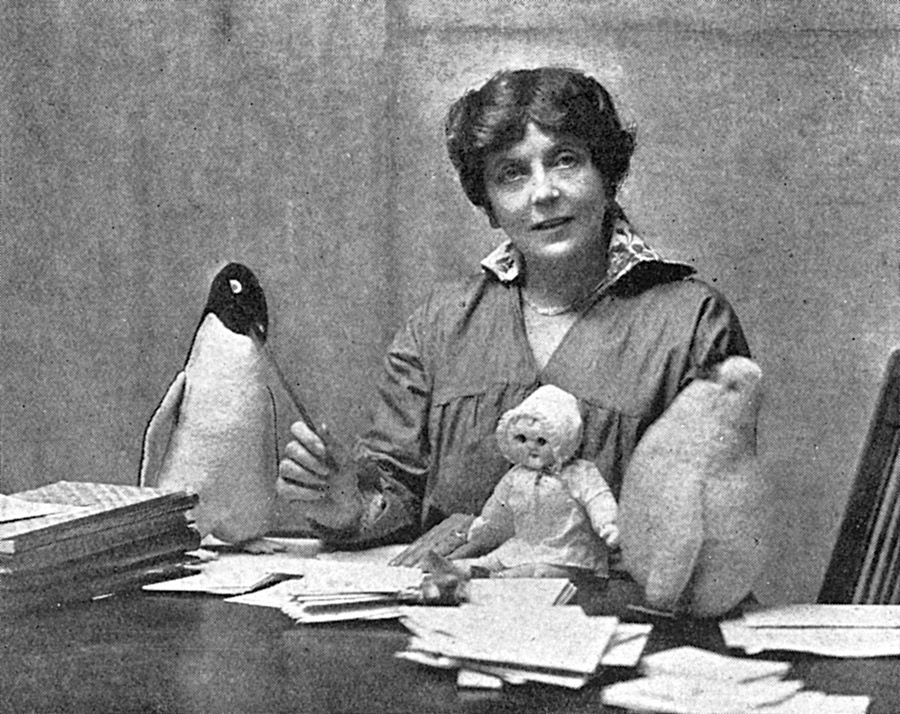
Fig. 84: Lena Connell (1875–1949), Lena Ashwell in Three Arts Club Overalls, World War I, 1915. Reproduction from The Sketch, 1915. © Illustrated London News Archive; within The March of the Women Collection/Mary Evans Picture Library.
In creating the scheme for this club in 1911, Ashwell explained in her autobiography that it was for the three arts of music, drama and painting, and she further embellished: “Clubs for women were just beginning, and my sister, Hilda, had already started one for the girls who sold programmes in the theatres…. The lease of a large house in the Marylebone Road was secured and alterations were made to accommodate members.”2 But, during the war its main goal was to help female arts workers who had been hard hit economically by the war’s impact. Ashwell also turned her energies to organizing health aid, joining her sister who was a nurse, along with sister suffragette and aid worker, Evelina Haverfield, by establishing the Women’s Emergency Corps. She then concentrated on entertaining the troops in a large theatrical venture, “Concerts on the Front,” for which she was awarded the OBE.3 This portrait stands as evidence of these new endeavors that rose out of Ashwell’s work with the suffrage cause. Connell’s imaging of Ashwell as a worker in overalls was significant as it established the shift that she and many other suffrage women took during the First World War as workers for the war cause. Like many other suffragists, Ashwell did not shirk from work. As Claire Hirshfield characterizes her life after the suffrage movement, she had a continued “urge to do good” which “remained alive; the habit of seeking a large cause in which to submerge herself had become an integral part of her character.”4
That stance is also readily evident in a striking portrait that Connell did of Evelina Haverfield in Field Uniform during the war under her new name of Beatrice Cundy (fig. 85) which bears her Baker Street work stamp on its obverse.
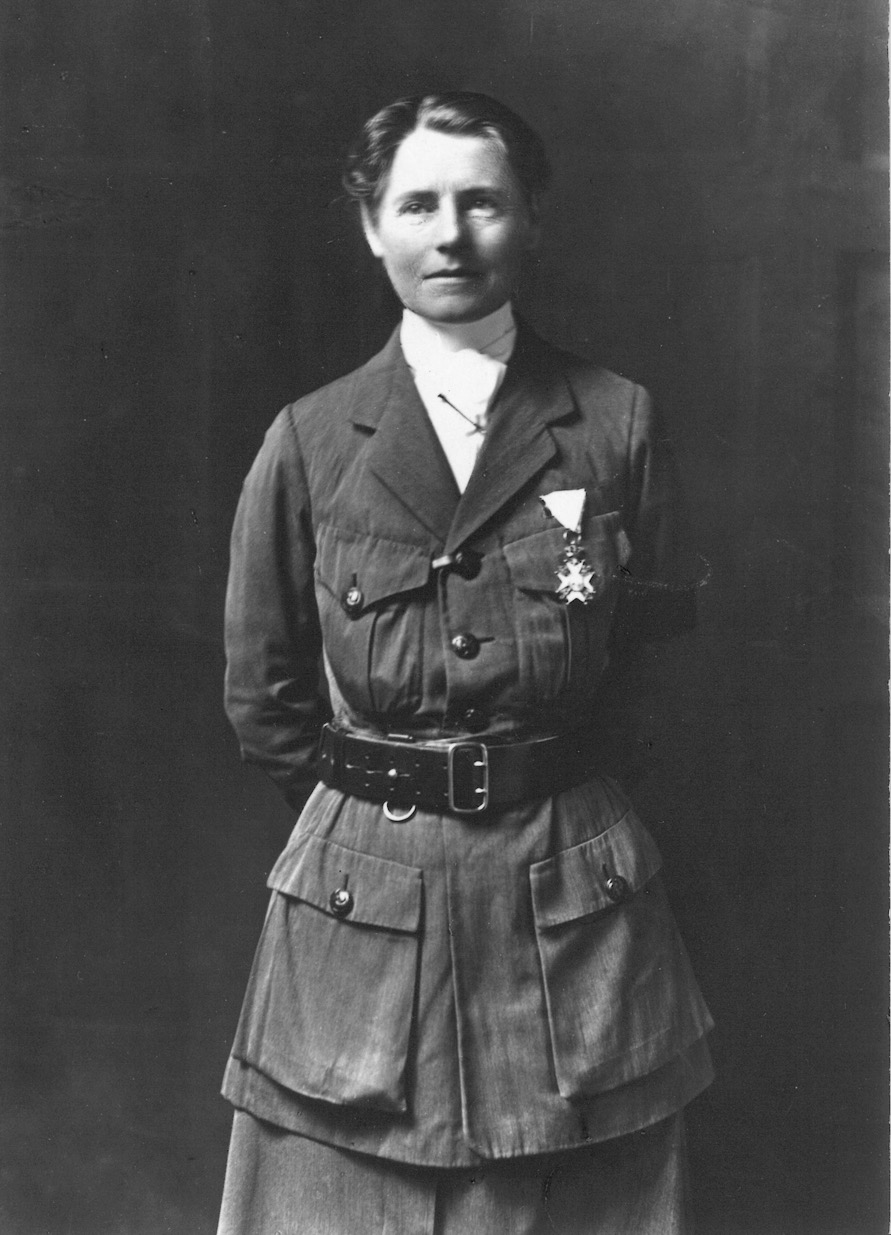
Fig. 85: Beatrice Cundy (1875–1949), The Hon. Mrs. Evelina Haverfield in Field Uniform, c. 1918 (photograph Women’s Library, London School of Economics and Political Science).
In the one letter that has survived from Lena Connell’s hand, she wrote to Vera (Jack) Holme in whose papers this photograph resides. While I have discussed this letter earlier in this study, here it is important to revisit it since the letter may, in fact, refer to this portrait:
Dear Miss Holme,
Thank you for your letter—Yes, I will be pleased to take the nurse on the same terms as Mrs. Haverfield & am writing to say so—If any ordinary layman or woman asks who are not subjects for concession will you let them have one of the enclosed.
You [underlined] should be taken on the “same terms as they are, or may be granted to ________.” Oh dear, I’m off on suffrage—I’ll be pleased to give you the same terms is what I mean.5
This letter probably dates from some time during the First World War, when Holme worked with Haverfield as a transport officer in the Scottish Women’s Hospital unit in Serbia and Russia. Haverfield died of pneumonia in Serbia in 1920 so this may be one of the last images Holme had of her.6 What the letter reveals is that Holme commissioned Connell to do this Haverfield portrait for her own collection and, further, that Connell was giving Holme permission to distribute copies to interested others. In addition, the letter tells us that Connell was trying to negotiate a sitting with Holme herself, who had been a significant presence in the WSPU campaign as chauffeur to Mrs. Pankhurst and others in the WSPU leadership circle. But Connell could not resist quoting from women’s suffrage demands even as she was doing business. Thus, this portrait serves as a poignant reminder of women’s continued service to their country, as well as to the personal lesbian relationship between Holme and Haverfield that gives punctuation to Connell’s double portrait of Edith Craig and Cicely Hamilton (fig. 66) as well as to Connell’s earlier portrait of Haverfield in hunting costume (fig. 49).7 The portrait itself offers up a beatific Evelina Haverfield who looks out at us with a slight smile. The light coming in from her right bathes her face in an almost ethereal glow. Somewhat comically, her uniform is cinched considerably at the waist, as it was obviously too big for her. Nonetheless she wears it proudly. As with portraits of our suffrage warriors, here as soldier she has pinned her war medal on her chest for this celebratory occasion. What a fitting final tribute to a woman who first fought in the war for women’s emancipation.
Maude Royden, whom we met in chapter two on suffrage leadership when Connell did early portraits of her, sat for Connell under Connell’s married name of Cundy for a series of portraits between 1920–1931. This latter set of portraits commemorated her professional position as the first British woman preacher. In 1931, Cundy did a portrait to honor Royden’s additional position as first woman Doctor of Divinity in England with a degree from Glasgow University (fig. 86).
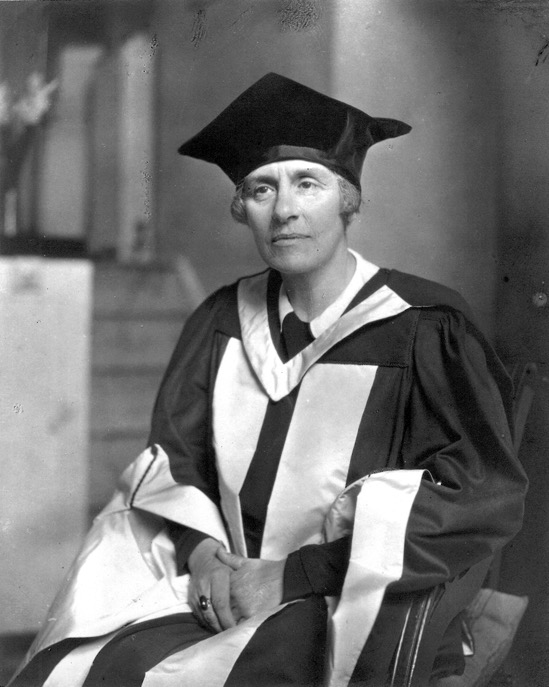
Fig. 86: Beatrice Cundy (1875–1949), Maude Royden in Doctor of Divinity Robes, c. 1931 (photograph Women’s Library, London School of Economics and Political Science).
Royden parted with the NUWSS during the war because she took a pacifist stance, but she nonetheless continued to fight for women, specifically for their right to join the priesthood, a battle which partly consumed her the remainder of her life.8
Connell’s portrait of Royden in her Doctor of Divinity robes reflected Royden’s success as a widely-loved preacher who did many tours to the U.S. and around the world. Royden used all of the portraits Connell did of her between 1920–31 in publicity articles to announce her engagements.9 Never uncontroversial, she promoted women’s access to birth control and openly smoked. In an instance for which she used one of the conservative dignified portraits Cundy had done of her, we witness a sense both of Royden’s humor and her unconventional style. It was during a U.S. tour when she reported that she was “headlined as ‘The Smoking, Flirting, Tippling Evangelist!’” As her biographer, Sheila Fletcher reports:
To confuse matters, her name appeared beneath the picture of a variety artiste (“a charming girl in little more than a string of beads and smoking a cigarette”). The editor made his apologies.
To the editor’s apology, Royden replied: “[I]f the young lady was hoping to win fame with a photograph of me in a cassock I felt that any apology should be addressed to her. For myself, I could not but think that if anyone really believed her picture to be a photograph of me, I should have a record audience.”10
In this dignified portrait Cundy captures Royden’s considerable cheekiness and strength, as well as something of her lifelong sense of duty to women. With her hands firmly clasped in her lap and her straight posture, she exudes a sense of that devotion to others. Further, Cundy’s use of the camera angle from below, as with many of her suffrage portraits, gives an air of loftiness to her sitter while still maintaining a sense of her affability. The portrait thus reflects an attitude of many of these suffrage women during and after the First World War, one Royden honored in her question to a lifelong friend near the end of her life: “Why do people ever want to deny work to women?” While she was reminiscing in this instance on her earlier suffrage work, Fletcher argues that it was just as apt a question about her later life. Royden’s exclamation, “Oh blessed work!” is a fitting reminder that these valiant women, post–1914, continued to dive into the modern world full force to make a difference.11
After a research trip to Australia in 2019, where I was able to study several suffrage collections and focus particularly on Muriel Matters and her career, it is fitting that I end here by discussing the continual visual presence of Matters within South Australian dialogue. From current historical exhibits to plays dedicated to her suffrage career to present-day murals, she is a significant force within South Australia’s women’s rights history and its visual residue. At the center of that discourse is Connell’s iconic photograph of Muriel Matters Speaking (fig. 6). In 2010, Adelaide celebrated the centenary of Matters’ Adelaide Town Hall lectures, ones she undertook on an Australian lecture tour in 1910 after she had moved to England and begun to work for the British suffrage movement. The cover of the program for the commemorative celebration shows the Connell portrait above the heading “Why Muriel Matters” and the catalog itself details her life and her impact on the British suffrage movement as well as her presence in South Australia.12 It is clear from this celebration and the devotion to Matters on the part of the Muriel Matters Society that the life of this Adelaide native was not just about home pride. She went from being an actress on local stages to an international arena as activist and she became a suffragist rock star!
The contents of Matters’ Town Hall performances were as compelling as the woman who delivered them. For example, one Town Hall poster details the contents of her lecture on “The Women’s War” being “brimful of incident and anecdote of the great non-party political movement,” which promised to be “fascinating and rich in humour.” It highlights her airship adventure, one commemorative embroidery from another source showing the dirigible alongside the title: “Adelaide’s Own Suffragist Aeronaut.” Further, the lecture would revisit Manners’ speech at the grille in the Houses of Parliament which earned her the title of “that daring Australian girl.” She gave a separate lecture in her prison dress, titled “Inside Holloway Prison” and the next night she gave a talk on “The Torch of Feminism,” in which she would reply to local criticism. She was well-versed in quick badinage by this point in her career, having been a central participant in the WFL caravan tours during which impromptu speaking was essential.13
In a tribute to Matters’ acting career, at the Adelaide Fringe Festival in March 2019, I was able to see a production by Joanne Hartstone who both wrote and performed the story of Matters’ life, That Daring Australian Girl.14 I posed with the stage managers who paid tribute to the spirit of the suffrage movement in their bright, suffrage-inspired sashes that were appropriately emblazoned with the play’s name (fig. 87).
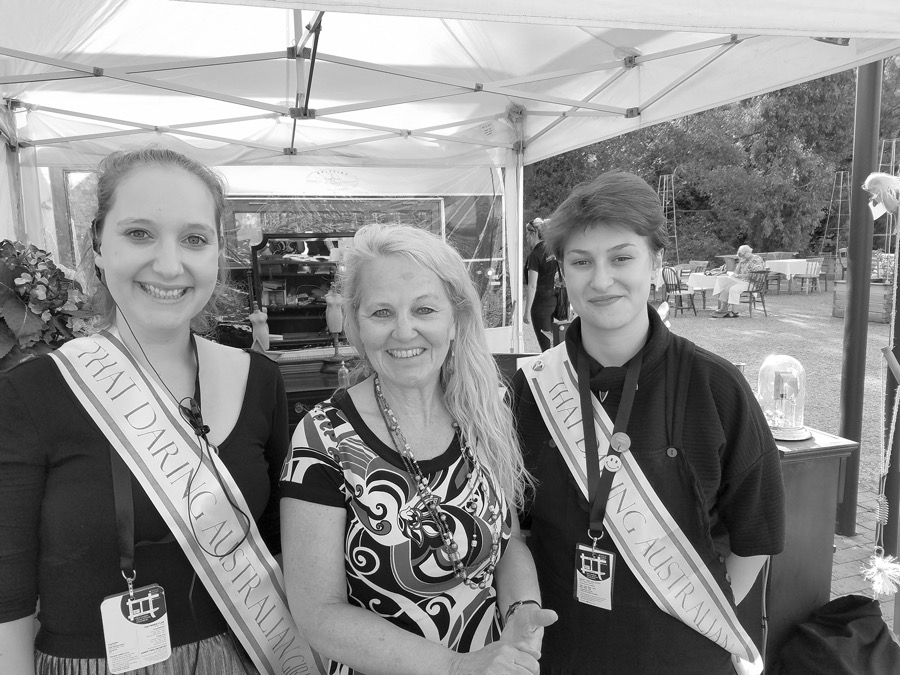
Fig. 87: The author with stage managers in suffrage-inspired sashes at the production of Joanne Hartstone’s play about Muriel Matters: That Daring Australian Girl, 2019. Adelaide Fringe Festival, Adelaide, South Australia (photograph by Trevor Davey).
I confess that I was creating my own kind of tribute for my daughter who is herself a passionate feminist and stage manager on the theatre scene in Seattle.
But more significant in terms of suffrage legacy and Connell’s part in promoting Matters is the actual grille to which Matters had attached herself which, due to the negotiations of Frances Bedford of the Muriel Matters Society and MP for Florey, now graces the vestibule of Parliament House in Adelaide, South Australia (fig. 88).15
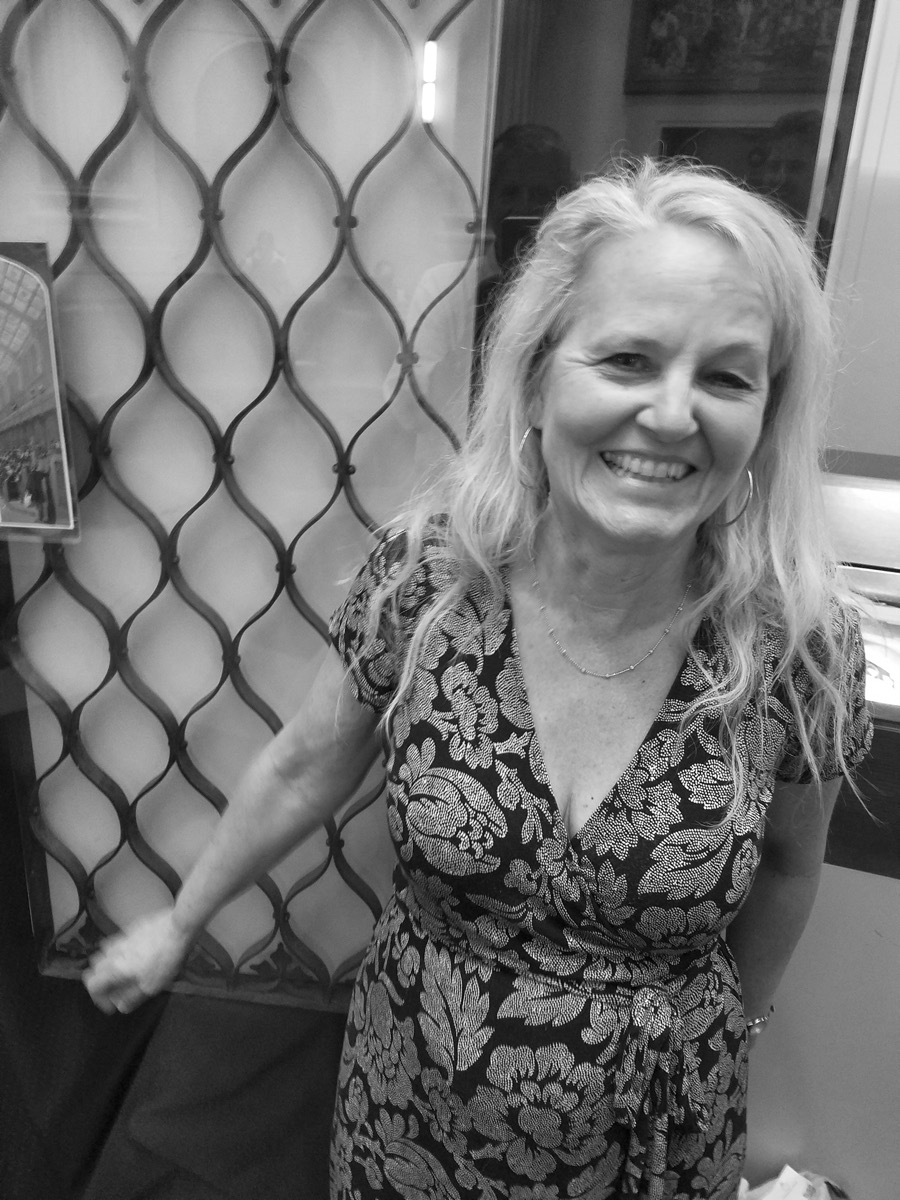
Fig. 88: The author in front of the Muriel Matters Grille, 2019. Currently on loan to Parliament House of South Australia, Adelaide, South Australia, from the Houses of Parliament, London, England (photograph by Ian Peak).
My friend, Ian Peak, who had introduced me to Frances Bedford, took this parting shot of me with the grille. You can tell by the gleeful expression on my face that it was a compelling moment, uniting feminists who were generations apart.
In David Welch’s catalog, Propaganda, Power and Persuasion that accompanied the exhibit of the same title at the British Library in 2013, he concludes by quoting Edward Bernays from 1928, who argues that “[p]ropaganda will never die out. Intelligent men must realise that propaganda is the modern instrument by which they can fight for productive ends and help to bring order out of chaos.” From this assumption, Welch responds: “It is perfectly possible to argue that in democracies politics has nothing to fear from propaganda. [ It] is merely a process of persuasion that forms a normal part of the political dynamic and as such it could be argued that we need more propaganda, not less.” He closes by saying that propaganda’s main goal is in “winning hearts and minds” to the cause at hand.16 Yet, as we have seen Connell do, propaganda for women can go much further. As the examples in this book have shown, it can address the complexities of women’s bodies in public spaces which can actually free them both from male approval and the male gaze. Further, as can be particularly argued in the case of Muriel Matters, it can become, in the modern sense, about improvising one’s identity. Further, visual representations like the ones Connell has produced can at once announce these women’s immanent presence and become a residue of them in terms of their legacy. Propaganda for women’s causes helps to shore up this alternative discourse that empowers them, to return to Lisa Pace Vetter’s argument in chapter two.17 Connell’s creation of a cult of great women stems from her ability to represent them in positions of power and in their ready visibility that, in turn, continues to empower feminists to this day.
When I began working on this epilogue, Elizabeth Warren was still making a bid for the 2020 U.S. Presidential election. In Claire Bond Potter’s New York Times article entitled “The ‘Likability’ Trap,” she argues that Warren, like all female candidates, is “unlikable,” that the likability issue is a ruse that is rigged in favor of men, the case in point being Hillary Roddam Clinton’s loss to Trump in 2016.18 If Connell’s suffrage imagery of women can be said to do anything in terms of its legacy, it is not only to make more political women visible, but also to render them powerful. In this regard, I had a conversation with my daughter about the 2020 presidential campaign. At that time, she had planned to vote for Warren, should she become the Democratic candidate. Goodbye Bernie, her previous favorite! She had been won over as a struggling twenty-something by Warren’s economic platform. In fact, as punctuation to this exchange she sent me a selfie in which she was proudly holding her Warren “Billionaire Tears” mug with a sweet smirk on her face. We had had no discussion of Warren’s “likability” quotient. My daughter is immune to such arguments, having been exposed to smart, passionate women all of her life. In fact, her most recent response to my continuing battle with some segments of students who cannot seem to reconcile a very funny woman professor with a symbol of authority was her holiday gift to me: a framed pink quote that simply says: “Fuck you, I’m delightful.” As the argument goes in Bond Potter’s article, so too with representations of political women: we need to see them more in government, Bond Potter ending on a hopeful note following the results of the 2018 midterm elections. Yet, in this same Sunday Review section of the New York Times, I return to a tongue-in-cheek article which I first introduced in the Preface. “This is an Article about Women” exposes the public marketing of “Woman,” which is a remake of a 1970s iconic t-shirt that is now emblazoned with the statement: “The Future is Female.” Its author, Nicola Pardy, concludes that while this visibility is hopeful, “[i]f in 2015 we predicted the future would be female, in 2019 it feels as if we were right. Water bottles are female. Tote bags are female. Workplaces are female. And somehow, it’s still not enough.”19 As Connell understood in her photographic campaign to promote women for the suffrage cause, visibility is key to success. Yet, the battle must rage on, as is evidenced in the lives of many of these suffrage women after they won the cause.
1. Diane Atkinson has made a valiant attempt to recover the lives of many suffrage women post-1914. See Rise Up Women! The Remarkable Lives of the Suffragettes (London: Bloomsbury, 2018), 523–565.
2. Lena Ashwell, Myself a Player (London: Michael Joseph, 1936), 180–181.
3. See Margaret Leask, “Lena Ashwell: Touring Concert Parties and Arts Advocacy, 1914–1919,” in British Theatre and the Great War, 1914–1919, ed., Andrew Maunder (London: Palgrave Macmillan, 2015), 251–268; and, more generally, Claire Hirschfield, “The Actress as Social Activist: The Case of Lena Ashwell,” in Politics, Gender, and the Arts: Women, the Arts, and Society, eds., Ronald Dotterer and Susan Bowers (Selingsgrove: Susquehanna University Press; London/Toronto: Associated University Presses, 1992), 72–86.
4. Hirschfield, “The Actress as Social Activist,” 83.
5. 7VJH/4/3/45, Vera (Jack) Holme Papers, Women’s Library, London School of Economics and Political Science.
6. See 7VJH/5/3/07, Vera (Jack) Holme Papers, a photograph of Holme by Bassano showing her in uniform.
7. Further, it is evidence that Connell had done a portrait of a First World War nurse for Holme’s collection as well, although no such image survives in her papers or elsewhere.
8. See Elizabeth Crawford, The Women’s Suffrage Movement: A Reference Guide 1866–1928 (London, New York: Routledge, 1999), 610–611; and Agnes Maude Royden Papers, Women’s Library, London School of Economics and Political Science.
9. The photographs are housed in the Agnes Maude Royden Papers, Women’s Library, along with press cuttings of her various tours.
10. Quoted in Sheila Fletcher, Maude Royden: A Life (Oxford/Cambridge, MA: Basil Blackwell, 1989), 248.
11. Quoted in Fletcher, Royden, 278.
12. Why Muriel Matters. A Centenary Commemoration Celebration (Adelaide: The Muriel Matters Society, Inc., 2010).
13. These documents exist in the Muriel Matters Society Ephemera Collection, Organizational Files Collection. South Australia File, State Library of South Australia, Adelaide, Australia.
14. Joanne Hartstone, That Daring Australian Girl: A Play for One Performer, foreword by Frances Bedford (Edinburgh/Cambridge: 49 Knights Independent Publishing House, 2018).
15. Frances Bedford explained that this one may not be the actual grille to which Matters was attached, but it is one of the original ones. Today these grilles are on display in the Education Center Hall, Houses of Parliament, London with this one exception which is currently on loan to Parliament House, Adelaide, South Australia (Personal Communication with Frances Bedford, MP for Florey, South Australia).
16. David Welch, Propaganda, Power and Persuasion (London: British Library, 2013), 200.
17. Lisa Pace Vetter, “Overview: Feminist Theories of Leadership,” in Gender and Women’s Leadership: A Reference Handbook, ed., Karen P. O’Connor (Los Angeles/London/New Delhi: Sage, 2010), 3.
18. Claire Bond Potter, “The Likability Trap,” New York Times, Sunday Review Section (May 5, 2019): 1, 4.
19. Nicola Pardy, “This Is an Article about Women,” New York Times, Sunday Review Section (May 5, 2019): 9.