
4
On September 5, 1934, a Cleveland man searching for driftwood along the Lake Erie shore stumbled across what he thought was a tree trunk. Up close, though, it turned out to be the rotting legs of a woman, severed at the waist and knees. A few days later, the upper torso—cut off at the waist and missing its head—was found on the beach. Not long after an upper arm washed up. A coroner, looking at the body parts under a microscope, saw distinct knife marks, which indicated that someone had deliberately dismembered the body. The woman was never identified, though, and the crime went unsolved.1
A year later, in the Kingsbury Run section of the city, then (and now) an industrial neighborhood not all that far from downtown, a boy looking for a lost softball at the bottom of a hill found a naked, headless corpse. Thirty feet away, at nearly the same time, two other boys glimpsed another headless corpse. When the police arrived, they discovered that in addition to being decapitated, the bodies of the two male victims had been castrated. The genitals were found nearby, as was the head of the first corpse but, weirdly, not the second head. As with the corpse found on the beach, the heads from both corpses had been neatly removed from the bodies. This time, however, one of the bodies was identified. It belonged to twenty-nine-year-old Edward W. Andressy, a minor criminal who made his home in what was then called the Roaring Third, a neighborhood of bars and tenements adjacent to Kingsbury Run.
Then, one night in January, in an area of the city just northwest of Kingsbury Run, dogs in the neighborhood would not stop barking, and in the morning residents discovered why. Someone had left two half-bushel baskets filled with human body parts—the lower half of a female torso, two thighs, and a right arm and hand—neatly wrapped in newspapers, including one bearing that day’s date, January 26, 1936. A little less than two weeks later, the rest of the body—everything except the head—turned up not far away. This time, the corpse turned out to belong to Florence Polillo, an occasional waitress, barmaid, and prostitute who, like Andressy, was not unknown to the police. Whoever dismembered her body had also carefully removed her entire reproductive system.
Separated by years, none of these gruesome murders had yet been linked. All that would change on the morning of June 5, 1936, when two boys walking through Kingsbury Run discovered a man’s head rolled up in his own pants. The next day, two local workers found the rest of his body. This corpse would never be identified. By then, no one could fail to connect the string of murders and decapitations, and the local newspapers began to refer—not inappropriately—to a “human butcher.” The next month, a headless corpse—this one badly decayed—turned up on the west side of the city.
It got worse. On September 10, 1936, a vagrant passing through Kingsbury Run found a torso—headless, armless, and legless—floating in a stagnant creek. In the same water, police later found the lower half of the legs but no head. Like some of the earlier male victims, this one had been castrated. The autopsy also suggested that the victim had been alive when he was dismembered—whether conscious or not no one could or wanted to say.
With five corpses discovered in one year—and six total beginning with the body of the woman found by the lake in 1934—the Cleveland newspapers did not temper their coverage. An editorial in the Cleveland News on September 12, 1936—two days after the latest victim appeared—set the tone:
Why these dead? Why this darkest of all Cleveland murder mysteries? He kills for the thrill of killing. He kills to satisfy a bestial, sadistic lust for blood. He kills to prove himself strong. He kills to feed his sex-perverted brain the sight of a beheaded human. He must kill. For decapitation is his drug, to be taken in closer-spaced doses. Yes, he will kill again. He is, of course, insane.2
Another paper declared:
Of all horrible nightmares come to life, the most shuddering is the fiend who decapitates his victims in the dark, dank recesses of Kingsbury Run. That this creature, sly, crafty, inhumanly skilled in butchery, is a menace to every man, woman and child who walks the streets of Cleveland does not have to be emphasized.3
In fact, it did have to be emphasized, for the human butcher had not—thus far anyway—proved a menace to every man, woman, and child in Cleveland. Both of the bodies that could be identified, and the neighborhoods where they were found, suggested that the human butcher was a menace to a rather narrow class of minor criminals and socially dispossessed. And the corpses that could not be identified also confirmed as much. They remained unidentified. Evidently, no one missed them. Indeed, such a gulf separated most residents of Cleveland from the Kingsbury Run section of the city that one newspaper, the Cleveland Press, induced a reporter to visit the neighborhood and describe it for those—the majority of Clevelanders—for whom it existed, at most, as a neighborhood seen from a train window.
On Friday, September 11, 1936, William Miller published his front-page article, which had the arresting lead, “Last midnight I went down in Kingsbury Run.” He continued: “Kingsbury Run, that lonely, mysterious gully where prowls a mad butcher. Four of his headless victims have been found there. He has killed two others.” In the article that follows, Miller describes his own passing fears and the more permanent ones of residents of Kingsbury Run. As for the former, Miller describes—some might say exaggerates—how fear feels and eventually overtakes the body. Near the outset of the piece, he writes “that if you enjoy feeling your flesh creep—feeling the small hairs rise on your neck and your heart pounding with shameless fear—if that’s what you like, just take a midnight tour through Kingsbury Run!” Later, he writes of making his way down an overgrown path, “Every step your feet took forward your heart was going the other way.” A flare of flame out of a nearby foundry made “our shadows turn somersaults.”
More convincingly, Miller describes the fear of residents themselves. For his midnight tour, Miller enlists the help of two local boys to show him around. They talk, Miller writes, “of ‘him’—that unknown person or thing whose specialty is removing the heads of homeless tramps.” “Every kid around here is in bed or at home early these nights,” the boys add. In addition to scaring the permanent residents of Kingsbury Run, the “thing” had also scared off its temporary ones. Those made homeless by the Depression had set up shantytowns in Kingsbury Run, until the human butcher had, Miller reports, driven many of them away. “Fear,” he concludes, “is over the Run like a living thing.”
Fear provides the final note of the article, too. His tour complete, and once again overlooking Kingsbury Run from an elevated road, Miller sees another car parked below “where ours had been.” “You knew it was just a curiosity seeker,” he writes, “but you couldn’t help thinking, ‘It might be … someone else.’”4
This chapter is about fear and, leaving aside the human butcher for a moment, Miller’s report of his midnight descent into Kingsbury Run suggests the many forms that fear can take. According to psychologists, fear exists along a spectrum of proximity.5 On the end of the spectrum, fear arises from an unexpected and immediate threat: finding a corpse instead of a softball, the flaring of a flame, or someone shouting, “Boo!” When this happens, one is startled, and the response bypasses conscious thought. Once the shock passes, however, the fear and its physiological responses pass too. This end of the fear spectrum is reserved for fright, or a sudden, intense feeling of fear. Somewhere along the middle of the spectrum lies the form of fear that arises not from something that has happened but something that might happen: the possibility that a human butcher might jump out from behind a bush, or the thought that a car might belong to a human butcher. The physiological responses include the ones Miller describes: creeping flesh, rising hair, pounding heart. That feeling is what most of us talk about when we talk about fear. Call it terror, or extreme fear. On the far end of the spectrum lies a more prospective fear, not of what has happened or what might happen but what may happen; for example, the fear on the part of residents when a serial killer stalks their neighborhood. Call this end of the spectrum dread, or an intense apprehension about potential threats.
In this chapter, I examine what scared Americans during the Great Depression, and with one or two exceptions, I focus on dread, the more prospective and less immediate end of the spectrum of fear: not flares of flame or human butchers jumping out from behind bushes, but the knowledge that somewhere in this city a human butcher plies his craft. As I suggest in my introduction, and discuss at greater length in my conclusion, fear—of unemployment, of impoverished old age, and of what people subject to or afraid of those horrors might do—would drive many of the legislative initiatives of the 1930s, including the Economic Security Bill of 1935, otherwise known as Social Security. In this chapter, I focus more on how fear works, on its inner logic.
I derive its inner logic by examining two fears in particular: polio and unemployment. Polio, I argue, frightens because it exposes the fragility of the human body. By the 1930s, scientists had developed vaccines for pertussis (whooping cough) and diphtheria. (Although doctors did not regularly administer such vaccines until the 1940s.) Vaccines for other communicable diseases, though, like measles, mumps, tuberculosis, tetanus, rubella, and polio, were years or decades away. As a result, these diseases sickened, killed, and scared many more people than they do today. The same goes for osteomyelitis, septicemia, pneumonia, and other bacterial infections, which, in the days before penicillin—it did not appear on the domestic market until well into the war years—regularly and casually killed people. Of the communicable diseases, however, polio seems to have scared people the most during the Great Depression, as a particularly alarming epidemic in New York City in 1931 illustrates. (Many New Yorkers in the 1930s would have remembered the ghastly polio outbreak of 1916.) In addition to scaring people, polio can help us understand how fear works. When we fear something, like polio, we often fear it because it reveals our body to be weaker and more defenseless than we supposed.
Not even polio, however, could compete with the most common fear of the Great Depression, unemployment, and for good reason. Not only was it widespread—the unemployment rate rose into the teens and twenties in the first half of the decade—but for years virtually no safety net (no unemployment insurance, no food stamps) existed to catch people when they fell. In this chapter, I examine unemployment and the fear of unemployment among the middle class, not because unemployment and the fear of unemployment among the working class does not matter, but only because the former has, over the years, received comparatively less attention and, therefore, may revitalize our understanding of this somewhat shopworn fear of the Great Depression. Like polio, unemployment can, ultimately, threaten the body. (People really did starve during the Great Depression.) In the accounts I examine, however, unemployment threatens something less substantial but no less meaningful than our body: our place in the world, our sense of identity.
After examining each of these fears, polio and unemployment, I argue that what they have in common, and what a reading of the pulp literature of the day confirms, is a concern for the purity and autonomy of being, the nature or essence of a person, and the dread that such being might be violated and despoiled by impersonal but nevertheless malevolent forces. I do not claim that this fear was unique to the 1930s, but it does seem to have become more general and more intense during the decade.
A fear that the integrity of being would be violated is obviously and somewhat crudely the case with the human butcher who stalked Cleveland during the middle years of the 1930s. Indeed, one of the things that disturbs us so much about the Cleveland serial killer is how casually and cruelly he treated something—the body—that we invest with such dignity and sacredness. In this respect, “the human butcher” is an apt nickname. He treated human beings like animals, like meat. The other things that people feared during the Great Depression—disease, unemployment—did not treat human beings with the obvious contempt that the human butcher did, but they were in their way akin to human butchers in their indifference to human life and, thus, at times, could be just as frightening.
In his inaugural address of 1933, President Franklin Roosevelt asserted his “firm belief that the only thing we have to fear is fear itself.”6 In a bit of unguarded optimism, Roosevelt meant that though the nation faced any number of what he called “the dark realities of the moment,” nothing had fundamentally changed about the country or its economy, nothing, anyway, that government could not fix. As years passed, though, and times remained tough, if Americans thought of Roosevelt’s words, they may have come to doubt their wisdom. During the Great Depression, as this chapter shows, Americans had plenty to fear beyond fear itself.
After the sixth body appeared in Kingsbury Run in September 1936, the human butcher went on to murder at least six more people over the next two years. Then he stopped. Although the police had dozens of suspects, some more likely than others, they never brought charges against anyone. In all likelihood, the killer remained free.
“Don’t Ever Kiss Your Children or Allow Them to Be Kissed”
Like baseball, polio arrives with the warm weather. On March 30, 1931, the New York Times reported its first annual case of infantile paralysis, as poliomyelitis was then more commonly known. Curiously, the case the Times reported on did not occur in New York City but in Rhode Island. The obituary (“Girl, 14, Dies of Poliomyelitis”) is terse. It says only that “Barbara Jones, 14-year-old daughter of Mayor Frederick A. Jones of Cranston, died at Jane Brown Memorial Hospital today of infantile paralysis. She was a freshman in Cranston High School, where she ranked high in scholarship. She had been ill about a week.”7 The Times picked up the story from the Associated Press. It likely did so not because of how the girl died—deaths from polio were rare but not uncommon—but because of who her father was; that is, the story is not about infantile paralysis but about the mayor of a sizable city in the northeast and his grief for the loss of his young daughter.
If that seems strange in light of what would happen over the coming summer, when New York would experience its worst polio outbreak since the devastating one of 1916, recall that by 1931 polio had all but dropped out of public consciousness. Indeed, when polio made news in recent years, it did so because of how little news it had made. On January 1, 1931, the health commissioner of New York City, Dr. Shirley W. Wynne, said that “the city was fortunate in having only seventy-nine” cases of infantile paralysis in the previous year, and though “the incidence of this disease was expected to be high in 1930, only eight more cases were reported here than in 1929, when the number was seventy-one, of which twenty-five were fatal.”8
That optimism began to change as the summer of 1931 progressed. In June, the Times reported on another victim of infantile paralysis, Louise Hohne:
After oxygen had been administered to 4-year old Louise Hohne of 215 Fourth Avenue, Brooklyn, for more than twenty-four hours in the Kings County Hospital, physicians there last night expressed the hope that she might recover from infantile paralysis.
The child was taken ill last Saturday and was removed to the hospital Wednesday afternoon. She was then in a coma.
At the hospital she was treated with a respirator. After four hours of treatment color returned slowly. During Wednesday night she mumbled a few words. A physician and nurse were in constant attendance. One of her parents was at her bedside constantly.
About noon yesterday Louise showed signs of consciousness. She asked for something to eat and liquid nourishment was given to her.
Dr. Ruben Budnowitz and Dr. Thomas Fry are in attendance, with a day and night nurse. Because her parents are not in financial position to pay for her treatment, the city will defray the expense.
Both doctors last night expressed satisfaction at her progress and said there was hope of recovery.9
As the story suggests, Louise Hohne suffered through the classic symptoms of the most serious type of infantile paralysis. Roughly one to three weeks prior to falling ill, Hohne would have contracted the virus from another person, whether through direct contact or, less likely, by consuming tainted food or water. On Wednesday, when she took ill, Hohne would probably have suffered from fever, fatigue, headache, vomiting, stiffness in the neck, and pain in the limbs. Her parents may have thought she had a bout of the flu. Over the coming days, though, her symptoms would not have improved and, before anyone knew what was going on, her stiffness and pain would have hardened into paralysis. The polio virus, that is, quickly attacks and destroys nerve cells and muscle tissue, usually in the hips, ankles, and feet. Some children fully recover, but others are left with withered limbs and a lifelong disability (see Figure 4.1). In the worst cases, such as Hohne’s, the paralysis spreads to the muscles of the diaphragm, which makes breathing impossible. When people die from polio, they usually asphyxiate. Hence the infamous iron lung, which, using changes in air pressure, artificially inflates and deflates the lungs, thereby breathing for those who could not. (The Times refers to it as a respirator.)
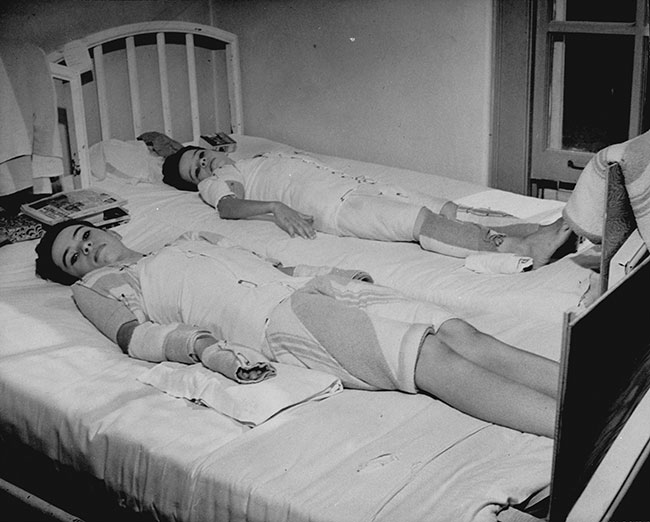
Figure 4.1. Two young polio patients press their legs against wooden footboards. The treatment—and others—was pioneered by an Australian nurse, Sister Elizabeth Kenny, who developed a following during the 1930s.
Source: Ed Clark/LIFE Images Collection/Getty Images
Sadly, the optimism on the part of Hohne’s doctors proved unfounded. Two days later, the Times reported her death.10 As Hohne’s case reveals, not even the leading edge of polio treatment—artificial respirators—could save the lives of those who contracted the virus. As her case reveals, too, a child could be healthy one week and dead the next.
In July, the Times reported a happier story concerning infantile paralysis: how a mechanical lung rushed from New York City to Connecticut saved the life of an eight-year-old boy, Arthur Ahearn.11 Two days later the Times reported that Ahern—the spelling had changed—still lived, but the newspaper never reported whether he ultimately lived or died.12
Soon, however, the narrative of infantile paralysis that summer changed from one of individual cases to one of the beginnings of an epidemic. On July 18, the Times reported that the Health Department of the City had asked the “medical societies of the Greater New York … to obtain the prompt reporting of new cases of infantile paralysis which may develop this Summer.” The same article reported that the number of cases of infantile paralysis in 1931 (171) had already exceeded the number of cases for 1929 (71) and 1930 (78), with, worryingly, much of the summer and early fall remaining, when the virus thrived.13 On July 25, the Times reported “New York City has the largest number of cases of infantile paralysis, or poliomyelitis, in several years.”14
As the epidemic worsened, Dr. Wynne, the health commissioner of the city, advised residents on “general preventative measures”: “strict attention to cleanliness, guarding against flies, keeping children from crowds, and normal care in food and water.”15 If these recommendations seemed vague, that is because, as the Times also reported in August, scientists were largely in the dark about the disease. “After three years of experimentation,” the Times wrote, “research experts of the National Institute of Health admitted today that they had failed to find the cause, methods of communication or cure for infantile paralysis.” “DISEASE BAFFLES SCIENTISTS,” as the headline put it.16 Similarly, in October, a Dr. Robert Kingman published an article in the Brooklyn Daily Eagle under the headline, “Infantile Paralysis a Medical Mystery.”17
This lack of knowledge about the disease left communities vulnerable to polio epidemics, and as became increasingly clear to everyone in 1931, New York City, particularly the borough of Brooklyn, had an epidemic on its hands. In late July, public health officials requested that parents from the city not visit children they had sent upstate to summer camps lest they bring the disease with them. The same article noted that thus far in July, 373 cases of infantile paralysis had been reported. On July 27 alone, 89 cases of polio were reported in the city, including 69 in Brooklyn. As the article observed, “this figure [89] is 11 more than were reported in the city throughout 1930.”18 Thus far, the epidemic had not matched the horrifying one of 1916, which sickened some 9,000 people, of which over 2,400 died.19 Still, in July alone 688 cases occurred, with 508 in Brooklyn. And as Dr. Wynne pointed out, true to the name infantile paralysis, “most of those afflicted with the disease were under 5 years of age.”20 As in later outbreaks, hospital rooms would be lined with as many iron lungs as hospitals could obtain, the heads of children poking out from the top like magician’s assistants waiting to be sawn in half (see Figure 4.2).
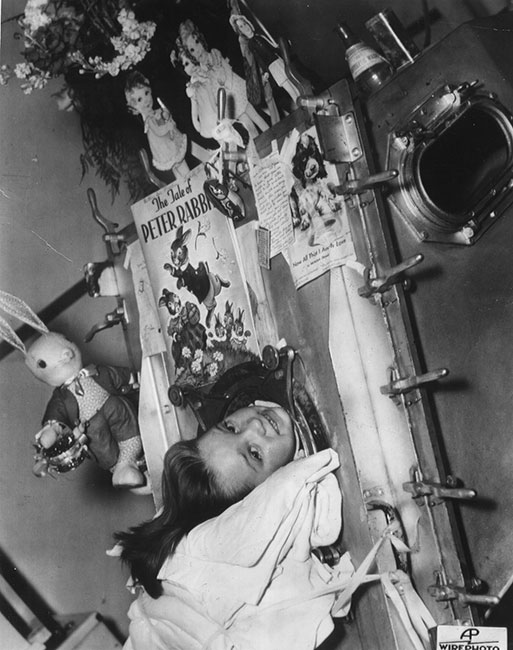
Figure 4.2. A child in an iron lung at Johns Hopkins Hospital.
Source: Steve Degenaro
In a story that only could have occurred in the Great Depression, in early August the Times reported on a Staten Island family “whose ten-month old son Theodore died in his mother’s arms Thursday as moving men were evicting the family from their home.” Generously, or so the Times thought anyway, the landlord told the family they “could remain in the house until Monday.” At that point, grieving for the death of their child, and facing eviction, another one of their children, “Minnie, 3 years old, was taken ill, and at Seaview Hospital was found to be suffering from malnutrition with symptoms of infantile paralysis.”21
On August 5, 111 new cases were reported, bringing the total in the city since July 1 to 1,013 (and 1,047 since the new year). At this point in the epidemic, real fear set in, especially on the part of authorities. Summer camps everywhere barred visitors from the city, and a camp in Vermont went so far as to bar children from the city. In Brooklyn, the center of the outbreak, Dr. John Oberwager, of the New York City Department of Health, addressed several thousand concerned parents and warned them against kissing their children. When a mother in the audience “asked whether it was safe for her husband to kiss their baby when he returned home from work,” Dr. Oberwager replied: “Don’t ever kiss your children or allow them to be kissed, now or at any other time. It is a legal, moral, parental duty. A kiss is the easiest way of spreading disease.”22 This advice may have seemed extreme, but given how the disease spread, or was thought to spread, it made sense. A booklet issued by the Department of Health “warned that patients carry germs of the disease in their mouths and noses for several days after the fever; [and] that the germs may be present in the noses and mouths of members of the family of those who are ill and may be carried in mouths of healthy persons.”23
In the event, August 5 turned out to be the high water mark—in terms of daily reported cases—of the epidemic. By then, the city had 1,570 cases, all but 34 since July 1. Still, the epidemic had by no means receded. On August 17, 87 new cases were reported.24 The next day, there were 79.25 On September 1, Dr. Wynne delayed the opening of the school year by a week.26 By September 3, 2,892 cases had been reported in the city.27 On September 22, however, the Times gratefully reported “Paralysis Recedes with Cool Weather.” By that point, 3,508 cases had occurred.28 But the Times may have been premature in calling the recession of the disease. Over 500 cases would yet be reported. All told, by the end of 1931, the city counted 4,087 cases of infantile paralysis. Happily, and as opposed to the 1916 outbreak, only 490 of those who contracted the disease died, thanks in no small part to the widespread use of iron lungs.29
When the narrative of a disease comes to revolve around the number of cases, the individuals who fall ill to the disease can too easily get lost in those numbers, obscuring the human drama associated with each so-called case. One would do well to remember, then, that each instance of polio involved more or less the same fear and, often enough, grief that the parents of Louise Hahn experienced early in the summer. To put it bluntly, children died, by the hundreds, and many more sickened and were disabled, and each death or illness battered the parents of those children, not to mention the children themselves. In addition, one has to calculate the dread of parents whose children did not contract polio during the epidemic but might. In short, parents in New York City in the summer of 1931, especially certain neighborhoods of the city, must have lived in a state of near constant dread. Every time a child coughed or looked tired, a chill must have gone down their spine.
All of this raises the question, though, of whether polio should have scared parents in 1931—and, for that matter, later summers—as much as it did. In the early days of the New York City outbreak, Dr. Charles F. Bouldan, the director of health education for the Health Department, tried to calm fearful parents. He pointed out that “so far there had been only 500 cases,” which, in a city of 1.5 million children under 15 years of age, meant that only one in 3,000 had contracted the disease. (Dr. Bouldan had no way of knowing it, but by year’s end, the ratio would be one in 367, which is a slightly less reassuring number.) He also observed that compared to measles, which in the United States killed 1,000 children annually, polio seemed relatively benign.30 Similarly, Dr. Wynne “counseled parents not to be frightened, pointing out that with ordinary precautions the disease was not very contagious.” Like Dr. Bouldan, Wynne also observed that “other contagious diseases were often far more prevalent.”31
Later critics echo these warnings that the public may have overreacted to the polio threat. In addition, they accuse charities like the March of Dimes, started by Franklin Roosevelt in 1938 as the National Foundation for Infantile Paralysis, with deliberately stoking public fear about the disease in order to raise money to fight it. Oftentimes, these critics make arguments similar to Drs. Bouldan and Wynne, which is that little distinguished polio from other infectious diseases, especially in prevalence and morbidity, yet polio commanded a disproportionate share of attention and public and private aid. Worse still, critics charge, polio may have received the attention and funds it did because it tended to affect the middle class, who had the resources, social and economic, to make it into more of an existential threat to public health than it was. As Gareth Williams writes in Paralysed with Fear: The Story of Polio, “the fear of polio [was] deliberately played up, by an organization [the March of Dimes] prepared to steamroller its way through American society to achieve its goal of conquering polio.”32
Although those who charge the National Foundation for Infantile Paralysis with deliberately exaggerating fears of polio have a point, those who make that charge also risk dismissing the genuine horror people had of polio and the reasons they had for it. As its name suggests, infantile paralysis primarily targeted children. An analysis in September of 1931 would show that 54 percent of all cases affected children under age five, and 83 percent affected children under age ten.33 Adding to fears, no one knew exactly what caused infantile paralysis or quite how it spread. The August booklet issued by the city hinted at what turned out to be true. Nearly everyone is infected by the polio virus, but usually only a few of those infected will develop any symptoms at all. (That, by the way, is why the disease primarily affected children. Most adults had previously—and unknowingly—contracted the virus and built up an immunity to it.) Moreover, most of those who did get sick as a result of the virus did not experience paralysis, meaning, in most cases, they thought they had the flu. Yet everyone—those made sick by the virus and those who did not know they had it—could equally infect others. As in the HIV crisis of the 1980s and 1990s, perfectly healthy people, ignorant of the fact that they carried a virus, could pass it on to others. If so, to recall Dr. Oberwager’s address to Brooklyn parents, it made a certain amount of sense not to let your children be kissed by anyone. That is, no one could know who carried the virus, which made it difficult to guard against. Finally, while most people who suffered from polio recovered without any lingering effects, many did not. Famously, Franklin Roosevelt, who contracted the disease in 1921 at age thirty-nine, never wholly regained the use of his legs. The same was true for many others. Each neighborhood would have one or more children who walked with crutches or a limp, a constant reminder of what the virus could do and what could befall your child. More than a few children spent the rest of their lives in an iron lung. And many, of course, like Louise Hahn, died. In short, and with no offense to measles, polio seemed reverse engineered to terrify parents. You can accuse the foundations of fear mongering, but I suspect most parents did not need the hard sell.
Whether you think polio was exaggerated or not, parents during the Great Depression feared it. And though neither the city nor the nation would experience another epidemic quite as bad as the one in 1931, at least during the Great Depression, fear of the disease lingered. More than just showing what those in the Great Depression feared, however, polio shows how fear works. As I discuss above, fear usually takes one of two forms: terror, or the fear of a sudden, specific stimuli; and dread, the fear of a looming, prospective threat. In a way, the latter is more psychologically destructive than the former. With the exception of those who suffer post-traumatic stress disorder, terror passes. By contrast, dread, particularly during anxious times, is a way of life. Unlike, say, the sudden appearance of a bear, in which case one is eaten or escapes, with anxiety and dread you cannot escape—or suffer—unless and until the threat manifests, which it never may, or disappears. Until it does, it—and the fear it engenders—simply lingers.
The polio epidemic of 1931 indicates two additional ways that fear works. First, although we fear a variety of things, at bottom, as with polio, many of our fears have to do with the body, with what illnesses, injuries, and, finally, death might do to our physical selves. Polio, which twists and deforms human bodies, plays on this fear perfectly. Second, we fear what may harm us, and what may harm us—like the polio virus—by definition lies beyond our control. After all, if we could control something or someone, it could not threaten us, and we would not fear it. As with polio, what we fear may strike at any moment, and we can do little to nothing about it. It transcends us. What we fear—and fear itself for that matter—therefore diminishes us. Polio targeted children, which made it even more dreadful because some children, especially the very young, could not understand what befell them. But fear makes children of us all. Fear reveals and exploits our vulnerability. It exposes our helplessness.
In the next section of this chapter, I explore another prominent fear of the Great Depression, perhaps the prominent fear of the Great Depression: unemployment. Unemployment, and the prospect of unemployment, also illustrates the helplessness and, to a certain extent, anxiety about our exposed bodies that lie behind fear. In this respect, unemployment, that quintessential Great Depression fear, may have more in common with polio than it might seem. Even more so, though, unemployment exposes the fragility of our identities, the precarious and contingent place we occupy in any given community.
Fear of Falling
In 1989, Barbara Ehrenreich famously diagnosed a “fear of falling” that had supposedly defined the inner life of the middle class for a generation or more. By middle class, Ehrenreich meant those people whose “economic and social status is based on education rather than the ownership of capital or property.”34 (Elsewhere, Ehrenreich refers to this group as the professional-managerial class.)35 The middle class included everyone from schoolteachers to professors to corporate executives. This stratum of the middle class, Ehrenreich argues, is haunted by its own precariousness. “Its real ‘capital,’” she writes, “is knowledge and skill … And unlike real capital, these cannot be hoarded against hard times, preserved beyond the lifetime of an individual, or, of course, bequeathed.”36 Because members of the professional-managerial class cannot guarantee that they will continue to succeed, or that their children will succeed as they did, there is, as Ehrenreich observes, “the fear, always, of falling.”
In the bulk of her book, Ehrenreich explores the repercussions of this fear of falling. It is not, she admits, “a pretty story.” Tracking the inner life of the professional-managerial class from the 1960s through the 1980s, Ehrenreich argues that its consciousness of itself as a precarious but nevertheless elite class “has led to—and sometimes helped to justify—the adoption of the kind of political outlook appropriate to an elite, which is a conservative outlook, and ultimately indifferent to the nonelite majority.”37 In short, as Ehrenreich tells it, the professional-managerial class in the second half of the twentieth century could have allied with the poor and working class against the rich, thereby making its condition slightly less precarious, but instead it emulated—culturally, ideologically, and ultimately politically—the rich, and it pays for it, cruelly, with more precariousness.
As a result of Ehrenreich’s argument, the “fear of falling”—the fear “of misfortunes that might lead to a downward slide”—has gotten a bad reputation, at least as that fear manifests itself among the middle class. Thanks to Ehrenreich, it implies smugness, complacency, and selfishness on the part of those who feel it. In this section, I set out to rehabilitate the fear of falling and those subject to it, especially as that fear showed up in the 1930s. To be sure, no one likes the middle class. (I exaggerate.) But I would like to approach them, especially as one glimpses them in the 1930s, with slightly less judgment and slightly more sympathy. I take this approach not because a fear of falling among the middle class in the 1930s necessarily led to less smugness, complacency, and selfishness than it would later. It did and it did not. Rather, I take it because during the Depression, people from across classes, including and especially the professional-managerial class, had a legitimate fear of falling, and instead of lamenting its politically conservative outcomes, I would like to take it seriously as a fear.
One does not have to look hard for stories of how unemployment afflicted the working class during the Great Depression. They are ubiquitous and horrifying. Stories of how unemployment affected the middle class, however, have attracted less attention. In what follows, I explore how a number of writers—popular novelists, academic sociologists, and federal relief investigators—represented unemployment and the fear of falling among the middle class.38 All agree that unemployment unravels the comforting identity individuals have wound, layer by layer, around themselves. Yet each, depending on when in the decade they wrote, offered different conclusions about how catastrophic and final this unraveling would be.
Hardy Perennials?
All but forgotten today, or consigned to the status of the lover of a slightly better-known writer (the children’s book author Mabel Louise Robinson), Helen Hull wrote seventeen novels during the middle decades of the twentieth century, including Heat Lightning, from 1932, which was a Book-of-the-Month Club selection. While the Great Depression for the most part remains in the background of that book, her next novel, Hardy Perennial (1933), moves it to the foreground. The novel concerns Cornelia Prescott, the vaguely dissatisfied wife of Horace Prescott, an executive at a Ford Foundation-like granting agency. Horace returns to Manhattan from a trip abroad with a new secretary, Miss Brusello. Cornelia fears that Miss Brusello has designs on Horace, and that Horace is insecure and vain enough to succumb to them. Their prospective affair, however, which casts a constant shadow over the book, turns out to be a McGuffin for the real crisis in the novel, when through an unlikely series of events Horace is pushed out of his executive position at the foundation and finds himself, during the worst years of the Great Depression, with no other prospects.
The novel generates considerable suspense about when, exactly, the sword of unemployment will fall on Horace. A third of the way through the book, before he can appoint Horace acting president, the president of the foundation dies, and Horace, having accumulated enemies on the board of trustees, suddenly feels exposed. “Just at this moment,” he exclaims to Cornelia, “with everything in the air! It’s preposterous! Cornelia, it won’t make any difference, will it? Don’t look at me as if you wanted to cry. Say it won’t.”39 But of course it will.
Although Horace does not lose his job immediately, his prospects—for the presidency of the foundation, for continued employment—immediately dim. Worse, Cornelia can glimpse the difference unemployment might make to Horace in Ellery, a friend of the family and a former broker who has lost his job and grown desperate. Unemployed, alienated from his wife, adrift in “a horrible world of nightmares,” Ellery seeks out Cornelia for courage and faith. “Give me a good reason for wanting to live,” he demands. “It’s not reason,” she responds, somewhat feebly, “It’s just wanting to live,” and their conversation reveals one reason why so many people—even those who would not necessarily starve—feared unemployment as much as they did.40 As Ellery describes it, unemployment robs you of your identity and a will to live. “But I don’t [want to live],” he tells Cornelia:
I’m sick of it. I tell you, Cornelia, I’ve had a look into what’s under the surface. Most folks stay on top and never know. As long as you’re busy, making money, spending it, feeling a fine fellow because you’re smarter than some other fellow— But that’s all over. The world’s gone to pot. I’m part of the ruins. Clear ‘em away!41
In the same conversation, Ellery will say: “All I do know is that I’ve walked the town, in and out offices, I’ve written letters, I’ve seen men. I have nothing to sell. And it’s no comfort that there are lots like me. I’m superfluous and useless.”42 At times, Ellery can seem sniveling, but these lines haunt. Hull, through Ellery, suggests that as much as unemployment threatens material comfort—and that threat is real enough—at bottom it threatens your sense of belonging, your place in the community. Unemployed, you have nothing to offer the community, and the community has no need of you. It is a form of exile. As if to confirm the point, Ellery will later die in a car accident, driving to Maine where he plans to buy a general store and “be of some use.”43 Although speaking of the specific conditions of his accident, Horace’s description of his death—“the Depression really got him finally, didn’t it?”—is nonetheless apt.44
Eventually, Hull drops the sword of unemployment on Horace, and for a while it looks as though the Depression will finally get him, too. Not only does Horace not receive a promotion to acting president, but his bureau—the foreign office—is closed, and he loses his job outright. If the prospect of losing his position makes Horace distraught, actually losing it throws him into despair. “You’ll find something else as good—or better,” Cornelia insists. “Of course I’ll find something,” Horace confirms. But then he “turned, his face altering as if a wind of fear blew over it,” and, perhaps with men like Ellery in mind, who do not in fact find something, he collapses.45
Cornelia, heretofore adrift in her life and marriage, finds renewed purpose in tending to “Horace’s needs” and his confidence, which indeed breaks after he loses his job. Oddly, this reversal of fortune merely confirms the thesis of the book, which is that individuals flourish when they have a use, when they are employed at some meaningful task, and wither when they are not. Unemployed, Horace begins to wither. “ ‘What am I going to do?’ Horace asks, dully. ‘How can I go asking for work?’ ”46 Later, he fears he is “too old, too old to start again.” Later still, after the family has retreated to its cabin in the woods, and Horace has sent out letters inquiring about jobs, Cornelia worries:
Nothing will come of those letters, she thought. He’s hiding, because the self he took abroad is stripped and shivering. He was what he had, so triumphantly. She breathed in fear with the damp smell of the sea’s margin. We all do that, dress up in what we possess, in what we have accomplished, to show the world. But Horace—it was not armor that he wore, within which he existed, complete; stripped of which he could step out, naked, alert. More like the bark of a tree, the shell of a tortoise, built cell by cell. Stripped of it, had he life enough—.47
Cornelia, fearing that Horace does not have life enough, that he will come to the suicidal despair that Ellery the unemployed broker did, does not finish the thought. Nevertheless, her metaphors—unemployment and loss of status as weakness, vulnerability, bodily decay—weirdly links it with polio. Unemployment, like disease, exposes one to the malevolence of the world, and unemployment, like disease, threatens first identity but eventually life itself. The novel links polio and unemployment still further. One of its subplots concerns Horace and Cornelia’s sons, David, who contracts polio in a 1927 outbreak, survives after a brush with death, but lives with the effects ever after. Just as Cornelia nurses David through that crisis, she will nurse Horace through his. Like father like son.
Just as it appears that Hull will follow the narrative of unemployment into genuine despair, however, the gods intervene. Cornelia, keeping a promise she made to the president of Horace’s foundation before he died, drives out to his estate to pick up some rare flower seedlings. While there, his widow asks if Cornelia thinks Horace would like to write a biography of the former president. The widow would pay. And just like that, Horace has solved the problem of unemployment—or, rather, Cornelia has solved it for him. Things may look bleak, the novel assures readers, but no one stays down for long. Winter, the Great Depression, descends upon us all, but, like a “hardy perennial,” some of us—Horace but Cornelia most of all—return to life in the spring. One of the last lines of the novel is Cornelia commenting on the seedlings: “They stand a lot.” Readers are to gather that humans do, too.
By letting the gods intervene, however, by saving Horace from unemployment and the relief rolls, the ending of Hardy Perennial is in many ways more frightening than if it had just followed Horace and Cornelia into unemployment and despair. That fate, the novel suggests, is so terrible that it must not be shown. Or, by contrast, it is a fate so familiar or cynical that it would not provide a sufficiently thrilling denouement, so, instead, it gets reduced, in Ellery, to a subplot, to a foil. Despite and perhaps because of the ending, though, what emerges from Hull is how deeply a sense of self is tied to use, and how catastrophically unemployment undermines the identity of those upon whom it falls. The novel shows that individuals, at least the professionals who people Hull’s novel, do not fear unemployment because they will starve, but because they will not be the same people afterwards. Their whole being is tied to their employment.
In his study of unemployment, the Yale sociologist E. Wight Bakke started from a similar premise, though he ultimately concluded that people could adapt to unemployment, could assume new identities. In 1940, Bakke published two significant if now largely forgotten books—Citizens without Work and The Unemployed Worker—that drew on his eight years of research among the unemployed in New Haven, Connecticut. In his research, Bakke attempted nothing less than to document how unemployment affected individual workers and their families during the 1930s.48 Although marred by patches of academic prose—it existed back then, too—the books offer glimpses into the lives of countless people as they navigated the economic pressures of the Great Depression. Few books reveal the era better than these.
In The Unemployed Worker, the second of the two volumes, Bakke writes of the Cohens, a professional family that, as he put it in a subtitle to the section, “Loses Its Social Status.” In 1924, as Bakke tells it, Mrs. Cohen married Mr. Cohen, a professional musician with his own orchestra, at least in part because he offered her better prospects than the man she claimed she really loved, a lowly cabinetmaker. This choice would come back to haunt them both. In the meantime, though, Mr. Cohen earned a professional salary, which paid for a suitably middle-class life for Mrs. Cohen and their two sons: a car; an attractively furnished house in a nice neighborhood; and a maid who came daily to tend the house and children. For her part, Mrs. Cohen played cards and belonged to clubs.
Then the Depression hit, undercutting Mr. Cohen’s orchestra. Theaters stopped using musicians, and the rich stopped throwing dances. The orchestra was forced to disband. For three months, the family lived on savings, but after they exhausted those funds, their lives began to unravel. They sold their car; they let the maid go; they took out loans; they cashed in an insurance policy; eventually, they appealed to Mr. Cohen’s family for help. And whereas before Mr. and Mrs. Cohen mostly got along, now they argued, viciously. Forced to keep house and care for the children, Mrs. Cohen resented her husband for, as Bakke paraphrases her, “losing his job and destroying the fairly comfortable routine to which she had become accustomed.”49 For his part, Mr. Cohen resented his wife for her selfishness. Before long, they stopped speaking to each other. Soon, they slept in separate rooms.
Not long after, though, they reconciled, until, that is, Mr. Cohen abandoned hope of finding work as a musician and considered taking a job at a department store unloading trucks. Mrs. Cohen rebelled. If she had wanted to marry a common laborer, she said, she would have married the cabinetmaker. Above all, she feared what a husband who worked unloading trucks would mean for her social status. As Bakke summarizes her argument with Mr. Cohen, “Didn’t he know why she had married him? What would her friends say? What would her family think?” She packed her bags and took the children to her parents in Massachusetts. “When he got a job that would support them decently,” she said, “he could send for them—not before.”50
Despite these warnings, Mr. Cohen took the job. He did not experience the loss in status nearly as acutely as his wife did. He felt like “he was making his own way and could support his family.”51 And here it—the marriage—would have ended, except that, as Bakke tells it, “at some point in [her] experience away from home [Mrs. Cohen] gave up the hope that she was to continue to be the wife of a professional man and determined to return to the task of building her home on the basis of actual possibilities.”52 In the end, the Cohens adjusted their sights downward. Despite opportunities to return to the orchestra, Mr. Cohen remained in his more stable job at the department store, and the family reconciled itself to that life. They “reorganized their home so that its activities and status are typically working-class rather than professional.”53 In short, as Ehrenreich might put it, they fell. But, as Bakke would respond, they survived the fall.
Bakke was an economist, but he never abandoned his training in sociology. In his two masterful books from 1940, he was interested, more than anything else, in how workers adjusted to unemployment. (The word adjust or adjustment appears countless times in the two books.) In other words, he tracks what resources—economic, political, psychological, and familial—workers brought to unemployment, and how they changed or adjusted when it appeared. The story of the Cohens shows this interest perfectly. The “family is an adjustable institution,” Bakke writes of the Cohens.54 “Unemployment did not destroy this family because the human beings who constituted it were able to modify their objectives in line with possibilities.”55 Bakke acknowledges that other families did not fare as well as the Cohens. Indeed, that the Cohens may not even be “typical” when it comes to “the effects of unemployment on family life.”56 (The more typical version of the story, he acknowledges, ends when Mrs. Cohen leaves home—and does not come back.) But the Cohens, in allowing their illusions to be destroyed and adjusting, downward, their family status, suit his argumentative purposes.
Hull and Bakke tell similar stories about unemployment and its effect on individual or family identity. They conclude their stories, though, in different ways, and one suspects the difference owes, at least in part, to when each told their stories. Hull, writing in the early 1930s, as the initial waves of unemployment continued to stagger and drown people, tries to save its main characters from the worst because the worst, as the character of Ellery demonstrates, is simply catastrophic. By contrast, Bakke, who published his books on unemployment in 1940, has the advantage of hindsight. He knows as well as anyone how unemployment can devastate lives, but he also knows that some people—not everyone, but some people—survive it. They adjust, to use his favorite word. They forge new identities. In short, for Bakke unemployment is not, as it is for Ellery, or as it looks to be for Horace, the end of the world.
My final foray into unemployment among the middle class comes from earlier in the decade and, not surprisingly, it shares the darker view of it on display in Hull. Unlike Hull, though, it offers no easy way out. Perhaps because its author, forced to describe reality, could not plot her way out of the ongoing catastrophe.
As I detail in the introduction, in 1933, at perhaps the very nadir of the Great Depression, the newly elected Franklin Roosevelt created the Federal Emergency Relief Administration, the office that would distribute relief funds to the unemployed. Within weeks of its creation, the head of the relief agency, Harry Hopkins, hired the former Associated Press reporter Lorena Hickok to travel the country and report back to him about what she saw. While visiting Atlanta in January 1934, Hickok for the first time confronted the problem of white-collar workers on relief, many of whom, Hickok notes, had finally “reached the end of their resources.”57 “The plight of some of them,” she wrote Hopkins, “is pitiable,” and then offered the following story as illustration:
For instance, a man in his late fifties, a salesman all his life. He paid cash for his home, now mortgaged, sent his two sons through college, and believed, when he lost his job something over a year ago, that he had enough to live on the rest of his life. His investments went bad, however. One of his sons is studying to be a priest in Washington and [he] cannot help him financially. The other boy, a graduate of Georgia Tech, is out of work and has been for a long time. Out of the money he borrowed on his home, the old man had supported himself, his wife, his son, and the latter’s wife and two children until the day before yesterday. At first he asked only for a little coal, saying he thought he could still get credit at the grocery store—always hoping that his son, at least, would get a job. Night before last, however, he called up the investigator and told her the grocery store had cut him off. The investigator told me that on her first visit, when she was getting the family background, this man’s wife suddenly burst into tears and left the room.58
The investigator Hickok mentions refers to the person—usually a young woman who had graduated from college—hired by the relief agency to confirm that a family had exhausted its savings and therefore qualified for relief. The investigator told Hickok, by way of illustrating how shameful previously professional families found their new lot, that “A couple of times lately I’ve found myself in a most embarrassing predicament. I discovered that I was being sent to investigate people I had known all my life—one man whose son I had once been engaged to!”59
In April 1934, in Birmingham, Hickok made a more systematic study of the problem of white-collar relief. To learn more, she spoke with “a certified public accountant, an insurance man, a pharmacist, a couple of engineers, an architect, a musician, a pawnshop clerk, and a masseur,” all of whom had gone on relief. “Generally,” she told Hopkins, “they were dumb with misery.”60 Hickok noted the difficulty in “getting white-collar people to apply for relief at all. God how they hate it!” Indeed, their shame—or pride—kept them from seeking much-needed help. “I simply had to murder my pride,” Hickok quotes one of the engineers. An insurance man tells her, “We’d lived on bread and water three weeks before I could make myself do it.” In particular, the white-collar unemployed resented the practice of investigators asking for the names of neighbors as references. “Good God,” Hickok quotes one of them, “can’t they realize that the very last people in the world we want to know we are on relief is any of the neighbors?” Sympathetically, Hickok admitted to Hopkins: “it is about as stupid [a practice] as any I ever heard of.”61
The other problem Hickok observes is what she calls “adequacy”; namely, those with white-collar backgrounds received the same relief funds as those from other classes, which did not enable them to sustain—or easily sustain—their white-collar lives. Although that did not keep many from trying to keep up appearances, especially when it came to housing. “To white collar people,” Hickok observed, “it’s damned important to live in a decent house or apartment, in a decent neighborhood.”62 “They’ve somehow managed—” she added, speaking generally of white-collar families on relief, “God knows how—to keep up that much of their standards of living before they came onto relief. And they’ll do it after they’re on relief, even if they starve.”63 She did not exaggerate about starving. She spoke with one young man who paid $3 in rent out of the $4.80 his family, including a wife and a seven months’ old baby, received in relief money per month, which left next to nothing for food. “Most of the time we honestly don’t have enough to eat,” he told Hickok. “My wife is losing all her teeth. I got a relief order for her to go to a doctor. He said it was due to bad and insufficient diet. Well, she’s nursing the baby, for one thing. Because we can’t afford to buy enough milk for the baby.”64 With a mixture of pity and admiration, Hickok commented on the situation: “Well, I suppose another family—not a white-collar family—might have broken down, let themselves be evicted, moved into cheaper quarters. But these people won’t. Apparently they won’t even let themselves be starved to it.”65
For Hickok, the dominant emotional note among those white-collar families who fall was pride. But in that pride lay a real sense of fear: of what the neighbors might think, of how far one might fall, and of what indignities one will have to suffer. Unlike Bakke, the story that emerges from Hickok’s investigations into white-collar workers who lose their jobs is not one of adjustment but of a stubborn refusal to adjust. In short, families clung to their identities as professionals and professional families. Indeed, in seeking to maintain their distinction from blue-collar families, white-collar families lived in worse circumstances—except for housing—than many blue-collar ones. In other words, they paid for their pride, their unwillingness to adjust, in hunger.
Although they draw different conclusions about it, Hull, Bakke, and Hickok tell remarkably similar stories about unemployment during the Great Depression. That story goes something like this: during the Depression, unemployment befell even those—professionals—whose education and training was supposed to defend them from such catastrophes. And when that happened, their education and training could suddenly seem paper thin, no longer a defense against economic chaos but a point of entry. Moreover, if polio threatened the body, unemployment threatened status and identity. Eventually, it went after the body, too, but its most immediate threat was to a way of life. No wonder people feared it as much as they did.
Both polio and unemployment revealed how few and comparatively flimsy were the barriers humans could build between themselves and the world. In the final section of this chapter, I want to suggest that all of these fears—of polio, of unemployment, for the body, for identity, for human vulnerability—come together in the weird fiction of the 1930s, which, as a matter of course, pictured a world of human bodies and identities under threat by forces beyond their control.
Glub Glub
In 1944, the literary critic Edmund Wilson reviewed a number of new anthologies of horror stories, including Creeps by Night (edited by the noir writer Dashiell Hammett) and Great Tales of Terror and the Supernatural, still considered one of the best such anthologies ever compiled.66 In the review, Wilson wondered how ghost stories survived—and lately seemed to thrive—in the age of electric light. Ghosts, the thinking went, required darkness. “If you can reach out and press a button and flood every corner of the room,” Wilson wrote, “leaving the specter quite naked in his vector, or if you can transfix him out of doors with a flashlight, his opportunities for haunting are quite limited.”67 Wilson offered two explanations for this mystery. The first, that readers sought evidence of another world because their own world presented them with nothing but social confusion and blocked political progress, is interesting but not overly convincing, unless Wilson simply means that ghost stories allow readers to escape their own disappointing realities, but one suspects he means more. His second explanation, however, has more to recommend it. Writing amid the Second World War, Wilson speculated that we read ghost stories out of an
instinct to inoculate ourselves against panic at the real horrors loose on the earth—Gestapo and G.P.U., tank attacks and airplane bombings, houses rigged with booby traps—by injections of imaginary horrors, which soothe us with the momentary illusion that the forces of madness and murder may be tamed and compelled to provide us with a mere dramatic entertainment.
Wilson called it “homeopathic horror.”68 We scare ourselves with invented monsters to keep from being scared by real ones.
If Wilson had expanded his scope beyond the Second World War, his theory of homeopathic horror might have made even more sense. Indeed, the age of horror stories truly arrives with the Great Depression, when horrors economic and political roamed the earth in alarming numbers. That is a demand-side explanation—as real horrors multiplied, individuals sought fictional, homeopathic ones—but there is a supply-side explanation as well. Horror, like pornography, quickly takes advantage of new media, and during the 1930s new media, specifically film and radio, thrived. Unsurprisingly, then, horror also thrived. During the 1930s, most of the horror classics appeared on film for the first time or were revived: Dracula (1931), Dr. Jekyll and Mr. Hyde (1931), Frankenstein (1932), Island of Lost Souls (1932), The Mummy (1933), Mad Love (1935), The Wolf Man (1941), and, by all accounts, the most disturbing of the lot, Tod Browning’s Freaks (1932). On the radio, then just coming into its own as a medium, both The Shadow and Lights Out, Everybody enjoyed long and popular runs.
In addition to its success in film and on radio, horror and its sister genre, weird fiction, continued to flourish in print. As its practitioners and readers described it, weird fiction mixed a number of pulp modes—horror, supernatural, science fiction—into one distinctive blend. It found a home in the pulp magazines of the 1920s and 1930s, especially Weird Tales, which, under its editor, Farnsworth Wright, published the writers now inextricably associated with the genre, including Robert Howard, Henry S. Whitehead, August Derleth, Clark Ashton Smith, Robert Bloch, and, above all, H.P. Lovecraft, whose 1927 essay “Supernatural Horror in Literature” all but defined the genre.69
Over the years, weird fiction has won many converts, though few would describe many of the stories as genuinely scary. As Wilson wrote in his 1944 review of a number of the new horror anthologies, he “found it very hard to believe that any of these particular tales could scare anybody over ten.”70 He further accused their authors of failing “to lay hold on the terrors that lie deep in the human soul and that cause man to fear himself.”71 Much the same could be said of weird fiction. In a follow up to the piece, Wilson had even less kind things to say about Lovecraft in particular. “The principal feature of Lovecraft’s work,” Wilson wrote, “is an elaborate concocted myth which provides the supernatural element for his most admired stories. This myth assumes a race of outlandish gods and grotesque prehistoric peoples who are always playing tricks with time and space and breaking through into the contemporary world, usually someplace in Massachusetts.”72 Wilson later took Lovecraft to task for “his incessant effort to work up the expectations of the reader by sprinkling his stories with adjectives” such as horrible, terrible, frightful, and others. “Surely one of the primary rules for writing an effective tale of horror is never to use any of these words—especially if you are going, at the end, to produce an invisible whistling octopus.”73 Lovecraft’s reputation has since risen—these days infinitely more people read him than Wilson—but, as Wilson shows, he is not to all tastes. From a contemporary perspective, Lovecraft and, for that matter, other weird fiction of the 1930s, can seem more farcical than fearsome.
Still, these stories do occasionally frighten, and for reasons that may refine a homeopathic theory of horror during the Great Depression. As Wilson describes it, for horror to be homeopathic, any old horror will do. Regardless of what you fear in the real world, the Mummy or the Wolf-Man or anything sufficiently scary will inoculate you against your fears. Yet it seems more likely that a relationship exists between what individuals in the Great Depression feared and what literature arose to inoculate them against that fear. In other words, to inoculate yourself against polio, scientists eventually learned that you should ingest some of the polio virus and not, say, the measles virus. To nullify what ails you, that is, you have to treat yourself with what ails you. “Like cures like,” as the original homeopaths of the nineteenth century believed. The same relationship, it would seem, would apply to fear.
What do the examples of polio and unemployment suggest that people feared during the Great Depression? Principally, the degeneration of the human body and the violation of personal identity. People have always feared these things, of course, but they seem to have especially feared them during that decade. (Consider how many of the horror movies I list above feature stories of ordinary people somehow or other twisted into awful monsters.) And while these particular fears can take many forms—Dracula has those teeth for a reason—several variations of them arise in some of the better weird fiction of the 1930s. In the remainder of this chapter, I look at one classic story from that literature, H.P. Lovecraft’s “The Thing on the Doorstep.” This story brings together the two fears thus far discussed in this chapter, polio and unemployment; or, better said, the story drills down to the source of those two fears, which is at bottom a concern for the contingency of being, the terrifying vulnerability of both body and identity.
“The Thing on the Doorstep,” published in Weird Tales in 1933, is one of Lovecraft’s best stories. It succeeds largely because the occasionally cumbersome mythology and creatures that Wilson regretted about Lovecraft remain in the background—no whistling octopuses—but also because the story is genuinely disturbing. In it, an architect named Daniel Upton narrates the tale of his friend Edward Derby. From youth, Edward is a precocious, sickly, and, we are told at several points in the story, weak-willed young man who dabbles in poetry and—this being an H.P. Lovecraft story—black magic, an interest Daniel shares. Daniel and Edward spend many evenings together, Edward announcing himself—this will matter—with “a characteristic way of ringing the doorbell or sounding the knocker that grew to be a veritable code signal.”74
In his late thirties, Edward marries a young woman, Asenath Waite, who also dabbles in black magic. Indeed, as Daniel describes her, Asenath is “a genuine hypnotist,” capable of inducing “a distinct feeling of exchanged personality—as if the subject were placed momentarily in the magician’s body and able to stare half across the room at her real body.” As a result of this dark parlor trick, Asenath “often made wild claims about the nature of consciousness and about its independence of the physical frame.” For Asenath, however, consciousness cannot, alas, exist independent of gender. The “crowning rage” of Asenath, we are told, “was that she was not a man,” since, she believes, only “a male brain had certain unique and far-reaching cosmic powers.”75
Physically, Asenath is “dark, smallish, and very-good looking,” but also “one of the Innsmouth Waites,” about which, Daniel says, “dark legends have clustered for generations.” In addition, Asenath is the daughter of the deceased Ephraim Waite, also of Innsmouth, who, like his daughter, practiced black magic. (Here Lovecraft refers to an earlier story of his, “The Shadow over Innsmouth.”)76 The black magic, Daniel thinks, may explain the changes he sees overtaking his friend. Whereas before Edward could not drive a car, now he drives Asenath’s, “handling it like a master, and meeting traffic entanglements with a skill and determination utterly alien to his accustomed nature.” Worse, in addition to driving Asenath’s car, he starts to resemble her physically—or, worse still, her father Ephraim. In the third year of his marriage, things, Edward tells Daniel, have gone “too far,” and he begins to “talk darkly” to his friend “about the need of ‘saving his identity.’ ”77
By this point, readers have likely figured out what is happening to poor Edward Derby, even if it takes his friend a while longer. In any case, the horrible plot is revealed when Daniel is summoned to rural Maine to rescue Edward, who stumbles “out of the woods with delirious ravings and screaming … for protection.”78 On the car ride back from Maine, Edward tells his story. Asenath “was getting hold of him, and he knew that someday she would never let go.” “She constantly took his body,” he explains, “and went into nameless places for nameless rites, leaving him in her body and locking him upstairs—but sometimes she couldn’t hold on, and he would find himself suddenly in his own body again in some far-off, horrible, and perhaps unknown place.”79 Later Edward speculates that Ephraim Waite, not his daughter Asenath, is ultimately responsible for his plight. Ephraim, Edward claims, found “the formula.” “On, on, on, on—body to body to body—he means never to die,” Edward tells his friend. “The life glow—he knows how to break the link.”80 In short, Ephraim Waite, wanting to live forever, exchanged bodies with his daughter, Asenath, whom he locked in an attic and killed. Unsatisfied with the female brain, however, Ephraim-now-Asenath courted and married Edward and has begun to take over his body.
Just as Edward reveals this horrible plot to his friend, though, “the thing happened.” “Derby’s voice … was shut off with an almost mechanical click.”81 Although Daniel only suspects it at this point, Asenath—or rather Ephraim—has repossessed Edward’s body, like a car someone has missed payments on. “The face beside me,” Daniel observes, “was twisted almost unrecognizably for a moment, while through the whole body there passed a shivering motion—as if all the bones, organs, muscles, nerves, and glands were readjusting themselves to a radically different posture, set of stresses, and general personality.”82 “This man,” Daniel concludes after the repossessed Edward takes the wheel of the car, “for all my lifelong knowledge of Edward Pickman Derby, was a stranger—an intrusion of some sort from the black abyss.”83 (By the way, note Edward’s middle name: Pickman. Lovecraft was not always subtle.)
The road trip from hell—appropriate given what Edward-cum-Ephraim had got up to in Maine—concludes, and in the months ahead the story reaches its awful conclusion. A few months after the return trip from Maine, Edward calls on Daniel to reclaim some books he had lent him, but he does “not even bother to give the old three-and-two signal when ringing the doorbell.” He does not bother, of course, because he does not know the signal. He is Ephraim in Edward’s body. A few months after that, though, Edward, announcing himself with his familiar signal, calls on Daniel and informs him that, employing some black magic of his own, he has banished Asenath-cum-Ephraim for good, and before she-slash-he could complete the transformation. Edward has evidently spoken too soon, though, for in time he begins to feel Asenath-cum-Ephraim “tugging” at his brain. He is committed to an insane asylum, where, when Daniel visits him, he repeats phrases such as “I had to do it” and “it’ll get me … it’ll get me … down there … down there in the dark.”
At this point, things turn truly weird. Edward regains his sanity, but as becomes clear when Daniel visits him in the asylum, he is not Edward. The next night, Daniel receives a telephone call, but all he hears is silence and “a sort of half-bubbling noise—‘glub … glub … glub’—which had an odd suggestion of inarticulate, unintelligible word and syllable divisions.”84 The caller hangs up. Later that night, Daniel hears someone ringing his doorbell and knocking at his door—“doorbell and knocker both, plied alternately and uncertainly in a kind of weak desperation, and each trying to keep to Edward’s old signal of three-and-two strokes.”85 At first, Daniel thinks that Edward has reoccupied his body, until he remembers that Edward is still locked up in the asylum. When he opens his door, he discovers a dwarfed, grotesque, malodorous corpse—the thing on the doorstep of the title—wearing one of Edward’s overcoats. “As I stepped unsteadily forward,” Daniel relates, “the figure made a semi-liquid sound like that I had heard over the telephone—‘glub … glub … ’—and thrust at me a large, closely written paper impaled on the end of a long pencil.”86
The note is from Edward-slash-the corpse of Asenath. It instructs Dan to “go to the sanitarium and kill it. Exterminate it. It isn’t Edward Derby any more. She got me—it’s Asenath—and she has been dead three months and a half.” Derby’s letter explains that he killed Asenath and buried her in the cellar. But not even death could stop her pursuit of his body. Fearing what is coming, he snaps and commits himself to the insane asylum, but Asenath finds him there. “Then it came—” he writes, “I found myself choked in the dark—in Asenath’s rotting carcass down there in the cellar under the boxes where I put it. And I knew she must be in my body at the sanitarium.” So he claws his way out of his grave and, unable to talk on the phone, writes his friend a letter and delivers it. “Kill that fiend if you value the peace and comfort of the world,” he tells his friend. “See that it is cremated. If you don’t, it will live on and on, body to body forever, and I can’t tell you what it will do.”87
Having read the note, the narrator decisively passes out, and when he wakes up, the thing at his doorstep has “died” and lies inert. Soon thereafter, Daniel visits the asylum and shoots Edward-cum-Ephraim, as Edward-cum-the rotting corpse of Asenath instructs him to do, an event that provides the wonderful opening line of the story: “It is true that I have sent six bullets through the head of my best friend, and yet I hope to shew [sic] by this statement that I am not his murderer.”88 As for the thing on the doorstep, “What they finally found inside Edward’s oddly assorted clothes was mostly liquescent horror. There were bones, too—and a crushed-in skull. Some dental work positively identified the skull as Asenath’s.” In other words, everything Edward says in his note is true.
To my mind, “The Thing at the Doorstep” has two genuinely frightening moments: the first is when the reanimated yet rotting corpse, which Lovecraft does well to describe as a “liquescent horror,” attempts to communicate (“glub … glub”) with the narrator; and the second is during the car ride home from Maine when Edward’s voice is “shut off with an almost mechanical click,” and his body repossessed by Ephraim. Asenath’s revivified—and reoccupied corpse—frightens because it grotesquely reminds us of the eventual fate of our own body. It too shall become a “liquescent horror.” As for the scene in the car when Edward switches off and Ephraim switches on, it also frightens because, like death, it suggests the fragility of our bodies and identities. Both scenes amount to the same thing. They demonstrate how outside forces may impose upon us. Within the terms of the story, they show that we are not as autonomous as we like to believe and that the everyday nature of our lives invites us to think. True, most of us will not marry someone intent on swapping personalities with us, and fewer still will wake up in the body of an interred, decomposing corpse. But Lovecraft worked in symbols, and both images—the corpse and the personality that switches on and off like a record player—suggest our essential vulnerability and exposure to the more malign powers of the universe.
In his biography of Lovecraft, S.T. Joshi argues that “The Thing at the Doorstep” “is one of his [Lovecraft’s] poorest later efforts.”89 Joshi complains that “the basic scenario of the story” is “obvious” and is executed with an “utter lack of subtlety”; that it is marred by “poor writing”; and finally that the story does not take up Lovecraft’s great theme, cosmicism. The first two charges may or may not have merit, though in truth “The Thing at the Doorstep” seems no more obvious and poorly written than any other Lovecraft work. The last charge, however, of failing to take up cosmicism, seems to rest on a narrow understanding of cosmicism. By cosmicism, Lovecraft apparently meant the worldview that followed from taking the long view of the universe and the place of humanity in it. In short, next to the former, the latter mattered not a whit. (You occasionally see cosmicism referred to by more revealing terms such as cosmic indifferentism or cosmic horror.) The French novelist Michel Houellebecq, whose first book was a critical appreciation of Lovecraft, ably summed up cosmicism when he writes that Lovecraft believed “the human race will disappear. Other races will appear and disappear in turn. The sky will become icy and void, pierced by the feeble light of half-dead stars. Which will also disappear. Everything will disappear.”90 Instead of simply sketching the “the blackness of space illimitable” to horrify readers, as he did in his very early short story “The Music of Erich Zann” (1922), Lovecraft invented his roster of whistling octopuses, as Wilson dismissed them, to make the same point.91 Space and time are infinite. Other races had preceded human beings, and other races would replace them. But in any case the universe did not evolve for our sake, and if one truly grasped this “terrifying” fact, as Lovecraft wrote in the opening paragraph of his most famous story, “The Call of Cthulhu” (1928), it would drive one mad.92
But you do not need whistling octopuses to generate cosmic horror. Anything that puts human beings in their proper—that is, meaningless—place will do, including, as in “The Thing at the Doorstep,” death and, relatedly, the precarious contingency of our very being. In other words, Ephraim Waite is simply another species of whistling octopus, which explains why the narrator of the story routinely speaks of his own cosmic horror when he confronts Ephraim in the body of Edward. In the car ride home from Maine, after Ephraim has repossessed Edward’s body, Daniel thinks:
Just where the supreme horror lay, I could not for my life tell; yet there swept over me such a swamping wave of sickness and repulsion—such a freezing, petrifying sense of utter alienage and abnormality—that my grasp of the wheel grew feeble and uncertain. The figure beside me seemed less like a lifelong friend than like some monstrous intrusion from outer space—some damnable, utterly accursed focus of unknown and malign cosmic forces.93
Later, he speaks of the new Edward as “a stranger—an intrusion of some sort from the black abyss” and, thus, when in his presence, his “feeling of elusive cosmic horror increased.”94 Near the climax of the story, Daniel confesses that the new Edward “filled me with the same dim feeling of blasphemous alienage and ineffable cosmic hideousness.”95 He fears, too, that the same forces that threatened Edward now threaten him. “There are horrors,” the narrator writes, “beyond life’s edge that we do not suspect, and once in a while man’s evil prying calls them just within our range. Ephraim—Asenath—that devil called them in, and they engulfed Edward as they are engulfing me.”96 Daniel reassures himself that, unlike Edward, “his will is not weak,” and therefore he is safe, but against cosmic forces like the ones Ephraim summons and represents, individual will does not much matter. Eventually, we are all engulfed, by one thing at the doorstep or another.97 Perhaps it is a malevolent sorcerer from someplace in Massachusetts, or perhaps unemployment, polio, or the death of a child, but something inevitably comes. If one believes Edmund Wilson, the liquescent horrors merely soothe our fears about the other ones.
Cosmic Triggers
Although I cannot put him in Cleveland at the time of the human butcher murders, the writer and occasional mystic Robert Anton Wilson strangely brings the themes of this chapter together in one person. Wilson was born in Brooklyn in 1932. In 1934, at the age of two, he contracted polio, and he walked with a limp the rest of his life. (He would eventually die, as many of those who initially survived polio did, from a later manifestation of the disease, called post-polio syndrome.) In the second volume (1995) of his Cosmic Trigger series, a work of spiritualism, futurism, and memoir quite unlike any other book written in the twentieth century, Wilson recalls of his boyhood days in Depression Brooklyn that many “regularly died of tuberculosis … and children had dozens of diseases now abolished. I myself survived measles, German measles, mumps, flu (still a major killer in those days), rheumatic fever, whooping cough, diphtheria and polio.”98 “People,” he adds, “were always dying of influenza and pneumonia and other diseases related to lack of heat in winter. Every head cold created minor panic because it might develop into one of those killer diseases.”99 People were also always expecting the worst, he observes, “because all they had known in all their lives were deadly diseases and grinding poverty. Optimism was a sign of insanity.”100
Wilson and his family had moved to Garrison Beach from another, better neighborhood in Brooklyn (Flatbush) after his father lost his job during the Great Depression. At the time of his birth, Wilson recalls,
The Depression had already brought unemployment to many, but not to my family. My father had a good job somewhere—I haven’t a gopher’s notion of what he was working at, but I dimly remember a very early time when I felt that we were safe from the God-awful things the Depression was doing to some of our relatives.
Then suddenly the Depression turned around and dumped its Golden Turd of the Week on us, too. The company my father had been working for went out of business and he and hundreds of others found themselves without jobs. We moved to Garrison Beach where rents were very low because only the poor Irish Catholics lived there.101
Within several years during the Great Depression, then, Wilson suffered two of its more frightening tragedies, polio and unemployment.
Unsurprisingly, or so I would like to claim, Wilson peppers his prose with references to H.P. Lovecraft, including the opening sentence of the first volume (1977) of Cosmic Trigger: “As the late, great H.P. Lovecraft might begin this narrative: It is now nearly 13 years since the ill-fated day when I first began investigating the terrible legends surrounding the enigmatic Bavarian Illuminati.”102 (For the record, that is a very good Lovecraft impersonation.) Like a character out of a Lovecraft story, too, for a span of years in the 1970s Wilson, while experimenting with LSD, suspected—at least, he could not rule it out—that he could telepathically communicate with extraterrestrial intelligences from the distant star Sirius. To be sure, the intelligences he encountered seemed far more benign—even welcoming—than the malevolent alien-gods with whom a Lovecraft character usually communicates, but that, I think, is a difference in degree and not kind. Indeed, I want to suggest that Wilson may not have gone as far off the rails as this brief description of his experiments with LSD and intergalactic communication might suggest.
To be sure, the LSD no doubt accounts for much of the reason why Wilson believed he spoke with aliens, and as he diminished his use of the drug the aliens seem to have had far less to communicate to him. But I do not think one can ascribe Wilson’s openness to extraterrestrial intelligences exclusively to drugs. Rather, the early events that befell Wilson during the Great Depression—unemployment, polio—could make extraterrestrial forces seem less rather than more extraordinary. As Lovecraft knew, nothing terrified readers more than the suspicion that the universe exercised infinitely more influence over them than they did over it. I have suggested that polio and unemployment gave rise to similar epiphanies and so similar fears. In the case of someone like Robert Wilson, who absorbed his share of the sort of suffering the Great Depression had to offer, it may have seemed natural to assume outsized, supernatural forces bearing down on human lives. After all, and especially after the trauma of the Great Depression, to believe in extraterrestrial forces may have seemed no more absurd than to believe in all the other organisms—human, viral, and economic—that also impinged on lives during this most fearful of all decades.