
6
On December 11, 1936, the King of England, Edward VIII, announced over the radio that he would give up his throne so he could marry the woman he loved, an American named Wallace Simpson. The affair—its public phase, anyway—began on October 2, 1936, when the Associated Press broke the news that the newly crowned, and still unmarried, Edward VIII would not return alone to Buckingham Palace from his late summer holiday. He would have company. The “possibility of an unofficial American hostess in the palace,” the Associated Press reported, “in the person of King Edward’s friend Mrs. Ernest [Wallie] Simpson, engaged Mayfair,” the fashionable neighborhood around Buckingham Palace. “The vivacious, dark eyed Mrs. Simpson,” the article recounted, “formerly Wallis Warfield of Baltimore, Md., who accompanied the 42-year old bachelor monarch on his six weeks’ holiday cruise in the Adriatic sea, then traveled as his guest to Edward’s Scottish seat at Balmoral castle, returned [to London] with Edward in a special saloon car today.”1
The article also offered the public its first glimpse of the royal couple in a photograph taken during the recently concluded holiday cruise (see Figure 6.1). In the photograph, Edward’s friend, Wallis, holding a small purse by the strap, has placed her hand affectionately on his wrist. If he looks slightly though not unpleasantly surprised by the gesture, she stares off into the distance, not giving it a second thought. Such intimacies, her casualness implies, come naturally to them.

Figure 6.1. Edward and Wallace.
Source: Keystone/Getty Images
That intimacy, which evidently included Buckingham Palace itself, would not have “engaged Mayfair,” or not to the extent that it did, if not for the fact that Mrs. Simpson remained married—to a London shipbroker named Ernest Simpson—and, as the article also reported, in passing but portentously, that Mrs. Simpson had married and divorced before marrying Simpson. In short, if Mayfair was engaged—and it was far from alone—it was because the King of England had taken up with a once-divorced, still-married American woman.
Mayfair and elsewhere paid still more attention when, on October 14, the Associated Press reported that Wallis Simpson had filed for divorce from her husband on grounds of adultery.2 Journalists immediately began to speculate whether the impending divorce meant that Edward would marry Wallis. On October 26, an article credited “friends of the King” with saying “that he is deeply and sincerely in love with Mrs. Simpson” and intended to marry her in the spring, which he could, in theory, since on October 27 an English judge granted Wallis’s divorce, which would free her to remarry six months from the day.3
The friends of the king knew their man. On November 16, Edward privately summoned prime minister Stanley Baldwin to Buckingham Palace and informed him of his wish to marry Simpson following his official coronation in May 1937. Baldwin told the king that the British people would never accept the marriage.4 As the coming weeks revealed, the British elite did not thrill to it either. Members of the royal family, including and especially Queen Mary, Edward’s mother, thought Wallis a temptress, a gold-digger, or just plain common. For its part, the still influential Church of England disapproved of the marriage too. It did not allow those who divorced to remarry while the former spouse lived, which Ernest Simpson very much did. Nor did Britain recognize Wallis’s first divorce, obtained in the United States, as legitimate since it dissolved because of “emotional incompatibly” instead of adultery. (Under British law, only adultery counted as grounds for divorce.) Technically, then, Wallis had already committed bigamy by marrying Ernest Simpson, her second husband, and would again if she married the king. The Church of England, needless to say, did not condone bigamy. Finally, some members of the British government, including the prime minister, suspected that Simpson—and Edward, for that matter, which did not burnish his qualifications as king—might be Nazi sympathizers. For these reasons, Baldwin and most of those who mattered opposed the marriage, and the prime minister flatly told Edward that if he proceeded with marrying Wallis, Edward would, for obscure legislative reasons, force the existing government to resign and prompt a dangerous constitutional crisis.5
Faced with this possibility, Edward chose to give up the throne and marry the woman he loved. On December 10, 1936 he formally abdicated, turning the kingdom over to his brother, Albert, who became George VI. The next day, Edward addressed the country over the radio. His speech would soon appear on the front pages of newspapers across the world. “At long last I am able to say a few words of my own,” Edward began. He continued:
You all know the reasons which have impelled me to renounce the throne. But I want you to understand that in making up my mind that I did not forget the country or the empire, which, as Prince of Wales and lately as King, I have for twenty-five years tried to serve.
But you must believe me when I tell you that I have found it impossible to carry the heavy burden of responsibility and to discharge my duties as King as I would wish to do without the help and support of the woman I love.6
Those who opposed his marriage—everyone from his mother to his prime minister—could not understand how Edward could choose his love for a woman, especially “that woman,” as more than one occasionally referred to Wallis, over his responsibility to his country. In doing so, however, he and Wallis orchestrated perhaps the greatest love story of the twentieth century, and certainly of the 1930s. Like Romeo pursuing Juliet, Edward defied his family—both his immediate family and the family of his country—for his love. And like Cinderella, brought to life on American screens two years earlier in a ten-minute Betty Boop animated film, Wallis Simpson rose from the cinders—or at least the cinders of the lower-upper-middle class—to marry her prince.7 In sum, Wallis and Edward showed that love triumphs over all, over the conventions of family, church, nation, social class, over even the blandishments of power and fame.
To be sure, some cheered Edward and Wallis more than others. In general, the British working classes thought Edward should marry whomever he liked, while the middle and upper classes thought he had betrayed his country.8 Most Americans, meanwhile, who followed the drama almost as closely as those in England, wanted the king to marry Simpson. In one of the first polls George Gallup conducted for his fledgling American Institute of Public Opinion, 61 percent of Americans said they would like to have King Edward marry Wallis Simpson.9 Less scientifically, on December 8 the Chicago Tribune conducted its own poll, reporting that three out of four residents it surveyed thought the king should marry Mrs. Wallis Simpson. The paper also printed four columns of comments gleaned from its survey. Although Henry J. Brown of 6223 South Racine Avenue no doubt spoke for many when he said, “I don’t know either of them, so I don’t care what they do,” most of the comments echoed Mrs. John L. Kaiser, 11716 South Normal Avenue, who said, “Love, I think, should come first,” and Patrick O’Leary, 7818 Vernon Avenue, who asked, rhetorically, “Love’s first, isn’t it?”10
The problem, and the context for Wallis and Edward’s storybook romance, is that since the onset of the Great Depression, love—heterosexual love measured in new marriages anyway—had not always come first. More often than not, to judge from the statistics, economics had. In 1929, roughly 1.233 million couples married in the United States, which up to that point, with the exception of the postwar year of 1920, were the most marriages to occur in a single year in the United States. Then the Depression hit, and new marriages plummeted. They bottomed out at 982,000 in 1932. To be sure, divorce rates fell as well over this period, from a high of 206,000 in 1929 to 164,000 and 165,000 in 1932 and 1933, respectively, though one suspects the drop in divorces owed less to suddenly renewed love than to an even greater than usual lack of options on the part of those, especially women, trapped in loveless marriages.11
Because it played out like such a fairytale romance, the love-at-all-costs story of Wallis and Edward would have likely made headlines and attracted the rooting interests of those for whom love should come first regardless of how the economy fared. But because the economy fared as badly as it did, and because love suffered with it, Americans—with the obvious exception of Henry J. Brown and those like him—may have needed and been more than usually open to an inspiring love story like that of Wallis and Edward. Arguably, much of the film and literary culture had not met those needs. True, composers like Irving Berlin, George and Ira Gershwin, Cole Porter, and Richard Rodgers and Lorenz Hart bombarded stages and airwaves alike with songs about the fascinations of love, but elsewhere, especially on screen and in the pages of literary fiction, love looked like it would never recover from the hard times on which it had fallen during the early years of the Depression. Indeed, to judge by its depiction in film and literature, love looked like it had expired, drowned in its own sordidness. At times, it seemed like an emotion to be exposed or exploited rather than enjoyed.
In what follows, I investigate one of the most important emotions, love, during one of the most important decades, the 1930s. By love, as should be clear by now, I mean, following the psychologists Harry T. Reis and Arthur Aron, the “desire to enter, maintain, or expand a close, connected, and ongoing relationship with another person.”12 In other words, throughout the chapter I speak of the love of others as opposed to the love of objects or ideas. (As Reis and Aron put it, puppy love instead of love of puppies.) For the most part, too, I speak of heterosexual love—or more often than not the lack thereof—between adults rather than, say, homosexual love or love between parents and children, though, as I eventually suggest, the collapse of heterosexual love and the valorization of other forms of love during the Great Depression may have had something to do with anxieties about children at that time. Moreover, while acknowledging the ways that love can do real harm, whether for individuals or for communities, I nevertheless treat it as, on balance, an essential human good, and I break with contemporary critics (Laura Kipnis, Sarah Ahmed) who focus almost exclusively on its admittedly many shortcomings.13 In the main, though, I side with Søren Kierkegaard, who argued that its opposite, isolation, is appalling. “Deep within every man,” Kierkegaard wrote in his journal in 1847,
there lies the dread of being alone in the world, forgotten by God, overlooked by the tremendous household of millions upon millions. That fear is kept away by looking upon all those about one who are bound to one as friends or family; but the dread is nevertheless there and one hardly dares think of what would happen to one if all the rest were taken away.14
In short, as Kierkegaard reminds us, though I admit it sounds banal to say so, few emotions matter to human beings as much as love. And while love, as I believe the Great Depression demonstrates, is very much subject to the public life that circumscribes it, its effects nevertheless remain comparatively private. (Will I love someone? Will someone love me? Will I marry? Will I have children?) Yet its effects are no less—and arguably much more—momentous because it remains so private, because it occurs between two people. All that is to say is that if you go looking for the emotional consequences of love, you will find them less in new legislation or sweeping change than in the shape of individual lives.
Although I discuss film, I mostly—and even more so than in previous chapters—trust writers to have discerned the possibilities and perils of this particular emotion during this particular decade. All told, writers may have offered a more cynical take on love than others did, and the writers I discuss a more cynical take than still other writers, but in doing so they nevertheless seem to capture something essential about the emotion and the decade. I start with Baby Face, a notorious pre-Code Hollywood film whose mercantilist view of love would shock in any era but seems especially shocking in black and white. I then turn to literature, including John O’Hara’s BUtterfield 8 (1935) and Mary McCarthy’s “The Man in the Brooks Brothers Shirt” (1941).15 In those works, love is a lost cause, mired in a cauldron of betrayals, venereal disease, and general tawdriness that not even King Edward VIII and Wallis Simpson could redeem. One by one, these works pull down three of the pillars often associated with love: one, that it involves treating people as ends rather than means; two, that you can always fall in love, regardless of what you might have done in the past or what might have been done to you in the past; and finally that love, while it may not always last forever, nevertheless lasts for some meaningful amount of time.
Curiously, all three of the works I discuss in this chapter cast women as their main characters. (In Chapter 7, on hope, I discuss another work about love—Isaac Asimov’s “Liar!”—that also enlists a woman as its main character.) Yet upon reflection, that all three works have women as their main characters may be less curious than inevitable. Although, as the rest of this book demonstrates, men feel as much as women, one cannot ignore a history that has repeatedly associated women with emotion and men with rationality. That goes doubly for an emotion like love, which, the thinking goes, may not be a specifically feminine emotion but is, nevertheless, an emotion that women value more than men or to which they are more susceptible than men.16 Even in rejecting that association, however, each of the texts in this chapter works within that tradition. That is, each generates drama by having a woman fall away from love and return to it—or vice versa. A man with doubts about love is a dog bites man story. A woman with the same doubts, however those doubts get reconciled, is a man bites dog story.
After my survey of 1930s sordidness and lovelessness, I offer a theory as to why so many writers and, for a time, the culture at large may have suddenly lost faith in love. (In short, I believe the economy did it.) My theory, however, makes room for another distinguishing characteristic of the decade, which is that for as much as heterosexual love may have fallen on hard times, other forms of love (charitable, brotherly, queer) thrived in its place. Nevertheless, my final take on the decade is that heterosexual love, like the economy with which its fate so closely intertwined, eventually recovered from the Depression that it, too, had been thrown into—and more quickly than one would think possible. So quickly, in fact, as to cast doubt on whether the works that documented its fall should truly represent the decade.
Baby Face
The romance of Wallis and Edward seems made for Hollywood, and in later years their story would in fact make it on screen. For most of the preceding years of the 1930s, however, its tribute to love coming first would have seemed out of place at the movies, where love often enough came in dead last. The 1930s famously witnessed the birth of the classical Hollywood cinema, that roughly thirty-year period in American film when the studio system, narrative conventions, and rigorous enforcement of the Motion Picture Production Code combined to produce beloved yet morally innocent films. As most film historians and connoisseurs know, though, the 1930s divides between pre- and post-enforcement of the Production Code, and pre-Code cinema, which came to an end with the appointment of Joseph Breen as the Production Code administrator in 1934, often portrayed love (and sex) with a frankness and cynicism that can seem shocking in retrospect.
Nowhere does love seem less romantic or morally innocent than in Baby Face (1933), the now slightly infamous film that has come to represent the pre-Code era perhaps more than any other, in no small part because the film, together with a few others, brought about stricter enforcement of the Production Code. Baby Face also offers a first glimpse into what I mean by the sordid, when the only love is for oneself, and when the body—of oneself or another—is viewed instrumentally, as an object to exploit.
Today, two versions of Baby Face exist. Once completed, the film was submitted to the Studio Relations Committee, the Hollywood-financed censorship group that loosely enforced the Production Code before Joseph Breen began strictly enforcing it in 1934. The Studio Relations Committee suggested changes to the film that the studio that produced the film, Warner Brothers, quickly made. These changes did not satisfy the New York State Board, however, which rejected the film without comment. In response, Warner Brothers cut still more of the egregious parts from the film, injected some moralizing, and tacked on a new, punitive ending. That version passed muster with the New York censors and was released nationwide in June 1933, and that is the version I mostly discuss, though it helps to keep in mind the movie the filmmakers originally wanted to make, the parts the censors evidently could not abide, and the changes the studio made in response.17 All tell a harrowing story about love in the early years of the Great Depression.
In Baby Face, Barbara Stanwyck plays Lily Powers, who, when the story begins, has anything but power. She waits tables in her father’s speakeasy in Erie, Pennsylvania, where she endures the groping of steel workers and the local politician alike. (In the original version of the film, her father explicitly prostitutes her out to the local politician, and later she derides him for having done so with other men since she was 14.) For once, Lily refuses to submit to the local politician, and after fighting him off, her father dies in an explosion at the still he operates. Lily, who has lost no love for her father, only smiles as she watches the flames consume him. After his death, she visits one of her only friends, a cobbler, who urges her to “Go to the big city” because “There you will find opportunities.” She does, though not of the sort that the cobbler or the censors would approve.18
In the scenes that follow, Lily almost literally sleeps her way to the top, which the film makes clear through surprisingly lewd camerawork. Arriving in New York City, Lily looks up at a skyscraper, which houses a bank, the Gotham Trust. Inside, she first sleeps with a junior clerk to land a job in the filing department, then with a colleague (a young John Wayne) in filing, who recommends her for a promotion to his boss, in mortgages, with whom she also sleeps, and then betrays, for a young executive, Ned Stevens, in accounting, whom she quickly seduces. Each time Lily sleeps with someone new, the camera returns to the street outside and pans further up the skyscraper, tracking her climb up the corporate ladder.19 Eventually, the vice president of the bank, J.P. Carter, takes her as his mistress, but the young executive in accounting, Stevens, refuses to give her up, and when he arrives at her apartment to ask Lily to marry him and finds Carter there as well, he kills Carter and himself. Stanwyck, in some of the finest acting in the film, overhears the shots in the next room and, face betraying no emotion, telephones the police and reports, blandly, “There’s been an accident.” Indeed.
Still using “men to get what she wants,” as the cobbler instructed her to do in the original version of the film, Lily tells the bank’s board of directors that after all the drama of the murder-suicide, she simply wants to start over in a new job somewhere else. To do so, she will sell her diary, which chronicles her salacious time at the bank, to the newspapers. Before the board of directors can agree to pay her off and prevent the scandal from going even more public, the new president of the bank, Courtland Trenholm, calls her bluff and offers her a job in the Paris branch of the bank, which Lily grudgingly accepts. Later, Trenholm visits Paris and finds Lily, to his surprise, thriving at her new job. He, too, falls in love with her, and perhaps sensing that she can climb no higher, Lily does not sleep with Trenholm, holding out instead for a marriage proposal, which, when it comes, she accepts. As if to confirm that the marriage represents the final rung on her climb to the top, when the couple returns to New York City, the camera, hearkening back to earlier shots in which it tracks Lily as she rises up the skyscraper, pans upward to the top of another skyscraper, this time to the penthouse Lily and Trenholm now occupy.
Upon returning to New York, Trenholm learns that his bank has failed, and that the board of directors has made him the scapegoat. He is indicted, and he tells Lily that he needs a million dollars to save himself from jail. He asks her to cash in the gifts—stocks, bonds, jewelry—he has lavished on her. Lily coldly refuses. She abandons Trenholm and boards a ship bound for Paris. While waiting for it to embark, though, she changes her mind. She races back to the apartment, where she finds that Trenholm has shot himself. She announces that she is ready to “sacrifice everything” for him, and in the ambulance on the way to the hospital, she neglects her suitcase full of money and jewels. “None of it matters, now,” she tells the attendant. Instead, she exchanges a smile with Trenholm as he awakes. Despite herself, Lily may have found true love after all.
The original version of the film stops here, but the censors, annoyed that the film ends well for someone as immoral and out for gold as Lily, demanded an unhappy ending for her. She must, the head of the Production Code wrote to the studio, be “stripped of her wealth and social standing.”20 Therefore, the studio tacked on a new ending, in which the board of directors of the bank discusses the ultimate fate of Trenholm and Lily. They “sacrificed everything they had for the bank,” one executive says. “They haven’t a cent,” another states, and then recounts that Trenholm is “working as a laborer in the steel mill.” In the last lines of the movie, which play out over an image of smoking chimneys, one of the executives dourly informs the other that Trenholm and Lily “are working out their happiness together,” which sounds, as the censors no doubt hoped it would, more like a prison sentence than anything resembling happiness. In any case, Lily has indeed been stripped of her wealth and social standing. She is back, more or less, where she started. So great are her sins that Trenholm, who as far as I can tell has done no wrong, must suffer with her.
At first glance, Baby Face might look like a love story, especially in its unedited version. In the original ending, as Lily waits for the ship to embark for Paris, she plays a record and sees the faces of one after the other of all the men she has seduced and betrayed. She also hears, which we overhear in voiceover, Trenholm saying, “I know you’ve known other men before me, probably more than one. But I don’t care.” Lily, we conclude, has come to realize the error of her exploitative ways and, moreover, has fallen in love with Trenholm for forgiving her for those errors. Yet the censors, or the studio concerned about what the censors might object to, cut those parts, both the police line up of her past conquests and Trenholm’s declaration of his indifference to the existence and number of her past lovers. As with other cuts it demanded, the censors seemed concerned about any scenes that explicitly showed the exchange of sex for favors. The film could imply these exchanges—it could do little else if it still wanted to make sense—but it could not show them, and that squeamishness about quid pro quos evidently extended to the explicit itemization of men in the scene aboard the steamship and Trenholm’s forgiveness of those relationships. Whatever the reason, as a result of the cuts, the ending—Lily’s change of heart—seemed even less believable than it might have otherwise. Those cuts, ironically enough, ruin the film as a love story. They make Lily’s love for Trenholm seem completely unmotivated. As a review for the New York Times, titled “A Woman’s Wiles,” put it, “Once aboard the steamship … [Lily] suffers a change of heart and is supposed to do her one good deed of the story.”21 That “supposed” drips with incredulity—and rightly so. Few, to judge from the reviews, left the film thinking that Lily loved anyone but herself. In saving viewers from sex, the censors robbed them of love.
In truth, though, even if the original version of the film had stood, Lily’s change of heart would not have seemed especially convincing. After all, the film spent the first hour or more of its seventy-five minutes extolling the virtues of using men to get what you want. “Crush out all sentiment,” the cobbler writes Lily in the original version of the film, quoting Nietzsche, and the film succeeds so well at crushing out sentiment that it cannot, in the end, bring sentiment back to life. As a more recent critic has written, both “the heroine’s final sacrifice and her punishment remain anomalies, at odds with the repetition”—of the exploitative relationship between the sexes—“which governs the progression of the narrative as a whole.”22 In other words, the romantic ending, even if allowed to stand, offers too little, too late.
The first thing to notice about a film like Baby Face, then, is—despite the ending—the deeply cynical attitude it takes toward love. True, Lily takes advantage of the men who simply lust after her, which does not seem so shocking, but she also takes advantage of the men—Ned Stevens and Courtland Trenholm—who plainly love her. For Lily, however, not to put to fine a point on it, love is for suckers. When Trenholm pleads with her to turn over her wealth to aid his legal defense, she explains that she is not “soft.” The implication, of course, is that love, and the sacrifices and kindness that go with it, is for the weak, the sentimental, an implication that the ending, try as it might—and it does not try very hard—cannot take back. The second thing to notice about a film like Baby Face, then, is that it exists at all. The studio that made it, Warner Brothers, guessed that moviegoers had a taste for such films, and to judge by its passable returns at the box office, they were not wrong.23 To some degree, its success suggests that Americans shared Lily’s cynicism about love, or, what amounts to the same thing, they could understand and sympathize with it. Perhaps they could because of the final thing to note about a film like Baby Face, which is that it is not alone. Warner Brothers made the film to keep up with the success of Red-Headed Woman, a Metro-Goldwyn-Mayer film starring Jean Harlow—with an uncredited story by F. Scott Fitzgerald and a script by Anita Loos, of Gentlemen Prefer Blondes fame—which, while slightly more comic than Baby Face, nevertheless takes an even more ruthless attitude toward love. (In that film, the calculating heroine not only is not stripped of her wealth and social standing, but she comes out very much on top as a result of her willingness to trade on lust and love.) And during the first years of the Great Depression, Mae West made still more comic—and less judgmental and more popular—versions of the gold-digging woman film. Indeed, although its plot somewhat belies its billing, the title of a 1933 Warner Brothers film, Gold Diggers of 1933, which was followed by Gold Diggers of 1935, Gold Diggers of 1937, and Gold Diggers in Paris (1938), testifies to the ubiquity of the trope.
Such films, however, would not last—or not last in their scandalous form, anyway. (Gold Diggers of 1933 includes one of the strangest—and lewdest—musical sequences in Hollywood history, a Busby Berkeley song and dance sequence called “Pettin’ in the Park.”) Under the heading “Sex,” the Production Code, drafted in 1930 and increasingly enforced as a result of films like Baby Face, stated that the “sanctity of the institution of marriage and the home shall be upheld,” and “Pictures shall not show that low forms of sex relationship are the accepted or common thing.” It added warnings for the proper handling of adultery, scenes of passion, and seduction or rape. None, as the Code said of adultery, should be “presented attractively.”24 Of course, that is just what Baby Face and other films did; or, if they did not quite present adultery and seduction attractively, they did what amounted to the same thing, presenting the institution of marriage, and the love that supposedly secured that marriage, cynically. They suggested that love and marriage were for the “soft,” for suckers, and could—and perhaps should—be exploited for advantage.
On the one hand, such films, and their success at the box office, reveal a widespread cynicism about love, or at least a willingness to entertain it and be entertained by it. On the other hand, the effort to censor such films reveals an anxiety about love, a feeling that it needed to be safeguarded. Either way, whether open to attack or in need of defense by Hollywood moralists, love had wandered out into the open; it was exposed, and, perhaps, more vulnerable than it had ever been before. Fiction writers would swoop in for the kill.
“Married. That’s What We All Ought to Do.”
When it comes to dramatizing first the unraveling and then the sordidness of love, few books can match the pair of novels John O’Hara published in the mid-1930s, Appointment in Samarra (1934) and BUtterfield 8 (1935). O’Hara has less of a following today than he once did. His first novel, Appointment in Samarra, which follows a thirty-year-old man, Julian English, as he drunkenly sabotages every part of his life, not least his marriage, had reviewers placing O’Hara in the same class as Hemingway and Fitzgerald. His second novel, BUtterfield 8, though it sold nearly as well as his first, disappointed those expectations, as did each of the dozen or so novels that followed, which may explain why he no longer gets mentioned in the same class as Hemingway and Fitzgerald.
If Appointment in Samarra offers a tale of love falling apart, BUtterfield 8 (1935), O’Hara’s second novel, published just a year later, adds to that plot the story of love failing to cohere. O’Hara based the novel, and especially his main character, Gloria Wondrous, on one of the biggest tabloid stories of the 1930s: the mysterious drowning death of twenty-five-year-old Starr Faithfull.
On June 8, 1931, Faithfull’s body washed ashore in Long Island, setting off a horribly public scramble to discover how she died and who, if anyone, had killed her. When found, Faithfull had on a silk dress but nothing underneath, and she had bruises all over her body. An autopsy revealed that she had taken—or someone had given her—Veronal, a commercially sold barbiturate; that she had recently had sex; and that her lungs were filled with sand. The last detail suggested that she had not drowned out at sea but near the shore, where she could inhale sand as she took her last breaths, perhaps as someone held her head under water.25
Over the coming weeks, investigators tracked Faithfull’s whereabouts over the two or three days before her death, and newspapers dug up her seamy and tragic past. A month before her death, she had been committed to (and shortly thereafter released from) Bellevue Psychiatric Hospital after police found her naked, drunk, and badly beaten in a Manhattan hotel room with a man she had just met. In the week before her death, she had, as she had in the past, attended several bon voyage parties aboard outgoing ocean liners. And shortly after her death, police discovered a diary, in which she had recorded sexual liaisons with nearly two-dozen different men, including one A.J.P., which apparently referred to her uncle, the former mayor of Boston, Andrew J. Peters. The diary revealed that, beginning when Faithfull was just eleven years old, and for years afterward, Peters, in hotel rooms and on automobile trips, had drugged the young girl with ether and then had sex with her. Faithfull told her family of the abuse in 1926, and the next year her stepfather, Stanley Faithfull, negotiated a settlement with Peters in which he would pay the family $20,000 in exchange for their silence. Over the following years, and apparently days before her death, the family extorted still more money from Peters, adding to suspicions that he—or someone in his employ—had murdered Faithfull in order to stop the blackmail.
During the investigation, however, a ship’s doctor, George Jamison-Carr, returned to New York with three letters Faithfull had written to him just days before her death. Faithfull had fallen in love with Carr—they had met when he had to pump alcohol from her stomach after one of the bon voyage parties—but Carr did not love her. The letters detailed her disappointment at her unrequited love and her determination to commit suicide, “to end my worthless, disorderly bore of an existence—before I ruin anyone else’s life as well.”26 With plenty of leads but no charges to bring, and with the letters to hand, investigators settled on suicide as the cause of her death, an explanation that others, including her stepfather, never accepted.
Eventually, the tabloids moved on to other scandals, and the world forgot about Starr Faithfull, until, that is, O’Hara borrowed details from her life for Gloria Wondrous, the main character of BUtterfield 8. (The title refers to the name of the telephone exchange for the Upper East Side, where several of the characters in the novel live.) From start to finish, the novel wallows in the squalid world of speakeasies in the late Prohibition era. O’Hara seems to delight in trying to shock his readers with the depravity of the characters that people that world. Throughout the novel, alcohol is consumed like water. Others prefer—or supplement their alcohol with—cocaine. Women consume pornography or, in the case of Gloria, pose for it. Several characters, including Weston Liggett, the older, wealthy, married Yale man who sleeps with and then falls in love with Gloria, have contracted venereal disease—gonorrhea, syphilis—and those who have not, like Gloria, very much expect to. Gloria, the narrator writes, has slept with “many men,” and the novel hints that she has sold sex for money; even when the exchange is not explicit, she nevertheless thinks of her body in terms of what it can fetch in the open market. “You haven’t enough money to own me,” she tells Weston when, early in the novel, he proposes to make her his mistress. “Last year, last fall, that is, I got a pretty good idea how much I was worth,” which is more than Weston can afford. She does not stay with the wealthier man who gave her the idea how much she was worth, though, because he is “peculiar” and, sexually, prefers “fancy variations.”27 In passing, the narrator remarks of one speakeasy denizen, “June Blake, show girl and model,” who “after four days was still cheerful over winning nearly a thousand dollars on Twenty Grand,” a horse. An acquaintance places the bet for her in exchange for her procuring for him “a certain virgin he wanted to know better.” “Was it her fault,” the narrator asks, blithely, “that the virgin was at this minute in a private hospital?”28 In addition to her occasional prostitution and constant promiscuity, Gloria, we learn, has had three abortions. She has had sex in front of others, and watched while others had sex. And the novel hints at what it believes is worse that it cannot tell. (“The two virgins. The dwarf.”)29 Near the end of the novel, Gloria compares New York in the early 1930s to Rome, except, she observes, “Rome never saw parties like that.”30
Worse, all but unreadable, in fact, are the scenes that document Gloria’s childhood sexual abuse, first at the hands of a family friend, Major Boam, and then a school principal, Dr. Reddington, whom she meets on a train when she is fourteen years old. O’Hara has the disturbing habit of switching into the point of view of the abuser in such scenes, which indirectly implicates readers in the abuse, making the scenes even more unbearable. “It was all too easy,” he writes of Reddington and his seduction of a fourteen-year-old Gloria. “Two days later she called at his hotel in the afternoon,” and “within a month he had her sniffing ether and loving it. It, and everything that went on in that room.”31 In truth, Gloria does not love ether or what goes in the hotel room, but Reddington has convinced himself that she does.
Gloria’s promiscuity and despair, the novel suggests, owes to this early abuse, which makes sense, but others in the novel, nearly everyone else in fact, behaves as badly or worse than she does without, presumably, a similar history of abuse.32 In any case, and despite its mood of hedonism and depravity, love has not gone completely missing from the novel. Gloria’s friend from boarding school, Ann, falls in love and gets engaged. Meanwhile, Gloria’s closest friend, Eddie Brunner, also thinks about asking his girlfriend, Norma, to marry him, even though he “distrusted romance” and has a history of trading one girlfriend for another.33 Finally, and perhaps most importantly, though their relationship starts as a one night stand, Weston Liggett does fall in love with Gloria, and Gloria supposedly comes to love him back, even if the ambiguous ending of the novel puts that love in doubt.
So love does exist in the novel, for some, at times, but the novel leaves the stronger impression that the sordidness that surrounds characters, and that characters surround themselves with, has disqualified them from conventional love. Like the venereal disease that circulates through the speakeasies and wild parties, such sordidness has tainted those who come into contact with it, cutting them off from love altogether. That is particularly the case for Gloria. She concludes that the life she imagines for her friend, Ana—more or less happily married with children—“was not her way of living.”34 She has a similar admiration for—and alienation from—a police dog in a neighbor’s yard that has given birth to a litter of puppies. Gloria, however, fears her three abortions have made it impossible for her to have children. Similarly, she convinces herself that her sexual history has made her ineligible for love and the institutions of love, marriage and motherhood.
Then there is her relationship with Eddie, whom she meets after he loans her money to escape a tryst that goes wrong at a hotel where he clerks. (Gloria is supposed to watch a man she has just met and a female prostitute have sex.) Despite or perhaps because of these beginnings, Gloria and Eddie become close friends, but their friendship always lives under the shadow of sex, which, both are convinced, would ruin their platonic love for each other. As Gloria explains midway through the novel, when she and Eddie almost give in to temptation,
it’s awful when you think that you’ve stayed with so many men and made such a mess of your life, and then someone you really want to stay with because you love him, that person is the one person you mustn’t stay with because if you do he immediately becomes like the rest, and you don’t want him to become like the rest. The thing he has that the rest haven’t is that you haven’t stayed with him.35
In other words, for Gloria, as for Eddie, sex and love mutually exclude each other. The former has nothing to do with—would ruin—the latter. Late in the novel, Eddie thinks,
Maybe he was wrong (he admitted) but always it seemed to him as though he and Gloria were many many times on the verge of a great romance, one for the ages, or at least a match for the love and anguish of Amory and Rosalind in “This Side of Paradise”; and Frederick and Catherine in “A Farewell to Arms.”36
Such storybook romance, however, belongs to another era. In the world of BUtterfield 8, only platonic love can last.37
The belief that promiscuity invalidates conventional love may explain the ambiguous ending of the novel, which has irritated readers and critics alike since its original publication. Despite her doubts about her qualifications for such a life, Gloria vows “to be moral,” to, in essence, settle down, and the early results of the experiment seem positive.38 She starts by trying to escape the city on a short boat trip. Weston, however, follows her onto the boat. He tells her that he loves her, that he and his wife will divorce, asks Gloria to marry him, and she says yes. Gloria tells Weston that she has found “out that there is only one life for a woman,” and it is not “the kind of life she has led.”39 She even refuses to sleep with Weston in his ship cabin because it is so “cheap and vulgar,” and too evocative of the life she wishes to leave behind.
All that would be fine, and the start of a happy ending for Weston, Gloria, and love in the 1930s, except for the ending of the novel, which throws it all overboard. Gloria leaves Weston’s cheap and vulgar cabin. Disappointed, he lingers for a bit and then follows her onto the uppermost deck of the ship, which, the narrator has portentously warned, has a dangerously low railing. When Gloria sees Weston, she “got up and ran forward. Then she stopped and looked around.” Weston calls, “Oh, all right,” and turns to leave. Halfway down the stairs, he hears a scream, and “he looked down at the water just in time to see Gloria getting sucked in by the side of the boat.”40 Her body is crushed in the paddle wheel. Weston thinks he causes her death because in trying to run away from him, she accidentally runs overboard, and since it all happens so fast, and the scene plays out from his perspective, readers never learn otherwise.
Understandably, few liked—or like—this ending. At the time, Malcolm Cowley, writing in the New Republic, complained of a “slovenly handled death scene.” Gloria “has the right to die tragically, as the result of some conflict or deliberate choice. But Mr. O’Hara denies her that right and makes her die by accident.”41 Cowley is right, of course, but if one wanted to defend O’Hara, one could argue that it does not much matter how Gloria dies, so long as she is prevented from realizing the conventional marriage plot from which she feels disqualified. Indeed, O’Hara’s point seems to be that that ending is not available for Gloria. The plot is defunct. Something, and it does not matter what, would stop her. In a sense, then, the more arbitrary—the more accidental—the ending the better.42 Deus ex machina. Although in this case the Gods appear out of nowhere not to save a character but to damn her—unless, that is, like O’Hara you think death preferable to marriage.
In the closing pages of the novel, Jimmy Malloy, an Irish journalist and John O’Hara stand-in, tells Gloria’s friend, Eddie Brunner: “Married. That’s what we all ought to do. You too.” Eddie says he is going to marry, and he may. Jimmy insists that he will marry, too, but it seems doubtful. “I have a novel half almost finished,” he tells Eddie. “As soon as I finish it and get the dough and stay on the wagon three months.”43 In other words, never. Marriage, in the novel, is infinitely postponed. It does not belong to the world O’Hara describes. Nor, for that matter, does love. It cannot survive the nearly ubiquitous sordidness that surrounds it, and if it does, it cannot survive the low railings that lie in wait, ready to cut it off at the knees.
Double Solitaire
Below, I explain why films like Baby Face and novels like BUtterfield 8 may have depicted love so bleakly during the early years of the Great Depression, but before I do I want to look at one more work, this from later in the Depression, indeed, published as the United States began to contemplate its role in the war then ravaging Europe. When it comes to the sordid during the 1930s, after BUtterfield 8, almost anything else will seem tame, even a one-night stand on a cross-country train, the subject of Mary McCarthy’s memorable 1941 short story “The Man in the Brooks Brothers Shirt.” Yet while that story may lack the Rome by way of Manhattan decadence of O’Hara and his novel, it nevertheless has a quieter if equally devastating account of love during the Great Depression.
McCarthy’s story originally appeared in the July 1941 issue of the Partisan Review, the anti-Stalinist leftist journal, and McCarthy included it the following year in her collection of linked short stories, The Company She Keeps. The story has an outwardly simple plot. A divorced young woman, Margaret Sargent, is traveling by train from New York to Portland, Oregon to tell her family of her engagement to a young man back in New York. Somewhere in the middle of the country, she meets an older, married, professional man, Mr. Breen. (He of the Brooks Brothers shirt.) When the young woman first sees Breen, of whose bald head the greater part “appeared to be pink,” she decides that “he looked … like a middle-aged baby, like a young pig, like something in a seed catalogue. In any case, he was plainly Out of the Question.”44 Yet just as plainly he is not. Despite their outward differences—she is a writer for the liberal magazines, he is an executive at an abhorrent Little Steel company—the two drink and talk into the night. And even though as “the whisky went down in the bottle, his face took on a more and more porcine look that became so distasteful to her that she could hardly meet his gaze,” the young woman soon wakes up in bed with him.
The passage that follows—when she recalls the previous night—describes a tryst that has all the romance of the typist home at teatime section of The Waste Land. Songs are sung. Other passengers are disturbed. The heroine fights off the man’s advances until, feeling tired and kind, she succumbs. “Then there had been something peculiar about the love-making itself,” she recalls, but without being able to recall what, exactly. Then she can. “There were (Oh holy Virgin!) four-letter words that she had been forced to repeat, and, at the climax, a rain of blows on her buttocks that must surely (dear God!) have left bruises.”45 Her abjection continues when she tries to keep the evening from becoming still more public. (The porter who made up the bed already knows she spent the night.) Hoping to return to her berth before anyone else on the train notices she did not sleep there, she crawls around on the floor of the man’s berth in the dark clumsily trying to reassemble her clothes without waking him. She finds most of them, but the man wakes before she can leave. “You can’t go,” he says, “I love you. I’m crazy about you. This is the most wonderful thing that’s ever happened to me.” “Kiss me,” he insists. She does not respond in kind. “I have to throw up,” she says, and does.46
More tawdry than sordid, as with BUtterfield 8, what matters is less the sordid (or the tawdry) alone than how either relates to love. The story leaves readers with two lingering questions. Why, if she finds him so distasteful, does the young woman sleep with the man in the Brooks Brothers shirt? And why, after waking in his berth, and trying to flee, does she remain, indeed, does she sleep with the man again? As to the first question, why she ever sleeps with him, at first she claims she was “tight,” but as the man rightly points out, “A girl like you doesn’t let a man have her just because she’s drunk.”47 And she certainly cannot claim drunkenness in the morning, when she sleeps with him again. Rather, the answer to both questions seems to be that throughout their liaison, the young woman invents fictions about herself and her companion that lead her straight into his arms. The story is light on romance in the sense of love, but teeming with romance in the sense of picturesque falsehoods. To put it another way, the young woman is a character in a story who lives her life like she is a character in a story. In essence, she talks herself into bed.
After they meet, but before they sleep together, the man insults her political allies by declaring, “You’re all nuts.” “The man’s vulgarity,” she thinks, “was undeniable.” Thus “it had been possible to stay in the compartment,” she reasons, “only on the basis of one of two assumptions, both of them literary (a) that the man was a frustrated socialist, (b) that he was a frustrated man of sensibility, a kind of Sherwood Anderson. But the man’s own personality kept popping up, perversely, like a jack-in-the-box, to confound these theories.”48
Nevertheless, these insights into the man’s irrepressible vulgarity do not stop her from inventing still more literary theories about him. Later, she convinces herself that this “man was the frontier,” a figure, like her Oregon father, from the Golden Age of American imperialism. “She saw the man now,” she tells herself, “as a man without a country, and felt a desire to reinstate him. But where? The best she could do was communicate to him a sense of his own isolation and grandeur. She could ensconce him in the dignity of sadness.” And thus does she glide “all the way from aversion to tenderness.” Of course, the man is no such thing, and he feels no such things, a point underscored by the opening sentence of the next paragraph, which instead of ensconcing him in the dignity of sadness, flatly states, “Meanwhile, the man had grown almost boisterously merry.”49
When the man refuses to act the blank slate for her literary theories, the young woman starts inventing theories about herself, ones that make it possible for her to stay with him and, ultimately, to do much more than that. Late in the night, the two discuss their love lives: he feels his wife does not know him and vice versa, and she feels guilt and shame about betraying her first husband. As a result, tears “came to her eyes again. The man’s life and her own life seemed unutterably tragic,” which, of course, they aren’t, except when viewed through an empty whiskey bottle.50 Such inventions, however, keep her in the man’s compartment and ultimately get her into his bed.
The young woman saves her biggest literary inventions, however, for the day after the tryst. Indeed, her metaphors all but get the better of her. After she vomits, the man helps her laugh off the situation and takes her in his arms. Then she “held herself in his stony embrace, and felt indeed like a rock being lapped by some importunate wave.”51 “At that the image suddenly turned and presented another facet to her: dear Jesus, she told herself, frightened, I’m really as hard as nails.” To prove otherwise, she returns the man’s embraces and decides to sleep with him again, “the glow of self-sacrifice illuminat[ing] her.” “This, she thought decidedly, is going to be the only real act of charity I have ever performed in my life; it will be the only time I have ever given anything when it honestly hurt me to do so.” Waiting “for the indignity to be over,” she thinks “that for once she was really and truly good, not hard or heartless at all.” Once again, however, a paragraph break and a shift in point of view throw cold water on her melodramatic fable of a “white lamb on an altar.” “You need a bath,” the man says when he has finished, evidently unimpressed with and ungrateful for her supposed martyrdom. 52
In the bath, the young woman changes tack, turning the affair into a political fable, wherein she represents “the citadel of socialist virginity” and “the man’s whole assault on her … an incidental atrocity in the long class war.”53 But none of these fables, especially the last, convinces for long. So, in the end, the young woman settles on the unlikeliest story of all: that she genuinely loves the man. “All day she believed she had been acting a tragic part in something called One Perfect Night, but slowly, without her being aware of it, the counterfeit had passed into the true.” Offering a variation on the French phrase that to understand all is to forgive all, the young woman claims that to understand all—as, she thinks, she now understands everything about the man’s tragic life—is to love all, and, thus, as she says to the man, “I love you … I didn’t before, but now I do.”54
For most people, however, love entails more than understanding. At minimum, and perhaps by definition, it must include fondness between the lovers and a desire to spend time with each other. That makes the exchange that follows between the man and the woman—and the definition of love that it entails—both unusual and unusually illustrative of the hard times that love had fallen on during the Great Depression. After they sleep together the first time, the man insists that the woman not get off the train in Sacramento but remain on it with him through to San Francisco and, uncertainly, into some future life together. Later, after she tells him that she loves him, he asks, naturally, “Then you won’t get off the train … ?” To which she replies, bizarrely, though, she claims, truthfully, “Oh, yes … I’ll certainly get off. One reason I love you, I suppose, is because I am getting off.”55 In effect, the young woman says I love you because I will never see you again. To borrow the title of McCarthy’s book, she loves him, but his is company she no longer wishes to keep.
At first glance, this confession of love makes no sense. Love demands proximity, the desire of those who love each other to remain close to each other. By contrast, the young woman’s confession of love implies that love cannot endure proximity, that it survives—if it survives—at a distance. In other words, the story suggests, love cannot bear the presence of the beloved. Oddly enough, the man confirms that sense of love. “And one reason I’m going to let you do it,” he says to the young woman when she tells him that she is getting off the train, “is because you love me.”56 If she stayed, he seems to understand, she would not love him. And he may not love her. Perhaps their relationship would turn into his current marriage, or her first marriage. “Hell,” the man adds, “it’s a funny thing, but I’m so happy now that I don’t care whether I ever see you again. I probably won’t feel that way after you’ve gone. Right now I think I can live in this one day for the rest of my life.”57 The point of the story seems to be that he will have to. Whether she stays or goes, they will only love each other—if you believe they love each other—for a day. If love, like an hibiscus flower, begins to wilt as soon as it blooms, then you can only enjoy it in the brief moment of its flowering, and then, perhaps, only in memory.
That epiphany clarifies what would otherwise remain a mystery in the story: the seemingly unmotivated decision on the part of the young woman to call off her engagement. “Her trip home seemed peculiarly pointless,” the narrator writes after she has left the train in Sacramento, “for she had known for the last twelve hours that she was never going to marry the young man back in New York.”58 Perhaps the young woman concludes that since she loves the man in the Brooks Brothers shirt—and can allow herself to sleep with him with so little fuss—she cannot also love her fiancé; or perhaps, as the man in the Brooks Brothers shirt thinks, she still loves her first husband. The more likely explanation, though, is the rather sour conclusion about love that develops over the course of the story. In short, it never lasts.
Early on in the story, the young woman compares love to “a wonderful slow game of double solitaire.” In double solitaire, each player has his or her own deck of cards and layout piles, but they share foundation piles. (The four stacks that start with the aces of each suit.) By comparison, McCarthy does not mean that the players—that is, the lovers—never interact with each other. Just the opposite. The metaphor draws out how lovers collaborate and gradually come to reveal—as from a hidden deck—more and more about themselves. The game, however, slow and wonderful as it is, nevertheless ends, and “nothing that happened afterwards,” the narrator writes, “counted for anything beside those first few hours of self-revelation.”59 In other words, love means falling in love, and if you are not falling in love, you are falling out of love. Unlike Baby Face or BUtterfield 8, “The Man in the Brooks Brothers Suit” does not emphasize the hazards, futility, or impossibility of love, only its utter ephemerality.
Love Stories
I admit that the works surveyed above offer a more disenchanted view of love than would other works of the 1930s. At the movie houses, for example, even in the midst of the pre-Code era, heterosexual love did not disappear entirely from screens. With genders reversed, one film, Queen Christina (1933), even prefigured the unlikely love story of King Edward and Wallis Simpson. It starred Greta Garbo as the 17th-century Swedish queen who abdicates her throne for the man she loves. In fiction, too, you could find far happier love stories even if you just stuck to the works and genres explored elsewhere in this book. Helen Hull’s Hardy Perennial (1933), discussed in the chapter on fear, is principally a love story. Hull’s main character, Cornelia Prescott, fends off proposals for affairs, forgives the affair of her husband, and sticks by him when the Depression undercuts him.
Or consider the pulps, which also appear in the chapter on fear. I do not mean, to be sure, the stories that appeared in Weird Fiction. (If you trust H.P. Lovecraft, a lifelong bachelor, most marriages end up in live burials.) Rather, I mean pulp magazines like Love Story, which, according to the pulp historian Quentin Reynolds, had a weekly circulation of about 600,000 in the early 1930s.60 The magazine thrived during that decade under the direction of its legendary editor, Daisy Bacon. “Miss Bacon,” Reynolds wrote in his 1955 history of Street & Smith, the great pulp publisher behind Love Story, “had an infallible instinct for choosing stories that would make the average woman forget her unhappy financial state, her dreary husband or her aching heart. Daisy’s own slim finger was never away from the feminine pulse of the nation; she knew just what girls of all ages wanted.”61 To judge from the success of Love Story and its imitators, what many women wanted—and what films like Baby Face and novels like BUtterfield 8 did not give them—were romance and marriage plots. In which case, perhaps the reports of love’s death during the Great Depression were greatly exaggerated. Or, as Reynolds seems to suggest, perhaps Love Story sold as well as it did precisely because love in the real world fell on such hard times. In that case, Love Story offered in fiction what languished in real life.
The latter seems like the more convincing explanation, because, though this will hardly count as persuasive evidence, when it comes to love during the 1930s, the decade does indeed feel different: more sordid, yes, but also, for a time, more cynical, more hopeless. If so, it remains to explain why. Why should love have followed the economy into hard times?
The likeliest explanation is that love lost its economic foundation. In the most scandalous chapter of Tom Kromer’s 1935 novel Waiting for Nothing, for example, the narrator, a young homeless man perpetually in search of “three hots and a flop,” allows himself to be picked up by Mrs. Carter, a wealthy transgender woman universally referred to by other characters in the book as “queer.” When they meet, Mrs. Carter asks Kromer if he has a girlfriend. “You have to have dough to get a girl,” he responds. “Girls are expensive. If you haven’t got any dough, you haven’t got any girl.”62 Later, he is even pithier: “No dough, no girl.”63
Kromer arrives at a formula that would come to haunt men and women in the 1930s. Indeed, what goes for the character in Waiting for Nothing goes for an entire culture, though one can rephrase it slightly: no dough, no love. As I mentioned at the outset of the chapter, as the economy collapsed, so too did marriage rates. Of course, marriage rates offer an imprecise proxy for love. Couples might fall in love and not marry or delay marriage. And, as I suggest below, other kinds of love not eligible for marriage flourished during the 1930s. Nevertheless, for many during the 1930s, love and marriage went hand in hand, and when one fell, the other seems to have fallen too. Figure 6.2 tracks the number of marriages per 1,000 people beginning in 1918.64 As it happens, that swift drop beginning in 1930 follows almost perfectly the unemployment rate. Basically, from year to year, for each additional five points in the unemployment rate, the marriage rate drops by roughly one point.65 As Jane Austen might have put it, during the Great Depression it quickly became a truth universally acknowledged that a single man in want of a good fortune must not be in possession of a wife. In other words, in the face of an uncertain economic future, couples everywhere postponed marriage—assuming, that is, as the one-night stand Kromer has with another down-and-out woman in the novel suggests, that they formed more than transitory couples in the first place.
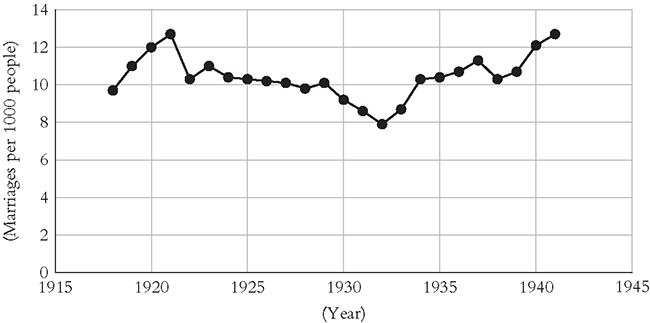
Figure 6.2. Marriages per 1,000 people, 1918–41.
Of course, the marriage rate dropped for other reasons, too. As I explain below, after a postwar boom in 1920, the marriage rate began a slow but steady drop throughout the 1920s, a decline that had to result from factors other than unemployment or an economic depression. Those other factors no doubt included greater opportunities, educational and professional, for women, and, as I also mention below, the invention of more reliable birth control. Yet those factors obtained throughout the period, including after the marriage rate recovered to its pre-Depression levels. Moreover, these gradual, long-term factors would not explain the abrupt drops in the marriage rate, like those from 1929 to 1932 and from 1937 to 1938, that mirror, almost perfectly, equally abrupt drops in the economy.
Nor would these long-term trends explain the sense of infinitely postponed love that turned into one of the defining features of the era. In “Ramblin’ Round,” Woodie Guthrie sings that he wishes he could marry and settle down but poverty condemns him to a life of eternal—and solitary—wandering.66 In one scene from Clifford Odets’s unexpectedly popular Waiting for Lefty (1935), a young woman and her fiancé, one of the taxi drivers at the heart of the play, cannot marry—and so part ways—because he does not make enough money. And in How to Win and Hold a Husband (1939), the nationally syndicated advice columnist Dorothy Dix observed:
there is a depression in the matrimonial market as well as in the stock market. Economic conditions make it impossible for many men to afford to marry. Every year men cling tighter to their bachelor freedom and economy, and no one can deny that prospects look gloomy for many young women who have set their hearts on getting wedding rings.67
By this logic, the economy is a leading indicator of marriage, which is a lagging indicator of love. All suffered during the Great Depression.68 In 1936, a young editor at Vogue named Marjorie Hillis published Live Alone and Like It: A Guide for the Extra Woman. It became an unlikely bestseller.69
You can approach this explanation another way, by working backwards from the argument Lee Edelman famously makes in No Future: Queer Theory and the Death Drive. In a heteronormative culture, Edelman claims, one ruled by what he calls reproductive futurism, the child “has come to embody for us the telos of the social order and come to be seen as the one for whom that order is held in perpetual trust.” “We are no more able to conceive of a politics without a fantasy of the future than we are able to conceive of a future without the figure of the Child.”70 In other words, as he sharply puts it, “the future is kid stuff.” By contrast, queerness—because it has nothing to do with the child—represents the death drive, the joyful refusal to reproduce: “the act of resisting enslavement to the future in the name of having a life.”71
As it happens, the Great Depression provides something of a natural experiment for Edelman’s theory. In chapter 12 of The General Theory of Employment, Interest, and Money (1936), John Maynard Keynes emphasized the essential uncertainty, even incomprehensibility of the future. (He speaks of “the dark forces of time and ignorance which envelop our future.”)72 The incomprehensibility of the future, as the introduction to my earlier chapter on righteousness suggests, emerged as a common theme of the Great Depression. (“He could no longer plan,” Sinclair Lewis writes of his main character in It Can’t Happen Here (1935), “for himself or for his dependents, as the citizens of this once unsettled country had planned since 1620. Why, their whole lives had been predicated on the privilege of planning.”)73 Or consider the title of Kromer’s novel, Waiting for Nothing, or its episodic structure, wherein the plot of each chapter unfolds over a single day and bears virtually no relation to what happens on other days or in other chapters of the book. There, as elsewhere, the horizon of the future is reduced to a single day. Or recall that in her letter to Dr. Carr, the shipboard surgeon, Starr Faithfull explained her reasons for suicide thus: “I certainly have made a sordid futureless mess of it all.”74
As the future became less knowable, less subject to planning, or even less of a viable possibility, the reign of the child, as Edelman might have predicted, was indeed weakened. Figure 6.3 tracks the birth rate per 1,000 people from 1922 to 1941.75 It began to fall during the middle years of the 1920s, during the first Golden Age of contraception in the United States. (The invention of latex in 1920 revolutionized the manufacture of condoms.)76 Yet after stabilizing in 1930, it plunged again. The fall of the child helps to explain what would otherwise remain one of the more curious features of Great Depression culture: the pervasive figure of the unwanted child. (The nationwide hunt first for the kidnapped infant son of the aviator Charles Lindbergh and then for the kidnapper is perhaps the very famous exception that proves the rule.) One chapter of Waiting for Nothing follows a mother as she tries to give away her infant. Although Harold Gray began drawing Little Orphan Annie comics in 1924, the comic only took off with the introduction of a radio show in 1930 and films in 1932 and 1938.77 In Boy and Girl Tramps of America (1934), Thomas Minehan, a young sociologist at the University of Minnesota, studied the legions of forsaken children who wandered the countryside during the early years of the Great Depression.78 As for the works examined in this chapter, in Baby Face children may as well not even exist. In BUtterfield 8, Gloria Wondrous has had three abortions. And despite one marriage and another on the horizon, the young woman in “The Man in the Brooks Brothers Shirt” does not give a thought to children. To my mind, though, nothing captures the pessimism about the future and the resulting indifference toward the child during the Great Depression better than the climax of Delmore Schwartz’s 1937 short story “In Dreams Begin Responsibilities.” Imagining that he is in a crowded theater watching a film of his parents’ courtship at Coney Island some twenty years earlier, at the moment his father proposes to his mother, the protagonist shouts at the screen, “Don’t do it! It’s not too late to change your minds, both of you. Nothing good will come of it, only remorse, hatred, scandal, and two children whose characters are monstrous.”79 Schwartz turns infanticide into suicide.

Figure 6.3. Live and still births per 1,000 people, 1922–41.
As if to confirm further Edelman, as marriage and the child waned in importance, other forms of queer—or, at least, non-heterosexual—love arose in their place. As unemployment swelled in the United States, so too did those, like Woodie Guthrie and the narrator of Waiting for Nothing, who took to the roads and rails. Historically, tramp culture has proved more welcoming, notoriously so, to queer love than virtually any other subculture. (In 1897, Havelock Ellis and John Addington Symonds published Sexual Inversion, which included an appendix to the volume written by the American sociologist Josiah Flynt Willard with the title “Homosexuality among Tramps.”)80 Yet other, non-sexual forms of love arose and thrived during the Great Depression, too. That is, if eros (love, mostly of the sexual passion) and storge (the love of parents and children) diminished during the Great Depression, other forms of love—agape (charity) and philia (friendship)—flourished.81 True, Christianity does not come through the Great Depression with a shining record. Its shelters and soup kitchens come in for near constant criticism in novels like Waiting for Nothing. (Kromer charges them with blaming the victim and making stingy charity contingent on expressions of faith.) Yet the Great Depression also witnessed some truly admirable examples of ordinary and extraordinary charity. The former were too numerous to document. The latter included the works of Dorothy Day, who published the first issue of Catholic Worker on May 1—it was dedicated, by the way, to “those who think there is no hope for the future”—and who, not long after, started the first “house of hospitality” on the Lower East Side in New York.82 By the time she published House of Hospitality in 1939, Day and her fellow activist Peter Maurin had established dozens of houses of hospitality and communal farms.
As a form of love, however, friendship had an arguably even better record during the Great Depression than charity. The examples come from across the culture. On their surface, the proletarian literature of the decade concerns the strike or the revolution, but not terribly far below that surface it concerns the relationship between its protagonists and, more generally, between and among workers. More specifically, in his 1935 biography of Walt Whitman, the critic Newton Arvin championed the poet for preaching “the gospel of comradeship.” (“Out of our nineteenth-century past, out of our American past,” Arvin wrote, “we inherit nothing potentially more fruitful than the vision Walt Whitman had of an all-embracing solidarity—a solidarity lifted above the level of rational conviction and political convenience to the level of sensibility, of social practice, of culture in its largest sense.”)83 In the late 1930s, Alcoholics Anonymous, the subject of Chapter 7, turned the ideal of comradeship into a reality. In urging recovering alcoholics to seek out existing alcoholics, the group imagined a “Fellows of Alcoholics Anonymous.” “Among [alcoholics] you will make lifelong friends. You will be bound to them with new and wonderful ties, for you will escape disaster together and you will commence shoulder to shoulder your common journey … You will learn the full meaning of ‘Love thy neighbor as thyself.’ ”84
Disaster also brought people together. On his second expedition to the Antarctic in 1934, Admiral Richard E. Byrd spent five months alone at an advanced meteorological station. In his 1938 memoir, Alone, Byrd recounts how after setting up camp he almost immediately suffered severe carbon monoxide poisoning. Over the weeks that followed, he and his crew back at the base conducted an elaborate subterfuge over the radio, with Byrd trying to hide how sick he was, lest his crew try to make an ill-advised rescue attempt, and his crew, who slowly became conscious of how sick Byrd was, inventing pretexts to come rescue him. What starts as a Thoreau-like journey into solitude and a celebration of independence slowly develops into one of the most moving tributes to dependence and friendship in all of literature.85
Meanwhile, on film, in addition to dramatizing the plight of unwanted young men during the Great Depression, Wild Boys of the Road (1933) celebrates the solidarity among them, extending it across genders to the young woman (the actress Dorothy Coonan) who dresses as a boy to travel safely among them.86 The Three Stooges, who made their first appearance in a 1934 film called, appropriately enough, Woman Haters, may torture each other for sport, but they repeatedly come to each other’s rescue and never leave each other’s sides over the forty-three short films they made over the rest of the decade.87 (The Marx Brothers offer an even more charming version of this form of brotherly love.) And while one might doubt the sincerity of the friendships formed, keep in mind that one of the best-selling books of the entire decade was titled How to Win Friends and Influence People.88
To be sure, some writers, like Carson McCullers in the powerful novel The Heart Is a Lonely Hunter (1940), remained acutely aware of the misrecognition of the Other that could occur in all relationships, including and especially those between friends.89 Still, as a whole, the decade revered friendship, even when in, say, John Steinbeck’s Of Mice and Men (1937), one friend, George, has to mercifully murder another, Lennie, to spare him a worse death.
In sum, then, love—heterosexual love, anyway—followed the economy into hard times because, like new automobile sales or housing starts, it requires and is evidence of a solid economic foundation. When that economic foundation collapses, it can pull heterosexual love and its accessories (hope for the future, the child) down with it. Yet the lesson of the Great Depression seems to be that other forms of love—charity, friendship—can arise on the ruins of that economic and erotic collapse.
People … Still Gettin’ Married
If you look again at Figure 6.2, which tracks the number of marriages per 1,000 people, you see that the marriage rate, following a postwar boom, begins a slow but noticeable decline not in the 1930s but in the 1920s. (The effect is even more pronounced if you examine marriages per single people aged 16–50.) Of course, the marriage rate still crashes come 1930, but it had tailed off for a while, and this decline matches what some observers had said about love and marriage even before the start of the Great Depression. In 1928, for example, the sociologist Ernest R. Groves published a volume titled The Marriage Crisis. Groves and others like him worried about the declining marriage rate, but they also worried about the phenomenon captured in Figure 6.4, which documents the number of divorces per 100 people.90 From 1918 to 1928, it increased by 50 percent. In absolute terms, the number of divorces nearly doubled over that period. To Groves, the increase in the number of divorces, together with the decline in the number of new marriages, suggested that marriage “is in the throes of crisis.”91 “The confidence of youth in matrimony as the goal of happiness,” he wrote, “has been, it must be confessed, roughly shaken of late, and there is abroad a considerable amount of pessimism with reference to the desirability of marriage.”92 Or, more colloquially, as someone told Groves, “Marriage is cracked.”93

Figure 6.4. Divorces per 100 people, 1918–41.
Looking backward toward the recently completed decade, the popular historian Frederick Lewis Allen wrote in 1931 that everywhere Americans looked, but especially in the realm of sex and the relation between the sexes, they could see a “revolution in manners and morals.”94 Moreover, writers like F. Scott Fitzgerald, Dorothy Speare, Percy Marks, Sherwood Anderson, Theodore Dreiser, Ernest Hemingway, and Samuel Hopkins Adams began to document this revolution in manners and morals and its less than reverent attitude toward love and marriage not in the 1930s but 1920s. If so, then one must conclude that the 1930s did not singlehandedly kill off love. It merely finished it off. As with so much else in the period, the history of love during the 1930s does not neatly begin with the start of the decade.
What might have changed by the 1930s, though, was the attitude toward that revolution. Whatever had seemed liberating (think the early poetry of Edna St. Vincent Millay) or comic (think Gentlemen Prefer Blondes by Anita Loos) about free love and the revolution in manners and morals in the 1920s had, by the 1930s, increasingly come to seem just plain sordid. In this respect, the 1930s start to resemble the 1980s, the decade that follows the sexual revolution, the decade of the backlash, when economic contraction ushers in a new conservatism. Consider Dorothy Dix, the advice columnist and author of How to Win and Hold a Husband. In a swipe at the revolution in manners and morals, Dix advised her readers that if they sought to find that one great cure-all, marriage, they should, above all, “Be Modest.”95 “Many girls think that they make themselves attractive by posing as sophisticated,” Dix wrote, “by telling dirty stories, swearing and getting drunk. Fatal error. There is no one who doesn’t shudder at the sound of an oath on a girl’s lips. There is nothing so disgusting as a drunken woman with disheveled clothes and bleary eyes, shedding maudlin tears or cackling with drunken laughter.”96 In a chapter titled “The Cost of Free Love,” Dix chided readers that “there are certain things”—like adultery—“that are either right or wrong and our attitude toward them does not change them.”97 “We teach children,” she continues,
that the very foundation stone of character is self-control and that the measure of our strength is our ability to deny ourselves what we want at the minute and work for it and wait for it until we can get it honestly. This applies to matters of sex just as much as it does to anything else. Illicit love never carries any blessing with it.98
In a chapter titled “Is Marriage Outmoded?” Dix offers an unequivocal no. In 1928, Ernest Groves came to the same conclusion, but it took an entire book to make the case. In 1939, Dix needs a few pages. The backlash could be taken for granted.
Let me offer one more caveat, perhaps the most important of all, which is that the history of love does not remain static throughout the 1930s. By 1939, in addition to urging readers to be modest, Dix was singing the praises of conventional love. “Great is the medicinal value of love,” she writes in a chapter titled “Love—the One Great Cure-All.” “Try it. It is a sovereign remedy for every trouble of body and mind and soul!”99 As Dix’s enthusiasm for the one great cure-all suggests, love, which had fallen on hard times, and remained down and out in the eyes of writers like McCarthy, nevertheless eventually found itself thriving again. For proof, watch what happens to the marriage rates after the worst, early years of the Great Depression. Like the rest of the economy, they recover, and after a brief dive following the Roosevelt recession of 1937–8, climb upward again. The birth rates take a little while longer to recover, but they stop falling the first year of the New Deal, and the wonder—to my mind—is that they stop falling at all. In any case, their recovery times out rather well with the cinematic incarnation of Shirley Temple, who made her first appearance on film at the age of five in 1934 in Bright Eyes and remained the number one box-office draw for the rest of the decade. The child, and the child star, to put it in terms Lee Edelman might recognize, had returned.100 And the return of the child is the only way to explain one of the strangest phenomena in all of the 1930s, which is the public fascination—it bordered on an obsession—with the Dionne quintuplets, five identical sisters born near Ontario, Canada in 1934. For nearly a decade, thousands of tourists per day—over 3 million in total—visited the public nursery where the Ontario government housed the quintuplets after declaring the parents unfit.101 The unemployment rate—again with the exception of a brief rise during the Roosevelt recession—largely dropped over these years as well.
On this reading, love did not die during the 1930s. Instead, it went dormant. Pulps like Love Story kept it alive. By contrast, films like Baby Face and works like BUtterfield 8 and “The Man in the Brooks Brothers Shirt” offered autopsies of the corpse. But these death announcements were out of step with a larger culture, which had never truly given up on love. As soon as the economy showed signs of life, people returned to the altar and the maternity ward. In “Extra Sheer,” for example, the lead story from the March 10, 1934 issue of Love Story—the title refers to a pair of stockings that figure in the plot—a couple has to stand in line at the New York City marriage-license bureau. “You’ll have to wait,” an old man cackles at them. “Looks like people is still gettin’ married, despite what the newspapers say!”102 If my reading of a dormant but never fully dead love is right, then the story of Edward and Wallis may have captured headlines to the extent that it did because by then, by late 1936, the worst of the hard times, whether when it came to the economy or to love, had passed. Love could come first again.