
8
Ham to ham and eggs to eggs
If I don’t get a pension I’ll have to beg.
Woody Guthrie, “Ashes to Ashes Dust to Dust”1
In January 1940, Ida May Fuller, then a 66-year-old retired legal secretary living in Vermont, opened her mailbox and found a check from the Treasury of the United States made out to her for $22.54 (a little over $400 today). The number on the check, 00-000-001, suggested Fuller’s place in history (see Figure 8.1). She had received the very first Social Security check issued by the United States government.2
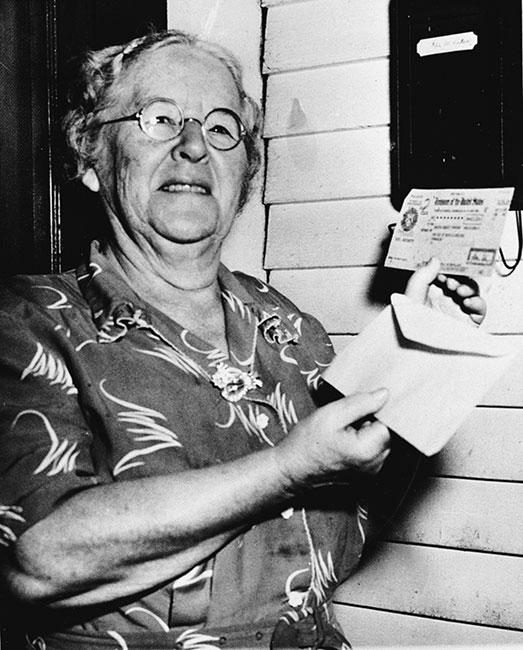
Figure 8.1. Ida May Fuller. The photograph is from 1950.
Source: Associated Press
In fact, Fuller had not received the very first Social Security check but the very first check issued under Title II of the Social Security Act, Federal Old-Age Benefits. Understandably, since it composes by far the largest share of Social Security expenditures, most people take that part of Social Security, Old Age Insurance, for the whole. Yet the Social Security Act, as passed in 1935, included more than just old-age benefits. The Act also provided grants to states for aged needy individuals; for unemployment compensation; for needy dependent children (that is, children who lived in families without male breadwinners); for maternal and child welfare, including services for crippled children; for public health work; and for the blind.3
Quibbles about terminology aside, how that check for $22.54 made its way to Ida May Fuller’s mailbox is one of the most fascinating public policy stories of the 1930s, perhaps of the twentieth century. Social Security, as one historian puts it, “remains the most lasting legacy of Depression-era activism, New Deal policymaking, and above all of the public commitment to a broadly inclusive system of shared social protection against the insecurities of a market economy.”4 As the most lasting legacy of the era, Social Security, particularly the sections that focused on old-age insurance for retired workers, also provides a fitting conclusion to an inquiry into the emotional life of the Great Depression. For its passage was shaped not just by the emotions of those who drafted the bill, debated it, denounced it, revised it, made it law, and then four years later amended it. Its passage was also shaped by the feelings of ordinary Americans, those who played no formal role in its enactment but whose emotions weighed heavily on those who did. In short, Social Security offers an example of how feelings can translate into action, into, at times, policy. Each of the emotions I examine in this book, from righteousness to hope, influenced the passage of the Social Security Act of 1935 or shaped the form the legislation took.
In what follows, I describe how the Social Security Act came into existence. I do so by focusing on three sets of actors: Dr. Francis Townsend and his followers, who provided much of the urgency for Social Security; Franklin Roosevelt and the planners of Social Security, who tried to steer the sudden and clamorous demand for pensions into a more pragmatic piece of legislation; and critics of Social Security, whose misgivings would guide the 1939 amendment to the bill. For each group, I focus on the emotions that motivated them. The upshot is a history of Social Security that clusters around the emotions previously discussed in the book: righteousness, panic, and fear, but also awe, love, and hope.
Although emotions can translate into action, the emotional life of the Social Security Act also provides an opportunity to reflect on the limits of this instrumentalist approach to studying the emotions. Emotions, that is, do not invariably translate into deeds. They almost always help people understand the world, but they do not necessarily, and they certainly do not always, lead them (or others on their behalf ) to change it. There is a danger, in other words, in thinking of emotions mechanically, as energy that is perpetually converted into action. Put simply, emotional energy does not have to exhaust itself in action. Occasionally, it simply exhausts itself. That said, the Social Security Act (and its 1939 amendment) offer a case study in how feeling leads to action, in how emotions can help one narrate and understand the past.
The Old People’s Crusade
One can start the history of the 1935 Social Security Act at several different yet equally justifiable moments: Franklin Roosevelt’s June 8, 1934 message to Congress calling for social insurance; the publication of I.M. Rubinow’s 1913 book Social Insurance; the German social welfare policies of Otto Von Bismarck; or even Thomas Paine’s 1797 pamphlet Agrarian Justice, which argued, among other things, for an estate tax that would fund old-age pensions.
It may make the most sense, however, to start with a letter to the editor published in the Long Beach Press Telegram on September 30, 1933. In that letter, a 66-year-old Long Beach doctor, Francis E. Townsend, described his, as the editors labeled it, “Cure for Depression.” Townsend proposed “the national Government retire all who reach [age sixty and above] on a monthly pension of $150 a month or more, on condition that they spend the money as they get it.” He suggested raising the funds for the program through a sales tax.5 In his next letter to the editor, and in subsequent descriptions of what came to be known as the Townsend Plan, Townsend increased the monthly pension to $200. He further specified that recipients would have to spend the money within 30 days. And he abandoned a sales tax in favor of a 2 percent tax on all transactions.
According to legend, the idea for the plan came to Townsend while shaving. His bathroom window overlooked an alley. One morning he looked through the window and saw three “haggard, very old women, stooped with great age, bending over the barrels, clawing into the contents.” Fed up with this picture of unrelieved poverty, he dropped his razor and “a torrent of invectives tore out of him.” When his wife warned him that if he shouted like that, the neighbors might hear, he replied, “I want all the neighbors to hear me! I want God Almighty to hear me! I’m going to shout till the whole country hears!”6
It makes a nice story, but it may have been no more than a story. In his 1943 autobiography, New Horizons, Townsend does not mention the women. He does mention, however, his own bleak prospects at the time and, in truth, the Townsend Plan may have been born out of fear for his own future as much as righteous anger on behalf of old women clawing through garbage cans. In 1933, Townsend had lost his position in the Long Beach Health Department. He woke up one day an old doctor with no patients in the middle of the worst depression in United States history. He tried selling real estate but got nowhere. As he remembered, “Things were not going too well in our home. Neither Mrs. Townsend nor myself could see a way out for the future … We were alone and, as day after day went by without a cent coming in—and our slender bank account being paid out—we worried.”7
Within days of publishing his first letter to the editor, however, Townsend found himself the head of what would with almost unimaginable speed become a national movement. By 1936, 7,000 Townsend Clubs had formed in the United States, with membership in the clubs numbering in the millions.8 (The city of San Diego had eighty Townsend Clubs with 30,000 members; nearly one out of every five residents of the city belonged to a Townsend Club.)9 Townsend claimed to control the votes of 25 million people.10 In 1935, Townsend and his supporters helped to get John Steven McGroarty, a Los Angeles Times columnist who had praised the Townsend Plan, elected to Congress.11 McGroarty did not disappoint. On January 16, 1936, he introduced a Townsend bill into Congress.12 An unpublished Gallup opinion poll taken on March 14, 1936 suggested that a majority of Americans might have favored such a bill.13
For Townsend the plan was, as he told the House Ways and Means Committee in 1935, “only incidentally a pension plan.” “The old people,” he continued, “are simply to be used as a means by which prosperity will be restored to all of us.”14 Whoever titled Townsend’s first letter to the editor had it right, then. It was more a “Cure for Depression” than anything else. By inducing those sixty and over to leave the labor market, Townsend would solve the unemployment problem, whether it was caused by the Depression or by mechanization. Like many in the 1930s, Townsend worried about the latter phenomenon. In the third paragraph of his first letter to the editor, Townsend argued, “Of late years it has become an accepted fact that because of man’s inventiveness less and less productive effort is going to be required to supply the needs of the race. That being the case, it is just as necessary to dispose of our surplus workers as it is to dispose of our surplus wheat.”15
Townsend also promised that the plan would put an end to the stock market and banking panics I describe in Chapter 2. If the government set individual pensions at $200 per month, he argued, it would make “the aggregate of these pensions a potent factor in stabilizing the circulation of money in a volume sufficient to insure against panics in the business world.”16 In general, though, Townsend promised that his plan “would bring back prosperity by restoring purchasing power to the people.”17 In his third letter to the editor, Townsend wrote, mistily, “Money from a universal sales tax will start a golden flood pouring into Washington that will be constantly augmented as business revives, and as bountiful a flood will return to its source monthly through the pension system stimulating every line of business, increasing prices and wages, restoring real estate values and rentals and making possible the abandonment of charity in all its ugly forms.”18 In short, Townsend did not offer a pension plan. He offered an economic panacea.
In Chapter 7, I argue that for many people the Great Depression meant a chastening of hopes, a reckoning with the power of fate and with forces that they could not control. The popularity of the Townsend Plan, however, complicates that argument. On the one hand, the Townsend Plan, and, as I suggest below, the Social Security Act of 1935, faced—and rebuked—decades of arguments that through self-reliance and thrift individuals could and should provide for their own old age. In that sense, both pension programs acknowledged that hopes did not always match realities. On the other hand, as the complete impracticality of the Townsend Plan also suggests, the Great Depression appears to have made people who lived through it susceptible to all manner of schemes and demagogues.19 For as nearly every economist who examined the Townsend Plan concluded, not only would it not work, in all likelihood it would make the economy worse, not better.20
In a 1935 Harper’s article “The Old People’s Crusade” and, later, in their 1936 book An Army of the Aged, the journalists Richard L. Neuberger and Kelley Loe did the most to throw cold water on the plan. In the Harper’s piece, they observed that according to Townsend himself, the plan would cost between $20 and $24 billion per year. Neuberger and Loe calculated that to fund it would cost each family in America an average of $850 per year (about $16,000 in 2019 dollars). Or, to think of it another way, to fund the Townsend Plan would cost 40 percent of the entire national income of 1934. That meant that those sixty and older, who represented 7 percent of the population in America, would receive 40 percent of the country’s income. The remaining 93 percent of the population would thus have to make do with the other 60 percent. “The Townsend Plan,” Neuberger and Loe pronounced, “simply would starve Junior to gorge Grandpa.”21
Indeed, critics were alarmed by the naiveté of those who believed in the Townsend Plan. Edwin Witte, who would lead the group charged with drafting Social Security, concluded, for the benefit of his fellow Social Security planners who may have contemplated adopting the Townsend Plan, “It is a plan which arouses great hopes but actually will give the old people little, or nothing.”22 For their part, Neuberger and Loe worried that “Uncounted thousands of old people have been blinded to even simple arithmetic by Dr. Townsend’s promise to make the sundown of life ‘a delightful golden autumn instead of a bleak and fearful winter.’”23 And after working through the numbers, a 1936 pamphlet signed by twenty-two social scientists at the University of Chicago observed of the Townsend Plan that the “notion of such large pensions financed by a 2 per cent transactions tax is thus altogether a delusion.” “To propose such an ill-advised scheme,” their final sentence read, “can do nothing but distract attention from more reasonable pension plans.”24 In sum, these critics charged, Townsend, like the Dale Carnegie of How to Win Friends and Influence People, was selling hope. By claiming that pensions would pay for themselves through increased economic activity, Townsend was also, as I accuse Napoleon Hill, practicing the most magical sort of magical thinking.
The credulity of his followers earned the Townsend Movement a place in Hadley Cantril’s 1941 book The Psychology of Social Movements. Cantril, as I discuss in Chapter 2, was the Princeton University psychologist who tried to discover why some people panicked when they heard the 1938 Invasion from Mars broadcast and why others did not. In The Psychology of Social Movements, Cantril set out to learn why “millions of people get swept into social movements,” especially “strange or esoteric” ones.25 After chapters on lynch mobs, Father Divine (the African-American leader of a religious cult whose disciples believed he was God), and the Oxford Group (a revivalist Christian movement that would influence the founders of Alcoholics Anonymous), Cantril turned to the Townsend Plan.
For Cantril, the Townsend Plan succeeded in part because it promised to satisfy the material needs of people. But so, Cantril observed, did a host of other economic panaceas that attracted nowhere the support that Townsend’s did. What separated the Townsend Plan from these programs, Cantril argued, was that it fit old norms (“The Townsend Plan Is True Americanism,” as one of its slogans ran) and it preserved or enhanced self-regard, by which Cantril meant it “gave old people a place in the scheme of things.”26 But perhaps most important was that the Townsend Plan was simple enough to be understood, and its followers bewildered, desperate, and simple enough to want to understand it. “They,” Cantril observed, speaking of those left behind by capitalism and unusually receptive to the Townsend Plan, “are highly suggestible, lacking in critical ability.”27 These are the same terms Cantril used to describe those who panicked while listening to Invasion from Mars. (A note in this section of The Psychology of Social Movements directs readers to an earlier discussion of that broadcast.) In other words, as Cantril sketched the Venn diagram of those living in the United States in the 1930s, those who panicked and those who joined Townsend clubs formed overlapping parts of the two circles. Call it the part that terrified Hadley Cantril.28
Cantril’s research soured him not just on the Townsend Movement but on populism generally. He closed his chapter on the Townsend Plan by observing that until the culture can accommodate people more satisfactorily, movements like the one Townsend led were inevitable. “It seems unlikely,” he added, “that the critical ability of people will be increased rapidly enough to enable them to properly evaluate the schemes presented them.” It fell, then, to “those who better understand the problems of government and finance, of capital and labor, and of youth and of age” to see to it “that needs are better provided for, that meaningful and reasonable goals are substituted for panaceas, and that a large portion of the population does not feel that the discrepancy between its hopes and its realizations is so unbridgeable.”29 Perhaps to add teeth to his warning, he devoted the next two chapters in his book to the rise of the Nazi Party, an illustration, he felt, of what happened to a country when it did not or could not realize the hopes of its citizens.
In the Shadow of the Poorhouse
Although Cantril did not think it sufficed, Social Security came into existence because “those who better understand the problems of government and finance” sought to provide for the needs of their fellow Americans, including those who would otherwise fall prey to economic panaceas like the Townsend Movement (or worse). Thus the history of Ida May Fuller and her $22.54 check starts with the Townsend Movement because of its legions of suggestible, hopeful, and righteous followers. (Many of Townsend’s followers believed God inspired his plan, and Townsend did nothing to disabuse them of this belief.) Together with Huey Long, whose Share Our Wealth campaign also included pensions for the elderly, Townsend made the old-age provisions of the Social Security Act not just politically possible but politically urgent. In The Politics of Upheaval, Arthur M Schlesinger, Jr. observed, “Townsend and his followers were calling attention to a cruel problem which the American people had too long ignored. Now the nation could no longer ignore its old again.”30
If the history of the Townsend Movement is one of suggestibility, hope, and righteousness, then the history of the Social Security Act is, to start at least, one of fear. Fear on the part of officeholders that if they did not come up with something more practicable, they might have to pass something “delusional” like the Townsend Plan. Or, more to the point, they would get voted out of office, replaced by someone who would vote for the plan, delusional or not. For then, as now, old people voted. And many old people supported the Townsend Plan. In a 1962 speech, “The Roots of Social Security,” Frances Perkins, then secretary of labor and eventual chairwoman of the Committee on Economic Security that would write Social Security legislation, recalled of Townsend:
In particular, he startled the Congress of the United States, because the aged have votes. The wandering boys didn’t have any votes; the evicted women and their children had very few votes. If the unemployed didn’t stay long enough in any one place, they didn’t have a vote. But the aged people lived in one place and they had votes, so every Congressman had heard from the Townsend Plan people.31
Hear from them they most certainly did. In his 1936 history of the Social Security Act, the economist Paul H. Douglas noted that “Many millions of signatures were obtained to petitions asking Congress to adopt the plan, while the letters advocating [the Townsend Plan] which were received by Congressmen probably themselves ran up into the millions.”32 Robert L. Doughton, the chairman of the House Ways and Means Committee, complained to Townsend when he appeared before that body that the letters arrived “by the carload.”33 The letters accomplished their purpose. In their Harper’s article, Richard Neuberger and Kelley Loe observed that the “almost unbelievable strength [of the Townsend organization] has stunned the leaders of both the Republican and Democratic parties. On Capitol Hill in Washington the politicians are amazed and terrified by it.”34 The politicians included the president. Frances Perkins, in her 1964 book The Roosevelt I Knew, recalled Roosevelt saying, “The Congress can’t stand the pressure of the Townsend Plan unless we are studying social security, a solid plan which will give some assurance to old people of systematic assistance upon retirement.”35
In their defense, in adopting the old-age provisions of the Social Security Act, politicians, including and especially Roosevelt, responded to more than just fears for what Townsend and his supporters might mean for their electoral prospects. Less cynically, they responded to the considerable fears of ordinary Americans. Roosevelt in particular received tens of thousands of letters from aged people (or their children) describing their desperate conditions, pleading for aid, or confessing their fear of the future. These letters predated or did not mention Townsend at all. They merely expressed desperation and fear.
The following letter from Mrs. M.A. Zoller, Sr., of Beaumont, Texas, written in neat, Palmer cursive and sent on July 13, 1933, is typical:
Dear Sir:
I write to ask your assistance in securing an old age pension for my mother Mrs. Martha Gilbert, wife of F. R. Gilbert (deceased since January 6, 1920).
She is helpless, suffering from Sugar Diabetes, which has affected her mind. She has to be cared for in the same manner as an infant. She is out of funds completely. Her son whom she used to keep house for is in a hospital in Waco, Texas—no compensation for either himself or her.
I am a widow; have spent all my savings in caring for her. I have kept boarders & roomers in a private home to keep my four children for I have always been a lady; this is why I appeal to you to place your dear mother in my dear mother’s place. With no money and no place to go unless it be to the poor house. I cannot rent my rooms now for she demands constant care & attention. Please do something about this request as soon as possible.
She will be 82 years old on August 9th.
Yours Truly,
Mrs. M. A. Zoller Sr.
I do not own my home & at present I cannot meet my bills (overdue). I don’t know what to expect next.
Thank you in advance.36
Mrs. Zoller appeals to the president’s empathy (“place your dear mother in my dear mother’s place”), but the more revealing part of the letter comes when she asks the president to imagine exactly what that place is: “With no money and no place to go unless it be to the poor house.”
Zoller’s reference to the poorhouse—and her fear that her mother would end up there—was not hyperbole. Although most people associate poorhouses with Victorian England or, if they acknowledge that they reached America, assume that their history ends with the nineteenth century, poorhouses survived well into the twentieth century. By then, few were still called poorhouses or almshouses. Rather, fully aware of the stigma of poorhouses, officials had renamed them city homes or county farms. The change, as David Wagner writes in The Poorhouse: America’s Forgotten Institution, “fooled few.”37 By any name, poorhouses reached their apotheosis in the 1930s. Of the six New England poorhouses Wagner examined for his monograph, each “held by far the largest number of inmates in their history during the period of the Great Depression.”38 To adapt the title of Michael B. Katz’s famous history of welfare in America, during the 1930s people still lived in the shadow of the poorhouse. Perhaps more than ever. And not least because most of the pension advocacy groups that formed in the early 1920s—the Fraternal Order of the Eagles, the American Association for Labor Legislation—argued for old-age pensions in part by very publicly demonizing poorhouses.39
They succeeded. By the 1930s the poorhouse had become the national bogeyman. Countless letters to the president or Eleanor Roosevelt spoke of the terror of the poorhouse. “Now there are a lot of us will choose suicide in preference to being herded into the poorhouse,” a Beverly, Massachusetts woman wrote Mrs. Roosevelt in December 1934.40 In May 1934, a man from Lincoln, Nebraska wrote the First Lady, “We have been honorable citizens all along our journey, calamity and old age has forced its self [sic] upon us please donot [sic] send us to the Poor Farm but instead allow us the small pension of $40.00 per month and we will do as we have done in the past (not complain).”41 Another woman, to illustrate how little her mother wanted to live with any other member of her family should anything happen to her daughter, said “she would rather go to a poor house.”42
Besides the fact that correspondents felt more comfortable writing to her than the president, Eleanor Roosevelt received many of these letters because of a speech she gave in early 1934 to the Washington, D.C. branch of the American Association for Social Security. The speech was reported and occasionally reprinted in newspapers across the country. In it, she endorsed old-age pensions. (At this point many states had passed or were debating legislation.) But like the advocacy groups of the 1920s, she did it by lamenting the alternative to pensions, poorhouses. “Most of us,” Roosevelt said, after discussing the merits and demerits of the New York pension law that had passed while her husband was governor of that state, “have had personal experiences which have brought [the necessity for this law] home to us.” She went on to describe hers, which involved “an old family—two old sisters and two old brothers—who had lived on a farm” near the Roosevelts in New York. Roosevelt, however, did not see them for two or three years.
Then, one Election Day, I went to get them and I found one old lady in tears because that day one surviving brother had been taken to the insane asylum because the worry of how they were to going to get enough to eat and enough to pay their taxes had finally driven him insane, and she was waiting to go to the poorhouse. The other sister had already gone, and the other brother had died.43
Roosevelt says she “felt I had been such a bad neighbor” and “felt so guilty.” Yet it also “seemed to me,” she said, “as though the whole community was to blame.” Old-age pensions, she implied, would allow individuals to fulfill their responsibilities as neighbors and members of a community. It was either that or the poorhouse.
In her speech, Roosevelt is careful to emphasize that only those “who have worked hard all their lives, and, through no fault of theirs, have not been able to provide for their old age” have the right “to be cared for in the last years of their life.” She notes of the farm family scattered to the grave, the insane asylum, and the poorhouse, for example, “All their lives they had done what good citizens should do and they simply had never been able to save.” Such rhetoric was meant to counteract arguments that for decades had prevented the United States from following Western European countries in adopting social insurance programs. In the early twentieth century, as early reformers like I.M. Rubinow and Abraham Epstein advocated for social insurance, they were nearly always met with claims that such compulsory plans would undermine American traditions of individualism, free association, and thrift.44
Such sentiments survived into the 1930s. As late as 1931, Calvin Coolidge argued in his syndicated newspaper column that “What a self-respecting people really needs is not a system of old-age pensions but a population made sufficiently skilled by education and sufficiently self-controlled and well-disposed by the hold of religion so that old-age pensions would be superfluity. Unless real reform comes from within, the problem will never be solved.”45 And during hearings on the Social Security Act, James L. Donnelly, executive vice-president of the Illinois Manufacturers’ Association, sent a statement to the House Ways and Means Committee listing eleven reasons why the bill should not be passed. Number ten read, “This program would undermine the fabric of our economic and social life by destroying initiative, discouraging thrift, and stifling individual responsibility.”46 To those like Coolidge and Donnelly, if the state assumed responsibility for the old, that meant the old had not taken responsibility for themselves while young. Pensions, in short, undermined character, the trait, I argue in my chapter on righteousness, whose lapse many felt had caused the Depression, but also the trait, “the eternally valuable element,” as F. Scott Fitzgerald put it in “Babylon Revisited,” whose resurgence offered the only permanent cure for the depression.
The concern with character is why, on June 8, 1934, when Franklin Delano Roosevelt called on Congress to “undertake the great task of furthering the security of the citizen through social insurance,” he was, like his wife, careful to emphasize that the safeguards he sought were not meant to undermine individual responsibility or thrift but to protect against “misfortunes which cannot be wholly eliminated in this man-made world of ours.” Hence, in a phrase that would become permanently associated with the Social Security Act, not least because he echoed it at the signing ceremony, Roosevelt told Congress he sought legislation that would offer security against “the hazards and vicissitudes of life.”47 Both words emphasize unpredictability, chance—the events or circumstances that lie beyond one’s control.
The existence of those hazards and vicissitudes are what I mean when I argue, in Chapter 7, that the Great Depression did not change what people hoped for but how they hoped for it. Everyone hoped for a prosperous old age. Many may have even worked and saved for that end. But more and more people came to recognize that one could not control everything. Reality had a way of betraying hopes. Indeed, the Depression had already done much to undermine the hope that thrift and character alone could assure prosperity. A popular 1931 cartoon had a squirrel asking an aged man on a park bench, “But why didn’t you save some money for the future, when times were good?” “I did,” the man says, whose label (“Victim of Bank Failure”) exposes the hope that thrift could offer sufficient protection against the hazards and vicissitudes of life and the economy.48 Save all they want, people could do little about bank failures. And if it were not a bank failure, it would be some other hazard or vicissitude of life that undermined their best laid plans. As I put it in Chapter 7, invoking the game of Monopoly, at some point everyone lands on Chance.
Obviously, that is a lesson that those who more often than not had benefited from the fortunes of life had to learn more than those who, historically, had suffered from its misfortunes, but the former seemed to have learned it nonetheless. In their 1937 book Social Security in America, for example, the authors observed, “Investigations on the extent of old-age dependency made by a number of State commissions in the twenties and early thirties disrupted once and for all the comfortable belief that ‘deserving’ citizens do not become dependent in old age.”49 And in her testimony before the Senate, Frances Perkins, after discussing the “hazards” of old age, illness, and unemployment, said, “Most of us here recognize that these are factors over which [families] have no particular control. The incidence of illness or death, of old age, and of unemployment are hazards which no individual can control for himself.”50 No one challenged her.
Although diehards like Coolidge and Donnelly still existed, those who opposed the Social Security Act did so because they thought it would harm the economy or would menacingly—and, as I argue below, awesomely—expand the powers of the federal government. Few opposed the Act because they thought it would undermine thrift or character. After all, the Act did not get rid of thrift so much as compel it.51
Social Security in America
But that is to jump ahead. After Roosevelt delivered his message to Congress in June, he formed the Committee on Economic Security, chaired by Frances Perkins, to study the problem of economic insecurity, including the economic problems of old age, and develop legislation that he could present to Congress by the end of the year. Within six months, the committee had produced a fifty-page formal report to the president, ten volumes of unpublished reports and studies, and, in 1937, a book, Social Security in America, that summarized their investigations and recommendations. The research into old-age security was led by Barbara Nachtried Armstrong, a law professor at the University of California, Berkeley (the first woman, as it happens, to join the faculty of the law school at a major university).52 In their report to the president, the Committee on Economic Security noted the increase of aged persons in the United States. A declining birth rate, they argued, together with the restrictions on immigration set forth in the 1924 Johnson-Reed Act, had led and would continue to lead to the aged representing a larger share of the American population.53 In addition to the increasing number of aged persons, they noted the increasing dependency of those aged people. They estimated, conservatively, that “at least half of the approximately 7,500,000 people over 65 years now living are dependent,” by which they meant having an annual income of less than $300 (about $5,500 in 2019).54
At least some of their dependency, the authors concluded, owed to the employment difficulties facing older workers. Like Townsend, the authors were concerned with “the mechanization of industry” and its effect “upon the chances which this growing number of aged persons now have, or in the future will have of preserving their economic independence.”55 Mechanization, Barbara Nachtried Armstrong wrote in the unpublished report, “has placed an increasing emphasis upon youth, physical strength and ability to stand nervous strain.”56 “Although such graphic phrases as ‘old at 40’ and the ‘scrap heap at 45’ suggest an exaggeration of the actual facts,” she added in language that made it into the 1937 book, “there is undeniable evidence of the progressive use of maximum hiring-age limits in industry.”57 These employment difficulties exacerbated the economic problems of old age. If those over forty years of age lost jobs more frequently and had more difficulty finding jobs once they lost them, they would have that much less of a chance to accumulate the earnings and the savings they would need to keep them out of poverty in old age.
Moreover, the Depression had worsened and would continue to worsen these trends. “Many children who previously supported their parents,” the authors of the report informed the president, “have been compelled to cease doing so, and the great majority will probably never resume this load.”58 In other words, whom would the aged depend on if those whom they had depended on—their grown children—could no longer support them? And down the road, those same grown children, having lost their jobs and sometimes their savings in the Depression, would be even less prepared for old age—and even more dependent—than their parents.59 In short, the Depression had made the economic problems of old age worse, but the economic problems of old age would not end with the Depression. Something must be done.
The Committee on Economic Security recommended a three-pronged attack on the economic insecurity of old age. First, the federal government would offer matching grants to states to supplement existing old-age assistance plans or to establish new ones. By the mid-1930s, most states had pension plans for aged needy individuals, but the Depression had wiped out their budgets. Under Title I of the Social Security Act, the federal government would assist states in providing pensions for those sixty-five and older who could demonstrate need. The pensions would pay up to $30 per month, with half of the money coming from the state and half coming from the federal government.
The planners of Social Security were not immune to considerations of thrift, however. They worried about the effect that “gratuitous assistance” would have on people and, ultimately, on the federal budget.60 If people began to treat old-age pensions as a matter of right, they reasoned, then more and more people would come to rely—if not to exploit—the system. If the state and the federal government guaranteed people $30 per month upon retirement, for example, then what incentive would people have to save during their working years? And unless they could save a lot, why would people bother to save a little when the government would grant them $30 per month regardless of how much they had saved? (As the authors of the report put it, “the very principle of gratuitous assistance, namely, that the less income the applicant has the more pension he receives, has an effect which is the inverse of inducement to thrift.”)61 If the federal government did nothing but offer old-age assistance to the states, the committee calculated, “the number of aged persons who arrive at old age without any income is actually increased,” and the costs of old-age assistance would spin out of control.62 In their worst-case scenario, the committee calculated that by 1957 50 percent of the aged would depend on the program, which, at pensions of $25 per month, would cost the federal government over $1 billion per year, unadjusted for inflation.63
Hence the second part of the plan: contributory old age insurance, what most people today think of as Social Security. To keep gratuitous assistance from undermining thrift, the federal government would simply compel thrift. Under Title II of the Act, workers would contribute a percentage of their paycheck—to be matched by their employer—to an old-age reserve account. Upon retirement at age 65, they would receive an annuity based on the contributions they had made to the reserve over their working life. The plan would begin collecting contributions on January 1, 1937. The first annuities would be paid in 1942.
To fund the program, the committee decided on gradually increasing the tax rate, starting at 0.5 percent in 1937 and increasing by 0.5 percent every five years until it reached a maximum of 2.5 percent in 1957. (Employers would pay the same rate, leading to an eventual total rate of 5 percent.) Social Security would pay annuities, based on how much one had contributed, to those who had paid into the system for five years or more. Those who had contributed for fewer years would simply receive a lump sum payment of what they had contributed, with interest.
The Committee on Economic Security submitted their proposal to President Roosevelt on Christmas Day, 1934 and Roosevelt submitted it to Congress on January 17, 1935. The plan would not survive congressional scrutiny intact. It would not even survive presidential scrutiny intact. As the Committee on Economic Security drafted the old-age insurance component of the bill, the system would have created a $1.5 billion deficit by 1980. The committee simply assumed that a future Congress would make good on the debt. No one—not President Roosevelt, not the secretary of the treasury, and not Congress—liked this idea. When he first saw the proposal, the president thought the table showing a deficit of $1.5 billion by 1980 must be a mistake, so committed was he to the concept that the program pay for itself. “It is almost dishonest,” Roosevelt told Frances Perkins, “to build up an accumulated deficit for the Congress of the United States to meet in 1980.” The secretary of the treasury, Henry Morgenthau, called the debt an “imposition of onerous burdens on the future” (898). To fix this “mistake,” Congress accelerated the tax schedule, starting it at 1 percent in 1937 and increasing it by 0.5 percent every three years thereafter, until it reached a maximum of 3 percent in 1949 (or 6 percent including employer contributions). (This alteration got rid of the debt, but, as I discuss below, it created another problem.)
Congress also altered the needlessly complicated annuity formula that the committee had originally proposed.64 Instead, those who had contributed at least $2,000 to the system during each of at least five years would receive a monthly annuity according to a formula that rewarded the first $3,000 of contributions more heavily than it did the next $42,000, and any amount over $45,000 least of all.65 Because the rates were higher on the lower contributions, the system was broadly redistributive. That is, assuming they lived as long as everyone else, those who contributed less to the system ultimately took more than their share, and vice versa. Oddly, for all the criticisms leveled against the compulsory old-age insurance component of Social Security, few at the time criticized that aspect of it.
The third leg of the plan was voluntary old-age annuities for those left out of the compulsory old-age insurance system. As the Committee on Economic Security proposed it, the compulsory insurance plan covered almost everyone who worked for wages or salaries. It did not, however, cover the self-employed or, notoriously, domestic and agricultural workers. Although many historians later perceived the operations of racist Southern congressmen in this exclusion, the evidence is mixed, at best. And in any case, the excluded groups would still be covered by Title I of the Act, old-age assistance.66 They would also be covered by the voluntary annuity plan. (Basically, the federal government would sell old-age annuities.) Unsurprisingly, this part of the plan did not make it out of Congress. At the behest of Senator Augustine Lonergan of Connecticut, where, coincidentally, a number of private insurance companies did business, the Senate nixed it.67
For all their actuarial precision, one could argue that as the drafters of Social Security contemplated the economic problems of old age and their solutions, emotions, as much as or more than numbers, motivated their policy decisions. “The step of adopting old-age annuities,” they argued in the report published in 1937 as Social Security in America,
would be justified from the standpoint of sound economic policy even if the net cost of insurance were far in excess of the future relief which it replaces, for the quality of self-respect and the relative freedom of fear of old age engendered by old-age insurance have a dollar-and-cents value to worker, employer, and government alike.68
To speak a little less actuarially, the authors of the report meant that whatever else its benefits, old-age annuities would provide emotional wellbeing, and any honest calculation of its costs had to include the value of that wellbeing. “When he has the assurance that each day’s work builds up an investment for his old age,” the committee speculated, “permitting independence of the charity of the community or financial aid from sons and daughters, already overburdened by the cost of maintaining their own families, much of the wage earner’s haunting fear of insecurity is removed.”69 The emotional security might even trickle down to the young, too. “The confidence and sense of security of a mature group of citizens could not but affect the attitudes of younger groups,” the committee hoped.70
Emotional considerations even influenced how the committee thought the country should fund its old-age insurance program. As sources of revenue, the committee considered personal income taxes, corporate income taxes, inheritance taxes, and sales taxes.71 It rejected each in favor of payroll taxes, on practical but also emotional grounds. Planners, including President Roosevelt, wanted to avoid any hint of “the dole,” or dependence upon the government. Roosevelt, in particular, loathed the dole. In making his case to Congress for a public works program over straight relief, Roosevelt had argued—just weeks before he submitted his Economic Security Bill—that “continued dependence upon relief induces a spiritual and moral disintegration fundamentally destructive to the national fibre. To dole out relief in this way is to administer a narcotic, a subtle destroyer of the human spirit.” “The Federal Government,” he added, “must and shall quit this business of relief.”72 Soon after forming the Committee on Economic Security, he told the Advisory Council to that body, “We must not allow this type of insurance to become a dole through the mingling of insurance and relief. It is not charity. It must be financed by contributions, not taxes.”73 He had other reasons, but that is why Roosevelt so vehemently opposed the old-age insurance part of the plan going into debt to the federal government. That smelled too much like the dole.
Conversely, if the plan were financed by contributions and not taxes, as Roosevelt desired, then its benefits would be received, as the Committee on Economic Security put it, as “a matter of right.”74 The employee would obtain “a virtual equity” in the system. By contributing to their old-age insurance system rather than drawing pensions from a government, “the individual worker would establish an earned right to a benefit related to the contribution made.”75 They would also, Roosevelt felt, guard it with their lives. Years later, when someone suggested to the president that it had been a mistake to tax payrolls to pay for Social Security during the middle of a depression, Roosevelt responded: “We put those pay roll contributions there so as to give the contributors a legal, moral, and political right to collect their pensions and their unemployment benefits. With those taxes in there, no damn politician can ever scrap my social security program. Those taxes aren’t a matter of economics, they’re straight politics.”76 They are, as Roosevelt and the Committee on Economic Security understood, straight emotions, too. Righteousness usually comes from God. It can also come from a sense of property, or, as the Committee on Economic Security put it, “virtual equity.” If Townsend hoped to inspire a righteous commitment to his plan by associating it with God, Roosevelt and his planners hoped to inspire a righteous commitment to theirs by appealing to a still higher power: that of property, the power of mine.
In April, the House passed what had been renamed the Social Security Act of 1935 by a vote of 371 to 19. Two months later, the Senate passed it by a vote of 76 to 6. Roosevelt signed the Act into law on August 14, 1935. “If the Senate and the House of Representatives in this long and arduous session had done nothing more than pass this Bill,” Roosevelt declared at the signing ceremony, “the session would be regarded as historic for all time.”77
Of Reservations and Reserves
Opponents of the bill agreed with Roosevelt about the historical importance of “this Bill,” though they believed historians would ultimately judge the Congress that passed it much more harshly than Roosevelt ever imagined. For its opponents, that is, the bill, in addition to whatever it would do to initiative, thrift, and individual responsibility, suffered from several, tragic flaws. If emotions played a role in generating urgency for the Social Security Act and in the shape it took, emotions—especially righteousness, fear, and awe—would also play a role in the form the opposition to the Act took.
By funding it through payroll taxes, President Roosevelt and the Committee on Economic Security hoped to endow Americans with an “earned right” to collect on their contributions later. Under the plan, the government did not assist Americans; Americans would take what rightly belonged to them. For critics of the legislation, however, the “virtual equity” that Social Security created was more virtual than real. Besides a promise from Congress, nothing guaranteed that the money individuals contributed throughout their working life would return to them upon retirement.
In the second of two articles on the new Social Security Act published in the Saturday Evening Post in March 1936, Frank Parker Stockbridge observed that when someone purchased an annuity from an insurance company, the company issued a contract stating that when the person reached a certain age, the company would pay a specified sum each month to that person for the rest of their life. The old-age benefit under Social Security, however, provided no such contract. Its debt to you was “no more than a moral obligation.”78 Strictly speaking, the payroll taxes collected from employers and employees, Parker argued, created “no vested rights. They become part of the general revenues of the Federal Government.”79 The federal government has promised to pay you what the law says it will, Parker argued, but the “law may be quite different in 1950, or whenever any given individual’s time comes to retire on a Federal pension.”80 “The worker who pays his old-age benefit tax,” Parker concluded, “is a taxpayer, not a premium payer, and he takes his chances, with all the rest of us taxpayers, on what his Government will do with his money.”81 Note the phrase: “his money.” Parker took the emotion—the righteousness inspired by a sense of property—that Roosevelt and his planners assumed would recommend Social Security to Americans and turned it on them. In all likelihood the Congress of 1950 or whenever would fulfill its side of the bargain. But one only had its word, not the backing of the law.
The Republican Party, and its candidate for president in 1936, Alf Landon, hoped to turn Parker’s legalistic criticism of the Social Security Act into a campaign issue. In a speech in Milwaukee, Wisconsin in September, Landon asserted that the “savings [the legislation] forces on workers is a cruel hoax.” The day may come, Landon told the crowd, when, having grown old, people will find that the money they faithfully contributed to Social Security all their life will have simply disappeared, used in the meantime by the federal government for “current deficits and new extravagances.”82 And as I detail in Chapter 2, in the weeks before the 1936 presidential election, some employers slipped notes into the pay envelopes of workers describing how, starting January 1, 1937, Roosevelt would compel them, employers, to start making a 1 percent deduction from workers’ paychecks and turning it over to the government. The deduction, the note said, might go as high as 4 percent. Trading on fear as much as righteousness, the note closed, “You might get this money back … but only if Congress decides to make the appropriation for this purpose. There is NO guarantee. Decide before November 3—election day—whether or not you wish to take these chances.”83
Still another criticism of Social Security sought to elicit in people not a feeling of righteousness born of property or fear for what the government would do with your money but, oddly enough, a feeling of the sublime. In Chapter 5, I examine new sources of the sublime in the 1930s: the universe, skyscrapers, Jesse Owens, steel workers, migrant workers, grandmothers, tenant farmers, and so on. To this list one might add, after the passage of the Social Security Act, the federal government. In Chapter 5, I associate the sublime with vastness, prompted, as Arthur Schopenhauer wrote, “by the sight of a power beyond all comparison superior to the individual.” For its critics, the Social Security Act endowed the federal government with powers—and with power—it had never had before. Its critics then began to look upon it—and to describe it—with terror, to contemplate how it could reduce individuals, as Schopenhauer said contemplating the stars of the sky could, to nothing. In short, after Social Security, people, especially conservatives, began to talk of Big Government, and not the bumbling, inefficient Big Government that conservatives today sometimes decry but an all-powerful, all-knowing state that exercised total authority and reduced human beings to nothing, to a number.
During debate on the Social Security Act, for example, congressman James W. Wadsworth warned, “This bill opens the door and invites the entrance into the political field of a power so vast, so powerful as to threaten the integrity of our institutions and to pull the pillars of the temple down upon the heads of our descendants.”84 Writing in the Saturday Evening Post in September 1936, less than a month after Roosevelt signed the Social Security Act into law, Garet Garrett echoed Wadsworth’s warnings of “a power so vast.” Social Security, he observed, “is a new instrument of government power.” “Not only does it enormously extend the authority of the Federal Government to administer our everyday lives and well being,” he observed; “it delivers free into the hands of Government a fund that may very well represent the capital resources of the country. What form of government might survive after that would not matter. Its economic power would be absolute.”85 And in the first of his two articles devoted to the Social Security Act in the Saturday Evening Post, Frank Parker Stephenson, discussing what made the act historic, regrettably so, listed “An official card index in Washington, recording the name, address, age, occupation and earnings of … wage workers or salaried persons from the day they began to work for pay until death or old age overtakes them. Has any American,” he asked, overwhelmed at the prospect, “ever seriously dreamed of anything like that in this country?”86 The illustration accompanying his article showed a family labeled “U.S. CITIZENS OF THE FUTURE.” They have been turned into walking government index cards.
Stephenson went a step further in the second of his two Post articles. There he discussed the challenges the federal government faced turning citizens into index cards—that is, documenting the tens of millions of workers in the United States that Social Security would require for it to function. He noted that in Germany, with less than half the population of the United States, the administration of their old-age pensions system required a staff of 12,000 employees. “Even if it were probable that any Government bureau under our American political system would operate as efficiently as in Germany,” Stephenson wrote,
it is not hard to visualize a building in Washington as big as or bigger than the Department of Commerce, crowded with forty or fifty million personal dossiers of actual and prospective beneficiaries of the old-age retirement system, and 20,000 or more Civil Service clerks and bookkeepers to keep track of them. The Social Security Board has already begun to talk about needing half a million square feet of floor space. That would be equivalent to a building 250 x 100 feet, 20 stories high.87
In seeking to describe the magnitude of the bureaucracy required to implement Social Security, Parker relies on some of the same tropes as those who tried to describe the vastness of the Empire State Building or the Hoover Dam. Instead of reciting the miles of electrical wire (2,000,000) or the cubic yards of concrete (4,400,000) required to construct those instances of the sublime, though, Parker recites the number of people or the amount of floor space required, which, at twenty stories high, would take up roughly a fifth of the newly constructed Empire State Building. These are numbers, he thinks, that simply go beyond human comprehension.
Finally, you may have noticed that, as originally planned, Social Security would not begin paying old age annuities until January 1942. Yet at the start of the chapter Ida May Fuller received the first Social Security check in January 1940. The change owed to a third criticism of the Act, offered by the political left and right, which is that in order to pay for itself, as everyone insisted it should, the system had to build up enormous future reserves against the day when younger workers would eventually retire. To build up this reserve, Congress, following a plan submitted by the secretary of the treasury, accelerated the payroll tax schedule that the Committee on Economic Security originally proposed. According to the revised schedule, instead of creating a $1.5 billion annual deficit by 1980, the Social Security system would require no annual federal contributions and have created a $50 billion reserve. Following that schedule, the system, even in the near term, would create a huge reserve. Actuaries thought the reserve would have accumulated nearly $3 billion by 1940 alone.88
For Roosevelt and his planners, these reserves represented fiscal probity. For critics of the plan, however, they represented economic suicide. As the economist Paul Douglas noted at the time, if Social Security taxed workers now to pay for old-age insurance later, workers would spend less in the short term, and the economy would have that much more trouble emerging from its doldrums. “The result might, therefore,” Douglas argued, “be an initial impounding and sterilization of large sums of monetary purchasing power, with a consequent intensification of the depression.”89 In other words, at a time when the federal government was flooding the economy with money to stimulate demand, it made little sense, critics charged, for the same government to then start sopping money back up in the form of payroll taxes.
Roosevelt and his planners, however, could live with this contradiction. They designed the Social Security Act, as the historian Edward Berkowitz writes, not for the “current depression so much as the next one.”90 “No one can guarantee this country against the dangers of future depressions,” Roosevelt told Congress when he announced his intention of creating a Social Security bill, “but we can reduce these dangers. We can eliminate many of the factors that cause economic depressions, and we can provide the means of mitigating their results.”91 Not everyone, however, wanted to devote present resources to future depressions. Many still had the present depression very much in mind. In seeking to ameliorate future depressions, its opponents and, even, like Douglas, its proponents argued, the Social Security Act might worsen the present one. For them, the “onerous burdens on the future” that Secretary Morgenthau spoke of in his testimony to the House Ways and Means Committee had been rashly shifted to the present.
Although it might seem like a leap to get from tax schedules, annual deficits, and reserves to love, the connection is closer than it may appear. (And goes beyond the metaphor of the sterilization or procreativity of money.) In Chapter 6, I argue that during the 1930s love—heterosexual love, anyway—followed the economy into hard times. As the economy plummeted, for example, so too did marriage and birth rates. Love, I argue, requires a solid economic foundation. That foundation gives people a horizon of time that makes love possible. That is, love thrives—people marry, have children—when the present offers a promising vision of the future. And love declines—or, to be specific, a certain form of love, namely heterosexual love—declines when the present makes the future look bleak. At those times, like the early years of the 1930s, people can barely imagine a future at all, let alone one in which, happily married, they have given birth to happy children.
Social Security reflected this dynamic because it sought to orient people toward the future. On the one hand, the Social Security Act reflected the chastened hopes of a generation. Self-reliance and thrift would not always suffice. On the other hand, the Social Security Act simultaneously offered a renewed hope for the future. Not just that the legislation would save people from the poorhouse or provide a minimum of economic security in old age, though it would do that. But also because it suggested that the United States could afford to direct resources toward the future, to stave off the next Great Depression. The old-age insurance component of Social Security posited the existence not just of a future but of a prosperous one. In this respect, the Social Security Act offered hope. The Depression, it implied, would not last forever. (After all, even postulating the existence of a reserve in 1980, let alone one of $1.5 billion, assumed that the economy would return to normal.) Indeed, so strong a hold did the future have on the imagination of those who passed the Act that they did not want to burden the future with debts that the present created, and even those who did not mind burdening the future, like the Committee on Economic Security, evidently thought the future could easily assume such burdens.
As passed in 1935, the Social Security Act borrowed from the present to pay the future. Almost immediately, however, and especially as the economy worsened again in 1937 and 1938 after appearing to emerge from the Depression in the middle years of the decade, many balked about making such a sacrifice. In 1939, then, facing considerable pressure from conservatives and liberals alike, Congress amended the Social Security Act. They solved the problem of the enormous future reserves less by reducing taxes than by making the plan more generous now: they opened up who qualified for annuities; they increased monthly annuities; and they accelerated, from 1942 to 1940, when the first annuities would be paid. In other words, they borrowed back from the future to pay the present.
Curiously, however, given what I have said about the relationship between heterosexual love and the balance between the present and the future, when the Congress of 1939 amended the Social Security Act to favor the present over the future, they counterbalanced that decision by also making the Act favor the family much more so than it did the individual. As originally passed, the old-age insurance component of the Social Security Act focused on the individual.92 A worker made contributions to the plan and upon retirement received an annuity. Plain and simple. To be sure, if the worker died before they received in monthly annuities all that they had contributed to the system, their surviving widow or dependent would receive a lump sum payment (with interest) of the lifetime contribution that remained. But that was it. After the 1939 amendments, however, Social Security would not only pay a full annuity to a worker but also a half annuity to the dependent spouse of a worker and a half annuity to a dependent child, if the worker had one. “On average,” Edward D. Berkowitz writes, “married couples would collect 150 percent of what bachelors received, even if a single worker and a married worker put exactly the same amount into the fund.”93
In addition to shifting the horizon of Social Security from the future to the present, the 1939 amendments transformed Social Security from an individual old-age insurance plan to a family old-age insurance plan. Those two decisions, I suggest, balanced each other out. The 1939 Amendments to Social Security moved resources from the future to the present, which followed the shift in horizon during the 1930s from the future to the present, the shift that would have such disastrous consequences for heterosexual love. Yet the Congress of 1939 could offset that shift, at least in amendments to the Social Security Act, by building in incentives to heterosexual love. “I don’t mind taxing the bachelors,” Theresa McMahon, a member of the 1938 advisory council that worked out the amendments to the 1935 Act, said when it was pointed out that families would draw more from the program than single men. “I think they ought to take on the responsibility of sharing their income with someone else.”94 McMahon admitted her feelings about bachelors and their social obligations around the same time, I argue, that the culture as a whole, to judge from marriage and birth rates, had recommitted itself to heterosexual love. The 1939 Amendments to Social Security reflected that recommitment. Strange to say, it paid people to fall in love (and marry).
As I have told it, the history of Social Security is a history of emotions: fear of people and the strange and esoteric social movements they might, in their suggestibility and lack of critical thinking, join if their hopes were not met; fear of the poorhouse; fear of the dole and what it might do to individual initiative; fear of what the government might do with your money; fear, verging on panic, verging on awe at the newfound size and power of the federal government; the righteousness of those who joined the Townsend Movement; righteousness, born of property, and how proponents and critics of Social Security sought to use that righteousness to inspire commitment to the new Act or to cast doubt upon it; hope for “a delightful golden autumn of old age” that inspired those who joined the Townsend Movement; the recognition that more than the hope in thrift and self-reliance was required to meet the hazards and vicissitudes of life, particularly the hazards and vicissitudes of old age; and hope, built into its actuarial tables, that the Great Depression would not last forever; and finally, in a strange way, love, in the sense that love reflected how people—and policymakers—during the Great Depression balanced the future against the present and nudged people toward heterosexual love.
For the sake of a conclusion, I have focused on the emotions that the body of the book takes up. Other emotions, however—anger, despair, sympathy—of course belong to the history of Social Security as well. That righteousness, fear, panic, awe, hope, and love nevertheless arise as frequently as they do in the history of what is, arguably, the signal legislative achievement of the 1930s confirms the intuition behind this book, which is that while those emotions belong to the history of any decade, they distinguish the 1930s in particular.
As I suggested at the outset of this conclusion, I would not want to make policy, or even action, the final or the only story emotions tell about the Great Depression, as though the decade were a Hoover Dam generating policy out of the Colorado River of emotions that ran through it. That is to privilege the public life of emotions over their private one. Emotions always make something happen, but what they make happen does not always disturb the surface of national life. Sometimes they do. And sometimes—think of evangelicals drawing comfort from their righteousness, or parents in Brooklyn terrified about whether their child’s fever and achiness meant the flu or infantile paralysis—they do not. To be sure, one can describe the indirect public or policy outcomes of those more private emotions: how the righteousness of evangelicals influenced whom they voted for, or how the fear of polio led to Title V of the Social Security Act, which set aside funds for crippled children. (The planners of the act had victims of polio in mind.)95 But such a focus can easily overlook how emotions count privately. For those who experienced these versions of righteousness or fear, politics and policy may have mattered, but they did not matter in the moment. Policy and politics play out over the long term, over weeks, months, and years. As often enough as not, emotions play out over the short term, over minutes, hours, and days.
Nonetheless, if we accept that qualification about the private life of emotions, we can more confidently pursue their public life. Or, as in the case of the passage of the Social Security Act, symbolized, for me, by the day in January 1940 when Ida May Fuller opened her mailbox and found a check for $22.54, we can see how the emotional life of the 1930s, public and private, came together to change the trajectory of American life.