
Friday 24–Saturday 25 May
The Lord of the Jungle roars into town. Hezza arrived just before Friday lunchtime after a week in China with nearly 300 British businessmen. He’s seen Li Peng, Li Lanqing (who has held senior economic and trade posts) and – this morning – Jiang Zemin, who is in Zhuhai for a bit of ‘R and R’ and a meeting of the Preparatory Committee. I like Michael, who has always been kind to me and loyal – though my views on China and my record here have tested that. He is brazenly broad brush and sometimes hams things up pretty outrageously. But he’s one of the few ‘big beasts’ in British politics: the PM himself, Ken Clarke and possibly Malcolm Rifkind. A Hezza premiership would certainly have had a lot of flash, bang and sometimes wallop, but on most of the big things he is absolutely right – for example Europe, improving the management of government and dealing with urban deprivation, not least in the north.
Yet I’m deeply sceptical of the sort of show business trip that he’s just completed. It’s not real business. You get glad-handed by the Chinese. El Dorado is glimpsed. Promises are made of untold commercial benefits if only political relations can improve. Middle Kingdom leaders smile and offer platitudes. Memorandums of understanding are signed. But what about the actual business? The Chinese never really budge from any positions which matter to them unless it suits their game. No progress at all for example on Hong Kong was either expected or made, but I’m sure that the trip confirmed Beijing’s view that we will always put Hong Kong’s interests behind that of British business. And, of course, they play one country off against another. As I keep on arguing, the figures don’t actually suggest that that there is any real relationship between trade and kowtowing. The American trade representative, Mickey Kantor, was saying exactly this to me the other day in Washington.
Anyway, Michael’s happy, especially since his meeting with Jiang lasted 45 minutes longer than the expected 30. So the president would have had more time to talk about Vivien Leigh and to deliver his selection of Shakespearean quotes – the normal routine. It’s reported that Michael gave Jiang a tear-jerking account of the sort of handover ceremony we wanted. There is invariably a tear in the Lion’s eye as he talks of the end of Empire. The Chinese don’t think that their own empire is ending at all – think of Tibet, Xinjiang and Taiwan.
Anson Chan, Hugh Davies, Bob Peirce and I gave Michael lunch and talked him through the usual Hong Kong issues. Then he went out to face the whole press pack on the steps of the house. It was relentlessly hot and sticky and everyone was in a bit of a bad temper. Michael wielded the big brush in a chirpily incoherent way. The difference between his position and mine yawned as he expressed his huge confidence in China’s good intentions and declined to answer questions about the relationship between freedom and democracy on the one hand and Hong Kong’s success on the other. The press smelled blood, got crosser and crosser, and in return got a blast from Michael about the fact that they are to blame for talking Hong Kong down. He was a tad under-briefed – ‘One country, two systems’ turned into ‘one nation, two regimes’, not quite what Deng had in mind. I suppose that all this will do, though none of it is actually out of line, is to confirm the cynics in the view that Hong Kong is being sold out for British business and that beleaguered Patten is now not only attacked by China and the business community but abandoned by Britain. Plus ça change. Mirsky phoned Kerry McGlynn afterwards to express outrage at the press conference. ‘Sedition,’ he says. I said to Kerry that Mirsky knows better than anyone that sedition is what happens in China. In an odd way I feel quite comforted by the whole show. If I’d taken a different tack while I was here, I’d have had four years of press conferences like that myself. I was told afterwards that, though I think I behaved impeccably at the press conference, my body language was horribly revealing.
Later in the afternoon we showed Michael all the new infrastructure we’re building around the airport, which much impressed him, and then gave a dinner in the evening for him and his terrific wife, Anne. There were about 40 guests at two tables. Mischievously, I put Hezza next to Margaret Ng, a relentlessly forensic Legco Democrat, who pursued him on China. In his speech, he did his new version of the old mantra. ‘One nation, two states,’ he said. ‘Was that okay?’ he asks afterwards. ‘They all looked a bit stony-faced.’ He was probably very tired but we can’t help comparing Michael’s show with John Major’s superb performance here a few months ago.
Otherwise we had a great weekend with them. We did some retail therapy in the Hollywood Road, where they bought some seriously good Chinese antiques, and then some goodies in David Tang’s shop, before we all lunched with him at the China Club. We also fitted in a visit to the bird sanctuary at Mai Po. Michael seems to know as much about birds as Ken Clarke, and he is also very knowledgeable about trees and shrubs – he and Anne have what Denis Healey called hinterlands, which is one of the things that makes them so interesting and so much fun. And politics is not everything as far as Michael is concerned. I was told that he wanted to have a private word during the weekend and assumed that this would be to set out some of his disagreements with me about Hong Kong and China. Nothing happened. Then, after our last meal together, he said, ‘Do you think we could have a private word?’ Of course I agreed, expecting a short lecture on the wonders of China. He took me on one side and said, ‘I hope you won’t take this personally. As you know I regard you as a friend. But I just wanted to say to you that I don’t think you’re pruning your bonsais properly.’ We had been lent the bonsais by a local monastery and we were told afterwards that the abbot had pruned them personally. Michael and Anne flew off with a van full of boxed purchases following behind their car to the airport.
Sunday 26 May
Pentecost. Impressed by how jolly the cathedral looks at 9.30 mass, with red and white silk streamers, banners and flowers everywhere, I reflected over my prayer book that the place where I worship does to some extent affect my devotions. Are other people like this? Does it suggest a lack of seriousness on my part? When I was growing up, our parish church looked like an aircraft hangar. Why should a church look as though it’s been built for the Holy Ghost rather than an Airbus? Moreover, in both the Anglican and Catholic cathedrals here, the English hymns they sing are proper ones about ‘death’s dead moments’ rather than ‘Kumbaya’. I assume it’s also true of the Cantonese hymns, which are beautifully sung by excellent choirs.
Monday 27 May
At a dinner Simon Murray played back one of my own favourite anecdotes but with a twist. When I was coming here and visited Singapore, I asked Lee Kuan Yew at one of our meetings how his government had dealt with the Triads. ‘We used one of your colonial ordinances,’ he said. ‘We locked them all up at Changi. They’re still there.’ ‘How many?’ I asked. ‘About 1000,’ he replied. ‘All Triads?’ I wondered. ‘Probably,’ he replied. Simon said that he’s recently heard my Exco colleague Raymond Ch’ien, an American-educated businessman in his 40s, tell the story to a Japanese audience as an example of how much better is the Singaporean way to my wishy-washy liberalism. Raymond is a kind and decent man with a lovely wife, but this sort of implied defence of Asian values is unconvincing and not based on facts. According to Interpol, Hong Kong’s crime statistics are even lower than Singapore’s. The other day the Straits Times said so too. So it must be true!
Much of the week will be spent in bilateral discussions between C. H. Tung, me and various members of Exco. He wants to resign from our ranks, saying that it’s become increasingly difficult for him to be both on the Preparatory Committee and on Exco. I do understand this, not least because I think it also suggests that he is thinking of his own chances of becoming the Chief Executive after 1997. T. S. Lo, a tough and unscrupulous bully, has started to campaign openly for the job, an outcome that would horrify the majority in Hong Kong. C.H. probably feels that he has a duty to go for the job himself but needs first to slip out from under my rafters. He would be much better than some of those who are talked about but not nearly as good as Anson. I suspect that he is one of those businessmen who isn’t actually capable of running things, and while he speaks well to conservative audiences outside Hong Kong, his political touch seems fairly hopeless.
We also have to sort out in the next few days exactly what the relationship between the Hong Kong government, the legally elected Legco and the Chinese provisional Legco (which they now seem determined to establish) is going to be. Should we also press Beijing to ensure that the provisional body has as democratic a basis as possible? This all requires quite a lot of political delicacy. We can’t give the impression that we are either undermining the credibility of the existing Legco or endorsing the credibility of China’s provisional body. We also need to show the community that we want the transfer of power to go as smoothly as possible.
Tuesday 28 May
This comes up at a dinner with Francis Cornish, the British Trade Commissioner. I suggested a few months ago that we should have a meeting of our FCO team to discuss the UK’s national interests in Hong Kong before and after 1997. The senior officials in the political adviser’s office, some of the JLG team, and Martin Dinham and Edward Llewellyn are all there. The main points to emerge are, first, the flak that Francis and his team in the Trade Commission have to take from the business community about the government’s policy, or rather – this is how they put it – about me. We are told again and again that I have made life much harder for them. They will of course want us to cooperate with the provisional Legco – ‘face reality, old boy’. Second, we are all pleasantly surprised by the extent to which the civil service is continuing to behave with integrity and loyalty despite huge pressure from the Chinese side, partly a result of Anson’s leadership. Third, we’ve still got some nasty issues to resolve; for instance, do we try to tackle the question of the privileged position of British workers here (no work permits required) before 1997 or leave things until after the handover? I rather favour raising the issue with the Chief Executive designate and asking him or her to clear up the situation after 1997. I don’t want to start throwing Brits out myself. Fourth, after some months of hardball, we all think we can now expect rather more cooperation from the Chinese They’re clearly going to say ‘yes’ to our proposals to start a second runway at the new airport this week and they will, I suspect, agree more franchises for other products like mobile phones. Yet for the time being I’m going to have to hold the line on one tiresome issue after another. For instance, how do we handle the budget which straddles 1997 without conceding to Chinese officials the question of whether or not the existing Legco can approve or reject it? We can’t fudge this indefinitely and we must try to get the sort of solution which the Chinese accepted over the future Court of Final Appeal, where they allowed the present Legco to place it on the statute book.
Wednesday 29 May
Bryan Dutton (who is doing an outstanding job in a very unshowy way) has just been on a fraternal visit to the Chinese general in Shenzhen. He was shown the future garrison and, perhaps maladroitly, lots of pictures of the soldiers in anti-riot gear. They are plainly training hard for that eventuality, just in case. Bryan says that they all (officers included) live in pretty austere conditions. Just wait until they see the barracks at Stanley and the officers’ villas. They are apparently very keen to have a substantial military presence here from next January, about 250 strong. Sorry, chaps, I’m not prepared to be Governor with two garrisons; two systems yes, two garrisons no. Bryan had to drink gallons of Mao Tai. He thinks that the Chinese have hand-picked their military team for Hong Kong, including an alumnus of the Royal College of Defence Studies. I wonder if they’ve included one or two property developers.
Thursday 30 May
Leon Brittan is with us. First of all he had to endure a dinner organized by the European Commission office in Hong Kong which appeared to be loaded with a slightly odd bunch of trusties. There were two former judges there including Simon Li, who was a sort of Chinese Mr Justice Cocklecarrot. Leon wondered how many of the party would have held foreign passports. One of those present, Leonie Ki, who is from the Better Hong Kong Foundation, has made himself well-known by claiming that I invented democracy in Hong Kong but that no one is really interested in it.
Friday 31 May
Before dinner at GH, Leon asked me whether I will return to British politics. I told him that I’m still undecided, but that whatever else I will certainly want to get stuck into the European debate when I get home. We talked a lot at dinner about a fairly disastrous interview that Lu Ping has given to CNN. Having declared that beyond 1997 the press in Hong Kong would remain free, Lu admitted under questioning that of course there are some things that journalists won’t be able to write about, such as Taiwanese independence. Storm clouds gather. I suspect that this may be the end of the present charm offensive.
Saturday 1–Sunday 2 June
The Chinese-language press take Lu Ping to task on Saturday morning. We say nothing.
Tim and Sally Kitson are staying at Fanling for the weekend. He used to be Ted Heath’s PPS and the chairman of the defence select committee when I was on it. It has been a magical weekend, which reminds me how lucky we are to have this very comfortable house. It is definitely 1930s Sunningdale. There is a long drawing room with a terrace looking out onto a two-tier garden. Lavender and I both have nice studies and there are big cool bedrooms. We keep a lot of our own things here, including the huge Dutch-Indonesian desk on which I’m writing this. There is a garden bright with bougainvillea, a fine pergola with a view of distant mountains, and the whole estate is ringed with tall trees and golf fairways beyond. It’s only a couple of miles from the border, maybe less, and is surrounded by encroaching motorways, scrapyards and urban development, which, of course, you can’t see. But here with the golf courses all around it’s a real oasis. A couple of years ago we were asked about putting in heavy security all around the garden, but I gave this a big thumbs down.
Tim tells me that he recently had a conversation in London with Willie Purves, who told him that I was doing my best in a very difficult job. Perhaps he has seen the light. I must remember him in my prayers.
Monday 3 June
After about 40 of us had given blood in the ballroom at GH, organized by the Red Cross, C. H. Tung came to see me again with a letter jutting out of his pocket. We had a perfectly amicable chat for 20 minutes. He had talked to Anson and others, had reflected on what they had to say, but thought he should retire now from Exco. Indeed, he thought he should probably have gone at the beginning of the year since he didn’t believe it was possible to straddle the Preparatory Committee and Exco. His letter was fine and we agreed that we’d release it to the press together with my reply – no mention of disagreements in either draft. I told him, first, that I greatly respected him as a fair and intelligent exponent of a point of view with which many agreed, though not me. Second, I knew that if fate tapped him on the shoulder it was a decision which the administration and civil servants would be happy about, as would many others in the community. But I added that it appeared to me that Anson’s role was crucial to the smoothness of the transition and to international confidence. Third, sooner or later those who shared his views would have to reach an accommodation with the Democrats, otherwise there was bound to be trouble. Moreover, the number who would support the Democrats was bound to increase given sentiment among younger people in Hong Kong. I said I would certainly ensure that – while respecting our legitimate institutions – nothing was said or done by anyone in the administration which would make it more difficult for us to work together in the future, or easier for the press to say that we couldn’t.
Kerry McGlynn’s phone glowed all evening as he spun away assuring the world that there is no terrible split between C.H. and me.
Tuesday 4 June
After Exco (when we toned down a rather aggressive paper on health education), I saw Charles Powell, who has started to become my buffer from Henry Keswick. The conversation strayed onto Europe. He mused about an alternative European agenda which he believes is what the Bruges speech was supposed to provide. But unfortunately Bernard Ingham apparently gave it a populist, nationalist spin. ‘Things might have been different,’ he muses. Norman Lamont is currently apparently casting himself in the role as leader of the ‘quit Europe’ campaign. Poor Norman, once so brightly ambitious, now driven to distraction by anguish at losing his position on the greasy pole.
I learned today that Michael DeGolyer, who runs a widely respected transition-tracking project at Baptist University, has been scolded by the Vice Chancellor, Daniel Tse, for having made some critical comments about China to a journalist from Newsweek. He has been told to be more circumspect in future. Tse is on the Preparatory Committee. How’s that for trahison des clercs? He and Professor Woo, the Vice Chancellor at the University of Science and Technology, don’t seem to be very strong supporters of the liberal values of universities but rather enthusiastic about totalitarian governments. Lavender tells me that when Woo had talked to her he seemed to be principally interested in whether I had a prostate problem like him, because I always pee before and after university congregations. Well, they are rather long, but it’s good of him to be bothered.
Wednesday 5 June
There was a big turnout at the candlelit vigil last night to commemorate the killings in Tiananmen Square. Police say 16,000; organizers 40,000. Edward was there and says that there is general agreement that the figure has been going up over the last two or three years.
Police behaviour was intrusive and unnecessary – they videoed everyone there with big cameras and bright lights, which had an unpleasant and intimidating impact. The official line is that this is always done in any case of disturbances during a demonstration. The film is said to be destroyed soon after the demo. I hope this is true and I’ll check it with the Police Commissioner. But if even I feel a trifle nervous about the whole business, what do the protesters think?
A boisterous police chief superintendent has been on the early radio justifying the videoing and criticizing youngsters who have been shining bright lights at the cameras to prevent them working. He doesn’t sound like an enthusiast for the Bill of Rights. I have to play these civil liberties issues with great care. I don’t want to see a gap opening up between the administration and the police, nor find the police semi-publicly looking forward to tougher tactics in 1997. On the other hand, I don’t intend to give an inch on the fundamentals. In a press conference after another district visit, this time to Tai Po, I was asked about the vigil and about remarks by Lu Ping who has been tying himself in knots during a ‘visit of reassurance’ to Japan (which seems to have been far from reassuring). He appeared in the speech to be saying that after the handover demonstrations would be for the Chinese chop. The trouble is that the Chinese communists don’t really understand what happens in a free society. How could they? But on no account should we allow them to get away with redefining what liberties in Hong Kong really mean. I lay it on the line that if people want to exercise their right to peaceful demonstration even close to the handover next year, they will be able to do so in any suitable venue. I’m not having any suspicion of connivance that there will be a pre-emptive clampdown on freedom before then.
Thursday 6 June
As luck would have it, I had one of my regular meetings with the Commissioner of Police. He is an honest man, Eddie Hui (‘steady Eddie’ as he’s known to his force), who is deservedly widely respected in the community. I asked him about videoing demonstrations and he says that he’ll look at the justification and report back on the destruction of tapes once they are clearly not going to be required for court action. Eddie has just been in Beijing, where he had a good meeting with the Minister for Security. The Minister gave him – in Eddie’s words – ‘lots of blah blah’ about the Basic Law and made it clear that Eddie would go on reporting to the Chief Executive. It would have been amazing if he’d said anything else.
The minister raised two important issues. First, he pressed for the extradition of an ex-party secretary whom the Chinese wanted to get hold of. On this, there is nothing we can do to help, above all because we don’t know the whereabouts of the official the Chinese are seeking, doubtless to shoot. Second, the minister is worried about the security arrangements for the handover ceremony. He is obviously nervous about looking after senior Chinese officials. But where on earth is safer than here? Is there even now some crazed Democrat in a Kowloon bedsit oiling a rifle to aim at a member of the politburo next year? I rather doubt it. How would you recognize a politburo member anyway? I suppose that the giveaway would be the dyed hair.
Friday 7 June
Kerry told me a grim little story when we were in the car on the way to the RTHK studios to record my monthly ‘Letter to Hong Kong’. A young expatriate friend of his wife, Jenny, had been travelling in a lift, the only Westerner with a group of Cantonese. One had said to her rudely, ‘why don’t you go home?’ ‘I am home,’ she replied. ‘This isn’t your home,’ he went on. ‘Go home.’ They had continued down in the lift with the Westerner feeling besieged by hostility. She was telling this to some scriptwriter friends and one of them said that a similar thing had happened to her recently. Another of Kerry’s friends, who ran corporate affairs for the Hong Kong and Shanghai Bank, is married to a Chinese woman. When Kerry told him the story, he said that he thought there was a definite increase in hostility and that this was sometimes followed by the recollection of old humiliations and slights. His wife is a professional woman who still fumed over the patronizing way she’d often been treated by third-rate expat businessmen, some of whom seemed to regard Hong Kong as an extension of Guildford. She’d also been discriminated against from time to time. It looks as though as colonialism unravels we will inevitably have visited on us some of the bitterness felt against past racial disadvantages. The sins of blimps in blazers at the Hong Kong Club, now retired to Gloucestershire or Scotland with their millions, are going to rebound on us. Were we so bad? I bet some people were really awful, although it was probably a minority. And there must’ve been a lot of Chinese biting of tongues as they watched many third-raters make so much money. It’s not surprising that the communist papers have latched on to the campaign to make the British apply for work permits here in the future like everyone else. At the heart of all this too is the fact that the Chinese are just as racist as other ethnic groups, maybe more so, at least that’s the general perception. It’s even more difficult to be black in China than it is in most other places. I do hope we leave behind some moral decency when we go. The jury is out on how much.
Saturday 8 June
At the JLG meeting this week the Chinese have agreed with our position on the budget talks, accepting our form of words to describe the legislative procedures. So we have been right to stand firm. I hope that local officials notice. Beijing blinked first over the budget: they will not control the spending plans for 1996/97. It’s another big success for Hugh Davies, Alan Paul and their colleagues in the JLG team who make progress in interminable meetings inch by inch.
Wednesday 12 June
A mild difference between Anson and me on the provisional Legislative Council has become apparent. In her speeches in America and elsewhere, she has said that while it would be wrong to scrap the present Legco which was fairly elected, clearly attention is going to switch to how representative its successor will be. This is taken as a softening of our position. The cartoonists make much of it all – with one strip in Apple Daily showing me tied to a railway line going nowhere while Anson speeds past on a parallel line trying to catch up with the ‘through train’ just ahead of her. Cartoons invariably get to the heart of what people are thinking. It’s unsurprising and I suppose reasonable that Anson should open up some daylight between us. I am sure we can make certain that it doesn’t become a question of substantive policy rather than simply one of presentation. I talked to her about this when she was about to go to Washington to lobby Congress and the administration on MFN. We agreed that it is largely a semantic point. The provisional body won’t include any Democrats and therefore can hardly be said to be representative, a point that I make as forcefully as I can in the afternoon at a press call after a housing tour with Rosanna Wong.
We gave a farewell dinner for Haider Barma, the Secretary for Transport. His family, originally from India, have been in Hong Kong for over a century. But he’s not ethnically Chinese and therefore can’t hold a senior policy secretary post after 1997. This explicitly racist policy was just accepted in discussions on the Basic Law as China’s right. People like Haider are trapped between Chinese racism and the British Home Office, which is reluctant to give the South Asian community in Hong Kong, about 7000 strong, the right of abode in Britain. Haider is a charming and very competent man, and we’ve found him a job as chairman of our public service commission, policing the integrity of our public service arrangements which have ironically been so unfair to him.
There’s a growing amount of gossip about the jockeying for position post-1997, with C. H. Tung clearly the front-runner for Chief Executive. There are rumours about some of his rivals, particularly T. S. Lo, trying to do the dirty on him. Henry Keswick, who has had some sort of feud with C.H. over the years, is now trying to put that in the past. He has invited Tung to dinner: the Field of the Cloth of Gold, Hong Kong style.
Friday 14 June
This year we’ve been able to hold the reception for the Queen’s Birthday outside on the lawn with the police band once again beating the retreat. The director of music, a north countryman from Bridlington, Frank Parkinson, retires this year, so I said a few words about him and presented him with a signed photo. (Why do we always give people signed photos? Are they proudly displayed on Bridlington sideboards or shoved in a bottom drawer?) Frank has a big smile and a shining bald head which always glitters with beads of perspiration. He is a man for whom the expression ‘salt of the earth’ could have been coined. Next year, the captains and kings will depart; this year it’s the bandmasters. As the band march off, they play ‘Happy Birthday’. The woman next to me in the crowd, president of St David’s Welsh Society I note by her chain, asks me, ‘Is it your birthday?’ The old Queen of Hong Kong.
Saturday 15–Sunday 16 June
James and Jane Loudon are staying with us. He used to work with me when I was Lord Carrington’s political secretary during his stint as party chairman (a job he cordially loathed), and Jane was our PA. We took them out on the boat and I’m reminded of a story which Peter Bottomley told us about a trip on the same boat which he once took with Julian Amery. As they swam around the boat during the hot afternoon, Julian said to him, ‘Just think. When I started in politics we had about a hundred of these around the world.’ That’s one way of looking at the history of the British Empire. The following day we show them the Chinese frontier city, Shenzhen. No one quite believes me when I describe the transformation that I’ve witnessed since I was first brought up to this frontier post in 1979: then, a winding river, fields of vegetables, a sleepy village – now, an explosion of raw capitalist development, the law of the jungle, Chinese socialist style.
Edward has got back safe and sound from a weekend in Burma. He went there at Easter and met Aung San Suu Kyi. He’s just met her again and took her some videos for her to watch with her staff. She likes to sit with them at weekends and do a bit of bonding while watching a suitably cheerful film. Her choice was interesting – nothing too sexy. She was expecting to be arrested this weekend but thank heavens she wasn’t. Lee Kuan Yew has given an interview this week on Burma, naturally taking the generals’ side.
Monday 17 June
Anson is back as well after her successful trip to the US. The Americans liked and respected her. While she was in New York she was contacted by relatives of one of the senior leaders in Beijing, who wanted copies of some of her American speeches and to find out her intentions for the future. He indicated that senior leaders wanted to meet her. I hope it’s true and that it happens. She loves and knows Hong Kong better than most; and she is a Chinese patriot, which she would not think was the same as being a Chinese communist. (That may turn out to be her problem.) On top of all that she is competent and decisive. I sent her some flowers to welcome her home and had a positive talk with her on the phone. I said I quite understood that the closer we got to the handover, the more she and others would have to position themselves discreetly and prepare for the future. We just have to know what we are all doing and try to avoid opening up gaps over issues of substance.
Tuesday 18 June
We are having trouble with London about the way we handle legislation on telephone interceptions. We want to get something on the statute book which reflects the views of the Law Reform Commission. If we don’t take action and produce a sensibly balanced piece of legislation with judicial oversight of what we do, there is a danger of a private member’s bill succeeding which we would not be able to veto. Officials in London seem to want to second-guess and micromanage every inch of the way on this and one or two other matters. Letters and phone calls from the Hong Kong department rain down on poor Martin. Ministers are regularly referred to as being ‘interested’ in the issue. I don’t believe they are for a moment. It’s another case of a group of officials in London trying to run us from behind ministerial skirts (or trousers), which doesn’t make governing Hong Kong any easier. We look back to the days of Peter Ricketts with profound nostalgia.
Wednesday 19 June
The doctor who supervises my treadmill test at the hospital thinks that my weight is greater than is suggested by the scales at GH. I dispute his finding! He is retiring in September even though he’s only 55, and said that he wants to collect his pension before 1997. I tried to persuade him that his pension would be quite safe after the handover. He told me that his wife had said this is what I would say, but they both thought that what he was proposing was the safe thing to do. His nurse tells me that she is going to England in August to put her 12-year-old son into school before the handover. So I am in denial about my weight, but Hong Kong’s professional middle class is not in denial about their fears of 1997.
Back at GH I saw Michael Yahuda, an academic who has just finished a book on the Joint Declaration. He says that the Chinese gave us the JD because they thought that a clapped-out nation like us needed it for face but wouldn’t make a fuss about its terms since all we could conceivably be interested in was commerce. After all, we’d taken Hong Kong for money, and we’d want to go on making money when we left. Then we turned round after Tiananmen and started making a fuss about the JD’s provisions. He thought that Tiananmen had been the crucial event in the transition. After that we seemed not to care as much about a ‘through train’. The Bill of Rights, the British nationality scheme and the decision to build the airport had all annoyed the Chinese. The scene had been set for my arrival and demonizing. Unlike my doctor and his nurse, he reckons that most people in Hong Kong will ‘wait and see’ and hope for the best after the handover.
Friday 21 June
Bob Peirce and I discussed a telegram for me to send to London before my return next month. We have to try to persuade them to accept that we will all have to stand back from Hong Kong from now on and allow local officials to manage things for themselves rather more, not least their relationship with China. London’s attempts to micromanage everything will have to end. The Hong Kong department is always these days tiresomely at our elbow. FCO officials here, and Hong Kong government officials, find this meddling from a distance even more annoying than I do.
Everyone has been hearing stories about Anson being invited to Beijing to see Jiang Zemin, Qiao Shi and Li Peng. It’s not inconceivable that the NCNA is leaking all this in order to try to stop it happening.
Saturday 22–Sunday 23 June
A weekend at Fanling as the rain crashes down. When it rains here, it really rains. I have boxes of speeches, telegrams, Exco papers, briefs and submissions. I’ve always been pretty good at doing my boxes; one result is that I’ve always got more of them. But I’m slightly better these days at knowing when to skim and when to concentrate hard. The real trick is to be able to hone in on the things that could blow up, and the decisions which are going to count. I find nowadays that I’m deliberately standing aside from some issues and letting other people – like Anson, Donald and the JLG team – handle them. I’m doing this with the current row over the Western Corridor Railway, the next large infrastructure project on our agenda.
Kerry has lined up getting on for 20 interviews this week – one year to go and all that. Nearly all of them were from a rather sceptical direction – but how will Hong Kong get on after 1997? That was the question to which everyone came back. There’s very little criticism that I’ve cocked things up by being too confrontational with China.
Monday 24 June
David Ford is over from London this week for a meeting with all the heads of our overseas offices. He’s always the best thermometer for the political temperature in Hong Kong. He’s a bit dubious about whether we will hit our growth target this year, but Donald Tsang gives me the same bright and breezy answer when I ask him about this. David says that all his rich Chinese friends are most worried about their security; some of them are asking him if they should hire bodyguards. There is a story about kidnapping and ransoms for large amounts of money. The view is that the Triads are targeting local big shots, bringing in mainlanders for the hits, and working their way steadily through the social pages of Hong Kong’s Tatler. When I raise this with the Commissioner of Police, he says he’s been looking into the stories and can’t find any corroborating evidence.
David also has insightful analysis of what a Labour government would mean for (a) me and (b) Hong Kong. First, he says that Mandelson and Co. won’t want me to return from Hong Kong looking like a hero. Second, some of them probably do believe (naïvely) that they could get on better with China. Third, Robin Cook doesn’t like Tories and will want to distance himself from responsibility for post-’97 problems in Hong Kong, such as the dismantling of Legco. He’ll say that we started democratization too late and then I bungled the job. The script for next year?
Wednesday 26 June
Michael Jones is here from the Sunday Times. He came with me three years ago to see the dragon boat races when I was mobbed. He wants to come on another district visit so we took him to Aberdeen, and got the same public reaction. It makes a point to which he is decently receptive. His instincts on Hong Kong are as good as they invariably are on British politics. After that we had our annual bash for everyone in the private office, past or present, plus our bodyguards, which was great fun. Mike Hanson was cheerfully gloomy. He’s going back to the UK at the end of the year and can’t wait. My first ADC, Felipe, is leaving the police and joining Michael Sze’s Trade Development Council. He sees no long-term future for an expat officer. I hope that we don’t see the departure of some of our best people right across the public service.
Friday 28 June
I’ve had a quasi summit on employment opportunities for people with disability, the sixth meeting I’ve had like this on disability. We’ve had three meetings on transport and three on jobs. We get representatives of disability and rehabilitation groups, employers’ organizations and government to discuss the issues, to agree on a programme for the coming year and at the following meeting we review progress and set new goals. These meetings have been extremely successful and we have really helped to improve conditions for those with a disability. That’s been one of my priorities here, but of course there’s also an economic spin-off. I figured that unless we change things before 1997, and establish some momentum, nothing much would be done afterwards; to put it mildly, Chinese attitudes to disability are not very enlightened. Those present want a further meeting next year with me and the Chief Executive designate. A through train for the disabled? We shall see.
Monday 1 July
On the first day of our last year, Hugh Davies has had quite a good meeting with Zhao Jihua, his opposite number in the JLG, about the handover ceremony. The Chinese are now obviously prepared to accept the convention centre as the venue, but will refuse anything outside. We’ve still got a long way to go – for example, we need to establish that there will be no separate vetting of the media – but it looks as though we should be able to get everything more or less in place for agreement at the foreign ministers’ meeting at the UNGA [United Nations General Assembly] in the autumn. The next question is whether we should hold a farewell ceremony in the open at Tamar next to the harbour before the joint handover. I’m in favour but we need to get UK money to fund it, about £2 to 3 million, and I can see the government getting shirty. But it’s out of the question to arrange anything unless Britain will put its hand in its pocket. It’s got a lot out of Hong Kong down the years; it shouldn’t hold back on a small gesture of generosity at the end.
Francis Cornish has just been to Macau, on which he is eloquent. Tarts, pimps, thugs, Chinese security officials from Zhuhai, Stanley Ho, 90,000 empty flats which no one wants to buy, two McDonald’s bombed because of a commercial row. The German manager of the Holiday Inn has just been chopped and almost killed because of an argument with the owner of the nightclub in his hotel about his pricing for prostitutes, which was luring them away from those in the club. The head of the judiciary police said to Francis, when asked why he wasn’t arresting the gangsters whose photographs were displayed in profusion on his office walls, ‘Why bother cutting down a few trees in the forest?’ Macau is a great warning to us – what Hong Kong could be like if things went wrong. The rot gives it a certain piquant charm, and the Governor is a decent figure, but it’s not a great tribute to Portugal, any more than were Angola and Mozambique.
Kate phoned up from Newcastle pleased as Punch. She’s got a 2.1 in her exams. I listened afterwards to Handel’s Dettingen Te Deum.
Tuesday 2 July
Unusually for me I went to early mass (7:45 at St Joseph’s) trying to make good the Te Deum. Martin Lee was serving and Donald Tsang was in the front pew. Apparently they are there almost every day.
At Exco, we began with a report of yesterday’s trip to Beijing by a group of pro-democracy legislators. They wanted to present a petition in favour of keeping the existing Legco. Despite the fact that they all had valid travel documents, they weren’t allowed to leave the plane and their documents were confiscated. The press who were covering the trip were given a dressing down by Chinese officials. Then the legislators were flown back to Hong Kong in the same plane. Thus does China trust those who will be its citizens after 1997. What will happen to dissenters then?
We then got on to the bill which will set up the police complaints body on a statutory basis. The police are strongly opposed to having a civilian in the top job. I think Legco will take a different position. More difficult still is the draft bill that we have to present on sedition, treason, subversion and secession. All these matters are covered in article 23 of the Basic Law and we are being pressed to draft legislation to cover them. Legco wants us to have something on the statute book before 1997, of course, since the Chinese are unlikely to put forward anything acceptable after that date. It’s inevitable that we will have a horrible row with the Chinese about whatever we propose and then another row with Legco, who won’t like whatever can be agreed. They need no telling that there is some difference between our view on an issue like sedition and what the law will be when there is enlightened Chinese rule!
After lunch there was a meeting of my Business Council – tycoons and taipans – at which our international image was on the agenda following the confected row about the Newsweek article earlier in the year. I went through all the critical articles in the international press one by one, and pointed out some of the criticisms that are being made about the playing field being tilted for business in China’s direction as we get closer to 1997, about the threats of loss of autonomy and increasing corruption and so on. I say that we’re going to prepare ‘song sheets’ on all these issues from which we hope business as well as government leaders will sing. I doubt whether we will get much support from the real quislings on the council like Paul Cheng, the American Chinese head of Inchcape. He spent the whole of the dinner we organized for business leaders with John Major telling all those on his table how disastrous democracy is. The other day he responded to criticism of commercial favouritism towards Chinese companies by saying that there is nothing wrong with this because British companies had been favoured for years. Well, that certainly is not true of recent years (which has been Jardine’s complaint) and it’s a bit odd coming from the head of Inchcape, though it’s probably true to say that they are performing so badly they could do with a bit of favouritism.
Wednesday 3 July
The new Australian Foreign Affairs Minister, Alexander Downer, is in town. I briefed him and gave him a dinner. He is a long-time politician, educated in Britain when his father was High Commissioner, and was briefly Leader of the Opposition. He arrives as ‘walking wounded’ having recently been accused of a sackful of gaffes. Once the press think you’re a gaffer, an eagle-eyed gaffewatch begins in earnest. You tend to find that even otherwise blameless statements of policy or reiteration of what you and others have said a hundred times before are hit with the ‘G’ word. It’s difficult to shake off save by staying out of the news for long enough for someone else to catch the disease. But poor Downer has arrived with a whole comet’s tail of journalists on gaffe patrol. Will he be as supportive of Hong Kong’s democracy and civil liberties as his predecessor, Gareth Evans, was? Martin Lee doesn’t help by giving an interview before he meets Downer saying that the Australians will sell Hong Kong’s freedoms down the river for more trade with China. Sometimes Martin has quite a large political sense deficit. He should be stroking people like the Australian Foreign Minister. In the event Downer, whom I rather like but who doesn’t give the impression of being entirely on top of matters here, sounds positive about what we are doing, if less openly so than Evans. The gaffe watchers are disappointed and head off in different directions – some say he has spoken out for Hong Kong and is heading for a row with China and some say the opposite.
Thursday 4 July
At a meeting the following day C. H. Leong, the thoroughly decent chairman of the main business committee in Legco and the representative of the medical profession there, talked to me about the continuing lobbying to provide full British passports for the 8000 members of the South Asian ethnic minority community in Hong Kong. Like the now retired Secretary for Transport, they are predominantly from the Indian subcontinent, came with the garrison generations ago, and now find themselves trapped between the explicitly racist Chinese nationality law and the British Home Office’s heavily rationed generosity over passports. We’ve moved the government and the Labour Party a small distance on the issue but still not far enough for Legco’s liking, nor for mine.
Just before flying back to London, I did a mid-year phone-in programme on RTHK in Cantonese as well as English to mark my fourth anniversary as Governor. I took 21 questions, only two of which are hostile, after which there was apparently a big surge of supportive calls. Cheung Man Yee, the wise head of RTHK, says that 7.45 to 9 o’clock was not long enough. Apparently there was a huge backlog and they could have gone on until lunchtime.
Friday 5 July
We got back to the flat in Morpeth Terrace after the overnight flight. We are all going to be in London together for a bit, then after meetings in London and Brussels, and Kate’s graduation in Newcastle, I will go back to Hong Kong. Kate will be much preoccupied with sending CVs to putative employers, Laura with her work at Harper’s magazine. Lavender is going to take Alice to have a look at universities she may like to apply to and will start to look around London for the sort of area we want to live in when we return.
Saturday 6 July
We were taken by David Tang and his fiancée, Lucy, to the three tenors concert at Wembley. A miserable, cold and grey evening and awful traffic jams getting to the stadium. We are in the best seats when the clouds opened and like all the other nobs we were drenched. As ever there was a sort of eccentric English gallantry about open-air events in the summer. The concert gave us all the big arias, although I’m not sure why they insist on singing ‘Moon River’ and all those Neapolitan and showbiz ballads. But the great big Italian voices warm up a damp north London night. On the way out, we bumped into Jackie Stewart (the Formula One British racing driver) who asks about Whisky and Soda and the quarantine laws. He and his wife also have a Norfolk terrier. I fire off both barrels about quarantine and, needless to say, he agrees with me.
Sunday 7 July
At mass in the cathedral Cardinal Hume gave me a big wink on his processional exit at the end of mass; he is a great head of the Catholic Church in England for us to have at the moment, not only because he winks at Governors.
Monday 8 July
I’ve flown to Brussels and am staying with our ambassador to the EU, Stephen Wall, who used to be John’s foreign affairs private secretary. He is a first-class guy, lean as a whippet, driven and clever. He and his wife have a nine-year-old long-haired dachshund which potters around their palatial house. I’ve worked with three ambassadors to the EU – David Hannay, John Kerr and now Stephen Wall, all outstanding. Lucky Britain.
After a speech at lunch to Belgium’s equivalent of Chatham House, I took questions and get one tricky one from the FT about the position of SAR passport holders after 1997. There are some people who say that there is no legal basis for visa-free access for SAR passport holders and that we shall need to amend the visa list and add a new declaration, or at least reach some sort of political agreement. The trouble is that we are all nervous when we raise these questions. Some of the Schengen states (which coordinate their immigration policies closely) will seek to amend the visa list in the wrong way, excluding SAR passport holders because they don’t trust China, don’t believe in ‘one country, two systems’, think that the SAR passport will be abused, and that it could lead to a flood of Chinese immigrants. It’s horribly complicated and we all know that we are walking on egg shells. If we had got the Home Office’s agreement earlier on visa-free access, and if the Foreign Office had believed that we would succeed with the Home Office, maybe we’d have played the issue differently. We thrash around these issues together with other officials to no great effect. I’m able to make the point at a dinner that the Japanese, Australians, Canadians and Americans have a higher profile in Hong Kong than Europe and that they are more supportive of us.
Tuesday 9 July
A day packed with meetings, thanks in part to help from Leon Brittan, including lunch with Jacques Santer (the President of the European Commission), a long session with the European Parliament and an interesting meeting with the Belgian Finance Minister. He tells me a rather worrying story. Talking privately, he says that he is chairman of the IMF interim committee. He is worried by the fact that recently the Chinese government pressed for the inclusion of a particular Chinese official who works for the IMF in a delegation going back to Beijing. When the delegation arrived, the official was arrested immediately and then sentenced to 12 years for corruption. The IMF was outraged but is trying to play the issue quietly for fear of the publicity which it could trigger. The concern now is that if this is not satisfactorily resolved, some will argue that the IMF should not come to Hong Kong for its annual meeting in September 1997. This would be a disaster for the new SAR, not least because of the reason for the decision. Everybody has to try to find some way in which to get a tough message through to senior Chinese officials. But does sending of messages do any good? It’s no surprise that the minister doesn’t seem to have much confidence in ‘one country, two systems’.
The press back home have beaten up my remarks on Europe to the Belgian Chatham House equivalent. ‘Patten to crusade for soul of Tory Party’, and so on. Leon, who is obviously the real heavyweight in the commission, talks to me about whether or not to return to British politics. He thinks that I should definitely go back if we win the election. If we lose then it would depend on who became leader. Right on both counts.
Wednesday 10 July
Lavender and I flew straight from Brussels to Newcastle for Kate’s graduation. The Vice Chancellor gives the same speech about the squeeze on university funding that I’ve heard vice chancellors give for 20 years. Nothing seems to change despite the fact that the assembled mums and dads always seem to agree with what is said. Higher education just doesn’t appear to have the salience which is needed in politics to make things happen, which says something about our priorities as a society. I went back to London to deliver a speech to the Centre for Policy Studies on Hong Kong, after which Lavender and I had a dinner with Malcolm and Edith Rifkind. As ever I have to get my act together to answer his sharp and forensic questions. He’s got some good ideas about how to react to a provisional Legco, though I think he’s on less firm ground in wanting to press the Chinese to make the membership of such a body as broad as possible. The Chinese wouldn’t take any notice of us, but the argument would come very rapidly to focus on their body rather than the one which has actually been elected by the voters of Hong Kong.
Edward tells me that he had dinner with a crowd of journalists who were all very nice about me but argued that my views on Europe suggested that I’d never make a serious return to Conservative politics. What I find extraordinary is how far things have moved in four years. Ken Clarke is written off as a sort of fanatical extremist because of his views on Europe. He (and I) were mainstream a few years back. Ken is one of the main reasons why the government is still alive and he’s an outstandingly successful Chancellor with a strong and audacious personality. He would be a good leader – if, that is, leadership consists of staking out your views and fighting for them.
Thursday 11 July
I had a private meeting with the foreign affairs select committee, which remains very helpful, and then a big meeting at the FCO covering the same sort of ground that Malcolm Rifkind and I covered at dinner. Malcolm thinks that if the Chinese set up a provisional Legco we should take them to the International Court of Justice (stopping off, I suggest, with the international jurists’ group, Justice, en route). Officials shift rather nervously in their seats. They are sent off to write lots of papers. I ask whether the feeble recent one, which suggested that it would be very difficult ever to tell whether the Chinese had breached the JD and even more difficult to find anything appropriate to do about it if they had, was the sort of advice ministers had been given in the mid-’80s when we were negotiating this treaty. Sherard’s response was that Sir S. Y. Chung had pressed at the time for an arbitration clause in the declaration, but ministers had concluded that this wasn’t necessary, both because of the development of democracy in Hong Kong and because the JD was a binding treaty! This rather confirms my argument that throughout the mid-’80s the democratic development of Hong Kong was regularly seen (at least in public) as the buttress to the territory’s freedoms and as the moral salve for the handover to Chinese communists.
I had half an hour with the Prime Minister, who had been involved in talks about the public spending round which he claimed (as usual) was the most troubling he could remember. He appeared quite cheerful. The polls have moved a bit in the government’s direction, but there is still a long way to go. That evening we had a Balliol dinner at the Groucho club in memory of Richard Cobb. Richard Lambert, the editor of the FT, is there and says that they have held a page all evening on rumours that Deng has died. Again. Richard slipped out to phone the office to find out what’s happened. Vivat. Deng is still alive.
Friday 12 July
After lots of official meetings we have dinner with Tristan and Alastair, who is doing a superb job in his present trench as Chief Whip dealing with some of the more ghastly Conservative MPs. Tristan has just written a piece about patriotism, taking Michael Portillo’s Spanish Republican father as the model for his argument. No response from ‘Little Gate’, as Enoch Powell calls him, but his mother phoned Tristan and came to tea with him on the terrace of the House of Commons. Tristan says that she is charming and was pleased to read a serious appreciation of her husband and his poetry.
Saturday 13 July
After some not very serious house hunting, we went to the Royal Tournament in the evening, where I take the salute since the Royal Hong Kong Police and the Service Corps from Hong Kong are performing. We filled the royal box with family and friends. My former Commons PA, Freda, was there. She’s just been accepted for the Anglican priesthood. It’s nice to know that the churches still accept saints. Patrick Rock, who used to be my political adviser but now works for Michael Howard, was there as well. He clearly thinks my remarks about Europe are politically dopey and therefore assumes that I don’t really wish to return to politics. Patrick invariably has excellent political sense.
Monday 15 July
I’ve returned on my own to Hong Kong. My first night back I had dinner with Martin Dinham. He remains a rock on which we have been able to build our defences, against both Beijing and from time to time – without any rancour on his part – London. He has impeccable judgement and works like a dog. People like him, too. I’ve been so lucky that he came here. He says that we’re going to have to watch out for a tendency on the part of the FCO from the autumn onwards to sacrifice all else to a ‘smooth transition’. (Why doesn’t the world talk about a successful transition?) They will want to avoid a fuss about the provisional Legco and will wriggle to avoid legislation on interceptions and all the things we want to do and are committed to do, bringing our laws into line with the Bill of Rights. We have to avoid, for example, last-minute ‘I told you so’ accusations that we have ratted on what we promised on interceptions, on which there are clear Law Reform Commission proposals. The view of some officials in the FCO is that we should simply veto any Legco private member’s bill if one comes forward, which will probably happen if we fail to act ourselves. The idea that one of our last colonial acts might be to veto a bill on phone tapping is not one that attracts me. You need the political wit of a melon to think this feasible or desirable. Martin also takes the view that we will have more FCO London second- – and even first- – guessing the closer we get to the election and the possibility of a new government.
Wednesday 17 July
I’ve written an article this week for the Daily Telegraph on Hong Kong, not politics but the places, goods and shops that I like. I describe two walks – one urban and the other rural. The city walk covers ground with which I’m very familiar from my favourite baker’s in Lyndhurst Terrace to my favourite ironmonger’s in Possession Street by way of the antique shops in Hollywood Road and lots of other delights. Then I describe the actual walk we took on Lantau over a weekend back in March with the Cornishes and Kim Salkeld. There were two days of very good walking with the night between spent on the Lady Maurine and a final lunch at a jolly South African-owned restaurant, where we ate huge barbecued meals.
I’m playing quite a lot of tennis with Colin, whose unofficial designation is ‘the man responsible for the Governor’s sanity’. I spoke to Lavender, who is in rural France at our new home there. It’s very hot but she is happy continuing to sort out the house. At a series of meetings this week, l become increasingly aware of growing if polite scepticism about what is going to happen after 1997. People keep on asking me what I really think.
Friday 19 July
I went this morning on one of my fairly regular unannounced visits to the black spots in a particular district. Today, it’s the turn of Yuen Long, up on the north-western borders of the new territories. People here have lived on the very edge of the law for years. Does the Queen’s writ actually run here? Barely. You notice it for instance in the chaotic planning with so many unauthorized container dumps. We are trying to deal with these environmental horrors. I set up a black-spots task force a couple of years ago. They’ve made some difference relocating a few unlawful activities and planting screens of trees along the roadsides. But it’s an awful job – pushing a boulder slowly uphill inch by painful inch.
This afternoon I had a lot of American visitors, including Senators Feinstein and Helms. The former seems to think that everything will be okay after the handover because she was told so by Jiang Zemin when he was mayor of Shanghai. Best of all is Winston Lord, who is as smart and encouraging as ever. I also had a dinner with the Canadian Foreign Minister, Lloyd Axworthy. What plainly worries the Canadians most about Hong Kong is that if things go wrong after the handover, they’ll suddenly have getting on for 150,000 Hong Kongers with Canadian passports arriving in … Hong-couver and all points east.
Tuesday 23 July
At quite a long Exco, with my departure on holiday imminent, the papers were all flooding in. The trickiest issue is about bringing the immigration status of Britons into line with that of other expats before the handover. The problem has been made more awkward by a small flood of British workers, including a few of the yobbo tendency, into Hong Kong in recent months. They work on building sites, in bars and so on, and give a bit of an impression of a reverse coolie class. This has become quite a sensitive political question, because the United Front trade unions, newspapers and politicians are claiming we are taking away jobs from locals at a time of higher unemployment by giving privileges to the blue-collar workers of the colonial power. Actually, unemployment figures remain exceptionally low (sometimes they look like a rounding error), and provided we can commit ourselves to sorting things out before the handover we should be all right. This may be an issue that I need to talk through with my successor.
Wednesday 24 July
The great escape is imminent. But before then, we’re having a discussion on the two Foreign Office draft papers prepared for Malcolm Rifkind after our discussions in London on what he should say to his opposite number, Qian, when he sees him about the provisional Legco, and the second about whether establishing such a body would be a breach of the JD. We prepare a pretty tough and uncompromising form of words for Malcolm to use with Qian. I wonder if he’ll use it. The rats will probably get at it over the summer before the meeting in New York at the UN. But it’s important that the Chinese don’t think that if they set up a provisional Legco we will simply look the other way. This and related questions will clearly dominate the autumn. We’ll also have to work out with Anson exactly how she handles the next few months and how the rest of the civil service manage this difficult period as well. I spoke to her on the phone – she is at Liverpool University getting an honorary degree. We agreed that we will talk every Friday morning while I’m away in Europe.
I’ve had a very funny letter from Michael Pakenham, the number two – the Minister – in Paris. I knew him when I was aid minister and he was looking after the external relations portfolio in the UK delegation to the European Community. He told me that he accompanied Sir Christopher Mallaby, our departing ambassador, on his farewell call on President Chirac. On being introduced to the President, who clearly misheard his name, Michael was asked, ‘Any relation to Chris Patten?’ Michael replied, ‘I’m afraid not. We are both Catholics, but otherwise we have no connections.’ ‘Ah well,’ replied the President, ‘No one is perfect.’ Michael charitably concluded that this was a reference to the fact that he wasn’t a Patten rather than that we were both Catholics. ‘Well, no one’s perfect’ just happens to be my favourite last line in Some Like It Hot – actually it’s my favourite film too.
Thursday 25 July
Before packing and the night plane, I had meetings with both Martin Lee and Emily Lau. I encouraged Martin, sating that if he wants to be effective in drumming up support in the international community for his position on the provisional legislature, it would be a good idea not to lambast foreign leaders like Winston Lord, who is after all the American Assistant Secretary of State for Asia, Alexander Downer and Lloyd Axworthy. They should be treated like important friends. Emily had a go at me on the position of dissidents and the selection of a Chief Executive. My own view is that the community would be very lucky if Anson was chosen. I’m not sure that elected politicians are very keen on the fact that Anson outstrips them all in the popularity polls.
On the plane back to London my incomparable PA, Jenny Best, will also be travelling, as will my former ADC Mike Ellis. Mike has now left the police force, done a law degree and got a job with a solicitors’ firm in Hong Kong. He has told me a string of anecdotes about people leaving Hong Kong before the handover next year or planning to do so afterwards.
Thursday 1–Friday 30 August
Lavender and I went straight from London to Salzburg to stay with our great friends Lothar and Christina Wesseman. Travelling back through London, we flew to Toulouse and then drove up past Gaillac and Cordes to our new home. We came here for our first visit last year; it doesn’t disappoint. The house consists of two converted tobacco farms and outbuildings around a courtyard, brought together in 1822 when the son from one farm married the daughter from the other. We spent much of our holiday knocking the house into shape, installing our furniture and preparing the garden for some serious later work. We were greatly helped by Jo and Binny Dimbleby, the gardening sons of the sculptor Nicholas, the youngest of the three sons of Richard Dimbleby. William and Caroline Waldegrave came to stay with their four children. We played lots of fiercely competitive tennis, had some good walks and picnics and did quite a lot of gardening. I’m determined to rescue from weeds and brambles what used to be a decent vegetable garden. Kate, Alice and Laura were with us and appeared to love the place as much as we do. It’s not grand but very beautiful in lovely countryside with rolling hills and quite big rivers in which we swim. Looking west from the end of the vegetable garden, next to the walnut tree, I can see nothing except the distant white cliffs above a river gorge. The first morning I swear that I was woken up by the silence. We are going to love it here.
I have thought about Hong Kong from time to time. So much of the next year is going to be predictable. First, we – I – really will start to look more and more irrelevant. The days will be loud with the slap of coats turning. People will question the point of making a fuss about anything any more. To do so will risk the accusation that one is undermining confidence. The international community will be keen to avoid having to have a spat with China about Hong Kong. Alleged pragmatism will dictate turning a blind eye to bad Chinese behaviour, for example over the Legislative Council and the Bill of Rights. Any gesture of generosity, however slight and self-serving, from China will be seized on as a harbinger of hope for the future.
Second, as time ticks past we will lose our ability to extract a price for bad behaviour. So there will be snubs and imagined snubs and a disposition on the part of the unhelpful to be even less helpful.
Third, the press will either write stories saying that we in general and the Governor in particular are beleaguered and irrelevant, or else are selling out Hong Kong’s interests. There will also be stories about human rights in Hong Kong being an irrelevant issue now. There won’t be much applause for us as we take our bows.
Fourth, we will have more problems with the Foreign Office and the Beijing embassy as they all opt for neat tidying up, and an allegedly pragmatic look to future interests, the avoidance of any more rows and a way of distancing themselves from us. The imminence of a general election, with ministers’ minds on other issues, and the likelihood of a change of government, with new ministers anxious to distance themselves from policy failures in Hong Kong made by their predecessors, will make critical and hostile officials even more difficult to deal with.
So what should we do?
I am determined to keep singing the same tunes. Don’t give up now. Ask from time to time how will all this look in five years? The long term is what matters.
And, of course, we will have to do the packing! The fact that the sand is running so fast out of the glass may help to make the rest more bearable.
Sunday 1 September
We got back to Hong Kong this afternoon. On the way, I watched a rather dim James Bond movie, but woke with sufficient time to knock off 1100 words for the Economist Yearbook. Anson greeted me at the airport with Martin, Edward, Lance [Brown] and Irene Yau, the head of the government information services. It’s been a pretty quiet August, the main flutter over reports that Sir T. L. Yang, the Chief Justice, is being pressed to run for the Chief Executive post. Emily Lau has spoken for many in criticizing this idea, given that – in her bowdlerized words –– Sir T.L. is not a great administrator and has been supine over the Bill of Rights. He wants to speak to me. We get back to Government House; Elspeth, Ah Chak and all the staff greeted us, and Whisky and Soda are all over Lavender and Alice. They look quite sleek from the ‘fur dresser’ and are doubtless exhausted by their non-stop activity in the very funny daily cartoon strip in the Hong Kong Economic Journal, ‘Fei Pang’s Theatre’, which records Fei Pang’s (Fatty Patten’s) life through their eyes and activities. Recently they have been discussing whether they should take French lessons.
During dinner, the Chief Justice phoned. He is on leave in London en route from Canada to Turkey and then on a cruise ship until October. That’s the way to campaign. He told me that he’s been approached by an old pro-Beijing supporter to see if he’s a candidate for CE, doesn’t of course wish to put himself forward, will do so if enough people want him, is quite prepared if necessary to resign as CJ, and go on paid or unpaid leave or merely withdraw from hearing cases. I purred my sympathy, said that we can work out exactly what he should do if he is really nominated, and suggested that we should clear a statement for him to make through his principal administration officer. From what I am told, she is the only person apart from his wife who is capable of managing him.
Sir T.L. is a slight, perky Shanghainese, trained in London. He has ‘risen without trace’ through the magistracy and the judiciary largely because he’s clean (no bad thing) and local. He became the first local CJ partly as a result of a failure to bring on better local lawyers or to parachute a really top-class Chinese QC into the job: someone like Andrew Li or Denis Chang, but there are others too these days. He is a decent and well-read man, who translates Chinese novels into English as a pastime. There isn’t an ounce of malevolence in him. I hope that the ambition of others doesn’t press him on towards self-destruction. The Hong Kong leftists are probably running him, pushed on by T. S. Lo, whose own campaign is spluttering to a halt, and by business opponents of C. H. Tung. Or it may be that the Chinese merely want someone else in the field so that C.H. faces an allegedly contested election. Who knows? But if the Almighty is kind, she or he will spare Sir T.L., who would be crucified were he to get the job.
Monday 2 September
After a mountain of work, Anson talked to me about the pressure on her to become a candidate herself for CE. She is pressed by several perfectly decent people to throw her non-existent hat in the ring, but she is reluctant. I argue that she would probably find it easier to be number one than number two, but in either circumstance she will be faced with difficult decisions that may compromise her. Many will reckon that as long as she’s there, they’ll stay. But she worries about declaring her candidacy while C. H. Tung is still waiting to declare himself. She wouldn’t want to run against him, any more than he’d like to run against her. Andrew Li, who has been increasingly close to Tung, has told her that Tung will declare in a couple of weeks. Tung articulates his very conservative views with courtesy and a degree of eloquence, but if she doesn’t run and he doesn’t run, what then? Will the Chinese really want her? Will the fact that the majority in Hong Kong really want her be helpful or provocative? And what of the fact that Archie, her straight as an arrow husband, doesn’t – at least this is my guess – want her to be Chief Secretary let alone CE? He clearly loves her too much. I agonize away with her for half an hour. They way I see it is –
1. (a) I think she’s terrific, wise and the best person for the job, a great and brave administrator with strong values – I have never worked with anyone better;
2. (b) the most cautious decent ticket might well be C.H. for the top job and Anson for the second;
3. (c) will she be able to avoid being compromised whichever job she does?
4. (d) the whole thing is a snakepit.
It’s much easier if you want the job to lose your Parliamentary constituency.
My friends and advisers are completely divided. Simon Murray thinks it would be an awful job, likes and admires Anson hugely, and thinks she shouldn’t touch it with a barge pole. Bob Peirce, a similar admirer, takes the opposite view. And me? In some respects I just like her too much to have a position.
Both Richard Hoare, my excellent (inherited) first private secretary, and Kerry have bought post-’97 houses during the summer holidays, Richard near Chichester and Kerry in Sydney. I find the news vaguely encouraging. The last act has started and there is life beyond next year.
Tuesday 3 September
At our first Ad Hoc meeting, we discussed two Foreign Office papers that we went over before the holidays. Would it be legal to set up a provisional Legco? Would it be a breach of the Joint Declaration? And how would it fit with Hong Kong’s mini constitution, the Basic Law? What are the options for action? The FCO papers meander elegantly across the surface of these questions. For me, what is most interesting is the genesis of the whole debate. During the negotiations on the JD, Sir Philip Haddon Cave (then Chief Secretary) and – as I noted before – Sir S. Y. Cheung (the senior member on Exco) argued strongly that there should be some arbitration clause in the JD and some agreed remedial courses of action in order to deal with any abuses. Percy Cradock and his FCO acolytes persuaded the Cabinet that this wasn’t necessary. The JD was a binding international agreement which China wouldn’t breach. And anyway, they argued, the development of democracy would protect Hong Kong’s position. So now here we are: if the Chinese breach the JD there is not much we can do about it except make clear that in our view a breach has happened and tell the world more or less noisily that the Chinese can’t be trusted to keep their treaty obligations. The JD binds China to cooperate with our discharge of sovereign responsibilities before 1997, and the JD and the BL commit them to a legislature composed through elections. It’s difficult to argue that setting up an alternative Legco before 1997 is in line with these requirements and almost as difficult to assert that setting up a selection committee of 400 to pick a Legco is what we all mean by an election.
I have three objectives. First, not to resile from our defence of democracy. Second, to be able to do this with the minimum fallout for Hong Kong and the minimum chance of isolating Britain from her friends. Third, to stick to a position which Anson and most of the administration can easily accept. I steered the committee quite gently towards accepting this as the basis of the briefing for Malcolm Rifkind before he sees Qian at the UNGA and raises the question of the establishment of a provisional Legco before 1997. We must sound tough enough to discourage the Chinese from doing too much too long before the handover. Anyway, we are on pretty safe ground. On the principle of a provisional Legco we should say that we’ve lived up to our promises in the JD on democratization, that it’s difficult (whatever the legalistic arguments) to argue that a selection committee of 400 represents what the JD promised on elections, that any provisional Legco so constituted should do as little as possible for as short a time as possible, and that Britain and the international community should press China to get back into compliance with the spirit and letter of the JD and the BL as soon as possible by holding free and fair elections. I’m also keen that we should ring one or two international bells. The FCO argue convincingly that we can’t really go to the World Court, since this would involve hazardous diplomacy in the UN, but we could ask the International Commission of Jurists for their legal opinion on a provisional Legco, which might help increase pressure on China while allowing ministers to say they’d done something (at least when pressed by opinion in Congress in Washington). Of course, the attitude of the Democrats in Hong Kong will largely determine whether international opinion thinks we’ve simply thrown in the towel. My own judgement is that this approach would be more or less right and politically solid. It should also give some relief to the Hong Kong civil servants present. It is principled without committing us to a year of struggle.
We seem to be drifting towards an agreement on a joint handover ceremony in the new convention centre. But before that we will stage a farewell next to the harbour; the Chinese communists will doubtless have their own fun and frivolity a bit later. They are still being tricky about issues like the press, and may try to implicate us in various unsavoury aspects of the inauguration of the new SAR institutions, for example Legco. I was amused by an exchange today in Beijing between Jeremy Hanley, our relatively new Foreign Office minister, and Vice Minister Wang at their Foreign Ministry. Wang protested against any idea that the Chinese might behave badly at the ceremony: after all they were an ancient and courteous civilization, he said. I suspect they may have been thinking – what about that unspeakably badly behaved Governor in Hong Kong? A satisfactory outcome seems in sight, especially now that Britain looks likely to agree to cough up some money to pay for a farewell. The main problems now are organizational. I want a younger and competent Hong Kong civil servant called Stephen Lam to be in total charge of the whole operation and Anson agrees.
Wednesday 4 September
I make a point of seeing individual secretaries from time to time alongside the Chief Secretary in order to review their areas of responsibility. I have a very good discussion today with Nicholas Ng,fn1 who has taken over the responsibility for Constitutional Affairs from Michael Sze, now the senior executive at the Trade Development Council. Nicholas has done this controversial job, seeing through our legislation and supervising the elections, extremely well. By instinct he is probably more conservative than Michael but he has a clear sense of the difference between right and wrong and a rocklike commitment to whatever is the agreed government line. I have huge respect for him, and there are a lot more like him.
Thursday 5 September
Lavender organized an extremely good reception for matrimonial lawyers at GH. She’s been speaking at their conference and it’s another opportunity to give them the standing in the legal profession and in wider social discussions that they deserve. She has also just launched an appeal for Eurasian bone marrow donors. She met a lovely little boy called Jasper Wong, who has a Chinese father and a Scottish mother. He has a serious form of leukaemia which can only be cured by a bone marrow transplant. The problem is that there is no match on the Chinese register and so far nothing back in Britain. It is thought that there is more likelihood of finding the right match among the Eurasian population here, so a Eurasian register is being set up. We hope that it will help Jasper and any other Eurasian children who need a transplant. There is in fact quite a sizeable Eurasian population in Hong Kong – there was a great deal of intermarriage between Eurasian families who often felt they were not fully accepted by either the Chinese or the British. They produced some extraordinarily talented individuals. Perhaps as Hong Kong becomes more cosmopolitan they won’t feel as much like outsiders.
Wednesday 11 September
I’m spending a lot of time writing my last policy address. In the meantime, C. H. Tung has apparently been up to Beijing, presumably to get the once over, and there have also been reports of Chinese officials coming down to Hong Kong to have a look at Anson. There has been growing concern in the legal profession about the rather anomalous position of the Chief Justice. After some public comments about whether he is now in the political game or not, he sent me a letter of resignation and I’ve appointed a very good Australian judge, Noel Power, as an interim CJ. I talk to him about improvements in court administration on which he makes a number of excellent points. I haven’t had a chat like this since I arrived in Hong Kong. What on earth did Sir T. L. Yangfn2 do? Australia also came to the rescue when we were looking for a restaurant to celebrate our wedding anniversary. We went to one called ‘M at the Fringe’ run by a splendid Australian woman.
Thursday 12 September
Some of the China watchers who talk to us suggest that the politburo concluded during their seaside talks in August that ‘leftism’ should be avoided over Hong Kong and Taiwan and that they should try to charm us to bits. Certainly, talks on the handover have been moving slowly towards a reasonably satisfactory conclusion. The Chinese have been giving way across a broad front and now there are suggestions (not least from the FCO and our Beijing embassy) that since they’ve fallen back on so many points, we should surrender a few castles ourselves. This is a return to old-style diplomacy with China. I think it gets you into trouble. I am insisting on digging in and only giving up points of little substance. Martin as ever is keeping me on the straight and narrow. But it won’t make me particularly popular.
The CBF, Bryan Dutton, came in to talk about the garrison and the position of China on the future arrangements for their troops. We want to discuss with them what the legal situation will be in the future so far as their soldiers are concerned. Will they be subject to the laws of Hong Kong like everyone else? The Basic Law says ‘yes’, but evidently the Chinese military are having second thoughts. There will be a huge amount of concern here if Chinese soldiers are, literally, a law unto themselves. Until the Chinese talk to us about their intentions on this we’ll find it ‘too difficult’ to find time to talk to them about the posting of Chinese advance personnel here before the 1997 handover. Bryan tells me that there will be five Chinese generals to replace him. Both the commander and his deputy are generals and they will apparently require equal-rank officers to take political care of them.
Of course, in order to have the handover ceremony in the convention centre, we will need to have built the convention centre! There are some problems about this, particularly about the roof, which is being made elsewhere and brought here by ship. It seems as though it’s likely to be a tight finish. At a meeting this afternoon with Anson, Donald [Tsang] and the Secretary for Trade and Industry, I simply made clear, in an example of triumph of the will leadership, that it has to be finished by next June. I don’t want to listen to briefings saying how difficult this is going to be. It simply has to be done. So far the technique appears to be working – just about. Nietzsche would be proud of me. Given that this is Hong Kong, the impossible will probably happen. I don’t think that any public administration anywhere in the world makes things happen so quickly.
Friday 13 September
We are having rather a tricky time getting agreement with China on international rights and obligations after 1997. What should happen according to the JD is that we agree with China what these are and then write to the UN Secretary General setting out a list of them. The Chinese have agreed on the list too, with the exception of two international covenants on human and civil rights. This is all of a piece with their refusal to accept that they have the obligation to report to the UN on the application of these covenants in Hong Kong, even though the JD binds them to accept the covenants here. I’m against the suggestion that we should agree on the list without the covenants while continuing to haggle over them. This would give Beijing what the communists want. I think it’s better by far to send what we believe the list should be to the UN and draw attention to what the Chinese are doing. That might at least put some pressure on them. So much for the ‘improved atmosphere’ enabling us to make progress on all these issues. Whenever something comes up affecting political control the Chinese just dig in.
Saturday 14 September
I’ve pretty well written the Legco policy address myself, all 9000 words of it. Reactions to the draft are interesting: my British advisers think it’s good strong stuff and needs to be said; local officials, including Anson, Donald and Nicholas, are worried that it will be regarded as too confrontational, too parliamentary and too difficult to translate. I’m not sure about the last point. Can it really be more difficult to translate what I have tried to make lively prose than slabs of bureaucratese? Anyway, I think I’ll have to tone it down. I don’t want to make life awkward for some very good senior civil servants. Jeremy Hanley is in Hong Kong for a couple of days. He has had a positive meeting with Exco but a more difficult time with the press and Legco. He doesn’t really put a foot wrong but it’s not easy bobbing and weaving when asked whether setting up a provisional legislature would represent a breach of the Joint Declaration. We need rather better answers than the ones we’ve got a present.
Wednesday 18 September
The JLG is getting busier than ever. The Chinese have at last signed up to a deal on the container terminal after holding it up for four years, perhaps because Jardine’s was in one of the consortiums and had originally supported my political proposals. The main argument in the JLG is now over security during the handover ceremony. It’s perfectly clear that even if we sign an agreement now, which makes plain that security is the responsibility of the Hong Kong Police, the Chinese will try to get their own armlock on the arrangements. We can offer them the same liaison that we would have with say British or American police if there was a high-level visitor from their country. The trouble is that for the Chinese security isn’t just stopping leaders being killed – it also embraces saving them from any potential embarrassment. So we will have endless haggling over the carrying of weapons and the control of demonstrations. What we can’t do – whatever the inevitability of these rows – is to give the Chinese now a hook on which they can subsequently hang an alleged entitlement to be consulted on all these things. Nor can we possibly sign up to anything next June which erodes the position of our police and appears to have given entrée to the Chinese security forces.
Thursday 19 September
C. H. Tung announced his candidature, sort of. What he actually said was that he is actively considering being a candidate and would make a proper announcement within two or three weeks. His press conference is disastrous. He is over an hour late. The press release is changed. The press crowd into a tiny boardroom. There are so many cameras and recorders on the boardroom table that it collapses. But C.H. comes across as a decent and sincere man, which he undoubtedly is, and he gets away with it through sheer niceness. I have shown my slightly redrafted Legco address to Malcolm and Jeremy Hanley and they have both given it their imprimatur.
Friday 20 September
I was reminded today of one of my most important encounters in Hong Kong. It has been raining hard but there’s a break in the clouds after lunch when I went to open the new buildings at Castle Peak hospital for the mentally ill. It was a grim institution in the furthest part of the new territories and I made it a priority to rebuild it. The last time I visited I was stopped by one Chinese patient, who spoke beautiful and formal English. ‘Excuse me, Governor. Would you claim that Britain is the oldest democracy in the world?’ he asked. ‘One could certainly claim that,’ I replied. ‘And would you also agree that China is the last great communist totalitarian state in the world?’ ‘Some people might say that,’ I responded diplomatically. ‘Well could you tell me, Governor,’ he went on, ‘why your democracy is handing Hong Kong, a fine and free city, over to a communist society without ever having consulted the people who live here about what they want?’ Here was the sanest man in Hong Kong locked up in a hospital for the mentally ill. So we are rebuilding it!
That evening I had a foresight of what lies ahead. Lavender and I went to a dinner for the SmithKline Beecham board, one of whose directors is Christopher Hogg. He is there with his wife, Miriam Stoppard as was. We had a particularly jolly conversation with them when we realized that they have a house in France only about seven or eight miles from us. They use the same nursery and Miriam gives us good advice about watering systems. My main project for next year! From building an airport to buying hosepipes.
Tuesday 24 September
Hugh Davies has had an awful – ‘grisly’ was his word – encounter with his opposite number, Zhao, on the handover. The Chinese negotiating style is always the same. Others, while obviously wanting to get the best for their own side, do at least search for some acceptable compromise or accommodation. But the Chinese are only interested in getting their own way. They’ll hold on, even if they intend to do a deal, until the 11th hour and beyond trying to extract last-minute concessions. And if they can win, they’ll try to ensure that the text of an agreement gives them enough elbow room to reopen every matter they might want to change subsequently. That’s what they did with us over the memorandum of understanding on the airport and that’s what they are doing over the handover now. The rest of the world should really learn how to play hardball with them. At present they get away with a negotiating style that combines the tactics of the Mafia and those of every barrack room lawyer, with a good dollop of unvarnished duplicity thrown in for good measure.
In the evening I had a long though delayed telephone conversation with Malcolm, who is at the UN General Assembly in New York – delayed because he’s been coping with a domestic drama (or pantomime). Sir Nicholas Bonsor, or Bonsoir as we used to know him, has called for Ken Clarke to shut up over EMU. You wouldn’t normally trouble about such turnip head criticism except that Nicholas, not a bad soul, is a Foreign Office minister. Thus does the party prepare for opposition. Malcolm agrees that it would be wrong if the spin on his meeting with Qian was that he’d secured a ‘dignified withdrawal’ for Britain, that is a deal on the handover ceremony, in return for soft pedalling on the provisional Legco. He’s got a tough line on the latter and intends to use it. I just hope they spin it the right way too. There’s always a tendency to think that the only good spin after these meetings is to say that they were friendly and constructive and signify a warming up or (awful phrase) thickening up of relations. Sometimes the best politics is to have a really bad meeting.
Wednesday 25 September
Things here just became more difficult. The Chinese have pulled the plug on any further discussions in Hong Kong about our farewell ceremony next to the harbour. They clearly feel that Qian can get an agreement out of Malcolm personally at their meeting about issues like the policing of the handover. I spoke to Sherard in the evening saying that we cannot accept an agreement which would lead to Chinese-style policing in Hong Kong. ‘But there wouldn’t be any Chinese police controlling the crowds,’ replies Sherard disingenuously. In fact, if the Chinese have a veto on how our police handle things, it will be a public relations disaster, getting the SAR off to the worst possible start and making a complete mockery of the JD. Beijing-style crowd control and swarms of Chinese Tonton Macoute-style bodyguards in mid-camera shot is not the impression we should wish to leave as we bow out. The Beijing embassy are naturally out for a quick surrender and they are claiming – wrongly, I think – that the Chinese will hold up agreement on privileges and immunities for our Consulate General until we come into line on the handover. We sent off telegrams to New York and London trying to stiffen backbones before tonight’s meeting. London are all for offering ‘consultation’ to the Chinese to get an agreement. But ‘consultation’ to the Chinese means a veto, and that is well known in Hong Kong. Let’s hope Malcolm keeps his nerve. So far as we can judge, the senior diplomat with him – Graham Fry – is standing firm in his customary gentlemanly way.
Thursday 26–Friday 27 September
All has gone swimmingly in New York. Malcolm stuck to his position and the Chinese blinked first. He and Qian quickly reached an agreement on totally acceptable wording regarding the media and security. So we got a deal. For the rest, Malcolm set out our position on the provisional legislature at length during the only somewhat tense part of the meeting. Qian listened but said little in response. Let’s hope he may think again and return the Chinese position to where it was last April in The Hague, when Qian made it clear that there would only be one Legco before 30 June. We also got the deal we wanted on the Consulate General and announced a visit to London in November by the Chinese Vice Premier, Li Lanqing, who is in effect the minister for foreign economic relations and trade. That should please Hezza. And the moral? It’s the usual one. If the Chinese want to do a deal badly enough, they’ll do one – but until the 11th hour or even later they’ll try to screw everything they can out of you. It’s a lesson, alas, which has still to be learned by our Beijing embassy and by a number of other officials in London as well.
Hugh Davies and Zhou signed the agreed minute at noon, after a final attempt by the Chinese to make one or two changes (for example, giving ‘the Hong Kong Police’ a small ‘p’). They are incorrigible. We also told them that we are planning our own farewell ceremony at dusk on 30 June next year, and we announced that here today as well.
Monday 30 September
Two rather disagreeable things today, but they can’t subtract from the fact that it’s Alice’s birthday. She is a real joy to have with us, beautiful, cheerful and bright. (She’s particularly cheerful at the moment because her boyfriend, Alex, has returned to Hong Kong from Europe before going to university in Sydney.) On the downside, however, Cradock (not so ubiquitous these days) has written an article two days before my policy address. He’s turning into a bit of a stalker. On top of that I had to go to the NCNA reception for China National Day. I shook hands with the quisling aristocracy of Hong Kong and then with the NCNA senior staff, including the ever-grinning Zhang, the vice director charged with public Patten-bashing. I’ve always rather cared for him. He gives the impression that he and I know it’s only a game and that chaps have to do what chaps have to do. In my remarks I referred as often as possible to a ‘freely and fairly elected Legco’. We left as the Communist Patriots flooded out into the night, duty done for another year. Next June it will be the real McCoy – the patriotic embrace of the motherland.
Wednesday 2 October
My last big speech to Legco. At 2.20pm we all – Lavender and half the private office team – piled into the Daimlers and headed for the Legco building. As ever, there were cameras and demonstrations outside. The main demo this year involved construction workers who want us to abandon our plans to tighten up safety on building sites, which they think will cost some of them their jobs.
I began by saying that even though there were only a few months left, we did not intend to go into hibernation. I quoted the American lawyer Justice Holmes, who had said, ‘We must sail sometimes with the wind, sometimes against it, but we must sail and not drift or lie at anchor.’ I then reported on how well we had done in meeting the goals that I set out in my very first address to Legco in 1992, listing area by area exactly what we had achieved. I started with schools, teachers, computers in classrooms and places at tertiary institutions. I went on to list all the things we had done for the disadvantaged and disabled. I went through our achievements in healthcare from hospital beds to new clinics. I ticked off a similar list of achievements in relation to housing, the environment and crime. I pointed out that while there were 50,000 Vietnamese migrants in 1992, the number had now fallen to 12,000. Then there were the infrastructure investments – the new airport, the container terminals, the first river trade terminal and our advanced telecommunications system. I also observed that we had further reduced corporate profits tax, raised the exemption levels of business registration and reduced other taxes as well. I pointed out that our tax rates were among the lowest in the world. 60% of the working population paid no salaries tax at all and only 2% paid tax at the hardly onerous top rate of 15%. For most people the tax burden was lower than in 1992.
I mentioned the preparations made for the transition. Hong Kong’s success was the result of all of the hard work by the Chinese men and women who lived in the city. I argued that the freedoms we took for granted at the moment reflected universal values. Our GDP per head was today US$23,200, even higher than Australia, Canada and the United Kingdom. We were the eighth-largest trading community in the world. Since the signing of the JD, Hong Kong’s GDP had almost doubled in real terms and fiscal reserves had increased six-fold. By the end of the present financial year our fiscal reserves would total almost HK$150 billion.
I referred to the work done in the Joint Liaison Group and set out how we had tried with our proposals on democracy, accountability and elections to meet the obligations and promises made in the JD and the BL. Outlining our attitude to the provisional Legco, I quoted what the JD had to say about the UK’s responsibility for the administration of Hong Kong before 1997 with cooperation promised by China. Noting that some people argued that democratization would go hand in hand with unaffordable welfarism, I said that we spent on welfare about the same as on perfume and cosmetics each year. Public spending had gone up considerably but was still only about 18% of GDP and represented a lower proportion for 1997 than in the early 1980s.
We were completing our programme of bringing all our laws into line with the Bill of Rights and the two international covenants on human rights which were part of the BL. Setting out what was required to continue our competitiveness, I finished with a checklist which the world could apply to see whether Hong Kong remained fundamentally the same place. It covered 16 questions that we should be able to answer, from autonomy and the rule of law to freedom of the press and due process in our courts. My peroration quoted Jack London’s credo:
‘I would rather be ashes and dust, I would rather my spark should burn out in a brilliant blaze, Than it should be stifled in dry rot. I would rather be a superb meteor, With every atom of me in magnificent glow, Than a sleepy and permanent planet.’
Finally, this:
‘Whatever the challenges ahead, nothing, nothing, should bring this meteor crashing to earth, nothing should snuff out its glow. I hope that Hong Kong will take tomorrow by storm. And when it does, history will stand and cheer.’
And then of course, as always in Legco, there was complete silence. I sat down. I guess I should have known by now not to perorate in purple.
Friday 4 October
For the remainder of the week I did the follow-ups which have become part of the post-speech routine. There was a question and answer session in Legco, a big press conference and a phone-in programme, and of course a public meeting with about 600 in the audience. It was quite a cheerful occasion, probably my last public meeting in Hong Kong. I was mobbed when I left and must have given at least 100 autographs. Looking back, it’s difficult to remember just what a culture shock it was when I started doing these meetings four years ago. How much things have changed since then. The political reactions were as frustrating as ever. I’ve done too much on democracy. I’ve done too little. I’ve done nothing on welfare. I’ve done too much. Why don’t I just keep quiet about democracy? Why do I sound so defeatist about the future? Why do I paint such a rosy picture? Why don’t I realize that British colonial government did some dreadful things? Why am I so British? Why did I quote Jack London?
Tuesday 8 October
There have been a couple of quite big polls – one in the SCMP shows that my address has a higher score than last year’s and that my personal rating has gone up from 62 to 67%. The same paper had a poll the following day which indicates that a majority opposes the provisional legislature; another majority thinks that nevertheless we should cooperate with it; and yet a third majority is strongly opposed to it amending the Bill of Rights. So that’s clear then. I got some fair press in Britain, a much more mixed one in Hong Kong (which makes the poll findings even more interesting), and a very nice letter from Winston Lord in which he said that I proved I was neither a lame duck nor a Peking duck.
Best thing was a quiet dinner with Alice. Lavender had gone out to the ballet. Alice and I talked about how much you needed to know about art or music in order to appreciate them. She’s excellent company. I haven’t had a talk like that (except with Lavender) for ages.
Wednesday 9 October
I’ve spent much of this week giving interviews to journalists and businessmen. Sometimes I look at my poor private secretary, pen poised listlessly over the pages as he pretends to be interested in what I’m saying once again. It’s the same spiel, the same anecdotes – a new order occasionally for a new audience. My office should have a code and give my stories and arguments numbers. ‘Governor – three, five, seven, nine, six’ et cetera.
I had a district visit to Eastern today. It’s the biggest district in Hong Kong – home to about 650,000 people, including about 50,000 recent immigrants from mainland China. Since I came to Hong Kong, it has been transformed. The squatter settlements which used to cover the hillsides are now replaced by blocks of high-rise flats. I had tea with a group of recent immigrants in a local café, where we eat delicious sugary buns and drink horrid sugary stewed tea. Then I emerged to a street packed with people. There must have been well over a thousand all pressing forward for a handshake or an autograph. I get worried about people’s safety as we go on a walkabout with a squad of photographers shoving and pushing their way through the crowds. All this celebrity-spotting stuff will probably build up as we get closer to next June, unless the choice of a Chief Executive switches the spotlight completely to him or her, but I slightly doubt it. I assume the economic situation is helping to sustain an increase in the enthusiasm for the last Governor. Inflation is down. Unemployment is down. The Hang Seng Index is booming. Crime is lower than it was 10 years ago. So much for catastrophe and a helicopter from the roof of Government House, as Max Hastings lugubriously warned.
Thursday 10 October
I spoke at lunchtime to the collected Chambers of Commerce – about 300 people or more at the Grand Hyatt. Without actually rubbing their noses in some of the nonsense their spokesmen have spouted (suborned by the United Front), I went through the fallacies which some in the business world have espoused but which – I argued – I can’t for a moment believe represent the overall business view. What are the main fallacies? That the economy needs a ‘kick-start’ to revive it. That it’s overregulated. That we are turning Hong Kong into a welfare state. That the rule of law doesn’t really matter. Then I say how important it is for business leaders to speak up for Hong Kong’s autonomy. Jimmy McGregor, a brave and independent-minded and genuinely liberal member of Legco who was a victim of the transformation of the General Chamber of Commerce into a United Front organization and was kicked off its board, is delighted with the speech. The chairman, James Tien, and the director, Brigadier Ian Christie, look rather sheepish and have some trouble finding anything to criticize. Christie is a real chump, a retired soldier who makes you wonder how we’ve ever won a war.
Friday 11–Sunday 13 October
Lord MacLehose is staying with us for a short visit and came with us to a party for Clare Hollingworth’s 85th birthday. Talking to her about Second World War novels, I mention Olivia Manning. Clare says that she had once sacked Manning when she worked for Clare as a stringer on the Daily Express. We give my predecessor a good tour of everything that’s happening in Hong Kong, a great deal of which was started by him. He tells me that he is pleased with what he’s heard about the quality and morale of the police and civil service, but he’s very concerned at the number of officials the Chinese are clearly intending to send to Hong Kong. After a trip we arranged for him around the territory by helicopter, he came back excited by all he’s seen. ‘All those things we dreamed about, all those things we were told were impossible, rising from the ground.’ He told Lance, my ADC, who went with him, that while he didn’t share my views or my way of expressing them, he was impressed by the way people regarded me and by how I’d managed to get things done. He’s a dignified and gentlemanly figure. We just come from different generations and different backgrounds.
Monday 14 October
There have been two great stories in the British press this week. First, there’s one in The Times suggesting that the government may look again at the quarantine regulations for dogs. The present ones involve locking up pets travelling back to the UK for months to protect it allegedly from rabies. Lavender and I are quoted attacking the existing controls as preposterous. The fate of Whisky and Soda looms large in the story. Kerry gets calls all day from British media and television programmes asking me to give my views. Kerry said it’s the greatest display of British interest in anything I’ve ever said! So much for the place of Hong Kong in the pecking order of issues back home.
The second great story, which comes out of Andrew Neil’s autobiography serialized in the Daily Mail, is that Rupert Murdoch doesn’t like me because he thinks I am screwing up his business interests in China. Andrew Neil has interviewed me for an article for a magazine and told me that I can add Conrad Black to the list of press barons who can’t stand me. At last, I have found a nasty Canadian.
Thursday 17 October
Qian Qichen has trampled all over the JD and the BL in an interview in the Asian Wall Street Journal. He says that there will be no vigil to commemorate 4 June after 1997 and no one will be allowed to criticize Chinese leaders. These things may not be against any particular law but they won’t be allowed. There can’t be any pretence that he didn’t really say all this. The text printed in the paper was translated from the original by Chinese Foreign Ministry officials. There has been a lot of to-ing and fro-ing with London about what sort of protest we should make. Malcolm agreed to send a personal message himself to Qian. The first draft we see is robust stuff, then the usual watering down began. There was a typically pusillanimous telegram from the Beijing embassy, where the official who deals with Hong Kong normally appears to take the Chinese position on any delicate issue. References to the need not to spoil the atmosphere ahead of the visit to London by Li Lanquing made their first appearance. After a struggle, we got a reasonable draft agreed. But it’s a bore, not least since we are also fighting Beijing and London about our proposal to go ahead unilaterally with legislation on the so-called Basic Law article 23 offences – treason, sedition, subversion and secession, plus bills on official secrets and telephone tapping. We’re getting a large bucketful of London at its worst, second-guessing everything we want to do. The Hong Kong department – Sherard – is on the phone every five minutes sending new lists of questions, drafting telegrams which ministers tick through late at night, putting his arguments in their name. It’s draining and bad for morale. The Governor is now home in London. The FCO suggest we are getting hysterical and imply that officials are swept along by the Governor’s political will and charisma. Actually, we’ve wrung our hands for months before coming to these collective conclusions. London officials don’t seem to understand that it’s not just the Governor and FCO diplomats here who are concerned, but senior Hong Kong government officials who are starting to notice what they regard as a drift away from serious efforts to stand up for Hong Kong. Anson and her colleagues observe what is happening with more than raised eyebrows.
There are now some twists and turns in the CE race. The retired judge Simon Li, who helped to assess public opinion in the late 1980s and concluded that Hong Kong didn’t want democracy and more directly elected legislators, has thrown his wig into the ring. He has Stone Age views and is very cross with Britain for not giving him a K despite all his lobbying. At the same time T. S. Lo has announced that he is pulling out of the race. Like for like, loser for loser. Another candidate has joined as well – Peter Woo, a very rich businessman who is married to one of Lavender’s golf partners, Bessie, one of the daughters of the late shipping tycoon Y. K. Pao. Peter is not going to win, but I doubt that he wants to hear that.
Friday 18 October–Sunday 27 October
London and Scotland. This has turned into one of my most exhausting trips home, or maybe I’m just getting older. The first Monday began with Sue Lawley and Desert Island Discs and went on later in the day to meetings with Malcolm Rifkind and John Major. Sue Lawley conducted a surprisingly political and aggressive interview, but choosing the music has been great fun. Malcolm had been strongly briefed by officials to be unhelpful but – while largely ignoring their steer – gave me a rigorous and perfectly fair workout. We’ve got most of what we wanted; for example, trying to push on ahead with legislation on official secrets and article 23 of the BL on treason, sedition and so on, though leaving some space between these matters and the visit early in November by Vice Premier Li Lanqing. On interceptions, Malcolm is worried about us going further in Hong Kong than the law in the UK, but it’s left open. For me what is important is judicial oversight of our decisions. The PM, on what is a busy day for him just before the Queen’s Speech debate, spends 45 minutes going through our Hong Kong agenda. It went well. He was on very relaxed form, charming my entourage before the meeting. We talked on our own and gossiped a bit about politics. The economy is looking better. He seems at ease with himself. I wish the same could be said of the Conservative Party. With the Home Secretary, Michael Howard, we do Chinese asylum seekers (on which I think he will be helpful), Vietnamese refugees and the ethnic minorities. Afterwards, privately, he made it pretty clear that he doesn’t think that Ken Clarke is being very helpful about a single currency. Since this is an issue for the next Parliament at the earliest, it seems to me that the priority should be to get through on this contentious question in as good shape as possible. I don’t think that Michael would necessarily disagree with this.
I gave yards of speeches in London, Edinburgh and Glasgow, the main one of which was the annual Hong Kong Trade Development Council dinner. In the margins of this event I spoke to Michael Jones, who makes the rather obvious point that I wouldn’t find a return to British politics a doddle. So I notice!
Saturday 26 October
We got back to Hong Kong, and while I’ve been away Anson has made a statement that she wasn’t herself going to run for the CE post but that she and the civil service would serve happily under a Chief Executive who met a number of criteria, such as standing up for Hong Kong’s freedoms and the promises set out in the JD. It was a good, brave statement, typical of her. She could have finished after stating her own position but she went on with a page of her benchmarks for the Chief Executive.
My main worry this week has been that C. H. Tung is sounding more and more hardline. Is this show or is it for real? He has just worried an American civil liberties campaigner, who has given him occasional advice over the years, by sounding so tough, saying that the new government will need to use the provisional legislature to put through tough restrictive legislation on civil liberties as soon as possible. When Anson spoke to Tung recently, he said that he wanted to keep her and Donald if he wins. He thought we needed a provisional Legco before next June, but apart from requiring it to help set up the Court of Final Appeal he didn’t seem to know why it was necessary.
Thursday 31 October
We are in the middle of two or three bellyaching episodes of Somme-type diplomacy with London. It’s a toss-up whether we have more difficulty with FCO officials or with Chinese apparatchiks in the JLG. London seems intent, if it can be managed, on clawing back the decisions which went against officials at my meeting with Malcolm on official secrets and on the treason and subversion proposals. Alan Paul has had a meeting with his JLG opposite number about official secrets in which the Chinese assured him that they were anxious to make progress. London regards this as a ‘very hopeful’ sign. There will shortly be pleas for postponement of final decisions on unilateral action so that more time can be devoted to seeking an agreement. We’ve been here of course before – again and again. London officials are also much distressed that the UN Human Rights Committee in Geneva, which has just conducted a further hearing on Hong Kong’s compliance with the International Covenant, is suggesting that we have a legal obligation to press China after 1997 to report on compliance, and perhaps, if China won’t do so, Britain should. Oh, what horror – a legal obligation! Not just moral or political waffle which will enable us to wriggle and run, to wash our hands of Hong Kong. FCO lawyers seem to be all of a heap. What exactly does it mean when we say that the JD is legally binding – on whom exactly to do what? And what if the legal bonds are snapped by one party? These are always the points that are obfuscated. Even if we have no legal obligation, the offer to report on non-compliance should things go wrong seems to me quite an attractive option which we shouldn’t throw away without a political judgement. After all, the Prime Minister and Foreign Secretary have talked about ‘exploring every legal avenue’ if China appears to break its word under the JD.
Friday 1 November
Lavender and I went to a ‘lump in the throat’ evening with the Gurkhas at their camp at Shek Kong. They have been part of the history of Hong Kong for years. They leave in the middle of the month and are beating the retreat for the last time in Hong Kong. As dusk fell over the Chinese hills, a pipe and brass band played all the old favourites. We finished up with a speech by me, the playing of ‘Sunset’ as the flag is lowered, and a lone piper playing a lament. There were wickedly strong champagne cocktails in the mess afterwards; I try to stick to beer.
Wednesday 6 November
President Clinton was re-elected yesterday and in London the Prime Minister made all the right points to Vice Premier Li about the provisional Legco during the course of a good-natured meeting. Hezza seemed to be rather cross about the strength of the PM’s briefing for this meeting, warning that we shouldn’t put at risk the gains in trade made recently. FCO officials are keen to pass this on to us. Fact – exports to China fell 25% in the four years before I arrived in Hong Kong to wreck all our exporting prospects. Fact – exports to China rose by 75% in the four years since then. What does this prove? Not much. Only – maybe – that kowtowing doesn’t make much difference.
Friday 8 November
At one of our Ad Hoc meetings, the members of the group looked at the timetable for introducing our bill on treason and related issues. We’ve agreed that as there seems to be a better chance of getting agreement on official secrets legislation, we should do that before taking a unilateral step on treason which could immediately scupper an agreement on the other. Yet we can’t give ourselves too much time because we want to get this unpleasant stuff on the road well before a Chief Executive is selected.
A meeting with and dinner for the visiting Swedish Prime Minister, Göran Persson, who has just discovered in China how difficult it is to strike a balance between cuddling up to Beijing to try to win trade while satisfying his domestic press and voters on human rights issues.
Sunday 10 November
Lavender and I went with Lance in his full ADC kit complete with feathered helmet for our last Remembrance Sunday in Hong Kong. Bands, judges in scarlet, Exco and Legco members (not many), veterans, consular corps, poppy wreaths. We pledge ‘never to forget’ against the background hum of Hong Kong. And next year?
At lunch I injudiciously asked Alice whether she has decided yet about the university to which she wants to apply. During her visits in the summer I know that she found Oxford ‘rather quaint’ but very much liked Queens’ College at Cambridge. They have their own theatre. I think part of her concern is that I might in some way influence an Oxford college to take her. Little does she know. Any suggestion of this, indeed any wafer-thin reminder of our relationship, would backfire with atomic force!
Tuesday 12 November
Although I’m only just back from London I had to go off again on the evening of Remembrance Sunday, this time to speak at the CBI conference in Harrogate on 11 November and then to visit Paris and Bonn. I enjoyed my first Eurostar trip to Paris, where I made a speech at the embassy and had a number of meetings with ministers and politicians. The Premier, Edouard Balladur, whose face gutters down into his suit like a melting candle, predictably asked whether anyone will be prepared to do anything to help Hong Kong if it jeopardizes their trade with China. This is done with a sad shrug about the ways of the world, but at least it’s honest. The Foreign Minister, Hervé de Charette, tested my Francophile sentiments by complaining about Hong Kong’s ad valorem tax on wines and spirits. He said (I tell myself nervously that it must be a joke), ‘Human rights are one thing, but the sale of cognac …’ He was entirely noncommittal about whether or not he will support allowing visas for access to SAR and BNO passport holders. He wants me to press Britain to take the lead in the annual ritual of condemning China in Geneva for its human rights record. I think it would be rather difficult to do this in April and then applaud Hong Kong’s return to China in July. I somehow think that this must have some relationship to Chirac’s state visit to China in May!
My most interesting meeting was with the former president, Giscard d’Estaing, who was as courteously de haut en bas as ever. He began by saying that he’d recently been to Bath, recalled our past meetings, quizzed me gently about my Irish ancestry and my Catholicism, and conferred worldly advice of no special perceptiveness about China, to which he is a regular visitor. One of the ‘old friends’, I think. While there are no particular insights, the language and the performances, as the French might say, ‘ça vaut le détour’. He is like a cardinal, wand thin, beautiful hands, old-fashioned suit and laced black brogues, a few strands of hair combed back hard from his high raised forehead. El Greco would have enjoyed painting him. Definitely a great patrician figure – but I’m not surprised that he wasn’t re-elected.
Thursday 14 November
I gave a speech in Bonn yesterday to the main CDU think tank. The prevailing mood in Germany, as in France, seemed to be to avoid boat rocking in case China’s golden favours were withdrawn. But I had a wonderful meeting with Chancellor Kohl today. It was supposed to last for 35 minutes but, despite periodic attempts by his secretary to end it, it went on for 2¼ hours. He listened patiently to what I had to say about Hong Kong and China, but most of his own remarks were about other Europeans, including John Major and the British royal family, and about how to manage a party. He has a habit of generalizing from very good anecdotes. In one, he told the Polish Interior Minister in Jaruzelski’s time that he couldn’t depend on the police to keep the people down in the wake of the Pope’s visit to Poland because, when those same policemen went home for supper and bed, they were clambering under the sheets with wives who had spent the day either kneeling in church or on the cobbles waiting for a blessing from the Holy Father as he passed by. He also told me that he had asked Li Peng why he had ordered the massacre in Tiananmen Square. Li had lost his temper. ‘It wasn’t just me,’ he said. ‘I can prove it. I’ll show you television film and documents.’ Kohl politely declined. When he took me to the door at the end of our marathon meeting, he saw some officials waiting, including Herr Tietmeyer from the Federal Bank. He pulled me back from the door saying, ‘If I’d known they were all waiting, I’d have gone on for longer.’ I flew back from Berlin to London, did a rather tired interview for Panorama on quarantine, and then hopped on the plane for Hong Kong.
Friday 15 November
I got a quick briefing from Bob, Martin and Edward on what’s been happening. C. H. Tung has all but won the CE race – 206 nominations (out of 400) in the first ballot with T. L. Yang and Peter Woo far behind and Simon Li eliminated. After going to an early evening Beating the Retreat by the police at Aberdeen, we went back to welcome a visit from Margaret Thatcher. She has just been in China, where she’s made a brave speech at an International Herald Tribune conference calling for the release of Chinese dissidents and for China to keep its word on Hong Kong. Our late-night drinks with her were very jolly until I mention seeing Chancellor Kohl. This set her off on a diatribe about Europe and its history which neither Germany nor France came out of well. At the end she turned on Lavender and says to her rather fiercely, ‘And you’ve bought a house in France.’ This is clearly regarded as some sort of act of treason. Her admirable major domo, Julian Seymour, cut in, saying, ‘But, Margaret, Peter Lilley, one of your closest political friends, has not just bought a house in France, he’s bought a château.’ She paused for a moment and then replied, ‘But it’s in northern France.’
Monday 18 November
We have finally reached agreement with the Chinese on the Official Secrets Bill. Can we now pocket that (as they’d say in the FCO) and go ahead with the treason and sedition legislation unilaterally, without Beijing going back on the Secrets agreement? I dare say we’ll spend all week arguing this through with London. We do. Sherard and his colleagues are incorrigible and try at every stage to unpick the agreement I had with Malcolm.
Wednesday 20 November
There has been an appalling fire in Kowloon. Lance and I went to the scene as soon as we heard in the evening and the area of Kowloon, known as Jordan, looks as though it’s been the scene of a battle. There are fire engines, police, ladders, hoses, emergency radio vans, TV lights and crowds held back behind barriers. The burned-out building itself looks like any other 20-odd-year-old building in Hong Kong. I’d guess about 15 storeys, undistinguished slab concrete, the windows and surrounds now blackened by smoke, which was still belching out of the upper floors. I splashed through water and was jostled through cameramen to get an impressive briefing from the chief fire officer. The fire service in Hong Kong was the first to be localized. It’s a very competent and well-led force. The guess is that the fire started in the lift shaft; engineers had been repairing the lift and some sparks from the welding probably ignited rubbish at the bottom of the shaft. The fire then spread rapidly through the department store on the bottom four floors and was sucked up by the lift shaft, mushrooming out with terrifying effect on the upper floors. About 80 people have been taken to hospital. I went on to the Queen Elizabeth Hospital, swarms of press, large teams of doctors coping with burns and smoke victims, distraught relatives. They were unsurprisingly stunned, incoherent with grief and shock. They look poor, giving the lie to the average per capita GDP figures in Hong Kong. Most of the casualties I saw were young women – a lot of them worked for a paging company in the building.
Thursday 21 November
I’m told that at least 40 people may have died. The fire and police services are now combing the still smouldering building and finding charred corpses. Such a horror. I am black with depression. Hong Kong has a First World economy but we stagger from one Third World horror to another. In this case, the building of course had no modern fire preventing equipment like sprinklers. Ever since the last big fire in commercial premises two years ago, we have been trying to beef up the safety regulations and introduced a bill into Legco in May to tighten things up. Needless to say, one or two of those who call themselves liberals – especially Selina Chow, who represents the retail functional constituency, and Ronald Arculli, who represents property – have been asking questions about the additional costs we are imposing on commerce. The fire wouldn’t have been prevented even if we had got the legislation through by now, and it will take years to deal with all our other buildings, but this is a typical bit of Hong Kong politics. Efforts to give Hong Kong the civilized standards we require are denounced as drags on our competitiveness and as examples of my Fabian socialism. We’ve been through all this with our attempts to improve Hong Kong’s dreadful industrial-safety record. No wonder some people argue that this is a city grown rich on tragedy. When I went to Legco to answer questions, many of them now about the fire, the whole weight of discussion had swung from ‘Why are you rushing and aren’t you asking businesses to do too much?’ to ‘You must do more straight away.’
In the JLG, Alan Paul, the extremely competent deputy to Hugh Davies, has a complete stand-off with his Chinese opposite numbers on the Crimes Ordinance on sedition, treason and so on. They simply read out the ‘get stuffed, it’s none of your business’ statement that they delivered when we last spoke to them in early October. Everyone agrees that we should go ahead with the bill and we draft a strong telegram. At the end of the week, we had a telegram from Malcolm Rifkind saying he supports our line and can go ahead. I really resent the way in which officials have stoked up this issue, just as they did with the negotiations last year over the Court of Final Appeal, so that it may put a strain on my relations with ministers.
Monday 25 November
We have started discussing guest lists for the handover. I really don’t want to have to spend time dealing with this. What happens about wives? What about bodyguards? What about former diplomats like Percy Cradock? And so on, and so on. I’m looking forward to passing the buck comprehensively on all these important decisions in an implacably irresponsible way to those who have had years of training on how to decide them. To think that when he was Viceroy in India Lord Curzon used to supervise the placement for dinners and durbahs.
Tuesday 26 November
After a discussion in Exco we announced we are going ahead with the Crimes Ordinance which meets the obligations under article 23 of the BL. The United Front lay into us but the lawyers and the Democrats are strongly onside, and the reporting in the international press reflects this.
Tuesday 26 November–Sunday 1 December
Lavender and I have had three hectic days in Tokyo and Osaka and a fine Saturday doing Kyoto in a day, rather in the manner of Japanese tours of the world. I saw much of the political establishment: Prime Minister Hashimoto, the Foreign Minister, the Finance Minister, the Minister for International Trade and Industry, former prime ministers and the opposition leader. The meetings all took a predictable course. We exchange pleasantries through an interpreter, then I do my bit in interpreter-sized gobbets, and then my interlocutor – having listened politely – gives a reaction which usually contains a recognition of Hong Kong’s success, its importance to Japan (there’s Japanese investment equivalent to US$20 billion dollars in the city) and finally a mild scepticism or at least the need to be convinced about Hong Kong’s future. Hashimoto is an interesting man who looks a bit sharp with an Elvis haircut and sideburns. He complained that his brief on the subject of visas and SAR passports is incomprehensible but gave me the assurance I need that SAR passports will be treated differently from and better than the PRC ones. A string of interviews, breakfasts, lunches, dinners and speeches. They know Hong Kong pretty well; they will be helpful in a quiet way; but they have no illusions about the way that China is likely to behave. We spent a ridiculously short time in Kyoto on a perfect autumn day. Everything was a blaze of colour – yellow ginkgo trees in the streets and bright-red maples in the formal gardens.
Monday 2 December
When I got back Anson wanted to talk to me about relations with the CE and the next administration. She may have been worried about how far I am prepared to cooperate. I make clear that I’m not prepared to be completely bypassed in any dialogue; though much of the detail can be sorted out with officials, C. H. Tung (we all assume it will be him) will have to talk to me about the broad thrust of our approach to his incoming team, as well of course as the 101 housekeeping issues that need to be resolved. I agree with Anson that we should offer good office staff to the CE elect. I made it clear that we can offer support in preparing policy, but we can’t assist with drafting of any legislation which will be considered before 30 June and I don’t expect to be involved in discussion about anything that will be done after the handover. I want to discuss how we can minimize friction between us, whether we can coordinate our programmes at all, whether C.H. will travel at least to Washington, Tokyo and London (he should), the arrangements for the handover ceremony, and the detailed household and housekeeping matters that will need to be resolved. I asked Anson to let me have a detailed paper on all this prepared and agreed by Nicholas Ng, the Secretary for Constitutional Affairs, Bob Peirce and Martin Dinham.
Tuesday 3rd December
After what has been a reasonably placid period we are suddenly facing an unnecessary firestorm over the British Nationality Selection Scheme [BNSS], introduced with the intention of preventing panic in, and mass migration from, Hong Kong after the Tiananmen massacres. This allowed the Governor to approve applications for passports from certain classes of permanent residents which would give them, if they wished, the opportunity to become registered as British citizens. The scheme covered about 50,000 heads of households with an additional 90,000 or so who were family members. The Chinese have always hated it, both because of its origins and because it has given an escape route to so many well-qualified Hong Kongers. Now the Chinese have suddenly made a fuss about this saying that they won’t recognize that anyone ethnically Chinese is a British citizen unless they can prove that they have acquired their passport by living in Britain. This looks like an attempt to define to whom we can give citizenship. It raises a very difficult consequence, that is whether a British citizen who has dual nationality (in our view but not China’s) can receive formal protection from a British consulate. Today, perhaps inadvertently, the Consulate in Hong Kong and the FCO in London put out a wishy-washy statement which makes it look as though people who are British nationals in Hong Kong won’t get full consular protection after 1997. It takes outrage from Anson, Donald Tsang and the general Hong Kong public and furious phone calls from us to London to get a statement issued putting this right and making clear that we will of course continue to give protection after 1997 to anyone holding a BNSS or any other British passport.
Thursday 5 December
I had to go down to Legco to make a statement and answer questions for an hour about BNSS. I hammered away at the basic points. The BNSS passports are the same as any others. Even if we can be convinced that a British passport holder does have dual nationality, and that we cannot therefore offer formal protection, that does not mean that we will not offer any protection at all. Chinese nationality law, when aggressively asserted, already creates consular problems in China, and if the Chinese behave similarly in Hong Kong there will be a string of consular arguments with other countries as well as Britain. I flourish passports, wax indignant, and argue with as much passion as I can summon. I hope it does a bit of good, though it may be difficult to get the horse back into the stable. The situation isn’t helped by the fact that an unnamed Chinese official is quoted in the papers saying that China will find out who has BNSS passports and deal with them in due course: chilling but believable. For those, not least among our most loyal supporters, who have doubts about how much faith they can place in British honour and promises, this has been a confirmation that they are perhaps right.
After a big reception at GH for 150 or so civil servants who have received ‘best service’ awards in their departments, we had dinner with Mike and Judith Hanson. Mike is about to leave Hong Kong and rejoin the civil service back in the UK. He is pretty demob happy. He assumes the worst, and that C.H. and Anson will be dispatched once they’ve served their time. The smart money, Mike says, is then on C. Y. Leung, a mildly sinister, long-time communist trustie here. Maybe Mike is just too cheerfully gloomy. He’s been a great friend and was like a rock as my information coordinator during the hottest times from 1992 to ’94. He never blinked and never lost his cool or his sense of humour. They are a grand couple and we will all miss them.
Friday 6 December
I said goodbye to Rod Eddington, who has been running Cathay Pacific. He is going back to his home in Australia to run the second airline there, Ansett. He will be a loss, a very smart Australian who was once a physics don in Oxford. He is also a very good cricketer. Rod says that his departure has nothing to do with the deal with Citic and the Chinese aviation authority which has given them a big stake in Cathay and Dragonair (the other airline owned by Swire’s) at a sweetheart price. Maybe not. His boss, Swire’s taipan, Peter Sutch, was named businessman of the year the other day for apparently placing Cathay skilfully before 1997 with one foot in China’s commercial camp. I’m not sure myself whether the foot was placed or dragged! Time will tell whether Swire’s strategy of trusting China is more sensible than Jardine’s of not trusting China further than you (or the Chinese) can spit. Rod has been the best Swire’s man here.
Saturday 7 December
Lavender and I attended the opening ceremony of the International Day for the Disabled. Harry Fang, who is Anson’s uncle, the head of her clan, and a distinguished doctor who looked after Deng Xiaoping’s son after he was defenestrated in the Cultural Revolution and left disabled, made a very kind and complimentary speech about the things that Lavender and I have done for the disabled and other needy groups. We then had a Christmas party for 100 or so disadvantaged kids, including the ones who were burned in the hillside fire earlier this year. Lavender has organized this brilliantly. Andy Lau comes to sing. There is a magician. Kerry dresses up as Santa Claus.
Sunday 8 December
Jonathan Dimbleby is here to do more filming and has dinner with us. A great blast of fresh air from London.
Monday 9 December
Lavender and I went to Kowloon for a moving ceremony to commemorate the fireman who died in the building disaster the other day. The hearse was an old fire engine, piled high with flowers. The police band played a slow march. There was a big photograph of the good-looking dead hero on the front of the hearse, and his coffin – wrapped in the Union Flag – was at the back, surrounded by firemen. A squad of fire service officers in their big wellingtons marched either side in escort. One by one we walked forward to place wreaths in front of the hearse. Behind the cortège, the family, many dressed in Buddhist funeral white, watched and wept.
In the evening there are two marvellous events. First, we held a reception for one of Lavender’s favourite small charities, Dr Dog, which encourages pet owners to take their creatures on morale-raising visits to hospitals, old people’s homes and so on. ‘Soda’ Patten stars on this circuit. We went straight from there to a packed Catholic cathedral for the consecration of two new bishops for the diocese, one – Father Zen – is to be Bishop Coadjutor, which means that he will pretty well automatically succeed Cardinal Wu, the wise and stately figure with a face like a Big Apple, who has led the church here for over 20 years. There must be about 250,000 local Chinese Catholics (about half the total Christian community) in Hong Kong and getting on for another 140,000 Filipina domestic helpers. The church is very active in health and education provision, and a high proportion of senior civil servants are Catholics, Anson and Donald for example, and several politicians too. The church has to manage its relations with two sister churches in China – the patriotic church (state-controlled and therefore not in direct communion with Rome) and the underground church (persecuted, from time to time, by the authorities). Both are growing fast. The ceremony itself was spectacular and moving, about three hours long. Bishop Zen made a witty and moving speech at the end, partly about unity with the church in China, which brought things to a forward-looking and confident conclusion. At the end, as the line of priests rolls by, they shook my hand warmly one by one; many are old friends from parish and welfare visits. The day ended a lot more cheerfully than it began.
Wednesday 11 December
The big day of C. H. Tung’s election (with Chinese characteristics). As it has crept up on us there has been more and more concern expressed, at least privately, about whether C.H. is really going to be his own man or whether he will be imprisoned by the Chinese communists in their own system from the start. The election committee is made up of 400 toadies, timeservers, tycoons, and members of the just keeping their noses clean brigade. Qian made a little speech in Mandarin welcoming this first step along the road to democracy in Hong Kong! Those who can understand him clap dutifully in the right places, and the others try to come in as quickly as they can. Then the voting started and C.H. wins by almost too much – he gets well over 300 votes. T. L. Yang and Peter Woo are miles behind. C.H. handled his victory – speeches, questions and so on – very well. I spoke to him on the phone after lunch and also sent a letter. He responds in a friendly way, recognizing that Hong Kong is mine to govern until the end of June and indicating that he hopes to see me when he’s gone through the bustle and formalities of the next few days. It’s all perfectly cordial. My guess, however, is that he’ll actually be in no great hurry to see me, and that will be the public impression. Let’s see.
There was one slightly unfortunate hitch in the proceedings. As the final vote was cast the organizers suddenly realized that the votes added up to 401. Lu Ping’s face went pale. Would the whole thing be discredited as a cock-up? He was saved by C. Y. Leung, vice chairman of the selection committee, who declared that he’d seen a woman whose job was to keep a tally double-counting one vote. And with that, before any questions could be asked, the organizers of this first communist step in democracy in Hong Kong swept up their papers and fled the hall.
‘When are they going to meet?’ That is going to be the question until we do actually sit down together. C.H. will be under a lot of pressure to give me as little ‘face’ as possible. But what the hell. I’m certainly not going to run after him. His nice wife, Betty, turned up at a lunch which Lavender gave for the wives of the whole consular corps. She is very gracious and complimentary, and gave Lavender a handsome shawl and a kind letter. Lavender and I are both a little preoccupied with Alice’s interviews at Cambridge (to read French and Spanish), where she has been this week. I hope that Queens’ College will like her even a fraction as much as we do.
Saturday 14 December
The disbandment parade of the Hong Kong Military Service Corps, the only Chinese unit in the British Army. It’s a sad occasion, and one stained by Britain’s lack of generosity to these men. We haven’t given passports to all who applied for them. Home Office honour doesn’t run that far. It’s no way to treat people who have been so loyal to Britain. At the insistence of members of the corps, we sang ‘Abide With Me’ and the national anthem. Then they marched off to whatever the future holds for them.
The European Council meeting in Dublin at the weekend has put out a statement supporting Hong Kong, including a sentence endorsing our representative institutions ‘as already established’. This seems to be as near as we could get to them supporting the elected Legco. Apparently, Chirac wouldn’t let them go any further. He has presumably got his state visit to China next May in mind. In addition, the French are trying to block the usual European support for a human rights resolution on China at Geneva. All this makes it slightly more difficult to swallow an attack in Le Monde on Britain’s handling of Hong Kong, saying that we will leave ‘without glory’.
Thursday 19 December
C.H. has gone up to Beijing for the laying on of hands. I went on a cheerful district visit to Kowloon city, recorded my annual Christmas day music programme for RTHK and attended a pre-Christmas meeting and lunch, organized by Anson, with heads of department. I think she wants me to show them that I’m still alive and capable of kicking. I praised them for their work, noted the consequences of the selection of a Chief Executive, say that we have got to deliver good government right up to the handover because you can’t switch public administration on and off like a car engine. I also remind them of our position on the provisional Legco.
Friday 20 December
There’s a scathing editorial in the Chinese language Economic Journal (the best upmarket Chinese newspaper) taking C.H. to task for not saying anything substantial so far, for sounding like a mainland official and for refusing to commit himself to keeping all our senior officials in post. Anson is making it clear that she thinks it’s important to reappoint all the senior officials even if some are later shifted. She worries about the effect on morale if the civil service gets the impression that political loyalties are what will count from now on in determining appointments. She notes wryly how many businessmen seem to think that I make all the appointments. The truth is that I’ve always left appointments largely to her or to David Ford.
C.H.’s office has phoned up to arrange a meeting and in London the FCO put out a statement on the provisional Legco making clear among other things that the process of selection for it can hardly be described as democratic. We won’t allow it to undermine the government of Hong Kong before next June.
Saturday 21 December
Lavender and I went up to Fanling to open the flower bird, fish and insects show. Lavender used to do it on her own, but when I heard what fun it is I crashed her visits. It’s a sort of Chinese version of a Wodehouse country flower and horticultural show. There are owls and snakes, tortoises and turtles, guppies and coral, orchids and bonsais; a glorious warm morning and huge fun. Kate and Laura came home this evening along with four of Lavender’s nieces and nephews. Kate has got a job in TV and Laura has been given a contract at Harper’s. I am so proud of how they have handled things while we’ve been in Hong Kong. All the girls are home for Christmas. That’s what really matters. Stuff the provisional Legco (rather a large number of whose members were defeated candidates in the 1995 elections for the real Legco).
Monday 23rd December
C.H. and I had an 85-minute talk in the afternoon on our own in my study. I began by setting out the arrangements we are happy to make to help the CE – office accommodation, staff – including a private secretary and an official at policy secretary level to coordinate preparatory work for the handover, a car and so on. I noted that we are already providing security (more than I get, actually). I also said that we’d like him to get in touch with the Chief Secretary and the Financial Secretary and individual policy secretaries to put in hand preparatory work. I told him that we’ve already prepared a big brief on every aspect of the government’s work policies and problems and suggested he should sort out the details with Anson. I then made two points of principle. He knows our position on the provisional Legco that we can’t and won’t do anything to help it before the handover. As for legal drafting, we are not prepared to provide any help with bills that would be considered before 30th June but could do so for legislation that would be looked at after that date. We then had a rather repetitive exchange. He is impervious to the argument that the provisional Legco doesn’t really have any work to do before July whatever the other arguments about its credibility. He’s the same old C.H. He is perfectly likeable but his deeply conservative and anti-democratic views are probably rather more bolstered now than they were. It’s clear that he will be Beijing’s man while presenting a more acceptable face to Hong Kong for his communist bosses. Afterwards we went out and addressed a huge regiment of the media. I said that we had a good meeting. He said that he raised the question of the provisional Legco, hasn’t been able to convince me to change my mind but will try again.
After that we had our usual annual carol concert, crowding around the big tree in the main hall led by the cathedral choir from St John’s. I guess this may be the last carol concert here.
Tuesday 24 December.
On Christmas Eve I visited the civil servants in the constitutional affairs branch, whose party is held in the old colonial house in Kennedy Road where the JLG meetings happen. I was shown around the drab rooms where hours of drab meetings with Chinese officials take place. Despite these gloomy surroundings and duties, the CAB staff have a real esprit de corps. They have been led by decent, straight civil servants – first Michael Sze and now Nicholas Ng – who have been under awful pressure to bend and trim but have declined to do so. We’ve been lucky to have them.
Thursday 26 December
We had a lovely Christmas, begun with a strange church sermon in rhyming couplets – ‘And so, dear brethren, there’s nothing stranger, than putting a baby in a manger’ and so on. There has been a full house, lots of walks, too much food, some competitive tennis and a boat trip to Sai Kung.
Saturday 28 December
Anson has seen C.H. at his family home on the south of the island. He spoke of his optimism about China, which he foresees joining the G7 within 10 years. He wants Anson to stay on and doesn’t want to replace anyone in our team of policy secretaries at present, but would obviously wish to see them all for himself. He is happy to take delivery of an office and staff and was grateful that I wasn’t trying to make things more awkward for him. But he remained adamant about the provisional legislature – we should recognize it before 30 June – and is still talking about changing the Bill of Rights legislation. He didn’t think that he would want to do the job for more than one five-year term and hoped that Anson would run for it after him. Many bridges and much water before then. Anson warned him against trying to do anything on the Bill of Rights before 1997. He said afterwards that he wants to retain the political neutrality of the civil service. Good.
Tuesday 31 December
New Year’s Eve. Donald has had his meeting with C.H. He told the next CE how strong the economy is and set out his very modest budget proposals, envisaging a small tax and rates reduction and a whopping surplus of over HK$20 billion. C.H. said that he wants a Financial Secretary who is strong, by which he presumably means immune to commercial pressures. Donald faces opposition from three groups. First, Chinese officials don’t much care for him because he was the civil servant who piloted through the British Nationality Selection Scheme. Second, United Front groupies don’t like him because he’s worked for the British. Third, some of the property developers and tycoons who form C.H.’s praetorian guard don’t like him because of his toughness and determination. I tell him that he’s only criticized by all these people because he’s been doing his job well and with integrity.
The girls here headed off for various forms of midnight revelry. Lavender and I stayed in, had a quiet dinner, drank champagne and watched Tin Cup. There are 191 days to go. I will be counting.
Sunday 5 January 1997
C.H. has gone off to Beijing again. The main fruit appears to be an agreement that Beijing will pay for the provisional legislature before the end of July and that Hong Kong will repay the costs afterwards. How’s that for a bargain? There’s growing criticism of him, some saying that he is in Beijing too much. He appeared in a showbiz spectacular on TVB New Year’s Eve spouting communist-sounding phrases. He makes it sound as though he’s had to clear the appointment of Fanny Lau as his private secretary with Beijing.
Monday 6 January
Just before supper Alice got a letter from Cambridge. She went into our bedroom to open it on her own and we heard a little squeak of pleasure. She’s got an offer from Queens’ – three As required.
Geoffrey Howe and Bob Hawke are in town. Howe is clearly doing some work for Cable & Wireless, and Bob Hawke has all sorts of dubious interests here. Sadly, he knows rather a lot of seedy businessmen in Hong Kong. In an interview on the radio yesterday Geoffrey Howe called for compromise over the provisional legislature and said the people in Hong Kong should recognize the need for self-restraint and for not using the territory as a base for thwarting China. Today Bob Hawke told the radio audience that if Britain asks for international help in lobbying China over Hong Kong after July, no one will take any notice because they’ll only be interested in trade with China. There’s a pretty savage editorial later in the week in the Asian Wall Street Journal on Geoffrey, contrasting what he has said with what Anson and I have done and said.
Thursday 9–Thursday 16 January
I had to go back to London for the usual round of meetings and speeches. I had an awful cold, which wasn’t improved by some foul-tasting herbal medicine that I was given by our director of health, Margaret Chan. I haven’t seen any increasing disposition to say we’ve got it all wrong. My main lobbying has been focused on the question of passports, visa-free access and rights of abode for the ethnic minorities. The PM and Malcolm are onside; the blockage is of course Michael Howard. Even his Minister of State has apparently urged him to change course. I think he may be prepared to move at least on right of abode. He’s an odd man, genuinely charming and kind in private, but unattractively narrow and hardline as a politician.
My meeting with Blair, Prescott and Cook was interesting. I tried to persuade them that it was unlikely that the handover would turn into the sort of foreign policy crisis they seem to fear in their early months of government. On the other hand, I said that they couldn’t simply wash their hands of Hong Kong on 30 June and get on with building a more commercially successful relationship with China. Hong Kong issues would continue to cut across the China relationship, and the rest of the world (above all America) would be looking to Britain to put down markers if anything went wrong. I said that they wouldn’t have to decide whether Tony Blair should attend the handover until May. I did not think myself that it would be too much of a risk.
I had lunch in the flat at No. 10 with John and Norma. He is trying to be helpful about ethnic minorities. We talked about domestic politics. What should he do if he lost? I said that the first thing that would happen would be that a delegation of grey-suited men would call on him. ‘Yes,’ said Norma, ‘telling him to go?’ ‘No,’ I said, ‘telling him to stay – he’s the only man who can unite the party – duty to see the party through a few difficult months – wait until an acceptable candidate emerged, et cetera et cetera.’ ‘Oh, no’, said Norma. ‘And what should I do?’ asked John. ‘Tell them to fuck off,’ I replied. They both looked relieved. Both John and Norma were in excellent form. They look well, relaxed and happy. They have great strength of character, which has seen them through some hard times and they are both content to take whatever comes, confident that they have done their best. I have liked Norma more and more down the years; she’s highly intelligent and astonishingly candid. She feels no pressure to pretend that she and John are other than they are, which is quite good enough, thank you very much.
Lavender and I ordered a car (a Volvo estate), more or less sold our flat to our next-door neighbours, and saw a house in Barnes that we greatly liked. We put in an offer. It would be so good to get that sorted out. The house has an Aga. What will Alice make of us acquiring a Volvo and an Aga? Can we handle the social statement this suggests?
Friday 17 January
Back in Hong Kong, the first meeting on the handover was about the ridiculously restrictive security arrangements being proposed by the police. They want to accredit, check out and give security badges to everyone with access to Tamar and the convention centre. That would mean about 30,000 people. They rather give the game away when the assistant commissioner speaks out on the importance of protecting guests from embarrassment. Chinese security already? I sent them away to think again. I’m not having Hong Kong turned into an armed camp on 30 June. What happens the next day is up to them.
I wasn’t surprised when Jeremy Mathews, the Attorney General, later told me that he and the Director of Public Prosecutions watched the police video of the handling of a demonstration outside the convention centre at the time of the selection committee meeting there. They think the police were very heavy-handed with a small group of demonstrators and are not intending to prosecute. More sign of things to come.
C.H. has told one or two of our senior officials his choice of Exco. It includes four communists, and one guy, Paul Yip, whose background would set alarm bells ringing in every security agency in the world. C.H. has a gatekeeper called Andrew Lo who is helping to keep him away from the present civil service. We hear as well that a Preparatory Committee subgroup has proposed gutting the Bill of Rights, and reinstating some of the old colonial legislation, which limited the right to demonstrate and the activities of political groups. This legislation has not of course been used for years – if in some cases at all. At the very least there is bound to be a great deal of legal confusion. The JD and the BL state that the International Covenant on Civil and Political Rights (ICCPR) should be applied to Hong Kong. Yet what is being suggested now is that the Chinese would put back on the statute book laws which contravene the convention. This should certainly keep the courts busy. After a number of representations about his preferences for Exco members, it does seem as though C.H. may now be rowing back.
Tuesday 21 January
There’s growing concern in the press about the threats to our human rights legislation. At Exco several members said that C.H. should get the Chinese to leave this issue to his administration after July. The main issue we discussed was housing. In our understandable response to the acute housing need of the 1940s and ’50s, we set up a public housing authority on the model of municipal housing departments in the UK or, I guess, the Singaporean housing authority. We are now locked into a socialist housing policy which doesn’t meet our needs. It is combined rather exotically with the dominance in the private sector of half a dozen big developers who control a large land bank and ensure that housing supply doesn’t reduce prices or abate their rise. The result of all this is that despite high incomes, it’s difficult for people to become homeowners, and if they are living in public flats there is no incentive for them to do so. Rents become politicized – tenants only pay about 9% of household income in rent, tenures are handed on from parents to children, and many of those who do buy privately sit tight on whatever public assets they might also have – between 12 and 14% of housing authority tenants own flats or property elsewhere. So really poor families find themselves on the waiting list for years, paying a higher proportion of their income on rotten private sector accommodation than is paid by often better-off tenants in heavily subsidized publicly owned property. The system leads to inequity and a huge misallocation of resources. I would have liked to have gone for some radical solutions years ago, but 1997 has always cast a shadow and now we are still looking at marginal adjustments to policy. And so it will go on.
Thursday 23rd January
Whisky has survived chewing a poisoned chicken bone on one of Lavender’s favourite walks with him. What sort of malign individuals get their kicks out of trying to kill dogs?
Anson is off to the States. She will obviously have some difficulty dealing with the question of civil liberties when she is there. She phones me up just before she goes to tell me that the good news is that Paul Yip is not going to be on Exco; the bad news is that he is going to be named as a special adviser to C.H. I record one of my ‘Letters to Hong Kong’ in which I have another go on human rights.
Friday 24 January
I took the annual parade of the Correctional Services Department and then had to go to speak at the St Andrew’s Society Burns Night dinner. There were five speakers and I was last up. All but the president’s speech were filthy beyond measure. The room rocks to jokes about the most intimate sexual encounters and the lower regions of the body. No wonder no Governor has been for 30 years or more. I survive, managing to get through a more or less pubic hair-free speech and they give me a great ovation. I’ve now learned that provided you tell the Scots that they’ve done everything important in British history they appear quite content.
Saturday 25 January
I was woken up at 6.30 by a call from Lance to say that there’s been a fire at a karaoke bar in Tsim Sha Tsui, a nightlife district in Kowloon. Fifteen people, mostly young, are dead. We had been planning a visit this weekend to Macau but we postponed our departure and drove over to the scene, then to the hospitals which have looked after the victims. It looks as though it was probably the result of arson, maybe a consequence of a Triad war. I spoke to the relatives at the hospitals. It’s a harrowing experience. They are mostly parents about our age, with teenage kids. They are poor, battered, shocked. This is our third big fire disaster in less than a year. It’s the worst part of my job, trying to take comfort to the ravaged. Lavender is far better at it than I am. She never appears to be trying to get through it as quickly as possible, which is what I always feel I’m doing. What can you say – especially in a language which they don’t understand? We still see the kids who were so badly burned in the country park fire last year. I find it easier to talk to them than to the bereaved.
Monday 27 January
An interesting talk with Sir Philip Haddon Cave, who was Financial Secretary and then Chief Secretary at the time of the Joint Declaration negotiations. He left in the mid-’80s and hasn’t been back since then. He’s a man of old-fashioned public service principle, repelled by the behaviour of other retired civil servants like Percy Cradock. He disliked the Foreign Office and didn’t think they ever really understood the nature of colonial responsibilities. He believed that things really went wrong when the constitutional development of Hong Kong, planned by Teddy Youde in 1984–5, was aborted in 1987 with the phony consultation exercise which ‘proved’ that people didn’t want a build-up in the number of directly elected seats in Legco until much later. This inevitably piled up trouble for the early ’90s by which time – post-Tiananmen – China was more hostile to any faster democratic development. He says that Youde and Cradock got on very badly, partly chemistry, partly different views about our obligations to Hong Kong.
Tuesday 28 January
The chairman of the Bar Association, Audrey Eu, has written a withering letter to C.H. on human rights. The Bar’s evidence to Legco called the proposal to amend the ordinances to seek to return them to their original shape an exercise in legal futility. Much the same points were made in a good Exco discussion, not least by Denis Chang, who referred as well to a speech by Zhou Nan to the provisional Legco in which he argued that Hong Kong would now be introduced to another legal tradition. This did not strengthen confidence in the future of the common law.
The Princess Royal has arrived to open the new consulate building. As ever, she’s mastered her brief and works hard. She looks fit, dresses like a young headmistress, and doesn’t tolerate an ounce of familiarity. As far as I’m concerned she behaves like ‘royals’ should. She is pre-eminently dutiful. At dinner, she cheered me up not least with a very funny story about how she was patronized during a recent visit to Delhi staying at the High Commission.
To be honest, I suspect that I’m also cheered in a perverse sort of way by the signs of the communists’ behaviour. They’re now doing what they wanted me to do on human rights, democracy and so on. How ghastly it would have been and what a mess would have resulted: a mess which would have brought obloquy down on our heads. Hong Kong deserved better than it is, I fear, likely to get.
Thursday 30 January
We’ve had a second Exco this week which was rather downcast. Jeremy Mathews, the Attorney General, said that the controversy over the legislation affecting civil liberties has shown the depth of commitment in the community to their adequate protection. He went on to note that it’s encouraging so many people have been prepared to speak out even so close to the handover.
There’s a mild fuss when one line in an interview I’ve given to AFP [Agence France-Presse] is ripped out of context and made to look as though it is an attack by me on Hong Kong’s tycoons for betraying the community. Fortunately, Kerry – the Shane Warne of spin – deploys his arts with his usual skill and calms the whole thing down. I’ve really been lucky to have two terrific spokesmen in succession.
Saturday 1 February
Exactly 150 days to go. China’s advisers on the Preparatory Committee have endorsed the decision to scrap the civil liberties laws and Alice has accepted her conditional offer from Cambridge.
Monday 3rd February
Anson has just got back from the US. She thinks it was very useful for her to be there to reassure people like George Shultz, George Bush, Bill Bradley and so on. There was a lot of concern about C.H. and what he was doing among his friends. Was he just a stooge for China? Anson appears to have done her best with the Americans, telling them that they must stay engaged and give C.H. fair advice. She’s very much against his making an early visit to America, especially if he’s just going to tell them to keep their noses out. Overall, she remains sparky even after a tough schedule and a long flight. Being told so often how vital she is for Hong Kong’s well-being and success must be quite good for morale.
Tuesday 4–Wednesday 12 February
After going through some Chinese New Year rituals, handing out gifts to the children of the staff and recording a message for RTHK, we went off for a week’s break to Bintan, an Indonesian island 40 minutes by fast ferry south of Singapore. We slept a lot and read a lot. I read Heart of Darkness largely because it is one of Alice’s A level texts. I suppose one reason it has had such a following over the years is it was written at the onset of a century which demonstrated all too horribly his main thesis that civilization is a thin veneer over man’s savagery. I read again recently some of Stefan Zweig’s work which shows how that civilization was shredded in Europe. He should be known more widely in Britain.
Two bits of politics intruded. First, very early on the morning we were setting off, Martin phoned to say that he had a phone call in the middle of the night from the Home Secretary’s private secretary to say that Michael Howard had seen the Prime Minister earlier in the day and had told him that he had decided to give the Hong Kong ethnic minorities full British nationality. A triumph – and a hat-trick! We have got passports for war widows and for the now ethnic minorities and visa-free access for SAR passport holders. It looks as though we will be able to sail away at the end of June without those stains on our record. It will be interesting to see how it’s all reported. There is also a poll showing that, despite his honeymoon coverage, C.H.’s approval rating is well below mine. You have to be a PR genius to push the first local Chinese boss down below the last colonial oppressor within two months. It’s a triumph for the Chinese understanding of politics.
Thursday 13 February
Before Malcolm Rifkind’s meeting in Singapore with Qian Qichen and his visit to Hong Kong, FCO officials have produced a briefing which suggests that Tung’s early days have gone pretty well and that Malcolm should negotiate a tolerable level of cooperation with the provisional Legco before 1 July. We agree that he should be told what is actually happening and that it would be intolerable if Hong Kong’s senior civil servants were required to answer to the provisional Legco as well as to the real Legco before 1 July. Anson has had what she says is her best meeting with Tung, who confirms that he is going to reappoint all the principal officials. We will arrange for her to have a private meeting with Malcolm when he is in Hong Kong.
I’m told that Chancellor Kohl phoned President Clinton personally this week to try to get him to drop the annual motion criticizing China’s human rights record at the UN Human Rights Commission. Presumably the Volkswagen sales department was in on the call.
Princess Alexandra has arrived the day before Malcolm. This will be her last visit to Hong Kong as Commandant General of the police. She has been a fantastic formal head of the police service. They love her to bits and she works incredibly hard whenever she is here.
Saturday 15 February
Malcolm had a long ‘no progress’ meeting with Qian yesterday. There was no give on their side and fortunately none on ours either. At least we haven’t fallen into any of the elephant traps which London and our embassy in Beijing were so keen to dig for us. Malcolm is now in Hong Kong for a visit made more brief by the necessity of him returning to London for a vote on mad cows. Try explaining that to the Chinese. He never performs below par; he’s always sharp, fluent and in intellectual command. I like and admire him the more I see him, and anyone whose best political friend is Richard Luce (now dispatched with plumes as Governor of Gibraltar) must be a good thing. He begins by having dinner with Anson, with whom he has an excellent talk and shows an accurate understanding on what is happening. Today he saw C.H., whom he thinks seems very self-confident, and tells him about his decision on reappointing senior civil servants. He has also seen both Exco and Legco. Exco gave him a rather gloomy readout, his fellow lawyers telling him that they fear that any change to the law on demonstrations is likely to lead to a challenge on the streets which will either show up the future government as toothless or else oblige it to be heavy-handed. At his closing press conference, the front row was composed of some of our most pessimistic foreign correspondents looking rather like the sinister birds in Hitchcock’s film. Kerry always calls the most miserable of them ‘the Laughing Cavalier’. They throw a lot of ‘it will all end in tears’ questions at him. Malcolm gives much better than he gets and leaves a few bloody noses behind. ‘What do you suggest we should do that we’re not doing already?’ he asks to general silence.
Sunday 16 February
We gave a dinner for Malcolm and Princess Alexandra. Yeung Sum, one of the best and nicest of the Democrats, came with his pretty young wife. When I said that I’m looking forward to seeing her again with her young baby, she burst into tears. She is worried sick about the future. I imagine she is most concerned about what’s going to happen to her brave and decent husband.
Tuesday 18 February
We discussed at Exco our proposals on phone tapping and suggested a system of judicial warrants to be contained in a so-called White Bill for public consultation. We’re going to press forward when we can gauge reactions and see how the article 23 bill on subversion and secession goes. There won’t be much point in us pushing on with the ideas on interceptions if the other proposals are carved up in Legco by a combination of pro-Beijing legislators and liberal lawyers.
Wednesday 19 February
Rumours again that Deng is dead. Bob has phoned our embassy in Beijing, who report that there are no signs of an imminent Deng–Mao celestial meeting – no extra police on the streets, no solemn music on the radio. One of our senior officials, whom I invested with the CBE a few months ago, has suggested that, since a message for the disabled in our lifts is not yet available in Cantonese, we should stop the English message.
We also had a good district visit to Sham Shui Po in Kowloon. It’s an old working-class area with a host of economic, housing and environmental problems. I’d been here last on an unpublicized visit to look at some black spots and I returned to the same block of really bad private housing that I looked at before. It’s been tidied up a bit and the tenants are disarmingly grateful. But the conditions are still pretty awful. I climb up onto the roof and look across rooftops of similar buildings, covered in illegal shacks as though a raggle-taggle army had camped out on Kowloon’s skyline. This is a long way from the marbled halls in mid-levels. Hardly surprisingly this district is a hotbed of political activism. The social problems find their safety valve in politics, petitioning, demonstrating, arguing – all pretty peacefully. When I see the problems in a place like this, it makes me realize how much Hong Kong needs another blast of social progress. I’d like to be building on what I started in 1992, which in some areas has only touched the surface of peoples’ lives. I ran into a good-natured demo on the way into a shopping mall and I disarmed them by handing out the traditional New Year lai see packets. There is a mad scramble to get one of the little red envelopes, banners dropping as hands reach out for the packets. Edward heard a photographer on his mobile phone talking to his newsdesk. ‘Did you get good photos of the demo?’ he was asked. ‘No – he started handing out bloody presents.’
Thursday 20 February
I was woken in the night by Kerry to tell me that Deng really has died; another triumph for our embassy’s ear to the ground. None of us knows exactly how this will alter the balance in Beijing. How will he be judged? His opening up of China’s economy was a spectacular achievement. But how do you weigh up the part he played in the anti-rightist campaign of the ’50s and the Tiananmen killings? I turned on the BBC TV World Service first thing to see a bloated and aggressive Ted Heath lambasting Martin Lee for believing in democracy and then going on to defend Tiananmen. What a despicable old bore he’s become. I then went down to the New China News Agency headquarters in Happy Valley to sign the condolence book. Bob Peirce, who went with me, recalled the visit here by Percy Cradock and calls it our memorial visit. We are taken upstairs past mourning billionaires and their chauffeurs into a long room at the end of which, in front of a large photo of Deng and a mountain range of wreathes, stood Zhou Nan and three of his vice directors. I advanced with Bob and our director of protocol in tow, stopped, bowed three times to Deng’s photo, exchanged grave words and handshakes (yes, they shook my hand) with Zhou and his buddies, turned on my heel and left.
Kerry tells me that C.H.’s office has demanded to see earlier articles written by foreign journalists who ask for an interviews before the request is accepted. Anson has been asked to find him a new office and house – he doesn’t intend to live in GH because he doesn’t like the feng shui.
Just before we said goodbye to Princess Alexandra and her husband, Angus Ogilvy, that evening, one of her policemen said to me, ‘It’s been really lovely; like spending a week with my favourite auntie.’
The reappointment of senior officials has been announced and gone down well. But the Paul Yip story is starting to emerge. No one quite says, ‘this man is a Chinese agent’, but they come close. It’s pretty clear that he is Li Chuwen’s man. Li is a sinister, urbane fellow with a spooky background, who posed as a Catholic priest in Shanghai back in the early days of the revolution in order to blow the whistle on genuine believers. Recently he’s come out of semi-retirement as Jiang Zemin’s eyes and ears in Hong Kong. A really bad man, I suspect, though sophisticated and intelligent.
David Ford is here and has had an argument at a dinner party with Michael Thomas, the former AG and the husband of Lydia Dunn. Michael Thomas thinks that we should have offered legal draughtsmen to C. H. Tung and argues with great passion that Hong Kong’s success is all due to Chinese qualities and very little to Britain. The weather changes and the birds sing a new tune.
Friday 21 February
On the way to Exco, Lance said to me, ‘125 days to go.’ He has his house and family in Canada to think about. Kerry had to go into hospital at the weekend. Early worries that he’d had a heart attack turned out to be untrue, thank heavens. But he’s been under heavy pressure and was feeling the strain. He and his lovely wife, Jenny, think that come mid-year they may just head home to Sydney rather than stay on. Martin in my office is having terrible back problems and has had to go into hospital this week for traction. For all of us, time is almost up. We want to get on with the next stage of our lives, whatever it may be.
I gave a jolly lunch for our departing refugee coordinator and his wife. They are Irish and live near Sligo. He has necessarily had to spend a great deal of time dealing with civil liberties lawyers but doesn’t resent it a bit. He has carried out a tough and unpleasant policy with competence and compassion. They are sailing home on the Oriana, which is a perk for retiring civil servants left over from the distant past. When his wife asked if they could be seated on a table without any other civil servants, they were told that everyone was asking for the same.
Wednesday 26 February
Michael Portillo, the Defence Secretary, is here for a brief visit. We know one another very well. I recruited him from Cambridge to the Conservative Research Department when I was director. He’s clever and seems to be trying to re-invent himself as more right wing than he really is. We had a perfectly friendly discussion about the garrison and the handover. He told Lavender that it looks as though the ministers opposed to changes to the quarantine regulations will succeed in blocking any move towards liberalization before the election. Lavender’s reaction prompts a mutter as he heads for the car that he is sorry he put his foot in it.
Our ambassador in Vietnam is staying so that we can say ‘thank you’ to him before he leaves his job and review what more can be done to deal with the migrant problem before the handover. What is remarkable is how many Vietnamese have passed through Hong Kong on their way to a new life – before being returned with difficulty to the old one. The figure must now exceed 200,000 and we are down to under 5000 still in Hong Kong. Over 15,000 went home last year. Many of those left are ethnically Chinese and, if the remaining problem is largely identified in this way, we should be reasonably well covered against criticism that we should take back to the UK any migrants left here at the time of the handover.
During the course of questions this week in Legco, I managed to get out a line which I’ve picked up from Bob. Hong Kong is a Rolls-Royce. C.H. and the Chinese are tinkering with the engine and trying to change the tyres. But all they really need to do is turn on the ignition and away she’ll go. This week’s metaphor takes the road.
We’ve published our proposals on phone tapping as a bill for consultation. There is to be a month’s discussion time. We got ourselves into a silly position on this and will be criticized for not going straight for early legislation. Some assume that we are looking for ways of avoiding this bill. It’s the first time we have blinked so far as this legislative programme is concerned. Thank you, FCO.
Saturday 1 March
Martin has been in hospital for four days now. He’s trying to cure the trapped nerve in his neck – if that’s what it is – that’s been giving him back and arm pains for so long. He is sedated in traction and having a ghastly and painful time. The treatment sounds medieval and is so far having bugger all effect. In the evening we went to the American Chamber of Commerce annual dinner and dance in the convention centre with 1200 cheerful Americans. AmCham [American Chamber of Commerce] have been much the most resolute members of the business community. They don’t get too exposed on the more high-profile political issues, but they take a firm and eloquent line on corruption and the rule of law.
Monday 3rd March
Breakfast with C. H. Tung. He came in, smiling, his distinctive brush cut flattening the top of his head, his shoulders slightly hunched forward as he walked, giving him a very soft slippered glide. Affable, all-American. Well, probably ex-American now. It’s a country for which, I am told, most of his family have passports. We discussed whether he should call in on the UK after he attends a business conference in the USA. I said that I’m sure a visit would be welcome but that the timing may be difficult in view of the upcoming general election.
C.H. strikes me these days as very different from the man I first met 4½ years ago. Anson thinks he’s changed too. He’s still got a genial manner, but behind it is a stubborn and rather insensitive character with the authoritarian tendencies of someone who has always got his own way. He knows best. When I say ‘insensitive’, I’m exposing one of the puzzles about him. There is such a jumble of opposites – he is both tactful and tactless, indecisive and impetuous, cautious and rash, sophisticated and naïve. This makes him very difficult to read, though it seems fairly clear that he will basically do whatever Beijing wants (or maybe whatever he thinks Beijing wants) on all the big things.
We covered familiar ground. Why am I so unhelpful about the provisional Legco? Why is he worried about the Bill of Rights? We don’t connect on much except his living arrangements. I said that if he’s not going to live in GH, we must work out as soon as possible an alternative use for the house that will guarantee the staff’s jobs, to be announced when his own wishes are made clear. Otherwise it’s unfair to our very loyal workers. He seems to take this point, says that Betty is cross with him for not agreeing to move into GH but that he does want to use Fanling. We are currently showing him all sorts of houses and sites. Presumably he’s going to get the feng shui expert to look at wherever is proposed. We are working on a plan to use GH for government entertaining and accommodation.
At Exco we discussed the plans which Beijing’s Preparatory Committee appear to be knocking about for a new election system. Denis Chang says that even though they can dismantle the legislation which produced the present electoral arrangements, they can’t dismantle a benchmark. People know what a fair electoral system is like now, and they will be able to compare it with whatever China imposes on Hong Kong.
It’s been helpful being able to talk to David Ford while he’s been in town with the other heads of our overseas offices. He always has a very good feel for what’s going on. He is impressed by the way that the civil service is still hanging together, despite all the pressures on them. He says that our overseas representatives were open with C. H. Tung when they saw him, pointing out that he was getting a bad press in their countries and would continue to be heavily criticized unless he changed some of his policies and language. On the other hand, David was rather dispirited about the speed at which the new political correctness is taking hold. While some leading Chinese businessmen are fed up at the demands on them to stump up large amounts of dosh for the handover celebrations in order to show their patriotism, there is generally a willingness to accept the inevitability of change in Hong Kong.
Thursday 6 March
We’ve had a readout from Madeleine Albright’s recent visit to Beijing. She spoke very well on Hong Kong – focused and self-confident and very clear, especially on the legislature and human rights. The Chinese responded rationally, though they still put out statements warning other countries to keep their noses out and criticizing the US human rights record. A French minister came by who’s been in China as the John the Baptist before Chirac’s state visit. He doesn’t behave out of character – in other words he doesn’t utter a word of criticism about the Chinese Communist Party. I’m delighted but not surprised that Michel Camdessus,fn3 who is hosting an IMF conference here, clearly understands all the dangers that lie ahead. – threats to autonomy, corruption, guanxi, meddling with the free market, political instability in China. Anson has wowed a group of American fund managers to whom she talks.
We’ve had a briefing on the farewell ceremony from our officials. The details are starting to come together. Thank heavens we’re not having to negotiate the details now of our ceremony with the Chinese. Bryn Terfel can’t now come and we are searching for an alternative. It looks as though we might be able to persuade Dame Gwyneth Jones.
Kenneth Clarke arrived in the evening, as ever cheerful, noisy, self-confident and intelligent. Lavender and I had to go to one of our three charity ‘dos’of the week. So Ken was taken off on Star Ferry by Edward to eat in Kowloon. Edward says that a bright journalist on the boat would have been able to pick up a scoop as Ken delivered his views on the single currency at fortissimo.
Friday 7 March
I made the opening speech at the IMF conference this morning. The Governor of the Bank of China hid in a room off the hotel lobby to avoid having to shake hands with me along with the other members of the platform party. As we swept into the main auditorium, he scuttled out to join the back of the line of speakers. What a silly lot. I had lunch with Ken before he nips off to spend the afternoon birdwatching at Mai Po. He’s gloomy about the election (who isn’t?) and thinks that voters have simply had enough of us. He is adamant that he won’t budge on Europe; to do so would ensure that the Conservatives fought an anti-European campaign and drifted into an increasingly hostile European policy. He doesn’t believe that the Germans can endure politically or economically another dose of belt tightening. He’s not convinced that the party will degenerate into civil war after the election, but admits this may be wishful thinking. He’s not very optimistic about Hong Kong staying the same, mostly because he doesn’t think that China really understands what has made it special.
I admire Ken greatly. He is a decent and wise man with swashbuckling charm, great wit and the self-confidence to deliver his views on anything and everything in a way which inevitably makes him ‘unsafe’ so far as party managers are concerned. But he is usually right. Challenged about Britain’s colonial record by the press in the morning, he went in with both feet in a way which most people wouldn’t have dared to do. He argued that Britain had a better colonial record than any other European power and it was difficult to think of any countries which had been British colonies that were now better governed or more free than in the past. When we tried to compile a list, we didn’t get much further than Botswana and Singapore (and that with reservations). Ken is a Cavalier, the very opposite of a wimp, his own man, with generous but hard-headed instincts. He notes how much the party has been changing and how many rather unpleasant right-wingers (with the stress on the unpleasantness rather than the right-wingery) there are in it these days. For that reason, I don’t suppose he will ever lead it. But he should. He belongs to the days when you had views yourself rather than waiting to discover from the latest market research or newspaper article what your views should be.
The US consul-general has told me that he not only warned Tung on Paul Yip, but also recommended strongly that he shouldn’t appoint Ronnie Chan as the Hong Kong chairman of the US–Hong Kong Business Council. Chan is a dreadful but ubiquitous fellow with the sort of views which seem specially designed to put off Americans, and indeed anyone who believes in liberal democracy, a signed-up member of the ‘no one cares about human rights’ school. Last year after he addressed an AmCham meeting they received a number of letters of complaint. Needless to say, he has an American passport.
Monday 10 March
There are disturbing stories out of Beijing. It looks as though the Ministry of Posts and Telecommunications have told Cable & Wireless that they must sell off 51% of Hong Kong Telecom. This would conclude the story of C and W’s brilliant handling of Hong Kong and China – kowtowing their way brainlessly and incompetently to disaster. It would also be another scalp for China as it marauds its way through British commercial interests in Hong Kong. Cathay and Swire. China Light and Power and the Kadoories. Now Cable & Wireless.
I saw Mrs Ogata, the UN High Commissioner for Refugees, who is reasonable and impressively well briefed, to discuss the difficulty of pushing the Vietnamese government to help us repatriate the last few thousand migrants. If we can reduce the number to a few hundred ethnic Chinese we will have done pretty well. She had to run the gauntlet on her way to the press club of a nasty crowd of communists shouting about the money that the UNHCR allegedly owes to Hong Kong. She was very philosophical about it, noting wryly that it may be difficult to persuade aid donors to cough up for Hong Kong when they are still being pressed for contributions to places like Rwanda. Bob Peirce is back from 10 days in the US. He reports a growing criticism of China right across the political spectrum and considerable scepticism about Hong Kong’s prospects. Qian hasn’t helped matters with a speech about the need after 1997 to rewrite school textbooks.
Tuesday 11 March
Jeremy Mathews made this practical point at Exco. He noted that lawyers have to do their best for their clients and are obliged to press every reasonable argument. Any laws which seem to have started their lives in the bowels of the provisional Legco before July will be challenged by lawyers who are actively pursuing their client’s interests and will sometimes challenge the legality of these laws. Bob notes that the establishment of the provisional Legco, with its dubious membership (so many people who were defeated in the elections for the real Legco) demonstrates that you can clone not only Scottish sheep these days, you can also clone Chinese political institutions.
Dinner in the evening at the China Club with Jonathan Dimbleby, his production crew and my private office plus their spouses. It seems so long since the filming for the BBC began, back in our kitchen in Victoria – almost five long years. It was a jolly meal at the end of which I made Edward do the reply to Jonathan’s toast. Edward is so long-suffering with me. Because he’s really family, he is the only member of the team I’m ever grumpy with. He takes it very well, occasionally giving as good as he gets. He is pissed off at missing the upcoming general election in Britain. I’m not sure that sharing in the tragedy would actually be all that much fun.
Wednesday 12 March
When C.H. is challenged about Qian’s remarks on textbooks, he agreed with Qian straight away, prompting an American journalist to ask him whether he’d ever said ‘no’ to China. He reacted angrily, enquiring when a British Governor had ever stood up to London. Where has he been all these years? Another journalist calls out – ‘war widows, visas, ethnic minorities, passports’, but he was ignored. And there was a time when Lord MacLehose used to be described as the second most unpopular foreign leader in the FCO after Dom Mintoff.
Thursday 13 March
With Lavender in the lead, we had dinner at the Society for AIDS Care’s almost finished hospice at Tai Po. Lavender has worked on a number of projects, including this one with a marvellous Irish nun, Sister Maureen, and she’d organized a delightful supper out on the lawn of the house looking down over the sea for all the helpers, sponsors and staff. For the second time we meet someone whose child had haemophilia and was an early victim of AIDS. We helped the family four years ago when Lavender set up a fund to help all those who had suffered like this child. Every time the father sees us he bursts into tears. Tonight he brought us a present, a handsome traditional Chinese teapot. His wife has got a job at the hospice. They are courageous people.
The Transition Project, run by an academic at Baptist University, has produced another of their regular in-depth surveys of public opinion which they have called ‘a golden sunset’ for Empire. It shows that 90% of the sample are satisfied with their life in Hong Kong. 73% are satisfied with the government. 62% are satisfied with me, and 53% are satisfied with C. H. Tung. I hope the project survives the handover.
Sunday 16 March
We opened the gardens this weekend to the disabled. Mums and dads with badly handicapped children queue up for photos. These families have such heroic qualities, coping day and night with so many unrelenting physical and emotional challenges. Their only disappointment seemed to be that Whisky and Soda have already left for Fanling. On Sunday evening we give a dinner for Tony Kenny, the former Master of my old college, Balliol, and Warden of Rhodes House, his wife, Nancy, and son (who works in Hong Kong), a number of friends and Jeremy Irons, who is in Hong Kong making a film with Gong Li. Tony Kenny reminds him of the time that he was one of the actors in a Shakespearean performance put on after dinner for the visiting Chinese leader Hua Guofeng and his party. They were in Britain and visiting Oxford with Harold Macmillan. They were clearly bored to tears by the performance of what was billed as the 11 ages of man. So 11 had to be cut to 6 mid-show.
Tuesday 18 March
John Major has called the election in Britain allowing for a long six-week campaign. The first blow is that the Sun has endorsed Blair. One wonders what black deal he has done with Rupert Murdoch; presumably he’s promised not to do anything to prohibit cross-media ownership. At Exco this morning, the Police Commissioner gave us some extraordinary crime figures. The numbers continue their steep decline. Over coffee afterwards, we were told that Victor Fung, who has just been in the USA, says that the mood there on Hong Kong is worse than he’s ever known it. The general view seems to be that C.H. would be well advised to postpone any visit until after the handover, by which time he would (presumably) be able to demonstrate that civilized life had not ended in Hong Kong. The passage of time might also have seen the end of the snowballing ‘Chinese connection’ political-funding scandal in American politics.
Wednesday 19 March
I’ve just done my last university congregation. I must have distributed more university degrees – aggregating eight congregations a year over my five years – than any other human being. Perhaps I could claim a place in the Guinness Book of Records? Joseph Hotung gets a degree ‘honoris causa’ at this one. A very well-deserved honour for someone who has been so honourable. Talking of which Percy has been at it again, claiming that because of me Hong Kong will now have less freedom and democracy after 1997. He appears to suggest that what I have been trying to do here is to ensure that I can return to Westminster afterwards as a plausible candidate for the leadership of the Conservative Party. I wonder if he has ever talked to a Conservative MP.
Thursday 20 March
Our redoubtable warriors in the JLG, led by Hugh Davies and Alan Paul, are doing the business this week in London. Of all of us, I sometimes think that they are the ones who most deserve the medals. A small number of British officials, supported by members of the Hong Kong government, work away day after day and week after week in dealing with some of the biggest issues, but also with the real minutiae of the handover. They cope with a succession of Chinese officials, largely charmless, often rude and invariably difficult and mean-spirited. Of course, there are some exceptions. But I guess that even the nicer ones are reined in by the instruction to be as difficult as possible as often as possible. This week we have made some progress on air service agreements flying rights in and out of Hong Kong, but on the question of the right of abode the Chinese are determined to try to use the issue to get us to accept the legitimacy before 1997 of the provisional Legco. The issue doesn’t affect Hong Kong Chinese residents in the city, but the status of Hong Kong citizens who had emigrated and that of foreigners who are resident in Hong Kong. It’s more and more apparent that the Chinese want to sort out all the ‘one country’ matters, while we are more bothered about the ‘two systems’ agenda. We are not going to give way on legitimizing their gimcrack unelected legislature, nor on Chinese pressure to bring in large numbers of their soldiers before 30 June.
Saturday 22–Sunday 23rd March
We’ve had our last Sevens tournament. The rugby as ever is very exciting, and as always the crowd behaviour is part of the show in the south stand, demonstrating that we are never going to be like Singapore. The regular chants include, ‘Who’s the wanker on the mobile phone’ and ‘Stand up if you hate the French’.
I phoned up John to wish him luck in the election. He’s pretty gloomy about the difficulties of focusing the campaign on the economic good news. Kate’s birthday on 24 March is not spoilt by a long discussion about guest lists for the handover and farewell ceremonies. The Chinese are still refusing to say whether they will come to the handover banquet. It could be because, since the Hong Kong government is footing the bill, the invitation is going out in my name. The new security arrangements for the event look better. After I had said the previous plans risked appearing to turn Hong Kong into an armed camp, the police have had second thoughts. We are also making progress with the UNHCR and the Vietnamese to return most of the remaining immigrants home before the handover.
We all went out to dinner at the Peak café for Kate’s birthday. Simon Murray came along and kept his end of the table enthralled and amused with jokes and tricks probably first performed in some desert fort in the Foreign Legion.
Monday 24 March
If the coming weeks are anything like the present one there will be legions of distinguished foreign visitors, other foreign visitors who think they are distinguished, their hangers on, academics and journalists who want to know what is going to happen after 1997 and who think that I know. Much of our negotiations are going to focus on China’s attempts to give some credibility to the provisional Legco and on the final arrangements for the farewell ceremony. There are endless twists and turns but I can’t just say, ‘I’m going to bed.’
Wednesday 26 March
I’m in discussion with the director of protocol about the handover honours list. I can never bring myself to get very excited about this less than engrossing subject, and I’m therefore always worried that we may have excluded some deserving candidate. I wish we could have a dis-honours list, to claim back gongs and baubles from those who have behaved badly, like Rita Fan (the president of the provisional Legco), whose services are available to any passing or arriving colonial power. She can be guaranteed to horrify any foreign visitors who talk to her.
We had on a district visit to Tuen Mun, big, cheerful crowds in a working-class community trapped by bad planning in the far north-west of the territory with inadequate transport links to the rest of Hong Kong. We’ve been trying to respond over the last couple of years to some of the social problems there. I originally paid an incognito visit to see some of the drug, housing, welfare, planning and transport problems for myself, and then pursued their resolution (or at least amelioration) through a three-monthly report back system from government departments. I think it’s had a small effect, and perhaps has rescued Tuen Mun from the bottom drawer of every departmental filing cabinet.
Anson and I had a chat before she goes off to Beijing for joint meetings with C.H. and both Li Peng and Lu Ping. She is wondering how outspoken she can be and how much C.H. will bridle at any indications of independence on her part. She is determined to speak out to Lu Ping on the right of abode, and the wisdom of signing up to our offer to produce a White Bill which the new administration can take forward with its own legislation after 1 July.
Friday 28–Monday 31 March
We’ve had a glorious Easter weekend in Fanling, including lunch in a big noisy restaurant in Sheung Shui followed by a bit of shopping in the local market afterwards. An old lady gives us some vegetables from her stall, including a lotus – she refused payment, which some of the onlookers thought unwise. ‘Take the money,’ one shouted. ‘He’ll only be here for another three months.’
Tuesday 1 April
Kate went home today along with our friends the Codringtons, who came originally for the Sevens. Anson has given me a readout of her meetings in Beijing. She says that Lu Ping was adamant about the right of abode and won’t buy our White Bill formula. He is determined to give the provisional Legco something to do and C.H. simply went along. There is a general feeling that C.H. feels obliged to run absolutely everything past Lu. In Beijing he raised with him housing and education policy and welfare benefit rates. A high degree of autonomy indeed.
We’ve been clearing out files, either to send back to London or to destroy. We’ve discovered one fascinating file which has some of the characteristics of a ‘smoking gun’. It contains telegrams between Hong Kong and London at around the time of the consultations in Hong Kong about the desired number of directly elected seats in Legco. It is not difficult to spot the cloven hoof of Percy Cradock. It seems that the principal objective at the time was not to find out what people in Hong Kong wanted but what Beijing might secretly accept. Since conspiracies of this kind are what many people in the territory assumed had happened, and since some journalists and commentators have claimed it for certain, I guess that it’s no big revelation. But I suppose that I’ve always hoped that it wasn’t true. The cloven hoof of Percy Cradrock is not difficult to spot, but even at my age I’m capable of being shocked.
Wednesday 2 April
We’ve had a telegram from London about the annual Geneva human rights resolution. It’s proving difficult to find a European Union member to table it now that the French (with tacit German and Italian support) are opposing the whole exercise as part of their demeaning ‘let’s suck up to China’ strategy. There is a draft submission to ministers advising against Britain taking the lead. We weigh in strongly on the other side, noting that our protestations of concern about post-handover Hong Kong will look pretty incredible if we chicken out of this. Needless to say, now that the Chinese can see that they are driving other countries off the crucial resolution, they are sitting on their hands as far as any relaxation on their attitude to human rights is concerned.
Thursday 3rd April
Geoffrey Howe is in town for C & W trying to help them find a strategy for Hong Kong Telecom, which makes the lion’s share of their profits. Lord Young has certainly left C + W in a terrible mess. The company is being driven into flogging off a large chunk of their shares to Chinese interests. Geoffrey and I had a talk about Hong Kong, I noted that no one can argue that having occasional rows with China has greatly unsettled the territory. As for the proposition that as a result of my policies Hong Kong will have less freedom and democracy than would otherwise have been the case, this is by definition unprovable. But I don’t find it very convincing. To get a smooth transition, I would have needed to do what C. H. Tung is setting his hand to now. This would have meant less freedom and democracy before 1997 under British sovereignty, local and international criticism, and protests in Hong Kong, with a British imprimatur on measures that would satisfy China’s appetite for political control. I say that I think more attention in future will concentrate on what many people will see as the hollowing out of the JD by Britain between 1984 and 1992, and that in particular there will be a lot of interest in whether Britain made secret promises about direct elections to China before the allegedly fair and open consultation was completed in 1987. Geoffrey mumbles in response.
Friday 4 April
An awful meeting with a tetchy C.H. He banged on and on about the provisional Legco, rejected the proposal that we should provide a White Bill on right of abode, is very negative on civil liberties legislation and declines to attend the opening of the Lantau bridges on the grounds that – even if I invited him to take a role in the ceremony – he didn’t like attending occasions at which I would be present because he would actually be attracting the limelight. Moreover, it was inappropriate to do anything with me while we were disagreeing about issues. So, yah boo from Mr Tung.
Sunday 6 April
Peter Barry’s last 9.30 English mass at the cathedral. He’s been doing it for about five years. There are obviously good reasons for replacing him with a full-time English priest in the parish, which is what the parish priest is doing, but there are some suspicions that his frequently expressed views on democracy and civil liberties may have something to do with it. He is a brave and forthright supporter of decency and he has been a terrific friend both to me and to Lavender.
Barry and Lizzie Humphries have been staying. He’s doing a film for the BBC on Hong Kong, called not surprisingly The Last Night of the Poms. Some of our Chinese staff won’t believe that he really is Dame Edna. ‘But she’s a woman,’ they insist.
Tuesday 8 April
At Exco, when we talk about C.H.’s Exco designate, Andrew Li asked who we think is the most influential member. Several colleagues replied, ‘Lu Ping.’ There is an unpleasant racist storm triggered by remarks made by a local Neanderthal businessman called Philip Tose (he was the fellow who offered the Conservative Party £5 million to get rid of me – some reports suggested that shooting was one option), who is believed to have said at a meeting of Harvard Business School alumni that democracy had been all right in America until about 30 years ago, in other words when black citizens got the vote. He’s a reminder that seriously stupid and unpleasant people can make a lot of money. C.H. has produced a consultation paper on civil liberties. Screw tightening all round – on demonstrations and political parties for instance. The words ‘national security’ appear frequently. I suspect that this document will bomb.
Friday 11 April
Another farewell ceremony, this one to decommission the Navy base at Tamar on Stonecutters Island. White ensigns. Eight bells. The First Sea Lord with sword, gongs and sash. Smart naval drill and speeches about duty. ‘For Those in Peril on the Sea’ sung to a steady beat from a Royal Marines band. So the Royal Navy ‘melts away’ in the words of ‘Recessional’. More lumps in the throat.
We’ve reached a first stage agreement with the Chinese on advanced military personnel, but will keep them hanging on further detachments. They are doing most of what we wanted on this, but we can go on using the issue to get a bit of leverage on other matters. There’s no point in being too accommodating. Anson is back from a brief trip to London, being philosophical about the problems of working with C.H. She has been told by a lot of people that there is no longer any point in giving him advice because he doesn’t listen. One or two have also reminded her that the fact that she seemed to Beijing to be reasonably well disposed to C.H. was pretty decisive when they in effect selected him. But what was the alternative? There’s another poll giving Tung a 54% satisfaction rate and me 79%. The general view is that he has slipped so much because he’s seen to be Beijing’s stooge doing whatever they want. He has decided not to go to the USA this summer, which may be a result of Martin Lee being fêted there – the President has now agreed to see Martin.
Tuesday 15 April
At Exco we discussed whether there needs to be legislation to provide a statutory basis for the public holidays on 1 and 2 July. Some people are worried that this will provoke a row with China. But apparently it is required legally and both Anson and Donald strongly back my support for it. From the top down our civil service is continuing to behave with professional integrity, even though people must know that they may have to argue the case on the other side over some of these issues in the future.
On civil liberties, it seems more and more clear that business leaders have no notion of the obvious point that when you take away, say, Martin Lee’s rights, sooner or later the rights of large corporations are filched too. Lavender has been making farewell calls on her charities and gets the impression that people are just starting to face up to the fact that the future is almost upon them. Leo Goodstadt is off soon. He has been an exceptionally valuable member of our team. His last contribution is to mark our cards about the communist past of some of Hong Kong’s new political elite and the history of C. H. Tung’s shipping business.
Thursday 17 April
The JLG are having an awful time in the negotiations on the handover ceremony. Even Hugh Davies, a man of legendary patience, lost his cool with the awful bullying and arrogant Chinese protocol boss. C.H. is apparently blaming me for his bad press and, in order to ensure that it continues, is insisting that new legislation on flags and emblems should oblige our offices around the world to fly the PRC flag as well as Hong Kong’s.
I had my last two investitures. It’s impressive to see Anson, Donald, Police Commissioner Eddie Hui and others warmly applauding their public service colleagues’ achievements. There’s a real sense of pride and corporate spirit, which is certainly one of our main successes here. I hope this won’t be lost.
Monday 21 April
We had a dinner to say ‘farewell and thank you’ to Lance and his honorary ADCs, drawn from the disciplined services and the garrison. They all look splendid in summer mess kit, gleaming like Persil advertisements – white jackets, striped trousers, cummerbunds, lanyards and medals. They have done a wonderful job, helping at official occasions and sweeping up a succession of important foreign visitors at the airport. By common agreement, they give the President of Gabon and his entourage the prize for tiresomeness; but this group did apparently make a spectacular contribution to our consumer spending figures. Lance has been fantastic, tough when necessary and a great friend to Lavender and the girls. If they had ever got into any scrapes, I wouldn’t have known about it and he would have rescued them. But naturally I don’t believe that this could have happened!
Tuesday 22 April
I’m looking through my private papers and throwing most of them away. Lavender and Edward are horrified. But I don’t much like accumulating clutter about myself. I’ve hung on to some of the really good letters but chucked the ones that flattered me from people who subsequently or even at the same time criticized me behind my back. Reading those after the event lowers the spirits.
Wednesday 23rd April
Lydia Dunn has made a speech of magnificent blandness at a conference in London which seems to be rather different from what she’s been saying to people in private. She claimed that stories of problems in Hong Kong are all got up by the press; that the consultation on civil liberties is wholly genuine; and that Hong Kong’s rights aren’t about to be seriously constrained, and so on. Maybe this is a sensible thing to do and good for Hong Kong and Swire’s.
We sent a telegram to London with a ‘tongue in cheek’ series of questions about the ‘smoking gun’ papers we found. London has responded at length with an exegesis of the telegrams in which they claim that there was no secret deal done at all about the number of directly elected legislators. But we seemed to have marked China’s card at the time about the importance of maximizing the number of letters (as opposed to names on petitions) opposing direct elections. In other words, one petition with scores or hundreds of signatures favouring directly elected seats was given the same weight as a single letter on the other side of the argument. Afterwards we told the Chinese that they shouldn’t underestimate the pressure for direct elections just because the consultation exercise purported to show that there wasn’t great support for them. ‘Don’t believe the result just because it tells you what you want to hear.’ I think that if we had done more then, we would have had almost a decade of developing representative government under our belts before the handover. I suppose that as ever it was all done to avoid a row with China. London unsurprisingly appears a little anxious about what we have discovered.
Thursday 24 April
I went to answer questions in Legco again on human rights and right of abode, and I asked rhetorically whether any Legco member would tell me any way in which our existing civil liberties legislation infringed the Basic Law. Silence. I allowed it to sink in.
We held our 70th charity dinner dance in the GH ballroom. We have also had about three dozen concerts and lots of other dinners there. I’m surprised that I don’t have an even bigger problem with my weight.
Friday 25 April
Members of my Business Council gave me a farewell lunch, organized by Sir Q. W. Lee, the chairman of the Hang Seng Bank, a gracious adornment of the past British colonial establishment, and now inevitably to become an adornment of the coming establishment. I am not sure that his heart is really in this, and there are some aspects that clearly worry him – he’s close to Anson. He is a very nice old boy, a slow-moving tortoise of a man with a deserved reputation for sagacity. I sit next to Larry Yung, the Citic boss, who is a real charmer and now the owner of Harold Macmillan’s old home Birch Grove. He is passionate about both shooting and fishing as well as golf. Harold Macmillan would doubtless have had some drollery to sum it all up – not so much selling the family silver as turning one’s house into a Chinese takeaway.
After lunch, I had a meeting with Margaret Ng. She said that it’s pretty certain that there will be legal challenges to bills which began their life in the pre-July provisional Legco. She wanted assurance that the British government won’t undermine any legal action by saying that they can’t see any problem with what the provisional Legco has done. It’s plainly not an assurance that I can give. Who knows what a (likely) new government will do?
Saturday 26 April
Margaret and Denis Thatcher arrived yesterday for the opening of the new Lantau bridges. We had a big dinner this evening for her, about 160 people in the ballroom, and marking tomorrow’s opening of the two great new bridges, which together we call the Lantau Link. After our speeches, Margaret and Denis came upstairs for a drink in our sitting room with Francis Cornish and Sherard Cowper-Coles, who is on his last visit before the handover. Margaret saw C.H. this morning. ‘He’s just like all the other businessmen here,’ she said.
Sunday 27 April
Except that C.H. chose not to come – he fixed up a last-minute trip to Guangdong as an excuse. I get a bit depressed by the graceless small-mindedness of Chinese communists and those who take their cue from them. It doesn’t damage me particularly, but it’s bad for Hong Kong.
The opening of the bridges went famously. We swept out on a motorcycle-led convoy through the new tunnel under the harbour and along the motorway to Tsing Yi. There, almost in the shadow of the bridge, there were ‘march pasts’ by community groups, bands, dragon dancers and choirs. Margaret and I both made speeches, she’s looking wonderful in blue. The sun set in a dramatic orange glow over one shoulder and the bridge towered over the other. Then, with Anson, we light up the bridges with laser beams and garlands of lights along the cables. A convoy of cars with us leading in our open Rolls-Royce then drove onto the bridge, through a tape and under clouds of streamers and confetti. We drove across, did a U-turn (unusual for Lady T.) and came back again for a reception and the spectacular firework display. It’s the best I’ve seen, with a waterfall of colour and sparks appearing to cascade off the bridge itself. The whole of the sound to the south is full of boats, big and small, with cameras flashing as the heavens are illuminated in silver, gold, purple, pink and green by the exploding fireworks. They cost the Kwok brothers HK$5 million. It couldn’t have gone much better.
Monday 28 April
Denis has perfectly innocently been drawn into the election campaign. A ‘friendly’ journalist called out to him when he and Margaret were visiting one of David Tang’s English-language centres, ‘What do you think of John Major’s chances in the election?’ ‘Absolutely nil,’ he replied. How to get a mini-scoop. On the whole Denis is several guineas a minute – cheerful, funny, self-deprecating, generous. After sitting next to Lavender at dinner on Saturday night, he thanked her for being such a good hostess and added, ‘It’s so good of you to spend the whole evening talking to a boring old soul like me.’ Margaret and Denis have been our last important official British visitors. As usual all the staff lined up in the hall in their white jackets with the red flashes and the crowns on their shoulders. Margaret is always so kind to them. I wonder what they were thinking. She said an especially warm thank you to one of our staff who was burned on Sir Galahad in the Falklands. Whisky and Soda were sorry to see them go. Margaret spoils them, feeding them biscuits in her room. ‘Poor little things, they looked so hungry.’
Tuesday 29 April
We had a briefing at Exco on the handover celebrations. Andrew Li’s first question was about the arrangements for the demonstrators. Everyone is very keen that they should have a reasonable place to demonstrate within sight of the convention centre. That’s certainly the way to avoid trouble. I wonder if the future Exco will see things that way. My main worries now about the handover are – first, that we need to know soon whether or not senior Chinese officials will attend our handover banquet. Second, I’m pretty sure that they will try to ensure that no members of the public can say farewell to us as we embark on Britannia. We’ll have to see whether we can finesse this.
I have a last discussion with Sherard. He is of course complimentary about how things have turned out. Among the usual unconvincing flattery, he observes that we’ve kept Hong Kong as an issue from bearing down on an increasingly weak government. That’s only partly true. It was the Prime Minister and ministers who helped to keep the issue of Hong Kong off its own back; they supported this last major colonial territory, despite pressures from business and from their own advisers from time to time. If they had hesitated or backtracked, it would have been very different – politically hazardous both at home and internationally.
Wednesday 30 April
I spoke first thing at Alice’s school prizegiving. She has been so happy at Island School with a good head, excellent teachers and very nice friends. It is a genuinely comprehensive school in the sense that there are mixed ethnicities, languages and abilities. Lavender and I feel enormously grateful to them.
Thursday 1 May
Polling day in Britain and the only question seems to be how big will the Tory defeat be. With political loyalties these days so much less deep, as the ideological divide narrows, the range of possible election outcomes almost everywhere seems to become much wider: a shallow but broad river. Similar things have happened in Canada, France and Australia.
Another good talk in the afternoon with the scholar Michael Yahuda. He is a bit more encouraged by the mood in Hong Kong, arguing that the reactions to Tung’s proposals on civil liberties – by, for instance, the legal profession and academics – show a greater resilience in the community than he had expected. He says there’s not much respect for Hong Kong in Beijing. People in the north only see the Hong Kong tycoon lobbyists, who they think are an unimpressive venal lot. They have no experience of Hong Kong’s public service, its intellectuals and its cultural life. Maybe after the handover they’ll learn about Hong Kong beyond the tycoons and come to respect it more. He thinks that Chinese communists live in their own ghetto world. There is no great admiration for those who cope with the outside world, though they know it has to be done by someone like Qian. In the evening we had our last public concert in the ballroom, given by the Stan Tracey Octet and featuring my favourite trumpeter, Guy Barker.
Friday 2 May
We woke up to news of the electoral disaster for the Conservatives. Landslide. Calamity. Earthquake. Avalanche. Wipeout. Slaughter of the not always so innocent. What a way to end 18 years in government. Tony Blair has stormed home with a crushing majority. Several of my friends have gone, including William Waldegrave. The majority looks set to give Blair a decade in office, though what goes up always comes down again. Eventually. It’s a great triumph for Blair himself. He’s turned Labour into an electable force with great skill and determination; at the same time some in our party have been assiduously making it unelectable. I’m still not convinced that he’s got a great strategy or more than plastic principles, and reading some of the truly, deeply soppy stuff written about him doesn’t convince me. St Anthony of Islington has come among us etc. We shall see. Sooner or later the shit will hit the fan even in Blair’s Britain. Of course, one doesn’t want things to go badly, quite the reverse. But it’s difficult to imagine how they can possibly go as well as we have been promised. ‘The crooked timber of humanity’ and all that.
John Major has resigned with dignity as party leader as well as Prime Minister, defeated by Conservatives more than Labour. But the outlook is bleak. No seats in Scotland and Wales. Tactical voting in spades cutting down Tories everywhere and returning over 40 of the wretched Liberal Democrats. Is it really true, as Enoch Powell once said, that all political careers end in failure? Look at William, a very clever and public-spirited man: five years of misery because of the wretched Scott Inquiry, now defeat. I suspect we all preferred making the journey to ministerial office rather than arriving there. It’s like Cavafy’s poem, ‘Ithaka’:
Ithaka gave you the marvellous journey.
Without her you wouldn’t have set out.
She has nothing left to give you now.
The Tung entourage have started criticizing the civil service for being excessively in Britain’s image and for not being more interventionist in economic policy. Local American businessmen confirmed the stories we’ve heard about the appalling effect that people like Ronnie Chan and other Tung groupies have on visitors. Gerald Segal was brought over from the Institute of Strategic Studies with a colleague this week to try to sort their image out, but they went away pretty horrified by what they’d heard from Tung.
Saturday 3rd May
Jim Prior and other businessmen in London have been in touch with John Coles to tell him that Li Peng and others in Beijing have told them that if I didn’t start cooperating with Tung, it would be bad for British trade. They presumably think that I should be brought into line by the new government. Coles’s reply undertakes to note what’s been said, not perhaps the most robust defence. I spent much of Saturday afternoon phoning the fallen. Then Carl Bildt, an old friend, telephoned me about Bosnia. He wants to know whether, not least in the light of the election result, I would be interested in succeeding him as the EU special envoy to Bosnia. I told him what I’ve said to others, namely that after this post I think I need a bit of time to decompress.
Lavender and I went out to dinner with Emily Lau and her lawyer husband, who are great fun. They are flattering about Lavender, who they rightly say is admired and liked on all sides. They’ve watched one British betrayal after another, as we’ve comforted ourselves in the past that at least the old colonial establishment were on our side, their knighthoods and passports packed. Contemptible really.
Robin Cook has said that he wants me to stay on and has every confidence in me. Hezza has announced that he won’t stand for the party leadership and has gone into hospital with an angina attack. He worked himself into the ground during the campaign. He’s a great soldier. I imagine that William Hague’s chances of getting the leadership increase by the hour. A very young man for a very long haul.
Monday 5 May
Lydia Dunn clambered noisily off the fence at the weekend, giving an interview on television criticizing the last Conservative government’s policy on Hong Kong and China, bemoaning the fact that we are not ‘cooperating’ with China, and calling on us ‘to face reality’ and work with the provisional Legco. She’s getting quite a lot of flak on the phone-in programmes for quitting Hong Kong and offering pro-Beijing advice from a convenient distance – Knightsbridge or the Cotswolds. I suppose she’s just singing from the Swire’s songsheet. But it’s quite a change to see her off the fence on which she normally perches so skilfully. On this occasion she might have got slightly ahead of the breeze, which appears to have turned, the opinion polls souring further on Tung. It was Lydia who sold me most of my original ideas on the composition of Exco, and Lydia who enthusiastically applauded in private during my early months and after my election proposals were first announced. I also know that she’s been very critical of C.H. in private, despairing of ever being able to convince him about anything he doesn’t want to hear. I didn’t want to think that Lydia would behave as she is now. She was such a firm supporter in my first two difficult years. This makes me even more grateful for those who’ve been brave, decent and principled right the way through – Anson, Donald, Michael Sze, Nicholas Ng and Peter Lai to name just a few. These are Chinese public servants who believe in values and not just what they are told might be their short-term interest. Peter Lai did a brilliant job as Michael Sze’s deputy at Constitutional Affairs, and he has done just as well as Secretary for Security. Their values are universal, not Asian or Western, and they know the difference between right and wrong, between loyalty and its reverse. All of them – like Michael when he was piloting our reforms through Legco – have often been under huge pressure from China and its bully boys in Hong Kong. I know that without these fine public servants I – we – would have been shipwrecked.
Having already let the media know that I am to stay, Robin Cook phoned me. He’s on his first day in the Foreign Office, even though it’s a bank holiday, and he wanted to talk about Hong Kong. He assured me that there would be continuity of policy and that he would welcome me staying at my post. We discussed C. H. Tung, whose behaviour is clearly worrying him (‘Well,’ he says, ‘what more can you expect of a contributor to Tory funds?’), and he asked my advice on whether Tony Blair should come out for the handover. I said that I hoped on balance that he would, provided he was able to say some reassuring things to Hong Kong which would underline Britain’s continuing commitment. I think that Robin Cook is an impressive man – clear, sharp-witted and (I would guess) decisive. He may well be nicer than he seems, even though he has a visceral dislike of Tories. It’s legal. When we briefly discussed the election results, he observed that there will presumably be more Conservative supporters of proportional representation now. I surprised him by saying that, like him, I’ve been a supporter for years.
Tuesday 6 May
We had our team photograph taken before Exco. They’ve been a good group, with few changes over the 4½ years since I put David Wilson’s crowd to the sword. They are intelligent, decent, rational people and have worked very well together. Rosanna Wong has done extremely well as the senior member; she is straight with me. The consensus is that Tung will go ahead with most of his civil liberties changes. He is off to see Qian tomorrow, presumably to get the Chinese chop on his plans. It will look awful here, but he doesn’t seem to take much account of these sorts of political perception. Yeung Sum, vice chairman of the Democratic Party, his wife, Eileen, and their toddler son, Gabriel, all came to lunch. He’s encouraged by gestures of public support for his party and thinks that they can do well enough even with rigged elections to establish a reasonably solid powerbase in Legco. He is pretty scathing about Lydia’s call to ‘face reality’. What would have happened, he asked rhetorically, if China had ‘faced reality’ and given in to Japan after being invaded? He says that the Democrats have voted unanimously to invite me to dinner, apparently not something they have ever done for an outgoing Governor before.
We went out in the evening to eat with Jonathan Mirsky and his clever partner, Deborah Glass. He’s just done an interview with Tung and thinks there’s nothing there except saloon bar vapidities. When pressed about the difference between Asian values and the Judaeo-Christian tradition, C.H. responded that some of his best friends were Jewish.
Thursday 8 May
News from England on screen (I’ve been given a lesson on the Internet by Kim Salkeld and can now switch it on to read The Times). Mr Mandelson in London has taken the helm – a minister without portfolio whose portfolio will actually embrace the whole of government, perhaps, if he has his way, the whole of the country. I wonder if he’s wise to take on a sort of super Machiavelli job – won’t it just confirm in trumps all the prejudices and hatreds about him? My confident prediction is that it will all end in tears. But I suspect he’s smart enough to rise from the sodden handkerchiefs. He’s a very talented man and (Lavender says) rather nice, an insight which has so far been denied me.
We’re getting a little worried about the boom in red-chip shares – companies set up in Hong Kong by Chinese public sector organizations which offer the prospect of a share of the Chinese action. It’s a form of privatization of state assets, but hardly one that should commend itself to socialists. Some are doubtless kosher; others are simply a wild punt attracting mostly small investors rather than big institutional funds. When the chips turn into mashed potato, it will be the little guys who get gobbled up.
We went to an evening service with the Carossian nuns, a mixture of mostly ancient Italians from the north and predominantly younger Chinese. We wanted to thank them for all their work in the community, mostly in schools. I so like nuns like these, full of grace and practical worldliness, by which I mean that they know more about and see more of the world than most of the rest of us put together. Moreover, they are far from judgemental. After that it’s dinner with a group of columnists from the Chinese-language newspapers. They invited me some time ago and I had rather dreaded the encounter. In fact, it turns out to be enjoyable; nearly all of them are on the side of decency.
A few lessons today in Chinese bullying and Western kowtowing. First, we learned from Canadian diplomats that when Lloyd Axworthy, the Canadian Foreign Minister, went to China earlier in the spring, Li Peng told him that if Canada supported the Geneva human rights resolution, Beijing would consider cancelling two power station contracts awarded to Canadian firms. To his credit, Axworthy returned to Ottawa determined to stick to his guns and support the resolution – but he was overruled by the Cabinet. Second, the Australians have convinced themselves that they are now on the commercial inside track with China, having withdrawn their support for the Geneva resolution. Third, the Foreign Office are already trying to claim ground lost to the Governor and our team here – ‘Perhaps we should try for a fresh start with China, Foreign Secretary.’ There’s been an exchange between Li Peng and Tony Blair without us being consulted on the draft of Blair’s reply. This would have been inconceivable two weeks ago. Our embassy in Beijing is already into ‘thickening up mode’. Time to press hard on the appeasement pedal. We learned by accident about the Blair letter and by the same accident that Qian has written to Cook. I doubt whether we will be consulted on the reply.
Friday 9 May
Chancellor Kohl is in Hong Kong again. After seeing C.H. he says that he is confident China will stand up for Hong Kong’s democratic development and promised freedoms, although I don’t think he believes this for one moment. We talk mostly about the British election and Europe, and as usual we had a frank conversation. I then took him off with four of his aides and Lavender, John Tsang, Bob Peirce and Edward Llewellyn to Yung Kee restaurant, famous for its geese. We worked our way through about 14 courses washed down with Tsingtao beer, one of Germany’s gifts to China. The Chancellor does not let Germany down. The only problem comes after a liberal splash of chili sauce on his steamed fish, when for a moment I think that the single currency was going to peg out in a Chinese restaurant, surrounded by dragons with flashing bulbs in their eyes and yellow pyjamaed waiters. Since we plainly hadn’t eaten enough, I took him afterwards to my favourite baker to get some custard tarts for tea. He is in every sense a big figure. I then went down to inspect the site for the farewell ceremony with the stands almost completed. Not long now.
Sunday 11 May
Lavender and I went to see a cricket match with a group of Australian tourists who are en route to England. On my way out, after I presented the cup to the winners, I was confronted by a seemingly unwashed, tattooed young Englishman, full of beer, who snarls, ‘You Tory piece of shit’ at me. I suppose the recent election has focused his eyes and energy. But it’s interesting how seldom I’ve been abused in Hong Kong. I can think of a drunk Indian, also at a cricket match (clearly a very dangerous game), and about three Chinese who have been or looked this disobliging. After all those walkabouts, that’s the full score. Otherwise people are cheerful and courteous. Anyway, the ‘Tory piece of shit’ is sufficiently unfazed to respond, ‘Ah, New Labour, I suppose.’
In the evening, we gave dinner to the head of Alice’s school and about 20 of the staff. We wanted to say ‘thank you’ for all they’ve done for Alice, who refused to show up on the grounds that it would be inappropriate. It’s a corker of a school. The teachers present us with a photo album showing Alice in various school activities – not many of them athletic, I notice. Lavender got a bit weepy.
Monday 12 May
I am 53. We had a nice party with the private office. They’ve arranged a piper from the police to play ‘Happy Birthday to you’. Lavender has given me a wonderful Chinese grave figure. The added bonus is that all the girls have remembered my birthday. Kate has written on her card, ‘Yippie, you’ll be home soon’.
Lee Kuan Yew has given an interview to the FT saying the usual stuff, though when I say ‘usual’ I recall that he gave an interview shortly after my first policy speech in which he applauded my deepening of democracy and the ingenious way that I’d filled in the spaces left in the Basic Law and the Joint Declaration. Why did he bother?
Tuesday 13 May
Andrew Li had a talk with me after Exco. He is perfectly reasonably preparing the ground in case he is chosen as Chief Justice, which I think and hope will now happen. If it does, then C.H. can be congratulated on choosing Andrew as well as Anson and Donald. The only question is how much they will be able to do on their own.
Tony Blair seems likely to come to the handover, which is pleasing. However, I keep as far away as I possibly can from all the lobbying that is going on about the guest lists for the final receptions, dinners, parties and other events. I hate this sort of thing at the best of times but also admit I’m starting to become a bit demob happy.
Thursday 15 May
I recorded a ‘Letter to Hong Kong’ for RTHK criticizing those who suggest that Hong Kong should adopt a more ‘proactive’ industrial policy with subsidies, government intervention and all the rest of that clapped-out malarkey. I hope that C.H. will be smart and knowledgeable enough to resist pressure to go down this road. It’s all based on the specious argument that wealth creation in Hong Kong has been hollowed out as manufacturing employment and processing have moved to the mainland or offshore. What actually happened is that we’ve retained the higher value-added aspects of manufacturing – design, quality control, marketing, financing – and exported the lower value. We made stupendous economic switches with little social and economic dislocation and minimum economic interference. But the whingers and free lunchers are circling the new administration looking for an opening and a tax break or back-hander. Some of the textile magnates and others are pressing for this sort of interventionism. It would damage our reputation with the international financial community and damage our economy too.
Friday 16 May
My morning tennis knock with Colin is memorialized by ITN and a photographer from Time. The most serious matter they record is that my forehand is having to be rebuilt with painful slowness – cocked wrist, full swing, racquet low to high. The trouble is that age has taken its toll of my ability to transfer signals from brain to body. Colin patiently keeps trying to get it all right. He is my friend, my shrink, my cardiac specialist. We never talk about politics. What would I have done without him?
Another friend, Bob Rae, the former Premier of Ontario, a genuinely good man and another reminder of just how intelligently decent Canadians can be, told me in the afternoon that last night he went to a lecture given by C.H. to the Asia Society and had bristled at the comparisons C.H. made between Asian and Western values. C.H. seems to have bought lock, stock and barrel from the egregious Ronnie Chan, his most damagingly talkative adviser, nonsense about Asian supremacy.
Invited out to dinner with Martin Lee and the Democratic Party legislators, all 18 of them, at a spectacular fish restaurant in Lei Yue Mun. Excellent food. A lot of Tsingtao beer. Jokes. Autographs. Photographs. More photographs. Speeches. Presentations. Szeto Wah, the veteran campaigner for democracy in Hong Kong and China, is also a famous calligrapher and has done a fine piece of calligraphy for me, cleverly playing on Lu Ping’s denunciation of ‘the sinner condemned for a thousand years’ which he has turned into a similar-sounding description of ‘the man who made Hong Kong drunk’ (with freedom). They also gave me cartoons of themselves, and in return I signed lots of first-day covers for them with a variety of topical observations, e.g. ‘from Rita Fan’ s favourite Governor’. They love all this knockabout but were apparently puzzled and slightly alarmed when I said in my ‘thank you’ speech that I was pleased to be able to fit this engagement in before my dinner with the (communist) DABHK. When I was outside having a pee, they anxiously asked John Tsang, who was with me, ‘Is he really having dinner with them?’ They are good and brave people. We have let them and others down. We should have delivered more explicitly what was promised in the Joint Declaration and given greater protection for the values which the great majority of Hong Kong Chinese citizens believe in and want to survive. In many respects these men and women represent the very best of China.
Saturday 17–Sunday 25 May
Lavender and I have been back in London. We spent much of the week observing the scale of the electoral disaster for the Conservative Party and talking to our friends about it. One mark of the rout is the problem of remembering who has survived. Lavender and I took John and Norma out to dinner at Green’s on Monday night. Sir Peter Tapsell was eating at the bar on his own. I could not remember whether he was still in the House of Commons. John thought (rightly) that he probably is; otherwise, why would he be eating in central London on his own? John and Norma are relieved to be shot of the grinding battle with Conservatives intent on suicide. He is sad about the friends who lost. He has been through a ghastly seven years and did his utmost, but the Tory Party was unmanageable. Later in the week I had a drink with Ken Clarke at the Garrick. The party would be mad not to vote for him, the only candidate who can rally it through his performances in the House and lead it back to the firm middle ground. We didn’t, as he points out, lose because we were insufficiently right-wing and Eurosceptic. But I think that William Hague will probably get it, as do most of those to whom I speak. William is clever and certainly not a rabid right-winger. I sometimes felt, as the week went past, that we are moving through occupied territory from one safe house to another, from Tristan’s for dinner to poor Alastair’s – poor because he’s still the Chief Whip with an even tougher job in opposition than in government.
Tony Blair asked me to go and see him at No. 10 to talk about Hong Kong and whether he should come to the handover. Relaxed, without his jacket, he seemed very much in control of events. Who wouldn’t be, with a recently acquired majority like that behind him? I quite like him, though his amiability requires a palace guard of real thugs to allow it to be paraded so conspicuously. If I was younger, I can imagine settling down with enthusiasm to the job of trying to turf them out – provided that the Conservative Party offered more congenial company than now seems likely.
Robin Cook gave me a dinner preceded by a meeting at Carlton House Terrace. He is very impressive, on top of his subject, and with good instincts on China and Hong Kong. He understandably wants a better relationship with China but not at Hong Kong’s expense. But you can see officials manoeuvring around him to downgrade our commitments to Hong Kong. They’ve started, for example, to put in submissions to him and draft messages to Chinese leaders without showing them to any of us in Hong Kong first for our comments. There’s always an excuse, but now it forms a pretty clear pattern. Ah well, only thirty-odd days to go. When I saw John Coles, the permanent secretary at the FCO, he gave a real Sir Humphrey performance. The new ministers were very impressive, especially the PM, he said. He’d come to address the meeting of permanent secretaries and given a superb presentation. Et cetera et cetera et cetera. I guess they’ve got to do it, but yuck. And why bother doing it to me? As far as the media are concerned, the honeymoon tale continues with Mills and Boon still writing most of the copy.
It looks as though we may finally have agreed the purchase of a pretty house Lavender and I saw in Barnes in January. I hope that it gives us the same joy as our place in France. We flew down to Toulouse at the weekend with Kate and Laura – it was looking beautiful, covered in roses. On Sunday morning, I stood in the vegetable garden looking west to the farthest horizon listening to the birds. I realized how much the thought of this home has kept me going during some of the most testing days in the last couple of years.
Tuesday 27 May
We got back to the very welcome news that Andrew Li has been nominated by C. H. Tung to be Chief Justice. Andrew is a moderate – clever, cautious, clean and decent. He will stand up for the independence of the judiciary and for the rule of law. C.H.’s best decisions have been the appointment of Anson, Donald, the other senior civil servants and now Andrew. He should be congratulated for doing what is plainly in the community’s interest. I hope he will let them get on with their jobs.
The question of when Chinese troops will arrive is still dominating everything. There seems to be a degree of embarrassment on the Chinese side that Jiang Zemin is so determined part of the Chinese garrison should be in place before the actual handover, whatever we say. In the JLG and elsewhere we present a catalogue of quotes and promises about the arrival of Chinese forces only happening once sovereignty has changed. There is of course a tendency in our Beijing embassy to suggest that perhaps we can negotiate with the Chinese about a small number of the garrison arriving early, and officials in London are starting to sniff out prospects of a compromise (i.e. modified surrender). But so far, ministers’ lines seem to be holding firm.
Discussion with Bob, John Ashton, Hugh Davies, Alan Paul and Martin and Edward about a paper for the FCO on the lessons we’ve learned over the years on dealing with China, and on what negotiating with China has told us about what that country is like. There’s so much hogwash talked about the Chinese. The Chinese communists always act solely in what they believe to be their own best interests, and regard any agreement as a stage in a relationship not as an immutable conclusion to a negotiation. I have never used the line that used to appear in all the briefs, that the Chinese always keep their word even though negotiating with them is hard pounding. This is simply untrue. Nor is it correct to suggest that if you do more or less what the Chinese want, they’ll give you a fair crack of the whip. They want to define both the crack and the whip. Look at the problems the Portuguese have still over Macau, even after throwing in the towel to China at every turn. Our negotiations have shown that the Chinese system is fundamentally unstable and this is one of the reasons why it is so difficult to construct a permanent policy of engagement with the Chinese Communist Party. The current leadership is erratic, nervous and bloody-minded. Yet the likelihood is that despite our experience in the trenches, the mush school of diplomacy will be listened to on China rather than us. So China will continue to get away with bad behaviour and will therefore go on behaving badly.
Wednesday 28 May
By mistake we received from Francis Cornish’s office a copy of a submission last week from the FCO to No. 10 about the PM’s proposed visit to, and performance in, Hong Kong. The covering letter from Sherard to Francis says that we aren’t to see the submission because it doesn’t agree with our advice on the length of Blair’s proposed visit and on the importance of him delivering some sort of message or speech. I don’t think this is the result of any conscious decision by ministers. For five years, we’ve been in the driving seat over policy because of my relationship with ministers. But since 1 May that has changed, so in a petty-minded way officials (with Sherard in the lead) are trying to ‘get things back to normal’ for the last few weeks. The sort of thing that happens is that we sit around with the JLG team, Anson and Hong Kong government officials to work out a negotiating position on this or that relatively minor issue. Then we get a letter from Sherard substituting his own judgement, without any ministerial endorsement. It’s crazy and brings out the worst bossy-boots fusspot side of one or two FCO officials. My colleagues have to cope directly with all this interference and it makes them even angrier than it does me.
Thursday 29 May
Our press office have found out that C. H. Tung’s office are issuing a press release on the future use of Government House as an official guesthouse and entertainment complex. C.H. is intending to stay in his own flat. It’s nice to be told. John Tsang quickly got the staff together to assure them that their jobs and accommodation are safe. We can’t answer all their questions. Who can? Maybe the Chinese Ministry of State Security.
The JLG has been meeting this week and predictably getting nowhere. For most of yesterday and today, the Chinese banged on about sending the garrison in early in increasingly shrill and minatory terms.
Friday 30 May
I had lunch with Robin Munro of Human Rights Watch Asia and Han Dong-Fan and his family. Han was the leading young trade unionist involved in Tiananmen. He was locked up, caught TB, released for medical treatment in the USA, and then refused re-entry to China when he tried to return. Since then, despite protests from the Chinese, he has lived in Hong Kong and wishes to do so after 1 July. We’ll see whether they let him stay. Han is a very handsome young man with real grace and authority. I hope that the future of China will one day rest with people like him. Robin says that, with every sign of dissident activity snuffed out, and with would-be dissidents thoroughly depressed about the prospects for peaceful political change and evolution in China (the West’s behaviour doesn’t help morale), there is a growing and miserable realization that if change comes at all it may well be violent and erratic.
Saturday 31 May
I worked all day. John Coles has written to apologize for not keeping us in the picture about the PM’s visit and so on. Perhaps we have done enough to prevent any further drift in London before the end of next month. No. 10 have given a briefing to the Sunday Times suggesting that, if the Chinese insist on swearing in the provisional Legco at the same time as the Chief Executive, Tony Blair won’t come to Hong Kong for the handover ceremony. That may mean that the Chinese dig in and we’ll have knock-on boycotts of the banquet and so on. Maybe it doesn’t much matter. But I’m sure the PM has done the right thing. We got telegrams today about the meeting between Blair and Clinton. They both spoke very well on Hong Kong.
Sunday 1 June
Not just the last lap, but the final straight. We gave a barbecue for present and past private office staff, bodyguards and families at Fanling. We will miss them all a lot. I can just about get through my ‘ta v. m.’ speech. Just about.
Monday 2 June
Anson has given an interview to Newsweek and they put her on the cover. It’s full of spirited stuff about standing up for Hong Kong’s freedoms and the importance of acting according to your conscience. It looks like the drawing of a line in the sand. Coincidentally, Time have done a cover story on me for their international edition. I am sure that one of the things that most worries Anson is the feel already of a drift in standards. I know that she makes this point to C.H. But does he take any notice? Today he gave Hong Kong a lecture about how everyone should forget about 4 June.
We are starting to get a series of white-flag telegrams from the Beijing embassy and from London (I doubt whether they are all agreed with ministers) about the negotiations on the garrison and the handover ceremony in general. There is mucho panico by Sherard and his groupies in London about all this. It makes life particularly difficult for Hugh Davies and his colleagues in the JLG if every time they try to take a reasonably firm line with their Chinese opposite numbers they have their legs cut from under them. It doesn’t bode well for the work they have to continue to do for some time after 1997 in the JLG. The impact of these limp arguments from London and the Beijing embassy is also starting to have an effect on any lingering confidence which civil servants like Anson and her colleagues may have on the dependability of British understanding (and, if necessary, action) after July. One or two of our senior Hong Kong civil servants have been saying that they sympathize more and more with Emily Lau’s frequently expressed view that you can never trust the Brits. As head of the Hong Kong civil service, Anson is sufficiently worried about the way things are going that she has fired off a personal telegram herself to Robin Cook.
Tuesday 3rd June
Among the many farewell lunches and dinners I went for a meal with the EU consuls-general. I gave the assembled diplomats a working over about how pathetic most European countries have been over Hong Kong, telling them that my Chinese officials who are staying on after the handover aren’t going to take declarations of European concern over Hong Kong remotely seriously. I suppose the flavour of these remarks may get back to capitals, though it won’t make any difference. In the meantime, we will continue to hear high-flown sentiments about a common European foreign and security policy.
Thursday 5 June
There’s a final meeting with the heads of civil service departments and a lunch at which Anson makes a lovely speech. Lots of tears all round. I only managed to avoid a lump in my throat by making a controlled and dry little response. In the evening, Exco gave me a dinner at the Grand Hyatt. When I look back on nearly five years with (mostly) this team of advisers, what is most surprising is that we’ve never had a really ill-natured discussion, despite all the problems. I must say that I’ve been much more relaxed with this group since Willie Purves left and Rosanna Wong became the senior member. There has never been a sense that any of the present Exco members brought their own agenda to the table or were pursuing all sorts of serpentine activities outside.
London seems to be panicking even more because of Anson’s telegram. Robin Cook has replied with oodles of reassurance. But the hunt for any bottom line in the negotiating positions of FCO officials and the Beijing embassy continues.
Saturday 7 June
Nury Vittachi, the very humorous columnist, sent me a copy of his latest book with a tear-jerking inscription.
We had a barbecue supper on the terrace of GH for our best friends here. There are lots of hugs from Father Barry and Father Lambertoni – I’ll miss them, the best of Irish American and the best of Italian, and the best of the Catholic Church. I’ve had more nice letters, including one from Hamish McLeod, who recalled how most of my local and expat advisers back in 1992 and 1993, including him, argued that we should stand fast on our bottom line having negotiated for years without one and seen the consequences. His conclusion was that whether you have a bottom line or not, the Chinese behave in the same way – the struggle school of diplomacy. But at least if you have a bottom line, you keep your respect and make it easier to govern Hong Kong.
Tuesday 10 June
The administrative service officers, the crack regiment in the civil service, gave me a farewell dinner. There was a record turnout of about 350. Nicholas Ng and Anson make nice speeches. Afterwards, Martin and Edward said that Hong Kong civil servants are watching the drift back to the usual FCO ways with, unsurprisingly, mild contempt. They’ve seen it all before – for example, when the Beijing embassy in 1989 refused to open its gates to Hong Kong citizens who went there for refuge after the Tiananmen massacre.
Wednesday 11 June
Just over a fortnight to go. GH seems to be full of packing cases and there is a loud noise of strips of sticky tape being ripped. Elspeth and Louise are helping to organize everything with their usual superb competence. Lavender conducts the orchestra and Alice does her exams!
The slither and slide in London continues. They don’t really take any notice at all now of what we have to say. Here we are, leaving Hong Kong in pretty good shape without years of domestic rows, demonstrations, turbulence, shaking fists, and you’d think this had been accomplished by the sort of diplomacy that came so naturally to some of those officials. It’s also worth pointing out that we are leaving our last major colony without the rest of the world thinking we have behaved badly. But there is no last ditch that some officials wouldn’t abandon. I don’t blame ministers. I think they believe that if we have a better relationship with the Chinese themselves, they will be able to do more for Hong Kong. But they’ll be advised the whole time that if they do or say anything about Hong Kong’s freedoms and democracy, they will annoy the Chinese leaders. Officials have slipped effortlessly into the vacuum created after the election. Anyway, Tony Blair has announced he is coming for the handover and I don’t imagine that he will want to be any part of Britain seeming to be humiliated by Beijing.
I made my last visit before the end of the month to the convention centre and the airport. They are both astonishing examples of what Hong Kong is able to do in a short time. When Lavender and I went on holiday in July 1994, work on creating the island base for the convention centre had only just been started. Now the whole spectacular edifice is complete. And work on the airport had only just begun when we arrived in 1992; it will be opened next April despite all the rows with China. The half a million square metre terminal, designed by Norman Foster, has been more or less finished in 29 months.
Kate has arrived from London in excellent form, a boost for morale for all of us, not least Alice (despite having to complete her A levels). Laura will be with us soon. Lords Howe and MacLehose have made disobliging speeches in a Lords debate saying that there wasn’t much wrong with the provisional Legco. I wonder if Geoffrey, who is not at all a bad egg, ever goes back and looks at what was promised, not least by him, in the House of Commons and in Hong Kong about democracy and the Joint Declaration in the mid-1980s.
Thursday 12 June
There’s been a so-called experts’ meeting on the early arrival of the garrison. The Chinese JLG leader started the meeting by saying that they would like our ideas about how they could best get 3000 soldiers into position on 30 June. This is what they take from their meetings with our ambassador in Beijing. Hugh Davies tells them that it had surely been agreed that Chinese experts would brief us on their own plans. When was the briefing to be? Stalemate. End of meeting. We’re also told that they’re intending that Jiang Zemin and other senior leaders should arrive in a huge new yacht which is presumably intended to win the ‘ours is bigger than yours’ competition. Meantime, Bryan Dutton [Commander British Forces] is quietly getting on with organizing the departure of our own garrison. He has done an excellent job, probably helped by the fact that he doesn’t have to clear every decision with the FCO.
Monday 16 June
Donald and Selina Tsang gave us a farewell dinner and a lovely piece of calligraphy by Selina. It’s a Tang poem, ‘Farewell to Minister Zhu’:
Farewell to a travelling friend returning to capital.
My precious sword worth thousand gold.
I readily part for my friend,
Together with my eternal friendship and a faithful heart.
Tuesday 17 June
Can I do another fortnight of farewells, emotional speeches and interviews about the future? Lavender and I flew to Macau for a farewell dinner with the Governor, Vieira, and his wife, Leonor. They have become good friends. He’s greyer than he was with big black bags under his eyes – and he’s still got 2½ years to go. I guess we know more about the impossibilities of our respective positions than anyone else. Here we are, on this strange Chinese shore, trying to bring a decent end to our respective countries’ colonial histories.
I had an enjoyable lunch on that day with a group of trade unionists who are members of Legco. It’s better to have praise from them than from a bunch of property developers. They gave me a cartoon and a delicious meal. I much appreciate the tribute from these guys who are not habitually social lunchers. After my last Legco Q and A session today, there was a lunch with Legco members past and present where I was presented with a pewter tankard. Asked in the chamber what I would have done if I’d been Prime Minister, I reply that the way things have turned out in the UK, I’d certainly have appointed myself Governor of Hong Kong. Tsang Yok-sing, the leader of the DABHK, makes a characteristically brave speech paying tribute to some aspects of British administration and of my governorship. There is even applause in the chamber, something I haven’t heard before. Our last formal dinner at GH was another goodbye to Exco. They have stuck by me through thick and thin. They will remain friends – mine and one another’s. They are planning to meet for dinner from time to time. Those who are going to serve on C. H. Tung’s Exco won’t have too much of a problem spotting the difference.
Friday 20 June
JLG experts are still locking horns over the advance arrival of Chinese troops. The Chinese are now looking for some sort of face-saving formula. We’ve obviously managed to beat them down quite a long way. I think we should be able to get the numbers down to about 500, with a few at Prince of Wales barracks in the middle of Central and the rest at Stanley and in the new territories. It won’t look very good, but it could be much worse.
An engaging conversation with Henry Kissinger on Friday afternoon. He’s had a talk to C.H., whom he found ‘cocky’.
Saturday 21 June
This afternoon I opened the new town near Chek Lap Kok airport. It has gone up in an astonishingly short time. I suspect that Rosanna Wong and Sally Lau, the Director of Home Affairs – a bubbly extrovert who gets things done – brought the opening forward so that I could do it.
Sunday 22 June
Lavender told me to prepare myself for a secret treat. We were driven off after breakfast and fetched up at the Catholic church at Shatin. We battled through a horde of cameramen and got into the church, to be confronted with a surprise. It was packed and the congregation gave us a great ovation. At the front were the Hong Kong Sinfonia, its full choir and four soloists. What was this all about? Then I saw David Tang, his girlfriend, Lucy, Simon Murray, Dominic Lawson and his wife, Rosa (they are staying with David again), and Cheung Man Yee. David handed me a sheet of paper with notes on the Haydn Nelson Mass. So here we were, Sunday mass with the full Haydn works. Most of our favourite priests had been recruited to come to concelebrate the occasion – Peter Barry, Peter Newberry, Jim Huvane, Sean Burke – and the parish priest Father Ahearne. It was completely wonderful. The parish priest simply announced that my friends had wanted to give me a prayer. Some prayer. In my emotional thanks, I avoided saying that this mass – long one of my favourites – was called ‘In Angustiis’, a mass for troubled or perilous times. Let’s hope not.
Then we went to David’s for lunch with more surprises. When we had finished, the pipes and drums of the Black Watch suddenly appeared on the lawn and banged away for us, then Simon Murray read a tear-jerker of a poem he had written, and to cap everything a tall-masted French sailing boat appeared in the bay to take us back to Central. We arrived home exhausted with emotion. Unbelievable. What great friends. Lucky old Guv.
Monday 23rd June
It’s a ‘lasts of everything’ week. And planning and organization for the farewell, the departure and the launching of the SAR government are becoming ever more demanding and even more frenetic. Chinese secretiveness and bureaucratic incompetence risk throwing everything into chaos. The Chinese are still producing lists of guests whom they want invited to events. Their plans for the arrival of senior leaders change by the day, but they seem to have given up on the idea of the vast yacht. What a mess. Our team of officials is working literally around the clock and are all dog-tired.
The weather is awful, leaden skies, rolls of thunder and swampy heat. At Exco, the main issue was about de-registering a company called Rex, which is involved in weapons proliferation, especially chemical weapons. It’s plainly a front for the main Chinese arms dealer and manufacturer, Noninco. The papers have all come through for this decision to be taken this week, and I’m also being pressed to close down an Iranian bank which has been funding the proliferation exercise along with the Bank of China. I’m prepared to act against the company even though it is so late in the day. But to hit the bank, which has local creditors, risks provoking an 11th-hour bank run that would look to the Chinese like a final British ‘petty trick’. We can fire a shot across their bows, setting the government on course to close them down later if they don’t give satisfactory answers to our questions. It will be an interesting test of the new SAR government’s resolve to protect Hong Kong’s reputation as a reliable partner in the strategic trade field.
Tuesday 24 June
Last night we had a big reception for all our Government House and Fanling staff and their families: gardeners, cooks, stewards, laundry workers, cleaners, electricians and so on. Autographs, photos, tears and dim sum. Tonight it was a final dinner given by Anson at Victoria Lodge, her official residence, for some of our closest friends and their spouses. We ate a delicious Chinese meal. The greatest stroke of luck that I’ve enjoyed here is having Anson as my number two. She is one of the nicest and bravest people I’ve ever known, and she’s become a firm friend. The dogs trotted out to greet us when we got home and Whisky made his customary diversion to bark at the policeman who was saluting his good night. The Economic Journal strip cartoon which stars the dogs had them learning French today. ‘Why are we doing this?’ says one. ‘Is there another British dog in France?’ Luckily, as I note too regularly, they have been taking French lessons.
Wednesday 25 June
A day full of interviews and a rather unpleasant meeting with Lee Kuan Yew. He berated Anson for her Newsweek interview suggesting that C.H. didn’t know very much about the way government works. I pointed out that civil servants in Hong Kong have always had a more public role than in Britain for example. Anson in particular is regarded by the public as the main custodian of their liberties and the standards and integrity of government. He brushed all this aside and slid into the mode he likes best – monologue. I increasingly wonder whether Lee would know a civil liberty if it hit him over the head with a truncheon. Edward told me that Margaret Thatcher had once said to him, ‘Harry’s become much more extreme since he was in government. I suppose there’s a lesson in that for all of us!’ A highly intelligent man, he’s also become a bit of a bore.
Thursday 26 June
Alice did her last A level today. She’s been incredibly relaxed about having to do her exams while we prepare for our departure, which can’t have been easy for her. She’s a remarkably mature kid. My monthly radio talks on the radio – ‘Letters to Hong Kong’ – have been published today. I’ve attempted in them to encourage Hong Kong people to stand up for themselves, and for the values which have made Hong Kong such a special and successful place. They are an example of what Denis Chang, my clever and funny Exco colleague, calls tutorial government.
Between all my interviews today was a call from the bully of the Lower Remove, Henry Keswick, to grumble again that we haven’t given sufficient help to Jardine’s, specifically in freeing them from the ambit of the Hong Kong takeover code. Actually we expended huge quantities of effort on this issue – Martin has a file on it like the Encyclopaedia Britannica. It’s lucky nobody’s ever dropped it off the back of a lorry. I steadfastly refused to overrule the independent regulator or try to push him to do what he believed would be contrary to the law. It would have been disastrous for me and disastrous for Jardine’s as well had we done so, a point completely lost on Keswick. We go round the same old bushes, both keeping our tempers more or less. Henry departed, full of anecdotes about C. H. Tung’s alleged commercial dishonesty. All this means is that they had some kind of a row over money. For perhaps understandable reasons, while knowing nothing about all this, I feel an instinctive sympathy for the CE designate. Like some other big men, Henry wears soft little slippers and moves lightfooted, heading off down the hill to abuse me again – and I assume as a vocation for evermore – once he is off the premises. I am sure that he will try to exact a price for the fact that I failed to comprehend that the whole purpose of the British Empire was to increase his personal fortune. Jardine’s is pretty well managed by competent people both here and in other countries – it doesn’t need special favours to make its lavish profits.
Friday 27 June
I rose early and went to the RTHK Studios for my last phone-in programme. There was only one hostile question in an hour and a quarter. We had our last district visit, this one to Kowloon, which goes as well as ever. Lance arrived this evening to take Whisky and Soda for their flight to France, but their departure has been delayed for 48 hours because of an airstrike. The stewards are delighted. One says, ‘We’ll miss them. They are like our children.’ After a drinks party which Simon Murray gives for Jennifer’s latest helicopter adventure, we went to a splendid concert at the theatre of the Academy of Performing Arts. This really is the last night of the Poms – Jerusalem, Elgar, flag-waving and of course ‘I Vow to Thee My Country’. I can’t sing the second verse of this great hymn at any time without choking up. And this isn’t ‘any time’.
Saturday 28 June
I went to the airport this morning to meet the Prince of Wales and Robin Cook, and escorted the Prince, who is as ever charming, to Britannia, which arrived earlier in the week. She is moored at Tamar along with the Type 22 frigate Chatham, which is really a light cruiser, both looking very handsome.
We still haven’t resolved all the outstanding issues with the Chinese about the handover and departure. They are pressing for the Prime Minister and Foreign Secretary to go and visit Jiang Zemin and Li Peng at their hotel on Kowloon side, and also for the Prince of Wales to call on Jiang at the convention centre since he is junior in protocol terms. But, of course, I insist that he should take precedence since Britain is sovereign until midnight. We are working on a compromise under which they both arrive at the same room at the same time. As for the arrival of their garrison, they’ve told us that 21 armoured cars will arrive with 4000 troops, warships and helicopters at dawn on 1 July. Armoured cars! So much for the argument that if we were accommodating about a pre-midnight arrival, they would scale down their post-midnight plans.
The Prince of Wales did an investiture before the Queen’s Birthday Party reception in the late afternoon. Everyone was there, including the Democrats for a change. The Royal Hong Kong Police Force band beat the retreat on the lawn at the back of the house. As the Union Flag came down to the sound of ‘The Last Post’, strong men bit their lips. Then the Prince gave a grand dinner on Britannia for the great and good of Hong Kong, with my Exco and senior officials as the core guests. The ship itself is a real beauty, elegant salons without any of the gin palace excess of so many big yachts. It is all perfectly done and gently understated. The Prince works hard, making a real effort with C. H. Tung and his wife. I wrote to Tung today wishing him well. I do. I got him into this in the first place.
Sunday 29 June
I did several interviews, including Breakfast With Frost before we went off to our last 9.30 mass at the Catholic cathedral. It’s the feast of St Peter and St Paul. Lavender and I are asked to do the readings. The second reading is from Paul to Timothy and is all about ‘fighting the good fight’ and ‘winning one’s crown’. I ask Lavender to do that one! The priest, Father Hanley (with whom Peter Barry concelebrates), preaches a nice sermon about love and service and ends with a story which is his response to questions about the future of Hong Kong. A small boy approaches an old man with cupped hands held in front of him and says, ‘I have a small bird here. Is it alive or dead?’ The old man knows that if he answers ‘alive’, the boy will crush the bird, if ‘dead’ the boy will open his hands and that the bird will fly free. So the old man says, ‘You have the life of the bird in your hands. You can crush it. Or if you want, it can fly.’ Thus the responsibilities that belong to the people of Hong Kong. At the end of mass the parish priest, Father Tsang, makes a nice short speech about Lavender and me which, as they say, my father would have enjoyed and my mother would have believed. Applause and photographs as we left.
Either side of lunch the Prince of Wales does another investiture and Lavender and I continue our face-to-face farewells with all the GH staff. Before dinner there was a reception for a cross-section of Hong Kong’s great and mostly good, especially those who run Hong Kong’s main charities. Louise has done such a brilliant job helping Lavender in her work with so many of them. On Britannia in the evening there is a dinner for the international grandees. I watched Ted Heath, who was with the Russian Foreign Minister, Primakov. So far as I can tell, he says nothing all evening sitting like an Easter Island statue. The high spot of my evening was a chat before dinner to Madeleine Albright, who said all the right things about decency and freedom. She’s clearly somewhat sceptical about Hong Kong’s prospects. Tonight will be my last night’s sleep in Hong Kong. Before turning in, I look out through the curtains of my dressing room at the wall of lights beyond. Five years not just to remember, five years branded on my mind.
Monday 30 June
I woke as I have for weeks at about 4.15am, my arms and hands rigid with adrenaline. I snoozed fitfully and manically until about 6.30. I was cross to discover that my early TV interview was being held outside, where I worked up a sweat, returning for an interview with Jim Naughtie, who was as friendly as ever – a nice person with whom to start the day. Madeleine Albright came in at 9 o’clock and we had a good round-the-houses talk about benchmarks for the future. She will keep the State Department switched on to Hong Kong, though I think they are anyway predisposed that way. We then rushed off to the airport to greet the Blairs and their entourage. I travel back to Central with the Prime Minister, Cherie and Lavender. He seemed once again the epitome of bright charm, quite an amicable and certainly an intelligent man – keen to do his best. They had brought along his brother and sister-in-law.
We got back for a briefing at Francis Cornish’s apartment. There were still some complex negotiations about the formal meetings. I warned that they would be completely vacuous occasions, but I don’t suppose that matters. The message for the day was, ‘we are making a fresh start with China’, as Robin Cook made clear when he joined us. The Prime Minister took me on one side and said that he hoped they could square this message with the expression of a lasting commitment to Hong Kong. I think he’s genuine about this and that he is trying to be courteous to me as well.
We organized a walkabout in the Pacific Place shopping mall afterwards for the Blairs, Lavender and me. I’m not sure that his officials, especially his press man, Alastair Campbell, quite knew what to expect. I suspect they thought that sometime during the day I’d try to cart them. Anyway, Pacific Place should have gone far to reassure them in a pretty gobsmacking way. There were huge crowds of well-wishers all pressing forward to be touched or spoken to. Spontaneous applause welled up through the galleried mall as we waved and pressed the flesh. There were shouts of ‘we’ll miss you’ – which the Blairs clearly think was directed at them. We stomped and stormed our way through the crowds with Tony and Cherie in the lead. They appeared delighted and surprised by the reception. It should make good television pictures back home, which will doubtless please Campbell. And that of course is what matters!
Back at GH, we bade farewell one by one to the stewards. ‘I’ve been bad. You’ve been good master,’ said my excellent and sweet-dispositioned valet. (‘But surely,’ said Prince Charles later, ‘no man is a hero to his valet?’) The senior steward, Ah Chak, who saw the dogs off to France last night, was woeful, wondering about the differences of working for Chinese rather than British employers. The staff were then all drawn up in a mighty circle in the hall and we went as a family person to person shaking hands. Tears dripped freely onto what will soon be Mrs Tung’s carpets. Then, everyone left for the ceremony outside, before Lavender, Kate, Laura, Alice and I – one glance back at a home where we’d been so happy – stepped outside this into a light drizzle for the last ceremony at the house.
It was simple and moving. I left the house through an honour guard of police, stepped onto a dais, accepted a royal salute with the National Anthem playing, watched a display of silent drill and then stepped down to say farewell to all my honorary ADCs. Back on the dais, the band played ‘Sunset’ and ‘The Last Post’ as the Union Flag on the balcony over the front porch was lowered for the last time. As the flag was folded and brought down to me, the pipes of the police band played my favourite ‘Highland Cathedral’. Lance, my tough and very competent ADC, who’s been like a friend and brother to me, handed me the flag, my flag. The band began playing ‘Auld Lang Syne’ and we stepped into the car, circled the front drive once and left to tears inside the garden, where all our staff and their families were drawn up and to tumultuous applause from the huge crowds outside. We drove down through the rain to the quayside, cheered on our way.
Changing on Britannia, and watching the crowds gather for the farewell, sporting thousands of umbrellas, the rain set in – by now very heavy drizzle. The farewell ceremony itself went well, despite or maybe because of the weather – children, choirs, ‘Nimrod’, bands, 21-gun salutes, marching, dancing and Hong Kong’s best rain. It tipped down harder and harder but everyone kept going cheerfully. In the front row of the main stand, we weren’t properly covered and got wetter and wetter. Despite the attempt by Laura, sitting beside him, to shield the Prime Minister with her umbrella, by the time he went off for his bilateral with Jiang he was completely drenched. I made a speech halfway through and cut short the ovation. The Prince of Wales was the real man of the hour. Shortly before he got up to speak, the rain began to pelt down even harder, monsoon style. ‘Oh no,’ he said, ‘I knew this would happen.’ But he stepped bravely and uncovered to the lectern, the rain cascading from his cap onto his naval uniform. He was barely able to turn the sodden pages of his speech. He deserved 10 out of 10 for sangfroid.
We then drove back to Britannia as the heavens began to explode with the grand firework display. After getting into some dry clothes, we returned to join the pre-dinner reception at the convention centre. I was able to shake hands with one sheepish Chinese official after another. Those who had declined to come near me for years were obliged – embarrassed, slightly crestfallen, even nervous – to accept the cheery salutations of the triple violator. All my pals from the north were there – Qian Qichen, Lu Ping, Zhou Nan, (former Ambassador) Ma Yuzhen. For the banquet I sat at the top table between Cherie Blair and Madeleine Albright. Mrs Blair was chatty company. We had a jolly conversation about education on which we didn’t seem to disagree. I thought her a smart woman. Madeleine Albright asked me about dealing with China, and I was able to give my usual spiel about obliging them to separate trade from politics and about getting better coordination between Europe and the USA, based on the realization that in practice kowtowing to China was not the only key to the tradesman’s entrance.
At the end of the banquet, served and eaten in record time, I joined Robin Cook to go and meet Jiang Zemin at the entrance. As we rushed down to meet him, we met Li Peng and his heavies on the way up. The entrance hall to the centre was surrounded by Chinese security men, with plastic pieces in their ears, but even their numbers and furious squawking into telephones did not stop Jiang’s car missing the entrance and having to reverse. He clambered slowly out of the Mercedes, Ronnie Corbett with trousers at half-mast. We took him upstairs for a meeting of fatuous irrelevance. Jiang, Li Peng, Zhou Nan, C. H. Tung and others sat in a line opposite the Prince, Blair, Cook, the Chief of the Defence Staff and me. Loads of photographers, officials and journalists stood at either end of the room. Jiang then read some bloviate stuff about ‘one country, two systems’. As the Prince replied rather well, without any script (partly about the agreement we had made in the Joint Declaration), Tony Blair whispered to me, ‘Shall I speak?’ ‘Yes,’ I said, ‘go next.’ And he did with a suitable follow-up to the Prince’s off-the-cuff remarks. At which point, Li Peng said that Hong Kong should be ‘a bridge not a barrier’, a phrase which the Chinese have picked up from Robin Cook as the new mantra.
And that was it. Meeting over. Apparently, the earlier bilateral wasn’t much better. As I looked at these clapped-out old tyrants, I thought to myself, ‘Why do we allow ourselves to be bullied by these people? Most of them are not remotely impressive and are scared stiff of the world. All they can do is bully.’ There weren’t many signs of grace and natural authority. I am sure that we would have felt differently if I’d been looking at Qiao Shi or Zhu Rongji.
And last, the handover itself. A stiff little ceremony, best got over with as quickly as possible. I looked back at the senior guests on the Chinese side, arranged in their egg box stand, the coelacanths of Leninism, rich, mighty, a bit seedy, cruel, corrupt, depressingly unimpressive. I turned to my left to wink at my girls. Jiang shouted his guttural speech, clapping himself and being clapped dutifully in all the right places by the Chinese guests. Then the Chinese honour guards goose-stepped about and, with our flag lowered and theirs raised, it was time for us all to shake hands and for us to get out as quickly as we could, leaving Heath, Howe and Heseltine to salute the new order and the provisional Legco. Howe has been phoning up journalists saying what a tragedy it is that I chose not to be de Klerk to Mandela. What does this crap mean? Who is Mandela? Jiang or Li Peng?
At the quayside, lots of our friends had gathered to give Lavender and even me a last hug. (‘They all said they played tennis with you,’ said the Prince.) All my policy secretaries and Exco members, and a number of other senior officials, had hurried to the quay by coach, which can’t have been a very politically correct thing to do. We hugged them too. I kissed Anson for the first time and wished her luck. I could only cope with the emotion by being brisk and gauntly cheerful. A few handshakes with a bemused group of Chinese officials led by their Vice Foreign Minister, and then a last goodbye to Robin Cook and his cheerful doctor wife, Margaret, who kissed me on both cheeks. Lavender and the girls, who all looked fantastic, went up the royal ramp ahead of me, faces crumpled with emotion and streaked with tears. I walked up last, just behind the Prince, turning to wave as the band on Britannia played ‘Auld Lang Syne’.
And so it ended. We pulled away from the quay, the crowd cheered and waved, singing ‘Rule Britannia’. Followed by Chatham and our escorting patrol craft, we pulled into midstream and drove down the harbour through a canyon of light, every window seeming to explode with the flashbulbs of cameras. A flotilla of small vessels followed as far as the Lei Yue Mun gap, where crowds lined the shore and cheered the departing oppressors. Then we sailed off into the night and the empty sea. Lavender and I gave the girls a hug, and went down to bed. I was tired. Tired but more deeply happy than I have ever been. The job was done. Lavender and I were going home.

1. Greeted by the Chief Secretary, Sir David Ford, on our arrival on 9 July 1992. Lavender, Alice and Laura follow down the steps.

2. Hong Kongers get their priorities right – but what about Kate?
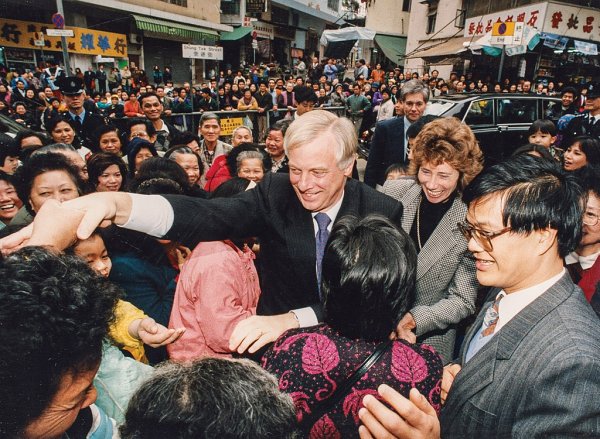
3. Getting out into the crowds was one of my favourite activities as Governor. This was mine and Lavender’s first visit to Mong Kok soon after our arrival.

4. Meeting Lu Ping, head of the Hong Kong and Macau Affairs Office, in Beijing, 21 October 1992. It was not a meeting of minds.

5. Lee Kuan Yew trying to be unhelpful, Hong Kong University, December 1992.

6. The annual address to the Legislative Council (Legco) was always an important date in my calendar. In October 1993 it was focused on welfare provisions and democracy.

7. Whisky and Soda outside their kennel, Government House.
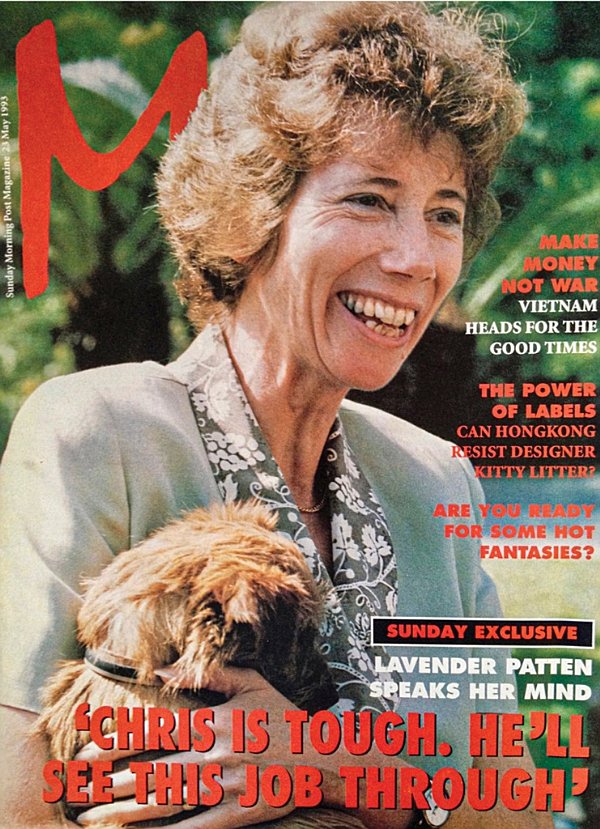
8. ‘Lavender Patten speaks her mind’ – not for first time, 1993.

9. My tennis partner Colin Grant always won of course.

10. With my press spokesman Mike Hanson in the Radio Television Hong Kong studios during my first year. Presumably I’d just made a good point.

11. Louise Law (née Cox), Lavender’s Social Secretary and Tommy Chow, one of my Private Secretaries.
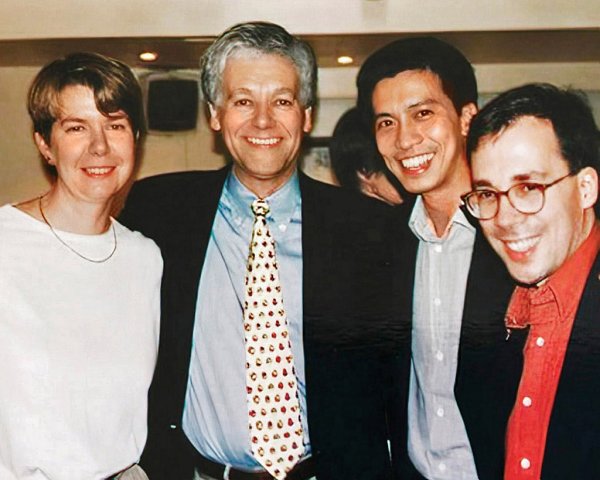
12. The Home Team (L-R): Elspeth Collins-Taylor, Housekeeper, Martin Dinham, Political Advisor, Steve Law, police inspector and Louise’s husband, and Edward Llewellyn, political advisor.

13. Formidable allies – Peter Ricketts and Michael Sze on the Great Wall during a break from endless negotiations on constitutional issues, 1993.

14. And formidable rivals – Zhou Nan, head of the New China News Agency, straining the limits of politeness at a China National Day reception in 1993.
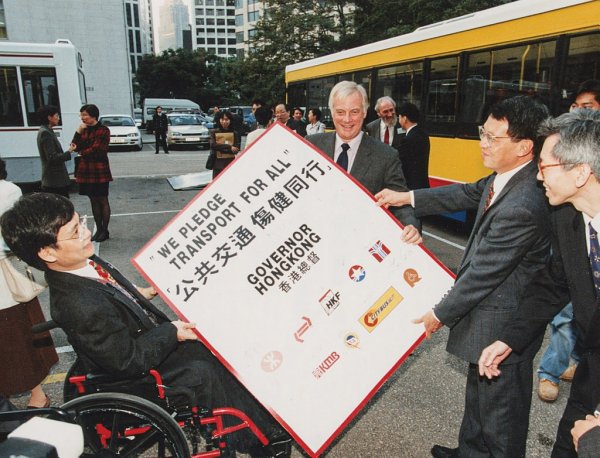
15. Gathering support for my plans to improve transport for those with disabilities.

16. Announcing the appointment of Donald Tsang (second right) to follow Sir Hamish McLeod (right) as Financial Secretary in March 1995. Anson Chan (left) and Kerry McGlynn (back left) look on.

17. Where’s our driver?

18. The Lady Maurine went with the job – thanks be.
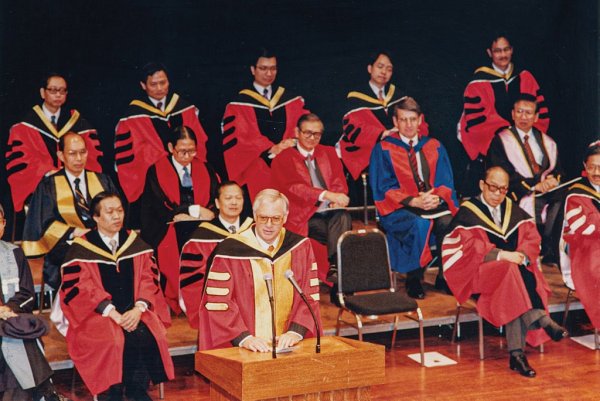
19. As Chancellor of all the universities in Hong Kong, I had to rely on my valet to remember the right robes.
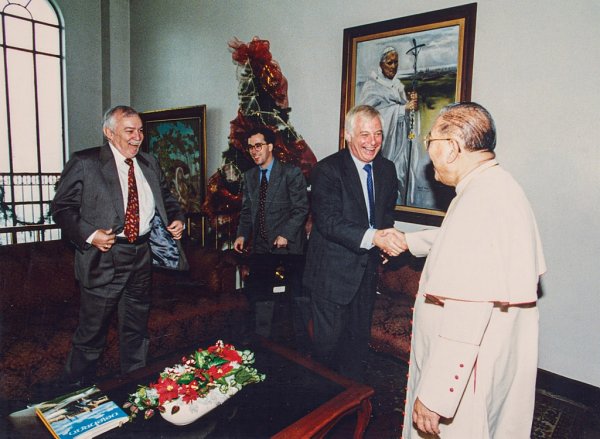
20. At the House of Sin, in the Philippines, December 1995, with Edward Llewellyn, Kerry McGlynn and the Cardinal of the same name.

21. Kate, Laura and Alice can’t have been laughing at one of my jokes.

22. Superintendent Lance Brown, who became my ADC in 1995, looked after me with and without feathers.

23. Fanling – our weekend retreat whenever we could make it.

24. Discussing the Court of Final appeal in Legco, 1996. Anson Chan and Jeremy Matthews lend support in the front row.

25. Garland’s cartoon shows John Major and Douglas Hurd nervously watching while I take the Hong Kong High Wire.

26. Hezza, almost as tall as the Tsing Ma bridge, 1996.

27. With C.H. Tung outside Government House, 23 December 1996. Feng shui persuaded him to live elsewhere.

28. The Executive Council (Exco) in 1997. Front row (L-R): Denis Chang, Jeremy Matthews, Anson Chan, self, Rosanna Wong, Donald Tsang and Felice Lieh-Mak. Back row (L-R): Nicholas Ng, Bob Peirce, Andrew Li, Raymond Chi’en, Vincent Cheng, Jimmy McGregor, Edward Chen, Simon Lord (Clerk of the Council) and Kerry McGlynn.

29. Fireworks over the opening of the Tsing Ma bridge, 1997.

30. Wong Po-Yan, Chairman of the Hong Kong Airport Authority, sedet ad dexteram matris Mrs Thatcher. Anson, as always, is by my side.

31. Chek Lap Kok, the new airport, rises from the sea.

32. President Jiang Zemin with British Foreign Secretary Malcolm Rifkind, 1997.

33. Leaving GH, 30 June 1997.

34. Boarding Britannia with the Prince of Wales.

35. The empire goes home.