
PART I
CHAPTER 1
ROBERT E. GOODIN
A “handbook” is Germanic in both its origins and its ambitions. Handbooks invariably aspire to be comprehensive, systematic, exhaustive—and above all, in contemporary academic practice, big.1 A handbook, at least in its academic instantiation, is definitely not a pocketbook. An editor of one particularly large volume of the Oxford Handbooks of Political Science wryly describes his as a “two-hand book.”
Weighing in around 1, 000 pages, such handbooks usually manage to be exhausting. But exhaustive is something else. Even with 1, 000 pages, handbook editors soon come to realize just how selective they must nonetheless be in their choices of topics and treatments. When even ten volumes of that size prove not enough, it becomes clear just how ill conceived any aspiration to comprehensiveness and exhaustiveness must surely be.
The best any handbook can do is to offer a bird’s-eye overview of the general shape of its subject, combined with some posthole exercises to show what riches might be found by probing deeper. That is the spirit in which this volume is offered. It is a schematic guide, and a sampler. There is much more by way of elaboration in the ten volumes upon which this one draws. There is, however, very much of great consequence that is left out, not only of this volume but also of those other ten as well.
So this book offers a glimpse of the breadth, the depth, and the excitement of political science. It is an invitation to delve deeper into the underlying ten volumes that constitute the series of Oxford Handbooks of Political Science.2 It is an invitation to delve deeper into the discipline that even those ten volumes can merely skim. It hints at the wide range of topics that have recently been preoccupying political scientists, the wide range of theories that they have formulated about them, the wide range of techniques that they have deployed in systematically examining them.3
In short, this book does not tell you everything you need to know about political science. What hopefully it does do is give some indication of why you should want to know, and how you might go about finding out.
1 THE DISCIPLINE
1.1A Mission Statement
Political science is a discipline with a mission. The main task of this chapter is to describe the former. Before turning to the state of the discipline, however, let me say a few words about how I conceive its mission.
The most oft-cited definition of “politics” is Lasswell’s (1950): “who gets what, when, how.”4 Certainly that is a correct assessment of why we care about politics. If politics carried no consequences, if it made no material difference in the larger world, it would hardly merit serious study. At most, the study of politics would then amount to an exercise in purely aesthetic appreciation of courtly intrigues, deft maneuvers, clever gamesmanship, and such like: cute, but inconsequential.
We should, however, separate out “why politics matters” from “what it is.” Laswell’s “who gets what, when and how”—broadly construed, per Lowi (1964)—is a good answer to the former question as to why politics matters. As to what politics is, however, I suggest a better answer would be this: politics is the constrained use of social power.5
Power of course takes many forms, and is constrained in many interestingly different ways (Lukes 1974/2005; Scott 1986; 1997). Systematically mapping all that is the fundamental task of political science.
Political scientists are often seen as handmaidens to power. Some cherish that role. Machiavelli and his modern-day heirs style themselves as counselors to princes and parties, advising on how to seize and wield power (Morgenthau 1948; Schultze 1992; Neustadt 2000). Other political scientists, taking their inspiration from Marx’s eleventh thesis on Feuerbach, adopt a more critical stance toward the powers that be.6 Self-styled policy scientists occupy points along the continuum, ranging from “accommodative” to “critical” (Wildavsky 1979; Dryzek 2006a).
Attempts at manipulating power always confront countervailing power and the constraints that come with that. Much though the strong might try to bend others to their will, their capacity to do so is inevitably limited. The weak have weapons of their own (Piven and Cloward 1979; Scott 1986). In politics, there is no such thing as a literally “irresistible force.” Even the powerful cannot just dictate—they have to persuade as well (Majone 1989). As he was passing the US presidency on to a five-star general, Truman mused, “Poor Ike—it won’t be a bit like the Army … He’ll sit here and say, ‘Do this, do that.’ And nothing will happen” (Neustadt 1990, 10). But since the same is true even within a notionally hierarchical military chain of command, it turned out that Eisenhower already knew as much (Greenstein 1982). The essence of politics lies in strategic maneuvering (Riker 1986). Politics is a matter of pursuing your purposes as best you can, in the context of other purposeful agents doing the same, and with whom, through whom, or around whom you must work to accomplish your goals.
Mid-twentieth-century pluralists made much—perhaps too much—of the idea of polyarchy, of multiple centers of (implicitly, pretty nearly equal) power (Dahl 1961b; 1972; Polsby 1980). Critics rightly challenged their naivety in several respects (McCoy and Playford 1968; Bachrach and Baratz 1970; Lukes 1974/2005; Foucault 1991). They rightly emphasized how power might work behind the backs of agents, how structures channel agency (Wendt 1987; Jessop 1990), how social constructs enable and disable (Finnemore and Sikkink 2001), how ideas shape and obscure interests (Laclau and Mouffe 1985; Goldstein and Keohane 1993).7 Useful correctives, all. But the cumulative effect is of course to expand, not contract, the list of ways in which power might be constrained as well as exercised.
The general idea that politics is about the constrained use of power is not merely a pluralist preoccupation. It is endemic to liberalism more generally (Hume 1777), and to liberal democracy most particularly (Macpherson 1977).
Obviously, even in autocratic regimes it is of intense interest to the powerful how they can work around constraints to wield power effectively. Machiavelli envisioned himself advising a fairly ruthless Prince, after all. Politics has been studied in just that spirit in all sorts of societies for a very long time.
But it is no accident that political science as a discipline has grown up alongside and in the context of liberal democracy, with its very special emphasis upon checks and balances, separation of power, political accountability, and political competition.8 It is in that setting that political science acquired its distinctive mission: to elucidate how social power is, can be, and should be exercised and constrained.
Power is constrained not only by countervailing power and social structures. Power is also constrained by purpose (Reus-Smit 1999)—not just by the powerholder’s actual purposes, but also (and in certain respects more importantly) by what those purposes should be. A central plank of the mission statement of political science lies in the elucidation of proper purposes, of worthy goals, and of rightful ways of pursuing them.
Political philosophers have sometimes felt marginalized by the scientific turn of the discipline (Storing 1962; Wolin 1969; Dryzek, Honig, and Phillips, this volume). But that is just one more—albeit perhaps the most central—of the false dichotomies I shall be bemoaning in this chapter. Far from being peripheral to the main mission of political science, normative concerns are absolutely central to it.
Of course, values are different from facts, and anyone studying them had better keep those differences straight. That it would be good for some fact to be true does nothing to make it true. To suppose otherwise is just plain wishful thinking. That it is a fact that people think something is good or valuable does not make it truly so, except in the shallowest supply-and-demand sense. You do not establish the truths of morality, any more than those of mathematics, by taking a vote (or sampling opinion, either).9
While different methodologies are clearly required for exploring each of those two realms, it is equally clear that both must be pursued in tandem if political science is to accomplish its mission as I conceive it. Consider an analogy: moral philosophers tell us that ethics is supposed to be “action-guiding;” but clearly ethics must connect some facts about the world to the values it recommends, if it is to provide any guidance on how to act in the real world. Equally clearly, from the other side, political science needs to connect up its empirical insights to some values in order to perform its own larger purpose.10
What is the point of finding out how things are, without wondering how they could and should be (Moore 1970; Geertz 1977)? Those are different questions, to be pursued in different ways perhaps by different people and certainly using different tool kits. Nonetheless, they are both clearly components of one and the same larger enterprise (Reus-Smit and Snidal, this volume). The mission of political science requires it to combine both.
1.2The Discipline of a Discipline
When calling political science a “discipline,” pause to ponder the broader associations of that term. According to the Oxford English Dictionary, “discipline” has all the following connotations (and more):
•A branch of instruction or education; a department of learning or knowledge; a science or art in its educational aspect.
•Instruction having for its aim to form the pupil to proper conduct and action; the training of scholars or subordinates to proper and orderly action by instructing and exercising them in the same; mental and moral training; also used fig. of the training effect of experience, adversity, etc.
•The orderly conduct and action which result from training; a trained condition.
•The order maintained and observed among pupils, or other persons under control or command, such as soldiers, sailors, the inmates of a religious house, a prison, etc.
•A system or method for the maintenance of order; a system of rules for conduct.
•Eccl. The system or method by which order is maintained in a church, and control exercised over the conduct of its members; the procedure whereby this is carried out; the exercise of the power of censure, admonition, excommunication, or other penal measures, by a Christian Church.
•Correction; chastisement; punishment inflicted by way of correction and training; in religious use, the mortification of the flesh by penance; also, in more general sense, a beating or other infliction (humorously) assumed to be salutary to the recipient. (In its monastic use, the earliest English sense.)
Running through all those definitions is this underlying thought: To subject yourself to some discipline is to be guided by a set of rules for doing certain things in an orderly fashion, rules that are shared among all others subject to the same discipline. Those who share the discipline take a critical reflective attitude toward those aspects of their conduct that fall under those standards (Hart 1961), judging their own conduct and that of others according to those standards (Hughes 1958; Caplow and McGee 1961; Parsons 1968; Sciulli 2007).
The discipline of political science is less fearsome than that of the church. “Mortification of the flesh by penance” is no part of standard induction into our discipline; and while some of its practitioners are denied tenure, few are literally banned from professing political science ever again. Still, it is an essential part of academic disciplines that they offer standards that can provide grounds for control, chastisement, and even occasional mortification. To discipline is to punish (Foucault 1977; Moran 2006), if only symbolically, if only occasionally or merely potentially.
Subjecting yourself to the discipline of a discipline is to accept constraints that are enabling in turn. A discipline imposes order. Its shared codes, traditions, standards, and practices give its practitioners something in common. A shared disciplinary framework channels the collective energies of the profession and facilitates collaborative attacks on common problems. It is what enables underlaborers to stand on the shoulders of giants, at the same time as enabling giants to stand on the accumulated product of underlaborers’ efforts in turn. The division of the universe of knowledge into disciplines and sub-disciplines facilitates division of labor among practitioners who inevitably cannot be expert in all things (Abbott 1988). A shared disciplinary framework is what unobtrusively coordinates all our disparate research efforts and enables the discipline’s findings to cumulate, after a fashion, into some larger synthesis.
An academic discipline is also, nowadays, a profession. But what our profession professes is, by and large, just its own professional competence. Professional associations serve to carve out an occupational niche for practitioners. So it was both with the American Political Science Association and many others around the world.11 (In this chapter I shall concentrate primarily upon developments within the US discipline, which have such a powerful influence on how political science is practiced worldwide: developments elsewhere are canvassed in many other excellent collections.12)
The sociology of work regards “professional” as a high-status occupational grade, access to which is typically controlled by existing members of the profession (Abbott 2002). Many bemoan the ritual practices of these self-replicating cartels, both in indoctrinating newcomers and in defending their turf against outsiders (Wallerstein 1998); and in their purely self-defensive modes, professions can indeed be conspiracies against the public interest, academically as surely as otherwise.
But academic professions have another side as well. They are self-organizing communities of scholars dedicated to trying to find progressively better answers to the problems around which they are organized. Anyone in doubt needs merely reflect upon the dilettantism of the American Social Science Association that preceded the American Political Science Association (Kaplan and Lewis 2001; see further Seidelman and Harpham 1985, 20; Seidelman 1993), and what passed for political science in the first third-century of the APSA’s own existence (Sigelman 2006b, 473). Compared to that, the increasing professionalization of political science from the middle of the last century onward has surely greatly enhanced the discipline’s collective capacity to bring a systematic body of theoretically integrated insights to bear on important problems of politics and society.13
Over a decade ago the New Handbook of Political Science offered a similarly rosy prognosis (Goodin and Klingemann 1996b; Almond 1996). Some scoffed at that as an unduly whiggish view of the discipline’s history. Doubtless scoffers were right, in part. Progress comes in fits and starts, at different rates in different times, different sub-disciplines, and different countries (Dryzek and Leonard 1995; Sigelman 2006b, 473).14 But there is movement in the right direction in most places. Let one example suffice. Writing in 1999, Barry (1999, 450–5) said he could see no evidence in the British discipline of the sort of professionalization the New Handbook described; less than a decade later, there has been a generational shift and a dramatic cross-fertilization of British political science from abroad (Goodin et al. 2007, 34–5; Goodin 2009).
1.3Against Either–Or
There are many who think that the discipline of political science has, over the past half-century, taken wrong turns and gone up blind alleys, that too many eggs have been put in far too few methodological baskets. There are many who think that the disciplinary control exercised over the profession by certain sects has been far too tight.15 That was the complaint of the Caucus for a New Political Science against behavioralism in the 1960s and 1970s (Easton 1969; Anon 2007) and of the Perestroika movement against rational choice in the 2000s (Schram 2003; Monroe 2005; Rudolph 2005).
To some extent those were movements targeted more at organizations than ideas. Reform of the professional association was high on the agendas of both insurgencies. In both cases, the American Political Science Association fobbed off the insurgents with a quintessentially organizational ploy: giving the dissidents an official new journal all their own (PS for the Caucus, Perspectives on Politics for Perestroika).16 To a large extent, however, those movements were targeted at credos of the profession, the Caucus bemoaning its insistent value-neutrality, Perestroika bemoaning its narrowness of vision. Those issues are harder to resolve.17
Here, however, I want to focus on one characteristic feature of these periodic “great debates” within the profession: their Manichean, Good versus Evil form. Nor is it found in only those major episodes that traumatized the profession as a whole. Even as regards the more substantive “great debates” within each of the various subdisciplines, there is a remarkable penchant for representing the options in “either–or” fashion. Behavioralist or traditionalist, structure or agency, ideas or interests, realist or idealist, rationalist or interpretivist: you simply have to choose, or so we are constantly told.
On all those dimensions, and many others as well, the only proper response is to refuse to choose. Respond, insistently, “Both!” Both sides to the argument clearly have a point, both are clearly on to something. Elements of both need to be blended, in some judicious manner (not just any will do18), into a comprehensive overall account.19
The “tyranny of small differences” is a notorious hazard across all of life. Among academics on the make, the tendency to exaggerate the extent of their differences, so as to emphasize the novelty and distinctiveness of their own contribution, powerfully fuels that general phenomenon (Moran 2006). Still, those are the machinations of “youngsters in a hurry” (Cornford 1908, 5), not the settled judgements of seasoned practitioners confident of their place in the profession.20
That may seem a strong conclusion, but it has history on its side. Remember the equanimity with which the behavioral revolution was originally greeted by those then ruling the profession.
If the behavioral revolution’s main tenets are behavior, science, pluralism and system, then “traditionalists” had little reason to oppose it. Research on behavior at the individual levels was already being done in the 1930s and 1940s...—and those who did not do it had little objection to those who did. The commitment to science was of long standing…. Pluralism as empirical theory was hardly new—indeed, the “latent theory of the traditionalists as … [a] ‘parallelogram of forces’ …” sounds a lot like pluralism. (Dryzek 2006b, 489–90)
Not until that revolution had been won was it seriously challenged, and even then in a way the mainstream studiously ignored. Leo Strauss’s vituperative “Epilogue” to Storing’s 1962 Essays on the Scientific Study of Politics constituted the challenge, but “the challenge was never officially accepted by the profession of political science.” Other political theorists (Schaar and Wolin 1963) were left to “come to the defense of political science.” And “political theorists … were left to squabble among themselves in their isolation from the discipline at large,” which proceeded basically to ignore “both the accusations that had been made against them and the proffered defense” (Saxonhouse 2006, 847–8).
“Multi-perspectival approaches” are the embodiment of the refusal to succumb to the demands of “either–or.”21 The fruitfulness of such approaches, and the willingness of members of the profession not merely to tolerate but to embrace them, is evinced across the ten-volume series of Oxford Handbooks of Political Science. Constructivists co-edit and coauthor with rationalist-realists (Reus-Smit and Snidal, this volume), critical theorists with post-structuralists (Dryzek, Honig, and Phillips, this volume), qualitative methodologists with quantitative (Box-Steffensmeier, Brady, and Collier, this volume); and all of them celebrate the synergies. Nowadays very few sophisticated philosophers or social scientists believe in covering-law positivism anymore (Moon 1975; Kitcher 1981; Hay 2002). But instead of throwing their hands up in despair, they turn to whole other disciplines that systematically map the many other contextual factors upon which political outcomes depend (Tilly and Goodin, this volume; cf. Flyvbjerg 2001 and Laitin 2003).
For a brief worked example of how such a multi-perspectival approach might work, consider the “new institutionalism.” Distinction-mongers divide that into multiple distinct “new institutionalisms” which they insist are incompatible in their fundamental epistemological and ontological assumptions: rational-choice, historical, constructivist, network (Rhodes, Binder, and Rockman 2006, chs. 2–5), discursive (Schmidt 2008). But it is not really all that hard to see coherent ways of synthesizing them all.
Of course, any attempt at synthesis has to start somewhere and in so doing will inevitably privilege some of those building blocks more than others. My own inclination is to start with a basically rational-choice account of intentional agents pursuing their projects through games of a slightly richer sort than ordinary game theory captures.22 Out of the interplay of those interactions, institutionalized solutions to their common problems emerge and acquire normative force among those who want to rely on those institutionalized solutions for future dealings (the constructivist and network institutionalist insight). Some branches of the extensive form of the game end sooner and less satisfactorily than others, with all possibilities for further development having been played out; in those cases we must either resign ourselves to making do with nonideal arrangements or face the prospect of a sharp and costly renegotiation of our settled practices (the historical institutionalist point). Often however we can simply shift among a plurality of different institutions governed by different norms and involving different players to address different problems we encounter (constructivist, discursive, and network institutionalisms again). In short, thinking how intentional goal-seeking agents might operate on and through history, developing shared norms and institutions as an aid to doing so seems to me a tolerably good synthesis of the many ostensibly “very different” strands of the new institutionalism (Goodin 1996; 2000; see similarly Knight 1992; Hay and Richards 2000; Orren and Skowronek 2004; Offe 2006; Hertting 2007; and most especially Olsen 2009).
That seems a good example of the potential fruitfulness of judicious combinations of ostensibly either–or approaches within political science.23 Such multi-perspectival accounts can come from collaboration via interdisciplinary or multidisciplinary research teams (Moran 2006). Or they might come from hybrid “border-crossing” scholars who themselves sit at the intersection of multiple different disciplines and move easily between them (Dogan and Pahre 1990; Dogan 1996; Rudolph 2002). Or they might come from collaborations across different sub-disciplines within political science, or from collaborations across some ostensible “great divide” within the same sub-discipline.
2 WHERE WE’RE AT
2.1Revolutions We Have Known
Academics thrill at the thought of their disciplines having been racked by a series of “revolutions” (Kuhn 1962). It is the great aim of every aspiring academic to be at the forefront of the next revolution.
But of course revolutions rarely are quite as consequential as their advocates hope, or their opponents fear. Most things go on pretty much the same, on the other side of the revolution. Bismarck’s social insurance legislation remained on the books under Hitler and afterwards in remarkably similar form in East and West Germany alike (US DHEW 1978). A revolution installs a new regime to which one is obliged to pay polite obeisance, and it genuinely gets in the way of some things you want to do. But generally you can work around it, to carry on much as before.
It is important to bear in mind not only how small the revolutionary avantgarde generally is, but also what a small proportion of the discipline are signed-up members of the ruling cadre even after a revolution has seemingly succeeded. As our International Benchmarking Panel reminded the UK Economic and Social Research Council:
However monolithic the US discipline may seem from a distance, those working within it know fully well that it is internally highly diverse. From a distance, the US discipline may seem to be dominated by some hegemonic practice—“behaviouralism” in the previous generation or “rational choice” in the present one. But in fact, those supposedly “hegemonic” practices are actually practiced to any high degree by only perhaps 5% of the US discipline, even in many top departments. (Goodin et al.24 2007, 9)
How “big” a revolution has to be to qualify as a revolution—how much of the territory it has to occupy, and just how much control it has to exercise over it—is a particularly open question when it comes to scientific revolutions (Dryzek 2006b, 487). I thus prefer to couch the next section’s prognostications in terms of what might be the next “big thing,” rather than the next “revolution.” Still, the discipline’s self-conception of its past is firmly organized around epochs punctuated by successful revolutionary takeovers, so let me begin by introducing the discipline in those, its own preferred terms.
According to the standard periodization, political science in the USA has been marked by three successful revolutions.25 The first was that which founded the discipline at the very beginning of the twentieth century: the turn away from the dilettantish do-gooderism of the American Social Science Association and toward systematic and professionalized study of political processes. The second successful revolution shaping the US discipline was the behavioral revolution of the 1950s, a self-styled break away from the previous preoccupation with what is formally supposed to happen and toward how people actually behave politically. The third successful revolution shaping the US discipline was the rational choice revolution of the 1970s, promising a break from “mindless empiricism” and offering instead a tight set of theoretical propositions deduced from a Spartan set of fundamental assumptions.
Those are the “storylines” of the discipline, at least in the USA. Elsewhere, even in the anglophone world and certainly outside it, those revolutionary waves either came much later or passed political science there by altogether (Barry 1999). And even as regards the US discipline, those highlighted storylines are only part of the larger story. Much going on in each period was at best only loosely connected to (and much more was wholly apart from) the ostensibly dominant storyline. There were important subthemes and counterpoints in each period, some of which went on to form the basis of the next “revolutionary challenge.” Some sub-disciplinary and sub-subdisciplinary and cross-disciplinary projects proceeded largely impervious to the imperial ambitions of the latest successful revolutionary cadre and were largely ignored by it: Public and Constitutional Law has always rather like that.26 Others were definitely on the radar of people working across many different fields: The “new institutionalism” was certainly like that, having been widely embraced as the “next big thing” across the discipline as a whole over the past decade or more (Goodin and Klingemann 1996b, 11).
More will be said shortly about each of these various movements that have washed over the discipline. But that highly synoptic characterization will suffice to set up the principal point that I want to make at this stage. That point is simply that, by virtue of that self-conception of its past, the discipline has come to acquire an accumulated “core” body of knowledge that must be mastered by aspirants to the profession.
Professionals specialize as well, of course. Facilitating that, and marshaling specialization in collectively fruitful ways, is the whole point of a profession. So in much of their own work, disciplinary professionals will inevitably be engaged in ever more narrowly focused enquiries into arcane corners of some niche or another.
There have been complaints about political science saying “more and more about less and less” (Corwin 1929, 569) for the best part of a century. One measure of that, Sigelman (2006a, v–vi) notes half-jokingly, is the increasing frequency of colons in the titles of articles found in the premier journals.
But while the work of the profession becomes increasingly “fragmented,” the profession as a whole need not. If there is a shared sense of what constitutes the core of the discipline (substantively even more than methodologically), and if professional training in the discipline insists upon mastering that as a condition of entry, then specialists however specialized have some common ground with one another. They have some sense, necessarily rudimentary, of where one another’s specialty fits within the large scheme that they share.
Again, not all places in the world practice the profession of political science in this way. And not all that do necessarily would adopt exactly, or even roughly, the same canon as the “common core” to be communicated to aspiring members of the profession. Still, in the top US (and, increasingly, UK) graduate schools of political science, entry to the profession requires aspirants to have mastered at least after a fashion the “scope and methods” of the discipline, and that they have done so in broadly similar ways to those in pretty much any other top political science program.
As we put it in the introduction to the New Handbook of Political Science:
Few of those trained at any of the major [US] institutions from the 1970s [or UK ones from the 1990s on, I would now add] will be unduly intimidated (or unduly impressed either) by theories or techniques from behavioral psychology, empirical sociology or mathematical economics. Naturally, each will have his or her own predilections among them. But nowadays most will be perfectly conversant across all those methodological traditions, willing and able to borrow and steal, refute and repel, as the occasion requires.
(Goodin and Klingemann 1996b, 13)
In his introduction to its centenary issue, the editor of the American Political Science Review begged to differ. From where Sigelman (2006b, 473) sat, our “warm-and-fuzzy image of an increased empathetic capacity among adherents of different approaches to political science … seems oddly out of touch with the experience of a discipline wracked by periodic culture wars (as manifested in the Caucus for a New Political Science of the 1960s and 1970s and the Perestroika movement of the last few years).” He saw the discipline as being more “characterized by something closer to an armed truce—an agreement to disagree—among true believers of different disciplinary creeds than to an active, congenial engagement in a joint enterprise.”
It is true that Klingemann and I did not see Perestroika coming. And from where I now sit I have to concede that, realistically, the profession probably has to undergo that sort of insurgency once every couple of generations, to remind itself of “things lost” over the course of its latest “revolution.” I can well understand why those in the firing line—beseiged editors of the American Political Science Review preeminently among them—might see those as veritable “culture wars.” But in academic politics as in real-world politics, trumped-up culture wars greatly exaggerate the depth of the disagreements and the extent of irreconcilability (Fiorina 2006). There is, I say again, no reason to accept the “either–or” straitjacket that cultural warriors would impose on us.
While I am sure some irreconcilables remain in each of the armed camps that Sigelman describes, I cannot help thinking that they are unrepresentative. The best talents in the profession are much less tempted to wallow in endless “meta” debates, and much more inclined to “just do it” (Dryzek 2005). The Oxford Handbook of Contextual Analysis (Goodin and Tilly 2006) is offered in evidence of just how productive it can be for mainstream political science to take those sorts of insights systematically on board, and as evidence of just how disciplined and systematic you can be in doing so—hopefully thereby allaying some of the mainstream’s deepest concerns with the latest insurgency.
2.2The Canon
What, then, is the core of the canon that practicing political scientists need to master in order to have mastered the discipline?
Of course, political science—like all the natural and many other social sciences27—is increasingly becoming an article-based discipline.28 Some classic journal articles never grow into a book. Some whole debates are conducted on the pages of journals alone. And some whole subfields seem dominated by articles rather than books. Still, most lasting contributions to political science as a whole typically come in, or eventually get consolidated into, book form.29
The canon of political science can, therefore, be reasonably described in terms of a set of “core books” with which any competent professional must have at least a passing acquaintance. Any selection of “must read” classics is inevitably somewhat idiosyncratic, and inevitably there will be disagreement at the margins. But the list offered in Appendix 1.1 would, I think, command a reasonably broad consensus.30
I hasten to add that the Appendix 1.1 list is more by way of a report than of an evaluation. Those books are ones that are professionally prominent. Each of us might privately harbor doubts about just how good some of them really are. Still, those books truly are touchstones of the discipline, with which any serious practitioner needs to be competently acquainted.
There are other books that should be better known by political scientists than they actually are. I nominate a few of my personal favorites in Appendix 1.1, as well. Doubtless others will have their own. My list is offered in the spirit of “starting a conversation.” Once we acknowledge that there is indeed a canon of the sort described in the first table in Appendix 1.1, the next logical thing we should do is have a conversation about what else ought to be included in it.
Where ought one to watch for new developments? Well, of course, much good work bubbles away below the surface for many years before breaking into high-profile places. But eventually important new trends will (and to become important discipline-wide, will have to) break into one or another of the truly major journals and book series that are the “outlets of record” for the profession as a whole. Among the journals serving that function are the American Political Science Review, the American Journal of Political Science, and the British Journal of Political Science and a raft of top-flight sub-disciplinary journals (such as International Organization, Political Analysis, Studies in American Political Development, Politics & Society, and so on). Among the book series serving that discipline-shaping function are CUP series on “Political Economy of Institutions & Decisions,” “Cambridge Studies in International Relations,” “Cambridge Studies in Comparative Politics,” and the OUP “Oxford Political Theory” series.31 All these developments are also ably surveyed in the Annual Review of Political Science, which serves, in effect, as the “annual supplement” to reference books such as the present one.
2.3The Cast
The main players of the discipline can be identified through a bibliometric analysis of reference patterns across the ten volumes of Oxford Handbooks of Political Science. This exercise is akin to one conducted for the New Handbook of Political Science (Goodin and Klingemann 1996b, 27–43). It differs in counting index entries to authors, rather than the frequency of an author’s appearance in reference lists alone.32
There is much information on citation rates already available (Masuoka, Grofman, and Feld 2007).33 Standard citation counts based on citations in the journals indexed by the Thompson Scientific/ISI Web of Science are problematic in various ways. Coverage of non-anglophone journals is patchy (but decreasingly so as the database is expanded). Conventional citation rates traditionally count only journal-to-journal citations in journals, thus ignoring citations in and even to books—although unnecessarily so, since journal-to-book citations can (with effort) be extracted from information already in ISI databases (Butler 2006). Ordinary citation analyses tell us much of interest, and they would tell us even more if they were further enhanced in those ways.
There are, nonetheless, two compelling reasons to go on to conduct a citation analysis of the ten-volume Oxford Handbooks of Political Science. One reason relates to the nature of the works cited. Citations within reference books are much more likely to be laudatory citations, recommendations that these are publications that people in the profession really need to read. And because Handbook authors have to survey large literatures in a small space, their citations have furthermore to be highly selective.
The 1 percent of political scientists appearing most frequently in indices to the Oxford Handbooks of Political Science are listed in appendices to this chapter.34 First that is done sub-discipline-by-sub-discipline, based on the index of each constituent sub-disciplinary volume. Appendix 1.2 lists “sub-disciplinary leaders” thus construed. Appendix 1.3 then merges the indexes of all ten volumes of Oxford Handbooks of Political Science, to identify leaders of the discipline as a whole.
Table 1.1. Integration of the discipline
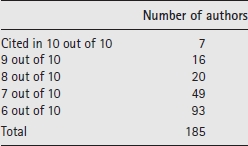
There is a second discipline-related reason to conduct a citation analysis on the ten volumes of Oxford Handbooks of Political Science. Doing so enables us to map the structure of the discipline. It allows us to assess how fragmented or integrated the discipline is, across its various sub-disciplines. Just how many people who are cited in one sub-discipline are also cited in others? And so on.
One measure of the extent to which the discipline as a whole is indeed well-integrated is the number of people whose work is used by several sub-disciplines in common. Following the New Handbook of Political Science (Goodin and Klingemann 1996a, 33–4), scholars whose names appear in more than half of the sub-disciplinary volumes of the Oxford Handbooks of Political Science are dubbed “integrators of the discipline.” Appendix 1.4 names names. But what we most need to know to assess the state of the discipline are the frequency counts reported in Table 1.1.
There we see that only a handful of people—seven authors, to be precise—are influential across literally every sub-discipline. But from Table 1.1 we can also see that a fair few authors impact on more than half the sub-disciplines. Those 185 authors represent over 2 percent of all authors mentioned across the ten volumes of Oxford Handbooks of Political Science. Judged that way, it seems that the various sub-disciplines of political science do indeed have quite a few touchstones in common.
A second way of assessing the structure of the discipline is to map linkages between each of the sub-disciplines. We can do that by counting how often the scholars who appear in the index of one sub-disciplinary handbook also appear in the indexes of each of the other sub-disciplinary handbooks.35 The larger the proportion of shared reference points, the “closer” one sub-discipline can be said to be to another. And the more other sub-disciplines that are “close” to it, the more “central” the sub-discipline can be said to be to the discipline as a whole.
Table 1.2. The structure of the discipline
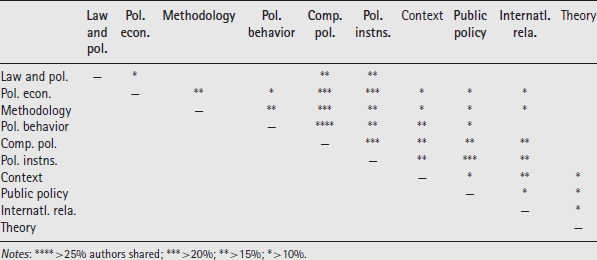
The percentage of authors whose names appear in one sub-disciplinary volume’s index also appear in the other’s is reported in Appendix 1.5.36 Table 1.2 represents those data in more summary manner. The more stars, the more shared references there are between the two sub-disciplines represented by that cell in Table 1.2.37
As we see from Table 1.2, the “core” of the discipline consists in Comparative Politics and Political Institutions. Political Behavior, Political Economy, and Political Methodology strands feed heavily into those. Law and Politics is connected to the Comparative Politics and Political Institutions core on the Political Economy side. Sub-disciplines of Public Policy and International Relations are connected to the Comparative Politics and Political Institutions core on the Contextual side. Political Theory dangles off the end of that latter cluster and is only very weakly connected to any of the rest of political science.
3 WHAT NEXT?
What is likely to be “the next big thing” to hit political science?38 It is hard to say, of course. As Humphrey Lyttelton famously said of jazz, if we knew where political science was going we would be there already (Winch 1958, 94).
What I can say, with a confidence born of reflection on the past bubbles that have punctuated the history of our discipline, is that the basic intellectual materials out of which the next big thing will be constructed already exist among us. The next big thing is something most of us will have bumped up against, something most of us will have mentioned in passing in writing or lectures. It is something we currently regard as an interesting curiosity, fitting awkwardly our current way of seeing things and doing business but not (as yet) occasioning any fundamental rethinking of them.
Having long been familiar with the next big thing as a minor curiosity, it will strike us as odd when a bubble suddenly arises around it, inflated by aspiring stars anxious to rise. Deeming it a perfectly worthy point or practice in its place, most of us will vaguely resent the exaggerated cure-all claims that will be made for the new snake oil. But that will be the modal tendency of a distribution whose two tails will inevitably go to war with one another, trying to force the sensible middle into taking sides.39 Thus it was with the behavioral revolution, with systems theory and structural-functionalism, with rational choice, and so on.40
3.1The Nature of “Big Things”
Those are the sorts of things I mean by a “big thing.” They are not nearly so domineering as a Weltanshaung or a Kuhnian paradigm, necessarily, nor so overwhelming as a “revolution.” “Big things” certainly set a research agenda and focus attention on “critical points” (Morgenstern 1972) or “unresolved problems” (Elster 1979, ch. 3) within it.41
In social science, a “big thing” is a simple idea that promises to pack a big explanatory punch, explaining much on the basis of a little. That, of course, is just what philosophers of science have long told us we ought be looking for: an explanation that is powerful and parsimonious at one and the same time (Carnap 1950, 3–8; Quine 1961, 16–17; Kitcher 1981).
“Big things” claim wide application, offering ways of reconceiving the discipline as a whole, or anyway some large portion of it. They promise something like “A Common Language for the Social Sciences” (the motto of the Harvard Department of Social Relations (Geertz 2000, 8)) or “a long-term program of scholarly activity which aims at no less than the unification of theory in all fields of the behavioral sciences” (as Talcott Parsons pitched it to Harvard’s Faculty Committee on Behavioralism (quoted in Rudolph 2005, 8)). David Truman pitched the behavioral revolution to the Social Science Research Council in similar terms, as have done countless advocates of other would-be “big things” in countless other venues.42
Alongside and within “big things” there are also many “medium-sized things”—“good gimmicks” (Mackenzie 1967, 111), tricks, tools, and mechanisms (Elster 1989; 2007; Hedström and Swedberg 1998), “theories of the middle range” (Merton 1968, ch. 2), and so on. These are loci of disciplinary feeding frenzies all their own. Recent examples include the new institutionalism (March and Olsen 1984; 1989) and ideas of social capital (Putnam 1993; 2000), path dependency (Pierson 2000; 2004), and deliberative democracy (Dryzek 2000). Those serve as ancillary theories, tricks or tools that can be mixed-and-matched with a variety of other things.43
Medium-sized things sometimes mushroom into big things, staging a takeover bid for the discipline as a whole. That happens as several cognate medium-sized things consolidate into “one big thing.” Rational choice, for example, became a “big thing” in the 1970s by consolidating various previously unconnected strands: operations research in defense (Hitch and McKean 1960), game theory in international relations (Schelling 1960), and notions of “public goods” (Olson 1965) and “median voters” (Downs 1957). As late as 1967, so shrewd an observer as Mackenzie (1967, ch. 9) failed to foresee that consolidation coming, regarding all these instead as simply separate (albeit related) “partial theories” or “good gimmicks.” Or for another example, the behavioral revolution consolidated realist skepticism about actual adherence to formal rules and ideal standards across several domains—constitution-writing (Beard 1913), policy-making (Bentley 1908/1967), public administration (Simon 1947, ch. 2), local governance (Lynd and Lynd 1929), international relations (Morgenthau 1948)—together with new experimental and observational methodologies and statistical techniques for assessing their findings (Merriam 1921; Key 1954). So too with all the other “big things” that have come and gone over the years: All have been conglomerations of medium-sized things with which we have long been familiar.
Finally, there are always research programs with “big thing” ambitions that have not (yet) succeeded in achieving hegemonic status across the profession as a whole. Political culture was one such, psychoanalytics another, biopolitics yet another. Although they once aspired to be more (and may still do), at least for now they remain middle-sized things available for mixing-and-matching with others. Likewise, failed “big things” never completely disappear but merely revert to the status of middle-sized things in the professional firmament, true so far as they go but definitely only part of the overall story.
3.2The Next Big Thing: A Job Description
When scanning the horizon for the next big thing, it behooves us to recall the distinctive features of things that have formerly risen to become “big things.”
3.2.1 Simplicity
“Big things” are, first and foremost, fundamentally simple ideas. They are capable of being expressed succinctly—stated in just a few words—yet they have wide ramifications.44 Think of the catchcry of the behavioral revolutionaries: “don’t just look at the formal rules, look at what people actually do.” Think of the catchcry of structural-functionalists: “form fits function.”45 Think of the catchcry of systems theorists: “everything is connected; feedback matters.” Think of the catchcry of the rational choice revolutionaries: “always remember, people pursue power and interest.” 46 Think of the catchcry of new institutionalists: “institutions matter.” Simple ideas, all.
3.2.2 Broad Application
“Big things” must have wide application to politics, across the board. That is why “consolidation” of medium-sized projects into “one big thing” is so important. To travel far, however, “big things” need to travel light: They need to be easily adaptable to the wide variety of circumstances and settings to which they aspire to apply. The same basic idea can, and should, play out differently in different contexts, without sacrificing its claim to simplicity and parsimony at some more fundamental level.
3.2.3 Formalizable
“Big things” must also admit of formalization of some sort or another.47 That need not necessarily take the form of propositional logic or higher mathematics, as with rational choice theory. In the case of structural-functionalism, formalization amounted to little more than an elaborate conceptual schema and a few diagrammatic techniques borrowed from structural anthropology (Merton 1968, ch. 3). Proper input–output analysis and linear programming came later (Forrester 1971; Meadows et al. 1972; cf. Shubik 1971b; Cole et al. 1973), but the early application of systems theory to political science consisted just in boxes connected by arrows (Easton 1957; 1965). So too with the early behavioral revolutionaries: Fancier techniques came later, but their initial formalism amounted to little more than cross-tabulations and chisquares (Miller 1996, 301). Still, a “big thing” must always admit of formalization, be it heavy or light.
3.2.4 Familiarity
Like stars of the cinema, things that have subsequently become “big things” have generally been around for quite a while before they hit it big.48 The raw materials of any “big thing”—what will subsequently come to be seen as its “classic texts”—were published long before it became big. Rational choice theory became a “big thing” in the mid-1970s (Sigelman 2006b, 469), but by then its seminal texts were all a decade or two old (Arrow 1951; Black 1958; Downs 1957; Riker 1962; Olson 1965). Likewise, by the time the behavioral revolution became a “big thing” in the 1950s (Dahl 1961a, 766; Sigelman 2006b, 469), its seminal texts were similarly antiquated (Merriam and Gosnell 1924; Tingsten 1937; Lazarsfeld, Berelson, and Gaudet 1944), and the intellectual materials out of which behavioralists built their models of politics were drawn from psychology of several decades previously (Lipset et al. 1954).49 Similarly, the materials out of which post-Second World War structural-functionalists built their models were drawn from interwar anthropologists (Radcliffe-Brown 1935; Malinowski 1936/1976). And the materials out of which the new institutionalists of the 1980s built their models were drawn from decades-old organization theory and behavioral theories of the firm (Simon 1947; March and Simon 1958; March 1962; 1996; Cyert and March 1963).
3.2.5 Marginality
Finally, the materials out of which political science constructs its own “next big thing” tend to be leftover fragments from other disciplines.50 From the point of view of political scientists, that makes it look like a takeover bid by some other discipline. But from the point of view of that other discipline, the raiders more often look like renegade bands operating at the margins of their home discipline.51 The rational choice revolution in political science was spearheaded by scholars of social choice and of public finance, both far from the center of gravity of mainstream economics.52 The behavioral revolution in political science drew on social psychology, which again is a somewhat marginalized subfield within psychology proper. And political science borrowed the structural-functionalist model from sociology and anthropology at just the time those disciplines were repudiating it (Radcliffe-Brown 1949; Davis 1959; cf. Merton 1968, ch. 3).
3.3Candidates for the Next Big Thing
I offer the following shortlist of candidate “next big things” with hesitation, knowing it is inevitably incomplete and that it almost certainly omits what will eventually win out. Still, interviewing several candidates is often the best way find out what job we really want to have done for us.
3.3.1 Framing Models
The basic idea of framing models is that of “choice under description” (Davidson 1980; 1984). Objects of choice always display a literal infinity of attributes. In choosing one thing over another, we focus in on some of those attributes whilst ignoring all the rest. We choose one under some description, picking out some features we see as particularly salient. Different frames lead to different choices, so shifting or imposing frames is an exercise of power: of the choosing agent, if done consciously and autonomously; of psychology over rationality, if it happens less consciously; of one person over another, if it happens less autonomously.
Part of the appeal of framing models is that they will provide a way of taking account of at least some of the crucial contextual effects to which Perestroikans point (Rudolph 2005). There are many ways in which “context matters,” of course (Goodin and Tilly, this volume), and how we frame situations is only one; still, it looks like it might be a central one, connecting micro and macro. Another part of their appeal is that, in helping us see the choice situation from the actor’s own point of view, framing models answer to the hermeneutic, interpretivist impulse.53
Within political science and political sociology, there is already a relatively rich array of forebears for this potential “next big thing” to build upon. Distinguished examples include: Allison’s classic discussion of conceptual maps in connection with the Cuban Missile Crisis (Allison 1971; Allison and Zeitkow 1999); classic discussions of ways in which rhetoric and media frame political perceptions and shape reactions (Gamson 1992; Riker 1986; Edelman 1988; Iyengar 1994; Chong and Druckman 2007); and more recent discussions of framing within social movements (Benford and Snow 2000), with echoes all the way back to Arendt’s Origins of Totalitarianism (1951).
In adjacent disciplines, framing effects are central to the surprising findings of experimental economics and psychology. What these experiments systematically show is that people will differ dramatically in their reaction to objectively identical choice situations (“objectively identical,” the sense that the same material effects will ensue from the same choices) depending just on the way the options are described and the choice thereby framed: whether as “saving lives” or “letting people die;” whether as a lost theater ticket or a lost bank note in the same value; whether as a gain or a loss, depending on how you describe the baseline; whether as being an issue of fairness or ordinary market behavior (Camerer 2002; Fehr and Fischbacher 2002; Güth, Schmittberger, and Schwarze 1982; Kahneman 2003; Kahneman, Knetsch, and Thaler 1986; Kahneman, Slovic, and Tversky 1982; Kahneman and Tversky 2000; Thaler 2000).
In trying to formalize notions of framing, one approach might be to extend Axelrod’s (1973; 1976) work on the “structure of decision,” mapping (literally: graphically) how people’s beliefs hang together based on a close reading of texts. Another approach might be to work on the evidence in experimental psychology and experimental economics, trying to taxonomize the instances found there of framing and trying to tease out some generalizations about the various mechanisms that might lie behind them.
If people’s decisions really are highly subject to framing and contextual effects, then we should obviously build that fact into our explanations of their actions and choices. We should do so with regret, however: normatively, because framing effects distort rationality and invite manipulation; empirically, because of the fundamental incompleteness of framing models. They must always be supplemented with some other account of what (or psychological forces of pattern recognition) causes people to see things one way rather than another. That crucial part of the explanation must come from outside the framing model itself.54
3.3.2 Evolutionary Models
The basic idea of evolutionary models is that society takes the shape it does because over time its elements have been subject to a repeated process of “selection for fitness” (Elster 1989, ch. 8). The elements subject to the selection mechanism can be genotypes, productive practices, game strategies, or whatever. The selection mechanism might involve differential reproductive success of biological organisms, differential bankruptcy rates of firms, social practices persisting or fading away, and so on (Witt 1993).
Part of the appeal of evolutionary models is that they offer a particularly rich account of dynamic aspects of social life. Furthermore, they do so by reference to structural- or systemic-rather than individual-level mechanisms. For those who are suspicious of models of individual choice as the fundamental driver of social stability and change, these are great attractions.
Within political science, there is a long tradition of thinking in broadly biopolitical terms. Some of those precedents, Social Darwinism and sociobiology most conspicuously, are unhappy ones (Dryzek and Schlosberg 1995); others make minimal reference to evolutionary dynamics as such.55 But at least some of those models of biopolitics serve as important precursors to a systematic application of evolutionary modeling within political science (Somit and Peterson 2001; Alford and Hibbing 2008).
The greatest impetus for evolutionary models in political science, however, probably lies in analyses of the “evolution of cooperation” in both experimental games and social settings. It was a “first” for our profession when Axelrod and Hamilton’s (1981, 1396 n. 19) article in the prestigious journal Science referred readers for the proofs to the American Political Science Review (Axelrod 1981). Subsequent work by Axelrod (1986), Ostrom (1990), and myriad scholars following in their footsteps offer us important insights into “the evolution of institutions” for social cooperation and collective action.
Looking beyond our own discipline, economists have long noted the structural similarities between the equilibria reached as a great many selfish economic agents seek simultaneously to maximize their utility and the equilibria reached as a great many selfish genes seek simultaneously to maximize their inclusive fitness and hence survival (Hirschleifer 1977). In adapting evolutionary models to politics, we might therefore also turn to Nelson and Winter’s classic 1982 Evolutionary Theory of Economic Change or to Bowles’s work on evolutionary economics, combining experimental economics and anthropology with institutional factors (Bowles 2004; Bowles and Gintis, this volume).
Familiar models from population biology are an obvious, elaborate, and intricate source of off-the-shelf technologies for formalizing evolutionary models imported into other disciplines (Nowak 2006). Just how appropriate the borrowing is depends upon just how apt the analogy is between the biological and other borrowing discipline (more of which below). But there is a major industry working on the project.
Evolutionary models, like functional ones before them, must above all avoid reducing themselves to empty tautologies by saying “that something must be fit in some way simply because it exists…. Most evolutionary theorists in biology or social science would accept” that notions of “fitness” must be given independent specification and selection mechanisms must “be specified in some detail … if evolutionary theorizing is to explain anything” (Nelson 1994, 115).
Evolutionary modeling sometimes involves only a very loose analogy to processes modeled in evolutionary biology. Evolution of a Darwinian sort implies a very precise set of mechanisms: random mutation, natural selection, genetic transmission. Social science models purporting to be evolutionary often lack one or more of those features.
Sometimes there is nothing analogous to random mutation in the model. Thus for example models of “deterministic models employing complex nonlinear dynamic equations” are sometimes called “evolutionary” (Anderson, Arrow, and Pines 1988). Reflective evolutionary modelers, however, rightly insist that “the term ‘evolutionary’ is reserved for models that contain both systematic [selection] and random [stochastic] elements” (Nelson 1994, 114).
Social scientists typically call their models “evolutionary” primarily by virtue of the fact that some “selection process” is involved in producing a stable equilibrium, as in evolutionary game theory (Selten 1991; Skyrms 1996; Samuelson 1997; Binmore 1998). But the unit of selection and the mechanism of transmission are importantly different in those social applications compared to biological ones. The strategies played are sometimes treated as if they were themselves the players, and strategies in successive games as analogous to successive “generations” in biological selection. But of course what they really are, are successive choices of the same player who learns over time—which is more of a Lamarkian matter of transmission of acquired characteristics.
“The hallmark of standard biological evolutionary theory is,” of course, “that only the genes, not any acquired characteristics or behavior, get passed on across the generations” (Nelson 1994, 116). Models of “cultural evolution” thus conspicuously differ in that crucial respect (Masters 1989; McElreath and Boyd 2007). Stories about cultural evolution concern the transmission of “memes” intragenerationally and intergenerationally, with replicator dynamics leading to evolutionary stable strategies.56 This process is “conditioned by human biology but with cumulative force of its own” (Nelson 1994, 118).57
These models of “cultural evolution” are “tied to the genetical theory of natural selection no more than… to epidemiology” (Sober 1994, 479). They “do not attempt to specify the particular evolutionary mechanisms and ‘cultural fitness’ criteria operative…. Thus,” Nelson (1994, 119)—himself a distinguished evolutionary economist—concludes, “these extensions … do not really come to grips with the kinds of evolutionary processes with which economists or other social scientists … have been concerned.”
Before they can borrow with confidence the tools of evolutionary biology, social scientists thus have to assure themselves that the mechanisms at work are genuinely analogous in all respects that really matter. Until that has been done, “the biological concept of natural selection plays the role of a suggestive metaphor, and nothing more” (Sober 1994, 480).
3.3.3 Network Models
The basis idea behind network-based models is that of decentered governance. These are models with no strong central authority, where power is widely dispersed among many disparate agents who coordinate with one another via “partisan mutual adjustment” (Lindblom 1965). “Networks” are the communication channels—the “nerves” in Deutsch’s (1963) old phrase—along which that business is transacted (Ansell 2006; Rhodes 2006).
Much of the appeal of these models lies in the fact that so much of the real political world is precisely like that. That is obviously so in the case of international relations, where there is no central authority: governance is inevitably via networking among sovereign states (Keohane 1984; 2001; Slaughter 2003). It is obviously so in weak federations, like the European Union, where the crab-dance of multiple overlapping sovereignties gives rise to notions like “subsidiarity” (Føllesdal 1998; van Kersbergen and Verbeek 2004) and “the open method of coordination” (Vandenbroucke 2002; Offe 2003; Olsen 2007, chs. 1, 5)—just as they did in pre-state Europe (Berman 1983; Spruyt 1994). But savvy observers know that even in “proper” states with notionally strong central authorities, the process of government involves an endless series of negotiations and networking with stakeholders with the power to exact tribute (Heclo 1978; Lehmbruch 1984; Rhodes 1988). Prudent authorities would naturally want to avoid showdowns with them, echoing the sentiments of Shaw’s (1934, 1025) King Magnus: “Naturally I want to avert a conflict in which success would damage me and failure disable me.”
Many of the sources upon which network models borrow are of course rooted in anthropology and sociology (Boissevain 1974; Mitchell 1974). Mark Granovetter’s (1973; 1983) classic paper on “The strength of weak ties” would without doubt top anyone’s reading list on the subject. But there is also a rich tradition within political science of thinking about matters in this way, as already alluded to. All the works on “the governmental process” (Bentley 1908/1967; Truman 1971) and the “iron triangles” and private-interest networking that are involved within it (Heclo 1978; Laumann and Knoke 1987; Heinz et al. 1993; Useem 1979; 1984) obviously serve as crucial professional touchstones for any subsequent elaboration of network-based models of politics. These models might also draw on studies of, for example, how “comity” used to work to bind Congressmen together (Matthews 1959; Uslaner 1991), how “epistemic communities” shape public policy (Haas 1992), how global power is mobilized (Grewal 2008), and how nongovernmental organizations mobilize transnational support for their causes (Keck and Sikkink 1998; Risse, Ropp, and Sikkink 1999).
Several “how-to” manuals have already been prepared for network analysis (Boissevain and Mitchell 1973; Burt and Minor 1983; Scott 1991; Wasserman and Faust 1994). And given its anthropological roots, much network analysis is inevitably going to be essentially ethnographic. But if it is genuine “formalization” we are after, the place to look is mathematical “graph theory.” No doubt there remain more resources still to be tapped. But as an illustration of how graph-theoretic techniques can be put to social-scientific use, ponder Laumann and Pappi’s (1976) microdescription of a small German town or Heinz and Laumann’s (1982) mapping of networks among lawyers in Chicago.
Therein lies the rub, of course. Can those formalizations prove useful beyond small-scale networks, and if they cannot just how much insight into political life can they offer? The answer might still be “lots,” if the governing elite is as small as some people suppose; but it might well be “not much,” even if we live in only a moderately pluralist political world (of more than, say, a few hundred important actors).
3.3.4 An End to Big Things?
To ask “what will be the next big thing?” implies that there will be one. That begs a question that some hope and others believe is firmly closed in the negative. Perestroikans and postmodernists more generally, committed to a plurality of ways of understanding the world, suppose that the time of monolithic “grand narratives” and totalizing, hegemonic research programs is at an end (Monroe 2005; Rudolph 2005). Their view of “big things,” like the Church of England’s view of miracles, is that those are “something that had occurred in the past but could hardly be expected to happen nowadays” (Barry 1970, 1).
Sometimes that proposition is put as a sociological hypothesis, other times as a philosophical necessity. Sociologically, with the “fracturing of modernity” it becomes increasingly difficult to imagine ever finding one simple, overarching analysis capable of unifying all the fractured parts (Wagner 2008). Philosophically, worldmaking is seen as a process of social construction, with unlimited scope for human creativity and hence fundamentally unpredictable variability in social forms and practices.58 Either alone, still more both together, make it difficult or impossible ever to come up with some single, unified “big thing” accounting for all social phenomena.
Those tempted by “big thing” ways of thinking, being of a more a posteriori cast of mind, will be undeterred by a priori demonstrations of the impossibility of their project. Their motto is, once again: “just do it” (Barry 1970, v; Dryzek 2005). If some “big thing” emerges that actually fills the bill, then the point is proven: The actual is ipso facto possible.
A raft of academic-political forces also push social science in “big thing” directions. “Big things” are hostile takeover bids, whereby outsiders seek to wrest control of the profession as a whole from its current management. The “next big thing” is the currency in which Young Turks bid to displace the Old Guard (Cornford 1908, 8; Moran 2006). It is the currency of department-builders and funding institutions trying to carve out a central rather than merely a niche role for themselves.59
“Big things” are also the terms in which whole disciplines compete with one another for power and influence. Economics is not so much queen of the social sciences as its hedgehog: It knows “one big thing” (Berlin 1953).60 And as Shaw has his Prime Minister Proteus saying to cabinet a propos their struggle with the sovereign, “One man that has a mind and knows it can always beat ten men who havnt and dont” (Shaw 1934, 1016). If that is why economics has so much more influence than the other social sciences, then the other social sciences will need to find some “one big thing” of their own in order to compete with the hegemony of economics in the public sphere.
The competitive logic of individual careerism also drives “big thingism.” Tempted though we may be to assimilate academic fads to mass frenzies like the South Sea Bubble and the Tulip Craze (Mackay 1841/1980), consider a couple of more rational sides to the story. In a world of imperfect and asymmetric information, price can serve as an indicator of quality. Other people know something you do not, and that is reflected in the higher price they are willing to pay or to demand for certain goods (Akerlof 1970; Stiglitz 1987). Further suppose the good in question is a “status good,” requiring you to invest more heavily than your competitors in order to win (Shubik 1971a; Hirsch 1976). Academic distinction and the rewards of educational attainment are both famously like that (Boudon 1974; Bourdieu 1984); investments in the “next big thing,” professionally, might be likewise, with the highest status rewards going to those who investmost. (Think of political methodologists investing ever more heavily in ever more rarified statistical techniques.) In that sort of scenario, everyone gets locked into a bidding war, with everyone investing ever more heavily in the good in question.
Alternatively (or perhaps equivalently), think of investing intellectual capital in the “next big thing” as akin to investing political capital in rising political stars. Bandwagons arise, arguably, from payoff structures, which derive in turn from the marginal increase in the probability of the candidate’s winning caused by that supporter’s joining the bandwagon. The marginal returns to the first comers are low, rising rapidly as support grows, and then drop off precipitously for latecomers (Brams 1978, ch. 2). Assume that payoffs (cabinet posts, good ambassadorships, in the case of a nominating convention; credit for having been central to the “revolution,” in the case of academic disciplines) are proportional to contributions. It then follows that prudent people will want to get on board quick-smart once a bandwagon is really rolling, within the profession just as at a nominating convention.
“Big things” will always be with us, therefore—for better or worse. But what does it matter? Just how big a deal are those ostensibly “big things” in the workaday world of practicing political scientists? Are they ever more than merely loose “moods” (Dahl 1961a, 766) or “persuasions” (Eulau 1963)?
Clearly, for the committed cadre in the vanguard of the new revolution, they are a very big deal indeed. Their entire careers are oriented toward elaborating, extending, and advocating their particular “big thing.” But the vast majority of political scientists whose main concerns lie elsewhere are generally nonplussed. They do obeisance to the reigning “big thing” in their opening paragraphs, but then they get down to business in pretty much the same way they would have done under any alternate regime.
Easy examples are found in structural-functionalism, which served (among political scientists anyway) largely just as a set of coding categories to facilitate comparison of “political systems differing radically in scale, structure and culture” (Almond 1960, 4; Mackenzie 1967, 317–21).61 In The Politics of the Developing Areas, for example, Almond’s introduction set out some functional categories and Coleman made light use of them in framing his conclusion; but those categories hardly impinged at all on the rest of the contributors, for whom they provided mostly just section headings and a framework for organizing material that, substantively, would have been very much the same if written to any other brief. Or for another example, notice how little “systems theory” actually impinges on Eisenstadt’s fascinating account of The Political Systems of Empires (1963).
The same is true of all the other “big things” that have come along from time to time. Mid-century studies of Congress and the Presidency wore their behavioralism lightly: They were typically told in the manner of “contemporary history” without recourse to any of the technical apparatus of the behavioral sciences. Come the rational choice revolution, studies of Congress, the executive, voting, and such like began gesturing toward rational choice frameworks in their opening pages, but often without any very deep impact on the way the subsequent studies proceeded. Or again, after a cursory nod toward new institutionalism, contemporary studies typically just get down to the business of describing the workings of the institution at hand, without further reference to that or any other overarching theory.
So do “big things” not really matter? Certainly not as much as some hope, and others fear. Still, just as hypocrisy is the tribute that vice pays to virtue, so too might paying obeisance to some shared “big things” be the tribute that parochialism pays to professionalism.
“Big things” serve as a lingua franca—or for those more dismissively inclined, a pidgin—facilitating conversation across the disparate sub-disciplinary communities within the profession.62 They help us see why something that matters to others maybe ought also matter to us, by showing us ways in which the two might be connected. They are what “bind us together into an intellectual community” (Stinchcombe 1982, 10).
4 DISCIPLINES WE HAVE KNOWN
Readers can judge for themselves the state of contemporary political science, after having perused the following chapters. Those constitute less a comprehensive survey than a select sample of what is currently under way within the discipline.
Still, even that small sample suffices—to my mind, at least—to illustrate both the unity and the diversity of contemporary political science. Much good work—interestingly different, yet powerfully complementary—is under way. Synergies abound. There is a genuine sense of excitement at forging research collaborations across long-standing divides. Different sub-disciplines are borrowing from, and contributing to, one another in ways and to extents not seen for years. Rejecting the illogic of “either–or,” scholars are crafting judicious blends of different methodologies to give richer and more nuanced analyses of important political phenomena that are easily distorted or obscured when viewed through a single methodological lens alone.
What has made all this progress possible, I submit, is not any loosening of the discipline of political science. Rather, that progress is attributable to the strength of the discipline’s discipline. If we were all freed from the discipline of the discipline merely to “go off and do our own thing,” then very few of these extraordinarily fruitful collaborations would have come about. It is the obligation to talk together, the sense of shared purpose, of shared histories and shared touchstones in the professional literature, that brings political scientists—however different their particular concerns and approaches—together to read, critique, and profit from one another’s work. The discipline is a pluralist one, but the plurality is contained within and disciplined by a discipline.63 Diversity is a healthy attribute of a gene pool—but only if the carriers of those diverse genes actually interbreed. So too in the talent pools constituting an academic discipline (Aldrich, Alt, and Lupia 2008).
APPENDICES
Appendix 1.1 The Canon of Political Science
Table A1.1.1 lists classics of political science, divided by periods. The first column contains items first published prior to the watershed American Voter (Campbell et al. 1960). The second column items published between that and the seminal Greenstein–Polsby Handbook of Political Science (1975). The third column items published between that and the New Handbook of Political Science (Goodin and Klingemann 1996a). The final column items published since then.
Table A1.1.1. Classic texts in political science
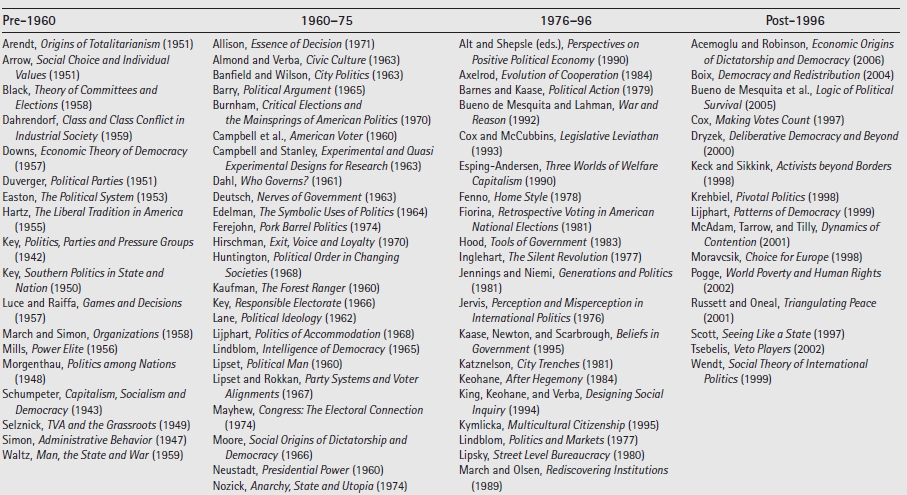
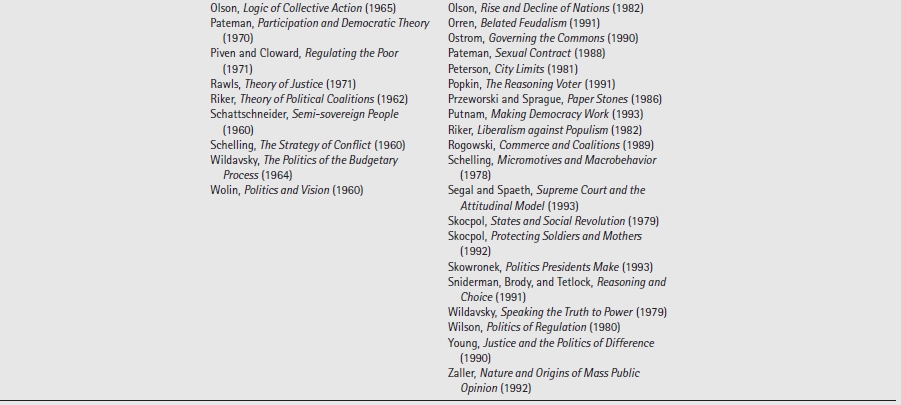
The lists in the four columns differ in length, not so much because some periods were more fruitful than others, but merely because they represent different lengths of time. The fact that the list in the last column is particularly short does not necessarily suggest that political science is running out of steam. That column covers the shortest period of time; and the list there is further truncated by fact that it takes time to see whether books, however good, actually start getting picked up by the profession at large.
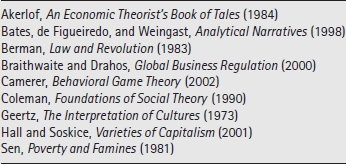
There are other books, often already famous within their home discipline, that political scientists should know better than they do. Among those I would nominate are those listed in Table A1.1.2.
Table A1.1.2. Books political scientists should know better
Appendix 1.2 Sub-disciplinary Leaders
“Sub-disciplinary leaders” are defined as the 1 percent of people (ignoring pre-twentieth century authors) whose names appear most frequently in the index of the respective sub-disciplinary volume in the Oxford Handbooks of Political Science series.64
Conventional citation counts typically disregard self-citations. But it would be wrong to do so here. Authors were chosen to write for the Oxford Handbooks of Political Science because they are leaders in their field. Anyone writing a chapter on that topic would have referenced their work frequently, albeit perhaps not quite so frequently as they sometimes reference themselves. (In none of the cases listed below does any substantial proportion of the author’s references come from self-referencing.)
I have therefore opted to include self-references in the counts reported in Table A1.2.1, and simply to flag the fact that the count might be inflated somewhat by setting an “A” against the count for people who authored a chapter in one of the volumes. Similar issues might arise with volume editors and with me as General Editor of the series; I flag that fact by setting an “E” against the count for any editor of the volume in question, and a “GE” against my name.
Table A1.2.1. Sub-disciplinary leaders
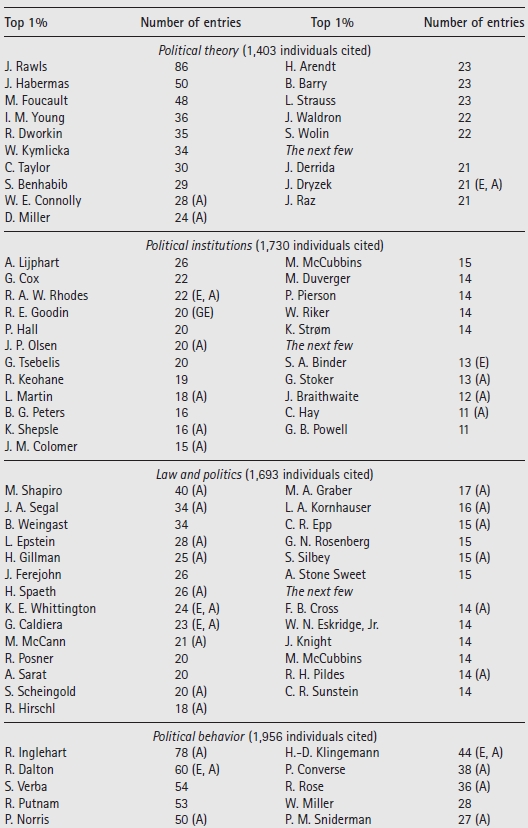
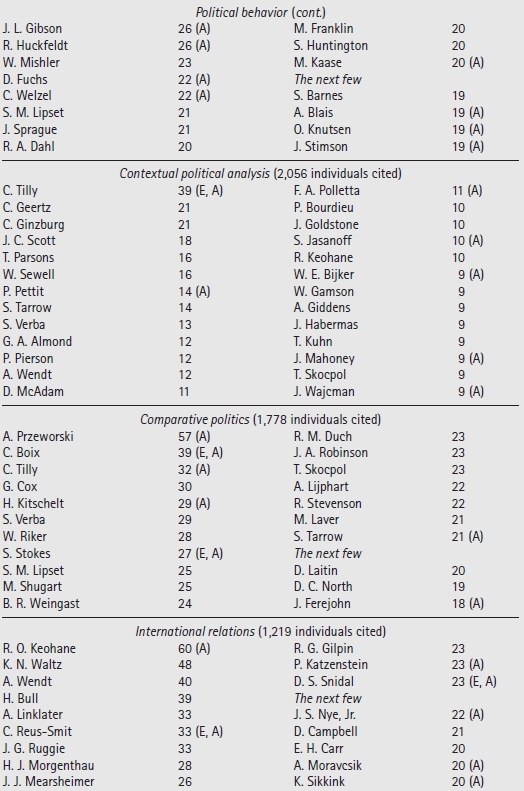
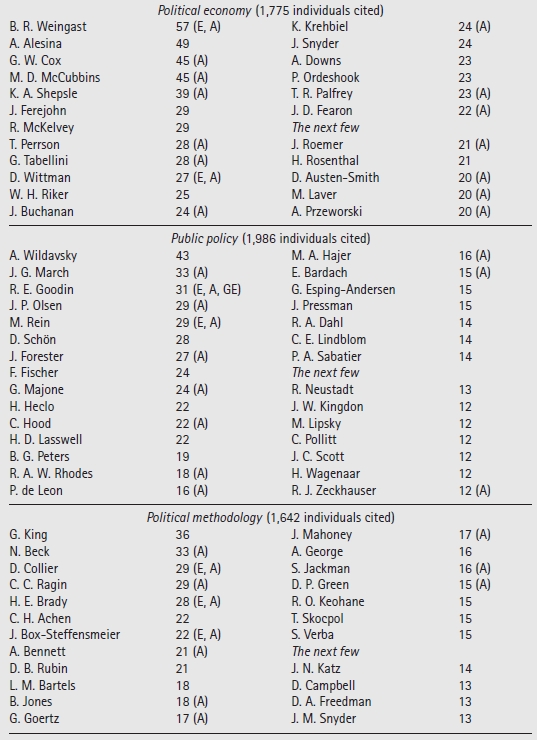
Appendix 1.3 Leaders of the Discipline
“Leaders of the discipline” are defined as the 1 percent of people (ignoring pre-twentieth century authors) whose names appear most frequently in the indices of the ten volumes of Oxford Handbooks of Political Science taken as a whole.
The same convention as in Appendix 1.2 is employed here, with an “A” indicating someone who authored a chapter in the volume in question; an “E” indicates someone who served as editor of the volume; and “GE” indicates the General Editor of the series as a whole.
The extent to which these results might be skewed by differences in citation practices across different sub-disciplines can be ascertained from Table A1.2. There is some difference across sub-disciplines in the frequency with which the very most frequently mentioned author is mentioned. But focusing on the last person among the 1 percent most referenced, that person gets around twenty mentions in all the established sub-disciplines. (The only exception is the less-established field of “Contextual Political Analysis.”)
Table A1.3. Leaders of the discipline
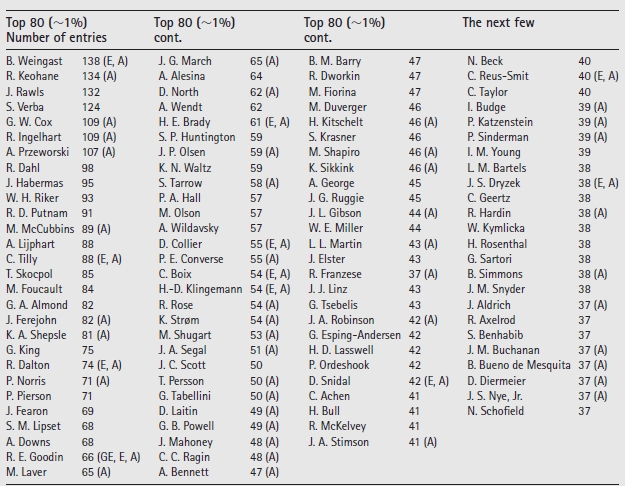
Appendix 1.4 Integrators of the Discipline
“Integrators of the discipline” are defined as people whose work is influential across multiple branches of the discipline (Goodin and Klingemann 1996b, 33–4). Table A1.4 lists people whose name appears in the indexes of multiple volumes of the Oxford Handbooks of Political Science, according to the number of those ten volumes in which it appears.
Again, in deference to fears that self-referencing might have affected the results, an “E” indicates someone who edited one of the volumes and “GE” the General Editor of the series as a whole.
Appendix 1.5 Structure of the Discipline
Appendix 1.5 Structure of the Discipline This appendix maps relations among the sub-disciplines of political science, as represented by each of the ten component volumes of the Oxford Handbooks of Political Science series. The “closeness” of one sub-discipline to another will be adjudged by the proportion of authors who appear in the name indexes of both sub-disciplinary volumes.
Pre-twentieth-century authors are once again ignored. So too are the names of public figures not cited as authors (US Supreme Court justices whose written opinions are cited are treated as authors, however). It is sometimes unclear whether people with the same name are the same author or not; for those cases I have adopted the rule “when in doubt, count.”
In Table A1.5, the total number of entries in the name index of each sub-disciplinary volume is reported below the name of the sub-discipline in the row and column headings. In each cell in the body of that table, two numbers appear: First, the total number of individuals whose name appears in the indexes of both volumes; and second, that expressed as a percentage of all names that appear in the handbook represented by that row. Since the total number of names indexed in different sub-disciplinary handbooks differs (the Context volume has 70 percent more names in its index than the one on International Relations), the two such percentages reported for the intersection of each pair of handbooks differs somewhat in the top-right and lower-left halves of Table A1.5.
The final column in Table A1.5 averages the interrelationships across the row representing the sub-discipline. From those averages, it would seem that—except for Political Theory and Law and Politics—the discipline as a whole is pretty uniformly integrated. Except for those two sub-disciplines, the average interrelationship between sub-disciplines ranges between 12 and 18 percent, with Comparative Politics and Political Institutions appearing as most central on average.
Table A1.4. Integrators of the discipline Authors appearing in multiple subdisciplinary volumes (omitting pre-twentieth-century authors)
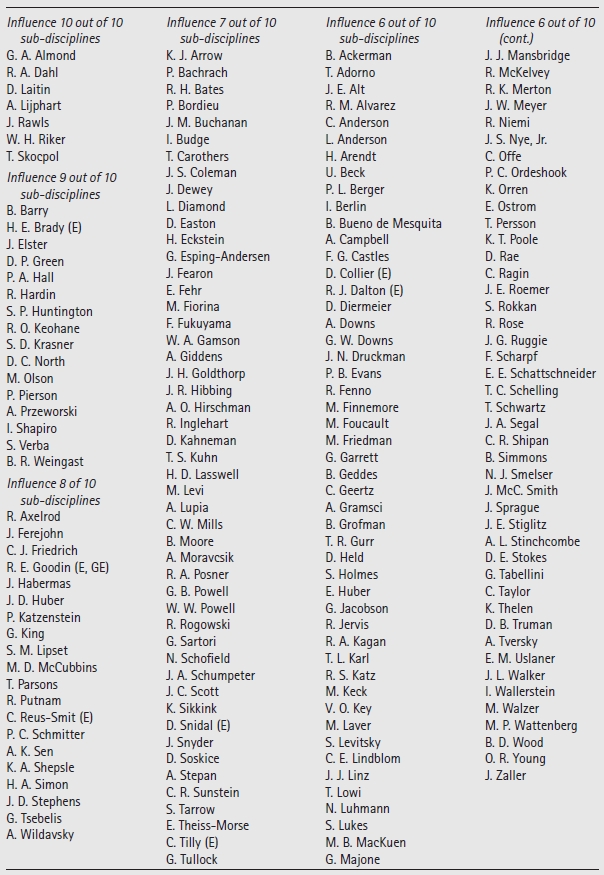
Table A1.5. The structure of the discipline (number and % of shared authors)
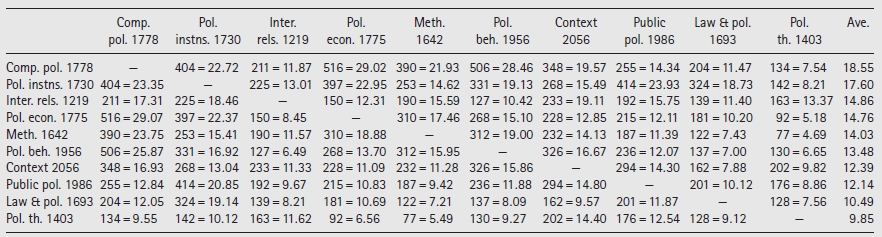
REFERENCES
ABBOTT, A. 1988. The System of Professions. Chicago: University of Chicago Press.
——2002. Sociology of professions. In International Encyclopedia of the Social and Behavioral Sciences, ed. P. Baltes and N. Smelser. Amsterdam: Elsevier.
ACEMOGLU, D. and ROBINSON, J. A. 2006. Economic Origins of Dictatorship and Democracy. Cambridge: Cambridge University Press.
AKERLOF, G. A. 1970. The market for “lemons:” qualitative uncertainty and the market mechanism. Quarterly Journal of Economics, 84: 488–500. Reprinted in Akerlof 1984, ch. 2.
——1984. An Economic Theorist’s Book of Tales. Cambridge: Cambridge University Press.
ALDRICH, J., ALT, J., and LUPIA, A. 2008. The EIM apprach: origins and interpretations. Pp. 828–43. In Box-Steffensmeier, Brady, and Collier, Oxford Handbook of Political Methodology. Oxford: Oxford University Press, ed. 2008.
ALFORD, J. R. and HIBBING, J. R. 2008. The new empirical biopolitics. Annual Review of Political Science, 11: 183–204.
ALLISON, G. T. 1969. Conceptual models and the Cuban Missile Crisis. American Political Science Review, 63: 689–718.
——1971. Essence of Decision. Boston: Little, Brown.
——and ZELIKOW, P. 1999. The Essence of Decision, 2nd edn. Reading, Mass.: Longman.
ALMOND, G. A. 1960. A functional approach to comparative politics. Pp. 3–66 in Almond and Coleman 1960.
——1988. Separate tables: schools and sects in political science. PS: Political Science and Politics, 21: 828–42.
——1996. Political science: the history of the discipline. Pp. 50–96 in Goodin and Klingemann 1996.
——and COLEMAN, J. S. (eds.) 1960. The Politics of the Developing Areas. Princeton, NJ: Princeton University Press.
——and VERBA, S. 1963. The Civic Culture. Princeton, NJ: Princeton University Press.
ALT, J. E., LEVI, M., and OSTROM, E. 1999. Introduction. In Alt, Levi, and Ostrom (eds.), Competition and Cooperation: Conversations with Nobelists about Economics and Political Science. New York: Russell Sage Foundation.
——and SHEPSLE, K. A. (eds.) 1990. Perspectives on Positive Political Economy. Cambridge: Cambridge University Press.
ANDERSON, P., ARROW, K. J., and PINES, D. 1988. The Economy as an Evolving Complex System. Redwood City, Calif.: Addison-Wesley.
ANON. 2007. History of the caucus for a new political science. New Political Science, 29/4: 501–7.
ANSELL, C. 2006. Network institutionalism. Pp. 75–89 in Rhodes, Binder, and Rockman 2006.
ANTONY, L. 2006. The socialization of epistemology. Pp. 58–77 in Goodin and Tilly 2006.
ARENDT, H. 1951/1966. The Origins of Totalitarianism, 3rd edn. and London: Allen and Unwin.
ARROW, K. J. 1951/1963. Social Choice and Individual Values, 2nd edn. New Haven, Conn.: Yale University Press.
AXELROD, R. 1973. Schema theory: an information processing model of perception and cognition. American Political Science Review, 67: 1248–66.
——(ed.) 1976. The Structure of Decision. Princeton, NJ: Princeton University Press.
——1981. Emergence of cooperation among egoists. American Political Science Review, 75: 306–18.
——1984. The Evolution of Cooperation. New York: Basic Books.
——1986. An evolutionary approach to norms. American Political Science Review, 80: 1095–112.
——and HAMILTON, W. D. 1981. The evolution of cooperation. Science, 211: 1390–6.
BACHRACH, P. and BARATZ, M. 1970. Power and Poverty. New York: Oxford University Press.
BANFIELD, E. C. and WILSON, J. Q. 1963. City Politics. New York: Vintage.
BARNES, S., KAASE, M., et al. 1979. Political Action: Mass Participation in Five Western Democracies. Beverly Hills, Calif.: Sage.
BARRY, B. 1965. Political Argument. London: Routledge & Kegan Paul.
——1970. Sociologists, Economists and Democracy. London: Collier-Macmillan. 2nd edn. Chicago: University of Chicago Press, 1978.
——1974. Review article: exit, voice and loyalty. British Journal of Political Science, 4: 79–107.
——1999. The study of politics as a vocation. Pp. 425–67 in Hayward, Barry, and Brown 1999.
BATES, R. H., DE FIGUEIREDO, R. J. P., Jr., and WEINGAST, B. R. 1998. The politics of interpretation: rationality, culture and transition. Politics and Society, 26: 603–42.
——GREIF, A., LEVI, M., ROSENTHAL, J.-L., and WEINGAST, B. R. 1998. Analytic Narratives. Princeton, NJ: Princeton University Press.
BEARD, C. A. 1913. An Economic Interpretation of the Constitution of the United States. New York: Macmillan.
BENDOR, J. and HAMMOND, T. H. 1992. Rethinking Allison’s models. American Political Science Review, 86: 301–22.
BENFORD, R. D. and SNOW, D. A. 2000. Framing processes and social movements: an overview and assessment. Annual Review of Sociology, 26: 611–39.
BENTLEY, A. F. 1908/1967. The Process of Government, ed. P. H. Odegard. Cambridge, Mass.: Harvard University Press. Originally published 1908.
BERLIN, I. 1953. The Hedgehog and the Fox. New York: Simon and Schuster.
BERMAN, H. J. 1983. Law and Revolution: The Formation of the Western Legal Tradition. Cambridge, Mass.: Harvard University Press.
BEYME, K. von (ed.) 1986. Politikwissenschaft in der Bundesrepublik Deutschland. Politische Vierteljahresschrift, special issue 17. Opladen: Westdeutscher Verlag.
BINMORE, K. 1998. Game Theory and Social Contract. Volume 2: Just Playing. Cambridge, Mass.: MIT Press.
BIRNBAUM, N. 1955. Monarchs and sociologists. Sociological Review, 3: 5–23.
BLACK, D. 1958. Theory of Committees & Elections. Cambridge: Cambridge University Press.
BOHMAN, J. 1999. Democracy as inquiry, inquiry as democratic: pragmatism, social science and the cognitive division of labor. American Journal of Political Science, 43: 590–607.
——2002. How to make a social science practical: pragmatism, critical social science and multiperspectival theory. Millennium, 31: 499–524.
BOISSEVAIN, J. 1974. Friends of Friends: Networks, Manipulators and Coalitions. Oxford: Blackwell.
——and MITCHELL, J. C. (eds.) 1973. Network Analysis: Studies in Social Interaction. The Hague: Mouton.
BOIX, C. 2004. Democracy and Redistribution. Cambridge: Cambridge University Press.
——and STOKES, S. C. (eds.) 2007. Oxford Handbook of Comparative Politics. Oxford: Oxford University Press.
BOUDON, R. 1974. Education, Opportunity, and Social Inequality. New York: Wiley.
BOURDIEU, P. 1984. Distinction, trans. R. Nice. London: Routledge and Kegan Paul.
BOWLES, S. 2004. Microeconomics: Behavior, Institutions and Evolution. Princeton, NJ: Princeton University Press, for Russell Sage Foundation.
——and GINTIS, H. 2006. The evolutionary basis of collective action. Pp. 951–70 in Weingast and Wittman 2006. Reprinted in this volume.
BOX-STEFFENSMEIER, J. M., BRADY, H. E., and COLLIER, D. (eds.) 2008. Oxford Handbook of Political Methodology. Oxford: Oxford University Press.
BRAITHWAITE, J. and DRAHOS, P. 2000. Global Business Regulation. Cambridge: Cambridge University Press.
BRAMS, S. J. 1978. The Presidential Election Game. New Haven, Conn.: Yale University Press.
BUENO DE MESQUITA, B. and LALMAN, D. 1992. War and Reason: Domestic and International Imperatives. New Haven, Conn.: Yale University Press.
——SMITH, A., SIVERSON, R. M., and MORROW, J. D. 2005. The Logic of Political Survival. Cambridge, Mass.: MIT Press.
BURAWORY, M. 2005. For public sociology. American Sociological Review, 70: 4–28.
BURNHAM, W. D. 1970. Critical Elections and the Mainsprings of American Politics. New York: Norton.
BURT, R. S. and MINOR, M. J. (eds.) 1983. Applied Network Analysis: A Methodological Introduction. Beverley Hills, Calif.: Sage.
BUTLER, L. 2006. RQF Pilot Study Project—History and Political Science Methodology for Citation Analysis. Briefing paper for CHASS Bibliometrics Project for the Department of Education, Science and Training, Commonwealth of Australia. Available at: .
CALHOUN, C. and MCGOWAN, J. (eds.) 1997. Hannah Arendt and the Meaning of Politics. Minneapolis: University of Minnesota Press.
CAMERER, C. F. 2002. Behavioral Game Theory. Princeton, NJ: Princeton University Press.
CAMPBELL, A., CONVERSE, P. E., MILLER, W., and STOKES, D. 1960. The American Voter. New York: Wiley.
CAMPBELL, D. T. and STANLEY, J. C. 1963. Experimental and Quasi Experimental Designs for Research. Boston: Houghton-Mifflin.
CAMPION LORD, CHESTER, D. N. MACKENENZIE, W. J. M., ROBSON, W. A., STREET, A., and WARREN, J. H. 1950. British Government since 1918. London: Allen and Unwin, for the Institute of Public Administration.
CAPLOW, T. and MCGEE, R. J. 1961. The Academic Marketplace. New York: Wiley.
CARNAP, R. 1950. Logical Foundations of Probability. Chicago: University of Chicago Press.
CHESTER, D. N. 1975. Political studies in Britain: recollections and comments. Political Studies, 23: 29–42.
CHONG, D. and DRUCKMAN, J. N. 2007. Framing theory. Annual Review of Political Science, 10: 103–26.
COAKLEY, J. and TRENT, J. 2000. History of the International Political Science Association 1949–1999. Dublin: International Political Science Association.
COLE, H. D. S., et al. (eds.) 1973. Thinking about the Future. London: Chatto and Windus, for Sussex University Press.
COLEMAN, J. S. 1990. Foundations of Social Theory. Cambridge, Mass.: Harvard University Press.
COLLINI, S., WINCH, D., and BURROWS, J. 1983. That Noble Science of Politics. Cambridge: Cambridge University Press.
CORNFORD, F. M. 1908. Microcosmographia Academia. Cambridge: Bowes and Bowes.
CORWIN, E. S. 1929. The democratic dogma and the future of political science. American Political Science Review, 23: 569–92.
COX, G. W. 1997. Making Votes Count. Cambridge: Cambridge University Press.
——and MCCUBBINS, M. D. 1993. Legislative Leviathan: Party Government in the House. Los Angeles: University of California Press; rev. edn. 2007.
CRICK, B. 1962. In Defence of Politics. London: Weidenfeld and Nicolson.
CYERT, R. M. and MARCH, J. G. 1963. A Behavioral Theory of the Firm. Englewood Cliffs, NJ: Prentice Hall.
DAHL, R. A. 1961a. The behavioral approach in political science: epitaph for a monument to a successful protest. American Political Science Review, 55: 763–72.
——1961b. Who Governs? New Haven, Conn.: Yale University Press.
——1972. Polyarchy: Participation and Opposition. New Haven, Conn.: Yale University Press.
DAHRENDORF, R. 1959. Class and Class Conflict in Industrial Society. Stanford, Calif.: Stanford University Press.
DALLMAYR, F. (ed.) 1999. Border Crossings: Toward a Comparative Political Theory. Lanham, Md.: Lexington Books.
——2004. Beyond monologue: for a comparative political theory. Perspectives on Politics, 2: 249–57.
DALTON, R. J. and KLINGEMANN, H.-D. (eds.) 2007. Oxford Handbook of Political Behavior. Oxford: Oxford University Press.
DAVIDSON, D. 1980. Essays on Actions and Events. Oxford: Clarendon Press.
——1984. Inquiries into Truth and Interpretation. Oxford: Clarendon Press.
DAVIS, K. 1959. The myth of functional analysis as a special method in sociology and anthropology. American Sociological Review, 24: 757–72.
DAWKINS, R. 1976. The Selfish Gene. Oxford: Oxford University Press.
DEUTSCH, K. W. 1963. The Nerves of Government. Glencoe, Ill.: Free Press.
——1979. Political science: major changes in the discipline. Pp. 157–80 in Rokkan 1979.
——MARKOVITS, A. S., and PLATT, J. (eds.) 1986. Advances in the Social Sciences. New York: University Press of America.
DEWAN, T., DOWDING, K., and SHEPSLE, K. A. 2008a. Rational choice classics in political science. Ch. 1 in Dewan, Dowding, and Shepsle 2008b.
—— —— ——(eds.) 2008b. Rational Choice Politics. London: Sage.
DIERKES, M. and BIERVERT, B. (eds.) 1992. European Social Science in Transition. Frankfurt am Main: Campus Verlag.
DOGAN, M. 1996. Political science and the other social sciences. Pp. 97–130 in Goodin and Klingemann 1996a.
——and PAHRE, R. 1990. Creative Marginality. Boulder, Colo.: Westview.
DOWNS, A. 1957. An Economic Theory of Democracy. New York: Harper.
DRYZEK, J. S. 2000. Deliberative Democracy and Beyond. Oxford: Oxford University Press.
——2005. A pox on perestroika, a hex on hegemony: toward a critical political science. In Monroe 2005.
——2006a. Policy analysis as critique. Pp. 190–203 in Moran, Rein, and Goodin 2006.
——2006b. Revolutions without enemies: key transformations in political science. American Political Science Review, 100: 487–92.
——HONIG, B., and PHILLIPS, A. (eds.) 2006. Oxford Handbook of Political Theory. Oxford: Oxford University Press.
——and LEONARD, S. T. 1995. History and discipline in political science. Pp. 27–48 in Easton, Gunnell, and Stein 1995.
——and SCHLOSBERG, D. 1995. Disciplining Darwin: biology in the history of political science. Pp. 123–44 in Farr, Dryzek, and Leonard 1995.
DUNLEAVY, P., KELLY, P. J., and MORAN, M. (eds.) 2000. British Political Science: Fifty Years of Political Studies. Oxford: Blackwell.
DUVERGER, M. 1951/1954. Political Parties, trans. B. and R. North. London: Methuen.
——1964/1966. The Idea of Politics: The Uses of Power in Society, trans. R. North and R. Murphy. London: Methuen.
EASTON, D. 1953. The Political System. New York: Knopf.
——1957. An approach to the analysis of political systems. World Politics, 9: 383–406.
——1965. A Systems Analysis of Political Life. New York: Wiley.
——1969. The new revolution in political science. American Political Science Review, 63: 1051–61.
GUNNELL, J. G., and GRAZIANO, L. (eds.) 1995. The Development of Political Science: A Comparative Survey. London: Routledge.
——and STEIN, M. B. (eds.) 1991. Regime and Discipline: Democracy and the Development of Political Science. Ann Arbor: University of Michigan Press.
EDELMAN, M. 1964. The Symbolic Uses of Politics. Urbana: University of Illinois Press.
——1988. Constructing the Political Spectacle. Chicago: University of Chicago Press.
EISENSTADT, S. N. 1963. The Political Systems of Empires. New York: Free Press.
ELSTER, J. 1979. Problematic rationality: some unresolved problems in the theory of rational behavior. Pp. 112–56 in Elster, Ulysses and the Sirens. Cambridge: Cambridge University Press.
——1989. Nuts and Bolts for the Social Sciences. Cambridge: Cambridge University Press.
——2007. Explaining Social Behavior: More Nuts and Bolts for the Social Sciences. Cambridge: Cambridge University Press.
ESPING-ANDERSEN, G. 1990. The Three Worlds of Welfare Capitalism. Cambridge: Cambridge University Press.
EUBEN, R. L. 1999. Enemy in the Mirror: Islamic Fundamentalism and the Limits of Modern Rationalism, A Work of Comparative Political Theory. Princeton, NJ: Princeton University Press.
EULAU, H. 1963. The Behavioral Persuasion in Politics. New York: Random House.
FARR, J. 1995. Remembering the revolution: behavioralism in American political science. Pp. 198–224 in Farr, Dryzek, and Leonard 1995.
DRYZEK, J. S., and LEONARD, S. T. (eds.) 1995. Political Science in History: Research Programs and Political Traditions. Cambridge: Cambridge University Press.
——and SEIDELMAN, R. (eds.) 1993. Discipline and History: Political Science in the United States. Ann Arbor: University of Michigan Press.
FEHR, E. and FISCHBACHER, U. 2002. Why social preferences matter: the impact of non-selfish motives on competition, cooperation and incentives. Economic Journal, 112: C1–C33.
FENNO, R. 1978. Home Style. Boston: Little, Brown.
FEREJOHN, J. A. 1974. Pork Barrel Politics. Stanford, Calif.: Stanford University Press.
FINFTER, A. W. (ed.) 1983. Political Science: The State of the Discipline. II Washington, DC: American Political Science Association.
——(ed.) 1993. Political Science: The State of the Discipline II. Washington, DC: American Political Science Association.
FINNEMORE, M. and SIKKINK, K. 2001. Taking stock: the constructivist research program in international relations and comparative politics. Annual Review of Political Science, 4: 391–416.
FIORINA, M. P. 1981. Retrospective Voting in American National Elections. New Haven, Conn.: Yale University Press.
FIORINA, M. P. 1996. Rational choice, empirical contributions and the scientific enterprise. Pp. 85–94 in Friedman 1996.
——2006. Culture War? The Myth of a Polarized America, 2nd edn. New York: Pearson Longman.
FLYVBJERG, B. 2001. Making Social Science Matter. Cambridge: Cambridge University Press.
FØLLESDAL, A. 1998. Subsidiarity. Journal of Political Philosophy, 6: 190–218.
FORRESTER, J. 1971. World Dynamics. Cambridge, Mass.: Wright-Allen Press.
FOUCAULT, M. 1977. Discipline and Punish, trans. A. Sheridan. Harmondsworth: Allen Lane.
FOUCAULT, M. 1991. Governmentality. Pp. 87–104 in The Foucault Effect: Studies in Governmen-tality, ed. G. Burchell et al. Hemel Hempstead: Harvester-Wheatsheaf.
FRIEDMAN, J. (ed.) 1996. The Rational Choice Controversy: Economic Models of Politics Recon-sidered. New Haven, Conn.: Yale University Press.
GAMSON, W. A. 1992. Talking Politics. Cambridge: Cambridge University Press.
GARFINKEL, H. 1967. Studies in Ethnomethodology. Englewood Cliffs, NJ: Prentice Hall.
GEERTZ, C. 1973. The Interpretation of Cultures. New York: Basic Books.
——1977. The judging of nations. Archives européennes de sociologie, 18: 245–61.
——2000. Available Light. Princeton, NJ: Princeton University Press.
GOLDSTEIN, J. and KEOHANE, R. (eds.) 1993. Ideas and Foreign Policy. Ithaca, NY: Cornell University Press.
GOODIN, R. E. 1996. Institutions and their design. Pp. 1–53 in The Theory of Institutional Design, ed. R. E. Goodin. Cambridge: Cambridge University Press.
——2000. Institutional gaming. Governance, 13: 523–33.
——2009. The British study of politics: an assessment. In Oxford Handbook of British Politics, ed. M. Flinders, A. Gamble, C. Hay, and M. Kenny. Oxford: Oxford University Press.
——and KLINGEMANN, H.-D. (eds.) 1996a. A New Handbook of Political Science. Oxford: Oxford University Press.
——1996b. Political science: the discipline. Pp. 3–49 in Goodin and Klingemann 1996a.
——and TILLY, C. (eds.) 2006. Oxford Handbook of Contextual Political Analysis. Oxford: Oxford University Press.
——et al. 2007. International Benchmarking Review of UK Politics and International Studies. London: Economic and Social Research Council in partnership with the British International Studies Association and the Political Studies Association.
GRANOVETTER, M. 1973. The strength of weak ties. American Journal of Sociology, 78: 1360–80.
——1983. The strength of weak ties: a network theory revisited. Sociological Theory, 1: 201–33.
GRAZIANO, L. (ed.) 1987. La scienca politica italiana. Milan: Feltrinelli.
GREEN, D. P. and SHAPIRO, I. 1994. The Pathologies of Rational Choice. New Haven, Conn.: Yale University Press.
GREENSTEIN, F. I. 1982. The Hidden-Hand Presidency: Eisenhower as Leader. New York: Basic Books.
——and POLSBY, N. W. (eds.) 1975. Handbook of Political Science, 8 vols. Reading, Mass.: Addison-Wesley.
GREWAL, D. S. 2008. Network Power: The Social Dynamics of Globalization. New Haven, Conn.: Yale University Press.
GUNNELL, J. G. 2005. Political science on the cusp: recovering a discipline’s past. American Political Science Review, 99: 597–609.
——2006. The founding of the American Political Science Association: discipline, profession, political theory and politics. American Political Science Review, 100: 479–86.
GÜTH, W., SCHMITTBERGER, R., and SCHWARZE, B. 1982. An experimental analysis of ultimatum bargaining. Journal of Economic Behavior and Organization, 3: 367–88.
HAAS, P. M. 1992. Epistemic communities and international policy coordination. International Organization, 46: 1–35.
HALL, P. A. and SOSKICE, D. (eds.) 2001. Varieties of Capitalism. Oxford: Oxford University Press.
HAMMOND, T. H., JEN. K. I., and MAEDA, K. 2007. Learning in hierarchies: an empirical test using library catalogues. Journal of Theoretical Politics, 19: 425–64.
HARDIN, R. 2006. Not shaken, not even stirred. The Good Society, 15: 1, 4–6.
HART, H. L. A. 1961. The Concept of Law. Oxford: Clarendon Press.
HARTZ, L. 1955. The Liberal Tradition in America. New York: Harcourt, Brace.
HAY, C. 2002. Political Analysis. London: Palgrave Macmillan.
——2004. Theory, stylized heuristic or self-fulfilling prophesy? The status of rational choice theory in public administration. Public Administration, 82: 39–62.
——and Richards, D. 2000. The tangled webs of Westminster and Whitehall: the discourse, strategy and practice of networking within the British core executive. Public Administration 78: 1–28.
HAYWARD, J., BARRY, B., and BROWN, A. (eds.) 1999. The British Study of Politics in the Twentieth Century. Oxford: Oxford University Press, for the British Academy.
HECLO, H. 1978. Issue networks and the executive establishment. Pp. 87–124 in The New American Political System, ed. A. King. Washington, DC: American Enterprise Institute.
HEDSTRöM, P. and SWEDBERG, R. (eds.) 1998. Social Mechanisms. Cambridge: Cambridge University Press.
HEILBRON, J., MAGNUSSON, L., and WITTROCK, B. (eds.) 1998. The Rise of the Social Sciences and the Formation of Modernity. Dordrecht: Kluwer.
HEINZ, J. P. and LAUMANN, E. O. 1982. Chicago Lawyers: The Social Structure of the Bar. New York: Russell Sage Foundation, for the American Bar Foundation.
NELSON, R. L., and SALISBURY, R. H. 1993. The Hollow Core: Private Interests in National Policymaking. Cambridge, Mass.: Harvard University Press.
HÉRITIER, A. 2007. Explaining Institutional Change in Europe. Oxford: Oxford University Press.
HERTTING, N. 2007. Mechanisms of governance network formation: a contextual rational choice perspective. Pp. 43–60 in Theories of Democratic Network Governance, ed. E. Sørensen and J. Torfing. London: Palgrave Macmillan.
HIRSCH, F. 1976. Social Limits to Growth. Cambridge, Mass.: Harvard University Press.
HIRSCHLEIFER, J. 1977. Economics from a biological viewpoint. Journal of Law and Economics, 20: 1–52.
HIRSCHMAN, A. O. 1970. Exit, Voice and Loyalty. Cambridge, Mass.: Harvard University Press
HITCH, C. J. and MCKEAN, R. N. 1960. The Economics of Defense in the Nuclear Age. Cambridge, Mass.: Harvard University Press.
HOOD, C. C. 1983. Tools of Government. London: Macmillan
HUGHES, E. C. 1958. Men and their Work. Glencoe, Ill.: Free Press.
HUME, D. 1777. That politics may be reduced to a science. Part I, Essay 3 in Essays, Literary, Moral and Political. London: A. Millar.
HUNTINGTON, S. P. 1968. Political Order in Changing Societies. New Haven, Conn.: Yale University Press.
INGLEHART, R. 1977. The Silent Revolution. Princeton, NJ: Princeton University Press.
IYENGAR, S. 1994. Is Anyone Responsible? How Television Frames Political Issues. Chicago: University of Chicago Press.
JENNINGS, M. K. and NIEMI, R. G. 1981. Generations and Politics. Princeton, NJ: Princeton University Press.
JERVIS, R. 1976. Perception and Misperception in International Politics. Princeton, NJ: Princeton University Press.
JESSOP, B. 1990. State Theory. Cambridge: Polity.
JOHNSON, J. 2002. How conceptual problems migrate: rational choice, interpretation and the hazards of pluralism. Annual Review of Political Science, 5: 223–48
KAASE, M., NEWTON, K., and SCARBROUGH, E. (eds.) 1995. Beliefs in Government, 5 vols. Oxford: Oxford University Press.
KAASE, M., AND SPARSCHUH, V. 2002. Three Social Science Disciplines in Central and Eastern Europe: Handbook on Economics, Political Science and Sociology (1989–2001). Bonn/Berlin/Budapest: GESIS/Social Science Information Centre and Collegium Budapest Institute for Advanced Study.
KAHNEMAN, D. 2003. Maps of bounded rationality: psychology for behavioral economics. American Economics Review, 93: 1449–75.
KNETSCH, J. L., and THALER, R. H. 1986. Fairness as a constraint on profit seeking: entitlements in the market. American Economic Review, 76: 728–41.
SLOVIC, P., and TVERSKY, A. (eds.) 1982. Judgment under Uncertainty: Heuristics and Biases. Cambridge: Cambridge University Press.
——and TVERSKY, A. (eds.) 2000. Choices, Values and Frames. Cambridge: Cambridge University Press.
KAPLAN, D. E. and LEWIS, K. M. 2001. Guide to the American Social Science Association Records. New Haven, Conn.: Manuscripts and Archives, Yale University Library.
KATZENSTEIN, P. and SIL, R. 2008. Eclectic theorizing in the study and practice of international relations. Ch. 6 in Reus-Smit and Snidal 2008.
KATZNELSON, I. 1981. City Trenches. Chicago: University of Chicago Press.
——and MILNER, H. (eds.) 2002. Political Science: The State of the Discipline III. Washington, DC: American Political Science Association.
KAUFMAN, H. 1967. The Forest Ranger. Baltimore: Johns Hopkins University Press, for Resources for the Future.
KECK, M. and SIKKINK, K. 1998. Activists beyond Borders: Advocacy Networks in International Politics. Ithaca, NY: Cornell University Press.
KEOHANE, R. O. 1984. After Hegemony. Princeton, NJ: Princeton University Press.
——2001. Governance in a partially globalized world. American Political Science Review, 95: 1–14.
KEY, V. O., Jr. 1942. Politics, Parties and Pressure Groups. New York: Crowell.
——1950. Southern Politics in State and Nation. New York: Knopf.
——1954. A Primer of Statistics for Political Scientists. New York: Crowell.
——1966. The Responsible Electorate: Rationality in Presidential Voting, 1936–1960. Cambridge, Mass.: Harvard University Press.
KING, G., KEOHANE, R., and VERBA, S. 1994. Designing Social Inquiry. Princeton, NJ: Princeton University Press.
KITCHER, P. 1981. Explanatory unification. Philosophy of Science, 48: 507–31.
KLINGEMANN, H.-D. (ed.) 2007. The State of Political Science in Western Europe. Opladen: Barbara Budrich.
KULESZA, E., and LEGUTKE, A. (eds.) 2002. The State of Political Science in Central and Eastern Europe. Berlin: Edition Sigma.
KNIGHT, J. 1992. Political Institutions and Social Conflict. Cambridge: Cambridge University Press.
KREHBIEL, K. 1998. Pivotal Politics: A Theory of US Lawmaking. Chicago: University of Chicago Press.
KUHN, T. 1962. The Structure of Scientific Revolutions. Chicago: University of Chicago Press.
KYMLICKA, W. 1995. Multicultural Citizenship. Oxford: Clarendon Press.
LACLAU, E. and MOUFFE, C. 1985. Hegemony and Socialist Strategy. London: Verso.
LAITIN, D. D. 2003. The Perestroikan challenge to social science. Politics and Society, 31: 163–84.
——and WEINGAST, B. R. 2006. An equilibrium alternative to the study of culture. The Good Society, 15: 15–20.
LAKATOS, I. and MUSGRAVE, A. (eds.) 1970. Criticism and the Growth of Knowledge. Cambridge: Cambridge University Press.
LAMOUNT, M. 1987. How to become a dominant French philosopher: the case of Jacques Derrida. American Journal of Sociology, 93: 584–622.
LANE, R. E. 1962. Political Ideology. Glencoe, Ill.: Free Press.
LASSWEL, H. D. 1950. Politics: Who Gets What, When, How? New York: P. Smith.
LAUMANN, E. O. and KNOKE, D. 1987. The Organizational State. Madison: University of Wisconsin Press.
——and. PAPPI, F. U. 1976. Networks of Collective Action. New York: Academic Press.
LAZARSFELD, P. F., BERELSON, B. R., and GAUDET, H. 1944. The People’s Choice. New York: Columbia University Press.
LECA, J. and GRAWITZ, M. (eds.) 1985. Traité de Science Politique, 4 vols. Paris: Presses Universitaires de France.
LEHMBRUCH, G. 1984. Concertation and the structure of corporatist networks. Pp. 60–80 in Order and Conflict in Contemporary Capitalism, ed. J. H. Goldthorpe. Oxford: Clarendon Press.
LEVY, J. S. 2008. Counterfactuals and case studies. Pp. 627–44 in Box-Steffensmeier, Brady, and Collier 2008.
LIJHART, A. 1968/1975. The Politics of Accommodation: Pluralism and Democracy in the Netherlands, 2nd edn. Berkeley: University of California Press.
——1999. Patterns of Democracy. New Haven, Conn.: Yale University Press.
LINDBLOM, C. E. 1965. The Intelligence of Democracy. New York: Free Press.
——1977. Politics and Markets. New York: Basic.
LINDZEY, G. (ed.) 1954. Handbook of Social Psychology. Cambridge, Mass.: Addison-Wesley.
LIPSET, S. M. 1960. Political Man. New York: Doubleday.
——LAZARSFELD, P. F., BARTON, A. H., and Linz, J. J. 1954. The psychology of voting: an analysis of political behavior. Pp. 1124–75 in Lindzey 1954.
——and ROKKAN, S. (eds.) 1967. Party Systems and Voter Alignments. New York: Free Press.
LIPSKY, M. 1980. Street Level Bureaucracy. New York: Russell Sage.
LOWI, T. J. 1964. American business, public policy, case-studies and political theory. World Politics, 16: 676–715.
——1973. The politicization of political science. American Politics Quarterly, 1: 43–71.
LUCE, R. D. and RAIFFA, H. 1957. Games and Decisions. New York: Wiley.
LUKES, S. 1974/2005. Power: A Radical View, 2nd edn. London: Palgrave Macmillan.
LYND, R. S. and Lynd, H. M. 1929. Middletown. New York: Houghton, Brace.
MCADAM, D., Tarrow, S., and TILLY, C. 2001. Dynamics of Contention. Cambridge: Cambridge University Press.
MCCLOSKEY, D. 2006. The Bourgeois Virtues: Ethics for an Age of Commerce. Chicago: University of Chicago Press.
MCCOY, C. A. and PLAYFORD, J. (eds.) 1968. Apolitical Politics: A Critique of Behavioralism. New York: Crowell.
MCELREATH, R. and BOYD, R. 2007. Mathematical Models of Social Evolution. Chicago: University of Chicago Press.
MACKAY, C. 1841/1980. Extraordinary Popular Delusions and the Madness of Crowds. New York: Bonanza Books.
MACKENZIE, W. J. M. 1967. Politics and Social Science. Harmondsworth: Penguin.
MACPHERSON, C. B. 1954. World trends in political science research. American Political Science Review, 48: 427–49.
——1977. The Life and Times of Liberal Democracy. Oxford: Clarendon Press.
MAJONE, G. 1989. Evidence, Argument and Persuasion in the Policy Process. New Haven, Conn.: Yale University Press
——and QUADE, E. S. (eds.) 1980. Pitfalls of Analysis. Chichester: Wiley, for International Institute for Applied Systems Analysis.
MALINOWSKI, B. 1936/1976. Functional anthropology. Pp. 511–24 in Sociological Theory: A Book of Readings, 4th edn., ed. L. A. Coser and B. Rosenberg. New York: Macmillan. Originally published as “Anthropology,” Encyclopedia Britannica, first supplementary volume, 1936.
MARCH, J. G. 1962. Some recent substantive and methodological developments in the theory of organizational decision-making. Pp. 191–208 in Essays on the Behavioral Study of Politics, ed. A. Ranney. Urbana: University of Illinois Press.
——1996. Continuity and change in theories of organizational action. Administrative Science Quarterly, 41: 278–87.
——and OLSEN, J. P. 1984. The new institutionalism: organizational factors in political life. American Political Science Review, 78: 734–49.
—— ——1989. Rediscovering Institutions. New York: Free Press.
——and Simon, H. A. 1958. Organizations. New York: Wiley.
MARSHALL, G. 1990. In Praise of Sociology. London: Unwin Hyman.
MARX, K. 1845/1972. Theses on Feuerbach. Pp. 107–9 in The Marx–Engels Reader, ed. R. C. Tucker. New York: Norton.
MASTERS, R. D. 1989. The Nature of Politics. New Haven, Conn.: Yale University Press.
MASUOKA, N., GROFMAN, B., and FELD, S. 2007. The Political Science 400: a 20-year update. PS: Political Science and Politics, 40: 133–45.
MATTHEWS, D. R. 1959. The folkways of the United States Senate. American Political Science Review, 53: 1064–89.
MAYHEW, D. R. 1974. Congress: The Electoral Connection. New Haven, Conn.: Yale University Press.
MAYNARD SMITH, J. 1982. Evolution and the Theory of Games. Cambridge: Cambridge University Press.
MEADOWS, D. H., MEADOWS, D. L., RANDERS, J., and BEHRENS, W. W. III. 1972. The Limits to Growth. London: Earth Island.
MERRIAM, C. E. 1921. The present state of the study of politics. American Political Science Review, 15: 173–85.
—— and GOSNELL, H. F. 1924. Non-voting. Chicago: University of Chicago Press.
MERTON, R. K. 1965. On the Shoulders of Giants. Chicago: University of Chicago Press.
——1968. Social Theory and Social Structure, 3rd edn. New York: Free Press.
——1973. The Sociology of Science, ed. N. W. Storer. Chicago: University of Chicago Press.
MILLER, W. E. 1996. Political behavior, old and new. Pp. 294–305 in Goodin and Klingemann 1996a.
MILLS, C. W. 1956. The Power Elite. Oxford: Oxford University Press.
MILNER, H. V. 1998. Rationalizing politics: the emerging synthesis of international, American, and comparative politics. International Organization, 52: 759–86.
MITCHELL, J. C. 1974. Social networks. Annual Review of Anthropology, 3: S279–93.
MONRE, K. R. (ed.) 2005. Perestroika! The Raucous Rebellion in Political Science. New Haven, Conn.: Yale University Press.
MOON, J. D. 1975. The logic of political inquiry: a synthesis of opposed perspectives. Pp. 131–228 in Greenstein and Polsby 1975, vol. 1.
MOORE, B., JR. 1966. The Social Origins of Dictatorship and Democracy. Boston: Beacon.
——1970. Reflections on the Causes of Human Misery. Boston: Beacon.
MORAN, M. 2006. Interdisciplinarity and political science. Politics, 26: 73–83.
——REIN, M., and GOODING, R. E. (eds.) 2006. Oxford Handbook of Public Policy. Oxford: Oxford University Press.
MORAVCSIK, A. 1998. The Choice for Europe. Ithaca, NY: Cornell University Press.
MORGENSTERN, O. 1972. Thirteen critical points in contemporary economic theory. Journal of Economic Literature, 10: 1163–89.
MORGENTHAU, H. J. 1948/1973. Politics among Nations, 5th edn. New York: Knopf.
NELSON, R. R. 1994. Evolutionary theorizing about economic change. Pp. 108–36 in Handbook of Economic Sociology, ed. N. J. Smelser and R. Swedberg. Princeton, NJ: Princeton University Press.
——and WINTER, S. G. 1982. An Evolutionary Theory of Economic Change. Cambridge, Mass.: Harvard University Press.
NEUSTADT, R. E. 1960. Presidential Power. New York: Wiley.
——1990. Presidential Power and the Modern Presidency. New York: Free Press.
——2000. Preparing to be President: The Memos of Richard E. Neustadt, ed. C. O. Jones. Washington, DC: American Enterprise Institute, for Public Policy Research.
NEWTON, K. 1991. The European Consortium for Political Research. European Journal of Political Research, 20: 445–58.
——and VALLÈS, J. M. (eds.) 1991. Political Science in Western Europe, 1960–1990. Special issue of European Journal of Political Research, 20: 225–466.
NOWAK, M. A. 2006. Evolutionary Dynamics. Cambridge, Mass.: Harvard University Press.
NOZICK, R. 1974. Anarchy, State and Utopia. Oxford: Blackwell.
OFFE, C. 2003. The European model of “social” capitalism: can it survive European integration? Journal of Political Philosophy, 11: 437–69.
——2006. Political institutions and social power: conceptual explorations. Pp. 9–31 in Rethinking Political Institutions: The Art of the State, ed. I. Shapiro, S. Skowronek, and D. Galvin. New York: New York University Press.
OLSEN, J. P. 2007. Europe in Search of Political Order. Oxford: Oxford University Press.
——2009. Change and continuity: an institutional approach to institutions of democratic government. European Journal of Political Science, 1.
OLSON, M., Jr. 1965. The Logic of Collective Action. Cambridge, Mass.: Harvard University Press.
——1982. The Rise and Decline of Nations. New Haven, Conn.: Yale University Press.
ORREN, K. 1991. Belated Feudalism. Cambridge: Cambridge University Press.
——and SKOWRONEK, S. 2004. The Search for American Political Development. New York: Cambridge University Press.
OSTROM, E. 1990. Governing the Commons: The Evolution of Institutions for Collective Action. New York: Cambridge University Press.
PARSONS, T. 1951. The Social System. New York: Free Press.
PARSONS, T. 1968. Professions. Volume 12, pp. 536–47 in International Encyclopedia of the Social Sciences, ed. D. L. Sills. London: Macmillan.
PATEMAN, C. 1970. Participation and Democratic Theory. Cambridge: Cambridge University Press.
——1988. The Sexual Contract. Oxford: Polity.
PETERSON, P. E. 1981. City Limits. Chicago: University of Chicago Press.
PIERSON, P. 2000. Increasing returns, path dependence and the study of politics. American Political Science Review, 94: 251–68.
PIERSON, P. 2004. Politics in Time. Princeton, NJ: Princeton University Press.
PIVEN, F. F. and Cloward, R. A. 1971. Regulating the Poor. New York: Pantheon.
——1979. Poor People’s Movements: Why They Succeed, How They Fail. New York: Vintage.
POGGE, T. 2002. World Poverty and Human Rights. Cambridge: Polity.
POLSBY, N. W. 1980. Community Power and Political Theory, 2nd edn. New Haven, Conn.: Yale University Press.
POPKIN, S. L. 1991. The Reasoning Voter. Chicago: University of Chicago Press.
POPPER, K. 1964. The Poverty of Historicism, 3rd edn. New York: Harper and Row; originally published 1957.
PROULX, S. R., MORMISLOW, D. E. L., and PHILLIPS, P. C. 2005. Network thinking in ecology and evolution. TRENDS in Ecology and Evolution, 20: 345–53.
PRZEWORSKI, A. and SPRAGUE, J. 1986. Paper Stones: A History of Electoral Socialism. Chicago: University of Chicago Press.
PUTNAM, R. D. 1993. Making Democracy Work. Princeton, NJ: Princeton University Press.
——2000. Bowling Alone. New York: Simon and Schuster.
QUERMONNE, J.-L. (ed.) 1996. La Science politique en Europe: formation, coopération, perspectives. Rapport Final, Projet réalisé avec le soutien de la Commission Européenne (DG XII). Paris: Institut d’Études Politiques de Paris.
QUINE, W. v. O. 1961. From a Logical Point of View, 2nd edn. New York: Harper and Row.
RADCLIFFE-BROWN, A. R. 1935. On the concept of function in social science. American Anthropologist, 37: 394–402.
——1949. Functionalism: a protest. American Anthropologist, 51: 320–2.
RAWLS, J. 1971. A Theory of Justice. Cambridge, Mass.: Harvard University Press; rev. edn. 1999.
REUS-SMIT, C. 1999. The Moral Purpose of the State. Princeton, NJ: Princeton University Press.
——and SNIDAL, D. (eds.) 2008. Oxford Handbook of International Relations. Oxford: Oxford University Press.
RHODES, R. A. W. 1988. Beyond Westminster and Whitehall. London: Unwin Hyman.
——2006. Policy network analysis. Pp. 425–47 in Moran, Rein, and Goodin 2006.
——BINDER, S. A., and Rockman, B. A. (eds.) 2006. Oxford Handbook of Political Institutions. Oxford: Oxford University Press.
RIKER, W. H. 1962. Theory of Political Coalitions. New Haven, Conn.: Yale University Press.
——1982. Liberalism against Populism: A Confrontation between the Theory of Democracy and the Theory of Social Choice. San Francisco: W. Freeman.
——1986. The Art of Political Manipulation. New Haven, Conn.: Yale University Press.
RISSE, T., ROPP, S. C., and SIKKINK, K. (eds.) 1999. The Power of Human Rights: International Norms and Domestic Change. Cambridge: Cambridge University Press.
ROGOWSKI, R. 1989. Commerce and Coalitions. Princeton, NJ: Princeton University Press.
ROKKAN, S. (ed.) 1979. A Quarter Century of International Social Science. New Delhi: Concept.
ROYAL SWEDISH ACADEMY OF SCIENCES2005. The Bank of Sweden Prize in Economic Sciences in Memory of Alfred Nobel-Laureates. Available at: (accessed Jan. 3, 2008).
RUDOLPH, S. H. 2002. In defense of diverse forms of knowledge. PS: Political Science and Politics, 35: 193–5.
——2005. The imperialism of categories: situating knowledges in a globalizing world. Perspectives on Politics, 3: 5–14.
RUSSETT, B. M. and ONEAL, J. 2001. Triangulating Peace: Democracy, Interdependence and International Organizations. New York: Norton.
SAMUELSON, L. 1997. Evolutionary Games and Equilibrium Selection. Cambridge, Mass.: MIT Press.
SAXONHOUSE, A. W. 2006. Exile and re-entry: political theory yesterday and tomorrow. Pp. 844–58 in Dryzek, Honig, and Phillips 2006.
SCHAAR, J. and WOLIN, S. 1963. Essays on the scientific study of politics: a critique. American Political Science Review, 57: 125–50.
SCHATTSCHNEIDER, E. E. 1960. The Semi-sovereign People. New York: Holt, Rinehart and Winston.
SCHELLING, T. C. 1960. The Strategy of Conflict. Cambridge, Mass.: Harvard University Press.
——1978. Micromotives and Macrobehavior. New York: Norton.
SCHMIDT, V. A. 2008. Discursive institutionalism: the explanatory power of ideas and discourse. Annual Reviews of Political Science, 11: 303–26.
SCHMITTER, P. C. 2002. Seven (disputable) theses concerning the future of “trans-Atlanticized” or “globalized” political science. European Political Science, 1: 23–40.
SCHRAM, S. 2003. Return to politics: Perestroika and postparadigmatic political science. Political Theory, 31: 835–51.
SCHULTZE, C. 1992. Memos to the President: A Guide through Macroeconmics for the Busy Policymaker. Washington, DC: Brookings Institution.
SCHUMPETER, J. A. 1943. Capitalism, Socialism, and Democracy. London: Allen and Unwin.
SCIULLI, D. 2007. Professions before professionalism. Archives européennes de sociologie, 48: 121–47.
SCOTT, J. C. 1986. Weapons of the Weak: Everyday Forms of Peasant Resistance. New Haven, Conn.: Yale University Press.
——1991. Social Network Analysis: A Handbook. London: Sage.
——1997. Seeing like a State. New Haven, Conn.: Yale University Press.
SEARS, D. O., HUDDY, L., and JERVIS, R. (eds.) 2003. Oxford Handbook of Political Psychology. Oxford: Oxford University Press.
SEGAL, J. A. and SPAETH, H. J. 1993. The Supreme Court and the Attitudinal Model. Cambridge: Cambridge University Press.
SEIDELMAN, R. 1993. Political scientists, disenchanted realists and disappearing democrats. Pp. 311–25 in Farr and Seidelman 1993.
——with HARPHAM, E. J. 1985. Disenchanged Realists: Political Science and the American Crisis, 1884-1984. Albany: State University of New York Press.
SELTEN, R. 1991. Evolution, learning and economic behavior. Games and Economic Behavior, 3: 3–24.
SELZNICK, P. 1949. TVA and the Grassroots: A Study of Politics and Organization. Los Angeles: University of California Press.
SEN, A. K. 1981. Poverty and Famines. Oxford: Clarendon Press.
SHAPIRO, I. 1999. Enough of deliberation: politics is about interests and power. Pp. 28–38 in Deliberative Politics, ed. S. Macedo. New York: Oxford University Press.
SHAPIRO, I. 2005. The Flight from Reality in the Human Sciences. Princeton, NJ: Princeton University Press.
SHAW, G. B. 1934. The Apple Cart. Pp. 1009–43 in The Complete Plays of Bernard Shaw. London: Odhams Press.
SHILS, E. and Young, M. 1953. The meaning of the coronation. Sociological Review, 1: 63–81.
SHUBIK, M. 1971a. Games of status. Behavioral Science, 16: 117–29.
——1971b. Modelling on a grand scale. Science, 174: 1014–15.
SIGELMAN, L. 2006a. Introduction to the centennial issue. American Political Science Review, 100: v–xvi.
SIGELMAN, L. 2006b. The coevolution of American political science and the American Political Science Review. American Political Science Review, 100: 463–78.
——et al. 2006. Top twenty commentaries. American Political Science Review, 100: 667–88.
SIMON, H. A. 1947. Administrative Behavior. New York: Free Press.
SKINNER, Q. 2002. Visions of Politics. Cambridge: Cambridge University Press.
SKOCOPOL, T. 1979. States and Social Revolutions. Cambridge: Cambridge University Press.
——1992. Protecting Soldiers and Mothers. Cambridge, Mass.: Harvard University Press.
SKOWEONEK, S. 1993/1997. The Politics Presidents Make, 2nd edn. Cambridge, Mass.: Harvard University Press.
SKYRMS, B. 1996. Evolution of the Social Contract. Cambridge: Cambridge University Press.
SLAUGHTER, A.-M. 2003. Everyday global governance. Daedalus, 132: 83–91.
SNIDERMAN, P. M., BRODY, R. A., and TETLOCK, P. E. 1991. Reasoning and Choice: Explorations in Political Psychology. Cambridge: Cambridge University Press.
SOBER, E. 1994. Models of cultural evolution. Pp. 477–92 in Conceptual Issues in Evolutionary Biology, 2nd edn, ed. E. Sober. Cambridge, Mass.: MIT Press.
SOMIT, A. and PETERSON, S. A. 2001. Biopolitics in the year 2000. Pp. 181–202 in Evolutionary Approaches to the Behavioral Sciences, ed. S. A. Peterson and A. Somit. Amsterdam: JAI.
SPRUYT, H. 1994. The Sovereign State and its Competitors. Princeton, NJ: Princeton University Press.
STIGLITZ, J. E. 1987. The causes and consequences of the dependence of quality on price. Journal of Economic Literature, 25: 1–48.
STINCHXCOMBE, A. 1982. Should sociologists forget their fathers and mothers? American Sociologist, 17: 2–11.
STORING, H. J. (ed.) 1962. Essays on the Scientific Study of Politics. New York: Holt, Rinehart and Winston.
TAYLOR, C. 1985. Philosophy and the Human Sciences. Cambridge: Cambridge University Press.
TETLOCK, P., LEBOW, R. N., and PARKER, N. G. (eds.) 2006. Unmaking the West: “What If?” Scenarios that Rewrite World History. Ann Arbor: University of Michigan Press.
THALER, R. H. 2000. From Homo Economicus to Homo Sapiens. Journal of Economic Perspectives, 14: 133–41.
TINGSTEN, H. 1937. Political Behavior. London: P. S. King.
TRUMAN, D. 1971. The Governmental Process, 2nd edn. New York: Knopf.
TSEBELIS, G. 2002. Veto Players: How Political Institutions Work. Princeton, NJ: Princeton University Press.
US DHEW (United States, Department of Health, Education and Welfare) 1978. Social Security Programs Throughout the World 1977. Social Security Administration, Office of Research and Statistics, Research Report no. 50. Washington, DC: Government Printing Office.
USEEM, M. 1979. The social organization of the American business elite and participation of corporation directors in the governance of American institutions. American Sociological Review, 44: 553–72.
——1984. The Inner Circle: Large Corporations and the Rise of Political Activity in the US and UK. New York: Oxford University Press.
USLANER, E. M. 1991. Comity in context. British Journal of Political Science, 21: 45–78.
VANDENBROUCKE, F. 2002. Foreword. In T. Atkinson, B. Cantillion, E. Marlier, and B. Nolan, Social Indicators: The EU and Social Inclusion. Oxford: Oxford University Press.
VAN KERSBERGEN, K. and VERBEEK, B. 2004. Subsidiarity as a principle of governance in the European Union. Comparative European Politics, 2: 142–62.
VERBA, S. and NIE, N. H. 1972. Participation in America: Political Democracy and Social Equality. New York: Harper and Row.
WAGNER, P. 2008. Modernity as Experience and Interpretation. Cambridge: Polity.
——WITTROCK, B., and WHITLEY, R. 1991. Discourses on Society: The Shaping of the Social Science Disciplines. Dordrecht: Kluwer Academic.
WAHLKE, J. C. 1979. Pre-behavioralism in political science. American Political Science Review, 73: 9–31.
——1986. What does the biopolitical approach offer political science? PS: Political Science and Politics, 19: 871–2.
WALLERSTEIN, I. 1998. Opening up the Social Sciences. Report of the Gulbenkian Commission on the restructuring of the Social Sciences. Stanford, Calif.: Stanford University Press.
WALTZ, K. N. 1959. Man, the State, and War: A Theoretical Analysis. New York: Columbia University Press.
——1979. Theory of International Politics. New York: McGraw-Hill.
WASSERMAN, S. and FAUST, K. 1994. Social Network Analysis: Methods and Applications. Cambridge: Cambridge University Press.
WEINGAST, B. R. and WITTMAN, D. A. (eds.) 2006. Oxford Handbook of Political Economy. Oxford: Oxford University Press.
——1999. Social Theory of International Politics. Cambridge: Cambridge University Press.
WHITTINGTON, K. E., KELEMEN, R. D., and Caldeira, G. A. (eds.) 2008. Oxford Handbook of Law and Politics. Oxford: Oxford University Press.
WILDAVSKY, A. 1964. Politics of the Budgetary Process. Boston: Little, Brown.
——1979. Speaking Truth to Power: The Art and Craft of Policy Analysis. Boston: Little, Brown.
WILSON, J. Q. 1980. The Politics of Regulation. New York: Basic Books.
WINCH, P. 1958. The Idea of a Social Science. London: Routledge and Kegan Paul.
WITT, U. (ed.) 1993. Evolutionary Economics. Aldershot: Elgar.
WOLIN, S. 1960. Politics and Vision. Boston: Little, Brown. Expanded edn. Princeton, NJ: Princeton University Press, 2006.
——1969. Political theory as a vocation. American Political Science Review, 63: 1062–82.
YOUNG, I. M. 1990. Justice and the Politics of Difference. Princeton, NJ: Princeton University Press.
ZALLER, J. R. 1992. The Nature and Origins of Mass Public Opinion. New York: Cambridge University Press.
1 Making academic usage deviant, judging from the Oxford English Dictionary’s definition of a “handbook” as “a small book or treatise, such as may conveniently be held in the hand.”
2 And an eleventh not formally part of that series but very much a companion volume: Sears, Huddy, and Jervis’s Oxford Handbook of Political Psychology (2003).
3 My focus in this chapter is primarily on recent tendencies, glancing backwards to the discipline’s past mostly just to ground prognostications as to its future. Those interested in more detail on the path to the present, particularly as regards some particular subject, can piece together the story from relevant chapters in the many handbooks surveying the discipline that have preceded this one. On the US discipline, which is this chapter’s principal focus, see: Greenstein and Polsby 1975; Finifter 1983; 1993; Goodin and Klingemann 1996a; Katznelson and Milner 2002. On developments outside the US see the sources cited in n. 12, and on the discipline’s history see those sources cited in n. 40.
4 Followers of Arendt of course dissent (Calhoun and McGowan 1997).
5 Tweaking Duverger’s (1964/1966, ix) characterization of it as “organized power, the institutions of command and control.”
6 “The philosophers have only interpreted the world, in various ways; the point is, however to change it” (Marx 1845/1972, 109). That has long been the stance of the Caucus for a New Political Science, for example (Anon 2007).
7 A propos the latter, Claus Offe tells me of a statue in the center of old East Berlin, with graffiti below depicting Marx saying to Engels, “It was just an idea …”
8 “For the greater part of its history, American political science has been tied to its political sibling, American reform liberalism” (Seidelman 1993, 311). Something similar was true in the UK (Collini, Winch, and Burrows 1983), although in continental Europe the emphases were more statist-modernizing ones (Wagner, Wittrock, and Whitley 1991; Heilbron, Magnusson, and Wittrock 1998; Wallerstein 1998, ch. 1). See more generally Easton, Gunnell, and Stein (1995).
9 Useful though surveys of people’s values are for the other quite distinct task of explaining and predicting their behavior, of course (Inglehart 1977).
10 The founding idea of American political science was one “of the discipline as a source of knowledge with practical significance” (Gunnell 2006, 485).
11 Gunnell (2006). On the UK see Chester (1975); Barry (1999). For an intriguing mid-century assessment of developments around the world, see Macpherson (1954). Supranational associations serve rather different purposes (Coakley and Trent 2000; Rokkan 1979; Newton 1991).
12 Schmitter (2002) is right that there are sometimes interesting local variations. See Easton, Gunnell, and Graziano (1991) for a wide-ranging comparative overview. For developments in Western Europe, see Newton and Vallès (1991), Dierkes and Biervert (1992), Quermonne (1996), and Klingemann (2007); and, in Eastern Europe, Kaase and Sparschuh (2002) and Klingemann, Kulesza, and Legutke (2002). For developments in specific countries, see Hayward, Barry, and Brown (1999) on the UK, Leca and Grawitz (1985) on France, Beyme (1986) on Germany, and Graziano (1987) on Italy.
13 As I wrote in commenting on the state of the discipline in Britain, “I defy anyone hankering for a return to the pre-professional past to say in all honesty that they wish they had written any of the chapters in for example the (pre-Royal) Institute of Public Administration’s survey of British Government since 1918 (Campion et al. 1950)” (Goodin 2009).
14 Sometimes in surprising ways: “how to become a dominant French philosopher” seems to be to get picked up by US comparative literature departments, judging from the case of Derrida (Lamont 1987).
15 The problem is not peculiar to political science, of course. Deirdre McCloskey (2006, 55) delights in quoting back to contemporary economists Oliver Cromwell’s words to the Scottish kirk: “I beseech you, in the bowel of Christ, think it possible you may be mistaken.”
16 Many would say they didn’t remain “all their own” for long, with PS soon becoming an establishment organ and Perspectives soon moving to the rational-choice base camp (Rochester).
17 Likewise the movement for a “public sociology” (Burawory 2005).
18 As Barry (1970, 183) says, “there is no intrinsic advantage in mixing up opposed ideas … the result can easily be a muddle.”
19 A point appreciated by writers as diverse as Bohman (1999; 2002), Hay (2002), and Katzenstein and Sil (2008). This is also the official ideology, if not always practice, of the Perestroika movement: “this new political science would not be one that is dedicated to replacing one method with another. Instead, such a discipline … would encourage scholars to draw on a wide range of methods from a diversity of theoretical perspectives, combining theory and empirical work in different and reactive ways, all in dialogue with political actors in specific contexts” (Schram 2003, 837).
20 Let me quote two. Russell Hardin (2006, 5) writes that “the small group who think there is a Methoden Streit that shakes many social scientists are largely ignored by the far—indeed, vastly—larger groups of active social scientists who more or less constructively pursue their highly varied methods. They are not shaken. They are not even stirred. And broadside dismissals will not bring them into this debate.” Gabriel Almond’s (1988, 840) phrase “separate tables” gave a name to a phenomenon he denies more than he decries; he insists that “mainstream political science is open to all methods that illuminate the world of politics and public policy. It will not turn its back on the illumination we get from our older methodologies just because it now can employ the powerful tools of statistics and mathematics.”
21 And they are commonplace among the wisest of the rational-choice modelers, so often accused of being narrow-mindedly hegemonic. Fiorina (1996, 88–9) observes that “when NASA put astronauts on the moon… its scientists and engineers did not rely on a single overarching model. They relied on literally hundreds of models and theories … No single model would have accounted for more than a few aspects of the total enterprise … [Likewise] I teach my students that [rational choice] models are most useful where stakes are high and numbers low, in recognition that it is not rational to go to the trouble to maximize if the consequences are trivial and/or your actions make no difference…. Thus, in work on mass behavior I utilize minimalist notions of rationality … whereas in work on elites I assume a higher order of rationality.”
22 Hay (2004) in contrast incorporates soft rational-choice style analyses within a broadly constructivist model, to address “what if” questions broadly after the fashion of Tetlock, Lebow, and Parker (2006) and Levy (2008).
23 For others, see: Bendor and Hammond’s (1992) masterly blending of Allison’s (1971) three models; and attempts at blending rational choice and interpretivist approaches to culture by Bates et al. (1998) and Laitin and Weingast (2006; cf. Johnson 2002).
24 My fellow members on that panel were James Der Derian, Kris Deschower, Friedrich Kratochwil, Audie Klotz, Brigid Laffan, Pippa Norris, B. Guy Peters, Joel Rosenthal, and Virginia Sapiro.
25 Gunnell (2005) dissents in a way sufficiently contrived as to strike me as confirmation of the truth of that conventional wisdom.
26 As Appendix 1.5 below shows.
27 Note however that when mounting his spirited defense of postwar British empirical sociology, Marshall (1990) focuses on books rather than articles.
28 A good guide to the “articles that have shaped the discipline” is found in the commentaries on the twenty most-cited articles in the American Political Science Review published in its Centennial Issue (Sigelman et al. 2006). For the British equivalent see Dunleavy, Kelly, and Moran (2000) and occasional online updates: . Dewan, Dowding, and Shepsle (2008a) offer a similar list of classic articles in rational choice approaches to political science.
29 Often the original article is a good substitute for (Axelrod 1981; 1984; Allison 1969; 1971), or occasionally much better than (March and Olsen 1984; 1989), the ensuing book. It also sometimes happens that the earlier editions of a book are much superior to subsequent ones (Allison 1971; Allison and Zeikow 1999; Neustadt 1960; 1990).
30 Notice, for example, the strong overlap between the similar list produced for the New Handbook of Political Science (Goodin and Klingemann 1996a, 15–17) and the list of “40 classic books in political science” produced for rather different purposes by Hammond, Jen, and Maeda (2007, 437–4).
31 In their editor’s own immodest view, best relegated to a footnote, the Journal of Political Philosophy is almost certainly the most interesting political theory journal for a general political science audience, and the CUP series of books on “Theories of Institutional Design” is akin to those others listed.
32 The latter strategy had the unfortunate effect, in the New Handbook, of treating authors identically whether they were referenced only once or multiple times in a chapter (Barry 1999, 452). The current strategy risks undercounting only insofar as authors are referenced multiple times on the same page.
33 This, like most such studies, is however confined to scholars based in US departments of political science.
34 And remember, those cited in the Oxford Handbooks of Political Science represent only a small fraction of all political scientists worldwide.
35 Admittedly, each sub-discipline is represented by a single Oxford Handbook; and a different set of editors would have chosen to emphasize different topics tapping different literatures. Still, each of those volumes contains chapters written by over fifty different people. Counting the overlaps between the references that two sets of fifty people employ is probably a fairly good basis upon which to assess linkages among the various sub-disciplines of political science.
36 Appendix 1.5 reports two slightly different numbers for each handbook pair. (The difference arises from the fact that the same number of overlapping authors is divided by the different total number of authors referenced in each of the handbooks concerned.) For purposes of Table 1.2, I simply average across those two numbers.
37 I am grateful to Kieran Healy and Simon Niemeyer for advice on how this material might best be presented.
38 I am indebted to Lee Sigelman for putting me in mind of this question.
39 Merton (1973, ch. 3). The most vitriolic complaints come from those left behind: Straussians venting their spleen against then-orthodox behavioralism (Storing 1962; cf. Schaar and Wolin 1963); Green and Shapiro (1994; cf. Friedman 1996) venting theirs against the rational choice orthodoxy, after Mancur Olson’s review panel berated their Yale department for having missed that boat.
40 I limit my attention to post-Second World War developments, although there are interesting stories well told by others of developments earlier. See, e.g.: Easton, Gunnell, and Stein (1995); Farr, Dryzek, and Leonard (1995); Farr and Seidelman (1993); Heilbron, Magnusson, and Wittrock (1998); Wagner, Wittrock, and Whitley (1991); Collini, Winch, and Burrows (1983).
41 They can, and often do, do that more in the spirit of “tying up loose ends” in the research program than of building protective belts to insulate it from falsification, necessarily (Quine 1961, 43; Kuhn 1962; Lakatos and Musgrave 1970).
42 As Truman wrote in the 1951 SSRC newsletter, “Political behavior is not and should not be a specialty, for it … aims at stating all the phenomena of government in terms of the observed and observable behavior of men. To treat it as a ‘field’ coordinate with (and presumably isolated from) public law, state and local government, international relations, and so on, would be to defeat its major aim. That aim includes an eventual reworking and extension of most of the conventional ‘fields’ of political science” (quoted in Dahl 1961a, 767). Biopolitics similarly aspires to “effect a major transformation in political scientists’ views and … instead of becoming a larger subfield of the discipline … disappear by total incorporation into it, as Christianity (to use Somit’s metaphor) was enveloped by and incorporated into the Roman Empire” (Wahlke 1986, 872).
43 Such medium-sized things predominate among the “advances in the social sciences” catalogued in Deutsch, Markovits, and Platt (1986; Deutsch 1979).
44 The same feature characterizes what come to be regarded as a “great book that everyone must read” in political science (Barry 1974, 80) and, indeed, as Nobel-worthy economics (Alt, Levi, and Ostrom 1999, xvi).
45 With apologies to the Bauhaus movement.
46 With apologies to Shapiro (1999).
47 Arguably the behavioral and rational choice revolutions were both method driven. The “next big thing” in political science might be similarly methodological—agent-based modeling or experimental or quasi-experimental methods or Bayesian rather than frequentist statistics. All these are surveyed at length in excellent chapters in the Oxford Handbook of Political Methodology (Box-Steffensmeier, Brady, and Collier 2008).
48 When leaders of the new revolution claim, with ostensive modesty, to be merely “standing on the shoulders of giants” (Merton 1965), what they are often really doing is claiming for themselves a lineage.
49 As Hardin (2006, 4) remarks, “the [behavioral] movement had passed its peak in psychology when it became a dominant theoretical stance in political science.”
50 One wave of the future might be “intradisciplinarity,” blending contributions from several of the discipline’s increasingly differentiated sub-disciplines. For example, work on the European Union (and on multiple overlapping sovereignties more generally) blends Comparative Politics and International Relations (Moravcsik 1998; Héritier 2007; Olsen 2007). “Comparative political theory” blends Comparative Politics and Political Theory (Dallmayr 1999; 2004; Euben 1999).
51 Perhaps because marginal scholars are, or are seen to be, more creative (Dogan and Pahre 1990).
52 Judging from the “press release” under each of their entries in the archives of the Nobel Foundation (Royal Swedish Academy of Science 2005), Arrow’s Nobel was awarded much more for his work on general equilibrium theory than for his impossibility theorem, and Sen’s for his work on poverty measures and on famines as much as for his work on social choice. Only Buchanan’s Nobel was awarded principally for work in work on “public choice” of the sort that the rational choice revolution brought to political science.
53 Summarizing one of the “lessons” of his dissertation, off which he says he has been living ever since, Geertz (2000, 6) writes: “To discover who people think they are, what they think they are doing, and to what end they think they are doing it, it is necessary to gain a working familiarity with the frames of meaning within which they enact their lives.” See further: Garfinkel 1967; Geertz 1973; Taylor 1985, volume 1, chs. 1, 3–4; Skinner 2002, volume 1.
54 And notice: it cannot stop with a story about other people manipulating you so as to see it that way; the question then arises as to how they came to see their choices in the way they did, leading them into that manipulation.
55 “Most writers on ‘biopolitical’ subjects,” Wahlke (1979, 25) reports, “draw more heavily on modern ethology than on evolutionary biology per se,” focusing on notions like “territoriality, dominance, submission and other concepts borrowed from biological disciplines” (Wahlke 1986, 871). Compare, e.g., Mackenzie (1967, ch. 11) and Masters (1989).
56 Maynard Smith’s (1982) notion of an “evolutionary stable strategy” assumes organisms are pre-programmed to play one strategy, and evolutionary dynamics weeds ones programmed to play “wrong” strategies out of successive generations of the population, whereas Dawkins’s (1976) model of “replicator dynamics” works through organisms each of which is choosing among various strategies.
57 For example, “if characteristics were transmitted by parents teaching their children, a selection process could occur without the mediation of genes” (Sober 1994, 479).
58 A position anticipated in Popper’s Poverty of Historicism (1964) and at the forefront of today’s “social epistemology” (Antony 2006).
59 As the SSRC did with the behavioral revolution and the Ford Foundation did with area studies (Dahl 1961a, 764–5).
60 And sociology knows three: Marx, Weber, and Durkheim.
61 The same was true among sociologists (Parsons 1951: 3; cf. Barry 1970, 166). Structural-functionalists justified their functional specifications by reference to “system maintenance” at a pretty high level of abstraction, and analysis of any very particular practice or piece of behavior in those terms became terribly contrived and question-begging (Barry 1970, chs. 4, 8). See e.g. Birnbaum’s (1955) critique of Shils and Young (1953).
62 Milner (1998) for example comments on how rational choice institutionalism brought the American Politics and International Relations subfields into conversation with one another, in a way that had previously been rare.
63 Schram (2003, 837), describing the Perestroika vision of a “new political science,” pauses at the work “discipline” to query “if that word is still appropriate.” Perestroikans, I submit, were wildly wrong and wickedly pernicious ever to cast doubt on that.
64 References to the collective McNollgast are attributed to the individual authors, McCubbins, Noll, and Weingast.