
6
THE POLITBURO GOT RID OF KHRUSHCHEV because he had violated the principle of collegiality, so naturally what replaced him had to be a ‘collective leadership’. It was headed by a troika: Leonid Brezhnev, organiser of the dismissal, who on Khrushchev’s departure became first secretary of the party (and from 1966, general secretary); Aleksei Kosygin heading the Council of Ministers; and Ukrainian Nikolai Podgorny, chairman of the Presidium of the Supreme Soviet. Kosygin was highly visible early on as the promoter of economic reform and building the consumer side of the economy, but his political star waned along with the economic reform during the late 1960s, and by 1977, Podgorny had also been sidelined. Thus it was Brezhnev who won out, ultimately taking over state as well as party leadership and, in his later years, showering himself (or being showered by his colleagues) with honours and decorations, particularly military. It was a long run – almost twenty years – but marred in the five years before his death in 1982 by declining physical and mental capacity, which his increasingly feeble appearance on television made all too visible to the public.
Leonid Brezhnev, born into a Russian working-class family in Ukraine in 1906 and trained as an engineer in the early 1930s, started his political career in the Ukrainian party organisation under Khrushchev, serving as first secretary in Dnepropetrovsk, Moldavia and Kazakhstan before moving to Moscow as a candidate member of the Politburo early in 1956. A cautious pragmatist without intellectual pretensions, he was seen by many as mediocre, and as he became known to the public, he was the butt of many jokes. But he could joke about himself too: when a speechwriter wanted to insert quotations from Marx in one of his public address, he allegedly objected: ‘What’s the point of that? Who will believe that Lenya Brezhnev has read Marx?’ That ‘Lenya’ (a familiar form of Leonid) was typical of the man: it was how his Politburo colleagues addressed him, while he in turn called them Yura (Yury Andropov), Kostia (Konstantin Chernenko), Andriusha (Andrei Gromyko) and so on. Vladimir Ilyich (Lenin), Iosif Vissarionovich (Stalin), and even Nikita Sergeevich (Khrushchev), would have felt that was too familiar.

Leonid Brezhnev as leader, with war decorations (1972)
While Brezhnev manoeuvred for primacy among his peers, as Stalin and Khrushchev had done before him, the process was free of bloodletting or even hard landings for those excluded from the inner circle (Brezhnev would usually find them a sinecure lower down the chain, with perks continuing). Despite the minor cult that developed in later years, Brezhnev was basically a much more collegial type than Khrushchev, so that there was a good deal of genuine Politburo collectivity: regular meetings and consultation, no independent ‘harebrained schemes’, collective decisions, and social and family interactions, often arranged by Brezhnev himself. It was a group that had a lot in common. More than half were of working-class or peasant origin and, like Brezhnev, had been sent to higher education under affirmative action programs, usually studying engineering. As young Communist graduates, they benefited from the very rapid promotion available to that cohort in the wake of the Great Purges. Marxism–Leninism was the ideology they had learned in youth, making state ownership of the means of production a given, along with suspicion of the capitalist West. Much of an age, they had gone through the war together, either in senior government and party positions on the home front or, like Brezhnev, serving as political officers in the armed forces.
The Brezhnev era may have been the best of Soviet times or the most boring, depending on your point of view. But nobody has ever said it was the worst of times, and the Soviet leaders had many causes for satisfaction, particularly in the 1970s before the impact of stalling economic growth rates hit home. This was the period in which the Soviet Union first achieved military parity with the United States and competed with it as an equal for influence in the Third World. It had become a major oil producer, and the price of oil on the international market doubled in the second half of the 1970s, much to the Soviet Union’s advantage. The Soviet GNP continued to rise, both absolutely and in relation to other powers, coming the closest it was ever to come to that of the United States in the early 1970s (it was still little more than a third of the US GNP, but in 1946 it had been only a fifth).
Two-thirds of the population were living in towns and cities by the 1980s, compared to a third on the eve of the war. There was no worry about unemployment, and housing rents and prices on basic food goods were kept low. Thanks to the apartment building program started under Khrushchev, the proportion of Soviet families living in separate apartments with their own bathrooms almost doubled in a decade. All the indices of consumer welfare rose: if at the beginning of the 1970s, one in every two families had a TV set and one in every three a refrigerator, by the end of the 1980s there was one of each per family. Private cars – frowned on by Khrushchev – were becoming available, if only for the lucky few. Most rural as well as urban children were now getting a secondary education, while the proportion of the population with higher education more than doubled in the Brezhnev period, reaching just under 10 per cent. Since the opening of the Soviet borders to tourism abroad in the mid-1950s, hundreds of thousands of Soviet citizens had had a chance to fall in love with Paris, or at least Prague. Life became easier for all groups of the population, particularly in the towns, not only because material circumstances were improving but also because the regime had abandoned the use of random terror and used even targeted measures of repression sparingly.
But this rosy picture needs qualification. The Brezhnev era was not all of a piece, and it was the first decade – the mid-1960s to the mid-1970s – that was the high point. After that it went downhill, particularly with regard to the economy. According to CIA estimates, the growth rate of the Soviet GNP dropped from almost 5 per cent annually in the 1960s to 2–3 per cent in the 1970s and under 2 per cent in the 1980s. High oil prices helped to disguise the problem, but oil prices do not stay high forever. Rising living standards in the 1960s and early ’70s generated expectations that rose even faster, encouraged by greater acquaintance with the conditions of life in the West; the result was growing consumer disappointment. Alcoholism, always a problem in the Soviet Union, rose alarmingly, with binge drinking and increased consumption of dubious homebrews contributing to a doubling of the number of deaths from alcohol poisoning in the 1970s. Disturbingly, male life expectancy, which had risen steadily through the Soviet period, started to fall in the mid-1960s, primarily as the result of male alcoholism (women’s life expectancy was not affected). It was down from sixty-four in 1965 to sixty-one in 1980, while in the United States over the same period, male life expectancy rose from sixty-seven to seventy.
Even the successes sometimes had their downsides. All that educational expansion had produced a generational gap of potentially worrying dimensions: by the end of the 1980s, over 90 per cent of people in their twenties had a secondary or higher education, as compared with under 40 per cent of those in their fifties – but it was the latter who were running the country. When US academics compared the results of an interview project with 1970s émigrés with those of the postwar Harvard Interview Project, conducted in the late 1940s, they found that younger interviewees in the 1970s showed less identification with the Soviet Union than their elders did. What their elders welcomed as stability might have seemed more like ‘petrification’ (to use the term popular with some Western scholars at the time) or ‘stagnation’ (Mikhail Gorbachev’s later characterisation) to the young. ‘There in the cemetery it’s so peaceful … everything cultured and decent … such a blessing’ was the ironical refrain of a song (‘Na kladbishche’) sung at informal gatherings by the guitar bards of the era.

‘Vodka specialist’: a Kukryniksy poster from the mid-1980s shows a drunken worker passed out at his lathe.
THE ECONOMY
The biggest long-term problem was the economic system. Central planning, output targets and strong administrative centralisation had worked well as a way of jump-starting a developing economy in the 1930s. They had performed excellently as a framework for the wartime economy in the 1940s and had done a good job of rebuilding industry and infrastructure after the war. But they were proving much less suitable for the kind of complex modern economy the Soviet Union needed from the 1960s. The Soviet system proved inhospitable to innovation, and as the pace of technological change in the world sped up, it started to lag behind. Foreign technology imports – one example being the 1966 contract with Fiat to build an auto plant in Togliatti on the Volga – only partially filled the gap. Efficiency varied sharply between industrial sectors, with the military and space industries at the top. The productivity of capital investment in industry was very low by world standards, and the productivity of labour even worse, both in industry and agriculture. Agricultural output grew in the first decade after 1964 but then went into slightly negative territory, and productivity was low both in the collective farms and in the state farms, where workers received a wage. A partial shift away from the collective farm model and towards large-scale state farms, exemplified in Khrushchev’s Virgin Lands program in Kazakhstan, increased the sown area but failed to solve the productivity problem.
Having taken advice from reform-minded economists, Kosygin tried to introduce market elements into the planned economy in the mid-1960s, notably by substituting sales (profit) for output as an indicator of enterprise performance. Something like this was tried with considerable success in Hungary under the rubric of the New Economic Mechanism or NEM, evoking memories of the Soviet Union’s own market phase in the 1920s, NEP. But in the Soviet Union, where the centralised planning system was more deeply entrenched, reform efforts foundered, largely because of resistance from industrial managers. Enterprises were used to being assessed in terms of gross output, which meant that they had no incentive to improve quality or respond to demand. As economic growth indices started falling in the second half of the 1970s, everybody recognised that there was a problem, but Brezhnev’s leadership offered no solution. Perhaps a more radical response would be needed down the line, but meanwhile, why rock the boat? Especially when the Soviet Union was floating along on a sea of oil, with prices for the commodity sky-high.
One of the dirty secrets of the Soviet planned economy was that its functioning depended on a grey market, which effectively, if not wholly legally, moved goods from their producers to the people who needed them. Industrial enterprises participated in this, using agents and cutting deals to get the raw materials they required, and so did ordinary citizens. Friends in the right places helped you get the products and services you needed under the counter. Money sometimes changed hands in these transactions, but the main currency was a running exchange of favours. Blat was the term used in the Soviet Union, the equivalent of guanxi in China; Western Sovietologists called it ‘the second economy’. It had been in existence since the end of the ’20s, largely unnoticed in the West, and this meant that the Soviet Union had actually retained a private sector after the end of NEP, albeit an unofficial one. But its illegality meant it was deeply enmeshed with corruption (bribes and favours to officials were among the methods used to get access to scarce goods) and criminality (the goods sold on the second economy were generally stolen from the first).
By the Brezhnev period, legal access to basic goods had improved. In the meantime, however, consumers had developed a taste for many goods that were not necessities, and these desirable goods were always in short supply. Apart from cultivating useful connections, members of the new middle class had various ways of getting to the front of the queue. Regional elites had always pushed for special closed-access stores and medical clinics for their own use, sometimes with central approval and sometimes without, but now the numbers of such facilities multiplied, not just for high officials but also for writers, physicists and sportsmen with elite status. Small-scale private businesses run out of the home (dressmaking, electrical work, car repair) flourished more or less legally, as long as there was no hired labour involved. The old Soviet habit persisted of assuming that individual appropriation of state property was something completely different from theft – but now, instead of just picking up bricks and pipes from state construction sites, it might be a matter of siphoning petrol from official limousines into private cars.

‘Who will beat whom?’: Lenin’s slogan about class war between the proletariat and the bourgeoisie is put to ironic use in this 1979 cartoon by K. Nevler and M. Ushats on competitive consumption.
‘Trust in cadres’ was the slogan Brezhnev launched at the Twenty-Third Party Congress in 1966, signalling a central hands-off policy according to which regional and district leaders were generally left to run their own affairs, rarely demoted and, if demoted, not seriously punished. That ensured stability within the bureaucracy, but it also encouraged corruption in ruling elites, which was particularly noticeable in the republics of Central Asia and the Caucasus.
INTERNATIONAL AFFAIRS
The Brezhnev leadership professed a commitment to peace, as indeed had all previous Soviet leaderships, and there was no reason to think it was any less averse to large-scale war than its predecessors – except for its extraordinarily high rate of military spending, which exceeded the levels of previous governments. By 1985, there were almost six million men in the Soviet armed forces, twice as many as in 1960, making them the largest in the world. The defence minister, Marshal Andrei Grechko, was a Politburo member from 1973 – the only military man other than Zhukov, briefly in the mid-1950s, to hold this position. While the old subservient relationship of armed forces to party was basically unchanged, Brezhnev got on well with the military and generally gave them what they wanted.
The post-Khrushchev leadership inherited a tense international situation, with American bases with medium-range nuclear weapons circling the Soviet Union and US politicians expressing alarm about a ‘missile gap’ to Soviet advantage (although the balance of terror was distinctly on the American side). Berlin was still a flash point, and the outbreak of a third world war seemed to have been narrowly averted in the recent Cuban missile crisis. Reacting to the humiliating backdown over Cuba, the Soviet military argued that a major build-up was needed to be able to stand up to the United States and protect Soviet allies in the future. A ‘guns versus butter’ debate ensued in the Politburo, but the guns won. US involvement in the war in Vietnam, trying to prop up the failing anti-communist government in the south, rose sharply in the mid-1960s, and tensions were intensified when the Soviet Union started to give military assistance to Ho Chi Minh’s North Vietnam in 1965. The US rhetoric had it that Vietnam was a ‘domino’ whose fall to communism would cause other shaky post-colonial regimes to follow.
But by now, in the wake of the Sino–Soviet split, Soviet pre-eminence in world communism was no longer a given. The Soviets and the Chinese both supported the north in Vietnam, but China – whose rise in international status was recognised when it took its seat in the UN Security Council in 1971 – was definitely following its own agenda in the Third World, often as much in competition with the Soviet Union as with the United States. In 1969, tensions between the Soviet Union and China over conflicting territorial claims led to armed clashes at the border on the Ussuri River. By the mid-1970s, the Chinese were calling the Soviet Union not only an ‘imperialist’ power in the Third World but also the more dangerous of the two imperialist superpowers.
Eastern Europe exacerbated Cold War tensions, both because the United States – and its domestic ethnic lobbies – regarded the existence of Soviet-type regimes there as illegitimate and because the populations of these countries inclined towards a similar view. Hungary had issued its challenge and been slapped down in 1956, and the same had happened on a minor scale to Poland in the same year. But in the late 1960s the problem was Czechoslovakia, historically one of the most pro-socialist and pro-Soviet countries in the bloc. When in 1968 a reforming communist leader, Alexander Dubček, tried to introduce ‘socialism with a human face’ (meaning a reduction of party and police dominance), the Soviet Union sent in tanks. This had damaging repercussions domestically (since it appalled much of the Moscow and Leningrad intelligentsia) and in Eastern Europe, as well as for Soviet relations with the United States. A new ‘Brezhnev doctrine’ held that the Soviet Union could intervene to save ‘socialism’ whenever it was threatened, which amounted to an assertion that any country in the Soviet bloc had to stay in it. This was particularly offensive to the Czechs as, unlike the Hungarians in 1956, they had not in fact been seeking to leave the Soviet bloc or abandon socialism – although, had the reforms been implemented, intentions might later have changed.
The Brezhnev regime’s military build-up went along, some thought contradictorily, with a search for détente, a relaxation of Cold War tensions, more high-level contacts with the United States and mutual arms-control agreements. There was some progress in this direction in the early 1970s, with an agreement on Berlin signed in 1971 and a strategic arms limitation treaty (SALT I) following the next year. The suave figure of Georgy Arbatov, head of the Soviet USA Institute and earlier one of Khrushchev’s advisers, became a familiar presence in the United States, putting the détente case to security experts and, via television, the American public. US hostility towards and suspicion of the Soviet Union ran deep, however, as did its counterpart on the Soviet side, and détente stalled in the second half of the 1970s after America’s humiliating withdrawal from Vietnam. The Soviet Union was by now an active competitor with the United States for influence in the Third World, its prestige there raised by its support for the liberation movement in Vietnam, and it backed anti-colonial nationalist forces challenging pro-American governments in Africa, the Middle East and Central America. There were setbacks on both sides in this geopolitical competition: for the Soviets, the Israeli victory over the Arab nations (Egypt, Syria and Jordan) in the Six-Day War of 1967; for the United States, the overthrow of the American-backed Shah of Iran by radical Muslims in 1979.
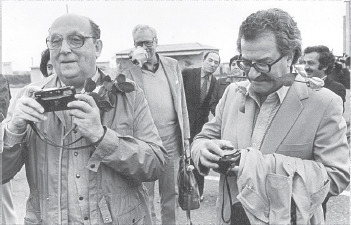
Soviet foreign policy expert and détente advocate Georgy Arbatov with American Sovietologist Seweryn Bialer
The Six-Day War was a diplomatic defeat for the Soviet Union, but it also created a new domestic problem by stimulating pride and pro-Israeli nationalism among Soviet Jews. This led to a crackdown on ‘Zionism’ and new restrictions on Jewish cultural life, which in turn sparked a highly visible international campaign for the right of Jews to emigrate. Jewish emigration from the Soviet Union became a humanrights issue that was taken up in the United Nations and the US Congress, leading to the punitive Jackson-Vanik amendment to the US Trade Reform Act of 1974. The Soviet leaders were caught in a bind, since they could scarcely defend themselves by arguing (truthfully) that their emigration policies denied this right to everyone, not just Jews. In the event, 236,000 Jews left the Soviet Union in the years 1971–1981 (another example of Jewish privilege, in the view of Soviet anti-Semites), slightly over half of them settling in Israel and another large group in the United States. But with many bureaucratic delays and a large exit tax for higher education imposed, the net effect was to underline the Soviet Union’s lack of sympathy with Jewish emigration rather than gain any credit for concessions.
More public relations disasters lay in store at the beginning of the 1980s. With the rise of the Solidarity movement in Poland, another threat to communist rule in Eastern Europe presented itself, though this time the Polish government imposed martial law itself and the Soviets got off without having to send in troops. The ill-advised Soviet intervention in defence of a client in Afghanistan’s civil war probably owed more to the Brezhnev leadership’s idea of how a superpower should behave than any rational analysis of costs and benefits. ‘We had to have our own Vietnam,’ critics within the Soviet foreign-policy establishment sighed, and so indeed it proved: the Soviet Union, like the United States in Vietnam, accomplished nothing at the cost of many lives and was eventually forced (under Gorbachev) into ignominious retreat. Public disapproval was more low-key than in the American case, but there was similar damage to army morale, and the subsequent Soviet problems with disgruntled and demoralised Afghanistan war veterans were probably even worse than those the United States had with its Vietnam vets.
Afghanistan notwithstanding, Brezhnev’s Soviet Union could congratulate itself on avoiding the alarming instability of the other superpower. The United States lurched through waves of student and civil-rights unrest in the 1960s, anti-Vietnam protests and Black Panthers, to a major crisis of government legitimacy in the Watergate affair, leading to the impeachment of President Nixon and his resignation in August 1974. Thank goodness Soviet national minorities were not as angry and mutinous as black Americans, and Soviet young people not so alienated from their elders and contemptuous of social decorum as their American counterparts, Brezhnev and many Soviet citizens must have thought – and what did Americans have to complain about anyway, with their huge suburban houses, double martinis and fancy cars?
IN THE REPUBLICS
It was certainly true that the Soviet Union had nothing like the American race problem with its national minorities. Overt ethnic conflicts were comparatively rare, and when they occurred were as likely to be between two ethnic minorities, or an ethnic minority and the titular majority in one of the Central Asian or Caucasian republics, as to involve Russians. The ethnic deportations of the 1940s had created problems, including in Kazakhstan, where the republican leadership’s unhappiness at being landed with the newcomers was almost as strong as the newcomers’ distress at being landed there. There were more problems when some of the ‘banished peoples’ were able to return to their former homes after Khrushchev’s Secret Speech, only to find them occupied by strangers. The Baltic republics were still resentful at being incorporated into the Soviet Union in 1939 – an ‘eastern’, hence culturally inferior power, in the Baltic view – and thus losing their interwar independence. Strong passive anti-Russian feeling persisted throughout the region, and in Lithuania a nationalist protest movement centred on the Catholic church had an underground existence from the early 1970s.
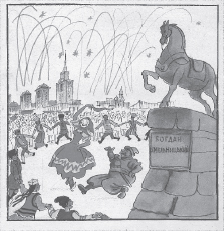
Friendship of nations is celebrated in this 1979 cartoon by Iu Cherepanov, marking the 325th anniversary of ‘Ukraine’s Union with Russia’ under the Treaty of Pereyaslav.
The republics were increasingly led by locals, drawing on the support of indigenous elites and presenting themselves in national (and, in Central Asia, secular Islamic) colours. After Kazakh Dinmukhamed Kunaev was named first secretary of Kazakhstan in October 1964 (following a series of Russian and Ukrainian first secretaries, including Brezhnev, during the Virgin Lands period), the enrolment of ethnic Kazakhs in the party doubled in two years. As before, there was generally a Slavic second secretary acting as Moscow’s eyes and ears in the republics, but in the Brezhnev period, when Kunaev and Volodymyr Shcherbytsky were full members of the Politburo, and the Azerbaijani, Georgian, Uzbek and Belorussian first secretaries were candidate members, these local second secretaries were clearly outranked. The republican leaders were energetic (and mutually competitive) lobbyists for Moscow investment, and most of them were net beneficiaries in the economic flow of resources. The Baltics, the most developed part of the Soviet Union with the highest per capita incomes, were the exception, contributing, along with the Russian Republic and Ukraine, to the subsidy of less-developed republics.
While the official long-term plan was to merge national differences, there were few signs that this was happening. Rather, the republics, with Moscow’s tacit agreement, were quietly asserting and consolidating national particularity. In questionnaires, Soviet citizens strongly endorsed ethnic tolerance, but in practice they had an equally strong preference for marrying within their own ethnic group, or at least one closely akin (Russian and Belorussian, Uzbek and Tajik). Intermarriage rates were low, and such intermarriage as occurred was often between people already living outside their native republics. Given the much higher birth rates in the Muslim areas of the Soviet Union (the Central Asian republics and Azerbaijan) than in the historically Christian regions (Russia, Ukraine, Belorussia, Armenia, Georgia), demographers started to see a future in which Slavs would be in the minority.
Indeed, it could have seemed that the major nationality problem of the Brezhnev era was actually a Russian one. Russian may have been the lingua franca of the Soviet Union, and Moscow its capital, but Russians were the ethnic group that had traditionally received least encouragement for displays of national culture and the fostering of national pride and culture. In literature, a quasi-nationalist trend developed, focusing primarily on the Russian village, and in the social realm, emerging movements to preserve historical monuments and combat industrial degradation of the environment acquired a distinctly nationalist tinge (Russophile writer Valentin Rasputin was one of those who became deeply involved in the movement to save Siberia’s Lake Baikal). Future Gorbachev adviser Aleksandr Yakovlev found himself in trouble for criticising Russian nationalist sympathisers within the Central Committee bureaucracy in the early 1970s, and it was rumoured that they had patrons even in the Politburo. In the non-Slavic regions, particularly Central Asia, the policy of supporting indigenous promotion had come at the expense of local Russian residents, who were starting to feel less at home. Among Russians, the sense of carrying out a virtuous civilising mission in the less-developed regions of the Soviet Union was giving way to a degree of resentment based on the perception that their republic was subsidising the weaker ones at the expense of its own citizens – in short, that the non-Slavic republics were a burden on Russia rather than an asset.
The Slavic regions of the country were experiencing a generational gap that was less dramatic than what existed in the contemporary United States but in some ways resembled it. There was a ‘sixties’ generation in the Soviet Union too, exchanging Beatles tapes to play in their new tape recorders, wearing blue jeans made in Eastern Europe, spicing up their vocabulary with Gulag jargon, singing Vladimir Vysotsky’s songs on their guitars and listening to foreign radio (the ‘Voices’). By the 1970s, rock music was the big attraction, flourishing even in Komsomol circles, despite moderate official disapproval. Perhaps more worrying for Communist true believers was the political passivity of the younger generation, compared with its prewar precursors. As portrayed by participant-observer Alexei Yurchak, the youth of the 1970s and ’80s accepted official language and rituals, and performed them fluently, but regarded their ‘real’ lives as being lived in a private sphere on which the public sphere barely impinged. By Soviet standards, their educational levels were spectacular, and with full employment they had no worries about getting a job – although for university graduates there was plenty of worry about whether the assigned job would be in Moscow or in the boondocks.
DAILY LIFE OF SOVIET CITIZENS
‘We pretend to work and they pretend to pay us’ was a joke that was even more popular with Western journalists than in the Soviet Union. But the Soviet workplace had advantages beyond tolerance of low productivity, as its denizens discovered when the Soviet Union collapsed. The workplace, with its special onsite shops and buffets, was a source of scarce goods for its employees (how good a source depended on the state and prestige of the plant, industrial sector or ministry) and an arena of camaraderie. Many pleasant hours were spent by women drinking tea with cake with office colleagues, and by men sharing a companiable cigarette (or even a companionable vodka) in the stairwell. If the economists had been trying to measure happiness at work instead of labour productivity, they might have come up with better results.
The Brezhnev years were good ones for ordinary Soviet citizens: it was at this time that the promises of universal ‘welfare state’ protection, made from the earliest days of Soviet rule, were fully realised. The guaranteed minimum wage, first introduced in 1956, was raised, as were pensions, which Soviet citizens could receive at the early ages of sixty for men and fifty-five for women. Welfare benefits previously confined to wage-earners were extended to kolkhozniks. In a surprising trend for a recently developed country, social differentiation diminished and a generally egalitarian ethos prevailed. This was often overlooked in the West, where commentators liked to make much of the fact that there was inequality under socialism and bosses had privileges. Of course there was inequality, and naturally the Soviets tried to pretend there wasn’t. But on an international comparative scale, it was relatively minor and not trending upwards.
For the Soviet Union’s middle class, there was not too much privilege but too little; and this middle class was growing spectacularly. If in 1941 there had been 2.4 million people with higher or secondary education, by 1960 the number was up to eight million, and by the end of the 1980s thirty-two million. Many of these people would, as a matter of course, join the Communist Party, whose numbers continued to rise, reaching close to sixteen million by 1976. The privileges that these people valued and hoped for included a dacha in the countryside as well as their small urban apartments, the new possibility of purchasing a ‘cooperative apartment’ for grown-up children, foreign travel, some access to foreign luxury goods and a car. There were still not enough of such coveted goods to go round, and not enough jobs that carried the salary and status that would procure them. Many high-school graduates in white-collar jobs were on a salary of 500 roubles, while a blue-collar worker might earn 300 roubles. When the postwar rise in the overall standard of living slowed in the 1970s and 1980s, there were ample grounds for an undertow of dissatisfaction among those whose expectations had risen so dramatically in previous decades.
In the intelligentsia, there was a sense of malaise. The heady optimism of the Khrushchev period was gone, with the 1968 intervention in Czechoslovakia marking the watershed. Intellectuals’ hopes of spiritual leadership were dashed, and they felt society was becoming increasingly materialistic. Those with material aspirations were also frustrated. In the diagnosis of American observer John Bushnell, the Soviet citizen had become a pessimist, listening to the mournful songs of Bulat Okudzhava and telling slightly politically risqué but also self-mocking jokes like this one, set in a political literacy (civics) class:
(Questioner:) ‘Is there life on the moon?’
(Instructor:) ‘No, comrade, Soviet cosmonauts have found no signs of life on the moon.’
(Questioner, sadly:) ‘Not there either?’
For all the cultivation of private life that was characteristic of the era, an embryonic associational life was emerging, separate from the state and focused mainly on protecting the natural environment and preserving historical and cultural monuments. These were generally ‘liberal’ preoccupations, but on the non-liberal and potentially nationalist side, ex-soldiers had finally managed to get permission to create veterans’ organisations, which were of great importance to the generation of men who had fought in World War II and kept up informal contact with their units through regular heavy-drinking reunions over the years. The ‘thick’ journals that had flourished during the Khrushchev era were still around, though most had endured a change of editor and greater restrictions on political, especially anti-Stalinist, content. Oktiabr, Novy Mir’s conservative competitor, had a succès de scandale with Vsevolod Kochetov’s So What Do You Want?, which attacked corrupting Western influences in a spirit of Stalinist nostalgia. A growing competitor to the thick journals was samizdat – self-published, and therefore uncensored, manuscripts on various touchy topics, from politics to religion to yoga, copied on typewriters and circulated by hand. A smaller relative, tamizdat, circulated banned literature brought in from the West.
By the 1980s, rates of female education and workforce participation were spectacular. The number of women wage-and salary-earners tripled, from twenty million in 1960 to almost sixty million in 1989, when they constituted 50.6 per cent of the workforce. In the whole Soviet population aged ten years and over, as of 1979, 60 per cent of women had secondary or higher education (for men it was 69 per cent) – and this high rate prevailed even in Uzbekistan, one of the republics where women had historically been most disadvantaged. Women were entering the party in greater numbers than ever before, composing 25 per cent of members in 1976 and 30 per cent in 1990. But the double burden of a full-time job plus shopping, housework and child rearing (all ‘women’s work’) was taking its toll, as Natalia Baranskaya vividly described in a novella published in Novy Mir, ‘A Week like any Other’ – without explicitly mentioning the problems associated with the unavailability of the contraceptive pill, which would have been too much for the prudish censor. For all the state provision of creches and kindergartens, the lives of working Soviet women were truly manageable only with a non-working babushka (grandmother) in residence.
The West was a powerful presence in the Soviet Union, not just as bogeyman but as cultural magnet. Half of the working population of Moscow listened to Western radio stations, according to a survey; young men called each other Alec and Mike instead of Sasha and Misha. By the 1980s, even middle-aged men might be seen of a weekend in jeans and black leather jackets, driving their cars (joyously but badly, since they were late learners) to the dacha. There, after Donald Kendall’s pioneering deal trading Pepsi for Stolichnaya vodka, they would drink both in alternation, the bottle of Pepsi on the kitchen table symbolising cosmopolitan savoir vivre. In Western Sovietological circles, it was for a time fashionable to talk about ‘convergence’, a theory built on the assumption that with modernisation, Soviet society would inevitably get more liberal, democratic, individualistic and pluralistic – in short, more like Western society. That sounded good to many in the Soviet Union, although the convergence they were mainly interested in was a convergence in the availability of Western-style products.
THE DISSIDENTS
Western connections were important for a new phenomenon on the Soviet scene: the dissident movement. Samizdat and tamizdat, combined with the feedback loop of Western radio, made it possible for ‘non-standard thinkers’ (inakomysliashchie) to get their thoughts into circulation in the Soviet Union, as well as build an audience and support group abroad. Initially, the urge to express non-standard ideas did not necessarily imply opposition to the Soviet Union, but after the satirical writers Andrei Sinyavsky and Yuly Daniel were put on public trial in 1966 and convicted of ‘anti-Soviet propaganda’ for publishing their work abroad, the two started to merge. Further impetus to the dissident movement was given by the Soviet intervention in Czechoslovakia, when many intellectuals signed protests against the invasion and found themselves with black marks in their personnel files as a result.
After serving a sentence in Gulag, Sinyavsky was allowed to emigrate to France, and this became the preferred way of dealing with literary dissidents, though some were committed to mental hospitals on the presumption that anyone who gratuitously put himself out on a limb by insisting on his own unpopular opinion had to be crazy. Russian-Jewish poet Joseph Brodsky, sentenced under Khrushchev’s ‘anti-parasite’ law in 1964, was invited by the KGB to emigrate in 1971 and, when he demurred, was peremptorily put on a plane to Vienna and deported in 1972. Aleksandr Solzhenitsyn’s Soviet citizenship was revoked in 1974 and he was flown, against his will, to Europe. In terms of the international reputation of the Soviet Union, it was a dubious strategy, since the exiled dissidents, now with the halo of martyrdom, continued to publish their criticisms for the benefit of a receptive Western audience. Soviet discomfiture was compounded by a spate of much-publicised defections, including Stalin’s unhappy daughter, Svetlana, and the dancer Rudolph Nureyev in 1967.
The dissidents’ political positions ranged from more or less disillusioned Communists like the Medvedev twins, Zhores and Roy, to liberals like Andrei Sakharov (distinguished physicist and member of the Academy of Sciences, exiled in 1980 to the city of Gorky on the Volga) and Russophile conservatives, as Solzhenitsyn ultimately became. The thread that united them was advocacy of human rights and the use of Western media as a platform. Foreign correspondents in Moscow were the dissidents’ lifeline, providing friendship as well as Johnnie Walker whisky and Marlboro cigarettes, smuggling out their work and, when they got into trouble, making their cases front-page news in Europe and North America. The CIA and other Western intelligence agencies also provided quiet indirect support, not necessarily requested or even known by the recipients, but emphasised in Soviet media attacks on them. Not surprisingly, this did not make the dissidents popular with ordinary citizens in the Soviet Union, and, except in the case of nationalist dissidence, the movement made little contact with the broader Soviet public. In the popular seditious materials the KGB regularly collected (mainly irreverent rhymes, obscenities and jokes, complaints about shortages and price rises and drunken denunciations of leaders), the dissidents whose names were so well known in the West go virtually unmentioned.
Over time, nevertheless, the dissident critique, combined with memories of Khrushchev’s denunciation of Stalinism in 1956, sank in and diffused through the elite, first the younger generation and then their parents. By the 1980s, solid Soviet citizens with good jobs might scoff at the dissidents when talking to foreigners, even off the record, while at the same time making criticisms of the Soviet life that they would never have voiced twenty years earlier.
It was so rare in the early 1980s to encounter anyone who professed fervent support for the Soviet Union and took its ideology seriously that many people assumed that the old utopian revolutionary spirit had had its last hurrah under Khrushchev. But this may have been too sweeping. Evtushenko, the most famous of the public poets of the Thaw, accustomed to being viewed as a troublemaker in the 1970s, suddenly in the 1980s started encountering younger bureaucrats with nostalgic memories of smuggling their way into his poetry readings when they were students twenty years earlier. And it wasn’t only the ’60s generation whose youthful idealism was hidden behind a workaday Brezhnevian facade. In the 1950s, Moscow University had already been producing idealists. One of them, Mikhail Gorbachev, had made his way up the party ladder to first secretary in Stavropol and was back in Moscow – waiting, though he didn’t know it yet, to start the revolution that would destroy the Soviet Union.

Non-conformist Ukrainian-Armenian artist Vagrich Bakhchanyan’s take on Mukhina’s statue was made soon after his emigration to the United States in 1974.