

It was different when I was a young man,
Hinnissy. In thim days, Capital an’ Labor
were friendly, or Labor was.
THE PRESIDENTIAL EAGLE fluttered bravely at masthead, its golden wings beating the drizzle. Roosevelt and his aides huddled below in raincoats and wraps, waiting for Manhattan to show across the East River. Fall was still three days off, but for party politicians the summer had already ended. A “grave and delicate” question demanded Roosevelt’s attention out west, where he was headed on another campaign trip.
The question was one of basic Republican policy. Some ambitious insurgents in Iowa, led by Governor Albert B. Cummins, had forced a revolutionary idea into the state platform for 1902:
We favor such amendments of the Interstate Commerce Act as will more fully carry out its prohibition of discrimination in ratemaking, and [such] modification of the tariff schedules [as] may be required to prevent their affording a shelter to monopoly.
In other words, monopolistic corporations should be controlled by special, punitive taxation. Price-fixing would give way to an equitable redistribution of Wall Street’s wealth. Railroad rate regulation would control the tendency of agricultural prices to decline in inverse proportion to manufacturing costs. And fair-trade agreements would reopen overseas markets shut by the impossible cost of doing business with the United States.
This “Iowa Idea” made little sense to Roosevelt (what, for instance, about trusts whose products were already on the free list?), but he could see its appeal to ignorant voters. Before leaving Oyster Bay, he had summoned six Republican leaders to advise him on what to say about the tariff while on tour. The meeting had been so divided as to confirm his suspicions that the Iowa Idea was a party-splitter. Senators Allison and Spooner and Postmaster General Payne, all Midwesterners, thought he should recommend some discreet modification of rates, to relieve radical pressures beyond the Mississippi. Senators Aldrich, Hanna, and Lodge had objected to any tinkering with a system that worked on behalf of their Eastern industrial constituencies. “As long as I remain in the Senate and can raise a hand to stop you,” said Hanna, flushed of face, “you shall never touch a schedule of the tariff act.”
Roosevelt inclined to the Western point of view. But Governor Cummins’s suggestion that the tariff was “the mother of trusts” was irresponsible. No wonder Hanna, an arch-protectionist, was so disturbed. Already, the Iowa Idea was on the lips of other prairie insurgents: Governors Robert M. LaFollette of Wisconsin and Samuel Van Sant of Minnesota were barking it with the fervor of patent-medicine salesmen. Protection must give way to Reciprocity—had not William McKinley said as much, the day before he was shot?
McKinley’s successor remembered being a free-trade man himself once, in hot youth. But he had found it wise to recant that heresy upon entering Republican politics. His failure eighteen years later to win even a minor bill of reciprocity for Cuba proved that protectionism was still the holiest tenet of party faith. Indeed, Speaker David B. Henderson, an Iowan, had announced he would not run for re-election, rather than submit to tariff blasphemies on the stump.
Roosevelt, thinking ahead to 1904, hesitated between risk-taking and caution. He had always been willing to embrace a worthy cause—civil-service reform, for example—if it could be proved legal and representative of vox populi. Tariff reform was beginning to look like just such a mass movement. But the mass, as yet, was still a minority. He did not want to alienate a key constituency—those millions of small businessmen and farmers who traded exclusively within the United States, and relied on tariffs as a bulwark against foreign competition. To them, protection was a right honored by twelve successive Republican administrations, and the Iowa Idea was both an insult and a threat.
During the next eighteen days, Roosevelt intended to drum into Midwestern and Western skulls the basic incompatibility of trust control and tariff reform. He planned major addresses on each issue, at Cincinnati and Indianapolis, before taking his message of strenuous moderation across the heartland of insurgency, from Milwaukee and St. Paul to Sioux Falls and Des Moines. He was setting out, he acknowledged, on an expedition fraught with risk. Every step must be measured carefully, and not just because of the nagging pain in his left shin. “There are a good many worse things than the possibility of trolley-car accidents in these trips!”

DISEMBARKING ON THE East Side, the presidential party proceeded across Manhattan by cavalcade. Secret Service men rode one hundred feet ahead, making sure, this time, that all local traffic was stationary. A Hudson River ferry took Roosevelt on to Jersey City. At 2:14P.M., his special pulled out of the depot and chugged west through the rain.
When the train crossed the Pennsylvania border, a small, saturnine, droop-eyed man got on. Matthew S. Quay was accustomed to free rides, as senior Senator from the Keystone State, on both public and private transport. Alone with Roosevelt for the next twenty-five miles, he reported on the coal strike. Happily, the miners were about to capitulate. They had abandoned their demand for union recognition. The determination of operators had defeated John Mitchell; management was not mocked.
No sooner had Quay detrained in Philadelphia than another hitch rider got on. This was Frank B. Sargent, Commissioner of Immigration, a former union leader and the Administration’s secret observer in anthracite country. Alone with Roosevelt for the next forty miles, he too reported on the coal strike. Happily, the miners were in good moral and financial shape. Recognition mattered less to them than fair wages. The determination of the rank and file gave John Mitchell strength; labor could not be bullied.
Roosevelt sent a wry message back to Senator Quay that he had received some “almost diametrically opposed” information. The truth, as usual, must lie somewhere in between.
HIS LEFT LEG WAS hurting badly next day at the Music Hall in Cincinnati. But he showed no sign of discomfort, beyond asking a capacity audience not to interrupt him with applause. “I intend … to make an argument as the Chief Executive of a nation who is the President of all the people.”
It was the first time Roosevelt had invoked the majesty of office, and the crowd listened with appropriate respect. For a while he expounded his familiar formula for trust control: tolerance, mild regulation, and public accountability. All the proposed alternatives, he said, were “ineffective or mischievous.” Chief among these was the Iowa Idea, “a policy … which would defeat its own professed object.” Governor Cummins imagined that tariff penalties would cause trusts to end monopolistic practices. Yet most trusts controlled far less than half of their respective markets. The rare trust with majority control had an advantage of only one or two percentage points. “Surely in rearranging the schedules affecting such a corporation, it would be necessary to consider the interests of its smaller competitors who control the remaining part, and which, being weaker, would suffer most?”
Speaking lucidly and calmly, the President reminded his audience that some trusts might react to tariff penalties by laying off “very many tens of thousands of workmen.” Other trusts would escape discipline because their products were tariff-free. “The Standard Oil Company offers a case in point—and the corporations which control the anthracite coal.”
By choosing two particularly unpopular trusts to illustrate the inequities of the Iowa Idea, Roosevelt managed to sound both reform-minded and conservative. He mentioned his own “present legislative and constitutional limitations,” and ended with a vague promise that in spite of them, he would deal “exact and even-handed justice … to all men, without regard to persons.”
At last the audience could applaud freely. He listened with an air of abstraction to the roars that followed him into the street. “It’s rather peculiar,” he remarked, “that everywhere they call for ‘Roosevelt’ or ‘Teddy,’ but never say ‘Theodore.’ ”
A REPORTER COVERING Roosevelt’s arrival at Detroit on Sunday, 21 September, was impressed with the change in him since his last visit, two years before. No longer was he a young, ruddy-faced Governor, grinning and squinting and pumping hands. He appeared to have aged considerably; his features were sterner. The close-cropped auburn hair glinted with gray, and there was “an indefinable something about his appearance, call it dignity, call it responsibility—that showed he felt the weight resting on his shoulders.”
Actually, the main weight Roosevelt felt was on his left leg. He complained of pain, and was unresponsive to press-pool questions about the coal strike. As soon as he reached the Hotel Cadillac, he went to bed.
Early the next morning, the inevitable crowd of gogglers gathered on the sidewalk outside. “Just keep your eye on that little window,” a porter said helpfully. “That’s his bathroom, and when you see a light in there you’ll know that the President is in his tub.” The light remained off, to general mystification. Roosevelt’s major appearance of the day was at a convention of Spanish-American War veterans. Normally he delighted in such events, but he arrived late and delivered a perfunctory address, grimacing and sweating heavily. During the subsequent parade, he had to stand for four hours. At the end, he looked drained.
Speculation that something was wrong with his health began early on Tuesday, at an outdoor event in Logansport, Indiana. Despite steady rain, he launched into the big speech he had been expected to deliver that afternoon at Indianapolis. He declined applause as he extolled the glories of private enterprise. Beneficiaries of the new prosperity must look to themselves, he said, rather than to government, for the advancement of their welfare. Stressing the word individual again and again, he prayed that great issues of the future would be decided by Americans thinking “as Americans first, and party men second.”
The tariff, for example—Roosevelt deftly brought it in—should be judged not as a political issue, but “as a business proposition” working in the people’s common interest. That interest would only be harmed by “violent and radical changes.” Perhaps some subtle regulatory device could be installed to correct the flaws in tariff policy, “without destroying the whole structure.”
Standing awkwardly off balance, Roosevelt allowed that his personal preference would be for a board of distinguished and pragmatic tariff commissioners. The concept was Senator Spooner’s, although he did not say so.
WITH FURTHER ROARS ringing in his ears, he stepped off the platform and saw, sloping away from him at an angle of forty-five degrees, a grassy path slick with rain. He hesitated, then allowed Captain Lung to take his elbow as he descended, slowly and with set face.
From Logansport station, secret telegrams flashed ahead to Indianapolis. Roosevelt reached the state capital on schedule, but begged “fifteen or twenty minutes grace” before attending a reception in his honor at the Columbia Club. He closeted himself with four surgeons in an anteroom, then emerged expressionless for lunch. There were no presidential remarks over coffee; just a grim smile, a wave, and a hurried exit. Bystanders were surprised to see Roosevelt’s carriage speed off toward St. Vincent’s Hospital, Secret Service men galloping after.
Rumors proliferated. “The President has burst a blood vessel!”
“He’s sick!”
“He’s been shot!”
At St. Vincent’s, the four surgeons were waiting. Before following them into the operating theater, Roosevelt had an intimation of mortality. He called for Elihu Root, who was on tour with him, and asked George Cortelyou to witness their conversation. “Elihu … if anything happens, I want you to be Secretary of State.”
It took a moment for the meaning of these words to sink in. He was appointing his line of succession. “If John Hay should be President,” Roosevelt went on, “he would have nervous prostration within six weeks.” In that case, the Constitution might require a third new Chief Executive before Christmas. Only one man, in Roosevelt’s judgment, could rise to such an emergency.
Root paced up and down, unable to speak. Finally he managed, “I guess you don’t need to disturb yourself in the least about anything of that kind.”
The President moved on without comment. Entering the operating theater, he tried to joke with the surgeons. “Gentlemen, you are formal! I see you have your gloves on.” He took off his trousers and left shoe, revealing a tumor halfway down his shin. It bulged nearly two inches. He lay down on the table and refused anesthetic. “Guess I can stand the pain.”
Dr. George H. Oliver’s scalpel pricked and sliced, disclosing a circumscribed accumulation of serum under the shin’s periosteum. Syringes punctured the sac and sucked the serum out, drop by drop. Roosevelt muttered to himself occasionally, and when the suction went deep, asked for a glass of water. Three aspirations were needed before the wound was pronounced clean.
At five o’clock, Cortelyou issued a bulletin stating that the President had had a successful operation, and was resting comfortably with his leg in a sling. “It is absolutely imperative, however, that he should remain quiet.” Two and a half hours later, a heavily sedated Roosevelt was carried out of the hospital, lying stiff on a stretcher, his face white under the streetlamps. Spectators removed their hats. At eight o’clock, the presidential train left for Washington.
Successive bulletins through the night assured the nation that Roosevelt was in no danger of blood poisoning. (The four surgeons were not so sure.) News of the cancellation of his western trip came as a relief to protectionists. “If it had been completed,” said one member of the Indiana Old Guard, “I do not think there would have been anything left of the Republican party. That Logansport speech today was the limit.”
PAINTERS AND PLASTERERS were putting the finishing touches to a restored White House when Roosevelt arrived back in Washington on 24 September 1902. But the gleaming halls and new Executive Wing were still bare of furnishings, so he was carried back to his temporary quarters at 22 Jackson Place. An anxious Edith was waiting to nurse him. “I feel a great deal better than I look,” he told reporters before she closed the door.
She established him in a second-floor parlor overlooking Lafayette Square. The room was large and sunny and full of well-wishers’ flowers. Treetops waved beneath its windows. It was an ideal place to recuperate, but the President, rolling around in a wheelchair, with his leg trussed stiffly in front of him, soon complained of inactivity.
He regretted that he had not been able to discuss tariff policy in the Midwest as fully as he wished. Still, his two big speeches had done much to quash the Iowa Idea. Governor Cummins was disavowing any threat to Republican unity, and other tariff reformers were following suit.
That did not stop Roosevelt from worrying if he had, indeed, gone too far with conservatives in his Logansport address. “I only hope Uncle Mark doesn’t mind it.” His fears seemed realized on 27 September, when Hanna rose at the Ohio State Convention and scoffed at the notion of a tariff commission. Amid cheers of “Hanna in 1904,” the Senator continued: “A year ago I gave you a piece of advice, ‘Let well enough alone.’ … Today I say, ‘stand pat.’ ”
Stand pat. That was it: Old Guard Republicanism in two words. Roosevelt’s dilemma, as he plotted his uncertain future, was how to convince reformers that he was their best hope, while standing pat enough to please conservatives.
Right now, he could not stand at all. Ominously, his left leg had begun to throb again.
ON SUNDAY, 28 SEPTEMBER, the Surgeon General of the Navy, Dr. Presley M. Rixey, decided that a second operation was necessary. The President’s temperature was rising, and there was a new swelling, large and shiny as a monocle, on his shin. This time—since Rixey intended to cut to the bone—Roosevelt allowed himself to be semi-anesthetized with whiskey. Cocaine was rubbed around the swelling. Then Rixey, assisted by an orthopedist, made a two-inch incision over the tibia and reopened the periosteum. Serous fluid welled out. It was allowed to drain, revealing a length of white, roughened bone. A few dark spots, the size of knitting-needle points, were visible. Rixey scraped the bone smooth, and left the incision unstitched, so that further fluid could flow out naturally, in the process of healing. Overnight, Roosevelt’s temperature subsided. A bulletin listing his condition as “satisfactory” was posted Monday morning, together with orders that he must remain chair-bound for at least another fortnight.
CHILL WEATHER THAT weekend sent the first tremors of panic through coal-dependent states. Northeastern hospitals, alarmed by a rise in the pneumonia rate, competed for reserve anthracite at three or four times last winter’s cost. Poor families burned coconut shells, available at fifteen cents a sack from candy companies, to keep warm. From New York, Mayor Seth Low wired the President: “I CANNOT EMPHASIZE TOO STRONGLY THE IMMENSE INJUSTICES OF THE EXISTING COAL SITUATION.… MILLIONS OF INNOCENT PEOPLE … WILL ENDURE REAL SUFFERING IF PRESENT CONDITIONS CONTINUE.”
Henry Cabot Lodge, who viewed all situations politically, whether they were social, sexual, or seasonal, feared that his Bay State constituents might vote Democratic in November. “They say (and this is literal) ‘We don’t care whether you are to blame or not. Coal is going up, and the party in power must be punished.’ ” He made a characteristic inquiry. “Is there anything we can appear to do?”
“Literally nothing,” Roosevelt wrote back, “so far as I have yet been able to find out.” Unless Pennsylvania requested federal aid, the strike remained a state issue.
He suspected that the real issue in anthracite country was one of executive “face.” The operators refused to recognize John Mitchell because they associated him with their humiliation in 1900, when Senator Hanna had bullied them into an election-year wage increase. They would never hand labor another victory to help a politician. At least, not this politician:
Unfortunately the strength of my public position before the country is also its weakness. I am genuinely independent of the big monied men in all matters where I think the interests of the public are concerned, and probably I am the first President of recent times of whom this could truthfully be said.… I am at my wits’ end how to proceed.
Two days later, the Governor of Massachusetts arrived in town, red-eyed with worry. W. Murray Crane felt a bond with Roosevelt since their shared escape from death at Pittsfield, but he did not hesitate to lecture him: “Unless you end this strike, the workers in the North will begin tearing down buildings for fuel. They will not stand being frozen to death.”
“Agreed. What is your remedy?”
Crane suggested Roosevelt appeal to both sides simultaneously, in words showing that he favored neither. Perhaps a bipolar conference could be arranged, along the lines of one that had happened almost accidentally during a teamsters’ strike in Boston. Then, too, management had refused to meet with labor, but the Governor had been allowed to shuttle between adjacent hotel suites as mediator. This dialogue-by-proxy led to an arbitration agreement in fewer than twenty-four hours. “It worked then,” Crane said, “and it will work now.”
A crisis-management team collected round Roosevelt as he brooded over what to do. Along with Crane and the essential Knox, there were his Postmaster General, Secretary of War, and Secretary of the Navy. Payne spoke for the electorate; Root for Wall Street; and Moody advised on the probable reactions of Congress.
Crane’s idea of a conference was opposed only by Knox. But the other Cabinet officers clearly hoped that somebody else of stature would intervene, as Hanna had done two years before. Roosevelt was not so sanguine, nor had he patience to wait much longer. His moral sense—always abstract, always powerful—persuaded him that the miners were entitled to the tribunal they asked for. He felt that Knox was advocating “the Buchanan principle of striving to find some constitutional reason for inaction.”
In the cool morning light of 30 September, he summoned his advisers back for another meeting. “Yes, I will do it,” he said, wincing at the pain in his leg. He showed them the draft of an invitation he proposed to send to George Baer. Knox subjected it to close legal review. Crane, Payne, and Moody made further changes. “I am much obliged to you gentlemen,” the President growled through set teeth, “for leaving me one sentence of my own.”
He got his revenge on the memorandum of action that they, in turn, submitted to him.
1st. We would recommend that a telegram be sent to the leading operators and also to Mitchell, the President of the Miners’ Association, substantially in the form of your proposed letter to Mr. Baer.…
2nd. We would suggest [saying] that upon the one hand the operators, as the owners of the coal mines, entertain certain views upon the basis of their conduct, whereas upon the other hand their workmen claim that certain modifications in the arrangements heretofore existing between them should be made; that these are substantially commercial questions affecting immediately the parties concerned, but the public only indirectly—
Roosevelt reached for a pencil. “The public also, vitally,” he scrawled.
—that so long as there seemed a reasonable hope that these matters could be adjusted between the parties it had not seemed proper on your part to interfere in any way; that you should disclaim your right or duty to interfere upon any legal grounds—
“Legal grounds now existing,” Roosevelt rephrased it.
… but that the request has been so general from all classes of people—
Roosevelt struck out line after cautious line, and wrote: “But that the urgency and terrible nature of the catastrophe now impending over a large portion of our people, in the shape of a winter fuel famine, and the further fact that as this strike affected a necessity of life to so many of our people, no precedent in other strikes will be created, impel me, after much anxious thought, to believe that my duty requires me to see whether I cannot bring about an agreement.”
THE COAL STRIKE was five months old. Every mail, every newspaper proclaimed an escalation of violence in anthracite country. There had been, by various estimates, six to fourteen murders, sixty-seven aggravated assaults (from eye-gougings to attempted lynchings), and sundry riots, ambushes, and arson. Bridges were being blown up, trains wrecked, mines flooded. Seven counties in northeastern Pennsylvania were under military surveillance. Governor Stone authorized state troops to “shoot to kill” at any provocation.
Mark Hanna wrote from Cleveland to say that the operators had told him they would not accept even an industry-appointed board of arbitration. “You see how determined they are. It looks as if it was only to be settled when the miners are starved to it.” And from Wilkes-Barre came John Mitchell’s most emotional public statement yet, vowing that his men would make the ultimate sacrifice, if necessary:
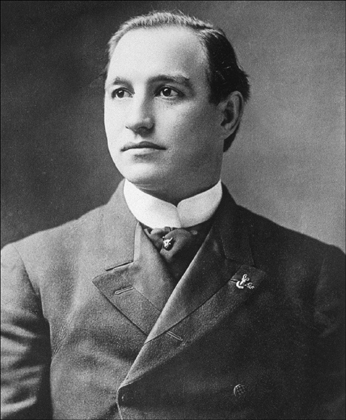
“YOU SEE HOW DETERMINED THEY ARE.”
John Mitchell as president of United Mine Workers, ca. 1902
The present miner has had his day; he has been oppressed and ground down and denied the right to live the life of a human being; but there is another generation coming up, a generation of little children prematurely doomed to the whirl of the mill and the soot and the noise and the blackness of the breaker. It is for [them] that we are fighting. We have not underestimated the strength of our opponents … but in the grimy hand of the miner is the little white hand of a child, a child like the children of the rich.
Sentimentalities of this kind left Roosevelt unmoved. More than any prophecies of future doom, or loss of congressional seats in November, he dreaded an immediate spread of “socialistic action” through the ranks of labor if his telegram to Baer failed. So he cast it in the form no American could refuse: that of a presidential invitation.
I SHOULD GREATLY LIKE TO SEE YOU ON FRIDAY NEXT, OCTOBER 3d, AT ELEVEN O’CLOCK A.M., HERE IN WASHINGTON, IN REGARD TO THE FAILURE OF THE COAL SUPPLY, WHICH HAS BECOME A MATTER OF VITAL CONCERN TO THE WHOLE NATION. I HAVE SENT A SIMILAR DISPATCH TO MR. JOHN MITCHELL, PRESIDENT OF THE UNITED MINE WORKERS OF AMERICA.
Duplicate telegrams went out to six other mine owners and coal-road executives. All agreed to attend, with the exception of the Pennsylvania’s A. J. Cassatt, who pleaded noninvolvement in the dispute, and the Delaware & Hudson’s aged Robert M. Olyphant, who said he would be represented by his counsel, David Willcox. Mitchell was reluctant to face such a phalanx of management alone, and received permission to bring along three UMW district presidents. Roosevelt made no attempt to explain the curious imbalance of his initial list. To liberals, it betrayed a bias in favor of management; to conservatives, it was a recognition of Mitchell’s monopolistic power. “Doesn’t that just show,” Willcox fumed, “that this one man has got the biggest kind of a trust in labor?”
In an eve-of-conference briefing, Knox and Root cautioned the President against allowing either side to hurl accusations of monopoly and tyranny. The tone of the proceedings must be kept lofty, in the higher interests of millions of innocent Americans without heat.
Roosevelt himself, as he prepared for the greatest challenge of his political career, could take satisfaction in the fact that the operators had already moderated their position. They had actually consented to meet under the same roof as John Mitchell. And in the same room too: a President in a wheelchair could hardly be expected to perform shuttle service.