

We insist that though his happy fellow-citizen may pass us
our vittles, he shall not fork out our stamps.
“THE EQUILIBRIUM OF the world is moving westwards,” a member of the Institut de France told Jean Jules Jusserand early in 1903.
Jusserand, packing his ambassadorial uniform for Washington, did not disagree. An intellectual himself (he was a specialist in medieval culture, and had published several works of literary and social history), he accepted, and mourned, the decline of French power. Yet it coincided excitingly with the rise of his own diplomatic fortunes. At forty-seven, he found himself entrusted with a mission of major importance: to protect France’s entente cordiale with her sister republic from increased competition by foreign monarchies. Tunis and Copenhagen had been nothing next to this. Clearly he had been selected less for experience than for brains and youthfulness—qualities now much in demand on Massachusetts Avenue. In Berlin, fifty-year-old Baron Speck von Sternburg was also packing for transfer. Britain’s forty-five-year-old Sir Michael Herbert had been at his post for three months. All three ambassadors had American wives.
Equally clearly, Jusserand saw that his life as half-scholar, half-envoy was over. Washington had little time for historiographical musings. As his friend at the Institut put it, “You will no longer decipher manuscripts, but men.” Jusserand could write in Latin and read fourteenth-century English with perfect fluency. But could he construe Theodore Roosevelt? The task had been too much for his predecessor, Jules Cambon, who seemed to doubt the President’s sanity.
Speculation about Roosevelt was intense at the Quai d’Orsay. French foreign-policy experts believed him to be the strongest international personality since Bismarck. Yet they could not reconcile the impérialiste who talked about “the proper policing of the world” with the statesman who had just modestly declined to arbitrate the Venezuela matter. Instead, Roosevelt had suggested that all parties to the dispute meet on neutral ground in Washington, in order to negotiate a protocol for referral to The Hague.
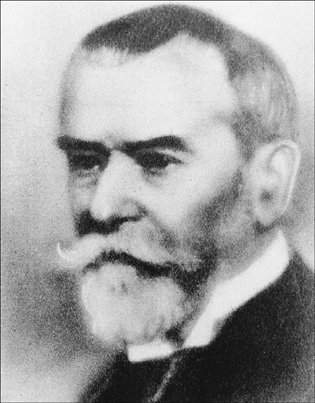
“HE FOUND HIMSELF ENTRUSTED WITH A MISSION
OF MAJOR IMPORTANCE.”
Jules Jusserand, anonymous sketch
Might he be, against original expectations, a man of peace?

THE JANUARY ISSUE of McClure’s disagreeably reminded Roosevelt that he had problems to confront at home, regardless of foreign powermongering. Never before had an American magazine publisher put out so shocking a number. Absent were the pallid love stories and escapist travelogues that most readers looked for. In their place were three long articles on trust abuse, political corruption, and union violence. Each one, Samuel S. McClure noted in his introductory editorial, could be entitled “The American Contempt of Law.”
The frontispiece photograph showed John D. Rockefeller seated, exuding the security of two hundred million dollars. But his trouser leg, hitched too high, revealed a hint of flabby calf, a vulnerable length of sock. This documentary note permeated the subsequent articles, which were remarkable for depth of research, toughness of language, and something fresh to journalism: a sort of tacit moral disdain.
“The Oil War of 1872,” by Ida Tarbell, described the panic that hit Titusville, Pennsylvania, when the Standard Oil Company announced new freight rates crippling to independent producers. Only one supplier, under a hitherto unknown name, was entitled to enjoy special rates: it turned out to be an alias for Standard Oil. A contemporary blacklist of “conspirators,” reproduced in facsimile, prominently featured Rockefeller’s name. The man with the flabby calf had gone on to other, more subtle schemes, inexorably locking an entire industry in his corporate grip. Tarbell was as meticulous in documenting Rockefeller’s acts of philanthropy as she was in analyzing the fine print of his contracts. But she noted that “religious emotion and sentiments of charity … seem to have taken the place in him of notions of justice and regard for the rights of others.”
Elsewhere in McClure’s, Lincoln Steffens contributed “The Shame of Minneapolis: Rescue and Redemption of a City That Was Sold Out.” The article, plentifully illustrated with bribery lists and police-file photographs, recounted the slide to corruption of a once-honest mayor. Thanks to the efforts of a courageous grand juror, Minneapolis was now purged, but Steffens allowed a cynical question to shadow his last paragraph: “Can a city be governed without any alliance with crime?”
The third story, by Ray Stannard Baker, was an equally harsh and factual survey of conditions in Pennsylvania during the coal strike. Entitled “The Right to Work,” it consisted of interviews with nonunion miners who had braved bullets and beatings to continue working. One was quoted as saying, “I believe that a man should have a right, no matter what his reasons are, to work when and where he pleases.” Baker reported that this miner had been set upon by union vigilantes, and blinded with a rock.
All in all, the January McClure’s made for ugly reading. But palpably, beneath its flotsam of fact, a new kind of reportage—“torrential journalism,” Roosevelt called it—was surging from wellsprings of popular discontent.
THE FIFTY-SEVENTH Congress reconvened for the last time on 5 January, and Roosevelt moved swiftly to push through the legislative program he had been talking about for so long. “From now until the 4th of March my hands will be full,” he wrote Kermit. The American economy had expanded at such a rate in 1902 (oil production alone was up 27 percent) that he knew there was no hope of controlling trust growth by occasional slow prosecutions under the Sherman Act. What was needed was an overall regulatory system calling for the cooperation, rather than the coercion, of businesses engaged in interstate trade.
He wanted three antitrust weapons: a Department of Commerce with an investigatory Bureau of Corporations, a bill banning railroad rebates to large industrial companies, and an “Expedition Act” that would provide special funds to speed up the Justice Department’s prosecution of illegal combinations. (After eleven months, the Northern Securities case was still under judicial review.)
These requests, written in English, were passed to Philander Knox, who translated them into language convoluted enough for Congressmen to understand. Even as “Administration bills,” they were less ambitious than some other antitrust measures already pending in the House. One such, sponsored by Representative Charles E. Littlefield of Maine, sought to give the Interstate Commerce Commission draconian powers over all monopolistic corporations. Inasmuch as it contained some Rooseveltian ideas, the President let Littlefield know that he could count on him for support. “I am prepared to go the whole distance!” He did not add that he doubted the distance would be very long, legislatively speaking.
The “Bureau of Corporations” clause in his own Department of Commerce bill struck Roosevelt as a more realistic proposal. Corporations would not be forced to open their books if they felt disinclined. All that Knox called for was an information exchange between government and industry, for the common good. Wall Street raised no objections, but corporate representatives congregated in Washington to make sure that the bill did not get stronger in committee. The House of Morgan sent an adroit lobbyist, William C. Beer, to monitor Roosevelt’s dealings with Capitol Hill.
“He was jovial—away up,” Beer reported to George Perkins, after his first presidential encounter. “I am sure that he feels the Department of Commerce is his baby, and his alone.”
JUSSERAND AND VON STERNBURG, both still in Europe, were unable to attend the President’s annual Diplomatic Reception on 8 January. But the rest of their Washington colleagues were there, beribboned and bemedaled, clutching swords, checking the precedence list posted outside the Blue Room. (“Germany” was slashed off the top in pencil: so much for the former doyency of Theodor von Holleben.) Secretary Hay, a diminutive, elegant figure in black, stood behind the President as he shook hands. His snowy beard screened all expression. Only the slanting, hemiopic eyes flashed occasionally with what Henry Adams called his “cosmic cynicism.”
One by one the diplomats filed by, bowing at an international variety of angles. Two of the most junior loomed disproportionately large in Roosevelt’s spectacles: Don Gonzalo de Quesada, Minister of Cuba, and Dr. Tomás Herrán, the Colombian chargé d’affaires. They served as walking reminders that the two treaties he wanted most—respectively granting Cuban trade reciprocity and canal rights in Panama—were still nothing but draft protocols.
Roosevelt’s strategy regarding the first measure was simple. Hay assured Quesada that if Congress had not helped his struggling republic by 4 March, the President would call a special session and compel it to sit until “justice was done.” The canal treaty presented a more vexing problem, in that Herrán kept getting conflicting instructions from Bogotá. Depending on the vagaries of sea mail and Colombia’s chronically faulty telegraph system, he was at times ordered not to sign Hay’s protocol, and at others, apparently, authorized to haggle over its monetary terms as if he were negotiating a contract for the sale of coffee.
Downstairs, 1,800 nondiplomatic guests were discovering that the White House’s new spaciousness had been bought at the expense of old coziness. The night was blustery, and as group after group crowded through the swing doors into the East Wing lobby, frigid gusts blew through the basement. Footmen confiscated coats and wraps, in exchange for cold metal tabs that some women stored wincingly en décolletage. Until all the ambassadors and ministers were received above, there could be no movement of the thinly clad throng. Mothers and daughters huddled together for warmth while the gusts rearranged their coiffures and rattled the portraits of the First Ladies.
Upstairs, in contrast, the modernized heating system worked so well that several embassy ladies grew flushed and faint. Etiquette did not permit them to sit while Mrs. Roosevelt remained standing. Tempers rose along with the temperature, until ushers cracked a few windows in the East Room. The resultant convection only increased the flow of fresh air beneath.
Roosevelt (attended, for the first time in White House history, by military aides) felt a corresponding chill in some of the later hands he shook. His last guests, drawn past him with a brisk “Dee-lighted,” proceeded as if catapulted toward the State Dining Room, only to encounter another line for hot punch. At 10:30, a young aide in a cutaway coat shouted that the reception was over, and a band of forty pieces swung into “Bill Bailey, Won’t You Please Come Home?” Yet another line jammed the basement as metal tags were redeemed, and the swing doors gave proof that the night was colder than ever. Outside on East Executive Avenue, hundreds of carriages jostled for precedence while porters bawled out names through megaphones.
The President, oblivious, cheerfully entertained a few close friends to a supper of bouillon, champagne, and ice cream.
AT BREAKFAST THE next morning, one of his houseguests, Owen Wister, said, “I don’t believe you should have appointed Dr. Crum.”
Roosevelt looked incredulous. “You don’t?”
William D. Crum was the black Republican he had named as Collector of Charleston nine weeks before. Although thirteen other Negroes had already won Roosevelt’s federal favor, Dr. Crum was the first he had chosen to replace a white incumbent. This alone guaranteed that there would be lively debate in the Senate when the appointment came up for confirmation. Several other factors suggested that the President (for all his air of innocence) was seeking a showdown with Senator Benjamin R. Tillman of South Carolina, the chief articulator of race hatred on Capitol Hill. “Pitchfork Ben” was not likely to vote in favor of a high Negro official in the cradle of the Confederacy—particularly one who had once had the temerity to campaign against him.
Roosevelt turned to Mary Wister, who was known for her good works and enlightened interest in Negro education. But she echoed her husband’s criticism.
“Why, Mrs. Wister! Mrs. Wister!” His head swiveled back and forth. “Why don’t you see—why you must see that I can’t close the door of hope upon a whole race!”
The Wisters said that he had, in fact, pushed it farther shut. Thirteen Negro appointments in sixteen months (compared to three thousand white) amounted to something less than a hill of beans. Moreover, most had been to minor posts or “consultancies”—such as the one exploring the idea of wholesale transportation of blacks to the Philippines. President McKinley had been more generous.
Roosevelt’s argument was that the quality of his Southern appointments mattered more than their quantity. Blacks were better served in the long run by an enlightened coalition of Gold Democrats and Union League Republicans than by the Hanna-McKinley alliance of “Lily White” bosses and purchasable Negro delegates. Before appointing Dr. Crum, he had awarded four of the most important posts in South Carolina to decent white men, three of them Democrats and two the sons of Confederate soldiers. His fifth nominee represented this same philosophy of merit. Objection to Dr. Crum could be based only on race, and “such an attitude would, according to my convictions, be fundamentally wrong.”
Wister, who had lived in Charleston, tried to explain that white Southerners could not be appealed to on the grounds of logic. “It’s a condition you have to reckon with, not a theory.” The Reconstruction nightmare of a rapacious black majority raised up by Yankee patronage was still vivid enough to make men like Tillman scream. “Your act theoretically ought to do good to the colored race, but actually does them harm by rousing new animosity.”
The argument lasted through two more breakfasts. “Here the Negroes are,” Roosevelt said despairingly, as the Wisters drank his coffee. “Not by their wish but our compulsion; and I cannot shirk the duty.…”
Not until 11 January, when he bade them good-bye, did he admit with outstretched arms, “Well, if I had it to do over again, I—don’t—think—I’d—do it.”
WISTER FLATTERED HIMSELF afterward that the President had surrendered, “in his completest school-boy manner,” to adult reasoning. If so, naïveté soon yielded to impulsiveness again. Roosevelt came to the defense of a beleaguered black postmaster in Indianola, Mississippi, who also happened to be female.
He knew her territory: Indianola stood not far from where he had hunted bear last fall. Appointed by President Harrison and reappointed by McKinley, Mrs. Minnie Cox was by all accounts a worthy citizen. She administered her office efficiently and even charitably, paying overdue box fees herself rather than embarrass white customers short of funds. But she had also invested her federal salary in local businesses, and become prosperous over the years. By local definition, she had therefore become uppity. At a mass meeting, white Indianolans chose to “persuade” her to resign.
Since Mrs. Cox was, as Mississippi’s Senator Anselm J. McLaurin allowed, “an intelligent Negro,” she had needed little persuasion. After hurriedly resigning, she had left town on vacation—the mayor of Indianola allowing that if she came back too soon “she would get her neck broken inside of two hours.”
Roosevelt’s reaction was prompt and precisely articulated. Mrs. Cox was being coerced “by a brutal and lawless element purely upon the ground of color.” He declined to “tolerate wrong and outrage of such flagrant character.” Neither would he stop paying Mrs. Cox her full federal salary. “The postmaster’s resignation has been received, but not accepted.”
In deference to the feelings of white Indianolans, however, he would not reopen her post office. In future, they could pick up their mail at Greenville, thirty miles away by country road.
ON 12 JANUARY, news leaked that the President had decided to give Boston a black Assistant District Attorney. In living memory, no Negro had ever received a Northern federal appointment. The report, coinciding with Roosevelt’s defense of Mrs. Cox and his refusal to back down on Dr. Crum, touched off an explosion of editorial criticism similar to that following his dinner with Booker T. Washington. Only now the complaints were heard from as close to home as his own native city. The New York Times accused him of using political operatives to corral black delegates—“not a nice game”—and the New York Herald saw danger of “setting the country back a generation in color prejudice and sectional strife.” Students at Columbia University debated a resolution “that President Roosevelt’s policy of appointing Negroes to offices in states where sentiment is opposed to it, is unwise.” Redneck reactionaries again excoriated the “nigger-loving” President, and the sheriff of Sunflower County, Mississippi, called him “a 14-karat jackass.”
By now, Roosevelt was used to this kind of invective. More worrying was the prospect of fair-minded Southerners regarding him as socially irresponsible. He pointed out in a letter to the editor of The Atlanta Constitution that merit, not color, was his prime patronage concern. On at least three recent occasions in Georgia, he had chosen to replace black men with white. Conversely, the white citizens of Savannah had not protested when he had retained a Negro as their Collector of Customs—the identical position that Dr. Crum was to hold in Charleston.
Why the appointment of one should cause any more excitement than the appointment of the other I am wholly at a loss to imagine. As I am writing to a man of keen and trained intelligence, I need hardly say that to connect either of these appointments … or my actions in upholding the law in Indianola, with such questions as “social equality” and “negro domination” is as absurd as to connect them with the nebular hypothesis or the theory of atoms.
Black leaders tried not to make things worse for him by openly saluting his policies. But William M. McGill, a Tennessee preacher and publisher who knew Mrs. Cox, could not resist issuing a brief statement in her behalf: “The Administration of President Roosevelt is to the Negro what the heart is to the body. It has pumped life blood into every artery of the Negro in this country.”
ROOSEVELT WORKED OFF his political frustrations in typical physical fashion. He chopped down trees on Cathedral Heights, gunned his big horse Bleistein daily through Rock Creek Park, and, when ice made riding dangerous, hiked for miles in hobnailed boots, crashing over saplings like a bear. His singlesticks duels with Leonard Wood continued: after one session he was so whacked about the right arm that he had to greet his evening guests left-handed.
ALONG EMBASSY ROW, anticipation of the arrival of new ambassadors from Germany and France mounted. Jusserand was an unknown quantity, but Baron von Sternburg’s previous postings to Washington, not to mention his closeness to the President, allowed for a good deal of gossip—not all of it friendly. “Il est plus anglais qu’un anglais,” sneered the Russian envoy, Count de Cassini, “et plus américain qu’un américain.” Insofar as Cassini himself spoke French at home, and was excessively proud of his Italian surname, this was a qualified condemnation.
“I see you are to have Specky again,” Cecil Spring Rice wrote enviously from St. Petersburg. “What fun.” With the Venezuela arbitration talks not yet under way, Roosevelt remained guarded. Time enough for “fun” when the Kaiser withdrew his warships, which were ostensibly guarding against any breakdown in the peace process. “He thinks he has me because he is sending an intimate friend of mine to Washington. I know what I mean to do.… The new Ambassador will not influence me any more than Herr von Holleben could.”
This confidence, shared with the French chargé d’affaires, Pierre de Margérie, let the diplomatic corps know that Roosevelt had not been merely modest in declining to arbitrate Allied claims against Venezuela. He wanted to use the current negotiatory situation to make a powerful, one-sided point. Since Germany and Britain would not deal directly with their debtor, President Castro had asked Herbert Bowen, the United States Minister in Caracas, to represent him at the talks. This awkward choice played right into American hands.
“Mr. Bowen is a capable man, but his manner is not always, shall we say, diplomatic,” the President said to de Margérie. Rambling on half ruminatively, he enunciated for the first time the Roosevelt Corollary to the Monroe Doctrine:
The debts will be paid. I’ll do whatever’s necessary to ensure that. There’s the Monroe Doctrine to consider. Since we can’t, on the one hand, tolerate permanent seizure of territory by a European power in any of the American republics … I, on the other, can’t let them hide behind the Doctrine in order to shirk obligations.
De Margérie speculated that it might have been a delusion to the contrary that caused President Castro to be so cavalier about credit in the first place. “That is precisely what I want no more of,” Roosevelt snapped. If Venezuela refused to abide by the arbitration agreement, he would enforce it himself. “I have the means.”
ON 22 JANUARY, Roosevelt held another conference, this time with Senators Hanna, Spooner, and Shelby M. Cullom, chairman of the Committee on Foreign Relations. They discussed the deadlocked Panama Canal Treaty. Bogotá’s latest instructions to Dr. Herrán proposed an annual rent that was at least a half-million dollars more than the United States was prepared to pay for a sea-to-sea strip of jungle six miles wide. Secretary Hay had made a New Year’s concession, offering to begin rental payments within nine years rather than fourteen, but this was still not satisfactory to Herrán. After six weeks of argument, negotiations had broken off, and both men were bedridden with frustration.
Under the Spooner Amendment—now enshrined in law—Roosevelt was required to revert to the Nicaragua alternative in the event of failure to negotiate a satisfactory agreement with Colombia. His advisers, Panama partisans all, dreaded such a reversal. Recent events in the Caribbean, they said, indicated that trouble with some major foreign power over the Monroe Doctrine was “inevitable.” Prompt construction of a Panama canal was “an absolute vital necessity for the United States.”
Roosevelt agreed to offer Bogotá a final concession, more than doubling the original rental figure proposed. The next morning, 22 January, Hay wrote to Herrán:
I am commanded by the President to say to you that the reasonable time that the statute accords for the conclusion of negotiations with Colombia for the excavation of a canal on the Isthmus has expired, and he has authorized me to sign with you the treaty of which I had the honor to give you a draft, with the modification that the sum of $100,000, fixed therein as the annual payment, be increased to $250,000. I am not authorized to consider or discuss any other change.
Herrán weighed this note for a few hours only. Its finality was unmistakable. Unbeknown to Hay, Herrán had secret instructions to sign the moment he felt “everything might be lost by delay.” That moment had now come. According to his calculations, Colombia actually had everything to gain. Indeed, by signing now, she would make a profit of $7.25 million on the original protocol. The loss of a few extra rental millions was nothing compared to the catastrophe of losing all. Colombia might have her canal, and Panama too, forever.
Late in the afternoon, Herrán went to Hay’s house.
NEWS THAT THE Panama Canal Treaty had been signed reached the White House in time to cheer Roosevelt at another disastrous reception. His problem this evening was not with crowd handling, but with the color of certain guests. Four or five Negroes strolled in to shake his hand. They were federal officeholders, so their attendance at an official, stand-up event was not unusual. This time, however, they made so bold as to bring their wives. Southern Congressmen hurried for the exits, swearing never to visit the White House again. No black women, as far as anybody could remember, had ever been entertained at a private function at 1600 Pennsylvania Avenue.
Yet another racial scandal erupted in Dixie.
“’Pears lak us niggers is on top now, Marse Roberts,” an old field hand teased his boss in Georgia.
“How’s that?”
“H’ain’t we got a nigger for President?”
White reactionaries believed the same, but failed to find it funny. James K. Vardaman, running for Governor of Mississippi, went to the limits of public invective. Theodore Roosevelt was nothing but a “little, mean, coon-flavored miscegenationist,” while the White House had become “so saturated with the odor of the nigger that the rats have taken refuge in the stable.”
This was not the kind of publicity Roosevelt needed, coinciding as it did with Senate Commerce Committee hearings on his nomination of Dr. Crum and floor debate on his closing of the Indianola post office.
He was lucky enough to be defended in the latter case by the fastest mind on Capitol Hill. John Spooner addressed the Senate on 24 January, in an atmosphere more rife with sectionalism than at any time since the “bloody shirt” demagoguery of his youth. Speaking with his usual easy rapidity, he affirmed the President’s goodwill toward all law-abiding Southerners. But the principle at stake in Indianola was that for which the Union Army had fought: an unconscionable minority must not be allowed to subvert the sovereignty of the state. Mrs. Cox had been “asked” to resign, after years of exemplary service:
It is as idle as the wind, Mr. President, to cavil upon the proposition that this was not a forced resignation.… If it was not duress, what was it? It was the power behind it that constituted the duress; it was the fact that that power was executed by the white citizens of that country, and that this person against whom it was addressed was colored.
Senator McLaurin rose to defend the right of a community to rid itself of personae non gratae. Mrs. Cox must submit to the will of her neighbors; that was the way of the South. Why, he himself had known persons who were asked to leave town in twenty-four hours.
“I have no doubt the Senator has,” Spooner said.
Goaded by chuckles, McLaurin launched into a rambling correlation of race domination and rape. White Southerners would never forsake their own moral standards. “It will take a hundred thousand bayonets to restrain them if the virtue of their women is assaulted.”
Spooner affected polite puzzlement. “Mrs. Cox had not made any improper advances to any woman in Indianola, had she?”
McLaurin ranted on for another forty minutes, but the debate was over.
ON 25 JANUARY, Dr. Herrán received new and belated instructions not to sign the Panama Canal Treaty. He cabled home that he had already exercised his previous authority to do so. Now it was up to the Colombian and United States Senates to ratify or reject the agreement.
“Gladly shall I gather up all the documents relating to that dreadful canal,” he told a friend, “and put them out of sight.”
IN THE LAST DAYS of January, the press began to notice unusual overtime activity in naval yards and stations. Roosevelt, alarmed by new signs of German truculence, had secretly directed that the Caribbean situation, while still under control, “was that which usually precedes war, and all possible preparations were to be made.”
The arbitration negotiations, begun in plenary on the twenty-sixth, were not going well. Herbert Bowen was blustering so much about American security that he was neglecting the desperate condition of Venezuela, starved even for bread and salt. Britain was agreeable to a token settlement, but Germany insisted on full retribution. Her envoys now talked of occupying Venezuela’s customs houses for the next six or seven years.
That sounded, to Roosevelt, ominously like the beginning of another “ninety-nine year lease.”
“Are people in Berlin crazy?” he burst out to the German chargé d’affaires, Count Albert von Quadt. “Don’t they know that they are inflaming public opinion more and more here?”
He did not add that one of his own German informants had told him that war fever was on the rise in the Reich. But he counted the hours until Quadt’s new boss arrived at the White House on 31 January.
BARON VON STERNBURG found the atmosphere along Massachusetts Avenue much changed from the days when he and Sir Michael Herbert had been young men about town together, playing tennis with “Teddy” and courting American girls. Indeed, it had become more formal in the few months since von Sternburg had been the President’s houseguest. Now he represented the full majesty of the German state.
After his first formal meeting with Roosevelt, von Sternburg told Sir Michael (“Mungo” no longer) that the President had not concealed his impatience for a prompt settlement of the Venezuela dispute. Roosevelt had also, disturbingly, suggested that the Anglo-German alliance was weakening. If so, the Kaiser’s small squadron might soon be left alone in the Caribbean, facing 130,000 tons of American armor.
Von Sternburg sent a worried cable to the Wilhelmstrasse, just as his predecessor had done in December. He warned that the United States fleet had again been ordered to “hold itself in readiness.” Whether it was this threat, or Bowen’s bullying, or advices from London that the British Government was in danger of collapse, German intransigence at the arbitration table soon moderated.
ROOSEVELT COULD NOT resist boasting about his sense of burgeoning American power to his next ambassadorial visitor, Jules Jusserand, on 7 February. “I am not for disarmament,” he said. On the contrary, he intended to build up the American Army and Navy until they could handle “foes more formidable than Spain ever was.”
Relaxing in the silken glow of the Blue Room, the two men took stock of each other. Roosevelt was familiar with Jusserand’s writings, in particular a study of Piers Plowman that had made him temporarily wistful about the low estate of American literary scholarship. Now he saw a dapper, dark-bearded little diplomat, shorter even than Secretary Hay, yet wiry beneath his weight of gold braid. Jusserand’s eyes were a brilliant black, his nose sharply beaked. He had a birdlike habit of cocking his head to one side, and when he did so with his plumed helmet on, Roosevelt had to struggle not to laugh.
The Ambassador’s own first impression of “the extraordinary President … more powerful than a King,” was one of both relief and surprise. He felt himself being swept away by a joie de vivre that engulfed all trouble. Unlike Bowen, he sensed no brutality, only the “force of will to do things.”
Beaming like a schoolboy proud of his homework, Roosevelt launched into a discussion of Jusserand’s books. He related material in English Wayfaring Life to the habits of hoboes in Colorado, said he had been reading Piers Plowman on his ill-fated trip west, and talked of Chaucer and Petrarch, Shakespeare and Voltaire. Then, perhaps sensing Hay’s polite distress, he intoned a few “cordial sentiments” for transmittal to the Quai d’Orsay, and the interview was over.
THAT EVENING, Roosevelt the diplomat reverted to Roosevelt the politician. For several weeks he had been log-walking nimbly from one antitrust bill to another, keeping up with the general flow through Congress, waiting to see which would prove the most buoyant and fastest-moving. Already, almost twenty different such measures had jammed or sunk from sight. Knox’s Expedition Bill floated free out front, sure of passage. With a special “antitrust provision” promised out of general appropriations, the Attorney General could now count on the substantial funds and quick process he needed to prosecute rogue corporations. Senator Stephen B. Elkins similarly guaranteed an Anti-Rebate Bill that would satisfy both the Administration and fair-minded railroad executives.
Congressman Charles Littlefield’s antimonopoly bill lay ponderously low despite House approval, and its sharpest protuberance—a clause empowering the government to subpoena corporate records—seemed certain to jag at the weir of the Senate. Just behind came what was now known (greatly to Roosevelt’s irritation) as the “Department of Commerce and Labor” Bill. Having been subtly reshaped in committee by Senator Knute Nelson, it sought to establish a double agency that would monitor all aspects of industrial production, while giving the President of the United States direct control over the Bureau of Corporations. Thus, Roosevelt alone would decide whether the private workings of trusts should be publicized or not.
In view of this privilege, he decided to step finally from Littlefield’s to his own bill. But before doing so, he wanted to get full press attention. Luck and perfect timing gave him a story that made headlines all over the country:
J. D. ROCKEFELLER TRIES TO BLOCK THE TRUST BILL
CHIEF OF STANDARD OIL COMPANY SENDS
PEREMPTORY ORDERS TO SIX U.S. SENATORS
SENSATION IN CONGRESS
NOT THE FIRST TIME BIG COMBINATION
HAS TRIED TO DEFEAT ROOSEVELT PLAN
PRESIDENT THREATENS EXTRA SESSION
Not since his Northern Securities announcement had Roosevelt so effectively provoked a popular outcry. Thanks to McClure’s, John D. Rockefeller was once again a depised symbol of corporate greed, and Standard Oil stereotyped as the ultimate antigovernment trust. Both impressions were unfair: Rockefeller was semiretired and devoted to charitable works, while his great corporation had operated fairly and lawfully for years. But Roosevelt knew from experience that a public image, once registered, is almost impossible to rephotograph: later exposures only darken the underlying silhouette. Just as he was for all time “the Rough Rider,” so was Rockefeller “the Robber Baron,” and Standard Oil “the Anaconda,” constricting democracy in its coils.
By publicizing these three images simultaneously, he simplified the complicated situation in Congress and strengthened support for the “Roosevelt plan.” And by identifying six senators as recipients of Standard Oil’s “orders,” he ensured six votes in favor of the Bureau of Corporations: the honorable gentlemen could hardly reject him now without seeming to be Rockefeller stooges.
Subsequent articles revealed that the name Rockefeller had appeared on only two of Standard Oil’s germane telegrams, and that it was in any case qualified by the abbreviation Jr. This did not save Rockefeller Senior from being accused of “the most brazen attempt in the history of lobbying.”
The old tycoon maintained a hurt silence. When the Department of Commerce and Labor Bill got to the Senate, it was approved in thirty seconds flat.
ON 8 FEBRUARY, Woodrow Wilson, the president of Princeton, got a big laugh explaining to a meeting of alumni why this year’s groundhog had returned to its burrow. It was afraid that Theodore Roosevelt would put a “coon” in.
“JUST AT PRESENT,” Roosevelt wrote his eldest son, “Congress is doing most of the things I wish.”
For the first time since becoming President, he felt real political momentum. In response to his urgent demands, echoed by the General Board of the Navy, the House initiated legislation for four new battleships and two armored cruisers, while the Senate rewardedElihu Root’s long struggle for an Army General Staff. By agreement with Great Britain, Roosevelt and King Edward VII were each empowered to appoint three “impartial jurists of repute” to negotiate the Alaskan boundary dispute. Favorable action on the Panama Canal Treaty was promised—as soon as Senator Morgan stopped filibustering it.
Roosevelt did not like the sound of that filibuster, and he was wary of corresponding tactics to delay the Cuban Reciprocity Treaty through the end of the session. Knowing that his legislative luck might not last, he worked around the clock without intermission, lobbying even as he ate.
On Saturday, 14 February, the Commerce and Labor Act arrived on his desk. He signed it with two pens, one of which went to the man he had decided to appoint as Secretary of the new Department: George Cortelyou. The other pen went to George Perkins of J. P. Morgan and Company. Evidently, Roosevelt expected the future relations of government and business to be amicable rather than antagonistic.
As a final cadence to these resolving harmonies, news came before night-fall that Herbert Bowen and his fellow negotiants at the Venezuela conference had agreed on a protocol to be submitted to The Hague. The last foreign battleships were steaming out of the Western Hemisphere.
THE NEXT MORNING’S newspapers proclaimed the double achievement: BLOCKADE ORDERED RAISED and THE PRESIDENT’S ANTITRUST PROGRAM COMPLETED.
Roosevelt let the first news story speak for itself. He was reluctant to draw personal attention to Wilhelm II’s large-bottomed retreat: “It always pays for a nation to be a gentleman.” About the second he was oddly defensive, fearing that it might not look like much of a triumph to readers studying the details. How were they to know he had had “a regular stand-up fight” with Senators Hanna and Aldrich before getting any trust legislation at all?
It was a fact, though, that he had negotiated only a modest, discretionary program. The powers invested in him had more to do with publicity than direct discipline. To forestall any radical discontent, he decided to issue a victory statement through the Attorney General’s office, emphasizing the cooperative nature of his plan. J. P. Morgan and George Perkins happened to be in town, so he summoned them to the White House after dark, along with Aldrich and Hanna.
Soon Aldrich was on his way to Knox’s house with scribbled instructions from the President: “Say what has been done: practically substantially everything asked for.… Not only has a long stride in advance been taken; not only have all the promises of last fall been made good, but Congress has now enacted all that is practicable and all that is desirable to do.” It was unclear whether these sentiments were those of sender or bearer, but Knox duly announced that the legislation just passed by Congress was “highly gratifying” to the Administration, and represented the concerted wisdom “of many earnest and thoughtful men.”
The result was another batch of positive headlines. They helped counteract negative editorials, such as one in the Philadelphia Ledger mocking the Roosevelt plan as “a lame and impotent conclusion to so much ferocious talk.” Few Republican papers went as far as the Philadelphia Press in claiming that “no such revolution in the operations of trusts and railroads has been worked since the Interstate Commerce Act was passed.”
Nevertheless, Roosevelt had brought about the first strengthening of federal regulatory authority in more than a decade, and unlike any Chief Executive before him, identified himself with antitrust policy. In the words of the Washington Evening Star, “The President of the United States is the original ‘trust-buster,’ the great and only one for this occasion.”
Whether this would redound to his future glory was uncertain. There were signs that yesterday’s great wave of combination was slowing, even as competition thrived, and the nation’s wealth swelled. Memories of hard times were growing dim. The American people were bored with antitrust, as they were tired of winter. Like their President, they looked forward to a summer of new issues. For now, “trust-busting” could safely be left to Knox, Cortelyou, and the courts.
GEORGE BRUCE CORTELYOU had a habit of carefully straightening his spectacles whenever anything was laid in front of him, whether a memorandum on his desk or sheet music on his piano. Each new challenge had to be focused twenty-twenty, in center lens, as he dealt with it. This self-protective gesture was the legacy of boyhood years when demands and deprivations came from unexpected directions, leaving him a young stenographer of impeccable ancestry but common education. Yet there had been, even then, a slithering efficiency about Cortelyou (associates used such words as oiled, smooth, eel-like to describe him) that sped him to high position, if not wealth, under Presidents Cleveland and McKinley. Now, still poor, he was raised to Cabinet rank under President Roosevelt.
Exulting, he straightened his spectacles and contemplated the future. “I am not going into this new department with the idea of staying indefinitely,” he wrote a friend. “I have refused many advantageous business offers.… If I am successful, and I think I shall be, the returns will be immediate and liberal within a very short time after I retire.” Just at the moment, however, he needed five thousand dollars to repay a debt of honor. A check for six thousand came by return mail. At forty, Cortelyou felt for the first time the luxurious correlation of money and power.
Political gossips doubted that the thirty-seven-year-old Commissioner of Corporations would accept much of Cortelyou’s authority. James Rudolph Garfield was the son of President Garfield, and Roosevelt’s former protégé at the Civil Service Commission. Although he was foppish enough to care passionately about silk hats, his lean good looks were those of a privately educated sportsman. As such he qualified for the elite company of exercise companions whom Roosevelt delighted to abuse with cliff-crawls and frigid swims.
Cortelyou, despite seventeen months of almost daily proximity to the President, had never been so privileged.
ON 18 FEBRUARY, Roosevelt invited Speck von Sternburg to join him for a horseback trot in Rock Creek Park. Snow had fallen and frozen the night before; wedges of white lay in the trees, and the stream growled between ice-roughened banks. The skinny German bobbed along looking correct but cold in afternoon dress, while Roosevelt relaxed warmly in fur coat and cap.
Now that Germany’s battleships were at last clear of the Caribbean, a soothing signal to Wilhelm II seemed called for. Roosevelt discounted the seriousness of the naval threat Admiral Dewey had posed, and said that His Majesty’s representatives had made “the best impression imaginable” during the recent negotiations.
The President’s words again showed a respect for diplomatic face. As “a gentleman,” he was in honor bound not to embarrass Wilhelm any more than he had already. So was John Hay. So were loyal archivists. On both sides of the Atlantic, defoliation of the records began. Nine crisis-period telegrams from Sir Michael Herbert disappeared from the British Foreign Office. Three sets of State Department instructions to London and Berlin were suppressed; a fourth was pruned of urgent adverbs. The German “U.S.–Venezuela Relations” series, fifty-one pages thick for 1901, thinned to a mere nine pages for 1902–1903. Hay apparently felt only two insignificant items of his December correspondence were worth preserving. The 1902 dossier of notes sent to the Wilhelmstrasse by the American Embassy in Berlin ended midsentence in a note dated 17 October. Nearly four hundred pages of blank paper followed.
And so, by polite agreement, the Venezuelan crisis faded from history. When Admiral Dewey thoughtlessly boasted that his deployment in the Caribbean had been “an object lesson to the Kaiser,” Roosevelt summoned him to the White House for a reprimand. The sight of the old warrior in medals melted his anger, but he wrote seriously afterward, “Do let me entreat you to say nothing that can be taken hold of by those anxious to foment trouble between ourselves and any foreign power, or who delight in giving the impression that as a nation we are walking about with a chip on our shoulder. We are too big a people to be able to be careless in what we say.”
THE FIFTY-SEVENTH Congress pushed on toward adjournment, shuddering against brakes applied by four determined Senators. John Tyler Morgan fanatically filibustered the Panama Canal Treaty; Quay filibustered a banking bill, to punish Aldrich for filibusteringhim;and Benjamin Tillman filibustered everything in sight.
Roosevelt’s “tyrannical and unconstitutional” attempts at race reform provided the big Southerner with plenty of material for harangues (one eye fiery beneath black brows, the other horribly missing; fists flailing from worn sleeves, as his voice screeched higher and higher). He had managed to bully the Senate Commerce Committee into a negative report on Dr. Crum, and threatened social violence if the full Senate overrode it: “We still have guns and ropes in the South.”
Of that Roosevelt was aware. But he also understood the tendency of most lawmakers to exaggerate their emotions:
To the Secretary of War:
This [enclosure] is austerely called to your attention by the President, who would like a full and detailed explanation, if possible with interjectional musical accompaniment, about the iniquity of making a promotion for the senior Senator from Maine and refusing to make one for the junior Senator.
Especial attention is directed to the pathos of the concluding sentence of the junior Senator’s letter. An early and inaccurate report is requested.
T.R.
March began, and the big clock in the upper chamber ticked away the last sixty hours of the session. Matters more urgent than patronage backed up against continuing filibusters: the unratified Cuban and Colombian treaties, and several vital spending measures, including the four-battleships bill. Soothsayers predicted a last-minute rush of legislation on the morning of the fourth. Surely not even “Pitchfork Ben” would allow the government to go bankrupt at noon.
Treaties were another matter. Roosevelt saw now that the Senate was cravenly going to let the clock postpone any vote on Cuban reciprocity until the next Congress. So he acted while he still had time. “I, Theodore Roosevelt, President of the United States of America, do hereby proclaim that an extraordinary occasion requires the Senate of the United States to convene at the Capitol in the city of Washington, on the fifth day of March at 12 o’clock noon.”
He had hardly finished dictating when complaints about his “precipitous and unnecessary action” resounded in the upper chamber. Evidently he had acted just in time. He responded by threatening to call back the House of Representatives as well, if funds were not voted in support of his naval buildup. If that meant he had to postpone his promised Western tour yet again, postpone it he would, “and keep Congress here all summer.”
A House-Senate conference hastily recommended that the President be given enough funds to build not four but five big new battleships. But at 10:00 P.M. on 3 March, Senator Tillman, his face ugly with anger, vowed to filibuster every cent in funds not yet appropriated unless South Carolina was bought off with pork-barrel money. “I’ll stand here and read Byron till I drop dead in my tracks.” At 2:00 A.M., he got his way. He yielded the floor to Senator Quay, who promptly embarked on another set of dilatory tactics.
Outside, the moon was setting, and the Capitol dome was obscured with shadow. In the tobacco-stale House, legislators snored at their desks. Word of Tillman’s victory came to the chairman of the Appropriations Committee. He got to his feet in sudden agitation, a bony, bearded, goatlike figure. “Mr. Speaker, if the House will bear with me …”
Joseph Gurney Cannon was sixty-six, and had been enduring Senate filibusters for nearly half his life. He had seen the House’s power decline steadily, till it functioned as almost a legislative bureau of supply to the Senate, sending money and parchment down the corridor on demand. Only last fall, Roosevelt and the Republican “leaders” had not even bothered to include Speaker Henderson in their tariff conference at Oyster Bay. To Cannon’s proud sensibility, the night just ending marked the nadir of what had once been the greatest deliberative body in the world.
Yet in this dark hour he felt dawn coming for himself. Later today, the retiring Speaker would lay down the gavel, and he—“Uncle Joe” of Danville, Illinois, the tightest wad and toughest talker in Congress—would take it up. Long years of frustration against the Senate surged in Cannon’s breast. His face reddened, and he began to shout, rousing his colleagues from sleep:
I am in earnest, with a message to the House touching this bill.… We have rules, sometimes invoked by our Democratic friends and sometimes by ourselves—each responsible to the people after all’s said and done—by which a majority, right or wrong, mistaken or otherwise, can legislate.
In another body, there are no rules. In another body, legislation is had by unanimous consent … and in the expiring hours of the session we are powerless without that unanimous consent. Help me Cassius, or I sink!
When Cannon lost his temper, he made even Senator Tillman seem tame. His body jerked in spasms, and he grew so hot he would tear off his coat and collar and douse himself with ice water. Now, however, he fought for his dignity, and for that of the House of Representatives:
I am getting to be a somewhat aged man. I pray God that my life may be spared until an intelligent and righteous sentiment, north and south, pervading both the great parties, will lash anybody into obedience to the right of the majority to rule.
Applause roared and rolled out of the chamber into the marble hall. Nobody in the Senate heard it: that body had voted itself a short recess. The House followed suit. Congressmen emerged blearily into the chill air and dispersed in quest of beds, breakfast, and fresh clothes. A pallor tinged the sky beyond East Capitol Street. One by one, the naphtha lamps winked out.
THEODORE ROOSEVELT’S CARRIAGE rolled up the Hill shortly after 10:00. He found both assemblies back in session. As tradition required, he went to the President’s Room to sign late bills. But the green baize table was bare. He sat waiting in a plump leather chair, his Cabinet officers ringed around him. George Washington and his Cabinet looked down from the walls. A black bust of McKinley stared into space. Finally, bills began to come in. He scrutinized and signed them to the ticking of a grandfather clock. The naval-construction appropriation was satisfying, but he still saw no confirmation of his choice for Collector of Charleston. He was not downcast, having long since decided to put Crum in office, if necessary, by means of interim and recess executive power. Perhaps the next Senate would be less obstructive than this one.
As the hands of the clock narrowed toward noon, his companions tiptoed across the lobby to watch the Fifty-seventh Congress die. Roosevelt sat alone except for his new secretary, William Loeb, Jr. Through the swinging door, in snatches, came the final drones of senatorial oratory—something about snuffboxes? The hands of the clock merged. “May God’s benediction abide with you all,” a voice called.
Far away, at the other end of the building, members of the House began singing “God Be with You Till We Meet Again” to the former Speaker, while the next Speaker smiled, a red carnation bright in his buttonhole. Joseph Cannon always looked amused; it had something to do with the cut of his mouth; but his eyes were hooded and hard. In the months and years ahead, Roosevelt would have a new force to reckon with on Capitol Hill.