

I’ll tell ye …’tis a gr-reat mistake to think that
annywan ra-aly wants to rayform.
THE DELAWARE LYNCHING was not, as some shocked headlines claimed, the first to occur north of the Mason-Dixon Line. But it was the first there with a motive that was explicitly racial, and its sadism revolted even Southerners. Roosevelt, child of a Georgian mother, was torn in his heart between “the horror that such savagery aroused” and concern that if he spoke out against it now, as passions still surged (fresh mobs were roaming the streets of Wilmington, protesting Sheriff Black’s arrest of the man in the red shirt), he might touch off worse and wider demonstrations. His one public reference to lynching, in front of the Custis-Lee Mansion, had badly damaged him politically. There was no question he must say something soon—but when, and how best for moral effect?
He poured out his distress to Jules Jusserand, who was fast becoming a confidant. What really worried him, he said, was “the demoralizing effect of mob executions” on young minds. He had heard of boys of twelve taking part. “They will be brutalized for life.”
The Delaware affair came as a particular shock to Roosevelt, because the national lynch rate had been dropping since he had taken office. If, now, four thousand hitherto peaceful whites living on Union soil were capable of such barbarity, what price Judge Jones’s manumission of a few peons in the South?

AS SUMMER SETTLED DOWN over Washington, the President, deserted by his wife and children, waited impatiently for some positive news from Bogotá. On 24 June, he gave a bachelor dinner for Hay and Jusserand. He said he was studying the War Reports of Prince Eugene of Savoy, that most self-confident and impetuous of monarchs, and was not fazed by James J. Hill’s angry determination to take the Northern Securities case to the Supreme Court. “He detests me, but I admire him,” Roosevelt said. “He will detest me much more before I have done with him.”
Hay, much of whose wealth derived from railroad stocks, disapproved of the Administration’s antitrust policy. “Where will it begin, and where will it stop?” he complained to Jusserand afterward. “Where is the limit, the line of demarcation?”
The next morning, a cable arrived from Arthur Beaupré, saying that the Colombian Congress had at last convened to debate the treaty, but did not appear to be intimidated by Hay’s ultimatum. A good sign, perhaps, was that President Marroquín had not specifically recommended against ratification. That guaranteed many weeks—if not months—of leisurely debate.
Hay and Roosevelt agreed to await further developments in their respective watering places. With that, they separately left town. Assistant Secretary of State Francis B. Loomis remained behind to stay in wire contact with Beaupré.
“Out of consideration for my feelings,” the President advised Hay, “pray go as little to Washington this summer as possible—otherwise I shall feel too poignantly that I am neglecting my own duty.”
CANNONS CRASHED AND a school choir sang “God Save the President” when Roosevelt stepped down under the white gull-wings of Oyster Bay station on 27 June 1903. He listened smiling, his hand resting on a child’s small golden head. The face beneath suffused in bliss. His own children stood outside the circle of attention, waiting to escort him to his carriage. They felt no sense of deprivation, for what he gave, he gave without stint. Only Alice, still the family “orphan” at nineteen, yearned for more. Haunted by the ghost of her namesake, hurt by his denial of that ghost, contemptuous of his guilt, she fought the maddening smile as best she could, with her own income, with cigarettes and flashy clothes. She begged him to let her buy a red automobile like Marguerite Cassini’s. Rebuffed, she “chauffeured” the cars of other friends at desperate speeds up to twenty-five miles an hour. She kept dynamite caps and pet reptiles in her purse, stuck silver butterflies in her hair, and—knowing how Roosevelt despised arrogant wealth—flaunted her popularity with the Four Hundred. But she remained his “blessed girl.” It was also what he called dowdy little Ethel.
“Father doesn’t care for me,” Alice scratched angrily in her diary. “That is to say, one eighth as much as he does for the other children.… We are not in the least congenial.… Why should he pay any attention to me or things that I live for, except to look upon them with disapproval.”
The most Roosevelt would say, to Ted, was, “I wish she had some pronounced serious taste.”
Ted, now fifteen, understood the word serious very well. He had all of his father’s purposeful force, but imagination and intellect were denied him. Small, nervous, grim, plug-ugly, he made plenty of the best blood flow at Groton. “He is a regular bull terrier,” Roosevelt noted proudly. “In a game last year he broke his collar bone, but finished the game without letting anyone know what had happened.”
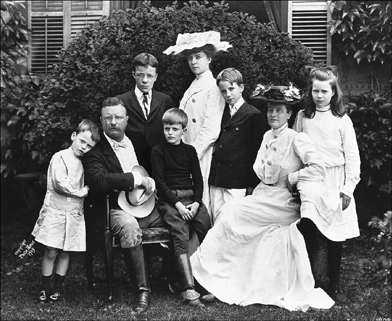
“WHAT HE GAVE HE GAVE WITHOUT STINT.”
The President and his family, summer 1903
Kermit, thirteen, was a grave, fine-eyed, clumsy adolescent, whom Edith adored. Roosevelt was aware of a solitariness and bookishness not unlike his own in youth. But Kermit also had a yielding quality: if not exactly soft (“He seems to hold his own well with boys”), he was pliable and easy to bruise.
Ethel, nearly twelve, was already the family hausfrau—a heavy-legged, blunt-featured girl who bossed the servants and took no nonsense from horses. Roosevelt thought her “gloomy,” but she was in reality shy, intimidated both by his power and by her half-sister’s glamour.
The two smallest boys, aged nine and five, were still too much in a state of perpetual motion, on banisters, bicycles, ponies, stilts, or swaying trees, to register on anyone with precise definition. Out of the noisy scurry that was Archie there poked occasionally a fierce, hawklike face, and sharp bony extremities much bitten by Josiah the badger. When the dust clouds around Quentin thinned, a miniature Theodore Roosevelt was revealed, dome-headed and wheezily garrulous, with mild, rather abstracted blue eyes.
“WASHINGTON IS NOW quite deserted,” Speck von Sternburg noted at the end of June, “and the men who are pushing the world seem to be taking a short and well-deserved nap.” One of the pushiest, however, remained in town long enough to disturb the rest of both President and Secretary of State. “The Russian Government,” Count Cassini announced on 1 July, “most positively and absolutely denies the reports that it has offered any official explanations to the American Government … regarding the Kishinev incident.”
Roosevelt was mystified. No explanation had been demanded. He and Hay had decided, on second thought, to allow the B’nai B’rith leaders to proceed with their petition, on the understanding that it was nongovernmental, and almost certainly a waste of ink. Cassini confirmed the latter point: “The Russian Government has categorically refused to receive any petitions, communications, or representations from any power regarding Russian internal affairs.”
Behind this statement Roosevelt sensed shame over the pogrom, as well as fear of publicity that might further hurt Russian prestige—already damaged by the occupation of Manchuria. He saw how he might exploit the Tsar’s embarrassment to his own advantage, winning the gratitude both of Jews and of American exporters hungry for Far Eastern trade. A peremptory telegram went forth from Oyster Bay to Acting Secretary of State Loomis, ordering him “in the absence of Secretary Hay” to respond publicly to Cassini’s statement. He must express “the deep sympathy felt not only by the Administration, but by all the American people for the unfortunate Jews who have been the victims of the recent appalling massacres and outrages.” Loomis was further authorized to quote “another official” as saying, in tones recognizably Rooseveltian, that “it seemed somewhat strange, to say the least,” for the Russian government to make such a statement at such a time, “when by methods which are certainly the reverse of friendly to the United States, it has sought to make China join in breaking the plighted faith of all the powers as to the open door in Manchuria.”
Throwing all semblance of impartiality aside, Roosevelt urged Loomis to expedite the Jewish petition (still gathering signatures), and prepare it for immediate transmission to St. Petersburg. Cassini was about to sail home on vacation; Russia must feel America’s displeasure before he arrived and smoothed things over.
John Hay, unaware of what was going on, wrote Roosevelt to say that Cassini’s “extraordinary” statement reinforced his earlier doubts about the petition. Better simply for B’nai B’rith to publicize its rejection in advance. “We can then all of us say what we think proper, and Russia cannot complain of anything we say among ourselves.”
His letter came too late to influence the telegrams and telephone calls buzzing back and forth between the summer White House and Washington. Whether Hay liked it or not, Roosevelt was beginning to act more and more as his own Secretary of State.
A DAY OR TWO LATER, Hay received a summons to Sagamore Hill, amid rumors that he would soon resign. It was assumed—correctly—that he felt the United States was becoming too confrontational in its foreign policy, not only vis-à-vis Russia and Germany, but also toward Canada and Great Britain in the Alaska boundary dispute. (Roosevelt’s three “impartial jurists,” Elihu Root, Henry Cabot Lodge, and former Senator George Turner, were busy polishing their prejudices for an upcoming tribunal in London.)
Hay was not so much disenchanted as weary of the strain of working for “Theodore the Sudden.” He packed his bags, wondering if this was to be the first of many summer interruptions. McKinley had never called for him without reason. Roosevelt tended to call first and think of reasons afterward. “I always find TR engaged with a dozen other people, and it is an hour’s wait and a minute’s talk—and a certainty that there was no necessity of my coming at all.”
Sure enough, when he rolled under the porte cochere on 7 July, the President was entertaining three senators, a Quaker financier, a poet, and a playboy. “Will you excuse me till I play a game of tennis with Winty Chanler, I have had no exercise all day.” Hay went off for a stroll around the estate, and did not see Roosevelt again that afternoon. In spite of himself he was charmed by Sagamore Hill. He admired its high panorama of trees and water—no other houses visible in any direction—and liked its air of dignified simplicity. At six o’clock, out of long habit, he dressed in black tie for dinner, and noticed that Roosevelt did the same. “The President was so cordial and hospitable,” he wrote his wife, “that I felt ashamed of my surly crossness at having to go there.”
When they did have their discussion, over coffee on the porch, it was long and businesslike. Hay abandoned all thought of resignation. Aside from Manchuria and the Kishinev petition, there were encouraging developments in Bogotá. President Marroquín had privately begun to pressure the Colombian Congress to ratify the Panama Canal Treaty. Members of the lower chamber were reported to be in favor. Senate opposition was still stiff, but if Marroquín was as powerful as Beaupré believed, the treaty might yet prevail, and Panamanians withdraw their threat of secession.
President and Secretary talked far into the night, while their imagined world ordered itself pleasingly, obediently, beyond the twinkling horizons of Oyster Bay.
HAY SAID GOOD-BYE the next morning, then continued south to Washington. His surprise arrival in the broiling city served notice to both Loomis and Roosevelt that he was still boss of the State Department, and would monitor all their future communications. Yet he could not forget the latter’s graciousness at Sagamore Hill. “It is a comfort to work for a President who, besides being a lot of other things, happened to be born a gentleman.”
On 12 July, a sobering cable arrived from Arthur Beaupré. He reported that only now, after five weeks, had Hay’s ultimatum at last been communicated to the Colombian Congress. It was “construed by many as a threat of direct retaliation against Colombia,” in the event of nonratification of the treaty. Delegates from the province of Panama were capitalizing on that threat, and talking openly of secession.
By a coincidence unsurprising to intimates of William Nelson Cromwell, the New York World prophesied the next morning that there would be a revolution in Panama on 3 November. Later in the day, a desperate message from Colombian liberals reached the State Department. The treaty might be saved if the United States would consent to two amendments: one requiring the Compagnie Nouvelle to pay a ten-million-dollar rights-transferral fee, and the other increasing the zone’s acquisition price from ten million to fifteen million dollars.
Hay prepared a note of refusal. “Make it as strong as you can to Beaupré,” Roosevelt ordered him. “These contemptible little creatures in Bogotá ought to understand how much they are jeopardizing things and imperiling their own future.”
THE KISHINEV PETITION finally wound its way up Sagamore Hill on 14 July. It was carried by Leo Levi and Simon Wolf, who did not know what to make of the President’s sudden urgency. Levi suppressed the cynical thought that Roosevelt might use a human tragedy in Bessarabia to shame the Tsar into opening up Manchuria. Wolf was embarrassed at how few signatures they had been able to collect on such short notice. The names of influential Gentiles were especially elusive in the vacation season. Unavoidably, the list still looked like a Jewish petition, rather than a mass interdenominational declaration.
Oscar Solomon Straus, a prominent Jew with diplomatic experience, and Albert Shaw, editor of Review of Reviews, joined the company for lunch in the President’s paneled dining room. When Roosevelt heard that the petition bore “only two or three thousand” signatures, he agreed that it was hardly worth submitting in physical form. Then he made an inspired suggestion. Secretary Hay should dispatch an official cable to Count Vladimir Lamsdorff, the Tsar’s Minister of Foreign Affairs inquiring whether or not an unofficial petition “relating to the condition of the Jews in Russia” would be acceptable to His Majesty. The cable would quote the entire text of the petition. Of course, Lamsdorff would say no. But he would have to file the cable as a formal message, while its senders published it around the world. Americans would have made their moral point, and Russians could not complain of any breach of diplomatic etiquette.
Everyone approved of this idea. The President led the way to his library, adapted a previous draft prepared by Hay, and pinned the petition to it. Straus, stoop-shouldered and frail, undertook to deliver the precious document to the State Department for immediate dispatch.
Long before he got to Washington, the Russian Embassy announced that “certain cities in Manchuria” were open to foreign commerce. This was less a coincidence, perhaps, than the consequence of Roosevelt’s earlier blast against the Tsar’s domestic and foreign policies. Evidently Russia did, after all, worry about her inflexible world image. Hated by China, threatened by Japan and Japan’s ally Britain, she did not need to add the United States to her list of enemies.
Nicholas II’s rejection of the petition cable the next day thus came as neither a disappointment nor a surprise. Roosevelt authorized the B’nai B’rith leaders to publicize the rejection as they chose, and accepted congratulations from John Hay. “You have done the right thing in the right way, and Jewry seems really grateful,” the Secretary wrote.
An exuberant Roosevelt was less inclined to call the matter quits. “If only we were sure that neither France nor Germany would join in, I should not in the least mind going to ‘extremes’ with Russia!”
THE CRESCENT SELF-CONFIDENCE Edith Roosevelt had noticed after her husband’s return from the West continued to energize him. He seemed to delight in juggling as many political and diplomatic balls as possible. To the annoyance of his children, carriages full of ponderous adults kept creaking through the chestnut trees. One such vehicle on 15 July discharged Treasury Secretary Leslie Shaw, Herman Kohlsaat of the Chicago Record-Herald, Charles J. Bonaparte, special counsel for the Justice Department in the Post Office investigation, and Ray Stannard Baker, reporter at large for McClure’s. Baker’s briefcase was especially bulky with notes, maps, and memoranda. The President had asked him to substantiate charges of corruption in the Salt River Valley, Arizona, reclamation project.
A servant showed the visitors into the library. Roosevelt was nowhere to be seen. They sat for a while under the varnished gaze of Theodore Senior, absorbing an aura of well-handled books, oak, and mahogany. On the desk, radiant with sun slanting in through gauze curtains, there lay a gold-miner’s pan, a silver dagger, and an inkwell ornamented with a little bust of Abraham Lincoln. Bearskins snarled silently on the floor. Somewhere a clock was ticking: it was well past noon.
Like a sudden explosion, the President blew in through the door. He looked ruddy and healthy in knickerbockers, worn gray shirt, and scuffed hiking shoes, and was bursting with mirth. In his hand he carried a note and newspaper clipping.
“I want to read you something I have just got,” he said, “in connection with conditions in the South.”
He shot a gleeful glance at Bonaparte, who owned a Maryland plantation. The note was from Booker T. Washington. “My dear Mr. President, the enclosed is a true story.” Roosevelt turned to the clipping, from the Baltimore Herald:
An old Florida colonel met Booker T. Washington and in a bibulous burst of confidence said to the Negro educator: “Suh, I am glad to meet you. Always wanted to shake your hand, suh. I think, suh, you’re the greatest man in America.”
“Oh no,” said Mr. Washington.
“You are, suh,” said the colonel, and then, pugnaciously, “who’s greater?”
“Well,” said the founder of Tuskegee, “there’s President Roosevelt.”
“No, suh,” roared the colonel. “Not by a jugful; I used to think so, but since he invited you to dinner I think he’s a [—] scoundrel.”
The library rang with presidential laughter. A gong sounded, and Roosevelt led the way into the dining room. Baker left a bemused account of the subsequent proceedings:
It was a very simple lunch, served by a maid. At first the President talked postal affairs with Mr. Bonaparte, asserting over and over again that he wanted the investigation to be thorough.
“I don’t care who it hits!” he said. “We must get to the bottom of these scandals.” He then turned abruptly to me and said, “Baker, who is the chief devil down there in the Salt River Valley?”
Since I had never considered the situation in terms of devils, I hesitated a moment—and the President burst into a vigorous, picturesque, and somewhat vitriolic description of the situation, implying that if he could catch the rascals who were causing the trouble he would execute them on the spot. Several of the statements he made seemed to me to be inaccurate, or at least exaggerated, but when I tried to break into the conversation—boiling inside with my undelivered articles and memoranda (one of which indeed I tried to draw from my pocket)—the President put one fist on the table beside him, looked at me earnestly, and said: “Baker, you and I will have to get together on these subjects.”
He instantly turned aside, leaving me—I think—with my mouth open, and began telling in a loud voice and with great unction of his lunch [with] a committee of prominent Jews interested in the Kishinev petition. He even imitated Oscar Straus by a hitch of the shoulders and laughed heartily when somebody asked if he had provided boiled ham for his guests. Once he said:
“Do not all these things interest you? Isn’t it a fine thing to be alive when so many great things are happening?” …
As the time drew near for leaving, I began to wonder when the President would ask me for the information upon which I had spent so much time and hard work. I had my heavy briefcase in hand when I went up to say goodbye—and my grand plans for enlightening the Government of the United States vanished in a handshake.
Mr. Bonaparte, Mr. Kohlsaat, and I walked down together, some three miles, to Oyster Bay. I carried my heavy case, filled with my memoranda, and papers, and maps and pictures—and the sun was hot.
Behind his jocularity on Southern race relations, the President was giving serious thought to an “utterance” on lynching. He admitted that long-term justice for the Negro concerned him more than any other issue. One of his least-noticed guests that July was Rollo Ogden, sometime Presbyterian missionary, editor of the New York Evening Post, and a crusader against mob justice. They met amid reports that anti-Negro vigilantes were menacing a jail in Evansville, Indiana. Governor Winfield T. Durbin had sent in state troops, who killed six rioters; even so, hundreds of terrified blacks were quitting town. The parallels to both the Wilmington lynching and the Kishinev pogrom were obvious. (A cartoon in Literary Digest showed Nicholas II tearfully rejecting the B’nai B’rith petition: “Excuse me, I’m too busy weeping over this Delaware affair.”) Roosevelt promised Ogden that he would say something soon.
For political reasons, he could not do so immediately. A Democratic primary campaign of extreme virulence was approaching its climax in Mississippi, with two racists, Hernando Money and James K. Vardaman, respectively fighting two Administration-backed moderates for the senatorial and gubernatorial nominations. Since there was no effective Republican opposition in that state, selection was as good as election. Much invective was being lavished on the “nigger-loving gang in Washington,” particularly Roosevelt for his support of Minnie Cox. Governor Andrew H. Longino, running for re-election, was blamed for involving the President in Mississippi politics during his 1902 visit to the Little Sunflower. Any move now by the detested “Teddy” against lynching, which Longino had himself condemned, would ensure the Governor’s defeat.
SO ROOSEVELT REMAINED SILENT, as midsummer heat mounted across the nation. The sun shone strong on western corn, ripening what looked, to James Wilson’s expert eye, like bumper crops. A good harvest was gold in Republican coffers, the Secretary of Agriculture wrote from South Dakota: “This people is very prosperous and so enthusiastic for you that they will contribute just as freely to next year’s campaign as to build a church.”
Temperatures—and tempers—rose less encouragingly at labor conventions in many cities. So far in 1903, there had been a record three and a half thousand strikes nationwide, and not only Wall Street held Roosevelt responsible. In a severe blow to his popular image, the National Association of Letter Carriers endorsed William Randolph Hearst for President as “a true friend of the plain people.” Union after union berated Roosevelt for the low pay increase awarded the anthracite miners, and for his more recent, precedent-setting enforcement of an open shop in the Government Printing Office.
James S. Clarkson, his chief patronage lieutenant outside Washington, grew nervous. He bombarded Sagamore Hill with statistics showing “the alarming growth of the Socialist vote in this country.” Hearst, he wrote, was a real threat, with enough funds and newspapers (three hundred at last count) to alienate every trade union from the Republican Party. He begged Roosevelt to avoid any further gestures toward free labor.
This was not the right thing to say to a President who prided himself on being fair. “Of course I will not for one moment submit to dictation by the labor unions any more than by the trusts,” Roosevelt shot back, “and that no matter what the effect on the presidential election may be.” Three times in one sentence, he reminded Clarkson that he stood for “a square deal.”
The sun beat down ever more fiercely, turning Southern plantations white, Western farms gold, Northern fields yellow and silver. It bleached the pale Percherons working Roosevelt’s own forty-seven acres. Farmers everywhere looked forward to an autumn bounty. But in the shadowed enclave of Wall Street, bears prowled. On 22 July, Jefferson Seligman, a banker friend, came out to see the President, warning of an imminent financial “panic.”
Roosevelt had never understood the ebb and flow of money, through his own hands or anyone else’s. “Every morning Edie puts twenty dollars in my pocket, and to save my life I can never tell her afterward what I did with it.” So he listened with more patience than comprehension as Seligman expounded the need for currency-reform legislation.
The problem, apparently, was an “inelastic currency,” combined with a seasonal need for cash to move America’s crops to market. Toward the end of summer, demand greater than supply caused cash to flow from Wall Street banks to the rural heartland, leaving behind depleted vaults and falling stock prices. Late in the fall, the money began to flow back. But promoters, stockjobbers, and other speculators trembled while it was gone, lest banks call their loans. This summer, the risk looked greater than usual. Continued combination and overcapitalization—not to mention worry over the Northern Securities Company’s appeal to the Supreme Court—had created a vast surplus of vulnerable stocks. “Undigested securities,” J. P. Morgan called them.
Roosevelt referred Seligman to Leslie Shaw, who had an emergency plan to transfer government gold into the national reserves. Then he braced for the strong views his next guest was bound to have on any such corrective measure. Joseph G. Cannon famously knew more about finance than anybody else in Congress, even Senator Aldrich. A profound conservative, of the Midwestern, small-town variety, Cannon was unlikely to be disturbed by the current situation. Eastern trust lords had been too grandiose in their capitalizations: they needed a short, sharp slump (affecting millionaires primarily) to teach them fiscal responsibility.
“Uncle Joe wants no legislation,” Roosevelt dictated to a secretary, while waiting for Cannon to arrive. “It seems to me we ought to have some.”
When the Speaker climbed out of his carriage, it was clear he was playing the defiant hayseed. He wore a seersucker jacket with tails that floated on the breeze, and salt-and-pepper trousers ballooned round his bony legs. The accepted uniform for waiting on the President was a dark frock coat, irrespective of season. But Cannon declined to apologize for his appearance. It was too “damn hot,” he said.
CANNON’S RUMPLED APPEARANCE, his scraggy white beard, perpetual half-chewed cigar, and folksy profanities were all part of a calculated image to disguise one of the most disciplined forces in government. Close inspection revealed his clothes to be of fine quality (a daily fresh pink in his lapel suggested the private dandy), while the beard was kept short and the cigar, when puffed, gave off mellow evidence of Havana leaf. As for the profanities, they were carefully mild. Cannon was actually more at home quoting Shakespeare and the Bible, which he studied every day along with the Congressional Record. His wire-puppet jerkiness was caused by an unusually fast reflex system, mental and physical. Not even Roosevelt was quicker to react to the occasional signals of intent or flexibility that politicians flash in conversation. And back of the quickness was an instant obstinacy whenever any tenet of orthodox Republicanism was threatened. The thin grin would vanish, the blue stare freeze, the long bony forefinger tap with suppressed fury. He was, in the President’s not unaffectionate opinion, “a hard, narrow old Boeotian.”
After a two-hour lunch, officially described as “social,” Cannon left Sagamore Hill smiling, hinting that he might consider some currency reform in a future session. But when he stopped off in New York, en route to his home in Illinois, he showed no inclination to reassure Wall Street further on that score. “I could not get him to visit a single banker,” Congressman Lucius Littauer wrote Roosevelt. “His constant reiteration was that a time of financial panic was not one in which to discuss the necessity of financial legislation.”
No sooner had Cannon left town on 23 July than a serious collapse in share values began on Wall Street. Banks canceled credit, and syndicates unloaded their reserve investments of high-grade securities. U.S. Steel common dropped by more than 50 percent. Frantic for more funds, the syndicates put up their newer, underwritten offerings, and got almost nothing for them. J. P. Morgan’s United States Shipbuilding Company went bankrupt, as did the hundred-million-dollar Consolidated Lake Superior. Four major brokers went out of business.
Like ripples round a dropped stone, waves of desperation ringed outward, but shallowly, failing to shake the calm depths of general investment. Cannon had gotten—perhaps even brought on—the “rich man’s panic” he wanted. Secretary Shaw wrote to reassure Roosevelt, as did James Clarkson: “The country is prosperous every place else except Wall Street, and perhaps the Street is all the better for this experience.”
So while stockbrokers raged, blaming the Administration’s antitrust policies—“This is a market on which John D. Rockefeller could not borrow on Standard Oil”—Roosevelt kept cool in white flannels. He had discovered a new sport, cricket, and spent many hours with a British professional, learning the difference between topspins, long-hops, and silly mid-ons.
A THOUSAND MILES SOUTH, the white Democrats of Mississippi prepared to cast their primary votes for Governor and Senator. James K. Vardaman’s vicious rhetoric had somehow turned the contest into one between “Rooseveltism” and racism. On 9 August, the President decided to issue his long-delayed “utterance,” in the form of a public letter to Winfield T. Durbin of Indiana.
“My dear Governor Durbin,” he wrote, “permit me to thank you as an American citizen for the admirable way in which you have vindicated the majesty of the law by your recent action in reference to lynching.” (Durbin had not only dispelled rioters with troops, but proclaimed the right of a black murderer to a fair trial.) “All thoughtful men,” Roosevelt continued, “must feel the gravest alarm over the growth of lynching in this country, and especially over the peculiarly hideous forms so often taken by mob violence when colored men are the victims—on which occasions the mob seems to lay most weight, not on the crime but on the color of the criminal.”
In a minority of cases—fewer than one in four—lynch victims were guilty of rape, “a crime horrible beyond description.” Yet rape’s very bestiality required that society respond to it in a civilized fashion. Roosevelt was at his most impassioned when he commented on the sadistic quality of lynchings:
There are certain hideous sights which when once seen can never be wholly erased from the mental retina. The mere fact of having seen them implies degradation.… Whoever in any part of our country has ever taken part in lawlessly putting to death a criminal by the dreadful torture of fire must forever after have the awful spectacle of his own handiwork seared into his brain and soul. He can never again be the same man.
Rollo Ogden congratulated him after the letter was published. “One of your happiest inspirations in the public service.” Other liberal-minded editors praised the strength, if not the promptness, of the President’s statement. They did not see how delaying it had improved Mississippi’s political situation, where Vardaman and Hernando Money both won decisively.
Roosevelt concluded that for the time being he had done all he could, rhetorically and practically, to help the American Negro. He would not risk his political future by seeming to endorse, in Vardaman’s phrase, “the black wave of ignorance, superstition, and immorality with which the South is perpetually threatened.”
BY NOW, THE State Department was seriously concerned over Arthur Beaupré’s silence. The Minister to Colombia was notorious for the frequency and verbosity of his cables. Three wordless weeks had given the impression he had been garroted. On 12 August, however, a thousand dollars’ worth of prose suddenly came over the wire. Beaupré summarized no fewer than nine amendments that had been attached to the Panama Canal Treaty in committee. The Colombian Senate now proposed at least five million dollars more in cash, plus huge kickbacks from the Compagnie Nouvelle and the Panama Railroad. The United States would be granted “tenancy” only in the canal zone, and would have to endure Colombian standards of law enforcement and sanitation. Beaupré begged John Hay, who was back in New Hampshire, “for an emphatic statement … or instructions” before the amendments were adopted by the Colombian Senate.
Hay was enraged. He had sent at least two sets of instructions over the past month, making plain that the United States would accept no amendments whatever. Evidently, Beaupré had not received them. Colombia’s cable service, Hay noticed, malfunctioned with curious regularity whenever the text of the treaty was undergoing serious scrutiny.
Now there arrived at Sagamore Hill a letter written by a longtime American resident of Bogotá. It described antitreaty sentiment in the capital as increasingly raucous and bitter. Politicians, merchants, planters, and common citizens were complaining that the United States wanted them to make a sacrifice “of untold millions belonging, by right, to their children.” One agitator was quoted as excoriating the “dirty American pigs” already wallowing in Panama mud.
Neither Roosevelt nor Hay had any public comment or prediction. “I am totally in the dark as to what the outcome in the Isthmus will be,” the President told Senator Morgan.
The first indication that he was losing patience came on Friday, 14 August, when Shelby M. Cullom, Chairman of the Senate Committee on Foreign Relations, emerged from a lunchtime conference at Sagamore Hill. Speaking with obvious authority, Cullom told reporters that no matter what happened in Bogotá, the Administration remained committed to a Panama Canal.
|
Q |
How can the canal be built without the treaty? |
|
A |
Well, we might make another treaty, not with Colombia, but with Panama. |
|
Q |
But Panama is not a sovereign state.… |
|
A |
Intimations have been made that there is great discontent on the Isthmus over the action of the Congress of the central government, and Panama might break away and set up a government which we could treat with. |
|
Q |
Is the U.S. prepared to encourage such a schism in a South American republic? |
|
A |
No, I suppose not. But this country wants to build that canal and build it now. |
Whatever “action” Cullom was referring to—or anticipating—he could not have more clearly signaled Senate support for any executive powers Roosevelt might avail himself of in the near future.
That weekend, an extraordinary naval panoply spread across Long Island Sound. Twenty-two white warships could be seen lying in parallel rows off the entrance to Oyster Bay, a spectacle, in the eyes of one observer, “almost overwhelmingly suggestive of America’s newly-born sea power.” Monday dawned bright and mirror-calm. The sun picked out thousands of white-clad sailors stationing themselves in geometric shapes on decks and in rigging. Oyster Bay bristled with pleasure boats come to witness the President’s review of the fleet.
Roosevelt came down from Sagamore Hill after breakfast and boarded the USS Mayflower. Nine and a half hours later, he returned home, eyes bloodshot from the glare of white metal and water, buffeted by the roar of continuous twenty-one-gun salutes—sixty-three thousand rounds in all. Hanging smoke thickened the dusk as he walked through the woods. An urgent cable from Beaupré awaited him.
BOGOTÁ, AUGUST 12, 7 P.M. THE TREATY WAS REJECTED BY THE SENATE TODAY IN ITS ENTIRETY.
ROOSEVELT WAS STILL digesting this news—“We may have to give a lesson to those jack rabbits”—when a note arrived from John Hay. The Secretary, who had never been a Panama enthusiast, reminded him that he could now revert to “the simple and easy Nicaraguan solution,” rather than press ahead with “the far more difficult and multifurcate scheme” articulated by Senator Cullom.
Before replying, Roosevelt studied the text of a startlingly aggressive memorandum by John Bassett Moore, the reigning American authority on international law. It had been forwarded to him by Francis B. Loomis, who was fast becoming his preferred contact at the State Department.
Professor Moore’s memorandum argued that Panama was the only place in the Americas to build a canal “for the world.” The question of Colombian sovereignty was therefore a global rather than a regional one. All nations had a right to benefit from the opening of this great “gate of intercourse” between East and West. One nation could not delay, or demand an exorbitant fee for, that constructive advance. Moore recalled that in 1846, Colombia—then known as New Granada—had guaranteed the United States free transit across the Isthmus “upon any modes of communication that now exist, or that may hereafter be constructed.” This “sort of supportive partnership” (Washington promising in return to protect both Colombian integrity and neutrality of the transit zone) must have been contracted in order to bring about, ultimately, a canal. Otherwise, as President Polk had pointed out, the United States had no direct interest in preserving the Colombian federation.
For almost six decades, successive administrations had honored the Treaty of New Granada, saving Colombia many times from outside attack and internal revolt. The Panama Railroad, designed and built by Americans, had operated continuously, to the profit of both countries. “Colombia has again and again claimed,” Moore wrote, “that it was our duty to protect the route … thus construing the treaty more broadly than we have done and less favorably to her own sovereignty.” This claim in effect “approached the point of making us responsible on the Isthmus.”
Moore noted, further, that the language of the 1846 treaty guaranteed passage across Panama not only to American citizens, but also to their “Government.” This by definition included military personnel and matériel. As early as 1852, indeed, President Fillmore had deployed troops on the Isthmus with neither permission nor protest from Bogotá. There had been other deployments since, with the express concurrence of the Colombian Senate.
Throughout the long special relationship, Americans had never “enjoyed the full benefit … that the treaty was intended and expected to secure”—namely, a canal. In view of the fact that Colombians had gotten their own side of the bargain—rail transit and armed protection—Washington could now reasonably “require” Bogotá to ratify the Hay-Herrán Treaty. All other considerations, including last-minute amendments, were superfluous and irrelevant. “The United States in constructing the canal would own it; and after constructing it, would have the right to operate it. The ownership and control would be in their nature perpetual.”
The effect upon Roosevelt of this vehement document was to make him strangely cautious. He referred it to Hay, suggesting that the Administration “do nothing,” at least not right away. “If under the treaty of 1846 we have a color of right to start in and build the canal, my offhand judgment would favor such proceeding.… What we do now will be of consequence, not merely decades, but centuries hence, and we must be sure that we are taking the right step before we act.”
NOT SURPRISINGLY, news of revolutionary activity on the Isthmus came within days. “The fathers at Bogotá are eating sour grapes,” Assistant Secretary of State Alvey A. Adee wrote Hay, “and the teeth of the children of Panama are getting a fine edge on to ’em.”
Hay was pleased that the President wanted to wait “a reasonable time” before deciding what to do next. He warned him against an outright seizure of Panama, which Moore’s memorandum seemed to justify. “The fact that our position, in that case, would be legal and just, might not greatly impress the jack-rabbit mind. I do not believe that we could faire valoir our rights in that way without war—which would, of course, be brief and inexpensive.”
Gradually, a partial understanding of Colombia’s behavior emerged, together with hopes that President Marroquín might yet save the situation by executive action. Beaupré seemed to feel some responsibility, having deeply offended the Colombian Senate with his imperious notes demanding ratification. He pleaded that the proposed treaty be given its full legal term to expire—some thirty more days.
“The President will make no engagement as to his action in the canal matter,” Hay replied. From then on, the wires from Oyster Bay and Washington were silent. Apprehension mounted in Bogotá.
“For the first time I must tell you,” Tomás Herrán wrote William Nelson Cromwell, “that I have lost all hope.”
AUGUST DROWSED TO an end. Inland, the weather turned cool, but Oyster Bay was reluctant to yield its summer heat. Geese continued to laze in the mudflats, and, when the breeze shifted landward, their guttural conversation could be heard at the top of Sagamore Hill. Other sounds were audible now, as the air sharpened: the distant tolling of a bell buoy, sometimes even the thrum of a steamer out to sea. Evening brought the less welcome whine of mosquitoes. For some reason, they avoided Roosevelt, as he sat on the piazza reading Euripides, and fanned out in search of Secret Service men hiding in the grape arbor.
Toward the end of the first night watch, about 10:15 P.M. on 1 September, a buggy rolled silently up the driveway’s grass shoulder. Clouds covered the moon. Nobody saw the little vehicle until it got within fifty yards of the house. Then Roosevelt, working behind blinds in his library, heard sounds of scuffling and swearing outside.
Unthinking, he stepped onto the piazza, and stood with the light behind him. Two of his guards were struggling with a youth in the buggy. “There he is!” the youth screamed, and brandished a revolver. It was knocked to the ground, while other agents rushed out of the dark and shoved Roosevelt back inside.
“I came to kill the President,” the youth admitted, as manacles were snapped on his wrists. At Oyster Bay police station later, he rambled about Roosevelt’s action in the Government Printing Office matter. “Why doesn’t the President do something for organized labor? He’s said a lot about it, but he hasn’t bettered the condition of the working man.”
The security detail at Sagamore Hill was increased to a twelve-man, twenty-four-hour alert, while Roosevelt, shaken, reflected on his sudden unpopularity among unions. By insisting that all GPO employees swear obedience to the civil-service law, he had disillusioned thousands of radicals who had come to count on his “partiality” during the great coal strike. Even more damagingly, he had issued an executive order mandating an open-shop policy in every government department. The influential Central Labor Union of Washington, D.C., declared in a nationwide mailing, “The order of the President cannot be regarded in any but an unfriendly light.”
A providential invitation came for him to review the Labor Day parade in Syracuse, New York. He accepted, to the delight of the little city: it had not been so honored in many years.
His speech there on 7 September was so utopian that Jules Jusserand accused him of parroting Sir Thomas More. Actually Roosevelt was identifying with Euripides—like himself, an upper-class celebrant of middle-class virtues—as he mused at length on the vulnerability of republics that failed to preserve their social equipoise. Whichever class arose to dominate others—whether high, low, or bourgeois—always made disproportionate claims on the government:
Again and again in the republics of ancient Greece, in those of medieval Italy, and medieval Flanders, this tendency was shown, and wherever the tendency became a habit it invariably and inevitably proved fatal to the state.… There resulted violent alternations between tyranny and disorder, and a final complete loss of liberty to all citizens—destruction in the end overtaking the class which had for the moment been victorious as well as that which had momentarily been defeated. The death-knell of the republic had rung as soon as the active power became lodged in the hands of those who sought, not to do justice to all citizens, rich and poor alike, but to stand for one special class and for its interests as opposed to the interests of others.
Uniquely, the checks and balances of American democracy worked to prevent any such lodgment. National unity was a moral challenge, rather than an economic one:
The line of cleavage between good and bad citizenship lies, not between the man of wealth who acts squarely by his fellow and the man who seeks each day’s wage by that day’s work, wronging no one.… On the contrary, [it] separates the rich man who does well from the rich man who does ill, the poor man of good conduct from the poor man of bad conduct. This line of cleavage lies at right angles to any arbitrary line of division as that separating one class from another, one locality from another, of a man with a certain degree of property from those of a less degree of property.
A civilized commonwealth, enjoying “the true liberties which can only come through order,” depended on square dealing between representatives of capital and labor. Just as the former had accepted a limited degree of public scrutiny, so must the latter face up to their own public duty. In any recession acerbated by strikes and union violence, “the first and severest suffering would come among those of us who are least well off at present.”
William Jennings Bryan would not have used the last two words. It was little touches like that—innocent, optimistic—that endeared Roosevelt to his audiences, even when he was trying to be severe.
BY MID-SEPTEMBER, predictions of Panamanian independence were being published almost daily in American and European newspapers, and voiced aloud even in Bogotá. Isthmian delegates to the Colombian Congress began to pack their bags and head for home. Senator José Domingo de Obaldía called out to the secretary of the American legation, “We’ll meet within a few weeks in the new Republic of Panama.”
Desperate to keep Colombia intact, President Marroquín ignored Obaldía’s open rebelliousness and appointed him Governor of Panama. Tomás Herrán, in Washington, was reminded of Spain’s panic just before the loss of Cuba. Only a last-minute ratification of the treaty, he cabled his minister, could save Colombia now. Otherwise, the Colossus of the North would “indirectly” favor the coming revolution, and would doubtless jump to recognize an independent Panama. “President Roosevelt is a decided partisan of the Panama route, and hopes to begin excavation of the canal during his administration. Your excellency already knows the impetuous and vehement character of the President, and you are aware of the persistence and decision with which he pursues anything to which he may be committed.”
Proposals for a “resumption of negotiations” came by return of wire. Some last-chancers in the Colombian Senate were under the impression that the United States would pay forty million dollars, rather than ten, for canal rights, in exchange for a legislative finding that canceled the Compagnie Nouvelle’s extended concession. Hay ignored this transparent attempt at fraud. “It is altogether likely,” he wrote the President, “that there will be an insurrection on the Isthmus against that regime of folly and graft that now rules in Bogotá. It is for you to decide whether you will (1) await the result of that movement, or (2) take a hand in rescuing the Isthmus from anarchy, or (3) treat with Nicaragua.”
Roosevelt had already opted for the first choice, but made plain his perfect willingness “to interfere when it becomes necessary so as to secure the Panama route without further dealing with the foolish and homicidal corruptionists in Bogotá.”
As the Panama Canal Treaty died, so did summer. Around Cove Neck, lilies and pale beach rosemary gave way to goldenrods and coarse asters, bristling against fresher breezes. Edith Roosevelt put away her white dresses. Archie and Quentin started wearing shoes again. Ted and Kermit braced themselves for another year at Groton. Their father industriously chopped wood.
The thudding ax and sprays of chips did not quite work off an onset of autumnal melancholy. A harvest of tart political fruits awaited him when he returned to the White House. Relations with Russia and Colombia had deteriorated sharply. His Syracuse speech did not seem to have reduced tensions between business and labor. Government antitrust policies were being blamed for the “rich man’s panic.” The Postal Service’s corruption probe had spread into his own state. Local Republicans warned that if the upper house in Albany were implicated, he would “certainly” lose New York in 1904.
These problems were complicated by another, more painful and personal. Elihu Root (currently representing him at the Alaska Boundary Tribunal in London) wanted to return to the practice of corporate law, after four and a half years as Secretary of War.Roosevelt had long dreaded this resignation as “the worst calamity that could happen to me officially.” But he could not deny his old friend’s need to recoup lost income. Fortunately, Root was willing to stay on until an adequate successor could be found.
Roosevelt took one last daylong row with Edith, down to the salt marsh at the end of Lloyd’s Neck. They ate their lunch there and watched the white sails of coasters passing up and down the Sound. Then he pulled home, exulting in the opposition of the wind and tide. “Next Monday I go back to Washington,” he wrote his sister Corinne on 23 September, “and for the thirteen months following there will be mighty little letup to the strain.”
He was confident of nomination to another term in his own right, but not at all sure of election. “I suppose few Presidents can form the slightest idea of whether their policies have met with approval or not—certainly I cannot.… As far as I can see these policies have been right, and I hope that time will justify them. If it does not, why, I must abide the fall of the dice, and that is all there is about it.”