

Saturday
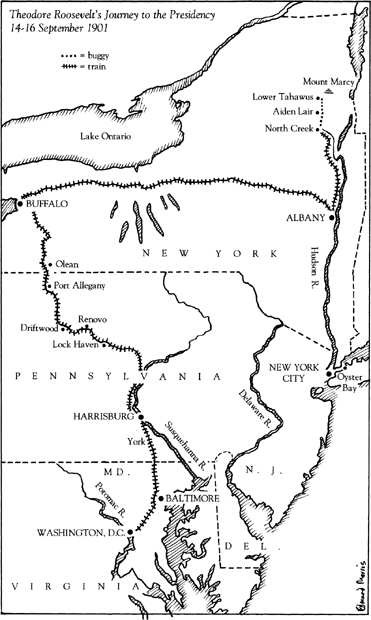
THEODORE ROOSEVELT became President of the United States without knowing it, at 2:15 in the morning of 14 September 1901. He was bouncing in a buckboard down the rainswept slopes of Mount Marcy, in the Adirondacks. Constitutionally, not so much as a heartbeat impeded the flow of power from his assassinated predecessor to himself. Practically, more than four hundred miles of mud and rails still separated him from William McKinley’s death chamber in Buffalo, where preparations for an emergency inauguration were already under way.
For all Roosevelt knew, he was still Vice President, yet he already realized that he would soon assume supreme responsibility. Yesterday’s telegrams, relayed up the mountain by telephone operators, riders, and runners, had documented the spread of gangrene through his bullet-ridden Chief:
THE PRESIDENT IS CRITICALLY ILL
HIS CONDITION IS GRAVE
OXYGEN IS BEING GIVEN
ABSOLUTELY NO HOPE
The last telegram to reach Roosevelt’s vacation cabin in Upper Tahawus had been urgent enough to banish all thought of waiting for clearer weather:
THE PRESIDENT APPEARS TO BE DYING AND MEMBERS
OF THE CABINET IN BUFFALO THINK YOU SHOULD
LOSE NO TIME COMING
So, shortly before midnight, he had kissed his wife and children good-bye and begun the descent to North Creek station—at least a seven-hour drive, even by day.
He was now, at the moment of his accession, halfway through the second stage of this journey, some five miles north of Aiden Lair Lodge, where a new wagon and fresh horses awaited him. He sat alone on the passenger seat, shrouded against splashes of mud in a borrowed raincoat several sizes too big. His favorite hat, a broad-brim slouch pulled well over his ears, kept some of the drizzle off his spectacles—not that he could see anything beyond the buckboard’s tossing circle of lamplight. Nor had he much to say: since leaving Lower Tahawus, indeed, he had spoken hardly a word to the lanky youth in front of him. From time to time, he muttered to himself.
Sincere, if slight, grief for McKinley—a cold-blooded politician he had never much cared for—struggled in Roosevelt’s breast with more violent emotions regarding the assassin, Leon Czolgosz. In his opinion, those bullets at Buffalo had been fired, not merely at a man, but at the very heart of the American Republic. They were an assault upon representative government and civilized order. Unable to contain his rage, he leaned forward and blurted an excoriation of Czolgosz into the rain. “If it had been I who had been shot, he wouldn’t have got away so easily.… I’d have guzzled him first.”

MEANWHILE, IN WASHINGTON, Secretary of State John Hay sat alone, weeping. For hours, he had heard newsboys shrieking outside his library window: “Extra! Extra! All about the President dying!” Aging and increasingly hypochondriachal, Hay had once worked for Abraham Lincoln and James Garfield, and seen them both assassinated. This third assassination, compounded by the recent death of his own son, was enough to extinguish all desire to go on living in an alien century. But duty had to be done. When the final knell sounded across Sixteenth Street, he wrote a telegram officially informing Theodore Roosevelt that McKinley was dead. He ordered it sent to North Creek Station.
AT ABOUT 3:30, the lights of Aiden Lair Lodge appeared in the mist. The landlord, Mike Cronin, was waiting outside with his rig. Roosevelt climbed down onto the wooden landing. “Any news?”
“Not a word.” Cronin spoke awkwardly, uncertain how to address his passenger. “Jump in right away, and we’ll be off.” He fumbled with a lantern. Roosevelt said, “Here, give it to me!” and joined him on the driver’s seat.
The new horses, two big black Morgans, started off swiftly. Cronin was an expert whip, and hoped to break his own daylight record of just under two hours to North Creek. The horses knew every curve of the sixteen-mile road, but the descent grew slippery, and one of them stumbled. Conscious of the precious value of his cargo, Cronin dragged on the reins.
“Oh, that doesn’t matter!” Roosevelt exclaimed. “Push ahead!”
Most of the time, the road was invisible, except when log bridges drummed suddenly under the buckboard’s wheels, and errant boulders loomed out of the mud, necessitating detours. Roosevelt kept holding his watch to the lantern. “Hurry up! Go faster!” Their speed increased on the steep descent. Cronin worried aloud about skidding off a bend and falling hundreds of feet into the bogs beneath. But Roosevelt was calm. “If you’re not afraid I am not.”
SINCE PUBERTY HE had taught himself to pluck the flower safety out of the nettle danger. Although his physical courage was by now legendary, it was not a natural endowment. He had been a timid child in New York City, cut off from schoolboy society by illness, wealth, and private tutors. Inspired by a leonine father, he had labored with weights to build up his strength. Simultaneously, he had built up his courage “by sheer dint of practicing fearlessness.” With every ounce of new muscle, with every point scored over pugilistic, romantic, and political rivals, his personal impetus (likened by many observers to that of a steam train) had accelerated. Experiences had flashed by him in such number that he was obviously destined to travel a larger landscape of life than were his fellows. He had been a published author at eighteen, a husband at twenty-two, an acclaimed historian and New York State Assemblyman at twenty-three, a father and a widower at twenty-five, a ranchman at twenty-six, a candidate for Mayor of New York at twenty-seven, a husband again at twenty-eight, a Civil Service Commissioner of the United States at thirty. By then he was producing book after book, and child after child, and cultivating every scientist, politician, artist, and intellectual of repute in Washington. His career had gathered further speed: Police Commissioner of New York City at thirty-six, Assistant Secretary of the Navy at thirty-eight, Colonel of the First U.S. Volunteer Cavalry, the “Rough Riders,” at thirty-nine. At last, in Cuba, had come the consummating “crowded hour.” A rush, a roar, the sting of his own blood, a surge toward the sky, a smoking pistol in his hand, a soldier in light blue doubling up “neatly as a jackrabbit” … When the smoke cleared, he had found himself atop Kettle Hill on the Heights of San Juan, with a vanquished empire at his feet.
From that viewpoint, the path to the presidency looked clear. Returning home a hero, Roosevelt had been elected Governor of New York within two weeks of his fortieth birthday. He had toured the Midwest and been greeted everywhere as if he was a presidential candidate. Dutifully supporting William McKinley for renomination in 1900, he had begun to assemble his own campaign organization for 1904. Everything in his hard philosophy assured him that the White House would be his one day. He had fought all his life for supreme power, for “that highest form of success which comes … to the man who does not shrink from danger, from hardship, or from bitter toil.”
Yet just when his momentum seemed irresistible, there had come that sickening sideways pull into the Vice Presidency, followed by a political dead halt. And now this even more violent lurch back on course!
His path ran, appropriately, past a cemetery: the churchyard of Minerva. Wet gravestones gleamed as the buckboard raced through the village. Beyond, slopes gave way to swamps, and the road began to flatten out. A pallor in the mist signaled dawn. At five o’clock, Cronin announced that they were only two miles from North Creek. Roosevelt ordered a stop “to let the horses blow.” He straightened his tie and smoothed his suit, saying there might be some “notables” waiting at the station.
The final dash was dramatic enough to satisfy Roosevelt’s love of stagy arrivals. Sun-reddened cliffs disclosed the racing floodwater of the Hudson River, and Cronin’s horses, refreshed by their brief pause, thundered thrillingly over the bridge into town. The noise acted as a drumroll, heralding their entrance onto Main Street. Voices shouted “There he comes!” The buckboard flew past darkened housefronts and stoops still bare of the morning milk. Its wheels had hardly come to rest at the depot when Roosevelt jumped down to discover, if not “notables,” at least a small crowd of local citizens and the neat, bespectacled figure of his secretary, William Loeb, Jr. A special train stood waiting. The time on the station clock read twenty-two minutes past five.
Loeb wordlessly handed over John Hay’s telegram from Washington. Roosevelt unfolded it. There was a moment of silence, broken only by the impatient hissing of the locomotive. He stared at the eight words in his hand:
THE PRESIDENT DIED AT TWO-FIFTEEN THIS MORNING
Looking suddenly worn and weary, he pocketed the paper and strode across the wet platform. A private car was ready for him. He darted up the steps, turned, and waved once. Loeb followed him inside. The train began to move before the door swung shut behind them.
ROOSEVELT’S FIRST WORDS, as he settled into his plush seat, were that he wanted to get to Buffalo “as soon as possible.” Loeb had anticipated this wish, and secured the fastest locomotive on the Delaware & Hudson Railroad. Three years of experience had taught him that his boss was always in a hurry. That dart up the train steps was typical: he could remember Governor Roosevelt doing the same up all seventy-seven stairs of the State Capitol in Albany.
Mount Marcy’s cloud banks began to lift, and the other peaks glowed in the sun as the special raced south toward Albany. But fog lingered in the Hudson Valley, and the crew of the locomotive could only trust in its emergency right-of-way. Roosevelt dictated a series of telegrams, including one to Edith that was as terse as Hay’s to himself. “Darling Edie” always knew what to do. She and the children would find their own way down the mountain and home to Oyster Bay. His work finished, he dismissed Loeb and sat staring out into the flying mists.
At about seven o’clock there was a scream of brakes, and a crash that shook the whole train. It jarred to a halt. Word came back that the locomotive had collided with a handcar in the fog: two men were nearly killed.
Roosevelt did not need to be told what might have happened had the handcar been another train. For fifteen minutes, while a gang cleared the track, he had leisure to ponder the mortal vulnerabilities of power. This accident was nothing compared to the threat of another Czolgosz lurking in wait for him. Anarchism, that plague of European government, was a virulent strain in America, fed by social unrest, and fear of it was spreading. Just the other day an old black man had taken him by the hand and said, “Look out they don’t get you, Mr. Vice-President.”
Personally, Roosevelt was not worried about assassination. If a bullet came from behind, he could do nothing about it, and would “go down into the darkness,” that being his fatalistic image of death. If the attack was frontal, as on McKinley, he had confidence in the abnormal speed of his reflexes, and the power of his 185-pound body. Last winter, in Colorado, he had leaped off his horse into a pack of hounds, kicked them aside, and knifed a cougar to death. What a great fight that had been!
His larger concern was the effect of morbid micro-organisms like Czolgosz on the American body politic. As President he intended to “war with ruthless efficiency” against them, just as he had warred against his own diseases in youth. Roosevelt had never hesitated to identify himself with the United States. Personal and patriotic pride throbbed as one in his breast. When, accepting the vice presidency, he saluted “a new century big with the fate of mighty nations,” it was clear which nation, and which leader, he believed would ultimately prevail.
Is America a weakling to shrink from the world work of the great world-powers? No. The young giant of the West stands on a continent and clasps the crest of an ocean in either hand. Our nation, glorious in youth and strength, looks in the future with eager eyes and rejoices as a strong man to run a race.
Youth, size, and strength: these things, surely, would render America proof against the anarchic strain. At forty-two, he, Theodore Roosevelt, was the youngest man ever called upon to preside over the United States—itself the youngest of the world powers. The double symbolism was pleasing. He refused to look at the future through “the dun-colored mists” of pessimism. Even now (as his train jerked into motion again), the fog outside was evaporating into a clear sky, and light flooded the Hudson Valley. Black night had given way to bright morning. Soon he would take the oath as President of “the mightiest Republic upon which the sun has ever shone.”
AT TWO MINUTES before eight, the train stopped briefly at Albany. Loeb emerged to tell waiting reporters that Roosevelt was “very tired,” and would have no statement to make until after his inauguration. Breakfast was whisked aboard, along with the morning newspapers. Within five minutes, the special was on its way again, accelerating to sixty miles an hour.
Roosevelt, sucking down some badly needed coffee, had as much to learn from DEATH EXTRA dispatches as millions of other Americans that morning. The President’s last hours were chronicled in poignant detail. Here was Senator Mark Hanna, who loved McKinley like a brother, dropping onto gouty knees and pleading, “William, William, speak to me!” Here were doctors squirting stimulants into the dying man’s heart, to shock him into momentary recognition of his wife. And here, framed in black, were the President’s last words, pious enough to heave all the bosoms in Christendom: “Nearer, my God to Thee … His will be done!”
In rude contrast, other columns celebrated the “Tremendous Energy,” “Superb Health,” and “Strenuous Life” of McKinley’s successor. Roosevelt did not need to read these, nor the potted biographies listing his many qualifications for office. He was more interested in analyses of his political situation.
The New York World announced that he had already “definitely fixed in his mind the nomination for 1904.” His old foe Senator Hanna, Chairman of the Republican National Committee, would have to be gotten out of the way somehow. The newspaper was silent as to Roosevelt’s chances of election. No Vice President succeeding to the presidency through death had yet won another term in his own right.
The New York Press predicted that John Hay would resign as Secretary of State, followed by Treasury Secretary Lyman J. Gage. Roosevelt did not like this forecast. No matter how genuine the desire of both Secretaries—ailing, old, and bereaved—to retire, he could not afford to have them decamp before he reached the White House. It would look like a vote of no confidence. There might be serious repercussions on Wall Street, where Hay was seen as an aggressive promoter of American commercial interests abroad, and Gage as guardian of Republicanism’s holiest grail, the protective tariff.
A remarkable consensus of Democratic and Republican editorial writers held that Roosevelt would be as “conservative” as McKinley. The very unanimity of this opinion seemed contrived, as if to soothe a nervous stock market. The financial pages reported that “Severe Shocks,” “Feverish Trading,” and “Heavy Declines” had hit Wall Street on Friday, when the Gold Dollar President began to die. Roosevelt knew little about money—it was one of the few subjects that bored him—but even he could see that one false move this weekend might bring about a real panic on Monday.
AS THE NEWS of McKinley’s death flashed around the world, members of Roosevelt’s circle of acquaintance could reflect with grim satisfaction on the many times they had predicted the presidency for him. In Dresden, his German tutor claimed first honors. “He will surely one day be a great professor,” she remembered telling his mother. “Or who knows, he may even become President of the United States.”
In Albany, an old girlfriend mused on the “strange prophetic quality in Theodore.” Ever since her first crush on him, Fanny Parsons had felt a “mystical” certainty that he would lead his country to world power. In Dickinson, North Dakota, the editor of a cowboy newspaper recalled the young Roosevelt’s complete lack of surprise at being told that he was destined for the White House. In Indianapolis, Benjamin Harrison’s son reread a memo by the late President: “Should Mr. Roosevelt aspire to become President of the United States, I believe that he will be successful.” In London, a Member of Parliament checked his diary entry for the day Roosevelt had been elected Vice President: “This can only mean one thing—that the Almighty has decided to promote the good McKinley to the vale of tears.” And in arctic Norway, a traveling Henry Adams stared aghast at the wire dispatches from America. “So Teddy is President! Is not that stupendous! Before such a career as that, I have no observations to make.”
Minds less fatalistic could view Roosevelt’s career only as a crazy trajectory, like that of a bee smacking against many surfaces before buzzing into the open air. Some ward heeler’s notion to nominate the young aristocrat for the New York Assembly; the freak tragedy that drove him west; the chance encounter that brought him back; the overnight war that made him Governor; his entrapment into the vice presidency, his liberation by an assassin … Horatio Alger could not get away with such a story.
Yet there was no doubt that Theodore Roosevelt was peculiarly qualified to be President of all the people. Few, if any Americans could match the breadth of his intellect and the strength of his character. A random survey of his achievements might show him mastering German, French, and the contrasted dialects of Harvard and Dakota Territory; assembling fossil skeletons with paleontological skill; fighting for an amateur boxing championship; transcribing birdsong into a private system of phonetics; chasing boat thieves with a star on his breast and Tolstoy in his pocket; founding a finance club, a stockmen’s association, and a hunting-conservation society; reading some twenty thousand books and writing fifteen of his own; climbing the Matterhorn; promulgating a flying machine; and becoming a world authority on North American game mammals. Any Roosevelt watcher could make up a different but equally varied list. If the sum of all these facets of experience added up to more than a geometric whole—implying excess construction somewhere, planes piling upon planes—then only he, presumably, could view the polygon entire.
THOUSANDS OF PEOPLE were milling on the platform of Exchange Street Station, Buffalo, when Roosevelt’s train approached at 1:30 P.M. But the engineer, obeying security instructions, did not slacken speed. He continued west at full steam. Four minutes later, the train drew up at Terrace Station, where a private carriage and twelve mounted policemen stood waiting in the sunshine. Roosevelt was down the steps of his car before the wheels stopped rolling. An hour’s rest had cleared the tiredness from his face, but his eyes were troubled. Some onlookers shouted, “Hurrah for Teddy!” He silenced them with a glare, and climbed into the waiting carriage. One of the policemen reached after him. “Colonel, will you shake hands with me?” Roosevelt recognized, and briefly embraced, a veteran of his regiment. Within thirty seconds, the cavalcade was on its way.
Roosevelt’s companion in the carriage was Ansley Wilcox, a Buffalo friend who had put him up on earlier, happier visits. Wilcox suggested that they go to his home at 641 Delaware Avenue for a quick lunch. McKinley’s body, attended by a quorum of the Cabinet, lay in the Milburn House, one mile farther uptown.
The cavalcade moved too fast for crowds to form, so the sidewalks of Delaware Avenue were practically empty when they reached number 641. Roosevelt remembered the Wilcox Mansion as one of Buffalo’s most elegant houses, but today its white pillars were hideously swathed in black, drapes blinded every window, and veils of fading wisteria hung from the walls like widow’s weeds. Averting his gaze, he hurried inside.
Over lunch, he said that he had decided where he wanted to be sworn in: “Here.” Wilcox protested that arrangements had been made to hold the ceremony at the Milburn House, in a room below McKinley’s corpse. “Don’t you think it would be far better to do as the Cabinet has decided?” Roosevelt was adamant. “No. It would be far worse.”
He would go there, he said, only to pay his respects. First he must make himself presentable. By a fortunate coincidence, Wilcox was of similar size and build, so Roosevelt was able to borrow a frock coat, waistcoat, and striped trousers. His bull-like neck presented no problem, as he had brought a fresh shirt and collar. The Rooseveltian head, however, proved too large for any of Wilcox’s tall silk hats. John S. Scatchard, a macrocephalic neighbor, entered the annals of history by lending his own capacious topper. A satin tie, fine watch chain, gloves, and gold-topped cane completed Roosevelt’s furnishings. Bootblacks polished away the last traces of Adirondack mud from his person, and he emerged onto the porch at 2:30, lustrous from head to foot.
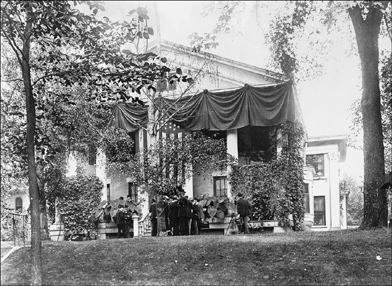
“ITS WHITE PILLARS WERE HIDEOUSLY SWATHED IN BLACK.”
The Wilcox Mansion, Buffalo, September 1901
Even now, the only spectators in Delaware Avenue were two platoons of mounted police, a knot of reporters, and a teenage girl. Roosevelt exploded with rage at the sight of the troopers. “I told you I did not want an escort!” he roared at the State Inspector General. He was clearly overwrought, and had to be coaxed to accept a few troopers around his carriage.
To swelling cries of “Roosevelt is coming! Roosevelt is coming!” the carriage sped north to Milburn House. He jumped out in precipitate fashion, then, recollecting himself, advanced across the lawn with bowed head. The dapper figure of George Bruce Cortelyou, McKinley’s secretary, came out to meet him. Roosevelt removed his hat. They talked gravely for a few seconds. Cortelyou, whose normally sleek, fortyish features were ravaged with grief and exhaustion, explained that an autopsy was being performed upstairs. Roosevelt would not be able to see the body. Mrs. McKinley was too prostrated to receive him. Senator Hanna was nowhere to be seen—he had limped off mumbling something about possible “misconstruction” if he attended the inaugural ceremony. Secretaries Hay and Gage were in Washington, looking after the government. The rest of the Cabinet was waiting in the parlor. Hat in hand, Roosevelt followed Cortelyou inside.
SIX SOLEMN FIGURES rose to greet him. A voice called out, “The President of the United States.” It was the first time he had heard the phrase in reference to himself. But its drama did not register, so intent was he upon behaving correctly.
After formal handshakes, he stood listening to the familiar hoarse murmur of Elihu Root, Secretary of War. How often had this authoritative figure, this severe face under the ridiculous fringe, bent over him in fatherly advice! Root—“the brutal friend to whom I pay the most attention”—had been one of the group of eminent New Yorkers that supported his entry into politics, seventeen years ago. Root, lawyer without peer, had hornswoggled the Saratoga convention into overlooking his technical ineligibility for the gubernatorial nomination. Time and again, the rising politician had submitted hot speeches to Root’s icy scrutiny, always with bracing results. He even enjoyed the deadly Root wit, though it bruised his ego.
Now, however, Roosevelt was senior. He politely rejected Root’s recommendation of an inauguration on the spot, saying it would be “more appropriate” elsewhere. The Secretary bowed assent.
Returning to his carriage, Roosevelt was driven back the way he had come. Root and the other Cabinet officers followed in separate carriages, with reporters running behind them.
A STRANGE HOTHOUSE glow filled Ansley Wilcox’s green library as Roosevelt entered it alone. From now on, he would have to get used to deference whenever he crossed a threshold. The luminescence came from a stained-glass window, fringed with sunny ivy. He chose this bright spot for himself, and watched the Cabinet officers filing in. Cortelyou arranged them in arcs to left and right, while a federal judge, John R. Hazel, stood in the center of the room. Loeb, acting as doorman, admitted a selection of local dignitaries. Among them Roosevelt recognized Senator Chauncey Depew (R., New York), looking humble for once, doubtless regretting how he used to tease “Teddy” about wanting to be President. Next, Loeb beckoned in representatives of the three press agencies, and, in a final relaxation of proprieties, a small party of women.
Some constitutional documents were given to Judge Hazel, who shuffled them into order. Roosevelt gazed around the library. A glint in his spectacles betrayed displeasure. Loeb came up inquiringly, and there was a whispered conversation in which the wordsnewspapermen and sufficient room were audible. Hurrying outside, Loeb returned with two dozen delighted scribes. They proceeded to report the subsequent ceremony with a wealth of detail unmatched in the history of presidential inaugurations.
The library clock struck 3:30. Elihu Root muttered something urgent to Roosevelt, then took up his position. There was a moment of extreme quietness, broken only by the chirp of a sparrow in the window. Roosevelt half turned, and gazed almost yearningly through the glass, a boy trapped in school. Root’s voice reclaimed his attention.
“Mr. Vice President, I—”
The Secretary of War choked, sobbed, and for a full minute struggled to control himself. Roosevelt’s face was stern, but as the suspense mounted his cheek muscles began to twitch, and his right foot pawed the floor. At last, Root managed to continue. “I have been asked, on behalf of the Cabinet of the late President … to request that, for reasons of weight affecting the administration of the government, you should proceed to take the constitutional office of the President of the United States.”
Roosevelt bowed, cleared his throat, and said waveringly, “I shall take the oath at once.” He, too, seemed to be fighting tears, but his voice grew rapidly stronger: “And in this hour of deep and terrible national bereavement I wish to state that it shall be my aim—” (here he shook his shoulders and pulled back his head) “—to continue absolutely unbroken the policy of President McKinley for the peace, the prosperity, and the honor of our beloved country.”
This speech, the shortest inaugural anybody could remember, created a profound impression. It struck all present as “pledge, platform, and policy all in one.” Roosevelt spoke with characteristic passion, punctuating his words with dental snaps, as if biting the syllables out of the air. He seemed to vibrate with force, sincerity, and reverence for the memory of his predecessor. To one observer, he symbolized “the magnificent moral and mental balance of the nation.” His statement “instantly solved the political and commercial crisis.” Finance, in the person of John G. Milburn, grew calm. Industry, in the person of Chauncey Depew, was comforted. And Government, in the persons of the Cabinet officers, breathed a collective sigh of relief.
Roosevelt was to receive worldwide praise for his few words. Yet they were not original. Elihu Root had suggested, sotto voce while the clock was chiming, that he “declare his intention to continue unbroken the policy of President McKinley for the peace, prosperity, and honor of the country.” Roosevelt’s parrot memory had preserved the words intact.
Judge Hazel clutched an inscribed parchment. “Please raise your right hand and repeat after me: I, Theodore Roosevelt…” Roosevelt’s arm shot up, fully extended. Throughout the oath, his hand remained high and steady, as if carved from marble. His face was drawn, and his eyes glittered. Depew was struck by the “terrible earnestness” with which he articulated every word. Yet even at this moment of ritual fidelity to the text of the Constitution, Roosevelt could not resist adding a personal flourish. “And thus I swear,” he concluded, ejaculating the words like bullets. Then he bowed his head.
Two minutes ticked by. The room filled with an almost unbearable tension. Beads of sweat stood on Roosevelt’s brow. Not until a third minute elapsed did he look up.
“Mr. President,” the judge said, holding out the certificate of oath, “please attach your signature.”
Roosevelt’s pen scratched across the parchment. Forty-three persons stood in thrall until he dismissed them with a kingly nod. They trooped out dreamy-eyed, as from a perfect theatrical performance. “I have witnessed many of the world’s pageants in my time,” Senator Depew said afterward, “—fleets and armies, music and cannon, … but they all seemed to me tawdry and insignificant in the presence of that little company in the library of the Wilcox house in Buffalo.”
ROOSEVELT REMAINED BEHIND to shake hands with members of his Cabinet. Asking them to prepare for an immediate meeting, he went into the hall to receive the farewells of departing guests. “God bless you, Mr. President.” “The whole country will pray for you, Mr. President.” There were tears on many faces, but he seemed unmoved.
A reporter was struck by Roosevelt’s “curious nervous tension,” so at odds with his usual boyish good cheer. “The cause of it was not at all any sense of the weight of his new position … but the reaction of a strong man to the idea that he was entering a domain where assassins lurked in the shadows and the ground might open at any moment under his feet.”
The Cabinet meeting proceeded behind closed doors. Afterward Roosevelt came out onto the porch to announce that all six officers had agreed to remain in their positions, “at least for the present.” He had similar “assurances” from his two absent Secretaries, John Hay and Lyman Gage. This was true, in the sense that both men had wired messages of support. But until he saw them in Washington, he hardly knew what their “assurances” were worth.
Business completed, Roosevelt put on his borrowed silk hat. “Let’s take a walk,” he said to Elihu Root. “It will do us both good.” A quartet of policemen fell into line behind him on the gravel path. Irritatedly, he shooed them away. “I do not want to establish the precedent of going about guarded.” The policemen touched their helmets, retreated a yard or two, and followed as before. Roosevelt headed for the gate like an escaping bull, but found Delaware Avenue blocked by cordoned-off crowds. He was forced to take leave of Root in the street, and marched back to the mansion in frustration.
Refuge was at least available in the morning room, where Cortelyou had laid a desk with pencils, an exercise book, and a copy of Messages of the Presidents. Turning to a proclamation of President Arthur, Roosevelt drew the rough pad toward him. He began to scrawl his first presidential order, making 19 September a day of official mourning. God in his infinite wisdom … The pencil hovered, then slashed back through the cliché. A great and terrible bereavement, it wrote instead, has come upon our nation. Roosevelt tried to make the last words more personal: has befallen our people. The President of the United States has been struck down.… How to describe the act of assassination? A foul and dastardly crime … the basest of all crimes … a crime so dastardly …
He struggled to reconcile his love of strong language with the need for dignified expression. It had always been thus with him: conflict between belligerence and civilized restraint, between animal brutality and human decency, between pessimism and optimism, or, as his perceptive friend Owen Wister put it, “between what he knew, and his wish not to know it.” In youth, the aggressive impulse had predominated, but in maturity he had strengthened himself to a state of containment, like a volcano sheathed in hardened lava. For three years there had been no serious fissures. At any rate, his struggle today was brief. The sentences began to shape themselves into statesmanlike prose, and soon the pencil was moving confidently. Now, therefore I, Theodore Roosevelt, President of the United States …
AT FOUR O’CLOCK, word came that Mark Hanna’s carriage was outside. Roosevelt hurried onto the porch and watched the old man descend, trembling on a cane. Hanna was clearly broken by the death of his adored “William.” He was pallid and stooped, and his piggy feet dragged in the gravel. “The Senator,” a reporter scribbled, “seems to have aged ten years in the last twenty-four hours.” With spontaneous grace, Roosevelt ran down to meet him, hand outstretched. Hanna was surprised and moved. Shifting his soft white hat and cane, he returned the gesture. “Mr. President, I wish you success and a prosperous administration, Sir. I trust that you will command me if I can be of service.” Roosevelt smiled and murmured a few sympathetic words about McKinley. He helped Hanna up the steps, and said, “I want your friendship.”
Seated inside, Hanna resisted further blandishment. He said that he would support the Roosevelt Administration only as long as it remained an extension of McKinley’s. As to the question of the Republican presidential nomination in 1904, that was “something for the future to decide.” Roosevelt replied, “I understand perfectly,” and escorted the Senator back to his carriage. Hanna drove away without so much as a wave.
That evening, George Cortelyou announced that there would be a private memorial service for McKinley at the Milburn House the next morning, Sunday. Roosevelt and his Cabinet officers would attend, and remain in Buffalo until Monday morning, when a funeral train would depart for Washington. On Tuesday, there would be further memorial exercises at the Capitol, followed by an interment ceremony Wednesday in Canton, Ohio. Mrs. McKinley would vacate the White House at her convenience. In the meantime, Roosevelt would stay at his sister’s house on N Street.
While Cortelyou talked, Roosevelt ate an early dinner, then went exhausted to bed.
SOMETIME AFTER MIDNIGHT in New York City, three hundred miles away, John F. Schrank began to dream. He was twenty-six years old, short, and reclusive. He lay above a saloon that had employed him once, before the Sunday-closing crusade of Police Commissioner Theodore Roosevelt. Since that crusade (and because of it, Schrank believed), he had been unable to get a job.
Now, as he dreamed, his shabby surroundings were transformed into a funeral parlor full of flowers. An open coffin stood before him. President McKinley sat up in it and pointed to a dark corner of the room. Schrank, peering, made out a man in monk’s raiment. Under the cowl were the bespectacled features of Theodore Roosevelt.
“This is my murderer,” said McKinley. “Avenge my death.” Schrank woke, and checked his watch. 1:30 A.M. Almost immediately, he went back to sleep. McKinley did not speak to him again that night. Indeed, the appeal would not be renewed for another eleven years—until the same hour of the same night of the week, in another gruesome September.
Sunday
ROOSEVELT AWOKE REFRESHED early the next morning. “I feel bully!” He went out onto the porch for some air, unaware that he was being minutely observed through the fence. His tanned skin stretched over his jutting jaw. His teeth gleamed through thick, half-parted lips. His neck, too squat for a standing collar, merged with weight-lifter shoulders, sloping two full inches to the tip of his biceps, and his chest pushed apart the lapels of his frock coat. He tugged at his watch chain with short, nervous fingers, shifting his small, square-toed shoes. Here, palpably, was a man of expansive force. When he breathed, the porch seemed to breathe with him.
Breakfast, laced as usual by vast infusions of caffeine, served only to stoke Roosevelt’s energy. A sheaf of congratulatory telegrams further stimulated him: one read simply, VIVE LE ROI. He managed to look solemn on the way to Milburn House, but his mind was seething with politics. During the memorial service, he caught sight of Herman H. Kohlsaat, publisher of the Chicago Times-Herald, and whispered urgently, “I want to see you.”
Kohlsaat followed him back to the Wilcox Mansion. He was shown into the library, and found Roosevelt exchanging compliments with a beaky, fortyish professor from Princeton. “Woodrow, you know Kohlsaat, don’t you? Mr. Kohlsaat, let me introduce you to Woodrow Wilson.” The professor bowed out. Roosevelt got straight to the point.
“I am going to make two changes in my Cabinet that I know will please you,” he said. Kohlsaat began to preen. He was a journalist of large influence, and even larger vanity. But what he heard next did not please him at all. “I am going to let John Hay go, and appoint Elihu Root Secretary of State,” Roosevelt said. “I am also going to ask Lyman Gage for his resignation.”
Actually, Roosevelt had no intention of firing either Hay or Gage. On the contrary, he was worried by continued reports that they would resign as soon as he got to Washington. The presence in Buffalo of Kohlsaat, who knew both men well, came as a godsend. Roosevelt had long since perfected the art of manipulating newspapermen. Kohlsaat rose to his herring like a trained seal.
|
KOHLSAAT |
John Hay is an old friend of mine.… What have you against Lyman Gage? |
|
ROOSEVELT |
(teeth snapping) He always gets his back up against the wall, and I can’t get around him. |
|
KOHLSAAT |
Don’t you know I am responsible for Mr. Gage being in the Cabinet? … Yesterday, when you were sworn in, you issued a statement that you were going to carry on McKinley’s policies, and now you propose to fire his Secretary of State and Secretary of the Treasury! |
|
ROOSEVELT |
(after a pause, falsetto) … Old man, I am going to pay you the highest compliment I ever paid any one in my life. I am going to keep both of them! |
Compounding the flattery, he invited Kohlsaat to accompany him to Washington the next day. “The only other friend I have on the train is Elihu Root.” Then, casually: “Gage does not like me. I want you to wire him to meet you at your hotel on our arrival and tell him he must stay for a while, at least, and I want you to see the Associated Press man and ask him to send a dispatch that when we reach Washington tomorrow night I am going to ask Hay and Gage to remain in the Cabinet.”
Kohlsaat bustled off feeling he had managed to sway the rods of power. Had he understood the subtleties of Rooseveltian press relations, he might have seen that he had been tricked into making a personal appeal to Gage. The AP dispatch would also forestall any possible resignation statement by Hay. Neither man could then quit without appearing disloyal to Roosevelt, and to the unfinished agenda of William McKinley.
Roosevelt’s move was well-timed. Even now, in Washington, the Secretary of State was composing a letter that read like a valedictory.
SEPT. 15, 1901
My dear Roosevelt: If the Presidency had come to you in any other way, no one would have congratulated you with better heart than I. My sincere affection and esteem for you, my old-time love for your father—would he could have lived to see where you are!—would have been deeply gratified. And even from the depths of the sorrow where I sit, with my grief for the President mingled and confused with that for my boy, so that I scarcely know, from hour to hour, the true source of my tears—I do still congratulate you, not only on the opening of an official career which I know will be glorious, but upon the vast opportunity for useful work which lies before you. With your youth, your ability, your health and strength, the courage God has given you to do right, there are no bounds to the good you can accomplish for your country and the name you will leave in its annals. My official life is at an end—my natural life will not be long extended; and so, in the dawn of what I am sure will be a great and splendid future, I venture to give you the heartfelt benediction of the past.
God bless you.
Yours faithfully,
JOHN HAY
Monday
16 SEPTEMBER DAWNED so bright that Buffalo’s heavy black drapery looked inconsequential, even tawdry, against the overwhelming blueness of lake and sky. A stiff breeze snapped thousands of half-mast flags. At shortly after 8:15, Roosevelt, escorted by a small troop of mounted policemen, rolled down Delaware Avenue on his way to Exchange Street Station. Presently, windblown fragments of music heralded the approach of McKinley’s cortege from City Hall. Roosevelt ordered his procession to follow at a respectful distance. He stood watching at the station entrance as soldiers unloaded the coffin and carried it inside. “Nearer My God to Thee” sounded inevitably from the band. Mrs. McKinley was escorted onto the platform, a frail figure almost hidden by black-clad relatives. Then Roosevelt stepped forward. He seemed surprised at the sight of a huge, mute crowd. Unthinkingly, he waved his hat. Before boarding the train, he groped for Herman Kohlsaat in the press party and hissed again in his ear. “Did you send that telegram to Gage?”
THE FUNERAL TRAIN, courtesy of the Pennsylvania Railroad, consisted of two black-draped locomotives—one, with a particularly sad whistle, to steam ahead as pilot for the other—plus a baggage car, a saloon car, and five sumptuous Pullmans. Reporters were assigned to the first of these, Senator Hanna and other dignitaries to the second, Roosevelt and his Cabinet to the third. The fourth carried George Cortelyou and members of the McKinley family. Officially speaking, Cortelyou was now Roosevelt’s personal secretary, but as long as Mrs. McKinley depended on him, he was pleased to defer to Loeb. The fifth and final car, a glass observation parlor, acted as a catafalque: McKinley’s coffin rode inside on a bed of flowers.
At 8:57, the train began to move. Church bells tolled across the city. Thousands of onlookers crowded every platform, stairway, bollard, and bridge. From sheds and warehouses along the track, grimy workmen emerged to squint and stare. The avid scrutiny of all these eyes was too much for Roosevelt. He ordered his blinds drawn—but not so soon as to miss the sight of workmen hurrying back to their jobs after the train had passed them by. For a while he sat alone, waiting for the liberating sense of acceleration into open country.
What he had just observed—evidence of America’s passion for work, its impatient refusal to loiter a moment longer than necessary—was pleasing, if not surprising. For several years, both he and the world had been aware that the United States was the most energetic of nations. She had long been the most richly endowed. This first year of the new century found her worth twenty-five billion dollars more than her nearest rival, Great Britain, with a gross national product more than twice that of Germany and Russia. The United States was already so rich in goods and services that she was more self-sustaining than any industrial power in history.
Indeed, it could consume only a fraction of what it produced. The rest went overseas at prices other exporters found hard to match. As Andrew Carnegie said, “The nation that makes the cheapest steel has other nations at its feet.” More than half the world’s cotton, corn, copper, and oil flowed from the American cornucopia, and at least one third of all steel, iron, silver, and gold.
Even if the United States were not so blessed with raw materials, the excellence of her manufactured products guaranteed her dominance of world markets. Current advertisements in British magazines gave the impression that the typical Englishman woke to the ring of an Ingersoll alarm, shaved with a Gillette razor, combed his hair with Vaseline tonic, buttoned his Arrow shirt, hurried downstairs for Quaker Oats, California figs, and Maxwell House coffee, commuted in a Westinghouse tram (body by Fisher), rose to his office in an Otis elevator, and worked all day with his Waterman pen under the efficient glare of Edison lightbulbs. “It only remains,” one Fleet Street wag suggested, “for [us] to take American coal to Newcastle.” Behind the joke lay real concern: the United States was already supplying beer to Germany, pottery to Bohemia, and oranges to Valencia.
As a result of this billowing surge in productivity, Wall Street was awash with foreign capital. Carnegie calculated that America could afford to buy the entire United Kingdom, and settle Britain’s national debt in the bargain. For the first time in history, transatlantic money currents were thrusting more powerfully westward than east. Even the Bank of England had begun to borrow money on Wall Street. New York City seemed destined to replace London as the world’s financial center.
It was hard to believe that the United States had struggled out of a depression only five years before. Prosperity was everywhere for Roosevelt to see—if not through drawn blinds at the moment, then memorably on his recent trip to Minnesota. The weather-stained barns of poorer days, the drab farmhouses and blistered grain elevators, were pristine with new paint. He had seen corrugated dirt giving way to asphalt, rotten boardwalks smoothing to stone, shards of shacks pushed aside by new redbrick houses. Not so long ago, Midwestern towns had glowed dully at night, if they glowed at all. Now they were constellations of electricity, bright enough to wake the sleeping traveler. Equally bright, by day, were silver threads of irrigation in the green fields, and new, steel-roofed sheds and schoolhouses.
Behind Roosevelt now (he could reopen his blinds, as the train gathered speed), Buffalo receded into a cyclorama of modern industrial development. Louis Sullivan’s “skyscraper,” the Prudential Building, bespoke a modern, defiantly native school of architecture. Scores of dockside cranes dipped and reared like hungry pterodactyls. Horseless carriages trailed plumes of dust and engine smoke in and out of town. Hydroelectric-plant towers loomed against the mists of Niagara, sending invisible thrills of power through the industrial suburbs. Wherever the sun shone, it glinted on countless telephone and telegraph wires, weaving block to block in warps and woofs of copper.
Trees soon barred Buffalo from sight, but the wires pursued the train effortlessly, rising and falling from pole to pole. Already news of Roosevelt’s departure had flashed along them, flickering into every corner of the land. Wires like these, connecting with other wires in Albany and yet more wires in the Adirondacks, had summoned him from the peak of Mount Marcy. In about twelve hours, they would broadcast the details of his arrival in Washington.
EMPTY LAKESIDE LAND BEGAN to roll by. Roosevelt relaxed with the morning newspapers. Almost every editor in the country, it seemed, approved of his promise to continue “unbroken” the policies of President McKinley. The New York Herald featured an on-the-spot sketch of him taking the oath, hand held high, saying that he deserved “golden praise.” The Albany Journal and The Washington Post contributed their share of fine ounces. The New York Sun, banner journal of business conservatism, hailed his “responsible” desire to keep the Cabinet intact. “Nothing so sobers a man as the possession of great power.”
The funeral train slowed to ten miles an hour as it approached Aurora, first village on the line. Farmworkers crowded the embankment, doffing their hats to the passing catafalque. Schoolchildren knelt in the cinders, holding up streams of black bunting. Thinly, through the hiss of steam and rumble of wheels, came the sound of their voices singing:
Nearer my God to Thee,
Nearer to Thee …
The train did not stop. Accelerating again, it moved out of the flat country into a narrow valley splotched with red maple trees. Roosevelt returned to his newspapers.
The foreign papers indicated that British opinion was in his favor. Even The Times, which had been critical of him during his bellicose Navy Department days, said that he had “great gifts” as a leader, and hoped that his “impulsiveness” was a thing of the past. The Daily Chronicle welcomed him as a benign, if formidable, new force in world affairs. “He believes in a big America. He is an expansionist and an imperialist, … [but] we are safe in thinking that this youngest of Presidents will prove one of the greatest.”
Continental comment was reported to be cooler. Misgivings about Roosevelt’s peculiar brand of Pan-Americanism had been expressed in both Paris and St. Petersburg. In Berlin, the Kreuz-Zeitung feared that the new President might be “anti-German.” But theNeueste Nachrichten recalled that as a teenager he had lived and studied with a Dresden family. Surely this meant that he would have more sympathy than his predecessors for the Teutonic point of view.
On one thing most nations were agreed: under Theodore Roosevelt, American sea power was sure to burgeon rapidly. The man who had prepared Admiral Dewey for Manila Bay was unlikely to let the United States Navy remain fifth in the world.
LOEB ANNOUNCED THE Secretary of War. Roosevelt willingly cast aside his newspapers. Elihu Root was the one person on the train he felt he could talk to freely. Soon, both men were deep in conversation, swaying in their seats as the train sped south. About 9:30, its momentum slowed so that a farm boy was able to race it through the fields, waving a flag. The outbuildings of Arcade, N.Y., came into view, followed by a little railroad station. Almost reluctantly, the train stopped. About twenty Grand Army veterans snapped to attention on the platform. Their ancient tunics looked pinched and trussed, but they held themselves stiff with respect for a fallen comrade. A few much younger soldiers stood to one side. Their uniforms were intimately familiar to Roosevelt: he had worn that khaki himself (hand-tailored by Brooks Brothers) in the Spanish-American War. He drew the blinds, afraid they might salute him rather than McKinley.
For ten minutes, while the locomotive took on water, Roosevelt and Root sat in semidarkness, listening to the sound of a band playing “Nearer My God to Thee.” Evidently they were to hear little else on their long way to Washington. Between strophes, there was a crunch of boots in the gravel, and an old soldier’s voice called quaveringly: “We’re all heartsore for Major McKinley.”
Much as Roosevelt coveted the respect of Grand Army veterans, he knew they would never love him as they had loved his predecessor. McKinley had marched with them at Antietam, when “Teedie” Roosevelt had been but a child in a zouave suit. A gulf, not merely of years but of ideology, separated him from these heroes of the past. They had fought to preserve the Union; he had fought to create a world power. The old soldiers had cheered when the young soldiers liberated Cuba, but they fell silent when similar “freedoms” were imposed on Puerto Rico, Guam, and the Philippines. They had watched with worried eyes as the Stars and Stripes rose over Hawaii, Wake Island, and half of Samoa, and Secretary Hay began negotiations to purchase the Danish West Indies. Was their beloved republic, they asked, taking on the trappings of an imperial power?
The ideological gulf had yawned even wider when the young soldiers persuaded McKinley that occupation of Spain’s former colonies should continue well beyond armistice. Cuba and Puerto Rico would need two or three years to perfect new constitutions and build independent economies. The Philippines would need much longer, half a century perhaps. Seven million largely illiterate tribesmen could not be left to govern themselves without reverting to the laws of the jungle.
Powerful commercial, strategic, and moral arguments to this effect had been advanced by the young soldiers—Theodore Roosevelt prominent among them—campaigning for McKinley’s re-election. They had trumpeted the islands as new markets for America’s superabundant production, cited naval research in favor of a global defense system, and looked to Congress to ensure that America would hold on to what the Supreme Court euphemistically called its “unincorporated territories.”
The old soldiers remained fiercely opposed to expansionism. They asked how a nation that had won its own independence in a colonial war could force dependence upon others. They rejected McKinley’s assurance, “No imperial designs lurk in the American mind.” So did most intellectuals, and Democrats looking for an issue to break the Republican Party. As yet this anti-imperialist lobby remained a minority, but its numbers were growing, and its propaganda was powerful. Roosevelt could see the day when it might paralyze his foreign policy.
“World duties,” he felt, were the inevitable and welcome consequence of America’s aggrandizing power. Old men and “mollycoddles” had no understanding of the huge historical forces at work. Just two weeks ago in Minnesota, he had dismissed the cliché that all great nations come to dust:
So they have; and so have all others. The weak and the stationary have vanished as surely as, and more rapidly than, those whose citizens felt within them the lift that impels generous souls to great and noble effort. This is only another way of stating the universal law of death, which is itself part of the universal law of life.…
While the nation that has dared to be great, that has had the will and the power to change the destiny of the ages, in the end must die, … [it] really continues, though in changed form, to live forever-more.
His vision was too grandiose to be merely territorial. He had no interest in square miles as such. Expansion, to him, meant a hemispheric program of acquisition, democratization, and liberation. Cuba, for example, was already eligible for freedom (of sorts) and should have it (in a way) as soon as Congress worked out a policy for tariff reciprocity with the island. Puerto Rico was semi-independent, in the sense that Secretary Root had ended the military government there and given most powers to a native legislature. The real problem was what to do about the Philippines. “Sometimes,” Roosevelt confessed, “I feel it is an intensely disagreeable and unfortunate task which we cannot in honor shirk.”
Clearly, a vast, primitive archipelago, divided by seven thousand waterways, seventy dialects, and the world’s most mutually incompatible religions—Christianity and Islam—needed an authoritarian government to hold it together. If not America’s, whose? There were also reasons of strategy to consider. Given half a chance, base-hungry powers such as Germany or Japan would annex and enslave the islands in perpetuity. The United States could at least be trusted not to hold them a day longer than democratic scruples required.
President McKinley’s enduring ambition was noble, yet Filipinos seemed ungrateful. Rebellion had been raging on the archipelago for almost two years; Root needed a seventy-thousand-man army to control it. Some measure of peace had at last been achieved. Today’s papers were blessedly free of bad news from “over there.” But neither Roosevelt nor Root cared to speculate what nice, clean-cut American boys were doing to keep that peace.
THE TRAIN BEGAN to move again. Root took his leave, and Roosevelt finished going through the newspapers. Great Britain offered “sincere expressions of sympathy” to the “bereaved” United States. No doubt the sympathy was sincere—an Anglo-American rapprochement had been under way for at least three years. Moscow confirmed another plot to assassinate Tsar Nicholas II—in Marseilles, of all places. One would have expected it rather in Tokyo: the most dangerous current rivalry in the world was that between Russia and Japan.
Both powers were circling like wolves about that sick mammoth, China. Their first snap and snarl would probably be over the mammoth’s Manchurian extremity, Kwangtung Province. Other wolves were on the prowl: German ones trailing the Russian pack, British behind the Japanese. America had its own “Open Door” trade relations with China to protect, and a corollary pledge to “preserve Chinese territorial and administrative integrity.” Roosevelt’s instinct was to stand watchfully aside for the moment. He might one day have to leap in—as into those hounds in Colorado!—and sort out the predators with his bare hands.
Worldwide, the balance of power was to his advantage. As long as Kaiser Wilhelm II of Germany (his likely enemy, he felt, in any foreseeable war) remained preoccupied with the Tsar, and the Tsar and the Meiji Emperor of Japan continued to mass forces around Kwangtung, the President of the United States could surely perfect a partnership with King Edward VII to control the Western Hemisphere. Of course, he must do most of the controlling. The United States acknowledged Britain’s dominion of Canada (what a pity, he always felt, that President Polk had not “taken it all” in 1846!), but he intended to end, once and for all, a languid argument about the southern Alaskan boundary line. “I have studied that question pretty thoroughly and I do not think the Canadians have a leg to stand on.” They were entitled to the few miles of coast that were theirs by treaty, and not a pebble more.
This was the only issue dividing the English-speaking powers. Elsewhere, there was benign assent. Britain seemed willing to accept the Monroe Doctrine, which Roosevelt, on the whole, held in greater reverence than the Nicene Creed. Lord Lansdowne’s Foreign Office had forsworn any role, strategic or territorial, in the construction of a canal across Central America. The second Hay-Pauncefote Treaty, now at the point of ratification, approved American management of such a project, and granted the United States exclusive right to fortify the canal.
Roosevelt could claim a large share of credit for the latter clause. As Governor, he had been outraged by the first Hay-Pauncefote treaty, which had allowed for neutrality and openness of the canal in the event of war. His criticism had been outspoken, and had hurt John Hay, but the Senate had agreed with him. Now there was this new, tougher treaty. It gave the United States Navy freedom to maneuver through the canal in wartime, while preventing other belligerents from doing so. He looked forward to signing it as soon as Hay laid it on his desk.
There remained the question of where to build the canal: Nicaragua or Panama. Nicaragua was the overwhelming preference of Congress: old John Tyler Morgan, chairman of the Senate Committee on Interoceanic Canals, had been croaking its praises for a decade. Roosevelt privately favored Panama, despite the failure of French engineers there. But his public attitude must be noncommittal. All he could urge now was that the canal be dug by American hands, and the first spade sunk during his Presidency. The stupendous task was uniquely that of the United States: “We must build the Isthmian Canal, and we must grasp the points of vantage which will enable us to have our say in deciding the destiny of the oceans of the east and the west.” Otherwise, Germany might start digging. The thought of the Kaiser acquiring land rights anywhere in the Americas was enough to freeze Roosevelt’s blood. A presidential commission was studying the choice of route, once and for all. It would probably recommend Nicaragua, and he would abide by its decision.
Even so, Panama remained an attractive alternative. The Isthmus was at its narrowest there—fewer than forty miles from sea to sea—and his nature was to love shortcuts. There were rumors that the entire French operation, both equipment and excavations, would soon be for sale. And the political situation in Panama was promising. That reluctant appendix to Colombia was having one of its annual rebellions against the authority of Bogotá—the forty-eighth or forty-ninth, by Roosevelt’s count. Since Colombia was itself waging war against Venezuela, there was a chance that, for once, Panama might succeed. If so, the rebels would surely offer their canal route to the United States, in exchange for a share of revenue and guaranteed independence from Colombia.
THE ALLEGHENY FOOTHILLS turned black and greasy near Olean. Discarded oil drums dribbled into Cuba Lake. The very ground seemed to ooze. Here, in 1627, Franciscan explorers had discovered a spring of “thick dark water that burned like brandy.” Later settlers found this same crude seeping out of rocks all over the Alleghenies. They had cursed it as poison for the soil, until Indians persuaded them it was medicinal. Roosevelt himself came from a generation of children who had been rubbed with evil-smelling “rock oil” whenever they had chest colds.
Olean Valley now was a landscape inconceivable to its discoverers. The slopes bristled with filthy derricks and flaming chimneys. Double-headed pumps toggled crazily, sucking tarry sludge out of the earth. High in the sky floated an oily miasma that seemed to drain the world of color.
Apocalyptic though the scene was, Roosevelt was aware of something more disturbing above and beyond it all, “a new and dark power” that shadowed every prospect in American life. The power had its source in a contract between executives of the industry he looked upon, and the carrier transporting him.
Nearly thirty years before, the Standard Oil Company and the Pennsylvania Railroad had pledged:
The party of the second part will pay and allow to the party of the first part … rebates … and on all oil transported for others, drawbacks.
Those simple words introduced a new concept—un-American to some—of privilege in commerce, bestowing rewards upon the large at the expense of the small. Both parties excused the contract by saying it would prevent “loss or injury by competition.” If they thus blasphemed against the gospel of free enterprise, Standard Oil, at least, was unrepentant. What, John D. Rockefeller wanted to know, was so holy about competition? Did it not lead to unrealistic rate-cutting, cycles of overproduction and depression, and needless duplication of services? What interdependent industries needed was less competition, and more “cooperation.”
Rockefeller’s rebate privilege had been too flagrant to survive under law. But it was followed, over the years, by sophisticated arrangements to the same effect. Standard Oil had engulfed its smaller rivals, while the Pennsylvania Railroad made similar deals with other industries, and became one of the richest transport systems in the country.
Presidents Cleveland, Harrison, and McKinley paid little attention to the phenomenon of Combination. To them, it seemed a natural economic trend. If industries produced vital supplies, if railroads functioned as semipublic utilities, why restrict their profitable development? Only slowly, and locally, had ordinary Americans—workers, consumers, and small businessmen—begun to feel the “dark power” growing. For Combination’s irresistible tendency was toward Monopoly; and whatever corporate executives might say about increased efficiency and reduced waste, the historic inclination of Monopoly was to raise prices and lower wages.
Standard Oil had taken early steps to protect itself against common-law suits—and, in doing so, had perverted one of the most sacred words in the legal vocabulary. It reorganized its component corporations into a “trust,” whereby all stocks were delivered to an independent board, which then operated the entire combination in unison. Congress had no power to quash this move. Within nine years, John D. Rockefeller had “entrusted” himself with 90 percent of the oil-refining business of the United States.
His profits were so fabulous that other industrial giants had rushed to organize interstate “trusts” of their own. Congress, responding to public concern, had passed the Sherman Antitrust Law of 1890. It declared illegal “every contract, combination in the form of trust, or conspiracy in restraint of trade or commerce among the several States.” But the Law was too comprehensive to be particular. Corporate lawyers (Elihu Root prominent among them) elaborated the trust concept into that of a “holding-company” chartered in one hospitable state, yet monopolizing related corporations throughout the nation. Holding-company directors concerned themselves with questions of finance, so the lawyers argued they were unengaged in “trade or commerce.” The Supreme Court had agreed reluctantly with this argument, and had ruled in U.S. v. E. C. Knight Co. (1895) that a trust controlling 98 percent of the nation’s sugar-refining business was legal, since refining was not itself an interstate activity.
The depression of the mid-nineties had cramped trust growth. But combination, aided by the spread of the telephone-telegraph web, resumed with a vengeance after the war with Spain. In 1898, there had been twenty multimillion-dollar industrial trusts; now, there were one hundred and eighty-five. The proliferation evoked an image, in many minds, of a constrictive organism stretching out to every extremity of American civilization. Hence the title of Frank Norris’s new antitrust novel: The Octopus.
These trackside mourners of Olean Valley, staring blindly at Roosevelt as he whizzed by—how enmeshed were they? The oil trust paid their wages. Other trusts carpeted their houses, papered their walls, piped their water, sluiced away their sewage. Trust ice cooled them in summer, trust wool warmed them in winter—as did trust whiskey. These men chewed trust tobacco, and checked trust watches. These women baked trust flour and cooked trust beef in trust stoves full of trust coal. These children chewed trust gum and scribbled on trust slates. Roosevelt himself had trusts to thank for the starch in his shirt, the type on his newspapers, the glass of his window, the rails under his wheels. Poor dead McKinley, two cars back, was jiggling in a trust coffin: what might a cynic make of that!
Ideologically, Roosevelt was committed to a conservative view of the trusts. Personally, he felt a certain ambivalence. He saw “grave dangers” in unrestricted combination, yet he could not deny that the economy functioned better now that the trusts were, in effect, running it. The price of kerosene, for example, had been declining for thirty years, courtesy of Standard Oil. America was no longer a patchwork of small self-sufficient communities. It was a great grid of monopolistic cities doing concentrated business with one another: steel cities and rubber cities, cities of salt and cloth and corn and copper. Just beyond these hills was a place that actually called itself Oil City! American exporters did not need a book of vouchers to dispatch one consignment across a rickety grid of independent railroads, each with its own timetable, rates, and reliability quotient. Now one ticket sped a million tons to either coast on flawlessly synchronized trains. At every port, trust-operated ships were ready to ferry the consignment on. If freight charges were higher than they used to be, so was turnover, and so were profits.
According to a recent survey, at least 65 percent of the national wealth was attributable to the trusts. That statistic did not even include the newest and most gigantic combination of all, Andrew Carnegie’s merger of his steel company with nine others. United States Steel, capitalized at almost one and a half billion dollars and feeding more than one million people, was virtually a nation in itself. Its income and expenditures approximated those of the Second Reich. It, too, had a Kaiser, an emperor of finance, and if today’s newspapers were to be believed, Wilhelm II might soon cede him a portion of his realm: “Mr. John Pierpont Morgan is trying to get control of the German steamship lines.”
ROOSEVELT LIKED MORGAN. The solitary, bottle-nosed banker had been a friend of his father, and on that score alone merited affection. Even so, he did not know him well. Few did. Only Morgan’s immediate family, and the half-dozen handsome young aides who stood between him and the world (as if to screen his legendary ugliness) claimed that privilege. Governor Roosevelt had once denied Morgan tax exemptions on two railroads. He had tried to make amends with a testimonial dinner (“an effort on my part to become a conservative man, in touch with the influential classes”), but the financier remained unmollified. Roosevelt’s last letter to Morgan had been answered by a secretary.
So far, 1901 had been Morgan’s annus mirabilis. Along with his new billion-dollar trust, he controlled several banks, including the international House of Morgan, the Western Union Telegraph Company, the Pullman Car Company, Aetna Life Insurance, General Electric, Britain’s Leyland Steamship Lines, and twenty-one railroads. Control, indeed, was his passion—not the constant, clashing competition of the free market. As chairman of J. P. Morgan and Company, he handled more wealth than any other man on earth, and was capable of plunging the United States into a depression overnight—or rescuing it from one. Yet his greatest power derived from his integrity of character. One nod of the massive head was security for fifty million; one snort of the carbuncled nose was enough to sweep all opposition from his path. Review of Reviews saluted him as “the most masterful personality in the country, perhaps in the world.”
But now there was a challenger to that title, riding to Washington on one of the few Northeastern railroads Morgan did not control. Sooner or later, their personal trajectories must intersect, as surely as this Alleghany track was destined to run into those of the Susquehanna Valley. Roosevelt hoped that the confluence would be smooth. To his mind, the real threat posed by financiers such as Morgan lay not so much in their combination policies as in their virtual freedom—thanks to U.S. v. E. C. Knight—from federal regulation. Even President McKinley had talked of doing “something about the trusts.” Roosevelt himself had publicly warned:
The vast individual and corporate fortunes, the vast combinations of capital which have marked the development of our industrial system, create new conditions, and necessitate a change from the old attitude of the State and the nation toward property.… More and more it is evident that the State, and if necessary the nation, has got to possess the right of supervision and control as regards the great corporations which are its creatures.
He now stood committed to those words, uttered only two weeks ago at the Minnesota State Fair. Morgan’s philosophy was also on record: “I owe the public nothing.”
If they were indeed set on a collision course, Roosevelt was determined not to be the one derailed. Morgan may be master of United States Steel, but he was master of the United States Government—surely the greatest combination of all. National stability required that he maintain eminent right-of-way.
ELSEWHERE IN THE TRAIN, Senator Hanna was slumped, cursing the day that William McKinley accepted Theodore Roosevelt as his running mate. “Now look—that damned cowboy is President of the United States!”
Herman Kohlsaat came back to tell Roosevelt about Hanna’s despair. He suggested that the Senator be treated with utmost delicacy, for he had the power to block all White House initiatives during the coming session of Congress.
Roosevelt reacted blankly. “What can I do?” Kohlsaat suggested a flattering supper à deux in the presidential car.
AT FOUR MINUTES past eleven, the funeral train drew into Port Allegany, Pennsylvania, and stopped for a while to allow platform mourners to look at the dead President’s bier. Souvenir collectors laid nickels and pennies and flowers on the rails. When the wheels started to roll again, there was a crunching of coins, and the perfume of pressed roses filled the air. In future years, misshapen metal discs and bits of dried petal would remind the citizens of Port Allegany of McKinley’s last earthly journey.
THE STEEP CLIMB up Keating Ridge began. At times the locomotive seemed about to stall. Shortly before noon, it dragged its payload over the crest and with loud puffs of relief entered a winding valley. Hills crowded in on both sides. Then one cut gave way to the shaft of a coal mine, and for a few seconds Roosevelt and his fellow passengers could exchange stares with four hundred filthy coal miners.
Boys, youths, and old men (were they really old, or just toothless?) stood bareheaded, leaning on picks and shovels. Their small, smudged eyes (only the creases showing white), squat bodies, and tape-wrapped shins proclaimed them to be Slavs. It was impossible to tell from their swarthy expressions whether the sight of a presidential cortege moved them or not. Implicit in the stare of those eyes, the power of those knobbly hands, was labor’s historic threat of violence against capital.
Roosevelt knew that nowhere in America was the threat more real than in the Pennsylvania coalfields—the bituminous region he had just entered, and the anthracite region to east and south. Valley after valley, as the train snaked through, disclosed communities as squalid as any these people could have fled in Europe. Thousands of sooty shacks on stilts, with pigs tied below; gutters buzzing with garbage; mules clopping to the mineheads, hock-deep in fine gray dust. Beneath that dust, men were scrabbling in wet, gassy gloom, earning a dollar and change for every ton of coal they hacked. If 1901 turned out to be a good year, they might get five hundred dollars apiece—about what Roosevelt had already earned as President of the United States. In cash, they would realize perhaps a third of that—their wage packets were subject to compulsory deductions for rent, fuel, medical bills, and food supplied at inflated prices by the company store. As a group, they aged and ailed faster than any other workers in American industry.
These boys began their careers at eight or nine, picking splinters of slate out of the coal breakers until their hands were scarred for life. These men worked coal ten hours a day, six days a week. They ate coal dust in their bread and drank it in their milk; they breathed it and coughed it. At forty or forty-five, most were so ravaged by black-lung disease that they had to return to the breakers to pick slate with their grandchildren, contracting fresh black scars until they died.
Roosevelt understood enough about social repression to sense that today’s contempt for the unskilled worker was tomorrow’s likely revolution. Trade-union membership had more than doubled in the last five years. Sullen miners personally fueled most of the nation’s industrial machine. In his opinion, “the labor question” was the greatest problem confronting twentieth-century America, “the most far-reaching in its stupendous importance.” He had been saying so since the United Mine Workers (UMW) first struck the Pennsylvania anthracite mines in 1900. How worried Hanna had been that bloodshed might prevent McKinley’s re-election! The Senator had wheedled both sides to an interim contract. Today’s New York Sun noted that this modus vivendi was to expire in six months. Passion was building in the pits: if the UMW was not soon recognized as a bargaining agent by the mine operators, the next coal strike could be violent enough to obliterate memories of the Haymarket Riot.
Roosevelt had been violently inclined himself in Haymarket days. He had fantasized leading a band of riflemen against the rioters, and shooting them into submission. But middle age, and the democratizing effect of war, had moderated his attitude toward organized labor.
PILLARS OF HEMLOCK and pine rose on either side of the train, suffusing it in cool gloom. Here and there a shaft of light fell vertically (for the sun stood at noon), disclosing naves and transepts carpeted with needles, cloisters where deer and pheasants sought sanctuary from the hunting season.
Roosevelt was more prone to revere such natural architecture than any Gothic cathedral. Trees were objects of deep spiritual significance to him, especially when they were full of birdsong. He had stocked the bare slopes of Sagamore Hill with elms and chestnuts and oaks and dogwoods, faithful to his family motto, Qui plantavit curabit. The jungles of Cuba had made a soldier of him; the forests of Wyoming had brought him solace after the death of his first wife; the piney air of Maine had cut and soothed the asthma in his teenage lungs. Further back still, in boyhood, were memories of summer nights in the woods, and the sound of a beloved, bass voice reading Last of the Mohicans under fire-reddened branches.
I am sorry the trees have been cut down. Little Teedie Roosevelt had been nine when he wrote that, after some minor act of vandalism in Georgia. As an adult, what was he to make of the wasteland he now began to see in Pennsylvania? The Allegheny forest receded on both sides, leaving only stumps. Soon there was nothing but a fringe of trees on the highest ridges, beyond reach of any saw. Stumps, stumps, and more stumps perforated the landscape, like arrows snapped off in death agony. Most were blackened. Local lumberjacks wanted white pines only—less profitable trees could be burned like weeds. There were no saplings to be seen. With billions more trees beyond the horizon, replanting was a waste of time.
Descent via Emporium Junction and Driftwood revealed even worse devastation. Roosevelt had foreseen just such sterility when Governor of New York: “Unrestrained greed means the ruin of the great woods and the drying up of the sources of the rivers.” These hillsides, which for centuries had absorbed foliage-filtered rainfall, were now bare, gullied by direct precipitation. The courses running off them were choked with mud and dead fish.
A town sign flashed by: RENOVO. Edith had vacationed here as a child. The name—Latin for I renew—sounded mocking in these dying uplands of the Susquehanna. About the only renewal Roosevelt could see was a station repair yard, where flatcars were being overhauled to carry away more and more trees. He understood (as most Americans did not) the tendency of transport and industrial combinations to consume the environments they served. United States railroads owned more timberland than all the nation’s homesteaders.
To him, conservation—a term just becoming politically fashionable—meant “not only the preservation of natural resources, but the prevention of the monopoly of natural resources, so they should inhere in the people as a whole.”
IT WAS NEARLY time for lunch. Roosevelt ordered places laid for himself and the Secretary of War, and went to pay his respects to Mrs. McKinley. Ravaged, almost comatose with grief, she did not detain him long. By 1:30, he was back in his car and the congenial company of Elihu Root.
He felt at home with conservatives. Whether or not the term applied to himself, he owed his political advancement to men of Root’s type: wealthy Republicans who belonged to the Union League Club, read the North American Review, and were coldly polite to butlers. More conservative rhetoric followed after lunch, as the other Cabinet officers on the train came in one by one to see him. With the exception of Attorney General Philander Chase Knox, a polished little man of forty-eight, they were venerable figures. There was his old boss, Secretary of the Navy John Davis Long, portly and lumbering at sixty-three. Secretary of Agriculture James Wilson was sixty-six, Secretary of the Interior Ethan Allen Hitchcock sixty-five, Postmaster General Charles Emory Smith fifty-nine. Elihu Root was fifty-six. The two absent Secretaries, John Hay and Lyman Gage, were sixty-two and sixty-five respectively.
McKinley had chosen carefully: a more orthodox phalanx of Republicans would be difficult to assemble. To a man, these conservatives believed in the sanctity of property and the patrician responsibilities of wealth and power.
Their eyes were honest, but hard (Knox again the exception, with his veiled, astigmatic stare). They were accustomed to luxury travel on complimentary railroad passes, and a myriad of other corporate privileges. They were prepared, in return, to give trust lords such as J. P. Morgan their favorable support in disputes between capital and labor, or local and interstate commerce. They tacitly acknowledged that Wall Street, rather than the White House, had executive control of the economy, with the legislative cooperation of Congress and the judicial backing of the Supreme Court. This conservative alliance, forged after the Civil War, was intended to last well into the new century, if not forever. Senator Hanna was determined to protect it: “Let well enough alone!”
Roosevelt was too restless and too reform-minded to heed such a motto. On the other hand (to use his favorite phrase), he despised the theorists who advocated radical change. Not for him Eugene Debs’s vision of a society purged of aggression, with all citizens pooling their assets in a state of torpid bonhomie. He tended toward a biological view of the common man as a brute—albeit capable, with encouragement, of self-refinement. Years of sweaty acquaintance with cowboys, policemen, and soldiers had convinced him that their instincts were benign, that greater social efficiency was as much their desire as his. All they needed was enlightened leadership.
In a fundamental disagreement with Social Darwinist thinkers, Roosevelt condemned “that baleful law of natural selection which tells against the survival of some of the most desirable classes.” His own field studies, both scientific and political, had shown him how populous species, whose competition was ferocious, advanced more slowly than those whose selection was determined by reasonable numbers and controlled by certain laws of behavior. As with guinea pigs, so with Slavs; as with lions, so with Anglo-Saxons.
The United States, with seventy-seven million citizens, was still uncrowded and healthily competitive. But its social balance would be threatened if poverty spread in proportion to immigration. (Hundreds of Japanese coolies and thousands of dirt-poor Chinese peasants were arriving every month, boxed in barrels, buried under potatoes, sandwiched between bales of hay.) The worst thing he could do now was “let well enough alone.” Somehow he must grant a little leisure, and a little extra money, to the multitudes currently working only to survive. This would enable them to develop those noneconomic virtues—intelligence, unselfishness, courage, decency—which he loosely defined as “character.” Character determined the worth of the individual, and “what is true of the individual is also true of the nation.”
At the same time, he must persuade Union League Republicans that perpetual, mild reform was true conservatism, in that it protected existing institutions from atrophy, and relieved the buildup of radical pressure. All his life he had preached this doctrine. He would preach it louder now that he had universal attention. He might not have power—yet—to convert his Cabinet, much less the Senate. But youth and time were on his side, and the presidency promised to be “a bully pulpit.”
AS IF TO REASSURE Roosevelt that the America of his dreams could be a reality, the exquisite town of Lock Haven rocked into view. Tall houses glowed white and apricot in the mid-afternoon light. Willows trailed their fronds in the glassy river, quiet lanes divided schools and steeples and shops. Here was Social Order, in the harmonious interdependence of rich and poor. Here was Fecundity, symbolized by the women on every stoop, lifting their babies to bless the new President. Here was Industry, in the form of an immaculate paper mill. And here—palpably, all about—was Morality. The fine white paper from that mill went under contract to Roosevelt’s good friend Edward W. Bok, publisher of Ladies’ Home Journal. Both men believed that the bourgeois domestic environment—efficient, loving, aesthetic, mother-controlled—was the nucleus of a perfect society (although Roosevelt wished the Journal would emphasize women’s suffrage less, and regular childbearing more).
Girls softly pelted the train with flowers as it steamed through Lock Haven Depot. More girls with more flowers were waiting down the line, at Williamsport. The locomotive stopped there briefly to take on water, and an invitation scrawled in childish capitals was delivered to Roosevelt’s car. Unable to resist it, he stepped outside and bowed. A little boy yelled “Hooray!” then burst into tears as an older girl smacked him for irreverence. The train jerked forward again, crossed the Susquehanna, and entered a broad landscape of harvest crops, orchards, and stone farmhouses.
Thickening crowds at every level crossing announced the approach to Harrisburg. Urchins perched like starlings on telephone poles. Soon even haystacks bore teetering human loads. At twenty minutes to five, city buildings closed in. A crescendo of ten thousand voices singing “Nearer My God to Thee” floated out of Union Station. Church bells, steam whistles, and several discordant bands joined in the din.
Governor William Stone of Pennsylvania was waiting on the platform with an honor guard, but Roosevelt stayed aloof behind drawn blinds. Harrisburg was notoriously the most corrupt seat of state government in the nation. It was also a bedrock of orthodox Republicanism. This posed delicate problems of executive strategy. If he wished to preserve his honest reputation, he could not identify too closely with machine politicians here—yet to govern effectively he had to cooperate with the machine’s Washington representatives. Only three weeks ago he had mused, “Were I President, I should certainly endeavor to do what the two Pennsylvania Senators wished in matters of patronage—so as I honorably could.”
A messenger ran along the train with a telegram for Herman Kohlsaat. It was a favorable reply, from Secretary Gage, to Roosevelt’s plea for loyalty. Kohlsaat jumped out and bought the evening papers. Riffling through them, he found the headlines he was looking for. Wall Street had reacted optimistically to the news that Gage and Hay might stay. Opening prices had soared one to six points higher than Friday’s closing, and steadiness had prevailed throughout the market. A spokesman for the financial community called these signs “clear and reassuring.”
Roosevelt was relieved to hear the good news. “I don’t care a damn about stocks and bonds, but I don’t want to see them go down the first day I am President!”
The tolling of church bells faded as the train moved on, but the singing did not. Thousands of black-clad mourners crammed around Cumberland Valley Bridge took up the threnody of McKinley’s dying hymn. By now the lugubrious tune palled on passengers who had listened to it ever since leaving Buffalo. For days to come, awake or asleep, they would hear voices crooning “Near-urr, my God to Thee, near-urr to Thee!” Their nerves, tightened by seventy-two hours of suspense, tragedy, excitement, and fatigue, began to fray in the waning daylight. Women burst into tears. Men grew morose, or in the case of Senator Hanna, profane. “That damn cowboy wants me to take supper with him alone, damn him!”
Ahead, in the press car, a group of reporters sat talking about death. They noticed a country funeral procession crawling darkly up the slope of a hill. It receded into the distance behind McKinley’s bier. “What shadows we are,” someone quoted softly, “and what shadows we pursue.”
THE SUN WAS SETTING, and its rays gilded the misty transpirations of peach orchards and tobacco fields. An old farmer, hearing the onrush of the train, climbed off his harrow and stood to attention, his red shirt incandescent in the horizontal light. Children ran to cluster around him. Their spindly shadows, leaping east, briefly stroked the wheels of Roosevelt’s car.
To eyes that had so recently gazed upon oil derricks and steel bridges and Harrisburg’s jumbled housing, the little group looked quaintly anachronistic, a vignette of the past century. Though such families still accounted for 60 percent of the American population, their numbers were dwindling as Combination crept across the countryside, leveling hedgerows and quintupling the size of farms. (These very fields were already in fief to the tobacco trust.) Departments of agriculture in state after state boasted the effects of the new “scientific management.” Kansas wheat production had increased to such an extent that some farmers there were calling themselves “manufacturers.” Review of Reviews reported enormous sales of sophisticated agricultural machinery across the nation. An “ultra-new combined header and thresher” was being tested in California. Eight horses were needed to haul it; it advanced across a field of standing grain, miraculously leaving nothing behind but a row of stuffed sacks.
Technological progress for big farmers, however, did not mean that life was any better for small. In the Midwest, nearly three fourths of rural families lived below subsistence level. In the South (looming ever closer as Roosevelt rode), country people sought town jobs through the winter, just to survive on fatback and hoecake.
Roosevelt could see little relief for the rural unemployed in the immediate future. A place like York, Pennsylvania (flashing by redly at a quarter to six), was the typical country town grown too big. There were more than a thousand such cities across the nation. For its new poor, York offered only more poverty. A laborer might trade his hoe for a hammer, for a few extra dollars a week, but the increment was meaningless, given urban costs. His children would still run barefoot through November, and in midwinter their breath would be ice on their bedsheets. Even more wretched than these migrants were the immigrants from unsalubrious parts of Europe further crowding American cities. Since January, nearly half a million had poured in. With their greasy kerchiefs and swollen cheekbones, they seemed content to live in any slum and do any work, for pig’s wages. Not surprisingly, the native-born Americans they supplanted felt rage and ethnic contempt. Roosevelt’s journalist friend William Allen White spoke for many in his syndicated diatribes against “Hunkies and Italians, the very scum of European civilization.”
Roosevelt was not immune to such sentiments himself—his youthful views on the inferiority of various ethnic stocks had been republished with rather embarrassing frequency—yet he believed in America’s ability to integrate all comers. One of his favorite stories was that of Otto Raphael, the young Russian Jew he had plucked from the Lower East Side of Manhattan and made a policeman. Roosevelt was the first President ever to be born in a large city; he welcomed the clash of alien cultures, as long as it did not degenerate into mass collision. As such, he saw no paradox in being an opponent of the xenophobic American Protective Association, and strong supporter of the Immigration Restriction League. But he felt that America’s first responsibility was to its literate, native-born, working poor.
Several thousand such citizens stood watching his train pass through the industrial outskirts of York—half a mile of humanity silhouetted against the sunset, dinner pails in hand. Then they were gone. Night closed in. For the next half hour Roosevelt sat with his elbow on the window ledge, staring through his own reflection at the speeding darkness.
THE CONSISTENT FEATURES of the political landscape, as he saw it, were fault lines running deeply and dangerously through divergent blocks of power. Potential chasms lurked between Isolationism and Expansionism, Government and the Trusts, Labor and Capital, Conservation and Development, Wealth and Commonwealth, Nativism and the Golden Door. And since the last election, the fault lines had widened. As William Jennings Bryan kept saying, “The extremes of society are being driven further and further apart.”
Roosevelt thought he knew what was causing the underlying drift: a crumbling of Government, the national bedrock. Some quick executive reinforcements (such as he always made when taking a new job) would slow the drift until the next election. Then, assuming he was the Republican Party’s chosen candidate, he might campaign for more fundamental change. How, in the meantime, to care for those millions of Americans out there in the twilight? How to articulate their vague feelings that despite general peace and prosperity, something deep down was wrong with the United States? Here was his challenge as President: to put into speech, and political action, what they felt in their hearts, but could not express. His appeal must be to neither reactionary nor radical, but to Everyman—the farmer in the red shirt.
Signs were not wanting in September 1901 that Everyman was impatient, inclining toward revolution. From several Western states came demands for direct voter participation in primary elections, direct election of senators, and a referendum system to permit citizens to pass legislation without the consent of their legislators. In Madison, Wisconsin, a Republican insurgent who called himself “Bob” had won the governorship on an antitrust ticket, and was crying hoarsely for regulation of interstate railroad rates. In Cleveland, Ohio, a fat radical nicknamed “Tom” had captured City Hall, and was bellowing threats against its private utility companies.
Far-flung and lonely as these voices might sound to a trainload of Old Guard politicians en route to Washington, one passenger, at least, was acute enough to pay attention. He sensed that they might some day swell into a chorus, the first great political outcry of the twentieth century. He must soon respond to it, or the farmer in the red shirt would vote for somebody else in 1904, and Theodore Roosevelt would go down in history as a President unworthy of power, forcibly retired at forty-six.
ROOSEVELT’S REVERIE WAS disturbed by Senator Hanna arriving for supper. While the two men ate and talked, the funeral train crossed the Mason-Dixon Line. Black faces began to flash by, lit by the glare of watch fires. Up North, earlier in the day, there had been few such faces—maybe one in fifty. Here in Maryland the ratio was one in five; across the South as a whole, one in three.
Census statistics such as these meant various things to marketers, sociologists, and geographers. To Roosevelt and Hanna they reduced down to one vital political fact: whoever commanded the loyalty of Southern blacks commanded the Republican presidential nomination.
The South was Hanna’s chief source of political strength. No matter that he himself represented Ohio. No matter either that the Republican Party in Dixie was so weak that in some state legislatures it had no seats at all. What did matter was that the South was disproportionately rich in delegates to national conventions. Hanna’s expert cultivation of these delegates, and his control of party funds as Chairman of the Republican National Committee, had guaranteed the two nominations of William McKinley. In his other role as Senator in charge of White House patronage, he had been a rewarding boss, showering offices and stipends upon the faithful. As long as the South continued to send delegations of these blacks north every four years, Mark Hanna would remain party kingmaker. For a moment—just one moment, two days ago—Hanna had seemed vulnerable. But Roosevelt’s vow of fidelity to McKinley’s policies reconfirmed his power. The new President must continue to consult him on matters of Southern patronage, as the old had done. And consultation, given Hanna’s mastery of the system, implied consent, rather than advice.
Such a partnership might be good for a party weakened by assassination, but it was hardly desirable for Roosevelt as a presidential candidate in 1904. Grotesquely, the next Republican nominee could be Hanna himself. “Uncle Mark” did not look like a vote-getter at sixty-three, with his arthritic limp and huge, melancholy eyes. Yet he was loved and respected by both business and labor. Even Roosevelt found Hanna’s “burly, coarse-fibered honesty” attractive.
To consolidate his Presidency, therefore, he must quietly build up a Southern organization of his own. He had in fact already sent an urgent summons to the nation’s most influential black leader, Booker T. Washington of Tuskegee, Alabama, asking him to come north for patronage consultations.
“Theodore,” said Hanna, perhaps reading his mind, “do not think anything about a second term.”
AT TWENTY PAST SEVEN, the train pulled into Baltimore. Flowers, handkerchiefs, gloves, and Bible pages cushioned the sound of its slowing wheels. The catafalque was gently detached from the rear of Mrs. McKinley’s car and shunted forward for the last stage of the journey. As soon as it was coupled, the train began to move again, serenaded by a choir of two thousand Negroes. They sang the inevitable dirge, but the tenderness of their voices was such that both words and melody regained full poignance. At least one passenger felt that it was the sweetest music he had ever heard.
An hour later, the lights of Washington came into view. Loeb helped Roosevelt into a dark Prince Albert coat, and gave him the black kid gloves and silk hat he had worn in Buffalo. Crape was tied around the Presidential sleeve.
There was neither clanging of bells nor singing when the locomotive nosed under the shed of Sixth Street Station at 8:38. Silence filled the cavernous space. Even the crowd outside stood hushed, listening for the final groan of brakes. All personnel on the platform were military or naval, with the exception of two elderly gentlemen in top hats: John Hay and Lyman Gage. Their black clothes made a somber contrast with the glitter of braid and swords all around them. Beside them paced the portly figure of Commander William Sheffield Cowles, Roosevelt’s brother-in-law, and host, until such time as Mrs. McKinley vacated the White House.
As usual in moments of high drama, Roosevelt delayed appearing. For nearly a quarter of an hour, the Cabinet waited in a semicircle around his car, and anticipation mounted on the platform and in the street. At last, a few minutes before nine, he came down the steps, jaw set sternly. The military guard presented arms. Roosevelt shook hands with Hay and Gage, and whispered the urgent word stay in the former’s ear. He made it clear this was an order: Hay “could not decline, nor even consider.” Then he marched on, his Cabinet following in double file. Five Secret Service men appeared from nowhere and clustered about him. Ignoring the crowd at the station entrance, he took command with the natural ease of a colonel of cavalry. “Divide off, divide off!” He waved a black-gloved hand at the Cabinet officers. They formed two facing ranks. Roosevelt joined Hay on the right-hand side. There was a pause, and onlookers barricaded behind the gates were able to contrast his features with those of Senator Hanna. Roosevelt’s face was lined with fatigue, but looked harsh and strong. Hanna’s was pitiful, full of despair.
Soldiers and sailors approached with the coffin on their shoulders. The crowd uncovered, and “Taps” broke the silence. Then, just as the coffin was sliding into the hearse, there was a flash from a window across the street, accompanied by a revolver-like crack. Roosevelt flinched. “What was that?”
“A photographer,” said Commander Cowles.
“Something should be done with that fellow,” Roosevelt muttered savagely. For a moment, in his nervousness, he forgot he was President, and gestured Hay and Gage into his carriage ahead of him. They demurred. He climbed in, taking the rear right seat. The Secretaries followed, with Commander Cowles. A little colonel jumped up on the box, yellow plumes waving. Ahead, to the sound of trumpets, the hearse began its journey to the White House. Roosevelt’s carriage rolled off a few seconds later. Thousands of spectators watched it disappear into the warm Washington night.