

Whin he does anny talkin’—which he sometimes does—he
talks at th’ man in front iv him. Ye don’t hear him hollerin’ at
posterity. Posterity don’t begin to vote till after th’ polls close.
HENRY ADAMS ATTENDED Roosevelt’s annual Diplomatic Reception on 7 January 1904, and was disturbed by signs of a developing autocracy—to say nothing of a nervous system that seemed to be beyond self-discipline. The President accosted him with a war whoop and ordered him upstairs for supper:
I was stuffed into place at the imperial table, opposite Joe Chamberlain’s daughter.… Root sat at the end of the table between us.… We were straws in Niagara. Never have I had an hour of worse social malaise. We were overwhelmed in a torrent of oratory, and at last I heard only the repetition of I-I-I—attached to indiscretions greater than one another until only the British female seemed to survive. How Root stands this sort of thing I do not know, for it is mortifying beyond even drunkenness. The worst of it is that it is mere cerebral excitement, of normal, or at least habitual, nature. It has not the excuse of champagne, the wild talk about everything—Panama, Russia, Germany, England, and whatever else suggested itself—belonged not to the bar-room but the asylum.… When I was let out and got to bed, I was a broken man.
Another veteran of quieter times visited Washington that month and found that it was no longer the genteel city he remembered. “I am glad to leave,” Charles G. Dawes wrote in his diary, after seeing both Mark Hanna and the President. “The air is full of intrigue and striving and change.”

ON THE AFTERNOON of 27 January, Roosevelt sent a White House carriage and a company of cavalry to Sixth Street Station. Crowds collected along Pennsylvania Avenue. Such trappings usually heralded a visiting head of state, although none had been announced. When the procession clattered and jingled back downtown, the carriage rode much lower on its springs. Inside sat an enormously corpulent man of forty-six, his jowls tanned and his mustache bleached by years of Pacific sun. He smiled with enchanting sweetness, waving a cushioned palm, his pale blue eyes squeezed between chuckling rolls of fat. He was the retiring Governor of the Philippines, and now the successor to Elihu Root as Secretary of War: William Howard (“Big Bill”) Taft.
Merely to look at him was to be warmed and impressed. Taft had none of Root’s austerity or Roosevelt’s restless energy. He lounged comfortably at any angle, and spoke calmly in all circumstances. At 330 pounds, he was periodically drowsy from too much food. Yet he was not lazy; once he got under way, he had the ponderous momentum of an elephant. His gestures were slow, but full of power. He bore with no complaint huge loads of work, and produced commensurately. Whether he dictated a document or wrote it by hand, the words flowed in their hundreds and thousands, bland but never specious, unsparkling yet clear. His was not the vocabulary of a calculating politician. Taft wrote, thought, and acted like a judge.
The Supreme Court was his admitted dream. “As far back as I can remember, I believe my ambitions were of a judicial cast,” he told a reporter, after checking into the Arlington Hotel. He did not mention that Roosevelt had twice offered him a seat on the Bench, and that he had declined only out of a sense of “duty” in the Philippines. Still less would the elephant allow that Mrs. Taft (perched small and determined in his howdah) was nudging him in another direction.
The reporter, Kate Carew of the New York World, asked, “Which would you rather be, Chief Justice of the United States, or President of the United States?”
Taft quaked with self-protective laughter. “Oh, ho, ho! Of course I couldn’t answer that question.” He flushed with merriment, while she thought, He must have been a very pink and white baby.
“Who do you suppose,” Miss Carew pursued, when the heavings subsided, “will be the Republican candidate for President this year?”
“PRESIDENT THEODORE ROOSEVELT!” Taft boomed, puffing out his cheeks.
“And who in 1908?”
“Oh,” he said, smiling, “that is too far ahead.”
“But I had read somewhere that perhaps you would be.”
Taft began to talk about golf.
TWO DAYS LATER, the outgoing Secretary of War attended his last Cabinet meeting. He appeared to be struggling with his composure as Roosevelt thanked him for staying on until Taft could relieve him. Root had a public reputation of being “the coldest proposition that ever came down the pike.” But friends knew the warmth of his bottled-up emotions and the precision of his wit, which Owen Wister nicely described as “humor in ambush.” The crack about the President’s culpability for “rape” was already part of Administration lore, as was the cable Root had sent to Manila, after hearing that Taft had taken a twenty-five-mile ride: HOW IS THE HORSE?
Roosevelt rambled on affectionately until Root stood up, unable to bear more. He crossed to Taft’s left, symbolically shedding power. “Mr. President,” he said. His eyes filled, and he stopped.
It was the little parlor in Buffalo all over again. Then, however, Root had been taking charge of a young and nervous beneficiary. Now he was quitting a leader who could do without him. “I thank you for what you have been good enough to say, Mr. President. This, of course, has been the great chapter in my life.…” He could not go on. “You know, sir, what I would say.”
The following evening, Root attended a Gridiron Club dinner in his honor at the Arlington. Roosevelt was there, along with the full Cabinet; even Senator Hanna limped downstairs. A performance group threw satiric barbs. Taft (giggling and guffawing, prodigiously duplicated in mirrors around the room) was warned that he might catch cold in Root’s chilly aura. If so, he must stand close when Mark Hanna finally swore allegiance to Theodore Roosevelt. The President’s glow of joy would thaw him.
Roosevelt and Hanna, separated by white linen and bowls of roses, laughed with the rest. But the latter looked far from happy. He ate and drank nothing, and there were dark smudges under his eyes.
“How is your health, Senator?” somebody asked.
“Not good.”
HANNA DID NOT leave his bed the next morning, Sunday, nor on Monday, the first of February. The jingling cavalrymen rode down the avenue again, below his windows, escorting Elihu Root to the station. Taft was sworn in. An order went out for an extra large Cabinet chair to be built for the new Secretary.
Day followed upon icy day. It had been the whitest winter in decades; Washington lay locked under a glaze of hard snow. Children skated on the streets. Alice Roosevelt and her friend Marguerite Cassini went bobsledding together and competed for the attentions of Congressman Nicholas Longworth, rich, youngish, and sexily balding.
Something about Alice’s laugh, when she asked if “Nick” had ever proposed, made Marguerite say, “Yes, he has.” The two girls began to see less of each other.
Roosevelt took a new course of jujitsu, lunched with Buffalo Bill, and sent a long tirade against the demoralization of scientific historiography to his latest intellectual “playmate,” Sir George Otto Trevelyan. He heard with relief that Mrs. Cox, the black postmaster of Indianola, Mississippi, had decided not to seek another term. In her place, he quietly appointed a white man.
The newspapers reported that Elihu Root had made a powerful speech to an audience of New York Republicans, warning them that Theodore Roosevelt was “not safe”:
He is not safe for the men who wish to prosecute selfish schemes for the public’s detriment. He is not safe for the men who wish the Government conducted with greater reference to campaign contributions than to the public good. [Applause] He is not safe for the men who wish to drag the President of the United States into a corner and make whispered arrangements.… I say that he has been, during these years since President McKinley’s death, the greatest conservative force for the protection of property and our institutions in the city of Washington.
When Root used the adjective conservative, conservatives listened. Private word came that Wall Street opposition was at last diminishing. “It has become almost flat for me to express to you my realization of all you have done for me,” the President wrote Root.
Late on the evening of 4 February, George Cortelyou came in with a shock bulletin. Senator Hanna had been diagnosed with typhoid fever. Roosevelt was at the Arlington Hotel well before nine the next morning. Doctors barred entry to the sickroom, but he stayed ten minutes with Mrs. Hanna. The afternoon papers noted his pilgrimage, as did Hanna, who scrawled a trembly note:
My dear Mr. President:
You touched a tender spot old man when you call personaly [sic] to inquire after this a.m. I may be worse before I can be better But all the same such “drops” of kindness are good for a fellow
Sincerely Yours
M.A. Hanna
Friday PM
The Senator lay comatose for several days, then surprised Mrs. Hanna by reaching for her hand. “Old lady,” he said, “you and I are on the home stretch.”
HALF A WORLD AWAY, the Far East exploded into war. For months, State Department officials had known that Japan would not long tolerate Russia’s expansionism in Manchuria and her designs on Korea. However, even John Hay was surprised by the ferocity and speed of the first attack, on 8 February. Dispatches confirmed that Admiral Heihachiro Togo had virtually annihilated the Russian Oriental fleet in a single swoop on Port Arthur. On the ninth, reports of further naval attacks followed like claps of thunder. In under twelve hours, Russia’s two biggest battleships were sunk, another seriously damaged, and four cruisers disabled or destroyed. Japan was now the superior power in the Yellow Sea. Minister Kogoro Takahira could hardly conceal his elation as he delivered the Mikado’s proclamation of war to Hay. On 11 February, Roosevelt announced that the United States would remain neutral.
Count Cassini, the Russian Ambassador, was not consoled by Hay’s expressions of sympathy. He knew that the President personally favored Japan. Marguerite and Alice became even more estranged.
UNCONSCIOUS, MARK HANNA drifted toward death. He had never paid much attention to the world at large. Panama was merely a crossroads of American commerce, the oceans but highways for American ships. The cosmopolitan curiosity of a Theodore Roosevelt (currently reading a study of Indo-European ethnicity, in Italian) was beyond him. All he had learned in life was that industry created wealth, and wealth subsidized good government. He had not done badly in either field; he had made seven million dollars, and a President of the United States.
Hanna’s horizon contracted. He knew nothing of the vigilants in the lobby below, the constantly shrilling telephone booth, the letter from Roosevelt: “May you soon be with us again, old fellow, as strong in body and as vigorous in your leadership as ever.”
Inert on the pillow, he looked as formidable as ever, porcine features firm, skin tanned from oxygen treatment. But in the small hours of Monday the fifteenth his heart began to fail. Doctors worked all morning to stimulate life. They blew ether up his nose, poured champagne and whiskey and nitroglycerine down his throat, and pumped brandy into his abdomen in eight-ounce shots. Washington’s political activity slowed to a halt. Congressmen quit their desks and joined the crowd in the Arlington lobby. At 3:00P.M., when Roosevelt walked over again from the White House, Hanna’s pulse rate was scarcely perceptible. It fluttered for three and a half more hours, then stopped.
Governors, generals, Cabinet officers, and senators pressed sobbing out of the lobby into the freezing night. Even Nelson Aldrich cried, his face contorted with sorrow.
ON 23 FEBRUARY, after nine weeks of debate, the Panama Canal Treaty came up for ratification. By now, most of the world agreed with John Hay that Roosevelt had followed a “perfectly regular course” in recognizing Panama. The little republic had just constituted herself into a tripartite democracy, and elected Manuel Amador as its first President. Encouraged by these developments, and by a positive legal argument by Elihu Root published in that morning’s newspapers, the Senate voted in favor of the treaty, 66 to 14.
Roosevelt and his successors were given power “in perpetuity” over the Canal Zone, ten miles wide, dividing Panama into two provinces and extending three miles out to sea each way. The power, though not technically absolute, was what “the United States would possess and exercise if it were the sovereign of the territory … to the entire exclusion of the exercise by the Republic of Panama of any such sovereign rights, power or authority.”
It was dread of such provisions that had caused old Amador to totter in Bunau-Varilla’s arms. The original Hay-Herrán Treaty had called for a ninety-nine-year renewable lease and a much narrower Canal Zone. But Bunau-Varilla had been so anxious to achieve ratification that Panamanians already felt he had mortgaged their future. Instead of becoming a hero of the people he had helped liberate, he incurred their lasting resentment.
Bunau-Varilla triumphantly resigned as Panamanian Minister, stating that he would accept no salary for his services. It was enough that the Great Idea could now be realized, “for the honor of Panama and for the glory of France and of the United States.”
Few Americans imagined, as Secretary Shaw prepared to disburse ten million dollars as down payment on the Zone (J. P. Morgan & Co., agents), that Amador could be anything but pleased.
AN ENORMOUS MAP in the White House enabled Roosevelt to keep pace with the Russo-Japanese War. He pinned it with little flags to show the movement of forces (“Japan is playing our game”), browsed weekly bulletins from the Office of Naval Intelligence, and wondered if he might not have to mediate a peace settlement one day. At present, the belligerents simply wanted to destroy each other. Japan, flush with naval success, was ready for a land battle. Russia would soon strike back. The world waited.
Cecil Spring Rice, now Secretary of the British Embassy in St. Petersburg, wrote to say that Russia was obsessed with expanding eastward as well as westward. “There has been nothing like it since Tamurlane. The whole of Asia and half Europe!” He foresaw problems with Muslims one day, but who could ultimately resist a Bear so big, so blindly driven?
Roosevelt, replying, looked instead to a victorious Japan as the “great new force” in the Far East. Should Korea and China proceed to develop themselves along Japanese lines, “there will result a real shifting of the center of equilibrium as far as the white races are concerned.” He was philosophical about this. “If new nations come to power … the attitude of we who speak English should be one of ready recognition of the rights of the newcomers, of desire to avoid giving them just offense, and at the same time of preparedness in body and in mind to hold our own if our interests are menaced.”
ON MONDAY, 14 MARCH, both Wall Street and the White House opened nervously for business. The Supreme Court was expected during the course of the day to announce its decision in U.S. v. Northern Securities. Guesses were that the decision would be “very drastic,” perhaps worse for railroad interests than last year’s lower-court ruling.
“All I can do is hope,” Roosevelt told friends.
Of one Justice, at least, he could be sure. Oliver Wendell Holmes, Jr., had so far proved a grateful supporter of Administration policies. During the Alaska boundary negotiations in London, Holmes had worked discreetly to soothe British sensibilities riled by the President’s official commissioners. He called at the White House more often and less formally than any other Justice, and was quite capable of teasing Roosevelt for self-righteousness: “The King, of course, can do no wrong.”
Justice William Rufus Day, Roosevelt’s second appointee to the Bench (in place of the wistful Taft), was a self-effacing little man of mild liberal tendencies. He, too, could be relied on. Justice David J. Brewer certainly could not, being an ultraconservative, patrician ideologue. The other Republicans on the Bench were less predictable. Noisy old John Marshall Harlan (“the last of the tobacco-spitting judges,” Holmes fondly called him) was a libertarian and a maverick. He had been against monopoly in the past, dissenting in U.S. v. E. C. Knight, but was wary of too much federal power. Justice Henry Brown was such a cold-blooded legal theorist, analyzing the statute books as if they were so many volumes of algebra, that he was capable of finding that x equaled y in the face of unanimous sentiment for z. Justice Joseph McKenna was an austere plodder, ill trained in law, and crotchety on issues he could not understand.
On the Democratic side, Chief Justice Melville W. Fuller and Justices Rufus Peckham and Edward D. White were conservatives of uncertain persuasion. They seemed likely to vote against the government—although Roosevelt had hopes of the affable White.
By noon, the Court Chamber in the Capitol was crowded with representatives of all three government branches. Attorney General Knox sat directly in front of the bench, exuding his usual porcelain impassivity. William Howard Taft sprawled nearby, a beached whale. Senators Spooner and Lodge conferred in low voices at the bar. “Oyez, oyez!” the clerk cried. Silence fell as nine Justices filed in, silk robes rustling. The attendance of Justice Brown, who was ill, emphasized the importance of the proceedings.
Chief Justice Fuller seated himself and waited until the chamber had settled. Two dozen reporters standing at the back of the chamber craned to see which way his white head would swivel. He turned to the right, and nodded at Oliver Wendell Holmes.
Holmes proceeded to read, in his clear, sharp voice, a decree reversal of no popular interest whatever. The audience slumped disappointedly. After about five minutes, silence fell again. Fuller gave a second nod, and Justice Harlan announced, “Case Number 277.” Instantly there was a scurrying of shoes, as messengers rushed off to alert congressmen that Northern Securities was “up.” Within minutes, the corridor was jammed all the way to the Rotunda.
“Let us see what are the facts disclosed by the record,” Harlan began. He showed how in 1901 “defendant Hill” and “defendant Morgan” had combined the Great Northern and Northern Pacific railroads into a holding company headquartered in New Jersey—thus making the interests of all stockholders identical. “No scheme or device could more certainly come within the words of the [Sherman] Act … or could more effectively and certainly suppress free competition.” Harlan’s strong, measured voice continued to rise and fall, but evidently the Administration had won its case. The messengers scurried off again, this time to telegraph and telephone offices. Harlan was still reading when they got back. He did not reach his summation until twenty past one: “The judgment of the Court is that the decree below be, and hereby is, affirmed.”
Cables flashed across the country: NORTHERN SECURITIES DECISION AFFIRMED. It was five minutes before someone thought to telephone the President, who was just sitting down to lunch with John Hay. Roosevelt was overjoyed, but declined to comment. William Loeb told reporters that the President felt the victory belonged to Knox.
The dimensions of that victory were still unclear. Back in court, Justice Brewer struck an encouraging note as he concurred with the decision, then a discouraging one as he rejected Harlan’s opinion. But he offered another of his own, proposing a “rule of reason” that would prevent wholesale antitrust proclamations. Justices Day, Brown, and McKenna joined the majority; Fuller, Peckham, and White opposed, making the verdict so far five against three. Only one vote more was needed to make Roosevelt’s victory decisive.
Justice Holmes dissented.
“Great cases,” he lectured the stupefied audience, “like hard cases, make bad law. For great cases are called great, not by reason of their real importance in shaping the law of the future, but because of some accident of immediate overwhelming interest which appeals to the feelings and distorts the judgment.”
He seemed to be implying that an “accident of immediate overwhelming interest” named Theodore Roosevelt had made an emotional issue of Northern Securities, and was exaggerating its legal significance.
The statute of which we have to find the meaning is a criminal statute … of a very sweeping and general character. It hits “every” contract or combination of the prohibited sort, great or small, and “every” person who shall monopolize or attempt to monopolize, the sense of the act, “any part” of the trade or commerce among the several states. There is a natual inclination to assume that it was directed against certain great combinations and to read it in that light. It does not say so. On the contrary, it says “every,” and “any part.” Still was it directed specially against railroads.…
If the act before us is to be carried out according to what seems to me to be the logic of the argument for the Government, which I do not believe that it will be, I can see no part of the conduct of life with which on similar principles Congress might not interfere [and] … hardly any transaction concerning commerce between the states that may not be made a crime by the finding of a jury or a court.
Holmes pointed out that the Sherman Act forbade only combinations in restraint of trade, not combinations in restraint of competition. He saw no evidence that the Northern Securities Company had “attempted to monopolize some portion of the trade or commerce of the realm,” nor had it discriminated against “strangers” to its charter. He rejected Knox’s plea that mere power to discriminate was as culpable as discrimination itself. What was monopoly anyway? A single railroad running down a narrow valley could be said to monopolize local traffic. “Yet I suppose,” Holmes scoffed, “no one would say the statute forbids a combination of men into a corporation to build and run such a railroad in the United States.” Neither could the sheer size of Northern Securities be equated with monopoly. “Size has nothing to do with the matter.”
The Justice concluded with a sarcastic reference to the narrowness of today’s verdict.
I am happy to know that only a minority of my brethren adopt an interpretation of the [Sherman] Law which in my opinion would make eternal the bellum omnium contra omnes, and disintegrate society so far as it could into individual atoms. If that were its intent I should regard calling such a law a regulation of commerce as a mere pretense. It would be an attempt to reorganize society. I am not concerned with the wisdom of such an attempt, but I believe that Congress was not entrusted by the Constitution with the power to make it, and I am deeply persuaded that it has not tried.
So by a margin of just one concurring vote, case number 277 sank to the footnotes of history.
JOHN HAY, who personally disapproved of antitrust actions, was struck by the bitterness of the President’s remarks about Holmes in the days following. “I could carve out of a banana a judge with more backbone than that,” Roosevelt raged. Holmes had not behaved like “a party man, a constructive statesman.” For a while it seemed that the Justice was going to become persona non grata at the White House, but Roosevelt’s sudden storms were short. “I have such confidence in his great heartedness,” Holmes wrote a friend, “that I don’t expect for a moment that after he has had time to cool down it will affect our relations.”
Knox and Taft joined in lamenting the closeness of the decision. Popularly, however, it was perceived as a big victory for democracy over monopoly. Nine out of ten national newspapers congratulated the President. The case both dramatized and demonstrated the latent strength of the Sherman Act. As the New York Evening Post remarked, the fundamental question of Northern Securities v. U.S.—to what extent might combination freely proceed?—was answered: not much, without popular approval. “Surely the most far-reaching benefit of the decision is the vindication of national control.”
The New York World agreed, but worried about placing such control in the hands of Theodore Roosevelt. He had already broadened the use of executive power in labor mediation, in foreign policy, and in federal patronage. Now he had dissolved the world’s second-largest trust. “Imagine the Demagogue as President, armed with all the legitimate power of an office grown greater than man had dreamed was possible …! He is Everything. He is Power. He is Patronage. He is Privilege.”
The three men most affected by the decision reacted with surprising equanimity. J. P. Morgan puffed serenely on a cigar, smiled, and waggled his great head at reporters. E. H. Harriman turned defeat into victory by suing for his old Northern Pacific stock, at a huge profit. James J. Hill put on a brave public face, saying, “The three railroads are still there, earning good money.” Only in private was he critical of the President as an aspirant king, surrounded by “gilded flunkies.”
Roosevelt persuaded himself that the case had ended happily, in spite of Justice Holmes’s dissent. If he had not achieved the historic review he dreamed of, he had won a temporal accord that redressed the balance between government and free enterprise. Washington resounded with praise, and predictions of four more Rooseveltian years. “As far as I can see,” Joseph Bucklin Bishop wrote in the Commercial Advertiser, “there is no need of an election.”
BY 1 APRIL, Washington was efflorescent with cherry blossom. A million and a quarter new bulbs splotched parks and roadsides. To Roosevelt, who since Groundhog Day had been hopefully snapping twigs for signs of sap, the warming sunshine felt especially pleasant. Mrs. J. Borden Harriman, remembering him as a boy, found him boylike still, “the embodiment of spring … bubbling with life and hope.” An Administration bill to set up American government in the Panama Canal Zone was set for passage, and the nation’s economy was improving. So were his jujitsu skills. Indeed, he had just shown how the latter could be adapted to politics, by grabbing a pension measure right out of the hands of Congress and flipping it into an executive order of his own. Veterans now found that they were eligible for benefits at the early age of sixty-two, and their gratitude was sure to translate into a huge number of votes in November.
As always when the President was happy, his happiness touched those around him. “He is a very sweet and natural man and a very trusting man,” William Howard Taft wrote. “… I am growing to be very fond of him.”
Even so, Roosevelt’s bright spring was not entirely cloudless. William Randolph Hearst seemed intent on a populist campaign for the presidency. Meanwhile, Old Guard Republicans were insisting that lanky, awful Charles W. (“Icicle”) Fairbanks be nominated for Vice President. He was the senior Senator from Indiana, a tireless speaker, and Wall Street’s darling. “Who in the name of Heaven else is there?” Roosevelt asked, not expecting any answer.
A long-simmering foreign-policy crisis also threatened to embarrass him, at a time when he did not want any more accusations of “gunboat diplomacy.” It was virtually a repeat of the Venezuelan affair of 1902–1903, transposed to the Dominican Republic. Again, an impoverished Caribbean nation could not pay its debts; again, Germany was an impatient creditor; again, the United States Navy had conducted “exercises” off Isla de Culebra, in a choreographed evocation of the Monroe Doctrine. So far, Wilhelm II had sent in no warships—only a fulsome letter to Roosevelt, unfortunately not reproducible at the Republican National Convention:
Your unlimited power for work, dauntless energy of purpose, pureness of motives moving towards the highest ideals, this all crowned by an iron will, form qualities which elicit the highest admiration from everybody over here. They are the characteristics of a “man,” and as such most sympathetic to me. The 20th century is sadly in want of men of your stamp at the head of great nations.… Thank Heaven, the Anglo-Saxon Germanic Race is still able to produce such a specimen. You must accept it as a fact that your figure has moved to the foreground of the world, and that men’s minds are intensely occupied by you.
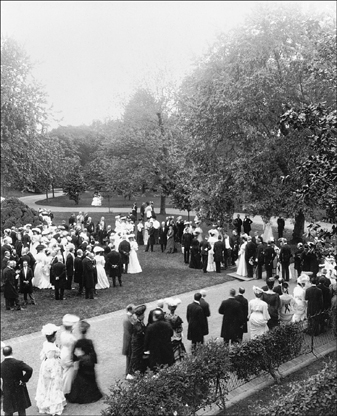
“AS ALWAYS WHEN THE PRESIDENT WAS HAPPY
HIS HAPPINESS TOUCHED THOSE AROUND HIM.” Theodore and Edith Roosevelt receiving at a White House garden party
The Kaiser could yet turn nasty if Roosevelt did not make good his own Corollary to the Monroe Doctrine, and place Santo Domingo under American receivership. Juan Franco Sanchez, the Dominican Minister of Foreign Affairs, was in Washington practically begging for annexation. Roosevelt saw political problems if he agreed. Any new protectorate, coinciding with his acquisition of the Canal Zone, was likely to reactivate the pesky Anti-Imperialist League, and give the Democrats a major campaign issue. Cuba waslibre and the Philippines, thanks to Taft, pretty well pacified; his own youthful appetite for empire was gone.
He searched for a simile strong enough to express his distaste for another insular possession: “I have about the same desire to annex it as a gorged boa constrictor might have to swallow a porcupine wrong end to.”
TWO MONTHS AFTER Mark Hanna’s death, the question of who should be the new chairman of the Republican National Committee had not been resolved. Elihu Root, prospering hugely as a Wall Street attorney, declined to serve. Three other candidates pleaded ill health: Henry Clay Payne of Wisconsin, Winthrop Murray Crane of Massachusetts, and the septuagenarian Cornelius N. Bliss of New York. The last, a veteran of McKinley’s first Cabinet, had such excellent corporate connections, not to mention “stainless honor and purity,” that Roosevelt urged him to reconsider. Bliss said he would think about it.
In the meantime, the President felt free to set his own Republican agenda, in a series of indiscretions calculated to heave fresh sod on Hanna’s grave. He preached conservation to the National Wholesale Lumber Dealers’ Association, and political morality to Republican professionals. He meddled in the gubernatorial politics of New York and Missouri, ordered a draft platform for the convention, considered and approved a mysterious proposal to translate American campaign literature into Bohemian, and grossly flattered the first national assembly of American periodical publishers: “It is always a pleasure for a man in public life to meet the real governing classes.”
Hearing that some desperate Democrats were trying to persuade Grover Cleveland to run against him, he circulated among newspaper editors (“for your private use”) a note from the former President that appeared to support his labor policies during the coal strike. Cleveland fumed with rage: “I am amazed at Roosevelt.… There are some people in this country that need lessons in decency and good manners.”
“Theodore thinks of nothing, talks of nothing, and lives for nothing but his political interests,” Henry Adams noted. “If you remark to him that God is Great, he asks naïvely how that will affect his election.”
Old Guard Republicans worried about the undignified spectacle of a President campaigning for his own office. He was supposed to put himself in the hands of party professionals. McKinley had successfully sat out two campaigns at home in Canton, Ohio; here was “Teddy” virtually setting up pre-convention headquarters in the White House.
The most that conservatives could do, until the party organized itself at the national convention in June, was beg Roosevelt not to go public with his spring exercise schedule, lest tabloid newspapers beholden to William Randolph Hearst depict him as a clown, or worse still, a snob. Skinny-dipping in Rock Creek Park, rough-riding on Bleistein, and tennis—that effete, Anglophile pastime of the rich—all carried a high degree of political risk. Aides shuddered at the memory of last year’s tour-bus megaphones on West Executive Avenue.
Reluctantly, in view of the marvelous weather, the President continued to exercise indoors. After some vain efforts to strangle his Japanese wrestling instructor, he managed three new throws that were “perfect corkers.” As a result, he was mottled all over with bruises, and lame in both big toes, the right ankle, left wrist, and thumb.
HIS SIGNATURE FINGERS still worked, however. On 28 April he scrawled Theodore Roosevelt at the bottom of the last sheet of legislation to come his way before Congress adjourned: “An Act to Provide for the Temporary Government of the Canal Zone at Panama, the Protection of the Canal Works, and Other Purposes.” Simultaneously in Paris, documents confirming the sale and conveyance of French rights were signed. Thus, as the largest real-estate transaction in history was consummated, the largest engineering project in history was begun.
Philippe Bunau-Varilla, who had waited in New York for this moment, sailed for France. His last request of Panama was that the diplomatic salary he had declined should be put toward a monument to Ferdinand de Lesseps, the canal’s progenitor. For better or worse, the completed waterway (he could see it already, blue and brimming from Gatun to Balboa) would be identified with a more contemporary hero. Both men would always, for him, merit the supreme adjective great.
“I HAVE TAKEN possession of, and now occupy, on behalf of the United States, the Canal Zone and public land ceded by the Republic of Panama,” Roosevelt announced.
By terms of treaty and act, he could exercise as much military, civil, and judicial authority as he liked in the Zone. But he immediately delegated this authority to his Secretary of War. Taft was a proven, brilliant colonial administrator, sensitive to native pride. The Panamanians, who showed early signs of being temperamental neighbors, would be soothed by him. “A more high-minded and disinterested man does not live,” Roosevelt wrote fondly.
He sent Taft an official letter, stipulating a government and constitution for the Zone in precise, peremptory language. Power was to be invested in a new, seven-man Isthmian Canal Commission, already appointed. This would be chaired, as the old commission had been, by Admiral John G. Walker. Major General George W. Davis, USMC, was appointed Governor of the Zone. All but one of the other Commission members were engineers.
Roosevelt ordered Taft to “supervise and direct” this body, as he had the Philippines Commission. On the plainly administrative level, it could be trusted to regulate, recruit, survey, purchase, and disburse. The basic privileges of the Bill of Rights were guaranteed to all inhabitants of the Zone, except—as he robustly specified—“idiots, the insane, epileptics, paupers, criminals, professional beggars [and] persons afflicted with loathsome or dangerous contagious diseases.” For good measure, he threw in felons, anarchists, andinsurrectos.
Sanitary reform along the lines of General Wood’s pioneering work in Havana was “a matter of first importance,” the President wrote. “I desire that every possible effort be made to protect our officers and workmen from the dangers of tropical and other diseases, which in the past have been so prevalent and destructive in Panama.”
ON 10 MAY, Cornelius Bliss formally declined the party chairmanship. A few days later, J. Hampton Moore, leader of the youth-oriented National Republican League, hurried to Washington to press the name of Senator Boies Penrose of Pennsylvania. Roosevelt could not see Moore until the late afternoon.
“You might as well know,” the President said, “that I shall recommend George B. Cortelyou.”
Shadows stole across the lawn outside, darkening the Executive Office windows. Moore stared at Roosevelt, trying to gauge his expression. Was that a smile, or a grin? Perhaps he was baring his teeth in anticipation of a fight, because this appointment was sure to upset the Republican Old Guard. They would want to know how an impoverished ex-stenographer, not quite forty-two, could possibly raise millions of dollars from the likes of J. P. Morgan, let alone manage the immense complexity of a national campaign.
Roosevelt seemed to have no such doubts. He rambled on about how young Republicans might help him win in November. Both he and Moore were aware that, even as they talked, an Old Guard stalwart lay near death in the reddening hills of western Pennsylvania. Senator Matthew Quay, master manipulator of so many national conventions, had bought his last delegate. So had Mark Hanna, already nothing more than a name set in stone in Cleveland.
Farther west still, in Wisconsin, the political careers of John Coit Spooner and Henry Clay Payne were in decline. Governor LaFollette had completed his takeover of that state’s organization, and was threatening to send a radical delegation to Chicago. “The last consignment of Great Captains of the Republican Party are passing into the twilight,” the New York Sun mourned. Even that venerable newspaper, expositor of corporate conservatism for so many years, had had its day. Its famous symbol—an orb half hidden behind a black mountain—looked more like dusk than dawn.
The President beamed at his visitor, showing no regret for temps perdu. Few people realized it, but Roosevelt loved Quay, probably the most despised politician of the last twenty years. He had made a secret pilgrimage to say good-bye, and been moved by Quay’s lament, “I do wish it were possible for me to get off into the great north woods and crawl out on a rock in the sun and die like a wolf!” Public men of the future must face a brighter, more businesslike light, the shadow-free light of Cooper-Hewitt lamps and popping press bulbs and Luxfer office windows. George Cortelyou—stenographer, scheduler, filer, colorless as onionskin, the quintessential modern bureaucrat—did not blink at this kind of light. Neither did Moore’s young Republicans.
“Go see Cortelyou as soon as you can,” the President said. “And tell him,” he added ingratiatingly, “I want him to work with you.”