

|
MR. DOOLEY Well, I see Congress has got to wurruk again. |
|
MR. HENNESSY Th’ Lord save us fr’m harm. |
ON 3 NOVEMBER 1908, Edith Roosevelt was dismayed to hear that Pine Knot had fallen to William Jennings Bryan.
The fake telegram was sent by her husband, radiant over the election of William Howard Taft as twenty-seventh President of the United States. He regarded the vote as a vindication of his own record, and a guarantee of four more years of Rooseveltism. “We have beaten them to a frazzle!” The next morning, he arrived in the Executive Office in high good humor. James Garfield and Captain Butt were waiting to see him. “You army officers and politicians who still have futures before you may continue the struggle,” he said, taking his secretary by the hand, “but Mr. Loeb and I will sing the Nunc Dimittis.”
Taft’s Electoral College majority was overwhelming, at 321 votes over Bryan’s 162. He also helped maintain the Republican control of both houses of Congress. His popular plurality was less so—1,269,606 votes over Bryan, a decisive total, but only half as impressive as Roosevelt’s landslide in 1904. Missouri reverted to the Democratic Party. Other Republican losses were in Colorado, Nebraska, and Nevada, along with the new state of Oklahoma. Indiana, Minnesota, Montana, North Dakota, and Ohio chose Democratic governors. Charles Evans Hughes retained New York by the merest of whiskers.
Bryan was gracious, even self-mocking after his third failed run for the White House. He said he identified with the legendary Texan drunk who tried to get into a bar, and was escorted out. Trying again, he was hustled out; trying yet again, he was thrown out. “I guess,” said the drunk, brushing dust from his clothes, “they don’t want me in there.”

ANY HOPES ROOSEVELT might have had that Taft would return to Washington to plot an ideologically continuous transition were disappointed when the President-elect headed straight back to Hot Springs to play golf. In his first public statement after arriving there, he announced, “I really did some great work at sleeping last night.”
Meanwhile, Roosevelt was composing an early valedictory for himself, addressed to George Otto Trevelyan:
Of course, if I had conscientiously felt at liberty to run again and try once more to hold this great office, I should greatly have liked to do so and to keep my hands on the levers of this mighty machine. I do not believe that any President has ever had as thoroly good a time as I have had, or has ever enjoyed himself as much. Moreover I have achieved a greater proportion than I had dared to think possible of the things I most desired to achieve.… Whatever comes hereafter, I have had far more than the normal share of human happiness.… But I am bound to say in addition that I cannot help looking forward to much enjoyment in the future. In fact, I am almost ashamed to say that while I would have been glad to remain as President, I am wholly unable to feel the slightest regret, the slightest sorrow, at leaving the office. I love the White House; I greatly enjoy the exercise of power; but I shall leave the White House without a pang, and, indeed, on the contrary, I am looking forward eagerly and keenly to being a private citizen again, without anybody being able to make a fuss over me or hamper my movements. I am as interested as I can be at the thought of getting back in my own house at Sagamore Hill, in the thought of the African trip, and of various things I intend to do when that is over.
He was not short of job opportunities. A large corporation offered him its presidency, at a salary of one hundred thousand dollars. The newspaperman Carr V. Van Anda offered him the editorship of a new metropolitan daily, to be formed out of a merger of the New York Sun and New York Press. The New York World suggested that he run for the Senate. Henry Adams thought he should emulate John Quincy Adams and become a Congressman. Philander Knox suggested he be made a bishop, to gratify his need to preach. A New York publisher made “a dazzling offer” for an exclusive on his postpresidential writings. G. P. Putnam’s tried to persuade him to complete his historical saga, The Winning of the West. Scribner’s offered him $25,000 for the story of his African adventure, McClure’s, $72,000, and Collier’s, $100,000. Lecture invitations came in sackfuls.
As before with the Nobel Prize, Roosevelt let his conscience, rather than greed, guide him. He had long ago been approached by the father-and-son team of Lyman and Lawrence Abbott to join their magazine, Outlook, as a contributing editor writing on current affairs. Lyman, an ordained clergyman with a strong social conscience, had been particularly persuasive. Although Outlook was not a wealthy periodical, its middle-class, mildly progressive profile appealed to Roosevelt. He gratefully remembered its support during the crises and controversies of his presidency—support that, by such a definition, had been continuous for seven years. Many magazines less loyal to him now wished to be generous, in exchange for what he could do for their circulation figures. For that reason if for no other, Roosevelt decided to accept Outlook’s offer. And in another gesture of loyalty, he signed a first-serial-and-book-rights deal with Charles P. Scribner’s Sons for fifty thousand dollars plus 20 percent royalties. In both cases, he could easily have doubled or tripled the money elsewhere. But, as he said to his editor at Scribner’s, Robert Bridges, “You have got the same standards of propriety that I have.”
The Abbotts proudly announced on 7 November that “on or after the 5th of March, 1909, Theodore Roosevelt will be associated with the Outlook’s editorial staff as a special Contributing Editor.” Only four days after the election, the President was having to get used to the nude look of his name shorn of any honorific.
Far from being disconcerted, he told Edith that that was how he wanted it styled on his new business cards. She thought Mr. would be more dignified. He thought not, and Archie Butt agreed with him.
“I might have known the true Georgians would stand together,” she said, laughing. “Why should he not have ‘Mr. Theodore Roosevelt,’ as any other gentleman would have on his card?”
“Because he is not like any other gentleman,” Butt said.
MID-NOVEMBER BROUGHT the first snow of the season. It fell, melted a little, then froze slick enough to prevent rides in Rock Creek Park. Roosevelt continued to play singles and doubles with members of the Tennis Cabinet, or, when they were not available, with the ever-willing Archie Butt. He enjoyed the velocity of the ball off the glassy lawn, the sharp air in his lungs, and the exchange of French Revolutionary shouts with his favorite partner, Jules Jusserand. (“Honneur au courage malheureux!” “À la lanterne!”) But as the month progressed, he became oddly silent on court, and played with less verve. Butt surmised that he was bracing himself for the return to town of the Sixtieth Congress, and its almost certain hostility to any further attempts at reform.
If so, his pessimism was justified. His last Annual Message, issued on 8 December, was so imperious a call for enhanced executive authority that it amounted to a condemnation of the doctrine of checks and balances. “Concentrated power is palpable, visible, responsible, easily reached, quickly held to account. Power scattered through many administrators, many legislators, many men who work behind and through legislators and administrators, is impalpable, is unseen, is irresponsible, cannot be reached, can not be held to account.”
His legislative requests were, for the most part, those of previous years, either strengthened or doggedly renewed: for control (“complete,” now) of railroad operations, extended employer’s liability and workmen’s-compensation laws, an eight-hour day in all government departments, forest protection, and inland-waterway improvements.
The only really new note in Roosevelt’s Eighth Message sounded so extreme, not to say eccentric, that it was criticized more as an attack on the courts than as what it really was: a deep and brilliant perception that justice is not a matter of eternal verities, but of constant, case-by-case adaptation to the human prejudices of judges. “Every time they interpret contract, property, vested rights, due process of law, liberty, they necessarily enact into law parts of a system of social philosophy; and as such interpretation is fundamental, they give direction to all lawmaking.”
This suggestion that the judicial branch of government was actually a branchlet of the legislative was almost as revolutionary as Roosevelt’s claim that concentration of power was democratic. Although he wrote in language considerably more thoughtful than that of his Special Message of the previous January, the mere implications of his words were enough to convince conservatives like Joseph Cannon that the best way to treat the President, as his legislative time ran out, was to ignore him.
Unless, of course, he was being deliberately and flagrantly provocative, as when he suggested, in another paragraph, that congressmen who had voted to limit the activities of the Secret Service “did not themselves wish to be investigated.”
PRESIDENT-ELECT TAFT arrived in town just in time to coincide with the release of the Message and thus present an alternative image—tranquil and uncomplicated—to Roosevelt’s perpetual Sturm und Drang. He was in reality depressed and wishing that he was headed for the Supreme Court, rather than the White House. But reporters were so beguiled by his winks and chuckles that they saw nothing strange in his unwillingness even to consider Cabinet appointments until February. “I suppose I must do it then.”
Roosevelt, beguiled too, told Archie Butt, “He is going to be greatly beloved as President. I almost envy a man who has a personality like Taft’s.” Then, with a self-mocking leer, “No one could accuse me of having a charming personality.”
Butt certainly could, after seven months of almost daily exposure to evidence in proof. Pondering the President’s remark, he decided that the difference between Taft and Roosevelt was that of the inanimate versus the animate. Taft’s personality was soothing, “like a huge pan of sweet milk,” whereas Roosevelt’s was galvanic. “When he comes into a room and stands as he always does for one second before doing something characteristic, he electrifies the company and gives one just that sensation which a pointer does when he first quivers and takes a stand on quail.”

“HE WAS IN REALITY DEPRESSED AND WISHING THAT HE
WAS HEADED FOR THE SUPREME COURT.”
President-elect William Howard Taft, 1909
About the only trait the two men had in common was their shared love of laughter. In company or alone, they were continually roaring with mirth, Taft quaking from head to foot, Roosevelt so convulsed that he had to hang on to a window frame for support. Members of the Gridiron Club had an opportunity to see them in action on 12 December, as they sat through a skit that satirized Roosevelt’s forthcoming role as a paid-by-the-word foreign journalist.
The lights were doused, and a voice announced, “We are now in Darkest Africa.” After a medley of wild-animal noises, the lights came on again, revealing a tent in a tropical jungle. From inside, came the rattle of a typewriter, punctuated regularly by the sound of a bell that registered not carriage returns, but pecuniary ones. A pair of offstage narrators kept “tab” as Author and Auditor:
|
AUTHOR |
(typing furiously) The lion is a wild and ferocious animal. |
|
AUDITOR |
Eight dollars. |
|
AUTHOR |
It has a soft body and a hard face. |
|
AUDITOR |
Seventeen dollars. |
|
AUTHOR |
It is the king of beasts and its daughter is a princess. |
|
AUDITOR |
Twenty-nine dollars. |
|
AUTHOR |
The lion roars like distant thunder. |
|
AUDITOR |
Thirty-five dollars. |
|
AUTHOR |
But it is nobody’s business what its religion is. |
|
AUDITOR |
Forty-four dollars. |
Roosevelt and Taft guffawed throughout, even when the typed article was followed by another, more serious one, explaining that “Author” had gone to Africa to avoid any appearance of interfering with the Taft Administration.
The Gridiron’s exclusively masculine, joke-heavy atmosphere was not conducive to observation of any change in the relationship of President and President-elect. As so often in situations involving transfer of power, it was women who registered the first signals of strain. Edith Roosevelt was upset to hear that Helen Taft intended to replace the White House’s frock-coated ushers with liveried black footmen. Mrs. Taft let it be known that she, as a frugal housewife, did not intend to continue the Roosevelt tradition of elaborate entertainments catered from outside. Her guests would be fed out of the White House kitchen, and like it. She also felt that her husband was altogether too much seen as Roosevelt’s “creature,” and urged him to demonstrate his independence. Alice Longworth, who was a gifted if cruel mimic, mounted her own propaganda by driving out in the Roosevelt surrey and rearranging her face into a terrifying caricature of the toothy Mrs. Taft.
IN MID-DECEMBER, Washington’s social season began with almost nightly receptions, dinners, and balls in and around the White House. The Roosevelts participated graciously, showing no signs of ennui on their eighth procession through the ritual calendar. Yet small signs of impending change darkened each event, like speckles on tired transparencies. Elihu Root announced that he was stepping down as Secretary of State, handing two months of token power over to Robert Bacon. The President’s annual Cabinet dinner on 17 December was attended, as usual, by Vice President and Mrs. Fairbanks, but “Sunny Jim” Sherman showed up, too, and so did Philander Knox—no longer as a stalwart of the old Roosevelt Cabinet, but as Taft’s rumored replacement for Bacon.
To the President, at least, this rumor did not suggest any abandonment of what he took to be a pledge by Taft to retain as many existing Cabinet officers as possible. He loved Bob Bacon, but the latter’s appointment was strictly stopgap. And Root (having been offered a seat in the United States Senate by Republican leaders in New York) would never have stayed on at State. Afterward, talking to Archie Butt, Roosevelt gave his first hint of accepting Taft’s right to proceed independently.
“I don’t feel any resentment at all,” he said. “Only I hope that he will take care of the men who served me here.”
ALL THE ROOSEVELTS gathered in the White House for a midday Christmas dinner, along with about fifty relatives and close friends. Bamie came with her drowsy husband, now Admiral Cowles, and their son, Sheffield, whose fondness for scrapple had made him an early beneficiary of the Pure Food Law; Alice brought Nick—a rather conflicted congressman these days, being the son-in-law of the President and a protégé of the President-elect; the Lodges were accompanied by their poetic son George Cabot (“Bay”) and his wife and family; the Roots were there, and various Meyers and Gardners and McIlhennys and Lowndeses and Eustaces, with their children; a few unattributable urchins, possibly gate-crashers from the White House Gang, seemed perfectly at home; and the indispensable Archie Butt, who had already been informed that the Tafts wished to keep him on, went about his business of observing and recording.
The Executive Dining Room moose looked down impassively on tables decorated with red leaves and ferns and Christmas crackers. Quentin wore a paper crown. Platters of roast turkey went round and round. Brandy-soaked plum puddings were carried in, flickering with blue flame. Little ice-cream Santas followed, each holding a tiny burning taper.
Afterward, gentlemen smoked in the Red Room while the women and children went down into the basement. There, in a specially darkened room, the White House Christmas tree stood out in colored radiance. The Jusserands and Bryces and Cabinet officers and their families came from other parties to give and exchange gifts (a volume of G. K. Chesterton’s Heretics for Captain Butt), and the President talked politics and kissed whichever child came within reach of his bear hug.
No sooner had the debris of this party been swept up the following morning than preparations began for a much more formal event on the twenty-eighth: the debut ball of Miss Ethel Roosevelt, age seventeen. The East Room’s floor was polished until it seemed to hold its own inverted chandeliers. Four hundred and forty-four places were laid at tables extending right down the length of the upper apartments. The glassed-in eastern colonnade, never used before, was turned into a luminous, flower-hung gallery. Clusters of roses perfumed the Blue Room, where expressionless Ethel would stand in her white satin gown.
A few hours before the party began, Captain Butt escorted Alice Longworth through the mansion. It looked more beautiful than either of them could remember. Time was when Alice—almost twenty-five now, filling out sexily, more poised and contemplative than in her wild teens—had made a rebellious point of staying away from the White House, but since marrying she had developed a passionate attachment to it, coming in daily for tea and gossip. Today, she had little to say, and her demeanor struck Archie as “unutterably sad.”
“MR. SPEAKER, a message from the President of the United States!”
The traditional call echoed through the House of Representatives on 4 January 1909, in the midst of a furor prompted by Roosevelt’s insinuation, one month before, that congressmen did not “wish to be investigated” by the Secret Service. That remark, coming soon after a sly reference to “the criminal classes,” had been too much for Senator Aldrich, who had demanded an inquiry into whether the President should be condemned for discourtesy toward Congress. The House had simultaneously challenged Roosevelt to substantiate his words.
So far, the second session of the Sixtieth Congress had been, in Alice’s words, “one long lovely crackling row between the White House and Capitol Hill.” Her father’s Eighth Annual Message had been, for Joseph Cannon, the last of a haystack of straws heaped on the camelback of the Constitution. The Conservation Conference and the Commission on Country Life had been bad enough, he felt; but if any of the significant centralizations of power Roosevelt called for—over the railroads, over telecommunications, over the environment—were made law, states could say good-bye to their individual rights. Progressivism would have finally replaced conservatism, with outright socialism sure to follow.
Cannon sat now, gavel in hand, as yet another Special Message was announced. It elicited such a bedlam of mocking laughter that the Speaker had to pound for order for several minutes. The Message, when read, amounted to a semi-apologetic withdrawal of Roosevelt’s perceived insult to Congress. But he persisted in objecting to a House move to confine the Secret Service’s activities strictly to presidential protection and the investigation of counterfeiting. Again, he said, such limitation would benefit “the criminal class.”
He might also have added, but wisely did not, that the House’s sudden prejudice against a venerable federal agency was due to rumors that he had been using the Secret Service for his own purposes over the years, harassing Senators Foraker and Tillman and other political opponents, gathering espionage for political campaigns, even getting his bodyguards to fetch and carry for him.
There was some substance to these rumors, although evidence of abuse of power was lacking. As The Atlanta Constitution pointed out, the Secret Service had been involved in most of Roosevelt’s major initiatives, from antitrust probes and peonage prosecutions to pure-food sleuthing and the grilling of Brownsville discharges. Its chief, John E. Wilkie, was a known favorite of the President. The force was tiny—only ten full-time agents—but Wilkie had funds to hire an unlimited number of private detectives for whatever purposes he deemed fit. It was these funds, and these purposes, that anti-Rooseveltians in Congress sought to restrict, conveniently focusing years of resentment against the President for his steady transfer of power away from Capitol Hill.
The Secret Service’s necessarily covert nature only fueled the suspicions of conspiracists in politics and the press. Seeking, as conspiracists always do, a central intelligence behind diverse activities, these rumormongers ignored the fact that many other government departments used confidential agents not under Wilkie’s or Roosevelt’s direct control. The irony was that the President himself wanted to concentrate all such activities in one federal bureau of investigation, answerable to the Attorney General, if not to the general public. So, conspiracism clashed with coordination, and seven years of cumulative frustration exploded in jeers and catcalls.
The chorus unhappily coincided with a debate on the very subjects Roosevelt had raised. After seven hours of mounting rancor, the House handed him a rebuke unprecedented since the days of Andrew Jackson, voting to table his new Message as so much white paper. Thus, little more than eight weeks before the end of his Presidency, Roosevelt reached the nadir of his relations with Congress. But—to his great personal glee—the House’s very action made it seem as if it was indeed afraid of an empowered Secret Service, because certain representatives might have things to hide. Effectively if not legislatively, he came out looking like a political winner.
“Nobody likes him now but the people,” Ambassador Bryce remarked.
ARCHIE BUTT WAS amazed at the President’s good-humored calm after his rejection by the House. While Mrs. Roosevelt chafed, her husband chuckled at Congressman Longworth’s discomfiture. (“Poor Nick! What he is not suffering for love’s sake these days!”) He was heard laughing heartily over a newspaper transcript of Benjamin Tillman’s latest anti-Roosevelt tirade in the Senate, and that night waltzed at a White House ball, happy and flushed as a boy.
Butt wrote home, “I think he sees more clearly than the rest of us do, or else he has no nerves at all.”
One legislative request that Congress was powerless to deny him, because of its guarantee of last April, was an appropriation for two more all-big-gun battleships. It came through on 22 January, adding an extra glow of celebration to the White House Army and Navy Reception. Roosevelt could—and did—congratulate himself on having built up a navy second only, now, to that of Great Britain in first-class capital ships, with vastly improved design and marksmanship standards.
All that remained to complete his sense of satisfaction was the return of the Great White Fleet, scheduled for exactly one month’s time.
FEBRUARY—THE MONTH in which Taft had set himself a languid deadline for the appointment of his Cabinet—found Roosevelt showing, for the first time, occasional hints of melancholy. He was saddened to hear that the Ohio Society of New York had declined to drink to his health at its recent annual banquet, presumably because the President-elect’s brother was present.
“I do not believe that it was done with a view to aid in the divorcement of Taft and myself, as some friends seem to think,” he said to Archie Butt. The captain thought otherwise, but kept silent.
Nothing but disillusioning news had come from the Taft camp for the past several weeks. Of all the current Cabinet, only George von L. Meyer, at latest report, stood a chance of being reappointed. So much for Taft’s promise of continuity. Roosevelt, still refusing to believe the worst of his erstwhile laughing companion, went on, as if trying to convince himself: “They little realize that Taft is big enough to carve out his own administration on individual lines.… I felt he was the one man for the Presidency, and any failure in it would be as keenly felt by me as by himself or his family.” Then, in a revealing free association, he went on, “You have heard some things said against my administration, Archie, but they are nothing to what you will hear when I am completely robbed of power and in Africa. But when the history of this period is written down, I believe my administration will be known as an administration of ideals.”
He cheered up in the days that followed, as carpenters invaded the upper floor of the White House and began to box up books and other Washington acquisitions for transfer to Sagamore Hill. Roosevelt went into a distributive frenzy as memento seekers, hearing that he could not resist a sad face, kept making meaningful visits. “Why, Mother,” Ethel complained, “he has given away nearly everything in the study, and Aunty Corinne and every other guest in the White House have their arms full of pictures, books, and souvenirs.”
Only when the carpenters transferred their hammering and sawing to Lafayette Square, and a review stand for the coming Inaugural Parade rose outside the North Gate, did the realization sink in that he was about to give away the largest memento of all: a presidency immeasurably enhanced in force, glamour, and power.
AT HAMPTON ROADS on 22 February, Roosevelt stood for the last time as Commander-in-Chief on the bridge of the Mayflower. He strained his one good eye through a pair of naval binoculars, trying to glimpse what everyone around him saw clearly: distant white superstructures looming through gray rain and fog. “Here they are,” he eventually shouted, feeling rather than seeing, as the sound of twenty-eight ships’ bands playing “The Star-Spangled Banner” grew in volume, to the rhythmic crash of cannon. The music, the gunpowder, the echelons of saluting bluejackets: all were for him, and for history.
“That is the answer to my critics,” he said, his top hat glistening in the wet air. “Another chapter is complete, and I could not ask a finer concluding scene for my administrations.”
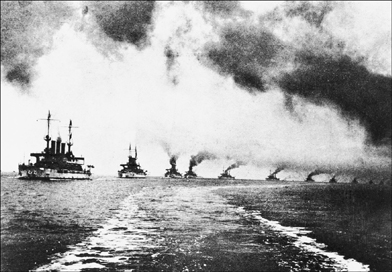
“I COULD NOT ASK A FINER CONCLUDING SCENE FOR MY ADMINISTRATIONS.”
The Great White Fleet returns from its round-the-world trip, 22 February 1909